EP0357254A1 - Compositions supraconductrices de haute pureté et procédés pour leur fabrication - Google Patents
Compositions supraconductrices de haute pureté et procédés pour leur fabrication Download PDFInfo
- Publication number
- EP0357254A1 EP0357254A1 EP89308003A EP89308003A EP0357254A1 EP 0357254 A1 EP0357254 A1 EP 0357254A1 EP 89308003 A EP89308003 A EP 89308003A EP 89308003 A EP89308003 A EP 89308003A EP 0357254 A1 EP0357254 A1 EP 0357254A1
- Authority
- EP
- European Patent Office
- Prior art keywords
- approximately
- solution
- precipitate
- barium
- superconducting
- Prior art date
- Legal status (The legal status is an assumption and is not a legal conclusion. Google has not performed a legal analysis and makes no representation as to the accuracy of the status listed.)
- Withdrawn
Links
- 238000000034 method Methods 0.000 title claims abstract description 126
- 239000000203 mixture Substances 0.000 title claims abstract description 53
- 238000004519 manufacturing process Methods 0.000 title claims description 11
- 239000000463 material Substances 0.000 claims abstract description 131
- 239000002244 precipitate Substances 0.000 claims abstract description 72
- 229910052788 barium Inorganic materials 0.000 claims abstract description 47
- DSAJWYNOEDNPEQ-UHFFFAOYSA-N barium atom Chemical compound [Ba] DSAJWYNOEDNPEQ-UHFFFAOYSA-N 0.000 claims abstract description 47
- 229910052727 yttrium Inorganic materials 0.000 claims abstract description 26
- VWQVUPCCIRVNHF-UHFFFAOYSA-N yttrium atom Chemical group [Y] VWQVUPCCIRVNHF-UHFFFAOYSA-N 0.000 claims abstract description 26
- 239000010949 copper Substances 0.000 claims abstract description 25
- RYGMFSIKBFXOCR-UHFFFAOYSA-N Copper Chemical compound [Cu] RYGMFSIKBFXOCR-UHFFFAOYSA-N 0.000 claims abstract description 20
- 229910052802 copper Inorganic materials 0.000 claims abstract description 20
- 229910052760 oxygen Inorganic materials 0.000 claims abstract description 15
- 239000001301 oxygen Substances 0.000 claims abstract description 15
- QVGXLLKOCUKJST-UHFFFAOYSA-N atomic oxygen Chemical compound [O] QVGXLLKOCUKJST-UHFFFAOYSA-N 0.000 claims abstract description 14
- 229910052761 rare earth metal Chemical group 0.000 claims abstract description 11
- 239000000243 solution Substances 0.000 claims description 111
- 239000000126 substance Substances 0.000 claims description 32
- XTVVROIMIGLXTD-UHFFFAOYSA-N copper(II) nitrate Chemical compound [Cu+2].[O-][N+]([O-])=O.[O-][N+]([O-])=O XTVVROIMIGLXTD-UHFFFAOYSA-N 0.000 claims description 30
- XLYOFNOQVPJJNP-UHFFFAOYSA-N water Substances O XLYOFNOQVPJJNP-UHFFFAOYSA-N 0.000 claims description 25
- 238000002156 mixing Methods 0.000 claims description 22
- 239000000758 substrate Substances 0.000 claims description 16
- 239000007864 aqueous solution Substances 0.000 claims description 10
- 239000000356 contaminant Substances 0.000 claims description 10
- 238000001354 calcination Methods 0.000 claims description 9
- 238000005245 sintering Methods 0.000 claims description 9
- 229910002651 NO3 Inorganic materials 0.000 claims description 5
- NHNBFGGVMKEFGY-UHFFFAOYSA-N Nitrate Chemical compound [O-][N+]([O-])=O NHNBFGGVMKEFGY-UHFFFAOYSA-N 0.000 claims description 4
- 238000000576 coating method Methods 0.000 claims description 4
- 239000000725 suspension Substances 0.000 claims description 4
- 239000011248 coating agent Substances 0.000 claims description 3
- 238000007598 dipping method Methods 0.000 claims description 3
- 238000010583 slow cooling Methods 0.000 claims 2
- PTVDYARBVCBHSL-UHFFFAOYSA-N copper;hydrate Chemical compound O.[Cu] PTVDYARBVCBHSL-UHFFFAOYSA-N 0.000 claims 1
- 239000003960 organic solvent Substances 0.000 abstract description 8
- 239000002243 precursor Substances 0.000 abstract description 2
- NGDQQLAVJWUYSF-UHFFFAOYSA-N 4-methyl-2-phenyl-1,3-thiazole-5-sulfonyl chloride Chemical compound S1C(S(Cl)(=O)=O)=C(C)N=C1C1=CC=CC=C1 NGDQQLAVJWUYSF-UHFFFAOYSA-N 0.000 description 23
- RQPZNWPYLFFXCP-UHFFFAOYSA-L barium dihydroxide Chemical compound [OH-].[OH-].[Ba+2] RQPZNWPYLFFXCP-UHFFFAOYSA-L 0.000 description 20
- 239000000047 product Substances 0.000 description 19
- 229910001863 barium hydroxide Inorganic materials 0.000 description 18
- 239000012467 final product Substances 0.000 description 18
- IJGRMHOSHXDMSA-UHFFFAOYSA-N Atomic nitrogen Chemical compound N#N IJGRMHOSHXDMSA-UHFFFAOYSA-N 0.000 description 16
- 239000002585 base Substances 0.000 description 15
- 239000002253 acid Substances 0.000 description 14
- 150000007513 acids Chemical class 0.000 description 14
- 239000007788 liquid Substances 0.000 description 14
- 239000000843 powder Substances 0.000 description 12
- 230000008901 benefit Effects 0.000 description 10
- 229910003098 YBa2Cu3O7−x Inorganic materials 0.000 description 9
- 238000001035 drying Methods 0.000 description 9
- 239000000919 ceramic Substances 0.000 description 8
- 229910052757 nitrogen Inorganic materials 0.000 description 8
- QVQLCTNNEUAWMS-UHFFFAOYSA-N barium oxide Chemical compound [Ba]=O QVQLCTNNEUAWMS-UHFFFAOYSA-N 0.000 description 7
- AYJRCSIUFZENHW-UHFFFAOYSA-L barium carbonate Chemical compound [Ba+2].[O-]C([O-])=O AYJRCSIUFZENHW-UHFFFAOYSA-L 0.000 description 6
- 230000005540 biological transmission Effects 0.000 description 6
- 238000005119 centrifugation Methods 0.000 description 5
- 239000012153 distilled water Substances 0.000 description 5
- 239000007858 starting material Substances 0.000 description 5
- WHXSMMKQMYFTQS-UHFFFAOYSA-N Lithium Chemical compound [Li] WHXSMMKQMYFTQS-UHFFFAOYSA-N 0.000 description 4
- 150000001875 compounds Chemical class 0.000 description 4
- 238000011161 development Methods 0.000 description 4
- 230000018109 developmental process Effects 0.000 description 4
- 229910052744 lithium Inorganic materials 0.000 description 4
- 150000003839 salts Chemical class 0.000 description 4
- 239000002904 solvent Substances 0.000 description 4
- VHUUQVKOLVNVRT-UHFFFAOYSA-N Ammonium hydroxide Chemical compound [NH4+].[OH-] VHUUQVKOLVNVRT-UHFFFAOYSA-N 0.000 description 3
- 239000000908 ammonium hydroxide Substances 0.000 description 3
- KRKNYBCHXYNGOX-UHFFFAOYSA-N citric acid Chemical compound OC(=O)CC(O)(C(O)=O)CC(O)=O KRKNYBCHXYNGOX-UHFFFAOYSA-N 0.000 description 3
- 238000000975 co-precipitation Methods 0.000 description 3
- -1 nitrate ions Chemical class 0.000 description 3
- 150000002823 nitrates Chemical class 0.000 description 3
- 229910000510 noble metal Inorganic materials 0.000 description 3
- 239000007787 solid Substances 0.000 description 3
- 239000002887 superconductor Substances 0.000 description 3
- 238000012360 testing method Methods 0.000 description 3
- CPLXHLVBOLITMK-UHFFFAOYSA-N Magnesium oxide Chemical compound [Mg]=O CPLXHLVBOLITMK-UHFFFAOYSA-N 0.000 description 2
- PXHVJJICTQNCMI-UHFFFAOYSA-N Nickel Chemical compound [Ni] PXHVJJICTQNCMI-UHFFFAOYSA-N 0.000 description 2
- BQCADISMDOOEFD-UHFFFAOYSA-N Silver Chemical compound [Ag] BQCADISMDOOEFD-UHFFFAOYSA-N 0.000 description 2
- MCMNRKCIXSYSNV-UHFFFAOYSA-N Zirconium dioxide Chemical compound O=[Zr]=O MCMNRKCIXSYSNV-UHFFFAOYSA-N 0.000 description 2
- 230000015572 biosynthetic process Effects 0.000 description 2
- 239000007795 chemical reaction product Substances 0.000 description 2
- 239000002826 coolant Substances 0.000 description 2
- 238000001816 cooling Methods 0.000 description 2
- 238000010438 heat treatment Methods 0.000 description 2
- 239000001307 helium Substances 0.000 description 2
- 229910052734 helium Inorganic materials 0.000 description 2
- SWQJXJOGLNCZEY-UHFFFAOYSA-N helium atom Chemical compound [He] SWQJXJOGLNCZEY-UHFFFAOYSA-N 0.000 description 2
- 239000012535 impurity Substances 0.000 description 2
- 239000011368 organic material Substances 0.000 description 2
- BASFCYQUMIYNBI-UHFFFAOYSA-N platinum Chemical compound [Pt] BASFCYQUMIYNBI-UHFFFAOYSA-N 0.000 description 2
- 238000001556 precipitation Methods 0.000 description 2
- 150000002910 rare earth metals Chemical class 0.000 description 2
- 229910052709 silver Inorganic materials 0.000 description 2
- 239000004332 silver Substances 0.000 description 2
- 238000003756 stirring Methods 0.000 description 2
- 150000003467 sulfuric acid derivatives Chemical class 0.000 description 2
- 239000006228 supernatant Substances 0.000 description 2
- 238000007740 vapor deposition Methods 0.000 description 2
- QXPQVUQBEBHHQP-UHFFFAOYSA-N 5,6,7,8-tetrahydro-[1]benzothiolo[2,3-d]pyrimidin-4-amine Chemical compound C1CCCC2=C1SC1=C2C(N)=NC=N1 QXPQVUQBEBHHQP-UHFFFAOYSA-N 0.000 description 1
- OKTJSMMVPCPJKN-UHFFFAOYSA-N Carbon Chemical compound [C] OKTJSMMVPCPJKN-UHFFFAOYSA-N 0.000 description 1
- BVKZGUZCCUSVTD-UHFFFAOYSA-L Carbonate Chemical compound [O-]C([O-])=O BVKZGUZCCUSVTD-UHFFFAOYSA-L 0.000 description 1
- 229910052684 Cerium Inorganic materials 0.000 description 1
- VEXZGXHMUGYJMC-UHFFFAOYSA-M Chloride anion Chemical compound [Cl-] VEXZGXHMUGYJMC-UHFFFAOYSA-M 0.000 description 1
- 229910052692 Dysprosium Inorganic materials 0.000 description 1
- 229910052691 Erbium Inorganic materials 0.000 description 1
- 229910052693 Europium Inorganic materials 0.000 description 1
- 229910052688 Gadolinium Inorganic materials 0.000 description 1
- 229910052689 Holmium Inorganic materials 0.000 description 1
- 229910052765 Lutetium Inorganic materials 0.000 description 1
- 229910052779 Neodymium Inorganic materials 0.000 description 1
- 229910052777 Praseodymium Inorganic materials 0.000 description 1
- 229910052773 Promethium Inorganic materials 0.000 description 1
- 229910052772 Samarium Inorganic materials 0.000 description 1
- 229910052771 Terbium Inorganic materials 0.000 description 1
- 229910052775 Thulium Inorganic materials 0.000 description 1
- 229910052769 Ytterbium Inorganic materials 0.000 description 1
- CNEWPRQQHICZBP-UHFFFAOYSA-N [O].[Cu].[Ba].[La] Chemical compound [O].[Cu].[Ba].[La] CNEWPRQQHICZBP-UHFFFAOYSA-N 0.000 description 1
- 239000003929 acidic solution Substances 0.000 description 1
- 230000002378 acidificating effect Effects 0.000 description 1
- 230000001464 adherent effect Effects 0.000 description 1
- 229910045601 alloy Inorganic materials 0.000 description 1
- 239000000956 alloy Substances 0.000 description 1
- 239000012736 aqueous medium Substances 0.000 description 1
- 229910001632 barium fluoride Inorganic materials 0.000 description 1
- 238000009835 boiling Methods 0.000 description 1
- 229910052799 carbon Inorganic materials 0.000 description 1
- 230000015556 catabolic process Effects 0.000 description 1
- 150000001768 cations Chemical class 0.000 description 1
- 229910010293 ceramic material Inorganic materials 0.000 description 1
- ZMIGMASIKSOYAM-UHFFFAOYSA-N cerium Chemical compound [Ce][Ce][Ce][Ce][Ce][Ce][Ce][Ce][Ce][Ce][Ce][Ce][Ce][Ce][Ce][Ce][Ce][Ce][Ce][Ce][Ce][Ce][Ce][Ce][Ce][Ce][Ce][Ce][Ce][Ce][Ce][Ce][Ce][Ce][Ce][Ce][Ce][Ce] ZMIGMASIKSOYAM-UHFFFAOYSA-N 0.000 description 1
- 239000013626 chemical specie Substances 0.000 description 1
- 150000001805 chlorine compounds Chemical class 0.000 description 1
- 230000009918 complex formation Effects 0.000 description 1
- 238000007796 conventional method Methods 0.000 description 1
- 150000004699 copper complex Chemical class 0.000 description 1
- RKTYLMNFRDHKIL-UHFFFAOYSA-N copper;5,10,15,20-tetraphenylporphyrin-22,24-diide Chemical compound [Cu+2].C1=CC(C(=C2C=CC([N-]2)=C(C=2C=CC=CC=2)C=2C=CC(N=2)=C(C=2C=CC=CC=2)C2=CC=C3[N-]2)C=2C=CC=CC=2)=NC1=C3C1=CC=CC=C1 RKTYLMNFRDHKIL-UHFFFAOYSA-N 0.000 description 1
- 239000013078 crystal Substances 0.000 description 1
- 238000006731 degradation reaction Methods 0.000 description 1
- 238000000151 deposition Methods 0.000 description 1
- 230000008021 deposition Effects 0.000 description 1
- 238000010586 diagram Methods 0.000 description 1
- 238000009792 diffusion process Methods 0.000 description 1
- KBQHZAAAGSGFKK-UHFFFAOYSA-N dysprosium atom Chemical compound [Dy] KBQHZAAAGSGFKK-UHFFFAOYSA-N 0.000 description 1
- 230000000694 effects Effects 0.000 description 1
- 230000005611 electricity Effects 0.000 description 1
- 238000001652 electrophoretic deposition Methods 0.000 description 1
- 238000005516 engineering process Methods 0.000 description 1
- 239000003344 environmental pollutant Substances 0.000 description 1
- UYAHIZSMUZPPFV-UHFFFAOYSA-N erbium Chemical compound [Er] UYAHIZSMUZPPFV-UHFFFAOYSA-N 0.000 description 1
- YBYGDBANBWOYIF-UHFFFAOYSA-N erbium(3+);trinitrate Chemical compound [Er+3].[O-][N+]([O-])=O.[O-][N+]([O-])=O.[O-][N+]([O-])=O YBYGDBANBWOYIF-UHFFFAOYSA-N 0.000 description 1
- OGPBJKLSAFTDLK-UHFFFAOYSA-N europium atom Chemical compound [Eu] OGPBJKLSAFTDLK-UHFFFAOYSA-N 0.000 description 1
- GAGGCOKRLXYWIV-UHFFFAOYSA-N europium(3+);trinitrate Chemical compound [Eu+3].[O-][N+]([O-])=O.[O-][N+]([O-])=O.[O-][N+]([O-])=O GAGGCOKRLXYWIV-UHFFFAOYSA-N 0.000 description 1
- 230000003203 everyday effect Effects 0.000 description 1
- 230000001747 exhibiting effect Effects 0.000 description 1
- 239000012530 fluid Substances 0.000 description 1
- UIWYJDYFSGRHKR-UHFFFAOYSA-N gadolinium atom Chemical compound [Gd] UIWYJDYFSGRHKR-UHFFFAOYSA-N 0.000 description 1
- MWFSXYMZCVAQCC-UHFFFAOYSA-N gadolinium(iii) nitrate Chemical compound [Gd+3].[O-][N+]([O-])=O.[O-][N+]([O-])=O.[O-][N+]([O-])=O MWFSXYMZCVAQCC-UHFFFAOYSA-N 0.000 description 1
- 238000000227 grinding Methods 0.000 description 1
- XLYOFNOQVPJJNP-ZSJDYOACSA-N heavy water Substances [2H]O[2H] XLYOFNOQVPJJNP-ZSJDYOACSA-N 0.000 description 1
- KJZYNXUDTRRSPN-UHFFFAOYSA-N holmium atom Chemical compound [Ho] KJZYNXUDTRRSPN-UHFFFAOYSA-N 0.000 description 1
- WDVGLADRSBQDDY-UHFFFAOYSA-N holmium(3+);trinitrate Chemical compound [Ho+3].[O-][N+]([O-])=O.[O-][N+]([O-])=O.[O-][N+]([O-])=O WDVGLADRSBQDDY-UHFFFAOYSA-N 0.000 description 1
- 150000002500 ions Chemical class 0.000 description 1
- 229910052747 lanthanoid Inorganic materials 0.000 description 1
- 150000002602 lanthanoids Chemical class 0.000 description 1
- 229910052746 lanthanum Inorganic materials 0.000 description 1
- FZLIPJUXYLNCLC-UHFFFAOYSA-N lanthanum atom Chemical compound [La] FZLIPJUXYLNCLC-UHFFFAOYSA-N 0.000 description 1
- FYDKNKUEBJQCCN-UHFFFAOYSA-N lanthanum(3+);trinitrate Chemical compound [La+3].[O-][N+]([O-])=O.[O-][N+]([O-])=O.[O-][N+]([O-])=O FYDKNKUEBJQCCN-UHFFFAOYSA-N 0.000 description 1
- OHSVLFRHMCKCQY-UHFFFAOYSA-N lutetium atom Chemical compound [Lu] OHSVLFRHMCKCQY-UHFFFAOYSA-N 0.000 description 1
- APRNQTOXCXOSHO-UHFFFAOYSA-N lutetium(3+);trinitrate Chemical compound [Lu+3].[O-][N+]([O-])=O.[O-][N+]([O-])=O.[O-][N+]([O-])=O APRNQTOXCXOSHO-UHFFFAOYSA-N 0.000 description 1
- 238000012986 modification Methods 0.000 description 1
- 230000004048 modification Effects 0.000 description 1
- QEFYFXOXNSNQGX-UHFFFAOYSA-N neodymium atom Chemical compound [Nd] QEFYFXOXNSNQGX-UHFFFAOYSA-N 0.000 description 1
- CFYGEIAZMVFFDE-UHFFFAOYSA-N neodymium(3+);trinitrate Chemical compound [Nd+3].[O-][N+]([O-])=O.[O-][N+]([O-])=O.[O-][N+]([O-])=O CFYGEIAZMVFFDE-UHFFFAOYSA-N 0.000 description 1
- 230000007935 neutral effect Effects 0.000 description 1
- 238000006386 neutralization reaction Methods 0.000 description 1
- 229910052759 nickel Inorganic materials 0.000 description 1
- 229910052758 niobium Inorganic materials 0.000 description 1
- 239000010955 niobium Substances 0.000 description 1
- GUCVJGMIXFAOAE-UHFFFAOYSA-N niobium atom Chemical compound [Nb] GUCVJGMIXFAOAE-UHFFFAOYSA-N 0.000 description 1
- 230000001590 oxidative effect Effects 0.000 description 1
- 150000002926 oxygen Chemical class 0.000 description 1
- 229910052697 platinum Inorganic materials 0.000 description 1
- 231100000719 pollutant Toxicity 0.000 description 1
- PUDIUYLPXJFUGB-UHFFFAOYSA-N praseodymium atom Chemical compound [Pr] PUDIUYLPXJFUGB-UHFFFAOYSA-N 0.000 description 1
- YWECOPREQNXXBZ-UHFFFAOYSA-N praseodymium(3+);trinitrate Chemical compound [Pr+3].[O-][N+]([O-])=O.[O-][N+]([O-])=O.[O-][N+]([O-])=O YWECOPREQNXXBZ-UHFFFAOYSA-N 0.000 description 1
- 238000002360 preparation method Methods 0.000 description 1
- 238000012545 processing Methods 0.000 description 1
- VQMWBBYLQSCNPO-UHFFFAOYSA-N promethium atom Chemical compound [Pm] VQMWBBYLQSCNPO-UHFFFAOYSA-N 0.000 description 1
- 239000003507 refrigerant Substances 0.000 description 1
- 238000011160 research Methods 0.000 description 1
- KZUNJOHGWZRPMI-UHFFFAOYSA-N samarium atom Chemical compound [Sm] KZUNJOHGWZRPMI-UHFFFAOYSA-N 0.000 description 1
- YZDZYSPAJSPJQJ-UHFFFAOYSA-N samarium(3+);trinitrate Chemical compound [Sm+3].[O-][N+]([O-])=O.[O-][N+]([O-])=O.[O-][N+]([O-])=O YZDZYSPAJSPJQJ-UHFFFAOYSA-N 0.000 description 1
- 238000004062 sedimentation Methods 0.000 description 1
- 239000002002 slurry Substances 0.000 description 1
- 239000004094 surface-active agent Substances 0.000 description 1
- GZCRRIHWUXGPOV-UHFFFAOYSA-N terbium atom Chemical compound [Tb] GZCRRIHWUXGPOV-UHFFFAOYSA-N 0.000 description 1
- YJVUGDIORBKPLC-UHFFFAOYSA-N terbium(3+);trinitrate Chemical compound [Tb+3].[O-][N+]([O-])=O.[O-][N+]([O-])=O.[O-][N+]([O-])=O YJVUGDIORBKPLC-UHFFFAOYSA-N 0.000 description 1
- LLZBVBSJCNUKLL-UHFFFAOYSA-N thulium(3+);trinitrate Chemical compound [Tm+3].[O-][N+]([O-])=O.[O-][N+]([O-])=O.[O-][N+]([O-])=O LLZBVBSJCNUKLL-UHFFFAOYSA-N 0.000 description 1
- 230000007704 transition Effects 0.000 description 1
- 238000009834 vaporization Methods 0.000 description 1
- 230000008016 vaporization Effects 0.000 description 1
- NAWDYIZEMPQZHO-UHFFFAOYSA-N ytterbium Chemical compound [Yb] NAWDYIZEMPQZHO-UHFFFAOYSA-N 0.000 description 1
- KUBYTSCYMRPPAG-UHFFFAOYSA-N ytterbium(3+);trinitrate Chemical compound [Yb+3].[O-][N+]([O-])=O.[O-][N+]([O-])=O.[O-][N+]([O-])=O KUBYTSCYMRPPAG-UHFFFAOYSA-N 0.000 description 1
- 229910021521 yttrium barium copper oxide Inorganic materials 0.000 description 1
Images
Classifications
-
- C—CHEMISTRY; METALLURGY
- C04—CEMENTS; CONCRETE; ARTIFICIAL STONE; CERAMICS; REFRACTORIES
- C04B—LIME, MAGNESIA; SLAG; CEMENTS; COMPOSITIONS THEREOF, e.g. MORTARS, CONCRETE OR LIKE BUILDING MATERIALS; ARTIFICIAL STONE; CERAMICS; REFRACTORIES; TREATMENT OF NATURAL STONE
- C04B35/00—Shaped ceramic products characterised by their composition; Ceramics compositions; Processing powders of inorganic compounds preparatory to the manufacturing of ceramic products
- C04B35/01—Shaped ceramic products characterised by their composition; Ceramics compositions; Processing powders of inorganic compounds preparatory to the manufacturing of ceramic products based on oxide ceramics
- C04B35/45—Shaped ceramic products characterised by their composition; Ceramics compositions; Processing powders of inorganic compounds preparatory to the manufacturing of ceramic products based on oxide ceramics based on copper oxide or solid solutions thereof with other oxides
- C04B35/4504—Shaped ceramic products characterised by their composition; Ceramics compositions; Processing powders of inorganic compounds preparatory to the manufacturing of ceramic products based on oxide ceramics based on copper oxide or solid solutions thereof with other oxides containing rare earth oxides
- C04B35/4508—Type 1-2-3
-
- C—CHEMISTRY; METALLURGY
- C01—INORGANIC CHEMISTRY
- C01G—COMPOUNDS CONTAINING METALS NOT COVERED BY SUBCLASSES C01D OR C01F
- C01G3/00—Compounds of copper
- C01G3/006—Compounds containing copper, with or without oxygen or hydrogen, and containing two or more other elements
-
- H—ELECTRICITY
- H10—SEMICONDUCTOR DEVICES; ELECTRIC SOLID-STATE DEVICES NOT OTHERWISE PROVIDED FOR
- H10N—ELECTRIC SOLID-STATE DEVICES NOT OTHERWISE PROVIDED FOR
- H10N60/00—Superconducting devices
- H10N60/01—Manufacture or treatment
- H10N60/0268—Manufacture or treatment of devices comprising copper oxide
- H10N60/0772—Processes including the use of non-gaseous precursors
-
- C—CHEMISTRY; METALLURGY
- C01—INORGANIC CHEMISTRY
- C01P—INDEXING SCHEME RELATING TO STRUCTURAL AND PHYSICAL ASPECTS OF SOLID INORGANIC COMPOUNDS
- C01P2002/00—Crystal-structural characteristics
- C01P2002/70—Crystal-structural characteristics defined by measured X-ray, neutron or electron diffraction data
- C01P2002/76—Crystal-structural characteristics defined by measured X-ray, neutron or electron diffraction data by a space-group or by other symmetry indications
-
- Y—GENERAL TAGGING OF NEW TECHNOLOGICAL DEVELOPMENTS; GENERAL TAGGING OF CROSS-SECTIONAL TECHNOLOGIES SPANNING OVER SEVERAL SECTIONS OF THE IPC; TECHNICAL SUBJECTS COVERED BY FORMER USPC CROSS-REFERENCE ART COLLECTIONS [XRACs] AND DIGESTS
- Y10—TECHNICAL SUBJECTS COVERED BY FORMER USPC
- Y10S—TECHNICAL SUBJECTS COVERED BY FORMER USPC CROSS-REFERENCE ART COLLECTIONS [XRACs] AND DIGESTS
- Y10S505/00—Superconductor technology: apparatus, material, process
- Y10S505/725—Process of making or treating high tc, above 30 k, superconducting shaped material, article, or device
- Y10S505/737—From inorganic salt precursors, e.g. nitrates
- Y10S505/738—From inorganic salt precursors, e.g. nitrates by precipitating
Definitions
- the present invention relates to superconducting materials and methods for their fabrication.
- this invention relates to high temperature superconducting materials and to methods for their manufacture. More particularly, the present invention relates to high temperature superconducting materials fabricated in such a manner as to be substantially free from contaminants.
- Superconductivity is generally defined as a condition which exists when a material meets two tests. These tests include (1) zero resistance, and (2) the so-called Meissner effect which comprises the repulsion of a magnetic field much as one magnet repels another. When these two tests are met, a material is classified as superconducting and exhibits some unique properties, most notably zero resistance as mentioned above. It has generally been observed, however, that superconductivity occurs only at very low temperatures. The onset of superconductivity was typically not observed until temperatures dropped to the range of approximately 23K or below.
- Superconducting ceramics are often produced by mixing powders together to form a crystalline substance having superconductive properties at low temperature. However, such mixing produces a material having a crystalline structure which is predetermined by the crystalline structure within the powders. It is very difficult using solid mixing techniques to produce mixing at a molecular level because long diffusion times are required to achieve a homogeneous solid.
- superconducting materials can be produced by a coprecipitation process. Generally, the material is dissolved in an organic solvent. Conditions are then adjusted so that a superconducting material will precipitate out of the solution. It is found, however, that the resulting precipitate includes a significant amount of the organic solvent and other chemical species that happen to be present in solution. The presence of carbon-containing contaminates can cause the formation of BaCO3 and other impurities. These and other dissolved molecules may severely disrupt the resulting crystalline structure, either of which will prevent the material from becoming superconductive, cause the material to be superconductive only at very low temperatures, or prevent the material from carrying commercially useful currents. While superconductive materials can be formed which contain these materials, it is better if they are not present.
- ammonium hydroxide is added to control pH.
- the ammonium hydroxide is known to form a complex with copper in solution.
- One technique used to prevent the copper complex formation is to treat the precipitate with lithium.
- the treatment with lithium however, itself adds a trace of lithium to the precipitate. Therefore, it is then necessary to attempt to remove the lithium from the precipitate.
- the addition of any unnecessary component to the solution during precipitation greatly increases the complexity of the process.
- the present invention provides methods and compositions for producing materials which exhibit superconductivity and, preferably, high temperature superconductivity.
- the material produced using the present invention is high in purity and is able to exhibit superconductivity at temperatures above those obtainable by liquid nitrogen.
- the material of the present invention is produced in solution.
- the method may comprise the use of water as a solvent throughout the process.
- the method may also comprise the use of pH control within the solution without the addition of foreign species.
- pH may be precisely controlled by varying the relative solution concentrations of the components of the superconducting material.
- one embodiment of the present invention may comprise techniques for fabricating ceramic superconducting materials of the type having the general chemical formula MBa2Cu30 7-x′ using an aqueous coprecipitation process where M is yttrium or a rare earth element and x is between approximately 0 and approximately 0.5.
- One of the important features of this embodiment of the present invention is that no material other than the cations of the salts of the materials which later form the superconducting material, nitrate ions and water exist in solution. This allows one to control the purity of the material by controlling the purity of the starting materials. No acids or bases are added for pH control and no organic solvents or the like are added.
- This embodiment of the present invention comprises the use of a solution of barium, barium oxide, barium hydroxide or hydrated barium hydroxide to neutralize the inherent acidity of the solutions used to form the subject superconducting material.
- Yttrium and copper nitrates tend to form acidic solutions which require pH modification in order to produce a desirable end product.
- the barium component itself may be used to neutralize the acidity of the other starting materials. This allows for neutralization of the pH without adding ammonium hydroxide or other such species which tend to complex with the other ions in solution.
- the process of this embodiment of the present invention begins with a solution of yttrium (or a rare earth metal) and copper dissolved in the same aqueous solution. While other salts, such as chlorides and sulfates, may also be used, nitrates of yttrium and copper are presently preferred because of the ease of removing nitrates from solution by heating.
- the yttrium and copper solution may then be heated to between approximately 85°C to approximately 100°C.
- an aqueous solution of barium, barium oxide, barium hydroxide, or hydrated barium hydroxide may be prepared.
- This solution may also be heated to within the range of from approximately 80°C to approximately 110°C.
- the total amount of barium added to the solution may be chosen such that there is a slight excess of the amount required to deposit stoichiometric MBa2Cu30 7-x′ .
- the yttrium and copper solution may be mixed with the barium solution. Since both solutions may be heated, the resulting mixture prefereably exists at a temperature in the range of approximately 85°C to approximately 95°C, and more preferably approximately 90°C. Once the two solutions are fully mixed a dark precipitate may be formed. This dark precipitate comprises the pure superconducting material.
- the superconducting material can be removed from solution by any one of a number of techniques.
- One technique is to centrifuge the solution to remove the precipitate.
- Other methods may include dipping a substrate into the solution and allowing the precipitate to coat the substrate.
- methods such as electrophorectic deposition of the material onto a substrate (electrode) can also be employed. Any conventional method of precipitate removal would be acceptable.
- barium can be removed from solution. Barium is typically removed by simply decanting a known amount of liquid from the mixture at a fixed temperature. This provides for both pH control and control of the barium content with the final product.
- the precipitate once recovered, may be calcined and sintered as desirable.
- the present process also takes advantage of both the limited solubility of barium hydroxide in water and the lack of solubility of hydrated oxides of yttrium and copper. These low solubilities may be used as tools in both controlling the pH at any point in the process and the chemical composition of the final product.
- composition of the present invention from an aqueous solution so that organic materials are not incorporated as contaminants into the final precipitate.
- the present invention relates to a high purity superconducting composition and methods for its fabrication and use.
- the present invention relates to the combining of two solutions to form the superconducting material. Because of the fact that no outside compositions are added, a very pure superconducting material can be obtained. No organic solvents or additional pH controlling acids or bases are added to the solutions such that the resulting material is free from contaminants.
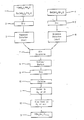
- one solution is prepared by forming a solution of yttrium or a rare earth element. This is designated at 1 in Figure 1.
- Yttrium and the rare earth elements are acceptable for use in the present invention.
- yttrium nitrate is illustrated in Figure 1, other salts of yttrium, such as chloride and sulfate salts, may be substituted.
- a hydrated nitrate of yttrium as is illustrated in Figure 1.
- a compound having the formula Y (NO3)3.6H20 has been found to provide an acceptable end product.
- Other hydrated forms of the yttrium or rare earth nitrate are also found to be acceptable.
- yttrium or rare earth element
- copper in solution is then combined with copper in solution to provide a copper and yttrium mixture.
- Copper in the hydrated nitrate form has been found to be acceptable and is illustrated in Figure 1.
- Copper nitrate in the form Cu(NO3)2 . 6H2O, 3H2O or 21 ⁇ 2H2O have all been found to be acceptable.
- Other hydrated forms may also be substituted within the scope of the present invention.
- other salts of copper are also acceptable for use within the scope of the present invention.
- drying step is illustrated at number 2 in Figure 1. Drying may take place according to any process known and accepted in the art.
- the combined yttrium and copper solution is then heated to a temperature in the range of from approximately 85°C to approximately 100°C (or the boiling point of the solution). This step is shown at 3 in Figure 1.
- barium solution is prepared.
- Barium is obtained in any one of a number of different forms. These forms may include elemental barium, barium oxide (BaO), barium hydroxide (Ba(OH)2), or a hydrated form of any of the above.
- Ba(OH)2 . 8H2O has been found to be an acceptable starting material as is illustrated at 4 in Figure 1.
- the barium is then dissolved to form an aqueous solution of barium, as illustrated at 6 in Figure 1.
- the barium solution is brought to a temperature between approximately 80°C and 110°C. More particularly, it is presently preferred that the solution be brought to a temperature in the range from approximately 94°C to approximately 98°C.
- the two solutions have been prepared, it is next preferred to mix the solutions, as designated at 7 in Figure 1.
- Various techniques of mixing can be employed. Simply pouring one solution into the other solution is one method that has produced acceptable results. When pouring large volumes of one solution into another, however, it is possible to obtain a precipitate product which is not uniform in composition throughout.
- the concentrations of the various components within the precipitate product may vary depending on the concentration of the various components at the point of mixing. For example, if the yttrium and copper were poured into the barium solution, the precipitate formed initially may have a high barium content. As more copper and yttrium solution is added, the barium content would then tend to decrease and the yttrium and copper content would tend to increase.
- pH of the resulting mix can be controlled without adding acids or bases.
- the barium, barium oxide, or barium hydroxide tends to neutralize the acidic copper and yttrium (or rare earth) solution.
- yttrium or rare earth
- the pH in the resulting mixture By carefully determining which form of barium is used and the concentration of the barium form in solution, it is possible to control the pH in the resulting mixture. This provides the capability of controlling pH in the mixture without the necessity of adding contaminating acids and bases.
- the precipitate which is formed when the two solutions are mixed is of extremely high purity, and does not incorporate any extraneous acids, bases, or organic solvents.
- Precipitates are formed over the entire range of pH. It is found, however, that the characteristics of the resultant precipitates vary depending on the pH at the point of precipitation.
- very desirable superconducting materials are produced at solution pH between approximately pH 3.0 and approximately pH 13.
- Precipitates formed in the low end of the pH range (below approximately pH 3) are typically found to be greenish and of relatively poor conductivity.
- precipitates formed at high pH above approximately 11 pH are found to be black. These black precipitates are found to have lower current carrying capacity than may be desirable for particular uses.
- the product be formed and precipitated at a relatively neutral pH.
- precipitates formed at pH's from approximately 6 to approximately 9 have been found to have very good superconductive characteristics at high temperature (above 77K).
- the resulting precipitate may remain suspended in the solution. This is in contrast to the situation where the initial starting materials are quite concentrated, resulting in a well-defined precipitate layer.
- centrifugation may be required in order to remove the precipitate from solution. While other procedures may also be acceptable, it has been found that the centrifugation technique has produced a desirable and acceptable product.
- drying can take place by simply heating the precipitate to drive off any excess moisture. This procedure can satisfactorily take place while the precipitate and any supernatant liquid are continuously stirred and as the entire mixture is heated such that moisture is driven off of the product.
- a calcining step as is illustrated at 10 in Figure 1.
- one calcining procedure that has been found to be acceptable is to heat the recovered precipitate to between approximately 400°C and approximately 1000°C in air or oxygen for approximately one hour. More particularly, good results are achieved by calcining at a temperature between approximately 600°C and approximately 950°C. The nitrates are driven off in this calcining step. This allows the precipitate to stabilize and minimizes degradation of the product. It will be appreciated that the calcining step can be incorporated within the sintering step illustrated at 11 in Figure 1.
- a substrate may be dipped into the suspension which exists at 7 in Figure 1.
- the dipping step will result in a coating of a precursor of the superconducting material.
- substrates are ZrO2, MgO, silver, noble metals and BaF2. Any substrate that is chemically compatible with the superconducting material and which has a similar coefficient of thermal expansion may be used as a substrate.
- An additional method of use is to go through an electrophoretic coating process.
- the coprecipitated material is first incorporated into an aqueous medium.
- the pH is adjusted to produce a colloidal suspension of the material.
- an electrical potential is applied to electrodes immersed in the suspension to cause electrophoretic deposition of the material on the electrodes.
- the electrodes may, for example, be fine noble metal wires, nickel-based alloys, noble metal coated wires or other filaments chemically compatible with the superconducting material.
- a superconducting film can be made adherent. The film can then be dried and annealed in an oxidizing atmosphere to produce a superconducting film on the substrate.
- One of the very significant features of the present invention is its ability to form a very pure final product. Purity is assured by not introducing process chemicals to form the superconducting material which may later need to be removed. Thus, no contaminants are found within the superconducting material in that no potentially contaminating materials are used during the process. The results of the process are superconducting materials having superconducting properties up to approximately 100K.
- the superconducting material formed by the above process has the chemical formula MBa2Cu3O 7-x′ where M may be yttrium or a rare earth element.
- the rare earth elements include lanthanum, cerium, praseodymium, neodymium, promethium, samarium, europium, gadolinium, terbium, dysprosium, holmium, erbium, thulium, ytterbium, and lutetium. Any of the above elements may be substituted for yttrium to form the composition of the present invention.
- In the formula (x) is expected to be in the range of from approximately 0 to approximately 0.5.
- This example describes a method for forming a high purity, high temperature superconducting composition within the scope of the present invention.
- the composition has the chemical formula YBa2Cu3O 7-x .
- a solution was prepared by combining 38.2 grams of hydrated yttrium nitrate, 70.0 grams of hydrated cupric nitrate with 100 milliliters of distilled water. The resulting solution was heated to approximately 92°C in a beaker designated beaker "A.”
- beaker A The contents of beaker A were dropped into beaker B. After the combined solutions were allowed time to react, 1300 milliliters of distilled water were added to the resulting mixture.
- the mixture was then poured into four 750 milliliter bottles for centrifuging.
- a Beckman GPR table top centrifuge was used for sedimentation of precipitates. Samples were centrifuged at 25°C for 25 minutes at 3800 RPM. After centrifugation, precipitates were found on the bottom of each bottle.
- the powder recovered from the procedure set forth above comprised a high purity superconducting composition having the formula YBa2Cu3O7.
- the composition exhibited superconducting characteristics, after sintering in oxygen at 900-970°C and after a slow cool to room temperature, at temperatures as high as approximately 93K.
- This example describes the preparation of a high purity superconducting composition within the scope of the present invention.
- the composition has the chemical formula YBa2Cu3O 7-x .
- a solution was prepared by combining 38.2 grams of hydrated yttrium nitrate, 71 grams of hydrated cupric nitrate and 100 milliliters of distilled water. The solution was placed in a beaker designated beaker "A" and brought to a temperature of 98°C.
- a second solution was prepared by combining 126.2 grams of hydrated barium hydroxide with 1000 milliliters of distilled water. This second solution was placed in a beaker designated "B" and brought to a temperature of 96°C.
- the product was placed in a beaker and the beaker was placed in a bath of water at approximately 77°C.
- the contents of the beaker was mixed with a quarter inch rotating drill. This procedure continued until essentially all liquid was removed from precipitate and a powder was formed.
- the dried powder was recovered and calcined at 650°C in air for one hour and then air cooled.
- the powder was cold pressed at 25,000 psi and then sintered in oxygen for 12 hours at 970°C, slow cooled to 700°C, then slow cooled to room temperature. This procedure produced 84.9 grams of high purity, high temperature superconducting material having the chemical formula YBa2Cu3O 7-x .
- This example describes a process for producing high purity superconducting material within the scope of the present invention, the composition having the chemical formula YBa2Cu3O 7-x .
- a first solution was prepared by combining 38.2 grams of hydrated yttrium nitrate, 71 grams of hydrated cupric nitrate and 400 milliliters of water. The combination was added to a buret designated "A" and brought to a temperature of approximately 89°C.
- each buret was sealed by a valve.
- a length of outlet tubing was connected to the outlet of the valve of each buret and was in turn connected to a T-joint.
- the T-joint lead to 3/8 inch plastic tubing forming a coil.
- buret A and buret B were mixed together by opening the respective valves and allowing the solution to flow through the T joint into the plastic tubing.
- intimate mixing was accomplished at relatively constant pH and concentration conditions throughout the procedure.
- the pH of the resulting mixture was found to be approximately 6.89.
- Example 2 a precipitate formed.
- the resulting precipitate was then recovered, calcined, and sintered in the same manner as described in Example 2. Following calcining a total of 78.5 grams of a high purity superconducting composition was recovered. Samples of this powder were sintered and cooled according to the procedures described in Example 2. The composition had the chemical formula YBa2Cu3O 7-x . Samples of this powder were sintered according to the procedures described in Example 2.
- This example describes a process for producing high purity superconducting material within the scope of the present invention.
- Example 2 The same procedure as that described in Example 1 was used. In this procedure 38.2 grams of hydrated yttrium nitrate and 75.5 grams of hydrated cupric nitrate were combined with water to form an aqueous solution. Simultaneously, 126.2 grams of hydrated barium hydroxide was dissolved in water. The two solutions were combined in the same manner as described in Example 1. Similarly, the resulting precipitate was recovered and processed according to the teachings of Example 2.
- the final product was a high purity superconducting composition having the following Y/Ba/Cu mole ratio: 1/2.3/3.3.
- This example describes a process for producing high purity superconducting material within the scope of the present invention.
- Example 2 The same procedure as that described in Example 1 was used. In this procedure 38.2 grams of hydrated yttrium nitrate and 72 grams of hydrated cupric nitrate were combined with water to form an aqueous solution. Simultaneously, 127 grams of hydrated barium hydroxide was dissolved in water. The two solutions were combined in the same manner as described in Example 1. Following mixing of the two solutions, 1200 milliliters of a total of 2400 milliliters of total solution were removed in order to control the barium content of the final product. The resulting precipitate was recovered and processed according to the teachings of Example 2.
- the final product was a high purity superconducting composition having the following Y/Ba/Cu mole ratio: 1/2.4/3.1.
- This example describes a process for producing high purity superconducting material within the scope of the present invention.
- Example 2 The same procedure as that described in Example 1 was used. In this procedure 76.4 grams of hydrated yttrium nitrate and 148.5 grams of hydrated cupric nitrate were combined with water to form an aqueous solution. Simultaneously, 260 grams of hydrated barium hydroxide was dissolved in water. The two solutions were combined in the same manner as described in Example 1. Following mixing of the two solutions, 900 milliliters of a total of 2000 milliliters of total solution were removed in order to control the barium content of the final product. The resulting precipitate was recovered and processed according to the teachings of Example 2.
- the final product was a high purity superconducting composition having the following Y/Ba/Cu mole ratio: 1/1.9/3.2.
- This example describes a process for producing high purity superconducting material within the scope of the present invention.
- Example 2 The same procedure as that described in Example 1 was used. In this procedure 38.2 grams of hydrated yttrium nitrate and 71 grams of hydrated cupric nitrate were combined with water to form an aqueous solution. Simultaneously, 126 grams of hydrated barium hydroxide was dissolved in water. The two solutions were combined in the same manner as described in Example 1. Following mixing of the two solutions, 1200 milliliters of a total of 2400 milliliters of total solution were removed in order to control the barium content of the final product. The resulting precipitate was recovered and processed according to the teachings of Example 2.
- the final product was a high purity superconducting composition having the following Y/Ba/Cu mole ratio: 1/1.86/2.78.
- This example describes a process for producing high purity superconducting material within the scope of the present invention.
- Example 2 The same procedure as that described in Example 1 was used. In this procedure 38.2 grams of hydrated yttrium nitrate and 71 grams of hydrated cupric nitrate were combined with water to form an aqueous solution. Simultaneously, 126 grams of hydrated barium hydroxide was dissolved in water. The two solutions were combined in the same manner as described in Example 1. In addition, a surfactant was added during the mixing step to provide a more finely divided powder. Following mixing of the two solutions, 1000 milliliters of a total of 2250 milliliters of total solution were removed in order to control the barium content of the final product. The resulting precipitate was recovered and processed according to the teachings of Example 2.
- the final product was a high purity superconducting composition having the following Y/Ba/Cu mole ratio: 1/2.26/3.0.
- Example 2 the same procedure as that set forth in Example 1 is used; however, sufficient barium hydroxide is added to bring the total solution pH to approximately 3.5.
- composition that is obtained is generally green in color and is found to have poorer conductivity than that produced in Example 1.
- the composition is, however, found to be superconductive in the liquid nitrogen temperature range.
- composition that is obtained is generally black in color and is found to have lower current carrying capacity than that produced in Example 1.
- the composition is, however, found to be superconductive in the liquid nitrogen temperature range.
- Example 2 The same procedure as that set forth in Example 1 is conducted; however, a platinum electrode is dipped into the mixture and an electrical current is passed through the electrode causing the precipitate to coat the electrode. This procedure produces an electrode coated with a high temperature superconducting material having the chemical formula YBa2Cu3O 7-x .
- Example 2 The same procedure set forth with respect to Example 1 is used. However, a silver substrate is dipped into the solution following mixture of the solution causing the precipitate to coat the substrate. This procedure produces a substrate coated with a high temperature superconducting material having the chemical formula YBa2Cu3O 7-x .
- Example 2 The same procedures as those followed in Example 1 are followed except that in the place of yttrium nitrate, lanthanum nitrate is substituted.
- a high temperature superconducting material is produced having the chemical formula LaBa2Cu3O 7-x .
- Example 2 The same procedures as those followed in Example 1 are followed except that in the place of yttrium nitrate, praseodymium nitrate is substituted.
- a high temperature superconducting material is produced having the chemical formula PrBa2Cu3O 7-x .
- Example 2 The same procedures as those followed in Example 1 are followed except that in the place of yttrium nitrate, neodymium nitrate is substituted.
- a high temperature superconducting material is produced having the chemical formula NdBa2Cu3O 7-x .
- Example 2 The same procedures as those followed in Example 1 are followed except that in the place of yttrium nitrate, samarium nitrate is substituted.
- a high temperature superconducting material is produced having the chemical formula SmBa2Cu3O 7-x .
- Example 2 The same procedures as those followed in Example 1 are followed except that in the place of yttrium nitrate, europium nitrate is substituted.
- a high temperature superconducting material is produced having the chemical formula EuBa2Cu3O 7-x .
- Example 2 The same procedures as those followed in Example 1 are followed except that in the place of yttrium nitrate, gadolinium nitrate is substituted.
- a high temperature superconducting material is produced having the chemical formula GdBa2Cu3O 7-x .
- Example 2 The same procedures as those followed in Example 1 are followed except that in the place of yttrium nitrate, terbium nitrate is substituted.
- a high temperature superconducting material is produced having the chemical formula TbBa2Cu3O 7-x .
- Example 2 The same procedures as those followed in Example 1 are followed except that in the place of yttrium nitrate, dysprosium nitrate is substituted.
- a high temperature superconducting material is produced having the chemical formula DyBa2Cu3O 7-x .
- Example 2 The same procedures as those followed in Example 1 are followed except that in the place of yttrium nitrate, holmium nitrate is substituted.
- a high temperature superconducting material is produced having the chemical formula HoBa2Cu3O 7-x .
- Example 2 The same procedures as those followed in Example 1 are followed except that in the place of yttrium nitrate, erbium nitrate is substituted.
- a high temperature superconducting material is produced having the chemical formula ErBa2Cu3O 7-x .
- Example 2 The same procedures as those followed in Example 1 are followed except that in the place of yttrium nitrate, thulium nitrate is substituted.
- a high temperature superconducting material is produced having the chemical formula TmBa2Cu3O 7-x .
- Example 2 The same procedures as those followed in Example 1 are followed except that in the place of yttrium nitrate, ytterbium nitrate is substituted.
- a high temperature superconducting material is produced having the chemical formula YbBa2Cu3O 7-x .
- Example 2 The same procedures as those followed in Example 1 are followed except that in the place of yttrium nitrate, lutetium nitrate is substituted.
- a high temperature superconducting material is produced having the chemical formula LuBa2Cu3O 7-x .
- the present invention accomplishes the objectives set forth above.
- the present invention provides methods for producing compositions of extremely high purity which are useful as high temperature superconducting materials.
- the present invention provides methods whereby high temperature superconducting ceramics can be produced using solution chemistry.
- the procedures disclosed above minimize non-uniform mixing and multiphase materials which result from techniques such as the mixture of various powders, frequently used to produce high temperature superconducting materials.
- the present invention provides methods whereby high purity superconducting materials are produced. This is achieved by starting with high purity materials and by adjusting pH using only the components of the final superconducting material. No additional acids, bases, or organic solvents need be used. Thus, it is a simple matter to remove excess barium from the final product in order to give a very pure superconducting material. There is no need to also remove other extraneous acids, bases or solvents.
- the present invention provides methods which will be highly useful in the development of superconducting materials which are economically practical, including particularly superconducting materials which are superconducting at temperatures which can be achieved using liquid nitrogen as a coolant.
- liquid nitrogen as a coolant.
Landscapes
- Chemical & Material Sciences (AREA)
- Engineering & Computer Science (AREA)
- Organic Chemistry (AREA)
- Manufacturing & Machinery (AREA)
- Ceramic Engineering (AREA)
- Materials Engineering (AREA)
- Structural Engineering (AREA)
- Inorganic Chemistry (AREA)
- Inorganic Compounds Of Heavy Metals (AREA)
- Compositions Of Oxide Ceramics (AREA)
Applications Claiming Priority (2)
| Application Number | Priority Date | Filing Date | Title |
|---|---|---|---|
| US230788 | 1988-08-10 | ||
| US07/230,788 US5019555A (en) | 1988-08-10 | 1988-08-10 | High purity superconducting compositions and methods for their fabrication |
Publications (1)
| Publication Number | Publication Date |
|---|---|
| EP0357254A1 true EP0357254A1 (fr) | 1990-03-07 |
Family
ID=22866587
Family Applications (1)
| Application Number | Title | Priority Date | Filing Date |
|---|---|---|---|
| EP89308003A Withdrawn EP0357254A1 (fr) | 1988-08-10 | 1989-08-07 | Compositions supraconductrices de haute pureté et procédés pour leur fabrication |
Country Status (3)
| Country | Link |
|---|---|
| US (1) | US5019555A (fr) |
| EP (1) | EP0357254A1 (fr) |
| JP (1) | JPH02133368A (fr) |
Families Citing this family (10)
| Publication number | Priority date | Publication date | Assignee | Title |
|---|---|---|---|---|
| US5304536A (en) * | 1987-06-09 | 1994-04-19 | E. I. Du Pont De Nemours And Company | Process for making superconductor powder |
| US5122508A (en) * | 1987-12-11 | 1992-06-16 | Kanegafuchi Kagaku Kogyo Kabushiki Kaisha | Coprecipitation process for preparing raw material powder for Y1 Ba2 Cu3 Ox oxide superconductor |
| US5114911A (en) * | 1991-02-20 | 1992-05-19 | Industrail Technology Research Institute | Homogeneous coprecipitation method for preparing YBaCuO superconducting powder |
| US5294594A (en) * | 1992-12-23 | 1994-03-15 | American Cyanamid Company | Water dispersible granular herbicidal compositions comprising dinitroaniline herbicides, montmorillonite carrier and water-swellable polymer |
| US6068711A (en) * | 1994-10-07 | 2000-05-30 | Mcmaster University | Method of increasing corrosion resistance of metals and alloys by treatment with rare earth elements |
| AU709214B2 (en) | 1995-05-19 | 1999-08-26 | American Superconductor Corporation | A multifilamentary superconducting composite and method of manufacture |
| US6428635B1 (en) | 1997-10-01 | 2002-08-06 | American Superconductor Corporation | Substrates for superconductors |
| US6458223B1 (en) | 1997-10-01 | 2002-10-01 | American Superconductor Corporation | Alloy materials |
| JP2000256012A (ja) * | 1999-03-05 | 2000-09-19 | Internatl Superconductivity Technology Center | 酸化物超電導体及びその製造方法 |
| KR20120111137A (ko) * | 2011-03-31 | 2012-10-10 | 한국전기연구원 | 고온 초전도 선재 |
Citations (2)
| Publication number | Priority date | Publication date | Assignee | Title |
|---|---|---|---|---|
| WO1988010009A1 (fr) * | 1987-06-09 | 1988-12-15 | E.I. Du Pont De Nemours And Company | Procede ameliore de fabrication de supraconducteurs |
| GB2207128A (en) * | 1987-07-22 | 1989-01-25 | Chloride Silent Power Ltd | Preparing superconducting ceramic materials |
Family Cites Families (2)
| Publication number | Priority date | Publication date | Assignee | Title |
|---|---|---|---|---|
| US4636378A (en) * | 1985-06-11 | 1987-01-13 | Hughes Aircraft Company | Method of preparation of perovskite-type compounds |
| US4661282A (en) * | 1985-06-24 | 1987-04-28 | The Dow Chemical Company | Inorganic anion exchangers and preparation thereof |
-
1988
- 1988-08-10 US US07/230,788 patent/US5019555A/en not_active Expired - Fee Related
-
1989
- 1989-08-07 EP EP89308003A patent/EP0357254A1/fr not_active Withdrawn
- 1989-08-09 JP JP1206588A patent/JPH02133368A/ja active Pending
Patent Citations (2)
| Publication number | Priority date | Publication date | Assignee | Title |
|---|---|---|---|---|
| WO1988010009A1 (fr) * | 1987-06-09 | 1988-12-15 | E.I. Du Pont De Nemours And Company | Procede ameliore de fabrication de supraconducteurs |
| GB2207128A (en) * | 1987-07-22 | 1989-01-25 | Chloride Silent Power Ltd | Preparing superconducting ceramic materials |
Non-Patent Citations (1)
| Title |
|---|
| PATENT ABSTRACTS OF JAPAN, vol. 13, no. 115 (C-578)[3463], 20th March 1989; & JP-A-63 288 912 (HITACHI LTD) 25-11-1988 * |
Also Published As
| Publication number | Publication date |
|---|---|
| JPH02133368A (ja) | 1990-05-22 |
| US5019555A (en) | 1991-05-28 |
Similar Documents
| Publication | Publication Date | Title |
|---|---|---|
| US4920093A (en) | Fabrication of superconducting oxide thin films by sol-gel method | |
| JP3009133B2 (ja) | 超伝導物質及びその製造方法 | |
| US4962083A (en) | High temperature T1-Ba-Ca-Cu-O and T1-Sr-Cu-O superconductor | |
| JPH0512289B2 (fr) | ||
| US4959347A (en) | Forming homogeneous precursers of Bi-Sr-Ca-Cu via carboxylates in the presence of oxidizing agents | |
| JPH02279518A (ja) | セラミック高温超伝導体から結晶配向の表面層を製造する方法 | |
| US5019555A (en) | High purity superconducting compositions and methods for their fabrication | |
| Komatsu et al. | High-Tc superconducting glass-ceramics | |
| US4866031A (en) | Process for making 90 K superconductors from acetate precursor solutions | |
| Lehndorff | High-Superconductors for Magnet and Energy Technology: Fundamental Aspects | |
| US5149684A (en) | Production of a superconductor powder having a narrow melting transition width using a controlled oxygen atmosphere | |
| EP0350143A1 (fr) | Formation d'un article supraconductif par électrodéposition | |
| EP0364494A1 (fr) | Procede ameliore de fabrication de supraconducteurs 90 k | |
| AU769751B2 (en) | A Pb-Bi-Sr-Ca-Cu-oxide powder mix with enhanced reactivity and process for its manufacture | |
| US5157581A (en) | Conductive ceramics, conductors thereof and methods | |
| EP0316143A2 (fr) | Préparation d'articles supraconducteurs par électrophorèse | |
| Saito et al. | Crystal growth and properties of R2Ba2CuPtO8 (R= Ho, Er, Y), R2Ba3Cu2PtO10 and Ba4CuPt2O9 | |
| EP0324660A2 (fr) | Supraconducteurs et procédé pour leur préparation | |
| US5066635A (en) | High temperature superconducting Ti-Ba-Ca-Cu-O phases | |
| Pak et al. | Solution‐Condensed YBa2Cu3O7− x Superconductor Thin Films from Thermosetting Metal‐Organic Precursors | |
| JPH04214027A (ja) | 酸化物超電導体およびその製造方法 | |
| US5371066A (en) | Method for oxidizing precursor compounds of superconducting oxides | |
| US4906608A (en) | Method for preparing superconductors ceramic composition | |
| JP2525833B2 (ja) | 超電導性部材の製造方法 | |
| WO1996008448A2 (fr) | Procede de depot par metafusion pour former des ceramiques supraconductrices |
Legal Events
| Date | Code | Title | Description |
|---|---|---|---|
| PUAI | Public reference made under article 153(3) epc to a published international application that has entered the european phase |
Free format text: ORIGINAL CODE: 0009012 |
|
| AK | Designated contracting states |
Kind code of ref document: A1 Designated state(s): AT BE DE FR GB IT NL SE |
|
| 17P | Request for examination filed |
Effective date: 19900822 |
|
| STAA | Information on the status of an ep patent application or granted ep patent |
Free format text: STATUS: THE APPLICATION IS DEEMED TO BE WITHDRAWN |
|
| 18D | Application deemed to be withdrawn |
Effective date: 19920303 |