EP0357338A2 - Système de court-circuit cardiopulmonaire périphérique et de reperfusion coronaire - Google Patents
Système de court-circuit cardiopulmonaire périphérique et de reperfusion coronaire Download PDFInfo
- Publication number
- EP0357338A2 EP0357338A2 EP89308579A EP89308579A EP0357338A2 EP 0357338 A2 EP0357338 A2 EP 0357338A2 EP 89308579 A EP89308579 A EP 89308579A EP 89308579 A EP89308579 A EP 89308579A EP 0357338 A2 EP0357338 A2 EP 0357338A2
- Authority
- EP
- European Patent Office
- Prior art keywords
- catheter
- pump
- patient
- blood
- heart
- Prior art date
- Legal status (The legal status is an assumption and is not a legal conclusion. Google has not performed a legal analysis and makes no representation as to the accuracy of the status listed.)
- Withdrawn
Links
- 230000002612 cardiopulmonary effect Effects 0.000 title claims abstract description 6
- 230000002093 peripheral effect Effects 0.000 title claims abstract 6
- 230000010410 reperfusion Effects 0.000 title claims description 38
- 239000008280 blood Substances 0.000 claims abstract description 67
- 210000004369 blood Anatomy 0.000 claims abstract description 67
- 210000005240 left ventricle Anatomy 0.000 claims abstract description 24
- 230000017531 blood circulation Effects 0.000 claims abstract description 14
- 210000003191 femoral vein Anatomy 0.000 claims abstract description 11
- 239000008148 cardioplegic solution Substances 0.000 claims abstract 3
- 210000001367 artery Anatomy 0.000 claims description 22
- 239000012530 fluid Substances 0.000 claims description 20
- 238000003780 insertion Methods 0.000 claims description 12
- 230000037431 insertion Effects 0.000 claims description 12
- 238000004891 communication Methods 0.000 claims description 9
- 239000005038 ethylene vinyl acetate Substances 0.000 claims description 7
- 210000001765 aortic valve Anatomy 0.000 claims description 6
- DQXBYHZEEUGOBF-UHFFFAOYSA-N but-3-enoic acid;ethene Chemical compound C=C.OC(=O)CC=C DQXBYHZEEUGOBF-UHFFFAOYSA-N 0.000 claims description 6
- 229940100084 cardioplegia solution Drugs 0.000 claims description 6
- 238000010276 construction Methods 0.000 claims description 6
- 229920001200 poly(ethylene-vinyl acetate) Polymers 0.000 claims description 6
- 239000000463 material Substances 0.000 claims description 5
- 238000005086 pumping Methods 0.000 claims description 5
- 230000008859 change Effects 0.000 claims description 4
- 238000006073 displacement reaction Methods 0.000 claims description 4
- 210000002837 heart atrium Anatomy 0.000 claims description 4
- 239000007788 liquid Substances 0.000 claims description 4
- 230000003247 decreasing effect Effects 0.000 claims description 3
- 210000005245 right atrium Anatomy 0.000 claims description 3
- 210000003462 vein Anatomy 0.000 claims description 3
- 230000001101 cardioplegic effect Effects 0.000 claims description 2
- 230000002792 vascular Effects 0.000 claims 1
- 208000010125 myocardial infarction Diseases 0.000 abstract description 22
- 238000002399 angioplasty Methods 0.000 abstract description 5
- 238000013022 venting Methods 0.000 abstract description 4
- 230000007246 mechanism Effects 0.000 abstract description 2
- 239000003146 anticoagulant agent Substances 0.000 abstract 1
- 230000003683 cardiac damage Effects 0.000 abstract 1
- 239000000243 solution Substances 0.000 abstract 1
- 230000002537 thrombolytic effect Effects 0.000 abstract 1
- 238000000034 method Methods 0.000 description 15
- 210000001105 femoral artery Anatomy 0.000 description 12
- 230000004087 circulation Effects 0.000 description 10
- 230000002861 ventricular Effects 0.000 description 10
- 210000004351 coronary vessel Anatomy 0.000 description 7
- 210000004165 myocardium Anatomy 0.000 description 7
- 230000006837 decompression Effects 0.000 description 6
- 238000013459 approach Methods 0.000 description 5
- 230000006378 damage Effects 0.000 description 5
- 239000004800 polyvinyl chloride Substances 0.000 description 5
- 238000011084 recovery Methods 0.000 description 4
- 208000031481 Pathologic Constriction Diseases 0.000 description 3
- 230000008901 benefit Effects 0.000 description 3
- 239000000203 mixture Substances 0.000 description 3
- 238000012544 monitoring process Methods 0.000 description 3
- 230000002572 peristaltic effect Effects 0.000 description 3
- 229920000915 polyvinyl chloride Polymers 0.000 description 3
- 230000036262 stenosis Effects 0.000 description 3
- 208000037804 stenosis Diseases 0.000 description 3
- 206010061216 Infarction Diseases 0.000 description 2
- 206010000891 acute myocardial infarction Diseases 0.000 description 2
- 230000004872 arterial blood pressure Effects 0.000 description 2
- 230000036770 blood supply Effects 0.000 description 2
- 238000013130 cardiovascular surgery Methods 0.000 description 2
- 230000010339 dilation Effects 0.000 description 2
- 230000007574 infarction Effects 0.000 description 2
- 238000001802 infusion Methods 0.000 description 2
- 230000000977 initiatory effect Effects 0.000 description 2
- 208000028867 ischemia Diseases 0.000 description 2
- 210000004072 lung Anatomy 0.000 description 2
- 229920002529 medical grade silicone Polymers 0.000 description 2
- 230000037452 priming Effects 0.000 description 2
- 239000004945 silicone rubber Substances 0.000 description 2
- 208000024891 symptom Diseases 0.000 description 2
- 238000012360 testing method Methods 0.000 description 2
- 210000000115 thoracic cavity Anatomy 0.000 description 2
- 230000003313 weakening effect Effects 0.000 description 2
- PSLCKQYQNVNTQI-BHFSHLQUSA-N (2s)-2-aminobutanedioic acid;(2s)-2-aminopentanedioic acid Chemical compound OC(=O)[C@@H](N)CC(O)=O.OC(=O)[C@@H](N)CCC(O)=O PSLCKQYQNVNTQI-BHFSHLQUSA-N 0.000 description 1
- QTBSBXVTEAMEQO-UHFFFAOYSA-M Acetate Chemical compound CC([O-])=O QTBSBXVTEAMEQO-UHFFFAOYSA-M 0.000 description 1
- 206010019280 Heart failures Diseases 0.000 description 1
- 208000013038 Hypocalcemia Diseases 0.000 description 1
- 208000001953 Hypotension Diseases 0.000 description 1
- 241001465754 Metazoa Species 0.000 description 1
- 239000004698 Polyethylene Substances 0.000 description 1
- 238000009825 accumulation Methods 0.000 description 1
- 230000003466 anti-cipated effect Effects 0.000 description 1
- 201000002064 aortic valve insufficiency Diseases 0.000 description 1
- 230000006793 arrhythmia Effects 0.000 description 1
- 206010003119 arrhythmia Diseases 0.000 description 1
- 230000003190 augmentative effect Effects 0.000 description 1
- 229910052788 barium Inorganic materials 0.000 description 1
- DSAJWYNOEDNPEQ-UHFFFAOYSA-N barium atom Chemical compound [Ba] DSAJWYNOEDNPEQ-UHFFFAOYSA-N 0.000 description 1
- 230000005540 biological transmission Effects 0.000 description 1
- 230000036772 blood pressure Effects 0.000 description 1
- 230000036760 body temperature Effects 0.000 description 1
- 238000009835 boiling Methods 0.000 description 1
- 230000000747 cardiac effect Effects 0.000 description 1
- 230000002490 cerebral effect Effects 0.000 description 1
- 210000000038 chest Anatomy 0.000 description 1
- 238000011109 contamination Methods 0.000 description 1
- 210000003748 coronary sinus Anatomy 0.000 description 1
- 238000013461 design Methods 0.000 description 1
- 239000003527 fibrinolytic agent Substances 0.000 description 1
- 238000001595 flow curve Methods 0.000 description 1
- 230000006870 function Effects 0.000 description 1
- 230000004217 heart function Effects 0.000 description 1
- 210000005003 heart tissue Anatomy 0.000 description 1
- 238000010438 heat treatment Methods 0.000 description 1
- 230000000705 hypocalcaemia Effects 0.000 description 1
- 230000036543 hypotension Effects 0.000 description 1
- 210000003111 iliac vein Anatomy 0.000 description 1
- 230000006698 induction Effects 0.000 description 1
- 208000014674 injury Diseases 0.000 description 1
- 239000003550 marker Substances 0.000 description 1
- 239000012528 membrane Substances 0.000 description 1
- QSHDDOUJBYECFT-UHFFFAOYSA-N mercury Chemical compound [Hg] QSHDDOUJBYECFT-UHFFFAOYSA-N 0.000 description 1
- 229910052753 mercury Inorganic materials 0.000 description 1
- 238000012986 modification Methods 0.000 description 1
- 230000004048 modification Effects 0.000 description 1
- 230000004220 muscle function Effects 0.000 description 1
- 230000006911 nucleation Effects 0.000 description 1
- 238000010899 nucleation Methods 0.000 description 1
- 210000004197 pelvis Anatomy 0.000 description 1
- 230000035515 penetration Effects 0.000 description 1
- 230000010412 perfusion Effects 0.000 description 1
- 230000000144 pharmacologic effect Effects 0.000 description 1
- -1 polyethylene Polymers 0.000 description 1
- 229920000573 polyethylene Polymers 0.000 description 1
- 230000008569 process Effects 0.000 description 1
- 230000002035 prolonged effect Effects 0.000 description 1
- 210000003752 saphenous vein Anatomy 0.000 description 1
- 238000007789 sealing Methods 0.000 description 1
- 230000000087 stabilizing effect Effects 0.000 description 1
- 238000011477 surgical intervention Methods 0.000 description 1
- 230000002459 sustained effect Effects 0.000 description 1
- 238000002560 therapeutic procedure Methods 0.000 description 1
- 229960000103 thrombolytic agent Drugs 0.000 description 1
- 239000003053 toxin Substances 0.000 description 1
- 231100000765 toxin Toxicity 0.000 description 1
- 108700012359 toxins Proteins 0.000 description 1
- 238000012549 training Methods 0.000 description 1
- 230000008733 trauma Effects 0.000 description 1
Images




Classifications
-
- A—HUMAN NECESSITIES
- A61—MEDICAL OR VETERINARY SCIENCE; HYGIENE
- A61M—DEVICES FOR INTRODUCING MEDIA INTO, OR ONTO, THE BODY; DEVICES FOR TRANSDUCING BODY MEDIA OR FOR TAKING MEDIA FROM THE BODY; DEVICES FOR PRODUCING OR ENDING SLEEP OR STUPOR
- A61M1/00—Suction or pumping devices for medical purposes; Devices for carrying-off, for treatment of, or for carrying-over, body-liquids; Drainage systems
- A61M1/36—Other treatment of blood in a by-pass of the natural circulatory system, e.g. temperature adaptation, irradiation ; Extra-corporeal blood circuits
- A61M1/3621—Extra-corporeal blood circuits
-
- A—HUMAN NECESSITIES
- A61—MEDICAL OR VETERINARY SCIENCE; HYGIENE
- A61M—DEVICES FOR INTRODUCING MEDIA INTO, OR ONTO, THE BODY; DEVICES FOR TRANSDUCING BODY MEDIA OR FOR TAKING MEDIA FROM THE BODY; DEVICES FOR PRODUCING OR ENDING SLEEP OR STUPOR
- A61M1/00—Suction or pumping devices for medical purposes; Devices for carrying-off, for treatment of, or for carrying-over, body-liquids; Drainage systems
- A61M1/36—Other treatment of blood in a by-pass of the natural circulatory system, e.g. temperature adaptation, irradiation ; Extra-corporeal blood circuits
- A61M1/3613—Reperfusion, e.g. of the coronary vessels, e.g. retroperfusion
-
- A—HUMAN NECESSITIES
- A61—MEDICAL OR VETERINARY SCIENCE; HYGIENE
- A61M—DEVICES FOR INTRODUCING MEDIA INTO, OR ONTO, THE BODY; DEVICES FOR TRANSDUCING BODY MEDIA OR FOR TAKING MEDIA FROM THE BODY; DEVICES FOR PRODUCING OR ENDING SLEEP OR STUPOR
- A61M1/00—Suction or pumping devices for medical purposes; Devices for carrying-off, for treatment of, or for carrying-over, body-liquids; Drainage systems
- A61M1/36—Other treatment of blood in a by-pass of the natural circulatory system, e.g. temperature adaptation, irradiation ; Extra-corporeal blood circuits
- A61M1/3621—Extra-corporeal blood circuits
- A61M1/3623—Means for actively controlling temperature of blood
-
- A—HUMAN NECESSITIES
- A61—MEDICAL OR VETERINARY SCIENCE; HYGIENE
- A61M—DEVICES FOR INTRODUCING MEDIA INTO, OR ONTO, THE BODY; DEVICES FOR TRANSDUCING BODY MEDIA OR FOR TAKING MEDIA FROM THE BODY; DEVICES FOR PRODUCING OR ENDING SLEEP OR STUPOR
- A61M1/00—Suction or pumping devices for medical purposes; Devices for carrying-off, for treatment of, or for carrying-over, body-liquids; Drainage systems
- A61M1/36—Other treatment of blood in a by-pass of the natural circulatory system, e.g. temperature adaptation, irradiation ; Extra-corporeal blood circuits
- A61M1/3621—Extra-corporeal blood circuits
- A61M1/3643—Priming, rinsing before or after use
- A61M1/3644—Mode of operation
-
- A—HUMAN NECESSITIES
- A61—MEDICAL OR VETERINARY SCIENCE; HYGIENE
- A61M—DEVICES FOR INTRODUCING MEDIA INTO, OR ONTO, THE BODY; DEVICES FOR TRANSDUCING BODY MEDIA OR FOR TAKING MEDIA FROM THE BODY; DEVICES FOR PRODUCING OR ENDING SLEEP OR STUPOR
- A61M1/00—Suction or pumping devices for medical purposes; Devices for carrying-off, for treatment of, or for carrying-over, body-liquids; Drainage systems
- A61M1/36—Other treatment of blood in a by-pass of the natural circulatory system, e.g. temperature adaptation, irradiation ; Extra-corporeal blood circuits
- A61M1/3621—Extra-corporeal blood circuits
- A61M1/3643—Priming, rinsing before or after use
-
- A—HUMAN NECESSITIES
- A61—MEDICAL OR VETERINARY SCIENCE; HYGIENE
- A61M—DEVICES FOR INTRODUCING MEDIA INTO, OR ONTO, THE BODY; DEVICES FOR TRANSDUCING BODY MEDIA OR FOR TAKING MEDIA FROM THE BODY; DEVICES FOR PRODUCING OR ENDING SLEEP OR STUPOR
- A61M1/00—Suction or pumping devices for medical purposes; Devices for carrying-off, for treatment of, or for carrying-over, body-liquids; Drainage systems
- A61M1/36—Other treatment of blood in a by-pass of the natural circulatory system, e.g. temperature adaptation, irradiation ; Extra-corporeal blood circuits
- A61M1/3621—Extra-corporeal blood circuits
- A61M1/3664—Extra-corporeal blood circuits for preparing cardioplegia solutions
-
- A—HUMAN NECESSITIES
- A61—MEDICAL OR VETERINARY SCIENCE; HYGIENE
- A61M—DEVICES FOR INTRODUCING MEDIA INTO, OR ONTO, THE BODY; DEVICES FOR TRANSDUCING BODY MEDIA OR FOR TAKING MEDIA FROM THE BODY; DEVICES FOR PRODUCING OR ENDING SLEEP OR STUPOR
- A61M25/00—Catheters; Hollow probes
- A61M2025/0001—Catheters; Hollow probes for pressure measurement
- A61M2025/0003—Catheters; Hollow probes for pressure measurement having an additional lumen transmitting fluid pressure to the outside for measurement
-
- A—HUMAN NECESSITIES
- A61—MEDICAL OR VETERINARY SCIENCE; HYGIENE
- A61M—DEVICES FOR INTRODUCING MEDIA INTO, OR ONTO, THE BODY; DEVICES FOR TRANSDUCING BODY MEDIA OR FOR TAKING MEDIA FROM THE BODY; DEVICES FOR PRODUCING OR ENDING SLEEP OR STUPOR
- A61M2205/00—General characteristics of the apparatus
- A61M2205/33—Controlling, regulating or measuring
- A61M2205/3331—Pressure; Flow
- A61M2205/3344—Measuring or controlling pressure at the body treatment site
-
- A—HUMAN NECESSITIES
- A61—MEDICAL OR VETERINARY SCIENCE; HYGIENE
- A61M—DEVICES FOR INTRODUCING MEDIA INTO, OR ONTO, THE BODY; DEVICES FOR TRANSDUCING BODY MEDIA OR FOR TAKING MEDIA FROM THE BODY; DEVICES FOR PRODUCING OR ENDING SLEEP OR STUPOR
- A61M2205/00—General characteristics of the apparatus
- A61M2205/33—Controlling, regulating or measuring
- A61M2205/3331—Pressure; Flow
- A61M2205/3351—Controlling upstream pump pressure
-
- A—HUMAN NECESSITIES
- A61—MEDICAL OR VETERINARY SCIENCE; HYGIENE
- A61M—DEVICES FOR INTRODUCING MEDIA INTO, OR ONTO, THE BODY; DEVICES FOR TRANSDUCING BODY MEDIA OR FOR TAKING MEDIA FROM THE BODY; DEVICES FOR PRODUCING OR ENDING SLEEP OR STUPOR
- A61M2205/00—General characteristics of the apparatus
- A61M2205/33—Controlling, regulating or measuring
- A61M2205/3331—Pressure; Flow
- A61M2205/3355—Controlling downstream pump pressure
-
- A—HUMAN NECESSITIES
- A61—MEDICAL OR VETERINARY SCIENCE; HYGIENE
- A61M—DEVICES FOR INTRODUCING MEDIA INTO, OR ONTO, THE BODY; DEVICES FOR TRANSDUCING BODY MEDIA OR FOR TAKING MEDIA FROM THE BODY; DEVICES FOR PRODUCING OR ENDING SLEEP OR STUPOR
- A61M2205/00—General characteristics of the apparatus
- A61M2205/36—General characteristics of the apparatus related to heating or cooling
- A61M2205/366—General characteristics of the apparatus related to heating or cooling by liquid heat exchangers
Definitions
- the subject invention relates to the treatment of heart attacks by placing the patient on a heart/lung machine without the necessity of a conventional open-chest operation, and to the treatment of the heart attack by the infusion of a special solution directly into the coronary arteries supplying the heart muscle.
- heart attacks are caused by closed coronary arteries; opening an artery does not cure the heart attack; and controlling the conditions and composition of the initial reperfusion of a blocked coronary artery does permit salvage of the damaged myocardium beyond the obstruction.
- the only accepted way to control the conditions and composition of coronary reperfusion of individuals undergoing a heart attack is by open-chest surgical operation with direct decompression of the heart, decompression of the left ventricle and direct infusion of the coronary arteries through surgically connected saphenous vein grafts.
- the system should relieve the workload of the heart by supporting the body on an extracorporeal circulation to eliminate the flow work of the heart and relieve the left ventricle of all blood to eliminate pressure work of the heart.
- the invention comprises a unique cardiopulmonary bypass apparatus and system.
- an extracorporeal bypass apparatus having a venous catheter (10) for insertion into a femoral vein, such catheter being sufficiently long and flexible to reach the atrium area of a patient's heart and an arterial cannula (12), characterized in that there is provided a single pump (18) connected between the venous catheter and the arterial cannula for withdrawing blood from a patient through said venous catheter and pumping it into a patient through the arterial cannula; and a vent catheter (14) for insertion into an artery sufficiently long and flexible to reach the left ventricle of the heart, said vent catheter being connected in parallel with the venous catheter connected to the pump in a manner such that the negative pressure developed by said pump is applied to the venous catheter and the vent catheter, said venous catheter and said pump being constructed such that substantially all of the patient's blood which would normally be returned to the heart is bypassed through the venous catheter, and the blood reaching the left ventricle
- the venous catheter is of special design which, for the first time, permits the induction of percutaneous total extracorporeal circulation, without producing dangerous increases in negative pressure.
- the hydrodynamics of the venous catheter system are selected so that they permit full normal cardiac output of 5 to 7 liters per minute without exceeding a maximum negative pressure, or suction, in the range of 140 to 200 mm Hg. This constraint minimizes blood damage and avoids creating bubbles in the blood.
- a blood cardioplegia delivery system further characterized by a cardioplegia delivery pump (24) having an inlet connected to the output of said arterial pump (18); a source of cardioplegic liquid (26) connected as an input to said cardioplegia pump; and a coronary reperfusion catheter assembly including a catheter (16) connected to the output of said cardioplegia pump, the coronary reperfusion catheter being sufficiently long and flexible to be adapted to be inserted through a patient's artery to reach an area of the heart that has been deprived of blood so that a cardioplegia solution can be applied to that area before resulting normal blood flow.
- the system is useful for routine extracorporeal circulation situations.
- the system further advantageously lends itself to electronic and mechanical control systems uniquely designed for performance of total extracorporeal circulation and controlled coronary reperfusion.
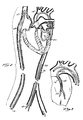
- a femoral-femoral bypass is performed wherein a femoral venous catheter 10 allows right heart access via the femoral vein 11.
- a femoral arterial cannula 12 allows the return of oxygenated blood to the femoral artery, and is used in connection with the venous catheter 10 to achieve femoral-femoral total extracorporeal circulation.
- a left ventricular vent catheter 14 is used to vent the left heart during extracorporeal circulation with the introduction of the catheter 14 made at the femoral artery and passing transaortically into the left ventricle.
- a coronary reperfusion catheter 16 is inserted into, and transverses a stenosed vessel in order to reperfuse the heart region beyond the stenosis.
- the venous catheter 10 and the vent catheter 14 are in fluid communication with an arterial pump 18 which provides a negative pressure in order to draw venous blood into the arterial pump and to draw blood out of the left ventricle, and maintain that portion of the heart in an at rest condition.
- the arterial pump 18 forces the blood through an oxygenator/heat exchange 20 and an arterial filter 22.
- a heater/circulator 21 provides fluid flowing into the heat exchanger contained within the oxygenator 20.
- a bridging venous reservoir 25 is connected in fluid communication with both the arterial pump 18 and the membrane oxygenator 20 in order to prime the system and to maintain sufficient fluid for proper operation.
- a cardioplegia delivery pump 24 is in fluid communication with the oxygenated blood after it leaves the arterial filter 22, and is also in fluid communication with a cardioplegia source 26 so as to mix the oxygenated blood and cardioplegia before delivering it at a predetermined flow rate to the coronary reperfusion catheter 16.
- vent catheter 14 removes all residual blood from the left ventricle and enables the heart to maintain an at-rest condition while the reperfusion catheter 16 enables reperfusion of the heart region beyond the stenosis which precipitated the heart attack.
- the femoral venous catheter is preferably made from ethylene-vinyl-acetate (EVA) tubing, preferably having about 18% acetate.
- EVA ethylene-vinyl-acetate
- the tubing has a constant inner diameter from the insertion tip up to the proximal end.
- the proximal end of the catheter 10 connects to a 3/8-inch connector which is in fluid communication with the arterial pump.
- the catheter should be long enough to reach the right atrium from the femoral triangle.
- An intravascular length about 70 cm, and an overall length of about 85 cm, has been found to be suitable.
- the thin wall and flexibility of the catheter allow for its introduction percutaneously into the femoral vein of a wide range of patients, and resist the kinking that might otherwise occur with other thin wall catheters as they are advanced through the iliac veins and across the curve of the pelvis.
- the distal end 27 of the venous catheter 10, as seen in Figures 4 and 5, has a plurality of drainage holes 28 which in a prototype product have a diameter of .165 with 1/4-inch center to center spacing. These holes have smooth edges and are formed by a tubular cutter, with the catheter internally supported on a mandrel. The holes are arranged in a spiral pattern so that if some holes are blocked by vessel walls, others will be open. This arrangement also minimizes weakening of the catheter while providing the necessary hole area. The holes extend sufficiently far from the distal end of the catheter to span the area from which blood is to be withdrawn.
- the preferred technique for introducing this canula into the body is to use the Seldinger technique (percutaneous) or a cutdown procedure along with vessel dilation.
- a radiopaque tip marker 25 near the distal end enables the drainage holes to be oriented in the superior vena cavae.
- An elongated removable stylet 31 which receives a .045 inch guidewire (not shown) is used to introduce and guide the catheter into position.
- the cross-sectional size and the material of the catheter 10 is particularly critical. Since a total bypass system is needed to accomplish the goals of the invention, it is necessary that the venous catheter fit within various constraints. Bypassing the patient's total blood flow requires a capacity in the range of up to 5-7 liters per minute. An overall flow rate of 5 liters per minute is expected in most patients.
- a thin-walled construction is advantageously used to provide a larger blood flow within the size limitations that may be accommodated by human veins.
- the EVA material in connection with the thin-walled construction, provides the needed flexibility to be properly positioned, yet sufficient strength to prevent kinking during normal handling. Moreover, the characteristics of the material are such that if the tubing is kinked and then released, it is self-restoring without significant weakening.
- a negative pressure of 200 mm of mercury is an appropriate safe maximum. Higher levels of negative pressure, which could create greater blood flow, run the increasing risk of creating bubbles in the blood. Although a minimum wall thickness is desired, the tubing must not collapse when subjected to such negative pressure. It has been determined that a catheter size of 26 French (O.D. - .341 inch, 8.66 mm) is suitable. Preferably, the catheter has an inner diameter of .277 inch (7.03 mm), thus making a wall thickness of .032 inch (.825 mm).
- An alternative approach is to use two smaller venous catheters that will carry the flow at the same negative pressure.
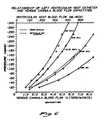
- Figure 6 illustrates the constraints of the venous catheter construction graphically from test data. It can be seen that the fluid flow dynamics are such that significant negative pressure is needed to approach the required flow rates, but yet the increased flow from increased suction diminishes quickly at higher levels, particularly for the smaller lumens. Within the acceptable pressure limit, it can be seen that inadequate flow is obtained from a 22 F or 24 F (French) thin-walled lumen.
- a 29 French thin-walled size provides adequate flow, but is too large for the vein of some patients, and produces insufficient negative pressure to assist vent drainage optimally (as discussed below). Incidentally, the 29 French lumen was made of polyethylene rather than EVA. It is believed that the flow curve would be similar for EVA.
- the 26 French size provides adequate flow within an acceptable pressure range of about 100-200 mm Hg, and it can be accommodated by the femoral vein of most adults.
- the vent catheter 14 is preferably a size 12.5 French (.164 inch, 4.166 mm O.D.) (.120 inch, 3.04 mm I.D.).
- the catheter is preferably made from a flexible polyvinyl chloride (PVC) tubing.
- PVC polyvinyl chloride
- the distal end 30 is formed in a loop providing a so-called "pigtail.”
- This loop when unstressed, has an outside diameter of about 7/8-inch, and has a plurality of spaced apertures 32 which are preferably about .050 inch in diameter and extend over a vent length of about 4 cm.
- a series of apertures 32 are located on opposite sides of the catheter.
- the catheter 14 must be long enough to reach the left ventricle from the femoral triangle when passed retrograde through the arterial system.
- a catheter with an intravascular length of 100 cm, and an overall length of about 112 cm is preferred.
- the catheter 14 includes a pressure monitoring lumen 41 which is integral with and formed in a wall of the vent catheter 14.
- this lumen 41 has a diameter of about .030 inch.
- the lumen 41 extends from the proximal end of the catheter 14 to a pressure inlet 41a which is spaced from the catheter tip a distance further from the tip than the apertures 32.
- the inlet 41a is positioned about 4 inches from the distal end of the catheter.
- the inlet 41a is located on the same side of the catheter 14 as the pigtail to prevent obstruction of the inlet 41a when the catheter contacts the ventricular wall.
- the catheter 14 is extruded with the lumen 41 extending throughout the length of the tubing.
- the distal end of the tubing is heated and stretched to reduce its diameter and increase flexibility, and to form the pigtail into its curled shape.
- the lumen 41 is closed on the distal end of the catheter.
- the opening 41a is formed by cutting the tubing at the desired location spaced further from the tip than the apertures 32.
- the exterior diameters of the catheter is decreased from .164 inch to about .100 inch, and the interior diameter is decreased from .120 inch to .062 inch.
- the very tip of the catheter is reduced a slight amount further. That is, the tip .030 inch is tapered on its exterior and is reduced on its interior diameter to about .040 inch.
- the preferred method of introducing the vent catheter 14 into the femoral artery is by using a sheath introducer procedure.
- a tubular sheath (not shown) is positioned in the entrance to the artery, a guidewire 47 is introduced into a stiffening stylet (now shown) that is in the flow lumen of the catheter.
- the guidewire extends beyond the pigtail distal end 30 sufficiently to straighten it and to permit insertion.
- the assembly is then inserted through the sheath into the artery.
- the guidewire and stylet are stopped when the wire approaches the aortic valve.
- the guide wire and the stylet are then withdrawn approximately 10 cm.
- the pigtail recurls, due to its memory, into the position shown in Figure 7.
- the curled distal end resiliently engages the aortic valve and passes through the valve without trauma when the valve opens.
- the distal end then assumes the position illustrated in Figure 2 wherein the pressure lumen hole 41a in the distal end is shielded from the ventricle walls so as to prevent blockage when pressure is monitored through the catheter.
- the flexibility of the catheter permits its presence in the ventricle, across the aortic valve, without causing distortion of the cusps of that valve and therefore avoids aortic insufficiency.
- a tube 40 is in fluid communication with the proximal end of the vent catheter via one aperture in a Wye connector 38 with the tube also communicating with the arterial pump 18.
- the catheter 14 is sized to allow transmission of approximately up to 500 ml per minute of blood flow at the same negative pressure at which the catheter 11 is operated by the arterial pump 18.
- a pressure transducer is connected to a second aperture in the Wye connector 38 which in turn is connected to the second lumen 41.
- the lumen 41 monitors the pressure in the left ventricle directly. If the ventricle is being properly decompressed, the sensed pressure should be about zero. Thus, there is a significant difference in pressure on the opposite sides of the aortic valve.
- the vent catheter is, as noted, necessary to ensure the left ventricle is completely decompressed, and does not fill with fluid and cause the heart to eject (pump), even though the heart is being bypassed.
- the venous drain cannula 10 does not ensure continual left ventricle decompression. Some coronary sinus return and/or bronchial flow will enter the left ventricle, distend it, allow wall tension to develop and result in occasional ejection despite apparent right heart decompression from the venous catheter 10.
- it is important that the catheter and its connecting tube 40 are sized to transmit the maximum anticipated flow from the left ventricle. This can range from 50 to 500 ml. Further, it is necessary to restrict negative pressure to the 200 mm Hg limitation mentioned above in connection with the venous catheter.
- Figure 6 also illustrates the constraints of tubing size and pressure for the vent catheter identified as 12.5F vent on the graph.
- the curve for the vent catheter shows a vent flow capacity of about 100 ml/minute at a very flow negative pressure, and up to 500 ml/minute at about 175 negative pressure. This is a very satisfactory pressure limit for providing the desired vent flow capacity.
- the suction provided by the venous catheter 10 and the ventricular vent catheter 14 are both advantageously provided by the same arterial pump.
- the diameter and flow resistance of the tubes 29, 40 and the catheters 10, 14 are selected with a diameter and length to provide a predetermined ratio of flow from each of the catheters for a given suction by the pump.
- the amount of suction provided to the left ventricle by the vent catheter 14 will vary in a predetermined relationship with respect to the blood withdrawn from the femoral vein by the venous catheter.
- a separate pump can be employed for the vent catheter, as in the prior art, it is highly desirable that the single pump approach be employed. To accomplish this, it is necessary to balance and coordinate those two catheters. That is, it is necessary to utilize a vent catheter that provides the needed flow within the pressure constraints required in connection with the venous flow.
- the amount of suction provided to the left ventricle by the vent catheter will vary in a predetermined relationship with respect to the blood withdrawn from the femoral vein by the venous catheter.
- the curve for the vent catheter is very similar to that for the 26 French venous catheter in the flow range desired.
- the flow rate of the venous catheter 10 will be, in a preferred construction, about 14 times greater than the flow capacity in the vent catheter 14 for the same negative pressure, but may range from 10 to 50 times greater for tubes of different sizes.
- pump speed can be increased to increase the flow through the vent catheter and the venous catheter, so long as the maximum negative pressure of 200 mm Hg is not exceeded.
- pump speed can be increased to provide 500 ml of vent flow capacity, venous flow only increasing to 7 liter a minute, and the negative pressure is at a safe 180.
- a venous pressure transducer 42 monitors the pressure in the tubes 29 and 40 generated by the arterial pump 18.
- a ventricular vent catheter of the type described above is also useful for reducing volume of the ventricle in partial bypass situations, i.e., when not using a venous catheter and an oxygenator. In such situations a larger catheter is desired, such as 18 French.
- the inlet holes 32 may also be enlarged to accommodate increased blood flow. Possibly with a larger catheter yet, a 100% assist can be attained.
- the bridging reservoir 25 is connected in parallel with the arterial pump 18, with flow clamp 44 between the reservoir and the pump inlet, and a flow clamp 46 between the pump outlet and the reservoir.
- the volume in the circuit can be controlled by temporarily opening one or the other of the clamps. If more volume is needed, the clamp 44 is briefly opened and then closed when the volume is at the desired level. Similarly, if less volume in the circuit is desired, the clamp 46 is briefly opened until the desired volume is attained.
- the system and method of this invention is a closed system; the chest is not opened to access the heart and there is no blood-to-air interface (other than in the oxygenator 20). Thus, whatever blood is taken out of the body must be returned to the body via catheter 12.
- the bridging reservoir 25 facilitates circulatory stability during the initiation and conduct of the bypass by providing volume control. Maintaining a stable fluid flow in the body is especially important during the time immediately following the initiation of extracorporeal circulation, as such instability can cause severe hypotension, possibly exacerbate the infarction, and cause secondary arrhythmias or cerebral symptoms.
- the reservoir provides sufficient fluid to maintain circulatory stability and has the capacity to allow fluid removal if the patient's blood volume is excessive due to heart failure. Further, the fluid in the reservoir can be used to prime the systems.
- the arterial pump 18 withdraws blood from the body under a negative pressure (suction), along with the appropriate amount of fluid from the reservoir 25, if any is needed, and pumps the blood and fluid mixture out of the pump under a positive pressure.
- the arterial pump 18 is schematically illustrated in Figure 1 as a centrifugal pump. Such a pump is known in the art and hence is not described in detail herein.
- One suitable centrifugal pump is that provided by Biomedicus of Minneapolis, Minnesota.
- a primary advantage of a centrifugal pump is that it has "hydrodynamic slippage" such that if the patient's blood volume falls, the blood flow diminishes without producing high negative pressures and creating nucleation ("boiling") of gasses as might occur with a displacement pump.
- the pump is connected to an electronic controller to prevent negative pressure from points above 200 mm Hg.
- the blood is forced under pressure to the oxygenator 20 where the blood is oxygenated and the temperature of the blood is controlled.
- the oxygenator 20 and heater circulator are known in the art and are not described in detail herein.
- the blood is preferably forced through an arterial filter 22, although a bypass is provided. After leaving the arterial filter 22, the main portion of the oxygenated and filtered blood is directed to the arterial cannula 12 where it is returned to the femoral artery of the body.
- a bubble detector 50 and an arterial pressure transducer 52 may be located on the tube carrying the blood to the arterial cannula 12.
- a positive displacement pump may be attached to the venous line with an interposed compliance chamber (to dampen phasic pressure variations) such that a servo based on negative pressure in the venous line achieves the desired flow.
- a positive displacement pump may be attached to the venous line with an interposed compliance chamber (to dampen phasic pressure variations) such that a servo based on negative pressure in the venous line achieves the desired flow.
- FIG. 9 A venous drainage line 129, and a vent catheter line 140, comparable to the lines 29 and 40 in Fig. are joined at a Y-connection to a common line 141 leading to a compliance chamber 153.
- This chamber is in turn connected by tubing 145 to a positive displacement pump 118 schematically illustrated as a peristaltic pump.
- a suitable example of a peristaltic pump is made by Stockert/Shiley, in Kunststoff, Germany.
- the pump 118 is controlled by an electronic controller 119 which receives pressure feedback from the compliance
- a reservoir 125 with inlet and outlet controls 144 and 146 bridges the pump 118 to provide for volume adjustment.
- the output of the pump is directed through an oxygenator 120, and optionally a filter 122 to a line 123 leading to an arterial cannula.
- a portion of the oxygenator output is directed through a line 128 to a cardioplegia pump 124 and conducted through a line 125 to a coronary artery by a suitable perfusion catheter.
- a cardioplegia supply 126 is connected by a line 127 to the pump 124.
- the compliance chamber 143 includes a flexible bladder or reservoir 151, having an inlet connected on one end to the venous drainage line 143 and an outlet connected on its other end to pump inlet tube 145.
- a rigid outer housing 153 encloses the bladder 151. This housing is sealed around the bladder 151 so that the negative pressure applied to the bladder 151 by the pump 118 is also applied to the space within the housing 153 surrounding the bladder 151. This negative pressure within the housing 153 is, as indicated above, sensed by a transducer 155 and fed back to the controller 119.
- a valved outlet 157 from the housing 153 is opened to atmosphere during priming to allow the bladder to initially expand due to the head pressure of the fluid in the system. The valve is then closed so that any changes in the size of the bladder are then reflected in pressure changes in housing.
- the peristaltic pump 118 is desirable in that the pumping mechanism does not actually contact the blood, thus eliminating a source of contamination and allowing reuse of the pump. Its shortcoming, however, is that if the blood supply falls, the pump can quickly increase the negative pressure applied on the venous drainage line to unsafe levels, even with a pressure sensor in the line to send a signal to a controller, the negative pressure can rise undesirably before the pump speed reacts to reduce pressure.
- the compliance chamber 143 in combination with a sensor and the pump controller solves this problem.
- the pressure within the rigid housing 153 being the same as that within the flexible bladder 151, is continually sensed and fed back to the pump controller.
- the housing 153 can be configured to replace the bridging reservoir 125, including being provided with the necessary inlet and outlet valves or clamps.
- venous return can augmented by negative pressure applied to the space between the housing 153 and the reservoir 151.
- a portion of the oxygenated blood through the arterial filter 22 is directed to the cardioplegia delivery pump 24.
- a cardioplegia solution from a cardioplegia source 26 is mixed with the blood and provided under a controlled temperature and pressure to the coronary reperfusion catheter 16.
- a normal body temperature of 37° Celsius is believed suitable for the reperfused solution.
- a suitable cardioplegia solution is believed to be an aspartate-glutamate-enriched, hypocalcemia, buffered, hypersomolar blood solution, as discussed more particularly in the above-mentioned Journal, Thoracic Cardiovascular Surgery, September 1986.
- a reperfusion pressure transducer 54 and monitor/pump feedback helps regulate the pressure with which the cardioplegia solution is provided to the catheter 16.
- a flow rate of 50 ml/min or that rate obtained with 50 mm Hg over the pressure drop in the system, whichever is greater, is believed suitable for the reperfusion.
- flow is reduced if the pressure exceeds 50 mm Hg, but the rate is best at 50 ml/min if the pressure drops below 50 mm Hg. Further information regarding reperfusion flow rate may be found in Article XVI in the above-mentioned journal.
- the various pressure transducers 42, 52, 54 and the bubble detector 50 all electronically communicate with a system controller 56, which in turn monitors the vital signs of the heart attack victim and regulates the amount of fluid withdrawn from, and reintroduced to, the victim.
- the femoral arterial cannula 12 is, as shown in Figure 12, a component of a cannula assembly 65.
- the assembly further includes a stylet 66, which is slidably received within the cannula, a fitting 68 secured to the proximal end of the cannula, a stopcock 70 on the fitting, and a clamp 71.
- the cannula 12 which is disclosed in detail in Figures 10-18 and below is separately claimed in a copending application since it is useful in systems other than that illustrated in Figure 1.
- the cannula 12 comprise an elongated tubular body 72 preferably made from a medical-grade silicone rubber or a polyvinyl chloride material.
- the body 72 has three primary sections including a distal tip section 72a for insertion into the femoral artery, an intermediate section 72b adapted to extend from the artery to a raised suture stabilizing ring 72c to be located near the exterior skin of the leg, and an exterior section 72d extending from the suture ring 72c to the fitting 68.
- the tip of section 72a is tapered to facilitate insertion into an artery.
- the exterior diameter of the tip section 72a is 6.68 mm or 20 French, and the interior diameter is 5.08 mm.
- the intravascular length of the tip section 72a in a preproduction version is 5.88 cm, which is a desirable length to ensure adequate seating within the artery.
- the intermediate section 72b has a length of about 5 cm, with an interior diameter that tapers to about 9.27 mm, and with an exterior diameter which tapers from the tip end of about 8.4 mm and increases to about 12-13 cm.
- This diameter change forms an annular shoulder 72e adapted to engage the exterior of an artery. That shoulder is formed at an angle of approximately 45° with respect to a diametrical plane through the cannula. It has been found that this angle is particularly desirable for sealing with the exterior of the femoral artery when the cannula is inserted in the direction towards the heart.
- the section 72d is about 19 cm in length, making the overall length of the cannula about 33 cm.
- the interior and exterior diameters are constant with the end of section 72b.
- a pair of suture wings or flaps 74 are formed integral with and extend outwardly from the cannula exterior section 72d.
- the wings have a lower surface which is approximately tangent with the exterior of the section 72d.
- the suture wings in a prototype are positioned about 5 cm from the sutured ring 72c.
- the stylet 66 is an elongated flexible tubular element preferably made of polyvinyl chloride.
- the stylet 66 is slightly longer than the cannula 12 having a tapered tip 66a on one end which extends beyond the tip of the cannula when the stylet is fully inserted therein.
- the overall length is about 42 cm.
- a knob 76 on the other end of the stylet extends beyond the fitting 68 and is useful for installing and removing the stylet from the cannula.
- the diameter of the stylet is slightly smaller than the inner diameter of the tip of the cannula.
- a small diameter lumen 77 is formed throughout the length of the stylet and is adapted to receive a small diameter guidewire.
- a cylindrical stop 66b having an exterior diameter which is sized to slide relatively easily within the cannula, but nevertheless there is resistance to movement caused by the stop 76b engaging the interior of the cannula.
- the stop 76b is spaced from the tip end of the stylet about 15 cm and has a length of about 4 cm. This means that the end of the stop 76b closest to the tip 66a of the stylet is located at the suture ring of the cannula when the stylet is fully inserted in the cannula, as seen in Figure 16.
- an anti-backflow ring 80 preferably made of medical-grade silicone rubber.
- the ring has a short barrel-like tubular shape with two axially spaced outwardly extending annular ribs 80a and 80b.
- the ribs are dimensioned such that they snugly engage the interior wall of the fitting 68 or cannula 12 and the exterior of the stylet to form a liquid inner and outer seal.
- the adjustable medical clamp 71 Mounted on the exterior of the cannula between the suture wings and the fitting 68 is the adjustable medical clamp 71.
- the clamp is of standard construction, adapted to be manually set to pinch the cannula closed when the stylet is removed.
- the guidewire is inserted into the femoral artery followed by the cannula and stylet with the stylet fully inserted, as shown in Figures 10, 11 and 15.
- the cannula is preferably introduced by use of the Seldinger technique, or a cutdown procedure along with vessel dilation.
- the assembly, guided by the guidewire, is inserted to the point where the cannula angled shoulder 72e engages the exterior of an artery 82 with the cannula tip section 72a extending into the artery, together with the tip of the stylet, as illustrated in Figure 15.
- the angled shoulder 72e engages the artery in a manner such that the artery substantially conforms to the shoulder with the exterior of the artery to form a seal, and limits insertion.
- the cannula With the cannula so positioned, it is sutured to the leg by means of the wings, as shown in Figure 15.
- the stylet 66 When it is desirable to connect the cannula to an extracorporeal circuit, the stylet 66 is partially withdrawn by pulling on the knob 76 to the position shown in Figure 17, wherein the stop 66b on the stylet engages anti-backflow ring 80 in the fitting. There is firm resistance to withdrawing the ring 80 out of the cannula so that an operator recognizes that that is the point to stop.
- the tip 66a of the stylet is spaced considerably from the suture ring since the length of the stylet from the stop 66b to its tip 66a is somewhat less than the length of the cannula from its fitting end to the suture ring 72c.
- the stylet 66 As the stylet 66 is withdrawn, a small quantity of blood enters the cannula, limited by the volume displaced by the stylet. With the stylet stop engaging the ring 80, the clamp 71 is squeezed onto the cannula section 72d at a location between the tip 66a of the stylet and the suture ring 72c, as seen in Figure 17. By locating the clamp close to the tip 66a of the stylet, there is only a small quantity of blood between the clamp and the stylet stop. Once the clamp has been positioned, and closed, the stylet can be withdrawn completely with a pulling force greater than that to previously move the stylet, such that the ring 80 in the end of the fitting is also withdrawn. The ring 80 remains captured on the stylet 66.
- the reperfusion catheter 16 is preferably made from flexible polyvinylchloride (PVC) tubing, preferably in the range of 3.5 to 5 French.
- the catheter 16 include a female luer lock fitting (not shown) at the proximal end.
- the PVC tubing is barium impregnated or incorporates two radiopaque bands for locating purposes, one of such bands being located at 61 in Figure 19.
- the reperfusion catheter 16 has a distal end 58 which contains a plurality of apertures 60 oriented in a spiral along the longitudinal axis of the catheter 16.
- the holes are about .030 inch (.762 mm) and extend for a tip length of about 2 cm.
- the tip of the catheter 16 tapers to a reduced size of about 3 French (.039 inch, .91 mm).
- a flexible guidewire 34 such as .018 inch diameter, which is capable of being inserted through the occlusion in the heart.
- a guiding catheter 62 is inserted onto the guidewire 34 to a point just short of the coronary ostium.
- the catheter 16 is inserted onto the guidewire 34 and into the guide catheter 62.
- the guidewire 34 is withdrawn, and the reperfusion solution can be passed through the catheter 16 to exit through the apertures 60.
- the tapered tip of the catheter facilitates penetration of the blockage and forms a seal with the blockage to prevent blood flow through the occlusion.
- a heart attack victim has a heart/lung bypass initiated by cannulating the femoral artery by arterial cannula 12 for arterial inflow, and by cannulating the femoral vein by the venous catheter 10 and advancing it under fluoroscopic control into the right atrium for venous return.
- the femoral-femoral bypass is sustained by the above-identified apparatus.
- the left ventricular vent catheter 14 is inserted through the femoral artery through the aortic valve, and into the left ventricle to provide left ventricular decompression.
- the vent catheter 14 maintains the heart in an at-rest condition by removing all blood flowing into the left ventricle.
- the process of the heart attack has been slowed markedly by placing the heart in such at-rest condition.
- the reperfusion catheter 16 is inserted as outlined above to administer a regional blood cardioplegia distal to the site of the occlusion which precipitated the heart attack. After reperfusion therapy, the occlusion which caused the heart attacks is then dissolved by thrombolytic agents or by balloon angioplasty.
- the reperfusion catheter 16 or the guide catheter 62 may advantageously be used for these methods of removing the occlusion.
- a guidewire is reinserted through it and the reperfusion catheter 16 is removed.
- An angioplasty catheter is then advanced in the guide catheter and conventional angioplasty is performed to relieve the stenosis in the coronary artery which caused a clot to form.
- the guidewire, angioplasty catheter are removed and, after an additional 30 minutes on total bypass the catheter 14 is withdrawn.
- the catheters 14, 16 are withdrawn and blood is allowed to enter the left ventricle.
- the patient can then be taken off the heart bypass system. If the closed artery cannot be penetrated, the patient can be transported to the operating room for coronary bypass grafting around the blockage.
- the apparatus and procedure thus offer the possibility of allowing greatly improved, if not complete, recovery by heart attack victims who would otherwise suffer from reduced heart function and shortened life span because a portion of the myocardium necrosed from the prolonged absence of blood.
- Another advantage is provided by the use of one pump for both the venous catheter 10 and the vent catheter 14.
- the single pump greatly simplifies the system operation, and requires less personnel, with less training, to maintain the appropriate blood pressure in the heart attack victim, while adequately venting the heart.
- the system further advantageously lends itself to electronic and mechanical control systems uniquely designed for performance of total extracorporeal circulation and controlled coronary reperfusion.
Landscapes
- Health & Medical Sciences (AREA)
- Heart & Thoracic Surgery (AREA)
- Vascular Medicine (AREA)
- Biomedical Technology (AREA)
- Engineering & Computer Science (AREA)
- Anesthesiology (AREA)
- Cardiology (AREA)
- Hematology (AREA)
- Life Sciences & Earth Sciences (AREA)
- Animal Behavior & Ethology (AREA)
- General Health & Medical Sciences (AREA)
- Public Health (AREA)
- Veterinary Medicine (AREA)
- External Artificial Organs (AREA)
Applications Claiming Priority (2)
| Application Number | Priority Date | Filing Date | Title |
|---|---|---|---|
| US07/237,969 US5011469A (en) | 1988-08-29 | 1988-08-29 | Peripheral cardiopulmonary bypass and coronary reperfusion system |
| US237969 | 1988-08-29 |
Publications (1)
| Publication Number | Publication Date |
|---|---|
| EP0357338A2 true EP0357338A2 (fr) | 1990-03-07 |
Family
ID=22895962
Family Applications (2)
| Application Number | Title | Priority Date | Filing Date |
|---|---|---|---|
| EP89308579A Withdrawn EP0357338A2 (fr) | 1988-08-29 | 1989-08-24 | Système de court-circuit cardiopulmonaire périphérique et de reperfusion coronaire |
| EP19890910482 Withdrawn EP0431071A4 (en) | 1988-08-29 | 1989-08-29 | Peripheral cardiopulmonary bypass and coronary reperfusion system |
Family Applications After (1)
| Application Number | Title | Priority Date | Filing Date |
|---|---|---|---|
| EP19890910482 Withdrawn EP0431071A4 (en) | 1988-08-29 | 1989-08-29 | Peripheral cardiopulmonary bypass and coronary reperfusion system |
Country Status (7)
| Country | Link |
|---|---|
| US (1) | US5011469A (fr) |
| EP (2) | EP0357338A2 (fr) |
| JP (1) | JPH07114808B2 (fr) |
| AU (2) | AU4315789A (fr) |
| CA (1) | CA1325754C (fr) |
| DE (1) | DE8990089U1 (fr) |
| WO (1) | WO1990001972A1 (fr) |
Cited By (31)
| Publication number | Priority date | Publication date | Assignee | Title |
|---|---|---|---|---|
| WO1991012036A1 (fr) * | 1990-02-06 | 1991-08-22 | Friedhelm Beyersdorf | Dispositif de reperfusion |
| EP0543172A3 (en) * | 1991-10-23 | 1993-08-25 | Terumo Kabushiki Kaisha | Medical pump driving device |
| WO1993018815A1 (fr) * | 1990-11-01 | 1993-09-30 | Baxter International Inc. | Systeme d'oxygenation du sang et procede de perfusion sanguine pendant une angioplastie par ballonnet |
| WO1995016476A1 (fr) * | 1993-12-17 | 1995-06-22 | Heartport Inc. | Systeme pour interventions cardiaques |
| EP0684781A4 (fr) * | 1993-02-22 | 1996-09-18 | Stanford Surgical Technologies | Methode de pontage cardiaque thoracoscopique. |
| WO1996032972A1 (fr) * | 1995-04-20 | 1996-10-24 | Peter Boekstegers | Procede et dispositif permettant d'injecter des fluides dans des vaisseaux sanguins par perfusion selective regulee par la pression vasculaire |
| WO1997039784A1 (fr) * | 1996-04-25 | 1997-10-30 | Medtronic, Inc. | Ensemble pompe intravasculaire et pontage et son procede d'utilisation |
| EP0737083A4 (fr) * | 1993-12-27 | 1997-12-29 | Heartport Inc | Dispositifs et methodes de thoracoscopie pour arreter le c ur |
| US5735290A (en) * | 1993-02-22 | 1998-04-07 | Heartport, Inc. | Methods and systems for performing thoracoscopic coronary bypass and other procedures |
| EP0819014A4 (fr) * | 1995-03-30 | 1998-12-23 | Heartport Inc | Catheter intravasculaire de decharge cardiaque et procede associe |
| WO1999004836A1 (fr) * | 1997-07-22 | 1999-02-04 | Chase Medical Inc. | Systeme de catheters et procede pour la revascularisation epicardique posterieure et la chirurgie intracardiaque sur un coeur battant |
| EP0906132A4 (fr) * | 1994-05-06 | 1999-04-07 | ||
| AU714807B2 (en) * | 1993-12-17 | 2000-01-13 | Heartport, Inc. | System for cardiac procedures |
| US6017493A (en) * | 1997-09-26 | 2000-01-25 | Baxter International Inc. | Vacuum-assisted venous drainage reservoir for CPB systems |
| WO2000043055A1 (fr) * | 1999-01-21 | 2000-07-27 | Edwards Lifesciences Corporation | Circuit de derivation cardio-pulmonaire a faible niveau d'amorçage |
| EP0983015A4 (fr) * | 1998-01-23 | 2000-09-27 | Heartport Inc | Methodes et dispositifs d'occlusion de l'aorte ascendante et de maintien de la circulation de sang oxygene dans le corps d'un patient apres arret du coeur |
| WO2000074574A1 (fr) * | 1999-06-09 | 2000-12-14 | Medivas, Llc | Dispositif de stabilisation d'un site de traitement et procede d'utilisation |
| US6217546B1 (en) | 1997-05-19 | 2001-04-17 | United States Surgical Corporation | Catheter system |
| US6241699B1 (en) | 1998-07-22 | 2001-06-05 | Chase Medical, Inc. | Catheter system and method for posterior epicardial revascularization and intracardiac surgery on a beating heart |
| EP1129744A1 (fr) * | 1993-12-03 | 2001-09-05 | Heartport, Inc. | Système de circulation extracorporelle pour intervention sur thorax ferme |
| US6315751B1 (en) | 1997-08-15 | 2001-11-13 | Cleveland Clinic Foundation | Cardiopulmonary bypass system using vacuum assisted venous drainage |
| US6338710B1 (en) | 1997-02-27 | 2002-01-15 | Medivas, Llc | Device for stabilizing a treatment site and method of use |
| AU2002300155B2 (en) * | 1995-03-30 | 2005-01-06 | Edwards Lifesciences Ag | Endovascular cardiac venting catheter and method |
| US6951555B1 (en) | 1998-03-16 | 2005-10-04 | Chase Medical, L.P. | Catheter having integral expandable/collapsible lumen |
| US7017581B2 (en) | 1993-02-22 | 2006-03-28 | Boyd Stephen W | Devices and methods for port-access multivessel coronary artery bypass surgery |
| US7028692B2 (en) | 1992-12-03 | 2006-04-18 | Heartport, Inc. | Methods and systems for performing thoracoscopic coronary bypass and other procedures |
| EP1684845A4 (fr) * | 2003-10-16 | 2007-06-06 | Neil J Thomas | Procede et appareil de reoxygenation controlee |
| FR2901480A1 (fr) * | 2006-05-24 | 2007-11-30 | Hemocare Sa | Circuit hydraulique pour un dispositif pour la mise en oeuvre d'un traitement de chimiotherapie hyperthermique |
| US8562585B2 (en) | 2008-07-17 | 2013-10-22 | Rheoxtech, Llc | Method and apparatus for mitigating acute reoxygenation injury during percutaneous coronary intervention |
| US8888737B2 (en) | 2009-10-20 | 2014-11-18 | Rheoxtech, Llc | Method and apparatus for cardiac tissue monitoring and catheter-based perfusion for mitigating acute reoxygenation injury |
| CN108601881A (zh) * | 2015-01-26 | 2018-09-28 | 伊克尼奥斯股份有限公司 | 具有吸取线路、压力线路和泵的装置 |
Families Citing this family (231)
| Publication number | Priority date | Publication date | Assignee | Title |
|---|---|---|---|---|
| US5270004A (en) | 1989-10-01 | 1993-12-14 | Minntech Corporation | Cylindrical blood heater/oxygenator |
| US5308320A (en) * | 1990-12-28 | 1994-05-03 | University Of Pittsburgh Of The Commonwealth System Of Higher Education | Portable and modular cardiopulmonary bypass apparatus and associated aortic balloon catheter and associated method |
| US5221257A (en) * | 1991-04-26 | 1993-06-22 | Research Industries Corporation | Apparatus and method for femoral venous cannulation |
| DE4117689A1 (de) * | 1991-05-29 | 1992-12-03 | Henkel Kgaa | Fluessige, giess- und pumpfaehige tensidzubereitung |
| US20060161173A1 (en) * | 1991-07-03 | 2006-07-20 | Maginot Thomas J | Endoscopic bypass grafting method utilizing an inguinal approach |
| US7597697B1 (en) | 1991-07-03 | 2009-10-06 | Boston Scientific Scimed, Inc. | Bypass grafting method |
| US5304220A (en) * | 1991-07-03 | 1994-04-19 | Maginot Thomas J | Method and apparatus for implanting a graft prosthesis in the body of a patient |
| US7033383B1 (en) | 1991-07-03 | 2006-04-25 | Cardiothoracic Systems, Inc. | Endoscopic bypass grafting method utilizing an inguinal approach |
| US5458574A (en) * | 1994-03-16 | 1995-10-17 | Heartport, Inc. | System for performing a cardiac procedure |
| US5433700A (en) * | 1992-12-03 | 1995-07-18 | Stanford Surgical Technologies, Inc. | Method for intraluminally inducing cardioplegic arrest and catheter for use therein |
| US5558644A (en) * | 1991-07-16 | 1996-09-24 | Heartport, Inc. | Retrograde delivery catheter and method for inducing cardioplegic arrest |
| US6866650B2 (en) * | 1991-07-16 | 2005-03-15 | Heartport, Inc. | System for cardiac procedures |
| US5766151A (en) | 1991-07-16 | 1998-06-16 | Heartport, Inc. | Endovascular system for arresting the heart |
| US6482171B1 (en) | 1991-07-16 | 2002-11-19 | Heartport, Inc. | Multi-lumen catheter |
| US5769812A (en) | 1991-07-16 | 1998-06-23 | Heartport, Inc. | System for cardiac procedures |
| US5584803A (en) | 1991-07-16 | 1996-12-17 | Heartport, Inc. | System for cardiac procedures |
| US5795325A (en) * | 1991-07-16 | 1998-08-18 | Heartport, Inc. | Methods and apparatus for anchoring an occluding member |
| US5879499A (en) * | 1996-06-17 | 1999-03-09 | Heartport, Inc. | Method of manufacture of a multi-lumen catheter |
| US6029671A (en) * | 1991-07-16 | 2000-02-29 | Heartport, Inc. | System and methods for performing endovascular procedures |
| DE69231100T2 (de) * | 1991-08-21 | 2001-02-15 | Smith & Nephew, Inc. | Flüssigkeitsbehandlungssystem |
| US5269752A (en) * | 1991-09-12 | 1993-12-14 | Bennett Laurence M | Method of extracorporeal treatment using a kink resistant catheter |
| US5449342A (en) * | 1991-09-30 | 1995-09-12 | Nippon Zeon Co., Ltd. | Apparatus for assisting blood circulation |
| US6224619B1 (en) | 1991-12-17 | 2001-05-01 | Heartport, Inc. | Blood vessel occlusion trocar having size and shape varying insertion body |
| WO1994003266A1 (fr) * | 1992-08-03 | 1994-02-17 | Maloney James V Jr | Dispositif ameliore de transfert de masse et de chaleur destine aux coeur-poumons artificiels et aux dialyseurs notamment |
| US5814097A (en) * | 1992-12-03 | 1998-09-29 | Heartport, Inc. | Devices and methods for intracardiac procedures |
| US6283127B1 (en) * | 1992-12-03 | 2001-09-04 | Wesley D. Sterman | Devices and methods for intracardiac procedures |
| US5718725A (en) * | 1992-12-03 | 1998-02-17 | Heartport, Inc. | Devices and methods for intracardiac procedures |
| US5980455A (en) | 1993-02-22 | 1999-11-09 | Heartport, Inc. | Method for manipulating a tissue structure within a thoracic cavity |
| US7213601B2 (en) * | 1993-02-22 | 2007-05-08 | Heartport, Inc | Minimally-invasive devices and methods for treatment of congestive heart failure |
| US5728151A (en) * | 1993-02-22 | 1998-03-17 | Heartport, Inc. | Intercostal access devices for less-invasive cardiovascular surgery |
| US5799661A (en) * | 1993-02-22 | 1998-09-01 | Heartport, Inc. | Devices and methods for port-access multivessel coronary artery bypass surgery |
| US6010531A (en) | 1993-02-22 | 2000-01-04 | Heartport, Inc. | Less-invasive devices and methods for cardiac valve surgery |
| US6125852A (en) * | 1993-02-22 | 2000-10-03 | Heartport, Inc. | Minimally-invasive devices and methods for treatment of congestive heart failure |
| US6346074B1 (en) * | 1993-02-22 | 2002-02-12 | Heartport, Inc. | Devices for less invasive intracardiac interventions |
| US5462524A (en) * | 1993-07-08 | 1995-10-31 | Research Corporation Technologies | Methods for improving recovery of heart function from open heart surgery |
| US5540841A (en) * | 1993-07-26 | 1996-07-30 | Pall Corporation | Cardioplegia filter and method for processing cardioplegia fluid |
| US5409461A (en) * | 1993-09-28 | 1995-04-25 | Becton Dickinson And Company | Catheter introducer assembly with needle shielding device |
| US5759170A (en) * | 1993-11-30 | 1998-06-02 | Heartport, Inc. | Method for intraluminally inducing cardioplegic arrest and catheter for use therein |
| AU740743B2 (en) * | 1993-12-03 | 2001-11-15 | Edwards Lifesciences Ag | Cardiopulmonary bypass system for closed-chest intervention |
| US5466216A (en) * | 1994-04-11 | 1995-11-14 | Gish Biomedical, Inc. | Antegrade/retrograde cardioplegia method and system |
| US5451207A (en) * | 1994-04-25 | 1995-09-19 | The Regents Of The University Of California | Method of coronary plaque removal with bypass and perfusion |
| US5605545A (en) * | 1994-05-05 | 1997-02-25 | Northgate Technologies Incorporated | Tubing system for delivering fluid to a surgical site |
| US5478309A (en) | 1994-05-27 | 1995-12-26 | William P. Sweezer, Jr. | Catheter system and method for providing cardiopulmonary bypass pump support during heart surgery |
| US5695457A (en) * | 1994-07-28 | 1997-12-09 | Heartport, Inc. | Cardioplegia catheter system |
| US5807243A (en) * | 1994-08-31 | 1998-09-15 | Heartport, Inc. | Method for isolating a surgical site |
| US5702358A (en) * | 1995-02-23 | 1997-12-30 | Sorin Biomedical Inc. | Cardioplegia delivery apparatus and method of use |
| US5904697A (en) | 1995-02-24 | 1999-05-18 | Heartport, Inc. | Devices and methods for performing a vascular anastomosis |
| AU708976B2 (en) * | 1995-03-30 | 1999-08-19 | Edwards Lifesciences Ag | System and methods for performing endovascular procedures |
| US5888247A (en) * | 1995-04-10 | 1999-03-30 | Cardiothoracic Systems, Inc | Method for coronary artery bypass |
| US5863366A (en) * | 1995-06-07 | 1999-01-26 | Heartport, Inc. | Method of manufacture of a cannula for a medical device |
| US5836311A (en) | 1995-09-20 | 1998-11-17 | Medtronic, Inc. | Method and apparatus for temporarily immobilizing a local area of tissue |
| US7445594B1 (en) | 1995-09-20 | 2008-11-04 | Medtronic, Inc. | Method and apparatus for temporarily immobilizing a local area of tissue |
| US6290644B1 (en) | 1996-02-20 | 2001-09-18 | Cardiothoracic Systems, Inc. | Surgical instruments and procedures for stabilizing a localized portion of a beating heart |
| US6852075B1 (en) * | 1996-02-20 | 2005-02-08 | Cardiothoracic Systems, Inc. | Surgical devices for imposing a negative pressure to stabilize cardiac tissue during surgery |
| US5894843A (en) * | 1996-02-20 | 1999-04-20 | Cardiothoracic Systems, Inc. | Surgical method for stabilizing the beating heart during coronary artery bypass graft surgery |
| CA2197614C (fr) * | 1996-02-20 | 2002-07-02 | Charles S. Taylor | Instruments chirurgicaux et procedes de stabilisation du coeur palpitant en cours de pontage aortocoronarien |
| US5980503A (en) * | 1996-04-08 | 1999-11-09 | Guidant Corporation | Endoscopic cardioplegia infusion cannula and method of use |
| US5868703A (en) * | 1996-04-10 | 1999-02-09 | Endoscopic Technologies, Inc. | Multichannel catheter |
| US6821265B1 (en) | 1996-04-10 | 2004-11-23 | Endoscopic Technologies, Inc. | Multichannel catheter |
| US5916191A (en) * | 1996-04-30 | 1999-06-29 | Medtronic, Inc. | Pulsatile flow generation in heart-lung machines |
| US5843024A (en) * | 1996-05-17 | 1998-12-01 | Breonics, Inc. | Solution and process for resuscitation and preparation of ischemically damaged tissue |
| US6270477B1 (en) * | 1996-05-20 | 2001-08-07 | Percusurge, Inc. | Catheter for emboli containment |
| US6022336A (en) * | 1996-05-20 | 2000-02-08 | Percusurge, Inc. | Catheter system for emboli containment |
| US6544276B1 (en) * | 1996-05-20 | 2003-04-08 | Medtronic Ave. Inc. | Exchange method for emboli containment |
| AU4668997A (en) * | 1996-10-04 | 1998-04-24 | United States Surgical Corporation | Circulatory support system |
| US5772625A (en) * | 1996-11-19 | 1998-06-30 | Heyer-Schulte Neurocare, Inc. | External drainage shunt |
| US5879321A (en) * | 1997-01-22 | 1999-03-09 | The University Of Kentucky Research Foundation | Portocaval-right atrial shunt |
| US5957879A (en) * | 1997-01-24 | 1999-09-28 | Heartport, Inc. | Methods and devices for maintaining cardiopulmonary bypass and arresting a patient's heart |
| US6106497A (en) * | 1997-01-31 | 2000-08-22 | Medical Instrument Development Laboratories | System and method for preventing an air embolism in a surgical procedure |
| US6035856A (en) | 1997-03-06 | 2000-03-14 | Scimed Life Systems | Percutaneous bypass with branching vessel |
| US6155264A (en) * | 1997-03-06 | 2000-12-05 | Scimed Life Systems, Inc. | Percutaneous bypass by tunneling through vessel wall |
| US6026814A (en) * | 1997-03-06 | 2000-02-22 | Scimed Life Systems, Inc. | System and method for percutaneous coronary artery bypass |
| US5755687A (en) | 1997-04-01 | 1998-05-26 | Heartport, Inc. | Methods and devices for occluding a patient's ascending aorta |
| US6106776A (en) * | 1997-04-11 | 2000-08-22 | University Of Pittsburgh | Membrane apparatus with enhanced mass transfer via active mixing |
| US6723284B1 (en) | 1997-04-11 | 2004-04-20 | University Of Pittsburgh | Membrane apparatus with enhanced mass transfer, heat transfer and pumping capabilities via active mixing |
| US6217826B1 (en) | 1997-04-11 | 2001-04-17 | University Of Pittsburgh | Membrane apparatus with enhanced mass transfer, heat transfer and pumping capabilities via active mixing |
| US6090096A (en) | 1997-04-23 | 2000-07-18 | Heartport, Inc. | Antegrade cardioplegia catheter and method |
| US6068608A (en) * | 1997-05-01 | 2000-05-30 | Chase Medical, Inc. | Method of using integral aortic arch infusion clamp |
| US6132397A (en) * | 1997-05-01 | 2000-10-17 | Chase Medical Inc. | Integral aortic arch infusion clamp catheter |
| US6213126B1 (en) | 1997-06-19 | 2001-04-10 | Scimed Life Systems, Inc. | Percutaneous artery to artery bypass using heart tissue as a portion of a bypass conduit |
| US6443158B1 (en) | 1997-06-19 | 2002-09-03 | Scimed Life Systems, Inc. | Percutaneous coronary artery bypass through a venous vessel |
| US6092526A (en) * | 1997-06-19 | 2000-07-25 | Scimed Life Systems, Inc. | Percutaneous chamber-to-artery bypass |
| US6969349B1 (en) * | 1997-09-17 | 2005-11-29 | Origin Medsystem, Inc. | Device to permit offpump beating heart coronary bypass surgery |
| US6338712B2 (en) | 1997-09-17 | 2002-01-15 | Origin Medsystems, Inc. | Device to permit offpump beating heart coronary bypass surgery |
| US6390976B1 (en) * | 1997-09-17 | 2002-05-21 | Origin Medsystems, Inc. | System to permit offpump beating heart coronary bypass surgery |
| US6889082B2 (en) | 1997-10-09 | 2005-05-03 | Orqis Medical Corporation | Implantable heart assist system and method of applying same |
| US6610004B2 (en) * | 1997-10-09 | 2003-08-26 | Orqis Medical Corporation | Implantable heart assist system and method of applying same |
| US6110139A (en) * | 1997-10-21 | 2000-08-29 | Loubser; Paul Gerhard | Retrograde perfusion monitoring and control system |
| US5957137A (en) * | 1997-12-23 | 1999-09-28 | Cobe Cardiovascular Operating Co., Inc. | Controlled dilution controlled concentration cardioplegia solution administration |
| US6533770B1 (en) * | 1998-01-21 | 2003-03-18 | Heartport, Inc. | Cannula and method of manufacture and use |
| US6622367B1 (en) | 1998-02-03 | 2003-09-23 | Salient Interventional Systems, Inc. | Intravascular device and method of manufacture and use |
| US6295990B1 (en) * | 1998-02-03 | 2001-10-02 | Salient Interventional Systems, Inc. | Methods and systems for treating ischemia |
| WO2009117663A2 (fr) * | 2008-03-20 | 2009-09-24 | Medrad, Inc. | Système de cathéter hydrodynamique à flux direct |
| US9586023B2 (en) | 1998-02-06 | 2017-03-07 | Boston Scientific Limited | Direct stream hydrodynamic catheter system |
| US7879022B2 (en) | 1998-02-06 | 2011-02-01 | Medrad, Inc. | Rapid exchange fluid jet thrombectomy device and method |
| US6736790B2 (en) * | 1998-02-25 | 2004-05-18 | Denise R. Barbut | Method and system for selective or isolated integrate cerebral perfusion and cooling |
| US6053896A (en) * | 1998-05-01 | 2000-04-25 | Cobe Cardiovascular Operating Co., Inc. | Left ventricle valve |
| AU2882099A (en) | 1998-08-12 | 2000-03-06 | Coaxia, Inc. | Intravascular methods and apparatus for isolation and selective cooling of the cerebral vasculature during surgical procedures |
| US6325813B1 (en) | 1998-08-18 | 2001-12-04 | Scimed Life Systems, Inc. | Method and apparatus for stabilizing vascular wall |
| JP4153167B2 (ja) | 1998-09-15 | 2008-09-17 | メドトロニック・インコーポレーテッド | 組織の局部的領域を一時的に固定するための方法及び装置 |
| US6632189B1 (en) | 1998-09-18 | 2003-10-14 | Edwards Lifesciences Corporation | Support device for surgical systems |
| US6245007B1 (en) | 1999-01-28 | 2001-06-12 | Terumo Cardiovascular Systems Corporation | Blood pump |
| US6331158B1 (en) | 1999-05-04 | 2001-12-18 | Cardiothoracic Systems, Inc. | Surgical retractor apparatus for operating on the heart through an incision |
| US6626830B1 (en) * | 1999-05-04 | 2003-09-30 | Cardiothoracic Systems, Inc. | Methods and devices for improved tissue stabilization |
| US6283912B1 (en) * | 1999-05-04 | 2001-09-04 | Cardiothoracic Systems, Inc. | Surgical retractor platform blade apparatus |
| US6685632B1 (en) | 1999-05-04 | 2004-02-03 | Cardiothoracic Systems, Inc. | Surgical instruments for accessing and stabilizing a localized portion of a beating heart |
| US6315768B1 (en) * | 1999-06-08 | 2001-11-13 | Richard K. Wallace | Perfusion procedure and apparatus for preventing necrosis following failed balloon angioplasty |
| US6511416B1 (en) * | 1999-08-03 | 2003-01-28 | Cardiothoracic Systems, Inc. | Tissue stabilizer and methods of use |
| US6406424B1 (en) * | 1999-09-16 | 2002-06-18 | Williamson, Iv Warren P. | Tissue stabilizer having an articulating lift element |
| US7338434B1 (en) | 2002-08-21 | 2008-03-04 | Medtronic, Inc. | Method and system for organ positioning and stabilization |
| US6712856B1 (en) * | 2000-03-17 | 2004-03-30 | Kinamed, Inc. | Custom replacement device for resurfacing a femur and method of making the same |
| WO2002001999A2 (fr) * | 2000-06-30 | 2002-01-10 | Viacor, Incorporated | Procede et appareil permettant d'effectuer une intervention sur une valvule cardiaque |
| US6454697B1 (en) * | 2000-07-18 | 2002-09-24 | Dai-Yuan Wang | Cardiac support device and method |
| US6488662B2 (en) * | 2000-12-19 | 2002-12-03 | Laksen Sirimanne | Percutaneous catheter assembly |
| US6676597B2 (en) * | 2001-01-13 | 2004-01-13 | Medtronic, Inc. | Method and device for organ positioning |
| US6758808B2 (en) | 2001-01-24 | 2004-07-06 | Cardiothoracic System, Inc. | Surgical instruments for stabilizing a localized portion of a beating heart |
| US6730267B2 (en) | 2001-02-09 | 2004-05-04 | Cardiovention, Inc. | Integrated blood handling system having active gas removal system and methods of use |
| US6773670B2 (en) | 2001-02-09 | 2004-08-10 | Cardiovention, Inc. C/O The Brenner Group, Inc. | Blood filter having a sensor for active gas removal and methods of use |
| US6902540B2 (en) * | 2001-08-22 | 2005-06-07 | Gerald Dorros | Apparatus and methods for treating stroke and controlling cerebral flow characteristics |
| US6929634B2 (en) * | 2001-08-22 | 2005-08-16 | Gore Enterprise Holdings, Inc. | Apparatus and methods for treating stroke and controlling cerebral flow characteristics |
| US7063714B2 (en) * | 2001-08-22 | 2006-06-20 | Gore Enterprise Holdings, Inc. | Apparatus and methods for treating stroke and controlling cerebral flow characteristics |
| CA2463415C (fr) | 2001-10-25 | 2012-02-07 | Emory University | Catheter pour perfusion modifiee |
| US20070160645A1 (en) * | 2001-10-25 | 2007-07-12 | Jakob Vinten-Johansen | PostConditioning System And Method For The Reduction Of Ischemic-Reperfusion Injury In The Heart And Other Organs |
| US8328877B2 (en) * | 2002-03-19 | 2012-12-11 | Boston Scientific Scimed, Inc. | Stent retention element and related methods |
| US7527608B2 (en) * | 2002-08-12 | 2009-05-05 | Lma North America, Inc. | Medication infusion and aspiration system and method |
| US7494460B2 (en) * | 2002-08-21 | 2009-02-24 | Medtronic, Inc. | Methods and apparatus providing suction-assisted tissue engagement through a minimally invasive incision |
| US7371223B2 (en) * | 2002-10-02 | 2008-05-13 | Boston Scientific Scimed, Inc. | Electroactive polymer actuated heart-lung bypass pumps |
| US7931590B2 (en) | 2002-10-29 | 2011-04-26 | Maquet Cardiovascular Llc | Tissue stabilizer and methods of using the same |
| US20040111079A1 (en) * | 2002-12-03 | 2004-06-10 | Richard Hayes | Targeted sanguinous drug solution delivery to a targeted organ |
| US20030130610A1 (en) * | 2002-12-09 | 2003-07-10 | Mager Larry F. | Aortic balloon catheter with improved positioning and balloon stability |
| US7189352B2 (en) * | 2003-01-14 | 2007-03-13 | Medtronic, Inc. | Extracorporeal blood circuit priming system and method |
| US7335334B2 (en) * | 2003-01-14 | 2008-02-26 | Medtronic, Inc. | Active air removal from an extracorporeal blood circuit |
| US7201870B2 (en) * | 2003-01-14 | 2007-04-10 | Medtronic, Inc. | Active air removal system operating modes of an extracorporeal blood circuit |
| US7204958B2 (en) * | 2003-01-14 | 2007-04-17 | Medtronic, Inc. | Extracorporeal blood circuit air removal system and method |
| US7198751B2 (en) * | 2003-01-14 | 2007-04-03 | Medtronic, Inc. | Disposable, integrated, extracorporeal blood circuit |
| US7022099B2 (en) * | 2003-03-17 | 2006-04-04 | Cardiovention, Inc. | Extracorporeal blood handling system with automatic flow control and methods of use |
| US20050085762A1 (en) * | 2003-03-31 | 2005-04-21 | Venkataramana Vijay | Perfusion circuit for cardiopulmonary bypass with air removal system |
| US6946099B2 (en) * | 2003-03-31 | 2005-09-20 | Venkataramana Vijay | Methods of using condensed perfusion circuit for cardiopulmonary bypass and cardioplegia |
| US20060129091A1 (en) | 2004-12-10 | 2006-06-15 | Possis Medical, Inc. | Enhanced cross stream mechanical thrombectomy catheter with backloading manifold |
| US7479104B2 (en) | 2003-07-08 | 2009-01-20 | Maquet Cardiovascular, Llc | Organ manipulator apparatus |
| DE10336902C5 (de) * | 2003-08-08 | 2019-04-25 | Abiomed Europe Gmbh | Intrakardiale Pumpvorrichtung |
| US20050085683A1 (en) * | 2003-10-15 | 2005-04-21 | Bolling Steven F. | Implantable heart assist system and method of applying same |
| KR101099962B1 (ko) * | 2003-11-07 | 2011-12-28 | 감브로 룬디아 아베 | 유체 분배 모듈 및 이러한 유체 분배 모듈을 포함하는 체외혈액 회로 |
| US7326195B2 (en) * | 2003-11-18 | 2008-02-05 | Boston Scientific Scimed, Inc. | Targeted cooling of tissue within a body |
| US7179224B2 (en) * | 2003-12-30 | 2007-02-20 | Cardiothoracic Systems, Inc. | Organ manipulator and positioner and methods of using the same |
| US20050148824A1 (en) * | 2003-12-30 | 2005-07-07 | Morejohn Dwight P. | Transabdominal surgery system |
| US7399272B2 (en) | 2004-03-24 | 2008-07-15 | Medtronic, Inc. | Methods and apparatus providing suction-assisted tissue engagement |
| US20060129087A1 (en) * | 2004-03-31 | 2006-06-15 | Takefumi Uesugi | Method and apparatus for supplying predetermined gas into body cavities of a patient |
| US7445592B2 (en) * | 2004-06-10 | 2008-11-04 | Orqis Medical Corporation | Cannulae having reduced flow resistance |
| US20050277870A1 (en) * | 2004-06-10 | 2005-12-15 | Robert Pecor | Cannula having reduced flow resistance |
| US20060025840A1 (en) * | 2004-08-02 | 2006-02-02 | Martin Willard | Cooling tissue inside the body |
| US7458952B2 (en) * | 2004-11-18 | 2008-12-02 | Venkataramana Vijay | Integrated cardiopulmonary bypass system for open and closed bypass circuits |
| US20080097385A1 (en) * | 2004-12-22 | 2008-04-24 | Jakob Vinten-Johansen | Therapeutic Adjuncts to Enhance the Organ Protective Effects of Postconditioning |
| US7947030B2 (en) * | 2004-12-30 | 2011-05-24 | Reynaldo Calderon | Retrograde perfusion of tumor sites |
| US20060184199A1 (en) * | 2005-02-14 | 2006-08-17 | O'leary Shawn | Apparatus and methods for reducing bleeding from a cannulation site |
| EP1861001A4 (fr) * | 2005-03-07 | 2013-08-14 | Transonic Systems Inc | Systeme et procede permettant de determiner un debit cardiaque |
| US20060224110A1 (en) * | 2005-03-17 | 2006-10-05 | Scott Michael J | Methods for minimally invasive vascular access |
| US7833268B2 (en) * | 2005-04-29 | 2010-11-16 | Delgado Iii Reynolds M | Method and apparatus for implanting an aortic valve prosthesis |
| US8083664B2 (en) | 2005-05-25 | 2011-12-27 | Maquet Cardiovascular Llc | Surgical stabilizers and methods for use in reduced-access surgical sites |
| US9283314B2 (en) * | 2005-09-21 | 2016-03-15 | Abiomed, Inc. | Cannula systems |
| US20080188793A1 (en) * | 2007-02-06 | 2008-08-07 | Possis Medical, Inc. | Miniature flexible thrombectomy catheter |
| US8012117B2 (en) * | 2007-02-06 | 2011-09-06 | Medrad, Inc. | Miniature flexible thrombectomy catheter |
| US8162878B2 (en) * | 2005-12-05 | 2012-04-24 | Medrad, Inc. | Exhaust-pressure-operated balloon catheter system |
| US8303569B2 (en) * | 2006-04-19 | 2012-11-06 | Medtronic Vascular, Inc. | Composite laminated catheter with flexible segment and method of making same |
| US8308712B2 (en) * | 2006-04-19 | 2012-11-13 | Medronic Vascular, Inc. | Composite laminated catheter with flexible segment and method of making same |
| US7794387B2 (en) | 2006-04-26 | 2010-09-14 | Medtronic, Inc. | Methods and devices for stabilizing tissue |
| US9855021B2 (en) | 2006-10-12 | 2018-01-02 | Perceptive Navigation, LLC | Image guided catheters and methods of use |
| US8403858B2 (en) * | 2006-10-12 | 2013-03-26 | Perceptive Navigation Llc | Image guided catheters and methods of use |
| US10772600B2 (en) | 2015-09-25 | 2020-09-15 | Perceptive Navigation Llc | Image guided catheters and methods of use |
| US7867266B2 (en) * | 2006-11-13 | 2011-01-11 | Zoll Circulation, Inc. | Temperature management system with assist mode for use with heart-lung machine |
| US8974418B2 (en) * | 2007-06-12 | 2015-03-10 | Boston Scientific Limited | Forwardly directed fluid jet crossing catheter |
| US20080319386A1 (en) * | 2007-06-20 | 2008-12-25 | Possis Medical, Inc. | Forwardly directable fluid jet crossing catheter |
| US8439859B2 (en) | 2007-10-08 | 2013-05-14 | Ais Gmbh Aachen Innovative Solutions | Catheter device |
| US8489190B2 (en) | 2007-10-08 | 2013-07-16 | Ais Gmbh Aachen Innovative Solutions | Catheter device |
| WO2009079539A1 (fr) * | 2007-12-17 | 2009-06-25 | Medrad, Inc. | Cathéter de thrombectomie rhéolytique avec ballon distal auto-gonflant |
| US8353907B2 (en) | 2007-12-21 | 2013-01-15 | Atricure, Inc. | Ablation device with internally cooled electrodes |
| US8998892B2 (en) | 2007-12-21 | 2015-04-07 | Atricure, Inc. | Ablation device with cooled electrodes and methods of use |
| EP2227285A4 (fr) * | 2007-12-26 | 2013-07-31 | Medrad Inc | Cathéter de thrombectomie rhéolytique avec ballonnet proximal autogonflant présentant des capacités d'infusion de médicament |
| US20100094074A1 (en) * | 2008-10-10 | 2010-04-15 | Hologic Inc. | Brachytherapy apparatus and methods employing expandable medical devices comprising fixation elements |
| EP2194278A1 (fr) | 2008-12-05 | 2010-06-09 | ECP Entwicklungsgesellschaft mbH | Pompe à fluide dotée d'un rotor |
| EP2216059A1 (fr) | 2009-02-04 | 2010-08-11 | ECP Entwicklungsgesellschaft mbH | Dispositif de cathéter doté d'un cathéter et d'un dispositif d'actionnement |
| EP2229965A1 (fr) | 2009-03-18 | 2010-09-22 | ECP Entwicklungsgesellschaft mbH | Pompe à fluide dotée d'une forme spéciale de lame de rotor |
| EP2246078A1 (fr) | 2009-04-29 | 2010-11-03 | ECP Entwicklungsgesellschaft mbH | Agencement d'arbres doté d'un arbre se déroulant à l'intérieur d'une enveloppe rempli de fluide |
| EP2248544A1 (fr) | 2009-05-05 | 2010-11-10 | ECP Entwicklungsgesellschaft mbH | Pompe à fluide à diamètre modifiable, notamment à des fins médicales |
| EP2266640A1 (fr) | 2009-06-25 | 2010-12-29 | ECP Entwicklungsgesellschaft mbH | Pale comprimable et extensible pour une pompe à fluide |
| EP2282070B1 (fr) | 2009-08-06 | 2012-10-17 | ECP Entwicklungsgesellschaft mbH | Dispositif de cathéter doté d'un dispositif d'accouplement pour un dispositif d'entraînement |
| EP2298372A1 (fr) | 2009-09-22 | 2011-03-23 | ECP Entwicklungsgesellschaft mbH | Rotor pour une pompe axiale pour le transport d'un fluide |
| EP2298371A1 (fr) | 2009-09-22 | 2011-03-23 | ECP Entwicklungsgesellschaft mbH | Elément fonctionnel, notamment pompe à fluide, doté d'un boîtier et d'un élément de transport |
| EP4215752A1 (fr) | 2009-09-22 | 2023-07-26 | ECP Entwicklungsgesellschaft mbH | Rotor pouvant être comprimé pour une pompe à fluide |
| EP2298373A1 (fr) | 2009-09-22 | 2011-03-23 | ECP Entwicklungsgesellschaft mbH | Pompe à fluide dotée d'au moins une aube directrice et d'un dispositif d'appui |
| DE102009045589A1 (de) * | 2009-10-12 | 2011-04-14 | Universitätsklinikum Freiburg | Vorrichtung zur Behandlung eines Individuums mit Herzminderleistung, Herzstillstand oder Schlaganfall |
| EP2314331B1 (fr) | 2009-10-23 | 2013-12-11 | ECP Entwicklungsgesellschaft mbH | Agencement de pompes de cathéter et agencement d'arbres flexible doté d'une âme |
| EP2314330A1 (fr) | 2009-10-23 | 2011-04-27 | ECP Entwicklungsgesellschaft mbH | Agencement d'arbres flexible |
| US9339599B2 (en) * | 2009-12-21 | 2016-05-17 | Sorin Group Usa, Inc. | Self-dilating cannula |
| US20110152915A1 (en) * | 2009-12-21 | 2011-06-23 | Tamer Ibrahim | Hemostatic stabilization system |
| EP2338541A1 (fr) | 2009-12-23 | 2011-06-29 | ECP Entwicklungsgesellschaft mbH | Rotor radial pouvant être comprimé et extensible pour une pompe à fluide |
| EP2338540A1 (fr) | 2009-12-23 | 2011-06-29 | ECP Entwicklungsgesellschaft mbH | Palette de transport pour un rotor pouvant être comprimé |
| EP2338539A1 (fr) | 2009-12-23 | 2011-06-29 | ECP Entwicklungsgesellschaft mbH | Dispositif de pompage doté d'un dispositif de détection |
| EP2347778A1 (fr) | 2010-01-25 | 2011-07-27 | ECP Entwicklungsgesellschaft mbH | Pompe à fluide dotée d'un rotor radial comprimable |
| US9022998B2 (en) | 2010-02-26 | 2015-05-05 | Maquet Cardiovascular Llc | Blower instrument, apparatus and methods of using |
| EP2363157A1 (fr) | 2010-03-05 | 2011-09-07 | ECP Entwicklungsgesellschaft mbH | Dispositif destiné à l'action mécanique sur un milieu, notamment pompe à fluide |
| EP2388029A1 (fr) | 2010-05-17 | 2011-11-23 | ECP Entwicklungsgesellschaft mbH | Agencement de pompe |
| EP3741306A3 (fr) | 2010-06-14 | 2021-07-21 | Maquet Cardiovascular LLC | Instruments chirurgicaux de stabilisation d'organes |
| EP2399639A1 (fr) | 2010-06-25 | 2011-12-28 | ECP Entwicklungsgesellschaft mbH | Système d'introduction d'une pompe |
| EP2407187A3 (fr) | 2010-07-15 | 2012-06-20 | ECP Entwicklungsgesellschaft mbH | Pompe sanguine pour l'application invasive à l'intérieur d'un corps de patient |
| EP2407186A1 (fr) | 2010-07-15 | 2012-01-18 | ECP Entwicklungsgesellschaft mbH | Rotor pour une pompe, fabriquée à l'aide d'une matière première élastique |
| EP2407185A1 (fr) | 2010-07-15 | 2012-01-18 | ECP Entwicklungsgesellschaft mbH | Rotor pouvant être comprimé et étendu radialement pour une pompe dotée d'une aube directrice |
| EP2422735A1 (fr) | 2010-08-27 | 2012-02-29 | ECP Entwicklungsgesellschaft mbH | Dispositif de transport de sang implantable, dispositif de manipulation et dispositif de couplage |
| EP2497521A1 (fr) | 2011-03-10 | 2012-09-12 | ECP Entwicklungsgesellschaft mbH | Dispositif de poussée pour l'introduction axiale d'un corps flexible en forme de tronçon |
| US8795253B2 (en) | 2011-04-05 | 2014-08-05 | Sorin Group Italia S.R.L. | Bi-directional perfusion cannula |
| EP2564771A1 (fr) | 2011-09-05 | 2013-03-06 | ECP Entwicklungsgesellschaft mbH | Produit médical doté d'un élément de fonction pour la mise en place invasive dans le corps d'un patient |
| US8926492B2 (en) | 2011-10-11 | 2015-01-06 | Ecp Entwicklungsgesellschaft Mbh | Housing for a functional element |
| EP2606919A1 (fr) | 2011-12-22 | 2013-06-26 | ECP Entwicklungsgesellschaft mbH | Dispositif de sas pour l'introduction d'un cathéter |
| EP2606920A1 (fr) | 2011-12-22 | 2013-06-26 | ECP Entwicklungsgesellschaft mbH | Dispositif de sas pour l'introduction d'un cathéter |
| EP2745869A1 (fr) | 2012-12-21 | 2014-06-25 | ECP Entwicklungsgesellschaft mbH | Agencement d'écluse pour l'introduction d'un corps en forme de tige, en particulier d'un cathéter, dans le corps d'un patient |
| US9629981B2 (en) * | 2013-12-13 | 2017-04-25 | Dolcera Information Technology Services Private Limited | Drainage catheter |
| CN104841029A (zh) * | 2015-03-20 | 2015-08-19 | 陈明龙 | 一种体外心脏泵 |
| US11027141B2 (en) | 2015-09-25 | 2021-06-08 | Innoscion Llc | Pericardial implantable cardioverter defibrillator |
| USRE50347E1 (en) | 2015-10-30 | 2025-03-25 | ECMOtek, LLC | Devices for endovascular access through extracorporeal life support circuits |
| WO2017075528A1 (fr) | 2015-10-30 | 2017-05-04 | ECMOtek, LLC | Dispositifs pour accès endovasculaire par le biais circuits de survie extracorporels |
| CA3039285C (fr) | 2016-10-25 | 2025-03-18 | Magenta Medical Ltd. | Dispositif d'assistance ventriculaire |
| US20190000558A1 (en) | 2017-06-28 | 2019-01-03 | Theodore P. Abraham | Devices and methods for image-guided percutaneous cardiac valve implantation and repair |
| WO2019138350A2 (fr) | 2018-01-10 | 2019-07-18 | Magenta Medical Ltd | Dispositif d'assistance ventriculaire |
| WO2019193604A1 (fr) * | 2018-04-06 | 2019-10-10 | Singru Kanha Vijay | Appareil de décompression et d'assistance ventriculaire |
| CN119280650A (zh) | 2019-01-24 | 2025-01-10 | 马真塔医药有限公司 | 心室辅助装置 |
| GB2591459A (en) * | 2020-01-24 | 2021-08-04 | Spectrum Medical Ltd | Vent Interlock |
| WO2021198881A1 (fr) | 2020-04-02 | 2021-10-07 | Magenta Medical Ltd | Roues centrifuges et à écoulement mixte destinées à être utilisées avec une pompe à sang |
| EP4039319B1 (fr) | 2020-04-07 | 2025-06-04 | Magenta Medical Ltd. | Estimation du débit cardiaque |
| CN116549834A (zh) | 2021-03-09 | 2023-08-08 | 马真塔医药有限公司 | 心室辅助装置 |
| KR102596967B1 (ko) * | 2021-09-14 | 2023-10-31 | 박현수 | 동맥용 카테터 |
| CA3262643A1 (fr) | 2022-09-14 | 2024-03-21 | Magenta Medical Ltd | Tube de sortie de pompe |
Family Cites Families (5)
| Publication number | Priority date | Publication date | Assignee | Title |
|---|---|---|---|---|
| US3513845A (en) * | 1966-09-15 | 1970-05-26 | United Aircraft Corp | Bypass heart pump and oxygenator system |
| US3903895A (en) * | 1973-01-05 | 1975-09-09 | Sherwood Medical Ind Inc | Cardiovascular catheter |
| JPS5491805U (fr) * | 1977-12-13 | 1979-06-29 | ||
| US4196731A (en) * | 1978-03-17 | 1980-04-08 | Baxter Travenol Laboratories, Inc. | Silicone-containing thermoplastic polymers for medical uses |
| US4540399A (en) * | 1983-02-01 | 1985-09-10 | Ken Litzie | Emergency bypass system |
-
1988
- 1988-08-29 US US07/237,969 patent/US5011469A/en not_active Expired - Lifetime
-
1989
- 1989-08-24 EP EP89308579A patent/EP0357338A2/fr not_active Withdrawn
- 1989-08-29 JP JP1509840A patent/JPH07114808B2/ja not_active Expired - Lifetime
- 1989-08-29 AU AU43157/89A patent/AU4315789A/en not_active Abandoned
- 1989-08-29 EP EP19890910482 patent/EP0431071A4/en not_active Withdrawn
- 1989-08-29 DE DE8990089U patent/DE8990089U1/de not_active Expired - Lifetime
- 1989-08-29 CA CA000609654A patent/CA1325754C/fr not_active Expired - Fee Related
- 1989-08-29 WO PCT/US1989/003759 patent/WO1990001972A1/fr not_active Ceased
-
1993
- 1993-07-01 AU AU41696/93A patent/AU4169693A/en not_active Abandoned
Cited By (53)
| Publication number | Priority date | Publication date | Assignee | Title |
|---|---|---|---|---|
| WO1991012036A1 (fr) * | 1990-02-06 | 1991-08-22 | Friedhelm Beyersdorf | Dispositif de reperfusion |
| WO1993018815A1 (fr) * | 1990-11-01 | 1993-09-30 | Baxter International Inc. | Systeme d'oxygenation du sang et procede de perfusion sanguine pendant une angioplastie par ballonnet |
| EP0543172A3 (en) * | 1991-10-23 | 1993-08-25 | Terumo Kabushiki Kaisha | Medical pump driving device |
| US5437634A (en) * | 1991-10-23 | 1995-08-01 | Terumo Kabushiki Kaisha | Medical pump driving device |
| US5584806A (en) * | 1991-10-23 | 1996-12-17 | Terumo Kabushiki Kaisha | Medical pump driving device |
| US7131447B2 (en) | 1992-12-03 | 2006-11-07 | Heartport, Inc. | Methods and systems for performing thoracoscopic coronary bypass and other procedures |
| US6027476A (en) * | 1992-12-03 | 2000-02-22 | Heartport, Inc. | Methods and systems for performing thoracoscopic coronary bypass and other procedures |
| US7028692B2 (en) | 1992-12-03 | 2006-04-18 | Heartport, Inc. | Methods and systems for performing thoracoscopic coronary bypass and other procedures |
| US5855210A (en) * | 1993-02-22 | 1999-01-05 | Heartport, Inc. | Methods for performing heart surgery |
| EP0684781A4 (fr) * | 1993-02-22 | 1996-09-18 | Stanford Surgical Technologies | Methode de pontage cardiaque thoracoscopique. |
| US5735290A (en) * | 1993-02-22 | 1998-04-07 | Heartport, Inc. | Methods and systems for performing thoracoscopic coronary bypass and other procedures |
| US6613069B2 (en) | 1993-02-22 | 2003-09-02 | Heartport, Inc. | Tunneling instrument for port access multivessel coronary artery bypass surgery |
| US7017581B2 (en) | 1993-02-22 | 2006-03-28 | Boyd Stephen W | Devices and methods for port-access multivessel coronary artery bypass surgery |
| US5961481A (en) * | 1993-02-22 | 1999-10-05 | Heartport, Inc. | Systems for coronary bypass procedures |
| EP1129744A1 (fr) * | 1993-12-03 | 2001-09-05 | Heartport, Inc. | Système de circulation extracorporelle pour intervention sur thorax ferme |
| AU714807B2 (en) * | 1993-12-17 | 2000-01-13 | Heartport, Inc. | System for cardiac procedures |
| WO1995016476A1 (fr) * | 1993-12-17 | 1995-06-22 | Heartport Inc. | Systeme pour interventions cardiaques |
| EP0737083A4 (fr) * | 1993-12-27 | 1997-12-29 | Heartport Inc | Dispositifs et methodes de thoracoscopie pour arreter le c ur |
| EP0906132A4 (fr) * | 1994-05-06 | 1999-04-07 | ||
| AU2002300155B2 (en) * | 1995-03-30 | 2005-01-06 | Edwards Lifesciences Ag | Endovascular cardiac venting catheter and method |
| EP0819014A4 (fr) * | 1995-03-30 | 1998-12-23 | Heartport Inc | Catheter intravasculaire de decharge cardiaque et procede associe |
| WO1996032972A1 (fr) * | 1995-04-20 | 1996-10-24 | Peter Boekstegers | Procede et dispositif permettant d'injecter des fluides dans des vaisseaux sanguins par perfusion selective regulee par la pression vasculaire |
| US6458323B1 (en) | 1995-04-20 | 2002-10-01 | Peter Boekstegers | Method and device for the vascular pressure-controlled selective perfusion of fluids through blood vessels |
| WO1997039784A1 (fr) * | 1996-04-25 | 1997-10-30 | Medtronic, Inc. | Ensemble pompe intravasculaire et pontage et son procede d'utilisation |
| US6338710B1 (en) | 1997-02-27 | 2002-01-15 | Medivas, Llc | Device for stabilizing a treatment site and method of use |
| US6217546B1 (en) | 1997-05-19 | 2001-04-17 | United States Surgical Corporation | Catheter system |
| WO1999004836A1 (fr) * | 1997-07-22 | 1999-02-04 | Chase Medical Inc. | Systeme de catheters et procede pour la revascularisation epicardique posterieure et la chirurgie intracardiaque sur un coeur battant |
| US6315751B1 (en) | 1997-08-15 | 2001-11-13 | Cleveland Clinic Foundation | Cardiopulmonary bypass system using vacuum assisted venous drainage |
| US6537495B1 (en) | 1997-09-26 | 2003-03-25 | Edwards Lifesciences Llc | Vacuum-assisted venous drainage system with rigid housing and flexible reservoir |
| US6017493A (en) * | 1997-09-26 | 2000-01-25 | Baxter International Inc. | Vacuum-assisted venous drainage reservoir for CPB systems |
| US6231585B1 (en) | 1997-11-20 | 2001-05-15 | Medivas, Llc | Device for stabilizing a treatment site and method of use |
| US6592547B2 (en) | 1998-01-23 | 2003-07-15 | Grimes Kevin V | Methods and devices for occluding the ascending aorta and maintaining circulation of oxygenated blood in the patient when the patient's heart is arrested |
| EP0983015A4 (fr) * | 1998-01-23 | 2000-09-27 | Heartport Inc | Methodes et dispositifs d'occlusion de l'aorte ascendante et de maintien de la circulation de sang oxygene dans le corps d'un patient apres arret du coeur |
| US6902556B2 (en) | 1998-01-23 | 2005-06-07 | Heartport, Inc. | Methods and devices for occluding the ascending aorta and maintaining circulation oxygenated blood in the patient when the patient's heart is arrested |
| US6951555B1 (en) | 1998-03-16 | 2005-10-04 | Chase Medical, L.P. | Catheter having integral expandable/collapsible lumen |
| US6241699B1 (en) | 1998-07-22 | 2001-06-05 | Chase Medical, Inc. | Catheter system and method for posterior epicardial revascularization and intracardiac surgery on a beating heart |
| WO2000043055A1 (fr) * | 1999-01-21 | 2000-07-27 | Edwards Lifesciences Corporation | Circuit de derivation cardio-pulmonaire a faible niveau d'amorçage |
| WO2000074574A1 (fr) * | 1999-06-09 | 2000-12-14 | Medivas, Llc | Dispositif de stabilisation d'un site de traitement et procede d'utilisation |
| US8709343B2 (en) | 2003-10-16 | 2014-04-29 | Rheoxtech, Llc | Method and apparatus for controlled reoxygenation |
| EP1684845A4 (fr) * | 2003-10-16 | 2007-06-06 | Neil J Thomas | Procede et appareil de reoxygenation controlee |
| US7455812B2 (en) | 2003-10-16 | 2008-11-25 | Rheoxtech, Llc | Method and apparatus for controlled reoxygenation |
| US7708942B2 (en) | 2003-10-16 | 2010-05-04 | Rheoxtech, Llc | Method and apparatus for controlled reoxygenation |
| US8178041B2 (en) | 2003-10-16 | 2012-05-15 | Rheoxtech, Llc | Method and apparatus for controlled reoxygenation |
| US9211371B2 (en) | 2003-10-16 | 2015-12-15 | Rheoxtech, Llc | Method and apparatus for controlled reoxygenation |
| FR2901480A1 (fr) * | 2006-05-24 | 2007-11-30 | Hemocare Sa | Circuit hydraulique pour un dispositif pour la mise en oeuvre d'un traitement de chimiotherapie hyperthermique |
| US9084856B2 (en) | 2008-07-17 | 2015-07-21 | Rheoxtech, Llc | Method and apparatus for mitigating acute reoxygenation injury during percutaneous coronary intervention |
| US8562585B2 (en) | 2008-07-17 | 2013-10-22 | Rheoxtech, Llc | Method and apparatus for mitigating acute reoxygenation injury during percutaneous coronary intervention |
| US9504779B2 (en) | 2008-07-17 | 2016-11-29 | Rheoxtech, Llc | Method and apparatus for mitigating acute reoxygenation injury during percutaneous coronary intervention |
| US9775940B2 (en) | 2008-07-17 | 2017-10-03 | Rheoxtech, Llc | Method and apparatus for mitigating acute reoxygenation injury during percutaneous coronary intervention |
| US8888737B2 (en) | 2009-10-20 | 2014-11-18 | Rheoxtech, Llc | Method and apparatus for cardiac tissue monitoring and catheter-based perfusion for mitigating acute reoxygenation injury |
| US9623167B2 (en) | 2009-10-20 | 2017-04-18 | Rheoxtech, Llc | Method and apparatus for cardiac tissue monitoring and catheter-based perfusion for mitigating acute reoxygenation injury |
| CN108601881A (zh) * | 2015-01-26 | 2018-09-28 | 伊克尼奥斯股份有限公司 | 具有吸取线路、压力线路和泵的装置 |
| CN108601881B (zh) * | 2015-01-26 | 2021-09-24 | 伊克尼奥斯股份有限公司 | 具有吸取线路、压力线路和泵的装置 |
Also Published As
| Publication number | Publication date |
|---|---|
| CA1325754C (fr) | 1994-01-04 |
| AU4315789A (en) | 1990-03-23 |
| JPH07114808B2 (ja) | 1995-12-13 |
| JPH04501220A (ja) | 1992-03-05 |
| EP0431071A1 (fr) | 1991-06-12 |
| WO1990001972A1 (fr) | 1990-03-08 |
| US5011469A (en) | 1991-04-30 |
| AU4169693A (en) | 1993-09-16 |
| DE8990089U1 (de) | 1991-08-22 |
| EP0431071A4 (en) | 1992-03-11 |
Similar Documents
| Publication | Publication Date | Title |
|---|---|---|
| US5011469A (en) | Peripheral cardiopulmonary bypass and coronary reperfusion system | |
| US6974434B2 (en) | Methods and devices for maintaining cardiopulmonary bypass and arresting a patient's heart | |
| CN110582241B (zh) | 用于降低管道的流出处的压力的系统和方法 | |
| US5186713A (en) | Extracorporeal blood oxygenation system and method for providing hemoperfusion during transluminal balloon angioplasty procedures | |
| US4804365A (en) | Vascular cannulae for transfemoral cardiopulmonary bypass and method of use | |
| US7846129B2 (en) | Multichannel catheter | |
| US6935344B1 (en) | Methods and systems for providing right and/or left heart support during cardiac surgery | |
| US7678098B2 (en) | Venous cannula and cardiopulmonary bypass system | |
| EP0504325B1 (fr) | Appareil catheter a double passage | |
| US7135008B2 (en) | Method and apparatus for ultrafiltration utilizing a peripheral access dual lumen venous cannula | |
| US7785246B2 (en) | Left and right side heart support | |
| US6821265B1 (en) | Multichannel catheter | |
| WO1999066977A1 (fr) | Catheter de transfusion a regions de debit segmentees, et mode d'emploi | |
| US20020077581A1 (en) | Simplified cerebral retroperfusion apparatus and method | |
| EP3747500A1 (fr) | Procédés et dispositifs pour le traitement de l' dème pulmonaire | |
| US20120215202A1 (en) | Multichannel catheter | |
| JP2023514058A (ja) | デュアルルーメン排出カニューレ、及びva ecmoシステム | |
| US5221257A (en) | Apparatus and method for femoral venous cannulation | |
| US12629495B2 (en) | Sheath and cannula combination devices for selectively directing blood flow and enabling interventional medical procedures | |
| EP3873561B1 (fr) | Verrouillage d'évent |
Legal Events
| Date | Code | Title | Description |
|---|---|---|---|
| PUAI | Public reference made under article 153(3) epc to a published international application that has entered the european phase |
Free format text: ORIGINAL CODE: 0009012 |
|
| STAA | Information on the status of an ep patent application or granted ep patent |
Free format text: STATUS: THE APPLICATION HAS BEEN WITHDRAWN |
|
| 17P | Request for examination filed |
Effective date: 19890904 |
|
| AK | Designated contracting states |
Kind code of ref document: A2 Designated state(s): AT BE CH DE ES FR GB GR IT LI LU NL SE |
|
| 18W | Application withdrawn |
Withdrawal date: 19900213 |