EP0357482A2 - Anordnung um ein elektrisches Gerät vor Diebstahl zu schützen - Google Patents
Anordnung um ein elektrisches Gerät vor Diebstahl zu schützen Download PDFInfo
- Publication number
- EP0357482A2 EP0357482A2 EP89402220A EP89402220A EP0357482A2 EP 0357482 A2 EP0357482 A2 EP 0357482A2 EP 89402220 A EP89402220 A EP 89402220A EP 89402220 A EP89402220 A EP 89402220A EP 0357482 A2 EP0357482 A2 EP 0357482A2
- Authority
- EP
- European Patent Office
- Prior art keywords
- alarm
- cable
- circuit
- electrical
- supply
- Prior art date
- Legal status (The legal status is an assumption and is not a legal conclusion. Google has not performed a legal analysis and makes no representation as to the accuracy of the status listed.)
- Granted
Links
Images


Classifications
-
- G—PHYSICS
- G08—SIGNALLING
- G08B—SIGNALLING SYSTEMS, e.g. PERSONAL CALLING SYSTEMS; ORDER TELEGRAPHS; ALARM SYSTEMS
- G08B13/00—Burglar, theft or intruder alarms
- G08B13/02—Mechanical actuation
- G08B13/14—Mechanical actuation by lifting or attempted removal of hand-portable articles
- G08B13/1409—Mechanical actuation by lifting or attempted removal of hand-portable articles for removal detection of electrical appliances by detecting their physical disconnection from an electrical system, e.g. using a switch incorporated in the plug connector
-
- G—PHYSICS
- G08—SIGNALLING
- G08B—SIGNALLING SYSTEMS, e.g. PERSONAL CALLING SYSTEMS; ORDER TELEGRAPHS; ALARM SYSTEMS
- G08B13/00—Burglar, theft or intruder alarms
- G08B13/22—Electrical actuation
Definitions
- the invention relates to a device for protecting an electrical device against theft, for example a microcomputer or computer terminal, by purely electrical means.
- the invention makes it possible to use an alarm system which is both reliable and practical, since it checks the continuity of the electric power cable by sector of the device to be protected, and does not impose any additional connection device .
- the continuity of the cable is checked by the identification of a permanent current in this cable by a detector system. If no current flows, this is proof that the cable has been interrupted by disconnecting or cutting and the alarm is given. In the event of a power failure, an auxiliary power supply automatically supplies the cable so that the alarm is not given unnecessarily.
- GB-A-2 158 277 describes two embodiments of anti-theft device which require both a current flow detector and a loop continuity detector to check the continuity of the cable across the terminals of the device to be protected and upstream the anti-theft device, which is therefore more complicated in design, especially since it uses a three-wire supply circuit (phase, neutral and earth).
- a current flow detector and a loop continuity detector to check the continuity of the cable across the terminals of the device to be protected and upstream the anti-theft device, which is therefore more complicated in design, especially since it uses a three-wire supply circuit (phase, neutral and earth).
- the unfavorable location of the battery which is supplied by the supply circuit of the device to be protected and therefore always connected to it and to other devices that may be connected.
- the battery powers all the devices and risks discharging quickly, which would then make it impossible to trigger the alarm in the event of theft, since the alarm circuit is powered by the battery.
- the low current through the detection loop could cause an unnecessary alarm.
- the invention consists of a device for protecting against the theft of an electrical appliance provided with a power cable to an electrical network, comprising an alarm circuit and a control circuit d alarm acting on the alarm circuit, characterized in that it is disposed in a fixed box through which the power cable passes, in that that the alarm control circuit is connected to the power cable and includes means for detecting a passage and an absence of current flow in the cable, and in that it finally comprises an auxiliary electrical supply including a battery and a supply switching circuit for automatically supplying the cable with the auxiliary supply in the event of a power supply failure and for re-supplying the cable with the power supply when the failure ceases.
- the switching circuit In the event of a power cut to the devices to be protected by a switch, the switching circuit allows current from the auxiliary power to pass through the cable.
- the battery is only used effectively and is discharged only in the event of total power cut due to a network failure, in principle of short duration.
- the alarm control circuit may include, to verify whether current is passing through the cable, a photodiode connected to it and a phototransistor sensitive to the light of this photodiode to switch between the blocked state and the on state.
- the alarm control circuit acts on the alarm circuit by a control relay whose excitation coil belongs to the alarm control circuit and is traversed by an excitation current when the alarm circuit must remain inactive. If the battery is discharged due to a too long mains failure, the alarm circuit becomes active and then indicates that the protection device is no longer effective.
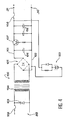
- the electrical device to be protected, terminal or microcomputer is referenced by 1 and the protection device 2 is enclosed in a housing 3 embedded in a wall 4 or applied to this wall.
- the apparatus 1 is supplied by a power cord 6 which passes through the housing 3 before reaching the sector 7, and it is also also connected to the housing 3 by a loop cable 8.
- the two systems that are will describe below verify respectively the continuity of the power cord 6 between the housing 3 and the apparatus 1 and that of the looped cable 8. If one wishes to steal the apparatus 1, it is necessary to interrupt the continuity of these two cables.
- the apparatus shown in Figure 1 is therefore redundant and only one of the two systems it contains is sufficient.
- the housing 3 is moreover provided with protections which give the alarm as soon as an attempt is made to tear it from the wall 4 or to open it. These protections are known in themselves and do not form part of the invention.
- the power cord 6 consists of two parallel wires 21 and 22, one of which 21 carries a fuse 23 and an ordinary rectifier bridge 24, composed of diodes.
- the two wires 21 and 22 are also joined by four parallel lines carrying respectively a varistor 25, a relay 26 and, inside the device 1 to be protected, a constant resistance 27 and an input resistance in series with the switch 19 of the device 1.
- the resistor 27 is necessary because otherwise, with the protection device which will be described, any interruption of the operation of the device 1 by opening the switch 19 would interrupt the passage of the current in cord 6 and would be taken for an attempted theft.
- Switches 61 controlled by the relay 26, make it possible to interrupt or reestablish simultaneously the connection of the wires 21 and 22 with the mains supply.
- a photodiode 28 is arranged in parallel with the rectifier bridge 24. It is optically coupled to a phototransistor 29 whose emitter is connected to ground 30 and the collector to a continuous supply 31 via a resistor 32.
- the voltage taken from the collector of the phototransistor 29, after having been amplified by the assembly 35, is applied to the base of a transistor 34.
- the purpose of the assembly 35 is to ensure more stable operation of the device. It successively comprises a CMOS inverter 36, a diode 37, a capacitor 38 connected to ground 30, a resistor 39 connected to ground 30, a second CMOS inverter 40 and a diode 41.
- the base of transistor 34 is connected to an assembly 35 ′ analogous to assembly 35, which is also connected to power supply 31 and to a set of Zener diode 55, capacitor 56.
- the transistor 34 has its emitter connected to the DC power supply 31 and its collector connected to the ground through an excitation coil 57 of an alarm control relay 58, which is connected to an alarm circuit 60.
- the latter is connected to a special electricity source and includes an audible warning or an indicator light on an alarm center.
- the relay 26 ceases to be energized and switches 61 arrive at the position shown in solid lines.
- the wire 21 and the wire 22 are connected by lines 155 and 156 respectively to the input of the assembly 35 ′ and to the ground 30.
- the assembly 35 ′ brings a zero to the base of the transistor 34, which saturates the transistor 34 and the coil 57 is excited. There is therefore no nuisance alarm.
- the photodiode 28 emits sufficient light to make the phototransistor 29 passing even with a current of low intensity in the wires 21 and 22.
- the resistance 27 can therefore be high, which avoids consuming excessive energy in these circumstances.
- the cable 8 is formed by several loops in series of the same wire connected at one end to the continuous supply 31 and to the other to the ground 30.
- the continuity of the cable 8 is ensured by two plugs called "Canon" 70 on the surface of the housing 3.
- a part of the cable 8, between the sockets 70, is included in the device 1 to be protected.
- the protection system here implements a circuit 71 formed of a resistor 72 and a potentiometer 73 in series between the continuous supply 31 and the ground 30.
- a resistor 74 of the same value as the resistor 72 is also installed on the end of the cable 8 close to the continuous supply 31.
- a differential amplifier 75 has two input terminals 76 and 77.
- the output terminal 78 of the amplifier 75 is connected to the base of a transistor 79 by means of a diode 80.
- a second circuit 71 ′ is provided (provided with a second potentiometer 73 ′), a second amplifier 75 ′ and a second diode 80 ′ in parallel on the first circuit.
- the second amplifier 75 ′ subtracts the voltage detected on the circuit 71 ′ from that detected on the cable 8.
- the emitter of transistor 79 is connected to DC power supply 31 via an excitation coil 84 of a relay 85.
- the collector of transistor 79 is connected to ground 30.
- the relay 85 controls a circuit alarm 87.
- a capacitor 82 and a resistor 83 can also be installed on parallel lines ending between the diodes 80 and the transistor 79 on the one hand, the ground 30 on the other hand.
- the voltages applied to the inputs 76 and 77 are different.
- the voltage at the output 78 of one of the amplifiers 75 is non-zero and blocks the transistor 79.
- the coil 84 ceases to be energized, the alarm control circuit 87 opens and the alarm occurs.
- the other amplifier 75 ′ has no influence because of the diodes 80: no current can flow to it.
- the continuous supply 31 can be made as shown in FIG. 4.
- the source of electricity, referenced 99, is connected to the sector 7 and supplies an alternating current.
- the power supply cable 100 is formed by two parallel wires 101 and 102 between which there is, in parallel, successively a varistor 103, a transformer 104, a diode rectifier bridge 105, capacitors 106 and a regulator 107.
- a fuse 108 is also provided. Finally, a DC voltage of 13.7 volts is obtained.
- a backup battery 109 constituting an auxiliary supply, is also provided and its terminals are connected to the wires 101 and 102.
- the DC power supply 31 can serve as auxiliary power to several alarm control circuits in parallel, each of which monitors a different device to be protected.
Landscapes
- Physics & Mathematics (AREA)
- General Physics & Mathematics (AREA)
- Burglar Alarm Systems (AREA)
- Fittings On The Vehicle Exterior For Carrying Loads, And Devices For Holding Or Mounting Articles (AREA)
- Push-Button Switches (AREA)
- Braking Arrangements (AREA)
Priority Applications (1)
| Application Number | Priority Date | Filing Date | Title |
|---|---|---|---|
| AT89402220T ATE91817T1 (de) | 1988-08-04 | 1989-08-04 | Anordnung um ein elektrisches geraet vor diebstahl zu schuetzen. |
Applications Claiming Priority (2)
| Application Number | Priority Date | Filing Date | Title |
|---|---|---|---|
| FR8810575 | 1988-08-04 | ||
| FR8810575A FR2635212B1 (fr) | 1988-08-04 | 1988-08-04 | Dispositif de protection d'un appareil electrique contre le vol |
Publications (3)
| Publication Number | Publication Date |
|---|---|
| EP0357482A2 true EP0357482A2 (de) | 1990-03-07 |
| EP0357482A3 EP0357482A3 (en) | 1990-03-28 |
| EP0357482B1 EP0357482B1 (de) | 1993-07-21 |
Family
ID=9369131
Family Applications (1)
| Application Number | Title | Priority Date | Filing Date |
|---|---|---|---|
| EP89402220A Expired - Lifetime EP0357482B1 (de) | 1988-08-04 | 1989-08-04 | Anordnung um ein elektrisches Gerät vor Diebstahl zu schützen |
Country Status (4)
| Country | Link |
|---|---|
| EP (1) | EP0357482B1 (de) |
| AT (1) | ATE91817T1 (de) |
| DE (1) | DE68907674D1 (de) |
| FR (1) | FR2635212B1 (de) |
Cited By (6)
| Publication number | Priority date | Publication date | Assignee | Title |
|---|---|---|---|---|
| DE9311034U1 (de) * | 1993-07-23 | 1993-09-30 | ESE Elektronische Sicherungsanlagen Entwicklungsgesellschaft mbH, 41469 Neuss | Diebstahlsicherung für Computer |
| FR2694636A1 (fr) * | 1992-08-04 | 1994-02-11 | Transec Sa | Dispositif de surveillance de la connexion d'un appareil électrique avec une source d'alimentation. |
| EP0584540A1 (de) * | 1992-07-27 | 1994-03-02 | Transec S.A. | Einrichtung zur Überwachung der Verbindung eines elektrischen Apparates mit einer Versorgungsquelle |
| US5406260A (en) * | 1992-12-18 | 1995-04-11 | Chrimar Systems, Inc. | Network security system for detecting removal of electronic equipment |
| FR2748139A1 (fr) * | 1996-04-30 | 1997-10-31 | Metallerie Ducrest | Procede de detection et son dispositif de mise en oeuvre destine a detecter le vol d'appareils et plus particulierement le vol d'appareils informatiques |
| US8155012B2 (en) | 1998-04-10 | 2012-04-10 | Chrimar Systems, Inc. | System and method for adapting a piece of terminal equipment |
Family Cites Families (5)
| Publication number | Priority date | Publication date | Assignee | Title |
|---|---|---|---|---|
| DE1274014B (de) * | 1966-11-12 | 1968-07-25 | Continental Instr Corp | Alarmvorrichtung zur Sicherung elektrischer Geraete gegen Diebstahl |
| US4300130A (en) * | 1979-10-29 | 1981-11-10 | Fotheringham Robert K | Anti-theft alarm circuit and compatible warning plugs |
| GB2158277B (en) * | 1983-11-03 | 1987-07-01 | Raymond John Corton | Continuous security alarm for current consuming equipments |
| AU536411B3 (en) * | 1984-02-23 | 1984-06-07 | Ronald Arthur Collins | Theft deterrent device for valuables |
| NL8502493A (nl) * | 1985-09-11 | 1987-04-01 | Elektrotechnisch Installatiebu | Stelsel voor het tegen diefstal beveiligen van elektrische toestellen, en voor dit stelsel bestemde wandcontactdoos. |
-
1988
- 1988-08-04 FR FR8810575A patent/FR2635212B1/fr not_active Expired - Fee Related
-
1989
- 1989-08-04 AT AT89402220T patent/ATE91817T1/de not_active IP Right Cessation
- 1989-08-04 DE DE8989402220T patent/DE68907674D1/de not_active Expired - Lifetime
- 1989-08-04 EP EP89402220A patent/EP0357482B1/de not_active Expired - Lifetime
Cited By (11)
| Publication number | Priority date | Publication date | Assignee | Title |
|---|---|---|---|---|
| EP0584540A1 (de) * | 1992-07-27 | 1994-03-02 | Transec S.A. | Einrichtung zur Überwachung der Verbindung eines elektrischen Apparates mit einer Versorgungsquelle |
| FR2694636A1 (fr) * | 1992-08-04 | 1994-02-11 | Transec Sa | Dispositif de surveillance de la connexion d'un appareil électrique avec une source d'alimentation. |
| US5406260A (en) * | 1992-12-18 | 1995-04-11 | Chrimar Systems, Inc. | Network security system for detecting removal of electronic equipment |
| DE9311034U1 (de) * | 1993-07-23 | 1993-09-30 | ESE Elektronische Sicherungsanlagen Entwicklungsgesellschaft mbH, 41469 Neuss | Diebstahlsicherung für Computer |
| FR2748139A1 (fr) * | 1996-04-30 | 1997-10-31 | Metallerie Ducrest | Procede de detection et son dispositif de mise en oeuvre destine a detecter le vol d'appareils et plus particulierement le vol d'appareils informatiques |
| US8155012B2 (en) | 1998-04-10 | 2012-04-10 | Chrimar Systems, Inc. | System and method for adapting a piece of terminal equipment |
| US8902760B2 (en) | 1998-04-10 | 2014-12-02 | Chrimar Systems, Inc. | Network system and optional tethers |
| US8942107B2 (en) | 1998-04-10 | 2015-01-27 | Chrimar Systems, Inc. | Piece of ethernet terminal equipment |
| US9019838B2 (en) | 1998-04-10 | 2015-04-28 | Chrimar Systems, Inc. | Central piece of network equipment |
| US9049019B2 (en) | 1998-04-10 | 2015-06-02 | Chrimar Systems, Inc. | Network equipment and optional tether |
| US9812825B2 (en) | 1998-04-10 | 2017-11-07 | Chrimar Systems, Inc. | Ethernet device |
Also Published As
| Publication number | Publication date |
|---|---|
| EP0357482B1 (de) | 1993-07-21 |
| DE68907674D1 (de) | 1993-08-26 |
| FR2635212B1 (fr) | 1994-07-08 |
| FR2635212A1 (fr) | 1990-02-09 |
| ATE91817T1 (de) | 1993-08-15 |
| EP0357482A3 (en) | 1990-03-28 |
Similar Documents
| Publication | Publication Date | Title |
|---|---|---|
| EP1100226B1 (de) | Verfahren zur Fernspeisung eines Endgerätes in einem lokalen Netz | |
| EP0094871B1 (de) | Elektronisches Relais zur Lichtbogendetektion | |
| FR2585158A1 (fr) | Systeme de surveillance de conditions dangereuses | |
| FR2842663A1 (fr) | Dispositif de surveillance de rupture de neutre et de terre, et appareil de coupure electrique comportant un tel dispositif | |
| FR3055495A1 (fr) | Procede et dispositif de circuit pour couper une source de tension d'au moins un consommateur | |
| EP0357482B1 (de) | Anordnung um ein elektrisches Gerät vor Diebstahl zu schützen | |
| EP0060790B1 (de) | Fehlerstromempfindliche Ausschalter | |
| FR2773921A1 (fr) | Interrupteur de protection contre les courants de fuite | |
| EP0524300A1 (de) | Vorrichtung zum schutz von elektrischen geräten, maschinen und anlagen | |
| FR2643195A1 (fr) | Procede et dispositif de protection d'un circuit ou reseau electrique a l'aide d'un disjoncteur a courant differentiel | |
| FR2520165A1 (fr) | Interrupteur differentiel a usage domestique | |
| EP0180506B1 (de) | Sicherheitseinrichtung für Differenzstromschutzgerät | |
| EP0814555B1 (de) | Differentialschutz | |
| FR2704686A1 (fr) | Procédé et dispositif de sécurisation d'un point de distribution d'énergie, notamment une prise électrique, et appareillages électriques incluant ce dispositif. | |
| EP0614259B1 (de) | Differenzstromschalter zum Schutz gegen Fehlerströme und Überspannungen | |
| EP0851554B1 (de) | Schutzschalter mit Vorrichtung zum Steueren des Öffnens und elektrische Verteilervorrichtung mit solchem Schalter | |
| FR2759512A1 (fr) | Procede et dispositif de telesurveillance de postes de drainage, ou de drainage de courants telesurveille, fonctionnant sur ouvrage metallique soumis a l'influence de courants vagabons | |
| FR2470466A1 (fr) | Dispositif de protection contre les surtensions | |
| FR2775847A1 (fr) | Dispositifs de protection differentielle, appareil electrique et installation electrique comportant un tel dispositif | |
| FR3124269A3 (fr) | Dispositif de détection de vol de câbles | |
| EP0851327B1 (de) | Elektrisches Gerät mit Steuerungseingabe | |
| EP3511970B1 (de) | Elektrischer schalter mit einem detektor welcher informationen über die auslösung des schalters in einen bus einspeist | |
| FR2659744A1 (fr) | Dispositif de detection de defauts d'isolement electrique pour installation sous tension. | |
| EP0755107A1 (de) | Nachrichtenkreis für Fehlermeldung und zugehöriges Testmodul | |
| FR2786040A1 (fr) | Dispositif de protection differentielle |
Legal Events
| Date | Code | Title | Description |
|---|---|---|---|
| PUAI | Public reference made under article 153(3) epc to a published international application that has entered the european phase |
Free format text: ORIGINAL CODE: 0009012 |
|
| PUAL | Search report despatched |
Free format text: ORIGINAL CODE: 0009013 |
|
| AK | Designated contracting states |
Kind code of ref document: A2 Designated state(s): AT BE CH DE ES FR GR IT LI LU NL SE |
|
| AK | Designated contracting states |
Kind code of ref document: A3 Designated state(s): AT BE CH DE ES FR GR IT LI LU NL SE |
|
| 17P | Request for examination filed |
Effective date: 19900903 |
|
| 17Q | First examination report despatched |
Effective date: 19920708 |
|
| GRAA | (expected) grant |
Free format text: ORIGINAL CODE: 0009210 |
|
| RAP1 | Party data changed (applicant data changed or rights of an application transferred) |
Owner name: FRANCE TELECOM |
|
| AK | Designated contracting states |
Kind code of ref document: B1 Designated state(s): AT BE CH DE ES FR GR IT LI LU NL SE |
|
| PG25 | Lapsed in a contracting state [announced via postgrant information from national office to epo] |
Ref country code: IT Free format text: LAPSE BECAUSE OF FAILURE TO SUBMIT A TRANSLATION OF THE DESCRIPTION OR TO PAY THE FEE WITHIN THE PRE;WARNING: LAPSES OF ITALIAN PATENTS WITH EFFECTIVE DATE BEFORE 2007 MAY HAVE OCCURRED AT ANY TIME BEFORE 2007. THE CORRECT EFFECTIVE DATE MAY BE DIFFERENT FROM THE ONE RECORDED.SCRIBED TIME-LIMIT Effective date: 19930721 Ref country code: GR Free format text: LAPSE BECAUSE OF FAILURE TO SUBMIT A TRANSLATION OF THE DESCRIPTION OR TO PAY THE FEE WITHIN THE PRESCRIBED TIME-LIMIT Effective date: 19930721 Ref country code: AT Effective date: 19930721 Ref country code: DE Effective date: 19930721 Ref country code: ES Free format text: THE PATENT HAS BEEN ANNULLED BY A DECISION OF A NATIONAL AUTHORITY Effective date: 19930721 Ref country code: NL Effective date: 19930721 Ref country code: SE Effective date: 19930721 |
|
| REF | Corresponds to: |
Ref document number: 91817 Country of ref document: AT Date of ref document: 19930815 Kind code of ref document: T |
|
| REF | Corresponds to: |
Ref document number: 68907674 Country of ref document: DE Date of ref document: 19930826 |
|
| EPTA | Lu: last paid annual fee | ||
| NLV1 | Nl: lapsed or annulled due to failure to fulfill the requirements of art. 29p and 29m of the patents act | ||
| PLBE | No opposition filed within time limit |
Free format text: ORIGINAL CODE: 0009261 |
|
| STAA | Information on the status of an ep patent application or granted ep patent |
Free format text: STATUS: NO OPPOSITION FILED WITHIN TIME LIMIT |
|
| 26N | No opposition filed | ||
| PGFP | Annual fee paid to national office [announced via postgrant information from national office to epo] |
Ref country code: BE Payment date: 19940728 Year of fee payment: 6 |
|
| PGFP | Annual fee paid to national office [announced via postgrant information from national office to epo] |
Ref country code: LU Payment date: 19940801 Year of fee payment: 6 |
|
| PGFP | Annual fee paid to national office [announced via postgrant information from national office to epo] |
Ref country code: CH Payment date: 19940829 Year of fee payment: 6 Ref country code: FR Payment date: 19940829 Year of fee payment: 6 |
|
| PG25 | Lapsed in a contracting state [announced via postgrant information from national office to epo] |
Ref country code: LU Free format text: LAPSE BECAUSE OF NON-PAYMENT OF DUE FEES Effective date: 19950804 |
|
| PG25 | Lapsed in a contracting state [announced via postgrant information from national office to epo] |
Ref country code: CH Effective date: 19950831 Ref country code: BE Effective date: 19950831 Ref country code: LI Effective date: 19950831 |
|
| BERE | Be: lapsed |
Owner name: FRANCE TELECOM Effective date: 19950831 |
|
| REG | Reference to a national code |
Ref country code: CH Ref legal event code: PL |
|
| PG25 | Lapsed in a contracting state [announced via postgrant information from national office to epo] |
Ref country code: FR Effective date: 19960430 |
|
| REG | Reference to a national code |
Ref country code: FR Ref legal event code: ST |