EP0357557A2 - Synergistische Mischung - Google Patents
Synergistische Mischung Download PDFInfo
- Publication number
- EP0357557A2 EP0357557A2 EP89810629A EP89810629A EP0357557A2 EP 0357557 A2 EP0357557 A2 EP 0357557A2 EP 89810629 A EP89810629 A EP 89810629A EP 89810629 A EP89810629 A EP 89810629A EP 0357557 A2 EP0357557 A2 EP 0357557A2
- Authority
- EP
- European Patent Office
- Prior art keywords
- chloroacetyl
- dimethylaniline
- methylaniline
- ethyl
- alkyl
- Prior art date
- Legal status (The legal status is an assumption and is not a legal conclusion. Google has not performed a legal analysis and makes no representation as to the accuracy of the status listed.)
- Withdrawn
Links
- 0 CCCC(CC1CC1)(C1)C1C(C(CC)C*C1CCC1)C1C(C2)C2CC1 Chemical compound CCCC(CC1CC1)(C1)C1C(C(CC)C*C1CCC1)C1C(C2)C2CC1 0.000 description 2
Classifications
-
- A—HUMAN NECESSITIES
- A01—AGRICULTURE; FORESTRY; ANIMAL HUSBANDRY; HUNTING; TRAPPING; FISHING
- A01N—PRESERVATION OF BODIES OF HUMANS OR ANIMALS OR PLANTS OR PARTS THEREOF; BIOCIDES, e.g. AS DISINFECTANTS, AS PESTICIDES OR AS HERBICIDES; PEST REPELLANTS OR ATTRACTANTS; PLANT GROWTH REGULATORS
- A01N43/00—Biocides, pest repellants or attractants, or plant growth regulators containing heterocyclic compounds
- A01N43/48—Biocides, pest repellants or attractants, or plant growth regulators containing heterocyclic compounds having rings with two nitrogen atoms as the only ring hetero atoms
-
- A—HUMAN NECESSITIES
- A01—AGRICULTURE; FORESTRY; ANIMAL HUSBANDRY; HUNTING; TRAPPING; FISHING
- A01N—PRESERVATION OF BODIES OF HUMANS OR ANIMALS OR PLANTS OR PARTS THEREOF; BIOCIDES, e.g. AS DISINFECTANTS, AS PESTICIDES OR AS HERBICIDES; PEST REPELLANTS OR ATTRACTANTS; PLANT GROWTH REGULATORS
- A01N37/00—Biocides, pest repellants or attractants, or plant growth regulators containing organic compounds containing a carbon atom having three bonds to hetero atoms with at the most two bonds to halogen, e.g. carboxylic acids
- A01N37/18—Biocides, pest repellants or attractants, or plant growth regulators containing organic compounds containing a carbon atom having three bonds to hetero atoms with at the most two bonds to halogen, e.g. carboxylic acids containing the group —CO—N<, e.g. carboxylic acid amides or imides; Thio analogues thereof
Definitions
- the invention relates to a synergistic agent containing a herbicidal active ingredient combination.
- the agent according to the invention is particularly suitable for selective weed control in crops.
- the invention also relates to a method for controlling weeds in crops.
- N-chloroacetylcyclohexenamines known from US Pat. No. 4,351,667, EP-A-13,429 and EP-A-0 113 030. These compounds are also selective herbicides which do not always satisfy in their potency, duration of action and in their range of use in the weeds to be controlled. In particular, these N-chloroacetylcyclohexenamines cannot satisfy their long-term effects.
- This synergistic combination is suitable for controlling the most important weeds without harming the crop.
- an increase in long-term effects is observed in some field weeds.
- the invention relates to a new herbicidal composition for selective weed control comprising a chloroacetanilide of the formula I as active ingredient wherein R1 and R2 are independently hydrogen; Halogen; C1-C4 alkyl; C i -C4 alkoxy; C1-C4 haloalkyl; or C1-C4 alkoxy-C1-C4 alkyl; Z is hydrogen; Halogen; or C1-C4 alkyl; Y is C1-C6 alkylene; R3 C1-C4 alkoxy; C3-C4 alkenyloxy; Cyano; C1-C4 alkoxycarbonyl; C1-C4-alkyl-CO-NH-; (R4) 2N-CO-; Benzoyl; Halobenzoyl; a 1,3-oxadiazol-2-yl, 1,3-dioxolan-2-yl, furan-2-yl, tetrahydrofuran-2-yl, 1,
- Alkyl methyl, ethyl, n-propyl, i-propyl, n-butyl, sec-butyl, i-butyl and tert-butyl; preferably methyl, ethyl and i-propyl.
- Halogen fluorine, chlorine, bromine and iodine; preferably fluorine, chlorine and bromine; particularly preferably fluorine and chlorine.
- Haloalkyl fluoromethyl, difluoromethyl, trifluoromethyl, chloromethyl, dichloromethyl, trichloromethyl, 2,2,2-trifluoroethyl, 2-fluoroethyl, 2-chloroethyl and 2,2,2-trichloroethyl.
- Alkoxy methoxy, ethoxy, propyloxy, i-propyloxy, n-butyloxy, i-butyloxy, s-butyloxy and t-butyloxy.
- Alkoxycarbonyl methoxycarbonyl, ethoxycarbonyl, n-propyloxycarbonyl, i-propyloxycarbonyl and n-butyloxycarbonyl; preferably methoxycarbonyl and ethoxycarbonyl.
- Halogenbenzoyl chlorobenzoyl, especially 4-chlorobenzoyl.
- C1-C6 alkylene methylene, 1,2-ethylene, 1,1-ethylene, 1-methyl-1,2-ethylene, 1-ethyl-1,2-ethylene, 2-methyl-1,2-ethylene, 1- (1-methylethyl) -1,2-ethylene, 2- (1-methylethyl) -1,2-ethylene, 1,2-dimethyl-1,2-ethylene.
- C3-C4-alkenyloxy in these radicals the double bond is preferably bound allylic to the oxygen atom, ie allyloxy and but-2-enyloxy.
- Preferred compounds of the formula I are the compounds in which R1 hydrogen; Chlorine; C1-C4 alkyl; Methoxy; or trifluoromethyl; R2 is hydrogen; Methyl; or ethyl; Z is hydrogen; or methyl; Y methylene; 1,2-ethylene; 1-methyl-1,2-ethylene; 2-methyl-1,2-ethylene; 1-ethyl-1,2-ethylene; 1- (1-methylethyl) -1,2-ethylene; or 1,2-dimethyl-1,2-ethylene; R3 C1-C4 alkoxy; Allyloxy; Cyano; C1-C2 alkoxycarbonyl; Acetylamino; N-allylcarbamoyl; N, N-dimethylcarbamoyl; Benzoyl; 4-chlorobenzoyl; 1,3-oxadiazol-2-yl; 1,3-dioxolan-2-yl; Furan-2-yl; Tetrahydrofuran-2-yl; 1,3,4-ox
- N-chloroacetyl-N-methoxymethyl-2,6-diethylaniline alachlor
- N-chloroacetyl-N- (2-methoxy-1-methylethyl) -2-ethyl-6-methylaniline metalolachlor
- N-chloroacetyl-N- (1H-pyrazol-1-ylmethyl) -2,6-dimethylaniline metalazachlor
- Preferred N-chloroacetylcyclohexenamines are the compounds of the formula II in which R5 C1-C4-alkyl, or C3-C4-alkenyl, and R6, R7, R8 and R9 independently of one another are hydrogen or C1-C2-alkyl.
- R5 C1-C4-alkyl, or C3-C4-alkenyl, and R6, R7, R8 and R9 independently of one another are hydrogen or methyl.
- N-isopropyl-N-chloroacetylcyclohex-1-enamine N-isopropyl-N-chloroacetyl-3 (5) -methylcyclohex-1-enamine, N-isopropyl-N-chloroacetyl-3,5,5 (3) -trimethylcyclohex-1-enamine (trimexachlor), N-isopropyl-N-chloroacetyl-3,3,5,5-tetramethylcyclohex-1-enamine and N-allyl-N-chloroacetyl-3,3,5,5-tetramethylcyclohex-1-enamine, but especially N-isopropyl-N-chloroacetyl-3,5,5 (3) -trimethylcyclohex-1-enamine (trimexachlor).
- crop plants are all plants which produce crops in some form, such as seeds, roots, stems, tubers, leaves, flowers, and furthermore ingredients, such as oil, sugar, starch, protein, etc., and are grown for this purpose .
- These plants include, for example, all types of cereals, such as wheat, rye, barley and oats, as well as rice, sorghum, corn, cotton, sugar beet, peanuts, sugar cane, soybeans, beans, sunflowers and peas.
- the active ingredient combination according to the invention is suitable for controlling weeds in maize, rice, sorghum, soybean, sugar beet, cotton, sunflower and peanut crops.
- the active substance combinations according to the invention can be used both pre- and post-emergent.
- the seed of the crop can be used with a herbicidally effective amount of the active compound combination according to the invention tion are treated (seed dressing). When sowing the useful plants, the active compound combination according to the invention is thus applied.
- the application rates of the individual compounds I and II are significantly reduced while the effectiveness remains the same.
- the combined mixture still achieves a high degree of weed control where both individual compounds have become completely ineffective in the area of excessively low application rates. This results in a substantial broadening of the weed spectrum and an additional increase in the safety margin on the respective crop, as is necessary and desirable for unintentional drug overdose. It has also been found that the long-term effects of the mixture exceed that of the individual components in some weeds.
- the optimum mixing ratio of the individual active ingredient components for the desired application can be determined by biological tests.
- the ratios of the individual active ingredient components can vary depending on the type of weed to be combated and depending on the particular form of application.
- the mixing ratio can thus be freely selected in a wide range, mixtures of the compounds of the formula I with those of the formula II are preferred in which the weight ratio of the individual components I: II varies from 5: 1 to 1: 5.
- the range from 2: 1 to 1: 2 is particularly preferred.
- Particularly noteworthy are mixtures of equivalent or nearly equivalent (such as in the range 1.5: 1 to 1: 1.5) parts by weight of both active ingredient components.
- the active compound combinations according to the invention have a balanced action against weeds without appreciably influencing the crop of useful plants at 0.1 to 5.0 kg, preferably 0.25 to 4.0 kg, of active compound applied per hectare.
- the formulations i.e. the agents, preparations or compositions containing the active substance mixture according to the invention and optionally a solid or liquid additive are prepared in a known manner, e.g. by intimately mixing and / or grinding the active ingredients with extenders, e.g. with solvents or other liquids in which the active ingredients are dispersible, solid carriers and optionally surface-active compounds (surfactants).
- extenders e.g. with solvents or other liquids in which the active ingredients are dispersible, solid carriers and optionally surface-active compounds (surfactants).
- Possible solvents or dispersants are: aromatic hydrocarbons, preferably fractions C8 to C12, such as Xylene mixtures or substituted naphthalenes, phthalic acid esters such as dibutyl or dioctyphthalate, aliphatic hydrocarbons such as cyclohexane or paraffins, alcohols and glycols, and their ethers and esters, such as ethanol, ethylene glycol, ethylene glycol monomethyl or ethyl ether, ketones such as cyclohexane, such as cyclohexane -2-pyrrolidone, dimethyl sulfoxide or dimethylformamide, and optionally epoxidized vegetable oils such as epoxidized coconut oil or soybean oil; or water.
- aromatic hydrocarbons preferably fractions C8 to C12, such as Xylene mixtures or substituted naphthalenes, phthalic acid esters such as dibutyl or dioctyphthalate, alipha
- Natural rock flours such as calcite, talc, kaolin, montmorillonite or attapulgite, are generally used as solid carriers, for example for dusts and dispersible powders.
- highly disperse silica or highly disperse absorbent polymers can also be added.
- Porous types such as pumice, broken brick, sepiolite or bentonite can be used as granular, adsorptive granulate carriers, and non-sorptive carrier materials, such as calcite or sand.
- a large number of pregranulated materials of inorganic or organic nature such as, in particular, dolomite or comminuted plant residues, such as, for example, cork flour or sawdust, can be used.
- Particularly advantageous, application-promoting additives which can lead to a large reduction in the application rate, are also natural (animal or vegetable) or synthetic phospholipids from the range of the cephalins and lecithins, such as e.g. Phosphatidylethanolamine, phosphatidylserine, phosphtidylcholine, sphingomyelin, phosphatidylinositol, phosphatidylglycerol, lysolecithin, plasmalogens or cardiolipin, which can be obtained, for example, from animal or plant cells, in particular brain, heart, lungs, liver, egg yolk or soybeans.
- Commercial mixtures that can be used are e.g. Phosphatidylcholine mixtures.
- Synthetic phospholipids are e.g. Dioctanoylphosphatidylcholine and dipalmititoylphosphatidylcholine.
- Suitable surface-active compounds are nonionic, cationic and / or anionic surfactants with good emulsifying, dispersing and wetting properties. Surfactants are also to be understood as mixtures of surfactants.
- Suitable anionic surfactants can be both so-called water-soluble soaps and water-soluble synthetic surface-active compounds.
- soaps are the alkali, alkaline earth or optionally substituted ammonium salts of higher fatty acids (C10-C22), e.g. the Na or K salts of oleic or stearic acid, or of natural fatty acid mixtures, e.g. can be obtained from coconut or tallow oil.
- the fatty acid methyl taurine salts should also be mentioned.
- the fatty sulfonates or sulfates are generally present as alkali, alkaline earth or optionally substituted ammonium salts and have an alkyl radical with 8 to 22 carbon atoms, alkyl also including the alkyl part of acyl radicals, for example the sodium or calcium salt lignin sulfonic acid, dodecylsulfuric acid ester or a fatty alcohol sulfate mixture made from natural fatty acids.
- This subheading also includes the salts of sulfuric acid esters and sulfonic acids of fatty alcohol ethylene oxide adducts.
- the sulfonated benzimidazole derivatives preferably contain 2-sulfonic acid groups and a fatty acid residue with 8-22 carbon atoms.
- alkylarylsulfonates are the sodium, calcium or triethanolamine salts of dodecylbenzenesulfonic acid, 2-dibutylnaphthalenesulfonic acid, or a naphthalenesulfonic acid / formaldehyde condensation product.
- Corresponding phosphates such as e.g. Salts of the phosphoric acid ester of a p-nonylphenol (4-14) ethylene oxide adduct in question.
- Suitable nonionic surfactants are primarily polyglycol ether derivatives of aliphatic or cycloaliphatic alcohols, saturated or unsaturated fatty acids and alkylphenols, which can contain 3 to 30 glycol ether groups and 8 to 20 carbon atoms in the (aliphatic) hydrocarbon radical and 6 to 18 carbon atoms in the alkyl radical of the alkylphenols.
- nonionic surfactants are the water-soluble polyethylene oxide adducts containing 20 to 250 ethylene glycol ether groups and 10 to 100 propylene glycol ether groups with polypropylene glycol, ethylene diaminopolypropylene glycol and alkyl polypropylene glycol with 1 to 10 carbon atoms in the alkyl chain.
- the compounds mentioned usually contain 1 to 5 ethylene glycol units per propylene glycol unit.
- nonionic surfactants are nonylphenol polyethoxyethanols, castor oil polyglycol ethers, polypropylene-polyethylene oxide adducts, tributylphenoxypolyethoxyethanol, polyethylene glycol and octylphenoxypolyethoxyethanol.
- Fatty acid esters of polyoxyethylene sorbitan such as polyoxyethylene sorbitan trioleate, are also suitable.
- the cationic surfactants are primarily quaternary ammonium salts which contain at least one alkyl radical having 8 to 22 carbon atoms as N substituents and lower, optionally halogenated alkyl, benzyl or lower hydroxyalkyl as further substituents have leftovers.
- the salts are preferably in the form of halides, methyl sulfates or ethyl sulfates, for example stearyltrimethylammonium chloride or benzyldi (2-chloroethyl) ethylammonium bromide.
- the agrochemical preparations generally contain 0.1 to 95%, in particular 0.1 to 80%, active ingredient mixture of the formulas I and II 1 to 99.9% of a solid or liquid additive and 0 to 25%, in particular 0.1 to 25% of a surfactant.
- the use forms can be diluted down to 0.001% of active ingredient.
- the combinations according to the invention can also be formulated as microcapsules in accordance with EP-A-0 281 521 published on September 7, 1988.
- biocidal active substances or agents can be added to the agents according to the invention described.
- the new agents can be e.g. Insecticides, fungicides, bactericides, fungistatic agents, bacteriostatics or nematicides contain to broaden the spectrum of activity.
- agents according to the invention can generally be formulated according to the following examples:
- Spray powder a) b) c) d) Active ingredient of formula I. 10% 20% 15% 30% Active ingredient of formula II 10% 40% 5% 30% Na lignin sulfonate 5% 5% 5% 5% Na lauryl sulfate 3% - 3% - Na diisobutylnaphthalenesulfonate - 6% - 6% Octylphenol polyethylene glycol ether 7-8 mol AeO) - 2% - 2% Fumed silica 5% 27% 5% 27% kaolin 67% - 67% -
- the mixture of active ingredients is mixed well with the additives and ground well in a suitable mill.
- Spray powder is obtained which can be diluted with water to form suspensions of any desired concentration.
- emulsion concentrate a) b) c) d) e) Active ingredient of formula I.
- Emulsions of any desired concentration can be prepared from these concentrates by dilution with water. c) dusts a) b) c) d) Active ingredient of formula I. 2% 4% 2% 8th % Active ingredient of formula II 3% 4% 4% 4% talc 95% - 94% - kaolin - 92% - 88%
- Ready-to-use dusts are obtained by mixing the active ingredient mixture with the carrier and grinding it in a suitable mill.
- extruder granules a) b) c) Active ingredient of formula I. 5% 3% 10% Active ingredient of formula II I 5% 7% 10% Na lignin sulfonate 2% 2% 2% Carboxymethyl cellulose 1 % 1 % 1 % kaolin 87% 87% 77%
- the finely ground mixture of active ingredients is intimately mixed with the additives. This gives a suspension concentrate from which suspensions of any desired concentration can be prepared by dilution with water.
- a herbicide always has a synergistic effect if the herbicidal action of the active compound combinations I and II is greater than the sum of the action of the individually applied active compounds.
- the expected herbicidal activity WE for a given combination of two herbicides can be calculated as follows (cf. COLBY, SR, "Calculating synergistic and antagonistic response of herbicide combinations", Weeds 15, pages 20-22, 1967):
- Y percent growth inhibition when treated with a herbicide II with q kg application rate per hectare compared to the untreated control
- WE expected herbicidal activity (percent growth inhibition compared to the untreated control) after treatment with herbicide mixtures I and II at an application rate of p + q kg of active ingredient per hectare.
- the plant seeds are sown in plastic pots containing 0.5 l soil in the greenhouse.
- the herbicides are applied individually or as a tank mix of 2 products after sowing but before the plants emerge.
- the biological activity is rated as a percentage of weed control in comparison to untreated control plants 21 days after application. Colby's formula is used to determine whether the mixtures achieve a synergistic effect compared to the individual products.
- Example B2 Preemergent experiment, long-term action against echinochloa
- the pots After a single application of the active ingredient or mixture of active ingredients to active soil, the pots are left at room temperature and Echinochloa crus galli is sown immediately after application and at weekly intervals thereafter. The effect on the plant of the respective sowing is evaluated 2 weeks after sowing in% activity compared to the untreated control.
Landscapes
- Life Sciences & Earth Sciences (AREA)
- Agronomy & Crop Science (AREA)
- Pest Control & Pesticides (AREA)
- Plant Pathology (AREA)
- Health & Medical Sciences (AREA)
- Engineering & Computer Science (AREA)
- Dentistry (AREA)
- General Health & Medical Sciences (AREA)
- Wood Science & Technology (AREA)
- Zoology (AREA)
- Environmental Sciences (AREA)
- Agricultural Chemicals And Associated Chemicals (AREA)
Abstract
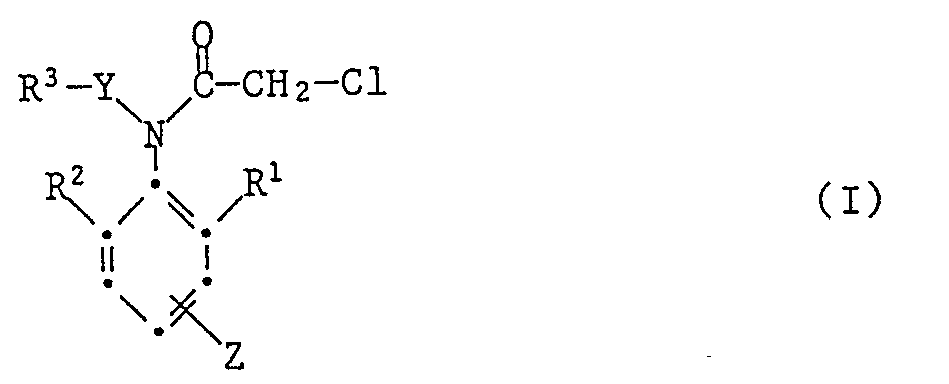
R¹ und R² unabhängig voneinander Wasserstoff; Halogen; C₁-C₄-Alkyl; C₁-C₄-Alkoxy; C₁-C₄-Halogenalkyl; oder C₁-C₄-Alkoxy-C₁-C₄-alkyl;
Z Wasserstoff; Halogen; oder C₁-C₄-Alkyl;
Y C₁-C₆-Alkylen;
R³ C₁-C₄-Alkoxy; C₃-C₄-Alkenyloxy; Cyano; C₁-C₄-Alkoxycarbonyl; C₁-C₄-Alkyl-CO-NH-; (R⁴)₂N-CO-; Benzoyl; Halogenbenzoyl; einen gegebenenfalls bis zu zweifach gleich oder verschieden durch C₁-C₄-Alkyl substituiertes 1,3-Oxadiazol-2-yl, 1,3-Dioxolan-2-yl, Furan-2-yl, Tetrahydrofuran-2-yl, 1,3,4-Oxadiazol-2-yl, Pyrazol-1-yl, 1,2,4-Triazol-1-yl oder 1,2,4-Triazol-3-yl; (C₁-C₄-Alkoxy)₂CH-; C₁-C₄-Alkyl; Ethinyl; oder 4-Methyl-5-methylthio-1,2,4-triazol-3-yl;
R⁴ unabhängig voneinander je Wasserstoff, C₁-C₄-Alkyl; C₁-C₄-Alkenyl; oder C₁-C₄-Alkinyl bedeutet
neben einer synergistisch wirksamen Menge eines N-Chloracetylcyclohexenamins der Formel II
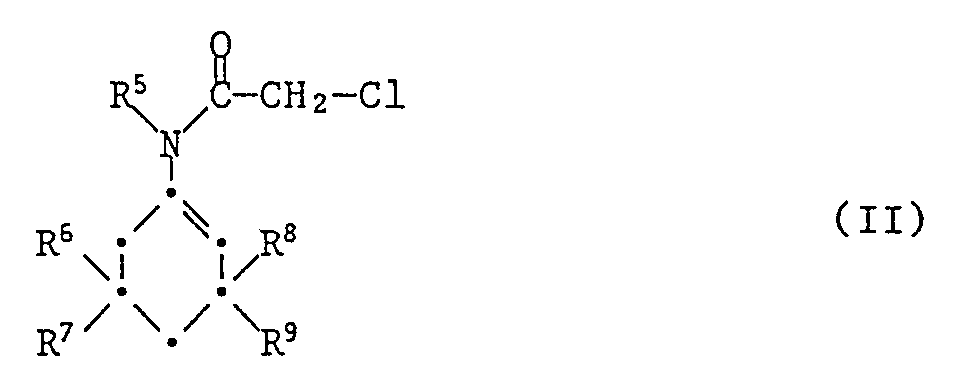
R⁵ C₁-C₆-Alkyl; oder C₃-C₆-Alkenyl; und
R⁶, R⁷, R⁸ und R⁹ unabhängig voneinander Wasserstoff; oder C₁-C₄-Alkyl;
bedeutet.
Description
- Die Erfindung betrifft ein synergistisches Mittel, eine herbizide Wirkstoffkombination enthaltend. Das erfindungsgemässe Mittel eignet sich insbesondere zur selektiven Unkrautbekämpfung in Nutzpflanzenkulturen.
- Die Erfindung betrifft auch ein Verfahren zur Bekämpfung von Unkräutern in Nutzpflanzenkulturen.
- Es sind bereits zahlreiche herbizid wirksame Verbindungen aus der Klasse der Chloracetanilide bekannt geworden. Eine Zusammenstellung dieser Verbindungsklasse findet man bei R. Wegler, Chemie der Pflanzenschutz- und Schädlingsbekämpfungsmittel, Springer Verlag, Berlin, Heidelberg, New York, Bd. 2 (1970) Seite 311 ff., Bd. 5 (1977) Seite 244 ff. und Bd. 8 (1982) Seite 90 ff. und Seite 310 ff. Diese Verbindungen befriedigen nicht immer im Hinblick auf ihre Wirkungsstärke, Wirkungsdauer und die Anwendungsbreite bei den zu bekämpfenden Ackerunkräutern.
- Eine weitere Klasse herbidiz wirksamer Acetylamine sind die aus der US-Patentschrift US-4 351 667, EP-A-13 429 und der EP-A-0 113 030 bekannt gewordenen N-Chloracetylcyclohexenamine. Auch diese Verbindungen sind Selektivherbizide, die nicht immer in ihrer Wirkungsstärke, Wirkungsdauer und in ihrer Anwendungsbreite bei den zu bekämpfenden Ackerunkräutern befriedigen. Insbesondere können diese N-Chloracetylcyclohexenamine nicht in ihrer Dauerwirkung befriedigen.
- Es hat sich nun überraschenderweise gezeigt, dass eine mengenmässig variable Kombination von Wirkstoffen aus der Klasse der Chloracetanilide mit Wirkstoffen aus der Klasse der N-Chloracetylcyclohexenamine eine synergistische Wirkung entfaltet, die in vorteilhafter Weise der Bekämpfung von Unkräutern in Nutzpflanzenkulturen geeignet ist.
- Diese synergistische Kombination ist zur Bekämpfung der wichtigsten Unkräuter geeignet, ohne dass dabei die Kulturpflanze geschädigt wird. Darüber hinaus wird bei einigen Ackerunkräutern eine Steigerung der Dauerwirkung beobachtet.
- Die Erfindung betrifft ein neues herbizides Mittel zur selektiven Unkrautbekämpfung enthaltend als Wirkstoff ein Chloracetanilid der Formel I

R¹ und R² unabhängig voneinander Wasserstoff; Halogen; C₁-C₄-Alkyl; Ci-C₄-Alkoxy; C₁-C₄-Halogenalkyl; oder C₁-C₄-Alkoxy-C₁-C₄-alkyl;
Z Wasserstoff; Halogen; oder C₁-C₄-Alkyl;
Y C₁-C₆-Alkylen;
R³ C₁-C₄-Alkoxy; C₃-C₄-Alkenyloxy; Cyano; C₁-C₄-Alkoxycarbonyl; C₁-C₄-Alkyl-CO-NH-; (R⁴)₂N-CO-; Benzoyl; Halogenbenzoyl; einen gegebenenfalls bis zu zweifach gleich oder verschieden durch C₁-C₄-Alkyl substituiertes 1,3-Oxadiazol-2-yl, 1,3-Dioxolan-2-yl, Furan-2-yl, Tetrahydrofuran-2-yl, 1,3,4-Oxadiazol-2-yl, Pyrazol-1-yl, 1,2,4-Triazol-1-yl oder 1,2,4-Triazol-3-yl; (C₁-C₄-Alkoxy)₂CH-; C₁-C₄-Alkyl; Ethinyl; oder 4-Methyl-5-methylthio-1,2,4-triazol-3-yl;
R⁴ unabhängig voneinander je Wasserstoff, C₁-C₄-Alkyl; C₁-C₄-Alkenyl; oder C₁-C₄-Alkinyl bedeutet
neben einer synergistisch wirksamen Menge eines N-Chloracetylcyclohexenamins der Formel II
R⁵ C₁-C₆-Alkyl; oder C₃-C₆-Alkenyl; und
R⁶, R⁷, R⁸ und R⁹ unabhängig voneinander Wasserstoff; oder C₁-C₄-Alkyl;
bedeutet. - In den in dieser Beschreibung verwendeten Definitionen umfassen die angegebenen generischen Begriffe, sowie die durch Kombination einzelner Unterbegriffe erhältlichen Substituenten, beispielsweise die folgenden spezifischen Einzelsubstituenten, wobei diese Aufzählung keine Einschränkung der Erfindung darstellt:
Alkyl: Methyl, Ethyl, n-Propyl, i-Propyl, n-Butyl, sek-Butyl, i-Butyl und tert-Butyl; vorzugsweise Methyl, Ethyl und i-Propyl.
Halogen: Fluor, Chlor, Brom und Jod; vorzugsweise Fluor, Chlor und Brom; besonders bevorzugt Fluor und Chlor.
Halogenalkyl: Fluormethyl, Difluormethyl, Trifluormethyl, Chlormethyl, Dichlormethyl, Trichlormethyl, 2,2,2-Trifluorethyl, 2-Fluorethyl, 2-Chlorethyl und 2,2,2-Trichlorethyl.
Alkoxy: Methoxy, Ethoxy, Propyloxy, i-Propyloxy, n-Butyloxy, i-Butyloxy, s-Butyloxy und t-Butyloxy.
Alkoxycarbonyl: Methoxycarbonyl, Ethoxycarbonyl, n-Propyloxycarbonyl, i-Propyloxycarbonyl und n-Butyloxycarbonyl; vorzugsweise Methoxycarbonyl und Ethoxycarbonyl.
Halogenbenzoyl: Chlorbenzoyl, insbesondere 4-Chlorbenzoyl.
C₁-C₆-Alkylen: Methylen, 1,2-Ethylen, 1,1-Ethylen, 1-Methyl-1,2-ethylen, 1-Ethyl-1,2-ethylen, 2-Methyl-1,2-ethylen, 1-(1-Methylethyl)-1,2-ethylen, 2-(1-Methylethyl)-1,2-ethylen, 1,2-Dimethyl-1,2-ethylen.
C₃-C₄-Alkenyloxy: in diesen Resten ist die Doppelbindung vorzugsweise allylisch zum Sauerstoffatom gebunden, also Allyloxy und But-2-enyloxy. - Bevorzugt sind als Verbindungen der Formel I die Verbindungen, in denen
R¹ Wasserstoff; Chlor; C₁-C₄-Alkyl; Methoxy; oder Trifluormethyl;
R² Wasserstoff; Methyl; oder Ethyl;
Z Wasserstoff; oder Methyl;
Y Methylen; 1,2-Ethylen; 1-Methyl-1,2-ethylen; 2-Methyl-1,2-ethylen; 1-Ethyl-1,2-ethylen; 1-(1-Methylethyl)-1,2-ethylen; oder 1,2-Dimethyl-1,2-ethylen;
R³ C₁-C₄-Alkoxy; Allyloxy; Cyano; C₁-C₂-Alkoxycarbonyl; Acetylamino; N-Allylcarbamoyl; N,N-Dimethylcarbamoyl; Benzoyl; 4-Chlorbenzoyl; 1,3-Oxadiazol-2-yl; 1,3-Dioxolan-2-yl; Furan-2-yl; Tetrahydrofuran-2-yl; 1,3,4-Oxadiazol-2-yl, Pyrazol-1-yl; 3,5-Dimethyl-pyrazol-1-yl; 1,2,4-Triazol-1-yl; 5-Methyl-1,3,4-oxadiazol-2-yl; 4-Methyl-5-methylthio-1,2,4-triazol-3-yl; Isopropyl; Ethinyl; oder (Ethoxy)₂CH;
bedeutet. - Als einzelne Vertreter der Chloracetanilide der Formel I seien die folgenden hervorgehoben
N-Ethoxymethyl-N-chloracetyl-2-ethyl-6-methylanilin,
N-Chloracetyl-N-methoxymethyl-2,6-diethylanilin (Alachlor),
N-Chloracetyl-N-(2-methoxyethyl)-2,6-dimethylanilin,
N-(2-Allyloxyethyl)-N-chloracetyl-2,6-dimethylanilin,
N-Chloracetyl-N-(2-n-propoxyethyl)-2,6-dimethylanilin,
N-Chloracetyl-N-(2-isopropoxyethyl)-2,6-dimethylanilin,
N-Chloracetyl-N-(2-methoxyethyl)-2-ethyl-6-methylanilin,
N-Chloracetyl-N-(methoxyethyl)-2,6-diethylanilin,
N-(2-Ethoxyethyl)-N-chloracetyl-2-ethyl-6-methylanilin,
N-Chloracetyl-N-(2-methoxy-1-methylethyl)-2-methylanilin,
N-Chloracetyl-N-(2-methoxy-1-methylethyl)-2,6-dimethylanilin,
N-Chloracetyl-N-(2-methoxy-1-methylethyl)-2,6-diethylanilin,
N-Chloracetyl-N-(2-methoxy-1-methylethyl-2-ethyl-6-methylanilin (Metolachlor),
N-(2-Ethoxyethyl)-N-chloracetyl-2,6-diethylanilin,
N-Chloracetyl-N-(2-n-propoxyethyl)-2-ethyl-6-methylanilin,
N-Chloracetyl-N-(2-n-propoxyethyl)-2,6-diethylanilin,
N-Chloracetyl-N-(2-isopropoxyethyl)-2-ethyl-6-methylanilin,
N-Ethoxycarbonylmethyl-N-chloracetyl-2,6-dimethylanilin,
N-Ethoxycarbonylmethyl-N-chloracetyl-2,6-diethylanilin,
N-Chloracetyl-N-methoxycarbonylmethyl-2,6-dimethylanilin,
N-Chloracetyl-N-(2,2-diethoxyethyl)-2,6-dimethylanilin,
N-Chloracetyl-N-(2-methoxy-1-methylethyl)-2,3-dimethylanilin,
N-(2-Ethoxyethyl)-N-chloracetyl-2-methylanilin,
N-Chloracetyl-N-(2-methoxyethyl)-2-methylanilin,
N-Chloracetyl-N-(2-methoxy-2-methylethyl)-2,6-dimethylanilin,
N-(2-Ethoxy-2-methylethyl)-N-chloracetyl-2-ethyl-6-methylanilin,
N-Chloracetyl-N-(1-ethyl-2-methoxyethyl)-2,6-dimethylanilin,
N-Chloracetyl-N-(2-methoxyethyl)-2-methoxy-6-methylanilin,
N-n-Butoxymethyl-N-chloracetyl-2-tert.-butylanilin,
N-(2-Ethoxyethyl-1-methylethyl)-N-chloracetyl-2,6-dimethylanilin,
N-Chloracetyl-N-(2-methoxyethyl)-2-chlor-6-methylanilin,
N-(2-Ethoxyethyl)-N-chloracetyl-2-chlor-6-methylanilin,
N-(2-Ethoxyethyl)-N-chloracetyl-2,3,6-trimethylanilin,
N-Chloracetyl-N-(2-methoxyethyl)-2,3,6-trimethylanilin,
N-Chloracetyl-N-cyanomethyl-2,6-dimethylanilin,
N-But-3-in-1-yl-N-chloracetylanilin,
N-Chloracetyl-N-propargyl-2-ethyl-6-methylanilin,
N-Chloracetyl-N-(1,3-dioxolan-2-ylmethyl)-2,6-dimethylanilin,
N-Chloracetyl-N-(1,3-dioxolan-2-ylmethyl)-2-ethyl-6-methylanilin,
N-Chloracetyl-N-(1,3-dioxan-2-ylmethyl)-2-ethyl-6-methylanilin,
N-Chloracetyl-N-(2-fuanylmethyl)-2,6-dimethylanilin,
N-Chloracetyl-N-(furanylmethyl)-2-ethyl-6-methylanilin,
N-Chloracetyl-N-(2-tetrahydrofuranylmethyl)-2,6-dimethylanilin,
N-Chloracetyl-N-(N-propargylcarbamoylmethyl)-2,6-dimethylanilin,
N-Chloracetyl-N-(N,N-dimethylcarbamoylmethyl)-2,6-dimethylanilin,
N-(n-Butoxymethyl)-N-chloracetyl-2,6-diethylanilin,
N-(2-n-Butoxyethyl)-N-chloracetyl-2,6-diethylanilin,
N-Chloracetyl-N-(2-methoxy-1,2-dimethylethyl)-2,6-dimethylanilin,
N-Chloracetyl-N-isopropyl-2,3-dimethylanilin,
N-Chloracetyl-N-isopropyl-2-chloranilin,
N-Chloracetyl-N-(1H-pyrazol-1-ylmethyl)-2,6-dimethylanilin (Metazachlor),
N-Chloracetyl-N-(1H-pyrazol-1-ylmethyl)-2-ethyl-6-methylanilin,
N-Chloracetyl-N-(1H-1,2,4-triazol-1-ylmethyl)-2,6-dimethylanilin,
N-Chloracetyl-N-(1H-1,2,4-triazol-1-ylmethyl)-2,6-diethylanilin,
N-Benzoylmethyl-N-chloracetyl-2,6-dimethylanilin,
N-Benzoylmethyl-N-chloracetyl-2-ethyl-6-methylanilin,
N-Chloracetyl-N-(5-methyl-1,3,4-oxadiazol-2-yl)-2,6-diethylanilin,
N-Chloracetyl-N-(5-methyl-1,3,4-oxadiazol-2-yl)-2-ethyl-6-methylanilin,
N-Chloracetyl-N-(5-methyl-1,3,4-oxadiazol-2-yl)-2-tert.butylanilin,
N-Chloracetyl-N-(4-chlorbenzoylmethyl)-2,6-dimethylanilin,
N-Chloracetyl-N-(1-methyl-5-methylthio-1,3,4-triazol-2-ylmethyl)-2,6-diethylanilin,
N-Chloracetyl-N-ethoxymethyl-6-methyl-2-trifluormethylanilin (Harmony) und
N-Chloracetyl-N-acetamidomethyl-2,6-diethylanilin (Amidochlor). - Besonders bevorzugt sind
N-Chloracetyl-N-methoxymethyl-2,6-diethylanilin (Alachlor),
N-Chloracetyl-N-(2-methoxy-1-methylethyl)-2-ethyl-6-methylanilin (Metolachlor) und
N-Chloracetyl-N-(1H-pyrazol-1-ylmethyl)-2,6-dimethylanilin (Metazachlor). - Als N-Chloracetylcyclohexenamine sind die Verbindungen der Formel II bevorzugt, worin
R⁵ C₁-C₄-Alkyl, oder C₃-C₄-Alkenyl, und
R⁶, R⁷, R⁸ und R⁹ unabhängig voneinander Wasserstoff oder C₁-C₂-Alkyl bedeutet. - Hervorzuheben sind die Verbindungen der Formel II worin
R⁵ C₁-C₄-Alkyl, oder C₃-C₄-Alkenyl, und
R⁶, R⁷, R⁸ und R⁹ unabhängig voneinander Wasserstoff oder Methyl bedeutet. - Besonders bevorzugt sind
N-Isopropyl-N-chloracetylcyclohex-1-enamin,
N-Isopropyl-N-chloracetyl-3(5)-methylcyclohex-1-enamin,
N-Isopropyl-N-chloracetyl-3,5,5(3)-trimethylcyclohex-1-enamin (Trimexachlor),
N-Isopropyl-N-chloracetyl-3,3,5,5-tetramethylcyclohex-1-enamin und
N-Allyl-N-chloracetyl-3,3,5,5-tetramethylcyclohex-1-enamin,
insbesondere aber
N-Isopropyl-N-chloracetyl-3,5,5(3)-trimethylcyclohex-1-enamin (Trimexachlor). - Als Kulturpflanzen gelten im Rahmen vorliegender Erfindung alle Pflanzen, die in irgendeiner Form Ertragsstoffe, wie Samen, Wurzeln, Stengel, Knollen, Blätter, Blüten, ferner Inhaltsstoffe, wie Oele, Zucker, Stärke, Eiweiss usw., produzieren und zu diesem Zweck angebaut werden. Zu diesen Pflanzen gehören beispielsweise sämtliche Getreidearten, wie Weizen, Roggen, Gerste und Hafer, daneben vor allem Reis, Sorghum, Mais, Baumwolle, Zuckerrüben, Erdnüsse, Zuckerrohr, Soja, Bohnen, Sonnenblumen und Erbsen.
- Insbesondere ist die erfindungsgemässe Wirkstofkombination zur Bekämpfung von Unkräutern in Mais-, Reis-, Sorghum-, Soja-, Zuckerrüben-, Baumwoll-, Sonnenblumen- und Erdnuss-Kulturen geeignet.
- Für die vorstehend genannten Zielkulturen sind die Kombinationen der als Einzelverbindungen genannten Halogenacetanilide der Formel I und der als Einzelverbindungen genannten N-Chloracetylcyclohexenamine der Formel II in besonderem Masse geeignet.
- Besonders hervorzuheben sind nachstehende Kombinationen:
- a) N-Chloracetyl-N-methoxymethyl-2,6-diethylanilin und N-Isopropyl-N-chloracetyl-3,5,5(3)-trimethylcyclohex-1-enamin,
- b) N-Chloracetyl-N-(2-methoxy-1-methylethyl)-2-ethyl-6-methylanilin und N-Isopropyl-N-chloracetyl-2,5,5(3)-trimethylcyclohex-1-enamin und
- c) N-Chloracetyl-N-(1H-pyrazol-1-ylmethyl)-2,6-dimethylanilin und N-Isopropyl-N-chloracetyl-3,5,5(3)-trimethylcyclohex-1-enamin.
- Die erfindungsgemässen Wirkstoffkombinationen können sowohl pre- als auch postemergent verwendet werden. Ausserdem kann das Saatgut der Nutzpflanze mit einer herbizid wirksamen Menge erfindungsgemässen Wirkstoffkombina tion behandelt werden (Samenbeizung). Bei der Aussaat der Nutzpflanzen wird so die erfindungsgemässe Wirkstoffkombination ausgebracht.
- Es ist in hohem Masse überraschend, dass die Kombination des Wirkstoffs der Formel I mit einem Wirkstoff der Formel II nicht nur eine prinzipiell zu erwartende additive Ergänzung des Wirkungsspektrums auf die üblichen mit der jeweiligen Kulturpflanze vergesellschafteten Unkräuter hervorruft, sondern dass sie einen synergistischen Effekt erzielt, der die Wirkungsgrenzen der miteinander kombinierten Aktivsubstanzen unter zwei Aspekten erweitert.
- Einmal werden die Aufwandmengen der Einzelverbindungen I und II bei gleichbleibend guter Wirkung deutlich gesenkt. Zum anderen erzielt die kombinierte Mischung auch dort noch einen hohen Grad der Unkraut-Bekämpfung, wo beide Einzelverbindungen im Bereich allzu geringer Aufwandmengen völlig wirkungslos geworden sind. Dies hat eine wesentliche Verbreiterung des Unkrautsprektrums und eine zusätzliche Erhöhung der Sicherheitsmarge auf die jeweilige Kulturpflanze zur Folge, wie sie für unbeabsichtigte Wirkstoffüberdosierung notwendig und erwünscht ist. Ausserdem wurde gefunden, dass bei einigen Unkräutern die Langzeitwirkung der Mischung die der Einzelkomponenten übersteigt.
- Das für die gewünschte Anwendung optimale Mischungsverhältnis der einzelnen Wirkstoffkomponenten kann durch biologische Versuche ermittelt werden. Dabei können die Verhältnisse der einzelnen Wirkstoffkomponenten je nach Art des zu bekämpfenden Unkrauts und in Abhängigkeit von der jeweiligen Applikationsform variieren.
Obwohl somit das Mischungsverhältnis in weiten Bereichen frei gewählt werden kann, sind Mischungen der Verbindungen der Formel I mit solchen der Formel II bevorzugt, in denen das Gewichtsverhältnis der Einzelkomponenten I:II von 5:1 bis 1:5 variiert.
Besonders bevorzugt ist der Bereich von 2:1 bis 1:2. Besonders hervorzuheben sind Mischungen äquivalenter oder nahezu äquivalenter (wie etwa im Bereich 1,5:1 bis 1:1,5) Gewichtsteile beider Wirkstoffkomponenten. - Die erfindungsgemässen Wirkstoffkombinationen zeigen eine ausgeichnete Wirkung gegen Unkräuter, ohne die Nutzpflanzenkultur nennenswert zu beeinflussen bei 0,1 bis 5,0 kg vorzugsweise 0,25 bis 4,0 kg Aufwandmenge Aktivsubstanz je Hektar.
- Die Formulierungen, d.h. die das erfindungsgemässe Wirkstoffgemisch und gegebenenfalls einen festen oder flüssigen Zusatzstoff enthaltenden Mittel, Zubereitungen oder Zusammensetzungen werden in bekannter Weise hergestellt, z.B. durch innniges Vermischen und/oder Vermahlen der Wirkstoffe mit Streckmitteln, wie z.B. mit Lösungsmitteln oder andere Flüssigkeiten, in denen die Wirkstoffe dispergierbar sind, festen Trägerstoffen und gegebenenfalls oberflächenaktiven Verbindungen (Tensiden).
- Als Lösungs- oder Dispergiermittel können in Frage kommen: Aromatische Kohlenwasserstoffe, bevorzugt die Fraktionen C₈ bis C₁₂, wie z.B. Xylolgemische oder substituierte Naphthaline, Phthalsäureester wie Dibutyl- ode Dioctyphthalat, aliphatische Kohlenwaserstoffe wie Cyclohexan oder Paraffine, Alkohole und Glykole sowie deren Aether und Ester, wie Aethanol, Aethylenglykol, Aethylenglykolmonomethyl- oder -äthyläther, Ketone wie Cyclohexanon, stark polare Lösungsmittel wie N-Methyl-2-pyrrolidon, Dimethylsulfoxid oder Dimethylformamid, sowie gegebenenfalls epoxidierte Pflanzenöle wie epoxidiertes Kokosnussöl oder Sojaöl; oder Wasser.
- Als feste Trägerstoffe, z.B. für Stäubemittel und dispergierbare Pulver, werden in der Regel natürliche Gesteinsmehle vewendet, wie Calcit, Talkum, Kaolin, Montmorillonit oder Attapulgit. Zur Verbesserung der physikalischen Eigenschaften können auch hochdisperse Kieselsäure oder hochdisperse saugfähige Polymerisate zugesetzt werden. Als gekörnte, adsorptive Granulatträger kommen poröse Typen wie z.B. Bimsstein, Ziegelbruch, Sepiolit oder Bentonit, als nicht sorptive Trägermaterialien z.B. Calcit oder Sand in Frage. Darüberhinaus kann eine Vielzahl von vorgranulierten Materilien anorganischer oder organischer Natur wie insbesondere Dolomit oder zerkleinerte Pflanzenrückstände, wie z.B. Korkmehl oder Sägemehl, verwendet werden.
- Besonders vorteilhafte, applikationsfördernde Zusatzstoffe, die zu einer starken Reduktion der Aufwandmenge führen können, sind ferner natürliche (tierische oder pflanzliche) oder synthetische Phospholipide aus der Reihe der Kephaline und Lecithine, wie z.B. Phosphatidyläthanolamin, Phosphatidylserin, Phosphtidylcholin, Sphingomyelin, Phosphatidylinosit, Phosphatidylglycerin, Lysolecithin, Plasmalogene oder Cardiolipin, die man beispielsweise aus tierischen oder pflanzlichen Zellen, insbesondere Hirn, Herz, Lunge, Leber, Eidotter oder Sojabohnen gewinnen kann. Verwendbare Handelsmischungen sind z.B. Phosphatidylcholin-Mischungen. Synthetische Phospholipide sind z.B. Dioctanoylphosphatidylcholin und Dipalmititoylphosphatidylcholin.
- Als oberflächenaktive Verbindungen kommen nichtionogene, kation-und/oder anionaktive Tenside in guten Emulgier-, Dispergier- und Netzeigenschaften in Betracht. Unter Tensiden sind auch Tensidgemische zu verstehen.
- Geeignete anionische Tenside können sowohl sogenannte wasserlösliche Seifen, als auch wasserlösliche synthetische oberflächenaktive Verbindungen sein.
- Als Seifen seien die Alkali-, Erdalkali- oder gegebenenfalls substituierten Ammoniumsalze von höheren Fettsäuren (C₁₀-C₂₂), wie z.B. die Na- oder K-Salze der Oel- oder Stearinsäure, oder von natürlichen Fettsäuregemischen, die z.B. aus Kokosnuss- oder Talgöl gewonnen werden können, genannt. Ferner sind auch die Fettsäuremethyl-taurinsalze zu erwähnen.
- Häufiger werden jedoch sogenannte synthetische Tenside verwendet, insbesondere Fettsulfonate, Fettsulfate, sulfonierte Benzimidazolderivate oder Alkylarylsulfonate.
- Die Fettsulfonate oder -sulfate liegen in der Regel als Alkali-, Erdalkali- oder gegebenenfalls substituierte Ammoniumsalze vor und weisen einen Alkylrest mit 8 bis 22 C-Atomen auf, wobei Alkyl auch den Alkylteil von Acylresten einschliesst, z.B. das Na- oder Ca-Salz der Ligninsulfonsäure, des Dodecylschwefelsäureesters oder eines aus natürlichen Fettsäuren hergestellten Fettalkoholsulfatgemisches. Hierher gehören auch die Salze der Schwefelsäureester und Sulfonsäuren von Fettalkohol-Aethylen oxid-Addukten. Die sulfonierten Benzimidazolderivate enthalten vorzugsweise 2-Sulfonsäuregruppen und einen Fettsäurerest mit 8-22 C-Atomen. Alkylarylsulfonate sind z.B. die Na-, Ca- oder Triäthanolaminsalze der Dodecylbenzolsulfonsäure, 2er Dibutylnaphthalinsulfonsäure, oder eines Naphthalinsulfonsäure-Formaldehydkondensationsproduktes.
- Ferner kommen auch entsprechende Phosphate wie z.B. Salze des Phosphorsäureesters eines p-Nonylphenol-(4-14)-Aethylenoxid-Adduktes in Frage.
- Als nichtionische Tenside kommen in erster Linie Polyglykolätherderivate von aliphatischen oder cycloaliphatischen Alkoholen, gesättigten oder ungesättigten Fettsäuren und Alkylphenolen in Frage, die 3 bis 30 Glykoläthergruppen und 8 bis 20 Kohlenstoffatome im (aliphatischen) Kohlenwasserstoffrest und 6 bis 18 Kohlenstoffatome im Alkylrest der Alkylphenole enthalten können.
- Weitere geeignete nichtionische Tenside sind die wasserlöslichen, 20 bis 250 Aethylenglykoläthergruppen und 10 bis 100 Propylenglykoläthergruppen enthaltenden Polyäthylenoxidaddukte an Polypropylenglykol, Aethylendiaminopolypropylenglykol und Alkylpolypropylenglykol mit 1 bis 10 Kohlenstoffatomen in der Alkylkette. Die genannten Verbindungen enthalten üblicherweise pro Propylenglykol-Einheit 1 bis 5 Aethylenglykoleinheiten.
- Als Beispiele nichtionischer Tenside seien Nonylphenolpolyäthoxyäthanole, Ricinusölpolyglykoläther, Polypropylen-Polyäthylenoxidaddukte, Tributylphenoxypolyäthoxyäthanol, Polyäthylenglykol und Octylphenoxypolyäthoxyäthanol erwähnt.
- Ferner kommen auch Fettsäureester von Polyoxyäthylensorbitan wie das Polyoxyäthylensorbitan-trioleat in Betracht.
- Bei den kationischen Tensiden handelt es sich vor allem um quartäre Ammoniumsalze, welche als N-Substituenten mindestens einen Alkylrest mit 8 bis 22 C-Atomen enthalten und als weitere Substituenten niedrige, gegebenenfalls halogenierte Alkyl-, Benzyl- oder niedrige Hydroxyalkyl reste aufweisen. Die Salze liegen vorzugsweise als Halogenide, Methylsulfate oder Aethylsulfate vor, z.B. das Stearyltrimethylammoniumchlorid oder das Benzyldi(2-chloräthyl)äthyl-ammoniumbromid.
- Die in der Formulierungstechnik gebräuchlichen Tenside sind u.a. in folgenden Publikationen beschreiben:
"1985 International Mc Cutcheon's Emulsifiers & Detergents", Glen Rock NJ USA, 1985",
"H. Stache, "Tensid-Taschenbuch", 2. Aufl., C. Hanser Verlag München, Wien 1981,
M. and J. Ash. "Encyclopedia of Surfactants", vol. I-III, Chemical Publishing Co., New York, 1980-1981. - Die agrochemischen Zubereitungen enthalten in der Regel 0,1 bis 95 %, insbesondere 0,1 bis 80 %, Wirkstoffgemisch der Formeln I und II 1 bis 99,9 % eines festen oder flüssigen Zusatzstoffes und 0 bis 25 %, insbesondere 0,1 bis 25 % eines Tensides.
- Insbesondere setzen sich bevorzugte Formulierungen folgendermassen zusammen: (% = Gewichtsprozent)
Emulgierbare Konzentrate Aktives Wirkstoffgemisch: 1 bis 20 %, bevorzugt 5 bis 10 % oberflächenaktives Mittel: 5 bis 30 %, vorzugsweise 10 bis 20 % flüssiges Trägermittel: 50 bis 94 %, vorzugsweise 70 bis 85 % Stäube: Aktives Wirkstoffgemisch: 0,1 bis 10 %, vorzugsweise 0,1 bis 1 % festes Trägermittel: 99,9 bis 90 %, vorzugsweise 99,9 bis 99 %. Suspension-Konzentrate Aktives Wirkstoffgemisch: 5 bis 75 %, vorzugsweise 10 bis 50 % Wasser: 94 bis 25 %, vorzugsweise 88 bis 30 % oberflächenaktives Mittel: 1 bis 40 %, vorzugsweise 2 bis 30 % Benetzbare Pulver Aktives Wirkstoffgemisch: 0,5 bis 90 %, vorzugsweise 1 bis 80 % oberflächenaktives Mittel: 0,5 bis 20 %, vorzugsweise 1 bis 15 % festes Trägermaterial: 5 bis 95 %, vorzugsweise 15 bis 90 % Granulate aktives Wirkstoffgemisch: 0,5 bis 30 %, vorzugsweise 3 bis 15 % festes Trägermittel: 99,5 bis 70 %, vorzugsweise 97 bis 85 %. - Während als Handelsware eher konzentrierte Mittel bevorzugt werden, verwendet der Endverbraucher in der Regel verdünnte Mittel. Die Anwendungsformen können bis hinab zu 0,001 % an Wirkstoff verdünnt werden.
- Neben den hier genannten bevorzugten Formulierungen als emulgierbare Konzentrate, Stäube, Suspensionskonzentrate, benetzbare Pulver und Granulate, können die erfindungsgemässen Kombinationen auch als Mikrokapseln gemäss der am 07.09.1988 veröffentlichten EP-A-0 281 521 formuliert werden.
- Den beschriebenen erfindungsgemässen Mitteln lassen sich andere biozide Wirkstoffe oder Mittel beimischen. So können die neuen Mittel ausser den genannten Verbindungen der allgemeinen Formel I und der Formeln II z.B. Insektizide, Fungizide, Bakterizide, Fungistatika, Bakteriostatika oder Nematizide zur Verbreiterung des Wirkungsspektrums enthalten.
- Im Einzelnen lassen sich die erfindungsgemässen Mittel allgemein nach den folgenden Beispielen formulieren:
-
a) Spritzpulver a) b) c) d) Wirkstoff der Formel I 10 % 20 % 15 % 30 % Wirkstoff der Formel II 10 % 40 % 5 % 30 % Na-Ligninsulfonat 5 % 5 % 5 % 5 % Na-Laurylsulfat 3 % - 3 % - Na-Diisobutylnaphthalinsulfonat - 6 % - 6 % Octylphenolpolyäthylenglykoläther 7-8 Mol AeO) - 2 % - 2 % Hochdisperse Kieselsäure 5 % 27 % 5 % 27 % Kaolin 67 % - 67 % - - Das Wirkstoffgemisch wird mit den Zusatzstoffen gut vermischt und in einer geeigneten Mühle gut vermahlen. Man erhält Spritzpulver, die sich mit Wasser zu Suspensionen jeder gewünschten Konzentration verdünnen lassen.
b) Emulsions-Konzentrat a) b) c) d) e) Wirkstoff der Formel I 5 % 15 % 12 % 25 % 30 % Wirkstoff der Formel II 5 % 10 % 13 % 25 % 30 % Octylphenolpolyäthylenglykoläther (4-5 Mol AeO) 3 % 3 % 3 % 3 % 3 % Ca-Dodecylbenzolsulfonat 3 % 3 % 2 % 5 % 5 % Ricinusölpolyglykoläther (36 Mol AeO) 4 % 4 % 4 % 4 % 4 % Cyclohexanon 30 % 30 % 31 % 15 % 10 % Xylolgemisch 50 % 35 % 35 % 13 % 8 % - Aus diesen Konzentraten können durch Verdünnen mit Wasser Emulsionen jeder gewünschten Konzentration hergestellt werden.
c) Stäubemittel a) b) c) d) Wirkstoff der Formel I 2 % 4 % 2 % 8 % Wirkstoff der Formel II 3 % 4 % 4 % 4 % Talkum 95 % - 94 % - Kaolin - 92 % - 88 % - Man erhält anwendungsfertige Stäubemittel, indem das Wirkstoffgemisch mit dem Träger vermischt und auf einer geeigneten Mühle vermahlen wird.
d) Extruder Granulat a) b) c) Wirkstoff der Formel I 5 % 3 % 10 % Wirkstoff der Formel II I 5 % 7 % 10 % Na-Ligninsulfonat 2 % 2 % 2 % Carboxymethylcellulose 1 % 1 % 1 % Kaolin 87 % 87 % 77 % - Das Wirkstoffgemisch wird mit den Zusatzstoffen vermischt, vermahlen und mit Wasser angefeuchtet. Dieses Gemisch wird extrudiert und anschliessend im Luftstrom getrocknet.
e) Umhüllungs-Granulat a) b) Wirkstoff der Formel I 1,5 % 3 % Wirkstoff der Formel II 1,5 % 5 % Polyäthylenglykol (MG 200) 3 % 3 % Kaolin 94 % 89 % - Das fein gemahlene Wirkstoffgemisch wird in einem Mischer auf das mit Polyäthylenglykol angefeuchtete Kaolin gleichmässig aufgetragen. Auf diese Weise erhält man staubfreie Umhüllungs-Granulate.
f) Suspensions-Konzentrat a) b) c) Wirkstoff der Formel I 20 % 20 % 40 % Wirkstoff der Formel II 20 % 40 % 20 % Aethylenglykol 10 % 10 % 10 % Nonylphenolpolyäthylenglykoläther (15 Mol AeO) 6 % 6 % 6 % Na-Ligninsulfonat 10 % 10 % 10 % Carboxymethylcellulose 1 % 1 % 1 % 37 %ige wässrige Formaldehyd-Lösung 0,2 % 0,2 % 0,2 % Silikonöl in Form einer 75 %igen wässrigen Emulsion 0,8 % 0,8 % 0,8 % Wasser 32 % 12 % 12 % - Das fein gemahlene Wirkstoffgemisch wird mit den Zusatzstoffen innig vermischt. Man erhält so ein Suspensions-Konzentrat, aus welchem durch Verdünnen mit Wasser Suspensionen jeder gewünschten Konzentration hergestellt werden können.
- Ein synergistischer Effekt liegt bei Herbiziden immer dann vor, wenn die herbizide Wirkung der Wirkstoffkombination I und II grösser ist als die Summe der Wirkung der einzeln applizierten Wirkstoffe.
- Die zu erwartende herbizide Wirkung WE für eine gegebene Kombination zweier Herbizide kann (vgl. COLBY, S.R., "Calculating synergistic and antagonistic response of herbicide combinations", Weeds 15, Seiten 20-22, 1967) wie folgt berechnet werden:

- Dabei bedeuten:
X = Prozent Wachstumshemmung bei Behandlung mit einem Herbizid I mit p kg Aufwandmenge pro Hektar im Vergleich zur unbehandelten Kontrolle (= 0 %).
Y = Prozent Wachstumshemmung bei Behandlung mit einem Herbizid II mit q kg Aufwandmenge pro Hektar im Vergleich zur unbehandelten Kontrolle
WE = Erwartete herbizide Wirkung (Prozent Wachstumshemmung im Vergleich zur unbehandelten Kontrolle) nach Behandlung mit Herbizidgemisch I und II bei einer Aufwandmenge von p + q kg Wirkstoffmenge pro Hektar. - Ist die tatsächlich beobachtete Wirkung grösser als der zu erwartende Wert WE, so liegt Synergismus vor.
- Der synergistische Effekt der Kombinationen der Wirkstoffe I und II wird in den folgenden Beispielen demonstriert.
- Die Pflanzensamen werden in Plastiktöpfen, die 0,5 l Erde enthalten, im Gewächshaus ausgesät. Die Herbizide werden einzeln oder als Tankmischung aus 2 Produkten nach der Saat aber vor dem Auflaufen der Pflanzen appliziert.
Die biologische Wirkung wird in Prozent Unkrautbekämpfung im Vergleich zu unbehandelten Kontrollpflanzen 21 Tage nach Applikation bonitiert. Nach der Formel von Colby wird ermittelt, ob die Mischungen eine synergistische Wirkungssteigerung im Vergleich zu den Einzelprodukten erzielen. - Die Resultate zeigen eine teilweise sehr deutliche synergistische Wirkungssteigerung der Mischungen.
Tabelle 1a Synergistische Wirkung von Trimexachlor in Tankmischung mit Metolachlor Behandlung Trimexachlor 125 g AS/ha + Metolachlor 125 g AS/ha Pflanzenart WE W Sorghum halepense 87 99 Alopecurus myosuroides 85 95 Amaranthus retroflexus 73 95 WE = Erwartungswert nach Colby W = gemessener Wert Tabelle 1b Wirkung der Einzelkomponenten Trimexachlor 125 g AS/ha Metolachlor 125 g AS/ha Sorghum halepense 85 10 Alopecurus myosuroides 85 0 Amaranthus retroflexus 10 70 Tabelle 2a Synergistische Wirkung von Trimexachlor in Tankmischung mit Alachlor Behandlung Trimexachlor 125 g AS/ha + Alachlor 125 g AS/ha Pflanzenart WE W Sorghum halepense 88 100 Alopecurus myosuroides 87 97 Cyperus esculentus 64 80 WE = Erwartungswert nach Colby W = gemessener Wert Tabelle 2b Wirkung der Einzelkomponenten Trimexachlor 125 g AS/ha Alachlor 125 g AS/ha Sorghum halepense 85 20 Alopecurus myosuroides 85 10 Cyperus esculentus 40 40 Tabelle 3a Synergistische Wirkung von Trimexachlor in Tankmischung mit Metazachlor Behandlung Trimexachlor 62,5 g AS/ha + Metazachlor 62,5 g AS/ha Pflanzenart WE W Sorghum halepense 55 95 Solanum nigrum 95 100 Amaranthus retroflexus 90 100 WE = Erwartungswert nach Colby W = gemessener Wert Tabelle 3b Wirkung der Einzelkomponenten Trimexachlor 62,5 g AS/ha Metazachlor 62,5 g AS/ha Sorghum halepense 50 10 Solanum nigrum 0 95 Amaranthus retroflexus 0 90 - Nach einmaliger Applikation des Wirkstoffs oder der Wirkstoffmischung auf aktiven Boden werden die Töpfe bei Raumtemperatur belassen und es wird direkt nach der Applikation und danach in wöchentlichem Abstand Echinochloa crus galli ausgesät.
Die Wirkung auf die Pflanze der jeweiligen Aussaat wird 2 Wochen nach der Saat in % Aktivität im Vergleich zur unbehandelten Kontrolle ausgewertet. - Die Ergebnisse dieses Versuchs sind in Tabelle 4 zusammengefasst.
Tabelle 4 Wochen nach Applikation g AS/ha 0 1 2 3 4 5 6 7 Trimexachlor 250 100* 40 0 500 100 95 10 0 Metolachlor 250 100 98 95 90 90 0 500 100 100 98 98 95 70 20 0 Trimexachlor 125 + 100 100 95 95 95 80 70 0 Metolachlor 125 Trimexachlor 250 + 100 100 100 98 98 95 95 40 Metolachlor 250 * Prozent Aktivität gegen Echinochloa
Claims (15)

R¹ und R² unabhängig voneinander Wasserstoff; Halogen; C₁-C₄-Alkyl; C₁-C₄-Alkoxy; C₁-C₄-Halogenalkyl; oder C₁-C₄-Alkoxy-C₁-C₄-alkyl;
Z Wasserstoff; Halogen; oder C₁-C₄-Alkyl;
Y C₁-C₆-Alkylen;
R³ C₁-C₄-Alkoxy; C₃-C₄-Alkenyloxy; Cyano; C₁-C₄-Alkoxycarbonyl; C₁-C₄-Alkyl-CO-NH-; (R⁴)₂N-CO-; Benzoyl; Halogenbenzoyl; einen gegebenenfalls bis zu zweifach gleich oder verschieden durch C₁-C₄-Alkyl substituiertes 1,3-Oxadiazol-2-yl, 1,3-Dioxolan-2-yl, Furan-2-yl, Tetrahydrofuran-2-yl, 1,3,4-Oxadiazol-2-yl, Pyrazol-1-yl, 1,2,4-Triazol-1-yl oder 1,2,4-Triazol-3-yl; (C₁-C₄-Alkoxy)₂CH-; C₁-C₄-Alkyl; Ethinyl; oder 4-Methyl-5-methylthio-1,2,4-triazol-3-yl;
R⁴ unabhängig voneinander je Wasserstoff, C₁-C₄-Alkyl; C₁-C₄-Alkenyl; oder C₁-C₄-Alkinyl bedeutet
neben einer synergistisch wirksamen Menge eines N-Chloracetylcyclohexenamins der Formel II

R⁵ C₁-C₆-Alkyl; oder C₃-C₆-Alkenyl; und
R⁶, R⁷, R⁸ und R⁹ unabhängig voneinander Wasserstoff; oder C₁-C₄-Alkyl;
bedeutet.
R¹ Wasserstoff; Chlor; C₁-C₄-Alkyl; Methoxy; oder Trifluormethyl;
R² Wasserstoff; Methyl; oder Ethyl;
Z Wasserstoff; oder Methyl;
Y Methylen; 1,2-Ethylen; 1-Methyl-1,2-ethylen; 2-Methyl-1,2-ethylen; 1-Ethyl-1,2-ethylen; 1-(1-Methylethyl)-1,2-ethylen; oder 1,2-Dimethyl-1,2-ethylen;
R³ C₁-C₄-Alkoxy; Allyloxy; Cyano; C₁-C₂-Alkoxycarbonyl; Acetylamino; N-Allylcarbamoyl; N,N-Dimethylcarbamoyl; Benzoyl; 4-Chlorbenzoyl; 1,3-Oxadiazol-2-yl; 1,3-Dioxolan-2-yl; Furan-2-yl; Tetrahydrofuran-2-yl; 1,3,4-Oxadiazol-2-yl; Pyrazol-1-yl; 3,5-Dimethyl-pyrazol-1-yl; 1,2,4-Triazol-1-yl; 5-Methyl-1,3,4-oxadiazol-2-yl; 4-Methyl-5-methylthio-1,2,4-triazol-3-yl; Isopropyl; Ethinyl; oder (Ethoxy)₂CH;
bedeutet.
N-Ethoxymethyl-N-chloracetyl-2-ethyl-6-methylanilin,
N-Chloracetyl-N-methoxymethyl-2,6-diethylanilin (Alachlor),
N-Chloracetyl-N-(2-methoxyethyl)-2,6-dimethylanilin,
N-(2-Allyloxyethyl)-N-chloracetyl-2,6-dimethylanilin,
N-Chloracetyl-N-(2-n-propoxyethyl)-2,6-dimethylanilin,
N-Chloracetyl-N-(2-isopropoxyethyl)-2,6-dimethylanilin,
N-Chloracetyl-N-(2-methoxyethyl)-2-ethyl-6-methylanilin,
N-Chloracetyl-N-(methoxyethyl)-2,6-diethylanilin,
N-(2-Ethoxyethyl)-N-chloracetyl-2-ethyl-6-methylanilin,
N-Chloracetyl-N-(2-methoxy-1-methylethyl)-2-methylanilin,
N-Chloracetyl-N-(2-methoxy-1-methylethyl)-2,6-dimethylanilin,
N-Chloracetyl-N-(2-methoxy-1-methylethyl)-2,6-diethylanilin,
N-Chloracetyl-N-(2-methoxy-1-methylethyl)-2-ethyl-6-methylanilin (Metolachlor),
N-(2-Ethoxyethyl)-N-chloracetyl-2,6-diethylanilin,
N-Chloracetyl-N-(2-n-propoxyethyl)-2-ethyl-6-methylanilin,
N-Chloracetyl-N-(2-n-propoxyethyl)-2,6-diethylanilin,
N-Chloracetyl-N-(2-isopropoxyethyl)-2-ethyl-6-methylanilin,
N-Ethoxycarbonylmethyl-N-chloracetyl-2,6-dimethylanilin,
N-Ethoxycarbonylmethyl-N-chloracetyl-2,6-diethylanilin,
N-Chloracetyl-N-methoxycarbonylmethyl-2,6-dimethylanilin,
N-Chloracetyl-N-(2,2-diethoxyethyl)-2,6-dimethylanilin,
N-Chloracetyl-N-(2-methoxy-1-methylethyl)-2,3-dimethylanilin,
N-(2-Ethoxyethyl)-N-chloracetyl-2-methylanilin,
N-Chloracetyl-N-(2-methoxyethyl)-2-methylanilin,
N-Chloracetyl-N-(2-methoxy-2-methylethyl)-2,6-dimethylanilin,
N-(2-Ethoxy-2-methylethyl)-N-chloracetyl-2-ethyl-6-methylanilin,
N-Chloracetyl-N-(1-ethyl-2-methoxyethyl)-2,6-dimethylanilin,
N-Chloracetyl-N-(2-methoxyethyl)-2-methoxy-6-methylanilin,
N-n-Butoxymethyl-N-chloracetyl-2-tert.-butylanilin,
N-(2-Ethoxyethyl-1-methylethyl)-N-chloracetyl-2,6-dimethylanilin,
N-Chloracetyl-N-(2-methoxyethyl)-2-chlor-6-methylanilin,
N-(2-Ethoxyethyl)-N-chloracetyl-2-chlor-6-methylanilin,
N-(2-Ethoxyethyl)-N-chloracetyl-2,3,6-trimethylanilin,
N-Chloracetyl-N-(2-methoxyethyl)-2,3,6-trimethylanilin,
N-Chloracetyl-N-cyanomethyl-2,6-dimethylanilin,
N-But-3-in-1-yl-N-chloracetylanilin,
N-Chloracetyl-N-propargyl-2-ethyl-6-methylanilin,
N-Chloracetyl-N-(1,3-dioxolan-2-ylmethyl)-2,6-dimethylanilin,
N-Chloracetyl-N-(1,3-dioxolan-2-ylmethyl)-2-ethyl-6-methylanilin,
N-Chloracetyl-N-(1,3-dioxan-2-ylmethyl)-2-ethyl-6-methylanilin,
N-Chloracetyl-N-(2-fuanylmethyl)-2,6-dimethylanilin,
N-Chloracetyl-N-(2-furanylmethyl)-2-ethyl-6-methylanilin,
N-Chloracetyl-N-(2-tetrahydrofuranylmethyl)-2,6-dimethylanilin,
N-Chloracetyl-N-(N-propargylcarbamoylmethyl)-2,6-dimethylanilin,
N-Chloracetyl-N-(N,N-dimethylcarbamoylmethyl)-2,6-dimethylanilin,
N-(n-Butoxymethyl)-N-chloracetyl-2,6-diethylanilin,
N-(2-n-Butoxyethyl)-N-chloracetyl-2,6-diethylanilin,
N-Chloracetyl-N-(2-methoxy-1,2-dimethylethyl)-2,6-dimethylanilin,
N-Chloracetyl-N-isopropyl-2,3-dimethylanilin,
N-Chloracetyl-N-isopropyl-2-chloranilin,
N-Chloracetyl-N-(1H-pyrazol-1-ylmethyl)-2,6-dimethylanilin (Metazachlor),
N-Chloracetyl-N-(1H-pyrazol-1-ylmethyl)-2-ethyl-6-methylanilin,
N-Chloracetyl-N-(1H-1,2,4-triazol-1-ylmethyl)-2,6-dimethylanilin,
N-Chloracetyl-N-(1H-1,2,4-triazol-1-ylmethyl)-2,6-diethylanilin,
N-Benzoylmethyl-N-chloracetyl-2,6-dimethylanilin,
N-Benzoylmethyl-N-chloracetyl-2-ethyl-6-methylanilin,
N-Chloracetyl-N-(5-methyl-1,3,4-oxadiazol-2-yl)-2,6-diethylanilin,
N-Chloracetyl-N-(5-methyl-1,3,4-oxadiazol-2-yl)-2-ethyl-6-methylanilin,
N-Chloracetyl-N-(5-methyl-1,3,4-oxadiazol-2-yl)-2-tert.butylanilin,
N-Chloracetyl-N-(4-chlorbenzoylmethyl)-2,6-dimethylanilin,
N-Chloracetyl-N-(1-methyl-5-methylthio-1,3,4-triazol-2-ylmethyl)-2,6-diethylanilin,
N-Chloracetyl-N-ethoxymethyl-6-methyl-2-trifluormethylanilin (Harmony)
oder
N-Chloracetyl-N-acetamidomethyl-2,6-diethylanilin (Amidochlor)
als Verbindung der Formel I.
N-Chloracetyl-N-methoxymethyl-2,6-diethylanilin (Alachlor),
N-Chloracetyl-N-(2-methoxy-1-methylethyl)-2-ethyl-6-methylanilin (Metolachlor) oder
N-Chloracetyl-N-(1H-pyrazol-1-ylmethyl)-2,6-dimethylanilin (Metazachlor) als Verbindung der Formel I.
R⁵ C₁-C₄-Alkyl, oder C₃-C₄-Alkenyl, und
R⁶, R⁷, R⁸ und R⁹ unabhängig voneinander Wasserstoff oder C₁-C₂-Alkyl bedeutet.
R⁵ C₁-C₄-Alkyl, oder C₃-C₄-Alkenyl, und
R⁶, R⁷, R⁸ und R⁹ unabhängig voneinander Wasserstoff oder Methyl bedeutet.
N-Isopropyl-N-chloracetylcyclohex-1-enamin,
N-Isopropyl-N-chloracetyl-3(5)-methylcyclohex-1-enamin,
N-Isopropyl-N-chloracetyl-3,5,5(3)-trimethylcyclohex-1-enamin (Trimexachlor),
N-Isopropyl-N-chloracetyl-3,3,5,5-tetramethylcyclohex-1-enamin oder
N-Allyl-N-chloracetyl-3,3,5,5-tetramethylcyclohex-1-enamin
als Verbindung der Formel II.
N-Chloracetyl-N-methoxymethyl-2,6-diethylanilin (Alachlor),
N-Chloracetyl-N-(2-methoxy-1-methylethyl)-2-ethyl-6-methylanilin (Metolachlor) oder
N-Chloracetyl-N-(1H-pyrazol-1-ylmethyl)-2,6-dimethylanilin (Metazachlor) als Verbindung der Formel I und
N-Isopropyl-N-chloracetylcyclohex-1-enamin,
N-Isopropyl-N-chloracetyl-3(5)-methylcyclohex-1-enamin,
N-Isopropyl-N-chloracetyl-3,5,5(3)-trimethylcyclohex-1-enamin (Trimexachlor),
N-Isopropyl-N-chloracetyl-3,3,5,5-tetramethylcyclohex-1-enamin oder
N-Allyl-N-chloracetyl-3,3,5,5-tetramethylcyclohex-1-enamin
als Verbindung der Formel II.
Applications Claiming Priority (2)
| Application Number | Priority Date | Filing Date | Title |
|---|---|---|---|
| CH328088 | 1988-09-02 | ||
| CH3280/88 | 1988-09-02 |
Publications (2)
| Publication Number | Publication Date |
|---|---|
| EP0357557A2 true EP0357557A2 (de) | 1990-03-07 |
| EP0357557A3 EP0357557A3 (de) | 1990-09-19 |
Family
ID=4252565
Family Applications (1)
| Application Number | Title | Priority Date | Filing Date |
|---|---|---|---|
| EP19890810629 Withdrawn EP0357557A3 (de) | 1988-09-02 | 1989-08-24 | Synergistische Mischung |
Country Status (19)
| Country | Link |
|---|---|
| EP (1) | EP0357557A3 (de) |
| JP (1) | JPH02115102A (de) |
| KR (1) | KR900004254A (de) |
| AP (1) | AP106A (de) |
| AU (1) | AU615571B2 (de) |
| BR (1) | BR8904355A (de) |
| DK (1) | DK434589A (de) |
| FI (1) | FI894074A7 (de) |
| GB (1) | GB2223947A (de) |
| HU (1) | HUT50582A (de) |
| IL (1) | IL91473A0 (de) |
| JO (1) | JO1588B1 (de) |
| MA (1) | MA21622A1 (de) |
| NO (1) | NO893526L (de) |
| NZ (1) | NZ230514A (de) |
| OA (1) | OA09132A (de) |
| PT (1) | PT91595A (de) |
| TN (1) | TNSN89093A1 (de) |
| ZA (1) | ZA896710B (de) |
Families Citing this family (3)
| Publication number | Priority date | Publication date | Assignee | Title |
|---|---|---|---|---|
| JP3783988B2 (ja) * | 1997-09-16 | 2006-06-07 | 株式会社ケイディエス | 巻尺 |
| US20260180658A1 (en) | 2024-12-20 | 2026-06-25 | Hewlett Packard Enterprise Development Lp | Increasing speed of ftm measurements |
| US20260213423A1 (en) | 2025-01-21 | 2026-07-23 | Hewlett Packard Enterprise Development Lp | Wideband reconfigurable metamaterial surface for spectrum sensing and beamforming |
Family Cites Families (7)
| Publication number | Priority date | Publication date | Assignee | Title |
|---|---|---|---|---|
| NL157008B (nl) * | 1966-02-01 | 1978-06-15 | Monsanto Co | Werkwijze voor het bereiden van een preparaat met fytotoxische werking, gevormde preparaten met deze werking, alsmede werkwijze voor het bereiden van n-digesubstitueerde alfa-chlooraceetamidederivaten. |
| BE756119R (fr) * | 1969-09-15 | 1971-03-15 | Monsanto Co | Procedes de preparation d'alpha-chloroacetamides, nouveaux produits et compositions phytotoxiques ainsi |
| PH11305A (en) * | 1970-01-07 | 1977-11-02 | Monsanto Co | Herbicidal compositions |
| US4731451A (en) * | 1980-03-25 | 1988-03-15 | Monsanto Company | N-((2-oxo-3(2H)benzothiazolyl)methyl)-2-chloroacetanilides |
| BE891248A (fr) * | 1980-11-26 | 1982-05-25 | Monsanto Co | Composes de 2-haloacetamides et compositions herbicides contenant ces composes comme ingredients actifs |
| US4767396A (en) * | 1987-03-03 | 1988-08-30 | Haemonetics Corporation | Method and apparatus for processing biological fluids |
| EP0281521B1 (de) * | 1987-03-06 | 1992-07-08 | Ciba-Geigy Ag | Herbizide Zusammensetzungen |
-
1989
- 1989-05-03 JO JO19891588A patent/JO1588B1/en active
- 1989-08-24 EP EP19890810629 patent/EP0357557A3/de not_active Withdrawn
- 1989-08-29 KR KR1019890012300A patent/KR900004254A/ko not_active Withdrawn
- 1989-08-30 FI FI894074A patent/FI894074A7/fi not_active IP Right Cessation
- 1989-08-30 IL IL91473A patent/IL91473A0/xx unknown
- 1989-08-30 GB GB8919605A patent/GB2223947A/en not_active Withdrawn
- 1989-08-30 BR BR898904355A patent/BR8904355A/pt unknown
- 1989-08-31 PT PT91595A patent/PT91595A/pt unknown
- 1989-08-31 TN TNTNSN89093A patent/TNSN89093A1/fr unknown
- 1989-08-31 AP APAP/P/1989/000138A patent/AP106A/en active
- 1989-08-31 NZ NZ230514A patent/NZ230514A/xx unknown
- 1989-08-31 MA MA21876A patent/MA21622A1/fr unknown
- 1989-09-01 JP JP1227286A patent/JPH02115102A/ja active Pending
- 1989-09-01 DK DK434589A patent/DK434589A/da not_active Application Discontinuation
- 1989-09-01 OA OA59637A patent/OA09132A/xx unknown
- 1989-09-01 AU AU40993/89A patent/AU615571B2/en not_active Expired - Fee Related
- 1989-09-01 HU HU894548A patent/HUT50582A/hu unknown
- 1989-09-01 NO NO89893526A patent/NO893526L/no unknown
- 1989-09-01 ZA ZA896710A patent/ZA896710B/xx unknown
Also Published As
| Publication number | Publication date |
|---|---|
| HUT50582A (en) | 1990-03-28 |
| MA21622A1 (fr) | 1990-04-01 |
| TNSN89093A1 (fr) | 1991-02-04 |
| FI894074A0 (fi) | 1989-08-30 |
| EP0357557A3 (de) | 1990-09-19 |
| FI894074A7 (fi) | 1990-03-03 |
| JO1588B1 (en) | 1989-12-16 |
| GB8919605D0 (en) | 1989-10-11 |
| AP106A (en) | 1990-11-15 |
| GB2223947A (en) | 1990-04-25 |
| NZ230514A (en) | 1991-01-29 |
| KR900004254A (ko) | 1990-04-12 |
| ZA896710B (en) | 1990-04-25 |
| NO893526L (no) | 1990-03-05 |
| JPH02115102A (ja) | 1990-04-27 |
| IL91473A0 (en) | 1990-04-29 |
| OA09132A (fr) | 1991-10-31 |
| DK434589A (da) | 1990-03-03 |
| BR8904355A (pt) | 1990-05-08 |
| AU4099389A (en) | 1990-03-08 |
| AP8900138A0 (en) | 1989-10-31 |
| DK434589D0 (da) | 1989-09-01 |
| PT91595A (pt) | 1990-03-30 |
| AU615571B2 (en) | 1991-10-03 |
| NO893526D0 (no) | 1989-09-01 |
Similar Documents
| Publication | Publication Date | Title |
|---|---|---|
| DE69625587T2 (de) | Synergistiche herbizide zusammensetzungen mit metolachlor | |
| EP1008297A2 (de) | Mischungen aus Herbiziden und Antidots | |
| DE69702968T2 (de) | Herbizide zusammensetzung und deren verwendung zur unkrautbekämpfung | |
| EP0943240B1 (de) | Kombinationen aus Herbiziden und pflanzenschützenden Stoffen | |
| EP0236273B1 (de) | Synergistisches Mittel und Verfahren zur selektiven Unkrautbekämpfung in Getreide | |
| EP1399022B1 (de) | Herbizide mittel enthaltend benzoylpyrazole und safener | |
| EP1453379B1 (de) | Synergistische herbizide mittel enthaltend herbizide aus der gruppe der benzoylpyrazole | |
| EP0149974B1 (de) | Mittel zum Schützen von Kulturpflanzen vor der phytotoxischen Wirkung von Herbiziden | |
| EP0768034B1 (de) | Herbizides synergistisches Mittel und Verfahren zur Unkrautbekämpfung | |
| EP1290946B1 (de) | Herbizides Mittel | |
| DD142643A5 (de) | Herbizide mittel | |
| DE4236475A1 (de) | Herbizide Mittel zur Unkrautbekämpfung in Reiskulturen | |
| DD301896A9 (de) | Zusammensetzung und Methode zur Verringerung der Phytotoxitaet fuer Kulturpflanzen aufgrund von herbiziden Benzoesaeurederivaten | |
| EP0318433B1 (de) | Synergistisches Mittel und Verfahren zur selektiven Unkrautbekämpfung | |
| EP0542687A1 (de) | Synergistisches Mittel und Verfahren zur selektiven Unkrautbekämpfung | |
| EP0126710B1 (de) | Mittel zum Schützen von Kulturpflanzen vor der phytotoxischen Wirkung von Herbiziden | |
| EP0685157B1 (de) | Selektiv-herbizides Mittel | |
| EP0182740A2 (de) | Synergistisches Mittel und Verfahren zur selektiven Unkrautbekämpfung, insbesondere in Getreide | |
| EP0823995B1 (de) | Synergistische Wirkstoffkombinationen zur Bekämpfung von Schadpflanzen in Nutzpflanzenkulturen | |
| EP0007575A1 (de) | Herbizide Mittel auf der Basis von Acetaniliden und ihre Verwendung zur Bekämpfung unerwünschten Pflanzenwuchses | |
| AP106A (en) | Synergistic mixture | |
| EP0614608A2 (de) | Synergistische Mischungen zur Bekämpfung von Ackerfuchsschwanz | |
| EP0547546A1 (de) | Kombination aus ALS-Hemmstoffen, Insektiziden und Safenern, Verfahren zu deren Herstellung und deren Verwendung als pflanzenschützende Mittel | |
| EP0092517B1 (de) | Neue Oximäther, Verfahren zu ihrer Herstellung, Mittel die die neuen Oximäther enthalten und ihre Verwendung | |
| EP0348343A2 (de) | Synergistisches Mittel und Verfahren zur selektiven Unkrautbekämpfung in Getreide, Mais und Reis |
Legal Events
| Date | Code | Title | Description |
|---|---|---|---|
| PUAI | Public reference made under article 153(3) epc to a published international application that has entered the european phase |
Free format text: ORIGINAL CODE: 0009012 |
|
| 17P | Request for examination filed |
Effective date: 19890826 |
|
| AK | Designated contracting states |
Kind code of ref document: A2 Designated state(s): AT BE CH DE ES FR GR IT LI LU NL SE |
|
| PUAL | Search report despatched |
Free format text: ORIGINAL CODE: 0009013 |
|
| AK | Designated contracting states |
Kind code of ref document: A3 Designated state(s): AT BE CH DE ES FR GR IT LI LU NL SE |
|
| 17Q | First examination report despatched |
Effective date: 19920402 |
|
| STAA | Information on the status of an ep patent application or granted ep patent |
Free format text: STATUS: THE APPLICATION IS DEEMED TO BE WITHDRAWN |
|
| 18D | Application deemed to be withdrawn |
Effective date: 19920813 |