EP0358330A1 - Commande d'interruptions programmable - Google Patents
Commande d'interruptions programmable Download PDFInfo
- Publication number
- EP0358330A1 EP0358330A1 EP89307986A EP89307986A EP0358330A1 EP 0358330 A1 EP0358330 A1 EP 0358330A1 EP 89307986 A EP89307986 A EP 89307986A EP 89307986 A EP89307986 A EP 89307986A EP 0358330 A1 EP0358330 A1 EP 0358330A1
- Authority
- EP
- European Patent Office
- Prior art keywords
- interrupt
- interrupt request
- controller
- processor
- signal
- Prior art date
- Legal status (The legal status is an assumption and is not a legal conclusion. Google has not performed a legal analysis and makes no representation as to the accuracy of the status listed.)
- Withdrawn
Links
Images


Classifications
-
- G—PHYSICS
- G06—COMPUTING OR CALCULATING; COUNTING
- G06F—ELECTRIC DIGITAL DATA PROCESSING
- G06F13/00—Interconnection of, or transfer of information or other signals between, memories, input/output devices or central processing units
- G06F13/14—Handling requests for interconnection or transfer
- G06F13/20—Handling requests for interconnection or transfer for access to input/output bus
- G06F13/24—Handling requests for interconnection or transfer for access to input/output bus using interrupt
Definitions
- This invention relates generally to computer systems.
- this invention relates to microcomputer systems including one or more peripheral input/output devices such as printers, modems, disc controllers, keyboards, etc.
- One method of servicing such requests is to program the central processor to periodically poll the various peripherals to determine whether any require service by the central processor.
- the peripheral devices execute certain tasks independently of the central source or microprocessor, but require communication with the microprocessor at irregular, random and therefore asynchronous intervals.
- the particular peripheral device or subsystem generates an interrupt signal which is passed on to the central processing unit or microprocessor via a dedicated interrupt line or channel to request that the central processing unit interrupt its processing and communicate with the peripheral device or subsystem.
- the central processor Upon detecting an active interrupt request the central processor transfers control to service the particular request.
- a processor services many peripheral devices over a single input/output channel which can only be utilized by one peripheral at a time. Consequently, the operator will want to assign priorities to the various peripheral devices to discriminate between concurrent interrupt requests to service the most urgent before the others.
- Conventional systems have dealt with the problem of multiple interrupt sources by providing an interface circuit between the central processor and the peripherals to centrally sort, prioritize and control the interrupt sequencing.
- One such circuit is the 8259 series programmable interrupt controller manufactured by the Intel Corporation and described in the publication "Microprocessor and Peripheral Handbook: Vol. 1, pp. 2-271 through 2-314 (Intel Corporation 1987). This manual is incorporated herein by reference.
- the typical interrupt controller handles interrupt requests from eight or more peripherals or subsystems.
- Each interrupt source is provided an interrupt service routine at a specified vectoral address for servicing the interrupt request.
- Each interrupt source has its own interrupt request line, and programmable controllers such as the Intel 8259 allow for identification and prioritizing the various sources on system initialization.
- the interrupt controller recognizes interrupt requests and passes the highest priority request to the central processor, holding lower priority requests until the processor has completed servicing the interrupt in progress.
- Interrupt sources utilized currently generate one of two types of interrupt signals.
- the first is known as edge triggered and consists of a pulse signal transitioning from a logic low level voltage to a logic high level.
- some interrupt sources provide a level interrupt request signal as distinguished from an edge sensed signal transitioning from low to high.
- Level sensing facilitates interrupt level sharing by more than one interrupt source and is the mode of choice for fully loaded systems to permit multiple interrupt sources such as serial ports to share a single interrupt line. Because of the variance between conventions, it has become important for the interrupt controller to be able to recognize either type of interrupt signal.
- FIG. 1 is a block diagram of the typical prior art controller such as the Intel 8259A.
- Fig. 2 is a schematic illustration of the simplified logic circuit of the 8259A relating to interrupt recognition.
- the 8259A interrupt controller in response to user designation issues one of two command words which set the controller to recognize edge sensed interrupts or disables the edge sense logic to permit interrupts to be recognized by the controller upon receipt of a level high interrupt request ( Figure 1).
- level sensed interrupt devices can easily be placed in parallel since a resistor pulls the line high when no interrupt is required and the device takes the output terminal low and holds it until serviced.
- the ability to provide one or more interrupt lines on an interrupt controller which are level sensed, while keeping the others edged sensed greatly facilitates the assembly of varied interrupt devices and the sharing of interrupt lines by more than one peripheral without involving complex and costly additional circuitry.
- the present invention provides an interrupt controller including a means for programming individual interrupt lines to recognize particular modes or conventions of interrupt signals.
- the present invention provides a computer system with interrupt control wherein various interrupt sources can be attached to individually programmed interrupt lines so that the user is able to assemble the system without being required to maintain uniformity of interrupt convention among the various peripheral or subsystems.
- the system of the present invention includes an interrupt line interface logic circuit to recognize either mode of interrupt signal and a readable, writable register to receive programmed instructions to individually define the interrupt mode of each interrupt line on the controller.
- Fig. 3 is a schematic block diagram of a portion of the computer system according to the invention.
- Fig. 3 is a schematic diagram of the interrupt controller circuit according to the present invention.
- the letter I designates generally the interrupt controller circuit.
- Interrupt controller I interfaces between a central processor (not shown) and one or more peripheral devices (not shown) which generate interrupt signals to indicate a need for servicing by the processor.
- the interrupt controller is attached to the central processor as an input/output peripheral.
- the user is able to program various parameters of the controller such as the priority levels, interrupt signal mode, etc. to suit the particular needs of the system.
- Interrupt request signals from the peripheral devices are received on interrupt request lines IR0 - IR7. It should be understood that while the interface controller of Fig. 3 is configured to receive interrupts from eight sources, multiple interrupt controllers can be cascaded to operate in a master/slave relationship via cascade buffer/comparator 10 in the same manner as the prior art 8259A Intel controller. A single interrupt controller circuit is shown and described herein in the interest of clarity.
- Interrupt controller I connects to the processor as follows.
- the C S pin is a chip select input which when enabled (low) enables the read ( R D ) and write ( W R ) logic 12 permitting communication between the interrupt controller I and the processor via the bidirectional internal bus 14, the data bus buffer circuit 16 and the bidirectional system data bus (D7 - D0).
- the data bus buffer 16 isolates the controller circuit from the system data bus unless enabled, whereupon data is transmitted via buffer 16 to the processor via the bidirectional system data bus connected to terminals D7 - D0.
- the write ( W R ) input to logic circuit 12 when enabled, permits the controller I to accept programming instructions from the processor. These instructions will include operating command words which set various parameters for operation of the controller I. Enabling the read ( R D ) input of logic circuit 12 permits the processor to obtain data indicative of the status of controller I, including the status of the parameters set in the initialization sequence.
- the A0 and A1 address lines work in conjunction with the W R , C S and R D lines of logic circuit 12 to decode various command words from the processor and the status requests from the processor. These address pins are typically connected to corresponding address lines of the processor.
- Data bus/buffer 16 is a bidirectional bus which permits transfer of control, status and interrupt address data between the controller I and the processor.
- Interrupt address data includes vectored pointers which identify the address in processor readable memory where the interrupt service routines for the particular peripheral devices are stored.
- Control logic circuit 18 is the logic circuit which controls the transmittal of interrupt requests to the processor via the interrupt line (INT) and receives interrupt acknowledge signals from the processor via the interrupt acknowledge line ( I N T A ).
- controller I In operation, when a valid interrupt request is asserted by a peripheral device, controller I causes an interrupt signal to be placed on output pin INT which is typically connected to the processor's interrupt input terminal. After receipt of an interrupt request via the INT line, the processor generates an interrupt acknowledge signal which is passed to controller circuit I via the I N T A line. An enabling signal on the I N T A line in conjunction with enabling signal to logic circuit 12 causes the controller circuit 18 to write the vectored address of the appropriate interrupt service routine to the data bus via buffer 16.
- Interrupt requests from the various peripherals are received via request lines IR0 - IR7. These are asynchronous requests.
- each of the request lines IR0 - IR7 may be programmed initially on power up and changed during program execution to recognize either an edge sensed interrupt signal or a level sensed signal.
- An edge sensed interrupt is executed by raising the voltage on an interrupt request line (IR0 - IR7) from a low state to logic high state and holding it high until acknowledged.
- a level sensed interrupt is executed by a low level signal on the request line.
- Interrupt request register 20 receives and stores the identity of any interrupt level or line IR0 - IR7 which is requesting an interrupt.
- Interrupt Request Register 20 is connected in cascade fashion to Priority Resolver 22.
- Priority Resolver 22 is a logic circuit which compares the priority levels (programmed by the user) of the interrupt lines or levels requesting service to those in service, latching the lower priority requests in a standby mode and directing servicing of the highest priority level.
- the outputs of the Priority Resolver 22 are connected to the In-Service Register 24.
- In-Service Register 24 stores the identification of any request line that is being serviced by the microprocessor. The details of interactive connection and internal logic relating to these registers is a matter well known in the art and consequently is not repeated herein.
- Interrupt Mask Register 26 operates to disable one or more Interrupt Request lines in Interrupt Request Register 20.
- Interrupt Mask Register 26 is a readable/writable register in bidirectional communication with the processor via internal bus 14 and data bus buffer 16.
- Interrupt mode register 28 is readable/writable by the processor and control logic 18 via internal bus 14 and data bus buffer 16. Interrupt mode register 28 stores a number of bits containing the interrupt mode designation for each of the interrupt lines I ⁇ 0 - IR7. In the preferred embodiment, a logic zero level indicates edge sensed mode and a logic one indicates level sensed mode. The default condition is zero or edge sensed. Address pin A1 is utilized by the processor to initialize the interrupt mode register during the system initialization sequence described below.
- interrupt controller I On power up, the processor initializes interrupt controller I by issuing a command wherein A0 and A1 are zero and D4 is set to one. Interrupt controller I recognizes this command and in response thereto initiates an automatic sequence of operations on the various registers of the controller I utilizing data obtained via bus/buffer 16. In this sequence, controller I: clears the interrupt mask register so that no interrupts are masked; assigns the lowest priority to IR7; sets the slave mode address (CAS0, CAS1, CAS2) to seven (111) indicating a single controller is being utilized; clears the special mask mode bit (no special masks); and sets the Status Read bit to IRR (prepared to read interrupt requests).
- the first and second initialization command words set the address format for locating interrupt service routines to be compatible with the particular processor being utilized, by inserting appropriate spacing bits on groups of address lines A0 - A15 with the rest of the address (2 bytes long) being provided in accordance with the user's program specifications. These first and second command words also cause the controller I to determine whether a single controller or multiple cascaded/controllers are to be utilized by reading a designated bit in the command word. If multiple controllers are to be utilized, subsequent initialization steps are executed in command word three. If multiple controllers are to be utilized in a master/slave relationship, command word three sets the slave register 10 to identify the particular controller as slave or master and set the logic gates for appropriate interaction to transmit interrupt, priority and mask data from slave to master.
- the initialization command word four is set to zero (indicating no further preconditioning is necessary) the initialization sequence is completed. If the initialization command word four is not zero, it indicates that the controller is to be operated in a fully nested mode. If the fully nested mode is specified, the controller will initialize the cascade buffer/comparator 10 in the same fashion as prior art controllers described in the incorporated reference.
- the first operational command word (OCW1) consists of a one on A0, a zero on A1 and eight bits on data bus D0 - D7 which specify which of the eight interrupt lines IR0 - IR7 are to be masked.
- a one (1) on line D7 masks IR7.
- a zero (0) on line D7 enables IR7.
- Operational command word two initializes the priority resolver and control logic relating to the type of end of interrupt signal desired, the type of rotating priority sequencing desired and other options as described in the incorporated reference.
- This command word two operates in the same fashion as the prior art Intel 8259A controller.
- Operational Control Word Three initializes the special mask mode to permit programs executing in the processing to temporarily mask specified interrupts. This word functions in the present controller in the same fashion as described in the incorporated reference.
- an additional operational command word four is specified which permits the user to individually program each interrupt request line to specify the interrupt mode (either edge or level sensed) which will be recognized.
- Operational command word four is recognized when A0 and A1 are both set to one.
- the controller then reads D0 - D7 to set the interrupt modes for IR0 - IR7 in the corresponding eight bit interrupt mode register 28. Edge sensed is set by placing a zero value in the register and level sensed is set by placing a value of one in the respective register positions.
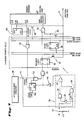
- FIG. 4 illustrates the simplified logic circuit L for recognition of interrupt requests.
- Circuit L essentially represents one logic cell of Interrupt Request Register 20 which is duplicated in register 20 for each interrupt request line I0 - IR7.
- I0 - IR7 interrupt request line
- each interrupt line IR0 - IR7 connects to an interrupt logic interface circuit 30.
- Circuit 30 includes inverters 32 and 34, AND gates 36 and 38, and OR gate 40.
- circuit 30 could be an XOR gate, instead of the inverters, AND gates and OR gate.
- Interrupt request signals on lines IR0 - IR7 will either be positive edge sensed or low level sensed.
- Circuit 30 will provide a logic high output at OR gate 40 in response to either type of input.
- An edge sensed signal at interrupt request line 42 which line is pulled high by a resistor 43, will be inverted by inverter 34 to provide a logic low signal at a first terminal of AND gate 38 and will provide a logic high signal at a first terminal of AND gate 36.
- interrupt request line 42 is programmed to be edge sensed, a logic low or zero will be placed on line 44 from interrupt mode register 28, thereby disabling AND gate 38, satisfying the AND condition of AND gate 36 via inverter 32, producing a logic high level output to OR gate 40 and consequently a logic high signal to inverter 46.
- a logic low or zero is therefore provided to a first terminal of NOR gate 48 and to the set pin of edge sense latch 50.
- Request Latch 54 is one latch in the Interrupt Request Register 20.
- the logic high at D on latch 54 produces a logic low at the Q output which satisfies half of the input condition for NOR gate 56.
- Mask latch 58 is a D type latch which forms part of Interrupt Mask Register 26. This latch masks the interrupt when a logic high voltage is presented at its D input from internal data bus 14 causing Q to go high to disable NOR gate 56.
- the interrupt request is then passed to the priority resolver 22 for transmittal to the control logic after resolving conflicts.
- the interrupt request is passed to the control logic, its INT output is enabled thereby communicating the interrupt request to the processor.
- the interrupt request is acknowledged by the processor via an interrupt acknowledge signal (INTA)
- the in-service bit is set, which sets In-Service Latch 60. This signal also enables OR gate 62 which clears Edge Sense Latch 50 to reinitialize the circuit L to receive the next interrupt.
- Switches 64, 66 and 68 are transistor switches which are normally open and only enabled to perform the Read IRR, Read IMR and Read ISR functions, respectively, to transfer status of those registers to internal data bus 14 for transmittal to the processor.
- a level low voltage interrupt signal is presented on IR line 42. This signal is inverted by inverter 34 satisfying half of the input enabling requirement for AND gate 38.
- a logic high is present on line 44 from interrupt mode register 28, thereby satisfying the second enabling condition for AND gate 38 and disabling the edge sense AND gate 36 via inverter 32.
- On enablement AND gate 38 provides an enabling high voltage to OR gate 40, which provides a logic high output to inverter 46.
- This input to inverter 46 provides an enabling low signal to one input of NOR gate 48.
- the other enabling condition for NOR gate 48 is always satisfied in level sensed mode by the logic high signal from line 44 to NOR gate 52.
- the interrupt is processed as described above.
- the ISR bit is attempted to be cleared.
- the interrupt signal from the peripheral is cleared by the processor as one step in the interrupt service routine.
- the in-service bit is cleared by controller I when the processor issues an End of Interrupt signal after terminating the interrupt signal from the peripheral device and before leaving the interrupt service routine to prevent a false second interrupt from occurring. If a second peripheral sharing the interrupt is requesting service by holding the IR line low, the processor receives a true second interrupt after exiting the interrupt service routine because the request is still pending so the interrupt is still active to the processor. Thus the processor performs back to back service on co-pending, shared interrupts. If a second peripheral was not requesting service, the IR line would be high because of the pull up resistor 43 and the in-service bit would be cleared.
- the interrupt controller of the present invention provides a computer system wherein peripherals with either level sensed or edge sensed interrupt signals can be assembled to a common interrupt controller.
- the controller of the present invention thereby provides enhanced flexibility and facilitates level sharing by permitting level sensed interrupts to share a single interrupt line without complex and costly additional circuitry.
Landscapes
- Engineering & Computer Science (AREA)
- Theoretical Computer Science (AREA)
- Physics & Mathematics (AREA)
- General Engineering & Computer Science (AREA)
- General Physics & Mathematics (AREA)
- Bus Control (AREA)
Applications Claiming Priority (2)
| Application Number | Priority Date | Filing Date | Title |
|---|---|---|---|
| US24295488A | 1988-09-09 | 1988-09-09 | |
| US242954 | 1988-09-09 |
Publications (1)
| Publication Number | Publication Date |
|---|---|
| EP0358330A1 true EP0358330A1 (fr) | 1990-03-14 |
Family
ID=22916782
Family Applications (1)
| Application Number | Title | Priority Date | Filing Date |
|---|---|---|---|
| EP89307986A Withdrawn EP0358330A1 (fr) | 1988-09-09 | 1989-08-04 | Commande d'interruptions programmable |
Country Status (2)
| Country | Link |
|---|---|
| EP (1) | EP0358330A1 (fr) |
| CA (1) | CA1319441C (fr) |
Cited By (6)
| Publication number | Priority date | Publication date | Assignee | Title |
|---|---|---|---|---|
| EP0426331A3 (en) * | 1989-11-03 | 1991-11-06 | International Business Machines Corporation | Programmable interrupt controller |
| EP0454096A3 (en) * | 1990-04-25 | 1992-05-20 | Mitsubishi Denki Kabushiki Kaisha | Interrupt control circuit and microcomputer system comprising the same |
| EP0469543A3 (en) * | 1990-07-31 | 1992-07-15 | Gold Star Co. Ltd | Multiple interrupt handling circuit |
| EP0581480A1 (fr) * | 1992-07-21 | 1994-02-02 | Advanced Micro Devices, Inc. | Dispositif d'interruption pour porte d'entrée/sortie génerale |
| EP0645690A1 (fr) * | 1993-09-22 | 1995-03-29 | Advanced Micro Devices, Inc. | Système ordinateur avec contrôleur d'interruption et unité de gestion de puissance |
| DE10047183A1 (de) * | 2000-09-22 | 2002-04-18 | Infineon Technologies Ag | Digitales Zwischenspeicherbauelement |
Citations (2)
| Publication number | Priority date | Publication date | Assignee | Title |
|---|---|---|---|---|
| US4631670A (en) * | 1984-07-11 | 1986-12-23 | Ibm Corporation | Interrupt level sharing |
| DE8803950U1 (de) * | 1987-03-24 | 1988-06-30 | International Business Machines Corp., Armonk, N.Y. | Digitalrechner mit Befehlsmodusumwandlung |
-
1989
- 1989-04-27 CA CA000598026A patent/CA1319441C/fr not_active Expired - Lifetime
- 1989-08-04 EP EP89307986A patent/EP0358330A1/fr not_active Withdrawn
Patent Citations (2)
| Publication number | Priority date | Publication date | Assignee | Title |
|---|---|---|---|---|
| US4631670A (en) * | 1984-07-11 | 1986-12-23 | Ibm Corporation | Interrupt level sharing |
| DE8803950U1 (de) * | 1987-03-24 | 1988-06-30 | International Business Machines Corp., Armonk, N.Y. | Digitalrechner mit Befehlsmodusumwandlung |
Non-Patent Citations (1)
| Title |
|---|
| INTEL MICROPROCESSOR AND PERIPHERAL HANDBOOK, vol. 1, 1987, pages 2-271-2-314, Intel Corp., Santa Clara, CA, US * |
Cited By (10)
| Publication number | Priority date | Publication date | Assignee | Title |
|---|---|---|---|---|
| EP0426331A3 (en) * | 1989-11-03 | 1991-11-06 | International Business Machines Corporation | Programmable interrupt controller |
| AU635338B2 (en) * | 1989-11-03 | 1993-03-18 | International Business Machines Corporation | Programmable interrupt controller |
| EP0454096A3 (en) * | 1990-04-25 | 1992-05-20 | Mitsubishi Denki Kabushiki Kaisha | Interrupt control circuit and microcomputer system comprising the same |
| EP0469543A3 (en) * | 1990-07-31 | 1992-07-15 | Gold Star Co. Ltd | Multiple interrupt handling circuit |
| EP0581480A1 (fr) * | 1992-07-21 | 1994-02-02 | Advanced Micro Devices, Inc. | Dispositif d'interruption pour porte d'entrée/sortie génerale |
| US5448743A (en) * | 1992-07-21 | 1995-09-05 | Advanced Micro Devices, Inc. | General I/O port interrupt mechanism |
| CN1069425C (zh) * | 1992-07-21 | 2001-08-08 | 先进显微设备股份有限公司 | 通用输入/输出端口的中断装置 |
| EP0645690A1 (fr) * | 1993-09-22 | 1995-03-29 | Advanced Micro Devices, Inc. | Système ordinateur avec contrôleur d'interruption et unité de gestion de puissance |
| US5894577A (en) * | 1993-09-22 | 1999-04-13 | Advanced Micro Devices, Inc. | Interrupt controller with external in-service indication for power management within a computer system |
| DE10047183A1 (de) * | 2000-09-22 | 2002-04-18 | Infineon Technologies Ag | Digitales Zwischenspeicherbauelement |
Also Published As
| Publication number | Publication date |
|---|---|
| CA1319441C (fr) | 1993-06-22 |
Similar Documents
| Publication | Publication Date | Title |
|---|---|---|
| US5101497A (en) | Programmable interrupt controller | |
| EP0205007B1 (fr) | Adaptateur d'extension de service à plusieurs ports pour un controleur de communications | |
| EP0204960B1 (fr) | Dispositif de commande et arbitre de DMA et d'interruptions intégré à plusieurs portes | |
| US4751634A (en) | Multiple port communications adapter apparatus | |
| US4648029A (en) | Multiplexed interrupt/DMA request arbitration apparatus and method | |
| US4870566A (en) | Scannerless message concentrator and communications multiplexer | |
| CA1179409A (fr) | Multiplexeur de transmission a selecteur de priorite variable utilisant une memoire morte | |
| US3953835A (en) | Method and apparatus for adapting a data processing port to receive and transmit different frequency signals | |
| US4034349A (en) | Apparatus for processing interrupts in microprocessing systems | |
| US4485438A (en) | High transfer rate between multi-processor units | |
| US3996561A (en) | Priority determination apparatus for serially coupled peripheral interfaces in a data processing system | |
| US4528626A (en) | Microcomputer system with bus control means for peripheral processing devices | |
| US4627054A (en) | Multiprocessor array error detection and recovery apparatus | |
| EP0435092B1 (fr) | Système de traitement de données avec contrÔleur d'accès mémoire direct et méthode pour changer la maîtrise du bus en réponse à des intérruptions à priorité déterminée | |
| US4890219A (en) | Mode conversion of computer commands | |
| GB1589180A (en) | Data processing apparatus | |
| HK1003803B (en) | Data processing system with direct memory access controller and method for varying communication bus masterchip in response to prioritized interrupt requests | |
| CA1169158A (fr) | Arrangement a priorites variables pour multiplexeur de communication | |
| US4393459A (en) | Status reporting with ancillary data | |
| CA1319441C (fr) | Controleur d'interruption programmable | |
| EP0118669A2 (fr) | Sous-système de canal | |
| US3911409A (en) | Data processing interface system | |
| US4646260A (en) | Data collection terminal high speed communication link interrupt logic | |
| EP0283580B1 (fr) | Calculateur comprenant un arbitrage pour un canal d'accès direct en mémoire | |
| EP0618536B1 (fr) | Dispositif d'interruption |
Legal Events
| Date | Code | Title | Description |
|---|---|---|---|
| PUAI | Public reference made under article 153(3) epc to a published international application that has entered the european phase |
Free format text: ORIGINAL CODE: 0009012 |
|
| AK | Designated contracting states |
Kind code of ref document: A1 Designated state(s): DE FR GB IT NL |
|
| 17P | Request for examination filed |
Effective date: 19900907 |
|
| STAA | Information on the status of an ep patent application or granted ep patent |
Free format text: STATUS: THE APPLICATION HAS BEEN WITHDRAWN |
|
| 18W | Application withdrawn |
Withdrawal date: 19911021 |
|
| R18W | Application withdrawn (corrected) |
Effective date: 19911021 |