EP0358410A2 - Kostengünstiger, sichtbares Licht ausstrahlender Festkörperlaser niedriger Leistung - Google Patents
Kostengünstiger, sichtbares Licht ausstrahlender Festkörperlaser niedriger Leistung Download PDFInfo
- Publication number
- EP0358410A2 EP0358410A2 EP89308841A EP89308841A EP0358410A2 EP 0358410 A2 EP0358410 A2 EP 0358410A2 EP 89308841 A EP89308841 A EP 89308841A EP 89308841 A EP89308841 A EP 89308841A EP 0358410 A2 EP0358410 A2 EP 0358410A2
- Authority
- EP
- European Patent Office
- Prior art keywords
- laser
- chip
- solid
- state
- doubler
- Prior art date
- Legal status (The legal status is an assumption and is not a legal conclusion. Google has not performed a legal analysis and makes no representation as to the accuracy of the status listed.)
- Withdrawn
Links
Images

Classifications
-
- H—ELECTRICITY
- H01—ELECTRIC ELEMENTS
- H01S—DEVICES USING THE PROCESS OF LIGHT AMPLIFICATION BY STIMULATED EMISSION OF RADIATION [LASER] TO AMPLIFY OR GENERATE LIGHT; DEVICES USING STIMULATED EMISSION OF ELECTROMAGNETIC RADIATION IN WAVE RANGES OTHER THAN OPTICAL
- H01S3/00—Lasers, i.e. devices using stimulated emission of electromagnetic radiation in the infrared, visible or ultraviolet wave range
- H01S3/02—Constructional details
- H01S3/025—Constructional details of solid state lasers, e.g. housings or mountings
-
- H—ELECTRICITY
- H01—ELECTRIC ELEMENTS
- H01S—DEVICES USING THE PROCESS OF LIGHT AMPLIFICATION BY STIMULATED EMISSION OF RADIATION [LASER] TO AMPLIFY OR GENERATE LIGHT; DEVICES USING STIMULATED EMISSION OF ELECTROMAGNETIC RADIATION IN WAVE RANGES OTHER THAN OPTICAL
- H01S3/00—Lasers, i.e. devices using stimulated emission of electromagnetic radiation in the infrared, visible or ultraviolet wave range
- H01S3/09—Processes or apparatus for excitation, e.g. pumping
- H01S3/091—Processes or apparatus for excitation, e.g. pumping using optical pumping
- H01S3/094—Processes or apparatus for excitation, e.g. pumping using optical pumping by coherent light
- H01S3/0941—Processes or apparatus for excitation, e.g. pumping using optical pumping by coherent light of a laser diode
- H01S3/09415—Processes or apparatus for excitation, e.g. pumping using optical pumping by coherent light of a laser diode the pumping beam being parallel to the lasing mode of the pumped medium, e.g. end-pumping
-
- H—ELECTRICITY
- H01—ELECTRIC ELEMENTS
- H01S—DEVICES USING THE PROCESS OF LIGHT AMPLIFICATION BY STIMULATED EMISSION OF RADIATION [LASER] TO AMPLIFY OR GENERATE LIGHT; DEVICES USING STIMULATED EMISSION OF ELECTROMAGNETIC RADIATION IN WAVE RANGES OTHER THAN OPTICAL
- H01S3/00—Lasers, i.e. devices using stimulated emission of electromagnetic radiation in the infrared, visible or ultraviolet wave range
- H01S3/10—Controlling the intensity, frequency, phase, polarisation or direction of the emitted radiation, e.g. switching, gating, modulating or demodulating
- H01S3/106—Controlling the intensity, frequency, phase, polarisation or direction of the emitted radiation, e.g. switching, gating, modulating or demodulating by controlling devices placed within the cavity
- H01S3/108—Controlling the intensity, frequency, phase, polarisation or direction of the emitted radiation, e.g. switching, gating, modulating or demodulating by controlling devices placed within the cavity using non-linear optical devices, e.g. exhibiting Brillouin or Raman scattering
- H01S3/109—Frequency multiplication, e.g. harmonic generation
-
- H—ELECTRICITY
- H01—ELECTRIC ELEMENTS
- H01S—DEVICES USING THE PROCESS OF LIGHT AMPLIFICATION BY STIMULATED EMISSION OF RADIATION [LASER] TO AMPLIFY OR GENERATE LIGHT; DEVICES USING STIMULATED EMISSION OF ELECTROMAGNETIC RADIATION IN WAVE RANGES OTHER THAN OPTICAL
- H01S3/00—Lasers, i.e. devices using stimulated emission of electromagnetic radiation in the infrared, visible or ultraviolet wave range
- H01S3/05—Construction or shape of optical resonators; Accommodation of active medium therein; Shape of active medium
- H01S3/06—Construction or shape of active medium
- H01S3/0602—Crystal lasers or glass lasers
- H01S3/0604—Crystal lasers or glass lasers in the form of a plate or disc
-
- H—ELECTRICITY
- H01—ELECTRIC ELEMENTS
- H01S—DEVICES USING THE PROCESS OF LIGHT AMPLIFICATION BY STIMULATED EMISSION OF RADIATION [LASER] TO AMPLIFY OR GENERATE LIGHT; DEVICES USING STIMULATED EMISSION OF ELECTROMAGNETIC RADIATION IN WAVE RANGES OTHER THAN OPTICAL
- H01S3/00—Lasers, i.e. devices using stimulated emission of electromagnetic radiation in the infrared, visible or ultraviolet wave range
- H01S3/05—Construction or shape of optical resonators; Accommodation of active medium therein; Shape of active medium
- H01S3/06—Construction or shape of active medium
- H01S3/0627—Construction or shape of active medium the resonator being monolithic, e.g. microlaser
Definitions
- the present invention relates generally to lasers and, more particularly, to a low cost, low power solid-state laser which generates a visible laser beam suitable for use in numerous applications, including surveying, measurement, and equipment control in the construction and agricultural industries.
- laser based instruments utilize conventional visible light helium neon (HeNe) plasma tubes as a source of the laser beam.
- HeNe visible light helium neon
- this need is met by miniature solid-state lasers having green output beams which can be reliably and economically produced.
- Such lasers compete visually in terms of radial symmetry and illuminance with three milliwatt helium neon gas lasers.
- the solid-state lasers of the present invention are concerned with aspects of visibility, spatial spot quality and spatial stability without concern for chromatic purity, amplitude stability, noise, CW operation or pulse regularity; accordingly, these solid-state lasers are particularly applicable for spatial reference applications, such as those encountered in the construction and agricultural arts.
- a low power frequency doubled solid-state laser has been produced by bonding a laser chip of stoichiometric lasing material to a frequency doubler chip by means of coupling material having a refractive index matched to the chips.
- a solid-state laser in accordance with the present invention will provide an ultrasmall unit approaching one milliwatt of output power at green light wavelengths with the unit occupying less than 5% of the volume of existing units and costing less than 5% of the smallest and lowest cost doubled solid-state lasers on the market today.
- a compact laser diode pumped, high efficiency, solid-state laser comprises output coupler means including a mirrored surface forming a front end of a laser cavity.
- a back end of the laser cavity is formed by rear mirror means through which the emissions from a laser diode pass for pumping a laser chip of stoichiometric lasing material.
- a frequency doubler chip positioned immediately adjacent the laser chip doubles the frequency of light generated by the laser chip to thereby halve its wavelength.
- the laser chip is bonded to the frequency doubler chip by coupling material having a refractive index matched to the chips to almost eliminate reflections at the bonded surfaces thereof.
- the bonded combination of the laser chip and the doubler chip is positioned in the laser cavity to receive pumping energy from the laser diode through the rear mirror means.
- the laser diode pump preferably comprises a single stripe laser diode.
- the solid-state laser further comprises beam shaping means for shaping the laser beam within the laser cavity to form a beam waist with the bonded combination of the laser chip and the doubler chip being positioned substantially at the beam waist.
- the laser chip may comprise neodymium pentaphosphate (NPP) which lases to generate infrared light near a wavelength of 1050 nm. If the infared light generated by an NPP laser chip is frequency doubled by the doubler chip, which can comprise potassium titanyl phosphate (KTP), the resulting light is green and has a wavelength of near 525 nm which light passes through the output coupler means.
- NPP neodymium pentaphosphate
- KTP potassium titanyl phosphate
- the rear mirror means may be concave and positioned some distance from the bonded combination of the laser chip and the doubler chip, preferrably it is positioned immediately adjacent the laser chip and can be formed thereon.
- the rear mirror means may comprise a mirror chip of thin glass which in turn is directly bonded to the laser chip by coupling material having a refractive index matched to the laser chip and the mirror chip.
- the solid-state laser of the present invention preferrably further comprises power peaking means for generating spikes in the light passed through the output coupler means.
- the power peaking means may comprise gain switching of the laser diode used to pump the laser chip or phase modulation techniques.
- support means may be provided for movably mounting the bonded combination of the laser chip and the doubler chip.
- the power peaking means may comprise vibratory means for moving the support means and thereby the bonded combination of the laser chip and the doubler chip.
- a compact, laser diode pumped, high efficiency, solid-state laser comprises a hollow laser body having generally open first and second ends.
- a laser diode is fitted into the first end of the laser body and output coupler means are fitted into the second end and include a mirrored surface forming a front end of a laser cavity within the laser body.
- Input mirror means are supported within the laser body for forming a back end of the laser cavity.
- a laser chip of stoichiometric lasing material has a frequency doubler chip positioned immediately adjacent thereto for doubling the frequency of light generated by the laser chip thereby halving its wavelength.
- Coupling material bonds the laser chip to the doubler chip and has a refractive index matched to the chips to nearly eliminate reflections at the bonded surfaces of the chips.
- the bonded combination of the laser chip and the doubler chip are supported in the laser cavity to receive pumping energy from the laser diode through the input mirror means.
- Lens means comprising a spherical relay lens or GRIN relay lens may be supported between the laser diode and the input mirror means.
- the laser body may comprise a mounting tube which can deformed to position the output means to align the laser cavity for lasing.
- the solid-state laser includes a monolithic lasing element formed by bonding a number of glass and crystalline components together.
- the solid-state laser further comprises a cylindrical glass member, the GRIN relay lens and input mirror means are bonded to one another and to the laser chip and the cylindrical glass member is bonded to and between the frequency doubler chip and the output coupler means to form the monolithic lasing element.
- the monolithic losing element is sized so that it can be slidably received within the second end of the laser body and positioned therein to maximize laser light passing through the output coupler means.
- the monolithic lasing element is secured within the second end of the laser body to maintain maximum laser light and complete construction of the solid-state laser.
- the bench construction shown in Fig. 1 comprises a laser diode 100, for example an LA-TOLD151-A sold by Toshiba Corporation, which emits radiation ranging from 804-810 nm in wavelength with the typical radiation being 807 nm.
- Collection optics represented schematically by a lens 102, focus the emissions from the laser diode 100 onto a laser chip 104 of stoichiometric lasing material, such as NPP, with the laser chip 104 having a thickness of approximately 0.3 millimeters.
- the focused radiation from the lens 102 passes through input mirror means comprising an input window mirror 106 which has a concave mirror surface 106A having a radius of approximately 25 millimeters (mm) and being highly reflective of light having a wavelength of 1050 nm but highly transmissive of light having a wavelength of 807 nm.
- a frequency doubler chip 108 is positioned immediately adjacent the laser chip 104 and provides for doubling the frequency of light generated by the laser chip 104 to thereby halve the light's wavelength.
- the doubler chip 108 preferrably comprises KTP and is of a thickness of approximately 5.0 millimeters.
- Coupling material 110 is used to bond the laser chip 104 to the doubler chip 108.
- the coupling material 110 has a refractive index matched to the two chips to substantially reduce reflections at the bonded surfaces of the chips and thereby increase the effective Q of a laser cavity which receives the bonded combination of the chips.
- the coupling material 110 should have a refractive index of approximately 1.68 at a wavelength of 1050 nm which is provided by a mounting media sold by R. P. Cargille Laboratories, Inc. under the trade name Meltmount, catalog # 24170.
- Output coupler means 112 comprises a mirrored surface 112A forming a front end of the laser cavity 114 extending between the mirrored surface 106A and the mirrored surface 112A.
- the mirror surface 112A is highly reflective to light having a wavelength of 1050 nm but highly transmissive to light having a wavelength of 525 nm.
- the concave surface of the output coupler 112 has a radius of approximately 25 millimeters such that the laser cavity 114 is approximately 50 mm long.
- the 807 nm light generated by the laser diode 100 is collected by the lens 102 and focused through the input window mirror 106 onto the laser chip 104 which lases to generate light having a wavelength of substantially 1050 nm.
- This light is passed to the frequency doubler chip 108 through the coupling material 110 and a portion of the 1050 nm light is converted to 525 nm light which passes through the output coupler 112. Since the output coupler 112 is highly transmissive to 525 nm, light, this light is emitted by the solid-state laser shown in Fig. 1 whereas 1050 nm light is reflected by the mirror surface 112A to the mirror surface 106A passing through the doubler chip 108 and the laser chip 104. Repeated passes result in additional conversion of 1050 nm light to 525 nm light resulting in its emission from the solid-state laser through the output coupler 112.
- the solid-state laser is substantially the same as that shown in Fig. 1 with the exception that the input mirror means comprises a mirror coating 116 which has been formed onto the laser chip 104. Accordingly, in the bench structure of Fig. 2, the length of the laser cavity 114 has been reduced by a factor of two to approximately 25 mm.
- Power peaking means is preferrably provided in the solid-state laser of the present invention for generating spikes in the laser light passed through the output coupler 112.
- the power peaking means can comprise, in the embodiments of Figs. 1 and 2, support means comprising a cantilever support member 118 for movably mounting the bonded combination of the laser chip 104 and the doubler chip 108 coupled with vibratory means for moving the support member 118 and thereby the bonded combination of the laser chip 104 and the doubler chip 108.
- the vibratory means may comprise a motor 120, a moving coil modulator, or other appropriate apparatus coupled to the support member 118 for imparting velocity to the bonded combination of the laser chip 104 and the doubler chip 108 by vibrating the support member 118.
- the degree of spiking or peaking of the output laser light passed through the output coupler 112 of the solid-state laser due to the vibratory means is an increasing function of the velocity of the bonded combination of the laser chip 104 and the doubler chip 108.
- the motor 120 or other vibratory means may vibrate the support member 118 on an irregular basis since pulse regularity is not critical to the intended use of the solid-state laser for spatial reference applications.
- Fig. 3 shows a partially cross sectioned view of a first commercial embodiment of a solid-state laser 128 of the present invention.
- Emission from a single stripe pump laser diode 130 which is supported upon a laser diode mount 132 is concentrated by lens means comprising a spherical relay lens 134 through input mirror means comprising an input window mirror 136 to a very small spot within a thin laser chip 138 of stoichiometric lasing material, for example NPP, which has a thickness on the order of 0.01 inches.
- the input window mirror 136 transmits the emissions from the pump laser diode 130 but reflects the light generated by the lasing action of the laser chip 138.
- the lasing emissions on the other hand pass through the thin slice of frequency doubling material, for example KTP, of a doubler chip 140 which also has a thickness on the order of 0.01 inches falling upon an output window mirror 142 which reflects light of the lasing wavelength but is highly transmittive of light having a wavelength which is double the lasing wavelength.
- frequency doubling material for example KTP
- the input window mirror 136 and the output window mirror 142 form a high Q resonant laser cavity for the lasing wavelength of the laser chip 138.
- the input window mirror 136 and the output window mirror 142 are coated for the highest reflectivity possible and intercavity reflection loss is nearly eliminated by optically bonding the input window mirror 136 to the laser chip 138 which is in turn optically bonded to the doubling chip 140 by means of coupling material as previously described with reference to the bench constructions of Figs. 1 and 2.
- the interface between the doubling chip 140 and air within the solid-state laser 128 is also antireflection coated. Residual reflectivity loss at the interface between the doubler chip 140 and the air within the solid-state laser 128 can be reduced by placing that interface at or near the cavity waist. Such placement can be accomplished by adding a slight radius, if necessary, to the input window mirror 136 to depart slightly from a hemispherical cavity configuration in accordance with the combined thicknesses of the laser chip 138 and the doubler chip 140. To align the laser cavity 144 for lasing, the positioning of the output window mirror 142 is adjustable by means of deformation 146 of a hollow laser body or mounting tube 148.
- One of the objectives of the embodiment of the solid-state laser of Fig. 3 is to make the laser cavity Q so high by means of mirror reflectivity, optical bonding and locations of the surfaces that frequency doubling sensivity, either due to material sensitivity or to thickness, is not critical provided internal transparency is very high.
- Cavity waist diameter is minimized by means of a short radius of curvature of the output window mirror 142 to maximize cavity power density at the beam waist and therefore doubling efficiency.
- the pump laser diode 130 can be gain switched or phase modulation techniques may be applied to obtain peak power which can be orders of magnitude above CW power levels. It should be apparent that the power peaking means of the embodiments of Figs. 1 and 2 can also comprise gain switching or phase modulation techniques.
- the solid-state laser 128 of Fig. 3 can be conveniently manufactured to have a length of approximately 0.5 inches and a diameter of approximately 0.4 inches; however, such a degree of miniaturization is not limiting and further miniaturization should be beneficial.
- the value of miniaturization for doubling can be realized as power density varies as the square of reciprocal beam waist and single pass doubling efficiency is proportional to power density.
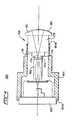
- FIG. 4 is a partially cross sectioned view of a second commercial embodiment of the solid-state laser of the present invention which, as of the present time, is believed to be preferred.
- a solid-state laser 160 as shown in Fig. 4 comprises a laser diode assembly 162 which is commerically available, for example, from the Toshiba Corporation.
- the diode assembly 162 is fitted into the large end 164A of a laser stepped adapter body 164 such that emissions from the laser diode assembly 162 are directed toward the small end 164B of the stepped adapter body 164.
- a monolithic lasing element 166 is preassembled by bonding a number of glass and crystalline components together.
- the monolithic lasing element 166 is sized to be slidingly received within the small end 164B of the stepped adapter body 164 and comprises: lens means comprising a GRIN relay lens 168; input mirror means comprising a thin glass mirror chip 170 which defines a laser cavity mirror surface 172; a stoichiometric laser chip 174 comprising, for example, NPP; a frequency doubler chip 176 comprising, for example, KTP; a cylindrical glass element 178; and, a plano convex glass lens element 180 which defines a second laser cavity mirror surface 182 on its outer surface and serves as the laser output coupler.
- Each of the components 168-180 have a similar index of refraction and are bonded to one another by means of coupling material having appropriate refractive indexes to match the components which are being bonded to one another
- Assembly of the preferred embodiment of the solid-state laser 160 of Fig. 4 is performed by initially securing the laser diode assembly 162 into the large end 164A of the stepped adapter body 164.
- the laser diode assembly 162 can then be activated to generate emissions which are passed through the small end 164B of the stepped adapter body 164.
- the cylindrical glass element 178 is coated with an adhesive which can be selectively activated to secure the monolithic lasing element 166 into the stepped adapter body 164 and the element 166 is inserted into the small end 164B of the stepped adapter body 164.
- the monolithic lasing element 166 is then positioned to maximize the laser light passing through the plano convex lens 180 which forms the output coupler of the solid-state laser 160.
- the adhesive coating upon the cylindrical glass element 178 is activated to complete the assembly of the solid-state laser 160 of Fig. 4.
- One of the objectives of the embodiment of the solid-state laser 160 of Fig. 4 is to make the cavity Q as high as possible for the lasing wavelength so that doubling sensitivity, either due to material sensitivity or material thickness, is not critical to thereby provide more options for the doubling material which can be used.
- the cavity Q is made high by: 1) minimizing fresnel losses by using like-index optical materials bonded with index-matched optical coupling materials as previously described, such construction also eliminates the cost of antireflection coating and permits usage of materials which can be troublesome to coat, such as NPP; 2) minimizing scattering losses by means of very thin chips of lasing and doubling materials, which chips are the greatest source of scattering; 3) utilizing highly transparent optical glasses; and, 4) utilizing state of the art cavity mirror coatings. With such minimization of losses, the doubled conversion per pass through the doubler chip can be very small but the number of passes very large such that a large percentage of the lasing energy is frequency doubled.
- Doubling efficiency is enhanced geometrically by making the cavity waist diameter and hence the beam cross section diameter at the doubling medium very small by means of a short radius/large aperture exit mirror, i.e., cavity mirror surface 182. Peak power density and hence doubling frequency has been increased by "bunching the power" producing peaks up to two orders of magnitude above CW operating levels by gain switching and phase modulation techniques.
- the degree of miniaturization shown is not limiting and further miniaturization should be beneficial.
- Key parameters to miniaturization of the solid-state laser are: 1) size commensurate with single stripe laser diode emitting areas; 2) short lasing cavity length for small beam waists and high cavity sweep frequency; and 3) very high cavity Q using state of the art coatings for cavity mirrors, low reflection boundaries clustered near the beam waist, and ultrathin sections of lasing and doubling materials for low scatter losses.
Landscapes
- Physics & Mathematics (AREA)
- Electromagnetism (AREA)
- Engineering & Computer Science (AREA)
- Plasma & Fusion (AREA)
- Optics & Photonics (AREA)
- Nonlinear Science (AREA)
- Lasers (AREA)
Applications Claiming Priority (2)
| Application Number | Priority Date | Filing Date | Title |
|---|---|---|---|
| US242792 | 1988-09-09 | ||
| US07/242,792 US4884281A (en) | 1988-09-09 | 1988-09-09 | Low cost/power visible light solid-state laser |
Publications (2)
| Publication Number | Publication Date |
|---|---|
| EP0358410A2 true EP0358410A2 (de) | 1990-03-14 |
| EP0358410A3 EP0358410A3 (de) | 1990-08-08 |
Family
ID=22916203
Family Applications (1)
| Application Number | Title | Priority Date | Filing Date |
|---|---|---|---|
| EP89308841A Withdrawn EP0358410A3 (de) | 1988-09-09 | 1989-08-31 | Kostengünstiger, sichtbares Licht ausstrahlender Festkörperlaser niedriger Leistung |
Country Status (3)
| Country | Link |
|---|---|
| US (1) | US4884281A (de) |
| EP (1) | EP0358410A3 (de) |
| JP (1) | JPH02122582A (de) |
Cited By (5)
| Publication number | Priority date | Publication date | Assignee | Title |
|---|---|---|---|---|
| WO1993021670A1 (en) * | 1992-04-17 | 1993-10-28 | Italtel Societa` Italiana Telecomunicazioni S.P.A. | Laser device |
| WO1994015385A1 (en) * | 1992-12-18 | 1994-07-07 | Italtel Societa' Italiana Telecomunicazioni S.P.A. | Multi-mode laser device |
| EP0592766A3 (de) * | 1992-06-19 | 1994-10-12 | Sony Corp | Optisches Abtastgerät und Verfahren zur Einstellung der optischen Achse desselben. |
| WO1994014215A3 (en) * | 1992-12-10 | 1994-10-27 | Italtel Spa | Single-mode laser device |
| DE19521943C2 (de) * | 1995-06-07 | 2001-03-01 | Laser Analytical Systems Las E | Festkörperlaservorrichtung |
Families Citing this family (18)
| Publication number | Priority date | Publication date | Assignee | Title |
|---|---|---|---|---|
| US5060233A (en) * | 1989-01-13 | 1991-10-22 | International Business Machines Corporation | Miniature blue-green laser source using second-harmonic generation |
| FR2655461B1 (fr) * | 1989-12-01 | 1992-11-27 | Thomson Csf | Source optique miniature et procede de realisation. |
| US5090019A (en) * | 1991-01-10 | 1992-02-18 | The United States Of America As Represented By The Secretary Of The Navy | Laser diode-pumped tunable solid state laser |
| JPH04283977A (ja) * | 1991-03-12 | 1992-10-08 | Fuji Photo Film Co Ltd | レーザーダイオードポンピング固体レーザー |
| US5315614A (en) * | 1993-05-03 | 1994-05-24 | The Spectranetics Corporation | Apparatus and method for soft focusing energy into an optical fiber array |
| US5420876A (en) * | 1994-06-02 | 1995-05-30 | Spectra-Physics Laserplane, Inc. | Gadolinium vanadate laser |
| US5440574A (en) * | 1994-06-02 | 1995-08-08 | Spectra-Physics Laserplane, Inc. | Solid-state laser |
| US5450429A (en) * | 1994-06-02 | 1995-09-12 | Spectra-Physics Laserplane, Inc. | Efficient linear frequency doubled solid-state laser |
| US5479431A (en) * | 1994-06-02 | 1995-12-26 | Spectra-Physics Laserplane, Inc. | Solid-state laser with active etalon and method therefor |
| US5511085A (en) * | 1994-09-02 | 1996-04-23 | Light Solutions Corporation | Passively stabilized intracavity doubling laser |
| US5692005A (en) * | 1995-03-04 | 1997-11-25 | Carl-Zeiss-Stiftung | Solid-state laser |
| DE19507625C2 (de) * | 1995-03-04 | 2002-10-17 | Zeiss Carl | Festkörper-Laser hoher Leistung mit gekühltem Lasermedium |
| US5982789A (en) * | 1995-11-22 | 1999-11-09 | Light Solutions Corporation | Pulsed laser with passive stabilization |
| US5840239A (en) * | 1997-01-31 | 1998-11-24 | 3D Systems, Inc. | Apparatus and method for forming three-dimensional objects in stereolithography utilizing a laser exposure system having a diode pumped frequency quadrupled solid state laser |
| US6141143A (en) * | 1998-05-01 | 2000-10-31 | Light Solutions Corporation | CW laser amplifier |
| US6129884A (en) * | 1999-02-08 | 2000-10-10 | 3D Systems, Inc. | Stereolithographic method and apparatus with enhanced control of prescribed stimulation production and application |
| US6700709B1 (en) * | 2002-03-01 | 2004-03-02 | Boston Laser Inc. | Configuration of and method for optical beam shaping of diode laser bars |
| US6778732B1 (en) * | 2002-06-07 | 2004-08-17 | Boston Laser, Inc. | Generation of high-power, high brightness optical beams by optical cutting and beam-shaping of diode lasers |
Family Cites Families (19)
| Publication number | Priority date | Publication date | Assignee | Title |
|---|---|---|---|---|
| US3982201A (en) * | 1975-01-24 | 1976-09-21 | The Perkin-Elmer Corporation | CW solid state laser |
| DE2510030A1 (de) * | 1975-03-07 | 1976-09-16 | Siemens Ag | Pumpanordnung fuer optisch gepumpte festkoerperlaser |
| JPS52144996A (en) * | 1976-05-28 | 1977-12-02 | Hitachi Ltd | End face excitation solid laser |
| JPS53103395A (en) * | 1977-02-21 | 1978-09-08 | Mitsubishi Electric Corp | Solid laser device |
| JPS5469990A (en) * | 1977-11-15 | 1979-06-05 | Toshiba Corp | Solid laser device |
| US4464759A (en) * | 1981-09-21 | 1984-08-07 | Massachusetts Institute Of Technology | Semiconductor diode laser system |
| US4739507A (en) * | 1984-11-26 | 1988-04-19 | Board Of Trustees, Stanford University | Diode end pumped laser and harmonic generator using same |
| US4618957A (en) * | 1985-04-17 | 1986-10-21 | Quantronix Corporation | Frequency doubling a laser beam by using intracavity type II phase matching |
| US4656635A (en) * | 1985-05-01 | 1987-04-07 | Spectra-Physics, Inc. | Laser diode pumped solid state laser |
| US4761786A (en) * | 1986-12-23 | 1988-08-02 | Spectra-Physics, Inc. | Miniaturized Q-switched diode pumped solid state laser |
| US4653056A (en) * | 1985-05-01 | 1987-03-24 | Spectra-Physics, Inc. | Nd-YAG laser |
| US4756003A (en) * | 1985-05-01 | 1988-07-05 | Spectra-Physics, Inc. | Laser diode pumped solid state laser |
| US4665529A (en) * | 1986-05-19 | 1987-05-12 | Spectra-Physics, Inc. | Laser diode pumped solid state laser with miniaturized quick disconnect laser head |
| US4701929A (en) * | 1985-12-19 | 1987-10-20 | Spectra-Physics, Inc. | Laser diode pumped solid state laser |
| US4723257A (en) * | 1986-05-19 | 1988-02-02 | Spectra-Physics, Inc. | Laser diode pumped solid state laser with miniaturized laser head |
| US4731795A (en) * | 1986-06-26 | 1988-03-15 | Amoco Corporation | Solid state laser |
| US4730335A (en) * | 1986-06-26 | 1988-03-08 | Amoco Corporation | Solid state laser and method of making |
| US4731787A (en) * | 1986-08-15 | 1988-03-15 | Board Of Trustees, Stanford University | Monolithic phasematched laser harmonic generator |
| US4791631A (en) * | 1987-08-31 | 1988-12-13 | International Business Machines Corporation | Wide tolerance, modulated blue laser source |
-
1988
- 1988-09-09 US US07/242,792 patent/US4884281A/en not_active Expired - Fee Related
-
1989
- 1989-08-31 EP EP89308841A patent/EP0358410A3/de not_active Withdrawn
- 1989-09-11 JP JP1235506A patent/JPH02122582A/ja active Pending
Cited By (7)
| Publication number | Priority date | Publication date | Assignee | Title |
|---|---|---|---|---|
| WO1993021670A1 (en) * | 1992-04-17 | 1993-10-28 | Italtel Societa` Italiana Telecomunicazioni S.P.A. | Laser device |
| EP0592766A3 (de) * | 1992-06-19 | 1994-10-12 | Sony Corp | Optisches Abtastgerät und Verfahren zur Einstellung der optischen Achse desselben. |
| US5402407A (en) * | 1992-06-19 | 1995-03-28 | Sony Corporation | Optical pickup apparatus and method for adjusting optical axis thereof |
| EP0795855A3 (de) * | 1992-06-19 | 1997-09-24 | Sony Corporation | Optisches Abtastgerät |
| WO1994014215A3 (en) * | 1992-12-10 | 1994-10-27 | Italtel Spa | Single-mode laser device |
| WO1994015385A1 (en) * | 1992-12-18 | 1994-07-07 | Italtel Societa' Italiana Telecomunicazioni S.P.A. | Multi-mode laser device |
| DE19521943C2 (de) * | 1995-06-07 | 2001-03-01 | Laser Analytical Systems Las E | Festkörperlaservorrichtung |
Also Published As
| Publication number | Publication date |
|---|---|
| EP0358410A3 (de) | 1990-08-08 |
| US4884281A (en) | 1989-11-28 |
| JPH02122582A (ja) | 1990-05-10 |
Similar Documents
| Publication | Publication Date | Title |
|---|---|---|
| US4884281A (en) | Low cost/power visible light solid-state laser | |
| EP0425516B1 (de) | Transversal einmodiger, auf stoss an die pump-diode gekoppelter laser | |
| US5440574A (en) | Solid-state laser | |
| US5268913A (en) | Frequency-doubling solid state laser | |
| US5420876A (en) | Gadolinium vanadate laser | |
| JP2004334129A (ja) | レンズ、光照射装置及びレーザポインタ | |
| US6501782B1 (en) | Compact laser apparatus | |
| US5216687A (en) | Solid state laser device with a bi-cylindrical covexo-convex lens having selected radii of curvature to preferably pump a region of a laser medium | |
| US6914928B2 (en) | Diode array end pumped slab laser | |
| US4173001A (en) | Laser apparatus | |
| EP0533114B1 (de) | Festkörperlaser | |
| US5513205A (en) | End-pumping laser configuration utilizing a retroreflector as an input coupler | |
| JPH0918072A (ja) | 固体レーザ | |
| JPS605578A (ja) | 出力結合鏡 | |
| JPH071807Y2 (ja) | ダイオードレーザ励起固体レーザ装置 | |
| WO1991006139A1 (en) | Diode pumped segmented fibre bundle coupled conical rod laser system | |
| US5463651A (en) | Laser beam generator | |
| JPH06104516A (ja) | レーザ装置 | |
| JPH06350168A (ja) | 固体レーザ発振器 | |
| JPH07112083B2 (ja) | アレイ半導体レーザ端面励起固体レーザ | |
| JPH02501520A (ja) | 空洞内ラーマンセル共振器 | |
| JP3493373B2 (ja) | レーザー発振器 | |
| JPH11177165A (ja) | 固体レーザーの光励起方式 | |
| JPH02130882A (ja) | 固体レーザ装置 | |
| JPH0632348B2 (ja) | 色素レ−ザ装置 |
Legal Events
| Date | Code | Title | Description |
|---|---|---|---|
| PUAI | Public reference made under article 153(3) epc to a published international application that has entered the european phase |
Free format text: ORIGINAL CODE: 0009012 |
|
| AK | Designated contracting states |
Kind code of ref document: A2 Designated state(s): DE FR GB NL SE |
|
| PUAL | Search report despatched |
Free format text: ORIGINAL CODE: 0009013 |
|
| AK | Designated contracting states |
Kind code of ref document: A3 Designated state(s): DE FR GB NL SE |
|
| 17P | Request for examination filed |
Effective date: 19900913 |
|
| RAP1 | Party data changed (applicant data changed or rights of an application transferred) |
Owner name: SPECTRA-PHYSICS LASERPLANE, INC. |
|
| 17Q | First examination report despatched |
Effective date: 19920723 |
|
| STAA | Information on the status of an ep patent application or granted ep patent |
Free format text: STATUS: THE APPLICATION IS DEEMED TO BE WITHDRAWN |
|
| 18D | Application deemed to be withdrawn |
Effective date: 19930716 |