EP0359029B1 - Moyen pour camoufler des objets militaires - Google Patents
Moyen pour camoufler des objets militaires Download PDFInfo
- Publication number
- EP0359029B1 EP0359029B1 EP89115975A EP89115975A EP0359029B1 EP 0359029 B1 EP0359029 B1 EP 0359029B1 EP 89115975 A EP89115975 A EP 89115975A EP 89115975 A EP89115975 A EP 89115975A EP 0359029 B1 EP0359029 B1 EP 0359029B1
- Authority
- EP
- European Patent Office
- Prior art keywords
- means according
- camouflage
- camouflage means
- base material
- fabric
- Prior art date
- Legal status (The legal status is an assumption and is not a legal conclusion. Google has not performed a legal analysis and makes no representation as to the accuracy of the status listed.)
- Expired - Lifetime
Links
- 238000000576 coating method Methods 0.000 claims description 11
- 239000000463 material Substances 0.000 claims description 11
- 239000004744 fabric Substances 0.000 claims description 10
- 239000011248 coating agent Substances 0.000 claims description 9
- 239000004922 lacquer Substances 0.000 claims description 4
- 239000004952 Polyamide Substances 0.000 claims description 2
- 230000001154 acute effect Effects 0.000 claims description 2
- 239000002184 metal Substances 0.000 claims description 2
- 229920002647 polyamide Polymers 0.000 claims description 2
- 238000010521 absorption reaction Methods 0.000 claims 2
- 239000011888 foil Substances 0.000 claims 1
- 239000002923 metal particle Substances 0.000 claims 1
- 229920000728 polyester Polymers 0.000 claims 1
- 239000003795 chemical substances by application Substances 0.000 description 9
- 230000000694 effects Effects 0.000 description 6
- 230000001788 irregular Effects 0.000 description 3
- 238000011161 development Methods 0.000 description 2
- 230000018109 developmental process Effects 0.000 description 2
- 239000004848 polyfunctional curative Substances 0.000 description 2
- 230000002035 prolonged effect Effects 0.000 description 2
- 230000000717 retained effect Effects 0.000 description 2
- 239000000654 additive Substances 0.000 description 1
- 230000007423 decrease Effects 0.000 description 1
- 239000012799 electrically-conductive coating Substances 0.000 description 1
- 230000003203 everyday effect Effects 0.000 description 1
- 238000009434 installation Methods 0.000 description 1
- 238000004519 manufacturing process Methods 0.000 description 1
- 230000003287 optical effect Effects 0.000 description 1
- 239000000049 pigment Substances 0.000 description 1
Images



Classifications
-
- F—MECHANICAL ENGINEERING; LIGHTING; HEATING; WEAPONS; BLASTING
- F41—WEAPONS
- F41H—ARMOUR; ARMOURED TURRETS; ARMOURED OR ARMED VEHICLES; MEANS OF ATTACK OR DEFENCE, e.g. CAMOUFLAGE, IN GENERAL
- F41H3/00—Camouflage, i.e. means or methods for concealment or disguise
- F41H3/02—Flexible, e.g. fabric covers, e.g. screens, nets characterised by their material or structure
Definitions
- the invention relates to a camouflage means for camouflaging military targets according to the preamble of claim 1.
- the base material which is present as a fabric, film or the like, is usually provided with incisions according to a certain pattern, so that the base material, when subjected to tensile forces, transversely or obliquely to the incisions to form a three-dimensional structure in the manner of a three-dimensional foliage sets up.
- a cutting pattern is known from DE-PS 1 088 843.
- the object of the invention is to improve a generic camouflage net so that its elasticity is increased and is retained even after prolonged use.
- the cutting pattern according to the invention leads to a considerably improved installation of the camouflage under tensile load. Even with a little stretch, the slats of the camouflage material form an irregular three-dimensional structure like a foliage. Larger tensile forces, such as can occur at any time in everyday military life when laying out camouflage means, are easily absorbed by the camouflage means according to the invention, with the slats of the camouflage means only expanding more strongly when stretched. Even after long use, the camouflage agent remains highly resilient.
- the camouflage agent can expediently also have other coatings which have camouflaging properties in particular in the radar range and, if appropriate, in the UV range and in the near and far infrared range.
- one or more of the coatings of the base material has a higher hardness than is normally the case when coating camouflage agents.
- a larger amount of hardener can be added to a coating based on a polyacrylic lacquer, which improves the erection of the slats when the camouflage agent is pulled apart and the elasticity of the jump is further increased.
- the camouflage consists of a polyamide fabric with plain weave L1 / 1. This is the simplest weave of a fabric in which there is a thread in the longitudinal direction, i.e. in the warp, and in the transverse direction, i.e. in the weft.
- An electrically conductive coating containing metal pigments is applied to the base material. This ensures the camouflage effect of the camouflage agent even when using radar devices.
- a second coating on the basis of a polyacrylic lacquer is applied to this first coating, which contains active additives in the infrared range and which is colored accordingly in order to achieve the desired optical camouflage effect.
- a relatively large amount of hardener is added to the polyacrylic lacquer, so that the coated fabric has high rigidity.
- the coated fabric is provided with incisions 1 which run along mutually parallel wavy lines 2, the incision 1 of each wavy line 2 being interrupted by a web 4 at every second wave crest and the interruptions of each wavy line compared to the interruptions of each adjacent one parallel wave line laterally offset by a wave crest are.
- the incisions 1 of the wave trains are connected to one another by points in FIG.
- the cutting pattern according to the invention in conjunction with the high rigidity of the coated material, leads to a particularly good positioning of the slats of the camouflage agent and to a high level of resilience which is retained even after years of use.
- FIG. 3 shows the behavior of the lamellae when a tensile force acts transversely to the wavy lines 2.
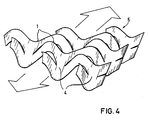
- the irregular erection of the slats under tensile load can be seen particularly clearly in FIG. 4.
- the webs 4 between two wave crests lying one behind the other in the loading direction partly as flat surfaces 4 ', 4 ′′′, which protrude partly at an acute angle, partly at an obtuse angle against the loading direction.
- the webs 4 also set up as surfaces 4 ⁇ which are bent in the middle between two wave crests. This different, accidental placement of the webs 4 increases the irregularity of the three-dimensional structure in the manner of a foliage, which considerably improves the camouflage effect.
- the camouflage agent can be colored differently on its top or bottom (summer side or winter side). Depending on the season, either the summer side or the winter side is camouflaged.
- Velcro fasteners 3, 3 ' can be attached to the outer edge of the camouflage, whereby the camouflage can be particularly quickly and easily attached to tubular objects such as gun barrels or masts.
Landscapes
- Engineering & Computer Science (AREA)
- General Engineering & Computer Science (AREA)
- Aiming, Guidance, Guns With A Light Source, Armor, Camouflage, And Targets (AREA)
- Treatments For Attaching Organic Compounds To Fibrous Goods (AREA)
Claims (12)
- Moyen de camouflage pour cibles militaires, composé d'un élément de base en tissu (5), en feuille ou analogue, qui est entrecoupé de fentes, caractérisé en ce que les fentes (1) s'étendent le long de lignes ondulées (2) parallèles entre elles, la fente (1) de chaque ligne ondulée (2) étant entrecoupée par une baguette (4) tous les deux sommets d'ondulation et les coupures de chaque ligne ondulée étant décalées latéralement d'un sommet d'ondulation par rapport aux coupures de chacune des lignes ondulées voisines.
- Moyen de camouflage selon la revendication 1, caractérisé en ce que les fentes (1) ondulées et l'élément de base sont dimensionnés de telle manière que les baguettes (4) soumises à l'effort de traction se dressent transversalement par rapport aux lignes ondulées (2) situées entre deux sommets d'ondulation disposés l'un derrière l'autre dans la direction de la charge pour former parfois des surfaces (4', 4''') essentiellement planes qui font saillie dans la section de la charge tantôt avec un angle aigu, tantôt avec un angle obtus , et en ce que les baguettes (4) se dressent pour former parfois des surfaces brisées (4'') au milieu entre deux sommets d'ondulation.
- Moyen de camouflage selon la revendication 1 ou 2, caractérisé en ce que le tissu est composé de fils de polyamide ou de polyester.
- Moyen de camouflage selon la revendication 1, 2 ou 3, caractérisé en ce que le tissu comporte l'armure-toile L 1/1.
- Moyen de camouflage selon l'une des revendications précédentes, caractérisé en ce qu'un revêtement de camouflage optique est appliqué sur le matériau de base.
- Moyen de camouflage selon l'une des revendication précédentes, caractérisé en ce que dans la zone du radar est appliqué, sur le matériau de base, un revêtement réfléchissant de manière dispersive et/ou absorbant.
- Moyen de camouflage selon la revendication 6, caractérisé en ce que le revêtement réfléchissant de manière dispersive et/ou absorbant dans la zone du radar est conducteur et présente une faible résistance superficielle spécifique.
- Moyen de camouflage selon la revendication 7, caractérisé en ce que le revêtement contient des particules de métal.
- Moyen de camouflage selon l'une des revendications précédentes, caractérisé en ce que les fils contenant du métal sont tissés dans le tissu.
- Moyen de camouflage selon l'une des revendications précédentes, caractérisé en ce que des fils recouverts d'un conducteur sont tissés dans le tissu.
- Moyen de camouflage selon l'une des revendications précédentes, caractérisé en ce qu'un revêtement à base de laque polyacrylique relativement dure est appliqué sur le matériau de base.
- Moyen de camouflage selon l'une des revendications précédentes, caractérisé en ce que des bandes agrippantes (3,3'), au moyen desquelles l'endroit et l'envers du moyen de camouflage peuvent être fixés l'un à l'autre, sont fixées sur l'endroit et l'envers.
Applications Claiming Priority (2)
| Application Number | Priority Date | Filing Date | Title |
|---|---|---|---|
| DE3831149 | 1988-09-13 | ||
| DE3831149A DE3831149A1 (de) | 1988-09-13 | 1988-09-13 | Tarnmittel zur tarnung militaerischer ziele |
Publications (2)
| Publication Number | Publication Date |
|---|---|
| EP0359029A1 EP0359029A1 (fr) | 1990-03-21 |
| EP0359029B1 true EP0359029B1 (fr) | 1993-07-21 |
Family
ID=6362882
Family Applications (1)
| Application Number | Title | Priority Date | Filing Date |
|---|---|---|---|
| EP89115975A Expired - Lifetime EP0359029B1 (fr) | 1988-09-13 | 1989-08-30 | Moyen pour camoufler des objets militaires |
Country Status (2)
| Country | Link |
|---|---|
| EP (1) | EP0359029B1 (fr) |
| DE (2) | DE3831149A1 (fr) |
Families Citing this family (1)
| Publication number | Priority date | Publication date | Assignee | Title |
|---|---|---|---|---|
| AT403094B (de) * | 1992-08-19 | 1997-11-25 | Haager Birgit | Vorrichtung zur tarnung militärischer geräte |
Family Cites Families (5)
| Publication number | Priority date | Publication date | Assignee | Title |
|---|---|---|---|---|
| AT28359B (de) * | 1906-06-06 | 1907-05-10 | Franz Unzeitig | Warmwasserheizanlage. |
| NL100293C (fr) * | 1957-11-18 | |||
| FR1206213A (fr) * | 1958-05-14 | 1960-02-08 | élément barbelé | |
| US4323605A (en) * | 1976-09-14 | 1982-04-06 | Brunswick Corporation | Camouflage incising geometry |
| DE3112924A1 (de) * | 1981-03-31 | 1982-10-07 | Ogus Netze und Wirkwaren GmbH & Co KG, 4050 Mönchengladbach | Tarnnetz fuer helme |
-
1988
- 1988-09-13 DE DE3831149A patent/DE3831149A1/de active Granted
-
1989
- 1989-08-30 DE DE8989115975T patent/DE58904958D1/de not_active Expired - Fee Related
- 1989-08-30 EP EP89115975A patent/EP0359029B1/fr not_active Expired - Lifetime
Also Published As
| Publication number | Publication date |
|---|---|
| EP0359029A1 (fr) | 1990-03-21 |
| DE58904958D1 (de) | 1993-08-26 |
| DE3831149C2 (fr) | 1990-06-28 |
| DE3831149A1 (de) | 1990-03-22 |
Similar Documents
| Publication | Publication Date | Title |
|---|---|---|
| DE4023287C2 (de) | Tarnnetz | |
| EP0129744B1 (fr) | Matériau de camouflage pour dissimuler des cibles militaires | |
| DE69611762T2 (de) | Paneel | |
| DE4024622C1 (fr) | ||
| DE2059881A1 (de) | Flaechenhaftverschluss | |
| DE1963405A1 (de) | Schutzblende | |
| EP0043531A2 (fr) | Elément de chauffage électrique | |
| DE3601968A1 (de) | Verriegelungselement fuer eine schliessvorrichtung | |
| DE2243229C3 (de) | Laufflächenausbildung für Langlauf-Ski | |
| EP1499846A1 (fr) | Dispositif de protection pour vehicules blindes, en particulier contre les projectiles a charge creuse | |
| EP0955515A1 (fr) | Tissu, en particulier tissu résistant aux coups de couteau | |
| DE69619153T2 (de) | Verbundwerkstoffstruktur, fähig zur Absorption und Dissipation von auffallender elektromagnetischer Strahlungsenergie, insbesondere für Luft-, See- und Landfahrzeuge und für feste Bodeneinrichtungen | |
| EP0359029B1 (fr) | Moyen pour camoufler des objets militaires | |
| EP1365206B1 (fr) | Filet de camouflage | |
| DE69912821T2 (de) | Tarnmaterial | |
| DE102012100573A1 (de) | Schutzelement zum Schutz gegen ballistische Geschosse und militärisches Fahrzeug | |
| DE3515726A1 (de) | Material mit hoher widerstandskraft | |
| DE2619512C3 (de) | Tarnfolie mit Lochmusterung | |
| CH672819A5 (fr) | ||
| AT210121B (de) | Bewehrungselement für Stahlbetonkonstruktionen | |
| DE102018102647B4 (de) | Schutzplane, insbesondere für einen LKW-Aufbau oder für einen Zelt-Aufbau oder für ein Tor | |
| DE2326909C2 (de) | Filznadel | |
| CH376459A (de) | Federelastisches Netz | |
| DE60023271T2 (de) | Verfahren zur herstellung von elastizität bei einem flachkabel, verwendete werkzeuge und kabel | |
| DE102004035201A1 (de) | Wasserdichtes biegbares Abdichtungsmaterial |
Legal Events
| Date | Code | Title | Description |
|---|---|---|---|
| PUAI | Public reference made under article 153(3) epc to a published international application that has entered the european phase |
Free format text: ORIGINAL CODE: 0009012 |
|
| 17P | Request for examination filed |
Effective date: 19891228 |
|
| AK | Designated contracting states |
Kind code of ref document: A1 Designated state(s): CH DE FR GB LI NL SE |
|
| 17Q | First examination report despatched |
Effective date: 19921130 |
|
| GRAA | (expected) grant |
Free format text: ORIGINAL CODE: 0009210 |
|
| AK | Designated contracting states |
Kind code of ref document: B1 Designated state(s): CH DE FR GB LI NL SE |
|
| PG25 | Lapsed in a contracting state [announced via postgrant information from national office to epo] |
Ref country code: SE Effective date: 19930721 Ref country code: NL Effective date: 19930721 |
|
| ET | Fr: translation filed | ||
| GBT | Gb: translation of ep patent filed (gb section 77(6)(a)/1977) |
Effective date: 19930727 |
|
| REF | Corresponds to: |
Ref document number: 58904958 Country of ref document: DE Date of ref document: 19930826 |
|
| PG25 | Lapsed in a contracting state [announced via postgrant information from national office to epo] |
Ref country code: GB Effective date: 19931021 |
|
| NLV1 | Nl: lapsed or annulled due to failure to fulfill the requirements of art. 29p and 29m of the patents act | ||
| PLBE | No opposition filed within time limit |
Free format text: ORIGINAL CODE: 0009261 |
|
| STAA | Information on the status of an ep patent application or granted ep patent |
Free format text: STATUS: NO OPPOSITION FILED WITHIN TIME LIMIT |
|
| GBPC | Gb: european patent ceased through non-payment of renewal fee |
Effective date: 19931021 |
|
| 26N | No opposition filed | ||
| PGFP | Annual fee paid to national office [announced via postgrant information from national office to epo] |
Ref country code: FR Payment date: 20030819 Year of fee payment: 15 |
|
| PG25 | Lapsed in a contracting state [announced via postgrant information from national office to epo] |
Ref country code: FR Free format text: LAPSE BECAUSE OF NON-PAYMENT OF DUE FEES Effective date: 20050429 |
|
| REG | Reference to a national code |
Ref country code: FR Ref legal event code: ST |
|
| PGFP | Annual fee paid to national office [announced via postgrant information from national office to epo] |
Ref country code: CH Payment date: 20070827 Year of fee payment: 19 |
|
| PGFP | Annual fee paid to national office [announced via postgrant information from national office to epo] |
Ref country code: DE Payment date: 20070927 Year of fee payment: 19 |
|
| REG | Reference to a national code |
Ref country code: CH Ref legal event code: PL |
|
| PG25 | Lapsed in a contracting state [announced via postgrant information from national office to epo] |
Ref country code: LI Free format text: LAPSE BECAUSE OF NON-PAYMENT OF DUE FEES Effective date: 20080831 Ref country code: CH Free format text: LAPSE BECAUSE OF NON-PAYMENT OF DUE FEES Effective date: 20080831 |
|
| PG25 | Lapsed in a contracting state [announced via postgrant information from national office to epo] |
Ref country code: DE Free format text: LAPSE BECAUSE OF NON-PAYMENT OF DUE FEES Effective date: 20090303 |