EP0359621B1 - Mit Tritium markierte Verbindung, ihre Herstellung und Verwendung, besonders bei der Bestimmung der Affinität der Retinoide für ihre nuklearen Rezeptoren und ihr zytosol-bindendes Protein - Google Patents
Mit Tritium markierte Verbindung, ihre Herstellung und Verwendung, besonders bei der Bestimmung der Affinität der Retinoide für ihre nuklearen Rezeptoren und ihr zytosol-bindendes Protein Download PDFInfo
- Publication number
- EP0359621B1 EP0359621B1 EP89402391A EP89402391A EP0359621B1 EP 0359621 B1 EP0359621 B1 EP 0359621B1 EP 89402391 A EP89402391 A EP 89402391A EP 89402391 A EP89402391 A EP 89402391A EP 0359621 B1 EP0359621 B1 EP 0359621B1
- Authority
- EP
- European Patent Office
- Prior art keywords
- tetrahydro
- tetramethyl
- anthracenyl
- tritiated
- benzoic acid
- Prior art date
- Legal status (The legal status is an assumption and is not a legal conclusion. Google has not performed a legal analysis and makes no representation as to the accuracy of the status listed.)
- Expired - Lifetime
Links
- 150000001875 compounds Chemical class 0.000 title claims description 56
- YZCKVEUIGOORGS-NJFSPNSNSA-N Tritium Chemical compound [3H] YZCKVEUIGOORGS-NJFSPNSNSA-N 0.000 title claims description 9
- 229910052722 tritium Inorganic materials 0.000 title claims description 9
- 238000002360 preparation method Methods 0.000 title claims description 4
- 108091008324 binding proteins Proteins 0.000 title description 9
- 108020005497 Nuclear hormone receptor Proteins 0.000 title description 5
- 108020004017 nuclear receptors Proteins 0.000 title description 5
- 230000001086 cytosolic effect Effects 0.000 title description 3
- 102000014914 Carrier Proteins Human genes 0.000 title 1
- 102000007399 Nuclear hormone receptor Human genes 0.000 title 1
- 101001099854 Xenopus laevis Cellular retinoic acid-binding protein 2 Proteins 0.000 claims description 36
- 108090000064 retinoic acid receptors Proteins 0.000 claims description 36
- 102000003702 retinoic acid receptors Human genes 0.000 claims description 36
- KBUHKLGVLUHYJL-UHFFFAOYSA-N 4-(5,5,8,8-tetramethyl-6,7-dihydroanthracen-2-yl)benzoic acid Chemical compound C=1C=C2C=C3C(C)(C)CCC(C)(C)C3=CC2=CC=1C1=CC=C(C(O)=O)C=C1 KBUHKLGVLUHYJL-UHFFFAOYSA-N 0.000 claims description 21
- QTBSBXVTEAMEQO-UHFFFAOYSA-N Acetic acid Chemical compound CC(O)=O QTBSBXVTEAMEQO-UHFFFAOYSA-N 0.000 claims description 15
- 230000027455 binding Effects 0.000 claims description 14
- 238000000034 method Methods 0.000 claims description 12
- 125000005907 alkyl ester group Polymers 0.000 claims description 11
- 238000002474 experimental method Methods 0.000 claims description 11
- 150000004492 retinoid derivatives Chemical class 0.000 claims description 10
- 230000000694 effects Effects 0.000 claims description 9
- 230000009471 action Effects 0.000 claims description 8
- 230000004071 biological effect Effects 0.000 claims description 8
- 230000008569 process Effects 0.000 claims description 8
- 239000000284 extract Substances 0.000 claims description 7
- WPYMKLBDIGXBTP-UHFFFAOYSA-N benzoic acid Chemical compound OC(=O)C1=CC=CC=C1 WPYMKLBDIGXBTP-UHFFFAOYSA-N 0.000 claims description 5
- 239000003795 chemical substances by application Substances 0.000 claims description 5
- 239000003638 chemical reducing agent Substances 0.000 claims description 4
- 125000004494 ethyl ester group Chemical group 0.000 claims description 4
- 230000002140 halogenating effect Effects 0.000 claims description 4
- 238000001727 in vivo Methods 0.000 claims description 4
- BASFCYQUMIYNBI-UHFFFAOYSA-N platinum Chemical compound [Pt] BASFCYQUMIYNBI-UHFFFAOYSA-N 0.000 claims description 4
- 230000001413 cellular effect Effects 0.000 claims description 3
- 239000005711 Benzoic acid Substances 0.000 claims description 2
- XLYOFNOQVPJJNP-PWCQTSIFSA-N Tritiated water Chemical compound [3H]O[3H] XLYOFNOQVPJJNP-PWCQTSIFSA-N 0.000 claims description 2
- 235000010233 benzoic acid Nutrition 0.000 claims description 2
- 239000003054 catalyst Substances 0.000 claims description 2
- 238000012512 characterization method Methods 0.000 claims description 2
- 238000009826 distribution Methods 0.000 claims description 2
- 230000004060 metabolic process Effects 0.000 claims description 2
- 229910052697 platinum Inorganic materials 0.000 claims description 2
- 238000003127 radioimmunoassay Methods 0.000 claims description 2
- 239000000700 radioactive tracer Substances 0.000 claims 8
- 102100038503 Cellular retinoic acid-binding protein 1 Human genes 0.000 claims 3
- 101001099865 Homo sapiens Cellular retinoic acid-binding protein 1 Proteins 0.000 claims 3
- 238000002372 labelling Methods 0.000 claims 2
- 238000006243 chemical reaction Methods 0.000 claims 1
- 238000007127 saponification reaction Methods 0.000 claims 1
- 239000003446 ligand Substances 0.000 description 33
- 230000002285 radioactive effect Effects 0.000 description 24
- 210000004027 cell Anatomy 0.000 description 23
- SHGAZHPCJJPHSC-YCNIQYBTSA-N all-trans-retinoic acid Chemical compound OC(=O)\C=C(/C)\C=C\C=C(/C)\C=C\C1=C(C)CCCC1(C)C SHGAZHPCJJPHSC-YCNIQYBTSA-N 0.000 description 21
- 229930002330 retinoic acid Natural products 0.000 description 21
- 229960001727 tretinoin Drugs 0.000 description 21
- YMWUJEATGCHHMB-UHFFFAOYSA-N Dichloromethane Chemical compound ClCCl YMWUJEATGCHHMB-UHFFFAOYSA-N 0.000 description 9
- OKKJLVBELUTLKV-UHFFFAOYSA-N Methanol Chemical compound OC OKKJLVBELUTLKV-UHFFFAOYSA-N 0.000 description 9
- 239000003550 marker Substances 0.000 description 9
- 102000023732 binding proteins Human genes 0.000 description 8
- 239000000047 product Substances 0.000 description 8
- WEVYAHXRMPXWCK-UHFFFAOYSA-N Acetonitrile Chemical compound CC#N WEVYAHXRMPXWCK-UHFFFAOYSA-N 0.000 description 6
- LFQSCWFLJHTTHZ-UHFFFAOYSA-N Ethanol Chemical compound CCO LFQSCWFLJHTTHZ-UHFFFAOYSA-N 0.000 description 6
- 238000011993 High Performance Size Exclusion Chromatography Methods 0.000 description 6
- HEMHJVSKTPXQMS-UHFFFAOYSA-M Sodium hydroxide Chemical compound [OH-].[Na+] HEMHJVSKTPXQMS-UHFFFAOYSA-M 0.000 description 6
- ZMANZCXQSJIPKH-UHFFFAOYSA-N Triethylamine Chemical compound CCN(CC)CC ZMANZCXQSJIPKH-UHFFFAOYSA-N 0.000 description 6
- 238000011534 incubation Methods 0.000 description 6
- 239000000203 mixture Substances 0.000 description 5
- 102000005962 receptors Human genes 0.000 description 5
- 108020003175 receptors Proteins 0.000 description 5
- KDLHZDBZIXYQEI-UHFFFAOYSA-N Palladium Chemical compound [Pd] KDLHZDBZIXYQEI-UHFFFAOYSA-N 0.000 description 4
- 239000002253 acid Substances 0.000 description 4
- 238000001514 detection method Methods 0.000 description 4
- 238000010828 elution Methods 0.000 description 4
- 230000009871 nonspecific binding Effects 0.000 description 4
- 102000006255 nuclear receptors Human genes 0.000 description 4
- XLYOFNOQVPJJNP-UHFFFAOYSA-N water Substances O XLYOFNOQVPJJNP-UHFFFAOYSA-N 0.000 description 4
- WKBOTKDWSSQWDR-UHFFFAOYSA-N Bromine atom Chemical compound [Br] WKBOTKDWSSQWDR-UHFFFAOYSA-N 0.000 description 3
- VYPSYNLAJGMNEJ-UHFFFAOYSA-N Silicium dioxide Chemical compound O=[Si]=O VYPSYNLAJGMNEJ-UHFFFAOYSA-N 0.000 description 3
- GDTBXPJZTBHREO-UHFFFAOYSA-N bromine Substances BrBr GDTBXPJZTBHREO-UHFFFAOYSA-N 0.000 description 3
- 229910052794 bromium Inorganic materials 0.000 description 3
- 210000000172 cytosol Anatomy 0.000 description 3
- 230000004069 differentiation Effects 0.000 description 3
- 239000003480 eluent Substances 0.000 description 3
- 238000012417 linear regression Methods 0.000 description 3
- 238000011002 quantification Methods 0.000 description 3
- 102000027483 retinoid hormone receptors Human genes 0.000 description 3
- 108091008679 retinoid hormone receptors Proteins 0.000 description 3
- 210000001550 testis Anatomy 0.000 description 3
- HMTOCCRVXOAAQG-UHFFFAOYSA-N 1-(5,5,8,8-tetramethylnaphthalen-2-yl)-5,6,7,8-tetrahydronaphthalene-2-carboxylic acid Chemical compound C1CCCC2=C1C=CC(C(O)=O)=C2C1=CC=C2C(C)(C)C=CC(C)(C)C2=C1 HMTOCCRVXOAAQG-UHFFFAOYSA-N 0.000 description 2
- -1 5,6,7,8-tetrahydro-5,5,8,8-tetramethyl-2-naphthyl Chemical group 0.000 description 2
- FCSKOFQQCWLGMV-UHFFFAOYSA-N 5-{5-[2-chloro-4-(4,5-dihydro-1,3-oxazol-2-yl)phenoxy]pentyl}-3-methylisoxazole Chemical compound O1N=C(C)C=C1CCCCCOC1=CC=C(C=2OCCN=2)C=C1Cl FCSKOFQQCWLGMV-UHFFFAOYSA-N 0.000 description 2
- 108020004635 Complementary DNA Proteins 0.000 description 2
- FKLJPTJMIBLJAV-UHFFFAOYSA-N Compound IV Chemical compound O1N=C(C)C=C1CCCCCCCOC1=CC=C(C=2OCCN=2)C=C1 FKLJPTJMIBLJAV-UHFFFAOYSA-N 0.000 description 2
- RTZKZFJDLAIYFH-UHFFFAOYSA-N Diethyl ether Chemical compound CCOCC RTZKZFJDLAIYFH-UHFFFAOYSA-N 0.000 description 2
- VEXZGXHMUGYJMC-UHFFFAOYSA-N Hydrochloric acid Chemical compound Cl VEXZGXHMUGYJMC-UHFFFAOYSA-N 0.000 description 2
- CSNNHWWHGAXBCP-UHFFFAOYSA-L Magnesium sulfate Chemical compound [Mg+2].[O-][S+2]([O-])([O-])[O-] CSNNHWWHGAXBCP-UHFFFAOYSA-L 0.000 description 2
- 241001529936 Murinae Species 0.000 description 2
- UIIMBOGNXHQVGW-UHFFFAOYSA-M Sodium bicarbonate Chemical compound [Na+].OC([O-])=O UIIMBOGNXHQVGW-UHFFFAOYSA-M 0.000 description 2
- FAPWRFPIFSIZLT-UHFFFAOYSA-M Sodium chloride Chemical compound [Na+].[Cl-] FAPWRFPIFSIZLT-UHFFFAOYSA-M 0.000 description 2
- DTQVDTLACAAQTR-UHFFFAOYSA-N Trifluoroacetic acid Chemical compound OC(=O)C(F)(F)F DTQVDTLACAAQTR-UHFFFAOYSA-N 0.000 description 2
- FPIPGXGPPPQFEQ-OVSJKPMPSA-N all-trans-retinol Chemical compound OC\C=C(/C)\C=C\C=C(/C)\C=C\C1=C(C)CCCC1(C)C FPIPGXGPPPQFEQ-OVSJKPMPSA-N 0.000 description 2
- 238000004458 analytical method Methods 0.000 description 2
- 238000003556 assay Methods 0.000 description 2
- 239000012298 atmosphere Substances 0.000 description 2
- 238000007796 conventional method Methods 0.000 description 2
- LOKCTEFSRHRXRJ-UHFFFAOYSA-I dipotassium trisodium dihydrogen phosphate hydrogen phosphate dichloride Chemical compound P(=O)(O)(O)[O-].[K+].P(=O)(O)([O-])[O-].[Na+].[Na+].[Cl-].[K+].[Cl-].[Na+] LOKCTEFSRHRXRJ-UHFFFAOYSA-I 0.000 description 2
- 238000010494 dissociation reaction Methods 0.000 description 2
- 230000005593 dissociations Effects 0.000 description 2
- 229940079593 drug Drugs 0.000 description 2
- 239000003814 drug Substances 0.000 description 2
- 230000007717 exclusion Effects 0.000 description 2
- 238000004128 high performance liquid chromatography Methods 0.000 description 2
- 230000002401 inhibitory effect Effects 0.000 description 2
- 230000000155 isotopic effect Effects 0.000 description 2
- 230000000670 limiting effect Effects 0.000 description 2
- 239000007788 liquid Substances 0.000 description 2
- 238000005259 measurement Methods 0.000 description 2
- 230000007246 mechanism Effects 0.000 description 2
- 239000012299 nitrogen atmosphere Substances 0.000 description 2
- 239000012071 phase Substances 0.000 description 2
- 239000002953 phosphate buffered saline Substances 0.000 description 2
- 230000035755 proliferation Effects 0.000 description 2
- 102000004169 proteins and genes Human genes 0.000 description 2
- 108090000623 proteins and genes Proteins 0.000 description 2
- 230000002829 reductive effect Effects 0.000 description 2
- 230000002441 reversible effect Effects 0.000 description 2
- 239000002904 solvent Substances 0.000 description 2
- 239000007858 starting material Substances 0.000 description 2
- 238000012360 testing method Methods 0.000 description 2
- OFFSPAZVIVZPHU-UHFFFAOYSA-N 1-benzofuran-2-carboxylic acid Chemical compound C1=CC=C2OC(C(=O)O)=CC2=C1 OFFSPAZVIVZPHU-UHFFFAOYSA-N 0.000 description 1
- DYSJMQABFPKAQM-UHFFFAOYSA-N 1-benzothiophene-2-carboxylic acid Chemical compound C1=CC=C2SC(C(=O)O)=CC2=C1 DYSJMQABFPKAQM-UHFFFAOYSA-N 0.000 description 1
- FPIPGXGPPPQFEQ-UHFFFAOYSA-N 13-cis retinol Natural products OCC=C(C)C=CC=C(C)C=CC1=C(C)CCCC1(C)C FPIPGXGPPPQFEQ-UHFFFAOYSA-N 0.000 description 1
- VYBLDUKQAWIMMM-UHFFFAOYSA-N 2-(5,5,8,8-tetramethyl-6,7-dihydronaphthalen-2-yl)-1-benzothiophene-6-carboxylic acid Chemical compound C1=C(C(O)=O)C=C2SC(C=3C=C4C(C)(C)CCC(C4=CC=3)(C)C)=CC2=C1 VYBLDUKQAWIMMM-UHFFFAOYSA-N 0.000 description 1
- 201000009030 Carcinoma Diseases 0.000 description 1
- 102000016911 Deoxyribonucleases Human genes 0.000 description 1
- 108010053770 Deoxyribonucleases Proteins 0.000 description 1
- 241000282412 Homo Species 0.000 description 1
- 102000008100 Human Serum Albumin Human genes 0.000 description 1
- 108091006905 Human Serum Albumin Proteins 0.000 description 1
- 239000007836 KH2PO4 Substances 0.000 description 1
- 102000036675 Myoglobin Human genes 0.000 description 1
- 108010062374 Myoglobin Proteins 0.000 description 1
- 108010058846 Ovalbumin Proteins 0.000 description 1
- 102000013566 Plasminogen Human genes 0.000 description 1
- 108010051456 Plasminogen Proteins 0.000 description 1
- 102000001938 Plasminogen Activators Human genes 0.000 description 1
- 108010001014 Plasminogen Activators Proteins 0.000 description 1
- 229920005654 Sephadex Polymers 0.000 description 1
- 239000012507 Sephadex™ Substances 0.000 description 1
- PQLVXDKIJBQVDF-UHFFFAOYSA-N acetic acid;hydrate Chemical compound O.CC(O)=O PQLVXDKIJBQVDF-UHFFFAOYSA-N 0.000 description 1
- 239000012190 activator Substances 0.000 description 1
- 125000003118 aryl group Chemical group 0.000 description 1
- 238000012925 biological evaluation Methods 0.000 description 1
- 230000031709 bromination Effects 0.000 description 1
- 238000005893 bromination reaction Methods 0.000 description 1
- 239000000872 buffer Substances 0.000 description 1
- 238000004587 chromatography analysis Methods 0.000 description 1
- 230000002860 competitive effect Effects 0.000 description 1
- 230000000593 degrading effect Effects 0.000 description 1
- 201000010099 disease Diseases 0.000 description 1
- 208000037265 diseases, disorders, signs and symptoms Diseases 0.000 description 1
- 231100000673 dose–response relationship Toxicity 0.000 description 1
- 230000008482 dysregulation Effects 0.000 description 1
- 239000012636 effector Substances 0.000 description 1
- 210000001339 epidermal cell Anatomy 0.000 description 1
- 238000011156 evaluation Methods 0.000 description 1
- 238000002270 exclusion chromatography Methods 0.000 description 1
- 239000013604 expression vector Substances 0.000 description 1
- 238000001914 filtration Methods 0.000 description 1
- 239000012467 final product Substances 0.000 description 1
- 125000005843 halogen group Chemical group 0.000 description 1
- 230000006698 induction Effects 0.000 description 1
- 230000005764 inhibitory process Effects 0.000 description 1
- 230000003834 intracellular effect Effects 0.000 description 1
- 238000002955 isolation Methods 0.000 description 1
- 238000004519 manufacturing process Methods 0.000 description 1
- 238000001819 mass spectrum Methods 0.000 description 1
- 239000002609 medium Substances 0.000 description 1
- 229910000402 monopotassium phosphate Inorganic materials 0.000 description 1
- 235000019796 monopotassium phosphate Nutrition 0.000 description 1
- 230000003287 optical effect Effects 0.000 description 1
- 210000000056 organ Anatomy 0.000 description 1
- 239000012074 organic phase Substances 0.000 description 1
- 229940092253 ovalbumin Drugs 0.000 description 1
- 230000003647 oxidation Effects 0.000 description 1
- 238000007254 oxidation reaction Methods 0.000 description 1
- 238000006303 photolysis reaction Methods 0.000 description 1
- 230000015843 photosynthesis, light reaction Effects 0.000 description 1
- 229940127126 plasminogen activator Drugs 0.000 description 1
- GNSKLFRGEWLPPA-UHFFFAOYSA-M potassium dihydrogen phosphate Chemical compound [K+].OP(O)([O-])=O GNSKLFRGEWLPPA-UHFFFAOYSA-M 0.000 description 1
- 239000002243 precursor Substances 0.000 description 1
- 238000012545 processing Methods 0.000 description 1
- 238000000746 purification Methods 0.000 description 1
- 238000003608 radiolysis reaction Methods 0.000 description 1
- 239000012217 radiopharmaceutical Substances 0.000 description 1
- 229940121896 radiopharmaceutical Drugs 0.000 description 1
- 230000002799 radiopharmaceutical effect Effects 0.000 description 1
- 239000012429 reaction media Substances 0.000 description 1
- 230000009467 reduction Effects 0.000 description 1
- 238000010992 reflux Methods 0.000 description 1
- 230000000717 retained effect Effects 0.000 description 1
- 108010059301 retinoic acid receptor gamma Proteins 0.000 description 1
- 229960003471 retinol Drugs 0.000 description 1
- 235000020944 retinol Nutrition 0.000 description 1
- 239000011607 retinol Substances 0.000 description 1
- 229920006395 saturated elastomer Polymers 0.000 description 1
- 239000012047 saturated solution Substances 0.000 description 1
- 238000004062 sedimentation Methods 0.000 description 1
- 238000000926 separation method Methods 0.000 description 1
- 239000012679 serum free medium Substances 0.000 description 1
- 239000000377 silicon dioxide Substances 0.000 description 1
- 235000017557 sodium bicarbonate Nutrition 0.000 description 1
- 229910000030 sodium bicarbonate Inorganic materials 0.000 description 1
- 239000011780 sodium chloride Substances 0.000 description 1
- AKHNMLFCWUSKQB-UHFFFAOYSA-L sodium thiosulfate Chemical compound [Na+].[Na+].[O-]S([O-])(=O)=S AKHNMLFCWUSKQB-UHFFFAOYSA-L 0.000 description 1
- 235000019345 sodium thiosulphate Nutrition 0.000 description 1
- 239000007787 solid Substances 0.000 description 1
- 239000000243 solution Substances 0.000 description 1
- 150000003431 steroids Chemical class 0.000 description 1
- 238000004809 thin layer chromatography Methods 0.000 description 1
- 210000001519 tissue Anatomy 0.000 description 1
- 238000001890 transfection Methods 0.000 description 1
- 238000003151 transfection method Methods 0.000 description 1
- 238000009281 ultraviolet germicidal irradiation Methods 0.000 description 1
- 238000000870 ultraviolet spectroscopy Methods 0.000 description 1
Images


Classifications
-
- A—HUMAN NECESSITIES
- A61—MEDICAL OR VETERINARY SCIENCE; HYGIENE
- A61K—PREPARATIONS FOR MEDICAL, DENTAL OR TOILETRY PURPOSES
- A61K51/00—Preparations containing radioactive substances for use in therapy or testing in vivo
- A61K51/02—Preparations containing radioactive substances for use in therapy or testing in vivo characterised by the carrier, i.e. characterised by the agent or material covalently linked or complexing the radioactive nucleus
- A61K51/04—Organic compounds
- A61K51/0402—Organic compounds carboxylic acid carriers, fatty acids
-
- A—HUMAN NECESSITIES
- A61—MEDICAL OR VETERINARY SCIENCE; HYGIENE
- A61K—PREPARATIONS FOR MEDICAL, DENTAL OR TOILETRY PURPOSES
- A61K2123/00—Preparations for testing in vivo
-
- Y—GENERAL TAGGING OF NEW TECHNOLOGICAL DEVELOPMENTS; GENERAL TAGGING OF CROSS-SECTIONAL TECHNOLOGIES SPANNING OVER SEVERAL SECTIONS OF THE IPC; TECHNICAL SUBJECTS COVERED BY FORMER USPC CROSS-REFERENCE ART COLLECTIONS [XRACs] AND DIGESTS
- Y10—TECHNICAL SUBJECTS COVERED BY FORMER USPC
- Y10S—TECHNICAL SUBJECTS COVERED BY FORMER USPC CROSS-REFERENCE ART COLLECTIONS [XRACs] AND DIGESTS
- Y10S435/00—Chemistry: molecular biology and microbiology
- Y10S435/968—High energy substrates, e.g. fluorescent, chemiluminescent, radioactive
Definitions
- the subject of the present invention is a new tritium-labeled compound related to retinoids, its preparation and its application in particular in determining the affinity of retinoids for their nuclear receptors and their cytosolic binding protein and / or in determining the content cell in nuclear receptors and cytosolic binding protein.
- retinoids constitute a known class of compounds which act in particular on the proliferation and differentiation of many types of cells; see, for example, B.A. Pawson et al., Journal of Medicinal Chemistry, vol.25, no.11, pages 1269-1277 (1982).
- Retinoids have been used in particular in the treatment of various dermatological diseases in which a dysregulation of the mechanisms for controlling the proliferation and differentiation of epidermal cells is involved; see for example the work "Update: Dermatology in General Medicine, edited by Thomas B. Fitzpatrick et al. (MacGraw-Hill Book Company), published in 1983, in particular the chapter of DBWindhorst et al., The Retinoids, pages 226-237.
- retinoids The mode of action of retinoids is analogous to that of steroids and other effectors interacting with nuclear receptors (Chytil & Ong, 1979).
- Nuclear retinoic acid receptors (RARs) have been isolated (Daly & Redfern, 1987) and the corresponding complementary DNAs cloned and sequenced (Petkovich et al., 1987; Brand et al., 1988). So far, three receptors have been described in humans, RARa (462 residues), RARb (448 residues) and RAR ⁇ (458 residues). It has also been shown that there exists in the cytosol a binding protein called CRABP (cellular retinoic acid binding protein), but its role is poorly understood.
- CRABP cellular retinoic acid binding protein
- Determining the affinity of a retinoid for RARs is a particularly interesting means of potential biological evaluation of said retinoid.
- the determination of affinity for CRABP provides an additional element of evaluation.
- a good radioactive ligand must on the one hand have a high affinity for its receptors and binding proteins and, on the other hand, have a low binding on any other molecule. In addition, it must be stable enough to allow convenient use.
- the radioactive ligand generally used is most often tritiated retinoic acid, either in position 2 (J. Labeled Compounds and Radiopharmaceuticals XVIII, p.1099 (1980)), or in position 4 (request for German Patent No. 3,142,975).
- Retinoic acid certainly has an excellent affinity for RARs and CRABP, with a weak non-specific binding, but the molecule has the disadvantage of degrading rapidly, by radiolysis, oxidation and photolysis.
- GB-A-2,194,535 describes 2- (5,6,7,8-tetrahydro-5,5,8,8-tetramethyl-2-naphthyl) -6-benzo [b] thiophenecarboxylic acid labeled with tritium, which has a specific activity of around 300 GBq / mole. It is desirable to obtain derivatives having a higher specific activity, in particular for the purpose of lowering the detection thresholds in the assays.
- tritiated benzoic 4- (5,6,7,8-tetrahydro-5,5,8,8-tetramethyl-2-anthracenyl) benzoic acid constitutes a new radioactive ligand which has an excellent affinity for RARs and CRABP, with weak non-specific fixation.
- this new ligand is very stable and can be obtained with a high specific activity, which makes it particularly useful for measuring the affinity of retinoids for RARS and CRABP.
- the present invention therefore relates to 4- (5,6,7,8-tetrahydro-5,5,8,8-tetramethyl-2-anthracenyl) benzoic acid labeled with tritium.
- the subject of the invention is in particular a new radioactive ligand, as defined above, having a specific activity greater than 30 Ci / mmol and preferably at least equal to 50 Ci / mmol, ie approximately 1875 GBq / mmol.
- the invention also relates to a process for the preparation of the new radioactive ligand as defined above.
- This process is mainly characterized by the fact that a multihalogenated alkyl ester of 4- (5,6,7,8-tetrahydro-5,5,8,8-tetramethyl-2-anthracenyl) benzoic acid is prepared. Depending on the number of equivalents of the halogenating agent chosen, up to five halogen atoms can be introduced. The halogenated alkyl ester is then subjected to the action of a tritiated reducing agent.
- the reducing agent is for example tritium used in the presence of 10% palladium on carbon, and triethylamine.
- the reduction of the halogenated derivative is preferably carried out at ambient temperature and pressure, for example at 15-30 ° C under a pressure of 1 bar (or about 105Pa).
- the alkyl ester is then saponified in a methanolic medium, in the presence of sodium hydroxide.
- the halogenated derivative used as starting material is preferably the brominated derivative.
- the alkyl ester used is preferably the ethyl ester.
- the halogenated alkyl ester of 4- (5,6,7,8-tetrahydro-5,5,8,8-tetramethyl-2-anthracenyl) benzoic acid can itself be prepared from the alkyl ester 4- (5,6,7,8-tetrahydro-5,5,8,8-tetramethyl-2-anthracenyl) benzoic acid by the action of a halogenating agent (in particular bromination).
- a halogenating agent in particular bromination
- the brominated derivative can be obtained by the action of bromine in acetic acid at room temperature and under a nitrogen atmosphere.
- the radioactive ligand of the invention can also be obtained from the alkyl ester of 4- (5,6,7,8-tetrahydro-5,5,8,8-tetramethyl-2-anthracenyl) benzoic acid by isotopic exchange with tritiated water in the presence of platinum and acetic acid at a temperature preferably ranging from 60 to 150 ° C. In this case isotopic exchange is preferably done with the aromatic protons of the ligand.
- a subject of the invention is also the use of 4- (5,6,7,8-tetrahydro-5,5,8,8-tetramethyl-2-anthracenyl) benzoic acid as radioactive marker, in particular in the determination the affinity, the presence or the content of the retinoids and / or in the quantification of the RARs and of the CRABP of said retinoids.
- the radioactive marker of the invention can be used during the purification of RARs and CRABP by conventional methods of exclusion chromatography under low or high pressure: it is sufficient to add to the cells (case of RARs) or to the tissue extract (in the case of CRABP) used as starting materials, a determined quantity of the radioactive ligand.
- the RARs and the CRABP are thus marked and one can easily identify their presence or absence in a given fraction.
- the radioactive marker of the invention can also be used in the characterization of antibodies against compound I, these antibodies (obtained according to conventional methods for obtaining anti-hapten antibodies) being themselves usable in the determination of the quantity of product I fixed or not fixed on the RARs and / or the CRABP.
- the labeled antibodies are used to perform a radioimmunoassay.
- the radioactive marker of the invention can also be used in the study of the mechanism of intracellular action and of the general metabolism of compound I in vivo and in cells and cellular extracts, and also to study the distribution in vivo as well as cellular and subcellular of this compound and retinoids in general.
- F9 cells from murine embryonic carcinoma (usually 4 x 90 mm dishes containing a total of 2-4x10⁷ cells per incubation condition) are washed once with PBS (phosphate buffered saline) and incubated for 3 hours in serum-free medium supplemented with the labeled retinoid in the absence or presence of homologous or heterologous cold retinoid (to verify specificity and for competitive experiments). The cells are then detached with a trypsin-EDTA mixture and counted with a Burker hemocytometer.
- PBS phosphate buffered saline
- the nucleosol containing RARs is extracted from the purified nuclei according to the method described by Daly and Redfern (1987), (that is to say after treatment with DNAase and 0.6M NaCl) and analyzed by chromatography. high performance exclusion (HPSEC). 50 ⁇ l of labeled extract are injected into a GF250 column (Dupont de Nemours) of 9x250 mm. The elution is carried out in a 0.3M KH2PO4 pH 7.8 buffer at a flow rate of 1 ml / min. The protein content is monitored by measuring optical density at 280nm. 28 fractions of 0.3 ml each are collected and counted in Picofluor scintillant (Packard).
- HPSEC high performance exclusion
- the number of bound molecules is determined from the area of the radioactivity peak and the concentration of semi-saturation (C50) calculated.
- the inhibitory concentrations 50% are calculated, the radioactive compound of Example I being used at a concentration of 2.10 ⁇ 9M.
- the molecular weight calibration of the column is carried out using human albumin (67kDa), ovalbumin (45kDa) and myoglobin (16.8kDa).
- the dose-response curves and the competition curves are analyzed by computer using non-linear regression using the various forms of the Clark equation.
- FIG. 1 represents the profile of HPSEC in the detection of nuclear retinoic acid receptors (RARs) in a fraction of approximately 45kDa in the nucleosol of F cellules cells, and makes it possible to study the specificity of the binding.
- RARs nuclear retinoic acid receptors
- the F9 cells were incubated with 200 nM tritiated retinoic acid (A) or the compound of Example 1 tritiated (B) in absence ( ⁇ - ⁇ ) or presence ( ⁇ - ⁇ ) of 20,000 nM of cold homologous ligand.
- FIG. 2 gives the results concerning the binding of retinoic acid and of the compound of example 1 on the RARs. Both compounds were used at a concentration of 200 nM. The amount of ligand linked to RARs is expressed in molecules per cell.
- the compound of Example 1 and the retinoic acid give a peak with the same surface corresponding to approximately 4,000 molecules per cell (Fig. 2).
- FIGS. 3 show competition experiments carried out with a fixed concentration of 2 nM of the compound of example 1 and variable concentrations of other retinoids (10 ⁇ 6M to 10 ⁇ 10M).
- the examples of retinoids cited are not limiting.
- HPSEC profiles are obtained after incubation of F9 cells with 2x10 ⁇ 9M of the compound of Example 1 in the absence ( ⁇ - ⁇ ) or in the presence of 10 ⁇ 9M ( ⁇ - ⁇ ), 10 ⁇ 8M ( ⁇ - ⁇ ), 10 ⁇ 7M ( ⁇ - ⁇ ), 10 ⁇ 6M ( ⁇ - ⁇ ) of cold competitors.
- I compound of Example 1 not labeled.
- RA retinoic acid.
- the inhibition sigmoid reported in inserts made it possible to determine the IC 50 reported in table 1. For each concentration of competitor, the area of the peak is expressed as a percentage of the area obtained with the compound of Example 1 without a competitor.
- the biological activity of retinoids can be measured on F9 cells by quantifying the production of plasminogen activator; secreted as a result of the differentiation of these cells, caused by retinoids.
- the CPA50 is the concentration of retinoids causing an induction of 50% of the maximum activator of the secreted plasminogen.
- FIG. 5 The results concerning the binding of compound I and retinoic acid to CRABP are shown in FIG. 5.
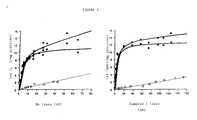
- the direct binding of increasing concentrations of the compound of example 1 (b) and of retinoic acid (a) is studied. to rat testis cytosol containing CRABP in the absence ( ⁇ - ⁇ ) or presence of 1000 nM of homologous cold ligand.
- the difference ( ⁇ - ⁇ ) represents the specific bond.
- the binding of the claimed compound to CRABP was characterized by saturation experiments (see Figure 5b).
- Total fixation (non-specific + specific (1 - 1) is obtained by incubation of increasing concentrations (up to a maximum of 125 nM) of the claimed compound with a constant amount (0.3 ml) of a homogenate of rat testes (organ rich in CRABP)
- the non-specific binding of the tritiated compound is determined in parallel, by measuring the binding with increasing concentrations of the radioactive ligand in the presence of a large excess (1 ⁇ M) of homologous cold ligand ( ⁇ - ⁇ ) An incubation time of two hours is necessary to establish equilibrium conditions.
- the CRABP-tritiated ligand complex is separated from the unbound ligand by filtration on a column of Sephadex G25 exclusion gel (BIO-Rad econo columns, 0.5 x 20 cm): the complex is eluted ( 2.5 ml elution peak), while the unbound ligand is retained in its entirety on the column. This results in a complete separation between linked and unbound product. The elution is made directly in scintillation tubes and the radioactivity is measured by counting.
- the IC50 is determined in each case (concentration of cold ligand reducing the attachment of the tritiated ligand by 50%). This IC50 value makes it possible to calculate in each case the dissociation constant at equilibrium (Kd) for the cold ligand.
Landscapes
- Health & Medical Sciences (AREA)
- Life Sciences & Earth Sciences (AREA)
- Epidemiology (AREA)
- Animal Behavior & Ethology (AREA)
- Chemical & Material Sciences (AREA)
- Medicinal Chemistry (AREA)
- Optics & Photonics (AREA)
- Pharmacology & Pharmacy (AREA)
- Proteomics, Peptides & Aminoacids (AREA)
- Physics & Mathematics (AREA)
- General Health & Medical Sciences (AREA)
- Public Health (AREA)
- Veterinary Medicine (AREA)
- Organic Low-Molecular-Weight Compounds And Preparation Thereof (AREA)
- Investigating Or Analysing Biological Materials (AREA)
- Medicines Containing Antibodies Or Antigens For Use As Internal Diagnostic Agents (AREA)
- Low-Molecular Organic Synthesis Reactions Using Catalysts (AREA)
Claims (15)
- Tritiummarkierte 4-(5,6,7,8-Tetrahydro-5,5,8,8-tetramethyl-2-anthracenyl)bezoesäure.
- Tritiummarkierte 4-(5,6,7,8-Tetrahydro-5,5,8,8-tetramethyl-2-anthracenyl)benzoesäure gemäß dem vorhergehenden Anspruch, dadurch gekennzeichnet, daß es eine spezifische Aktivität von mindestens 1875 GBq/mMol besitzt.
- Verfahren zur Herstellung eines tritiummarkierten Produktes gemäß einem der vorhergehenden Ansprüche, dadurch gekennzeichnet, daß man:
entweder einen mehrfach halogenierten Alkylester der
4-(5,6,7,8-Tetrahydro-5,5,8,8-tetramethyl-2-anthracenyl)-benzoesäure herstellt und auf diesen ein tritiiertes Reduktionsmittel oder Tritium in Gegenwart eines Katalysators einwirken läßt und anschließend verseift;
oder den Alkylester der 4-(5,6,7,8-Tetrahydro-5,5,8,8-tetramethyl-2-anthracenyl)-benzoesäure einer Isotopen-Austauschreaktion mit Tritiumwasser in Gegenwart von Platin und Essigsäure bei einer Temperatur von 60°C bis 150°C unterzieht. - Verfahren nach Anspruch 3, dadurch gekennzeichnet, daß das Reduktionsmittel Tritium ist.
- Verfahren nach einem der Ansprüche 3 oder 4, dadurch gekennzeichnet, daß man das halogenisierte Produkt durch Einwirken eines Halogenierungsmittels auf einen Alkylester der 4-(5,6,7,8-Tetrahydro-5,5,8,8-tetramethyl-2-anthracenyl)-benzoesäure erhält.
- Verfahren nach einem der Ansprüche 3 bis 5, dadurch gekennzeichnet, daß das Holgenierungsmittel ein Bromierungsmittel ist.
- Verfahren nach einem der Ansprüche 3 bis 5. dadurch gekennzeichnet, daß der verwendete Alkylester der Ethylester ist.
- Verwendung der tritiierten 4-(5,6,7,8-Tetrahydro-5,5,8,8-tetramethyl-2-anthracenyl)-benzoesäure als radioaktiver Marker zur Lokalisierung, Bestimmung oder Markierung von endogenen oder durch Transfektionsmethoden erhaltenen Kern-Rezeptoren von Retinsäure.
- Verwendung von tritiierten 4-(5,6,7,8-Tetrahydro-5,5,8,8-tetramethyl-2-anthracenyl)-benzoesäure als radioaktiver Marker zur Bestimmung der Affinität von Retinoiden gegenüber RARs (Konkurrenzexperimente) und zur Abschätzung ihrer biologischen Aktivität.
- Verwendung von tritiierter 4-(5,6,7,8-Tetrahydro-5,5,8,8-tetramethyl-2-anthracenyl)-benzoesäure als radioaktiver Marker zur Lokalisierung, Bestimmung oder Markierung von CRABP.
- Verwendung von tritiierter 4-(5,6,7,8-Tetrahydro-5,5,8,8-tetramethyl-2-anthracenyl)-benzoesäure als radioaktiver Marker zur Bestimmung der Affinität von Retinoiden gegenüber CRABP.
- Verwendung von tritiierter 4-(5,6,7,8-Tetrahydro-5,5,8,8-tetramethyl-2-anthracenyl)-benzoesäure als radioaktiver Marker zur Bestimmung eines bekannten Retinoids durch Kompetition bei der Fixierung auf CRABP.
- Verwendung von tritiierter 4-(5,6,7,8-Tetrahydro-5,5,8,8-tetramethyl-2-anthracenyl)-benzoesäure als radioaktiver Marker zur Charakterisierung von Antikörpern gegen diese Verbindung und zur gemeinsamen Verwendung dieser Verbindung mit Antikörpern zur Durchführung einer Radioimmunobestimmung.
- Verwendung von tritiierter 4-(5,6,7,8-Tetrahydro-5,5,8,8-tetramethyl-2-anthracenyl)-benzoesäure als radioaktiver Marker zur Untersuchung der in vivo und der zellulären und subzellulären Verteilung dieser Verbindung sowie von Retinoiden.
- Verwendung von tritiierter 4-(5,6,7,8-Tetrahydro-5,5,8,8-tetramethyl-2-anthracenyl)-benzoesäure als radioaktiver Marker zur Untersuchung des Metabolismus dieser Verbindung in vivo, in Zellen und Zellextrakten.
Applications Claiming Priority (2)
| Application Number | Priority Date | Filing Date | Title |
|---|---|---|---|
| FR8811469A FR2635683B1 (fr) | 1988-09-01 | 1988-09-01 | Nouveau compose marque au tritium, sa preparation et son application notamment dans la determination de l'affinite des retinoides pour leurs recepteurs nucleaires et leur proteine de liaison cytosolique |
| FR8811469 | 1988-09-01 |
Publications (2)
| Publication Number | Publication Date |
|---|---|
| EP0359621A1 EP0359621A1 (de) | 1990-03-21 |
| EP0359621B1 true EP0359621B1 (de) | 1993-07-28 |
Family
ID=9369652
Family Applications (1)
| Application Number | Title | Priority Date | Filing Date |
|---|---|---|---|
| EP89402391A Expired - Lifetime EP0359621B1 (de) | 1988-09-01 | 1989-09-01 | Mit Tritium markierte Verbindung, ihre Herstellung und Verwendung, besonders bei der Bestimmung der Affinität der Retinoide für ihre nuklearen Rezeptoren und ihr zytosol-bindendes Protein |
Country Status (6)
| Country | Link |
|---|---|
| US (1) | US5196577A (de) |
| EP (1) | EP0359621B1 (de) |
| JP (1) | JP2825867B2 (de) |
| CA (1) | CA1327052C (de) |
| DE (2) | DE359621T1 (de) |
| FR (1) | FR2635683B1 (de) |
Families Citing this family (13)
| Publication number | Priority date | Publication date | Assignee | Title |
|---|---|---|---|---|
| IL104789A (en) * | 1993-02-18 | 1995-12-31 | Scopus Light 1990 Ltd | Radioactive marker |
| US5508456A (en) * | 1993-07-30 | 1996-04-16 | Ligand Pharmaceuticals Incorporated | 9-cis tritium-labeled retinoids and intermediates, methods for their synthesis and methods for their use in discovering retinoid X receptor ligands |
| WO1995011217A1 (en) * | 1993-10-22 | 1995-04-27 | Ligand Pharmaceuticals Incorporated | Isotopically-labeled retinoids, their production and use |
| US5514821A (en) * | 1994-05-27 | 1996-05-07 | Ligand Pharmaceuticals Incorporated | Ring-labeled retinoids and intermediates, and methods for their synthesis and use |
| US5770383A (en) * | 1994-12-30 | 1998-06-23 | Ligand Pharmaceuticals, Inc. | Tricyclic retinoids, methods for their production and use |
| US5770382A (en) * | 1994-12-30 | 1998-06-23 | Ligand Pharmaceuticals, Inc. | Tricyclic retinoids, methods for their production and use |
| US5770378A (en) * | 1994-12-30 | 1998-06-23 | Ligand Pharmaceuticals, Inc. | Tricyclic retinoids, methods for their production and use |
| RU2163903C2 (ru) * | 1998-10-05 | 2001-03-10 | Институт молекулярной генетики РАН | Способ введения тритиевой метки в органические соединения и высокомеченный тритием метил-(е)-{2-[6-(2-цианофенокси)пиримидин-4-илокси]фенил}-3-метоксиакрилат |
| RU2197457C1 (ru) * | 2001-05-22 | 2003-01-27 | Институт молекулярной генетики РАН | Высокомеченный тритием n-метил-n-2-пропинилбензиламин |
| RU2183633C1 (ru) * | 2001-05-22 | 2002-06-20 | Институт молекулярной генетики РАН | Высокомеченный тритием 2-гидрокси-6-меркаптопурин |
| FR2910321B1 (fr) | 2006-12-21 | 2009-07-10 | Galderma Res & Dev S N C Snc | Gel creme comprenant au moins un retinoide et du peroxyde de benzole |
| FR2910320B1 (fr) | 2006-12-21 | 2009-02-13 | Galderma Res & Dev S N C Snc | Emulsion comprenant au moins un retinoide et du peroxyde de benzole |
| FR2931661B1 (fr) | 2008-05-30 | 2010-07-30 | Galderma Res & Dev | Nouvelles compositions depigmentantes sous forme d'une composition anhydre sans vaseline et sans elastomere comprenant un derive phenolique solubilise et un retinoide. |
Family Cites Families (3)
| Publication number | Priority date | Publication date | Assignee | Title |
|---|---|---|---|---|
| DE3142975A1 (de) * | 1981-10-29 | 1983-05-11 | Max-Planck-Gesellschaft zur Förderung der Wissenschaften e.V., 3400 Göttingen | Verfahren zur herstellung von mit tritium markierterretinsaeure |
| LU86022A1 (fr) * | 1985-07-25 | 1987-02-04 | Cird | Derives aromatiques polycyliques,leur procede de preparation et leur application dans les domaines pharmaceutique et cosmetique |
| FR2603280B1 (fr) * | 1986-08-29 | 1988-10-28 | Cird | Nouveau compose marque au tritium, sa preparation et son application notamment dans la determination de l'affinite des retinoides pour leur recepteur cellulaire |
-
1988
- 1988-09-01 FR FR8811469A patent/FR2635683B1/fr not_active Expired - Lifetime
-
1989
- 1989-08-31 CA CA000609966A patent/CA1327052C/fr not_active Expired - Fee Related
- 1989-08-31 JP JP1226365A patent/JP2825867B2/ja not_active Expired - Fee Related
- 1989-08-31 US US07/400,537 patent/US5196577A/en not_active Expired - Lifetime
- 1989-09-01 EP EP89402391A patent/EP0359621B1/de not_active Expired - Lifetime
- 1989-09-01 DE DE198989402391T patent/DE359621T1/de active Pending
- 1989-09-01 DE DE89402391T patent/DE68907830T2/de not_active Expired - Fee Related
Also Published As
| Publication number | Publication date |
|---|---|
| DE359621T1 (de) | 1990-12-20 |
| CA1327052C (fr) | 1994-02-15 |
| FR2635683A1 (fr) | 1990-03-02 |
| JP2825867B2 (ja) | 1998-11-18 |
| FR2635683B1 (fr) | 1990-11-09 |
| US5196577A (en) | 1993-03-23 |
| EP0359621A1 (de) | 1990-03-21 |
| DE68907830D1 (de) | 1993-09-02 |
| DE68907830T2 (de) | 1994-03-24 |
| JPH02209845A (ja) | 1990-08-21 |
Similar Documents
| Publication | Publication Date | Title |
|---|---|---|
| EP0359621B1 (de) | Mit Tritium markierte Verbindung, ihre Herstellung und Verwendung, besonders bei der Bestimmung der Affinität der Retinoide für ihre nuklearen Rezeptoren und ihr zytosol-bindendes Protein | |
| Catella et al. | Endogenous biosynthesis of arachidonic acid epoxides in humans: increased formation in pregnancy-induced hypertension. | |
| CA2177774C (fr) | Nouveaux composes de la piperazine, de la piperidine et de la 1,2,5,6,-tetrahydropyridine, leur procede de preparation et les compositions pharmaceutiques les contenant | |
| US4347176A (en) | Compounds and methods of making same | |
| CA1293733C (fr) | Compose marque au tritium, sa preparation et son application notamment dans la determination de l'affinite des retinoides pour leur recepteur cellulaire | |
| CA2118102C (fr) | Nouveaux derives de 1,2,3,4-tetrahydronaphtalene, leur procede de preparation et les compositions pharmaceutiques qui les contiennent | |
| EP0409740B1 (de) | Mit Tritium markierte Verbindung, seine Herstellung und Verwendung, besonders bei der Lokalisierung von nuklearen Rezeptoren von Retinoiden | |
| US4356165A (en) | Bupropion radioimmunoassay, and kit | |
| Chalon et al. | Time course of changes in striatal dopamine transporters and D2 receptors with specific iodinated markers in a rat model of Parkinson's disease | |
| US4355179A (en) | Radioactive nuclide labeled propiophenone compounds | |
| Willis et al. | Synthesis and Structure− Activity Relationship of a Novel Series of Aminoalkylindoles with Potential for Imaging the Neuronal Cannabinoid Receptor by Positron Emission Tomography | |
| US4347178A (en) | Compounds and methods of making | |
| US4347177A (en) | Compounds and methods of making them | |
| US5280045A (en) | 4(3,5-bis(1,1-dimethylethyl-4-hydroxyphenyl)-4-oxobutanamide compound useful as an anti-inflammatory agent | |
| JPS6383045A (ja) | アミド置換ナフタレン類及びその中間体 | |
| Goodman et al. | Design, synthesis, and evaluation of. omega.-iodovinyl-and. omega.-iodoalkyl-substituted methyl-branched long-chain fatty acids | |
| US5149631A (en) | Compound marked with tritium, its preparation and its use in the location of nuclear receptors of retinoids | |
| EP0344816A1 (de) | Mit Jod markierte Pyrethrinoide, Verfahren und Zwischenprodukte zu ihrer Herstellung und ihre Anwendung in Radioimmunobestimmungen | |
| Goodman et al. | Synthesis and evaluation of radioiodinated terminal‐substituted 5‐iodo‐(2‐thienyl) fatty acids as new myocardial imaging agents | |
| JPS6113715B2 (de) | ||
| Otto et al. | Synthesis of 125I‐labeled 14‐iodo‐9‐tetradecynoic acid | |
| Baldwin et al. | Structure-activity relationships of 123 I labeled o-iodobenzamide derivatives | |
| EP0038071B1 (de) | Radioaktiv markierte und unmarkierte Butylaminopropiophenon-Derivate, ihre Herstellung, aus den unmarkierten Derivaten erzeugte Immunogene und ein Verfahren zur Herstellung der Antisera, durch Immunogen hergestellte Antisera und Verfahren zur Herstellung der Antisera, ein Radioimmunoassayverfahren und eine Reagentiengarnitur zum Gebrauch bei dieser Methode | |
| ITBO940562A1 (it) | Lattoni ad attivita' antiossidante ed ipolipidemica utili nella terapia dell'aterosclerosi | |
| JPS5817742B2 (ja) | カンジヨウカゴウブツノ セイゾウホウ |
Legal Events
| Date | Code | Title | Description |
|---|---|---|---|
| PUAI | Public reference made under article 153(3) epc to a published international application that has entered the european phase |
Free format text: ORIGINAL CODE: 0009012 |
|
| AK | Designated contracting states |
Kind code of ref document: A1 Designated state(s): BE CH DE GB IT LI NL SE |
|
| ITCL | It: translation for ep claims filed |
Representative=s name: MODIANO & ASSOCIATI S.R.L. |
|
| 17P | Request for examination filed |
Effective date: 19900629 |
|
| GBC | Gb: translation of claims filed (gb section 78(7)/1977) | ||
| TCNL | Nl: translation of patent claims filed | ||
| DET | De: translation of patent claims | ||
| RAP1 | Party data changed (applicant data changed or rights of an application transferred) |
Owner name: CENTRE INTERNATIONAL DE RECHERCHES DERMATOLOGIQUES |
|
| 17Q | First examination report despatched |
Effective date: 19920103 |
|
| GRAA | (expected) grant |
Free format text: ORIGINAL CODE: 0009210 |
|
| AK | Designated contracting states |
Kind code of ref document: B1 Designated state(s): BE CH DE GB IT LI NL SE |
|
| PG25 | Lapsed in a contracting state [announced via postgrant information from national office to epo] |
Ref country code: IT Free format text: LAPSE BECAUSE OF FAILURE TO SUBMIT A TRANSLATION OF THE DESCRIPTION OR TO PAY THE FEE WITHIN THE PRE;WARNING: LAPSES OF ITALIAN PATENTS WITH EFFECTIVE DATE BEFORE 2007 MAY HAVE OCCURRED AT ANY TIME BEFORE 2007. THE CORRECT EFFECTIVE DATE MAY BE DIFFERENT FROM THE ONE RECORDED.SCRIBED TIME-LIMIT Effective date: 19930728 Ref country code: SE Effective date: 19930728 Ref country code: NL Effective date: 19930728 |
|
| GBT | Gb: translation of ep patent filed (gb section 77(6)(a)/1977) |
Effective date: 19930730 |
|
| REF | Corresponds to: |
Ref document number: 68907830 Country of ref document: DE Date of ref document: 19930902 |
|
| NLV1 | Nl: lapsed or annulled due to failure to fulfill the requirements of art. 29p and 29m of the patents act | ||
| PLBE | No opposition filed within time limit |
Free format text: ORIGINAL CODE: 0009261 |
|
| STAA | Information on the status of an ep patent application or granted ep patent |
Free format text: STATUS: NO OPPOSITION FILED WITHIN TIME LIMIT |
|
| 26N | No opposition filed | ||
| REG | Reference to a national code |
Ref country code: GB Ref legal event code: IF02 |
|
| PGFP | Annual fee paid to national office [announced via postgrant information from national office to epo] |
Ref country code: GB Payment date: 20040901 Year of fee payment: 16 |
|
| PGFP | Annual fee paid to national office [announced via postgrant information from national office to epo] |
Ref country code: DE Payment date: 20040902 Year of fee payment: 16 |
|
| PGFP | Annual fee paid to national office [announced via postgrant information from national office to epo] |
Ref country code: CH Payment date: 20040915 Year of fee payment: 16 |
|
| PGFP | Annual fee paid to national office [announced via postgrant information from national office to epo] |
Ref country code: BE Payment date: 20041122 Year of fee payment: 16 |
|
| PG25 | Lapsed in a contracting state [announced via postgrant information from national office to epo] |
Ref country code: GB Free format text: LAPSE BECAUSE OF NON-PAYMENT OF DUE FEES Effective date: 20050901 |
|
| PG25 | Lapsed in a contracting state [announced via postgrant information from national office to epo] |
Ref country code: CH Free format text: LAPSE BECAUSE OF NON-PAYMENT OF DUE FEES Effective date: 20050930 Ref country code: BE Free format text: LAPSE BECAUSE OF NON-PAYMENT OF DUE FEES Effective date: 20050930 Ref country code: LI Free format text: LAPSE BECAUSE OF NON-PAYMENT OF DUE FEES Effective date: 20050930 |
|
| PG25 | Lapsed in a contracting state [announced via postgrant information from national office to epo] |
Ref country code: DE Free format text: LAPSE BECAUSE OF NON-PAYMENT OF DUE FEES Effective date: 20060401 |
|
| REG | Reference to a national code |
Ref country code: CH Ref legal event code: PL |
|
| GBPC | Gb: european patent ceased through non-payment of renewal fee |
Effective date: 20050901 |
|
| BERE | Be: lapsed |
Owner name: CENTRE INTERNATIONAL DE RECHERCHES DERMATOLOGIQUES Effective date: 20050930 |