EP0359941A2 - Dispositif composé de mémoire à semi-conducteur à configuration de redondance - Google Patents
Dispositif composé de mémoire à semi-conducteur à configuration de redondance Download PDFInfo
- Publication number
- EP0359941A2 EP0359941A2 EP89113686A EP89113686A EP0359941A2 EP 0359941 A2 EP0359941 A2 EP 0359941A2 EP 89113686 A EP89113686 A EP 89113686A EP 89113686 A EP89113686 A EP 89113686A EP 0359941 A2 EP0359941 A2 EP 0359941A2
- Authority
- EP
- European Patent Office
- Prior art keywords
- line
- transistor
- primary
- source
- redundant
- Prior art date
- Legal status (The legal status is an assumption and is not a legal conclusion. Google has not performed a legal analysis and makes no representation as to the accuracy of the status listed.)
- Granted
Links
Images



Classifications
-
- G—PHYSICS
- G11—INFORMATION STORAGE
- G11C—STATIC STORES
- G11C29/00—Checking stores for correct operation ; Subsequent repair; Testing stores during standby or offline operation
- G11C29/70—Masking faults in memories by using spares or by reconfiguring
- G11C29/78—Masking faults in memories by using spares or by reconfiguring using programmable devices
- G11C29/781—Masking faults in memories by using spares or by reconfiguring using programmable devices combined in a redundant decoder
Definitions
- the present invention relates to a compound semiconductor memory device, and more particularly, to a compound semiconductor memory device of static random access memory (hereinafter called as SRAM) type having a redundant memory cell section and a redundant decoder.
- SRAM static random access memory
- a redundant memory cell section and a redundant decoder of a type in which selected fuses are blown by laser beam have been provided to replace defective memory cells to good ones in the redundant memory cell section thereby enhancing the yield ratio of the device.
- GaAs gallium arsenide
- a redundancy configuration is not provided because one suitable for the compound semiconductor memory device has not been developed. Therefore, when one or two defective memory cells are produced in the compound semiconductor memory device of, for example, 4K bits SRAM, the device must be rejected, and therefore, the yield ratio cannot be enhanced.
- one object of the present invention is to provide a compound semiconductor memory device having an effective redundancy configuration to enhance its yield ratio.
- Another object of the present invention is to provide an effective compound semiconductor memory device of SRAM type in which each memory cell includes a plurality of compound semiconductor field effect transistors (hereinafter called as MESFET'S in plural case, and as MESFET in singular case) having a gate forming Schottky barrier diode, and in which a redundancy configuration is formed.
- MESFET'S compound semiconductor field effect transistors
- a compound semiconductor memory device which comprises a primary memory cell section including a plurality of primary memory cells, a redundant memory cell section including a plurality of redundant memory cells, a plurality of primary decoders, at least one redundant decoder, a plurality of primary column lines (primary word lines) each formed in the primary memory cell section, coupled to corresponding the primary memory cells and connected to corresponding the primary decoder, at least one redundant column line (redundant word line) formed in the redundant memory cell section, coupled to corresponding the redundant memory cells and connected to the redundant decoder, and first and second power voltage lines.
- each of the primary decoders includes a NOR gate circuit connected between first and second common lines and inputted address signals, a first transistor connected to the first common line, a first fuse element connected between the first transistor and the first power voltage line so as to form a series connection with the first transistor, a second transistor connected between the first and second common lines and connected to the second power voltage line.
- the redundant decoder may include a NOR gate circuit having a fuse programmable link means, connected between third and fourth common lines and inputted address signals, a third transistor connected between the third common line and the first power voltage line, and a second fuse element connected between the third and fourth common lines and connected to the second power voltage line.
- the NOR circuit in the primary decoder may be constituted by a plurality of MESFET's each having source and drain regions connected between the first and second common lines and a gate forming a Schottky barrier diode and inputted an address signal
- the NOR gate circuit in the redundant decoder may be constituted by a plurality of programmable fuse elements as the programmable link means each connected to the fourth common line at its one end, a plurality of MESFET's each having source and drain region and a gate forming a Schottky barrier diode and inputted an address signal, one of the source and drain regions being connected to the other end of the programmable fuse element to form a series connection and the other of the source and drain regions being connected to the third common line.
- the first transistor in the primary decoder section may be a MESFET having source and drain regions and a gate forming a Schottky barrier diode, one of the source and drain regions being connected to the first fuse element to form a series connection and the other of the source and drain regions and the gate being connected in common to the first common line;
- the second transistor in the primary decoder section may be a MESFET having source and drain regions and a gate forming a Schottky barrier diode, one of the source and drain regions being connected to the first common line and the other of the source and drain regions and the gate being connected in common to the second power voltage line with the second common line;
- the third transistor in the redundant decoder may be a MESFET having source and drain regions and a gate forming a Schottky barrier diode, one of the source and drain regions being connected to the first power voltage line and the other of the source and drain regions and the gate being connected in common to the third common line.
- the first power voltage line supplies a high voltage such as a ground voltage (0 volts) and the second power voltage line supplies a low voltage such as an negative voltage of, for example, -2.0 volts.
- the primary column line may be connected to a driver circuit of the primary decoder and the redundant column line (redundant word line) may be connected to a driver circuit in the redundant decoder.
- each driver circuit includes an output node connected to the primary column line or the redundant column line, a third power voltage line supplying an negative voltage of, for example, -4.5 volts, a pull-down MESFET connected between the output node and the third power voltage line at its source and drain regions and connected to the third power voltage line at its gate which forms a Schottky barrier diode, a source follower MESFET connected at its drain region to the first power voltage line and at its gate, which forms a Schottky barrier diode, to the first common line of the primary decoder or to the third common line of the redundant decoder, and a level shift diode connected between the source region of the source follower MESFET and the output node.
- the level shift diode may be formed by a gate Schottky barrier diode of a MESFET between the gate and the source and drain regions which are commonly connected to each other.
- the primary column line may be directly connected to the first common line of the primary decoder without the driver circuit
- the redundant column line may be directly connected to the third common line of the redundant decoder without the driver circuit.
- Each of the primary and redundant memory cells may include a transfer gate transistor of MESFET which has a pair of source and drain regions and a gate forming a Schottkey barrier diode, one of the source and drain regions being coupled to corresponding a row line (bit line) and the gate being coupled to corresponding the primary or redundant column line (word line).
- the present invention is useful when the memory cell is of SRAM type.
- the transfer gate transistor of MESFET mentioned above may be of DRAM memory cell in which the transfer gate transistor is coupled to a storage capacitor.
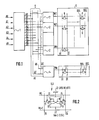
- FIG. 1 six address signals (A0, A1 ... A5) are inputted in an address buffer section 1, and in turn, twelve address signals (A0, A0 , ... A5, A5 ) of true and complement are outputted from the buffer section 1 to respective decoder lines 5.
- the twelve decoder lines 5 are connected to a redundant word address decoder 4 to which a redundant word line W R is connected.
- a single redundant word line connected to a single redundant decoder is shown.
- two or more redundant word lines connected to respective redundant decoders may be used, if necessary.
- the same redundancy technology can be employed. If the primary SRAM cell 8 coupled to the primary word line W l is defective one, tho word line W l and the primary dccoder 2 connected to the line W l are replaced by the redundant word line W R and the redundant decoder 4.
- Each of the primary and redundant SRAM cells 8, 9 is shown in Fig. 2.
- the cell includes a pair of load MESFET's 13, 14 of depletion type, a pair of drive MESFET's 15, 16 of enhancement type, and a pair of transfer gate MESFET's 11, 12 of depletion type connected between the bit lines and nodes 17, 18 at their source and drain regions, respectively, and connected to the word line at their gates, respectively.
- a primary decoder 32 and a redundant decoder 34 which are modified from a conventional silicon memory device by replacing MOSFET's (insulated gate field effect transistors of silicon series) with MESFET's of compound semiconductor having gate Schottky barrier diode.
- the primary decoder 32 includes a NOR gate circuit 200 having six MESFET's 61, 62 ... 66 of depletion type connected at their drain regions to a first common line 24, and at their source regions to a second common line 25 to which an negative voltage Vss of -2.0 volts is applied from a voltage line 22. Selected six address signals from the decoder lines 5 (Fig. 1) are applied to respective gates.
- a MESFET 41 of depletion type is connected at its drain to a ground voltage line (0 volt line) 21 and at its source region and gate to the first common line 24.
- a word driver circuit includes a MESFET 42 connected at its drain to the ground voltage line 21, at its source to an anode of a level shift diode 44 and at its gate to the first common line, a MESFET 43 of depletion type connected at its drain to the cathod of the diode 44 and at its source region and gate to a third power voltage line 23 supplying an negative voltage of -4.5 volts, and an output node 46 provided between the diode 44 and the MESFET 43.
- the primary word line W j is connected to the output node 46 via a metallic fuse 45. When the primary memory cell 8 coupled to the primary word line W j is defective one, the metallic fuse 45 is blown by laser beam to cut off from the primary decoder 32.
- the transfer gate transistors 11, 12 in every memory cells coupled to the cut off word line must be non-conductive state so as to not affect unfavorable action to the bit lines. Therefore, the primary word line is connected to the third power voltage line 23 of -4.5 volts through a pull-down resistor 40 having a high resistance of 20 K ⁇ , to apply the negative voltage of -4.5 volts to the gate of the transfer gate MESFET's 11, 12 (Fig. 2) and to render the MESFET's 11, 12 to non-conductive state.
- the gate Schottky barrier diode of MESFET occurs the breakdown phenomenon; because the breakdown voltage of the diode is about 2.5 volts (reverse voltage) and an negative voltage of -1.7 volts is applied from bit lines, and therefore, the voltage difference (reverse voltage) between the anode (gate) of the diode and the cathode (N-type portion of the compound semiconductor (GaAs) under the gate) becomes 2.8 volts (
- the breakdown of the diode is produced, the bit lines become unstable state.
- the transfer gate transistor cannot be non-conductive state, and that the applicapable voltage levels used in a memory device are defined such as 0 volts, -2.0 volts and -4.5 volts.
- NOR circuit 300 including twelve MESFET's 71, 72 ... 81, 82 of depletion type and twelve programmable metallic fuses 91, 92 ... 101, 102 as a programmable fuse link and forming every series connection with respective MESFET's 71, 72 ... 81, 82 is provided between third and fourth common lines 26, 27 such that the drain regions of MESFET's 71, 72 ... 81, 82 are connected to the third common line 26; one ends of the programmable metallic fuses 91, 92 ... 101, 102 are connected to the fourth common line 27; and the other ends of the fuses and the source regions of respective MESFET's are connected.
- a MESFET 53 of depletion type is connected at its drain region to the first power voltage line 21 of the ground voltage and at its source region and gate to the third common line 26.
- a control circuit 400 for controlling whether the redundant decoder operates or not is composed of MESFET's 48, 49, 52 of enhancement type, a MESFET 47 of depletion type, a resistor 51 and a metallic fuse 50.
- the redundant decoder has a driver circuit including a source follower MESFET 54 of depletion type connected at its drain to the ground voltage line 21 and at its gate to the third common line 26, a level shift diode connected at its anode to the source region of the MESFET 54, a pull-down MESFET 56 of depletion type connected at its drain region to the cathode of the diode 55 and at its source region and gate to the negative voltage line 23 of -4.5 V, and an output node 57 provided between the diode and the MESFET 56 and connected to the redundant word line W R .
- a driver circuit including a source follower MESFET 54 of depletion type connected at its drain to the ground voltage line 21 and at its gate to the third common line 26, a level shift diode connected at its anode to the source region of the MESFET 54, a pull-down MESFET 56 of depletion type connected at its drain region to the cathode of the diode 55 and at its source region and gate to the
- the metallic fuse 45 is blown as mentioned above.
- the metallic fuse 50 is also blown by laser beam so as to operate the decoder function of the redundant decoder, and a programming of the fuse link is conducted so that the same address signals as in the NOR gate circuit 200 connected to the defective word line, can operate in the NOR gate circuit 300 and that the defective primary word line W j can be replaced by the redundant word line W R . That is, six address signals A0 (true), A1 (complement) ... A5 (complement) are sent to the primary decoder 32 (which is assumed to be connected to the defective word line), and therefore, metallic fuses 92, 93 (not shown) ...
- control circuit 400 employs many elements 47, 48, 49, 50, 51 and 52.
- a demand to use as small number of elements as possible is more serious in a compound semiconductor memory device than in a silicon memory device, and therefore, the control circuit 400 of the redundant decoder 34 in Fig. 3, which is modified from a silicon memory device, is not suitable for a compound semiconductor memory device.
- a primary decoder 2 of the present invention includes a fuse element 121 connected at its one end to the ground line of 0 volts; a first MESFET 111 of depletion type as a load transistor connected at its drain region to the other end of the fuse element 121, and at its source region and at its gate to the first common line 24 in common; and a second MESFET 112 of depletion type having a small current flowing ability of one tenth as compared with the first MESFET 111 and connected at its drain region to the first common line 24, and at its source region and at its gate to the negative voltage line 22 of -2.0 V in common with the second common line 25.
- the word line W j is directly connected to the output node 46 of the decoder 2 without fuse element.
- a redundant decoder 4 of the present embodiment installs a simple control circuit 500 for controlling whether redundancy is to be operated or not. That is, the control circuit 500 includes a third MESFET 113 of depletion type as a load transistor connected at its drain region to the ground line 21 of 0 volts, and at its source region and at its gate to the third common line 26 in common; and a fuse element 122 connected at its one end to the third common line 26 and at its the other end to the negative voltage line 22 of -2.0 volts with the fourth common line 27.
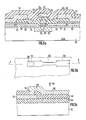
- a P-type impurity region 133 and an active layer consisting of N+-type source and drain regions 131, 132 having a high N-type impurity concentration and an N-type region 134 used as a channel portion provided between the source and drain regions and having a low N-type impurity concentration are formed by ion-implantation method, and N+-type contact layers 135, 136 of GaAs having a high impurity concentration are deposited on the source and drain regions 131, 132, respectively.
- a gate consisting of a tungsten silicide (WSi) portion 139 and a tungsten portion 140 is formed so that a Schottky barrier diode 149 is formed at the surface of the N-type region 134.
- Electrodes 137 of AuGe-Ni are formed on the contact layers 135, 136, respectively, and source and drain wirings 141 made of a first level gold layer are connected to the electrodes 137, respectively.
- a gate wiring 143 made of the first level gold layer is connected to the gate via a contact hole 144 formed in an inter-ply insulating layer 145, and an inter-ply insulating layer 146 covers the MESFET entirely.
- the threshold voltage of the MESFET can be controlled by the impurity concentration of the N-type impurity region 134.
- An enhancement type MESFET can be obtained by forming the depth of the region 134 to be shallower than that of a depletion type MESFET.
- a wiring 150 made of a second level gold layer is connected to the source or drain wiring 141 through a contact hole 151 formed in the inter-ply insulating layer 146, and extending on the layer 146.
- the wiring 150 has a narrow part 152 used as the fuse element on the insulating layer 146, and when the fuse element is to be cut-off, a laser beam 153 is irradiated for blowing a section of the narrow part 152.
- the word line W j renders "L" state (non-selective state) (before t21 and after t24 in Fig. 6) in which transfer gate MESFET's become non-conductive.
- the redundant word line W R keeps “L” state during all the time.
- the memory cell 8 coupled to the word line W j is defective one or the word line per se is defective, the fuse element 121 is blown by laser beam, and therefore, the common line keeps a low-voltage state, and the word line W j keeps "L" state in all the time (Fig. 6) irrespective of the address signals A0 ... A0 applied to the NOR gate circuit 200 of the primary decoder 2.
- the low voltage of "L" state in the word line W j is applied from the node 46 of the drive circuit in the primary decoder 2, and its level is -3.2 volts which level can render every transfer gate MESFET coupled to the defective word line W j at their gate non-conductive, and which level does not cause the unfavorable breakdown phenomenon of the Schottky barrier diode mentioned above because the voltage difference (reverse voltage) between the anode (gate) and the cathode (N-type GaAs region) of the diode becomes 1.5 volts (
- the fuse element 122 in the control circuit 500 of the redundant decoder 4 is blown by laser beam so that the redundancy function can be conducted, that is, the voltage in the third common line 26 connected to the gate of the source follower MESFET 54 of the driver circuit can be changed its binary state ("H" state and "L" state) in response to the address signals, and among the twelve programmable fuse elements 91, 92 ... 101, 102 in the NOR gate circuit 300, necessary six fuse elements 92 ... 101 are blown off by laser beam so that the redundant decoder 4 can be operated by the same address signals (A0, ...
- Fig. 7 shows a second embodiment of the present invention.
- the primary decoder 2′ of the second embodiment omits to form the level shift circuit (drive circuit) in the first embodiment including the MESFET's 42, 43 and the diode 44 in the primary decoder 2 (Fig. 4), and the primary word line W j is directly connected to the first common line 24, and also, the redundant decoder 4′ omits to form the level shift circuit including the MESFET's 54, 56 and the diode 55 in the redundant decoder 4 (Fig. 4), and the redundant word line W R is directly connected to the third common line 26.
- the binary levels in the primary and redundant word lines are raised by the V f (forward voltage) of the diode. Consequently, the second embodiment is useful when the primary and redundant memory cells 8′, 9′ employ MESFET's having a high threshold voltage or an enhancement type, as their transfer gate transistors.
Landscapes
- For Increasing The Reliability Of Semiconductor Memories (AREA)
- Techniques For Improving Reliability Of Storages (AREA)
- Compression, Expansion, Code Conversion, And Decoders (AREA)
Applications Claiming Priority (2)
| Application Number | Priority Date | Filing Date | Title |
|---|---|---|---|
| JP63186015A JPH0235699A (ja) | 1988-07-26 | 1988-07-26 | 化合物半導体メモリデバイス |
| JP186015/88 | 1988-07-26 |
Publications (3)
| Publication Number | Publication Date |
|---|---|
| EP0359941A2 true EP0359941A2 (fr) | 1990-03-28 |
| EP0359941A3 EP0359941A3 (fr) | 1991-04-24 |
| EP0359941B1 EP0359941B1 (fr) | 1995-09-27 |
Family
ID=16180892
Family Applications (1)
| Application Number | Title | Priority Date | Filing Date |
|---|---|---|---|
| EP89113686A Expired - Lifetime EP0359941B1 (fr) | 1988-07-26 | 1989-07-25 | Dispositif composé de mémoire à semi-conducteur à configuration de redondance |
Country Status (4)
| Country | Link |
|---|---|
| US (1) | US4985866A (fr) |
| EP (1) | EP0359941B1 (fr) |
| JP (1) | JPH0235699A (fr) |
| DE (1) | DE68924387T2 (fr) |
Cited By (1)
| Publication number | Priority date | Publication date | Assignee | Title |
|---|---|---|---|---|
| EP0475764A3 (en) * | 1990-09-13 | 1993-03-17 | Nec Corporation | Redundant decoder circuit |
Families Citing this family (15)
| Publication number | Priority date | Publication date | Assignee | Title |
|---|---|---|---|---|
| JP2509730B2 (ja) * | 1989-08-11 | 1996-06-26 | 株式会社東芝 | 半導体メモリ装置及びその製造方法 |
| JPH03245400A (ja) * | 1990-02-21 | 1991-10-31 | Mitsubishi Electric Corp | 半導体メモリ装置 |
| US5270976A (en) * | 1990-06-19 | 1993-12-14 | Texas Instruments Incorporated | Laser link decoder for DRAM redundancy scheme |
| JPH0461098A (ja) * | 1990-06-29 | 1992-02-27 | Nec Ic Microcomput Syst Ltd | 半導体メモリ装置 |
| KR970000501B1 (en) * | 1991-04-12 | 1997-01-13 | Hyundai Electronics Ind | Semiconductor memory device with redundancy confirmative circuit |
| KR940008211B1 (ko) * | 1991-08-21 | 1994-09-08 | 삼성전자 주식회사 | 반도체메모리장치의 리던던트 셀 어레이 배열방법 |
| US5262994A (en) * | 1992-01-31 | 1993-11-16 | Sgs-Thomson Microelectronics, Inc. | Semiconductor memory with a multiplexer for selecting an output for a redundant memory access |
| JP2923114B2 (ja) * | 1992-02-18 | 1999-07-26 | 株式会社沖マイクロデザイン宮崎 | 冗長デコーダ回路 |
| US5612918A (en) * | 1995-12-29 | 1997-03-18 | Sgs-Thomson Microelectronics, Inc. | Redundancy architecture |
| US5771195A (en) * | 1995-12-29 | 1998-06-23 | Sgs-Thomson Microelectronics, Inc. | Circuit and method for replacing a defective memory cell with a redundant memory cell |
| US5790462A (en) * | 1995-12-29 | 1998-08-04 | Sgs-Thomson Microelectronics, Inc. | Redundancy control |
| US5841709A (en) * | 1995-12-29 | 1998-11-24 | Stmicroelectronics, Inc. | Memory having and method for testing redundant memory cells |
| US6037799A (en) * | 1995-12-29 | 2000-03-14 | Stmicroelectronics, Inc. | Circuit and method for selecting a signal |
| DE19743271C1 (de) * | 1997-09-30 | 1998-10-29 | Siemens Ag | Lineare Anordnung metallischer Sicherungsstrecken auf Wafern, wobei durch "Schießen" der Sicherungsstrecken Schaltungskenngrößen einstellbar sind |
| US8325557B2 (en) * | 2008-12-23 | 2012-12-04 | Contour Semiconductor, Inc. | Methods and apparatus for disabling a memory-array portion |
Family Cites Families (4)
| Publication number | Priority date | Publication date | Assignee | Title |
|---|---|---|---|---|
| US4573146A (en) * | 1982-04-20 | 1986-02-25 | Mostek Corporation | Testing and evaluation of a semiconductor memory containing redundant memory elements |
| JPS60195797A (ja) * | 1984-03-16 | 1985-10-04 | Mitsubishi Electric Corp | 半導体記憶装置の冗長回路 |
| US4689494A (en) * | 1986-09-18 | 1987-08-25 | Advanced Micro Devices, Inc. | Redundancy enable/disable circuit |
| US4885720A (en) * | 1988-04-01 | 1989-12-05 | International Business Machines Corporation | Memory device and method implementing wordline redundancy without an access time penalty |
-
1988
- 1988-07-26 JP JP63186015A patent/JPH0235699A/ja active Pending
-
1989
- 1989-07-25 DE DE68924387T patent/DE68924387T2/de not_active Expired - Fee Related
- 1989-07-25 EP EP89113686A patent/EP0359941B1/fr not_active Expired - Lifetime
- 1989-07-26 US US07/385,118 patent/US4985866A/en not_active Expired - Fee Related
Cited By (1)
| Publication number | Priority date | Publication date | Assignee | Title |
|---|---|---|---|---|
| EP0475764A3 (en) * | 1990-09-13 | 1993-03-17 | Nec Corporation | Redundant decoder circuit |
Also Published As
| Publication number | Publication date |
|---|---|
| US4985866A (en) | 1991-01-15 |
| EP0359941A3 (fr) | 1991-04-24 |
| JPH0235699A (ja) | 1990-02-06 |
| DE68924387T2 (de) | 1996-04-18 |
| EP0359941B1 (fr) | 1995-09-27 |
| DE68924387D1 (de) | 1995-11-02 |
Similar Documents
| Publication | Publication Date | Title |
|---|---|---|
| EP0359941B1 (fr) | Dispositif composé de mémoire à semi-conducteur à configuration de redondance | |
| EP0355768B1 (fr) | Cellules de mémoire à semi-conducteur et dispositif de mémoire à semi-conducteur utilisant de telles cellules | |
| US5005068A (en) | Semiconductor memory device | |
| EP0535681B1 (fr) | Corps semi-conducteur, son procédé de fabrication et dispositif semi-conducteur utilisant ce corps | |
| US4990992A (en) | Semiconductor integrated circuit device | |
| KR100389040B1 (ko) | 반도체 집적 회로의 퓨즈 회로 | |
| USRE45698E1 (en) | Semiconductor memory device | |
| JPS6240795B2 (fr) | ||
| JP2509730B2 (ja) | 半導体メモリ装置及びその製造方法 | |
| US4794568A (en) | Redundancy circuit for use in a semiconductor memory device | |
| US5079746A (en) | Semiconductor memory circuit | |
| KR940006161B1 (ko) | 반도체 메모리장치 | |
| EP0359204B1 (fr) | Dispositif de mémoire à semi-conducteur capable de réduire le nombre de bits défectueux | |
| US4780851A (en) | Semiconductor memory device having improved redundant structure | |
| US4590388A (en) | CMOS spare decoder circuit | |
| KR930000760B1 (ko) | 라인 전환 회로 및 그를 사용한 반도체 메모리 | |
| US5172337A (en) | Semiconductor memory device | |
| US7352610B1 (en) | Volatile memory elements with soft error upset immunity for programmable logic device integrated circuits | |
| US5841723A (en) | Method and apparatus for programming anti-fuses using an isolated well programming circuit | |
| US10607696B2 (en) | FPGA configuration cell utilizing NVM technology and redundancy | |
| JPS6350799B2 (fr) | ||
| US5184202A (en) | Semiconductor integrated circuit device | |
| JP3758251B2 (ja) | 半導体記憶装置 | |
| US6351407B1 (en) | Differential one-time programmable memory cell structure in CMOS technology | |
| US4783767A (en) | Static RAM with divided word-line structure |
Legal Events
| Date | Code | Title | Description |
|---|---|---|---|
| PUAI | Public reference made under article 153(3) epc to a published international application that has entered the european phase |
Free format text: ORIGINAL CODE: 0009012 |
|
| 17P | Request for examination filed |
Effective date: 19890725 |
|
| AK | Designated contracting states |
Kind code of ref document: A2 Designated state(s): DE FR GB |
|
| PUAL | Search report despatched |
Free format text: ORIGINAL CODE: 0009013 |
|
| AK | Designated contracting states |
Kind code of ref document: A3 Designated state(s): DE FR GB |
|
| 17Q | First examination report despatched |
Effective date: 19931019 |
|
| GRAA | (expected) grant |
Free format text: ORIGINAL CODE: 0009210 |
|
| AK | Designated contracting states |
Kind code of ref document: B1 Designated state(s): DE FR GB |
|
| REF | Corresponds to: |
Ref document number: 68924387 Country of ref document: DE Date of ref document: 19951102 |
|
| ET | Fr: translation filed | ||
| PLBE | No opposition filed within time limit |
Free format text: ORIGINAL CODE: 0009261 |
|
| STAA | Information on the status of an ep patent application or granted ep patent |
Free format text: STATUS: NO OPPOSITION FILED WITHIN TIME LIMIT |
|
| 26N | No opposition filed | ||
| PGFP | Annual fee paid to national office [announced via postgrant information from national office to epo] |
Ref country code: FR Payment date: 20010712 Year of fee payment: 13 |
|
| PGFP | Annual fee paid to national office [announced via postgrant information from national office to epo] |
Ref country code: DE Payment date: 20010716 Year of fee payment: 13 |
|
| PGFP | Annual fee paid to national office [announced via postgrant information from national office to epo] |
Ref country code: GB Payment date: 20010725 Year of fee payment: 13 |
|
| REG | Reference to a national code |
Ref country code: GB Ref legal event code: IF02 |
|
| PG25 | Lapsed in a contracting state [announced via postgrant information from national office to epo] |
Ref country code: GB Free format text: LAPSE BECAUSE OF NON-PAYMENT OF DUE FEES Effective date: 20020725 |
|
| PG25 | Lapsed in a contracting state [announced via postgrant information from national office to epo] |
Ref country code: DE Free format text: LAPSE BECAUSE OF NON-PAYMENT OF DUE FEES Effective date: 20030201 |
|
| GBPC | Gb: european patent ceased through non-payment of renewal fee |
Effective date: 20020725 |
|
| PG25 | Lapsed in a contracting state [announced via postgrant information from national office to epo] |
Ref country code: FR Free format text: LAPSE BECAUSE OF NON-PAYMENT OF DUE FEES Effective date: 20030331 |
|
| REG | Reference to a national code |
Ref country code: FR Ref legal event code: ST |