EP0360139A2 - Vorrichtung zur Osteosynthese und Verfahren zu ihrer Herstellung - Google Patents
Vorrichtung zur Osteosynthese und Verfahren zu ihrer Herstellung Download PDFInfo
- Publication number
- EP0360139A2 EP0360139A2 EP89116920A EP89116920A EP0360139A2 EP 0360139 A2 EP0360139 A2 EP 0360139A2 EP 89116920 A EP89116920 A EP 89116920A EP 89116920 A EP89116920 A EP 89116920A EP 0360139 A2 EP0360139 A2 EP 0360139A2
- Authority
- EP
- European Patent Office
- Prior art keywords
- osteosynthesis
- resorbable
- plate
- threaded rod
- resorbable device
- Prior art date
- Legal status (The legal status is an assumption and is not a legal conclusion. Google has not performed a legal analysis and makes no representation as to the accuracy of the status listed.)
- Withdrawn
Links
- 238000004519 manufacturing process Methods 0.000 title claims abstract description 13
- 210000000988 bone and bone Anatomy 0.000 claims description 38
- 229920000642 polymer Polymers 0.000 claims description 26
- 239000008187 granular material Substances 0.000 claims description 25
- 239000000463 material Substances 0.000 claims description 17
- 229910000389 calcium phosphate Inorganic materials 0.000 claims description 15
- 239000001506 calcium phosphate Substances 0.000 claims description 15
- 235000011010 calcium phosphates Nutrition 0.000 claims description 15
- QORWJWZARLRLPR-UHFFFAOYSA-H tricalcium bis(phosphate) Chemical compound [Ca+2].[Ca+2].[Ca+2].[O-]P([O-])([O-])=O.[O-]P([O-])([O-])=O QORWJWZARLRLPR-UHFFFAOYSA-H 0.000 claims description 15
- 239000002245 particle Substances 0.000 claims description 14
- 229910052588 hydroxylapatite Inorganic materials 0.000 claims description 11
- XYJRXVWERLGGKC-UHFFFAOYSA-D pentacalcium;hydroxide;triphosphate Chemical compound [OH-].[Ca+2].[Ca+2].[Ca+2].[Ca+2].[Ca+2].[O-]P([O-])([O-])=O.[O-]P([O-])([O-])=O.[O-]P([O-])([O-])=O XYJRXVWERLGGKC-UHFFFAOYSA-D 0.000 claims description 11
- 239000011248 coating agent Substances 0.000 claims description 10
- 238000000576 coating method Methods 0.000 claims description 10
- JJTUDXZGHPGLLC-IMJSIDKUSA-N 4511-42-6 Chemical compound C[C@@H]1OC(=O)[C@H](C)OC1=O JJTUDXZGHPGLLC-IMJSIDKUSA-N 0.000 claims description 7
- 229920001577 copolymer Polymers 0.000 claims description 7
- 229910052709 silver Inorganic materials 0.000 claims description 7
- 239000004332 silver Substances 0.000 claims description 7
- 230000002787 reinforcement Effects 0.000 claims description 5
- 230000008719 thickening Effects 0.000 claims description 5
- 238000010438 heat treatment Methods 0.000 claims description 3
- 229920001432 poly(L-lactide) Polymers 0.000 claims description 3
- AEMRFAOFKBGASW-UHFFFAOYSA-N Glycolic acid Polymers OCC(O)=O AEMRFAOFKBGASW-UHFFFAOYSA-N 0.000 claims description 2
- 229920000954 Polyglycolide Polymers 0.000 claims description 2
- 230000003385 bacteriostatic effect Effects 0.000 claims description 2
- 239000011149 active material Substances 0.000 claims 1
- 239000003899 bactericide agent Substances 0.000 claims 1
- 239000000022 bacteriostatic agent Substances 0.000 claims 1
- 230000003247 decreasing effect Effects 0.000 claims 1
- 239000012783 reinforcing fiber Substances 0.000 claims 1
- 239000007943 implant Substances 0.000 description 12
- 239000000835 fiber Substances 0.000 description 10
- 229910052751 metal Inorganic materials 0.000 description 9
- 239000002184 metal Substances 0.000 description 9
- 238000001746 injection moulding Methods 0.000 description 8
- 206010017076 Fracture Diseases 0.000 description 7
- BQCADISMDOOEFD-UHFFFAOYSA-N Silver Chemical compound [Ag] BQCADISMDOOEFD-UHFFFAOYSA-N 0.000 description 7
- 239000004068 calcium phosphate ceramic Substances 0.000 description 7
- 229920000747 poly(lactic acid) Polymers 0.000 description 7
- 208000010392 Bone Fractures Diseases 0.000 description 6
- 238000010521 absorption reaction Methods 0.000 description 6
- 238000013461 design Methods 0.000 description 6
- 239000012634 fragment Substances 0.000 description 6
- 230000008901 benefit Effects 0.000 description 5
- 230000005540 biological transmission Effects 0.000 description 5
- 238000000034 method Methods 0.000 description 5
- 230000000844 anti-bacterial effect Effects 0.000 description 4
- 229920003023 plastic Polymers 0.000 description 4
- 239000004033 plastic Substances 0.000 description 4
- 210000001519 tissue Anatomy 0.000 description 4
- 239000003242 anti bacterial agent Substances 0.000 description 3
- 229940088710 antibiotic agent Drugs 0.000 description 3
- 230000015556 catabolic process Effects 0.000 description 3
- 238000006731 degradation reaction Methods 0.000 description 3
- 230000000694 effects Effects 0.000 description 3
- 230000035876 healing Effects 0.000 description 3
- 230000001988 toxicity Effects 0.000 description 3
- 231100000419 toxicity Toxicity 0.000 description 3
- 238000012800 visualization Methods 0.000 description 3
- CPKVUHPKYQGHMW-UHFFFAOYSA-N 1-ethenylpyrrolidin-2-one;molecular iodine Chemical compound II.C=CN1CCCC1=O CPKVUHPKYQGHMW-UHFFFAOYSA-N 0.000 description 2
- 229940126575 aminoglycoside Drugs 0.000 description 2
- 210000003423 ankle Anatomy 0.000 description 2
- 238000013459 approach Methods 0.000 description 2
- 238000005452 bending Methods 0.000 description 2
- 239000002131 composite material Substances 0.000 description 2
- 238000005553 drilling Methods 0.000 description 2
- 239000002657 fibrous material Substances 0.000 description 2
- 239000002271 gyrase inhibitor Substances 0.000 description 2
- 230000006872 improvement Effects 0.000 description 2
- 239000002861 polymer material Substances 0.000 description 2
- 239000000843 powder Substances 0.000 description 2
- 230000036316 preload Effects 0.000 description 2
- 230000002028 premature Effects 0.000 description 2
- 230000008569 process Effects 0.000 description 2
- 238000012545 processing Methods 0.000 description 2
- 230000006641 stabilisation Effects 0.000 description 2
- 238000011105 stabilization Methods 0.000 description 2
- 230000003313 weakening effect Effects 0.000 description 2
- 238000003466 welding Methods 0.000 description 2
- RKDVKSZUMVYZHH-UHFFFAOYSA-N 1,4-dioxane-2,5-dione Chemical compound O=C1COC(=O)CO1 RKDVKSZUMVYZHH-UHFFFAOYSA-N 0.000 description 1
- ZCYVEMRRCGMTRW-UHFFFAOYSA-N 7553-56-2 Chemical compound [I] ZCYVEMRRCGMTRW-UHFFFAOYSA-N 0.000 description 1
- 206010065687 Bone loss Diseases 0.000 description 1
- LFQSCWFLJHTTHZ-UHFFFAOYSA-N Ethanol Chemical compound CCO LFQSCWFLJHTTHZ-UHFFFAOYSA-N 0.000 description 1
- 206010020751 Hypersensitivity Diseases 0.000 description 1
- 241001465754 Metazoa Species 0.000 description 1
- 229910000990 Ni alloy Inorganic materials 0.000 description 1
- 229920000153 Povidone-iodine Polymers 0.000 description 1
- 244000063498 Spondias mombin Species 0.000 description 1
- 235000015127 Spondias tuberosa Nutrition 0.000 description 1
- 108010059993 Vancomycin Proteins 0.000 description 1
- 208000027418 Wounds and injury Diseases 0.000 description 1
- 230000001154 acute effect Effects 0.000 description 1
- 230000007815 allergy Effects 0.000 description 1
- 230000003115 biocidal effect Effects 0.000 description 1
- 238000010276 construction Methods 0.000 description 1
- 238000004132 cross linking Methods 0.000 description 1
- 238000005520 cutting process Methods 0.000 description 1
- 239000007857 degradation product Substances 0.000 description 1
- 238000011161 development Methods 0.000 description 1
- 238000007731 hot pressing Methods 0.000 description 1
- 238000002347 injection Methods 0.000 description 1
- 239000007924 injection Substances 0.000 description 1
- 229910052500 inorganic mineral Inorganic materials 0.000 description 1
- 238000001990 intravenous administration Methods 0.000 description 1
- 239000011630 iodine Substances 0.000 description 1
- 229910052740 iodine Inorganic materials 0.000 description 1
- 230000007794 irritation Effects 0.000 description 1
- 239000011159 matrix material Substances 0.000 description 1
- 238000005259 measurement Methods 0.000 description 1
- 230000007246 mechanism Effects 0.000 description 1
- 230000002503 metabolic effect Effects 0.000 description 1
- 239000011707 mineral Substances 0.000 description 1
- 239000000178 monomer Substances 0.000 description 1
- 229910052759 nickel Inorganic materials 0.000 description 1
- PXHVJJICTQNCMI-UHFFFAOYSA-N nickel Substances [Ni] PXHVJJICTQNCMI-UHFFFAOYSA-N 0.000 description 1
- 238000012856 packing Methods 0.000 description 1
- 230000004962 physiological condition Effects 0.000 description 1
- 238000002360 preparation method Methods 0.000 description 1
- 238000003825 pressing Methods 0.000 description 1
- 230000009467 reduction Effects 0.000 description 1
- 239000012779 reinforcing material Substances 0.000 description 1
- 210000002966 serum Anatomy 0.000 description 1
- 238000004904 shortening Methods 0.000 description 1
- FJOLTQXXWSRAIX-UHFFFAOYSA-K silver phosphate Chemical compound [Ag+].[Ag+].[Ag+].[O-]P([O-])([O-])=O FJOLTQXXWSRAIX-UHFFFAOYSA-K 0.000 description 1
- 229940019931 silver phosphate Drugs 0.000 description 1
- 229910000161 silver phosphate Inorganic materials 0.000 description 1
- 239000007787 solid Substances 0.000 description 1
- 239000000243 solution Substances 0.000 description 1
- 230000002269 spontaneous effect Effects 0.000 description 1
- 239000007921 spray Substances 0.000 description 1
- 238000005507 spraying Methods 0.000 description 1
- 229910001220 stainless steel Inorganic materials 0.000 description 1
- 238000003860 storage Methods 0.000 description 1
- 239000000126 substance Substances 0.000 description 1
- 238000001356 surgical procedure Methods 0.000 description 1
- 238000012360 testing method Methods 0.000 description 1
- 238000004154 testing of material Methods 0.000 description 1
- 229960003165 vancomycin Drugs 0.000 description 1
- MYPYJXKWCTUITO-LYRMYLQWSA-N vancomycin Chemical compound O([C@@H]1[C@@H](O)[C@H](O)[C@@H](CO)O[C@H]1OC1=C2C=C3C=C1OC1=CC=C(C=C1Cl)[C@@H](O)[C@H](C(N[C@@H](CC(N)=O)C(=O)N[C@H]3C(=O)N[C@H]1C(=O)N[C@H](C(N[C@@H](C3=CC(O)=CC(O)=C3C=3C(O)=CC=C1C=3)C(O)=O)=O)[C@H](O)C1=CC=C(C(=C1)Cl)O2)=O)NC(=O)[C@@H](CC(C)C)NC)[C@H]1C[C@](C)(N)[C@H](O)[C@H](C)O1 MYPYJXKWCTUITO-LYRMYLQWSA-N 0.000 description 1
- MYPYJXKWCTUITO-UHFFFAOYSA-N vancomycin Natural products O1C(C(=C2)Cl)=CC=C2C(O)C(C(NC(C2=CC(O)=CC(O)=C2C=2C(O)=CC=C3C=2)C(O)=O)=O)NC(=O)C3NC(=O)C2NC(=O)C(CC(N)=O)NC(=O)C(NC(=O)C(CC(C)C)NC)C(O)C(C=C3Cl)=CC=C3OC3=CC2=CC1=C3OC1OC(CO)C(O)C(O)C1OC1CC(C)(N)C(O)C(C)O1 MYPYJXKWCTUITO-UHFFFAOYSA-N 0.000 description 1
Images

Classifications
-
- A—HUMAN NECESSITIES
- A61—MEDICAL OR VETERINARY SCIENCE; HYGIENE
- A61B—DIAGNOSIS; SURGERY; IDENTIFICATION
- A61B17/00—Surgical instruments, devices or methods
- A61B17/56—Surgical instruments or methods for treatment of bones or joints; Devices specially adapted therefor
- A61B17/58—Surgical instruments or methods for treatment of bones or joints; Devices specially adapted therefor for osteosynthesis, e.g. bone plates, screws or setting implements
- A61B17/68—Internal fixation devices, including fasteners and spinal fixators, even if a part thereof projects from the skin
- A61B17/80—Cortical plates, i.e. bone plates; Instruments for holding or positioning cortical plates, or for compressing bones attached to cortical plates
- A61B17/8033—Cortical plates, i.e. bone plates; Instruments for holding or positioning cortical plates, or for compressing bones attached to cortical plates having indirect contact with screw heads, or having contact with screw heads maintained with the aid of additional components, e.g. nuts, wedges or head covers
- A61B17/8047—Cortical plates, i.e. bone plates; Instruments for holding or positioning cortical plates, or for compressing bones attached to cortical plates having indirect contact with screw heads, or having contact with screw heads maintained with the aid of additional components, e.g. nuts, wedges or head covers wherein the additional element surrounds the screw head in the plate hole
-
- A—HUMAN NECESSITIES
- A61—MEDICAL OR VETERINARY SCIENCE; HYGIENE
- A61B—DIAGNOSIS; SURGERY; IDENTIFICATION
- A61B17/00—Surgical instruments, devices or methods
- A61B17/56—Surgical instruments or methods for treatment of bones or joints; Devices specially adapted therefor
- A61B17/58—Surgical instruments or methods for treatment of bones or joints; Devices specially adapted therefor for osteosynthesis, e.g. bone plates, screws or setting implements
- A61B17/68—Internal fixation devices, including fasteners and spinal fixators, even if a part thereof projects from the skin
- A61B17/84—Fasteners therefor or fasteners being internal fixation devices
- A61B17/86—Pins or screws or threaded wires; nuts therefor
- A61B17/8605—Heads, i.e. proximal ends projecting from bone
-
- A—HUMAN NECESSITIES
- A61—MEDICAL OR VETERINARY SCIENCE; HYGIENE
- A61B—DIAGNOSIS; SURGERY; IDENTIFICATION
- A61B17/00—Surgical instruments, devices or methods
- A61B17/56—Surgical instruments or methods for treatment of bones or joints; Devices specially adapted therefor
- A61B17/58—Surgical instruments or methods for treatment of bones or joints; Devices specially adapted therefor for osteosynthesis, e.g. bone plates, screws or setting implements
- A61B17/68—Internal fixation devices, including fasteners and spinal fixators, even if a part thereof projects from the skin
- A61B17/84—Fasteners therefor or fasteners being internal fixation devices
- A61B17/86—Pins or screws or threaded wires; nuts therefor
- A61B17/866—Material or manufacture
-
- A—HUMAN NECESSITIES
- A61—MEDICAL OR VETERINARY SCIENCE; HYGIENE
- A61L—METHODS OR APPARATUS FOR STERILISING MATERIALS OR OBJECTS IN GENERAL; DISINFECTION, STERILISATION OR DEODORISATION OF AIR; CHEMICAL ASPECTS OF BANDAGES, DRESSINGS, ABSORBENT PADS OR SURGICAL ARTICLES; MATERIALS FOR BANDAGES, DRESSINGS, ABSORBENT PADS OR SURGICAL ARTICLES
- A61L31/00—Materials for other surgical articles, e.g. stents, stent-grafts, shunts, surgical drapes, guide wires, materials for adhesion prevention, occluding devices, surgical gloves, tissue fixation devices
- A61L31/04—Macromolecular materials
- A61L31/06—Macromolecular materials obtained otherwise than by reactions only involving carbon-to-carbon unsaturated bonds
-
- A—HUMAN NECESSITIES
- A61—MEDICAL OR VETERINARY SCIENCE; HYGIENE
- A61L—METHODS OR APPARATUS FOR STERILISING MATERIALS OR OBJECTS IN GENERAL; DISINFECTION, STERILISATION OR DEODORISATION OF AIR; CHEMICAL ASPECTS OF BANDAGES, DRESSINGS, ABSORBENT PADS OR SURGICAL ARTICLES; MATERIALS FOR BANDAGES, DRESSINGS, ABSORBENT PADS OR SURGICAL ARTICLES
- A61L31/00—Materials for other surgical articles, e.g. stents, stent-grafts, shunts, surgical drapes, guide wires, materials for adhesion prevention, occluding devices, surgical gloves, tissue fixation devices
- A61L31/08—Materials for coatings
- A61L31/082—Inorganic materials
-
- A—HUMAN NECESSITIES
- A61—MEDICAL OR VETERINARY SCIENCE; HYGIENE
- A61L—METHODS OR APPARATUS FOR STERILISING MATERIALS OR OBJECTS IN GENERAL; DISINFECTION, STERILISATION OR DEODORISATION OF AIR; CHEMICAL ASPECTS OF BANDAGES, DRESSINGS, ABSORBENT PADS OR SURGICAL ARTICLES; MATERIALS FOR BANDAGES, DRESSINGS, ABSORBENT PADS OR SURGICAL ARTICLES
- A61L31/00—Materials for other surgical articles, e.g. stents, stent-grafts, shunts, surgical drapes, guide wires, materials for adhesion prevention, occluding devices, surgical gloves, tissue fixation devices
- A61L31/08—Materials for coatings
- A61L31/082—Inorganic materials
- A61L31/086—Phosphorus-containing materials, e.g. apatite
-
- A—HUMAN NECESSITIES
- A61—MEDICAL OR VETERINARY SCIENCE; HYGIENE
- A61L—METHODS OR APPARATUS FOR STERILISING MATERIALS OR OBJECTS IN GENERAL; DISINFECTION, STERILISATION OR DEODORISATION OF AIR; CHEMICAL ASPECTS OF BANDAGES, DRESSINGS, ABSORBENT PADS OR SURGICAL ARTICLES; MATERIALS FOR BANDAGES, DRESSINGS, ABSORBENT PADS OR SURGICAL ARTICLES
- A61L31/00—Materials for other surgical articles, e.g. stents, stent-grafts, shunts, surgical drapes, guide wires, materials for adhesion prevention, occluding devices, surgical gloves, tissue fixation devices
- A61L31/12—Composite materials, i.e. containing one material dispersed in a matrix of the same or different material
- A61L31/125—Composite materials, i.e. containing one material dispersed in a matrix of the same or different material having a macromolecular matrix
-
- A—HUMAN NECESSITIES
- A61—MEDICAL OR VETERINARY SCIENCE; HYGIENE
- A61L—METHODS OR APPARATUS FOR STERILISING MATERIALS OR OBJECTS IN GENERAL; DISINFECTION, STERILISATION OR DEODORISATION OF AIR; CHEMICAL ASPECTS OF BANDAGES, DRESSINGS, ABSORBENT PADS OR SURGICAL ARTICLES; MATERIALS FOR BANDAGES, DRESSINGS, ABSORBENT PADS OR SURGICAL ARTICLES
- A61L31/00—Materials for other surgical articles, e.g. stents, stent-grafts, shunts, surgical drapes, guide wires, materials for adhesion prevention, occluding devices, surgical gloves, tissue fixation devices
- A61L31/14—Materials characterised by their function or physical properties, e.g. injectable or lubricating compositions, shape-memory materials, surface modified materials
- A61L31/148—Materials at least partially resorbable by the body
-
- A—HUMAN NECESSITIES
- A61—MEDICAL OR VETERINARY SCIENCE; HYGIENE
- A61L—METHODS OR APPARATUS FOR STERILISING MATERIALS OR OBJECTS IN GENERAL; DISINFECTION, STERILISATION OR DEODORISATION OF AIR; CHEMICAL ASPECTS OF BANDAGES, DRESSINGS, ABSORBENT PADS OR SURGICAL ARTICLES; MATERIALS FOR BANDAGES, DRESSINGS, ABSORBENT PADS OR SURGICAL ARTICLES
- A61L31/00—Materials for other surgical articles, e.g. stents, stent-grafts, shunts, surgical drapes, guide wires, materials for adhesion prevention, occluding devices, surgical gloves, tissue fixation devices
- A61L31/14—Materials characterised by their function or physical properties, e.g. injectable or lubricating compositions, shape-memory materials, surface modified materials
- A61L31/16—Biologically active materials, e.g. therapeutic substances
-
- A—HUMAN NECESSITIES
- A61—MEDICAL OR VETERINARY SCIENCE; HYGIENE
- A61B—DIAGNOSIS; SURGERY; IDENTIFICATION
- A61B17/00—Surgical instruments, devices or methods
- A61B2017/00004—(bio)absorbable, (bio)resorbable or resorptive
-
- A—HUMAN NECESSITIES
- A61—MEDICAL OR VETERINARY SCIENCE; HYGIENE
- A61B—DIAGNOSIS; SURGERY; IDENTIFICATION
- A61B90/00—Instruments, implements or accessories specially adapted for surgery or diagnosis and not covered by any of the groups A61B1/00 - A61B50/00, e.g. for luxation treatment or for protecting wound edges
- A61B90/03—Automatic limiting or abutting means, e.g. for safety
- A61B2090/037—Automatic limiting or abutting means, e.g. for safety with a frangible part, e.g. by reduced diameter
-
- A—HUMAN NECESSITIES
- A61—MEDICAL OR VETERINARY SCIENCE; HYGIENE
- A61B—DIAGNOSIS; SURGERY; IDENTIFICATION
- A61B90/00—Instruments, implements or accessories specially adapted for surgery or diagnosis and not covered by any of the groups A61B1/00 - A61B50/00, e.g. for luxation treatment or for protecting wound edges
- A61B90/39—Markers, e.g. radio-opaque or breast lesions markers
-
- A—HUMAN NECESSITIES
- A61—MEDICAL OR VETERINARY SCIENCE; HYGIENE
- A61F—FILTERS IMPLANTABLE INTO BLOOD VESSELS; PROSTHESES; DEVICES PROVIDING PATENCY TO, OR PREVENTING COLLAPSING OF, TUBULAR STRUCTURES OF THE BODY, e.g. STENTS; ORTHOPAEDIC, NURSING OR CONTRACEPTIVE DEVICES; FOMENTATION; TREATMENT OR PROTECTION OF EYES OR EARS; BANDAGES, DRESSINGS OR ABSORBENT PADS; FIRST-AID KITS
- A61F2/00—Filters implantable into blood vessels; Prostheses, i.e. artificial substitutes or replacements for parts of the body; Appliances for connecting them with the body; Devices providing patency to, or preventing collapsing of, tubular structures of the body, e.g. stents
- A61F2/0077—Special surfaces of prostheses, e.g. for improving ingrowth
-
- A—HUMAN NECESSITIES
- A61—MEDICAL OR VETERINARY SCIENCE; HYGIENE
- A61F—FILTERS IMPLANTABLE INTO BLOOD VESSELS; PROSTHESES; DEVICES PROVIDING PATENCY TO, OR PREVENTING COLLAPSING OF, TUBULAR STRUCTURES OF THE BODY, e.g. STENTS; ORTHOPAEDIC, NURSING OR CONTRACEPTIVE DEVICES; FOMENTATION; TREATMENT OR PROTECTION OF EYES OR EARS; BANDAGES, DRESSINGS OR ABSORBENT PADS; FIRST-AID KITS
- A61F2310/00—Prostheses classified in A61F2/28 or A61F2/30 - A61F2/44 being constructed from or coated with a particular material
- A61F2310/00389—The prosthesis being coated or covered with a particular material
- A61F2310/00592—Coating or prosthesis-covering structure made of ceramics or of ceramic-like compounds
- A61F2310/00796—Coating or prosthesis-covering structure made of a phosphorus-containing compound, e.g. hydroxy(l)apatite
-
- A—HUMAN NECESSITIES
- A61—MEDICAL OR VETERINARY SCIENCE; HYGIENE
- A61L—METHODS OR APPARATUS FOR STERILISING MATERIALS OR OBJECTS IN GENERAL; DISINFECTION, STERILISATION OR DEODORISATION OF AIR; CHEMICAL ASPECTS OF BANDAGES, DRESSINGS, ABSORBENT PADS OR SURGICAL ARTICLES; MATERIALS FOR BANDAGES, DRESSINGS, ABSORBENT PADS OR SURGICAL ARTICLES
- A61L2300/00—Biologically active materials used in bandages, wound dressings, absorbent pads or medical devices
- A61L2300/10—Biologically active materials used in bandages, wound dressings, absorbent pads or medical devices containing or releasing inorganic materials
- A61L2300/102—Metals or metal compounds, e.g. salts such as bicarbonates, carbonates, oxides, zeolites, silicates
- A61L2300/104—Silver, e.g. silver sulfadiazine
-
- A—HUMAN NECESSITIES
- A61—MEDICAL OR VETERINARY SCIENCE; HYGIENE
- A61L—METHODS OR APPARATUS FOR STERILISING MATERIALS OR OBJECTS IN GENERAL; DISINFECTION, STERILISATION OR DEODORISATION OF AIR; CHEMICAL ASPECTS OF BANDAGES, DRESSINGS, ABSORBENT PADS OR SURGICAL ARTICLES; MATERIALS FOR BANDAGES, DRESSINGS, ABSORBENT PADS OR SURGICAL ARTICLES
- A61L2300/00—Biologically active materials used in bandages, wound dressings, absorbent pads or medical devices
- A61L2300/40—Biologically active materials used in bandages, wound dressings, absorbent pads or medical devices characterised by a specific therapeutic activity or mode of action
- A61L2300/404—Biocides, antimicrobial agents, antiseptic agents
-
- A—HUMAN NECESSITIES
- A61—MEDICAL OR VETERINARY SCIENCE; HYGIENE
- A61L—METHODS OR APPARATUS FOR STERILISING MATERIALS OR OBJECTS IN GENERAL; DISINFECTION, STERILISATION OR DEODORISATION OF AIR; CHEMICAL ASPECTS OF BANDAGES, DRESSINGS, ABSORBENT PADS OR SURGICAL ARTICLES; MATERIALS FOR BANDAGES, DRESSINGS, ABSORBENT PADS OR SURGICAL ARTICLES
- A61L2430/00—Materials or treatment for tissue regeneration
- A61L2430/02—Materials or treatment for tissue regeneration for reconstruction of bones; weight-bearing implants
-
- Y—GENERAL TAGGING OF NEW TECHNOLOGICAL DEVELOPMENTS; GENERAL TAGGING OF CROSS-SECTIONAL TECHNOLOGIES SPANNING OVER SEVERAL SECTIONS OF THE IPC; TECHNICAL SUBJECTS COVERED BY FORMER USPC CROSS-REFERENCE ART COLLECTIONS [XRACs] AND DIGESTS
- Y10—TECHNICAL SUBJECTS COVERED BY FORMER USPC
- Y10S—TECHNICAL SUBJECTS COVERED BY FORMER USPC CROSS-REFERENCE ART COLLECTIONS [XRACs] AND DIGESTS
- Y10S606/00—Surgery
- Y10S606/907—Composed of particular material or coated
- Y10S606/908—Bioabsorbable material
Definitions
- the invention relates to a resorbable device for osteosynthesis consisting of an osteosynthesis plate and a fastening device, and a method for its production.
- the implant must be removed in a further operation after the healing process has ended, which not only leads to a burden on the patient associated with further risks, but is also associated with considerable healing costs. Furthermore, the increasing number of chrome-nickel allergies and the associated complications make the use of such materials appear problematic.
- bio-absorbable polymers are understood in general and in the sense of the invention to be those polymers which, under physiological conditions, are broken down into the body's own substances and excreted with the metabolic cycle.
- bioabsorbable materials in plate osteosynthesis offers the advantage that the second operation, which would otherwise be necessary, for removing the implant is eliminated.
- the resorption-related dismantling of the implant which is associated with a corresponding reduction in mechanical stability and which causes an increasing functional load on the bone, which in turn enables further functional structuring in the fracture gap, prevents the undesirable effect of the "stress protection" in this way.
- the previously proposed embodiments for screws also have disadvantages, for example that very many different lengths must be available in order to be able to meet the requirements of each individual fracture.
- the length of the screws required is currently being determined using sensors on the holes predrilled in the bones in question. This requires a great deal of experience from the respective surgeon. Depending on the measured length, suitable screws can only be selected during the operation. If metal screws are used, the fact that the thread in the bone can be over-tightened when the screws are tightened also proves disadvantageous, which either results in the need to drill a replacement hole, or else a new screw with a larger diameter is used must what however, this is only possible after the originally screwed-in screw has been removed.
- Another object of the present invention is to provide fastening devices which can be fitted into the respective borehole in terms of their length without further effort, in order to make storage of a large number of screws or fastening devices dispensable.
- Another object of the present invention is to carry out a plastic-appropriate design of the fastening device, which allows higher tightening forces than the pure copy of the shape of metal templates made of plastic.
- Another object of the present invention is to make an osteosynthesis device made of resorbable polymers radiologically visible.
- a resorbable osteosynthesis device consisting of a plate provided with screw holes made of a resorbable polymer or copolymer, which is coated on the side facing the bone with calcium phosphate and / or hydroxylapatite granules and at least two fastening devices consisting of a threaded rod and the associated mother solved.
- Suitable resorbable polymers from which the plate, the threaded rods and the nuts can be made are polymers and copolymers based on the following monomers: L-lactide, D, L-lactide, glycolide. If desired or necessary, the polymers or copolymers can be reinforced by resorbable fibers.
- the processes for the production and processing of suitable polymers and copolymers are known from the prior art and need not be discussed in more detail.
- the shape of the plate according to the invention can be varied in a very wide range, provided that this does not conflict with the properties of the polymer materials used (breaking strength, rate of degradation etc.) and the intended use (type of break etc.).
- An essential feature of the plate according to the invention is that on its underside - i.e. the side facing the bone has a coating of calcium phosphate and / or hydroxyapatite - preferably in the form of granules or small spheres.
- the underside of the plate according to the invention is roughened by the coating, which, compared to the previously used osteosynthesis plates made of bio-resorbable materials, guarantees less mobility with the same pressure force - on the other hand, the plate coated with calcium phosphate or hydroxyapatite ensures an early growth on the bone surface , because even industrially produced calcium phosphate ceramic granulate largely corresponds to the mineral in the bone.
- the growth of the bio-resorbable osteosynthesis plate coated with calcium phosphate ceramic granules on the bone surface leads to an additional mechanical stabilization of the plate on the bone surface, which at the same time minimizes the undesired mobility between the bone and plate with a given axial screw tension.
- This can be of crucial importance if the fastening device (hereinafter also referred to as the threaded rod or screw) is prematurely broken due to the beginning of absorption and the mechanical weakening of the screws associated with it, whereby it can be assumed that the absorption increases affects the filigree screws, which are subject to high mechanical loads, faster than the much more solid plates.
- the calcium phosphate or hydroxylapatite coating - also called calcium phosphate ceramic granules in the following - also opens up the possibility of making the implant visible radiologically. In this way, the shape and size of the implant, including the positional relationship to the stabilized bone, can be assessed in the X-ray image. A possible break or a later dislocation of the plate can also be seen in the X-ray image.
- the calcium phosphate ceramics are also subject to absorption, even if this takes somewhat longer periods than is the case with polylactide, for example.
- the calcium phosphate ceramic granulate is hot-pressed into the surface of a prefabricated plate.
- the use of this method results in a mechanically very firm binding of the granules to the carrier.
- the application can also take place, for example, in such a way that, for example, a 0.5-1.0 mm thick polylactide film is hot pressed onto a hot, close-lying granulate layer, whereby a bond of the granulate is achieved. It proves to be advantageous if the granules are not too close together; this prevents the granules from flaking off when the plates are bent.
- the granule-coated polylactide film obtained in this way is laid out in a suitable injection molding tool and overmolded with polylactide, the polylactide film coated with hydroxyapatite or calcium phosphate being intimately bonded to the implant body produced by injection molding.
- the granulate-coated film can be produced over a large area. In the subsequent step, the film can be cut to the desired plate size.
- the calcium phosphate ceramic granules can be fixed electrostatically to a wall of the tool and then overmolded as described above. Furthermore, it is possible to carry out the coating in such a way that the granules pass through small holes in an injection molding tool which have a smaller diameter than the granules during the subsequent spraying process Suction should be kept in this position.
- the plates according to the invention can be deformed with heating so that they can be adapted to the surface of the bone. This can also be carried out by the surgeon in the operating room, for example using a special hot air blower or a microwave generator specially designed for this purpose. There was no noticeable flaking of the granulate coating. The spontaneous maximum tensile force of a polylactide plate of 2000 N used in the tests (determined with a Zwick material testing machine) remained unchanged after the heat treatment of the surface.
- all surfaces of the plate not facing the bone can be coated with a low-molecular, low-mechanical strength film of a suitable polymer, for example with a polylactide film, which contains colloidally distributed silver.
- a suitable polymer for example with a polylactide film, which contains colloidally distributed silver.
- the higher-enriched but deeper layers will have no toxicologically harmful influence, since portions of the silver will be released from the deeper layers in the course of the absorption, so that after the layers on the surface have been eroded, the tissue comes into contact with a layer that has a already reduced concentration of colloidal silver - based on the initial concentration - which prevents damage to the tissue.
- the calcium phosphate ceramic granulate layer of the plate itself can be enriched with fine-grained silver phosphate up to 30% (based on the total weight of the granulate) in order to achieve an antibacterial effect on this side of the implant as well.
- the layers described can also contain PVP iodine [polyvinylpyrrolidone-iodine complex or poly (1-vinyl-2-pyrrolidin-2-one) iodine complex] in concentrations of 5% to 40% , which also achieves an antibacterial effect and an X-ray visualization of the plate.
- PVP iodine polyvinylpyrrolidone-iodine complex or poly (1-vinyl-2-pyrrolidin-2-one) iodine complex
- thermostable antibiotics from different groups, with preference for those antibiotics with a broad spectrum of activity - such as e.g. Aminoglycosides, gyrase inhibitors or vancomycin - take place.
- activity - such as e.g. Aminoglycosides, gyrase inhibitors or vancomycin - take place.
- system toxicity need not be taken into account, since only small amounts are detectable in the serum, which are far below the toxicity limit, which must be observed with an intravenous application.
- the plate itself is essentially loaded by bending and tensile stress. It is therefore desirable to achieve a longitudinal orientation of the molecular chains in the injection molding process by arranging the spray nozzles.
- the person skilled in the art is familiar with the necessary technical requirements for processing the polymers.
- the material to be sprayed must be kept extremely dry, since at higher temperatures the proportion of chain degradation products increases with each alcohol content. This has a direct impact on the degradation behavior of the polymer.
- thermostable antibiotics such as aminoglycosides or gyrase inhibitors in powder form. Since the thermal load on pressing only becomes acute for an extremely short period of time, the tolerable upper temperature limit specified by the respective manufacturer can be exceeded without this resulting in serious disadvantages for the preparation as well as for the implant.
- the temperature control and the post-injection during curing must be carried out in such a way that there are no voids in the center and the heat can be dissipated as quickly as possible in order to keep the thermal load on the polymer as low as possible.
- the plate according to the invention is reinforced by a fiber material embedded in the polymer.
- Stretched poly-L-lactide is preferably used as the fiber material, while the matrix preferably consists of poly-D, L-lactide.
- the tensile strength of the plates according to the invention of this embodiment is up to a factor of 10 greater than that of the non-reinforced plate.
- Extruded fibers, which are additionally stretched during curing, have proven to be advantageous. Since the plates are essentially subjected to tensile and bending loads, the fibers should be longitudinally oriented and the angle which the fibers have to one another should not exceed 30 °.
- a thin coating of low molecular weight L-lactide or D, L-lactide may prove to be advantageous as temperature protection for the production of the fibers.
- Colloidally distributed silver, PVP iodine or a heat-resistant antibiotic in powder form can also be added to the reinforced plate.
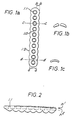
- the plate (1.0) (Fig. 1) is designed such that the cross section along the section line bb, that is, the cross sections along the section line cc, which can be placed through the center of the screw holes or fastening holes (1.1), approximately correspond to half the cross-section along the section line dd in position aa of the plate (1.0) between the fastening holes (1.1).
- This design avoids that the plate (1.0) in the area of the fastening holes (1.1) is prematurely "weakened” due to the degradation of the polymer material by absorption. This results in an elongated basic shape of the osteosynthesis plate, which bulges in the area of the fastening holes (1.2)
- the plate in the middle should be 25% thicker than at the ends.
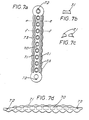
- lateral and longitudinal reinforcements or thickenings of the plate 7.1 in FIGS. 7a-d
- the mounting hole depressions are preferably spherical (FIG. 1b), with elongated holes with an inclined run-in path possibly proving to be advantageous.
- the osteosynthesis plate according to the invention is connected to the bone by means of a fastening device.
- Suitable fastening devices are generally screws, threaded rods, nuts or similarly designed fastening devices with the same function, which are made from a polymer that is resorbable in the body, such as poly-L-lactide, poly-D, L-lactide, polyglycolide, copolymers or polymers or copolymers with resorbable fibers.
- the material properties of the screws can be improved through the use of injection molding processes - as is used in the production of fiber composite materials.
- injection molding processes both in the orientation of the molecular chains in the screw core and in the orientation of the fibers in the production of the composite material, a screw-shaped 45 ° rotation in the clockwise direction must be achieved so that the screw has both the axially longitudinal screw tension and the torque to be tolerated at the same time Can stand.
- a fundamental material improvement is achieved by using the injection molding process (denser packing of the material and cross-linking of the molecular chains).
- the resorbable fastening device consists of a threaded rod (3.0) (Fig. 3) and an associated nut (4.0) with an internal thread (Fig. 4), the threaded rod offering the possibility of a tool attachment for torque transmission at one end (e.g. 3.1 in Fig. 3).
- This approach can be the thread itself - but preferably as a hole, slot or inside or outside hexagon.
- the fastening unit can be screwed into the bone and tightened using any suitable tool, the tightening force of which should be adjustable.
- the threaded rod (3.0) can have a predetermined breaking point (3.3) (FIG. 3), which enables the fastening unit to be replaced effortlessly if the threaded rod fails when it is screwed in.
- the lower end of the threaded rod (3.0) (Fig. 3) can - as will be described later - be provided with an X-ray shadow-producing material or particle (3.2) (Fig. 3), which is in a finely divided layer on the Surface or in compact form inside or only on or in the tip of the screw or the threaded rod (Fig. 3).
- the X-ray shadow-producing material can itself be bio-absorbable or non-bio-absorbable.
- a nut is screwed onto the upper end of the threaded rod, which has a hexagon and which converges spherically at the lower end.
- the nut with the threaded rod attached to it is inserted into the hexagon receptacle of a special device and the thread is screwed through the inserted nut into the internal thread in the device.
- the threaded rod can be screwed into the bone by turning the knurled nut on the device, whereupon the threaded rod is tightened finger-tight until it stops.
- the threaded rod is then tightened using a tensioning mechanism - while at the same time supporting the instrument on the plate to a value that is 10% below the tensile strength.
- the nut is screwed down finger-tight via a second knurled screw of the device, so that the nut is supported on the plate and takes over the axial screw tensile force maintained up to now by the device.
- the axial screw pulling force is applied by the pure pull to the screw end screwed into the device, while the nut only has to be turned down until it catches and maintains this axially built-up screw pull.
- the device is then relaxed and the protruding threaded rod is cut off by means of a hot wire over the nut.
- the hot wire can be run across the threaded rod and the nut at the same time in order to achieve welding, which prevents the screw connection from becoming loose.
- the device for fastening the osteosynthesis plate can consist of a threaded rod (3.0) (FIG. 3) and a nut (4.0) (FIG. 4), the threaded rod made of a resorbable polymer having a shoulder at its upper end - such as a hexagon, square, imbus or a transverse hole (31) - is provided (Fig. 3), which allows the threaded rod to be screwed into the bone.
- the threaded rod at the opposite end of the head of the thread designed for the torque transmission (at the tip) (FIG.
- 3) is provided with one or more particles (3.2) which produce X-ray shadows, which particles themselves are composed of an absorbable or else a non-absorbable material.
- the particle or particles producing the X-ray shadow can, however, also be arranged in another way - as described below - in the screw or the threaded rod.
- the threaded rod itself is provided with a predetermined breaking point (3.3) which, in the event of damage or premature breaking, enables the remainder of the threaded rod that is still in the thread to be easily removed.
- the threaded rod is screwed into the bone using a rod inserted through the transverse hole.
- the threaded rod is preloaded using an auxiliary tool which engages in the thread of the threaded rod and which is supported on the plate (5.0) (Fig. 5) and then secured using the counterpart (4.0).
- the threaded rod can be screwed into the hole prepared in the bone until the X-ray screen ensures that the threaded rod is screwed deep enough due to the x-ray contrasting particle (s) in the rod.
- the threaded rod is pretensioned by means of an auxiliary device which, for example, engages in the devices (3.1) (Fig.
- the protruding ends of the various rods can be cut off, whereby chips or fragments that may get into the wound may not - as e.g. Metal shavings must be removed as they do not cause tissue irritation and are absorbed by the body over time.
- the protruding rods can also - as already described - be removed by means of a hot wire, whereby no chips are produced and with which welding is achieved at the same time, which prevents the screw connection from becoming loose.
- the fibers can be axially introduced into the threaded rods due to the quasi-uniaxial force effect, which, compared to the screws subjected to torsion and tension, brings about a substantial improvement in strength and simplifies production.
- Such screws for example produced by injection molding, also show improved strength values due to the orientation introduced in the axial direction.
- the fastening unit when the fastening unit is overstretched, the screw itself and not the bone is damaged.
- the rod end protruding clearly from the plate can be created by a taper on the threaded rod (3.3) (Fig. 3), a predetermined breaking point, so that the rod breaks in the event of an overload at this predetermined location.
- This broken threaded rod can be unscrewed by hand without further manipulation of the plate or even its removal, which in the other case would inevitably be necessary if a screw with a larger thread diameter was subsequently used and unscrewed all the screws already attached.
- FIG. 3 A preferred embodiment of the fastening unit according to the invention is shown in Figs. 3, 4, 5 and 6 and is described in the following explanatory:
- the threaded rod (3.0) (Fig. 3) has at the end provided for the transmission of the torque a transverse hole (3.1) for receiving a rod into which this can be inserted or screwed.
- a transverse hole (3.1) for receiving a rod into which this can be inserted or screwed.
- an X-ray shadow-producing particle (3.2) is embedded.
- the introduced taper (3.3) is designed as a groove in this example, but can also be designed in any other suitable embodiment.
- the counterpart (4.0) (Fig. 4) is designed on one side as a hemisphere to enable the attachment of screws that are not perpendicular to the plate.
- the counterpart (4.0) (Fig. 4) has four holes (4.1), which should enable screwing with a suitable auxiliary tool.
- the threaded rod is screwed into the bone using a rod inserted through the transverse hole (3.1) until the correct position of the screw (Fig. 5) is determined by X-ray.
- the threaded rod is pre-tensioned using an auxiliary tool that engages in the thread of the rod and is supported on the plate (5.0) and then secured using the counterpart (4.0).
- the holes in the bone fragments can be drilled using a drilling template or drilling jig which is placed on the holes of the osteosynthesis plate.
- Another object of the invention is - as already mentioned - the production of screws or threaded rods that can be made visible by X-ray.
- the screws or threaded rods are given a small calcium phosphate ball by hot pressing in, which enables X-ray visualization. This allows the length of the screw to be determined in the x-ray image and thus gives the operator a control option to assess whether a screw is too long due to incorrect length measurement during the operation.
- Another possibility is the arrangement of several calcium phosphate granules from the tip at a distance of 2 - 3 mm each.
- a screw designed in this way also allows the position of the screw to be assessed or its position in an X-ray image taken directly after surgery Determine length.
- a pin made of calcium phosphate (with a diameter of up to approx. 1 mm) with a length of approx. 5 mm is inserted into the center of the screw, which also opens up the possibility, even after a shortening which may be necessary determine the position and length of the screw by X-ray.
- a very fine-grained calcium phosphate granulate (diameter of the granulate grains up to max. 300 ⁇ m) is applied to the distal half of the screw surface in the outermost layer in the area of the thread of the screw, which can also be made visible in the X-ray image.
- this embodiment has the advantage that the coating of the screw surface in the distal thread area allows the screw to grow on the corresponding bone surface, which is a loosening caused by the micro-movements of the body or even an independent It is difficult to unscrew the screw.
Landscapes
- Health & Medical Sciences (AREA)
- Life Sciences & Earth Sciences (AREA)
- Surgery (AREA)
- Orthopedic Medicine & Surgery (AREA)
- Animal Behavior & Ethology (AREA)
- Veterinary Medicine (AREA)
- Public Health (AREA)
- General Health & Medical Sciences (AREA)
- Heart & Thoracic Surgery (AREA)
- Epidemiology (AREA)
- Vascular Medicine (AREA)
- Engineering & Computer Science (AREA)
- Chemical & Material Sciences (AREA)
- Biomedical Technology (AREA)
- Molecular Biology (AREA)
- Neurology (AREA)
- Medical Informatics (AREA)
- Nuclear Medicine, Radiotherapy & Molecular Imaging (AREA)
- Inorganic Chemistry (AREA)
- Chemical Kinetics & Catalysis (AREA)
- Composite Materials (AREA)
- Materials Engineering (AREA)
- Medicinal Chemistry (AREA)
- Surgical Instruments (AREA)
- Materials For Medical Uses (AREA)
Abstract
Description
- Die Erfindung betrifft eine resorbierbare Vorrichtung zur Osteosynthese bestehend aus einer Osteosyntheseplatte und einer Befestigungsvorrichtung sowie Verfahren zu ihrer Herstellung.
- Die Anwendung der stabilen Plattenosteosynthese, mit deren Hilfe eine mechanische Verbindung zwischen den beiden Bruchenden einer Fraktur erreicht wird, ist an sich bekannt und kann zur Stabilisierung der verschiedensten Frakturen am menschlichen Skelett nutzbar gemacht werden. Herkömmlicherweise werden die zur Osteosynthese benötigten Platten, Schrauben, Nägel oder Nadeln aus Metall - Edelstählen oder Chrom-Nickel-Legierungen (z.B. vom Typ L 316) -hergestellt, womit im wesentlichen zwei gravierende Nachteile verbunden sind: Zum einen ist der Steifheitsgrad der Metallimplantate deutlich höher als derjenige menschlicher Knochen. Die hieraus resultierende "stress protection" hat einen Knochenabbau (Osteoporosie) zur Folge, welcher seinerseits das Risiko einer erneuten Fraktur - nach dem Entfernen der Metallplatte - erhöht. Zum anderen muß das Implantat nach der Beendigung des Heilungsprozesses in einer weiteren Operation entfernt werden, was nicht nur zu einer mit weiteren Risiken verbundenen Belastung des Patienten führt, sondern auch mit erheblichen Heilungskosten verbunden ist. Weiterhin läßt die ansteigende Zahl der auftretenden Chrom-Nickel-Allergien und die damit verbundenen Komplikationen den Einsatz derartiger Materialien problematisch erscheinen.
- Diese Nachteile können durch den Einsatz sogenannter bio-resorbierbarer Polymere überwunden werden. Als biologisch resorbierbare Polymere werden im allgemeinen und im Sinne der Erfindung solche Polymere verstanden, die unter physiologischen Bedingungen zu körpereigenen Substanzen abgebaut und mit dem Stoffwechselkreislauf ausgeschieden werden. Die Verwendung bio-resorbierbarer Materialien bei der Plattenosteosynthese bietet den Vorteil, daß die sonst notwendige Zweitoperation zur Entnahme des Implantates entfällt. Der resorptionsbedingte Abbau des Implantates, mit dem eine entsprechende Minderung der mechanischen Stabilität verbunden ist und der eine zunehmende funktionelle Belastung des Knochens bedingt, welche ihrerseits eine weitere funktionelle Strukturierung im Bruchspalt ermöglicht, verhindert auf diesem Wege die unerwünschte Auswirkung der "stress protection".
- Zahlreiche Patente bzw. Patentanmeldungen haben resorbierbare Implantate für die Plattenosteosynthese zum Gegenstand:
EP 0258 692, US-PS 46 55 777, EP 0204 931, EP 0011 528 und US-PS 43 29 743. - In diesen Patenten wird davon ausgegangen, daß die Festigkeit der resorbierbaren Polymere für einen Einsatz in der Osteosynthese nicht ausreicht. Daher wurde vorgeschlagen, verschiedenartige Fasern als Verstärkungsmaterial zur Erhöhung der mechanischen Belastbarkeit einzusetzen, wobei diese aus resorbierbaren oder in der Regel aber aus nicht-resorbierbaren Materialien bestehen können. Die Form der Platten oder Schrauben wird dabei fast vollständig von den entsprechenden Osteosynthesevorrichtungen aus Metall übernommen. Es hat sich in der Praxis jedoch gezeigt, daß die für die "Metallosteosynthese" bewährten Formen und Konstruktionen bei der Verwendung von resorbierbaren Polymeren entscheidende Nachteile aufweisen. So wurde bislang beispielsweise außer acht gelassen, daß die aus der Verwendung von Kunststoff resultierenden Gestaltungsmöglichkeiten andere, wesentlich belastungsgerechtere Konstruktionen zulassen, deren Verwendung zudem für den operierenden Arzt mit erheblichen Erleichterungen verbunden sein kann.
Herkömmliche Osteosyntheseplatten aus resorbierbaren Polymeren weisen beispielsweise den Nachteil auf, daß sie - insbesondere im Bereich der Schraubenlöcher - relativ leicht brechen. - Die bisher im Stand der Technik vorgeschlagenen Ausführungsformen für Schrauben weisen ebenfalls Nachteile auf, so zum Beispiel, daß sehr viele verschiedene Längen zur Verfügung stehen müssen, um den Anforderungen jeder individuellen Fraktur gerecht werden zu können. Die Länge der benötigten Schrauben wird zur Zeit noch mit Meßfühlern an den in den betreffenden Knochen vorgebohrten Löchern ermittelt. Dies setzt bei dem jeweiligen Operateur ein großes Maß an Erfahrung voraus. Entsprechend der gemessenen Länge können dann erst während der Operation geeignete Schrauben ausgesucht werden. Bei der Verwendung von Metallschrauben erweist sich ferner der Umstand als nachteilig, daß beim Festziehen der Schrauben das Gewinde im Knochen überdreht werden kann, woraus sich entweder die Notwendigkeit ergibt, ein Ersatzloch bohren zu müssen, oder aber eine neue Schraube mit einem größerem Durchmesser verwendet werden muß, was jedoch erst nach einer aufwendigen Entfernung der ursprünglich eingedrehten Schraube möglich ist. Auf der anderen Seite erwächst beim Einsatz von Schrauben aus resorbierbaren Materialien der Nachteil, daß beim Einschrauben zwar nicht das Gewinde im Knochen zerstört wird, sondern - aufgrund der geringen mechanischen Festigkeit - das Gewinde derSchraube selbst oder aber die Schraube unterhalb des Schraubenkopfes abreißt. Diese Schrauben müssen zum Entfernen ausgebohrt und anschließend ersetzt werden.
- Diese vergleichsweise geringe mechanische Stabilität bedingt, daß die Schrauben aus resorbierbaren Polymeren zum Befestigen der Platte nicht so fest angezogen werden können, daß die erforderliche geringe Verschiebebeweglichkeit zwischen der Platte und den Knochenhälften erzielt wird und somit ein einwandfreies Zusammenwachsen der Bruchstücke nicht gewährleistet ist. Je geringer die freie Beweglichkeit der Bruchstücke (Verschiebebeweglichkeit) ist, desto größer sind die Heilungsaussichten des Bruches.
- Ein weiterer Nachteil von resorbierbaren Syntheseschrauben besteht darin, daß sie keinen Röntgenkontrast erzeugen und somit der Operateur keine Möglichkeit besitzt, die richtige Lage der Schrauben zu beurteilen.
- Es ist die Aufgabe der vorliegenden Erfindung, eine resorbierbare Vorrichtung zur Osteosynthese zur Verfügung zu stellen, die die Verschiebebeweglichkeit zwischen der Platte und den Knochenbruchstücken auf das für das komplikationslose Zusammenwachsen der Knochen erforderliche Maß reduziert.
- Es ist weiterhin die Aufgabe der vorliegenden Erfindung, Vorrichtungen zur Befestigung der Osteosyntheseplatte aus resorbierbaren Polymeren zur Verfügung zu stellen, die im Falle ihrer Beschädigung oder Zerstörung leicht aus dem Knochen entfernt und ersetzt werden können, um die eventuell notwendige Entfernung der ganzen Befestigungsvorrichtung zu vermeiden.
- Eine weitere Aufgabe der vorliegenden Erfindung besteht darin, Befestigungsvorrichtungen zur Verfügung zu stellen, die hinsichtlich ihrer Länge ohne weiteren Aufwand in das jeweilige Bohrloch eingepaßt werden können, um somit eine Lagerhaltung von einer Vielzahl von Schrauben bzw. Befestigungsvorrichtungen verzichtbar zu machen.
- Eine weitere Aufgabe der vorliegenden Erfindung besteht darin, eine kunststoffgerechte Gestaltung der Befestigungsvorrichtung vorzunehmen, die gegenüber der reinen Kopie der Gestalt von Metallvorlagen aus Kunststoff höhere Anzugskräfte erlaubt.
- Eine weitere Aufgabe der vorliegenden Erfindung besteht darin, eine Osteosynthese-Vorrichtung aus resorbierbaren Polymeren röntgenologisch sichtbar zu machen.
- Die Aufgabe der vorliegenden Erfindung wird durch eine resorbierbare Osteosynthesevorrichtung bestehend aus einer mit Schraubenlöchern versehenen Platte aus einem resorbierbaren Polymer oder Copolymer, die auf der dem Knochen zugewandten Seite mit Calciumphosphat- und/oder Hydroxylapatitgranulat beschichtet ist sowie mindestens zweier Befestigungsvorrichtungen bestehend aus einer Gewindestange und der dazugehörigen Mutter gelöst.
- Geeignete resorbierbare Polymere aus denen die Platte, die Gewindestangen und die Muttern bestehen können sind Polymere und Copolymere auf der Basis folgender Monomere: L-Lactid, D,L-Lactid, Glycolid. Falls es gewünscht oder erforderlich ist, können die Polymere bzw. Copolymere durch resorbierbare Fasern verstärkt werden. Die Verfahren zur Herstellung und Bearbeitung geeigneter Polymere und Copolymere sind aus dem Stand der Technik bekannt und brauchen nicht näher erörtert werden.
- Die Form der erfindungsgemäßen Platte kann in sehr weiten Bereichen beliebig variiert werden, soweit dies nicht im Widerspruch zu den Eigenschaften der verwendeten Polymermaterialien (Bruchfestigkeit, Abbaurate etc.) und der beabsichtigten Verwendung (Art des Bruches etc.) steht. Ein wesentliches Merkmal der erfindungsgemäßen Platte ist, daß sie an ihrer Unterseite - d.h. der dem Knochen zugewandten Seite -eine Beschichtung aus Calciumphosphat und/oder Hydroxylapatit - vorzugsweise in Form eines Granulates oder kleiner Kügelchen - aufweist.
- Einerseits erfährt die Unterseite der erfindungsgemäßen Platte durch die Beschichtung eine Aufrauhung, die im Vergleich zu den bisher verwandten Osteosyntheseplatten aus bio-resorbierbaren Materialien bei gleicher Andruckkraft eine geringere Verschiebebeweglichkeit gewährleistet - andererseits sichert die mit Calciumphosphat bzw. Hydroxylapatit beschichtete Platte ein baldiges Anwachsen an der Knochenoberfläche, da auch industriell hergestelltes Calciumphosphatkeramik-Granulat weitestgehend dem im Knochen befindlichen Mineral entspricht.
- Durch das Anwachsen der mit Calciumphosphatkeramik-Granulat beschichteten bio-resorbierbaren Osteosyntheseplatte an der Knochenoberfläche kommt es zu einer zusätzlichen mechanischen Stabilisierung der Platte auf der Knochenoberfläche, wodurch gleichzeitig die unerwünschte Beweglichkeit zwischen Knochen und Platte bei vorgegebener axialer Schraubenzugkraft auf ein Mindestmaß verringert wird. Diese kann von ausschlaggebender Bedeutung sein, falls es zu einem vorzeitigen Bruch der Befestigungsvorrichtung (nachfolgend auch als Gewindestange bezeichnet oder auch Schraube genannt) infolge beginnender Resorption und der damit verbundenen mechanischen Schwächung der Schrauben kommt, wobei davon ausgegangen werden kann, daß sich die Resorption bei den unter hoher mechanischer Belastung stehenden filigranen Schrauben schneller auswirkt als bei den wesentlich massiver ausgeführten Platten.
- Durch die Calciumphosphat- bzw. Hydroxylapatit-Beschichtung - im folgenden auch Calciumphosphatkeramik-Granulat genannt - wird zudem die Möglichkeit eröffnet, das Implantat röntgenologisch sichtbar zu machen. Auf diesem Wege können Form und Größe des Implantates einschließlich der Lagebeziehung zum stabilisierten Knochen im Röntgenbild beurteilt werden. Weiterhin ist ein eventueller Bruch oder eine spätere Dislokation der Platte im Röntgenbild zu erkennen. Die Calciumphosphatkeramiken unterliegen ebenfalls der Resorption, auch wenn diese etwas größere Zeiträume beansprucht als dies z.B. beim Polylactid der Fall ist.
- Zur Herstellung der erfindungsgemäßen Platte können folgende Techniken angewandt werden: Das Calciumphosphatkeramik-Granulat wird heiß in die Oberfläche einer vorgefertigten Platte eingepresst. Die Anwendung dieser Methode hat eine mechanisch sehr feste Bindung des Granulates an dem Träger zur Folge. Die Aufbringung kann beispielsweise aber auch in der Weise erfolgen, daß z.B. eine 0,5 - 1,0 mm dicke Polylactidfolie auf eine heiße dicht liegende Granulatschicht heiß aufgepresst wird, womit ein Verbund des Granulates erzielt wird. Es erweist sich als vorteilhaft, wenn die Granulatkörner nicht zu dicht nebeneinander liegen; hierdurch wird vermieden, daß das Granulat beim Biegen der Platten abplatzt. Die so erhaltene granulatbeschichtete Polylactidfolie wird in einem geeigneten Spritzgußwerkzeug ausgelegt und mit Polylactid überspritzt, wobei es zu einer innigen Verbindung der mit Hydroxylapatit bzw. mit Calciumphosphat beschichteten Polylactidfolie mit dem durch Spritzguß erzeugten Implantatkörper kommt. Die Herstellung der granulatbeschichteten Folie kann großflächig erfolgen. Im anschließenden Schritt kann die Folie auf die gewünschte Plattengröße zugeschnitten werden.
- In einer weiteren Ausführungsform können die Calciumphosphatkeramik-Granulatkörner elektrostatisch an einer Wand des Werkzeuges fixiert werden und anschließend wie oben beschrieben überspritzt werden. Weiterhin besteht die Möglichkeit die Beschichtung auf die Weise durchzuführen, daß die Granulatkörner an kleinen Bohrungen eines Spritzgußwerkzeuges, die einen kleineren Durchmesser als die Granulatkörner aufweisen, während des anschließenden Spritzvorganges durch Ansaugen in dieser Posititon gehalten werden. Die erfindungsgemäßen Platten können unter Erwärmung verformt werden, so daß sie der Knochenoberfläche angepaßt werden können. Dies kann auch vom Operateur -z.B. mit einem speziellen Heißluftgebläse oder einem für diese Zwecke speziell ausgestalteten Mikrowellengenerator - im Operationssaal durchgeführt werden. Ein nennenswertes Abplatzen der Granulat-Beschichtung ist dabei nicht zu beobachten. Die spontane maximale Zugkraft einer bei den Versuchen verwendeten Polylactid-Platte von 2000 N (ermittelt mit einer Zwick Material-Prüfmaschine) bestand nach der Hitzebehandlung der Oberfläche unverändert weiter.
- In einer weiteren Ausführungsform können alle nicht dem Knochen zugewandten Flächen der Platte einschließlich die der Schraubenköpfe mit einem niedermolekularen lediglich geringe mechanische Festigkeit aufweisenden Film eines geeigneten Polymeren - z.B. mit einem Polylactidfilm - überzogen werden, welcher kolloidal verteiltes Silber enthält. Die Oberflächenbeschichtung - von der Dicke bis zu 1 mm - verhindert einerseits aufgrund der oligo-dynamischen antibakteriellen Wirksamkeit des Silbers eine Keimbesiedlung der Oberfläche des Implantates in den ersten Wochen nach der Operation; zum zweiten wird eine schemenhafte röntgenologische Sichtbarmachung des Implantates ermöglicht. Um eine primäre Gewebetoxizität zu vermeiden, ist es erforderlich, die der Platte näher liegenden Schichten stärker mit Silber anzureichern als diejenigen Schichten an der Oberfläche. Die höherangereicherten aber tieferliegenden Schichten, werden keinen toxikologisch bedenklichen Einfluß ausüben, da im Verlaufe der Resorption Anteile des Silbers aus den tiefergelegenen Schichten herausgelöst werden, so daß nach dem Aberodieren der jeweils an der Oberfläche liegenden Schichten das Gewebe mit einer Schicht in Kontakt kommt, die eine bereits reduzierte Konzentration an kolloidalem Silber - bezogen auf die Ausgangskonzentration - aufweist, wodurch Schädigungen des Gewebes vermieden werden.
- In einer weiteren Ausführungsform kann die Calciumphosphatkeramik-Granulatschicht der Platte selbst mit feinkörnigem Silberphosphat bis zu 30 % (bezogen auf das Gesamtgewicht des Granulates) angereichert werden, um dadurch auch auf dieser Seite des Implantats eine antibakterielle Wirkung zu erzielen.
- An Stelle von kolloidal verteiltem Silber können die beschriebenen Schichten auch PVP-Jod [Polyvinylpyrrolidon-Jod-Komplex bzw. Poly(1-vinyl-2-pyrrolidin-2-on)-Jod-Komplex] in Konzentrationen von 5 % bis 40 % enthalten, wodurch ebenfalls eine antibakterielle Wirkung als auch eine röntgenologische Sichtbarmachung der Platte erreicht wird.
- Eine antibakterielle bzw. bakteriostatische Wirkung kann weiterhin durch Beaufschlagung mit thermostabilen Antibiotika aus verschiedenen Gruppierungen unter Bevorzugung von denjenigen Antibiotika mit breitem Wirkungsspektrum - wie z.B. Aminoglycoside, Gyrase-Hemmer oder Vancomycin - erfolgen. Bei einer derartigen Beschichtung braucht auf eine Systemtoxizität keine Rücksicht genommen werden, da nur geringe Mengen im Serum nachweisbar werden, die weit unterhalb der Toxizitätsgrenze liegen, welche bei einer intravenösen Applikation beachtet werden muß.
- Die Platte selbst wird, wie aus der Entwicklung von Metallplatten zur Stabilisierung von Knochen bekannt ist, im wesentlichen durch Biegung und Zugbeanspruchung belastet. Es ist daher anzustreben, im Spritzgußverfahren durch die Anordnung der Spritzdüsen eine Längsorientierung der Molekülketten zu erreichen. Die notwendigen technischen Voraussetzungen zur Verarbeitung der Polymere sind dem Fachmann bekannt. Es wird jedoch darauf hingewiesen, daß das zu spritzende Gut extrem trocken gehalten werden muß, da bei höheren Temperaturen mit jedem Promille Wassergehalt der Anteil an Kettenabbauprodukten steigt. Dies wirkt sich direkt auf das Abbauverhalten des Polymeren aus. Wie schon erwähnt, besteht die Möglichkeit, in Pulverform vorliegende und thermostabile Antibiotika, wie z.B. Aminoglykoside oder Gyrase-Hemmer, zuzufügen. Da deren thermische Belastung beim Aufpressen nur für eine äußerst kurze Zeitspanne akut wird, kann dabei die vom jeweiligen Hersteller angegebene tolerierbare Temperaturobergrenze überschritten werden, ohne daß daraus schwerwiegende Nachteile für das Präparat wie auch für das Implantat resultieren.
- Die Temperaturführung und das Nachspritzen während des Aushärtens ist derart durchzuführen, daß im Zentrum keine Hohlräume entstehen und die Wärme möglichst schnell abgeführt werden kann, um die thermische Belastung des Polymers so gering wie möglich zu halten.
- In einer besonderen Ausführungsform wird die erfindungsgemäße Platte durch ein in das Polymer eingelagertes Fasermaterial verstärkt.
- Als Fasermaterial wird bevorzugt verstrecktes Poly-L-lactid verwendet, während die Matrix vorzugsweise aus Poly-D,L-lactid besteht. Die Zugfestigkeit der erfindungsgemäßen Platten dieser Ausführungsform ist im Vergleich zu der nicht verstärkten Platte bis um einen Faktor von 10 größer. Vorteilhaft erweisen sich extrudierte Fasern, die beim Aushärten zusätzlich verstreckt werden. Da die Platten im wesentlichen einer Zug- und Biegebelastung ausgesetzt sind, sollten die Fasern längsorientiert sein und der Winkel, den die Fasern zueinander aufweisen, 30° nicht überschreiten. Als Temperaturschutz bei der Herstellung für die Fasern erweist sich gegebenenfalls ein dünner Überzug aus niedermolekularem L-Lactid oder D,L-Lactid von Vorteil. Auch der verstärkten Platte kann kolloidal verteiltes Silber, PVP-Jod oder ein wärmebeständiges und in Pulverform vorliegendes Antibiotikum zugemischt werden.
- Die Formgebung der Platten richtet sich in erster Linie nach dem Indikationsgebiet. Trotz unterschiedlicher Länge bzw. der generell unterschiedlichen Größe der Platten - in Abhängigkeit von der geplanten Anwendung - weisen die Osteosyntheseplatten und die Befestigungsvorrichtungen vorzugsweise folgende Grundformen auf:
- Fig. 1a zeigt eine bevorzugte Ausführungsform der erfindungsgemäßen Osteosyntheseplatte (1.0).
- Fig. 1b zeigt einen Querschnitt durch die erfindungsgemäße Osteosyntheseplatte (1.0) aus Fig. 1a längs der Schnittlinie cc.
- Fig. 1c zeigt einen Querschnitt durch die erfindungsgemäße Osteosyntheseplatte (1.0) aus Fig. 1a längs der Schnittlinie dd.
- Fig. 2 zeigt eine Seitenansicht der erfindungsgemäßen Osteosyntheseplatte, die in der Mitte eine um ca. 25 % stärkere Dicke aufweist als an den Enden (h¹ = 1/4 h²).
- Fig. 3 zeigt die Gewindestange (3.0) der erfindungsgemäßen Befestigungsvorrichtung, welche ein Querloch (3.1), ein einen Röntgenkontrast erzeugendes Teilchen (3.2) und eine Verjüngung (3.3) (Sollbruchstelle) aufweist.
- Fig. 4 zeigt eine bevorzugte Ausführungsform einer Mutter (4.0) der erfindungsgemäßen Befestigungsvorrichtung, welche gegebenenfalls mehrere Vorrichtungen (4.1) zur Übertragung eines Drehmomentes aufweist.
- Fig. 5 zeigt eine erfindungsgemäße Osteosyntheseplatte (5.0), welche mit den erfindungsgemäßen Befestigungsvorrichtungen, Gewindestange (3.0) und der Mutter (4.0) auf den Knochenfragmenten angebracht ist.
- Fig. 6 zeigt die erfindungsgemäße Vorrichtung zur Osteosynthese nach dem Abschneiden der Gewindestangen.
- Fig. 7a zeigt eine weitere bevorzugte Ausführungsform einer erfindungsgemäßen Osteosyntheseplatte (7.0), welche im zentralen Teil mit in parallel zur Längsrichtung verlaufenden Verstärkungen (7.1) versehen ist sowie Verbreiterungen im Bereich der Schraubenlöcher (7.3) aufweist. Die erfindungsgemäße Osteosyntheseplatte (7.0) weist an beiden Enden Einkerbungen (7.2) zum Einsetzen eines Plattenspanngerätes auf.
- Fig. 7b zeigt einen Querschnitt durch die erfindungsgemäße Osteosyntheseplatte (7.0) aus Fig. 7a längs der Schnittlinie ee.
- Fig. 7c zeigt einen Querschnitt bzw. die resultierenden Querschnittsflächen bei einem Schnitt durch die erfindungsgemäße Osteosyntheseplatte (7.0) aus Fig. 7a längs der Schnittlinie ff.
- Fig. 7d zeigt die Seitenansicht der erfindungsgemäßen Osteosyntheseplatte (7.0) aus Fig. 7a mit der Verstärkung (7.1) und den Einkerbungen (7.2) zum Einsetzen eines Plattenspanngerätes.
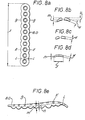
- Fig. 8a zeigt eine weitere bevorzugte Ausführungsform der erfindungsgemäßen Vorrichtung zur Osteosynthese in Form einer Außenknöchelplatte (8.0) mit den Schnittlinien gg, kk und 11, wobei die Länge x der Platte etwa 10 cm beträgt.
- Fig. 8b zeigt einen Querschnitt durch die erfindungsgemäße Osteosyntheseplatte (8.0) aus Fig. 8a längs der Schnittlinie gg, wobei die Dicke u der Platte ca. 2 mm und die Höhe der Wölbung m ca. 2 mm beträgt.
- Fig. 8c zeigt einen Querschnitt durch die erfindungsgemäße Osteosyntheseplatte (8.0) aus Fig. 8a längs der Schnittlinie kk, wobei die Dicke der Platte v ca. 1,8 mm beträgt.
- Fig. 8d zeigt einen Querschnitt durch die erfindungsgemäße Osteosyntheseplatte (8.0) aus Fig. 8a längs der Schnittlinie 11, wobei die Dicke w der Platte ca. 1,5 mm und die Höhe n der Wölbung ca. 1 mm beträgt.
- Fig. 8e zeigt die Seitenansicht der Außenknöchelplatte (8.0) mit den Lagen der Schnittebenen in Fig. 8a und den Höhen der Wölbungen m und n.
- Je nach Verwendungszweck bzw. Einsatzgebiet können andere Plattenabmessungen bzw. Wölbungshöhen vorteilhafter sein.
- Die Platte (1.0) (Fig. 1) ist derart gestaltet, daß der Querschnitt längs der Schnittlinie bb, das heißt die Querschnitte, die längs der Schnittlinie cc, die durch den Mittelpunkt der Schraubenlöcher bzw. Befestigungslöcher (1.1) gelegt werden kann, ungefähr dem halben Querschnitt längs der Schnittlinie dd in der Lage aa der Platte (1.0) zwischen den Befestigungslöchern (1.1) entsprechen. Durch diese Formgebung wird vermieden, daß die Platte (1.0) im Bereich der Befestigungslöcher (1.1) infolge des Abbaus des Polymermaterials durch Resorption vorzeitig "geschwächt" wird. Dadurch bedingt ergibt sich eine längliche Grundform der Osteosyntheseplatte, die im Bereich der Befestigungslöcher Ausbuchtungen (1.2)
- Weiterhin soll die Platte in der Mitte (Fig. 2) eine um 25 % stärkere Dicke aufweisen als an den Enden. Darüber hinaus wird durch seitliche und in Längsrichtung verlaufende Verstärkungen bzw. Verdickungen der Platte (7.1 in Fig. 7a-d) im wesentlichen im zentralen Teil der Platte eine Stabilisierung der Platte erreicht.
- Dabei sollten diese Verstärkungen bzw. Verdickungen nur so hoch sein, daß sie den höchsten Punkt der Schraube nicht überragen, um keine Gesamtverdickung des Systems Platte/Schraube hervorzurufen. Die Befestigungslocheinsenkungen sind vorzugsweise sphärisch gestaltet (Fig. 1b), wobei sich gegebenenfalls Langlöcher mit schräger Anlaufbahn als vorteilhaft erweisen können.
- Die erfindungsgemäße Osteosyntheseplatte wird mittels einer Befestigungsvorrichtung mit dem Knochen verbunden.
- Als Befestigungsvorrichtungen sind im allgemeinen Schrauben, Gewindestäbe, Muttern oder ähnlich gestaltete Befestigungsvorrichtungen gleicher Funktion geeignet, die aus einem im Körper resorbierbarem Polymeren, wie z.B. Poly-L-lactid, Poly-D,L-lactid, Polyglycolid, Copolymeren oder Polymeren bzw. Copolymeren mit resorbierbaren Fasern bestehen.
- Bei der Herstellung der Schrauben hat es sich bewährt, diese mit einem kunststoffgerechten 3-Grad-30 Grad-Sägezahngewinde zu versehen. Dieses Gewinde besitzt den Vorteil, daß die Gewindezüge des Schraubenkerns die gleiche Stärke gegenüber den Gewindezügen im Knochen und gegenüber der Schraubenmutter aufweisen. Die Kanten des Gewindes sind stumpf gehalten, um ein vorzeitiges Nachlassen der Haltekraft, wie sie bei spitzen Gewindekanten, welche die meisten Gewinde aufweisen - durch die Resorption bedingt - beobachtet werden kann, zu vermeiden. Das 3-Grad-30-Grad-Sägezahngewinde besitzt ein geringes Rückstellmoment, welches eine Lockerung der Schrauben bei den im menschlichen bzw. tierischen Körper ununterbrochen stattfindenden Mikrobewegungen verhindert, da sich die sehr weit ausgeladenden Gewindezüge breit am umgebenden Knochen abstützen können.
- Generell ist eine Verbesserung der Materialeigenschaften der Schrauben durch die Anwendung von Spritzgußverfahren - wie es bei der Herstellung von Faserverbundwerkstoffen angewandt wird - möglich. Hierbei muß sowohl bei der Orientierung der Molekülketten im Schraubenkern, als auch bei der Orientierung der Fasern bei der Herstellung des Verbundmaterials eine schraubenförmige 45°-Drehung im rechtsdrehenden Sinne erzielt werden, damit die Schraube sowohl der axial längsgerichteten Schraubenzugkraft als auch der zugleich zu tolerierenden Drehkraft Stand zu halten vermag. Eine prinzipielle Materialverbesserung wird durch Anwendung des Spritzgußverfahrens (dichtere Packung des Materials sowie Quervernetzung der Molekülketten) erzielt.
- Beim Beibehalten konventioneller Schrauben, welche zur Erzielung einer axialen Schraubenzugkraft unter Anwendung eines geeignet großen Drehmomentes eingedreht werden, bieten sich beispielsweise folgende Kopfformen an:
- Ein bis in Ansatznähe des Schraubenkerns und damit durch den gesamten Schraubenkopf durchreichender Innensechskant, welcher - in flacherer Ausführung - von einem Außensechskant umgeben wird. In dem zirkular umlaufenden Wall des Schraubenkopfes sind weitere Einsenkungen eingearbeitet, die eine weitere Übertragung des Drehmoments ermöglichen.
- Bei einer derartigen Form des Schraubenkopfes und der hierzu korrespondierenden Form des Schraubenziehers ist einerseits eine sichere Führung der Schraube möglich (die Schraube sitzt auf dem Schraubenzieher und kann auch in nach unten gerichteten Bohrungen eingeführt werden). Mit dieser Ausführungsform ist ferner eine maximale Übertragung des Drehmomentes gewährleistet, ohne dabei Gefahr zu laufen, daß es bei dem Versuch, das Drehmoment vom Schraubenzieher auf die Schraube zu übertragen zu einem Abdrehen der Kanten kommt. Solche Schraubenköpfe lassen sich im Spritzgußverfahren problemlos in großer Zahl und zu niedrigen Kosten herstellen.
- Die erfindungsgemäße resorbierbare Befestigungsvorrichtung besteht aus einer Gewindestange (3.0) (Fig. 3) und einer dazugehörigen Mutter (4.0) mit Innengewinde (Fig. 4), wobei die Gewindestange an einem Ende die Möglichkeit eines Werkzeugansatzes zur Drehmomentübertragung bietet (z.B. 3.1 in Fig. 3).
- Dieser Ansatz kann das Gewinde selbst sein -vorzugsweise jedoch als Loch, Schlitz oder Innen- bzw. Außen-Sechskant - ausgestaltet sein. Die Befestigungseinheit kann mit jedem entsprechend geeigneten Werkzeug, dessen Anzugskraft regelbar sein sollte, in den Knochen eingeschraubt und festgezogen werden. Die Gewindestange (3.0) kann in einer bevorzugten Ausführungsform über eine Sollbruchstelle (3.3) (Fig. 3) verfügen, die bei einem Versagen des Gewindestabes beim Eindrehen ein müheloses Erneuern der Befestigungseinheit ermöglicht.
- Das untere Ende der Gewindestange (3.0) (Fig. 3), kann - wie an späterer Stelle beschrieben wird - mit einem Röntgenschatten erzeugenden Material bzw. Teilchen (3.2) (Fig. 3) versehen sein, das sich in fein verteilter Schicht auf der Oberfläche oder in kompakter Form innerhalb oder lediglich nur an oder in der Spitze der Schraube bzw. des Gewindestabes befindet (Fig. 3). Das Röntgenschatten erzeugende Material kann selbst bio-resorbierbarer oder auch nicht bio-resorbierbarer Natur sein.
- Zur Befestigung der erfindungsgemäßen Platte bieten sich - je nach Ausgestaltung der Gewindestange - bzw. des Gewindestabes verschiedene Vorgehensweisen an.
- a) Der Gewindestab enthält keine besonderen Ausgestaltungen zum Ansatz eines Werkzeuges (d.h. einer Vorrichtung zum Eindrehen des Gewindestabes). In diesem Fall ist eine speziell gestaltete Vorrichtung zum Einschrauben notwendig.
- Auf dem oberen Ende des Gewindestabes ist eine Mutter aufgeschraubt, welche einen Sechskant aufweist und die am unteren Ende sphärisch zusammenläuft. Die Mutter wird mit dem daran befindlichen Gewindestab in die Sechskant-Aufnehmung einer speziellen Vorrichtung eingesteckt und das Gewinde durch die eingesteckte Mutter hindurch in das Innengewinde in der Vorrichtung eingeschraubt.
- In dieser Position kann durch Drehen der Rändelmutter an der Vorrichtung der Gewindestab in den Knochen eingedreht werden, worauf der Gewindestab bis zum Anschlag fingerfest angezogen wird. Anschließend wird über einen Spannmechanismus der Gewindestab - bei gleichzeitigem Abstützen des Instrumentes auf der Platte bis auf einen Wert, der 10 % unter der Reißfestigkeit liegt, angezogen.
- Diese Position wird auf die folgende Weise fixiert:
- Über eine zweite Rändelschraube der Vorrichtung wird die Mutter fingerfest heruntergeschraubt, sodaß sich die Mutter auf der Platte abstützt und die durch die Vorrichtung bisher aufrecht erhaltene axiale Schraubenzugkraft übernimmt. Auf diese Weise kommt es nicht zu einer Drehmomentbelastung des Gewindestabs, da die axiale Schraubenzugkraft durch den reinen Zug an dem in der Vorrichtung eingeschraubten Schraubenende aufgebracht wird, während die Mutter nur soweit heruntergedreht werden muß, bis sie diesen axial aufgebauten Schraubenzug auffängt und aufrecht erhält.
- Anschließend wird die Vorrichtung entspannt und der überstehende Gewindestab vermittels eines heißen Drahtes über der Mutter abgeschnitten. Hierbei kann der heiße Draht zugleich quer über den Gewindestab und der Mutter geführt werden, um dabei ein Verschweißen zu erzielen, welches ein Lockerwerden der Verschraubung verhindert.
- Weiterhin ist eine kunststoffgerechte Fixierungen des eingedrehten Gewindestabes, z.B. durch einen überstehenden Zapfen möglich, welcher rund oder eckig gearbeitet sein kann und an der Innenseite nach unten hin (d.h. zur Platte bzw. zum Knochen) gerichtete feine Zähne aufweist. Hierüber wird eine passende mit ebensolchen jedoch in entgegengesetzter Richtung angeordneten Zähnen ausgestattete Hülse geschoben, welche durch Anwendung einer nach unten gerichteten Zugkraft auf die Platte geschoben wird und durch das Einrasten der Zähne ineinander eine mechanisch feste, kunststoffgerechte Verbindung herstellt, welche die axiale Schraubenzugkraft weiterhin aufrecht erhält. Diese Hülse ist nach Art einer sich zusammenziehenden elastischen Feder auszugestalten, um beim Herunterschieben der Hülse spontan in den Zähnen einzurasten.
- b) Die Gewindestange enthält einen besonders ausgestalteten Ansatz zum Ansetzen eines Werkzeuges bzw. einer Vorrichtung zum Eindrehen der Gewindestange.
- In einer weiteren Ausführungsform kann die Vorrichtung zum Befestigen der Osteosyntheseplatte aus einem Gewindestab (3.0) (Fig. 3) und einer Mutter (4.0) (Fig. 4) bestehen, wobei die aus einem resorbierbaren Polymer hergestellte Gewindestange an ihrem oberen Ende mit einem Ansatz - wie z.B. ein Sechskant, Vierkant, Imbus oder einem Querloch (31) - versehen ist (Fig. 3), welches das Eindrehen der Gewindestange in den Knochen ermöglicht. In einer bevorzugten Ausführungsform ist die Gewindestange an dem gegenüberliegenden Ende des für die Drehmomentübertragung gestalteten Kopfes des Gewindes (an der Spitze) (Fig. 3) mit einem oder mehreren Röntgenschatten erzeugenden Teilchen (3.2) versehen, welches selbst aus einem resorbierbaren oder aber auch aus einem nicht-resorbierbaren Material besteht. Die bzw. das den Röntgenschatten erzeugenden Teilchen kann/können jedoch auch auf andere Art und Weise - wie nachfolgend beschrieben - in der Schraube bzw. dem Gewindestab angeordnet sein. Der Gewindestab selbst ist mit einer Sollbruchstelle (3.3) versehen, die bei einer Beschädigung bzw. bei einem vorzeitigen Abbrechen ein leichtes Entfernen des noch im Gewinde befindlichen Restes des Gewindestabes ermöglicht.
- Die Gewindestange wird mittels eines durch das Querloch gesteckten Stabes in den Knochen eingeschraubt. Über ein Hilfswerkzeug, welches in das Gewinde der Gewindestange eingreift und welches sich auf der Platte (5.0) (Fig. 5) abstützt, wird der Gewindestab vorgespannt und anschließend über das Gegenstück (4.0) gesichert.
- Aus einer derartigen Teilung der bislang aus dem Stand der Technik verwandten Schrauben in eine Art Gewindestange und eine Art Mutter resultieren erhebliche Vorteile:
- Durch die Verwendung von Gewindestangen kann die sonst bei Schrauben maximal erreichbare Vorspannkraft nahezu verdoppelt werden.
- Die Gewindestange kann in das im Knochen vorbereitete Loch so tief eingeschraubt werden, bis auf dem Röntgenschirm aufgrund des/der im Stab eingebrachten, einen Röntgenkontrast hervorrufenden Teilchen(s) sichergestellt ist, daß die Gewindestange tief genug eingeschraubt ist. Nach dem Aufschrauben des Gegenstückes (4.0) mit Innengewinde wird die Gewindestange mittels eines Hilfsgerätes, welches z.B. in die zur Übertragung eines Drehmomentes vorgesehene Vorrichtungen (3.1) (Fig. 3) eingreift und auf die gewünschte Anzugskraft vorgespannt und das Gegenstück (4.0) (Figs. 4 und 5) festgezogen, was jedoch nicht die Anwendung eines hohen Drehmomentes erfordert, da lediglich die im Gewinde auftretenden Reibungskräfte überwunden werden müssen, nicht aber die Vorspannung über das Anzugsmoment aufgebracht werden muß, wodurch sich das in der Schraube beim Anziehen sonst vorliegende Torsionsmoment erheblich verringert, und letztendlich im wesentlichen nur noch Zugkräfte in der Gewindestange vorliegen. Die erreichbaren Anzugskräfte können in der Befestigungseinheit somit größere Werte annehmen.
- Nachdem die Platte befestigt ist, können die überstehenden Enden der verschiedenen Stäbe abgeschnitten werden, wobei anfallende Späne oder Bruchstücke, die unter Umständen in die Wunde gelangen, nicht - wie es z.B. bei Metallspänen der Fall ist -entfernt werden müssen, da sie keine Gewebeirritationen hervorrufen und vom Körper im Laufe der Zeit absorbiert werden. Die überstehenden Stäbe können aber auch - wie schon beschrieben - mittels eines heißen Drahtes entfernt werden, wobei keine Späne anfallen und womit gleichzeitig ein Verschweißen erreicht wird, welches ein Lockerwerden der Verschraubung verhindert.
- Bei der Verwendung von faserverstärkten Materialien können aufgrund der quasi einachsigen Kräftewirkung die Fasern axial in die Gewindestäbe eingebracht werden, was gegenüber den auf Torsion und Zug belasteten Schrauben eine wesentliche Verbesserung der Festigkeit sowie eine Vereinfachung der Fertigung bewirkt.
- Derartige - beispielsweise im Spritzgrußverfahren hergestellten - Schrauben zeigen aufgrund der in axialer Richtung eingebrachten Orientierung ebenfalls verbesserte Festigkeitswerte.
- Da bei Osteosynthesematerialien aus resorbierbaren Polymeren - im Gegensatz zu den entsprechenden Osteosynthesevorrichtungen aus Metall - nicht der Knochen das schwächste Glied ist, sondern die Befestigungseinheit, wird beim Überspannen der Befestigungseinheit die Schraube selbst und nicht der Knochen geschädigt. Da bei der erfindungsgemäßen Lösung, das Stangenende deutlich aus der Platte herausragt, kann durch eine an der Gewindestange angebrachte Verjüngung (3.3) (Fig. 3) eine Sollbruchstelle erzeugt werden, so daß der Stab bei einer eventuellen Überbelastung an dieser vorbestimmten Stelle bricht. Diese gebrochene Gewindestange kann -ohne weitere Manipulationen an der Platte oder gar deren Entfernung, was im anderen Fall bei einer nachfolgend eventuell erforderlichen Verwendung einer Schraube mit größerem Gewindedurchmesser zwangsläufig mit einem Herausschrauben aller bereits angebrachten Schrauben verbunden wäre - ohne weitere Schwierigkeiten von Hand herausgeschraubt werden.
- Eine bevorzugte Ausführungsform der erfindungsgemäßen Befestigungseinheit ist in den Figs. 3, 4, 5 und 6 dargestellt und wird im folgenden erläuternd beschrieben:
- Die Gewindestange (3.0) (Fig. 3) weist am zur Übertragung des Drehmomentes vorgesehenen Ende ein Querloch (3.1) zur Aufnahme eines Stabes auf, in welches dieser eingestecke oder eingeschraubt werden kann. Am entgegengesetzten Ende - der Spitze - ist ein Röntgenschatten erzeugendes Teilchen (3.2) eingelassen. Die eingebrachte Verjüngung (3.3) ist in diesem Beispiel als Nut gestaltet, kann jedoch auch in jeder anderen geeigneten Ausführungsform gestaltet sein.
- Das Gegenstück (4.0) (Fig. 4) ist auf einer Seite als Halbkugel gestaltet, um auch das Anbringen von nicht senkrecht zur Platte stehenden Schrauben zu ermöglichen. Auf der gegenüberliegenden Seite weist das Gegenstück (4.0) (Fig. 4) vier Bohrungungen auf (4.1), die das Verschrauben mit einem entsprechend geeigneten Hilfswerkzeug ermöglichen sollen.
- Die Gewindestange wird mittels eines durch das Querloch (3.1) gesteckten Stabes soweit in den Knochen eingeschraubt, bis auf röntgenologischem Wege - die richtige Position der Schraube (Fig. 5) festgestellt wird. Über ein Hilfswerkzeug, welches in das Gewinde des Stabes eingreift und sich auf der Platte (5.0) abstützt wird die Gewindestange vorgespannt und anschließend über das Gegenstück (4.0) gesichert.
- Abschließend werden die überstehenden Enden der Gewindestange abgeschnitten.
- Das Bohren der Löcher in den Knochenfragmenten kann unter Verwendung einer Bohrschablone oder Bohrlehre, welche auf die Löcher der Osteosyntheseplatte aufgesetzt wird, erfolgen.
- Ein weiterer Gegenstand der Erfindung ist - wie schon erwähnt - die Herstellung von Schrauben bzw. Gewindestangen, die röntgenologisch sichtbar gemacht werden können.
- Die Schrauben bzw. Gewindestangen erhalten durch heißes Einpressen an der Spitze eine kleine Calciumphosphatkugel, wodurch eine röntgenologische Sichtbarmachung ermöglicht wird. Diese erlaubt die Längenbestimmung der Schraube im Röntgenbild und gibt dem Operateur somit eine Kontrollmöglichkeit an die Hand, zu beurteilen, ob eine Schraube aufgrund fehlerhafter Längenmessung bei der Operation zu lang ist.
- Ein Festigkeitsverlust ist hierbei nicht zu befürchten, da lediglich die Spitze der Schrauben leicht erhitzt wird.
- Eine weitere Möglichkeit besteht in der Anordnung von mehreren Calciumphosphatgranulat-Kügelchen von der Spitze ab in einem Abstand von jeweils 2 - 3 mm Eine derartig ausgestaltete Schraube ermöglicht es auch nach deren Kürzung in einem direkt postoperativ angefertigten Röntgenbild die Lage der Schraube zu beurteilen bzw. deren Länge zu bestimmen. In einer anderen Ausführungsform wird ein Stift aus Calciumphosphat (mit einem Durchmesser von bis zu ca. 1 mm) mit einer Länge von ca. 5 mm in das Zentrum der Schraube eingebracht, womit ebenfalls die Möglichkeit eröffnet wird, auch nach einer ggf. erforderlichen Kürzung der Schraube deren Lage und Länge auf röntgenologischem Wege zu bestimmen.
- In einer weiteren Ausführungsform wird an der distalen Hälfte der Schraubenoberfläche ein sehr feinkörniges Calciumphosphat-Granulat (Durchmesser der Granulatkörner bis max. 300 µm) in der äußersten Schicht im Bereich der Gewindezüge der Schraube aufgebracht, womit diese im Röntgenbild ebenfalls sichtbar gemacht werden kann.
- Das Granulat soll lediglich im distalen Bereich der Schraube aufgebracht werden, um eine zu starke Schwächung der Schraube zu verhindern. Neben dem Vorteil, daß auch nach einer - im Zuge der Operation eventuell erforderlichen - Kürzung deren geometrische Form sowie deren Lage auf röntgenologischem Wege feststellbar ist, weist diese Ausführungsform den Vorzug auf, daß durch die Beschichtung der Schraubenoberfläche im distalen Gewindebereich ein Festwachsen der Schraube an der entsprechenden Knochenoberfläche ermöglicht wird, was eine durch die Mikrobewegungen des Körpers bedingte Lockerung oder gar ein eigenständiges Herausdrehen der Schraube erschwert.
Claims (18)
Applications Claiming Priority (2)
| Application Number | Priority Date | Filing Date | Title |
|---|---|---|---|
| DE3831657 | 1988-09-17 | ||
| DE3831657A DE3831657A1 (de) | 1988-09-17 | 1988-09-17 | Vorrichtung zur osteosynthese und verfahren zu ihrer herstellung |
Publications (2)
| Publication Number | Publication Date |
|---|---|
| EP0360139A2 true EP0360139A2 (de) | 1990-03-28 |
| EP0360139A3 EP0360139A3 (de) | 1991-06-05 |
Family
ID=6363158
Family Applications (1)
| Application Number | Title | Priority Date | Filing Date |
|---|---|---|---|
| EP19890116920 Withdrawn EP0360139A3 (de) | 1988-09-17 | 1989-09-13 | Vorrichtung zur Osteosynthese und Verfahren zu ihrer Herstellung |
Country Status (5)
| Country | Link |
|---|---|
| US (1) | US5108399A (de) |
| EP (1) | EP0360139A3 (de) |
| JP (1) | JPH02121652A (de) |
| CA (1) | CA1326190C (de) |
| DE (1) | DE3831657A1 (de) |
Cited By (27)
| Publication number | Priority date | Publication date | Assignee | Title |
|---|---|---|---|---|
| WO1991011148A1 (en) * | 1990-02-02 | 1991-08-08 | Troels Torp Andreassen | A method and device for local administration of biologically active substances |
| WO1992011819A1 (en) * | 1991-01-14 | 1992-07-23 | Robin Black | Spinal support plates |
| EP0412280B1 (de) * | 1989-08-08 | 1994-03-16 | BIOVISION GmbH Entwicklung, Herstellung und Vertrieb von Biomaterialien | Befestigungsmittel |
| WO1994016634A1 (de) * | 1993-01-25 | 1994-08-04 | Synthes Ag | Gegenspannscheibe für die plattenosteosynthese |
| EP0681459A4 (de) * | 1992-09-29 | 1995-08-08 | Smith & Nephew Richards Inc | Osteoinduktive knochenschraube. |
| EP0532421B1 (de) * | 1991-09-13 | 1995-11-08 | Itac Var-Implant Sarl | Osteosynthetische Gegenstände mit oberflächenbeschichteten Knochenberührungsflächen |
| GB2266246B (en) * | 1992-03-27 | 1996-08-07 | Jesse Shirley & Son Limited | Fracture fixation device |
| US5810823A (en) * | 1994-09-12 | 1998-09-22 | Synthes (U.S.A.) | Osteosynthetic bone plate and lock washer |
| EP1321154A3 (de) * | 2001-12-20 | 2004-01-07 | Ethicon, Inc. | Bioabsorbierbare Beschichtungen für chirurgische Artikel |
| US6918912B2 (en) | 2000-08-24 | 2005-07-19 | Stryker Trauma Gmbh | Condylus screw |
| WO2007076050A1 (en) * | 2005-12-21 | 2007-07-05 | Synthes (U.S.A.) | Resorbable anterior cervical plating system with screw retention mechanism |
| WO2009029853A3 (en) * | 2007-08-31 | 2009-06-11 | Phillips Plastic Corp | Composite scaffold structure |
| WO2008112912A3 (en) * | 2007-03-13 | 2009-09-03 | Smith & Nephew, Inc. | Internal fixation devices |
| WO2008112875A3 (en) * | 2007-03-13 | 2009-12-03 | Smith & Nephew, Inc. | Internal fixation devices |
| US8343196B2 (en) | 2003-08-26 | 2013-01-01 | Synthes Usa, Llc | Bone plate |
| WO2014029033A1 (de) * | 2012-08-21 | 2014-02-27 | Montavon Lorraine | Klemmelement und vorrichtung zur stabilisierung von knochen |
| US10231768B2 (en) | 2003-05-30 | 2019-03-19 | DePuy Synthes Products, Inc. | Methods for implanting bone plates |
| US10335211B2 (en) | 2004-01-26 | 2019-07-02 | DePuy Synthes Products, Inc. | Highly-versatile variable-angle bone plate system |
| US10624686B2 (en) | 2016-09-08 | 2020-04-21 | DePuy Synthes Products, Inc. | Variable angel bone plate |
| US10772665B2 (en) | 2018-03-29 | 2020-09-15 | DePuy Synthes Products, Inc. | Locking structures for affixing bone anchors to a bone plate, and related systems and methods |
| US10820930B2 (en) | 2016-09-08 | 2020-11-03 | DePuy Synthes Products, Inc. | Variable angle bone plate |
| US10905476B2 (en) | 2016-09-08 | 2021-02-02 | DePuy Synthes Products, Inc. | Variable angle bone plate |
| US10925651B2 (en) | 2018-12-21 | 2021-02-23 | DePuy Synthes Products, Inc. | Implant having locking holes with collection cavity for shavings |
| US11013541B2 (en) | 2018-04-30 | 2021-05-25 | DePuy Synthes Products, Inc. | Threaded locking structures for affixing bone anchors to a bone plate, and related systems and methods |
| US11026727B2 (en) | 2018-03-20 | 2021-06-08 | DePuy Synthes Products, Inc. | Bone plate with form-fitting variable-angle locking hole |
| US11259851B2 (en) | 2003-08-26 | 2022-03-01 | DePuy Synthes Products, Inc. | Bone plate |
| US11291484B2 (en) | 2004-01-26 | 2022-04-05 | DePuy Synthes Products, Inc. | Highly-versatile variable-angle bone plate system |
Families Citing this family (225)
| Publication number | Priority date | Publication date | Assignee | Title |
|---|---|---|---|---|
| US5062843A (en) * | 1990-02-07 | 1991-11-05 | Mahony Iii Thomas H | Interference fixation screw with integral instrumentation |
| DE4010977C1 (de) * | 1990-04-05 | 1991-11-14 | Aesculap Ag, 7200 Tuttlingen, De | |
| US7208013B1 (en) | 1990-06-28 | 2007-04-24 | Bonutti Ip, Llc | Composite surgical devices |
| US6464713B2 (en) * | 1990-06-28 | 2002-10-15 | Peter M. Bonutti | Body tissue fastening |
| DE9016227U1 (de) * | 1990-11-29 | 1991-02-14 | Howmedica GmbH, 2314 Schönkirchen | Korrekturimplantat für die menschliche Wirbelsäule |
| FR2683712B1 (fr) * | 1991-11-18 | 1995-12-29 | Hades | Capuchon de protection d'une broche d'osteosynthese et ensemble comportant ce capuchon ainsi qu'un organe pour sa fixation sur la broche. |
| JP2619760B2 (ja) * | 1991-12-25 | 1997-06-11 | グンゼ株式会社 | 骨治療用具及びその製造法 |
| US6326458B1 (en) | 1992-01-24 | 2001-12-04 | Cargill, Inc. | Continuous process for the manufacture of lactide and lactide polymers |
| US5142023A (en) * | 1992-01-24 | 1992-08-25 | Cargill, Incorporated | Continuous process for manufacture of lactide polymers with controlled optical purity |
| US6005067A (en) * | 1992-01-24 | 1999-12-21 | Cargill Incorporated | Continuous process for manufacture of lactide polymers with controlled optical purity |
| US5258488A (en) * | 1992-01-24 | 1993-11-02 | Cargill, Incorporated | Continuous process for manufacture of lactide polymers with controlled optical purity |
| US5247058A (en) * | 1992-01-24 | 1993-09-21 | Cargill, Incorporated | Continuous process for manufacture of lactide polymers with controlled optical purity |
| US5247059A (en) * | 1992-01-24 | 1993-09-21 | Cargill, Incorporated | Continuous process for the manufacture of a purified lactide from esters of lactic acid |
| ATE172091T1 (de) * | 1992-02-14 | 1998-10-15 | Smith & Nephew Inc | Polymere schrauben und beschichtungen zum chirurgischen gebrauch |
| US5505736A (en) * | 1992-02-14 | 1996-04-09 | American Cyanamid Company | Surgical fastener with selectively coated ridges |
| US5681575A (en) * | 1992-05-19 | 1997-10-28 | Westaim Technologies Inc. | Anti-microbial coating for medical devices |
| GEP20002074B (en) * | 1992-05-19 | 2000-05-10 | Westaim Tech Inc Ca | Modified Material and Method for its Production |
| US5779706A (en) * | 1992-06-15 | 1998-07-14 | Medicon Eg | Surgical system |
| US5290281A (en) * | 1992-06-15 | 1994-03-01 | Medicon Eg | Surgical system |
| US5368593A (en) * | 1992-07-07 | 1994-11-29 | Stark; John G. | Devices and methods for attachment of spine fixation devices |
| FR2693899B1 (fr) * | 1992-07-24 | 1994-09-23 | Laboureau Jacques | Agrafe-plaque d'ostéosynthèse. |
| ES2099326T3 (es) * | 1992-08-12 | 1997-05-16 | Synthes Ag | Elemento de fijacion del raquis. |
| EP0615555B1 (de) | 1992-10-02 | 2001-03-21 | Cargill, Incorporated | Schmelzstabiles lactidpolymergewebe und verfahren zu seiner herstellung |
| WO1994008090A1 (en) * | 1992-10-02 | 1994-04-14 | Cargill, Incorporated | Paper having a melt-stable lactide polymer coating and process for manufacture thereof |
| US5338822A (en) * | 1992-10-02 | 1994-08-16 | Cargill, Incorporated | Melt-stable lactide polymer composition and process for manufacture thereof |
| US6005068A (en) | 1992-10-02 | 1999-12-21 | Cargill Incorporated | Melt-stable amorphous lactide polymer film and process for manufacture thereof |
| DE69330909T2 (de) * | 1992-11-12 | 2002-06-20 | Neville Alleyne | Einrichtung zum schutz des herzens |
| US5944721A (en) * | 1997-12-08 | 1999-08-31 | Huebner; Randall J. | Method for repairing fractured bone |
| DE4302708C2 (de) * | 1993-02-01 | 1995-06-01 | Kirsch Axel | Abdeckmembran |
| DE4302709C1 (de) * | 1993-02-01 | 1994-07-28 | Kirsch Axel | Abdeckeinrichtung mit Abdeckmembran |
| FR2709247B1 (fr) * | 1993-08-27 | 1995-09-29 | Martin Jean Raymond | Dispositif d'ancrage d'une instrumentation rachidienne sur une vertèbre. |
| US5549685A (en) * | 1994-02-23 | 1996-08-27 | Zimmer, Inc. | Augmentation for an orthopaedic implant |
| US5616142A (en) * | 1994-07-20 | 1997-04-01 | Yuan; Hansen A. | Vertebral auxiliary fixation device |
| WO1996005778A1 (en) * | 1994-08-23 | 1996-02-29 | Spinetech, Inc. | Cervical spine stabilization system |
| WO1996016611A1 (en) * | 1994-11-30 | 1996-06-06 | Implant Innovations, Inc. | Implant surface preparation |
| US6652765B1 (en) | 1994-11-30 | 2003-11-25 | Implant Innovations, Inc. | Implant surface preparation |
| US5863201A (en) * | 1994-11-30 | 1999-01-26 | Implant Innovations, Inc. | Infection-blocking dental implant |
| AU3795395A (en) * | 1994-11-30 | 1996-06-06 | Ethicon Inc. | Hard tissue bone cements and substitutes |
| US5976141A (en) * | 1995-02-23 | 1999-11-02 | Synthes (U.S.A.) | Threaded insert for bone plate screw hole |
| US5628766A (en) * | 1995-06-29 | 1997-05-13 | Johnson; Lanny L. | Method of using a mini-screw to anchor a suture |
| ES2158127T3 (es) * | 1995-09-06 | 2001-09-01 | Synthes Ag | Lamina osea. |
| CA2158890C (en) * | 1995-09-22 | 2002-01-22 | John Runciman | Spherical washer for use with a bone screw |
| US5868749A (en) * | 1996-04-05 | 1999-02-09 | Reed; Thomas M. | Fixation devices |
| US5785712A (en) * | 1996-04-16 | 1998-07-28 | Terray Corporation | Reconstruction bone plate |
| US5718717A (en) | 1996-08-19 | 1998-02-17 | Bonutti; Peter M. | Suture anchor |
| US5676146B1 (en) * | 1996-09-13 | 2000-04-18 | Osteotech Inc | Surgical implant containing a resorbable radiopaque marker and method of locating such within a body |
| US6416515B1 (en) | 1996-10-24 | 2002-07-09 | Spinal Concepts, Inc. | Spinal fixation system |
| CA2264672C (en) * | 1996-10-24 | 2010-11-30 | Spinal Concepts, Inc. | Method and apparatus for spinal fixation |
| WO1998027883A1 (en) * | 1996-12-20 | 1998-07-02 | Mehmet Emin Mavili | Bone screw and screwdriver blade with screw holding capability |
| US6004323A (en) * | 1997-02-04 | 1999-12-21 | The University Of Iowa Research Foundation | Surgically implantable fastening system |
| ATE309752T1 (de) * | 1997-02-11 | 2005-12-15 | Michelson Gary K | System für die vorder-verplattung der halswirbelsäule |
| JP4467647B2 (ja) * | 1997-02-11 | 2010-05-26 | ウォーソー・オーソペディック・インコーポレーテッド | 骨プレーティングシステム |
| US5730598A (en) * | 1997-03-07 | 1998-03-24 | Sulzer Calcitek Inc. | Prosthetic implants coated with hydroxylapatite and process for treating prosthetic implants plasma-sprayed with hydroxylapatite |
| US6045579A (en) | 1997-05-01 | 2000-04-04 | Spinal Concepts, Inc. | Adjustable height fusion device |
| US5928243A (en) * | 1997-07-16 | 1999-07-27 | Spinal Concepts, Inc. | Pedicle probe and depth gage |
| US20050216059A1 (en) | 2002-09-05 | 2005-09-29 | Bonutti Peter M | Method and apparatus for securing a suture |
| US6030389A (en) * | 1997-08-04 | 2000-02-29 | Spinal Concepts, Inc. | System and method for stabilizing the human spine with a bone plate |
| US6454769B2 (en) * | 1997-08-04 | 2002-09-24 | Spinal Concepts, Inc. | System and method for stabilizing the human spine with a bone plate |
| US6153210A (en) * | 1997-08-14 | 2000-11-28 | Periodontix, Inc. | Use of locally delivered metal ions for treatment of periodontal disease |
| US6053921A (en) * | 1997-08-26 | 2000-04-25 | Spinal Concepts, Inc. | Surgical cable system and method |
| US5964769A (en) | 1997-08-26 | 1999-10-12 | Spinal Concepts, Inc. | Surgical cable system and method |
| US6269716B1 (en) * | 1998-11-18 | 2001-08-07 | Macropore, Inc. | High-torque resorbable screws |
| US6045551A (en) | 1998-02-06 | 2000-04-04 | Bonutti; Peter M. | Bone suture |
| US7052499B2 (en) * | 1998-02-18 | 2006-05-30 | Walter Lorenz Surgical, Inc. | Method and apparatus for bone fracture fixation |
| US6325803B1 (en) | 1998-02-18 | 2001-12-04 | Walter Lorenz Surgical, Inc. | Method and apparatus for mandibular osteosynthesis |
| US6129728A (en) * | 1998-02-18 | 2000-10-10 | Walter Lorenz Surgical, Inc. | Method and apparatus for mandibular osteosynthesis |
| US6008433A (en) * | 1998-04-23 | 1999-12-28 | Stone; Kevin R. | Osteotomy wedge device, kit and methods for realignment of a varus angulated knee |
| EP0997107B1 (de) * | 1998-08-06 | 2004-12-22 | DePuy ACE Medical Company | Orthopädische selbsthemmende Mutter |
| WO1998044849A2 (de) * | 1998-08-25 | 1998-10-15 | Medartis Ag | Osteosynthetische fixationsvorrichtung |
| ES2187195T3 (es) * | 1998-09-11 | 2003-05-16 | Gerhard Dr Schmidmaier | Implantes biologicamente activos. |
| CA2319443C (en) * | 1998-12-01 | 2009-09-29 | Cook Biotech, Inc. | Collagenous biomaterials formed with submucosal tissue |
| WO2000045724A1 (de) * | 1999-02-04 | 2000-08-10 | Synthes Ag Chur | Knochenschraube |
| US6423069B1 (en) * | 1999-03-23 | 2002-07-23 | Synthes (Usa) | Orthopedic system having detachable bone anchors |
| US6783529B2 (en) | 1999-04-09 | 2004-08-31 | Depuy Orthopaedics, Inc. | Non-metal inserts for bone support assembly |
| US6296645B1 (en) | 1999-04-09 | 2001-10-02 | Depuy Orthopaedics, Inc. | Intramedullary nail with non-metal spacers |
| US7094239B1 (en) * | 1999-05-05 | 2006-08-22 | Sdgi Holdings, Inc. | Screws of cortical bone and method of manufacture thereof |
| US6267766B1 (en) | 1999-05-28 | 2001-07-31 | Stephen S. Burkhart | Suture anchor reel device kit and method |
| US7959649B2 (en) * | 2003-03-31 | 2011-06-14 | Arthrex, Inc. | Suture anchor device, kit and method |
| US6592609B1 (en) * | 1999-08-09 | 2003-07-15 | Bonutti 2003 Trust-A | Method and apparatus for securing tissue |
| US6447516B1 (en) | 1999-08-09 | 2002-09-10 | Peter M. Bonutti | Method of securing tissue |
| US6368343B1 (en) | 2000-03-13 | 2002-04-09 | Peter M. Bonutti | Method of using ultrasonic vibration to secure body tissue |
| US20030228288A1 (en) | 1999-10-15 | 2003-12-11 | Scarborough Nelson L. | Volume maintaining osteoinductive/osteoconductive compositions |
| US7691145B2 (en) | 1999-10-22 | 2010-04-06 | Facet Solutions, Inc. | Prostheses, systems and methods for replacement of natural facet joints with artificial facet joint surfaces |
| US6811567B2 (en) * | 1999-10-22 | 2004-11-02 | Archus Orthopedics Inc. | Facet arthroplasty devices and methods |
| US6974478B2 (en) * | 1999-10-22 | 2005-12-13 | Archus Orthopedics, Inc. | Prostheses, systems and methods for replacement of natural facet joints with artificial facet joint surfaces |
| US8187303B2 (en) * | 2004-04-22 | 2012-05-29 | Gmedelaware 2 Llc | Anti-rotation fixation element for spinal prostheses |
| EP2204144B1 (de) * | 1999-10-22 | 2013-04-03 | Gmedelaware 2 LLC | Facettenarthroplastiegeräte und Verfahren |
| US7674293B2 (en) * | 2004-04-22 | 2010-03-09 | Facet Solutions, Inc. | Crossbar spinal prosthesis having a modular design and related implantation methods |
| JP2003521973A (ja) * | 1999-11-30 | 2003-07-22 | ビオンクス インプランツ オサケユイチア | 生体吸収性骨促進性固定プレート |
| US6331179B1 (en) | 2000-01-06 | 2001-12-18 | Spinal Concepts, Inc. | System and method for stabilizing the human spine with a bone plate |
| US6635073B2 (en) | 2000-05-03 | 2003-10-21 | Peter M. Bonutti | Method of securing body tissue |
| US7857838B2 (en) | 2003-03-27 | 2010-12-28 | Depuy Products, Inc. | Anatomical distal radius fracture fixation plate |
| US7094251B2 (en) | 2002-08-27 | 2006-08-22 | Marctec, Llc. | Apparatus and method for securing a suture |
| US9138222B2 (en) | 2000-03-13 | 2015-09-22 | P Tech, Llc | Method and device for securing body tissue |
| US8932330B2 (en) * | 2000-03-13 | 2015-01-13 | P Tech, Llc | Method and device for securing body tissue |
| US6808527B2 (en) | 2000-04-10 | 2004-10-26 | Depuy Orthopaedics, Inc. | Intramedullary nail with snap-in window insert |
| US7993369B2 (en) | 2000-06-22 | 2011-08-09 | Arthrex, Inc. | Graft fixation using a plug against suture |
| US6355275B1 (en) | 2000-06-23 | 2002-03-12 | Carbon Medical Technologies, Inc. | Embolization using carbon coated microparticles |
| US9387094B2 (en) | 2000-07-19 | 2016-07-12 | Warsaw Orthopedic, Inc. | Osteoimplant and method of making same |
| US6394965B1 (en) | 2000-08-15 | 2002-05-28 | Carbon Medical Technologies, Inc. | Tissue marking using biocompatible microparticles |
| US20080177310A1 (en) * | 2000-10-20 | 2008-07-24 | Archus Orthopedics, Inc. | Facet arthroplasty devices and methods |
| US6692498B1 (en) | 2000-11-27 | 2004-02-17 | Linvatec Corporation | Bioabsorbable, osteopromoting fixation plate |
| US7323193B2 (en) | 2001-12-14 | 2008-01-29 | Osteotech, Inc. | Method of making demineralized bone particles |
| US7235079B2 (en) | 2004-11-18 | 2007-06-26 | Acumed Llc | Composite bone fasteners |
| EP1252865B1 (de) * | 2001-04-24 | 2005-10-19 | Co-Ligne AG | Instrumentarium zur Stabilisierung gewisser Wirbel der Wirbelsäule |
| US7122037B2 (en) * | 2001-05-17 | 2006-10-17 | Inion Ltd. | Bone fracture fastener and material for production thereof |
| SI1389963T1 (sl) | 2001-05-28 | 2006-10-31 | Synthes Ag | Kostna ploscica za fiksiranje zlomov proksimalnega humerusa |
| CA2433038A1 (en) * | 2001-10-12 | 2003-04-17 | Osteotech, Inc. | Bone graft compositions with improved growth factor stability |
| US7766947B2 (en) | 2001-10-31 | 2010-08-03 | Ortho Development Corporation | Cervical plate for stabilizing the human spine |
| US6719765B2 (en) | 2001-12-03 | 2004-04-13 | Bonutti 2003 Trust-A | Magnetic suturing system and method |
| US20030105530A1 (en) * | 2001-12-04 | 2003-06-05 | Inion Ltd. | Biodegradable implant and method for manufacturing one |
| AU2002220448B2 (en) * | 2001-12-24 | 2005-06-30 | Synthes Gmbh | Device for performing osteosynthesis |
| US20050065521A1 (en) * | 2002-02-22 | 2005-03-24 | Steger Shon D. | Method and apparatus for bone fracture fixation |
| CA2702131A1 (en) * | 2002-03-11 | 2003-09-25 | Zimmer Spine, Inc. | Instrumentation and procedure for implanting spinal implant devices |
| US9155544B2 (en) | 2002-03-20 | 2015-10-13 | P Tech, Llc | Robotic systems and methods |
| FI118172B (fi) * | 2002-04-22 | 2007-08-15 | Inion Ltd | Kirurginen implantti |
| US20050101961A1 (en) * | 2003-11-12 | 2005-05-12 | Huebner Randall J. | Bone screws |
| NL1021137C2 (nl) * | 2002-07-23 | 2004-01-27 | Fondel Finance B V | Steunelement voor bevestiging aan bot. |
| AU2002351649B2 (en) * | 2002-12-02 | 2006-08-24 | Synthes Gmbh | Implant for fixing bones |
| GB0302026D0 (en) * | 2003-01-29 | 2003-02-26 | Biocomposites Ltd | Bioabsorbable implant |
| ES2268644T3 (es) * | 2003-03-20 | 2007-03-16 | Stryker Trauma S.A. | Dispositivo de conexion de hueso. |
| US20040193155A1 (en) * | 2003-03-27 | 2004-09-30 | Hand Innovations, Inc. | Fracture fixation plate with particular plate hole and fastener engagement and methods of using the same |
| AU2004229471B2 (en) * | 2003-04-10 | 2011-01-20 | Medoff, David | Fracture fixation system including buttress pin and post washer |
| US7497864B2 (en) | 2003-04-30 | 2009-03-03 | Marctec, Llc. | Tissue fastener and methods for using same |
| US20040230195A1 (en) * | 2003-05-14 | 2004-11-18 | Inion Ltd. | Soft-tissue screw |
| US7608104B2 (en) * | 2003-05-14 | 2009-10-27 | Archus Orthopedics, Inc. | Prostheses, tools and methods for replacement of natural facet joints with artifical facet joint surfaces |
| US20040230201A1 (en) * | 2003-05-14 | 2004-11-18 | Archus Orthopedics Inc. | Prostheses, tools and methods for replacement of natural facet joints with artifical facet joint surfaces |
| US20040230304A1 (en) * | 2003-05-14 | 2004-11-18 | Archus Orthopedics Inc. | Prostheses, tools and methods for replacement of natural facet joints with artifical facet joint surfaces |
| US8251700B2 (en) | 2003-05-16 | 2012-08-28 | Biomet 3I, Llc | Surface treatment process for implants made of titanium alloy |
| KR20060031808A (ko) * | 2003-06-11 | 2006-04-13 | 오스테오테크, 인코포레이티드 | 뼈 임플란트 및 그의 제조 방법 |
| US7074238B2 (en) * | 2003-07-08 | 2006-07-11 | Archus Orthopedics, Inc. | Prostheses, tools and methods for replacement of natural facet joints with artificial facet joint surfaces |
| US7655009B2 (en) * | 2003-12-01 | 2010-02-02 | Smith & Nephew, Inc. | Humeral nail |
| US20050131406A1 (en) | 2003-12-15 | 2005-06-16 | Archus Orthopedics, Inc. | Polyaxial adjustment of facet joint prostheses |
| US7637928B2 (en) | 2004-01-26 | 2009-12-29 | Synthes Usa, Llc | Variable angle locked bone fixation system |
| US20080039873A1 (en) * | 2004-03-09 | 2008-02-14 | Marctec, Llc. | Method and device for securing body tissue |
| US7942913B2 (en) * | 2004-04-08 | 2011-05-17 | Ebi, Llc | Bone fixation device |
| US7051451B2 (en) * | 2004-04-22 | 2006-05-30 | Archus Orthopedics, Inc. | Facet joint prosthesis measurement and implant tools |
| US7406775B2 (en) * | 2004-04-22 | 2008-08-05 | Archus Orthopedics, Inc. | Implantable orthopedic device component selection instrument and methods |
| US7914556B2 (en) | 2005-03-02 | 2011-03-29 | Gmedelaware 2 Llc | Arthroplasty revision system and method |
| US20070093833A1 (en) * | 2004-05-03 | 2007-04-26 | Kuiper Mark K | Crossbar spinal prosthesis having a modular design and related implantation methods |
| US7717946B2 (en) * | 2004-06-07 | 2010-05-18 | Degima Gmbh | Polymeric plate bendable without thermal energy and methods of manufacture |
| US8012501B2 (en) * | 2004-06-10 | 2011-09-06 | Synthes Usa, Llc | Flexible bone composite |
| US7229445B2 (en) * | 2004-06-21 | 2007-06-12 | Synthes (Usa) | Bone plate with bladed portion |
| CA2576636A1 (en) | 2004-08-18 | 2006-03-02 | Archus Orthopedics, Inc. | Adjacent level facet arthroplasty devices, spine stabilization systems, and methods |
| US20060058796A1 (en) * | 2004-09-14 | 2006-03-16 | Hartdegen Vernon R | Compression brace |
| US20060079895A1 (en) * | 2004-09-30 | 2006-04-13 | Mcleer Thomas J | Methods and devices for improved bonding of devices to bone |
| US20060085075A1 (en) * | 2004-10-04 | 2006-04-20 | Archus Orthopedics, Inc. | Polymeric joint complex and methods of use |
| CA2585135A1 (en) | 2004-10-25 | 2006-05-26 | Archus Orthopedics, Inc. | Spinal prosthesis having a modular design |
| US9173647B2 (en) | 2004-10-26 | 2015-11-03 | P Tech, Llc | Tissue fixation system |
| US9463012B2 (en) | 2004-10-26 | 2016-10-11 | P Tech, Llc | Apparatus for guiding and positioning an implant |
| US9271766B2 (en) | 2004-10-26 | 2016-03-01 | P Tech, Llc | Devices and methods for stabilizing tissue and implants |
| US20060089646A1 (en) | 2004-10-26 | 2006-04-27 | Bonutti Peter M | Devices and methods for stabilizing tissue and implants |
| US7527640B2 (en) * | 2004-12-22 | 2009-05-05 | Ebi, Llc | Bone fixation system |
| MX2007008561A (es) * | 2005-01-14 | 2008-02-21 | Osteotech Inc | Osteoimplante expandible. |
| US20060195085A1 (en) * | 2005-02-01 | 2006-08-31 | Inion Ltd. | System and method for stabilizing spine |
| US7410488B2 (en) | 2005-02-18 | 2008-08-12 | Smith & Nephew, Inc. | Hindfoot nail |
| US9089323B2 (en) | 2005-02-22 | 2015-07-28 | P Tech, Llc | Device and method for securing body tissue |
| US8496686B2 (en) | 2005-03-22 | 2013-07-30 | Gmedelaware 2 Llc | Minimally invasive spine restoration systems, devices, methods and kits |
| US20060247638A1 (en) * | 2005-04-29 | 2006-11-02 | Sdgi Holdings, Inc. | Composite spinal fixation systems |
| JP4613867B2 (ja) * | 2005-05-26 | 2011-01-19 | ソニー株式会社 | コンテンツ処理装置及びコンテンツ処理方法、並びにコンピュータ・プログラム |
| US20060276788A1 (en) * | 2005-05-26 | 2006-12-07 | Amedica Corporation | Osteoconductive spinal fixation system |
| US20060276787A1 (en) * | 2005-05-26 | 2006-12-07 | Accin Corporation | Pedicle screw, cervical screw and rod |
| US7955364B2 (en) * | 2005-09-21 | 2011-06-07 | Ebi, Llc | Variable angle bone fixation assembly |
| US20080287959A1 (en) * | 2005-09-26 | 2008-11-20 | Archus Orthopedics, Inc. | Measurement and trialing system and methods for orthopedic device component selection |
| US8900620B2 (en) | 2005-10-13 | 2014-12-02 | DePuy Synthes Products, LLC | Drug-impregnated encasement |
| KR101246113B1 (ko) * | 2005-10-25 | 2013-03-20 | 앤썸 오르소패딕스, 엘엘씨 | 뼈 고정 어셈블리 및 거기에서 사용되는 부싱 및 스크루 |
| WO2007056671A1 (en) | 2005-11-02 | 2007-05-18 | Osteotech, Inc. | Hemostatic bone graft |
| US8100952B2 (en) * | 2005-12-22 | 2012-01-24 | Anthem Orthopaedics Llc | Drug delivering bone plate and method and targeting device for use therewith |
| US8496657B2 (en) | 2006-02-07 | 2013-07-30 | P Tech, Llc. | Methods for utilizing vibratory energy to weld, stake and/or remove implants |
| US11278331B2 (en) | 2006-02-07 | 2022-03-22 | P Tech Llc | Method and devices for intracorporeal bonding of implants with thermal energy |
| US7967820B2 (en) | 2006-02-07 | 2011-06-28 | P Tech, Llc. | Methods and devices for trauma welding |
| US11253296B2 (en) | 2006-02-07 | 2022-02-22 | P Tech, Llc | Methods and devices for intracorporeal bonding of implants with thermal energy |
| US8361129B2 (en) * | 2006-04-28 | 2013-01-29 | Depuy Spine, Inc. | Large diameter bone anchor assembly |
| US11246638B2 (en) | 2006-05-03 | 2022-02-15 | P Tech, Llc | Methods and devices for utilizing bondable materials |
| WO2008019397A2 (en) | 2006-08-11 | 2008-02-14 | Archus Orthopedics, Inc. | Angled washer polyaxial connection for dynamic spine prosthesis |
| US8524265B2 (en) * | 2006-08-17 | 2013-09-03 | Warsaw Orthopedic, Inc. | Medical implant sheets useful for tissue regeneration |
| US8715350B2 (en) | 2006-09-15 | 2014-05-06 | Pioneer Surgical Technology, Inc. | Systems and methods for securing an implant in intervertebral space |
| US8617185B2 (en) | 2007-02-13 | 2013-12-31 | P Tech, Llc. | Fixation device |
| US20080234762A1 (en) * | 2007-03-06 | 2008-09-25 | Zimmer Technology, Inc. | Self-tapping screw with resorbable tip |
| US8480715B2 (en) | 2007-05-22 | 2013-07-09 | Zimmer Spine, Inc. | Spinal implant system and method |
| US9072548B2 (en) * | 2007-06-07 | 2015-07-07 | Anthem Orthopaedics Llc | Spine repair assembly |
| US8100949B2 (en) * | 2008-06-03 | 2012-01-24 | Warsaw Orthopedic, Inc. | Transverse rod connectors with osteoconductive material |
| WO2010024242A1 (ja) * | 2008-08-26 | 2010-03-04 | 学校法人松本歯科大学 | 生体吸収性成形物、及び生体吸収性成形物の製造方法 |
| US9642658B2 (en) * | 2008-10-15 | 2017-05-09 | Orthoclip Llc | Device and method for delivery of therapeutic agents via internal implants |
| US20100130959A1 (en) * | 2008-10-15 | 2010-05-27 | Palmetto Biomedical, Inc. | Device and method for delivery of therapeutic agents via artificial internal implants |
| JP2012506733A (ja) * | 2008-10-24 | 2012-03-22 | ウォーソー・オーソペディック・インコーポレーテッド | 骨形成を促進するための組成物および方法 |
| US8795340B2 (en) * | 2008-11-07 | 2014-08-05 | Globus Medical, Inc. | Vertical inline plate |
| IT1392434B1 (it) * | 2008-12-23 | 2012-03-09 | Orthofix Srl | Dispositivo ortopedico per favorire la osteosintesi rigida di fratture |
| EP2400899A4 (de) | 2009-02-24 | 2015-03-18 | P Tech Llc | Verfahren und vorrichtungen zur verwendung bindbarer materialien |
| US8506608B2 (en) | 2009-03-24 | 2013-08-13 | Douglas Cerynik | Orthopedic fixation device with bioresorbable layer |
| US8652183B1 (en) | 2009-07-07 | 2014-02-18 | Mari S Truman | Multi-angle orthopedic expansion head fastener |
| EP2477566B1 (de) | 2009-09-14 | 2017-03-22 | Synthes GmbH | Druckplatte mit veränderlichem winkel |
| US9011494B2 (en) * | 2009-09-24 | 2015-04-21 | Warsaw Orthopedic, Inc. | Composite vertebral rod system and methods of use |
| US8361123B2 (en) | 2009-10-16 | 2013-01-29 | Depuy Spine, Inc. | Bone anchor assemblies and methods of manufacturing and use thereof |
| US20110218574A1 (en) * | 2010-03-03 | 2011-09-08 | Warsaw Orthopedic, Inc. | Dynamic vertebral construct |
| JP5145375B2 (ja) * | 2010-05-10 | 2013-02-13 | タキロン株式会社 | インプラントと生体組織との間の結合用詰め物 |
| WO2012112444A1 (en) * | 2011-02-14 | 2012-08-23 | Buttermann Glenn R | Orthopaedic device |
| TWI590843B (zh) | 2011-12-28 | 2017-07-11 | 信迪思有限公司 | 膜及其製造方法 |
| US20130178947A1 (en) * | 2012-01-09 | 2013-07-11 | Zimmer, Inc. | Porous metal implants with bone cement |
| US9101426B2 (en) | 2012-10-11 | 2015-08-11 | Stryker Trauma Sa | Cable plug |
| US20160166296A9 (en) * | 2012-10-22 | 2016-06-16 | Globus Medical, Inc. | Posterior Lumbar Plate |
| US10076377B2 (en) | 2013-01-05 | 2018-09-18 | P Tech, Llc | Fixation systems and methods |
| AU2014281010B2 (en) * | 2013-06-21 | 2018-05-10 | DePuy Synthes Products, Inc. | Films and methods of manufacture |
| CN103654928A (zh) * | 2013-12-10 | 2014-03-26 | 徐斌 | 自松解型骨折内固定系统 |
| GB2523814A (en) * | 2014-03-07 | 2015-09-09 | Nobel Biocare Services Ag | Implant surface composition |
| US9784922B2 (en) * | 2014-07-18 | 2017-10-10 | Biosense Webster (Israel) Ltd | Electro-optical connector with hot electrical contact protection |
| US10499968B2 (en) | 2014-08-08 | 2019-12-10 | Stryker European Holdings I, Llc | Cable plugs for bone plates |
| EP3188693B1 (de) | 2014-09-07 | 2020-05-27 | Ossio Ltd. | Anisotropes bioverbundstoffmaterial, medizinische implantate damit und verfahren zur behandlung davon |
| EP3034033A1 (de) | 2014-12-16 | 2016-06-22 | Nobel Biocare Services AG | Zahnimplantat |
| CN107106210B (zh) | 2014-12-26 | 2021-05-04 | 奥西奥有限公司 | 连续纤维增强的生物复合材料医用植入物 |
| EP3308736B1 (de) * | 2015-06-09 | 2022-04-06 | She, Chengxin | Fixierung einer knochenplatte |
| CN104887305B (zh) * | 2015-06-29 | 2018-03-27 | 河北瑞诺医疗器械股份有限公司 | 一种接骨螺钉 |
| WO2017058965A1 (en) * | 2015-09-28 | 2017-04-06 | Regenimmune, Inc. | Improved modular bone screw for surgical fixation to bone |
| KR102456201B1 (ko) | 2016-06-27 | 2022-10-19 | 오씨오 리미티드 | 높은 광물 함량을 갖는 섬유 강화된 생체복합재료 의료용 임플란트 |
| US10441317B2 (en) | 2016-10-26 | 2019-10-15 | SIGN Fracture Care International | Bone fixation system and method using a clamping instrument to guide fastener placement |
| FI3678566T3 (fi) | 2017-09-07 | 2024-11-28 | Ossio Ltd | Kuitulujitettuja kierteitettyjä biokomposiitti-implantteja |
| EP3678602A4 (de) | 2017-09-08 | 2021-10-06 | Pioneer Surgical Technology, Inc. | Bandscheibenimplantate, instrumente und verfahren |
| USD907771S1 (en) | 2017-10-09 | 2021-01-12 | Pioneer Surgical Technology, Inc. | Intervertebral implant |
| EP3740145B1 (de) | 2018-01-15 | 2025-06-04 | GLW, Inc. | Hybride intramedulläre stäbe |
| USD928589S1 (en) * | 2018-02-12 | 2021-08-24 | Bematrix Bvba | Pin plate |
| CN108542487A (zh) * | 2018-06-04 | 2018-09-18 | 王文 | 一种髋臼后壁组合内固定系统 |
| US10690164B2 (en) | 2018-09-14 | 2020-06-23 | Door County Rustic, LLC | Fasteners, systems, and methods for wood construction |
| USD856786S1 (en) * | 2018-10-05 | 2019-08-20 | Door County Rustic LLC | Threaded receiver for tenon |
| EP4331530B1 (de) | 2018-11-12 | 2025-07-02 | Nobel Biocare Services AG | Verfahren zum bilden einer schutzschicht auf der oberfläche einer implantierbaren komponente, implantierbare komponente mit der schutzschicht und verwendung der schutzschicht |
| IL294542B1 (en) | 2021-07-19 | 2026-02-01 | Ossio Ltd | Device with an implant insertion tube with adjustable insertion depth |
Family Cites Families (22)
| Publication number | Priority date | Publication date | Assignee | Title |
|---|---|---|---|---|
| US3739773A (en) * | 1963-10-31 | 1973-06-19 | American Cyanamid Co | Polyglycolic acid prosthetic devices |
| FR2342711A1 (fr) * | 1976-03-04 | 1977-09-30 | Meyrueis Jean Paul | Plaque d'osteosynthese a face de contact osseux ayant un coefficient de frottement modifie, destinee au traitement des fractures, osteotomies et autres |
| DE2621384C3 (de) * | 1976-05-14 | 1978-12-07 | Pfaudler-Werke Ag, 6830 Schwetzingen | Medizinisches Befestigungselement und Verfahren zu seiner Herstellung |
| DE2806609C2 (de) * | 1978-02-16 | 1980-03-13 | Anton Dr. 4400 Muenster Haerle | Osteosynthesehilfsmittel |
| FR2439003A1 (fr) * | 1978-10-20 | 1980-05-16 | Anvar | Nouvelles pieces d'osteosynthese, leur preparation et leur application |
| US4329743A (en) * | 1979-04-27 | 1982-05-18 | College Of Medicine And Dentistry Of New Jersey | Bio-absorbable composite tissue scaffold |
| DE2928007A1 (de) * | 1979-07-11 | 1981-01-15 | Riess Guido Dr | Knochen-implantatkoerper fuer prothesen und knochenverbindungsstuecke sowie verfahren zu seiner herstellung |
| WO1981002667A1 (en) * | 1980-03-27 | 1981-10-01 | Nat Res Dev | Antimicrobial surgical implants |
| JPS59189841A (ja) * | 1983-04-09 | 1984-10-27 | 三菱鉱業セメント株式会社 | 骨髄腔内充てん用密封栓 |
| US4655777A (en) * | 1983-12-19 | 1987-04-07 | Southern Research Institute | Method of producing biodegradable prosthesis and products therefrom |
| DE3509417A1 (de) * | 1985-03-15 | 1986-09-25 | geb. Goos Hildegund Dr. 2300 Kiel Ewers | Einrichtung zur unterstuetzung der osteosynthese in der knochen-chirurgie |
| FI75493C (fi) * | 1985-05-08 | 1988-07-11 | Materials Consultants Oy | Sjaelvarmerat absorberbart osteosyntesmedel. |
| DE3676741D1 (de) * | 1985-05-20 | 1991-02-14 | Sumitomo Chemical Co | Verfahren zur herstellung endossaler implantate. |
| US4728570A (en) * | 1985-10-29 | 1988-03-01 | United States Surgical Corporation | Calcium-hydroxide-treated polymeric implant matrial |
| US4648388B1 (en) * | 1985-11-01 | 1995-10-31 | Acromed Corp | Apparatus and method for maintaining vertebrae in a desired relationship |
| US4781183A (en) * | 1986-08-27 | 1988-11-01 | American Cyanamid Company | Surgical prosthesis |
| JPS6368155A (ja) * | 1986-09-11 | 1988-03-28 | グンゼ株式会社 | 骨接合ピン |
| US4905680A (en) * | 1986-10-27 | 1990-03-06 | Johnson & Johnson Orthopaedics, Inc. | Absorbable bone plate |
| NZ222159A (en) * | 1986-10-27 | 1989-12-21 | Johnson & Johnson Prod Inc | Absorbable bone plate |
| US4737411A (en) * | 1986-11-25 | 1988-04-12 | University Of Dayton | Controlled pore size ceramics particularly for orthopaedic and dental applications |
| DE3701765C1 (de) * | 1987-01-22 | 1988-06-09 | Ethicon Gmbh | Knochenschraube |
| US4908030A (en) * | 1987-04-29 | 1990-03-13 | Vent-Plant Corporation, Inc. | Method of manufacturing synthetic bone coated surgical implants |
-
1988
- 1988-09-17 DE DE3831657A patent/DE3831657A1/de not_active Ceased
-
1989
- 1989-09-13 EP EP19890116920 patent/EP0360139A3/de not_active Withdrawn
- 1989-09-14 JP JP1239761A patent/JPH02121652A/ja active Pending
- 1989-09-15 US US07/407,986 patent/US5108399A/en not_active Expired - Fee Related
- 1989-09-15 CA CA000611593A patent/CA1326190C/en not_active Expired - Fee Related
Cited By (38)
| Publication number | Priority date | Publication date | Assignee | Title |
|---|---|---|---|---|
| EP0412280B1 (de) * | 1989-08-08 | 1994-03-16 | BIOVISION GmbH Entwicklung, Herstellung und Vertrieb von Biomaterialien | Befestigungsmittel |
| WO1991011148A1 (en) * | 1990-02-02 | 1991-08-08 | Troels Torp Andreassen | A method and device for local administration of biologically active substances |
| WO1992011819A1 (en) * | 1991-01-14 | 1992-07-23 | Robin Black | Spinal support plates |
| US5647872A (en) * | 1991-01-14 | 1997-07-15 | Donald Chow | Spinal support plates |
| EP0532421B1 (de) * | 1991-09-13 | 1995-11-08 | Itac Var-Implant Sarl | Osteosynthetische Gegenstände mit oberflächenbeschichteten Knochenberührungsflächen |
| GB2266246B (en) * | 1992-03-27 | 1996-08-07 | Jesse Shirley & Son Limited | Fracture fixation device |
| EP0681459A4 (de) * | 1992-09-29 | 1995-08-08 | Smith & Nephew Richards Inc | Osteoinduktive knochenschraube. |
| WO1994016634A1 (de) * | 1993-01-25 | 1994-08-04 | Synthes Ag | Gegenspannscheibe für die plattenosteosynthese |
| US5741258A (en) * | 1993-01-25 | 1998-04-21 | Synthes (U.S.A.) | Lock washer for bone plate osteosynthesis |
| US5810823A (en) * | 1994-09-12 | 1998-09-22 | Synthes (U.S.A.) | Osteosynthetic bone plate and lock washer |
| US6918912B2 (en) | 2000-08-24 | 2005-07-19 | Stryker Trauma Gmbh | Condylus screw |
| US8197480B2 (en) | 2001-12-20 | 2012-06-12 | Depuy Mitek, Inc. | Bioabsorbable coatings of surgical devices |
| US9737643B2 (en) | 2001-12-20 | 2017-08-22 | Depuy Mitek, Llc | Bioabsorbable coatings of surgical devices |
| US7713272B2 (en) | 2001-12-20 | 2010-05-11 | Ethicon, Inc. | Bioabsorbable coatings of surgical devices |
| EP1321154A3 (de) * | 2001-12-20 | 2004-01-07 | Ethicon, Inc. | Bioabsorbierbare Beschichtungen für chirurgische Artikel |
| US8840613B2 (en) | 2001-12-20 | 2014-09-23 | Depuy Mitek, Llc | Bioabsorbable coatings of surgical devices |
| US11419647B2 (en) | 2003-05-30 | 2022-08-23 | DePuy Synthes Products, Inc. | Bone plate |
| US10653466B2 (en) | 2003-05-30 | 2020-05-19 | DePuy Synthes Products, Inc. | Bone plate |
| US10231768B2 (en) | 2003-05-30 | 2019-03-19 | DePuy Synthes Products, Inc. | Methods for implanting bone plates |
| US11259851B2 (en) | 2003-08-26 | 2022-03-01 | DePuy Synthes Products, Inc. | Bone plate |
| US10342586B2 (en) | 2003-08-26 | 2019-07-09 | DePuy Synthes Products, Inc. | Bone plate |
| US8343196B2 (en) | 2003-08-26 | 2013-01-01 | Synthes Usa, Llc | Bone plate |
| US10335211B2 (en) | 2004-01-26 | 2019-07-02 | DePuy Synthes Products, Inc. | Highly-versatile variable-angle bone plate system |
| US11291484B2 (en) | 2004-01-26 | 2022-04-05 | DePuy Synthes Products, Inc. | Highly-versatile variable-angle bone plate system |
| WO2007076050A1 (en) * | 2005-12-21 | 2007-07-05 | Synthes (U.S.A.) | Resorbable anterior cervical plating system with screw retention mechanism |
| WO2008112912A3 (en) * | 2007-03-13 | 2009-09-03 | Smith & Nephew, Inc. | Internal fixation devices |
| WO2008112875A3 (en) * | 2007-03-13 | 2009-12-03 | Smith & Nephew, Inc. | Internal fixation devices |
| US8062655B2 (en) | 2007-08-31 | 2011-11-22 | Phillips Plastics Corporation | Composite scaffold structure |
| WO2009029853A3 (en) * | 2007-08-31 | 2009-06-11 | Phillips Plastic Corp | Composite scaffold structure |
| WO2014029033A1 (de) * | 2012-08-21 | 2014-02-27 | Montavon Lorraine | Klemmelement und vorrichtung zur stabilisierung von knochen |
| US10820930B2 (en) | 2016-09-08 | 2020-11-03 | DePuy Synthes Products, Inc. | Variable angle bone plate |
| US10905476B2 (en) | 2016-09-08 | 2021-02-02 | DePuy Synthes Products, Inc. | Variable angle bone plate |
| US10624686B2 (en) | 2016-09-08 | 2020-04-21 | DePuy Synthes Products, Inc. | Variable angel bone plate |
| US11529176B2 (en) | 2016-09-08 | 2022-12-20 | DePuy Synthes Products, Inc. | Variable angle bone plate |
| US11026727B2 (en) | 2018-03-20 | 2021-06-08 | DePuy Synthes Products, Inc. | Bone plate with form-fitting variable-angle locking hole |
| US10772665B2 (en) | 2018-03-29 | 2020-09-15 | DePuy Synthes Products, Inc. | Locking structures for affixing bone anchors to a bone plate, and related systems and methods |
| US11013541B2 (en) | 2018-04-30 | 2021-05-25 | DePuy Synthes Products, Inc. | Threaded locking structures for affixing bone anchors to a bone plate, and related systems and methods |
| US10925651B2 (en) | 2018-12-21 | 2021-02-23 | DePuy Synthes Products, Inc. | Implant having locking holes with collection cavity for shavings |
Also Published As
| Publication number | Publication date |
|---|---|
| EP0360139A3 (de) | 1991-06-05 |
| US5108399A (en) | 1992-04-28 |
| JPH02121652A (ja) | 1990-05-09 |
| CA1326190C (en) | 1994-01-18 |
| DE3831657A1 (de) | 1990-03-22 |
Similar Documents
| Publication | Publication Date | Title |
|---|---|---|
| DE3831657A1 (de) | Vorrichtung zur osteosynthese und verfahren zu ihrer herstellung | |
| DE3433331C2 (de) | Chirurgische Vorrichtung zum Immobilisieren von Knochenfrakturen | |
| DE69928510T2 (de) | Anatomisches befestigungsimplantat | |
| DE69825954T2 (de) | Nähfadenanker mit eingegossenem Nähfaden | |
| EP1486175B1 (de) | Osteosyntheseplatte oder vergleichbares Implantat nebst Kugelhülse | |
| DE69934516T2 (de) | Axiale intrameduläre schraube zur osteosynthese von langen knochen | |
| EP1096892B1 (de) | Knochenschraube, insbesondere für den einsatz bei translaminärer wirbelverschraubung | |
| EP1211993B1 (de) | Fixationssystem für knochen | |
| EP0201905B1 (de) | Dauerspannbares Kunststoffband mit Selbsthalterung | |
| DE69937876T2 (de) | Stift zur knochenfixation | |
| EP0260222B1 (de) | Osteosyntheses Implantatset | |
| EP1631206B1 (de) | Chirurgischer nagel | |
| DE69526909T2 (de) | Vorrichtung zur Knochenfixierung | |
| DE3541597C2 (de) | ||
| DE60314235T2 (de) | Gewindevorrichtung mit verbessertem widerstand gegen durch torsion verursachtes brechen | |
| DE9321544U1 (de) | Osteosynthetische Platte | |
| WO2004110290A1 (de) | Chirurgischer nagel | |
| EP3470001B1 (de) | Implantat zum zugfesten verbinden zumindest zweier teile eines gebrochenen röhrenknochens | |
| DE19647410A1 (de) | Chirurgisches Fixageinstrument | |
| EP3209232B1 (de) | Fixierungsimplantat | |
| DE19960507A1 (de) | Kompressions-Knochennagel | |
| EP1758513B1 (de) | Chirurgischer nagel | |
| EP0412280B1 (de) | Befestigungsmittel | |
| DE4118201C2 (de) | Vorrichtung zum Verbinden von Knochen | |
| EP2611394B1 (de) | Knochenverankerungs- oder verbindungseinrichtung die einen dehnungsreiz induziert |
Legal Events
| Date | Code | Title | Description |
|---|---|---|---|
| PUAI | Public reference made under article 153(3) epc to a published international application that has entered the european phase |
Free format text: ORIGINAL CODE: 0009012 |
|
| AK | Designated contracting states |
Kind code of ref document: A2 Designated state(s): BE CH DE ES FR GB GR IT LI LU NL SE |
|
| PUAL | Search report despatched |
Free format text: ORIGINAL CODE: 0009013 |
|
| AK | Designated contracting states |
Kind code of ref document: A3 Designated state(s): BE CH DE ES FR GB GR IT LI LU NL SE |
|
| 17P | Request for examination filed |
Effective date: 19910907 |
|
| 17Q | First examination report despatched |
Effective date: 19940216 |
|
| STAA | Information on the status of an ep patent application or granted ep patent |
Free format text: STATUS: THE APPLICATION IS DEEMED TO BE WITHDRAWN |
|
| 18D | Application deemed to be withdrawn |
Effective date: 19961116 |