EP0360352B1 - Arbeitsstation für ein Rechnersystem mit einem Abbildungselement, einem Eingabesystem und einem Audiokommunikationssystem sowie Rechnersystem mit derartigen Arbeitsstationen - Google Patents
Arbeitsstation für ein Rechnersystem mit einem Abbildungselement, einem Eingabesystem und einem Audiokommunikationssystem sowie Rechnersystem mit derartigen Arbeitsstationen Download PDFInfo
- Publication number
- EP0360352B1 EP0360352B1 EP89202364A EP89202364A EP0360352B1 EP 0360352 B1 EP0360352 B1 EP 0360352B1 EP 89202364 A EP89202364 A EP 89202364A EP 89202364 A EP89202364 A EP 89202364A EP 0360352 B1 EP0360352 B1 EP 0360352B1
- Authority
- EP
- European Patent Office
- Prior art keywords
- work station
- program
- speech
- user
- block
- Prior art date
- Legal status (The legal status is an assumption and is not a legal conclusion. Google has not performed a legal analysis and makes no representation as to the accuracy of the status listed.)
- Expired - Lifetime
Links
Images


Classifications
-
- G—PHYSICS
- G06—COMPUTING OR CALCULATING; COUNTING
- G06F—ELECTRIC DIGITAL DATA PROCESSING
- G06F15/00—Digital computers in general; Data processing equipment in general
- G06F15/16—Combinations of two or more digital computers each having at least an arithmetic unit, a program unit and a register, e.g. for a simultaneous processing of several programs
-
- G—PHYSICS
- G06—COMPUTING OR CALCULATING; COUNTING
- G06F—ELECTRIC DIGITAL DATA PROCESSING
- G06F3/00—Input arrangements for transferring data to be processed into a form capable of being handled by the computer; Output arrangements for transferring data from processing unit to output unit, e.g. interface arrangements
- G06F3/16—Sound input; Sound output
-
- G—PHYSICS
- G06—COMPUTING OR CALCULATING; COUNTING
- G06F—ELECTRIC DIGITAL DATA PROCESSING
- G06F3/00—Input arrangements for transferring data to be processed into a form capable of being handled by the computer; Output arrangements for transferring data from processing unit to output unit, e.g. interface arrangements
- G06F3/01—Input arrangements or combined input and output arrangements for interaction between user and computer
- G06F3/048—Interaction techniques based on graphical user interfaces [GUI]
- G06F3/0487—Interaction techniques based on graphical user interfaces [GUI] using specific features provided by the input device, e.g. functions controlled by the rotation of a mouse with dual sensing arrangements, or of the nature of the input device, e.g. tap gestures based on pressure sensed by a digitiser
- G06F3/0489—Interaction techniques based on graphical user interfaces [GUI] using specific features provided by the input device, e.g. functions controlled by the rotation of a mouse with dual sensing arrangements, or of the nature of the input device, e.g. tap gestures based on pressure sensed by a digitiser using dedicated keyboard keys or combinations thereof
- G06F3/04895—Guidance during keyboard input operation, e.g. prompting
Definitions
- the invention relates to a work station for use in a computer system for executing a computer program while sustaining a dialog between a user person and the program by means of a data display element for outputting signals from said executing, and a mechanical input element for inputting of data signals and control signals for said executing.
- Work stations of this kind are generally known.
- the computer system may locally form part of the work station, so that it constitutes, for example a personal computer.
- the processing capacity of the compute system itself is arbitrary, it may be very high but may also be at the level of a scientific calculator.
- the computer system may be arranged at a remote site and be connected to one or more work stations via a communication system or network.
- the display element is capable of displaying an amount of data in the form of respective lines of text, for example in that information fetched from a memory is translated into a readable character format by means of a character generator.
- the number of lines may amount to one or two, but may also be organized as a page comprising, for example 16, 24, 32 or more lines.
- the text may be accompanied by, or even be fully replaced for a given page, by graphic information.
- the technology of the display element may vary: CRT, LCD or otherwise; in given circumstances the display mechanism may be provided exclusively as a generator for a hard copy.
- the display may be, for example decimal, hexadecimal, alphanumerical or ideographic.
- the input system may be a conventional keyboard or a special keyboard (alphanumerical, hexadecimal or otherwise).
- the actuation of a key can be signalled by detection of the motion of a key or of a finger of the operator.
- the system may also be based on graphic input, on a so-called soft keyboard, on a mouse, on a joystick, or the like.
- a program is called and data is made available for the execution. This data can be read from a memory, for example from a data file.
- the data can also be input by a user, for example via the keyboard, such as in the case text writing or the updating of a data file.
- the work station may comprise further components, for example a printer, a local memory (for example a magnetic disc or CD-ROM), a local processor in addition to the central computer, data communication equipment for connection to an environment and so on.
- a printer for example a printer, a local memory (for example a magnetic disc or CD-ROM), a local processor in addition to the central computer, data communication equipment for connection to an environment and so on.
- a local processor for example a magnetic disc or CD-ROM
- data communication equipment for connection to an environment and so on.
- the invention does not relate to such additional equipment.
- the computer may be suitable for general purposes. It may also be a special-purpose version, for example for a text processing system, for a television game, for educational purposes or for controlling an industrial installation. In the latter case respective keys may also be situated at a large distance from one another, for example as much as a few meters apart. Furthermore, in addition to the relevant work station and/or other work stations the computer system may also comprise stations of a different kind, for example a fast printer, back-up memory, sensors, actuators, input/output stations and so on.
- stations of a different kind for example a fast printer, back-up memory, sensors, actuators, input/output stations and so on.
- the work station comprises detection means fed by said input element for therefrom detecting an impending exception situation from a set of exception situations, which situation is conditional to a particular further said inputting, and an assistance mechanism fed by said detection means for thereupon presenting assistance information particular to said exception situation and said particular further inputting, said assistance mechanism feeding a speech communication channel for presenting said assistance information in the form of speech as a measure against screen pollution.
- Exception situations are situations in which it is to be expected that future inputs by the user (or the omission of such inputs) will impede correct execution of the program or will lead to the execution of an undesirable program (part). The foregoing may occur in the case of incorrect user control signals or incorrect specification of data.
- the assistance information explains the further input and hence is formulated as a check question or as supplementary information: a proposal is formulated therein or an instruction or directive.
- Given control signals have a substantial effect on the information present: they destroy, for example, a data file (delete file), have the file printed by a printer, or control an (expensive) despatch via a network. Therefore, in accordance with the invention in practice they must be confirmed by the operator after calling.
- the appropriate request can be made on a display screen, but such a request may worsen the textual structure already present thereon, i.e. so-called screen pollution. Therefore, the invention by no means relates to the parallel-wise presentation of a series of possibilities in a menu or the like. Additional display output is often found to be unclear for inexperienced users.
- Explaining a control signal by speech output for special cases has an accelerating effect and makes it easier for the user.
- signalling use is made of a speech output channel which may form part of a more extensive audio communication system. Signalling can be expressed in various ways, for example:
- the explanatory assistance information can also be given for data. This may concern very specific data without which execution of a program does not make sense. It may also concern data not specified or not adequately specified in a previous execution of a program (part). Prior to a repeat to be executed, it is announced by speech that the relevant data must be (further) specified. Finally it may concern data which has not been specified by the operator, while a given delay incurred demonstrates that the operator is aware of the existence of some omission but does not know how to remedy this omission.
- Data signals can in principle be selected from an unlimited set of elements and influence the result of the execution of a part of the program, but not the execution which is visible outside the relevant part.
- An important category of user control signals is in principle capable of modifying the function, outside the program, of data available within the program, for example in that the data becomes available outside the program (for example, for another program), are erased (will never be available again), despatched, printed, compressed, displayed, encrypted, stored in back-up memory and so on.
- control in this sense does not concern the calling of sub-routines, the cyclical activation of processes in a multi-process environment, micro-code, jump and branch commands and the like, because these processes take place entirely within the execution of the program and can have an effect towards the environment only subject to the condition of a user control signal as defined above.
- the invention is based inter alia on the important insight that, while in human-to-human dialog acknowledge and check information generated by the participants almost always refers to the past (examples: can you understand me? I presume that you, etc.) and that also in man-computer dialogs the check and acknowledge information generated by the computer still does so, the explanatory assistance information in accordance with the invention anticipates on a further mechanical actuation possibly taking place in the future.
- the work station comprises a speech communication channel for receiving, in the form of speech, a user control signal for a program function and for displaying, in response to the recognition of the user control signal, qualification information of said program function on the display element prior to the activation of this program function in response to the reception of activation information to be received from an operator subsequent to said user control signal.
- the qualification information for example the name of the program function or of the file, is displayed after recognition of the calling information.
- the qualification information of both interpretations is displayed or reproduced in speech.
- a third possibility consists in that an "erroneous" program function or erroneous file is called, the computer detecting that the call is erroneous. It may occur that in a given situation the computer can distinguish between correct functions/files and incorrect functions and files. When an incorrect function/file is called, the qualification information thereof is displayed, possibly together with a warning. Preferably, the qualification information is displayed together with the further operations required for execution, for example key actuations.
- a respective, different voice is available for at least two respective effect signalisations. Given user control signals can thus be immediately recognised and distinguished from other user control signals and/or receive special attention.
- the respective voices can differ in various ways: male versus female, high pitch versus low pitch, interrogative versus affirmative, friendly versus curt.
- Fig. 1 shows a block diagram of a computer system in accordance with the invention. It comprises are three work stations 22, 24, 26. Also shown are a central data processor 32, a back-up memory 30, a fast printer 28 and an input/output station 34 for further equipment. All stations are bidirectionally connected to a bus 20.
- a block 48 symbolises an industrial process, for example a chemical reactor. To this block there are connected sensors 44, 46, actuators 36, 38 and elements 40, 42 which bidirectionally communicate with the industrial process, for example as a feed-back control element.
- the elements 36, ... 46 are connected to a control element 34 which comprises, for example suitable DA/AD converters and an interface to the bus 20.
- the computer system is often used in an office or personal environment and in such a case an industrial process is not involved.
- the sub-systems of Fig. 1, each of which may have a conventional construction, will not be elaborated herein. This also holds good for the bus protocols on the bus 20.
- Fig. 2 shows a detailed block diagram of a work station (22, 24, 26) of Fig. 1 which is functionally bounded by the broken line 22.
- Element 52 is an interface element to the bus 20 whereto it is connected via line 50.
- a sub-system is a local data processor 56, for example a microprocessor with an associated foreground memory, for example a cache.
- Block 58 is a memory which operates as a foregound memory vis-à-vis the memory 30.
- Block 60 represents a control unit for a display element 62.
- This control element may comprise an interface element to the bus 54, a page memory, address counters and associated control means, a conversion to control for element 62, and a character generator.
- Element 64 is a control element for keyboard 66.
- Element 68 is a control element for loudspeaker 70.
- Element 72 is a control and processing element for microphone 74. The latter four elements together constitute a bidirectionally operating speech communication channel. This channel may also operate unidirectionally. In that case either only the elements 68/70 or only the elements 72/74 are present.
- Element 72 comprises a speech recognition device. This device is capable of recognising speech produced by an operator for conversion into character codes. The character codes can be output as representative words in a human language, for example English.
- Element 68 comprises a speech output element for which the statement given for the element 72 is reversed. The signals generated by the program are converted therein into a speech representation which is understandable for an operator.
- non-speech signals such as a ringing or whistling sound can be used in addition to or instead of speech signals.
- the elements 68-74 are known per se, so that they will not be elaborated herein.
- the bus protocol on the bus 54 is also irrelevant for the invention.
- the work station can be made suitable for specific purposes by means of hardware and/or software. For example, it may be designed as a game computer or as a teaching computer for educational purposes.
- a first example of the work station comprises a speech output channel.
- the operating system of the computer After which a male voice signals this omission to the user.
- the first mechanical actuation concerns a provisional activation of a user control operation to be definitively activated by a further mechanical actuation (for example, "erase file"), the effect of the further actuation yet to be performed is announced to the user, for example, by a male voice of a different pitch.
- the operating system may be entirely localised in the work station or in the central computer.
- the detection is realised by a so-called monitor program.
- this program In the time reserved for the execution of the relevant program, or in the relevant time slot when a multiprocess environment is concerned, this program signals that, after a given point in the execution has been reached, no operation has taken place in a given period of time, for example 5 seconds.
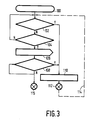
- the flowchart is shown in Fig. 3.
- preliminary operations are performed, for example the calling of the program and a partial specification of the variables, but in this example not yet the necessary variables V1, V3. Consequently, the system awaits the specification of these variables V1, V3.
- the blocks 102, 104 then form a waiting loop. If no key is actuated (102N), it is detected whether 5 seconds have already expired after the last user operation.
- Block 106 the following message is output in a male voice: "You have not yet specified variables (V1 and V3)".
- Block 108 corresponds to block 102.
- the relevant information is processed in block 110. If the specification is still inadequate, the system returns to the block 102 via line 114, so that a new waiting loop is started. In given circumstances the text is then adapted in block 106 (for example, "V1" instead of "V1 and V3").
- indication 112 forms the output of the program module. Therein the actual program function is executed. This may lead to termination of the operations because a result is obtained and possibly another program module is activated on the basis thereof.
- the system may return to block 102 as yet.
- the mechanical actuation by a key can be replaced by other actions, for example by the specification of a variable by means of a mouse or a graphic input apparatus.
- Output 115 can be reached, possibly after a prolonged waiting period, if no key has been actuated yet; the program can be terminated, for example by the user himself. If the implementation concerned the activation of a critical function, the necessary first actuation has been performed in block 100. When the second mechanical actuation is detected in the block 102, the activation becomes final. If this is done quickly, no speech output will be required: output from block 102Y. If it requires more than, for example 5 seconds, the previously described effect signalisation is output in the form of speech in the block 106.
- the second example is a continuation of the first example. Assume that the user understands that he still must do something but does not know what to do. If the user does nothing, after a given "time-out" the same male voice will tell how the relevant specifications must be performed, i.e. a form of active assistance.
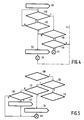
- the relevant flowchart is shown in Fig. 4 which is a supplement to the flowchart shown in Fig. 3.
- the waiting time it is detected in block 120 whether the waiting time already exceeds 10 seconds. For as long as this is not the case (N), the waiting loop consisting of the blocks 108, 120 is followed. When said 10 seconds have expired, the system proceeds to the block 122.
- the third example is an alternative for the second example. Assume that the user does something, i.e. actuate of a HELP key; the same information as above will be issued by the system (passive help), be it possibly in legible form on the display screen because the user knows that readable information will be issued by the actuation of the HELP key or the like.
- Fig. 5 which is again a supplement to the Figs. 3 and 4.
- the blocks 108, 116, 122 are the same as shown in Fig. 4.
- block 130 it is detected whether the "HELP" key (keys) was (were) concerned. If this is not the case (N), the system proceeds to the block 116 as discussed above.
- block 132 it is detected in block 132 whether the system is in the passive visual HELP mode. It is assumed that the system has three modes which are selectable, for example prior to the execution of the program, by specification of a trivalent variable:
- block 136 When the system does not operate in the passive help mode (132N), in block 136 it is detected whether it operates, for example in the audio active help mode. If this is not so (N), the system proceeds to block 124. If it is so, the system proceeds to the previously described block 122. In this case the system can again provide qualification information and/or effect signalling. Therefore, a direct change-over to block 124 does not provide assistance information. An experienced user who accidentally actuates the HELP key will not experience delays because of this error.
- Fig. 6 shows a fourth example in the form of a block diagram.
- a user issues speech commands concerning the composition and further treatment of a message to be despatched by electronic mail.
- "Critical" commands which cause, for example deletion or despatch of the message will be repeated, in view of (1) incorrect recognition and/or (2) a user error, in the form recognised by the system for verification, that is to say by a female voice (for the purpose of distinction from any signalling and HELP messages spoken by a male voice).
- the system can again issue qualification information and/or effect signalling information to the user.
- the system is initialised or all operations are executed in order to bring the system in this state.
- the user issues a speech command.
- the operations are performed for recognising this command and for extracting the user control signal contained therein.
- simple signalling can be used, for example a ringing or beeping sound.
- the speech communication channel is bidirectional and input (blocks 202, 220) as well as output (210, 214, 218, 226) are in speech. Alternatively, only the output may be in speech. In that case the blocks 212, 214 can be omitted, the recognition (blocks 204, 222) being elementary; block 208 means that an impossible or incorrect command has been given.
- the same principle can also be used, for example when a data file has been called by a user in block 202.
- the system can then request confirmation of the access request to this particular data file, again in speech.
Landscapes
- Engineering & Computer Science (AREA)
- Theoretical Computer Science (AREA)
- General Engineering & Computer Science (AREA)
- Physics & Mathematics (AREA)
- General Physics & Mathematics (AREA)
- Human Computer Interaction (AREA)
- Health & Medical Sciences (AREA)
- Audiology, Speech & Language Pathology (AREA)
- General Health & Medical Sciences (AREA)
- Computer Hardware Design (AREA)
- Software Systems (AREA)
- Input From Keyboards Or The Like (AREA)
- Debugging And Monitoring (AREA)
- Electrically Operated Instructional Devices (AREA)
- Computer And Data Communications (AREA)
Claims (10)
- Arbeitsstation zur Verwendung in einem Computersystem zum Ausführen eines Computerprogramms, wobei ein Dialog zwischen einem Benutzer und dem Programm aufrechterhalten wird, mit Hilfe eines Datendisplay-Elements (62) zum Ausgeben von Signalen aus der genannten Ausführung und eines mechanischen Eingabeelements (66) zum Eingeben von Datensignalen und Steuersignalen für die genannte Ausführung, dadurch gekennzeichnet, daß die Arbeitsstation Detektionsmittel umfaßt, die von dem genannten Eingabeelement gespeist werden, um dann aus einem Satz von Ausnahmesituationen eine bevorstehende Ausnahmesituation zu detektieren, die von einem bestimmten weiteren Eingeben abhängig ist, sowie einen von den Detektionsmitteln gespeisten Begleitmechanismus, um daraufhin für diese Ausnahmesituation und das genannte spezielle weitere Eingeben spezielle Begleitinformation anzubieten, wobei der genannte Begleitmechanismus einen Sprachkommunikationskanal (68, 70) speist, um die genannte Begleitinformation in Form von Sprache als Maßnahme gegen Überladung des Bildschirms anzubieten.
- Arbeitsstation nach Anspruch 1, dadurch gekennzeichnet, daß die genannte bevorstehende Ausnahmesituation durch ein vorläufiges Aktivieren eines bestimmten Benutzersteuerungssignals dargestellt wird, wobei die Begleitinformation eine Auswirkung einer durch eine folgende mechanische Betätigung erfolgenden endgültigen Aktivierung des Benutzersteuerungssignals erläutert.
- Arbeitsstation nach Anspruch 2, dadurch gekennzeichnet, daß das genannte Benutzersteuerungssignal in dem Programm vorhandene Daten beeinflußt, soweit es ihre Funktion außerhalb des Programms betrifft.
- Arbeitsstation nach Anspruch 2 oder 3, dadurch gekennzeichnet, daß Verzögerungsmittel zum Verzögern des genannten Ausgebens um eine vorbestimmte Verzögerung vorgesehen sind, und gekennzeichnet durch Verzichten auf das genannte Ausgeben in Reaktion auf das vor Beendigung der genannten Verzögerung erfolgte, genannte weitere Eingeben.
- Arbeitsstation nach Anspruch 2, 3 oder 4, dadurch gekennzeichnet, daß die genannte Begleitinformation eine Benutzerhandlung spezifiziert.
- Arbeitsstation nach einem der Ansprüche 1 bis 5, dadurch gekennzeichnet, daß ein Betriebsartsteuerungselement vorgesehen ist, um das genannte Ausgeben reversibel zum genannten Display-Element zu übertragen.
- Arbeitsstation nach einem der Ansprüche 1 bis 6, dadurch gekennzeichnet, daß der genannte Sprachkommunikationskanal (68, 70, 72, 74) bidirektional ist, um ein Benutzersteuerungssignal für eine Programmfunktion in Form von Sprache zu empfangen, und wobei die genannte Arbeitsstation eingerichtet ist, in Reaktion auf das Erkennen eines bestimmten Benutzersteuerungssignals qualifizierende Information der genannten Programmfunktion auf dem Display-Element (62) vor der Aktivierung dieser Programmfunktion in Reaktion auf den Empfang eines folgenden Benutzersteuerungssignals wiederzugeben.
- Arbeitsstation nach Anspruch 7, dadurch gekennzeichnet, daß der Sprachkommunikationskanal zum Erkennen des genannten folgenden Benutzersteuerungssignals in Form von Sprache eingerichtet ist.
- Arbeitsstation nach Anspruch 7 oder 8, dadurch gekennzeichnet, daß der Sprachkommunikationskanal eingerichtet ist, um dem Benutzer ein Spracherkennungsergebnis zu bestätigen.
- Arbeitsstation nach einem der Ansprüche 7, 8 oder 9, dadurch gekenn zeichnet, daß ein Assoziationsmechanismus zum Darstellen einer Reihe zugehöriger qualifizierender Informationen unter der Steuerung erkannter Rufinformation vorhanden ist.
Applications Claiming Priority (2)
| Application Number | Priority Date | Filing Date | Title |
|---|---|---|---|
| NL8802350A NL8802350A (nl) | 1988-09-23 | 1988-09-23 | Werkstation voor een computersysteem voorzien van een afbeeldelement, een ingavesysteem, en een audiokommunikatiesysteem, alsmede computersysteem bevattende zulke werkstations. |
| NL8802350 | 1988-09-23 |
Publications (2)
| Publication Number | Publication Date |
|---|---|
| EP0360352A1 EP0360352A1 (de) | 1990-03-28 |
| EP0360352B1 true EP0360352B1 (de) | 1995-12-13 |
Family
ID=19852952
Family Applications (1)
| Application Number | Title | Priority Date | Filing Date |
|---|---|---|---|
| EP89202364A Expired - Lifetime EP0360352B1 (de) | 1988-09-23 | 1989-09-19 | Arbeitsstation für ein Rechnersystem mit einem Abbildungselement, einem Eingabesystem und einem Audiokommunikationssystem sowie Rechnersystem mit derartigen Arbeitsstationen |
Country Status (5)
| Country | Link |
|---|---|
| EP (1) | EP0360352B1 (de) |
| JP (1) | JP3314928B2 (de) |
| KR (1) | KR0147061B1 (de) |
| DE (1) | DE68925089T2 (de) |
| NL (1) | NL8802350A (de) |
Families Citing this family (4)
| Publication number | Priority date | Publication date | Assignee | Title |
|---|---|---|---|---|
| EP0582536A1 (de) * | 1992-07-27 | 1994-02-09 | International Business Machines Corporation | Verfahren und Vorrichtung zur Lieferung automatischer Antwortaktionen für vorher bestehende Benutzereingangsprozeduren |
| DE19646634A1 (de) * | 1996-11-12 | 1998-05-14 | Bosch Gmbh Robert | Verfahren zur Befehlseingabe mit Sprache |
| DE19963899A1 (de) * | 1999-12-30 | 2001-07-05 | Bsh Bosch Siemens Hausgeraete | Vorrichtung und Verfahren zur Herstellung und/oder Bearbeitung von Produkten |
| KR102305609B1 (ko) * | 2019-08-27 | 2021-09-28 | 코스맥스 주식회사 | 스타필로코커스속 균주 및 그의 용도 |
Family Cites Families (3)
| Publication number | Priority date | Publication date | Assignee | Title |
|---|---|---|---|---|
| JPS5667470A (en) * | 1979-11-07 | 1981-06-06 | Canon Inc | Voice desk-top calculator |
| NL8401863A (nl) * | 1984-06-13 | 1986-01-02 | Philips Nv | Werkwijze voor het herkennen en uitvoeren van een besturingskommando in een interaktief systeem, en een interaktief systeem voor het uitvoeren van de werkwijze. |
| US4704703A (en) * | 1985-07-22 | 1987-11-03 | Airus Incorporated | Dynamic input processing system |
-
1988
- 1988-09-23 NL NL8802350A patent/NL8802350A/nl not_active Application Discontinuation
-
1989
- 1989-09-19 DE DE68925089T patent/DE68925089T2/de not_active Expired - Lifetime
- 1989-09-19 EP EP89202364A patent/EP0360352B1/de not_active Expired - Lifetime
- 1989-09-23 KR KR1019890013705A patent/KR0147061B1/ko not_active Expired - Lifetime
- 1989-09-25 JP JP24899289A patent/JP3314928B2/ja not_active Expired - Lifetime
Also Published As
| Publication number | Publication date |
|---|---|
| KR0147061B1 (ko) | 1998-09-15 |
| KR900005316A (ko) | 1990-04-14 |
| JPH02148120A (ja) | 1990-06-07 |
| DE68925089D1 (de) | 1996-01-25 |
| DE68925089T2 (de) | 1996-07-18 |
| NL8802350A (nl) | 1990-04-17 |
| JP3314928B2 (ja) | 2002-08-19 |
| EP0360352A1 (de) | 1990-03-28 |
Similar Documents
| Publication | Publication Date | Title |
|---|---|---|
| US6499015B2 (en) | Voice interaction method for a computer graphical user interface | |
| CA2054581A1 (en) | Interface for keyboard emulation provided by an operating system | |
| KR20080109322A (ko) | 사용자의 직관적 의도 파악에 따른 서비스 제공 방법 및장치 | |
| US20020122591A1 (en) | Verification system for confidential data input | |
| WO1999005671A1 (en) | Universal voice operated command and control engine | |
| EP0360352A1 (de) | Arbeitsstation für ein Rechnersystem mit einem Abbildungselement, einem Eingabesystem und einem Audiokommunikationssystem sowie Rechnersystem mit derartigen Arbeitsstationen | |
| JPH07504775A (ja) | キーボードインターフェースを介しての入力装置の制御方法 | |
| US7080002B1 (en) | Bi-lingual system and method for automatically converting one language into another language | |
| Fleizach et al. | System-class Accessibility: The architectural support for making a whole system usable by people with disabilities | |
| KR20040033011A (ko) | 컴퓨터 인터페이스 시스템 및 방법 | |
| US20080109227A1 (en) | Voice Control System and Method for Controlling Computers | |
| EP0052754B1 (de) | Texthervorhebungsmethode fòr eine Textbearbeitungseinrichtung | |
| JPH0358090A (ja) | 表示装置 | |
| JPS60146327A (ja) | 計算機対話方法 | |
| JP3271466B2 (ja) | 読み上げ装置 | |
| JPH0618023B2 (ja) | タイパマチツクキ−ボ−ド入力制御方式 | |
| CN115686329A (zh) | 一种弱网环境下按键粘连处理方法、装置、介质及设备 | |
| JP2000132316A (ja) | キーボード装置を使用した入力装置 | |
| JPS6029824A (ja) | キ−入力装置 | |
| CN121979417A (zh) | 输入处理方法、装置、电子设备及存储介质 | |
| JP3073226B2 (ja) | 文書処理装置 | |
| CN113434066A (zh) | 一种输入设备指示图标实现方法和装置、设备及存储介质 | |
| JPH05204516A (ja) | 情報処理システムおよびキー入力に対するエコーバック方法 | |
| JPH04308924A (ja) | コンピュータシステム | |
| JP2006268879A (ja) | データ処理装置及び音声出力制御方法 |
Legal Events
| Date | Code | Title | Description |
|---|---|---|---|
| PUAI | Public reference made under article 153(3) epc to a published international application that has entered the european phase |
Free format text: ORIGINAL CODE: 0009012 |
|
| AK | Designated contracting states |
Kind code of ref document: A1 Designated state(s): DE FR GB IT SE |
|
| 17P | Request for examination filed |
Effective date: 19900926 |
|
| 17Q | First examination report despatched |
Effective date: 19930512 |
|
| GRAA | (expected) grant |
Free format text: ORIGINAL CODE: 0009210 |
|
| AK | Designated contracting states |
Kind code of ref document: B1 Designated state(s): DE FR GB IT SE |
|
| REF | Corresponds to: |
Ref document number: 68925089 Country of ref document: DE Date of ref document: 19960125 |
|
| ITF | It: translation for a ep patent filed | ||
| ET | Fr: translation filed | ||
| PLBE | No opposition filed within time limit |
Free format text: ORIGINAL CODE: 0009261 |
|
| STAA | Information on the status of an ep patent application or granted ep patent |
Free format text: STATUS: NO OPPOSITION FILED WITHIN TIME LIMIT |
|
| 26N | No opposition filed | ||
| REG | Reference to a national code |
Ref country code: FR Ref legal event code: CD |
|
| REG | Reference to a national code |
Ref country code: GB Ref legal event code: IF02 |
|
| PGFP | Annual fee paid to national office [announced via postgrant information from national office to epo] |
Ref country code: FR Payment date: 20080917 Year of fee payment: 20 |
|
| PGFP | Annual fee paid to national office [announced via postgrant information from national office to epo] |
Ref country code: GB Payment date: 20080929 Year of fee payment: 20 |
|
| PGFP | Annual fee paid to national office [announced via postgrant information from national office to epo] |
Ref country code: DE Payment date: 20081031 Year of fee payment: 20 |
|
| REG | Reference to a national code |
Ref country code: GB Ref legal event code: 732E |
|
| PGFP | Annual fee paid to national office [announced via postgrant information from national office to epo] |
Ref country code: IT Payment date: 20080929 Year of fee payment: 20 Ref country code: SE Payment date: 20080929 Year of fee payment: 20 |
|
| REG | Reference to a national code |
Ref country code: GB Ref legal event code: PE20 Expiry date: 20090918 |
|
| REG | Reference to a national code |
Ref country code: FR Ref legal event code: TP |
|
| EUG | Se: european patent has lapsed | ||
| PG25 | Lapsed in a contracting state [announced via postgrant information from national office to epo] |
Ref country code: GB Free format text: LAPSE BECAUSE OF EXPIRATION OF PROTECTION Effective date: 20090918 |