EP0360988A2 - Procédé pour la fabrication d'une solution aqueuse de formaldéhyde - Google Patents
Procédé pour la fabrication d'une solution aqueuse de formaldéhyde Download PDFInfo
- Publication number
- EP0360988A2 EP0360988A2 EP89112302A EP89112302A EP0360988A2 EP 0360988 A2 EP0360988 A2 EP 0360988A2 EP 89112302 A EP89112302 A EP 89112302A EP 89112302 A EP89112302 A EP 89112302A EP 0360988 A2 EP0360988 A2 EP 0360988A2
- Authority
- EP
- European Patent Office
- Prior art keywords
- methanol
- absorption
- water
- fractional distillation
- formaldehyde solution
- Prior art date
- Legal status (The legal status is an assumption and is not a legal conclusion. Google has not performed a legal analysis and makes no representation as to the accuracy of the status listed.)
- Granted
Links
Images

Classifications
-
- C—CHEMISTRY; METALLURGY
- C07—ORGANIC CHEMISTRY
- C07C—ACYCLIC OR CARBOCYCLIC COMPOUNDS
- C07C45/00—Preparation of compounds having >C = O groups bound only to carbon or hydrogen atoms; Preparation of chelates of such compounds
- C07C45/78—Separation; Purification; Stabilisation; Use of additives
- C07C45/81—Separation; Purification; Stabilisation; Use of additives by change in the physical state, e.g. crystallisation
-
- C—CHEMISTRY; METALLURGY
- C07—ORGANIC CHEMISTRY
- C07C—ACYCLIC OR CARBOCYCLIC COMPOUNDS
- C07C45/00—Preparation of compounds having >C = O groups bound only to carbon or hydrogen atoms; Preparation of chelates of such compounds
- C07C45/27—Preparation of compounds having >C = O groups bound only to carbon or hydrogen atoms; Preparation of chelates of such compounds by oxidation
- C07C45/32—Preparation of compounds having >C = O groups bound only to carbon or hydrogen atoms; Preparation of chelates of such compounds by oxidation with molecular oxygen
- C07C45/37—Preparation of compounds having >C = O groups bound only to carbon or hydrogen atoms; Preparation of chelates of such compounds by oxidation with molecular oxygen of >C—O—functional groups to >C=O groups
- C07C45/38—Preparation of compounds having >C = O groups bound only to carbon or hydrogen atoms; Preparation of chelates of such compounds by oxidation with molecular oxygen of >C—O—functional groups to >C=O groups being a primary hydroxyl group
-
- C—CHEMISTRY; METALLURGY
- C07—ORGANIC CHEMISTRY
- C07C—ACYCLIC OR CARBOCYCLIC COMPOUNDS
- C07C45/00—Preparation of compounds having >C = O groups bound only to carbon or hydrogen atoms; Preparation of chelates of such compounds
- C07C45/78—Separation; Purification; Stabilisation; Use of additives
- C07C45/783—Separation; Purification; Stabilisation; Use of additives by gas-liquid treatment, e.g. by gas-liquid absorption
-
- C—CHEMISTRY; METALLURGY
- C07—ORGANIC CHEMISTRY
- C07C—ACYCLIC OR CARBOCYCLIC COMPOUNDS
- C07C45/00—Preparation of compounds having >C = O groups bound only to carbon or hydrogen atoms; Preparation of chelates of such compounds
- C07C45/78—Separation; Purification; Stabilisation; Use of additives
- C07C45/81—Separation; Purification; Stabilisation; Use of additives by change in the physical state, e.g. crystallisation
- C07C45/82—Separation; Purification; Stabilisation; Use of additives by change in the physical state, e.g. crystallisation by distillation
Definitions
- the present invention relates to a process for the preparation of aqueous formaldehyde solutions, from which the major part of the condensation and absorption energy which is produced during their production is withdrawn in order to evaporate the required methanol / water / air mixture. Furthermore, part of the heat content of the formaldehyde solution produced can be used for the recovery of methanol contained in the formaldehyde solution. Both measures can be used alone or simultaneously.
- Formaldehyde is an important basic chemical, for example for the production of phenol-formaldehyde resins or urea-formaldehyde resins and is still used as a disinfectant and as a tanning agent.
- the invention accordingly relates to a process for the preparation of aqueous formaldehyde solutions, consisting of the steps a) reaction of a methanol / water / air mixture at a higher temperature on a catalyst, b) absorption of the reaction mixture in one or more absorbers connected in series below Formation of a methanol-containing aqueous formaldehyde solution and optionally c) fractional distillation of a fraction essentially containing methanol and water from this formaldehyde solution, which is characterized in that the methanol / water mixture required for the reaction is evaporated by indirect heating with a formaldehyde solution taken from the absorber or at least a part of the vapors obtained in the fractional distillation is condensed with liquid water and this condensate with fresh methanol and with air the evaporator upstream of the catalyst stage is supplied.
- the two characteristic measures are carried out together.
- the absorption is carried out in at least two absorption stages connected in series.
- the methanol-containing aqueous formaldehyde solution used for the fractional distillation is in this case taken from the second absorption stage or one of the further downstream absorption stages;
- the formaldehyde solution required to heat the evaporator upstream of the catalyst stage is taken from the first absorption stage or from one of the upstream absorption stages, preferably the first absorption stage.
- the one from the evaporator Returning formaldehyde solution can be removed as a process product for further use, as well as fed back to the absorption stage from which it was taken.
- Indirect heating by the formaldehyde solution taken from the absorber covers the entire or at least predominant energy requirement of the evaporator. Additional heating is installed to start the process.
- each absorption level can of course also consist of several absorbers.
- a suitable evaporator is designed in such a way that an intensive and even distribution of the components methanol / water and air is ensured over its cross section.
- An evaporator constructed in this way can be operated without external energy, i.e. only be heated with the help of the formaldehyde solution taken from the absorber; the absorption and condensation energy generated in the absorption stage can be largely used.
- the fractional distillation of essentially methanol and water can be carried out at a pressure of 40 to 800 mbar, measured at the top of the column.
- a pressure of 50 to 400 mbar is preferred, particularly preferred from 50 to 200 mbar and very particularly preferably from 50 to 95 mbar, all measured at the top of the column.
- the vapors obtained in the fractional distillation are only partially condensed on a surface condenser in order to maintain a reflux to the desired extent for the distillation column. Most of the methanol still leaves this surface condenser in the vapor state and is completely precipitated in a downstream injection condenser by added water.
- the condensate obtained is fed to the evaporator upstream of the catalyst stage.
- a quantity of water which extends up to the total quantity of water required in the methanol / water / air mixture can thus preferably be used for the injection condensation.
- the sensible heat contained in the absorption solutions is supplied to other heat consumers of the process according to the invention (evaporator and / or fractional distillation) in the manner described, so that they can be operated without external energy, it is nevertheless possible for the gases escaping from the catalyst stage to be in themselves to supply known waste heat boilers without a lack of energy at the other points described. It is therefore a further preferred variant to carry out the steam generation in such a waste heat boiler also in the method according to the invention.
- the method according to the invention is explained as follows using the example of a three-stage absorption, wherein the evaporator is preferably heated by formaldehyde solution removed from the absorber and the vapors of the flash evaporation are precipitated by fresh water, an additional waste heat boiler being operated:
- Fresh methanol (1), air (2) and a recycled mixture (3) consisting essentially of methanol and water are completely converted into the vapor form in the evaporator (4) and fed to the catalyst stage (5).
- the reaction mixture flowing out of the catalyst stage (5) is fed to a waste heat boiler (6), where it is cooled to about 120 ° C. with the simultaneous conversion of optionally preheated water (7) into a 5 to 6 bar steam (8).
- the reaction mixture leaving the waste heat boiler is fed via line (9) to a first absorber stage (10).
- the aqueous formalin solution formed in (10) is fed via line (11) to the evaporator (4) for heat exchange and partially returned via line (12) to the first absorber stage (10).
- a portion of the aqueous formalin solution from (10) is removed as product stream (13) after the heat exchange (4).
- the reaction gases not condensed in (10) are fed via line (14) to the second absorber stage (15).
- the (15) flowing methanol-containing aqueous formaldehyde solution is fed via line (16) into the rectifying column (17), where flash evaporation takes place under reduced pressure.
- the remaining one Low-methanol aqueous formaldehyde solution is removed from the bottom of (17) via line (18) and partly as return to the second absorber stage (15) via line (19) and partly taken off via line (20) as a product.
- the non-condensable components and the inert gas components are fed via line (27) to the vacuum pump (28), on the pressure side of which they escape as exhaust gas (29) and are passed on for suitable disposal.
- the part of the reaction gases not absorbed in the second absorber stage (15) is absorbed in a third absorber stage (30).
- the heat of condensation still absorbed in this absorbate is removed by a cooler (31).
- Necessary water as the absorption medium is provided via (33).
- the non-condensable constituents and the inert gases are supplied as waste gas (32) to a suitable disposal, as a rule a combustion with steam generation.
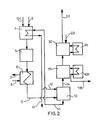
- FIG. 2 shows the inventive method of heating the evaporator by means of formaldehyde solution removed from the absorber without vapor condensation according to the invention during flash evaporation.
- (101) means the supply of methanol and water as a mixture
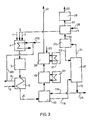
- FIG. 3 shows the method according to the invention of condensing the vapors from the flash distillation and feeding the condensate obtained to the evaporation stage without heating this evaporator stage according to the invention.
- the evaporation is effected by steam which is generated in the waste heat boiler (6), supplemented by steam which is taken from the general network.
- the same reference numerals as in Fig. 1 in turn have the meaning given therefor.
- 1,070 parts by weight of a mixture consisting of 600 parts by weight of methanol and 470 parts by weight of water together with 970 parts by weight of air become the evaporator (4) fed and completely evaporated there.
- the gas mixture is reacted in the reactor (5), which is equipped with a silver catalyst.
- About 630 parts by weight of 5 bar steam are generated in the waste heat boiler (6) and fed to the steam network via line (8).
- the reaction gases cool down to approx. 120 ° C. From the first absorption stage (10), about 25,000 parts by weight of formaldehyde solution of 79-83 ° C.
- aqueous formaldehyde solution circulate via line (11) to the evaporator (4), which are cooled down to 68-70 ° C. as they pass through the evaporator (4) . From this, 570 parts by weight of aqueous formaldehyde solution are taken off per hour via line (13) (40.5% formaldehyde and about 1% methanol). Approx. 27,000 parts by weight of aqueous formaldehyde solution circulate from the second absorption stage (15) to the rectification / expansion column (17), from which 880 parts by weight of formaldehyde solution / h are removed after flash evaporation at 85 mbar head pressure (30 , 5% formaldehyde and 0.5% methanol).
- the vapors flowing through the surface condenser (22) are precipitated in the injection condenser (25) with 450 parts by weight of water / h (via (26)) and result in a condensate flowing back to the evaporator (4) with the composition specified above.
- the yield of formaldehyde, based on the methanol used, is 91.3% of the theoretical yield.
Landscapes
- Chemical & Material Sciences (AREA)
- Organic Chemistry (AREA)
- Crystallography & Structural Chemistry (AREA)
- Organic Low-Molecular-Weight Compounds And Preparation Thereof (AREA)
- Low-Molecular Organic Synthesis Reactions Using Catalysts (AREA)
Applications Claiming Priority (4)
| Application Number | Priority Date | Filing Date | Title |
|---|---|---|---|
| DE3824360 | 1988-07-19 | ||
| DE19883824360 DE3824360A1 (de) | 1988-07-19 | 1988-07-19 | Verfahren zur herstellung von waessrigen formaldehydloesungen |
| DE3834323 | 1988-10-08 | ||
| DE19883834323 DE3834323A1 (de) | 1988-10-08 | 1988-10-08 | Verfahren zur herstellung von waessrigen formaldehydloesungen |
Publications (3)
| Publication Number | Publication Date |
|---|---|
| EP0360988A2 true EP0360988A2 (fr) | 1990-04-04 |
| EP0360988A3 EP0360988A3 (fr) | 1992-05-13 |
| EP0360988B1 EP0360988B1 (fr) | 1995-04-26 |
Family
ID=25870224
Family Applications (1)
| Application Number | Title | Priority Date | Filing Date |
|---|---|---|---|
| EP89112302A Expired - Lifetime EP0360988B1 (fr) | 1988-07-19 | 1989-07-06 | Procédé pour la fabrication d'une solution aqueuse de formaldéhyde |
Country Status (3)
| Country | Link |
|---|---|
| US (1) | US4990685A (fr) |
| EP (1) | EP0360988B1 (fr) |
| DE (1) | DE58909195D1 (fr) |
Cited By (1)
| Publication number | Priority date | Publication date | Assignee | Title |
|---|---|---|---|---|
| ES2103193A1 (es) * | 1995-05-16 | 1997-08-16 | Patentes Novedades Sa | Procedimiento para la preparacion en continuo de soluciones acuosas de formaldehido. |
Families Citing this family (5)
| Publication number | Priority date | Publication date | Assignee | Title |
|---|---|---|---|---|
| US6448448B1 (en) | 1998-03-31 | 2002-09-10 | Ticona Gmbh | Process for the non-oxidative preparation of formaldehyde from methanol |
| SE530611C2 (sv) * | 2006-03-24 | 2008-07-15 | Perstorp Specialty Chem Ab | Återvinning av exoterm energi vid framställning av formaldehyd |
| AT516530B1 (de) * | 2014-11-20 | 2018-02-15 | Johnson Matthey Plc | Verfahren und Vorrichtung zur Herstellung einer wässrigen Lösung von Formaldehyd |
| CN106349043B (zh) * | 2016-08-30 | 2018-11-06 | 安徽金禾实业股份有限公司 | 一种稀乙醛精馏残液回收使用方法 |
| CN112920029A (zh) * | 2021-02-03 | 2021-06-08 | 安徽金禾实业股份有限公司 | 一种甲醛中提取和精制甲醇的装置及方法 |
Family Cites Families (7)
| Publication number | Priority date | Publication date | Assignee | Title |
|---|---|---|---|---|
| US2773101A (en) * | 1952-07-25 | 1956-12-04 | Shell Dev | Catalytic reactions with osmium oxide catalysts |
| US2947750A (en) * | 1957-02-08 | 1960-08-02 | Borden Co | Formaldehyde absorption |
| DE1618413A1 (de) * | 1967-04-29 | 1970-10-29 | Bayer Ag | Verfahren zur Herstellung waessriger Formaldehydloesungen |
| US4097535A (en) * | 1977-01-31 | 1978-06-27 | Continental Oil Company | Preparation of aldehydes from alcohols |
| US4454354A (en) * | 1982-08-02 | 1984-06-12 | Monsanto Company | Manufacture of aqueous formaldehyde |
| DE3402995A1 (de) * | 1984-01-28 | 1985-08-08 | Basf Ag, 6700 Ludwigshafen | Verfahren zur herstellung von formaldehyd |
| JPH0662478B2 (ja) * | 1984-04-12 | 1994-08-17 | 三菱瓦斯化学株式会社 | ホルムアルデヒド水溶液の製造法 |
-
1989
- 1989-06-27 US US07/371,786 patent/US4990685A/en not_active Expired - Lifetime
- 1989-07-06 EP EP89112302A patent/EP0360988B1/fr not_active Expired - Lifetime
- 1989-07-06 DE DE58909195T patent/DE58909195D1/de not_active Expired - Fee Related
Cited By (1)
| Publication number | Priority date | Publication date | Assignee | Title |
|---|---|---|---|---|
| ES2103193A1 (es) * | 1995-05-16 | 1997-08-16 | Patentes Novedades Sa | Procedimiento para la preparacion en continuo de soluciones acuosas de formaldehido. |
Also Published As
| Publication number | Publication date |
|---|---|
| EP0360988B1 (fr) | 1995-04-26 |
| EP0360988A3 (fr) | 1992-05-13 |
| DE58909195D1 (de) | 1995-06-01 |
| US4990685A (en) | 1991-02-05 |
Similar Documents
| Publication | Publication Date | Title |
|---|---|---|
| DE2447551C3 (de) | Verfahren zur Herstellung von Methylchlorid | |
| EP2328854A1 (fr) | Procédé et dispositif de fabrication de méthanol | |
| DE2757478A1 (de) | Verfahren zur herstellung von methanol | |
| DE2726491A1 (de) | Verfahren zur kontinuierlichen herstellung von alkalialkoholaten | |
| DE69807135T2 (de) | Ein Verfahren zur kontinuierlichen Herstellung eines cyclischen Formals | |
| DE2224306A1 (de) | Verfahren zur Herstellung von Ammoniak | |
| DE3402995A1 (de) | Verfahren zur herstellung von formaldehyd | |
| DE2646804C3 (de) | Verfahren zur Gewinnung von reinem Ammoniak aus Ammoniak und Kohlendioxid enthaltenden Gasgemischen | |
| EP0360988B1 (fr) | Procédé pour la fabrication d'une solution aqueuse de formaldéhyde | |
| EP2367780B1 (fr) | Procédé et dispositif de production de diméthyléther à partir de méthanol | |
| DE2451990C3 (de) | Verfahren zur Herstellung von konzentrierten, wäßrigen Lösungen von Formaleyhd und Harnstoff | |
| DE1443164A1 (de) | Verbessertes Verfahren zur Herstellung von Harnstoff | |
| DE2645251C2 (de) | Verfahren zur Herstellung und Gewinnung von Diisopropanolamin aus einem 1-(2-Hydroxypropyl)-4-methyl-oxazolidon-(2) enthaltenden Gemisch | |
| DE3003332A1 (de) | Verfahren zur reinigung von rohem olefinisch ungesaettigten nitril und kuehler zur durchfuehrung des verfahrens | |
| DE3002660A1 (de) | Verfahren zur gewinnung von methacrolein | |
| DE68906423T2 (de) | Verfahren zur konzentrierung der salpetersaeure. | |
| DE3834323A1 (de) | Verfahren zur herstellung von waessrigen formaldehydloesungen | |
| DE3824360A1 (de) | Verfahren zur herstellung von waessrigen formaldehydloesungen | |
| DE2419276C3 (de) | Verfahren zur Herstellung von Acrolein | |
| DE19920741B4 (de) | Verfahren zur Herstellung konzentrierter Salpetersäure | |
| DE2708617C2 (de) | Verfahren zur Gewinnung von nicht umgesetztem Ammoniak und Kohlendioxid und Wärme aus einem Harnstoffsyntheseabstrom | |
| DE1518468A1 (de) | Verfahren zur Herstellung von Harnstoffen | |
| DE2117060A1 (en) | Methanol synthesis with improved reboiler heating | |
| EP0148293B1 (fr) | Procédé pour la préparation de la trioxane | |
| DE860048C (de) | Verfahren und Vorrichtung zur Herstellung von Methanol |
Legal Events
| Date | Code | Title | Description |
|---|---|---|---|
| PUAI | Public reference made under article 153(3) epc to a published international application that has entered the european phase |
Free format text: ORIGINAL CODE: 0009012 |
|
| 17P | Request for examination filed |
Effective date: 19890706 |
|
| AK | Designated contracting states |
Kind code of ref document: A2 Designated state(s): DE FR GB |
|
| PUAL | Search report despatched |
Free format text: ORIGINAL CODE: 0009013 |
|
| AK | Designated contracting states |
Kind code of ref document: A3 Designated state(s): DE FR GB |
|
| 17Q | First examination report despatched |
Effective date: 19931021 |
|
| GRAA | (expected) grant |
Free format text: ORIGINAL CODE: 0009210 |
|
| AK | Designated contracting states |
Kind code of ref document: B1 Designated state(s): DE FR GB |
|
| GBT | Gb: translation of ep patent filed (gb section 77(6)(a)/1977) |
Effective date: 19950501 |
|
| REF | Corresponds to: |
Ref document number: 58909195 Country of ref document: DE Date of ref document: 19950601 |
|
| ET | Fr: translation filed | ||
| PLBE | No opposition filed within time limit |
Free format text: ORIGINAL CODE: 0009261 |
|
| STAA | Information on the status of an ep patent application or granted ep patent |
Free format text: STATUS: NO OPPOSITION FILED WITHIN TIME LIMIT |
|
| 26N | No opposition filed | ||
| PGFP | Annual fee paid to national office [announced via postgrant information from national office to epo] |
Ref country code: GB Payment date: 19980629 Year of fee payment: 10 |
|
| PGFP | Annual fee paid to national office [announced via postgrant information from national office to epo] |
Ref country code: FR Payment date: 19980720 Year of fee payment: 10 |
|
| PG25 | Lapsed in a contracting state [announced via postgrant information from national office to epo] |
Ref country code: GB Free format text: LAPSE BECAUSE OF NON-PAYMENT OF DUE FEES Effective date: 19990706 |
|
| PG25 | Lapsed in a contracting state [announced via postgrant information from national office to epo] |
Ref country code: FR Free format text: THE PATENT HAS BEEN ANNULLED BY A DECISION OF A NATIONAL AUTHORITY Effective date: 19990731 |
|
| GBPC | Gb: european patent ceased through non-payment of renewal fee |
Effective date: 19990706 |
|
| REG | Reference to a national code |
Ref country code: FR Ref legal event code: ST |
|
| PGFP | Annual fee paid to national office [announced via postgrant information from national office to epo] |
Ref country code: DE Payment date: 20070626 Year of fee payment: 19 |
|
| PG25 | Lapsed in a contracting state [announced via postgrant information from national office to epo] |
Ref country code: DE Free format text: LAPSE BECAUSE OF NON-PAYMENT OF DUE FEES Effective date: 20090203 |