EP0361061A1 - Siliciumnitridpulver mit verbesserten Oberflächeneigenschaften sowie Verfahren zu deren Herstellung - Google Patents
Siliciumnitridpulver mit verbesserten Oberflächeneigenschaften sowie Verfahren zu deren Herstellung Download PDFInfo
- Publication number
- EP0361061A1 EP0361061A1 EP89115213A EP89115213A EP0361061A1 EP 0361061 A1 EP0361061 A1 EP 0361061A1 EP 89115213 A EP89115213 A EP 89115213A EP 89115213 A EP89115213 A EP 89115213A EP 0361061 A1 EP0361061 A1 EP 0361061A1
- Authority
- EP
- European Patent Office
- Prior art keywords
- oxygen content
- powder
- oxygen
- si3n4
- less
- Prior art date
- Legal status (The legal status is an assumption and is not a legal conclusion. Google has not performed a legal analysis and makes no representation as to the accuracy of the status listed.)
- Granted
Links
- 239000000843 powder Substances 0.000 title claims abstract description 73
- 238000000034 method Methods 0.000 title claims abstract description 16
- 238000002360 preparation method Methods 0.000 title claims abstract description 6
- -1 Silicium nitride Chemical class 0.000 title description 4
- QVGXLLKOCUKJST-UHFFFAOYSA-N atomic oxygen Chemical compound [O] QVGXLLKOCUKJST-UHFFFAOYSA-N 0.000 claims abstract description 88
- 239000001301 oxygen Substances 0.000 claims abstract description 88
- 229910052760 oxygen Inorganic materials 0.000 claims abstract description 88
- 229910052581 Si3N4 Inorganic materials 0.000 claims abstract description 40
- YCKRFDGAMUMZLT-UHFFFAOYSA-N Fluorine atom Chemical compound [F] YCKRFDGAMUMZLT-UHFFFAOYSA-N 0.000 claims abstract description 18
- 229910052731 fluorine Inorganic materials 0.000 claims abstract description 18
- 239000011737 fluorine Substances 0.000 claims abstract description 18
- XLYOFNOQVPJJNP-UHFFFAOYSA-N water Substances O XLYOFNOQVPJJNP-UHFFFAOYSA-N 0.000 claims abstract description 7
- 150000001298 alcohols Chemical class 0.000 claims abstract description 3
- 238000004519 manufacturing process Methods 0.000 abstract description 4
- 238000004833 X-ray photoelectron spectroscopy Methods 0.000 description 18
- HQVNEWCFYHHQES-UHFFFAOYSA-N silicon nitride Chemical compound N12[Si]34N5[Si]62N3[Si]51N64 HQVNEWCFYHHQES-UHFFFAOYSA-N 0.000 description 7
- VYPSYNLAJGMNEJ-UHFFFAOYSA-N Silicium dioxide Chemical compound O=[Si]=O VYPSYNLAJGMNEJ-UHFFFAOYSA-N 0.000 description 6
- 239000002245 particle Substances 0.000 description 6
- 238000005245 sintering Methods 0.000 description 5
- 238000000227 grinding Methods 0.000 description 4
- 239000012071 phase Substances 0.000 description 4
- KRHYYFGTRYWZRS-UHFFFAOYSA-M Fluoride anion Chemical compound [F-] KRHYYFGTRYWZRS-UHFFFAOYSA-M 0.000 description 3
- 229910003910 SiCl4 Inorganic materials 0.000 description 3
- 238000006460 hydrolysis reaction Methods 0.000 description 3
- 239000010410 layer Substances 0.000 description 3
- 230000002829 reductive effect Effects 0.000 description 3
- 235000012239 silicon dioxide Nutrition 0.000 description 3
- 239000000377 silicon dioxide Substances 0.000 description 3
- FDNAPBUWERUEDA-UHFFFAOYSA-N silicon tetrachloride Chemical compound Cl[Si](Cl)(Cl)Cl FDNAPBUWERUEDA-UHFFFAOYSA-N 0.000 description 3
- IJGRMHOSHXDMSA-UHFFFAOYSA-N Atomic nitrogen Chemical compound N#N IJGRMHOSHXDMSA-UHFFFAOYSA-N 0.000 description 2
- XEEYBQQBJWHFJM-UHFFFAOYSA-N Iron Chemical compound [Fe] XEEYBQQBJWHFJM-UHFFFAOYSA-N 0.000 description 2
- 238000004364 calculation method Methods 0.000 description 2
- 229910052681 coesite Inorganic materials 0.000 description 2
- 229910052906 cristobalite Inorganic materials 0.000 description 2
- 238000001514 detection method Methods 0.000 description 2
- 238000009826 distribution Methods 0.000 description 2
- 238000000605 extraction Methods 0.000 description 2
- 239000007789 gas Substances 0.000 description 2
- 230000009477 glass transition Effects 0.000 description 2
- 238000001513 hot isostatic pressing Methods 0.000 description 2
- 230000007062 hydrolysis Effects 0.000 description 2
- 238000005121 nitriding Methods 0.000 description 2
- 229910052757 nitrogen Inorganic materials 0.000 description 2
- 230000003647 oxidation Effects 0.000 description 2
- 238000007254 oxidation reaction Methods 0.000 description 2
- 239000000047 product Substances 0.000 description 2
- 230000035945 sensitivity Effects 0.000 description 2
- 238000001228 spectrum Methods 0.000 description 2
- 229910052682 stishovite Inorganic materials 0.000 description 2
- 229910052905 tridymite Inorganic materials 0.000 description 2
- OKTJSMMVPCPJKN-UHFFFAOYSA-N Carbon Chemical compound [C] OKTJSMMVPCPJKN-UHFFFAOYSA-N 0.000 description 1
- LFQSCWFLJHTTHZ-UHFFFAOYSA-N Ethanol Chemical compound CCO LFQSCWFLJHTTHZ-UHFFFAOYSA-N 0.000 description 1
- 229910005091 Si3N Inorganic materials 0.000 description 1
- 229910000831 Steel Inorganic materials 0.000 description 1
- 238000009825 accumulation Methods 0.000 description 1
- 239000002253 acid Substances 0.000 description 1
- 239000000654 additive Substances 0.000 description 1
- 238000000137 annealing Methods 0.000 description 1
- 244000309464 bull Species 0.000 description 1
- 239000012159 carrier gas Substances 0.000 description 1
- 238000006243 chemical reaction Methods 0.000 description 1
- 238000011109 contamination Methods 0.000 description 1
- 238000002425 crystallisation Methods 0.000 description 1
- 230000008025 crystallization Effects 0.000 description 1
- 238000006298 dechlorination reaction Methods 0.000 description 1
- 230000001419 dependent effect Effects 0.000 description 1
- 230000006866 deterioration Effects 0.000 description 1
- RAABOESOVLLHRU-UHFFFAOYSA-N diazene Chemical group N=N RAABOESOVLLHRU-UHFFFAOYSA-N 0.000 description 1
- 229910000071 diazene Inorganic materials 0.000 description 1
- 230000000694 effects Effects 0.000 description 1
- 239000004744 fabric Substances 0.000 description 1
- 239000010419 fine particle Substances 0.000 description 1
- 238000010574 gas phase reaction Methods 0.000 description 1
- 229910002804 graphite Inorganic materials 0.000 description 1
- 239000010439 graphite Substances 0.000 description 1
- 239000001307 helium Substances 0.000 description 1
- 229910052734 helium Inorganic materials 0.000 description 1
- SWQJXJOGLNCZEY-UHFFFAOYSA-N helium atom Chemical compound [He] SWQJXJOGLNCZEY-UHFFFAOYSA-N 0.000 description 1
- 239000013067 intermediate product Substances 0.000 description 1
- 238000011835 investigation Methods 0.000 description 1
- 229910052742 iron Inorganic materials 0.000 description 1
- 238000002386 leaching Methods 0.000 description 1
- 239000007788 liquid Substances 0.000 description 1
- 239000007791 liquid phase Substances 0.000 description 1
- 239000000463 material Substances 0.000 description 1
- 238000005457 optimization Methods 0.000 description 1
- 239000003960 organic solvent Substances 0.000 description 1
- 238000002161 passivation Methods 0.000 description 1
- 238000003672 processing method Methods 0.000 description 1
- 230000000630 rising effect Effects 0.000 description 1
- 229910052710 silicon Inorganic materials 0.000 description 1
- 239000010703 silicon Substances 0.000 description 1
- 238000001179 sorption measurement Methods 0.000 description 1
- 239000007858 starting material Substances 0.000 description 1
- 238000001256 steam distillation Methods 0.000 description 1
- 239000010959 steel Substances 0.000 description 1
- 238000005211 surface analysis Methods 0.000 description 1
- 239000002344 surface layer Substances 0.000 description 1
- 238000005979 thermal decomposition reaction Methods 0.000 description 1
- 238000005406 washing Methods 0.000 description 1
- 230000004584 weight gain Effects 0.000 description 1
- 235000019786 weight gain Nutrition 0.000 description 1
- 238000007704 wet chemistry method Methods 0.000 description 1
Images

Classifications
-
- C—CHEMISTRY; METALLURGY
- C01—INORGANIC CHEMISTRY
- C01B—NON-METALLIC ELEMENTS; COMPOUNDS THEREOF; METALLOIDS OR COMPOUNDS THEREOF NOT COVERED BY SUBCLASS C01C
- C01B21/00—Nitrogen; Compounds thereof
- C01B21/06—Binary compounds of nitrogen with metals, with silicon, or with boron, or with carbon, i.e. nitrides; Compounds of nitrogen with more than one metal, silicon or boron
- C01B21/068—Binary compounds of nitrogen with metals, with silicon, or with boron, or with carbon, i.e. nitrides; Compounds of nitrogen with more than one metal, silicon or boron with silicon
- C01B21/0687—After-treatment, e.g. grinding, purification
-
- C—CHEMISTRY; METALLURGY
- C01—INORGANIC CHEMISTRY
- C01P—INDEXING SCHEME RELATING TO STRUCTURAL AND PHYSICAL ASPECTS OF SOLID INORGANIC COMPOUNDS
- C01P2002/00—Crystal-structural characteristics
- C01P2002/70—Crystal-structural characteristics defined by measured X-ray, neutron or electron diffraction data
- C01P2002/74—Crystal-structural characteristics defined by measured X-ray, neutron or electron diffraction data by peak-intensities or a ratio thereof only
-
- C—CHEMISTRY; METALLURGY
- C01—INORGANIC CHEMISTRY
- C01P—INDEXING SCHEME RELATING TO STRUCTURAL AND PHYSICAL ASPECTS OF SOLID INORGANIC COMPOUNDS
- C01P2004/00—Particle morphology
- C01P2004/60—Particles characterised by their size
- C01P2004/62—Submicrometer sized, i.e. from 0.1-1 micrometer
-
- C—CHEMISTRY; METALLURGY
- C01—INORGANIC CHEMISTRY
- C01P—INDEXING SCHEME RELATING TO STRUCTURAL AND PHYSICAL ASPECTS OF SOLID INORGANIC COMPOUNDS
- C01P2006/00—Physical properties of inorganic compounds
- C01P2006/12—Surface area
Definitions
- the present invention relates to Si3N4 powder with a total oxygen content of less than 1.8 wt .-%, the proportion of surface oxygen content is more than 65% of the total oxygen content and methods for producing these powders.
- Silicon nitride powders all have a certain oxygen content. Depending on the area of application, the oxygen content is between approx. 0.8 and 2.5% by weight. Although oxygen is actually a contamination of the powder, it is considered to a limited extent necessary to improve the sintering activity of the silicon nitride powder (G. Ziegler, J. Heinrich, G. Woetting, J. Mater Sci. 22 (1987), 3041-86).
- sintering additives are added to the silicon nitride powder, which liquid together with the oxygen present in the powder at the sintering temperature Form phases and only allow the material to compact.
- the oxygen content in the silicon nitride powder should not be too high, since a high oxygen content lowers the glass transition temperature of the secondary phases formed during sintering and thus worsens the mechanical properties of the sintered molded article produced therefrom at high temperatures.
- an oxygen content of approximately 1.5% by weight is considered optimal for gas pressure sintering.
- the oxygen content can also be lower. Limit values for the oxygen required for hot isostatic pressing are not known.
- fluorine deteriorates the high-temperature strength of the parts sintered from the powder, since fluorine, like oxygen, influences the glass transition temperature of the secondary phases (LAG Hermansson, M. Burström, T. Johansson, ME Hatcher, J. Amer. Ceram. Soc. 71 (4) (1988) , C183-184).
- the powder can be oxidized in air by annealing at temperatures above 500 ° C. (C. Greskovich, JAPalm, Am. Ceram. Soc. Bull. 59 (11) (1980), 1155).
- the oxidation starts on the powder surface, which means that the surface oxygen content can be increased.
- This leads to an increase in the oxygen content to over 1.8% by weight and thus, as described above, to a deterioration in the high-temperature properties.
- the process has the same disadvantage of increasing the surface oxygen content by hydrolysis. In the grinding of commercial Si3N4 powder with a low surface oxygen content in water or in alcohol, an acid is admitted by the hydrolysis fabric-rich surface layer formed, but at the same time the total oxygen content increased to a value above 1.8 wt .-%.
- the object of this invention is now to provide Si3N4 powder which does not have the disadvantages of the prior art described.
- This Si3N4 powder have a total oxygen content of less than 1.8 wt .-%, the proportion of surface oxygen content is more than 65% of the total oxygen content, their fluorine content is less than 35 ppm.
- This Si3N4 powder are the subject of this invention. Are particularly preferred the Si3N4 powder according to the invention, in which the fluorine content on the surface of the Si3N4 powder is less than 0.1 at .-%.
- Si3N4 powders according to the invention can be obtained if one starts from a powder which has an extremely low total oxygen content.
- Such powders and processes for their preparation are the subject of German patent application P 3 829 503, which was taken at the same time.
- the Si3N4 starting powder used for this should have an oxygen content of less than or equal to 0.4% by weight.
- This invention also relates to processes for the preparation of the Si3N4 powder according to the invention.
- a possible method according to the invention is characterized in that Si3N4 powder with a total oxygen content of less than or equal to 0.4% by weight is annealed at temperatures of 700 ° C to 1200 ° C and times between 15 minutes and 90 minutes in an oxygen-containing atmosphere becomes. If the total oxygen content is higher than 0.4% by weight, the subsequent steps can only be checked with considerable technical effort so that the required final oxygen content no longer exceeds 1.8% by weight, especially when it comes to very fine-particle and thus reactive powder.
- silicon nitride is thermodynamically unstable to silicon dioxide, it was to be expected that silicon nitride powders with a low oxygen content could be oxidized and hydrolyzed very easily until a passivation layer reacted after some time something inhibits. Surprisingly, however, it was found that powders with a total oxygen content of less than or equal to 0.4% by weight react very sluggishly to oxidation and hydrolysis reactions, so that they can be enriched in a technically simple manner in a defined manner on their surface. If the times are too short or the temperatures are too low in the method according to the invention, the accumulation of surface oxygen is too low. If the times are too long or the temperatures are too high, the oxygen content can rise to over 1.8% by weight.
- the proportion of surface oxygen is more than 65% of the total oxygen content and at the same time the fluorine content is less than 35 ppm, in particular the fluorine content on the powder surface is less than 0.1 at%.
- the powder according to the invention can be prepared by grinding Si3N4 powder with an oxygen content of less than or equal to 0.4% by weight in water and / or alcohols between 15 minutes and 120 minutes.
- Si3N Pulver powder is not ground in water, but in organic solvents, since otherwise the oxygen content increases to a too high value (B. Hoffmann, Keramische Zeitschrift 40 (2) (1988), 90-96).
- you start with the powders with a very low oxygen content you can set a defined oxygen content on the powder surface by optimizing the grinding time. without the total oxygen content rising to more than 1.8% by weight.
- the specific surface BET of the powders according to the invention is determined according to DIN 66131, nitrogen 1-point adsorption method.
- the total oxygen content of the Si3N4 powder is determined by the method of hot extraction in an inert carrier gas stream.
- a Si3N4 sample is weighed into a graphite crucible and heated to over 1800 ° C in a helium stream.
- the oxygen contained in the sample is converted to CO, which is determined quantitatively using an IR measuring cell.
- the powder samples are digested in an alkaline melt.
- the fluoride formed is distilled off in a steam distillation apparatus and the fluoride content is measured quantitatively with a fluoride ion-sensitive electrode.
- the fluorine content on the powder surface can be determined quantitatively using ESCA from the peak intensity of the F 1 s peak divided by the atomic sensitivity factor for fluorine (Practical Surface Analysis by Anger and X-ray Photo-Electron-Spectroscopy; Ed. D. Briggs , MP Seak, Willy and Sons, New York (1983)).
- the proportion of surface oxygen in relation to the total oxygen is determined according to the Ver. Described by Peuckert and Greil (J. Mater. Sci. 22 (1987), 3717-3720) drive with ESCA determined.
- a fictitious surface oxygen layer d s can be determined from the average particle diameter Ds and the total oxygen content C O (% by weight), which would result if all of the oxygen were bound to the powder surface:
- the percentage of surface oxygen, based on the total oxygen, can be determined by forming the percentage ratio of d XPS and d s .
- Si3N4 powder and manufacturing process according to the invention are to be explained in more detail below with the aid of examples, without any limitation being seen therein.
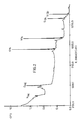
- Table 1 shows the ESCA spectrum of the annealed sample. According to the method of Peuckert and Greil (J. Mater. Sci. 22 (1987), 3717-3720), the values given in Table 1 can be calculated: Table 1 Calculation of the percentage of surface oxygen I O / I N d XPS [nm] BET [m2 / g] Ds [ ⁇ m] C O [% by weight] d s [nm] d XPS / d s [%] 0.705 0.655 4.0 0.47 0.45 0.920 71 The percentage of surface oxygen, based on the total amount of oxygen, is then 71%.
- An amorphous Si3N4 intermediate is produced by reacting SiCl4 with NH3 in the gas phase and subsequent dechlorination.
- This intermediate product has a BET of 135 m2 / g.
- 3 kg of this amorphous preliminary product are placed in a crystallization boat and then crystallized at a temperature of 1500 ° C. for 2 hours.
- the moisture content of the atmosphere during handling is less than 5 ppm.
- the crystalline product has an oxygen content of 0.27% by weight.
- Table 2 Calculation of the percentage of surface oxygen I O / I N d XPS [nm] BET [m2 / g] Ds [ ⁇ m] C O [% by weight] d s [nm] d XPS / d s [%] 0.537 0.528 13.3 0.142 1.2 0.746 71 The percentage of surface oxygen, based on the total amount of oxygen, is then 71%.
Landscapes
- Chemical & Material Sciences (AREA)
- Organic Chemistry (AREA)
- Inorganic Chemistry (AREA)
- Ceramic Products (AREA)
- Silicon Compounds (AREA)
Abstract
Description
- Die vorliegende Erfindung betrifft Si₃N₄-Pulver mit einem Gesamtsauerstoffgehalt von kleiner als 1,8 Gew.-%, wobei der Anteil an Oberflächensauerstoffgehalt mehr als 65 % des Gesamtsauerstoffgehaltes beträgt sowie Verfahren zur Herstellung dieser Pulver.
- Siliciumnitridpulver weisen alle einen gewissen Gehalt an Sauerstoff auf. Je nach Anwendungsbereich beträgt der Sauerstoffgehalt zwischen ca. 0,8 und 2,5 Gew.-%. Obwohl der Sauerstoff eigentlich eine Verunreinigung des Pulvers darstellt, wird er doch in begrenztem Umfang als notwendig angesehen, um die Sinteraktivität des Siliciumnitridpulvers zu verbessern (G.Ziegler, J.Heinrich, G.Wötting, J. Mater Sci. 22 (1987), 3041-86).
- Üblicherweise werden dem Siliciumnitridpulver Sinteradditive zugesetzt, die zusammen mit dem im Pulver vorliegenden Sauerstoff bei der Sintertemperatur flüssige Phasen bilden und erst eine Verdichtung des Materials ermöglichen. Der Sauerstoffgehalt im Siliciumnitridpulver sollte jedoch nicht zu hoch sein, da ein hoher Sauerstoffgehalt die Glastemperatur der bei der Sinterung gebildeten Sekundärphasen erniedrigt und damit die mechanischen Eigenschaften des daraus hergestellten Sinterformkörpers bei hohen Temperaturen verschlechtert. Insgesamt wird für die Gasdrucksinterung ein Sauerstoffgehalt von ca. 1,5 Gew.-% als optimal betrachtet. Zum heißisostatischen Pressen kann der Sauerstoffgehalt jedoch auch niedriger liegen. Grenzwerte für den zum heißisostatischen Pressen notwendigen Sauerstoff sind nicht bekannt.
- In J. Mater. Sci. 22 (1987), 3717-3720, wird die Sauerstoffverteilung in kommerziellen Si₃N₄-Pulvern mit ESCA (Electron Spectroscopy for Chemical Analysis) beschrieben. Es wird ausgeführt, daß der Sauerstoffgehalt im Teilcheninneren reduziert werden sollte. Bei einem gewünschten Gesamtsauerstoffgehalt von 1,5 Gew.-% bedeutet das eine Anreicherung des Sauerstoffs an der Teilchenoberfläche. Nach obengenannter Literatur ist die Sauerstoffverteilung zwischen Teilcheninnerem und der Teilchenoberfläche stark vom Herstellungsverfahren abhängig. Si₃N₄-Pulver, die durch Nitridierung von Silicium oder reduktive Nitridierung von SiO₂ hergestellt wurden, zeigen nur eine geringe Anreicherung von Sauerstoff an der Pulveroberfläche. Der Anteil an Oberflächensauerstoff liegt zwischen 17 % und 58 % des Gesamtsauerstoffgehaltes. Bei dem durch Gasphasenreaktion von SiCl₄ und NH₃ bei Raumtemperatur hergestellten Pulvers (Toyo Soda TS 7) liegt der Oberflächensauerstoffgehalt schon bei 60 %. Noch höher ist die Sauerstoffanreicherung an der Oberfläche mit 83 % bei dem Si₃N₄-Pulver, das durch Flüssigphasenreaktion zwischen SiCl₄ und NH₃ und anschließende thermische Zersetzung des Diimids erhalten wurde (Ube E 10). Dieses Pulver weist aber einen naßchemisch bestimmten Gesamtfluorgehalt von über 35 ppm auf. Bei ESCA-Untersuchungen beträgt der Fluorgehalt an der Pulveroberfläche ca. 0,3 At.-%. Fluor verschlechtert jedoch die Hochtemperaturfestigkeit der aus dem Pulver gesinterten Teile, da Fluor ebenso wie Sauerstoff die Glastemperatur der Sekundärphasen beeinflußt (L.A.G.Hermansson, M.Burström, T.Johansson, M.E.Hatcher, J. Amer. Ceram. Soc. 71 (4) (1988), C183-184).
- Abgesehen vom generellen Pulverherstellungsverfahren gibt es mehrere Aufbereitungswege, mit denen der Sauerstoffgehalt an der Pulveroberfläche eingestellt werden kann. Zum einen kann das Pulver durch Glühen bei Temperaturen über 500°C an Luft anoxidiert werden (C.Greskovich, J.A.Palm, Am. Ceram. Soc. Bull. 59(11) (1980), 1155). Die Oxidation setzt an der Pulveroberfläche ein, wodurch der Oberflächensauerstoffgehalt erhöht werden kann. Dies führt jedoch zu einer Erhöhung des Sauerstoffgehaltes auf über 1,8 Gew.-% und damit, wie oben beschrieben, zu einer Verschlechterung der Hochtemperatureigenschaften. Denselben Nachteil hat das Verfahren, den Oberflächensauerstoffgehalt durch Hydrolyse zu erhöhen. Bei der Mahlung von kommerziellem Si₃N₄-Pulver mit niedrigem Oberflächensauerstoffgehalt in Wasser oder in Alkohol wird zwar durch die Hydrolyse eine sauer stoffreiche Oberflächenschicht gebildet, gleichzeitig jedoch der Gesamtsauerstoffgehalt auf einen Wert über 1,8 Gew.-% erhöht.
- Geht man von Pulvern mit einer stark sauerstoffhaltigen Oberfläche aus, die z.B. durch Mahlung in Wasser hergestellt wurden, lassen sich daraus durch Laugung mit HF die Gesamtsauerstoffgehalte erniedrigen. Durch Optimierung kann man zu einem Pulver mit einem hohen Oberflächensauerstoffgehalt bei einem Gesamtsauerstoffgehalt von kleiner als 1,8 Gew.-% gelangen. Dieses Verfahren hat jedoch den Nachteil, daß Spuren von Fluoridionen im Pulver zurückbleiben, die dem Verfahren entsprechend an der Pulveroberfläche angereichert sind. Diese Spuren können nicht durch Waschen entfernt werden.
- Aufgabe dieser Erfindung ist es nunmehr, Si₃N₄-Pulver zur Verfügung zu stellen, die die beschriebenen Nachteile des Standes der Technik nicht aufweisen.
- Es wurde nun gefunden, daß es möglich ist, Siliciumnitridpulver bereitzustellen, bei denen der Oberflächensauerstoffgehalt auf einen hohen Wert angereichert ist, ohne daß gleichzeitig der Gesamtsauerstoffgehalt über 1,8 Gew.-% ansteigt und ohne daß störende Fluoridionen in der Hülle vorliegen. Diese Si₃N₄-Pulver weisen einen Gesamtsauerstoffgehalt von kleiner als 1,8 Gew.-% auf, wobei der Anteil an Oberflächensauerstoffgehalt mehr als 65 % des Gesamtsauerstoffgehaltes beträgt, ihr Fluorgehalt ist kleiner als 35 ppm. Diese Si₃N₄-Pulver sind Gegenstand dieser Erfindung. Besonders bevorzugt sind die erfindungsgemäßen Si₃N₄-Pulver, bei denen der Fluorgehalt an der Oberfläche des Si₃N₄-Pulvers kleiner als 0,1 At.-% beträgt.
- Zu diesen erfindungsgemäßen Si₃N₄-Pulvern kann man gelangen, wenn man von einem Pulver ausgeht, welches einen extrem geringen Gesamtsauerstoffgehalt aufweist. Solche Pulver sowie Verfahren zu deren Herstellung sind Gegenstand der gleichzeitig entnommenen deutschen Patentanmeldung P 3 829 503 . Die dafür eingesetzten Si₃N₄-Ausgangspulver sollten einen Sauerstoffgehalt von weniger oder gleich 0,4 Gew.-% aufweisen.
- Gegenstand dieser Erfindung sind auch Verfahren zur Herstellung der erfindungsgemäßen Si₃N₄-Pulver. Ein mögliches erfindungsgemäßes Verfahren ist dadurch gekennzeichnet, daß Si₃N₄-Pulver mit einem Gesamtsauerstoffgehalt von kleiner oder gleich 0,4 Gew.-% bei Temperaturen von 700°C bis 1200°C und Zeiten zwischen 15 Min. und 90 Min. in sauerstoffhaltiger Atmosphäre geglüht wird. Liegt der Gesamtsauerstoffgehalt höher als 0,4 Gew.-%, sind die nachfolgenden Schritte nur noch unter erheblichem technischen Aufwand so kontrollierbar, daß der geforderte Endsauerstoffgehalt 1,8 Gew.-% nicht mehr übersteigt, insbesondere wenn es sich um sehr feinteilige und damit reaktive Pulver handelt.
- Da Siliciumnitrid thermodynamisch instabil gegenüber Siliciumdioxid ist, war zu erwarten, daß gerade Siliciumnitridpulver mit einem geringen Sauerstoffgehalt sehr leicht oxidiert und hydrolysiert werden können, bis eine Passivierungsschicht die Reaktion nach einiger Zeit etwas hemmt. Überraschenderweise wurde jedoch gefunden, daß Pulver mit einem Gesamtsauerstoffgehalt von kleiner oder gleich 0,4 Gew.-% gegenüber Oxidation und Hydrolysereaktionen sehr träge reagieren, so daß man bei ihnen auf technisch einfache Weise den Sauerstoffgehalt an der Oberfläche definiert anreichern kann. Sind beim erfindungsgemäßen Verfahren die Zeiten zu kurz bzw. die Temperaturen zu niedrig, ist die Anreicherung an Oberflächensauerstoff zu gering. Sind die Zeiten zu lang bzw. die Temperaturen zu hoch, kann der Sauerstoffgehalt auf über 1,8 Gew.-% ansteigen. Je nach Sauerstoffgehalt des Ausgangsmaterials müssen daher Zeit und Temperatur optimiert werden, um zu dem gewünschten Si₃N₄-Pulver zu gelangen, bei dem bei einem Gesamtsauerstoffgehalt von kleiner als 1,8 Gew.-% der Anteil an Oberflächensauerstoff mehr als 65 % des Gesamtsauerstoffgehaltes beträgt und gleichzeitig der Fluorgehalt kleiner als 35 ppm, insbesondere der Fluorgehalt an der Pulveroberfläche kleiner als 0,1 At.-% ist.
- In einer weiteren bevorzugten Ausführungsform läßt sich das erfindungsgemäße Pulver dadurch herstellen, daß man Si₃N₄-Pulver mit einem Sauerstoffgehalt von kleiner oder gleich 0,4 Gew.-% in Wasser und/oder Alkoholen zwischen 15 Min. und 120 Min. mahlt. Üblicherweise werden Si₃N₄-Pulver nicht in Wasser, sondern in organischen Lösungsmitteln gemahlen, da sonst der Sauerstoffgehalt auf einen zu hohen Wert ansteigt (B. Hoffmann, Keramische zeitschrift 40(2) (1988), 90-96). Geht man jedoch von den Pulvern mit sehr niedrigem Sauerstoffgehalt aus, läßt sich durch Optimierung der Mahldauer ein definierter Sauerstoffgehalt an der Pulveroberfläche einstellen, ohne daß der Gesamtsauerstoffgehalt auf über 1,8 Gew.-% ansteigt.
- Die spezifische Oberfläche BET der erfindungsgemäßen Pulver wird nach DIN 66131, Stickstoff 1-Punkt-Adsorptionsmethode bestimmt.
- Der Gesamtsauerstoffgehalt der Si₃N₄-Pulver wird nach der Methode der Heißextraktion im inerten Trägergasstrom ermittelt. Dabei wird eine Si₃N₄-Probe in einen Graphittiegel eingewogen und in einem Heliumstrom auf über 1800°C erhitzt. Der in der Probe enthaltene Sauerstoff wird dabei zu CO umgesetzt, das mit Hilfe einer IR-Meßzelle quantitativ bestimmt wird.
- Zur Bestimmung des Gesamtfluorgehaltes werden die Pulverproben in einer alkalischen Schmelze aufgeschlossen. Das gebildete Fluorid wird in einer Wasserdampfdestillationsapparatur abdestilliert und der Fluorid-Gehalt quantitativ mit einer Fluoridionen-sensitiven Elektrode gemessen.
- Der Fluorgehalt an der Pulveroberfläche läßt sich über ESCA aus der Peakintensität des F 1 s-Peaks, dividiert durch den atomaren Empfindlichkeitsfaktor für Fluor, quantitativ ermitteln (Practical Surface Analysis by Anger and X-ray Photo-Electron-Spectroscopy; Ed. D. Briggs, M. P. Seak, Willy and Sons, New York (1983)).
- Der Anteil an Oberflächensauerstoff im Verhältnis zum Gesamtsauerstoff wird nach dem von Peuckert und Greil (J. Mater. Sci. 22 (1987), 3717-3720) beschriebenen Ver fahren mit ESCA bestimmt. Dabei werden mit ESCA die mit den atomaren Empfindlichkeitsfaktoren korrigierten Peakintensitäten des O 1 s und des N 1 s-Peaks (IN bzw. IO) gemessen, durch IN⁰ bzw IO⁰ (theoretische Signalintensitäten, die sich bei reinem SiO₂ bzw. Si₃N₄ ergeben würden; IN⁰ /IO⁰ wurde zu 1,03 berechnet) dividiert und daraus die ESCA-Oxidschichtdicke dXPS über folgende Formel bestimmt:


- Aus dem mittleren Teilchendurchmesser Ds und dem Gesamtsauerstoffgehalt CO (Gew.-%) läßt sich eine fiktive Oberflächensauerstoffschicht ds bestimmen, die sich ergeben würde, wenn der gesamte Sauerstoff an der Pulveroberfläche gebunden wäre:

- Der prozentuale Anteil des Oberflächensauerstoffs, bezogen auf den Gesamtanteil des Sauerstoffs, läßt sich bestimmen, indem man das prozentuale Verhältnis von dXPS und ds bildet.
- Die erfindungsgemäßen Si₃N₄-Pulver und Herstellungsverfahren sollen im folgenden anhand von Beispielen näher erläutert werden, ohne daß darin eine Einschränkung zu sehen ist.
- 12,3 g Si₃N₄-Pulver mit einem Gesamtsauerstoffgehalt von 0,22 Gew.-%, welches entsprechend dem Beispiel 2 der Patentanmeldung P 3 829 503 erhalten wurde, wird in einem Röhrenofen unter Luft eine Stunde lang bei 1000°C geglüht. Die Gewichtszunahme ist dabei kleiner als 0,1 g. Die spezifische Oberfläche BET des geglühten Pulvers beträgt 4,0 m²/g. Nach der Heißextraktionsmethode wird der Gesamtsauerstoffgehalt zu 0,45 Gew.-% bestimmt. Der Fluorgehalt liegt unter 10 ppm. An der Pulveroberfläche ist mit ESCA kein Fluor nachweisbar (Nachweisgrenze ca. 0,1 At.-%.).
- In Fig. 1 ist das ESCA-Spektrum der geglühten Probe dargestellt. Nach dem Verfahren von Peuckert und Greil (J. Mater. Sci. 22 (1987), 3717-3720) lassen sich daraus die in der Tabelle 1 angegebenen Werte berechnen:
Tabelle 1 Berechnung des prozentualen Anteils an Oberflächensauerstoff IO/IN dXPS [nm] BET [m² /g] Ds [µm] CO [Gew.-%] ds [nm] dXPS/ds [%] 0,705 0,655 4,0 0,47 0,45 0,920 71 Der prozentuale Anteil des Oberflächensauerstoffs, bezogen auf den Gesamtanteil des Sauerstoffs, beträgt danach 71 %. - Durch Umsetzung von SiCl₄ mit NH₃ in der Gasphase und anschließender Entchlorierung wird ein amorphes Si₃N₄-Vorprodukt hergestellt. Dieses Vorprodukt hat eine BET von 135 m²/g. Innerhalb einer Zeit von 60 Min. werden 3 kg dieses amorphen Vorprodukts in ein Kristallisationsschiffchen gefüllt und anschließend 2 h lang bei einer Temperatur von 1500°C kristallisiert. Der Feuchtigkeitsgehalt der Atmosphäre bei der Handhabung liegt niedriger als 5 ppm. Das kristalline Produkt hat einen Sauerstoffgehalt von 0,27 Gew.-%.
- 700 g dieses Si₃N₄-Pulvers werden mit Stahlkugeln 70 Min. in 900 ml Wasser gemahlen. Der Eisenabrieb wird entfernt und das Pulver getrocknet. Die spezifische Oberfläche BET des gemahlenen Pulvers beträgt 13,3 m²/g. Der Gesamtsauerstoffgehalt wird zu 1,2 Gew.-% bestimmt. Der Gesamtfluorgehalt liegt unter 10 ppm. Mit ESCA ist an der Pulveroberfläche kein Fluor nachweisbar (Nachweisgrenze ca. 0,1 At.-%.).
- In Fig. 2 ist das ESCA-Spektrum der gemahlenen Probe dargestellt.
- Nach dem Verfahren von Peuckert und Greil lassen sich die in Tabelle 2 angegebenen Werte ermitteln:
Tabelle 2 Berechnung des prozentualen Anteils an Oberflächensauerstoff IO/IN dXPS [nm] BET [m² /g] Ds [µm] CO [Gew.-%] ds [nm] dXPS/ds [%] 0,537 0,528 13,3 0,142 1,2 0,746 71 Der prozentuale Anteil des Oberflächensauerstoffs, bezogen auf den Gesamtanteil des Sauerstoffs, beträgt danach 71 %.
Claims (4)
Applications Claiming Priority (2)
| Application Number | Priority Date | Filing Date | Title |
|---|---|---|---|
| DE3829504A DE3829504A1 (de) | 1988-08-31 | 1988-08-31 | Siliciumnitridpulver mit verbesserten oberflaecheneigenschaften sowie verfahren zu deren herstellung |
| DE3829504 | 1988-08-31 |
Publications (2)
| Publication Number | Publication Date |
|---|---|
| EP0361061A1 true EP0361061A1 (de) | 1990-04-04 |
| EP0361061B1 EP0361061B1 (de) | 1992-04-08 |
Family
ID=6361959
Family Applications (1)
| Application Number | Title | Priority Date | Filing Date |
|---|---|---|---|
| EP89115213A Expired - Lifetime EP0361061B1 (de) | 1988-08-31 | 1989-08-18 | Siliciumnitridpulver mit verbesserten Oberflächeneigenschaften sowie Verfahren zu deren Herstellung |
Country Status (5)
| Country | Link |
|---|---|
| US (1) | US5030434A (de) |
| EP (1) | EP0361061B1 (de) |
| JP (1) | JPH0637285B2 (de) |
| DE (2) | DE3829504A1 (de) |
| NO (1) | NO893295L (de) |
Cited By (4)
| Publication number | Priority date | Publication date | Assignee | Title |
|---|---|---|---|---|
| EP0511489A1 (de) * | 1991-04-27 | 1992-11-04 | Hoechst Aktiengesellschaft | Verfahren zur Herstellung von Siliciumnitrid mit kleiner Kristallitgrösse |
| EP0545169A3 (en) * | 1991-12-03 | 1993-09-01 | Bayer Ag | Silicon containing ceramic powders having a low fluorine content and process for the preparation thereof |
| EP0560005A1 (de) * | 1992-01-15 | 1993-09-15 | Bayer Ag | Verfahren zur Herstellung von Siliciumnitrid, Ausgangsverbindung hierfür sowie Verfahren zu dessen Herstellung |
| EP0618172A1 (de) * | 1993-03-30 | 1994-10-05 | Sumitomo Electric Industries, Ltd. | Siliziumnitridpulver und Verfahren zu seiner Herstellung |
Families Citing this family (9)
| Publication number | Priority date | Publication date | Assignee | Title |
|---|---|---|---|---|
| JPH0822730B2 (ja) * | 1989-11-06 | 1996-03-06 | 電気化学工業株式会社 | 窒化ケイ素粉末の製造方法 |
| DE69309515T2 (de) * | 1992-01-24 | 1997-11-06 | Sumitomo Electric Industries | Siliziumnitridpulver und Verfahren zu dessen Herstellung |
| JP3314554B2 (ja) * | 1993-12-10 | 2002-08-12 | 宇部興産株式会社 | 窒化珪素粉末及び窒化珪素含有水系スラリー |
| DE4405331C2 (de) * | 1994-02-21 | 1999-04-01 | Deutsch Zentr Luft & Raumfahrt | Verfahren zur Herstellung eines Keramikbauteils |
| JP2001080967A (ja) * | 1999-09-06 | 2001-03-27 | Sumitomo Electric Ind Ltd | Si3N4セラミックスとその製造用Si基組成物及びこれらの製造方法 |
| JP2009190699A (ja) * | 2008-02-18 | 2009-08-27 | Kanto Auto Works Ltd | ベルトモール取付構造 |
| US20160159648A1 (en) * | 2013-07-11 | 2016-06-09 | Ube Industries, Ltd. | Silicon nitride powder for mold release agent of casting mold for casting polycrystalline silicon ingot and method for manufacturing said silicon nitride powder, slurry containing said silicon nitride powder, casting mold for casting polycrystalline silicon ingot and method for manufacturing same, and method for manufacturing polycrystalline silicon ingot using said casting mold |
| TW202140407A (zh) * | 2020-03-30 | 2021-11-01 | 日商電化股份有限公司 | 氮化矽粉末、以及氮化矽燒結體之製造方法 |
| WO2021200814A1 (ja) * | 2020-03-30 | 2021-10-07 | デンカ株式会社 | 窒化ケイ素粉末、及び窒化ケイ素焼結体の製造方法 |
Citations (1)
| Publication number | Priority date | Publication date | Assignee | Title |
|---|---|---|---|---|
| EP0251322A2 (de) * | 1986-07-02 | 1988-01-07 | Nippon Kokan Kabushiki Kaisha | Verfahren zur Raffinierung von nicht-oxidischen Keramikpulvern |
Family Cites Families (8)
| Publication number | Priority date | Publication date | Assignee | Title |
|---|---|---|---|---|
| US4341874A (en) * | 1977-01-13 | 1982-07-27 | Tokyo Shibaura Electric Co., Ltd. | Si3 N4 Ceramic powder material and method for manufacturing the same |
| SE427650B (sv) * | 1977-01-13 | 1983-04-25 | Tokyo Shibaura Electric Co | Kiselnitridpulvermaterial samt sett att framstella detsamma |
| JPS60122708A (ja) * | 1983-12-07 | 1985-07-01 | Denki Kagaku Kogyo Kk | 窒化けい素粉末の製法 |
| JPS62143805A (ja) * | 1985-12-16 | 1987-06-27 | Toyo Soda Mfg Co Ltd | 窒化珪素粉末から塩素および/またはフツ素を除去する方法 |
| JPS62241876A (ja) * | 1986-03-28 | 1987-10-22 | 日本碍子株式会社 | 窒化珪素焼結体の製造法 |
| JPH01313308A (ja) * | 1988-06-09 | 1989-12-18 | Denki Kagaku Kogyo Kk | 易焼結性アルフア窒化ケイ素粉末 |
| DE3829502A1 (de) * | 1988-08-31 | 1990-03-01 | Bayer Ag | Siliciumnitridpulver mit niedrigem isoelektrischen punkt sowie verfahren zu deren herstellung |
| US5245242A (en) * | 1992-04-13 | 1993-09-14 | Rockwell International Corporation | Efficiency driver system for piezoelectrics |
-
1988
- 1988-08-31 DE DE3829504A patent/DE3829504A1/de not_active Withdrawn
-
1989
- 1989-08-16 NO NO89893295A patent/NO893295L/no unknown
- 1989-08-18 EP EP89115213A patent/EP0361061B1/de not_active Expired - Lifetime
- 1989-08-18 DE DE8989115213T patent/DE58901116D1/de not_active Expired - Lifetime
- 1989-08-29 JP JP1220486A patent/JPH0637285B2/ja not_active Expired - Lifetime
-
1990
- 1990-09-04 US US07/579,237 patent/US5030434A/en not_active Expired - Fee Related
Patent Citations (1)
| Publication number | Priority date | Publication date | Assignee | Title |
|---|---|---|---|---|
| EP0251322A2 (de) * | 1986-07-02 | 1988-01-07 | Nippon Kokan Kabushiki Kaisha | Verfahren zur Raffinierung von nicht-oxidischen Keramikpulvern |
Non-Patent Citations (5)
| Title |
|---|
| AM. CERAM. SOC. BULL., Band 58, Nr. 11, 1980, Seiten 1155-1156, Columbus, Ohio, US; C. GRESKOVICH et al.: "Controlling the oxygen content of Si3N4 powders" * |
| CHEMICAL ABSTRACTS, Band 107, Nr. 14, 5. Oktober 1987, Seite 130, Zusammenfassung Nr. 117860z, Columbus, Ohio, US; & JP-A-62 143 805 (TOYO SODA Mfg. CO., LTD) 27-06-1987 * |
| JOURNAL OF MATERIALS SCIENCE, Band 22, 1987, Seiten 3717-3720, Chapman and Hall Ltd, London, GB; M. PEUCKERT et al.: "Oxygen distribution in silicon nitride powders" * |
| JOURNAL OF THE AMERICAN CERAMIC SOCIETY, Band 71, Nr. 4, April 1988, Seiten C-183 - C-184; L.A.G. HERMANSSON et al.: "High-temperature behavior of chemically treated silicon nitride powders" * |
| KERAMISCHE ZEITSCHRIFT, Band 40, Nr. 2, Februar 1988, Seiten 90-96, Freiburg, DE; B. HOFFMANN: "Probleme der Feinstpulverherstellung für Mechanokeramik durch mechanische Aufbereitung" * |
Cited By (6)
| Publication number | Priority date | Publication date | Assignee | Title |
|---|---|---|---|---|
| EP0511489A1 (de) * | 1991-04-27 | 1992-11-04 | Hoechst Aktiengesellschaft | Verfahren zur Herstellung von Siliciumnitrid mit kleiner Kristallitgrösse |
| EP0545169A3 (en) * | 1991-12-03 | 1993-09-01 | Bayer Ag | Silicon containing ceramic powders having a low fluorine content and process for the preparation thereof |
| EP0560005A1 (de) * | 1992-01-15 | 1993-09-15 | Bayer Ag | Verfahren zur Herstellung von Siliciumnitrid, Ausgangsverbindung hierfür sowie Verfahren zu dessen Herstellung |
| US5340561A (en) * | 1992-01-15 | 1994-08-23 | Bayer Ag | Process fo the production of Si2 N4 using a silicon, phosphorous and nitrogen containing precursor |
| EP0618172A1 (de) * | 1993-03-30 | 1994-10-05 | Sumitomo Electric Industries, Ltd. | Siliziumnitridpulver und Verfahren zu seiner Herstellung |
| US5478649A (en) * | 1993-03-30 | 1995-12-26 | Sumitomo Electric Industries, Ltd. | Silicon nitride powder and method for producing the same |
Also Published As
| Publication number | Publication date |
|---|---|
| JPH02107509A (ja) | 1990-04-19 |
| DE3829504A1 (de) | 1990-03-01 |
| US5030434A (en) | 1991-07-09 |
| NO893295D0 (no) | 1989-08-16 |
| JPH0637285B2 (ja) | 1994-05-18 |
| EP0361061B1 (de) | 1992-04-08 |
| NO893295L (no) | 1990-03-01 |
| DE58901116D1 (de) | 1992-05-14 |
Similar Documents
| Publication | Publication Date | Title |
|---|---|---|
| EP0361061B1 (de) | Siliciumnitridpulver mit verbesserten Oberflächeneigenschaften sowie Verfahren zu deren Herstellung | |
| DE3017782C2 (de) | Verfahren zur Herstellung von sinterfähigen Legierungspulvern auf der Basis von Titan | |
| DE2940629C2 (de) | ||
| DE2751998A1 (de) | Verfahren zur herstellung von polykristallinen dichten formkoerpern aus borcarbid durch drucklose sinterung | |
| EP0402687B1 (de) | Nioboxidpulver (Nb205) sowie Verfahren zu dessen Herstellung | |
| EP0047540B1 (de) | Verfahren zur Herstellung eines V2O5 und Alkalisulfat enthaltenden Katalysators | |
| DE4102426C2 (de) | Verfahren zur Herstellung eines gesinterten Siliciumcarbid- und Siliciumnitrid-Basiskörpers | |
| DE2854200B1 (de) | Verfahren zur Herstellung von Zirkonoxid aus technischem Calciumzirkonat | |
| DE3531790A1 (de) | Verfahren zur herstellung de (beta)-form von si(pfeil abwaerts)3(pfeil abwaerts)n(pfeil abwaerts)4(pfeil abwaerts) | |
| DE69218495T2 (de) | Zirconiumoxydpulver und Verfahren zu seiner Herstellung | |
| EP0019174A2 (de) | Verfahren zur Herstellung eines Katalysators für die Oxidation von Schwefeldioxid | |
| DE2848452C3 (de) | Verfahren zur Herstellung von hochreinem, borhaltigem β -Siliziumcarbid und dessen Verwendung zur Herstellung von Sinterkörpern | |
| DE3685806T2 (de) | Herstellung von gesinterten siliziumnitridformkoerpern. | |
| EP0358975B1 (de) | Siliciumnitridpulver mit geringem Sauerstoffgehalt | |
| DE3780659T2 (de) | Herstellung eines gesinterten siliziumnitridformkoerpers. | |
| DE2351163C3 (de) | Verfahren zur Herstellung eines heißgepreßten Siliziumnitrid- und/oder Siliziumoxinitrid-Formkörpers | |
| DE3910161A1 (de) | Verfahren zur herstellung von nitridkeramischen formstuecken | |
| DE3829502A1 (de) | Siliciumnitridpulver mit niedrigem isoelektrischen punkt sowie verfahren zu deren herstellung | |
| DE3709137C2 (de) | ||
| DE69128709T2 (de) | Aluminiumnitrid-sinterkörper und seine herstellung | |
| EP0507165B1 (de) | Verfahren zur Herstellung chloridarmer, wässriger Titanylnitratlösungen | |
| DE1558398C3 (de) | Verfahren zur Hef stellung von Tantalmetallpulver | |
| DE1280121B (de) | Verfahren zur wahlweisen Herstellung eines keramischen Dielektriums oder eines Halbleiterwiderstandes mit positivem Temperaturkoeffizienten | |
| DE3742667C2 (de) | ||
| DE69111537T2 (de) | Verfahren zur Wärmebehandlung eines Sinterkörpers aus Siliziumnitrid. |
Legal Events
| Date | Code | Title | Description |
|---|---|---|---|
| PUAI | Public reference made under article 153(3) epc to a published international application that has entered the european phase |
Free format text: ORIGINAL CODE: 0009012 |
|
| 17P | Request for examination filed |
Effective date: 19890818 |
|
| AK | Designated contracting states |
Kind code of ref document: A1 Designated state(s): DE FR GB IT SE |
|
| 17Q | First examination report despatched |
Effective date: 19910917 |
|
| GRAA | (expected) grant |
Free format text: ORIGINAL CODE: 0009210 |
|
| AK | Designated contracting states |
Kind code of ref document: B1 Designated state(s): DE FR GB IT SE |
|
| ITF | It: translation for a ep patent filed | ||
| REF | Corresponds to: |
Ref document number: 58901116 Country of ref document: DE Date of ref document: 19920514 |
|
| ET | Fr: translation filed | ||
| GBT | Gb: translation of ep patent filed (gb section 77(6)(a)/1977) | ||
| PLBE | No opposition filed within time limit |
Free format text: ORIGINAL CODE: 0009261 |
|
| STAA | Information on the status of an ep patent application or granted ep patent |
Free format text: STATUS: NO OPPOSITION FILED WITHIN TIME LIMIT |
|
| 26N | No opposition filed | ||
| EAL | Se: european patent in force in sweden |
Ref document number: 89115213.4 |
|
| PGFP | Annual fee paid to national office [announced via postgrant information from national office to epo] |
Ref country code: DE Payment date: 19990716 Year of fee payment: 11 |
|
| PGFP | Annual fee paid to national office [announced via postgrant information from national office to epo] |
Ref country code: SE Payment date: 19990726 Year of fee payment: 11 |
|
| PGFP | Annual fee paid to national office [announced via postgrant information from national office to epo] |
Ref country code: GB Payment date: 19990818 Year of fee payment: 11 |
|
| PGFP | Annual fee paid to national office [announced via postgrant information from national office to epo] |
Ref country code: FR Payment date: 19990831 Year of fee payment: 11 |
|
| PG25 | Lapsed in a contracting state [announced via postgrant information from national office to epo] |
Ref country code: GB Free format text: LAPSE BECAUSE OF NON-PAYMENT OF DUE FEES Effective date: 20000818 |
|
| PG25 | Lapsed in a contracting state [announced via postgrant information from national office to epo] |
Ref country code: SE Free format text: LAPSE BECAUSE OF NON-PAYMENT OF DUE FEES Effective date: 20000819 |
|
| GBPC | Gb: european patent ceased through non-payment of renewal fee |
Effective date: 20000818 |
|
| EUG | Se: european patent has lapsed |
Ref document number: 89115213.4 |
|
| PG25 | Lapsed in a contracting state [announced via postgrant information from national office to epo] |
Ref country code: FR Free format text: LAPSE BECAUSE OF NON-PAYMENT OF DUE FEES Effective date: 20010430 |
|
| PG25 | Lapsed in a contracting state [announced via postgrant information from national office to epo] |
Ref country code: DE Free format text: LAPSE BECAUSE OF NON-PAYMENT OF DUE FEES Effective date: 20010501 |
|
| REG | Reference to a national code |
Ref country code: FR Ref legal event code: ST |
|
| PG25 | Lapsed in a contracting state [announced via postgrant information from national office to epo] |
Ref country code: IT Free format text: LAPSE BECAUSE OF NON-PAYMENT OF DUE FEES;WARNING: LAPSES OF ITALIAN PATENTS WITH EFFECTIVE DATE BEFORE 2007 MAY HAVE OCCURRED AT ANY TIME BEFORE 2007. THE CORRECT EFFECTIVE DATE MAY BE DIFFERENT FROM THE ONE RECORDED. Effective date: 20050818 |