EP0361119B1 - Verfahren zur Herstellung von Benzophenonen - Google Patents
Verfahren zur Herstellung von Benzophenonen Download PDFInfo
- Publication number
- EP0361119B1 EP0361119B1 EP89116071A EP89116071A EP0361119B1 EP 0361119 B1 EP0361119 B1 EP 0361119B1 EP 89116071 A EP89116071 A EP 89116071A EP 89116071 A EP89116071 A EP 89116071A EP 0361119 B1 EP0361119 B1 EP 0361119B1
- Authority
- EP
- European Patent Office
- Prior art keywords
- reaction
- boron trifluoride
- formula
- nitrobenzene
- benzophenones
- Prior art date
- Legal status (The legal status is an assumption and is not a legal conclusion. Google has not performed a legal analysis and makes no representation as to the accuracy of the status listed.)
- Expired - Lifetime
Links
Classifications
-
- C—CHEMISTRY; METALLURGY
- C07—ORGANIC CHEMISTRY
- C07C—ACYCLIC OR CARBOCYCLIC COMPOUNDS
- C07C45/00—Preparation of compounds having >C = O groups bound only to carbon or hydrogen atoms; Preparation of chelates of such compounds
- C07C45/45—Preparation of compounds having >C = O groups bound only to carbon or hydrogen atoms; Preparation of chelates of such compounds by condensation
- C07C45/46—Friedel-Crafts reactions
-
- C—CHEMISTRY; METALLURGY
- C07—ORGANIC CHEMISTRY
- C07C—ACYCLIC OR CARBOCYCLIC COMPOUNDS
- C07C49/00—Ketones; Ketenes; Dimeric ketenes; Ketonic chelates
- C07C49/76—Ketones containing a keto group bound to a six-membered aromatic ring
- C07C49/82—Ketones containing a keto group bound to a six-membered aromatic ring containing hydroxy groups
- C07C49/83—Ketones containing a keto group bound to a six-membered aromatic ring containing hydroxy groups polycyclic
-
- C—CHEMISTRY; METALLURGY
- C07—ORGANIC CHEMISTRY
- C07C—ACYCLIC OR CARBOCYCLIC COMPOUNDS
- C07C49/00—Ketones; Ketenes; Dimeric ketenes; Ketonic chelates
- C07C49/76—Ketones containing a keto group bound to a six-membered aromatic ring
- C07C49/84—Ketones containing a keto group bound to a six-membered aromatic ring containing ether groups, groups, groups, or groups
Definitions
- the present invention relates to a new process for the preparation of benzophenones by reacting benzoic acids and aromatics from the benzene series in the presence of boron trifluoride, the reaction being carried out in nitrobenzene as the reaction medium.
- FR-A-1 375 033 the production of benzophenones by reacting boron trifluoride complexes of the reactants in trichlorethylene as a diluent.
- the respective boron trifluoride complexes have to be prepared in a separate step.
- Trichlorethylene is also considered toxicologically unsafe.
- JP-A-190 943/1984 describes the use of chlorobenzene as a reaction medium.
- the low solubility of the boron trifluoride complexes of the reactants in this medium is disadvantageous. It leads to longer reaction times and poorer yields.
- EP-A-69 598 describes, inter alia, the preparation of a dihydroxybenzophenone by reacting 4-hydroxybenzoic acid with phenol in anhydrous hydrogen fluoride.
- the object of the present invention was to provide a new process for the preparation of benzophenones, in which boron trifluoride is also used as a catalyst, but in which the disadvantages mentioned above are avoided.
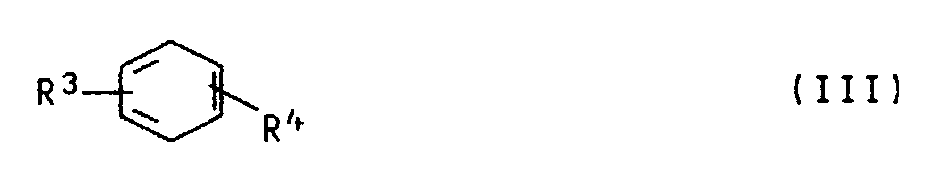
- Suitable aromatics of the formula III are, for example, resorcinol or hydroquinone.
- the process according to the invention is advantageously carried out in such a way that the benzoic acid of the formula II and the aromatics from the benzene series (formula III) are initially introduced into nitrobenzene and are gassed into this mixture, at room temperature, with boron trifluoride with stirring.
- the condensation reaction then follows, which is carried out with stirring at a temperature of 20 to 200 ° C., preferably 20 to 130 ° C. and in particular 50 to 90 ° C.
- the reaction is generally complete for 0.5 to 5 hours.
- the reaction mixture can e.g. subject to steam distillation to remove the nitrobenzene.
- the benzophenone of the formula I generally crystallizes out of the remaining aqueous mother liquor.
- the nitrobenzene removed by steam can be returned to the reaction after regeneration.
- a preferred working-up method is to extract the reaction mixture with water in a liquid-liquid extractor at elevated temperature, it being possible for the extraction to be carried out without pressure or under pressure.
- the extraction temperature is generally between 80 ° C and the boiling point of the water at the pressure used, preferably 90 to 100 ° C.
- the pressure at which the extraction is performed can can be set between 0.9 and 10 bar, normal pressure is preferred.
- the amount of water used for the extraction can be selected between 50 and 1000% by weight, based on the nitrobenzene used.
- the extraction can be carried out batchwise, but preferably continuously. A continuous procedure in which water is evaporated from the aqueous extract and then used again for extraction is particularly preferred.
- the aqueous extract is cooled and the target product is isolated by filtration. If necessary, valuable product can also be isolated from the cooled organic phase by filtration.
- the filtration of the aqueous phase can be carried out continuously or batchwise, regardless of the extraction.
- the molar ratio of benzoic acid II: aromatic III is usually 1: 0.5 to 1: 2.
- the amount of nitrobenzene as the reaction medium can be kept low. It is usually 100 to 250% by weight, based on the sum of the weight of benzoic acid II and aromatic III.
- the new process is also characterized by a short reaction time and low reaction temperature.
- the target products are generally of high purity and can therefore be used without further purification.
- the benzophenones produced by means of the process according to the invention which can be carried out both continuously and batchwise, are suitable as UV absorbers or as monomers for high-temperature-resistant polymers.
Landscapes
- Chemical & Material Sciences (AREA)
- Organic Chemistry (AREA)
- Chemical Kinetics & Catalysis (AREA)
- Organic Low-Molecular-Weight Compounds And Preparation Thereof (AREA)
Description
- Die vorliegende Erfindung betrifft ein neues Verfahren zur Herstellung von Benzophenonen durch Umsetzung von Benzoesäuren und Aromaten aus der Benzolreihe in Gegenwart von Bortrifluorid, wobei man die Umsetzung in Nitrobenzol als Reaktionsmedium durchführt.
- Die Verwendung von Bortrifluorid als aktivierendes Reagenz für die Kondensation von Carbonsäuren mit reaktiven Aromaten zu aromatischen Ketonen ist bekannt und beispielsweise in Chem. Ber. 66, 411 (1933) ; Chem. Ber. 87, 194 (1954); Archiv Pharm. 287, 210 (1954) oder Pharmazie 1954, 102, beschrieben. Üblicherweise wird dabei die Carbonsäure, gelegentlich aber auch deren Reaktionspartner, als Lösungsmittel verwendet. Dies ist bei wertvollen Reaktanden unwirtschaftlich und bedeutet außerdem bei Reaktionspartnern, die in festem Aggregatzustand vorliegen, daß die Reaktion in einer Schmelze durchgeführt werden muß, was einen erheblichen technischen Aufwand mit sich bringt.
- Um diese Nachteile zu vermeiden, wurde die Anwendung von Verdünnungsmitteln vorgeschlagen. So lehrt z.B. die FR-A-1 375 033 die Herstellung von Benzophenonen durch Umsetzung von Bortrifluorid-Komplexen der Reaktanden in Trichlorethylen als Verdünnungsmittel. Dabei müssen die jeweiligen Bortrifluorid-Komplexe aber in einer separaten Stufe hergestellt werden. Außerdem gilt Trichlorethylen als toxikologisch bedenklich.
- Die JP-A-190 943/1984 beschreibt die Verwendung von Chlorbenzol als Reaktionsmedium. Hierbei ist jedoch die geringe Löslichkeit der Bortrifluorid-Komplexe der Reaktionspartner in diesem Medium von Nachteil. Sie führt nämlich zu verlängerten Reaktionszeiten und schlechteren Ausbeuten.
- In der EP-A-69 598 wird unter anderem die Herstellung eines Dihydroxybenzophenons durch Umsetzung von 4-Hydroxybenzoesäure mit Phenol in wasserfreiem Fluorwasserstoff beschrieben.
- Aufgabe der vorliegenden Erfindung war es nun, ein neues Verfahren zur Herstellung von Benzophenonen bereitzustellen, bei dem ebenfalls Bortrifluorid als Katalysator verwendet wird, bei dem aber die obengenannten Nachteile vermieden werden.
- Es wurde nun gefunden, daß die Herstellung von Benzophenonen der Formel I

in der - R¹ und R²
- gleich oder verschieden sind und unabhängig voneinander jeweils Wasserstoff oder Hydroxy und
- R³ und R⁴
- jeweils Hydroxy bedeuten,
- Geeignete Aromaten der Formel III sind beispielsweise Resorcin oder Hydrochinon.
- Das erfindungsgemäße Verfahren wird zweckmäßig so durchgeführt, daß man die Benzoesäure der Formel II und den Aromaten aus der Benzolreihe (Formel III) in Nitrobenzol vorlegt und in dieses Gemisch üblicherweise bei Raumtemperatur, Bortrifluorid unter Rühren eingast. Dann folgt die Kondensationsreaktion, die unter Rühren bei einer Temperatur von 20 bis 200°C, vorzugsweise 20 bis 130°C und insbesondere 50 bis 90°C vorgenommen wird. Die Reaktion ist im allgemeinen 0,5 bis 5 Stunden beendet.
- Zur Aufarbeitung kann man das Reaktionsgemisch z.B. einer Wasserdampfdestillation unterwerfen, um das Nitrobenzol zu entfernen. Nach dem Abkühlen kristallisiert dabei das Benzophenon der Formel I in der Regel aus der verbleibenden wäßrigen Mutterlauge aus. Das mittels Wasserdampf entfernte Nitrobenzol kann nach Regenerierung wieder in die Reaktion zurückgeführt werden.
- Eine bevorzugte Aufarbeitungsmethode besteht darin, das Reaktionsgemisch in einem Flüssig-Flüssig-Extraktor bei erhöhter Temperatur mit Wasser zu extrahieren, wobei die Extraktion drucklos oder unter Druck durchgeführt werden kann. Die Extraktionstemperatur liegt im allgemeinen zwischen 80°C und dem Siedepunkt des Wassers beim angewandten Druck, vorzugsweise bei 90 bis 100°C. Der Druck, bei dem die Extraktion durchgeführt wird, kann zwischen 0,9 und 10 bar eingestellt werden, bevorzugt ist Normaldruck. Die Menge des zur Extraktion verwandten Wassers kann zwischen 50 und 1000 Gew.-%, bezogen auf das verwendete Nitrobenzol, gewählt werden. Die Extraktion kann diskontinuierlich, bevorzugt aber kontinuierlich durchgeführt werden. Besonders bevorzugt ist eine kontinuierliche Arbeitsweise, bei der Wasser aus dem wäßrigen Extrakt verdampft und anschließend erneut zur Extraktion verwandt wird.
- Zur Isolierung wird der wäßrige Extrakt abgekühlt und das Zielprodukt durch Filtration isoliert. Gegebenenfalls kann auch aus der abgekühlten organischen Phase Wertprodukt durch Filtrieren isoliert werden. Die Filtration der wäßrigen Phase kann, unabhängig von der Extraktion, kontinuierlich oder diskontinuierlich durchgeführt werden.
- Verglichen mit der Wasserdampfdestillation, ergibt die extraktive Aufarbeitung noch bessere Ausbeuten und eine noch bessere farbliche Qualität des Zielprodukts. Ein weiterer Vorteil besteht darin, daß weniger Wasser mit Nitrobenzol kontaminiert wird. Das ist von ökologischem Interesse.
- Im erfindungsgemäßen Verfahren verwendet man im allgemeinen pro Mol Benzoesäure II 1 bis 3 Mol Bortrifluorid.
- Das Molverhältnis Benzoesäure II: Aromat III beträgt in der Regel 1 : 0,5 bis 1 : 2.
- Aufgrund der ausgezeichneten Löslichkeit der Bortrifluorid-Komplexe der Reaktanden kann die Menge an Nitrobenzol als Reaktionsmedium gering gehalten werden. Sie beträgt üblicherweise 100 bis 250 Gew.-%, bezogen auf die Summe des Gewichts von Benzoesäure II und Aromat III.
- Das neue Verfahren zeichnet sich außerdem durch kurze Reaktionszeit und niedrige Reaktionstemperatur aus. Die Zielprodukte fallen im allgemeinen in hoher Reinheit an und können daher ohne weitere Reinigung weiterverwendet werden.
- Die mittels des erfindungsgemäßen Verfahrens, das sowohl in kontinuierlicher als auch diskontinuierlicher Arbeitsweise durchgeführt werden kann, hergestellten Benzophenone sind als UV-Absorber oder als Monomere für hochtemperaturfeste Polymere geeignet.
- Die folgenden Beispiele sollen die Erfindung näher erläutern.
- 27,5 g Resorcin und 30,5 g Benzoesäure wurden in 100 ml Nitrobenzol suspendiert. In diese Suspension wurden dann 34 g Bortrifluorid eingegast. Das Reaktionsgemisch wurde auf 80°C erwärmt und 30 Minuten bei dieser Temperatur gehalten. Nach dem Abkühlen wurde mit Wasserdampf destilliert. Das Zielprodukt 2,4-Dihydroxybenzophenon kristallisierte beim Abkühlen aus der Mutterlauge aus. Ausbeute: 51,2 g (96 %); Reinheit gemäß HPLC: 99,8 %.
- Die in der folgenden Tabelle aufgeführten Benzophenone wurden in analoger Weise erhalten.
Tabelle Beispiel Nr. Benzoesäure II Aromat III Benzophenon I Ausbeute [%] Reinheit gem. HPLC [%] 2 2,4-Dihydroxybenzoesäure Resorcin 2,2',4,4'-Tetrahydroxybenzophenon 59 98,5 3. 4-Hydroxybenzoesäure Hydrochinon 3',4,5'-Trihydroxybenzophenon 64 - 220 g Resorcin und 308 g 2,4-Dihydroxybenzoesäure wurden in 1 l Nitrobenzol suspendiert und bei 25 bis 40°C 138 g Bortrifluorid eingeleitet (schwach exotherme Reaktion). Das Reaktionsgemisch wurde für 30 Minuten auf 80°C erwärmt und anschließend in einen auf 98°C vorgewärmten, mit 1,5 l Wasser beschichteten, kontinuierlich betriebenen Flüssig-Flüssig-Extraktor gegeben. Aus dem Extrakt wurde Wasser destillativ zurückgeführt und erneut zur Extraktion verwendet. Nach 10 Stunden wurde die wäßrige Phase abgetrennt, abgekühlt und das auskristallisierte Produkt abgesaugt. Ausbeute: 315 g (64 %); Reinheit gemäß HPLC: 99,6 %.
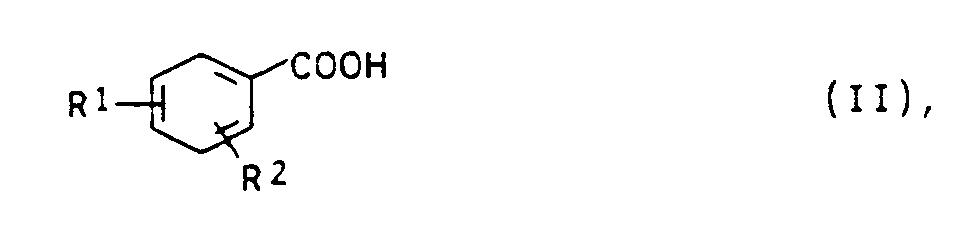
in der R¹ und R² jeweils die obengenannte Bedeutung besitzen, mit Aromaten aus der Benzolreihe, die der Formel III

entsprechen, worin R³ und R⁴ jeweils die obengenannte Bedeutung besitzen, in Gegenwart von Bortrifluorid als Katalysator vorteilhaft gelingt, wenn man die Umsetzung in Nitrobenzol als Reaktionsmedium durchführt.
Claims (3)
- Verfahren zur Herstellung von Benzophenonen der Formel I
 R¹ und R² gleich oder verschieden sind und unabhängig voneinander jeweils Wasserstoff oder Hydroxy undR³ und R⁴ jeweils Hydroxy bedeuten,durch Umsetzung von Benzoesäuren der Formel II
- Verfahren gemäß Anspruch 1, dadurch gekennzeichnet, daß man die Umsetzung bei einer Temperatur von 20 bis 200°C durchführt.
- Verfahren gemäß Anspruch 1, dadurch gekennzeichnet, daß man pro Mol Benzoesäure der Formel II 1 bis 3 Mol Bortrifluorid verwendet.
Applications Claiming Priority (2)
| Application Number | Priority Date | Filing Date | Title |
|---|---|---|---|
| DE3831092 | 1988-09-13 | ||
| DE3831092A DE3831092A1 (de) | 1988-09-13 | 1988-09-13 | Verfahren zur herstellung von benzophenonen |
Publications (2)
| Publication Number | Publication Date |
|---|---|
| EP0361119A1 EP0361119A1 (de) | 1990-04-04 |
| EP0361119B1 true EP0361119B1 (de) | 1993-10-27 |
Family
ID=6362847
Family Applications (1)
| Application Number | Title | Priority Date | Filing Date |
|---|---|---|---|
| EP89116071A Expired - Lifetime EP0361119B1 (de) | 1988-09-13 | 1989-08-31 | Verfahren zur Herstellung von Benzophenonen |
Country Status (3)
| Country | Link |
|---|---|
| US (1) | US4982005A (de) |
| EP (1) | EP0361119B1 (de) |
| DE (2) | DE3831092A1 (de) |
Families Citing this family (1)
| Publication number | Priority date | Publication date | Assignee | Title |
|---|---|---|---|---|
| US5118860A (en) * | 1990-11-27 | 1992-06-02 | Hoechst Celanese Corporation | Bf3 catalyzed acylation of aromatic compounds |
Family Cites Families (10)
| Publication number | Priority date | Publication date | Assignee | Title |
|---|---|---|---|---|
| FR375033A (fr) * | 1907-02-25 | 1907-06-28 | Gustave Rouze | Pince de fixation pour épingles de cravates |
| DE643433C (de) * | 1928-01-13 | 1937-04-08 | Arthur Lange | Schaltwerksgetriebe, insbesondere fuer Kraftfahrzeuge |
| FR1375033A (fr) * | 1963-05-22 | 1964-10-16 | Procédé de préparation de benzophénones substituées sur une ou plusieurs des positions 2, 2', 4, 4' | |
| US3403183A (en) * | 1966-12-16 | 1968-09-24 | Koppers Co Inc | Production of benzophenones |
| EP0057503B1 (de) * | 1981-02-04 | 1985-03-20 | Imperial Chemical Industries Plc | Verfahren zur Herstellung von Hydroxy-Arylophenonen |
| ATE10831T1 (de) * | 1981-07-08 | 1985-01-15 | Raychem Corporation | Herstellung von aromatischen ketonen. |
| JPS59190943A (ja) * | 1983-04-12 | 1984-10-29 | Shipuro Kasei Kk | ポリヒドロキシベンゾフエノン類の製造方法 |
| JPS6197240A (ja) * | 1984-10-16 | 1986-05-15 | Sankyo Kasei Kk | ポリハイドロキシベンゾフエノンの製造法 |
| DE3518668A1 (de) * | 1985-05-24 | 1986-11-27 | Rütgerswerke AG, 6000 Frankfurt | Verfahren zur acylierung von 2-alkylnaphthalinen |
| GB8603578D0 (en) * | 1986-02-13 | 1986-03-19 | Ici Plc | Aromatic ketone |
-
1988
- 1988-09-13 DE DE3831092A patent/DE3831092A1/de not_active Withdrawn
-
1989
- 1989-08-23 US US07/397,873 patent/US4982005A/en not_active Expired - Fee Related
- 1989-08-31 DE DE89116071T patent/DE58906016D1/de not_active Expired - Lifetime
- 1989-08-31 EP EP89116071A patent/EP0361119B1/de not_active Expired - Lifetime
Also Published As
| Publication number | Publication date |
|---|---|
| US4982005A (en) | 1991-01-01 |
| DE3831092A1 (de) | 1990-03-15 |
| EP0361119A1 (de) | 1990-04-04 |
| DE58906016D1 (de) | 1993-12-02 |
Similar Documents
| Publication | Publication Date | Title |
|---|---|---|
| EP0025843B1 (de) | Herstellung von Monoalkylethern von Hydroxyphenolen und deren Umwandlung zu Hydroxycumaranen | |
| EP0108374B1 (de) | Verfahren zur Herstellung von Hydroxy-phenoxy-alkancarbonsäuren | |
| AT402818B (de) | Verfahren zur herstellung von reinem 4,6-dichlorpyrimidin | |
| EP0029176B1 (de) | Verfahren zur Herstellung von Carbonsäure-Anhydriden | |
| DE2608932C2 (de) | Verfahren zur Herstellung von 3-Oxy-4H-pyran-4-on-Derivaten | |
| EP0498847B1 (de) | Verfahren zur herstellung von 1,4-bis-(4-hydroxybenzoyl)-benzol | |
| EP0398095B1 (de) | Verfahren zur Herstellung von Phosphorsäure-tris(2-chlor(iso)-propyl)estern | |
| DE2703640C2 (de) | ||
| EP0032374B1 (de) | Verfahren zur Herstellung von p-Hydroxyphenylessigsäure | |
| EP0647614B1 (de) | Verfahren zur Herstellung von 5-Fluoranthranilsäure | |
| EP0500639B1 (de) | Verfahren zur herstellung von alkyl-[3-chlorphenyl]-sulfonen | |
| EP0003052B1 (de) | Verfahren zur Herstellung von 4-Methyl-5-chlormethylimidazol | |
| DE2653601A1 (de) | Perfluoralkylgruppen enthaltende hydroxyketone | |
| EP0497210B1 (de) | Verfahren zur Herstellung von Dialkylaminopropandiol | |
| EP0017832B1 (de) | Verfahren zur Herstellung von 5-Brom-5-nitro-1,3-dioxan | |
| EP0806405A1 (de) | Verfahren zur Herstellung von Hexahydrofarnesylaceton aus 6.7-Dihydro-geraniol sowie neue Zwischenprodukte für dieses Verfahren | |
| EP0381045A2 (de) | Verfahren zur Herstellung von Bis-(4-chlorphenyl)-sulfon | |
| CH630882A5 (de) | Verfahren zur herstellung von diprenyl-acyl-phloroglucinen und anwendung derselben zur herstellung von humulonen. | |
| EP0174624A1 (de) | Verfahren zur Herstellung von Milchsäureestern | |
| DE69206216T2 (de) | Verfahren zur Herstellung von 2-Methyl-1,3-Cyclohexandion und 2-Methylresorcinol. | |
| EP0361119A1 (de) | Verfahren zur Herstellung von Benzophenonen | |
| DE69011996T2 (de) | Verfahren zur Herstellung von 1,4-Dihydroxy-2-arylnaphthoat. | |
| DE2508512A1 (de) | Verfahren zur herstellung von o-derivaten des p-isopropenylphenols | |
| EP0200187B1 (de) | Verfahren zur Herstellung von 2-Hydroxy-dibenzofuran-3-carbonsäure bzw. deren Alkalisalzen | |
| EP0773213A2 (de) | Verfahren zur Herstellung von (2RS,3RS)-3-(2'-Aminophenylthio)-2-hydroxy-3-(4"-methoxyphenyl)-propionsäuremethylester |
Legal Events
| Date | Code | Title | Description |
|---|---|---|---|
| PUAI | Public reference made under article 153(3) epc to a published international application that has entered the european phase |
Free format text: ORIGINAL CODE: 0009012 |
|
| 17P | Request for examination filed |
Effective date: 19900109 |
|
| AK | Designated contracting states |
Kind code of ref document: A1 Designated state(s): CH DE FR GB IT LI |
|
| 17Q | First examination report despatched |
Effective date: 19910816 |
|
| GRAA | (expected) grant |
Free format text: ORIGINAL CODE: 0009210 |
|
| AK | Designated contracting states |
Kind code of ref document: B1 Designated state(s): CH DE FR GB IT LI |
|
| REF | Corresponds to: |
Ref document number: 58906016 Country of ref document: DE Date of ref document: 19931202 |
|
| ITF | It: translation for a ep patent filed | ||
| GBT | Gb: translation of ep patent filed (gb section 77(6)(a)/1977) |
Effective date: 19931111 |
|
| ET | Fr: translation filed | ||
| PGFP | Annual fee paid to national office [announced via postgrant information from national office to epo] |
Ref country code: FR Payment date: 19940722 Year of fee payment: 6 |
|
| PGFP | Annual fee paid to national office [announced via postgrant information from national office to epo] |
Ref country code: CH Payment date: 19940725 Year of fee payment: 6 |
|
| PGFP | Annual fee paid to national office [announced via postgrant information from national office to epo] |
Ref country code: GB Payment date: 19940815 Year of fee payment: 6 |
|
| PGFP | Annual fee paid to national office [announced via postgrant information from national office to epo] |
Ref country code: DE Payment date: 19940816 Year of fee payment: 6 |
|
| PLBE | No opposition filed within time limit |
Free format text: ORIGINAL CODE: 0009261 |
|
| STAA | Information on the status of an ep patent application or granted ep patent |
Free format text: STATUS: NO OPPOSITION FILED WITHIN TIME LIMIT |
|
| 26N | No opposition filed | ||
| PG25 | Lapsed in a contracting state [announced via postgrant information from national office to epo] |
Ref country code: DE Effective date: 19950811 |
|
| PG25 | Lapsed in a contracting state [announced via postgrant information from national office to epo] |
Ref country code: LI Effective date: 19950831 Ref country code: GB Effective date: 19950831 Ref country code: CH Effective date: 19950831 |
|
| REG | Reference to a national code |
Ref country code: CH Ref legal event code: PL |
|
| PG25 | Lapsed in a contracting state [announced via postgrant information from national office to epo] |
Ref country code: FR Effective date: 19960430 |
|
| GBPC | Gb: european patent ceased through non-payment of renewal fee |
Effective date: 19950831 |
|
| REG | Reference to a national code |
Ref country code: FR Ref legal event code: ST |
|
| PG25 | Lapsed in a contracting state [announced via postgrant information from national office to epo] |
Ref country code: IT Free format text: LAPSE BECAUSE OF NON-PAYMENT OF DUE FEES;WARNING: LAPSES OF ITALIAN PATENTS WITH EFFECTIVE DATE BEFORE 2007 MAY HAVE OCCURRED AT ANY TIME BEFORE 2007. THE CORRECT EFFECTIVE DATE MAY BE DIFFERENT FROM THE ONE RECORDED. Effective date: 20050831 |