EP0361146A2 - Longeron de jonction pour la fixation des constructions de cadre - Google Patents
Longeron de jonction pour la fixation des constructions de cadre Download PDFInfo
- Publication number
- EP0361146A2 EP0361146A2 EP89116401A EP89116401A EP0361146A2 EP 0361146 A2 EP0361146 A2 EP 0361146A2 EP 89116401 A EP89116401 A EP 89116401A EP 89116401 A EP89116401 A EP 89116401A EP 0361146 A2 EP0361146 A2 EP 0361146A2
- Authority
- EP
- European Patent Office
- Prior art keywords
- piece
- leg
- carrier according
- connection carrier
- angle
- Prior art date
- Legal status (The legal status is an assumption and is not a legal conclusion. Google has not performed a legal analysis and makes no representation as to the accuracy of the status listed.)
- Ceased
Links
Images




Classifications
-
- E—FIXED CONSTRUCTIONS
- E06—DOORS, WINDOWS, SHUTTERS, OR ROLLER BLINDS IN GENERAL; LADDERS
- E06B—FIXED OR MOVABLE CLOSURES FOR OPENINGS IN BUILDINGS, VEHICLES, FENCES OR LIKE ENCLOSURES IN GENERAL, e.g. DOORS, WINDOWS, BLINDS, GATES
- E06B1/00—Border constructions of openings in walls, floors, or ceilings; Frames to be rigidly mounted in such openings
- E06B1/04—Frames for doors, windows, or the like to be fixed in openings
- E06B1/36—Frames uniquely adapted for windows
- E06B1/363—Bay windows
-
- E—FIXED CONSTRUCTIONS
- E04—BUILDING
- E04B—GENERAL BUILDING CONSTRUCTIONS; WALLS, e.g. PARTITIONS; ROOFS; FLOORS; CEILINGS; INSULATION OR OTHER PROTECTION OF BUILDINGS
- E04B1/00—Constructions in general; Structures which are not restricted either to walls, e.g. partitions, or floors or ceilings or roofs
- E04B1/0046—Loggias
-
- E—FIXED CONSTRUCTIONS
- E04—BUILDING
- E04D—ROOF COVERINGS; SKY-LIGHTS; GUTTERS; ROOF-WORKING TOOLS
- E04D3/00—Roof covering by making use of flat or curved slabs or stiff sheets
- E04D3/02—Roof covering by making use of flat or curved slabs or stiff sheets of plane slabs, slates, or sheets, or in which the cross-section is unimportant
- E04D3/06—Roof covering by making use of flat or curved slabs or stiff sheets of plane slabs, slates, or sheets, or in which the cross-section is unimportant of glass or other translucent material; Fixing means therefor
- E04D3/08—Roof covering by making use of flat or curved slabs or stiff sheets of plane slabs, slates, or sheets, or in which the cross-section is unimportant of glass or other translucent material; Fixing means therefor with metal glazing bars
-
- E—FIXED CONSTRUCTIONS
- E04—BUILDING
- E04D—ROOF COVERINGS; SKY-LIGHTS; GUTTERS; ROOF-WORKING TOOLS
- E04D3/00—Roof covering by making use of flat or curved slabs or stiff sheets
- E04D3/02—Roof covering by making use of flat or curved slabs or stiff sheets of plane slabs, slates, or sheets, or in which the cross-section is unimportant
- E04D3/06—Roof covering by making use of flat or curved slabs or stiff sheets of plane slabs, slates, or sheets, or in which the cross-section is unimportant of glass or other translucent material; Fixing means therefor
- E04D3/08—Roof covering by making use of flat or curved slabs or stiff sheets of plane slabs, slates, or sheets, or in which the cross-section is unimportant of glass or other translucent material; Fixing means therefor with metal glazing bars
- E04D2003/0818—Roof covering by making use of flat or curved slabs or stiff sheets of plane slabs, slates, or sheets, or in which the cross-section is unimportant of glass or other translucent material; Fixing means therefor with metal glazing bars the supporting section of the glazing bar consisting of several parts, e.g. compound sections
-
- E—FIXED CONSTRUCTIONS
- E04—BUILDING
- E04D—ROOF COVERINGS; SKY-LIGHTS; GUTTERS; ROOF-WORKING TOOLS
- E04D3/00—Roof covering by making use of flat or curved slabs or stiff sheets
- E04D3/02—Roof covering by making use of flat or curved slabs or stiff sheets of plane slabs, slates, or sheets, or in which the cross-section is unimportant
- E04D3/06—Roof covering by making use of flat or curved slabs or stiff sheets of plane slabs, slates, or sheets, or in which the cross-section is unimportant of glass or other translucent material; Fixing means therefor
- E04D3/08—Roof covering by making use of flat or curved slabs or stiff sheets of plane slabs, slates, or sheets, or in which the cross-section is unimportant of glass or other translucent material; Fixing means therefor with metal glazing bars
- E04D2003/0843—Clamping of the sheets or glass panes to the glazing bars by means of covering strips
- E04D2003/085—Clamping of the sheets or glass panes to the glazing bars by means of covering strips locked by snap action
-
- E—FIXED CONSTRUCTIONS
- E04—BUILDING
- E04D—ROOF COVERINGS; SKY-LIGHTS; GUTTERS; ROOF-WORKING TOOLS
- E04D3/00—Roof covering by making use of flat or curved slabs or stiff sheets
- E04D3/02—Roof covering by making use of flat or curved slabs or stiff sheets of plane slabs, slates, or sheets, or in which the cross-section is unimportant
- E04D3/06—Roof covering by making use of flat or curved slabs or stiff sheets of plane slabs, slates, or sheets, or in which the cross-section is unimportant of glass or other translucent material; Fixing means therefor
- E04D3/08—Roof covering by making use of flat or curved slabs or stiff sheets of plane slabs, slates, or sheets, or in which the cross-section is unimportant of glass or other translucent material; Fixing means therefor with metal glazing bars
- E04D2003/0868—Mutual connections and details of glazing bars
- E04D2003/0875—Mutual connections and details of glazing bars on the ridge of the roof or on intersecting roof parts
-
- E—FIXED CONSTRUCTIONS
- E04—BUILDING
- E04D—ROOF COVERINGS; SKY-LIGHTS; GUTTERS; ROOF-WORKING TOOLS
- E04D3/00—Roof covering by making use of flat or curved slabs or stiff sheets
- E04D3/02—Roof covering by making use of flat or curved slabs or stiff sheets of plane slabs, slates, or sheets, or in which the cross-section is unimportant
- E04D3/06—Roof covering by making use of flat or curved slabs or stiff sheets of plane slabs, slates, or sheets, or in which the cross-section is unimportant of glass or other translucent material; Fixing means therefor
- E04D3/08—Roof covering by making use of flat or curved slabs or stiff sheets of plane slabs, slates, or sheets, or in which the cross-section is unimportant of glass or other translucent material; Fixing means therefor with metal glazing bars
- E04D2003/0868—Mutual connections and details of glazing bars
- E04D2003/0881—Mutual connections and details of glazing bars on the eaves of the roof
Definitions
- the invention relates to a connection carrier for fastening frame structures to one another or to adjacent walls.
- connection carrier of the type described above, with the frame structures, such as. B. window frames or frames of conservatory walls or roofs, continuously in all occurring angular positions to each other or to adjacent masonry or the like. Can be connected to each other or to the masonry.
- a cylindrical center piece on which at least two independent angle pieces, each with one leg, bear tangentially and which can be fastened or fastened to the cylindrical center piece in the desired rotational position by means of this adjacent leg.
- the cylindrical middle piece with the front ends in the adjacent masonry or by means of any connecting piece with another middle piece
- a supporting structure which can absorb static forces, via a plurality of interconnected center pieces.
- the two or more circumferentially arranged angle pieces, which abut the middle piece with one leg, can be rotated with this adjacent leg in any rotational position around the circumferential surface of the cylindrical middle piece, so that one angle piece for connection to a frame to be fastened and the other Elbow can be used to connect to adjacent masonry or another frame.
- the frame with each other or the frame with the masonry take any angular positions to each other.
- connection carrier for fastening the frame structures to be connected to one another.
- the individual elements of this connection carrier namely the cylindrical center piece and the elbows, which can also be identical to one another, can be stored by the meter and therefore only need to be cut to the desired length on site or in preparatory processing .
- the cylindrical center piece be designed as a metal tube. This makes it easier, easier and faster to process and cheaper, without losing a significant amount of load-bearing capacity.
- the tube is thick-walled. This has certain advantages in the case of special fastening methods with which the angle pieces are fastened with one leg to the peripheral surface of such a tube.
- the angle pieces are formed from sheet metal and are soldered, welded, riveted or nailed to the middle piece.
- These contra-angle handpieces can be made sufficiently stable from metal sheet and are also very inexpensive produce.
- Steel sheet of various qualities is particularly suitable for this. To protect against corrosion, this steel sheet can also be galvanized.
- the above-described thick-walledness of the tube is particularly advantageous here if one leg of the angle pieces is to be riveted or nailed to the tube.
- the thick-walled effect is particularly favorable when a free leg is to be nailed because it is then possible to shoot the nails in a manner known per se.
- the tube If the tube is relatively thin-walled, the tube deforms at the shooting point and the nail seat is loosened immediately. With thick-walled pipe, there is no deformation of the pipe and no loosening of the nail that has been shot in. If the nail is sufficiently thick, the nail and wall of the tube will cause a weld between the two parts, which will ensure a secure, looseness-free fit of the nail.
- the tangential leg of each angle piece has a round bend at its free end corresponding to the pipe curvature. This enables a simple orientation of this leg on the pipe and a simple adjustment in the desired angular position. In addition, the connection of this leg to the tube is thereby facilitated.
- the tangentially adjacent leg protrudes at least one angle piece beyond the point of contact and has at its free end a part angled at right angles to the center piece, so that an extension of the outer surface of the angled part is tangential to the outer diameter of the center piece runs while an end edge of the angled part touches the outer surface of the center piece.
- This also enables sufficient alignment of the elbow on the tube and there are at the same time satisfactory fastening options or connection options for this leg of the elbow with the tube.
- the bend instead of the circular bend described above is easier to manufacture and thus allows this angle piece to become cheaper in the Manufacturing.
- the tangent leg is riveted or nailed with a double row. This makes the connection area wider and the connection more secure.
- each angle piece has a second leg extending at right angles to the first leg and at a distance from the outer peripheral surface of the central piece. This ensures that there is sufficient installation space for the connection of these legs to the frame parts to be fastened in each angular position of the angle pieces. This distance can be increased or decreased, depending on the dimensions of the frame parts of a frame construction to be fastened thereon.
- the cylindrical center piece can always remain unchanged. To take into account the different cross-sectional dimensions of such frame legs of a frame construction, it is possible to keep elbows with different leg lengths in stock and to type them according to the assigned cross-sectional dimensions of the frame constructions.
- the free end of the second leg has an angled piece pointing at right angles to this and towards the center piece.
- this increases the bending stiffness and the torsional stiffness and, on the other hand, defines a width with which this leg can be used in suitable dimensions of a frame part or a connecting intermediate piece.
- the angled piece is so wide that in the rotational position for a right-angled connection of two components to be connected, the angled piece of one angle piece with its end face on the back of the first leg of the second angle piece to the system is coming. This is at the same time an orien with the simplest of means possibility created.
- At least one angle piece extends continuously over approximately the entire length of a frame side to be fastened.
- only one angle piece needs to be sawn off to length, so that multiple cuts are not required.
- no alignment in the longitudinal direction of several such elbows along the length of the tube has to take place.
- such a one-piece overall length is also more stable and thus more resilient than a plurality of individual pieces.
- connection carrier according to the invention
- FIGS. 1 and 6 The basic structure of the connection carrier according to the invention can be seen particularly clearly from FIGS. 1 and 6.
- a connection carrier of the type according to the invention is shown in cross section.
- a side view is not necessary because the cross section shown extends only over a desired length in the longitudinal direction without substantial change.
- connection carrier essentially consists of the cylindrical middle piece, which is preferably designed as a metal tube 6.
- Figures 2, 3, 4 and 5 show this cylindrical center piece 1 as a thick-walled metal tube 7. However, apart from the wall thickness, there is no difference between the thick-walled metal tube 7 and the metal tube 6.
- the diameter of the metal pipe and the wall thickness dimensions can be adapted to the desired static load-bearing capacity of this pipe 6 or 7.
- the tube 6 is assigned two angle pieces 2 and 3, the two legs 4 and 12 of which are at right angles to one another. This also applies to the two legs 5 and 13.
- the leg 4 lies from the angle piece 2 and the leg 5 from the angle piece 3 tangentially to the tube 6, each of the abutting legs mentioned having a round bend 8 at its free end, with which this leg follows the curvature of the tube in the circumferential direction.
- the round bend can extend, for example, over an angular range of 45 ° .
- the leg 4 or 5 is then also connected or connectable to the tube 6.
- the connection can be designed arbitrarily.
- the second leg 12 or 13 of the angle piece 2 or 3 has a clear distance from the circumferential surface of the tube 6 in the radial direction.
- each leg 13 or 12 has an angled piece 17 or 16.
- the width of this piece is angled 17 and 16 such that each other at a 90 ° arrangement of the legs 13 and 12, eg in an arrangement according to Figure 1, the end face of the bent piece 17 the back of the leg 4 of the elbow 2 comes to rest.
- the 90 o position mentioned, which occurs very frequently, can thus be set very easily and without additional aids.
- FIG. 6 An alternative embodiment to the round bend 8 is shown in FIG. 6.
- an elbow 9 is used with a free leg 14 spaced from the tube, at the free end of which an angled piece 19 is provided which corresponds to the angled pieces 16 and 17 already described.
- the other leg 10, on the other hand, with which the angle piece 9 lies tangentially on the circumference of the tube 6, does not have the round bend 8 at its free end, but rather an angled part 11 which is angled at a right angle to the leg 10 and to the tube 6.
- the bending takes place so that the outer surface of the angled part 11 extends tangentially to the circumferential surface of the tube 6, the width of the angled part 11 being such that the inner edge of the end face of the angled part 11 touches the tube peripheral surface of the tube 6.
- the round bend 8 ensures that the respective angle pieces 2, 3 or 9 can be aligned without any auxiliary means on the tube 6 so that the Leg 12, 13 or 14 each take the necessary, but preferably the same distance from each other to the surface of the tube 6.
- connection carrier For connecting the connection carrier according to the invention shown in FIGS. 1 and 6 to a frame part of a frame construction, for example a leg 12, 13 or 14 could be connected directly to such a frame part on the one hand and e.g. be connected to a wall on the other hand.
- connecting spacers 18 are generally used, with which the alignment of the frame part to the legs of the angle pieces is facilitated and at the same time the necessary stability is given to the frame part in a manner known per se.
- Such connecting spacers are already described in their structure and function in DE-G 87 08 611.
- Such connecting spacers 18 have grid webs 20 which engage in corresponding longitudinal slots in a spar profile of a window frame or other frame and thereby the frame in which give mentioned utility model stability.
- the embodiment of the connecting support according to the invention shown in the drawings has elbows 2, 3 and 9, in each of which the leg 12, 13 or 14 arranged at a distance from the pipe surface between two opposing raster webs 20 of the connecting intermediate piece 18 in the manner shown in all figures is used.
- the legs mentioned can be connected in any suitable manner to the connecting intermediate pieces 18, for example by means of centrally inserted self-tapping screws.
- FIG. 2 shows a corresponding cross section, in which a window frame or a winter garden frame is connected to the connecting intermediate piece 18 in the manner already described and known and is stabilized via the grid webs 20 via a longitudinal bar 21.
- a thick-walled tube 7 is provided here as a cylindrical central part of the connection carrier, on which Angle pieces 2 and 3 are fastened in the manner already described. The attachment is done here by shooting a series of nails 22 to each elbow 2 and 3. The use of a thick-walled tube 7 has proven to be particularly advantageous for shooting in the nails 22.
- the frame is to be connected to the longitudinal frame beam at an angle of 5 ° to the masonry 23 shown in cross section.
- the longitudinal frame spar 21 is connected to the connecting intermediate piece 18, the raster webs 20 giving the longitudinal frame spar 21 the necessary stability against bending, for example due to wind pressure against the glass pane 24.
- the leg 13 is inserted between the grid webs 20 and in this arrangement the leg 13 can be connected in any way to the connecting intermediate piece 18.
- the further leg of the angle piece 3 is applied to the metal tube 7 in the manner already described and is fastened by means of a series of injected nails 22.
- the metal tube 7 itself can be attached at its two ends in any manner to a roof structure on the one hand and to the foundation on the other. However, it can also be part of an overall frame construction and can be connected at one end or at both ends with arbitrarily designed but suitable connectors to another such tube as a cylindrical middle piece for another corresponding connection carrier, which runs, for example, in the horizontal direction.
- the further angle piece 2 with its leg 4 is now also fastened to the tube by a series of nails 22 in such a rotational position that the further leg 12 runs parallel to the masonry 23 and in this position on the masonry 23, for example by anchoring.
- the attachment can be made directly to the masonry or to one attached to the masonry or in the Masonry recessed bracket 25.
- the fastening made in this way can then be covered by any cladding, which is shown in FIG. 2 but is not designated in more detail.
- FIG. 3 shows a cross section which is very similar to that in FIG. 2 and also shown as a fastening to a masonry 23. However, the fastening should no longer take place under 5 o but under 45 o to the masonry. It can be seen here that the arrangement of the angle piece 2 in relation to the masonry 23 is unchanged. The angle piece 3 is, however , pivoted on the pipe 7 by a further 40 ° compared to the illustration in FIG. 2 and then only fastened to the pipe 7. Also in FIG.
- FIG. 5 again shows a cross section very similar to the cross sections according to FIG. 2 and FIG. 3.
- a frame is attached to the masonry, but rather two frames are attached to their adjacent longitudinal frame members 27 and 28 in any arbitrary angular position to one another by means of the fastened connection carrier according to the invention.
- the respective angle piece 2 and 3 is only rotated in the required rotational position on the tube 7 in order to be able to be inserted into the connecting intermediate pieces 18 in the manner already described.
- the connecting spacers 18 in turn are then connected to the longitudinal frame spars 27 and 28 in a manner which has also already been described. It is also noteworthy here that, according to the exemplary embodiment shown in FIG.
- the angle piece 2 is fastened in the region of the round bend of the leg abutting the tube 7 with two rows of nails 22 running parallel to one another.
- the frames formed from the frame longitudinal spars 27 and 28 can be frames of a known type. The cross-sectional design of this frame is not the subject of the invention and therefore need not be described here will. For this purpose, reference can be made to the known prior art.
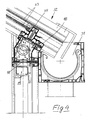
- FIG. 4 shows the use of a connection carrier according to the invention in the attachment or connection of a vertically standing frame of a winter garden with an inclined roof frame construction of a winter garden.
- the cross section of the tube 7 shown in FIG. 4 with the angle pieces 2 and 3 arranged thereon shows this tube 7 in a horizontal position.
- the angle piece 2 of the tube 7 is fastened to the tube 7 in the manner already described in such a position that it is in turn connected to a horizontally extending frame longitudinal beam 29 via the connecting intermediate piece 18.
- the angle piece 2 can be connected to the connecting intermediate piece 18 via a series of self-tapping screws 30.
- the longitudinal frame beam 29 is part of a large frame that forms the glass wall of a winter garden.
- a rain eaves 31 can be attached to the upper outer front of this glass frame in a conventional manner.
- a roof construction 32 which is essentially formed from a frame construction in which glass panes 33 are held, opens into this rain eaves 31.
- An associated spar 34 of such a frame can in turn be connected to a connecting intermediate piece 18, which in turn is connected in the manner already described to the angle piece 3, which in turn is attached to the metal tube 7 in the appropriate angular position. This again creates a secure connection between the associated spars 34 and 29.
- FIG. 7 shows a simplified exemplary embodiment which essentially corresponds to the exemplary embodiments according to FIG. 1 or FIG. 6.
- a metal tube 7 is equipped with elbows 2 'and 3', as described with reference to Figures 1 and 6 with respect to the metal tube 6 and the elbows 2, 3 or 9.
- the embodiment according to FIG. 7 is simplified compared to the embodiments according to FIGS. 1 and 6 insofar as in the embodiment according to FIG. 7 there is no longer an additional connection Lich connector 18 is required. Rather, in the embodiment according to FIG. 7, the second leg 12 'or 13' of the angle pieces 2 'and 3' is already formed as one half of the connecting piece 18 already described by the shaping of the grooves 35 and 36.
- the other half is formed by a flat profile 37, which has the grooves 38 and 39 in a corresponding arrangement and is so connected to the second leg 12 'or 13' of the angle pieces 2 'or 3' that parallel cavities arise as a result are open to the outside in a known manner via longitudinal slots 40 and 41.
- This flat profile 37 then in turn has the grid webs 42 which run parallel to one another at a distance and which correspond to the grid webs according to FIG. 6, for example.
- cylindrical center pieces it must be pointed out here in particular that it is not absolutely necessary for the cylindrical center pieces to be fastened at their front ends with masonry or other structures for absorbing static forces. Rather, these cylindrical center pieces 1 can be connected to one another to form a frame structure, which as such is the one that occurs can absorb static forces.
- connection carrier With the connection carrier according to the invention, a component is created with which it is possible to securely connect frame structures, such as those that occur, for example, to windows or window walls or conservatories, in almost any angular position.
- these connection carriers according to the invention can in turn be connected to external components which absorb static forces or can also be assembled to form a frame structure which can then absorb the static forces that occur.
- the connection carrier is extremely easy to manufacture and store and its dimensions can easily be adapted to the forces that occur.
Landscapes
- Engineering & Computer Science (AREA)
- Architecture (AREA)
- Civil Engineering (AREA)
- Structural Engineering (AREA)
- Physics & Mathematics (AREA)
- Electromagnetism (AREA)
- Joining Of Building Structures In Genera (AREA)
Applications Claiming Priority (4)
| Application Number | Priority Date | Filing Date | Title |
|---|---|---|---|
| DE8812237U DE8812237U1 (de) | 1988-09-28 | 1988-09-28 | Verbindungsträger zur Befestigung von Rahmenkonstruktionen |
| DE8812237U | 1988-09-28 | ||
| DE8900107U DE8900107U1 (de) | 1988-09-28 | 1989-01-05 | Verbindungsträger zur Befestigung von Rahmenkonstruktionen |
| DE8900107U | 1989-01-05 |
Publications (2)
| Publication Number | Publication Date |
|---|---|
| EP0361146A2 true EP0361146A2 (fr) | 1990-04-04 |
| EP0361146A3 EP0361146A3 (fr) | 1991-07-17 |
Family
ID=25953583
Family Applications (1)
| Application Number | Title | Priority Date | Filing Date |
|---|---|---|---|
| EP19890116401 Ceased EP0361146A3 (fr) | 1988-09-28 | 1989-09-06 | Longeron de jonction pour la fixation des constructions de cadre |
Country Status (5)
| Country | Link |
|---|---|
| EP (1) | EP0361146A3 (fr) |
| DE (1) | DE8900107U1 (fr) |
| DK (1) | DK476289A (fr) |
| FI (1) | FI894262A7 (fr) |
| NO (1) | NO893556L (fr) |
Cited By (2)
| Publication number | Priority date | Publication date | Assignee | Title |
|---|---|---|---|---|
| GB2321487A (en) * | 1997-01-24 | 1998-07-29 | Leslie George Briggs | A structure for joining glazed frames comprising a rod and corner post |
| EP0989249A3 (fr) * | 1998-09-25 | 2001-02-07 | Andreas Burkart | Auvent |
Family Cites Families (9)
| Publication number | Priority date | Publication date | Assignee | Title |
|---|---|---|---|---|
| DE6931959U (de) * | 1969-08-08 | 1969-11-20 | Mannesmann Ag | Vorrichtung zum befestigen von plattenfoermigen dach- oder wandelementen an den rohrfoermigen profilen eines tragwerkes. |
| DE2160216B1 (de) * | 1971-12-04 | 1973-01-25 | MERO-Dr.-Ing. Max Mengeringhausen, 8700 Würzburg | Mehrteiliger Profilstab zur Herstellung von Skelett-Baukonstruktionen mit ausfachenden Platten |
| DE2226323A1 (de) * | 1972-01-31 | 1973-08-09 | Edgar Gerald Wise | Langgestrecktes bauelement, insbesondere fuer das gerippe von haeusern, sowie verbindungsanordnung fuer solche bauelemente |
| DE2258006A1 (de) * | 1972-11-27 | 1974-05-30 | Werner Bauer | Versetzbare innenwand |
| AT336236B (de) * | 1973-08-03 | 1977-04-25 | Danescu Septimius | Verbindung von mobilen trennwandelementen und schiene zur halterung solcher elemente |
| SE415915B (sv) * | 1979-02-16 | 1980-11-10 | Moelnlycke Ab | Kopplingsanordning |
| JPS6164441A (ja) * | 1984-09-07 | 1986-04-02 | 新日本製鐵株式会社 | 重防食被覆鋼材 |
| DE3435399C1 (de) * | 1984-09-27 | 1986-03-13 | Siegfried 6074 Rödermark Kraus | Profilsystem für den Aufbau von metallischen Tragkonstruktionen |
| DE8607498U1 (de) * | 1986-03-19 | 1986-06-19 | Schultze, Gerhard M. E., 8500 Nürnberg | Dichtungsleiste |
-
1989
- 1989-01-05 DE DE8900107U patent/DE8900107U1/de not_active Expired
- 1989-09-05 NO NO89893556A patent/NO893556L/no unknown
- 1989-09-06 EP EP19890116401 patent/EP0361146A3/fr not_active Ceased
- 1989-09-11 FI FI894262A patent/FI894262A7/fi not_active IP Right Cessation
- 1989-09-27 DK DK476289A patent/DK476289A/da not_active Application Discontinuation
Cited By (2)
| Publication number | Priority date | Publication date | Assignee | Title |
|---|---|---|---|---|
| GB2321487A (en) * | 1997-01-24 | 1998-07-29 | Leslie George Briggs | A structure for joining glazed frames comprising a rod and corner post |
| EP0989249A3 (fr) * | 1998-09-25 | 2001-02-07 | Andreas Burkart | Auvent |
Also Published As
| Publication number | Publication date |
|---|---|
| NO893556L (no) | 1990-03-29 |
| FI894262A0 (fi) | 1989-09-11 |
| EP0361146A3 (fr) | 1991-07-17 |
| NO893556D0 (no) | 1989-09-05 |
| FI894262L (fi) | 1990-03-29 |
| DK476289D0 (da) | 1989-09-27 |
| FI894262A7 (fi) | 1990-03-29 |
| DK476289A (da) | 1990-03-29 |
| DE8900107U1 (de) | 1989-03-02 |
Similar Documents
| Publication | Publication Date | Title |
|---|---|---|
| EP1135616B1 (fr) | Assemblage en t de deux barreaux profiles | |
| DE102005044980B4 (de) | Stoßverbinder für Holz-/Aluminiumfassaden | |
| DE2838163A1 (de) | Zerlegbares rahmensystem | |
| EP0296280B1 (fr) | Longeron pour cadres de fenêtre | |
| DE3603221C2 (fr) | ||
| EP2236693B1 (fr) | Support à isolation thermique pour éléments de revêtement | |
| EP0067970B1 (fr) | Dispositif de fixation pour éléments de façade | |
| DE2923903C2 (fr) | ||
| EP4012132B1 (fr) | Raccord en t pour montants et traverses et montants et traverses dotcomprenant un tel raccord en t | |
| EP0361146A2 (fr) | Longeron de jonction pour la fixation des constructions de cadre | |
| EP1381739B1 (fr) | Assemblage en t de deux profiles | |
| DD296135A5 (de) | Verbindungstraeger zur befestigung von rahmenkonstruktionen | |
| DE3442398A1 (de) | Halteelement fuer selbsttragende bauelemente, wie dach- und wandverkleidungen oder dergleichen, und abdeckkappe fuer diese | |
| DE102008023483B4 (de) | T-Verbinder | |
| DE1759497C3 (de) | Verbindungselement für die Herstellung einer Spannverbindung von Wandteilen oder anderen Teilen mit Profilschienen | |
| DE20018012U1 (de) | Endstopfen zum Anschrauben von Sprossen an Abstandhalterrahmen von insbesondere Isolierglasscheiben | |
| DE29614812U1 (de) | Befestigungsvorrichtung | |
| DE2750351A1 (de) | Profilkonstruktion | |
| DE3128505A1 (de) | Vorrichtung zur knotenverbindung hoelzerner fachwerksstaebe | |
| DE9304016U1 (de) | Schraubverbindung für Rahmenprofil-Kombinationen, insbesondere für Aluminium-Fassaden | |
| DE29821204U1 (de) | Tragprofil für ein Aufbausystem zur Erstellung von Aufbauten | |
| EP3879042B1 (fr) | Raccord en t entre un profilé de montants et de traverses et construction de montants et de traverses dotée d'un tel raccord en t | |
| EP2378045A2 (fr) | Disque en verre isolant | |
| DE3929557C2 (fr) | ||
| EP1491696A2 (fr) | Système d'assemblage de profilés |
Legal Events
| Date | Code | Title | Description |
|---|---|---|---|
| PUAI | Public reference made under article 153(3) epc to a published international application that has entered the european phase |
Free format text: ORIGINAL CODE: 0009012 |
|
| AK | Designated contracting states |
Kind code of ref document: A2 Designated state(s): AT BE CH DE ES FR GB GR IT LI LU NL SE |
|
| PUAL | Search report despatched |
Free format text: ORIGINAL CODE: 0009013 |
|
| AK | Designated contracting states |
Kind code of ref document: A3 Designated state(s): AT BE CH DE ES FR GB GR IT LI LU NL SE |
|
| 17P | Request for examination filed |
Effective date: 19911018 |
|
| 17Q | First examination report despatched |
Effective date: 19920514 |
|
| STAA | Information on the status of an ep patent application or granted ep patent |
Free format text: STATUS: THE APPLICATION HAS BEEN REFUSED |
|
| 18R | Application refused |
Effective date: 19930829 |