EP0361230A2 - Mischungen aus Polyamiden, aromatischen Polycarbonaten und Maleinimid-Copolymerisaten und deren Verwendung als thermoplastische Formmassen - Google Patents
Mischungen aus Polyamiden, aromatischen Polycarbonaten und Maleinimid-Copolymerisaten und deren Verwendung als thermoplastische Formmassen Download PDFInfo
- Publication number
- EP0361230A2 EP0361230A2 EP89117098A EP89117098A EP0361230A2 EP 0361230 A2 EP0361230 A2 EP 0361230A2 EP 89117098 A EP89117098 A EP 89117098A EP 89117098 A EP89117098 A EP 89117098A EP 0361230 A2 EP0361230 A2 EP 0361230A2
- Authority
- EP
- European Patent Office
- Prior art keywords
- weight
- units
- formula
- bis
- polyamides
- Prior art date
- Legal status (The legal status is an assumption and is not a legal conclusion. Google has not performed a legal analysis and makes no representation as to the accuracy of the status listed.)
- Granted
Links
- 0 CC(C)(C)C(*(C(C)(C)C)C(N*)=O)C(C)=O Chemical compound CC(C)(C)C(*(C(C)(C)C)C(N*)=O)C(C)=O 0.000 description 1
Classifications
-
- C—CHEMISTRY; METALLURGY
- C08—ORGANIC MACROMOLECULAR COMPOUNDS; THEIR PREPARATION OR CHEMICAL WORKING-UP; COMPOSITIONS BASED THEREON
- C08L—COMPOSITIONS OF MACROMOLECULAR COMPOUNDS
- C08L77/00—Compositions of polyamides obtained by reactions forming a carboxylic amide link in the main chain; Compositions of derivatives of such polymers
Definitions
- the invention relates to mixtures of polyamides, aromatic polycarbonates containing o, o, o ', o'-tetramethylbisphenol units, and statistical copolymers of maleimides with styrene and / or methyl methacrylate and acrylonitrile, and optionally elastomers and their use as thermoplastic molding compositions for Manufacture of molded articles.
- Polyamide molding materials are increasingly used in automotive engineering, e.g. for hubcaps. Their rigidity and dimensional stability, especially at higher temperatures, such as those that occur in painting ovens, are still in need of improvement.
- Known fillers for increasing the dimensional stability are e.g. Fiberglass.
- Thermoplastic blends made of amorphous polyamides and polycarbonates are known and i.a. described in EP 0 235 384.
- One problem is the lack of coupling between the polyamide and polycarbonate phases and the even distribution of the polycarbonate phase in the polyamide matrix.
- the mixture of (A), (B) and (C) may also contain an elastomer (D) to increase the impact strength.
- the invention also relates to the use of the mixture of (A), (B), (C) and optionally (D) as a molding composition for the production of moldings.
- the mixtures preferably contain A and B in a weight ratio of 60 to 40 to 95 to 5, particularly preferably 70 to 30 to 80 to 20.
- Component C makes up 1 to 30, preferably 1 to 25% by weight of the mixture and the amount D is 0 to 30% by weight, preferably 7.5 to 25% by weight of the total polymer mixture.
- polyamides are polymeric condensation products which contain aromatically or aliphatically bound amide groups as repeating units in the linear main chain. They contain hydrocarbon residues in the main chain, which are represented by groups of the formula: are connected.
- AB type There are two basic types, AB type and AA / BB type, where A is a primary or secondary amino function and B is a carboxyl function.
- the AB type is produced by polycondensation of aminocarboxylic acids or their functional derivatives or by polymerization of lactams and is therefore also called "aminocarboxylic acid type", for example nylon-6 (poly- ⁇ -caprolactam).
- the AA / BB type arises from the polycondensation of diamines with dicarboxylic acids or their functional derivatives, such as carboxylic acid chlorides and carboxylic acid esters, e.g. Nylon 6: 6 (polylhexamethylene adipinamide).
- the molecular weights of the polyamides used are in the range from 15,000 to 50,000.
- the most important polyamides are listed below: Homopolymers Polyhexamethylene adipinamide (Nylon 6: 6) Polypyrrolidone (Nylon-4) Polycaprolactam (Nylon-6) Polyheptolactam (Nylon-7) Polycaprylactam (Nylon-8) Polynonanolactam (Nylon-9) Polyundecanolactam (Nylon-11) Polydodecanolactam (Nylon-12) Polyhexamethylene azelainamide (Nylon 6: 9) Polyhexamethylene sebacinamide (Nylon 6:10) Polyhexamethylene isophthalamide (Nylon 6: ip) Polymetaxylylene adipinamide (Nylon MSD: 6) Polyamide of hexamethylene diamine and n-dodecanedioic acid (Nylon 6:12) Polyamides of dodecamethylene diamine and
- Polyamides are amorphous or partially crystalline. Particularly worth mentioning are semi-crystalline standard polyamides such as nylon-6 (poly- ⁇ -caprolactam), nylon-11 (polyundecane lactam), nylon-6,6 polylhexamethylene adipinamide, nylon 12 (polylaurine lactam), and also mixed aliphatic-aromatic polyamides , the structural units of terephthalic acid and isophthalic acid, and also m-xylylenediamine, bis- (4-aminophenyl) methane, bis- (4-aminocyclohexyl) methane or Bis- (4-aminophenyl) propane-2.2 included.
- mixtures can also be used in the invention.
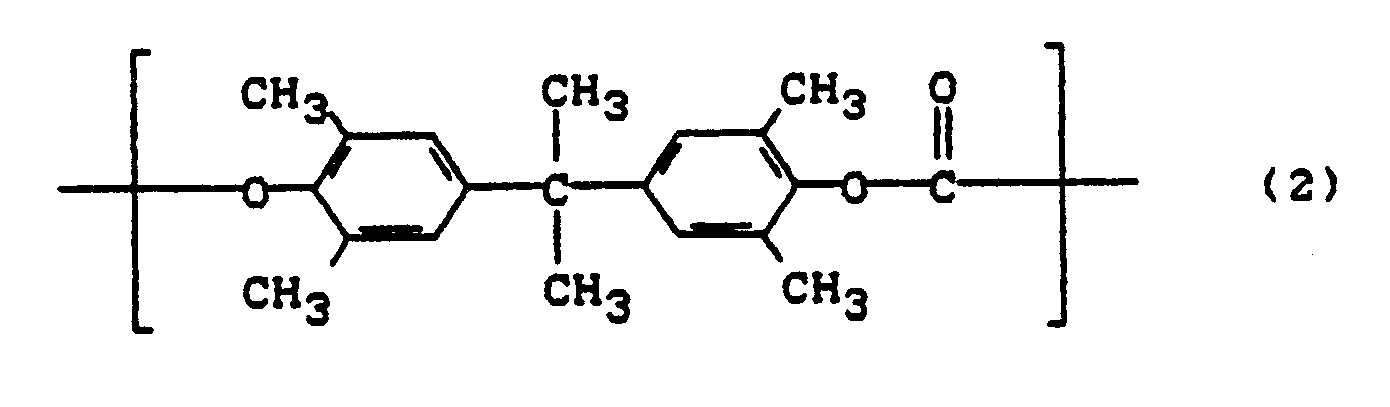
- the aromatic polycarbonates of the formula (2) contain 2,2-bis (3,5-dimethyl-hydroxyphenyl) propane units in polycondensed form.
- other aromatic diols can be condensed, e.g. Hydroquinone, resorcinol, dihydroxydiphenyl, bis (hydroxyphenyl) alkanes, bis (hydroxyphenyl) cycloalkanes, bis (hydroxyphenyl) sulfides, bis (hydroxyphenyl) ethers, bis (hydroxyphenyl) sulfones, ⁇ , ⁇ '-bis (hydroxyphenyl) diisopropylbenzenes and their nuclear alkylated and nuclear halogenated derivatives.
- aromatic dihydroxy compounds and polycarbonates based thereon are e.g. in US Pat. Nos. 3,028,365, 2,999,835, 3,148,172, 3,271,368, 2,991,273, 3,271,367, 3,780,078, 3,014,891, 2,999,846, in DE-OS 2,063,050, 2 211 957, 1 570 703, 2 329 585, 2 329 646 and in Hermann Schnell, Chemistry and Physics of Polycarbonates, Polymer Reviews, Volume 9, Interscience Publishers, New York, 1964.
- crude bisphenols are preferably used, as can be prepared from 2,6-dimethylphenol by the processes of DE-OS 2 928 464 and DE-OS 2 928 443. In this case, up to 15% by weight of by-products may be present in the reaction mixture.
- This reaction mixture can be used in the preparation of the polycarbonates without prior purification.
- Preferred copolycarbonates with recurring structural units of the formula (2) contain at least 80 mol% of these structural units.
- Polycarbonates which contain only recurring structural units of the formula (2) are very particularly preferred.
- Aromatic polycarbonates which can be used according to the invention can be prepared by known processes, for example according to DE-OS 2 063 050, 2 211 957, 2 901 665 and 2 901 668. These polycarbonates have molecular weights M w (weight average) from 10,000-200,000, preferably from 20,000-80,000, particularly preferably from 25,000-60,000 and very particularly preferably from 30,000-45,000.
- chain terminators can be used in the usual quantities.
- Suitable chain terminators are, for example, phenols such as phenol, o-, m-, p-cresol, 2,6-dimethylphenol, p-tertiary-butylphenol and p-isooctylphenol.
- the polycarbonates which can be used according to the invention can be branched. This is achieved by incorporating small amounts, preferably amounts of 0.05 to 2.0 mol% (based on the diphenols used), of three or more than three-functional compounds.
- the three-functional compounds used are preferably those with three or more than three phenolic hydroxyl groups.
- the production of branched polycarbonates of this type is described, for example, in DE-OS 1 570 533, 1 596 762, 2 116 974, 2 113 347, GB-PS 1 079 821 and 1 476 108 and US Pat. No. 3,544,514.
- Statistical copolymers (C) with structural units (3) are known and are described, for example, in DE-PS 3 430 802. They can be manufactured in two ways:
- vinyl aromatics are e.g. Styrene, ⁇ -methylstyrene, p-tert-butylstyrene, chlorostyrenes.
- Suitable amines are, for example, monomethylamine, monoethylamine, n-propylamine, monoisopropylamine, monobutylamine, isobutylamine, secondary butylamine, tertiary butylamine, monopentylamine, isobutylamine, 1,2-dimethylpropylamine, 1,1-dimethylpropylamine, tert-pentylamine, 5-methylhexylamine -2-hexylamine, monooctylamine, mono-2-ethylhexylamine, 6-methyl-2-heptamine, dodecylamine, tetradecylamine, hexadecylamine, tridecylamine, 2-methoxyethylamine, 2-ethoxyethylamine, 3-methoxypropylamine, 3-
- the reaction with the monoamines or the mixtures thereof proceeds via a half-imide stage.
- the imide stage arises from this by elimination of water. Not all anhydride groups need to be converted to imide groups. It is sufficient if the implementation is at least 70% complete.
- the polymer (C) then still carries free anhydride and half-amide groups.
- maleic anhydride is first reacted with one of the above primary monoamines via the half-imide stage and the imide stage is achieved by elimination of water, for example in acetic anhydride, and the maleimide thus obtained is obtained with vinylaromatic and / or methyl methacrylate and optionally acrylonitrile copolymerized.
- the polymerization procedures are the same as those described above for the preparation of random maleic anhydride copolymers, except that the maleimide of one of the amines described above is used instead of maleic anhydride. Mixtures of maleimide derivatives can also be used.
- Polyamides with the recurring structural unit (1) and polycarbonates with the recurring structural unit (2) cannot be mixed homogeneously by melt compounding. If a mixture is produced in the melt which predominantly contains polyamide, the polycarbonate is divided into a flat shape in the (continuous) polyamide phase. The polyamide is then "filled” with polycarbonate, but there is no bond between the two phases. The mixture therefore has poor mechanical properties. If the polycarbonate predominates, the phase behavior is reversed. In this case too, the distribution of the polyamide in the (continuous) polycarbonate is irregular and the bond between the phases is missing.
- a statistical maleimide copolymer (C) to a mixture of polyamide (A) and polycarbonate (B) changes the phase structure in the mixture considerably and brings about a phase coupling.
- the additive (C) according to the invention the polymer phase present in the deficit is within the excess existing polymer phase dispersed finely and homogeneously.
- the mechanical strength rises sharply, which suggests coupling and power transmission between the phases.
- elastomers (D) can be added to improve toughness. These can also be grafted with vinyl monomers for better phase coupling. Examples include:
- Polybutadiene rubber acrylate rubber, styrene-butadiene rubber, polybutene rubber, hydrogenated styrene-butadiene rubber, acrylonitrile-butadiene rubber, ethylene-propylene rubber, polyisoprene rubber, styrene-grafted ethylene-propylene rubber, rubber , thermoplastic polyester, polyamide or polyurethane elastomers, ethylene rubber and ionomers, styrene-butadiene block copolymers, such as AB, ABA, ABA tapering and star block copolymers as well as similar isoprene block copolymers and hydrogenated or partially hydrogenated block copolymers.
- the proportion of the impact-modifying rubber is not critical. In general, however, it is not more than 30% by weight, based on the total amount of components A) to C).
- graft polymers or polymer modifiers Rubber bases for the graft polymers or polymer modifiers are e.g. Diene rubber, ethylene-propylene-diene rubber or acrylate rubber, which can be obtained by known methods.
- Diene rubbers are understood to mean homopolymers of conjugated dienes having 4-8 C atoms, for example butadiene, isoprene and chloroprene, copolymers of such dienes with one another and copolymers of such dienes with other monomers, in particular with up to 50% by weight of the abovementioned.
- diene rubbers are polybutadiene, polyisoprene, butadiene-styrene copolymers, butadiene-acrylonitrile copolymers, butadiene-methyl methacrylate copolymers and butadiene-acrylic acid butyl ester copolymer.
- Ethylene-propylene-diene rubbers are, for example, those which contain hexadiene-1,5, norbornadiene or ethylidene norbornene as diene.
- Acrylate rubbers are, for example, crosslinked or uncrosslinked polymers made from acrylic acid alkyl esters, optionally with up to 40% by weight of other polymerizable ethylenically unsaturated monomers.
- the acrylic acid alkyl esters preferably include C1-C8 alkyl esters, for example methyl, ethyl, butyl, octyl esters, in particular the butyl ester.
- Acrylate rubbers are described, for example, in German Patent Application P 3 118 861.
- the polymer mixture or polymer compounds are produced by mixing in polymer melt on kneaders, rollers or screw machines such as extruders.
- the molding compositions according to the invention can contain conventional additives, such as lubricants and mold release agents, nucleating agents, stabilizers, fillers and reinforcing materials, flame retardants and dyes.
- thermoplastic molding compositions according to the invention can contain fillers and / or reinforcing materials.
- Preferred fillers which can also have a reinforcing effect, are glass fibers, glass balls, mica, silicates, quartz, talc, titanium dioxide, wollastonite, aramid fibers.
- the molding compositions finished with flame retardants contain flame retardants in a concentration of generally less than 30% by weight, based on the flame retardant molding compositions.
- flame retardants such as, for example, polyhalodiphenyl, polyhalodiphenyl ether, polyhalophthalic acid and its derivatives and polyhalogenated oligo- and polycarbonates, the corresponding bromine compounds being particularly effective. They also usually contain a synergist, such as antimony trioxide.
- Tetramethyl-bisphenol-A polycarbonate (MPC) with a relative solution viscosity of 1.30 dl / g (measured at 25 ° C in CH2Cl2 at 0.5 g in 100 ml of solution).
- Statistical copolymers of styrene and maleic anhydride were prepared according to DE-AS 2 724 360 or DE-OS 2 343 871 and contain 22% by weight of maleic anhydride (a1) and 13% by weight of maleic anhydride (a2).
- the intrinsic viscosity is 0.51 dl / g for a1, measured at 25 ° C in DMF, for 0.52 dl / g for a2.
- the resins a1 and a2 were implemented with aniline to the maleimide copolymer in a twin-screw machine according to DE-PS 3 430 802.
- the shafts have a diameter of 32 mm and a length of 1200 mm.
- the reaction conditions are shown in Table 1. The volatiles were removed in a degassing zone with the application of vacuum.
- the N-phenyl maleimide resin C 1 consists of 72% by weight of styrene, 27.7% by weight of N-phenyl maleimide and 0.3% by weight of maleic anhydride in polymerized form; Resin C2 consisting of 80.7% by weight of styrene, 18% by weight of N-phenylmaleimide and 1.3% by weight of maleic anhydride.
- Graft polymer prepared by grafting 10 parts by weight of methyl methacrylate and 10 parts by weight of n-butyl acrylate onto 80 parts by weight of a polybutadiene rubber base with an average particle size (d50 value) of 400 nm and a gel content of 90% by weight.
- the polymer mixtures were produced on a counter-rotating, conical laboratory extruder at 300 ° C, granulated and injected at 240 ° C into standard small bars. See Table 2 for details.
- the impact strength was determined according to ISO 180 Method 1c on 80 mm x 10 mm x 4 mm flat bars.
- the recording of the mixture from experiment 1 shows a coarsely dispersed distribution of the amorphous MPC phase in the partially crystalline polyamide.
- the coarsely dispersed MPC particles have a diameter of 2 to 4 ⁇ m.
- the TEM images of the materials from experiments 2 and 3 show that the MPC particles are finely dispersed with particle diameters of less than 0.1 ⁇ m.
Landscapes
- Chemical & Material Sciences (AREA)
- Health & Medical Sciences (AREA)
- Chemical Kinetics & Catalysis (AREA)
- Medicinal Chemistry (AREA)
- Polymers & Plastics (AREA)
- Organic Chemistry (AREA)
- Compositions Of Macromolecular Compounds (AREA)
- Addition Polymer Or Copolymer, Post-Treatments, Or Chemical Modifications (AREA)
- Graft Or Block Polymers (AREA)
Abstract
- (A) Polyamiden, die das Strukturelement der Formel (1)

- (B) aromatischen Polycarbonaten, deren lineare Hauptketten zu mindestens 80 Mol-% aus wiederkehrenden Struktureinheiten der Formel (2) bestehen
- (C) statistischen Copolymerisaten aus
- (C₁) 5 bis 30 Gew.-% Maleinimideinheiten der Formel (3)
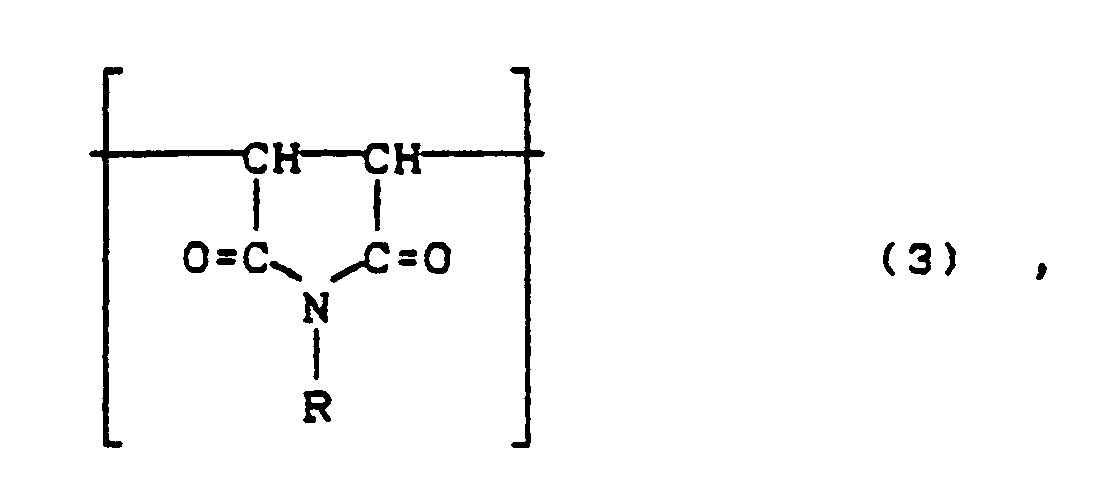
R = H, C₁-C₃₀-Alkyl, Cycloalkyl, Heterocycloalkyl, Aryl sind oder bedeuten, - (C₂) 95 bis 38 Gew.-% Vinylaromat und/oder Methylmethacrylat-Einheiten,
- (C₃) 0 bis 32 Gew.-% Acrylnitril-Einheiten.
- (C₁) 5 bis 30 Gew.-% Maleinimideinheiten der Formel (3)
Description
- Die Erfindung betrifft Mischungen von Polyamiden, aromatischen Polycarbonaten, die o,o,o′,o′-Tetramethylbisphenol-Einheiten enthalten, und statistischen Copolymerisaten von Maleinimiden mit Styrol und/oder Methylmethacrylat und Acrylnitril, sowie gegebenenfalls Elastomeren und ihre Verwendung als thermoplastische Formmassen zur Herstellung von Formkörpern.
- Polyamid-Formmasen werden zunehmend im Automobilbau, z.B. für Radkappen, eingesetzt. Deren Steifigkeit und Formbeständigkeit, insbesondere bei höheren Temperaturen, wie sie in Lackieröfen vorkommen, ist noch verbesserungsbedürftig. Bekannte Füllstoffe zur Erhöhung der Formbeständigkeit sind z.B. Glasfasern.
- Um eine gute Verarbeitbarkeit der Massen durch Extrusion oder Spritzguß zu erzielen, könnte man statt Glasfasern gut schmelzende, jedoch wärmeformbeständige Polymere als Füllstoff verwenden. Das Problem ist jedoch die Zerteilung und Ankopplung des eingearbeiteten Verstärker-Polymers in Polyamiden.
- Thermoplastische Blends aus amorphen Polyamiden und Polycarbonaten sind bekannt und u.a. in der EP 0 235 384 beschrieben. Ein Problem ist die mangelnde Ankopplung der Polyamid- und Polycarbonat-Phasen untereinander sowie die gleichmäßige Verteilung der Polycarbonat-Phase in der Polyamid-Matrix.
- Es wurde nun gefunden, daß ein Zusatz von 1 bis 30 Gew.-%, bezogen auf die gesamte Polymermischung, eines statistischen Copolymerisates aus Maleinmiden mit Styrol und/oder Methylmethacrylat und Acrylnitril bestimmter Zusammensetzung ermöglicht, aromatische Polycarbonate, deren lineare Ketten zu mindestens 80 Mol-% aus wiederkehrenden Struktureinheiten der Formel (2):

in thermoplastischen Polyamid-Formmassen einzuarbeiten, wobei Steifigkeit und Formbeständigkeit, insbesondere in der Wärme, verbessert werden. Gegenstand der Erfindung sind demnach Mischungen aus - (A) Polyamiden, die in der Hauptkette mehrmals das Strukturelement (1) enthalte,

- (B) aromatischen Polycarbonaten, deren lineare Hauptketten zu mindestens 80 Mol-% aus wiederkehrenden Struktureinheiten der Formel (2) bestehen,

- (C) statistischen Copolymerisaten aus
- (C₁) 5 bis 30 Gew.-% Maleinimideinheiten der Formel (3)

R = H, C₁-C₃₀-Alkyl, Cycloalkyl, Heterocycloalkyl, Aryl sind oder bedeuten, - (C₂) 95 bis 38 Gew.-% Vinylaromat- und/oder Methylmethacrylat-Einheiten,
- (C₃) 0 bis 32 Gew.-% Acrylnitril-Einheiten.
- (C₁) 5 bis 30 Gew.-% Maleinimideinheiten der Formel (3)
- Gegebenenfalls enthält die Mischung aus (A), (B) und (C) zur Erhöhung der Schlagfestigkeit noch ein Elastomer (D). Gegenstand der Erfindung ist auch die Verwendung der Mischung aus (A), (B), (C) und gegebenenfalls (D) als Formmasse zur Herstellung von Formkörpern.
- Die Mischungen enthalten bevorzugt A und B im Gewichtsverhältnis 60 zu 40 bis 95 zu 5, besonders bevorzugt 70 zu 30 bis 80 zu 20. Der Bestandteil C macht 1 bis 30, bevorzugt 1 bis 25 Gew.-% der Mischung aus und die Menge D ist 0 bis 30 Gew.-%, bevorzugt 7,5 bis 25 Gew.-% der gesamten Polymerenmischung.
- Polyamide im Sinne dieser Erfindung sind polymere Kondensationsprodukte, die aromatisch oder aliphatisch gebundene Amid-Gruppen als wiederkehrende Einheiten in der linearen Hauptkette enthalten. Sie enthalten in der Hauptkette Kohlenwaserstoffreste, die durch Gruppen der Formel:

- Dabei gibt es zwei Grundtypen, AB-Typ und AA/BB-Typ, wobei A eine primäre oder sekundäre Amino-Funktion und B eine Carboxyl-Funktion darstellen. Der AB-Typ wird durch Polykondensation von Aminocarbonsäuren bzw. deren funktionellen Derivaten oder durch Polymerisation von Lactamen hergestellt und heißt daher auch "Aminocarbonsäure-Typ", z.B. Nylon-6 (Poly-ε-caprolactam).
- Der AA/BB-Typ entsteht bei der Polykondensation von Diaminen mit Dicarbonsäuren, bzw. deren funktionellen Derivaten, wie Carbonsäurechloride und Carbonsäureester, z.B. Nylon-6:6 (Polylhexamethylen-adipinamid).
- Eine Übersicht über die hier verwendeten Polyamid findet sich in Houben-Weyl, Methoden der Organischen Chemie, 4. Auflage, Bd. E 20/2, S. 1497 ff., (1987), Georg Thieme Verlag, Stuttgart.
- Die Molmassen der verwendeten Polyamide liegen im Bereich von 15 000 bis 50 000. Im folgenden werden die bedeutendsten Polyamide aufgeführt:
Homopolymere Polyhexamethylen-adipinamid (Nylon-6:6) Polypyrrolidon (Nylon-4) Polycaprolactam (Nylon-6) Polyheptolactam (Nylon-7) Polycaprylactam (Nylon-8) Polynonanolactam (Nylon-9) Polyundecanolactam (Nylon-11) Polydodecanolactam (Nylon-12) Polyhexamethylen-azelainamid (Nylon-6:9) Polyhexamethylen-sebacinamid (Nylon-6:10) Polyhexamethylen-isophthalamid (Nylon-6:ip) Polymetaxylylen-adipinamid (Nylon MSD:6) Polyamid des Hexamethylendiamins und der n-Dodecandionsäure (Nylon 6:12) Polyamide des Dodecamethylendiamins und n-Dodecandionsäure (Nylon 12:12) Copolymere Hexamethylen-adipinamid/caprolactam (Nylon 6:6/6) Hexamethylen adipinamid/hexamethylenisophthalamid (Nylon 6:6(6ip) Hexamethylen-adipinamid/hexamethylenterephthalamid (Nylon 6:6/6T) Trimethylhexamethylen oxamid/hexamethylen-oxamid (Nylon trimethyl-6:2/6:2) Hexamethylen-adipinamid/hexamethylen-azelainamid (Nylon 6:6/6:9) Hexamethylen-adipinamid/hexamethylen-azelainamid/caprolactam (Nylon 6:6/6:9/6). - Polyamide sind amorph oder teilkristallin. Besonders erwähnt werden sollen teilkristallin Standard-Polyamide wie Nylon-6 (Poly-ε-caprolactam), Nylon-11 (Polyundecanlactam), Nylon-6,6 Polylhexamethylen-adipinamid, Nylon-12 (Polylaurinlactam), ferner gemischt aliphatisch-aroma tische Polyamide, die Struktureinheiten der Terephthalsäure und Isophthalsäure, sowie m-Xylylendiamin, Bis-(4-aminophenyl)methan, Bis-(4-aminocyclohexyl)methan oder Bis-(4-aminophenyl)propan-2.2 enthalten. Anstelle eines Polyamides können in der Erfindung auch Gemische eingesetzt werden.
- Die aromatischen Polycarbonate der Formel (2) enthalten 2,2-Bis-(3.5-dimethyl-hydroxyphenyl)-propan-Einheiten in polykondensierter Form. Daneben können andere aromatische Diole einkondensiert sein, z.B. Hydrochinon, Resorcin, Dihydroxydiphenyl, Bis-(hydroxyphenyl)-alkane, Bis-(hydroxy-phenyl)-cycloalkane, Bis-(hydroxyphenyl)-sulfide, Bis-(hydroxyphenyl)-ether, Bis-(hydroxyphenyl)-sulfone, α,α′-Bis-(hydroxyphenyl)-diisopropylbenzole sowie deren kernalkylierte und kernhalogfenierte Abkömmlinge.
- Diese und weitere geeignete aromatische Dihydroxyverbindungen sowie darauf basierende Polycarbonate sind z.B. in den US-PS 3 028 365, 2 999 835, 3 148 172, 3 271 368, 2 991 273, 3 271 367, 3 780 078, 3 014 891, 2 999 846, in den DE-OS 2 063 050, 2 211 957, 1 570 703, 2 329 585, 2 329 646 und in Hermann Schnell, Chemistry and Physics of Polycarbonates, Polymer Reviews, Volume 9, Interscience Publishers, New York, 1964, beschrieben.
- Bei der Herstellung der Polycarbonate werden vorzugsweise Rohbisphenole eingesetzt, wie sie aus 2,6-Di-methylphenol nach den Verfahren der DE-OS 2 928 464 und der DE-OS 2 928 443 hergestellt werden können. In diesem Fall können bis zu 15 Gew.-% Nebenprodukte im Reaktionsgemisch vorhanden sein. Dieses Reaktionsgemisch kann ohne vorherige Reinigung bei der Herstellung der Polycarbonate eingesetzt werden.
- Bevorzugte Copolycarbonate mit wiederkehrenden Struktureinheiten der Formel (2) enthalten mindestens 80 Mol. -% dieser Struktureinheiten. Ganz besonders bevorzugt sind Polycarbonate, die ausschließlich wiederkehrende Struktureinheiten der Formel (2) enthalten.
- Erfindungsgemäß einsetzbare aromatische Polycarbonate können nach bekannten Verfahren hergestellt werden, beispielsweise gemäß DE-OS 2 063 050, 2 211 957, 2 901 665 und 2 901 668. Diese Polycarbonate besitzen Molekulargewichte
M w (Gewichtsmittel) von 10 000-200 000, bevorzugt von 20 000-80 000, besonders bevorzugt von 25 000-60 000 und ganz besonders bevorzugt von 30 000-45 000. - Für die einstellung der gewünschten Molekulargewichte
M w können Kettenabbrecher in den üblichen Mengen verwenden werden. Geeignete Kettenabbrecher sind beispielsweise Phenole wie Phenol, o-, m-, p-Kresol, 2,6-Dimethylphenol, p-tertiär-Butylphenol und p-Isooctylphenol. - Die erfindungsgemäß einsetzbaren Polycarbonate können verzweigt sein. Dies wird durch den Einbau geringer Mengen, vorzugsweise von Mengen von 0,05 bis 2,0 Mol-% (bezogen auf eingesetzte Diphenole), an drei- oder mehr als dreifunktionellen verbindungen erreicht. Als dreifunktionelle Verbindungen werden vorzugsweise solche mit drei oder mehr als drei phenolischen Hydroxygruppen eingesetzt. Die Herstellung von verzweigten Polycarbonaten dieser Art ist z.B. in den DE-OS 1 570 533, 1 596 762, 2 116 974, 2 113 347, GB-PS 1 079 821 und 1 476 108 sowie US-PS 3 544 514 beschrieben. Statistische Copolymerisate (C) mit Struktureinheiten (3) sind bekannt und z.B. in der DE-PS 3 430 802 beschrieben. Sie sind auf zwei Wegen herstellbar:
- 1. Statistische Copolymerisation von Maleinsäureanhybrid mit Vinylaromaten und gegebenenfalls weiteren copolymerisierbaren vinylverbindungen, insbesondere Acrylnitril und Derivaten der (Meth)acrylsäure und anschließende polymeranaloge Umsetzung mit Aminen in Lösung, Feststoff oder in der Polymerschmelze, Vinylaromaten sind z.B. Styrol, α-Methylstyrol, p-tert.-Butylstyrol, Chlorstyrole.
- Verfahren zur statistischen Copolymerisation von Maleinsäureanhybrid werden beispielsweise in DE-AS 2 724 360, DE-OS 2 343 871, DE-OS 2 747 822 beschrieben. Verfahren zur Umsetzung der Maleinsäureanhydride mit primären Aminen zu Maleinimid-Copolymerisaten sind beschrieben in DE-AS 1 925 996, US-PS 4 404 322, DE-OS 2 343 408, DE-OS 3 148 965 und DE-PS 3 430 802. Bevorzugt werden die Polymeren (C) mit den wiederkehrenden Struktureinheiten (3) nach dem Verfahren der DE-PS 3 430 802 hergestellt. Die zu imidisierenden Ausgangsharze enthalten 2 bis 35 Mol-% Maleinsäureanhyrid und besitzen Molmassen von 10 000 bis 150 000. Als Amine werden primäre aliphatische, cycloaliphatische, heterocyclische, aromatische Amine mit 1 bis 30 Kohlenstoffatomen eingesetzt. Geeignete Amine sind z.B. Monomethylamin, Monoethylamin, n-Propylamin, Monoisopropylamin, Monobutylamin, Isobutylamin, sekundäres Butylamin, tertiäres Butylamin, Monopentylamin, Isobutylamin, 1,2-Dimethylpropylamin, 1,1-Dimethylpropylamin, tert.-Pentylamin, Monohexylamin, 5-Methyl-2-hexylamin, Monooctylamin, Mono-2-ethyl-hexylamin, 6-Methyl-2-heptamin, Dodecylamin, Tetradecylamin, Hexadecylamin, Tridecylamin, 2-Methoxyethylamin, 2-Ethoxyethylamin, 3-Methoxypropylamin, 3-Methoxypropylamin, 3-Ethoxypropylamin, 3-(2-Ethoxy)propylamin, 2-(Ethylhexyl)-(3-aminopropylether), 3-Tridecyloxypropylamin, 3-Stearyloxypropylamin, 1-Methoxymethylpropylamin, 2-Aminopropionaldehyd-dimkethylacetal, 5-Diethylamino-2-pentanon, 9-Phenoxy-4,7-dioxanonan-1-amin, Cyclopropylmethylenamin, Cyclohexylamin, 2-Methylcyclohexylamin, 3,3,5-Trimethylcyclohexylamin, Norbornylamin, Benzylamin, 2-Phenylethylamin, o-Methoxyphenylethylamin, p-Methoxyphenylethylamin, 3,4-Dimethoxybenzolethylamin (Homoveratrylamin), 2-Phenylpropylamin, 1-Methyl-3-phenylpropylamin, Anilin, o-Toluidin, 3,3,5-Trimethylcyclohexylamin, o, m, p-Chloranilin, Di- und Trichloraniline, o, m, p-Methylanilin und Dimethylaniline, bzw. gemischte Methylchlor-aniline, Methoxy- und Ethoxyaniline, Methoxyund Ethoxy-methylaniline, Dimethoxy- und Diethoxyaniline, Amino-benzonitrile, Amino-benzoesäureamide, Aminobenzoesäureester, 2-Dimethylaminoethylamin, 2-Diethylaminoethylamin, 2-Diisopropylamino ethylamin,2-Dibutylaminoethylamin, Dimethylaminopropylamin, Diethylaminopropylamin, 4-Diethylaminobutylamin, Diethylamino-4-aminopentan, Dimethylaminoneopentanamin, 2-(1-Pyrrolidyl)ethylamin, 2-(Piperidyl)ethylamin, 1-(2-Aminopropyl)piperidin, 2-(4-Morpholin)ethylamin, 4-(3-Aminopropyl)-morpholin, 1-(3-Aminopropyl)imidazol, Aminosulfolan, 2-Furanmethylamin, 3-Dibenzofuranamin, 7-Amino-3-phenylcumarin, 2-Pyridinamin, 2-Pyrimidinamin, 1H Benzimidazol-2-pentylamin, Triazolamin, 4-Morpholinpropanamin, 2-Aminothiazol, 1-(2-Aminoethyl)piperazin, 1-Cyclohexylethylamin, 1-Phenylethylamin, N-Acyl-4.4′-diamino-diphenylmethan, N-Acyl-4,4′-diamino-diphenyl-dimethylmethan.
- Die Umsetzung mit den Monoaminen oder den Mischungen hieraus verläuft über ein Halbimidstufe. Unter Wasserabspaltung entsteht hieraus die Imid-Stufe. Es brauchen nicht alle Anhydrid-Gruppen in Imid-Gruppen überführt zu sein. Es reicht, wenn die Umsetzung zu mindestens 70% erfolgt. Das Polymer (C) trägt dann noch freie Anhydrid- und Halbamid-Gruppen.
- 2. Bei dem zweiten Weg, der zu den Maleinimid-Polymeristaten (C) führt, wird Maleinsäureanhydrid zuerst mit einem der obigen primären Monoamine über die Halbimidstufe umgesetzt und die Imidstufe durch Wasserabspaltung, z.B. in Acetanhydrid, erreicht und das so erhaltene Maleinimid mit Vinylaromat und/oder Methylmethacrylat und gegebenenfalls Acrylnitril copolymerisisert. Die Polymerisations verfahren sind dieselben wie die oben beschriebenen zur Herstellung von statistischen Maleinsäureanhydrid-Copolymeren, nur daß anstelle von Maleinsäureanhydrid das Maleinimid eines der oben beschriebenen Amine eingesetzt wird. Es können auch Gemische von Maleinimid-Derivaten eingesetzt werden.
- Polyamide mit der wiederkehrenden Struktureinheit (1) und Polycarbonate mit der wiederkehrenden Struktureinheit (2) lassen sich nicht homogen durch Schmelzcompoundieren mischen. Stellt man in der Schmelze eine Mischung her, die überwiegend Polyamid enthält, so zerteilt sich in der (kontinuierlichen) Polyamidphase das Polycarbonat fladenförmig. Das Polyamid ist dann zwar mit Polycarbonat "gefüllt", doch besteht zwischen den beiden Phasen kein Verbund. Die Mischung hat deshalb schlechte mechanische Eigenschaften. Bei überwiegendem Polycarbonat kehrt sich das Phasenverhalten um. Auch in diesem Fall ist die Verteilung des Polyamids im (kontinuierlichen) Polycarbonat unregelmäßig und es fehlt der Verbund zwischen den Phasen. Der Zusatz von 1-30 Gew.-% eines statistischen Maleinimid-Copolymerisates (C) zu einer Mischung aus Polyamid(A) und Polycarbonat (B) verändert die Phasenstruktur in der Mischung erhelblich und bewirkt eine Phasenankopplung. Durch den erfindungsgemäßen Zusatz (C) wird die im Unterschuß vorhandene Polymer-Phase innerhalb der im Überschuß vorhandenen Polymer-Phase feinteilig und homogen dispergiert. Die mechanische Festigkeit steigt stark an, was auf eine Ankopplung und Kraftübertragung zwischen den Phasen schließen läßt. Gegebenenfalls können zur Verbesserung der Zähigkeit Elastomere (D) zugegeben werden. Diese können auch zur besseren Phasenankopplung mit Vinylmonomeren bepfropft sein. Beispielsweise sind hier zu nennen:
- Polybutadienkautschuk, Acrylatkautschuk, Styrol-Butadien-Kautschuk, Polybuten-Kautschuk, hydrierte Styrol-Butadien-Kautschuke, Acrylnitril-Butadien-Kautschuk, Ethylen-Propylen-Kautschuk, Polyisopren-Kautschuk, styrolgepfropfte Ethylen-Propoylen-Kautschuke, thermoplastische Ethylen-Propylen-Kautschuke, thermoplastische Polyester-, Polyamid- oder Polyurethan-Elastomere, Ethylenkautschuk und Ionomere, Styrol-Butadien-Blockcopolymere, wie z.B. AB, ABA, ABA-Tapering-und Stern-Blockcopolymere sowie ähnliche Isopren-Blockpolymerisate und hydrierte oder teilweise hydrierte Blockcopolymerisate.
- Der Anteil des schlagzäh modifizierenden Kautschuks ist nicht kritisch. Im allgemeinen beträgt er jedoch nicht mehr als 30 Gew.-%, bezogen auf die Gesamtmenge der Komponenten A) bis C).
- Sind die Kautschuke mit Vinylmonomeren, wie z.B. Styrol, α-Methylstyrol, p-Methylstyrol, Methylmethacrylat, Acrylnitril, Maleinsäureanhdyrid, Maleinimid-Derivaten, unter vielen bepfropft, so spricht man von Pfropfpolymeren oder auch Polymermodifikatoren (siehe hierzu Dr. H. Waniczek in Houben-Weyl, Methoden der Organischen Chemie, 4. Auflage, Bd. E 20, Teil 1, S. 626 ff, Georg Thieme Verlag, Stuttgart 1987 und ebenda: H. Alberts u. Chr. Lindner, S. 663 ff). Kautschuk-Grundlage für die Pfropfpolymeren oder Polymermodifikatoren sind z.B. Dienkautschuk, Ethylen-Propylen-Dien-Kautschuk oder Acrylatkautschuk, die nach bekannten Verfahren erhalten werden können.
- Unter Dienkautschuken werden Homopolymerisate von konjugierten Dienen mit 4-8 C-Atomen, z.B. Butadien, Isopren und Chloropren, copolymerisate solcher Diene untereinander und copolymerisate solcher Diene mit anderen Monomeren, insbesondere mit bis zu 50 gew.-% der obengenannten, verstanden. Solche Dienkautschuke sind beispielsweise Polybutadien, Polyisopren, Butadien-Styrol-Copolymere, Butadien-Acrylnitril-Copolymere, Butadien-Methylmethacrylat-Copolymere und Butadien-Acrylsäurebutylester-Copolymer. Ethylen-Propylen-Dien-Kautschuke sind beispielsweise solche, die als Dien Hexadien-1,5, Norbornadien oder Ethylidennorbornen enthalten. Acrylatkautschuke sind beispielsweise vernetzte oder unvernetzte Polymerisate aus Acrylsäurealkyl estern, gegebenenfalls mit bis zu 40 Gew.-% anderer polymerisierbarer ethylenisch ungesättigter Monomerer. Zu den Acrylsäurealkylestern gehören bevorzugt C₁-C₈-Alkylester, z.B. Methyl-, Ethyl-, Butyl-, Octylester, insbesondere der Butylester. Acrylatkautschuke sind beispielsweise in der Deutschen Patentanmeldung P 3 118 861 beschrieben.
- Spezielle, geeignete Pfropfpolymerisate auf Kautschuk-Grundlage sind z.B. in den Europäischen Patentanmeldungen EP 0 096 301 und 0 064 692 beschrieben.
- Die Herstellung der Polymermischung oder Polymer-compounds erfolgt durch Mischen in Polymerschmelze auf Knetern, Walzen oder Schneckenmaschinen wie Extruder.
- Die erfindungsgemäßen Formmassen können übliche Additive, wie Gleit- und Entformungsmittel, Nukleiermittel, Stabilisatoren, Füll- und Verstärkungsstoffe, Flammschutzmittel sowie Farbstoffe enthalten.
- Die erfindungsgemäßen thermoplastischen Formmassen können Füll- und/oder Verstärkungsstoffe enthalten. Bevorzugte Füllstoffe, die auch verstärkend wirken können, sind Glasfasern, Glaskugeln, Glimmer, Silikate, Quarz, Talkum, Titandioxid, Wollastonit, Aramid-Fasern.
- Die mit Flammschutzmitteln ausgerüsteten Formmassen enthalten Flammschutzmittel in einer Konzentration von im allgemeinen weniger als 30 Gew.-%, bezogen auf die flammgeschützen Formmassen.
- Es kommen alle bekannten Flammschutzmittel in Frage, wie z.B. Polyhalogendiphenyl, Polyhalogendiphenylether, Polyhalogenphthalsäure und ihre Derivate und Polyhalogenoligo- und -polycarbonate, wobei die entsprechenden Bromverbindungen besonders wirksam sind. Außerdem enthalten sie in der Regel einen Synergisten, z.B. Antimontrioxid.
- Polyamid 6 mit einer relativen viskosität von 3,5 dl/g, gemessen in H₂SO₄ konz.
- Tetramethyl-bisphenol-A-Polycarbonat (MPC) der relativen Lösungsviskosität 1,30 dl/g (gemessen bei 25°C in CH₂Cl₂ bei 0,5 g in 100 ml Lösung).
- Statistische Copolymerisate aus Styrol und Maleinsäureanhyhdrid wurden nach DE-AS 2 724 360 bzw. DE-OS 2 343 871 hergestellt und enthalten 22 Gew.-% Maleinsäureanhydrid (a₁) und 13 Gew.-% Maleinsäureanhydrid (a₂). Die Intrinsicviskosität beträgt für a₁ 0,51 dl/g, gemessen bei 25°C in DMF, für a₂ 0.54 dl/g.
- Die Harze a₁ und a₂ wurden mit Anilin zum Maleinimidcopolymerisat in einer Zweiwellen-Schneckenmaschine entsprechend der DE-PS 3 430 802 umgesetzt. Die Wellen haben einen Durchmesser von 32 mm und eine Länge von 1200 mm. Die Reaktionsbedindungen sind Tabelle 1 zu entnehmen. Die flüchtigen Anteile wurden in einer Entgasungszone unter Anlegen von Vakuum entfernt. Das N-Phenylmaleinimid-Harz C 1 besteht aus 72 Gew.-% Styrol, 27,7 Gew.-% N-Phenylmaleinimid und 0,3 Gew.-% Maleinsäureanhydrid in polymerisierter Form; das Harz C2 aus 80,7 Gew.-% Styrol, 18 Gew.-% N-Phenylmaleinimid und 1,3 gew.-% Maleinsäureanhydrid.
- Pfropfpolymerisat, hergestellt durch Pfropfung von 10 Gew.-Teilen Methylmethacrylat und 10 Gew.-Teilen n-Butylacrylat auf 80 Gew.-Teile einer Polybutadienkautschukgrundlage einer mittleren Teilchengröße (d₅₀-Wert) von 400 nm und einem Gelgehalt von 90 Gew.-%.
Tabelle 1 Harz Ausgangsharz Menge g/h Amin Menge g/h Katalysator Menge g/h Temperatur °C Umsatz % C 1 a₁ 3000 Anilin 628 Triethylendiamin 7,6 235 97 C 2 a₂ 3000 Anilin 533 Triethylendiamin 8,5 240 90 - Die Polymermischungen wurden auf einem gegensinnig drehenden, konischen Laborextruder bei 300°C hergestellt, granuliert und bei 240°C zu Normkleinstäben gespritzt. Für Einzelheiten siehe Tabelle 2.
- Die Bestimmung der Schlagzähigkeit erfolgte nach ISO 180 Methode 1c an 80 mm x 10 mm x 4 mm Flachstäben.
- Die Bestimmung der Kerbschlagzähigkeit erfolgte nach ISO 180, Methode 1 A.
Tabelle 2 Versuch A B C D ak an Gew.-% Gew.-% Gew.-% Gew.-% kJ/m² kJ/m² 1 45,92 37,24 - 16,84 11,3 9,0 2 45 36,5 2 (C2) 16,5 15,9 n.g. 3 44 35,5 4 (C2) 16,5 16,8 n.g. - Zur Untersuchung der Morphologie der Polymermischung wurden von Ultra-Dünnschnitten nach Ätzung mit Formalin und Osmiumtetroxid elektronenmikroskopische TEM Aufnahmen gemacht.
- Die Aufnahme der Mischung aus Versuch 1 zeigt eine grobdisperse Verteilung der amorphen MPC-Phase im teilkristallinen Polyamid. Die grob dispergierten MPC-Teilchen besitzen einen Durchmesser von 2 bis 4 µm. Dagegen zeigen die TEM-Aufnahmen der Materialien aus Versuch 2 und 3, daß die MPC-Teilchen feindispers mit Teilchendurchmessern bis unter 0,1 µm vorliegen.
Claims (3)


R = H, C₁-C₃₀-Alkyl, Cycloalkyl, Heterocycloalkyl, Aryl sind oder bedeuten,
Applications Claiming Priority (2)
| Application Number | Priority Date | Filing Date | Title |
|---|---|---|---|
| DE3832849A DE3832849A1 (de) | 1988-09-28 | 1988-09-28 | Mischungen aus polyamiden, aromatischen polycarbonaten und maleinimid-copolymerisaten und deren verwendung als thermoplastische formmassen |
| DE3832849 | 1988-09-28 |
Publications (3)
| Publication Number | Publication Date |
|---|---|
| EP0361230A2 true EP0361230A2 (de) | 1990-04-04 |
| EP0361230A3 EP0361230A3 (de) | 1991-07-24 |
| EP0361230B1 EP0361230B1 (de) | 1994-01-12 |
Family
ID=6363854
Family Applications (1)
| Application Number | Title | Priority Date | Filing Date |
|---|---|---|---|
| EP89117098A Expired - Lifetime EP0361230B1 (de) | 1988-09-28 | 1989-09-15 | Mischungen aus Polyamiden, aromatischen Polycarbonaten und Maleinimid-Copolymerisaten und deren Verwendung als thermoplastische Formmassen |
Country Status (3)
| Country | Link |
|---|---|
| EP (1) | EP0361230B1 (de) |
| JP (1) | JPH02127469A (de) |
| DE (2) | DE3832849A1 (de) |
Family Cites Families (5)
| Publication number | Priority date | Publication date | Assignee | Title |
|---|---|---|---|---|
| EP0235384A3 (de) * | 1985-12-23 | 1989-05-10 | General Electric Company | Thermoplastische Mischungen mit amorphes Polyamid |
| DE3604376A1 (de) * | 1986-02-12 | 1987-08-13 | Basf Ag | Thermoplastische formmassen |
| EP0294062B1 (de) * | 1987-06-03 | 1993-09-01 | Ube Industries, Ltd. | Harzzusammensetzungen und daraus hergestellte Formkörper |
| NL8702603A (nl) * | 1987-11-02 | 1989-06-01 | Stamicarbon | Thermoplastisch polymeermengsel. |
| DE3804161A1 (de) * | 1988-02-11 | 1989-08-24 | Basf Ag | Fuellstoffhaltige thermoplastische formmassen mit verringertem abrieb |
-
1988
- 1988-09-28 DE DE3832849A patent/DE3832849A1/de not_active Withdrawn
-
1989
- 1989-09-15 EP EP89117098A patent/EP0361230B1/de not_active Expired - Lifetime
- 1989-09-15 DE DE89117098T patent/DE58906694D1/de not_active Expired - Fee Related
- 1989-09-27 JP JP1249392A patent/JPH02127469A/ja active Pending
Also Published As
| Publication number | Publication date |
|---|---|
| JPH02127469A (ja) | 1990-05-16 |
| EP0361230B1 (de) | 1994-01-12 |
| EP0361230A3 (de) | 1991-07-24 |
| DE58906694D1 (de) | 1994-02-24 |
| DE3832849A1 (de) | 1990-03-29 |
Similar Documents
| Publication | Publication Date | Title |
|---|---|---|
| EP0050265B2 (de) | Thermoplastische Polyester-Formmassen mit verbesserter Zähigkeit | |
| EP2121833B1 (de) | Formmassen mit reduzierter anisotropie der schlagzähigkeit | |
| EP0050262B1 (de) | Thermoplastische Polyester-Formmassen mit verbesserter Zähigkeit | |
| US4381371A (en) | Polymer mixtures | |
| EP1217039A2 (de) | Leichtfliessende Polyester-Formmasse | |
| EP0022216A1 (de) | Hochschlagzähes Polybutylenterephthalat | |
| EP0083446B1 (de) | Schlagzähe Polyamid-Formmassen | |
| EP0027198B1 (de) | Schlagzähe Polyamid-Formmassen | |
| EP0613916B1 (de) | Formmasse auf der Grundlage von Polyarylenethern mit Anhydridendgruppen | |
| DE69219833T2 (de) | Verstärkte thermoplastische Mischungen von polyphenylene Ethern und Polyamiden | |
| EP0355510B1 (de) | Verstärkte/gefüllte Blends aus thermoplastischen Interpolymeren und Polyamiden, und ein Verfahren zu ihrer Herstellung | |
| EP0355512A2 (de) | Thermoplastische Homogenisierungsprodukte und ihre Verwendung in Mischungen aus Polyamid und Styrol-Co- und/oder -Pfropf-Polymerisaten | |
| EP0361230B1 (de) | Mischungen aus Polyamiden, aromatischen Polycarbonaten und Maleinimid-Copolymerisaten und deren Verwendung als thermoplastische Formmassen | |
| EP0722988A1 (de) | Thermoplastische Polyamidformmassen | |
| DE69801439T2 (de) | Feuerfeste polymerzusammensetzung | |
| WO1998020074A1 (de) | Verfahren zur herstellung von zusammensetzungen auf der basis thermoplastischer polymere und polyamide | |
| DE69108797T2 (de) | Thermoplastische Harzzusammensetzungen. | |
| DE10259266A1 (de) | Thermoplastische Formmassen | |
| EP0356729A1 (de) | Thermoplastische Formmassen aus Polyamid und hydriertem Nitrilkautschuk | |
| DE69101921T2 (de) | Phosphortrilactame und verfahren zu deren herstellung. | |
| DE4211061A1 (de) | Thermoplastische Formmassen auf der Basis von Polycarbonaten, Polyamiden und Styrol/Acrylnitril-Polymerisaten | |
| DE69028015T2 (de) | Mischungen von styrencopolymeren mit verbesserter schlagfestigkeit bei niedrigen temperaturen | |
| EP0796879B1 (de) | Pfropfcopolymerisate aus Polyarylenethern, Polyamiden und Copolymeren, die cyclische, alpha,beta-ungesättigte Dicarbonsäureanhydride einpolymerisiert enthalten | |
| DE69223578T2 (de) | Polyphenylenether enthaltend reaktive Endgruppen, Verfahren zur Herstellung und deren thermoplastische Mischungen | |
| DE10310693A1 (de) | Schlagzähmodifizierte Polymer-Zusammensetzungen |
Legal Events
| Date | Code | Title | Description |
|---|---|---|---|
| PUAI | Public reference made under article 153(3) epc to a published international application that has entered the european phase |
Free format text: ORIGINAL CODE: 0009012 |
|
| 17P | Request for examination filed |
Effective date: 19890915 |
|
| AK | Designated contracting states |
Kind code of ref document: A2 Designated state(s): DE FR GB IT |
|
| PUAL | Search report despatched |
Free format text: ORIGINAL CODE: 0009013 |
|
| AK | Designated contracting states |
Kind code of ref document: A3 Designated state(s): DE FR GB IT |
|
| 17Q | First examination report despatched |
Effective date: 19921028 |
|
| GRAA | (expected) grant |
Free format text: ORIGINAL CODE: 0009210 |
|
| AK | Designated contracting states |
Kind code of ref document: B1 Designated state(s): DE FR GB IT |
|
| REF | Corresponds to: |
Ref document number: 58906694 Country of ref document: DE Date of ref document: 19940224 |
|
| ITF | It: translation for a ep patent filed | ||
| GBT | Gb: translation of ep patent filed (gb section 77(6)(a)/1977) |
Effective date: 19940419 |
|
| ET | Fr: translation filed | ||
| PG25 | Lapsed in a contracting state [announced via postgrant information from national office to epo] |
Ref country code: GB Effective date: 19940915 |
|
| PLBE | No opposition filed within time limit |
Free format text: ORIGINAL CODE: 0009261 |
|
| STAA | Information on the status of an ep patent application or granted ep patent |
Free format text: STATUS: NO OPPOSITION FILED WITHIN TIME LIMIT |
|
| 26N | No opposition filed | ||
| GBPC | Gb: european patent ceased through non-payment of renewal fee |
Effective date: 19940915 |
|
| PG25 | Lapsed in a contracting state [announced via postgrant information from national office to epo] |
Ref country code: FR Effective date: 19950531 |
|
| PG25 | Lapsed in a contracting state [announced via postgrant information from national office to epo] |
Ref country code: DE Effective date: 19950601 |
|
| REG | Reference to a national code |
Ref country code: FR Ref legal event code: ST |
|
| PG25 | Lapsed in a contracting state [announced via postgrant information from national office to epo] |
Ref country code: IT Free format text: LAPSE BECAUSE OF NON-PAYMENT OF DUE FEES;WARNING: LAPSES OF ITALIAN PATENTS WITH EFFECTIVE DATE BEFORE 2007 MAY HAVE OCCURRED AT ANY TIME BEFORE 2007. THE CORRECT EFFECTIVE DATE MAY BE DIFFERENT FROM THE ONE RECORDED. Effective date: 20050915 |