EP0361486B1 - Monomères fluorés, procédé pour leur préparation et leur utilisation - Google Patents
Monomères fluorés, procédé pour leur préparation et leur utilisation Download PDFInfo
- Publication number
- EP0361486B1 EP0361486B1 EP89117996A EP89117996A EP0361486B1 EP 0361486 B1 EP0361486 B1 EP 0361486B1 EP 89117996 A EP89117996 A EP 89117996A EP 89117996 A EP89117996 A EP 89117996A EP 0361486 B1 EP0361486 B1 EP 0361486B1
- Authority
- EP
- European Patent Office
- Prior art keywords
- compound
- hexafluoropropane
- reaction
- nitrophenyl
- aminophenyl
- Prior art date
- Legal status (The legal status is an assumption and is not a legal conclusion. Google has not performed a legal analysis and makes no representation as to the accuracy of the status listed.)
- Expired - Lifetime
Links
- 238000000034 method Methods 0.000 title claims description 22
- 238000002360 preparation method Methods 0.000 title claims description 7
- 239000000178 monomer Substances 0.000 title description 5
- QTBSBXVTEAMEQO-UHFFFAOYSA-N Acetic acid Chemical compound CC(O)=O QTBSBXVTEAMEQO-UHFFFAOYSA-N 0.000 claims description 29
- YXFVVABEGXRONW-UHFFFAOYSA-N Toluene Chemical compound CC1=CC=CC=C1 YXFVVABEGXRONW-UHFFFAOYSA-N 0.000 claims description 21
- 238000006243 chemical reaction Methods 0.000 claims description 21
- 150000001875 compounds Chemical class 0.000 claims description 18
- XLYOFNOQVPJJNP-UHFFFAOYSA-N water Substances O XLYOFNOQVPJJNP-UHFFFAOYSA-N 0.000 claims description 16
- UHOVQNZJYSORNB-UHFFFAOYSA-N Benzene Chemical compound C1=CC=CC=C1 UHOVQNZJYSORNB-UHFFFAOYSA-N 0.000 claims description 12
- 229960000583 acetic acid Drugs 0.000 claims description 12
- DOAYUKLNEKRLCQ-UHFFFAOYSA-N 3-[2-(4-aminophenyl)-1,1,1,3,3,3-hexafluoropropan-2-yl]aniline Chemical compound C1=CC(N)=CC=C1C(C(F)(F)F)(C(F)(F)F)C1=CC=CC(N)=C1 DOAYUKLNEKRLCQ-UHFFFAOYSA-N 0.000 claims description 10
- DMLAVOWQYNRWNQ-UHFFFAOYSA-N azobenzene Chemical compound C1=CC=CC=C1N=NC1=CC=CC=C1 DMLAVOWQYNRWNQ-UHFFFAOYSA-N 0.000 claims description 10
- 239000010941 cobalt Substances 0.000 claims description 9
- GUTLYIVDDKVIGB-UHFFFAOYSA-N cobalt atom Chemical compound [Co] GUTLYIVDDKVIGB-UHFFFAOYSA-N 0.000 claims description 9
- KRHYYFGTRYWZRS-UHFFFAOYSA-N Fluorane Chemical compound F KRHYYFGTRYWZRS-UHFFFAOYSA-N 0.000 claims description 8
- CPELXLSAUQHCOX-UHFFFAOYSA-N Hydrogen bromide Chemical compound Br CPELXLSAUQHCOX-UHFFFAOYSA-N 0.000 claims description 8
- 239000003054 catalyst Substances 0.000 claims description 8
- 229910000040 hydrogen fluoride Inorganic materials 0.000 claims description 8
- 239000000203 mixture Substances 0.000 claims description 8
- 229910017052 cobalt Inorganic materials 0.000 claims description 7
- 239000012362 glacial acetic acid Substances 0.000 claims description 7
- 229910052739 hydrogen Inorganic materials 0.000 claims description 7
- 229910052748 manganese Inorganic materials 0.000 claims description 7
- 239000011572 manganese Substances 0.000 claims description 7
- 229910052684 Cerium Inorganic materials 0.000 claims description 6
- PWHULOQIROXLJO-UHFFFAOYSA-N Manganese Chemical compound [Mn] PWHULOQIROXLJO-UHFFFAOYSA-N 0.000 claims description 6
- GDTBXPJZTBHREO-UHFFFAOYSA-N bromine Substances BrBr GDTBXPJZTBHREO-UHFFFAOYSA-N 0.000 claims description 6
- 229910052794 bromium Inorganic materials 0.000 claims description 6
- 150000001732 carboxylic acid derivatives Chemical class 0.000 claims description 6
- 230000003647 oxidation Effects 0.000 claims description 6
- 238000007254 oxidation reaction Methods 0.000 claims description 6
- WKBOTKDWSSQWDR-UHFFFAOYSA-N Bromine atom Chemical compound [Br] WKBOTKDWSSQWDR-UHFFFAOYSA-N 0.000 claims description 5
- 239000001257 hydrogen Substances 0.000 claims description 5
- 229910052751 metal Inorganic materials 0.000 claims description 5
- 239000002184 metal Substances 0.000 claims description 5
- DSNLGJSCQFOPPH-UHFFFAOYSA-N 4-[1,1,1,3,3,3-hexafluoro-2-(3-nitrophenyl)propan-2-yl]aniline Chemical compound C1=CC(N)=CC=C1C(C(F)(F)F)(C(F)(F)F)C1=CC=CC([N+]([O-])=O)=C1 DSNLGJSCQFOPPH-UHFFFAOYSA-N 0.000 claims description 4
- TVUNENAUDYEHNJ-UHFFFAOYSA-N 4-[1,1,1,3,3,3-hexafluoro-2-(3-nitrophenyl)propan-2-yl]benzoic acid Chemical compound C1=CC(C(=O)O)=CC=C1C(C(F)(F)F)(C(F)(F)F)C1=CC=CC([N+]([O-])=O)=C1 TVUNENAUDYEHNJ-UHFFFAOYSA-N 0.000 claims description 4
- 229910000042 hydrogen bromide Inorganic materials 0.000 claims description 4
- 229910021645 metal ion Inorganic materials 0.000 claims description 4
- 125000002496 methyl group Chemical group [H]C([H])([H])* 0.000 claims description 4
- 238000006396 nitration reaction Methods 0.000 claims description 4
- JBIXVYXDUNECKL-UHFFFAOYSA-N 1-(1,1,1,3,3,3-hexafluoro-2-phenylpropan-2-yl)-4-methylbenzene Chemical compound C1=CC(C)=CC=C1C(C(F)(F)F)(C(F)(F)F)C1=CC=CC=C1 JBIXVYXDUNECKL-UHFFFAOYSA-N 0.000 claims description 3
- 239000002253 acid Substances 0.000 claims description 3
- 229910052783 alkali metal Inorganic materials 0.000 claims description 3
- 150000001340 alkali metals Chemical class 0.000 claims description 3
- 150000001649 bromium compounds Chemical class 0.000 claims description 3
- 125000003917 carbamoyl group Chemical group [H]N([H])C(*)=O 0.000 claims description 3
- 125000004435 hydrogen atom Chemical group [H]* 0.000 claims description 3
- IIACRCGMVDHOTQ-UHFFFAOYSA-N sulfamic acid Chemical compound NS(O)(=O)=O IIACRCGMVDHOTQ-UHFFFAOYSA-N 0.000 claims description 3
- CPELXLSAUQHCOX-UHFFFAOYSA-M Bromide Chemical compound [Br-] CPELXLSAUQHCOX-UHFFFAOYSA-M 0.000 claims description 2
- UFHFLCQGNIYNRP-UHFFFAOYSA-N Hydrogen Chemical compound [H][H] UFHFLCQGNIYNRP-UHFFFAOYSA-N 0.000 claims description 2
- 150000001242 acetic acid derivatives Chemical class 0.000 claims description 2
- PQLVXDKIJBQVDF-UHFFFAOYSA-N acetic acid;hydrate Chemical compound O.CC(O)=O PQLVXDKIJBQVDF-UHFFFAOYSA-N 0.000 claims description 2
- MDFFNEOEWAXZRQ-UHFFFAOYSA-N aminyl Chemical group [NH2] MDFFNEOEWAXZRQ-UHFFFAOYSA-N 0.000 claims description 2
- QVGXLLKOCUKJST-UHFFFAOYSA-N atomic oxygen Chemical compound [O] QVGXLLKOCUKJST-UHFFFAOYSA-N 0.000 claims description 2
- 239000000835 fiber Substances 0.000 claims description 2
- 238000005984 hydrogenation reaction Methods 0.000 claims description 2
- 150000003949 imides Chemical class 0.000 claims description 2
- 150000002739 metals Chemical class 0.000 claims description 2
- 125000000896 monocarboxylic acid group Chemical group 0.000 claims description 2
- 239000001301 oxygen Substances 0.000 claims description 2
- 229910052760 oxygen Inorganic materials 0.000 claims description 2
- 230000000737 periodic effect Effects 0.000 claims description 2
- 230000009467 reduction Effects 0.000 claims description 2
- 229910052723 transition metal Inorganic materials 0.000 claims description 2
- 150000003624 transition metals Chemical class 0.000 claims description 2
- 125000004429 atom Chemical group 0.000 claims 2
- ZMIGMASIKSOYAM-UHFFFAOYSA-N cerium Chemical compound [Ce][Ce][Ce][Ce][Ce][Ce][Ce][Ce][Ce][Ce][Ce][Ce][Ce][Ce][Ce][Ce][Ce][Ce][Ce][Ce][Ce][Ce][Ce][Ce][Ce][Ce][Ce][Ce][Ce][Ce][Ce][Ce][Ce][Ce][Ce][Ce][Ce][Ce] ZMIGMASIKSOYAM-UHFFFAOYSA-N 0.000 claims 2
- 238000006482 condensation reaction Methods 0.000 claims 2
- AOAVZPXKNQAALI-UHFFFAOYSA-N 1,1,1,3,3,3-hexafluoro-2-(4-methylphenyl)propan-2-ol Chemical compound CC1=CC=C(C(O)(C(F)(F)F)C(F)(F)F)C=C1 AOAVZPXKNQAALI-UHFFFAOYSA-N 0.000 claims 1
- IZPIZCAYJQCTNG-UHFFFAOYSA-N 1,1,1,3,3,3-hexafluoro-2-phenylpropan-2-ol Chemical compound FC(F)(F)C(C(F)(F)F)(O)C1=CC=CC=C1 IZPIZCAYJQCTNG-UHFFFAOYSA-N 0.000 claims 1
- 150000001408 amides Chemical class 0.000 claims 1
- 230000001590 oxidative effect Effects 0.000 claims 1
- 125000002924 primary amino group Chemical group [H]N([H])* 0.000 claims 1
- -1 methyl compound Chemical class 0.000 description 24
- HEDRZPFGACZZDS-MICDWDOJSA-N Trichloro(2H)methane Chemical compound [2H]C(Cl)(Cl)Cl HEDRZPFGACZZDS-MICDWDOJSA-N 0.000 description 16
- YMWUJEATGCHHMB-UHFFFAOYSA-N Dichloromethane Chemical compound ClCCl YMWUJEATGCHHMB-UHFFFAOYSA-N 0.000 description 9
- QAOWNCQODCNURD-UHFFFAOYSA-N Sulfuric acid Chemical compound OS(O)(=O)=O QAOWNCQODCNURD-UHFFFAOYSA-N 0.000 description 9
- 239000000243 solution Substances 0.000 description 9
- 239000012043 crude product Substances 0.000 description 8
- LFQSCWFLJHTTHZ-UHFFFAOYSA-N Ethanol Chemical compound CCO LFQSCWFLJHTTHZ-UHFFFAOYSA-N 0.000 description 7
- GRYLNZFGIOXLOG-UHFFFAOYSA-N Nitric acid Chemical compound O[N+]([O-])=O GRYLNZFGIOXLOG-UHFFFAOYSA-N 0.000 description 7
- 229910017604 nitric acid Inorganic materials 0.000 description 7
- 239000007787 solid Substances 0.000 description 7
- XEKOWRVHYACXOJ-UHFFFAOYSA-N Ethyl acetate Chemical compound CCOC(C)=O XEKOWRVHYACXOJ-UHFFFAOYSA-N 0.000 description 6
- 239000011541 reaction mixture Substances 0.000 description 6
- 238000004293 19F NMR spectroscopy Methods 0.000 description 4
- 238000005160 1H NMR spectroscopy Methods 0.000 description 4
- JKPHVIYSVWMGQT-UHFFFAOYSA-N 4-(1,1,1,3,3,3-hexafluoro-2-phenylpropan-2-yl)benzoic acid Chemical compound C1=CC(C(=O)O)=CC=C1C(C(F)(F)F)(C(F)(F)F)C1=CC=CC=C1 JKPHVIYSVWMGQT-UHFFFAOYSA-N 0.000 description 4
- 229910052731 fluorine Inorganic materials 0.000 description 4
- 125000000590 4-methylphenyl group Chemical group [H]C1=C([H])C(=C([H])C([H])=C1*)C([H])([H])[H] 0.000 description 3
- WFDIJRYMOXRFFG-UHFFFAOYSA-N Acetic anhydride Chemical compound CC(=O)OC(C)=O WFDIJRYMOXRFFG-UHFFFAOYSA-N 0.000 description 3
- WEVYAHXRMPXWCK-UHFFFAOYSA-N Acetonitrile Chemical compound CC#N WEVYAHXRMPXWCK-UHFFFAOYSA-N 0.000 description 3
- 239000004642 Polyimide Substances 0.000 description 3
- HEMHJVSKTPXQMS-UHFFFAOYSA-M Sodium hydroxide Chemical compound [OH-].[Na+] HEMHJVSKTPXQMS-UHFFFAOYSA-M 0.000 description 3
- 239000002585 base Substances 0.000 description 3
- 238000009835 boiling Methods 0.000 description 3
- 238000004519 manufacturing process Methods 0.000 description 3
- 239000003960 organic solvent Substances 0.000 description 3
- 229920001721 polyimide Polymers 0.000 description 3
- 239000007858 starting material Substances 0.000 description 3
- 238000003756 stirring Methods 0.000 description 3
- UXVMQQNJUSDDNG-UHFFFAOYSA-L Calcium chloride Chemical compound [Cl-].[Cl-].[Ca+2] UXVMQQNJUSDDNG-UHFFFAOYSA-L 0.000 description 2
- OKTJSMMVPCPJKN-UHFFFAOYSA-N Carbon Chemical compound [C] OKTJSMMVPCPJKN-UHFFFAOYSA-N 0.000 description 2
- HEDRZPFGACZZDS-UHFFFAOYSA-N Chloroform Chemical compound ClC(Cl)Cl HEDRZPFGACZZDS-UHFFFAOYSA-N 0.000 description 2
- YCKRFDGAMUMZLT-UHFFFAOYSA-N Fluorine atom Chemical compound [F] YCKRFDGAMUMZLT-UHFFFAOYSA-N 0.000 description 2
- XEEYBQQBJWHFJM-UHFFFAOYSA-N Iron Chemical compound [Fe] XEEYBQQBJWHFJM-UHFFFAOYSA-N 0.000 description 2
- CSNNHWWHGAXBCP-UHFFFAOYSA-L Magnesium sulfate Chemical compound [Mg+2].[O-][S+2]([O-])([O-])[O-] CSNNHWWHGAXBCP-UHFFFAOYSA-L 0.000 description 2
- PXHVJJICTQNCMI-UHFFFAOYSA-N Nickel Chemical compound [Ni] PXHVJJICTQNCMI-UHFFFAOYSA-N 0.000 description 2
- 239000004952 Polyamide Substances 0.000 description 2
- 239000005708 Sodium hypochlorite Substances 0.000 description 2
- 229910000831 Steel Inorganic materials 0.000 description 2
- WYURNTSHIVDZCO-UHFFFAOYSA-N Tetrahydrofuran Chemical compound C1CCOC1 WYURNTSHIVDZCO-UHFFFAOYSA-N 0.000 description 2
- 230000002378 acidificating effect Effects 0.000 description 2
- 239000001110 calcium chloride Substances 0.000 description 2
- 229910001628 calcium chloride Inorganic materials 0.000 description 2
- 125000004432 carbon atom Chemical group C* 0.000 description 2
- 150000003857 carboxamides Chemical class 0.000 description 2
- 229910001429 cobalt ion Inorganic materials 0.000 description 2
- 238000009833 condensation Methods 0.000 description 2
- 230000005494 condensation Effects 0.000 description 2
- 150000004985 diamines Chemical class 0.000 description 2
- XBDQKXXYIPTUBI-UHFFFAOYSA-N dimethylselenoniopropionate Natural products CCC(O)=O XBDQKXXYIPTUBI-UHFFFAOYSA-N 0.000 description 2
- 239000000706 filtrate Substances 0.000 description 2
- 239000011737 fluorine Substances 0.000 description 2
- 239000000543 intermediate Substances 0.000 description 2
- 239000007791 liquid phase Substances 0.000 description 2
- 229910001437 manganese ion Inorganic materials 0.000 description 2
- 238000002844 melting Methods 0.000 description 2
- 230000008018 melting Effects 0.000 description 2
- 229920002647 polyamide Polymers 0.000 description 2
- 229920000642 polymer Polymers 0.000 description 2
- 239000000047 product Substances 0.000 description 2
- 238000001953 recrystallisation Methods 0.000 description 2
- SUKJFIGYRHOWBL-UHFFFAOYSA-N sodium hypochlorite Chemical compound [Na+].Cl[O-] SUKJFIGYRHOWBL-UHFFFAOYSA-N 0.000 description 2
- 239000010959 steel Substances 0.000 description 2
- 239000000725 suspension Substances 0.000 description 2
- HJUGFYREWKUQJT-UHFFFAOYSA-N tetrabromomethane Chemical compound BrC(Br)(Br)Br HJUGFYREWKUQJT-UHFFFAOYSA-N 0.000 description 2
- VZGDMQKNWNREIO-UHFFFAOYSA-N tetrachloromethane Chemical compound ClC(Cl)(Cl)Cl VZGDMQKNWNREIO-UHFFFAOYSA-N 0.000 description 2
- NSGXIBWMJZWTPY-UHFFFAOYSA-N 1,1,1,3,3,3-hexafluoropropane Chemical compound FC(F)(F)CC(F)(F)F NSGXIBWMJZWTPY-UHFFFAOYSA-N 0.000 description 1
- RYHBNJHYFVUHQT-UHFFFAOYSA-N 1,4-Dioxane Chemical compound C1COCCO1 RYHBNJHYFVUHQT-UHFFFAOYSA-N 0.000 description 1
- LJGHYPLBDBRCRZ-UHFFFAOYSA-N 3-(3-aminophenyl)sulfonylaniline Chemical group NC1=CC=CC(S(=O)(=O)C=2C=C(N)C=CC=2)=C1 LJGHYPLBDBRCRZ-UHFFFAOYSA-N 0.000 description 1
- UVUCUHVQYAPMEU-UHFFFAOYSA-N 3-[2-(3-aminophenyl)-1,1,1,3,3,3-hexafluoropropan-2-yl]aniline Chemical compound NC1=CC=CC(C(C=2C=C(N)C=CC=2)(C(F)(F)F)C(F)(F)F)=C1 UVUCUHVQYAPMEU-UHFFFAOYSA-N 0.000 description 1
- NGXQKMSLLUXZIP-UHFFFAOYSA-N 4-[2-(3-aminophenyl)-1,1,1,3,3,3-hexafluoropropan-2-yl]benzoic acid Chemical compound NC1=CC=CC(C(C=2C=CC(=CC=2)C(O)=O)(C(F)(F)F)C(F)(F)F)=C1 NGXQKMSLLUXZIP-UHFFFAOYSA-N 0.000 description 1
- BEKFRNOZJSYWKZ-UHFFFAOYSA-N 4-[2-(4-aminophenyl)-1,1,1,3,3,3-hexafluoropropan-2-yl]aniline Chemical compound C1=CC(N)=CC=C1C(C(F)(F)F)(C(F)(F)F)C1=CC=C(N)C=C1 BEKFRNOZJSYWKZ-UHFFFAOYSA-N 0.000 description 1
- QGZKDVFQNNGYKY-UHFFFAOYSA-O Ammonium Chemical compound [NH4+] QGZKDVFQNNGYKY-UHFFFAOYSA-O 0.000 description 1
- NLXLAEXVIDQMFP-UHFFFAOYSA-N Ammonium chloride Substances [NH4+].[Cl-] NLXLAEXVIDQMFP-UHFFFAOYSA-N 0.000 description 1
- VHUUQVKOLVNVRT-UHFFFAOYSA-N Ammonium hydroxide Chemical compound [NH4+].[OH-] VHUUQVKOLVNVRT-UHFFFAOYSA-N 0.000 description 1
- GYFNPJWUVSCQME-UHFFFAOYSA-N CC1C=C(C(C(F)(F)F)C(F)(F)F)C=CC1 Chemical compound CC1C=C(C(C(F)(F)F)C(F)(F)F)C=CC1 GYFNPJWUVSCQME-UHFFFAOYSA-N 0.000 description 1
- 0 CC1C=CC(*)=CC1 Chemical compound CC1C=CC(*)=CC1 0.000 description 1
- RYGMFSIKBFXOCR-UHFFFAOYSA-N Copper Chemical compound [Cu] RYGMFSIKBFXOCR-UHFFFAOYSA-N 0.000 description 1
- MYMOFIZGZYHOMD-UHFFFAOYSA-N Dioxygen Chemical compound O=O MYMOFIZGZYHOMD-UHFFFAOYSA-N 0.000 description 1
- 239000004593 Epoxy Substances 0.000 description 1
- VEXZGXHMUGYJMC-UHFFFAOYSA-N Hydrochloric acid Chemical compound Cl VEXZGXHMUGYJMC-UHFFFAOYSA-N 0.000 description 1
- CTQNGGLPUBDAKN-UHFFFAOYSA-N O-Xylene Chemical compound CC1=CC=CC=C1C CTQNGGLPUBDAKN-UHFFFAOYSA-N 0.000 description 1
- NMJSSVVQBLOAIT-UHFFFAOYSA-J O.O.O.O.[Mn+4].CC([O-])=O.CC([O-])=O.CC([O-])=O.CC([O-])=O Chemical compound O.O.O.O.[Mn+4].CC([O-])=O.CC([O-])=O.CC([O-])=O.CC([O-])=O NMJSSVVQBLOAIT-UHFFFAOYSA-J 0.000 description 1
- 229910021626 Tin(II) chloride Inorganic materials 0.000 description 1
- 150000007513 acids Chemical class 0.000 description 1
- 238000007259 addition reaction Methods 0.000 description 1
- 239000000853 adhesive Substances 0.000 description 1
- 230000001070 adhesive effect Effects 0.000 description 1
- 150000001338 aliphatic hydrocarbons Chemical class 0.000 description 1
- 229910001854 alkali hydroxide Inorganic materials 0.000 description 1
- 150000008044 alkali metal hydroxides Chemical class 0.000 description 1
- 125000000217 alkyl group Chemical group 0.000 description 1
- 125000003277 amino group Chemical group 0.000 description 1
- SWLVFNYSXGMGBS-UHFFFAOYSA-N ammonium bromide Chemical compound [NH4+].[Br-] SWLVFNYSXGMGBS-UHFFFAOYSA-N 0.000 description 1
- 235000011114 ammonium hydroxide Nutrition 0.000 description 1
- 239000007864 aqueous solution Substances 0.000 description 1
- 150000004945 aromatic hydrocarbons Chemical class 0.000 description 1
- 125000000751 azo group Chemical group [*]N=N[*] 0.000 description 1
- 150000001735 carboxylic acids Chemical class 0.000 description 1
- 230000003197 catalytic effect Effects 0.000 description 1
- 238000010531 catalytic reduction reaction Methods 0.000 description 1
- GWXLDORMOJMVQZ-UHFFFAOYSA-N cerium Chemical compound [Ce] GWXLDORMOJMVQZ-UHFFFAOYSA-N 0.000 description 1
- 239000007795 chemical reaction product Substances 0.000 description 1
- KRVSOGSZCMJSLX-UHFFFAOYSA-L chromic acid Substances O[Cr](O)(=O)=O KRVSOGSZCMJSLX-UHFFFAOYSA-L 0.000 description 1
- 238000000576 coating method Methods 0.000 description 1
- ZBYYWKJVSFHYJL-UHFFFAOYSA-L cobalt(2+);diacetate;tetrahydrate Chemical compound O.O.O.O.[Co+2].CC([O-])=O.CC([O-])=O ZBYYWKJVSFHYJL-UHFFFAOYSA-L 0.000 description 1
- 238000001816 cooling Methods 0.000 description 1
- 239000010949 copper Substances 0.000 description 1
- 229910052802 copper Inorganic materials 0.000 description 1
- 150000003983 crown ethers Chemical class 0.000 description 1
- 239000013078 crystal Substances 0.000 description 1
- 125000006159 dianhydride group Chemical group 0.000 description 1
- SOCTUWSJJQCPFX-UHFFFAOYSA-N dichromate(2-) Chemical compound [O-][Cr](=O)(=O)O[Cr]([O-])(=O)=O SOCTUWSJJQCPFX-UHFFFAOYSA-N 0.000 description 1
- 239000003085 diluting agent Substances 0.000 description 1
- 229910001882 dioxygen Inorganic materials 0.000 description 1
- 230000002349 favourable effect Effects 0.000 description 1
- 239000010408 film Substances 0.000 description 1
- 238000001914 filtration Methods 0.000 description 1
- AWJWCTOOIBYHON-UHFFFAOYSA-N furo[3,4-b]pyrazine-5,7-dione Chemical compound C1=CN=C2C(=O)OC(=O)C2=N1 AWJWCTOOIBYHON-UHFFFAOYSA-N 0.000 description 1
- 238000004817 gas chromatography Methods 0.000 description 1
- 239000011521 glass Substances 0.000 description 1
- 150000004820 halides Chemical class 0.000 description 1
- QAOWNCQODCNURD-UHFFFAOYSA-M hydrogensulfate Chemical compound OS([O-])(=O)=O QAOWNCQODCNURD-UHFFFAOYSA-M 0.000 description 1
- 150000002500 ions Chemical class 0.000 description 1
- 229910052742 iron Inorganic materials 0.000 description 1
- 238000002955 isolation Methods 0.000 description 1
- 239000012263 liquid product Substances 0.000 description 1
- 229910052943 magnesium sulfate Inorganic materials 0.000 description 1
- 235000019341 magnesium sulphate Nutrition 0.000 description 1
- 239000000463 material Substances 0.000 description 1
- 239000011159 matrix material Substances 0.000 description 1
- 229910044991 metal oxide Inorganic materials 0.000 description 1
- 150000004706 metal oxides Chemical class 0.000 description 1
- XKBGEWXEAPTVCK-UHFFFAOYSA-M methyltrioctylammonium chloride Chemical compound [Cl-].CCCCCCCC[N+](C)(CCCCCCCC)CCCCCCCC XKBGEWXEAPTVCK-UHFFFAOYSA-M 0.000 description 1
- 150000002762 monocarboxylic acid derivatives Chemical class 0.000 description 1
- 239000012452 mother liquor Substances 0.000 description 1
- 238000000465 moulding Methods 0.000 description 1
- 230000007935 neutral effect Effects 0.000 description 1
- 229910052759 nickel Inorganic materials 0.000 description 1
- 230000000802 nitrating effect Effects 0.000 description 1
- 125000000449 nitro group Chemical group [O-][N+](*)=O 0.000 description 1
- 150000002894 organic compounds Chemical class 0.000 description 1
- 239000012074 organic phase Substances 0.000 description 1
- 238000010525 oxidative degradation reaction Methods 0.000 description 1
- 239000003444 phase transfer catalyst Substances 0.000 description 1
- 229920002120 photoresistant polymer Polymers 0.000 description 1
- 229910052697 platinum Inorganic materials 0.000 description 1
- BASFCYQUMIYNBI-UHFFFAOYSA-N platinum Substances [Pt] BASFCYQUMIYNBI-UHFFFAOYSA-N 0.000 description 1
- 229920001223 polyethylene glycol Polymers 0.000 description 1
- 239000004848 polyfunctional curative Substances 0.000 description 1
- 239000012704 polymeric precursor Substances 0.000 description 1
- 239000012286 potassium permanganate Substances 0.000 description 1
- 239000002244 precipitate Substances 0.000 description 1
- 235000019260 propionic acid Nutrition 0.000 description 1
- 238000000746 purification Methods 0.000 description 1
- IUVKMZGDUIUOCP-BTNSXGMBSA-N quinbolone Chemical compound O([C@H]1CC[C@H]2[C@H]3[C@@H]([C@]4(C=CC(=O)C=C4CC3)C)CC[C@@]21C)C1=CCCC1 IUVKMZGDUIUOCP-BTNSXGMBSA-N 0.000 description 1
- 239000000376 reactant Substances 0.000 description 1
- 230000035484 reaction time Effects 0.000 description 1
- 230000008707 rearrangement Effects 0.000 description 1
- 238000006722 reduction reaction Methods 0.000 description 1
- 239000011347 resin Substances 0.000 description 1
- 229920005989 resin Polymers 0.000 description 1
- 150000003839 salts Chemical class 0.000 description 1
- 239000002904 solvent Substances 0.000 description 1
- 235000011150 stannous chloride Nutrition 0.000 description 1
- 150000005621 tetraalkylammonium salts Chemical class 0.000 description 1
- 150000000000 tetracarboxylic acids Chemical class 0.000 description 1
- YLQBMQCUIZJEEH-UHFFFAOYSA-N tetrahydrofuran Natural products C=1C=COC=1 YLQBMQCUIZJEEH-UHFFFAOYSA-N 0.000 description 1
- AXZWODMDQAVCJE-UHFFFAOYSA-L tin(II) chloride (anhydrous) Chemical compound [Cl-].[Cl-].[Sn+2] AXZWODMDQAVCJE-UHFFFAOYSA-L 0.000 description 1
- 239000008096 xylene Substances 0.000 description 1
Classifications
-
- C—CHEMISTRY; METALLURGY
- C08—ORGANIC MACROMOLECULAR COMPOUNDS; THEIR PREPARATION OR CHEMICAL WORKING-UP; COMPOSITIONS BASED THEREON
- C08G—MACROMOLECULAR COMPOUNDS OBTAINED OTHERWISE THAN BY REACTIONS ONLY INVOLVING UNSATURATED CARBON-TO-CARBON BONDS
- C08G73/00—Macromolecular compounds obtained by reactions forming a linkage containing nitrogen with or without oxygen or carbon in the main chain of the macromolecule, not provided for in groups C08G12/00 - C08G71/00
- C08G73/06—Polycondensates having nitrogen-containing heterocyclic rings in the main chain of the macromolecule
- C08G73/10—Polyimides; Polyester-imides; Polyamide-imides; Polyamide acids or similar polyimide precursors
- C08G73/1039—Polyimides; Polyester-imides; Polyamide-imides; Polyamide acids or similar polyimide precursors comprising halogen-containing substituents
-
- C—CHEMISTRY; METALLURGY
- C07—ORGANIC CHEMISTRY
- C07C—ACYCLIC OR CARBOCYCLIC COMPOUNDS
- C07C17/00—Preparation of halogenated hydrocarbons
- C07C17/26—Preparation of halogenated hydrocarbons by reactions involving an increase in the number of carbon atoms in the skeleton
- C07C17/263—Preparation of halogenated hydrocarbons by reactions involving an increase in the number of carbon atoms in the skeleton by condensation reactions
- C07C17/266—Preparation of halogenated hydrocarbons by reactions involving an increase in the number of carbon atoms in the skeleton by condensation reactions of hydrocarbons and halogenated hydrocarbons
-
- C—CHEMISTRY; METALLURGY
- C07—ORGANIC CHEMISTRY
- C07C—ACYCLIC OR CARBOCYCLIC COMPOUNDS
- C07C201/00—Preparation of esters of nitric or nitrous acid or of compounds containing nitro or nitroso groups bound to a carbon skeleton
- C07C201/06—Preparation of nitro compounds
- C07C201/08—Preparation of nitro compounds by substitution of hydrogen atoms by nitro groups
-
- C—CHEMISTRY; METALLURGY
- C07—ORGANIC CHEMISTRY
- C07C—ACYCLIC OR CARBOCYCLIC COMPOUNDS
- C07C209/00—Preparation of compounds containing amino groups bound to a carbon skeleton
- C07C209/30—Preparation of compounds containing amino groups bound to a carbon skeleton by reduction of nitrogen-to-oxygen or nitrogen-to-nitrogen bonds
- C07C209/32—Preparation of compounds containing amino groups bound to a carbon skeleton by reduction of nitrogen-to-oxygen or nitrogen-to-nitrogen bonds by reduction of nitro groups
- C07C209/36—Preparation of compounds containing amino groups bound to a carbon skeleton by reduction of nitrogen-to-oxygen or nitrogen-to-nitrogen bonds by reduction of nitro groups by reduction of nitro groups bound to carbon atoms of six-membered aromatic rings in presence of hydrogen-containing gases and a catalyst
- C07C209/365—Preparation of compounds containing amino groups bound to a carbon skeleton by reduction of nitrogen-to-oxygen or nitrogen-to-nitrogen bonds by reduction of nitro groups by reduction of nitro groups bound to carbon atoms of six-membered aromatic rings in presence of hydrogen-containing gases and a catalyst by reduction with preservation of halogen-atoms in compounds containing nitro groups and halogen atoms bound to the same carbon skeleton
-
- C—CHEMISTRY; METALLURGY
- C07—ORGANIC CHEMISTRY
- C07C—ACYCLIC OR CARBOCYCLIC COMPOUNDS
- C07C211/00—Compounds containing amino groups bound to a carbon skeleton
- C07C211/43—Compounds containing amino groups bound to a carbon skeleton having amino groups bound to carbon atoms of six-membered aromatic rings of the carbon skeleton
- C07C211/44—Compounds containing amino groups bound to a carbon skeleton having amino groups bound to carbon atoms of six-membered aromatic rings of the carbon skeleton having amino groups bound to only one six-membered aromatic ring
- C07C211/52—Compounds containing amino groups bound to a carbon skeleton having amino groups bound to carbon atoms of six-membered aromatic rings of the carbon skeleton having amino groups bound to only one six-membered aromatic ring the carbon skeleton being further substituted by halogen atoms or by nitro or nitroso groups
-
- C—CHEMISTRY; METALLURGY
- C07—ORGANIC CHEMISTRY
- C07C—ACYCLIC OR CARBOCYCLIC COMPOUNDS
- C07C22/00—Cyclic compounds containing halogen atoms bound to an acyclic carbon atom
- C07C22/02—Cyclic compounds containing halogen atoms bound to an acyclic carbon atom having unsaturation in the rings
- C07C22/04—Cyclic compounds containing halogen atoms bound to an acyclic carbon atom having unsaturation in the rings containing six-membered aromatic rings
- C07C22/08—Cyclic compounds containing halogen atoms bound to an acyclic carbon atom having unsaturation in the rings containing six-membered aromatic rings containing fluorine
-
- C—CHEMISTRY; METALLURGY
- C07—ORGANIC CHEMISTRY
- C07C—ACYCLIC OR CARBOCYCLIC COMPOUNDS
- C07C227/00—Preparation of compounds containing amino and carboxyl groups bound to the same carbon skeleton
- C07C227/04—Formation of amino groups in compounds containing carboxyl groups
-
- C—CHEMISTRY; METALLURGY
- C07—ORGANIC CHEMISTRY
- C07C—ACYCLIC OR CARBOCYCLIC COMPOUNDS
- C07C233/00—Carboxylic acid amides
- C07C233/64—Carboxylic acid amides having carbon atoms of carboxamide groups bound to carbon atoms of six-membered aromatic rings
- C07C233/65—Carboxylic acid amides having carbon atoms of carboxamide groups bound to carbon atoms of six-membered aromatic rings having the nitrogen atoms of the carboxamide groups bound to hydrogen atoms or to carbon atoms of unsubstituted hydrocarbon radicals
-
- C—CHEMISTRY; METALLURGY
- C07—ORGANIC CHEMISTRY
- C07C—ACYCLIC OR CARBOCYCLIC COMPOUNDS
- C07C245/00—Compounds containing chains of at least two nitrogen atoms with at least one nitrogen-to-nitrogen multiple bond
- C07C245/02—Azo compounds, i.e. compounds having the free valencies of —N=N— groups attached to different atoms, e.g. diazohydroxides
- C07C245/06—Azo compounds, i.e. compounds having the free valencies of —N=N— groups attached to different atoms, e.g. diazohydroxides with nitrogen atoms of azo groups bound to carbon atoms of six-membered aromatic rings
- C07C245/08—Azo compounds, i.e. compounds having the free valencies of —N=N— groups attached to different atoms, e.g. diazohydroxides with nitrogen atoms of azo groups bound to carbon atoms of six-membered aromatic rings with the two nitrogen atoms of azo groups bound to carbon atoms of six-membered aromatic rings, e.g. azobenzene
-
- C—CHEMISTRY; METALLURGY
- C07—ORGANIC CHEMISTRY
- C07C—ACYCLIC OR CARBOCYCLIC COMPOUNDS
- C07C51/00—Preparation of carboxylic acids or their salts, halides or anhydrides
- C07C51/16—Preparation of carboxylic acids or their salts, halides or anhydrides by oxidation
- C07C51/29—Preparation of carboxylic acids or their salts, halides or anhydrides by oxidation with halogen-containing compounds which may be formed in situ
-
- C—CHEMISTRY; METALLURGY
- C07—ORGANIC CHEMISTRY
- C07C—ACYCLIC OR CARBOCYCLIC COMPOUNDS
- C07C63/00—Compounds having carboxyl groups bound to a carbon atoms of six-membered aromatic rings
- C07C63/68—Compounds having carboxyl groups bound to a carbon atoms of six-membered aromatic rings containing halogen
- C07C63/72—Polycyclic acids
-
- C—CHEMISTRY; METALLURGY
- C08—ORGANIC MACROMOLECULAR COMPOUNDS; THEIR PREPARATION OR CHEMICAL WORKING-UP; COMPOSITIONS BASED THEREON
- C08G—MACROMOLECULAR COMPOUNDS OBTAINED OTHERWISE THAN BY REACTIONS ONLY INVOLVING UNSATURATED CARBON-TO-CARBON BONDS
- C08G69/00—Macromolecular compounds obtained by reactions forming a carboxylic amide link in the main chain of the macromolecule
- C08G69/02—Polyamides derived from amino-carboxylic acids or from polyamines and polycarboxylic acids
- C08G69/26—Polyamides derived from amino-carboxylic acids or from polyamines and polycarboxylic acids derived from polyamines and polycarboxylic acids
Definitions
- the invention relates to fluorine-containing monomers and their preparation, in particular 2- (3-aminophenyl) -2- (4-aminophenyl) hexafluoropropane, a new fluorine-containing monomer for the production of high-temperature-resistant polycondensates such as polyamides and polyimides.
- high-temperature-stable and transparent polymers can be prepared from 2,2-bis (3-aminophenyl) hexafluoropropane and 2,2-bis (4-aminophenyl) hexafluoropropane (US Pat. No. 3,356,648, DE-OS 3,526 .010, U.S. Patent 4,645,824). Due to the above properties, these polymers are used as high-quality materials e.g. used in the aerospace and electronics industries.
- the object was to produce a partially fluorinated diamine with which polycondensates can be obtained which combine the properties of the polycondensates on the basis of the structurally isomeric diamino compounds mentioned above.
- the methyl compound (III) can be prepared by two processes, namely a) by condensation of one mole of 2- (4-methylphenyl) hexafluoropropanol-2 with one mole of benzene or b) by condensation of one mole of 2-phenylhexafluoropropanol-2 with one mole of toluene in the presence of hydrogen fluoride.
- the starting compounds are known and are described in JOC, 998-1001, 30 (1965).
- the reaction temperatures in processes a) and b) are between 80 and 180 ° C., preferably between 100 and 170 ° C.
- the reaction times are 24 to 90, preferably 65 to 90 hours.
- the molar ratio of the reactants used in both cases is generally 1: 5, preferably 1: 1.5 to 2.5, the compounds benzene and toluene always being the excess components.
- the proportion of hydrogen fluoride which is necessary in the reaction for the preparation of the compound (III) is based on the corresponding starting compound and is in both processes generally in a molar ratio of 1: 7 to 25, preferably 1: 9 to 20.
- the hydrogen fluoride is generally vented from the reactor at about 80.degree.
- the crude mixture obtained is washed with water, dried and fractionally distilled.
- the methyl compound (III) can be prepared using the usual stoichiometric methods, e.g. Potassium permanganate, chromic acid / glacial acetic acid, dichromate / sulfuric acid or, preferably, catalytically with molecular oxygen in the presence of a catalyst combination of the ions of cobalt, manganese and bromine are oxidized to the carboxylic acid (IV), working in an acidic medium which consists of at least 40% Acetic acid or propionic acid or mixtures thereof. Acetic acid is preferable because of its greater resistance to oxidative degradation.
- the ratio of acidic medium to starting material used can be used up to a ratio of 40:60% by weight, based on the total reaction mass.
- Cobalt and manganese ions are generally used in a ratio of 3: 1 to 1: 3, preferably 1: 1.
- the sum of the concentrations of the two elements is generally 0.01 to 0.2, preferably 0.02 to 0.12 and in particular 0.04 to 0.08 g-atom / kg total mass.
- the ratio of the sum of cobalt and manganese to bromine is generally 1: 0.01-2, preferably 1: 0.025-1 and in particular 1: 0.05-0.2. It is also possible to use cerium ions in addition to the two metal ions of the catalyst. These catalyze the oxidation of incompletely oxidized intermediates.
- the cerium ions are added to the catalyst in the ratio of the sum of the cobalt and manganese ions to cerium ions such as 1: 0.02-2, preferably 1: 0.05-1 and in particular 1: 0.2-0.6.
- the metal ions are preferably used in the form of their acetates.
- Bromine can be in the form of bromides, for example the bromides of alkali metals, including ammonium bromide, and those the metals cobalt, manganese and cerium or as a solution of hydrogen bromide in water or glacial acetic acid.
- bromine-containing organic compounds can also be used, which decompose during the oxidation and release bromine ions, for example tetrabromomethane.
- the oxidation is generally carried out at temperatures from 120 to 220, preferably 140 to 190 and in particular 155 to 180 ° C.
- the pressure in the reactor is generally between 5 and 40, preferably between 10 and 30 and in particular between 14 and 20 bar.
- the air required for the oxidation is introduced into the liquid phase near the bottom of the reactor and is finely distributed in the liquid phase by vigorous stirring or by special nozzles.
- the 2- (4-carboxyphenyl) -2- (3-nitrophenyl) hexafluoropropane (V) is produced from the carboxylic acid (IV) by a nitration reaction.
- nitrating acid mixtures for example nitric acid / sulfuric acid, nitric acid / glacial acetic acid, nitric acid / acetic anhydride or nitric acid / water mixtures, can be used for the nitration.
- nitric acid is suitable for nitration, the carboxylic acid being dissolved in an organic solvent, for example tetrahydrofuran, dioxane, glacial acetic acid, ethanol, halogenated aliphatic hydrocarbons with up to 3 carbon atoms, preferably dichloromethane, and concentrated sulfuric acid.
- the concentrated nitric acid is then added in small amounts at a temperature of minus 20 to plus 50 ° C, preferably at minus 5 to plus 5 ° C.
- the connection (V) is then in the 2- (4- Carboxamidophenyl) -2- (3-nitrophenyl) hexafluoropropane (VI) transferred.
- the generally customary methods for preparing carboxamides from carboxylic acids can be used to prepare the carboxamide (VI).
- the carboxamide compound (VI) is reacted under the conditions of the "Hofmann" rearrangement with aqueous hypohalide solutions in the presence of bases, at reaction temperatures of 5 to 70 ° C., preferably about 40 ° C.
- reaction temperatures of 5 to 70 ° C., preferably about 40 ° C.
- the expected 2- (4-aminophenyl) -2- (3-nitrophenyl) hexafluoropropane (VIIa) is obtained only in minor amounts.
- the majority of the reaction product is the 4,4'-bis [2- (3-nitrophenyl) hexafluoropropane] azobenzene (VII).
- hypohalide solutions 5 to 30% aqueous solutions of alkali metal hypochlorides and hypobromides, preferably an approx 13% sodium hypochlorite solution, in the presence of 5-50% by weight of a base, for example Alkali hydroxide or ammonium bases used.
- Phase transfer catalysts e.g. Tetraalkylammonium salts, Benzyltrialkylammoniumsalze, Benzyltrialkylphosphoniumsalze, Benzyltriphenylphosphoniumsalze, Tetraalkylphosphoniumsalze with 1-6 ° C-atoms in the alkyl residue, crown ether or polyethylene glycols, in amounts of 0.1 to 20 mol% are added.
- the fifth reaction step in addition to the azo compound (VII), which contains about 70% of the crude product, to a small extent - ie up to 15% - 2- (4-aminophenyl) -2- (3-nitrophenyl) hexafluoropropane ( VIIa) formed as another product.
- the pure azo compound (VII) can be obtained by recrystallization of the crude product from an organic solvent, for example ethanol, acetonitrile, ethyl acetate, dichloromethane, chloroform, carbon tetrachloride, preferably ethanol.
- platinum metals, copper, iron, cobalt, nickel, metal oxides or mixed metal catalysts preferably without or with the use of excess pressure in conventional diluents such as low aliphatic alcohols, aromatic hydrocarbons (eg toluene, xylene), aliphatic monocarboxylic acid esters or Similar organic solvents can be used at temperatures of 10-130 ° C, for example.
- diluents such as low aliphatic alcohols, aromatic hydrocarbons (eg toluene, xylene), aliphatic monocarboxylic acid esters or Similar organic solvents
- purification of the compound (II) it can be converted at 10-100 ° C. with acids into one of its water-soluble salts (for example halide, hydrogen sulfate) which is inert to amino groups under the conditions used.
- the 3,4'-diamino compound obtained is suitable for the production of high-temperature-resistant polycondensates.
- polyimides By reaction with tetracarboxylic acids or their derivatives, polyimides are obtained.
- the reaction with dicarboxylic acid chlorides gives polyamides.
- the polyimides have low dielectric constants.
- new monomers and oligomers can be obtained, for example by reaction with dianhydrides.
- the imide monomers and oligomers obtained can be cured by addition reactions.
- the diamine according to the invention is also suitable for the production of polymeric precursors, epoxy hardeners, matrix resins, laminates, films, fibers, adhesives, coatings, photoresists and moldings.
Landscapes
- Chemical & Material Sciences (AREA)
- Organic Chemistry (AREA)
- Chemical Kinetics & Catalysis (AREA)
- Medicinal Chemistry (AREA)
- Polymers & Plastics (AREA)
- Health & Medical Sciences (AREA)
- Oil, Petroleum & Natural Gas (AREA)
- Engineering & Computer Science (AREA)
- Organic Low-Molecular-Weight Compounds And Preparation Thereof (AREA)
- Low-Molecular Organic Synthesis Reactions Using Catalysts (AREA)
- Polyamides (AREA)
- Polymers With Sulfur, Phosphorus Or Metals In The Main Chain (AREA)
- Epoxy Resins (AREA)
- Macromolecular Compounds Obtained By Forming Nitrogen-Containing Linkages In General (AREA)
Claims (13)
- Composés de formule :

Y un groupe CH₃, COOH, CONH₂, NH₂ ou -N=N-Z, Z étant le groupe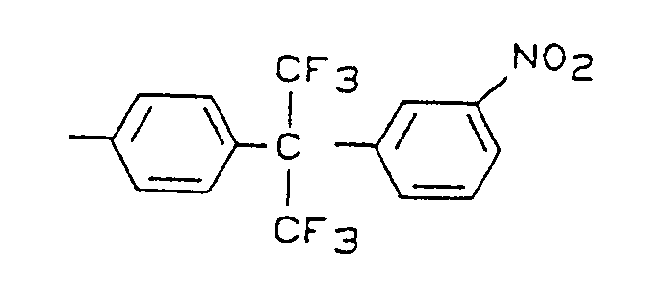
- Le composé selon la revendication 1, de formule :

- Procédé de préparation du composé de formule II selon la revendication 2 en plusieurs étapes, procédé caractérisé en ce que :1a) on condense le 2-(4-méthylphényl)-hexafluoropropanol-2 avec du benzène, ou bien1b) le 2-phénylhexafluoropropanol-2 avec du toluène, en présence de fluorure d'hydrogène,2) on oxyde le 2-(4-méthylphényl)-2-phényl-hexafluoropropane (III) ainsi obtenu en acide carboxylique correspondant (IV),3) en nitrant cet acide (IV) on obtient le 2-(4-carboxyphényl)-2-(3-nitrophényl)-hexafluoropropane (V)4) que l'on transforme par réaction avec l'acide aminosulfonique en 2-(4-carboxylamidophényl)-2-(3-nitrophényl)-hexafluoropropane (VI),5) en faisant réagir ce composé (VI) en milieu alcalin avec une solution d'un hypohalogénite de métal alcalin on forme le 4,4′-bis-[2-(3-nitrophényl)-hexafluoroisopropyl]-azobenzène (VII)6) que l'on réduit ensuite en 2-(3-aminophényl)-2-(4-aminophényl)-hexafluoropropane (II).
- Procédé selon la revendication 3, caractérisé en ce qu'il se forme dans l'étape 5), en plus du composé (VII), une moindre proportion de 2-(3-nitrophényl)-2-(4-aminophényl)-hexafluoropropane (composé VIIa).
- Procédé selon la revendication 3, caractérisé en ce que l'on effectue la réduction de l'étape 6) par voie catalytique avec des catalyseurs d'hydrogénation de métaux de transition de la classification périodique des éléments, en particulier avec au moins un métal du sous-groupe VIII de cette classification, ou bien suivant des méthodes stoechiométriques.
- Procédé selon une ou plusieurs des revendications 3 à 5, caractérisé en ce que l'on réduit dans l'étape 6) les composés (V), (VI) et (VIIa) en leurs composés aminés correspondants.
- Procédé selon la revendication 3, caractérisé en ce que l'on effectue l'oxydation du composé (III) en faisant passer de l'oxygène dans un milieu organique acide à des températures de 120 à 220 °C et sous une pression de 5 à 40 bar, en présence d'un mélange de composés du cobalt et du manganèse ainsi que d'ions bromure.
- Procédé selon la revendication 7, caractérisé en ce que le rapport du cobalt au manganèse est de 3:1 à 1:3, de préférence de 1:1, la somme des concentrations des deux éléments cobalt et manganèse étant de 0,01-0,20 atome-g par kg de la masse réactionnelle totale, de préférence de 0,02-0,12 et en particulier de 0,04-0,08 atome-g par kg.
- Procédé selon la revendication 7 ou 8, caractérisé en ce que le catalyseur comprend en outre des ions cérium dans un rapport de la somme du cobalt et du manganèse au cérium tel que 1:0,02-2, de préférence de 1:0,05-1 et en particulier de 1:0,2-0,6.
- Procédé selon une ou plusieurs des revendications 7 à 9, caractérisé en ce que les ions de métaux sont ajoutés sous la forme d'acétates.
- Procédé selon une ou plusieurs des revendications 7 à 10, caractérisé en ce que l'on ajoute le brome à l'état de bromures ou bien en une solution de bromure d'hydrogène dans de l'eau ou de l'acide acétique cristallisable.
- L'emploi du composé de la revendication 2 pour fabriquer des amides et imides d'acides polycarboxyliques linéaires.
- Emploi selon la revendication 12, caractérisé en ce que l'on fabrique des objets moulés, des pellicules ou des fibres.
Applications Claiming Priority (3)
| Application Number | Priority Date | Filing Date | Title |
|---|---|---|---|
| DE3833338A DE3833338A1 (de) | 1988-09-30 | 1988-09-30 | Fluorhaltige monomere, verfahren zu ihrer herstellung und ihre verwendung |
| DE3833338 | 1988-09-30 | ||
| US08/093,932 US5288908A (en) | 1988-09-30 | 1993-07-19 | Process for the preparation of fluorine containing monomers |
Publications (2)
| Publication Number | Publication Date |
|---|---|
| EP0361486A1 EP0361486A1 (fr) | 1990-04-04 |
| EP0361486B1 true EP0361486B1 (fr) | 1993-03-03 |
Family
ID=25872753
Family Applications (1)
| Application Number | Title | Priority Date | Filing Date |
|---|---|---|---|
| EP89117996A Expired - Lifetime EP0361486B1 (fr) | 1988-09-30 | 1989-09-28 | Monomères fluorés, procédé pour leur préparation et leur utilisation |
Country Status (5)
| Country | Link |
|---|---|
| US (1) | US5288908A (fr) |
| EP (1) | EP0361486B1 (fr) |
| JP (1) | JPH02209849A (fr) |
| CN (1) | CN1023118C (fr) |
| DE (1) | DE3833338A1 (fr) |
Families Citing this family (5)
| Publication number | Priority date | Publication date | Assignee | Title |
|---|---|---|---|---|
| DE4022997A1 (de) * | 1989-07-19 | 1991-01-31 | Central Glass Co Ltd | Asymmetrische 2,2-bisarylhexafluorpropane und verfahren zu ihrer herstellung |
| DE4020184A1 (de) * | 1990-06-25 | 1992-01-02 | Hoechst Ag | Teilfluorierte biphenyle, verfahren zu ihrer herstellung und ihre verwendung |
| JP3351065B2 (ja) * | 1993-10-29 | 2002-11-25 | 日本メクトロン株式会社 | 2,2−ジフェニルヘキサフルオロプロパン類の製造法 |
| US5637772A (en) * | 1995-09-22 | 1997-06-10 | Aerojet General Corporation | Fluorinated diamines and polymers formed therefrom |
| CN114230791B (zh) * | 2021-12-29 | 2023-10-24 | 山东华夏神舟新材料有限公司 | 本征型低介电含氟聚酰亚胺薄膜及其制备方法 |
Family Cites Families (8)
| Publication number | Priority date | Publication date | Assignee | Title |
|---|---|---|---|---|
| US3310573A (en) * | 1963-06-17 | 1967-03-21 | Du Pont | Diaryl fluoro compounds |
| US3356648A (en) * | 1966-10-13 | 1967-12-05 | Du Pont | Polyamide-acids and polyimides from hexafluoropropylidine bridged diamine |
| US4370501A (en) * | 1981-10-05 | 1983-01-25 | Hughes Aircraft Company | Synthesis of bis(aminophenyl) compounds |
| DE3526010A1 (de) * | 1984-07-20 | 1986-01-30 | Japan Synthetic Rubber Co., Ltd., Tokio/Tokyo | In organischen loesungsmitteln loesliches polyimid und verfahren zu seiner herstellung |
| US4645824A (en) * | 1985-11-25 | 1987-02-24 | Hughes Aircraft Company | Method of preparing high molecular weight polyimide, product and use |
| US4711964A (en) * | 1986-05-08 | 1987-12-08 | University Of Dayton | Bisdiene from bis-benzocyclobutene compound |
| US4758380A (en) * | 1986-10-29 | 1988-07-19 | The United States Of America As Represented By The Administrator Of The National Aeronautics And Space Administration | Substituted 1,1,1-triaryl-2,2,2-trifluoroethanes and processes for their synthesis |
| US4952669A (en) * | 1988-09-30 | 1990-08-28 | Hoechst Celanese Corp. | Copolyimides prepared from 2-(3-aminophenyl)-2-(4-aminophenyl) Hexafluoro propane |
-
1988
- 1988-09-30 DE DE3833338A patent/DE3833338A1/de not_active Withdrawn
-
1989
- 1989-09-28 CN CN89107560.7A patent/CN1023118C/zh not_active Expired - Fee Related
- 1989-09-28 EP EP89117996A patent/EP0361486B1/fr not_active Expired - Lifetime
- 1989-09-29 JP JP1252460A patent/JPH02209849A/ja active Pending
-
1993
- 1993-07-19 US US08/093,932 patent/US5288908A/en not_active Expired - Fee Related
Also Published As
| Publication number | Publication date |
|---|---|
| US5288908A (en) | 1994-02-22 |
| CN1041358A (zh) | 1990-04-18 |
| JPH02209849A (ja) | 1990-08-21 |
| CN1023118C (zh) | 1993-12-15 |
| EP0361486A1 (fr) | 1990-04-04 |
| DE3833338A1 (de) | 1990-05-31 |
Similar Documents
| Publication | Publication Date | Title |
|---|---|---|
| EP0361486A1 (fr) | Monomères fluorés, procédé pour leur préparation et leur utilisation | |
| CH642626A5 (de) | Alkenylphenylmaleinsaeureimidderivate, lineare dimere davon und verfahren zu deren herstellung. | |
| EP0317882B1 (fr) | Composés contenant du fluor à base du bis[(hydroxy-4-phényl)-2-hexafluoroisopropyl](-4,4'-)diphényléther, procédé pour leur préparation et leur utilisation | |
| DD239591A5 (de) | Verfahren zur herstellung von 2,4-dichlor-5-fluor-benzoesaeure | |
| EP0551632B1 (fr) | Procédé de préparation d'acide anthranilique halogénée | |
| DE2737210A1 (de) | Verfahren zur herstellung von nitrilen | |
| DE3721839A1 (de) | Verfahren zur herstellung von 2,2-bis-(3,4-diaminophenyl)-hexafluorpropan | |
| DE3909881A1 (de) | Hexafluorisopropylgruppenhaltige monomere, verfahren zu ihrer herstellung und ihre verwendung | |
| DE4438366A1 (de) | Verfahren zur Herstellung von N-Alkenylcarbonsäureamiden | |
| US5856557A (en) | Process for producing hexafluorobiphenyl -3,3',4,4'-Tetracarboxylic acid precursors | |
| EP0481316B1 (fr) | Procédé pour la préparation du 2,2-bis(aminophényl)-propane | |
| EP0510490B1 (fr) | Procédé de préparation d'acide 2,3,4,5-tetrafluorobenzoique | |
| DE3300821A1 (de) | Verfahren zur herstellung von 3,3'- oder 3,4'-diaminobenzophenon | |
| DE3305654C2 (fr) | ||
| DE19521588A1 (de) | N-substituierte cis-N-Propenyl-acetamide und Verfahren zu ihrer Herstellung | |
| DE4321273A1 (de) | Verfahren zur Herstellung von Aminopropionitrilen | |
| EP0005484B1 (fr) | Procédé de préparation de cyanures d'acides carboxyliques | |
| PL121520B1 (en) | Process for preparing n,n-disubstituted halogenacylamides | |
| DE3308659C2 (fr) | ||
| DE3875501T2 (de) | Verfahren zur herstellung eines benzoesaeurederivates. | |
| EP0043490B1 (fr) | Préparation de cyanides acylées | |
| EP0529426A2 (fr) | Procédé de préparation des acides nitrobenzoiques et anthraniliques | |
| WO2001072690A2 (fr) | Procede de preparation d'ester de methyle d'acide n-butyryl-4-amino-3-methyl-benzoique et le nouveau compose n-(4-brome-2-methylphenyl)-butanamide | |
| CA1339126C (fr) | Monomeres fluores; methodes de preparation et utilisation | |
| DE3739799A1 (de) | Fluorhaltige verbindungen auf basis von 4,4'-bis(2-(4-hydroxyphenyl)hexafluorisopropyl) diphenylether, verfahren zu ihrer herstellung und ihre verwendung |
Legal Events
| Date | Code | Title | Description |
|---|---|---|---|
| PUAI | Public reference made under article 153(3) epc to a published international application that has entered the european phase |
Free format text: ORIGINAL CODE: 0009012 |
|
| AK | Designated contracting states |
Kind code of ref document: A1 Designated state(s): BE CH DE FR GB IT LI NL |
|
| 17P | Request for examination filed |
Effective date: 19900609 |
|
| 17Q | First examination report despatched |
Effective date: 19920129 |
|
| GRAA | (expected) grant |
Free format text: ORIGINAL CODE: 0009210 |
|
| AK | Designated contracting states |
Kind code of ref document: B1 Designated state(s): BE CH DE FR GB IT LI NL |
|
| REF | Corresponds to: |
Ref document number: 58903652 Country of ref document: DE Date of ref document: 19930408 |
|
| ITF | It: translation for a ep patent filed | ||
| GBT | Gb: translation of ep patent filed (gb section 77(6)(a)/1977) |
Effective date: 19930511 |
|
| ET | Fr: translation filed | ||
| PG25 | Lapsed in a contracting state [announced via postgrant information from national office to epo] |
Ref country code: BE Effective date: 19930930 |
|
| PGFP | Annual fee paid to national office [announced via postgrant information from national office to epo] |
Ref country code: NL Payment date: 19930930 Year of fee payment: 5 |
|
| PLBE | No opposition filed within time limit |
Free format text: ORIGINAL CODE: 0009261 |
|
| STAA | Information on the status of an ep patent application or granted ep patent |
Free format text: STATUS: NO OPPOSITION FILED WITHIN TIME LIMIT |
|
| 26N | No opposition filed | ||
| BERE | Be: lapsed |
Owner name: HOECHST A.G. Effective date: 19930930 |
|
| PG25 | Lapsed in a contracting state [announced via postgrant information from national office to epo] |
Ref country code: NL Effective date: 19950401 |
|
| NLV4 | Nl: lapsed or anulled due to non-payment of the annual fee | ||
| PGFP | Annual fee paid to national office [announced via postgrant information from national office to epo] |
Ref country code: CH Payment date: 19950821 Year of fee payment: 7 |
|
| PG25 | Lapsed in a contracting state [announced via postgrant information from national office to epo] |
Ref country code: LI Effective date: 19960930 Ref country code: CH Effective date: 19960930 |
|
| PGFP | Annual fee paid to national office [announced via postgrant information from national office to epo] |
Ref country code: DE Payment date: 19961114 Year of fee payment: 8 |
|
| REG | Reference to a national code |
Ref country code: CH Ref legal event code: PL |
|
| PGFP | Annual fee paid to national office [announced via postgrant information from national office to epo] |
Ref country code: FR Payment date: 19970815 Year of fee payment: 9 |
|
| PGFP | Annual fee paid to national office [announced via postgrant information from national office to epo] |
Ref country code: GB Payment date: 19970901 Year of fee payment: 9 |
|
| PG25 | Lapsed in a contracting state [announced via postgrant information from national office to epo] |
Ref country code: DE Free format text: LAPSE BECAUSE OF NON-PAYMENT OF DUE FEES Effective date: 19980603 |
|
| PG25 | Lapsed in a contracting state [announced via postgrant information from national office to epo] |
Ref country code: GB Free format text: LAPSE BECAUSE OF NON-PAYMENT OF DUE FEES Effective date: 19980928 |
|
| GBPC | Gb: european patent ceased through non-payment of renewal fee |
Effective date: 19980928 |
|
| PG25 | Lapsed in a contracting state [announced via postgrant information from national office to epo] |
Ref country code: FR Free format text: LAPSE BECAUSE OF NON-PAYMENT OF DUE FEES Effective date: 19990531 |
|
| REG | Reference to a national code |
Ref country code: FR Ref legal event code: ST |
|
| PG25 | Lapsed in a contracting state [announced via postgrant information from national office to epo] |
Ref country code: IT Free format text: LAPSE BECAUSE OF NON-PAYMENT OF DUE FEES;WARNING: LAPSES OF ITALIAN PATENTS WITH EFFECTIVE DATE BEFORE 2007 MAY HAVE OCCURRED AT ANY TIME BEFORE 2007. THE CORRECT EFFECTIVE DATE MAY BE DIFFERENT FROM THE ONE RECORDED. Effective date: 20050928 |