EP0361650A2 - Grünlicht emittierendes Phosphor - Google Patents
Grünlicht emittierendes Phosphor Download PDFInfo
- Publication number
- EP0361650A2 EP0361650A2 EP89307300A EP89307300A EP0361650A2 EP 0361650 A2 EP0361650 A2 EP 0361650A2 EP 89307300 A EP89307300 A EP 89307300A EP 89307300 A EP89307300 A EP 89307300A EP 0361650 A2 EP0361650 A2 EP 0361650A2
- Authority
- EP
- European Patent Office
- Prior art keywords
- phosphor
- zns
- present
- amount
- copper
- Prior art date
- Legal status (The legal status is an assumption and is not a legal conclusion. Google has not performed a legal analysis and makes no representation as to the accuracy of the status listed.)
- Granted
Links
Images




Classifications
-
- C—CHEMISTRY; METALLURGY
- C09—DYES; PAINTS; POLISHES; NATURAL RESINS; ADHESIVES; COMPOSITIONS NOT OTHERWISE PROVIDED FOR; APPLICATIONS OF MATERIALS NOT OTHERWISE PROVIDED FOR
- C09K—MATERIALS FOR MISCELLANEOUS APPLICATIONS, NOT PROVIDED FOR ELSEWHERE
- C09K11/00—Luminescent materials, e.g. electroluminescent or chemiluminescent
- C09K11/08—Luminescent materials, e.g. electroluminescent or chemiluminescent containing inorganic luminescent materials
- C09K11/64—Luminescent materials, e.g. electroluminescent or chemiluminescent containing inorganic luminescent materials containing aluminium
- C09K11/641—Chalcogenides
- C09K11/642—Chalcogenides with zinc or cadmium
-
- C—CHEMISTRY; METALLURGY
- C09—DYES; PAINTS; POLISHES; NATURAL RESINS; ADHESIVES; COMPOSITIONS NOT OTHERWISE PROVIDED FOR; APPLICATIONS OF MATERIALS NOT OTHERWISE PROVIDED FOR
- C09K—MATERIALS FOR MISCELLANEOUS APPLICATIONS, NOT PROVIDED FOR ELSEWHERE
- C09K11/00—Luminescent materials, e.g. electroluminescent or chemiluminescent
- C09K11/08—Luminescent materials, e.g. electroluminescent or chemiluminescent containing inorganic luminescent materials
- C09K11/77—Luminescent materials, e.g. electroluminescent or chemiluminescent containing inorganic luminescent materials containing rare earth metals
- C09K11/7701—Chalogenides
- C09K11/7702—Chalogenides with zinc or cadmium
-
- C—CHEMISTRY; METALLURGY
- C09—DYES; PAINTS; POLISHES; NATURAL RESINS; ADHESIVES; COMPOSITIONS NOT OTHERWISE PROVIDED FOR; APPLICATIONS OF MATERIALS NOT OTHERWISE PROVIDED FOR
- C09K—MATERIALS FOR MISCELLANEOUS APPLICATIONS, NOT PROVIDED FOR ELSEWHERE
- C09K11/00—Luminescent materials, e.g. electroluminescent or chemiluminescent
- C09K11/08—Luminescent materials, e.g. electroluminescent or chemiluminescent containing inorganic luminescent materials
- C09K11/77—Luminescent materials, e.g. electroluminescent or chemiluminescent containing inorganic luminescent materials containing rare earth metals
- C09K11/7715—Luminescent materials, e.g. electroluminescent or chemiluminescent containing inorganic luminescent materials containing rare earth metals containing cerium
- C09K11/7716—Chalcogenides
- C09K11/7717—Chalcogenides with zinc or cadmium
-
- C—CHEMISTRY; METALLURGY
- C09—DYES; PAINTS; POLISHES; NATURAL RESINS; ADHESIVES; COMPOSITIONS NOT OTHERWISE PROVIDED FOR; APPLICATIONS OF MATERIALS NOT OTHERWISE PROVIDED FOR
- C09K—MATERIALS FOR MISCELLANEOUS APPLICATIONS, NOT PROVIDED FOR ELSEWHERE
- C09K11/00—Luminescent materials, e.g. electroluminescent or chemiluminescent
- C09K11/08—Luminescent materials, e.g. electroluminescent or chemiluminescent containing inorganic luminescent materials
- C09K11/77—Luminescent materials, e.g. electroluminescent or chemiluminescent containing inorganic luminescent materials containing rare earth metals
- C09K11/7728—Luminescent materials, e.g. electroluminescent or chemiluminescent containing inorganic luminescent materials containing rare earth metals containing europium
- C09K11/7729—Chalcogenides
- C09K11/773—Chalcogenides with zinc or cadmium
-
- C—CHEMISTRY; METALLURGY
- C09—DYES; PAINTS; POLISHES; NATURAL RESINS; ADHESIVES; COMPOSITIONS NOT OTHERWISE PROVIDED FOR; APPLICATIONS OF MATERIALS NOT OTHERWISE PROVIDED FOR
- C09K—MATERIALS FOR MISCELLANEOUS APPLICATIONS, NOT PROVIDED FOR ELSEWHERE
- C09K11/00—Luminescent materials, e.g. electroluminescent or chemiluminescent
- C09K11/08—Luminescent materials, e.g. electroluminescent or chemiluminescent containing inorganic luminescent materials
- C09K11/77—Luminescent materials, e.g. electroluminescent or chemiluminescent containing inorganic luminescent materials containing rare earth metals
- C09K11/7743—Luminescent materials, e.g. electroluminescent or chemiluminescent containing inorganic luminescent materials containing rare earth metals containing terbium
- C09K11/7744—Chalcogenides
- C09K11/7745—Chalcogenides with zinc or cadmium
-
- C—CHEMISTRY; METALLURGY
- C09—DYES; PAINTS; POLISHES; NATURAL RESINS; ADHESIVES; COMPOSITIONS NOT OTHERWISE PROVIDED FOR; APPLICATIONS OF MATERIALS NOT OTHERWISE PROVIDED FOR
- C09K—MATERIALS FOR MISCELLANEOUS APPLICATIONS, NOT PROVIDED FOR ELSEWHERE
- C09K11/00—Luminescent materials, e.g. electroluminescent or chemiluminescent
- C09K11/08—Luminescent materials, e.g. electroluminescent or chemiluminescent containing inorganic luminescent materials
- C09K11/77—Luminescent materials, e.g. electroluminescent or chemiluminescent containing inorganic luminescent materials containing rare earth metals
- C09K11/7766—Luminescent materials, e.g. electroluminescent or chemiluminescent containing inorganic luminescent materials containing rare earth metals containing two or more rare earth metals
- C09K11/7767—Chalcogenides
-
- C—CHEMISTRY; METALLURGY
- C09—DYES; PAINTS; POLISHES; NATURAL RESINS; ADHESIVES; COMPOSITIONS NOT OTHERWISE PROVIDED FOR; APPLICATIONS OF MATERIALS NOT OTHERWISE PROVIDED FOR
- C09K—MATERIALS FOR MISCELLANEOUS APPLICATIONS, NOT PROVIDED FOR ELSEWHERE
- C09K11/00—Luminescent materials, e.g. electroluminescent or chemiluminescent
- C09K11/08—Luminescent materials, e.g. electroluminescent or chemiluminescent containing inorganic luminescent materials
- C09K11/77—Luminescent materials, e.g. electroluminescent or chemiluminescent containing inorganic luminescent materials containing rare earth metals
- C09K11/7783—Luminescent materials, e.g. electroluminescent or chemiluminescent containing inorganic luminescent materials containing rare earth metals containing two or more rare earth metals one of which being europium
- C09K11/7784—Chalcogenides
- C09K11/7785—Chalcogenides with zinc or cadmium
Definitions
- the present invention relates to a green emitting phosphor for use in a color cathode ray tube, and a cathode ray tube using the said phosphor. More particularly, the present invention relates to a copper, gold and aluminum activated zinc sulphide green emitting phosphor having baking and luminescent characteristics improved by adding at least a trace of one element selected from the group consisting of Ce, Tb, Eu, Sc and La; and a color cathode ray tube coated with a phosphor layer comprising of a green emitting phosphor having a formula [ZnS:Cu, Au, Al, M] (where M indicates at least one element of Ce, Tb, Eu, Sc and La).
- a color cathode ray tube is of a construction such that the luminescent screen is coated with red, green and blue emitting phosphors in the form of dots or stripes, and these phosphor layers are excited by electron beams projected from corresponding electron guns through a shadow mask so that the colors may be reproducted differently depending on the excitation levels.
- europium activated yttrium oxysulphide phosphor (Y2 O2 S: Eu) or europium activated yttrium oxide phosphor (Y2 O3 : Eu) is used as the red emitting phosphor, while silver activated zinc suplphide phosphor (ZnS: Ag) is used as the blue emitting phosphor.
- europium activated yttrium oxysulphide phosphor Y2 O2 S: Eu
- europium activated yttrium oxide phosphor Y2 O3 : Eu
- silver activated zinc suplphide phosphor ZnS: Ag
- the green emitting phosphor for use in a color cathode ray tube includes a copper and aluminum activated zinc sulphide phosphor (hereinafter often referred to as "ZnS: CuAl”), a copper and aluminum activated zinc-cadmium sulphide phosphor(hereinafter often referred to as “(ZnCd)S: CuAl”), or a copper, gold and aluminum activated zinc sulphide phosphor (hereinafter often referred to as "ZnS: CuAuAl").
- ZnS copper and aluminum activated zinc sulphide phosphor
- ZnCd copper and aluminum activated zinc-cadmium sulphide phosphor
- ZnS: CuAuAl a copper, gold and aluminum activated zinc sulphide phosphor
- the ZnS:CuAl phosphor is slightly shifted in emission color to the shorter wavelength side, and therefore, shows an insufficiency in the white luminance color when it is used in a color cathode ray tube.
- the current allocation for the red emitting phosphor which is the lowest in the light emission efficiency among the red, blue and green emitting phosphor has to be increased, thereby shortening the life expectancy of the cathode or the electron gun, and ultimately deteriorating the quality of image formed on the cathode ray tube. Due to this disadvantage, phosphor of this type is not used in most cases at present.
- the (ZnCd)S: CuAl phosphor is usually superior to the ZnS: CuAl phosphor and the ZnS: CuAuAl phosphor in its emission color and the emission luminance, but the cadmium(Cd) included in the phosphor is toxic to the human body and causes air pollution, and therefore, its use has been discouraged (See Japanese Patent Publication No. 55-33834).
- the phosphor ZnS: CuAl and (ZnCd)S: CuAl has recently been used as the green emitting component for a color cathode ray tube. (See Japanese Patent Publication No. 60-21713.)
- this ZnS: Cu Au Al green emitting phosphor is not desirable as it has an emission luminance which is about 5 ⁇ 12% lower than the (Zn Cd)S:Cu Al green emitting phosphor, and especially in a high contrast color cathode ray tube, a phosphor having a high emission luminance is demanded commercially.
- the composition of the phosphor ZnS: CuAuAl according to the present invention is such that, in the case where the amount of copper as an activator is 2 X 10 ⁇ 5 g to 3 ⁇ 10 ⁇ 4 g , the amount of gold as an activator is 5 ⁇ 10 ⁇ 5 g to 2.5 ⁇ 10 ⁇ 3 g, and the amount of aluminum as a coactivator is 3.5 ⁇ 10 ⁇ 5 g to 5 ⁇ 10 ⁇ 2 g per 1g of the host material zinc sulphide, the amounts of the material to be additionally selectively added will be: europium(O ⁇ Eu ⁇ 4 ⁇ 10 ⁇ 4 g), cerium(O ⁇ Ce ⁇ 5 ⁇ 10 ⁇ 3 g), terbium(O ⁇ Tb ⁇ 6 ⁇ 10 ⁇
- the respective amount of activators, Cu, Au and Al are conveniently 2 ⁇ 10 ⁇ 5 g to 3 ⁇ 10 ⁇ 4 g, 5 ⁇ 10 ⁇ 5 g to 2.5 ⁇ 10 ⁇ 4 g, and 3.5 ⁇ 10 ⁇ 5 g to 5.0 ⁇ 10 ⁇ 2 g, while additions will be such that Ce is more than 0g and not exceeding 2.5 ⁇ 10 ⁇ 3 g, Eu is more than 0g and not exceeding 3 ⁇ 10 ⁇ 4 g.
- This phosphor according to the present invention having the formula [ZnS: Cu Au Al M] (where M indicates one element selected from the group consisting of Ce, Tb, Eu, Sc and La) has a higher emitting luminance compared with the phosphor ZnS:Cu Au Al according to the conventional technology which does not include Ce, Tb, Eu, Sc and/or La, while its emission color is substantially the same as that of the conventional ones.
- Ce, Tb, Eu, Sc and La are thought to be playing the role of sensitizers within the crystals of the host material, zinc sulphide.
- the present invention also provides a process for preparing [ZnS: Cu Au Al M] phosphor according to the present invention.
- a process for preparing a green emitting phosphor comprising copper, gold and aluminum in the amounts of 2 ⁇ 10 ⁇ 5 g to 3 ⁇ 10 ⁇ 4 g ,5 ⁇ 10 ⁇ 5 g to 2.5 ⁇ 10 ⁇ 3 g, and 3.5 ⁇ 10 ⁇ 5 g to 5 ⁇ 10 ⁇ 2 g, respectvely per 1 gram of the host material zinc sulphide is composed of the step of
- the composition of the phosphor ZnS: CuAuAl according to the present invention is conveniently such that, in the case where an amount of copper is 2 ⁇ 10 ⁇ 5 g to 3 ⁇ 10 ⁇ 4 g , an amount of gold is 5 ⁇ 10 ⁇ 5 g to 2.5 ⁇ 10 ⁇ 3 g, and an amount of aluminum is 3.5 ⁇ 10 ⁇ 5 g to 5 ⁇ 10 ⁇ 2 g per 1 g of the host material zinc sulphide, the amounts of the material to be additionally selectively added will be: europium (0 ⁇ Eu ⁇ 4 ⁇ 10 ⁇ 4 g), cerium(0 ⁇ Ce ⁇ 5 ⁇ 10 ⁇ 3 g), terbium (0 ⁇ Tb ⁇ 6 ⁇ 10 ⁇ 5 g), scandium (0 ⁇ Sc ⁇ 2.0 ⁇ 10 ⁇ 4 g), and lanthanum ( 0 ⁇ La ⁇ 1.2 ⁇ 10 ⁇ 3 g).
- the activators are added in such a manner that copper (Cu) is added in compound form such as copper sulphate(CuSO4 ⁇ 5H2 O), or copper nitrate [Cu(NO3 )2 ⁇ 6H2 O], gold (Au) is added in compound form such as chloroauric acid (HAuCl4 ⁇ 2H2 O); and the coactivators are added in such a mannner that aluminum (Al) is added in compound form such as aluminum sulphate (Al2 (SO4 )3 ⁇ 18H2 O), aluminum nitrate(Al(NO3 )3 ⁇ 9H2 O), and the like, while cerium is added in compound form such as cerium oxide (CeO2 ), cerium nitrate (Ce(NO3 )3 ), terbium is added in compound form such as terbium oxide (Tb4 O7 ) and terbium fluoride (TbF3 ),europium is added in
- the above materials can be added by a dry method or a wet method in which an appropriate solvent is used.
- alkali metal halides, alkaline earth metal halides and ammonium halide can be used as the general flux.
- sulfur can be added as an antioxidant.
- the above-mentioned activators, coactivators, and additives have to be adequately mixed together by means of a ball mill or a milling rod.
- the mixture of the materials obtained through the above mentioned mixing operations is filled into a pot made of a heat resistant material such as quartz or alumina, and is baked in it.
- the baking process is carried out in a reducing atmosphere containing hydrogen sulphide or carbon disulphide gas.
- the desirable baking temperature is in the range of 95°C to 105°C, and the duration of the baking can vary depending on the baking temperature, but comes within the range of 30 minutes to 6 hours.
- the phosphor obtained after the baking treatment is subjected to various steps such as washing, drying, and grading and the like to finally obtain the green emitting phosphor according to the present invention.
- the phosphor according to the present invention thus obtained will display a high emission luminance of green color and will be thermally stabilized.
- a cathode ray tube may be manufactured based on the known method, using [ZnS:Cu Au Al M] (where M is at least one element selected from the group consisting of Ce, Tb, Eu, Sc and La) phosphor as the green luminescent component, Y2 O2 S: Eu phosphor as the red luminescent component, and ZnS: Ag phosphor as the blue luminescent component.
- M is at least one element selected from the group consisting of Ce, Tb, Eu, Sc and La
- Y2 O2 S Eu phosphor as the red luminescent component
- ZnS Ag phosphor as the blue luminescent component.
- the baking temperature after the formation of the phosphor layer was maintained at 460°C for several hours, but even after such a step, the green emitting phosphor [ZnS: Cu Au Al M] of the phosphor layer of the cathode ray tube showed the emission luminance and emission color almost the same as that before the formation of the phosphor layer.
- Figure 1 shows the relationship between the content of cerium (Ce) and the emission luminance in a green emitting phosphor (ZnS: Cu Au Al Ce) according to the present invention in which the amount of a copper is 1.5 ⁇ 10 ⁇ 4 g, and the amount of a gold is 1.4 ⁇ 10 ⁇ 4 g.
- the abscissa in Figure 1 represents the number of grams of cerium (Ce) per 1 gram of the host materical ZnS, while the ordinate thereof shows the emission luminance of the green emitting phosphor in relative figures as against the case where the ZnS: Cu Au Al green emitting phosphor without containing cerium (Ce) is assumed to be 100%.
- the phosphor according to the present invention has the characteristics that, if the content of cerium is more than 0g and less than 5 ⁇ 10 ⁇ 3 g for 1 gram of ZnS, then the phosphor according to the present invention produces a higher emission luminance over the conventional [ZnS: Cu Au Al] phosphor, and particularly, if the cerium content is within the range of 1 ⁇ 10 ⁇ 5 g to 1 ⁇ 10 ⁇ 3 g per 1 gram of the host material zinc sulphide, the emission luminance of the phosphor according to the present invention is markedly improved.
- the drawing shows the relationship between the cerium content and the emission luminance when the amount of copper is 1.5 ⁇ 10 ⁇ 4 g and the amount of gold is 1.4 ⁇ 10 ⁇ 4 g per 1 gram of the host material zinc sulphide, it has been confirmed that the relationship between the cerium content and the emission luminance is almost the same as that of Figure 1 even in the case where the amounts of the copper and gold are different.
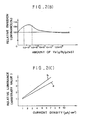
- Figure 2(A) is an examplarily diagram of chromaticity against the variations of the content of terbium when copper, gold and aluminum are added respectively in amounts of 1.1 ⁇ 10 ⁇ 4 g, 1.5 ⁇ 10 ⁇ 4 g, and 3 ⁇ 10 ⁇ 4 g, per 1 gram of the host material zinc sulphide.
- the chromaticity is steeply varied.
- Figure 2(B) shows the variations of the emission luminance against the variations of the terbium content when copper, gold and aluminum are added respectively in amounts of 1.1 ⁇ 10 ⁇ 4 g, 1.5 ⁇ 10 ⁇ 4 g, and 3 ⁇ 10 ⁇ 4 g per 1 gram of the host material zinc sulphide.
- This drawing shows relative figures as against the case where the conventional [ZnS: Cu Au Al] phosphor which does not contain terbium is assumed to have the emission luminance of 100%, and that the emission luminance is markedly improved within the range where the terbium content comes between 2.0 ⁇ 10 ⁇ 5 g, and 4.0 ⁇ 10 ⁇ 5 g.
- Figure 2(C) is an examplary diagram showing the relative luminance values as against the variations of the current density when the phosphor is composed such that, per 1 gram of the host material zinc sulphide, copper, gold and aluminum are added respectively in the amounts of 1.1 ⁇ 10 ⁇ 4 g, 1.5 ⁇ 10 ⁇ 4 g, and 3 ⁇ 10 ⁇ 4 g and terbium is added in the amount of 3.0 ⁇ 10 ⁇ 5 g, where the curve (a) represents the characteristics of a conventional phosphor and the curve (b) represents the characteristics of a phosphor according to the present invention.
- Figure 2(C) gives a graphical illustration of the characteristics of the phosphor according to the present invention based on the condition that the contents of copper, gold and aluminum are 1.1 ⁇ 10 ⁇ 4 g, 1.5 ⁇ 10 ⁇ 4 g and 3 ⁇ 10 ⁇ 4 g respectively, a phosphor having different contents of copper, gold and aluminum is confirmed to display substantially the same trend as that of Figure 2(C) if terbium is added into the phosphor.
- Figure 3 shows the relationship between the content of europium and the emission luminance in a green emitting phosphor (ZnS: Cu Au Al) in which the amounts of the copper and gold are 1.1 ⁇ 10 ⁇ 4 g and 1.5 ⁇ 10 ⁇ 4 g respectively.
- the abscissa represents the europium contents per 1 gram of the host material zinc sulphide, while the ordinate represents relative values of the emission luminance as against the case where [ZnS: Cu Au Al] green emitting phosphor having the same contents of copper and gold as indicated above but which does not contain europium is assumed to have the emission luminance of 100%.
- the phosphor according to the present invention produces a higher luminance over the conventional [ZnS: Cu Au Al] phosphor in the range where the content of europium is more than 0 and less than 4 ⁇ 10 ⁇ 4 g per 1 gram of the host material and particularly, its emission luminance is markedly improved in the range where the content of europium is between 3 ⁇ 10 ⁇ 4 g and 1.0 ⁇ 10 ⁇ 4 g per 1 gram of the host material zinc sulphide.
- Figure 3 illustrates the case where the amount of the copper is 1.1 ⁇ 10 ⁇ 4 g, and the amount of the gold is 1.5 ⁇ 10 ⁇ 4 g, even if the amounts of the copper and gold are made to be different, the phosphor according to the present invention containing europium shows substantially the same trend as that of Figure 3.
- Figure 4(A) illustrates a case where the amounts of copper, gold and aluminum are 1.1 ⁇ 10 ⁇ 4 g, 2.0 ⁇ 10 ⁇ 4 g and 2.2 ⁇ 10 ⁇ 4 g respectively per 1 gram of the host material zinc sulphide, and here it can be observed that the chromaticity CIE is steeply varied in the section where the content of scandium is more than 0 and less than 5 ⁇ 10 ⁇ 5 g .
- Figure 4(B) shows the variations of the emission luminance as against the variations of the content of scandium in a phosphor according to the present invention in which the amounts of copper, gold and aluminum are 1.1 ⁇ 10 ⁇ 4 g, 2.0 ⁇ 10 ⁇ 4 g and 2.2 ⁇ 10 ⁇ 4 g respectively per 1 gram of the host materical zinc sulphide, with the values being relative ones as against the case where the conventional phosphor (ZnS: Cu Au Al) without containing scandium is assumed to have the emission luminance of 100%.
- the green emitting phosphor according to the present invention displays a markedly improved emission luminance in the range where the content of scandium is between 4.0 ⁇ 10 ⁇ 5 g and 6.0 ⁇ 10 ⁇ 5 g.
- Figure 5(A) shows the relative variations of the emission luminance as against the variations of the content of lanthanum (La) in [ZnS: Cu Au Al] phosphor of the present invention in which the amounts of copper, gold and aluminum are 1.1 ⁇ 10 ⁇ 4 g, 1.5 ⁇ 10 ⁇ 4 g and 3 ⁇ 10 ⁇ 4 g respectively per 1 gram of the host material zinc sulphide, with the values being relative ones as against the case where the conventional [ZnS: Cu Au Al] phosphor which does not contain lanthanum (La) is assumed to have the emission luminance of 100%.
- Figure 5(B) shows the variations of the chromaticity CIE as against the variations of the baking temperature
- the curve (a) representing the characteristics of the phosphor according to the present invention in which, per 1 gram of the host material zinc sulphide, the contents of copper, gold and aluminum are 1.1 ⁇ 10 ⁇ 4 g, 1.5 ⁇ 10 ⁇ 4 g and 3 ⁇ 10 ⁇ 4 g respectively, and the content of lanthanum is 4 ⁇ 10 ⁇ 4 g
- the curve (b) represents the characteristics of the conventional phosphor without containing lanthanum (La).
- the phosphor according to the present invention containing lanthanum has superior characteristics over the conventional one.
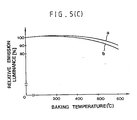
- Figure 5(C) shows the relative variations of the emission luminance as against the variations of the baking temperature, with the curve (a) representing the characteristics of the phosphor according to the present invention in which the contents of copper, gold, aluminum and lanthanum are 1.1 ⁇ 10 ⁇ 4 g, 1.5 ⁇ 10 ⁇ 4 g, 3 ⁇ 10 ⁇ 4 g and 5 ⁇ 10 ⁇ 4 g respectively, and with the curve (b) representing the characteristics of the conventional phosphor without containing lanthanum.
- the phosphor according to the present invention containing lanthanum is confirmed to have almost the same trend as that of Figure 5(C).
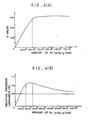
- Figure 6(A) shows the relationship between the emission luminance and the cerium (Ce) content in a phosphor according to the present invention (ZnS: Cu Au Al M) (where M indicates at least one element of Ce, Tb, Eu, Sc and La) in which the amounts of copper and gold are 1.5 ⁇ 10 ⁇ 4 g and 1.4 ⁇ 10 ⁇ 4 g respectively.
- the abscissa represents the number of grams of the contained cerium (Ce) per 1 gram of the host material zinc sulphide, while the ordinate represents relative values of the emission luminance as against the case where the conventional green emitting phosphor (ZnS: Cu Au Al) which does not contain cerium is assumed to have the emission luminance of 100%.
- the emission luminance of [ZnS: Cu Au Al Ce] phosphor according to the present invention is markedly improved in the range where the content of cerium (Ce) is between 5 ⁇ 10 ⁇ 5 g and 5 ⁇ 10 ⁇ 4 g per 1 gram of the host material zinc sulphide.
- cerium (Ce) should be added in an amount of more than 0 and less than 2.5 ⁇ 10 ⁇ 3 g per 1 gram of the host material zinc sulphide.
- Fuigure 6(B) shows the relationship between the emission luminance and the content of europium in [ZnS:Cu Au Al Eu] green emitting phosphor according to the present invention in which the amount of copper, gold and aluminum are 1.1 ⁇ 10 ⁇ 4 g, 1.5 ⁇ 10 ⁇ 4 g and 3 ⁇ 10 ⁇ 4 g respectively.
- the abscissa represents the number of grams of the contained europium per 1 gram of the host material zinc sulphide, while the ordinate represents the relative values of the emission luminance as against the case where the conventional [ZnS: Cu Au Al] green emitting phosphor which does not contain europium is assumed to have the emission luminance of 100.
- [ZnS: Cu Au Al Eu] phosphor according to the present invention displays a high luminescence in the range where the europium content is more than 0 and less than 4 ⁇ 10 ⁇ 4 g, and its emission luminance is markedly improved in the range where the europium content is between 5 ⁇ 10 ⁇ 5 g and 1.5 ⁇ 10 ⁇ 5 g, while, if the europium content is over 4 ⁇ 10 ⁇ 4 g, its emission luminance is lowered below the level of the conventional phosphor.
- the europium should be added in the amount of more than 0 and less than 4 X 10 ⁇ 4 g per 1 gram of the host material zinc sulphide.
- the cathode ray tube for use in a color television using the green emitting phosphor (ZnS: Cu Au Al M) (where M is at least one element of Ce, Tb, Eu, Sc, and La) according to the present invention makes it easy to carry out the baking process compared with the conventional color cathode ray tube using the convertional green emitting phosphor (ZnS: Cu Au Al).
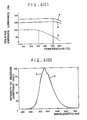
- Figure 6(C) shows comparatively the thermal stability of the phosphor (ZnS: Cu Au Al M) (where M is at least one element of Ce, Tb, Eu, Sc and La) of the present invention by the curves (a) and (b) and the thermal stablity of the conventional phosphor(ZnS: Cu Au Al) by the curve (c).
- the different luminances of the phosphor before the heating are indicated along the vertical axis of the coordinate of Figure 6(C).
- the experiment shows comparatively the characteristics of the conventional phosphor (ZnS: Cu Au Al) and two types of the phosphors of the present invention, of which cerium (Ce) is added in one(curve a), and europium Eu is added in another (curve b) with the contents of copper and gold being kept constant.
- the conventional green emitting phosphor(ZnS: Cu Au Al) is stable up to the temperature of 300°C, but the luminance is lowered beyond the said temperature.
- the green emitting phosphor (ZnS: Cu Au Al M) (where M is at least one element of Ce, Tb, Eu, Sc and La) according to the present invention is stable up to the temperature of about 500°C and there is no lowering of the luminance.
- the baking step carried out when forming the phosphor layer is aimed at decomposing and removing the binders in the phosphor layer, and therefore, it is required that it be carried out at a temperature of over 400°C
- the phosphor [ZnS: Cu Au Al M] (where M is at least one element of Ce, Tb, Eu, Sc and La) used in the cathode ray tube of the present invention shows a perfect stability at the usual baking temperature, and there appears to be no decrease of luminance.
- Figure 6(D) shows the emission spectra before and after the baking process of the green emitting phosphor (ZnS: Cu Au Al M) (where M is at least one element of Ce, Tb, fin, Sc and La) according to the present invention. That is, this drawing shows comparatively spectra before heating (curve a) and after the heating (curve b), the heating of the green emitting phosphor [ZnS: Cu Au Al M] (where M indicates at least one element of Ce, Tb, Eu, Sc and La) according to the present invention being carried out at 500°C for two hours.
- the present invention provides a cathode ray tube provided with a phosphor layer having a green component constituted by the green emitting phosphor [ZnS: Cu Au Al M] (where M is at least one element of Ce, Tb, Eu, Sc and La) according to the present invention.
- the cathode ray tube according to the present invention can be applied not only to a color television, but also a uni-color cathode ray tube having a phosphor layer constituted by the phosphor [ZnS: Cu Au Al M] (where M indicates at least one element of Ce, Tb, Eu, Sc and La).
- the cathode ray tube according to the present invention can also be manufactured by the usual method without using the said green emitting phosphor [ZnS: Cu Au Al M] (where M is at least one element of Ce, Tb, Eu, Sc and La). That is, the phosphor layer of the cathode ray tube according to the present invention can be prepared by the ordinary slurry method.
- EXAMPLE 1 Zinc sulphide Zns 1,000g * Cerium oxide CeO2 1.22 ⁇ 10 ⁇ 5 g * Copper sulphate CuSO4 ⁇ 5H2 O 0.59g * Chloroauric acid HAuCl4 ⁇ 2H2 O 0.27g * Aluminum nitrate Al(NO3 )3 ⁇ 9H2 O 4.17g * Potassium iodide KI 12g * Ammonium iodide NH4 I 10g * Sulfur S 20g
- the above materials were sufficiently mixed together by means of a ball mill, and the resulting mixture was filled into a guartz pot. After closing the pot with a cap, the pot was put into an electric kiln to bake it at 980°C for 3 hours.
- the baked product was taken out of the pot, washed and dried.
- the cerium-containing phosphor (ZnS: Cu Au Al Ce) according to the present invention was obtained in which the contents of cerium and the activating copper, gold and aluminum were 1 ⁇ 10 ⁇ 5 g, 1.5 ⁇ 10 ⁇ 4 g, 1.4 ⁇ 10 ⁇ 4 g, and 3 ⁇ 10 ⁇ 4 g respectively per 1 gram of the host material zinc sulphide.
- the said phosphor according to the present invention displayed a green emission upon being excited by an electron beam, and its luminance level was 119% compared with the conventional [ZnS: Cu Au Al] phosphor which does not contain cerium but with the same contents of the activating copper, gold and aluminum (the conventional phosphor which does not contain cerium was also prepared by the same method as that for the phosphor of the present invention, and it would be manufactured in the same way also in Example 2 and throughout).
- the materials were prepared in the same amount as in Example 1 except that the cerium oxide (CeO 2) content was 1.22X 10 ⁇ 4 g.
- a cerium-containing phosphor (ZnS: Cu Au Al Ce) according to the present invention was obtained in which the contents of cerium and the activating copper, gold and aluminum were 1 ⁇ 10 ⁇ 4 g, 1.5 ⁇ 10 ⁇ 4 g, 1.4 ⁇ 10 ⁇ 4 g, and 3 ⁇ 10 ⁇ 4 g respectively per 1 gram of the host material zinc sulphide.
- the said phosphor according to the present invention displayed a green emission upon being excited by an electron beam, and its luminance level was 120% compared with the conventional [ZnS: Cu Au Al] phosphor which does not contain cerium but with the same contents of the activating copper, gold and aluminum.
- the materials were prepared in the same amounts as in Example 1 except that the cerium oxide(CeO2 )content was 1.22 x 10 ⁇ 3 g.
- a cerium containing phosphor (ZnS: Cu Au Al Ce) according to the present invention was obtained in which the contents of cerium and the activating copper, gold and aluminum were 1 ⁇ 10 ⁇ 3 g, 1.5 ⁇ 10 ⁇ 4 g, 1.4 ⁇ 10 ⁇ 4 g, and 3 ⁇ 10 ⁇ 4 g respectively per 1 gram of the host material zinc sulphide.
- the said phosphor according to the present invention displayed a green emission upon being excited by an electron beam, and its luminance level was 118% compared with the conventional [ZnS: Cu Au Al] phosphor which does not contain cerium but with the same contents of the activating copper, gold and aluminum.
- EXAMPLE 4 Zinc sulphide ZnS 1,000g * Terbium oxide Tb4 O7 0.023g * Copper sulphate CuSO4 ⁇ 5H2 O 0.431g * Chloroauric acid HAuCl4 ⁇ 2H2 O 0.285g * Aluminum nitrate Al(NO3 )3 ⁇ 9H2 O 4.17g * Ammonium chloride NH4 Cl 1.2g * Sulfur S 25g
- the above materials were sufficiently mixed together by means of a ball mill, and the resulting mixture was filled into a pot. After closing the pot with a cap, the pot was put into an electric kiln to bake it under a reducing atmosphere containing carbon dioxide at 980°C for 1 hour.
- the baked product was taken out of the pot, washed and dried.
- the Terbium-conventional phosphor (ZnS: Cu Au Al Tb) according to the present invention was obtained in which the contents of Terbium and the activating copper, gold and aluminum were 2 ⁇ 10 ⁇ 5 g, 1.1 ⁇ 10 ⁇ 4 g, 1.5 ⁇ 10 ⁇ 4 g and 3 ⁇ 10 ⁇ 4 g respectively per 1 gram of the host material zinc sulphide.
- the said phosphor according to the present invention displayed the emission color having the longer wavelength and its luminance level was 4% compared with the conventional [ZnS: Cu Au Al] phosphor which does not contain cerium but with the same contents of the activating copper, gold and aluminum.
- the above materials were sufficiently mixed together by means of a ball mill, and the resulting mixture was filled into a pot. After closing the pot with a cap, the pot was put into an electric kiln to bake it under a reducing atmosphere containing carbon dioxide at 1,000°C for 1.5 hours.
- the terbium-conventional phosphor (ZnS: Cu Au Al Tb) according to the present invention was obtained in which the contents of terbium and the activating copper, gold and aluminum were 3 ⁇ 10 ⁇ 5 g, 1.0 ⁇ 10 ⁇ 4 g, 1.8 ⁇ 10 ⁇ 4 g and 4.0 ⁇ 10 ⁇ 4 g respectively per 1 gram of the host material zinc sulphide.
- the said phosphor according to the present invention displayed the emission color having the longer wavelength and its luminance level was 6% compared with the conventional [ZnS: Cu Au Al] phosphor without containing cerium but with the same contents of the activating copper, gold and aluminum.
- EXAMPLE 6 Zinc sulphide ZnS 1,000g * Terbium fluoride TbF3 0.054g * Copper sulphate CuSO4 ⁇ 5H2 O 0.353g * Chloroauric acid HAuCl4 ⁇ 2H2 O 0.38g * Aluminum nitrate Al(NO3 )3 ⁇ 9H2 O 6.95g * Potassium iodide KI 1.5g * Ammonium iodide NH4 I 1.6g * Sulfur S 35g
- the above materials were sufficiently mixed together by means of a ball mill, and the resulting mixture was filled into a pot.
- the baking process was carried out in the same manner as in Example(1) or (2).
- the terbium-conventional phosphor (ZnS: Cu Au Al Tb) according to the present invention was obtained in which the contents of terbium and the activating copper, gold and aluminum were 4 ⁇ 10 ⁇ 5 g, 9 ⁇ 10 ⁇ 5 g, 2 ⁇ 10 ⁇ 4 g and 5 ⁇ 10 ⁇ 4 g respectively per 1 gram of the host material zinc sulphide.
- the emission luminance of the phosphor according to the present invention was 6% compared with the conventional [ZnS: Cu Au Al] phosphor which does not contain terbium but with the same contents of a copper, gold and aluminum.
- the phosphor according to the present invention improved its emission luminance since it has the emission color of the longer wavelength.
- EXAMPLE 7 Zinc sulphide ZnS 1,000g * Europium Eu2 O3 0.035g * Copper sulphate CuSO4 ⁇ 5H2 O 0.432g * Chloroauric acid HAuCl4 ⁇ 2H2 O 0.289g * Aluminum sulphate Al(NO3 )3 ⁇ 9H2 O 4.17g * Potassium iodide KI 5g * Sulfur S 40g
- the above materials were sufficiently mixed together by means of a ball mill, and the resulting mixture was filled into a pot. After closing the pot with a cap, the pot was put into an electric kiln to bake it at 980°C for 2 hours.
- the baked product was taken out of the pot, washed and dried.
- the Europium-conventional phosphor (ZnS: Cu Au Al Eu) according to the present invention was obtained in which the contents of Europium and the activating copper, gold and aluminum were 3 ⁇ 10 ⁇ 5 g, 1.1 ⁇ 10 ⁇ 4 g, 1.5 ⁇ 10 ⁇ 5 g and 3 ⁇ 10 ⁇ 4 g respectively per 1 gram of the host material zinc sulphide.
- the said phosphor according to the present invention displayed a green emission upon being excited by an electron beam, and its luminance level was 10% higher compared with the conventional [ZnS: Cu Au Al] phosphor without containing cerium but with the same contents of the activating copper, gold and aluminum.
- the materials were prepared in the same amount as Example 1 except that europium oxide (Eu2 O3 ) was 0.058g.
- the materials were prepared in the same amount as Example 7 except that the europium oxide (Eu 2 O3) content was 0.104g.
- the above materials were sufficiently mixed together by means of a ball mill, and the resulting mixture was filled into a pot. After closing the pot with a cap, the pot was put into an electric kiln to bake it under an atmosphere of hydrogen sulfide containing carbon disulfide at 950°C for 1 hour. After the completion of the baking process, the baked product was taken out of the pot, washed and dried.
- a scandium-containing phosphor (ZnS: Cu Au Al Sc) according to the present invention was obtained in which the contents of scandium and the activating copper, gold and aluminum were 4 ⁇ 10 ⁇ 5 g, 1.1 ⁇ 10 ⁇ 4 g, 2.0 ⁇ 10 ⁇ 4 g and 2.2 ⁇ 10 ⁇ 4 g respectively per 1 gram of the host material zinc sulphide.
- the said phosphor according to the present invention showed the longer wavelength and its luminance level was increased 4% compared with the conventional phosphor without containing scandium.
- EXAMPLE 11 Zinc sulphide ZnS 1,000g * Scandium oxide Sc2 O3 0.077g * Copper sulphate CuSO4 ⁇ 5H2 O 0.392g * Chloroauric acid HAuCl4 ⁇ 2H2 O 0.38g * Aluminum sulphate Al2 (SO4 )3 ⁇ 18H2 O 0.496g * Potassium iodide KI 1.5g * Ammonium iodide NH4 I 1.0g * Sulfur S 30g
- the above materials were sufficiently mixed together by means of a ball mill, and the resulting mixture was filled into a pot. After closing the pot with a cap, the pot was put into an electric kiln to bake it under a reducing atmosphere containing carbon disulfide at 100°C for 1.5 hours.
- the baked prouct was taken out of the pot, washed and dried.
- the scandium-containing phosphor [ZnS: Cu Au Al Sc] according to the present invention was obtained in which the contents of scandium and the activating copper, gold and aluminun were 5.0 ⁇ 10 ⁇ 5 g, 1.0 ⁇ 10 ⁇ 4 g, 2.0 ⁇ 10 ⁇ 4 g and 4.0 ⁇ 10 ⁇ 4 g respectively per 1 gram of the host material zinc sulphide.
- a scandium-containing phosphor (ZnS: Cu Au Al Sc) according to the present invention was obtained in which the contents of scandium and the activating copper, gold and aluminum were 6.0 ⁇ 10 ⁇ 5 g, 9.0 ⁇ 10 ⁇ 5 g, 1.8 ⁇ 10 ⁇ 4 g and 5.0 ⁇ 10 ⁇ 4 g respectively per 1 gram of the host material zinc sulphide.
- the phosphor according to the present invention showed the emission color of the longer wavelength and its emission luminance level was 4.3% compared with the conventional phosphor which does not contain scandium.
- EXAMPLE 13 Zinc sulphide ZnS 1,000g * Lanthanium oxide La2 O3 0.141g * Copper sulphate CuSO4 ⁇ 5H2 O 0.431g * Chloroauric acid HAuCl4 ⁇ 2H2 O 0.285g * Aluminum nitrate Al(NO3 )3 ⁇ 9H2 O 4.17g * Ammonium chloride NH4 Cl 1.6g * Sulfur S 30g
- the above materials were sufficiently mixed together by means of a ball mill, and the resulting mixture was filled into a pot. After closing the pot with a cap, the pot was put into an electric kiln to bake it under a reducing atmosphere containing carbon disulfide at 980°C for 1 hour.
- a lanthanium-containing phosphor (ZnS: Cu Au Al La) according to the present invention was obtained in which the contents of lanthanium and the activating copper, gold and aluminum were 4 ⁇ 10 ⁇ 4 g, 1.1 ⁇ 10 ⁇ 4 g, 1.5 ⁇ 10 ⁇ 4 g and 3.0 ⁇ 10 ⁇ 4 g respectively per 1 gram of the host material zinc sulphide.
- the above mentioned phosphor was put into the baking furnace to measure the characteristic value depending upon the temperature variation. As a result, it can be seen that the baking characteristics of the phosphor according to the present invention are improved more than the conventional phosphor which does not contain lanthanium as is shown in FIG 5(B) and FIG 5(C). And also the relative emission luminance was measured before the baking process, as a result it was increased 9% compared with the conventional phosphor without containing lanthanium.
- the above materials were sufficiently mixed together by means of a ball mill, and the resulting mixture was filled into a pot. After closing the pot with a cap, the pot was put into an electric kiln to bake it under a reducing atmosphere containing carbon disulfide at 1000°C for 1.5 hours.
- a lanthanium-containing phosphor (ZnS: Cu Au Al La) according to the present invention was obtained in which the contents of lanthanium and the copper, gold and aluminum were 5 ⁇ 10 ⁇ 4 g, 1.0 ⁇ 10 ⁇ 4 g, 1.8 ⁇ 10 ⁇ 4 g and 4 ⁇ 10 ⁇ 4 g respectively per 1 gram of the host material zinc sulphide.
- the above mentioned phosphor was put into the baking kiln to measure the characteristic value depending upon the temperature variation. As a result, it can be seen that the baking characteristics of the phosphor according to the present invention are improved more than the conventional phosphor which does not contain lanthanium as is shown in FIG 5(B) and FIG 5(C). And also the relative emission luminance was measured before the baking process, as a result it was increased 10.5% compared with the conventional phosphor without containing lanthanium.
- the above materials were sufficiently mixed together by means of a ball mill, and the resulting mixture was filled into a pot. After closing the pot with a cap, the pot was put into an electric kiln to bake under a reducing atmosphere containing carbon disculfide at 1050°C for 2 hours.
- the lanthanium-containing phosphor (ZnS: Cu Au Al La) according to the present invention was obtained in which the contents of lanthanium and the copper, gold and aluminum were 6 ⁇ 10 ⁇ 4 g, 9.5 ⁇ 10 ⁇ 5 g, 2 ⁇ 10 ⁇ 5 g and 5 ⁇ 10 ⁇ 4 g respectively per 1 gram of the host material zinc sulphide.
- the above mentioned phosphor was put into the baking kiln to measure the characteristic value depending upon the temperature variation. As a result, it can be seen that the baking characteristics of the phosphor according to the present invention are improved more than the conventional phosphor which does not contain lanthanum as it shown in FIGS 5(B) and FIG 5(C). And also the relative emission luminance was measured before the baking process, as a result it was increased 8% compared with the conventional phosphor without containing lanthanium.
- the above materials were sufficiently mixed together by means of a ball mill, and 5.0 ⁇ 10 ⁇ 5 g of at least one element selected from the group consistingof Ce, Tb, Eu, Sc and La is added to the said misture as a oxide form, and then they are mixed sufficiently. Thereafter, they are subjected to baking treatment
- EXAMPLE 16 Zinc sulphide ZnS 1,000g * Cerium oxide CeO2 1.22 ⁇ 10 ⁇ 5 g * Copper sulphate CuSO4 ⁇ 5H2 O 0.59g * Chloroauric acid HAuCl4 ⁇ 2H2 O 0.27g * Aluminum nitrate Al(NO3 )3 ⁇ 9H2 O 4.17g * Potassium iodide KI 12g * Ammonium iodide NH4 I 10g * Sulfur S 20g
- the above materials were sufficiently mixed together by means of a ball mill, and the resulting mixture was filled into a pot. After closing the pot with a cap, the pot was put into an electric kiln to bake it under a reducing atmosphere containing carbon disulfide at 980°C for 3 hours.
- the baked product was taken out of the pot, washed and dried.
- the cerium-containing phosphor(ZnS: Cu Au Al Ce) according to the present invention was obtained in which the contents cerium and a copper, gold and aluminium were 1 ⁇ 10 ⁇ 5 g, 1.5 ⁇ 10 ⁇ 4 g, 1.4 ⁇ 10 ⁇ 4 g and 3 ⁇ 10 ⁇ 4 g respectively per 1 gram of the host material zinc sulfide.
- the said phosphor according to the present invention displayed a green emission upon being excited by an electron beam, and its luminance level was 119% compared with the conventional [ZnS: Cu Au Al] phosphor which does not contain cerium but with the same contents of the activating copper, gold and aluminum (the conventional phosphor which does not contain cerium was also prepared by the same method as that for the phosphor of the present invention, and it would be manufactured in the same way also in Example 2 and throughout).
- a cathode ray tube for a color television comprising [ZnS: Cu Au Al Ce] phosphor, [Y2 O2 S: Eu] phosphor, and [ZnS: Ag] phosphor as a green emitting component, a red emitting component and a blue emitting component respectively was prepared by a conventional method. Baking conditions in the preparation of the above cathode ray tube were carried out at 460°C for 2 hours. The emission luminance and emission color of [ZnS: Cu Au Al Ce] green emitting phosphor thus obtained were almost the same as before the formation of phosphor layer.
- the materials were present in the same amounts as in Example 16 except that the amount of cerium oxide was 1.22 ⁇ 10 ⁇ 4 g.
- the cerium-containing phosphor (ZnS: Cu Au Al Ce) comprising contents of cerium and a copper, gold and aluminium of 1 ⁇ 10 ⁇ 4 g, 1.5 ⁇ 10 ⁇ 4 g, 1.4 ⁇ 10 ⁇ 4 g and 3 ⁇ 10 ⁇ 4 g respectively per 1 gram of the host material zinc sulphide displayed a green emission upon being excited by an electron beam, and its emission luminance level was 120% compared with the conventional [ZnS: Cu Au Al] phosphor which does not contain cerium but with the same contents of the activating copper, gold and aluminum(the conventional phosphor which does not contain cerium was also prepared by the same method as that for the phosphor of the present invention, and it would be manufactured in the same way also in Example 2 and throughout).
- the method of preparation was the same as that in Example 1 except that the above materials were used.
- europium-containing phosphor [ZnS: Cu Au Al Eu] was obtained in which the contents of europium and copper, gold and aluminium were 5 ⁇ 10 ⁇ 5 g, 1.1 ⁇ 10 ⁇ 4 g, 1.5 ⁇ 10 ⁇ 4 g and 3 ⁇ 10 ⁇ 4 g respectively per 1 gram of the host material zinc sulphide.
- the above mentioned phosphor displayed a green emission upon being exited by an electron beam, and its luminance level was 100% compared with the conventional [ZnS: Cu Au Al] phosphor which does not contain europium but with the same contents of a copper, gold and aluminium.
- Table 1 when the current value applied to the cathode of an electron gun is IR, IB, IG respectively to excite a red, blue and green emission material and obtain the white color of 6500K + 7MPCD, it is shown the ratio of the current value of each electron gun to have the same white color luminance in a cathode ray tube using [ZnS: Ag] phosphor, [Y2 O2 S: Eu] phosphor, [ZnCdS: Cu, Al] and [ZnS: Cu, Au, Al].
- Table 1 the relation between the combination and the current ratio of the phosphor
- Table 1 the relation between the combination and the current ratio of the phosphor
- a cathode ray tube for use in a green emitting phosphor [ZnS: Cu, Au, Al, M] (where M is at least one element selected from the group consisting of Ce, Tb, Eu, Sc and La) according to the present invention is the longer life expectancy compared with the conventional [ZnS: Cu, Au, Al] phosphor because it does not enhance the current value applied to the red color cathode of electron gun and reduces the overcharge of the red color cathode of electron gun to obtain the same white color luminance.
- the phosphor prepared by the addition of Ce or Eu among phosphor materials enhances the emission luminance and can maintain the emission color as in the prior phosphor, and similarily the emission luminance of the phosphor prepared by the addition of Tb, Sc is enhanced, and has the characteristics of longer wavelength compared with the conventional phosphor containing the same contents of the activator, and also that of the phosphor prepared by the addition of La is enhanced and improves the heating characteristics in the baking process in the formation of the phosphor layer, thereby making the longer life expectancy of a cathode ray tube and can obtain a bright image having a high contrast.
- the above mentioned cathode ray tube does not cause decrease of the emission luminance and shift to the shorter wavelength side of the emission spectra after the baking process in the formation of the phosphor layer and has the phosphor layer formed by a thermally stable and high luminance green emitting phosphor and particularily it can be a color cathode ray tube.
Landscapes
- Chemical & Material Sciences (AREA)
- Inorganic Chemistry (AREA)
- Engineering & Computer Science (AREA)
- Materials Engineering (AREA)
- Organic Chemistry (AREA)
- Luminescent Compositions (AREA)
Applications Claiming Priority (10)
| Application Number | Priority Date | Filing Date | Title |
|---|---|---|---|
| KR1019880012626A KR920005957B1 (ko) | 1988-09-29 | 1988-09-29 | 녹색 발광 형광체 |
| KR1019880012624A KR920004166B1 (ko) | 1988-09-29 | 1988-09-29 | 녹색 발광 형광체 |
| KR8812624 | 1988-09-29 | ||
| KR8812626 | 1988-09-29 | ||
| KR1019880015344A KR920001782B1 (ko) | 1988-11-22 | 1988-11-22 | 녹색 발광 형광체 |
| KR8815344 | 1988-11-22 | ||
| KR1019880017344A KR910007796B1 (ko) | 1988-12-23 | 1988-12-23 | 음극선관 |
| KR8817344 | 1988-12-23 | ||
| KR1019880017527A KR940005193B1 (ko) | 1988-12-26 | 1988-12-26 | 녹색 발광 형광체 |
| KR8817527 | 1988-12-26 |
Publications (3)
| Publication Number | Publication Date |
|---|---|
| EP0361650A2 true EP0361650A2 (de) | 1990-04-04 |
| EP0361650A3 EP0361650A3 (de) | 1991-02-06 |
| EP0361650B1 EP0361650B1 (de) | 1994-06-15 |
Family
ID=27532113
Family Applications (1)
| Application Number | Title | Priority Date | Filing Date |
|---|---|---|---|
| EP19890307300 Expired - Lifetime EP0361650B1 (de) | 1988-09-29 | 1989-07-19 | Grünlicht emittierendes Phosphor |
Country Status (3)
| Country | Link |
|---|---|
| EP (1) | EP0361650B1 (de) |
| JP (1) | JPH075886B2 (de) |
| DE (1) | DE68916146T2 (de) |
Cited By (1)
| Publication number | Priority date | Publication date | Assignee | Title |
|---|---|---|---|---|
| KR100309760B1 (ko) * | 1999-03-10 | 2001-09-26 | 김순택 | 플리커리스 형광체 및 그 제조 방법 |
Families Citing this family (1)
| Publication number | Priority date | Publication date | Assignee | Title |
|---|---|---|---|---|
| JPH07119413B2 (ja) * | 1990-03-27 | 1995-12-20 | 化成オプトニクス株式会社 | 硫化物系蛍光体 |
Family Cites Families (2)
| Publication number | Priority date | Publication date | Assignee | Title |
|---|---|---|---|---|
| CA1132791A (en) * | 1978-01-03 | 1982-10-05 | Robert E. Dodds | Zinc sulfide phosphor coactivated with gold, copper and aluminum |
| JP5536606B2 (ja) | 2010-10-12 | 2014-07-02 | 矢崎化工株式会社 | 組み立て、分解が自在なペット類用ケージ |
-
1989
- 1989-07-19 DE DE1989616146 patent/DE68916146T2/de not_active Expired - Fee Related
- 1989-07-19 EP EP19890307300 patent/EP0361650B1/de not_active Expired - Lifetime
- 1989-07-20 JP JP18870689A patent/JPH075886B2/ja not_active Expired - Lifetime
Cited By (1)
| Publication number | Priority date | Publication date | Assignee | Title |
|---|---|---|---|---|
| KR100309760B1 (ko) * | 1999-03-10 | 2001-09-26 | 김순택 | 플리커리스 형광체 및 그 제조 방법 |
Also Published As
| Publication number | Publication date |
|---|---|
| DE68916146D1 (de) | 1994-07-21 |
| JPH02242881A (ja) | 1990-09-27 |
| DE68916146T2 (de) | 1995-01-12 |
| JPH075886B2 (ja) | 1995-01-25 |
| EP0361650A3 (de) | 1991-02-06 |
| EP0361650B1 (de) | 1994-06-15 |
Similar Documents
| Publication | Publication Date | Title |
|---|---|---|
| KR100417885B1 (ko) | 알루미네이트형광체,그것의제조방법및진공자외선-여기발광소자 | |
| US4208299A (en) | Method of preparing zinc sulfide phosphor coactivated with copper and gold | |
| EP0091184B1 (de) | Phosphore und ihre Anwendung in durch Elektronen angeregten Fluoreszenz-Anzeigevorrichtungen | |
| US4151442A (en) | Color television cathode ray tube | |
| US4140940A (en) | Green emitting fluorescent composition and color television cathode ray tube using the same | |
| US5185553A (en) | Green emitting phosphor and cathode ray tube using said phosphor | |
| JPH0458518B2 (de) | ||
| EP0361650B1 (de) | Grünlicht emittierendes Phosphor | |
| EP0390194B1 (de) | Indiumboratphosphor und diesen verwendende Kathodestrahlröhre | |
| EP0109676B1 (de) | Farbbildvideovorrichtung | |
| EP0078538B1 (de) | Blau-emittierender Leuchtstoff mit langer Nachleuchtzeit und eine denselben verwendende, durch Elektronen angeregte Anzeigevorrichtung | |
| JP2000034480A (ja) | 蓄光性蛍光体 | |
| JP2863160B1 (ja) | 蓄光性蛍光体 | |
| KR910007796B1 (ko) | 음극선관 | |
| JPH06103915A (ja) | カラー陰極線管 | |
| JP2561144B2 (ja) | 青色発光蛍光体 | |
| KR910002681B1 (ko) | 녹색 발광 형광체 | |
| KR930003383B1 (ko) | ZnS : Ag, Al계 청색발광 형광체의 제조방법 | |
| CA1132791A (en) | Zinc sulfide phosphor coactivated with gold, copper and aluminum | |
| JPH0726098B2 (ja) | 陰極線管用蛍光体および陰極線管 | |
| KR100286934B1 (ko) | 녹색발광 형광체 | |
| JPH072946B2 (ja) | 螢光体 | |
| KR920004166B1 (ko) | 녹색 발광 형광체 | |
| JPS6121582B2 (de) | ||
| KR100294506B1 (ko) | 녹색 발광 형광체 조성물 및 이를 이용하여 제조된 형광막을구비한 투사형 음극선관 |
Legal Events
| Date | Code | Title | Description |
|---|---|---|---|
| PUAI | Public reference made under article 153(3) epc to a published international application that has entered the european phase |
Free format text: ORIGINAL CODE: 0009012 |
|
| AK | Designated contracting states |
Kind code of ref document: A2 Designated state(s): DE FR GB |
|
| PUAL | Search report despatched |
Free format text: ORIGINAL CODE: 0009013 |
|
| AK | Designated contracting states |
Kind code of ref document: A3 Designated state(s): DE FR GB |
|
| 17P | Request for examination filed |
Effective date: 19910722 |
|
| 17Q | First examination report despatched |
Effective date: 19920514 |
|
| GRAA | (expected) grant |
Free format text: ORIGINAL CODE: 0009210 |
|
| AK | Designated contracting states |
Kind code of ref document: B1 Designated state(s): DE FR GB |
|
| REF | Corresponds to: |
Ref document number: 68916146 Country of ref document: DE Date of ref document: 19940721 |
|
| ET | Fr: translation filed | ||
| PLBE | No opposition filed within time limit |
Free format text: ORIGINAL CODE: 0009261 |
|
| STAA | Information on the status of an ep patent application or granted ep patent |
Free format text: STATUS: NO OPPOSITION FILED WITHIN TIME LIMIT |
|
| 26N | No opposition filed | ||
| REG | Reference to a national code |
Ref country code: GB Ref legal event code: IF02 |
|
| PGFP | Annual fee paid to national office [announced via postgrant information from national office to epo] |
Ref country code: FR Payment date: 20020709 Year of fee payment: 14 |
|
| PGFP | Annual fee paid to national office [announced via postgrant information from national office to epo] |
Ref country code: GB Payment date: 20020717 Year of fee payment: 14 |
|
| PG25 | Lapsed in a contracting state [announced via postgrant information from national office to epo] |
Ref country code: GB Free format text: LAPSE BECAUSE OF NON-PAYMENT OF DUE FEES Effective date: 20030719 |
|
| GBPC | Gb: european patent ceased through non-payment of renewal fee |
Effective date: 20030719 |
|
| PG25 | Lapsed in a contracting state [announced via postgrant information from national office to epo] |
Ref country code: FR Free format text: LAPSE BECAUSE OF NON-PAYMENT OF DUE FEES Effective date: 20040331 |
|
| REG | Reference to a national code |
Ref country code: FR Ref legal event code: ST |
|
| PGFP | Annual fee paid to national office [announced via postgrant information from national office to epo] |
Ref country code: DE Payment date: 20070712 Year of fee payment: 19 |
|
| PG25 | Lapsed in a contracting state [announced via postgrant information from national office to epo] |
Ref country code: DE Free format text: LAPSE BECAUSE OF NON-PAYMENT OF DUE FEES Effective date: 20090203 |