EP0361810B1 - Détection coulométrique pulsée - Google Patents
Détection coulométrique pulsée Download PDFInfo
- Publication number
- EP0361810B1 EP0361810B1 EP89309683A EP89309683A EP0361810B1 EP 0361810 B1 EP0361810 B1 EP 0361810B1 EP 89309683 A EP89309683 A EP 89309683A EP 89309683 A EP89309683 A EP 89309683A EP 0361810 B1 EP0361810 B1 EP 0361810B1
- Authority
- EP
- European Patent Office
- Prior art keywords
- potential
- pcd
- detection
- value
- electrode
- Prior art date
- Legal status (The legal status is an assumption and is not a legal conclusion. Google has not performed a legal analysis and makes no representation as to the accuracy of the status listed.)
- Expired - Lifetime
Links
- 238000000835 electrochemical detection Methods 0.000 title claims abstract description 10
- 238000001514 detection method Methods 0.000 claims abstract description 62
- 238000000034 method Methods 0.000 claims abstract description 47
- 230000015572 biosynthetic process Effects 0.000 claims abstract description 24
- 238000006243 chemical reaction Methods 0.000 claims abstract description 13
- 125000004122 cyclic group Chemical group 0.000 claims abstract description 13
- 230000008859 change Effects 0.000 claims description 22
- 239000012491 analyte Substances 0.000 claims description 15
- 239000007788 liquid Substances 0.000 claims description 12
- 238000010828 elution Methods 0.000 claims description 10
- 230000001590 oxidative effect Effects 0.000 claims description 9
- 238000004140 cleaning Methods 0.000 claims description 8
- 238000004090 dissolution Methods 0.000 claims description 5
- 230000007420 reactivation Effects 0.000 claims description 5
- 230000002745 absorbent Effects 0.000 claims 1
- 239000002250 absorbent Substances 0.000 claims 1
- 230000003247 decreasing effect Effects 0.000 claims 1
- UMGDCJDMYOKAJW-UHFFFAOYSA-N thiourea Chemical compound NC(N)=S UMGDCJDMYOKAJW-UHFFFAOYSA-N 0.000 abstract description 72
- XSQUKJJJFZCRTK-UHFFFAOYSA-N Urea Natural products NC(N)=O XSQUKJJJFZCRTK-UHFFFAOYSA-N 0.000 abstract description 36
- 238000004401 flow injection analysis Methods 0.000 abstract description 14
- 150000003464 sulfur compounds Chemical class 0.000 abstract description 7
- 230000010354 integration Effects 0.000 abstract description 5
- 238000004587 chromatography analysis Methods 0.000 abstract description 4
- 230000008030 elimination Effects 0.000 abstract description 2
- 238000007788 roughening Methods 0.000 abstract 1
- HEMHJVSKTPXQMS-UHFFFAOYSA-M Sodium hydroxide Chemical compound [OH-].[Na+] HEMHJVSKTPXQMS-UHFFFAOYSA-M 0.000 description 18
- 239000010931 gold Substances 0.000 description 18
- 230000004044 response Effects 0.000 description 15
- 239000000243 solution Substances 0.000 description 13
- 150000001720 carbohydrates Chemical class 0.000 description 12
- 235000014633 carbohydrates Nutrition 0.000 description 12
- 238000004811 liquid chromatography Methods 0.000 description 11
- WQZGKKKJIJFFOK-GASJEMHNSA-N Glucose Natural products OC[C@H]1OC(O)[C@H](O)[C@@H](O)[C@@H]1O WQZGKKKJIJFFOK-GASJEMHNSA-N 0.000 description 9
- 235000001014 amino acid Nutrition 0.000 description 9
- WQZGKKKJIJFFOK-VFUOTHLCSA-N beta-D-glucose Chemical compound OC[C@H]1O[C@@H](O)[C@H](O)[C@@H](O)[C@@H]1O WQZGKKKJIJFFOK-VFUOTHLCSA-N 0.000 description 9
- 239000008103 glucose Substances 0.000 description 9
- 230000035945 sensitivity Effects 0.000 description 9
- 150000001413 amino acids Chemical class 0.000 description 7
- BASFCYQUMIYNBI-UHFFFAOYSA-N platinum Substances [Pt] BASFCYQUMIYNBI-UHFFFAOYSA-N 0.000 description 7
- 230000008569 process Effects 0.000 description 7
- 239000000126 substance Substances 0.000 description 7
- 238000002347 injection Methods 0.000 description 5
- 239000007924 injection Substances 0.000 description 5
- 238000005259 measurement Methods 0.000 description 5
- HNSDLXPSAYFUHK-UHFFFAOYSA-N 1,4-bis(2-ethylhexyl) sulfosuccinate Chemical compound CCCCC(CC)COC(=O)CC(S(O)(=O)=O)C(=O)OCC(CC)CCCC HNSDLXPSAYFUHK-UHFFFAOYSA-N 0.000 description 4
- 230000000694 effects Effects 0.000 description 4
- 230000006870 function Effects 0.000 description 4
- 229910052737 gold Inorganic materials 0.000 description 4
- 239000000203 mixture Substances 0.000 description 4
- 229910052697 platinum Inorganic materials 0.000 description 4
- 238000000926 separation method Methods 0.000 description 4
- 238000001179 sorption measurement Methods 0.000 description 4
- 238000004702 staircase voltammetry Methods 0.000 description 4
- 150000007824 aliphatic compounds Chemical class 0.000 description 3
- 150000001412 amines Chemical class 0.000 description 3
- 230000007423 decrease Effects 0.000 description 3
- 238000013461 design Methods 0.000 description 3
- 238000011067 equilibration Methods 0.000 description 3
- 239000011521 glass Substances 0.000 description 3
- 229910000510 noble metal Inorganic materials 0.000 description 3
- 230000009467 reduction Effects 0.000 description 3
- 238000005070 sampling Methods 0.000 description 3
- 239000002904 solvent Substances 0.000 description 3
- NINIDFKCEFEMDL-UHFFFAOYSA-N Sulfur Chemical compound [S] NINIDFKCEFEMDL-UHFFFAOYSA-N 0.000 description 2
- 150000001298 alcohols Chemical class 0.000 description 2
- 239000012670 alkaline solution Substances 0.000 description 2
- 125000003275 alpha amino acid group Chemical group 0.000 description 2
- 230000003466 anti-cipated effect Effects 0.000 description 2
- 230000008901 benefit Effects 0.000 description 2
- 230000015556 catabolic process Effects 0.000 description 2
- 238000006555 catalytic reaction Methods 0.000 description 2
- 239000003153 chemical reaction reagent Substances 0.000 description 2
- 238000013375 chromatographic separation Methods 0.000 description 2
- 150000001875 compounds Chemical class 0.000 description 2
- 239000007772 electrode material Substances 0.000 description 2
- 238000002474 experimental method Methods 0.000 description 2
- PCHJSUWPFVWCPO-UHFFFAOYSA-N gold Chemical compound [Au] PCHJSUWPFVWCPO-UHFFFAOYSA-N 0.000 description 2
- 238000004128 high performance liquid chromatography Methods 0.000 description 2
- 230000002427 irreversible effect Effects 0.000 description 2
- 238000012856 packing Methods 0.000 description 2
- 239000003531 protein hydrolysate Substances 0.000 description 2
- 150000005846 sugar alcohols Polymers 0.000 description 2
- 229910052717 sulfur Inorganic materials 0.000 description 2
- 239000011593 sulfur Substances 0.000 description 2
- 238000004832 voltammetry Methods 0.000 description 2
- 102000002068 Glycopeptides Human genes 0.000 description 1
- 108010015899 Glycopeptides Proteins 0.000 description 1
- 102000003886 Glycoproteins Human genes 0.000 description 1
- 108090000288 Glycoproteins Proteins 0.000 description 1
- UFHFLCQGNIYNRP-UHFFFAOYSA-N Hydrogen Chemical compound [H][H] UFHFLCQGNIYNRP-UHFFFAOYSA-N 0.000 description 1
- LEVWYRKDKASIDU-IMJSIDKUSA-N L-cystine Chemical compound [O-]C(=O)[C@@H]([NH3+])CSSC[C@H]([NH3+])C([O-])=O LEVWYRKDKASIDU-IMJSIDKUSA-N 0.000 description 1
- 238000013494 PH determination Methods 0.000 description 1
- 235000008331 Pinus X rigitaeda Nutrition 0.000 description 1
- 235000011613 Pinus brutia Nutrition 0.000 description 1
- 241000018646 Pinus brutia Species 0.000 description 1
- 229910021607 Silver chloride Inorganic materials 0.000 description 1
- QAOWNCQODCNURD-UHFFFAOYSA-L Sulfate Chemical compound [O-]S([O-])(=O)=O QAOWNCQODCNURD-UHFFFAOYSA-L 0.000 description 1
- 239000004809 Teflon Substances 0.000 description 1
- 229920006362 Teflon® Polymers 0.000 description 1
- 238000009825 accumulation Methods 0.000 description 1
- 230000004913 activation Effects 0.000 description 1
- -1 aliphatic organic compounds Chemical class 0.000 description 1
- PNEYBMLMFCGWSK-UHFFFAOYSA-N aluminium oxide Inorganic materials [O-2].[O-2].[O-2].[Al+3].[Al+3] PNEYBMLMFCGWSK-UHFFFAOYSA-N 0.000 description 1
- 229940126575 aminoglycoside Drugs 0.000 description 1
- 238000004164 analytical calibration Methods 0.000 description 1
- 238000004458 analytical method Methods 0.000 description 1
- 230000002238 attenuated effect Effects 0.000 description 1
- 239000008364 bulk solution Substances 0.000 description 1
- 238000011088 calibration curve Methods 0.000 description 1
- 239000003575 carbonaceous material Substances 0.000 description 1
- 239000003518 caustics Substances 0.000 description 1
- 230000002596 correlated effect Effects 0.000 description 1
- 230000000875 corresponding effect Effects 0.000 description 1
- 229960003067 cystine Drugs 0.000 description 1
- 230000001419 dependent effect Effects 0.000 description 1
- 238000003795 desorption Methods 0.000 description 1
- 238000011161 development Methods 0.000 description 1
- ZOMNIUBKTOKEHS-UHFFFAOYSA-L dimercury dichloride Chemical class Cl[Hg][Hg]Cl ZOMNIUBKTOKEHS-UHFFFAOYSA-L 0.000 description 1
- 150000002016 disaccharides Chemical class 0.000 description 1
- 238000003411 electrode reaction Methods 0.000 description 1
- 239000003792 electrolyte Substances 0.000 description 1
- 239000003480 eluent Substances 0.000 description 1
- 238000013213 extrapolation Methods 0.000 description 1
- 229910052739 hydrogen Inorganic materials 0.000 description 1
- 239000001257 hydrogen Substances 0.000 description 1
- 125000004435 hydrogen atom Chemical group [H]* 0.000 description 1
- 230000006872 improvement Effects 0.000 description 1
- 230000003993 interaction Effects 0.000 description 1
- 238000005342 ion exchange Methods 0.000 description 1
- 150000002500 ions Chemical class 0.000 description 1
- 238000005184 irreversible process Methods 0.000 description 1
- 229910052745 lead Inorganic materials 0.000 description 1
- 230000007246 mechanism Effects 0.000 description 1
- 150000002772 monosaccharides Chemical class 0.000 description 1
- 230000008450 motivation Effects 0.000 description 1
- 238000005457 optimization Methods 0.000 description 1
- 230000003647 oxidation Effects 0.000 description 1
- 238000007254 oxidation reaction Methods 0.000 description 1
- 229910052763 palladium Inorganic materials 0.000 description 1
- 230000002572 peristaltic effect Effects 0.000 description 1
- 238000010926 purge Methods 0.000 description 1
- 239000008213 purified water Substances 0.000 description 1
- 238000001448 refractive index detection Methods 0.000 description 1
- 238000011160 research Methods 0.000 description 1
- 230000002441 reversible effect Effects 0.000 description 1
- 229910052703 rhodium Inorganic materials 0.000 description 1
- 229910052707 ruthenium Inorganic materials 0.000 description 1
- HKZLPVFGJNLROG-UHFFFAOYSA-M silver monochloride Chemical compound [Cl-].[Ag+] HKZLPVFGJNLROG-UHFFFAOYSA-M 0.000 description 1
- 239000000758 substrate Substances 0.000 description 1
- 150000003457 sulfones Chemical class 0.000 description 1
- 150000003460 sulfonic acids Chemical class 0.000 description 1
- 230000000007 visual effect Effects 0.000 description 1
- 238000001075 voltammogram Methods 0.000 description 1
- XLYOFNOQVPJJNP-UHFFFAOYSA-N water Chemical compound O XLYOFNOQVPJJNP-UHFFFAOYSA-N 0.000 description 1
Images






Classifications
-
- G—PHYSICS
- G01—MEASURING; TESTING
- G01N—INVESTIGATING OR ANALYSING MATERIALS BY DETERMINING THEIR CHEMICAL OR PHYSICAL PROPERTIES
- G01N27/00—Investigating or analysing materials by the use of electric, electrochemical, or magnetic means
- G01N27/26—Investigating or analysing materials by the use of electric, electrochemical, or magnetic means by investigating electrochemical variables; by using electrolysis or electrophoresis
- G01N27/416—Systems
- G01N27/42—Measuring deposition or liberation of materials from an electrolyte; Coulometry, i.e. measuring coulomb-equivalent of material in an electrolyte
- G01N27/423—Coulometry
Definitions
- Electrochemical detection is a widely accepted means of detection in liquid and ion chromatrography.
- Electrochemical detectors operate by applying an electric potential to the working electrode in a flow-through cell. Such detectors typically employ a three-electrode cell including a working electrode, a reference electrode and a counter electrode.
- the methodology relies on use of multi-step potential waveforms which incorporate a detection operation along with the anodic cleaning and cathodic reactivation of the electrode surface.
- a typical potential waveform is shown in Fig. 1A.
- Anodic detection occurs at potential E1 with current sampling during a 16.7-ms period at the end of period t1.
- the potential then is stepped to E2 (period t2), for oxidative cleaning of the electrode surface, and subsequently to E3 (period t3) for reactivation by cathodic dissolution of the surface oxide formed at E1 and/or E2.
- Pulsed Amperometric Detection has been demonstrated for alcohols, polyalcohols and carbohydrates (reducing and non-reducing) (1-6); amines and amino acids (primary and secondary) (7); aminoglycosides (8); and numerous sulfur compounds (except sulfate, sulfonic acids and sulfones) (9-11).
- PCD Pulsed Coulometric Detection
- reference (15) discloses an indirect method wherein an initial chemical adsorption reaction between a working electrode and hydrogen establishes an electrical current, which current is then attenuated by an adsorption reaction between the working electrode and a chemical analyte.
- the working electrode may be platinum, but, for example, cannot be gold, since hydrogen atoms will not adsorb gold.
- the pre-measurement phase electrode-chemical adsorption requirement precludes indirect measurements for those chemicals that do not adsorb to the working electrode.
- the presently claimed direct method does not impose a chemical-electrode reaction as an absolute prerequisite to detection.
- PAD (1-10) and PCD (12) were introduced for detection of numerous aliphatic organic compounds in conjunction with liquid chromatography (LC).
- LC liquid chromatography
- PAD at a Pt electrode in a flow-injection (FI) system has been suggested for the determination of pH changes in caustic media (13).
- Sensitivity of the baseline in PAD and PCD to changes in solution pH is greatest for amines and sulfur compounds at Au and Pt because the anodic detection reactions are catalyzed by simultaneous formation of surface oxide on the noble metal electrodes (7,9,10).
- a liquid chromatographic pulsed coulometric detection method for direct detection of at least one analyte comprising the following steps; applying an electrical potential waveform defining a potential sweep or potential step function to a working electrode in a flow-through cell, and electrochemically detecting analyte directly by integrating current over a cyclic detection portion of the total electric potential waveform.
- the pulsed coulometric detection method according to the present invention is intended for use in electrochemical modes of detection which utilize anodic cleaning and cathodic reactivation of electrode surfaces in a liquid chromatographic environment.
- the method comprises the steps of generating multi-step potential waveforms having cyclic potential changes where the cyclic waveforms have a first initial potential value (E1) for a first time period t d so that the electrode surfaces exist in an oxide-free state, advancing (increasing) the potential value to a second, higher value (E 1′ ) for a time period t s so as to cause the formation of surface oxide with concurrent electrocatalytic oxidative reaction of soluble and/or adsorbed analyte, and returning the potential value to said first value E1 for a holding time period t h , during which all oxide formed during the potential change to E 1′ is cathodically stripped from said electrode surfaces.
- E1 initial potential value
- E 1′ second, higher value
- the cyclic potential change may be according to potential-sweep or potential-step functions, or a combination thereof, and the abbreviation PS-PCD is applied for the technique.
- PS-PCD is applied for the technique.
- the greatest significance for PS-PCD is anticipated for anodic detections based on oxide-catalyzed reactions, and it has been concluded that the technique is capable of virtual rejection of baseline drift in LC methods utilizing pH-gradient elution.
- the theory of gradient elution is well known and is described, for example, by Snyder and Kirkland in Introduction of Modern Liquid Chromatography, Second Edition, John Wiley & Sons, Inc. (1979), pp. 663-715, the details of which are hereby incorporated by reference.
- Typical potential waveforms for PS-PCD are shown in Figs. 1B and 1C for comparison to the conventional waveform for PAD and PCD in Fig. 1A.
- the initial value of E1 is chosen so that the electrode surface exists in an oxide-free state.
- the detection potential is advanced to the value E 1′ by a fast potential sweep (Fig. 1B) or a potential step (Fig. 1C) for a time period of t s .
- the value of E 1′ is chosen to cause the formation of surface oxide with the concurrent electrocatalytic oxidative reaction of soluble and/or adsorbed analyte.
- the detection potential then is returned to the initial value E1 for the holding period t h during which all oxide formed during the potential change to E 1′ is cathodically stripped from the electrode surface.
- An integrator (analog or digital) is activated during period t d and remains active throughout period t1.
- the output signal from the integrator is sampled at the end of period t h and the value, or a proportional value, is fed to a recording device. Thereafter can be applied the positive and negative pulses to E2 and E3 which achieve anodic cleaning and cathodic reactivation, respectively.
- the integrator is reset to zero at the end of period t3 just prior to the start of the next waveform cycle.
- the values of E 1′ and t s can be sufficiently large to provide complete oxidative cleaning of the electrode and a subsequent step to E2 for further oxidative cleaning may not be needed.
- the resulting waveform is shown in Fig. 1D. Advantages include a higher waveform frequency.
- a saturated calomel reference electrode (SCE) was substituted for the manufacturer supplied Ag/AgCl electrode (SSCE). Voltammetry was performed at a Au rotated disk electrode (RDE, 0.0050 cm2) in a MSR rotator (Pine Instrument Co., Grove City, PA).
- Voltammetry at the Au RDE was performed using a staircase waveform in which 20-mV steps were applied to the Model 174A to simulate a scan rate of ca. 4.8 V min ⁇ 1. Electrode current was measured during the last 16.7 ms of the time period for each step. Charge-potential (q-E) plots were obtained during staircase scans by continuous analog integration of electrode current.
- Surfur compounds exhibit an anodic behavior at noble-metal electrodes which is under strong control by the simultaneous anodic formation of surface oxide (9, 10).
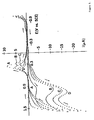
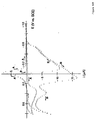
- This response is typified by the i-E plots shown in Fig. 2 (Curves B-D) which were obtained by staircase voltammetry obtained at a Au RDE rotated at 900 rev min ⁇ 1 in 0.25 M NH4NO3 (pH 5.1) as a function of thiourea concentration.
- the residual i-E plot obtained in the absence of thiourea is shown (Curve A).
- the surface-catalyzed anodic detection of thiourea is observed to occur simultaneously with the formation of surface oxide during the positive potential sweep in the region ca. 0.6 - 1.3 V.
- the potential waveforms for PS-PCD incorporate a sampling methodology that can result in virtual rejection of the large background signals from oxide formation commonly observed in PAD and PCD.
- the anodic charge from oxide formation (q a,ox ) accumulated during the positive potential charge from E1 to E 1′ is compensated by the nearly equivalent but opposite charge from the cathodic dissolution of the oxide (q c,ox ) for return of the potential from E 1′ to E1.
- Fig. 4 The rate of equilibration and the drift of the baseline are compared in Fig. 4 for PS-PCD and PAD at a Au electrode in the FI system.
- the Au electrode was polished (0.5 ⁇ m alumina) prior to recording each response curve.
- the zero current for PAD is off the scale of Fig. 4. It is seen that severe baseline drift in PAD continues for longer than 10 min. This results from the gradual increase in the true electrode area during the detection process due to surface reconstruction caused by the repeated cycles of oxide formation and dissolution. With baseline rejection in PS-PCD, there is virtually no consequence evident from a charge in electrode surface area. Commonly for PS-PCD, the baseline is observed to reach its "zero" value within ca.
- Fig. 5 A comparison is shown in Fig. 5 of the detection peaks for thiourea in 0.25 M NH4NO3 (pH 5.1) obtained by PS-PCD, PCD and PAD in the FI system.
- the full-scale current sensitivity of the stripchart recorder was adjusted from each detection mode so that the peak deflections would be equivalent. This allows for direct visual comparison of S/N factors in the figure.
- the magnitude of the baseline response is represented in the figure as a percentage of the net peak response. For example, the baseline signal for PS-PCD is only ca. 20% of the peak height for injections of 100 ⁇ M thiourea, whereas the baseline signal for PAD is nearly 150% the peak height.
- a small uncompensated baseline offset can persist in PS-PCD for three reasons: potential and current offsets in the operational amplifiers of the electronic instrument; a very short period for the second application of E1 (i.e., period t h ), which does not permit complete cathodic removal of all surface oxide; and choice of an electrode material, electrode potentials (E1 and E 1′ in Fig. 1B), and/or solution conditions for which q c,ox ⁇ -q a,ox .
- the detection limits for PS-PCD of sulfur compounds are superior to PAD and PCD, as would be anticipated from observation of the respective S/N values estimated from Fig. 5.
- the limit of detection (LOD) for thiourea by PS-PCD was determined by flow injection to be ca. 2 ⁇ M for waveform WF-3 (see Table I), which corresponds to 15 ng in a 100- ⁇ l sample (0.15 ppm).
- the LOD for PAD (waveform WF-1) was 15 ⁇ M (110 ng, 1.1 ppm) and the LOD for PCD (waveform WF-2) was 6 ⁇ M (45 ng, 0.44 ppm).
- the calibration curve for PS-PCD was linear over two decades in concentration (i.e., 2-200 ⁇ M). Note that the detection limits for PAD and PCD using the present "home-built" instrument are poorer than can be achieved using commercial instrumentation (Dionex Corp.). Hence, the values of LOD given here should be considered only for purposes of intercomparison of the three detection modes and not as indicators of values of LOD expected from state-of-the-art instrumentation.
- E1 corresponds to a value at which the electrode is free of oxide and dissolved O2 is not detected.
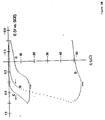
- Staircase voltammograms obtained at the Au RDE at 1600 rev min ⁇ 1 are shown in Fig. 7A for thiourea in 0.25 M NH4NO3 (pH 5.1) and in Fig. 7B for 0.20 M NaOH (pH ca. 13).
- the peak potential for oxide stripping at the Au electrode shifts negative by ca. 0.40 V
- the half-wave potential for O2 reduction shifts by only ca. 0.15 V.
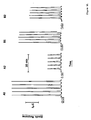
- Peaks for thirourea obtained by PS-PCD and PAD are compared in Fig. 8 for flow-injection detections with a pH step in the carrier solution from 3.8 to 5.1, as designated by the arrow.
- the recorder setting for each experiment was adjusted such that the peak deflection would be nearly equivalent for the two detection techniques.
- PS-PCD the change in baseline response is very small, whereas the baseline shift for PAD is much more severe.
- the sensitivity for thiourea detection by either method exhibits little variation with the change in solution pH. Also, it is readily apparent that the S/N is superior for PS-PCD.
- Monosaccharides and disaccharides exhibit a nearly mass transport-limited peak-shaped response at a Au electrode in alkaline solutions (5).
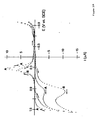
- the positive potential sweep in the voltammetric curves in Fig. 9 obtained at the Au RDE at 900 rev min ⁇ 1 the anodic peak for glucose is obtained in a potential region where no substantial quantity of surface oxide is formed (compare curves A and B).
- the voltammetric peak response for glucose is virtually mass-transport controlled, detection at a constant potential without the benefit of the cleaning, and activation pulses in PAD or PCD is unsatisfactory.
- the anodic response for carbohydrates decays steadily at Au electrodes.
- the optimization of the waveform for PS-PCD is influenced by the analyte(s) of interest.
- the waveform depicted in Figs. 1C and 1D are not considered appropriate because the stepwise change of potential from E1 to E 1′ results in the rapid and extensive formation of oxide with cessation of analytical response (see Fig. 9). Absorbed analytes detected by mechanisms which are catalyzed by formation of surface oxide, e.g., sulfur compounds, are expected to be detected well by either waveform.
- Results from a comparison of the waveforms in Figs. 1B and 1D are shown in Fig. 10 for detection of glucose (A1, A2) and thiourea (B1, B2) in 0.2 M NaOH.
- the total period of detection was the same in the two waveforms (1000 ms).
- Numerical values for the baseline signal ( ⁇ C) are indicated in parentheses.
- Glucose shows a substantially higher sensitivity for the waveform in Fig. 1B as compared to Fig. 1D, as predicted.
- Thiourea is detected with similar sensitivity, also as predicted.
- amino acids also are detected by processes which are catalyzed by the formation of the surface oxides, as will be described in conjunction with Figs. 11-13.
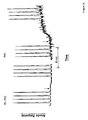
- Fig. 11 contains a chromatogram for 17 amino acids (peak identity given on page 17a) using the Dionex scheme for gradient elution with detection by PS-PCD.
- the chromatographic column was the Dionex AS-8.
- the tremendous shift in baseline is typical for PAD or PCD detection of amino acids when the gradient elution method is used, i.e., the composition of the mobile phase is caused to change during the elution process. Note it is apparent that some of the detection peaks are lost in the shifting baseline.
- This particular chromatogram was obtained using the pH electrode as the reference. If the SCE reference had been used, the baseline shift would have been even more severe.
- Fig. 12 contains a chromatogram obtained under the exact conditions of Fig. 11 except that PS-PCD was used for detection, with the pH reference. It is very evident that the great significance of the invention is the stability of the baseline when gradient elution is employed. Peak identity given on page 17b.
- Fig. 13 contains a chromatogram obtained with the PS-PCD and pH reference with a slight change in the gradient elution conditions. The different conditions allowed separation of 20 amino acides. Again, the baseline is remarkably stable. Peak identity given on page 17c.
- Fig. 14 shows the potential waveform for the PS-PCD separation process of Figs. 12 and 13, and page 17d shows a Table illustrating a solvent system for amino acid separation.
- the design of the waveform for PS-PCD at a Au electrode can result in virtual elimination of baseline signals for oxide-catalyzed detection processes, and the technique is recommended in conjunction with a pH reference for liquid chromatographic separations which utilize pH-gradient elution over a limited pH range.
- the technique according to the present invention is for electrochemical detection of analyte in a liquid chromatographic environment.
- PS-PCD with a Au working electrode has been described, but this technique will work equally well with other electrode substrates, such as Pt, Ru, Rh, Pd, Pb, etc., for which an oxide layer can be formed and subsequently stripped at more cathodic potentials.
- this technique is applicable to the measurement of irreversible electrochemical processes superimposed or coincident with irreversible processes.
- the measurement of surface-oxide catalyzed reactions during the formation of surface oxide is a single example of the PS-PCD technique.
- the PS-PCD method of the present invention is particularly applicable to detection of multiple chemical components in a liquid sample which have been separated by liquid chromatography, particularly high performance liquid chromatography (HPLC).
- the liquid sample is normally mixed with an eluent including an electrolyte as a developing reagent and passed through a chromatography column.
- the packing for the column typically would include gel or particulate forms of ion exchange or reverse phase packing.
- the technology is well developed. For example, see C.F.Simpson, Techniques of Liquid Chromatography , 1983, J.H. Knox, High Performance Liquid Chromatography , 1981, and K. Polkar et al., Liquid Chromatography in Clinical Analysis , 1981.
- the PS-PCD method is useful as a method of detection in flow injection analysis (FIA).
- FOA flow injection analysis
- Such systems are described in Skeggs, Amer. J. Clin. Path., 28, 311-322 (1957) and in the U.S. patents 4,013,413, 4,022,575, 4,177,677, 4,224,033, 4,227,973, 4,314,824, 4,315,754, 4,352,780, 4,399,102, 4,399,255, and 4,504,443.
- these samples are supplied to the detector in a continuous liquid carrier flow rather than by being separated, e.g., in liquid chromatography. This technique is of limited application in comparison to the aforementioned liquid chromatographic system.
Landscapes
- Chemical & Material Sciences (AREA)
- Life Sciences & Earth Sciences (AREA)
- Health & Medical Sciences (AREA)
- General Physics & Mathematics (AREA)
- Pathology (AREA)
- Electrochemistry (AREA)
- Physics & Mathematics (AREA)
- Analytical Chemistry (AREA)
- Biochemistry (AREA)
- General Health & Medical Sciences (AREA)
- Molecular Biology (AREA)
- Immunology (AREA)
- Chemical Kinetics & Catalysis (AREA)
- Investigating Or Analyzing Materials By The Use Of Electric Means (AREA)
- Investigating Or Analysing Biological Materials (AREA)
- Analysing Materials By The Use Of Radiation (AREA)
- Radar Systems Or Details Thereof (AREA)
- Investigating, Analyzing Materials By Fluorescence Or Luminescence (AREA)
- Detergent Compositions (AREA)
- Investigating Or Analyzing Non-Biological Materials By The Use Of Chemical Means (AREA)
- Other Investigation Or Analysis Of Materials By Electrical Means (AREA)
Claims (8)
- Procédé de détection coulométrique pulsée chromatographique liquide destiné à la détection directe d'au moins un analyte, comprenant les étapes suivantes consistant à:
appliquer une forme d'onde de potentiel électrique définissant une fonction de balayage de potentiel ou d'échelon de potentiel à une électrode en fonctionnement dans une cellule à recirculation, et
détecter électrochimiquement l'analyte directement en intégrant le courant sur une partie cyclique de détection de la forme d'onde totale du potentiel électrique. - Procédé selon la revendication 1, dans lequel ladite cellule à recirculation est une cellule à trois électrodes et dans lequel une des électrodes est une électrode de référence de pH.
- Procédé selon la revendication 2, dans lequel l'élution du gradient de pH est employée.
- Procédé selon la revendication 1, comprenant en outre les étapes consistant à:
générer des formes d'ondes de potentiel à échelons multiples possédant des variations cycliques de potentiel lorsque les formes d'ondes cycliques ont une première valeur de potentiel initiale (E₁) durant un premier intervalle de temps td, de sorte que les surfaces de ladite électrode en fonctionnement se trouvent sans oxyde;
amener la valeur de potentiel à une seconde valeur supérieure (E′) durant un intervalle de temps ts, de façon à provoquer sur ladite électrode en fonctionnement la formation d'oxyde de surface à l'aide d'une réaction d'oxydation électrocatalytique en parallèle d'un analyte soluble et/ou absorbant; et
ramener la valeur de potentiel à ladite première valeur E₁ durant un intervalle de temps d'arrêt th pendant lequel tout l'oxyde formé pendant la variation de potentiel en E' est ôté par voie cathodique desdites surfaces de ladite électrode en fonctionnement. - Procédé selon la revendication 4, dans lequel la variation cyclique de potentiel est amenée selon une fonction de balayage de potentiel.
- Procédé selon la revendication 4, dans lequel la variation cyclique de potentiel est amenée selon une fonction d'échelon de potentiel.
- Procédé selon la revendication 4, comprenant en outre l'étape consistant à amener ladite valeur de potentiel à une valeur E₂ supérieure auxdites première et seconde valeurs durant un intervalle de temps t₂ afin de nettoyer par oxydation lesdites surfaces de ladite électrode en fonctionnement.
- Procédé selon la revendication 4 ou 7, comprenant en outre l'étape consistant à abaisser ladite valeur de potentiel à une valeur E₃ inférieure à ladite première valeur durant un intervalle de temps t₃ afin de réactiver, par dissolution par voie cathodique, l'oxyde de surface formé en E′ et/ou E₂.
Applications Claiming Priority (2)
| Application Number | Priority Date | Filing Date | Title |
|---|---|---|---|
| US249014 | 1988-09-26 | ||
| US07/249,014 US4939924A (en) | 1988-09-26 | 1988-09-26 | Pulsed coulometric detection with automatic rejection of background signal in surface-oxide catalyzed anodic detections at gold electrodes in flow-through cells |
Publications (3)
| Publication Number | Publication Date |
|---|---|
| EP0361810A2 EP0361810A2 (fr) | 1990-04-04 |
| EP0361810A3 EP0361810A3 (fr) | 1992-08-05 |
| EP0361810B1 true EP0361810B1 (fr) | 1994-12-14 |
Family
ID=22941675
Family Applications (1)
| Application Number | Title | Priority Date | Filing Date |
|---|---|---|---|
| EP89309683A Expired - Lifetime EP0361810B1 (fr) | 1988-09-26 | 1989-09-22 | Détection coulométrique pulsée |
Country Status (7)
| Country | Link |
|---|---|
| US (1) | US4939924A (fr) |
| EP (1) | EP0361810B1 (fr) |
| JP (1) | JPH02186256A (fr) |
| AT (1) | ATE115724T1 (fr) |
| AU (1) | AU610808B2 (fr) |
| CA (1) | CA1300683C (fr) |
| DE (1) | DE68919973T2 (fr) |
Cited By (1)
| Publication number | Priority date | Publication date | Assignee | Title |
|---|---|---|---|---|
| US7641784B2 (en) | 2003-01-30 | 2010-01-05 | Tanita Corporation | Method for measuring by means of chemical sensor, and chemical sensor type measuring apparatus |
Families Citing this family (9)
| Publication number | Priority date | Publication date | Assignee | Title |
|---|---|---|---|---|
| WO1994020841A1 (fr) * | 1993-03-05 | 1994-09-15 | University Of Wollongong | Detection electrochimique pulsee au moyen d'electrodes electroactives en polymere |
| US5626738A (en) * | 1995-11-17 | 1997-05-06 | American Health Foundation | Methods for the separation and detection of nitrosothiols |
| US7373255B2 (en) | 2003-06-06 | 2008-05-13 | Biacore Ab | Method and system for determination of molecular interaction parameters |
| SE0301639D0 (sv) | 2003-06-06 | 2003-06-06 | Biacore Ab | Method and apparatus for characterization of intercations |
| EP1631829B1 (fr) * | 2003-06-06 | 2016-04-13 | GE Healthcare Bio-Sciences AB | Procede et appareil de caracterisation d'interactions |
| US7909981B2 (en) * | 2004-03-03 | 2011-03-22 | Perkinelmer Health Sciences, Inc. | Method and apparatus for improving the performance of an electrochemical sensor |
| US7566392B2 (en) * | 2006-04-12 | 2009-07-28 | Dionex Corporation | Pulsed electrochemical detection method |
| US9664636B2 (en) | 2013-12-23 | 2017-05-30 | Thermo Fisher Scientific Aquasensors Llc | Chlorine detection with pulsed amperometric detection |
| US10877005B2 (en) * | 2016-12-20 | 2020-12-29 | Dionex Corporation | Method of measuring an analyte with a reductive detection waveform |
Family Cites Families (5)
| Publication number | Priority date | Publication date | Assignee | Title |
|---|---|---|---|---|
| CH659327A5 (en) * | 1982-11-23 | 1987-01-15 | Inst Elektrokhimii Akademii Na | Method and apparatus for determining the organic carbon content of water or of an aqueous solution |
| FR2551548B1 (fr) * | 1983-08-31 | 1991-06-07 | United Kingdom Government | Voltametre a decollement anodique pour mesure de concentrations ioniques |
| US4566949A (en) * | 1983-10-19 | 1986-01-28 | Hewlett-Packard Company | Method of operating a self cleaning electrochemical detector |
| FR2583879B1 (fr) * | 1985-06-20 | 1987-09-18 | Chromatografield | Cellule de mesure d'un appareil de chromatographie en phase liquide |
| US4917774A (en) * | 1986-04-24 | 1990-04-17 | Shipley Company Inc. | Method for analyzing additive concentration |
-
1988
- 1988-09-26 US US07/249,014 patent/US4939924A/en not_active Expired - Lifetime
-
1989
- 1989-09-22 DE DE68919973T patent/DE68919973T2/de not_active Expired - Fee Related
- 1989-09-22 EP EP89309683A patent/EP0361810B1/fr not_active Expired - Lifetime
- 1989-09-22 AT AT89309683T patent/ATE115724T1/de not_active IP Right Cessation
- 1989-09-25 AU AU41738/89A patent/AU610808B2/en not_active Ceased
- 1989-09-25 CA CA000613005A patent/CA1300683C/fr not_active Expired - Lifetime
- 1989-09-26 JP JP1250390A patent/JPH02186256A/ja active Pending
Non-Patent Citations (1)
| Title |
|---|
| Analytica Chemical Acta, vol. 192, 1987, pages 205-218. * |
Cited By (2)
| Publication number | Priority date | Publication date | Assignee | Title |
|---|---|---|---|---|
| US7641784B2 (en) | 2003-01-30 | 2010-01-05 | Tanita Corporation | Method for measuring by means of chemical sensor, and chemical sensor type measuring apparatus |
| DE102004004392B4 (de) * | 2003-01-30 | 2011-08-18 | Tanita Corp. | Messmethode mit Hilfe eines chemischen Sensors und eines chemischen Sensormessgerätes |
Also Published As
| Publication number | Publication date |
|---|---|
| DE68919973D1 (de) | 1995-01-26 |
| US4939924A (en) | 1990-07-10 |
| AU4173889A (en) | 1990-03-29 |
| JPH02186256A (ja) | 1990-07-20 |
| EP0361810A2 (fr) | 1990-04-04 |
| CA1300683C (fr) | 1992-05-12 |
| EP0361810A3 (fr) | 1992-08-05 |
| ATE115724T1 (de) | 1994-12-15 |
| AU610808B2 (en) | 1991-05-23 |
| DE68919973T2 (de) | 1995-07-27 |
Similar Documents
| Publication | Publication Date | Title |
|---|---|---|
| LaCourse et al. | Optimization of waveforms for pulsed amperometric detection of carbohydrates based on pulsed voltammetry | |
| Welch et al. | Comparison of pulsed coulometric detection and potential-sweep-pulsed coulometric detection for underivatized amino acids in liquid chromatography | |
| Feng et al. | Electrochemical pretreatment of carbon fibers for in vivo electrochemistry: effects on sensitivity and response time | |
| Wang et al. | Selective voltammetric detection based on adsorptive preconcentration for flow injection analysis | |
| US5192416A (en) | Method and apparatus for batch injection analysis | |
| Lu et al. | Pulsed amperometric detection of carbohydrates separated by capillary electrophoresis | |
| WO2007121267A2 (fr) | Procédé de détection électrochimique pulsée | |
| EP0361810B1 (fr) | Détection coulométrique pulsée | |
| CN1284652A (zh) | 用于确定试样检测初始时间的电化学分析 | |
| EP0602043A1 (fr) | Procede et appareil permettant d'effectuer l'analyse par injection de lots d'echantillons et la recherche de metaux a l'etat de traces | |
| Polta et al. | Liquid chromatographic separation of aminoglycosides with pulsed amperometric detection | |
| Neuburger et al. | Pulsed coulometric detection with automatic rejection of background signal in surface-oxide-catalyzed anodic detections at gold electrodes in flow-through cells | |
| Wang et al. | Highly sensitive and selective measurements of lead by stripping voltammetry/potentiometry following adsorptive accumulation of the lead-o-cresolphthalexon complex | |
| Wang | Hydrodynamic modulation voltammetry | |
| Liu et al. | Capillary electrophoretic enzyme immunoassay for digoxin in human serum | |
| Ngoviwatchai et al. | Pulsed amperometric detection of sulfur-containing pesticides in reversed-phase liquid chromatography | |
| Austin‐Harrison et al. | Pulsed amperometric detection based on direct and indirect anodic reactions: A review | |
| Shihabi et al. | Hemoglobin A2 quantification by capillary zone electrophoresis | |
| Kotnik et al. | Cathodic re-activation of the gold electrode in pulsed electrochemical detection of carbohydrates | |
| Patentamt | 12 EUROPEAN PATENT SPECIFICATION | |
| Anderson et al. | Transient electrochemical techniques in liquid chromatography with microprocessor-based instrumentation | |
| CN117030820A (zh) | 一种生物传感器的测量方法 | |
| Gerhardt et al. | Adsorption-based electrochemical detection of nonelectrochemically active analytes for capillary electrophoresis | |
| Cataldi et al. | Effect of Ca (II), Sr (II), and Ba (II) on the pulsed amperometric detection of alditols and carbohydrates at a gold electrode in alkaline solutions | |
| Oates et al. | Voltammetric detection with gradient elution for open tubular liquid chromatography |
Legal Events
| Date | Code | Title | Description |
|---|---|---|---|
| PUAI | Public reference made under article 153(3) epc to a published international application that has entered the european phase |
Free format text: ORIGINAL CODE: 0009012 |
|
| AK | Designated contracting states |
Kind code of ref document: A2 Designated state(s): AT BE CH DE ES FR GB GR IT LI LU NL SE |
|
| PUAL | Search report despatched |
Free format text: ORIGINAL CODE: 0009013 |
|
| AK | Designated contracting states |
Kind code of ref document: A3 Designated state(s): AT BE CH DE ES FR GB GR IT LI LU NL SE |
|
| 17P | Request for examination filed |
Effective date: 19921015 |
|
| 17Q | First examination report despatched |
Effective date: 19930127 |
|
| GRAA | (expected) grant |
Free format text: ORIGINAL CODE: 0009210 |
|
| AK | Designated contracting states |
Kind code of ref document: B1 Designated state(s): AT BE CH DE ES FR GB GR IT LI LU NL SE |
|
| PG25 | Lapsed in a contracting state [announced via postgrant information from national office to epo] |
Ref country code: BE Effective date: 19941214 Ref country code: CH Effective date: 19941214 Ref country code: NL Effective date: 19941214 Ref country code: AT Effective date: 19941214 Ref country code: LI Effective date: 19941214 Ref country code: ES Free format text: THE PATENT HAS BEEN ANNULLED BY A DECISION OF A NATIONAL AUTHORITY Effective date: 19941214 Ref country code: GR Free format text: LAPSE BECAUSE OF FAILURE TO SUBMIT A TRANSLATION OF THE DESCRIPTION OR TO PAY THE FEE WITHIN THE PRESCRIBED TIME-LIMIT Effective date: 19941214 |
|
| REF | Corresponds to: |
Ref document number: 115724 Country of ref document: AT Date of ref document: 19941215 Kind code of ref document: T |
|
| REF | Corresponds to: |
Ref document number: 68919973 Country of ref document: DE Date of ref document: 19950126 |
|
| ITF | It: translation for a ep patent filed | ||
| PG25 | Lapsed in a contracting state [announced via postgrant information from national office to epo] |
Ref country code: SE Effective date: 19950314 |
|
| REG | Reference to a national code |
Ref country code: CH Ref legal event code: PL |
|
| ET | Fr: translation filed | ||
| NLV1 | Nl: lapsed or annulled due to failure to fulfill the requirements of art. 29p and 29m of the patents act | ||
| PG25 | Lapsed in a contracting state [announced via postgrant information from national office to epo] |
Ref country code: LU Free format text: LAPSE BECAUSE OF NON-PAYMENT OF DUE FEES Effective date: 19950930 |
|
| PLBE | No opposition filed within time limit |
Free format text: ORIGINAL CODE: 0009261 |
|
| STAA | Information on the status of an ep patent application or granted ep patent |
Free format text: STATUS: NO OPPOSITION FILED WITHIN TIME LIMIT |
|
| 26N | No opposition filed | ||
| REG | Reference to a national code |
Ref country code: GB Ref legal event code: IF02 |
|
| PGFP | Annual fee paid to national office [announced via postgrant information from national office to epo] |
Ref country code: DE Payment date: 20070920 Year of fee payment: 19 |
|
| PGFP | Annual fee paid to national office [announced via postgrant information from national office to epo] |
Ref country code: GB Payment date: 20070919 Year of fee payment: 19 |
|
| PGFP | Annual fee paid to national office [announced via postgrant information from national office to epo] |
Ref country code: IT Payment date: 20070926 Year of fee payment: 19 |
|
| PGFP | Annual fee paid to national office [announced via postgrant information from national office to epo] |
Ref country code: FR Payment date: 20070914 Year of fee payment: 19 |
|
| GBPC | Gb: european patent ceased through non-payment of renewal fee |
Effective date: 20080922 |
|
| REG | Reference to a national code |
Ref country code: FR Ref legal event code: ST Effective date: 20090529 |
|
| PG25 | Lapsed in a contracting state [announced via postgrant information from national office to epo] |
Ref country code: IT Free format text: LAPSE BECAUSE OF NON-PAYMENT OF DUE FEES Effective date: 20080922 Ref country code: DE Free format text: LAPSE BECAUSE OF NON-PAYMENT OF DUE FEES Effective date: 20090401 |
|
| PG25 | Lapsed in a contracting state [announced via postgrant information from national office to epo] |
Ref country code: FR Free format text: LAPSE BECAUSE OF NON-PAYMENT OF DUE FEES Effective date: 20080930 |
|
| PG25 | Lapsed in a contracting state [announced via postgrant information from national office to epo] |
Ref country code: GB Free format text: LAPSE BECAUSE OF NON-PAYMENT OF DUE FEES Effective date: 20080922 |