EP0361869A2 - Appareil pour l'affichage d'information et méthode de défilement des données affichées - Google Patents
Appareil pour l'affichage d'information et méthode de défilement des données affichées Download PDFInfo
- Publication number
- EP0361869A2 EP0361869A2 EP89309794A EP89309794A EP0361869A2 EP 0361869 A2 EP0361869 A2 EP 0361869A2 EP 89309794 A EP89309794 A EP 89309794A EP 89309794 A EP89309794 A EP 89309794A EP 0361869 A2 EP0361869 A2 EP 0361869A2
- Authority
- EP
- European Patent Office
- Prior art keywords
- data
- information display
- display apparatus
- set forth
- liquid crystal
- Prior art date
- Legal status (The legal status is an assumption and is not a legal conclusion. Google has not performed a legal analysis and makes no representation as to the accuracy of the status listed.)
- Granted
Links
Images






Classifications
-
- G—PHYSICS
- G06—COMPUTING OR CALCULATING; COUNTING
- G06F—ELECTRIC DIGITAL DATA PROCESSING
- G06F3/00—Input arrangements for transferring data to be processed into a form capable of being handled by the computer; Output arrangements for transferring data from processing unit to output unit, e.g. interface arrangements
- G06F3/01—Input arrangements or combined input and output arrangements for interaction between user and computer
- G06F3/048—Interaction techniques based on graphical user interfaces [GUI]
- G06F3/0487—Interaction techniques based on graphical user interfaces [GUI] using specific features provided by the input device, e.g. functions controlled by the rotation of a mouse with dual sensing arrangements, or of the nature of the input device, e.g. tap gestures based on pressure sensed by a digitiser
- G06F3/0489—Interaction techniques based on graphical user interfaces [GUI] using specific features provided by the input device, e.g. functions controlled by the rotation of a mouse with dual sensing arrangements, or of the nature of the input device, e.g. tap gestures based on pressure sensed by a digitiser using dedicated keyboard keys or combinations thereof
-
- G—PHYSICS
- G06—COMPUTING OR CALCULATING; COUNTING
- G06F—ELECTRIC DIGITAL DATA PROCESSING
- G06F1/00—Details not covered by groups G06F3/00 - G06F13/00 and G06F21/00
- G06F1/26—Power supply means, e.g. regulation thereof
- G06F1/32—Means for saving power
- G06F1/3203—Power management, i.e. event-based initiation of a power-saving mode
- G06F1/3206—Monitoring of events, devices or parameters that trigger a change in power modality
- G06F1/3215—Monitoring of peripheral devices
- G06F1/3218—Monitoring of peripheral devices of display devices
-
- G—PHYSICS
- G06—COMPUTING OR CALCULATING; COUNTING
- G06F—ELECTRIC DIGITAL DATA PROCESSING
- G06F15/00—Digital computers in general; Data processing equipment in general
- G06F15/02—Digital computers in general; Data processing equipment in general manually operated with input through keyboard and computation using a built-in program, e.g. pocket calculators
- G06F15/025—Digital computers in general; Data processing equipment in general manually operated with input through keyboard and computation using a built-in program, e.g. pocket calculators adapted to a specific application
- G06F15/0283—Digital computers in general; Data processing equipment in general manually operated with input through keyboard and computation using a built-in program, e.g. pocket calculators adapted to a specific application for data storage and retrieval
-
- G—PHYSICS
- G06—COMPUTING OR CALCULATING; COUNTING
- G06F—ELECTRIC DIGITAL DATA PROCESSING
- G06F3/00—Input arrangements for transferring data to be processed into a form capable of being handled by the computer; Output arrangements for transferring data from processing unit to output unit, e.g. interface arrangements
- G06F3/01—Input arrangements or combined input and output arrangements for interaction between user and computer
- G06F3/048—Interaction techniques based on graphical user interfaces [GUI]
- G06F3/0484—Interaction techniques based on graphical user interfaces [GUI] for the control of specific functions or operations, e.g. selecting or manipulating an object, an image or a displayed text element, setting a parameter value or selecting a range
- G06F3/0485—Scrolling or panning
-
- G—PHYSICS
- G06—COMPUTING OR CALCULATING; COUNTING
- G06F—ELECTRIC DIGITAL DATA PROCESSING
- G06F40/00—Handling natural language data
- G06F40/10—Text processing
-
- G—PHYSICS
- G06—COMPUTING OR CALCULATING; COUNTING
- G06F—ELECTRIC DIGITAL DATA PROCESSING
- G06F40/00—Handling natural language data
- G06F40/10—Text processing
- G06F40/103—Formatting, i.e. changing of presentation of documents
- G06F40/106—Display of layout of documents; Previewing
Definitions
- the present invention relates to an information display apparatus having a display unit for displaying information and capable of scrolling the information displayed on the display unit, which apparatus is provided with (i) a continuous search function for continuously searching and displaying, in a predetermined order, information concerned as selected from previously stored information with entered information serving as a clue, and (ii) an automatic power-off function for turning the power of the apparatus to OFF if the apparatus remains non-operated for a predetermined period of time.
- an information display apparatus of the type above-mentioned, for example, a so-called image display apparatus or electronic pocket notebook, adapted to store data entered by operating the input keys and to display the stored data on the display unit.
- displayed data as information may be scrolled vertically and transversely, enabling to display a data portion which cannot be displayed at one time on the screen of the display unit.
- a display apparatus such as a so-called electronic pocket notebook has a continuous search function for continuously displaying, in a predetermined order, pre viously stored data concerned according to data entered by operating the input keys. It is now supposed that such apparatus has an English-English dictionary function. In this case, when data of "a” is entered and the key for executing a search processing is operated, there are displayed, on the display unit, data such as "a” ⁇ “abandon” ⁇ "abbey”, one by one, in a predetermined order.
- the conventional information display apparatus is arranged such that, when executing the continuous search function, the search processing is continued until all data concerned are displayed. Further, while the key for executing a search processing is pressed, the search is permanently executed. Accordingly, the apparatus is, in a sense, under operation while the search processing is under way. Therefore, the automatic power-off function is not operable. Further, there are instances where the automatic power-off function is not operated even after the search processing has been complete.
- the conventional information display apparatus is generally arranged such that, for example when scrolling data displayed on the screen, only a divided portion of the displayed data is scrolled and displayed, or the data to be displayed are grouped by screens so that the entire displayed data are scrolled in the same direction. More specifically, there cannot be readily carried out operations, on the same display screen, for transversely scrolling the data on one position and vertically scrolling the data on another position. Accordingly, for example when mutually referring to different data on the same screen, an efficient data display cannot be made, but troublesome operations are required. Thus, the conventional apparatus is not handy in use.
- the conventional information display apparatus merely has a choice of the following three possibilities:
- the information display apparatus in accordance with a second embodiment of the present invention com strictlyprises: a display unit for displaying data; a plurality of input units for designating the directions in which data displayed on the display unit are to be scrolled; and a processing unit for displaying data with the display unit divided into a plurality of display areas, and for scrolling data displayed on the display areas in an individual direction for every display area according to designation made at each of the input units.
- the information display apparatus in accordance with a third embodiment of the present invention com strictlyprises: a display unit for displaying data; a plurality of input units for designating the directions in which data displayed on the display unit are to be scrolled; and a processing unit for displaying data of a plurality of groups on the display unit and for scrolling data of a plurality of groups displayed on the display unit in an individual direction for every data group according to designation made at each of the input unit.
- the operation of the processing unit causes the display unit to be divided into a first display area and a second display area, and different data are respectively displayed on the display areas.
- the input unit for designating the transverse scrolling direction When the input unit for designating the transverse scrolling direction is operated, the displayed data on the first display area may be transversely scrolled.
- the input unit for designating the vertical scrolling direction When the input unit for designating the vertical scrolling direction is operated, the data displayed on the second display area may be vertically scrolled. If the data displayed on the first display area originally contain a data portion which cannot be displayed at one time thereon, the input unit for designating the transverse scrolling direction may be operated.
- individual scrolling directions are respectively set for a plurality of display areas formed, as divided, on the display unit.
- displayed data may be readily scrolled in an individual direction for every display area. This assures a good maneuverability and an efficient data display.
- the information display apparatus in accordance with a fourth embodiment of the present invention com strictlyprises: an input unit for entering a variety of data and for designating a variety of processings; a display unit for displaying input data and processing results; a memory unit for storing input data and a variety of information; a control circuit for controlling all the units above-mentioned; and search stop means adapted to automatically stop a continuous search under way when a predetermined amount of continuous search is finished, thereby to make effective an automatic power-off function by which the power of the apparatus is turned to OFF if the apparatus remains non-operated for a predetermined period of time; whereby the apparatus is capable of executing a continuous search for continuously displaying, in a predetermined order, data concerned as selected out of previously stored data with entered data serving as a clue.
- the search processing is stopped after it has been made to a certain extent. Thereafter, the automatic power-off function is made effective. This prevents the continuous search operation to be executed in vain for a long period of time. This prevents the increase in power consumption.
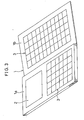
- FIG. 1 to Figure 9 show an embodiment of the present invention
- the information display apparatus in accordance with the present invention has an openable main body 1 in the form of a pocket note book.
- the main body 1 has a left-hand portion 1a and a right-hand portion 1b.
- the left-hand portion 1a is provided at the upper part thereof with a liquid crystal display device 2 (hereinafter referred to as the LCD) serving as a display unit for displaying calculation results or messages as data contents.
- the LCD 2 is of a dot matrix structure, and is adapted to be divided into an upper-half first display area 2a and a lower-half second display area 2b, to be discussed later.
- An input key group 3 for entering a variety of information is disposed under the LCD 2 and on the right-hand portion 1b.
- a mode setting key group 4 for calling and setting a variety of functions of the information display apparatus is disposed at the upper part of the right-hand portion 1b.
- the mode setting key group 4 includes an English-English dictionary key 4a for setting an English-English dictionary mode, and a variety of keys for respectively setting modes of calender, schedule, calculation, telephone, memo and the like.
- an alphabet key group 5 for entering character information in alphabets.
- a numeral input key group 6 for entering numerical information when the apparatus is used as a calculator.
- a power-ON key 7, a power-OFF key 8 and other keys are disposed between the mode setting key group 4 and the alphabet key group 5.
- the English-English dictionary key 4a serves also as the power-ON key 7, and vice versa. More specifically, provision is made such that, for example when the power-ON key 7 is operated, the English-English dictionary mode is executed.
- an operation key group 9 including an index word search key 9a for executing a search according to an index word, and other input keys.
- a cursor key group 10 serving as an input unit for scrolling the screen in predetermined directions and for moving the cursor in predetermined directions.
- the cursor key group 10 includes a right-direction cursor key 10a for moving the cursor rightward, a left-direction cursor key 10b for moving the cursor leftward, an up-direction cursor key 10d for moving the cursor upward, and a down-direction cursor key 10c for moving the cursor downward.
- the main body 1 of the apparatus incorporates a control unit shown in Fig. 4.
- the control unit includes: a central processing unit 11 (hereinafter referred to as the CPU) for executing an input/output processing, an arithmetic processing and the like for the entire apparatus; an LCD driver 12 for driving an LCD 2 based on a control signal supplied from the CPU 11; an input/output port 13 (hereinafter referred to as the I/O port) for transmitting data entered through the input key group 3, to the CPU 11; a ROM 14 for storing a control program of the CPU 11, mainly an input/output control program, and for serving as a data unit for storing a number of data; a RAM 15 for temporarily storing data utilized in the control program of the ROM 14; and a real time clock 16 (hereinafter referred to as the RTC) for clocking hour, minute and second to count the date.
- a central processing unit 11 hereinafter referred to as the CPU
- the LCD driver 12 for driving
- the ROM 14 is a read-only memory and contains a variety of data for the modes to be respectively selected with the input keys of the mode setting key group 4. For example, in the English-English dictionary mode, the ROM 14 contains the meaning data and the like of index words based on which a search is made.
- the RAM 15 is a read/write random-access memory.
- the RTC 16 is adapted such that the contents are read or written by the CPU 11.
- the apparatus includes batteries 17 as a power supply. Provision is made such that, even though the power is turned OFF, the batteries 17 are operated to back up the RAM 15 such that the contents stored therein are maintained.
- the processing unit includes the CPU 11, the ROM 14, the RAM 15 and the LCD driver 12.
- the ROM 14 includes a data unit containing index words, their meanings and the like, an index unit to be used for a search, and a program unit containing an operation program.
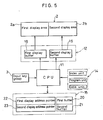
- Fig. 5 shows the arrangement embodying the schematic arrangement of the control unit shown in Fig. 4.
- the LCD driver 12 includes a first display buffer 18, and a second display buffer 19.
- the first display buffer 18 corresponds to a first display area 2a forming the upper-half portion of the screen of the LCD 2, while the second display buffer 19 corresponds to a second display area 2b forming the lower-half portion of the screen of the LCD 2.
- the RAM 15 includes a first buffer 20, a second buffer 21, a first display address pointer 22, and a second display address pointer 23.
- the display address pointers 22, 23 are adapted to indicate the addresses on the first and second buffers 20, 21.
- the first display address pointer 22 is used as an index word buffer address pointer, while the second display address pointer 23 is used as a meaning buffer address pointer.
- the information display apparatus having the arrangement above-mentioned is so arranged as to execute a variety of functions in the manner that, based on the operation program in the ROM 14, the CPU 11 executes a processing according to data entered through the input key group 3, and the LCD 2 displays the results of this processing.
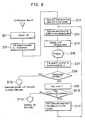
- the English-English dictionary key 4a of the mode setting key group 4 or the power-ON key 7 is operated (S1).
- the operation mode is set to the English-English dictionary mode and the sequence enters in processing of the English-English dictionary application software (S2).
- the LCD 2 displays an ini tial screen as shown in Fig. 6 (a) and the sequence is in a state waiting for entry of the spelling of a word desired to be searched.
- the index word search key processing is started. More specifically, based on the operation program stored in the ROM 14, the CPU 11 obtains the record corresponding to the entered spelling "abandon", from the index unit as shown in Fig. 7. Then, the CPU 11 obtains, based on the address of this record, the record concerned in the data unit in Fig. 7, and calls the index word and meaning data in this data record, to the first and second buffers 20, 21 of the RAM 15 (S5).
- the first and second display address pointer 22, 23 are set to the initial values, respectively (S6).
- the data in the first display buffer 18 are developed in the first display area 2a of the LCD 2, and the data in the second display buffer 19 are developed in the second display area 2b (S8). Such data as developed are displayed (S9).
- the index word is displayed at the upper part corresponding to the first display area 2a, and the meaning is displayed at the lower part corresponding to the second display area 2b, as shown in Fig. 6 (c).
- there are not entirely displayed (i) the data to be displayed on the first display area 2a, i.e., the index word "abandon”, and (ii) the data to be displayed on the second display area 2b, i.e., the meaning of "abandon”. Accordingly, there are displayed " ⁇ " and " ⁇ " presenting that more data to be displayed are present.
- the first display address pointer 22 for index word is incremented (S13), and, based on the address indicated by the address pointer 22, data of digits which can be displayed at one time on the first display area 2a, are read from the first buffer 20 and written in the first display buffer 18 (S14).
- the data of the first display buffer 18 are developed (S15) and displayed (S9) on the first display area 2a.
- the portion of the index word which could not be displayed at one time, i.e., "n" is now displayed at the upper part of the LCD 2 screen as shown in Fig. 6 (d).
- the data displayed on the second display area 2b at the lower part of the LCD 2 screen are not scrolled but remain immobile.
- the second display address pointer 23 for meaning data is incremented (S18), and, based on the address indicated by the address pointer 23, data of digits which can be displayed at one time on the second display area 2b, are read from the second buffer 21 and written in the second display buffer 19 (S19).
- the data of the second display buffer 19 are developed (S20) and displayed (S9) on the second display area 2b.
- the data displayed on the first display area 2a at the upper part of the LCD 2 screen are not scrolled but remain immobile.
- the left-direction cursor key 10b or the up-direction cursor key 10d When the left-direction cursor key 10b or the up-direction cursor key 10d is operated, it is then judged, in the same manner as above-mentioned, whether or not " ⁇ " or " ⁇ " is displayed. Then, the first display address pointer 22 or the second display address pointer 23 is decremented. Based on the address indicated by the pointer 22 or 23, data of digits which can be displayed at one time on the first display area 2a or the second display area 2b, are read from the first buffer 20 or the second buffer 21, and written in the first display buffer 18 or the second display buffer 19. The data are then developed in the first display area 2a or the second display area 2b, and displayed on the LCD 2. Thus, the data displayed on the first display area 2a may be scrolled in the right direction, or the data displayed on the second display area 2b may be scrolled in the down direction.
- the index word displayed on the first display area 2a of the LCD 2 may be independently scrolled leftward or rightward by operating the right-direction cursor key 10a or the left-direction cursor key 10b.
- the meaning data of the index word displayed on the second display area 2b may be independently scrolled upward or downward by operating the up-direction cursor key 10d or the down-direction cursor key 10c. Accordingly, by operating the cursor key group 10, the index word and its meaning data may be independently scrolled, in the individual directions, on the first display area 2a and the second display area 2b, respectively.
- the data portion which cannot be displayed at one time on the LCD 2 may be readily displayed.
- the main body 1 of the apparatus incorporates the control unit shown in Fig. 4.
- This control unit is so arranged as to execute an input/output processing, an arithmetic processing and the like for the entire information display apparatus. Further, the control unit is so arranged as to execute (i) the automatic power-off function for automatically turning the power of the apparatus to OFF if the apparatus remains non-operated for a predetermined period of time, and (ii) a continuous search function for continuously displaying, in a predetermined order, data concerned as selected from pre viously stored data with entered data serving as a clue. Further, the control unit is arranged such that, when a predetermined amount of continuous search is finished, search stop means automatically stops such continuous search under way, thereby to make effective the automatic power-off function.
- the English-English dictionary mode is to be selected. That is, the English-English dictionary key 4a of the mode setting key group 4 or the power-ON key 7 is operated to set the operation mode to the English-English dictionary mode.
- the sequence enters into a processing of an English-English dictionary application software (S11).
- the LCD 2 displays an initial screen as shown in Fig. 6 (a).
- a search counter (not shown) in the CPU 11 is initially set (S12).
- the sequential feed key 9c of the operation key group 9 is to be operated.
- a continuous search processing is started based on the entered data.
- the CPU 11 obtains the record corresponding to the entered data, i.e., "abandon", from the index unit as shown in Fig. 7.
- the CPU 11 obtains the record concerned in the data unit in Fig. 7.
- the CPU 11 calls the index word and meaning data in this data record, into the first and second buffers 20, 21 of the RAM 15 (S13).
- data concerned by a predetermined unit are read from the first and second buffers 20, 21 and written in the first and second display buffers 18, 19 (S14). These data concerned are developed in the LCD driver 12 (S15), and displayed on the display screen of the LCD 2 (S16). At this time, the data concerned, i.e., "abandon" are displayed as shown in Fig. 6 (c). Then, the search counter is incremented by +1 (S17).
- the index unit pointer is incremented to obtain the next record from the index unit of the ROM 14 as shown in Fig. 7. Then, there is obtained the next data record in the data unit in Fig. 7 stored in the address of this record. The next data record thus obtained is called to the first and second buffers 20, 21 of the RAM 15 (S111).
- the sequence is returned to the step 14, and the operations from the step 14 to the step 111 are repeated.
- the number of counts of the search counter is increased.
- the continuous search processing is stopped to make effective the automatic power-off function (S112).
- the search counter produces a carry.
- this circuit 51 is in a high level in a binary logic.
- the CPU 11 supplies, through a buffer circuit 53, a search stop signal to the processing unit and to one input terminal of an AND circuit 55 for executing a logical product operation. This causes the control unit to stop the search processing.
- the automatic power-off counter produces a carry.
- the carry is entered into a carry detector circuit 52, the circuit 52 is in a high level in a binary logic.
- the CPU 11 supplies an automatic power-off signal to the other input terminal of the AND circuit 55 through a buffer circuit 54.
- the automatic power-off counter is adapted to monitor the non-operation state of the information display apparatus, and to execute a counting operation while the apparatus is under non-operation.
- the circuit 55 supplies a high-level output to the processing unit. With such operation, the control unit executes the automatic power-off operation.
- the search counter produces no carry
- the output of the carry detector circuit 51 is in a low level. Accordingly, the output of the buffer circuit 53 is also in a low level so that a normal search operation is executed.
- the output of the AND circuit 55 is also in a low level, the automatic power-off operation is not executed.
- the main body 1 of the apparatus may incorporates a timer adapted such that the continuous search processing is stopped when the CPU 11 judges that the search processing time exceeds a predetermined period of time.
- the continuous search processing is stopped after it has been made to a certain extent. Thereafter, the automatic power-off function is made effective, preventing the continuous search operation from being executed in vain for a long period of time. This prevents the increase in power consumption.
- the information display appara tus in accordance with the present invention comprises: an input unit for entering a variety of data and for designating a variety of processings; a display unit for displaying input data and processing results; a processing unit having (i) a scrolling function for scrolling data displayed on the display unit in an individual direction for every display data or for every displayed data of each of a plurality of groups according to designation made at the input unit, (ii) a continuous search function for continuously searching, in a predetermined order, data concerned with entered data serving as a clue, and (iii) an automatic power-off function for automatically turning the power of the apparatus to OFF if the apparatus remains non-operated for a predetermined period of time; and search stop means adapted to automatically stop a continuous search under way when a predetermined amount of continous search is finished, thereby to make effective the automatic power-off function.
- the information display apparatus in accordance with the present invention comprises: a display unit for displaying data; a plurality of input units for designating the directions in which data displayed on the display unit are to be scrolled; and a processing unit for displaying data with the display unit divided into a plurality of display areas, and for scrolling data displayed on the display areas in an individual direction for every display area according to designation made at each of the input units.
- the displayed data may be respectively scrolled in an individual direction for every display area by operating each of the input units.
- data portions may be displayed on the display unit.
- the input units may include an input key group for entering a variety of informations, and a cursor key group for moving the screen and the cursor in predetermined directions.
- the input key group may include a mode setting key group for calling and setting a variety of functions of the information display apparatus.
- the mode setting key group may include an English-English dictionary key for setting an English-English dictionary mode, and other keys for respectively setting modes of calender, schedule, calculation, telephone No., memo and the like.
- the cursor key group may include a key for moving the cursor rightward, a key for moving the cursor leftward, a key for moving the cursor upward, and a key for moving the cursor downward.
- the processing unit may include a central processing unit, a read-only memory, a read/write random-access memory and a liquid crystal display device driver.
- the information display apparatus above-mentioned may include batteries for backing up data temporarily stored in the processing section, even though the power of the apparatus is turned to OFF.
- the liquid crystal display device driver may include a first display buffer forming the upper-half portion of the screen of a liquid crystal display device, and a second display buffer forming the lower-half portion of the screen of the liquid crystal display device.
- the read/write random-access memory may include an index word buffer, an index word buffer address pointer, a meaning buffer, and a meaning buffer address pointer.
- the display unit may include a liquid crystal dis play device.
- the liquid crystal display device may include a display of the dot matrix type.
- the liquid crystal display device may include a plurality of display areas.
- the liquid crystal display device may include a first display area corresponding to the upper-half portion of the liquid crystal display device, and a second display area corresponding to the lower-half portion thereof.
- the information display apparatus in accordance with the present invention comprises: a display unit for displaying data: a plurality of input units for designating the directions in which data displayed on the display unit are to be scrolled; and a processing section for displaying data of a plurality of groups on the display unit and for scrolling data of a plurality of groups displayed on the display unit in an individual direction for every data group.
- the displayed data may be respectively scrolled in individual directions by operating the respective input units.
- Such data portions may be displayed on the display unit. This eliminates the operations for separately editing and displaying data of different groups and for successively scrolling such data. This not only considerably improves the maneuverability, but also assures an efficient data display. Thus, the data may be readily referred to.
- the input units may include an input key group for entering a variety of informations, and a cursor key group for moving the screen and the cursor in predetermined directions.
- the input key group may include a mode setting key group for calling and setting a variety of functions of the information display apparatus.
- the mode setting key group may include an English-English dictionary key for setting an English-English dictionary mode, and other keys for respectively setting modes of calender, schedule, calculation, telephone No., memo and the like.
- the cursor key group may include a key for moving the cursor rightward, a key for moving the cursor leftward, a key for moving the cursor upward, and a key for moving the cursor downward.
- the processing unit may include a central processing unit, a read-only memory, a read/write random-access memory and a liquid crystal display device driver.
- the information display apparatus above-mentioned may include batteries for backing up data temporarily stored in the processing unit, even though the power of the apparatus is turned to OFF.
- the liquid crystal display device driver may include a first display buffer forming the upper-half portion of the screen of a liquid crystal display device, and a second display buffer forming the lower-half portion of the screen of the liquid crystal display device.
- the read/write random-access memory may include an index word buffer, an index word buffer address pointer, a meaning buffer, and a meaning buffer address pointer.
- the display unit may include a liquid crystal display device.
- the liquid crystal display device may include a display of the dot matrix type.
- the liquid crystal display device may include a first display area corresponding to the upper-half portion of the liquid crystal display device, and a second display area corresponding to the lower-half portion.
- the information display apparatus in accordance with the present invention comprises: an input unit for entering a variety of data and for designating a variety of processings; a display unit for displaying input data and processing results; a memory unit for storing input data and a variety of information; a control circuit for controlling all the units above-mentioned; and search stop means adapted to automatically stop a continuous search under way when a predetermined amount of continous search is finished, thereby to make effective an automatic power-off function by which the power of the apparatus is turned to OFF if the apparatus remains non-operated for a predetermined period of time; whereby the apparatus is capable of executing a continuous search for continuously displaying, in a predetermined order, data concerned as selected out of previously stored data with entered data serving as a clue.
- the information display apparatus above-mentioned may comprise a control unit including: a central processing unit for executing an input/output processing and an arithmetic processing for the entire apparatus; a liquid crystal display device driver for driving a liquid crystal display device; input/output ports; a read-only memory; a read/write random-access memory; and a real time clock for counting the date.
- a control unit including: a central processing unit for executing an input/output processing and an arithmetic processing for the entire apparatus; a liquid crystal display device driver for driving a liquid crystal display device; input/output ports; a read-only memory; a read/write random-access memory; and a real time clock for counting the date.
- the search stop means may include a timer for counting a search time, adapted to stop a continuous search processing when the search time thus counted exceeds a predetermined period of time.
- the search stop means may include a search counter for detecting a predetermined amount of continuous serch, an automatic power-off counter for detecting a state where the information display apparatus remains non-operated for a predetermined period of time, carry detector circuits for detecting carries of the counters above-mentioned, and a logic circuit for judging the automatic power-off operation.
- the display unit may include a liquid crystal display device.
- the liquid crystal display device may include a display of the dot matrix type.
- the display unit may include a first display area corresponding to the upper-half portion of the liquid crystal display device, and a second display area corresponding to the lower-half portion thereof.
- the information display apparatus above-mentioned may include batteries for backing up data temporarily stored in the control unit, even though the power of the apparatus is turned to OFF.
- the liquid crystal display device driver may include a display buffer for temporarily storing displayed data.
- the read/write random-access memory may include an index word buffer, an index word buffer address pointer, a meaning buffer, and a meaning buffer address pointer.
- the liquid crystal display device may include a first display area corresponding to the upper-half portion of the liquid crystal display device, and a second display area corresponding to the lower-half portion thereof.
- a method of scrolling displayed data in an information display apparatus in accordance with the present invention may comprise the steps of: entering data for search through an input unit; reading data concerned from a read-only memory and displaying such data on a display unit; and scrolling displayed data in an individual direction for every display area or for every displayed data according to designation made at an input unit.
Landscapes
- Engineering & Computer Science (AREA)
- Theoretical Computer Science (AREA)
- General Engineering & Computer Science (AREA)
- Physics & Mathematics (AREA)
- General Physics & Mathematics (AREA)
- Health & Medical Sciences (AREA)
- Human Computer Interaction (AREA)
- Artificial Intelligence (AREA)
- Audiology, Speech & Language Pathology (AREA)
- Computational Linguistics (AREA)
- General Health & Medical Sciences (AREA)
- Computing Systems (AREA)
- Computer Hardware Design (AREA)
- Control Of Indicators Other Than Cathode Ray Tubes (AREA)
- Controls And Circuits For Display Device (AREA)
- User Interface Of Digital Computer (AREA)
Applications Claiming Priority (6)
| Application Number | Priority Date | Filing Date | Title |
|---|---|---|---|
| JP63240482A JPH0289095A (ja) | 1988-09-26 | 1988-09-26 | 情報表示装置 |
| JP240482/88 | 1988-09-26 | ||
| JP63240483A JPH0776868B2 (ja) | 1988-09-26 | 1988-09-26 | 情報表示装置 |
| JP240484/88 | 1988-09-26 | ||
| JP240483/88 | 1988-09-26 | ||
| JP63240484A JPH0680509B2 (ja) | 1988-09-26 | 1988-09-26 | 情報記憶表示装置 |
Publications (3)
| Publication Number | Publication Date |
|---|---|
| EP0361869A2 true EP0361869A2 (fr) | 1990-04-04 |
| EP0361869A3 EP0361869A3 (fr) | 1992-07-29 |
| EP0361869B1 EP0361869B1 (fr) | 1996-03-27 |
Family
ID=27332830
Family Applications (1)
| Application Number | Title | Priority Date | Filing Date |
|---|---|---|---|
| EP89309794A Expired - Lifetime EP0361869B1 (fr) | 1988-09-26 | 1989-09-26 | Appareil pour l'affichage d'information et méthode de défilement des données affichées |
Country Status (3)
| Country | Link |
|---|---|
| US (1) | US5384579A (fr) |
| EP (1) | EP0361869B1 (fr) |
| DE (1) | DE68926083T2 (fr) |
Cited By (4)
| Publication number | Priority date | Publication date | Assignee | Title |
|---|---|---|---|---|
| FR2664998A1 (fr) * | 1990-07-19 | 1992-01-24 | Canon Kk | Appareil electronique a fonction de mise hors tension automatique. |
| EP0567957A1 (fr) * | 1992-04-27 | 1993-11-03 | Sharp Kabushiki Kaisha | Système de traitement d'informations avec un dispositif de contrôle d'énergie |
| US5737248A (en) * | 1994-10-05 | 1998-04-07 | Semiconductor Energy Laboratory Co., Ltd. | Device for altering the output conditions of an information processing device according to input states at the user's keyboard |
| EP0718804A3 (fr) * | 1994-12-14 | 1999-01-13 | Holger Dipl.-Ing. Schaffer | Dispositif d'enregistrement de données |
Families Citing this family (19)
| Publication number | Priority date | Publication date | Assignee | Title |
|---|---|---|---|---|
| US5749082A (en) * | 1990-06-11 | 1998-05-05 | Ricoh Company, Ltd. | Display system including data display fields in which characters are scrolled |
| US5774116A (en) * | 1992-01-31 | 1998-06-30 | Siemens Nixdorf Informationssysteme Aktiengesellschaft | Electric functional unit and cathode ray tube visual display unit |
| US5821924A (en) * | 1992-09-04 | 1998-10-13 | Elonex I.P. Holdings, Ltd. | Computer peripherals low-power-consumption standby system |
| JP3243365B2 (ja) * | 1994-04-19 | 2002-01-07 | シャープ株式会社 | キー入力装置 |
| US5568603A (en) * | 1994-08-11 | 1996-10-22 | Apple Computer, Inc. | Method and system for transparent mode switching between two different interfaces |
| US5579252A (en) * | 1994-09-20 | 1996-11-26 | Huang; Jen S. | Computer monitor power-saving device |
| JPH09146499A (ja) * | 1995-11-22 | 1997-06-06 | Toshiba Corp | 情報機器 |
| US6310599B1 (en) * | 1995-12-22 | 2001-10-30 | Cirrus Logic, Inc. | Method and apparatus for providing LCD panel protection in an LCD display controller |
| US6067068A (en) * | 1996-04-16 | 2000-05-23 | Canon Business Machines, Inc. | Scrollable display window |
| US6128012A (en) * | 1996-09-19 | 2000-10-03 | Microsoft Corporation | User interface for a portable data management device with limited size and processing capability |
| US5952995A (en) * | 1997-02-10 | 1999-09-14 | International Business Machines Corporation | Scroll indicating cursor |
| US6147670A (en) | 1997-03-13 | 2000-11-14 | Phone.Com, Inc. | Method of displaying elements having a width greater than a screen display width |
| US6750850B2 (en) | 1998-01-07 | 2004-06-15 | Microsoft Corporation | Viewer system for a wireless device |
| US6832084B1 (en) | 1998-01-07 | 2004-12-14 | Microsoft Corporation | Wireless database environment |
| US6295038B1 (en) | 1998-04-16 | 2001-09-25 | Carlton S. Rebeske | Laptop computer |
| US6370518B1 (en) * | 1998-10-05 | 2002-04-09 | Openwave Systems Inc. | Method and apparatus for displaying a record from a structured database with minimum keystrokes |
| JP3824833B2 (ja) * | 2000-02-21 | 2006-09-20 | シャープ株式会社 | 情報表示装置 |
| US7136282B1 (en) | 2004-01-06 | 2006-11-14 | Carlton Rebeske | Tablet laptop and interactive conferencing station system |
| US20070097025A1 (en) * | 2005-10-27 | 2007-05-03 | Tomoko Itoh | LCD display |
Family Cites Families (14)
| Publication number | Priority date | Publication date | Assignee | Title |
|---|---|---|---|---|
| JPS53120158A (en) * | 1977-03-29 | 1978-10-20 | Sharp Corp | Power source control system |
| US4338623A (en) * | 1977-10-11 | 1982-07-06 | U.S. Philips Corporation | Video circuit with screen-burn-in protection |
| US4970502A (en) * | 1979-08-27 | 1990-11-13 | Sharp Kabushiki Kaisha | Running character display |
| JPS56110177A (en) * | 1980-02-06 | 1981-09-01 | Canon Inc | Electronic learning machine |
| JPS57108962A (en) * | 1980-12-25 | 1982-07-07 | Casio Comput Co Ltd | Search system of electronic dictionary |
| DE3151357C2 (de) * | 1981-12-24 | 1986-06-19 | Triumph-Adler Aktiengesellschaft für Büro- und Informationstechnik, 8500 Nürnberg | Einrichtung zum Steuern der Bewegung eines Cursors |
| JPS5913281A (ja) * | 1982-07-15 | 1984-01-24 | キヤノン株式会社 | 画面表示器 |
| US4912462A (en) * | 1982-07-29 | 1990-03-27 | Sharp Kabushiki Kaisha | Letter input device for electronic word retrieval device |
| JPH0642137B2 (ja) * | 1982-11-22 | 1994-06-01 | 株式会社日立製作所 | 表示情報処理装置 |
| JPS59121391A (ja) * | 1982-12-28 | 1984-07-13 | シチズン時計株式会社 | 液晶表示装置 |
| JPS6336294A (ja) * | 1986-07-31 | 1988-02-16 | 東芝ライテック株式会社 | 映像表示装置 |
| JPH0625901B2 (ja) * | 1986-08-08 | 1994-04-06 | 三輪 博秀 | 電子単一言語辞典及び電子複数言語間辞典 |
| JPS63149719A (ja) * | 1986-12-13 | 1988-06-22 | Brother Ind Ltd | 情報処理装置 |
| US4825143A (en) * | 1987-08-12 | 1989-04-25 | Leo Cheng | Digital meter automatic off power supply circuit |
-
1989
- 1989-09-26 EP EP89309794A patent/EP0361869B1/fr not_active Expired - Lifetime
- 1989-09-26 DE DE68926083T patent/DE68926083T2/de not_active Expired - Lifetime
-
1991
- 1991-11-12 US US07/794,327 patent/US5384579A/en not_active Expired - Lifetime
Cited By (6)
| Publication number | Priority date | Publication date | Assignee | Title |
|---|---|---|---|---|
| FR2664998A1 (fr) * | 1990-07-19 | 1992-01-24 | Canon Kk | Appareil electronique a fonction de mise hors tension automatique. |
| DE4123429C2 (de) * | 1990-07-19 | 1999-11-11 | Canon Kk | Elektronisches Gerät mit automatischer Abschaltung |
| EP0567957A1 (fr) * | 1992-04-27 | 1993-11-03 | Sharp Kabushiki Kaisha | Système de traitement d'informations avec un dispositif de contrôle d'énergie |
| US5384721A (en) * | 1992-04-27 | 1995-01-24 | Sharp Kabushiki Kaisha | Information processing system with a power control unit |
| US5737248A (en) * | 1994-10-05 | 1998-04-07 | Semiconductor Energy Laboratory Co., Ltd. | Device for altering the output conditions of an information processing device according to input states at the user's keyboard |
| EP0718804A3 (fr) * | 1994-12-14 | 1999-01-13 | Holger Dipl.-Ing. Schaffer | Dispositif d'enregistrement de données |
Also Published As
| Publication number | Publication date |
|---|---|
| US5384579A (en) | 1995-01-24 |
| EP0361869A3 (fr) | 1992-07-29 |
| EP0361869B1 (fr) | 1996-03-27 |
| DE68926083T2 (de) | 1997-01-23 |
| DE68926083D1 (de) | 1996-05-02 |
Similar Documents
| Publication | Publication Date | Title |
|---|---|---|
| EP0361869A2 (fr) | Appareil pour l'affichage d'information et méthode de défilement des données affichées | |
| US6085204A (en) | Electronic dictionary and information displaying method, incorporating rotating highlight styles | |
| US5784060A (en) | Mobile client computer programmed to display lists and hexagonal keyboard | |
| EP0469581B1 (fr) | Petit appareil électronique avec fonctions de mémoire interchangeable commandée par programme | |
| EP0919907A1 (fr) | Controleur de défilement d'image affichée | |
| EP0369829B1 (fr) | Dispositif de recherche d'information | |
| JP2883528B2 (ja) | 電子装置 | |
| JPH08297640A (ja) | 電子機器 | |
| EP0273764B1 (fr) | Système de traitement de texte | |
| KR950009762B1 (ko) | 전자계산기의 메모리 기능키 데이타 표시방법 | |
| JPH0776868B2 (ja) | 情報表示装置 | |
| US5058036A (en) | Device for secret registration of display data | |
| JPS61267163A (ja) | デ−タ管理装置 | |
| JPH0335355A (ja) | 電子機器 | |
| JPH0522265B2 (fr) | ||
| JP3274312B2 (ja) | 情報処理装置 | |
| JPH0630089B2 (ja) | 電子装置 | |
| JPH06161690A (ja) | 情報表示装置 | |
| EP0364099A2 (fr) | Emmagasinage et recouvrement de données dans un calculateur | |
| JPS6129074Y2 (fr) | ||
| JPH0680509B2 (ja) | 情報記憶表示装置 | |
| JPH0437919A (ja) | 小型電子機器 | |
| JPH0776953B2 (ja) | データ処理装置 | |
| JPH05250330A (ja) | 世界時計機能を有する電子機器 | |
| JPH0368073A (ja) | 電子システムノート |
Legal Events
| Date | Code | Title | Description |
|---|---|---|---|
| PUAI | Public reference made under article 153(3) epc to a published international application that has entered the european phase |
Free format text: ORIGINAL CODE: 0009012 |
|
| 17P | Request for examination filed |
Effective date: 19891019 |
|
| AK | Designated contracting states |
Kind code of ref document: A2 Designated state(s): DE FR GB |
|
| PUAL | Search report despatched |
Free format text: ORIGINAL CODE: 0009013 |
|
| AK | Designated contracting states |
Kind code of ref document: A3 Designated state(s): DE FR GB |
|
| 17Q | First examination report despatched |
Effective date: 19940729 |
|
| GRAH | Despatch of communication of intention to grant a patent |
Free format text: ORIGINAL CODE: EPIDOS IGRA |
|
| GRAA | (expected) grant |
Free format text: ORIGINAL CODE: 0009210 |
|
| AK | Designated contracting states |
Kind code of ref document: B1 Designated state(s): DE FR GB |
|
| REF | Corresponds to: |
Ref document number: 68926083 Country of ref document: DE Date of ref document: 19960502 |
|
| ET | Fr: translation filed | ||
| PLBE | No opposition filed within time limit |
Free format text: ORIGINAL CODE: 0009261 |
|
| STAA | Information on the status of an ep patent application or granted ep patent |
Free format text: STATUS: NO OPPOSITION FILED WITHIN TIME LIMIT |
|
| 26N | No opposition filed | ||
| REG | Reference to a national code |
Ref country code: GB Ref legal event code: IF02 |
|
| PGFP | Annual fee paid to national office [announced via postgrant information from national office to epo] |
Ref country code: FR Payment date: 20080915 Year of fee payment: 20 |
|
| PGFP | Annual fee paid to national office [announced via postgrant information from national office to epo] |
Ref country code: DE Payment date: 20081002 Year of fee payment: 20 |
|
| PGFP | Annual fee paid to national office [announced via postgrant information from national office to epo] |
Ref country code: GB Payment date: 20081001 Year of fee payment: 20 |
|
| REG | Reference to a national code |
Ref country code: GB Ref legal event code: PE20 Expiry date: 20090925 |
|
| PG25 | Lapsed in a contracting state [announced via postgrant information from national office to epo] |
Ref country code: GB Free format text: LAPSE BECAUSE OF EXPIRATION OF PROTECTION Effective date: 20090925 |