EP0362032A2 - Eine Lösung und ein Verfahren zur Kalibrierung eines Sensors - Google Patents
Eine Lösung und ein Verfahren zur Kalibrierung eines Sensors Download PDFInfo
- Publication number
- EP0362032A2 EP0362032A2 EP89402596A EP89402596A EP0362032A2 EP 0362032 A2 EP0362032 A2 EP 0362032A2 EP 89402596 A EP89402596 A EP 89402596A EP 89402596 A EP89402596 A EP 89402596A EP 0362032 A2 EP0362032 A2 EP 0362032A2
- Authority
- EP
- European Patent Office
- Prior art keywords
- sensor
- solution
- calibration
- ionic strength
- solutions
- Prior art date
- Legal status (The legal status is an assumption and is not a legal conclusion. Google has not performed a legal analysis and makes no representation as to the accuracy of the status listed.)
- Granted
Links
Images

Classifications
-
- A—HUMAN NECESSITIES
- A61—MEDICAL OR VETERINARY SCIENCE; HYGIENE
- A61B—DIAGNOSIS; SURGERY; IDENTIFICATION
- A61B5/00—Measuring for diagnostic purposes; Identification of persons
- A61B5/145—Measuring characteristics of blood in vivo, e.g. gas concentration or pH-value ; Measuring characteristics of body fluids or tissues, e.g. interstitial fluid or cerebral tissue
- A61B5/14539—Measuring characteristics of blood in vivo, e.g. gas concentration or pH-value ; Measuring characteristics of body fluids or tissues, e.g. interstitial fluid or cerebral tissue for measuring pH
-
- A—HUMAN NECESSITIES
- A61—MEDICAL OR VETERINARY SCIENCE; HYGIENE
- A61B—DIAGNOSIS; SURGERY; IDENTIFICATION
- A61B5/00—Measuring for diagnostic purposes; Identification of persons
- A61B5/145—Measuring characteristics of blood in vivo, e.g. gas concentration or pH-value ; Measuring characteristics of body fluids or tissues, e.g. interstitial fluid or cerebral tissue
- A61B5/1495—Calibrating or testing of in-vivo probes
-
- G—PHYSICS
- G01—MEASURING; TESTING
- G01N—INVESTIGATING OR ANALYSING MATERIALS BY DETERMINING THEIR CHEMICAL OR PHYSICAL PROPERTIES
- G01N27/00—Investigating or analysing materials by the use of electric, electrochemical, or magnetic means
- G01N27/26—Investigating or analysing materials by the use of electric, electrochemical, or magnetic means by investigating electrochemical variables; by using electrolysis or electrophoresis
- G01N27/416—Systems
- G01N27/4163—Systems checking the operation of, or calibrating, the measuring apparatus
- G01N27/4165—Systems checking the operation of, or calibrating, the measuring apparatus for pH meters
-
- G—PHYSICS
- G01—MEASURING; TESTING
- G01N—INVESTIGATING OR ANALYSING MATERIALS BY DETERMINING THEIR CHEMICAL OR PHYSICAL PROPERTIES
- G01N33/00—Investigating or analysing materials by specific methods not covered by groups G01N1/00 - G01N31/00
- G01N33/48—Biological material, e.g. blood, urine; Haemocytometers
- G01N33/50—Chemical analysis of biological material, e.g. blood, urine; Testing involving biospecific ligand binding methods; Immunological testing
- G01N33/96—Chemical analysis of biological material, e.g. blood, urine; Testing involving biospecific ligand binding methods; Immunological testing involving blood or serum control standard
-
- G—PHYSICS
- G01—MEASURING; TESTING
- G01N—INVESTIGATING OR ANALYSING MATERIALS BY DETERMINING THEIR CHEMICAL OR PHYSICAL PROPERTIES
- G01N2496/00—Reference solutions for assays of biological material
- G01N2496/70—Blood gas control solutios containing dissolved oxygen, bicarbonate and the like
Definitions
- This invention relates to a calibration solution and a calibration method used when measuring ion concentration in medical fields, clinical fields and biochemical fields dealing with blood and other body fluids and ion concentration in variable partial gas pressure systems using an ion sensor or gas sensor having solid electrodes.
- ion selective electrodes as well minute solid microelectrodes and the like can be extensively utilized for medical sensors, and there are indications of practical use of pH sensors and other ion sensors in the field of clinical chemistry and artificial organ control monitors.
- high accuracy measurement and temperature compensation requirement levels are higher than in the case of the general analysis, and it is difficult to meet these levels.
- pH sensors and other ion sensors measure the electrode potential difference corresponding to ion activity.
- the ion activity is the product of the ion concentration and activity coefficient.
- a pH value which can be mathematically calculated from pH values of the inner solution and outer measurement solution, which is given as where R is the gas constant, T is the absolute temperature, F is the Farady constant, E x and E s are battery elecromotive forces in solutions X and S.
- the battery is composed of Pt; H2 solution X or S/saturated KCl solution, saturated calomel electrode.
- solution with pH s is a standard solution.
- a 0.05M potassium hydrogen phthalate solution is used, and the pH there is defined to be 3.998 (0°C, 4.000) at 15°C.
- This standard conforms to NBS and is adopted in Japan.
- the measurement of electrode potential difference on the membrane surface is influenced by coexistent matter in the solution under examination such as other ions than the subject of measurement, protein, amino acid. This is so because the electrode potential difference is measured to calculate pH on the basis of the definition of equation (1).
- An object of the invention accordingly, is to provide a calibration solution and a calibration method, which permit high accuracy measurement using sensors in medical and other fields.
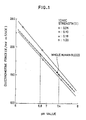
- the invention is predicated in the fact that the activity coefficient noted above is determined by the charge of ions and total ionic strength in the solution.
- the ionic strength I and activity coefficient are related to each other as a Debye-Huckel threshold equation where A and B are constants determined by the dielectric constant and temperture of the solvent, Z i an ion valency, I ionic strength and a i effective radius of hydration ion.
- the activity coefficient of certain ion depends on the total ionic strength of that solution. Therefore, the ionic strength, i.e., activity coefficient, varies with changes in the concentrations of coexistent ions other than the measurement ion even if the measurement ion concentration is constant. According to the invention, the ionic strength is set to be substantially identical with the ionic strength of solution under measurement.
- a calibration solution for sensor consist of a solid electrode for measuring ion concentration of a solution under examination, in which NaCl is added to a standard buffer solution to provide an ionic strength substantially identical with the ionic strength of the solution under examination.
- the calibration solution of the above constitution permits measurement with less error.
- the invention can be more suitably utilized in medical and like fields, in which the solution under examination is blood or like body fluids subject to less ion concentration changes.
- a calibration method for calibrating a sensor in which at least two reference calibration solutions having different pH values are prepared, the electromotive forces of the sensor in these reference calibration solutions are measured by immersing the sensor in these solutions, and a calibration formula (calibration curve) from the electromotive forces with respect to the pH values of the reference calibration solutions.
- a calibration solution for calibrating a sensor in case of measuring partial gas pressure as well as ion concentration of a solution under examination containing carbon dioxide gas and/or oxygen gas, in which a predetermined quantity of bicarbonate buffer solution is added to the standard buffer solution to maintain a substantially constant ion concentration as well as adding NaCl to set an ionic strength substantially identical with the ionic strength of the solution under examination.
- This calibration solution can be utilized for calibrating a carbon dioxide gas sensor as well as a pH sensor or like ion sensor, that is, it is possible to obtain a simultaneous calibration solution permitting high accuracy simultaneous measurement.
- a calibration method for calibrating an ion sensor and a gas sensor in which at least two reference calibration solutions having different pH values and partial gas pressure values are prepared, the electromotive forces of these sensors in these reference calibration solutions are measured by immersing the sensors in the solutions, and calibration formulas are formed by plotting the electromotive forces of the sensors for the pH values and partial gas pressure values for gas sensor.
- a first standard buffer solution is prepared by using a mixture solution composed of Na2HPO4 (27.2 mEq/l)/NaH2PO4 (6.8 mEq/l) and Na2HPO4 (22.5 mEq/l)/NaH2PO4 (22.5 mEq/l) of phosphate buffer solution system with respective pH values of 7.4 and 6.8.
- NaCl phosphate buffer solution system with respective pH values of 7.4 and 6.8.
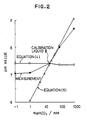
- At least two standard buffer solutions having an ionic strength substantially identical with that of solution under examination and having different pH values are prepared on the basis of equation (4), and a calibration formula is formed by plotting the electromotive forces of a pH sensor or the like in these standard buffer solutions by immersing the sensor in the solutions.
- a calibration solution may be prepared which has an identical ionic strength.
- bicarbonate buffer solution like phosphate buffer solution
- the pH of the solution can be held constant in the presence of CO2.
- the concentration of [HCO3 ⁇ ] may be obtained from the intersection between equations (4) and (5) by varying it with the standard buffer solution system of pH values of 7.4 and 6.8 while holding constant the [HPO42 ⁇ ]/[H2PO4 ⁇ ] in equation (4) and P CO2 in equation (5).
- the invention is further predicated in charges induced on the membrane surface of a solid membrane electrode by charges on ions and protein dissolved in solution under examination.
- the invention seeks to provide a calibration solution for a sensor, with which a system obtained by adding NaCl to a standard buffer solution and a system of ions and/or protein dissolved in the solution under examination are made identical in the status of charges to that of charges induced on solid membrane surface.
- the ratio Na2HPO4/NaH2PO4 in the standard buffer solution was set to 4/1 in Examples 1 to 4 and to 1/1 in Examples 5 to 8.
- Suitable ranges of components of calibration solutions I and II are as in Table 1-C as above.
- Electromotive force obtained from a pH sensor with saturated sodium chloride calomel electrode (SSEC) as electrode potential pair in case of total human blood was 153.30 mV, and pH at this time measured at a temperature of 37°C using a HL-30 gas monitor manufactured by Radiometer Co., Ltd. was 7.367.
- SSEC saturated sodium chloride calomel electrode
- the range of fluctuation may be thought to be 0.08 to 0.18, and a calibration curve may be formed with respect to ionic strength values in this range.
- Calibration solutions for simultaneous calibration of ion sensor and gas sensor were prepared as Examples 9 to 18 shown in Tables 2-A and 2-B below.
- Calibration solution I was used for Examples 9 to 13, and calibration solution II for Examples 14 to 18.
- NaHCO3 was added to these calibration solutions, and the calibration solution compositions were calculated on the basis of equation (5).
- the amount of NaHCO3 in calibration solution suited for simultaneous calibration of ion sensor and gas sensor is determined as follows.
- Examples 12 was determined to be appropriate as calibration solution III, and Example 16 as calibration solution IV.
- Calibration curves for pH sensor, carbon dioxide gas sensor and oxygen gas sensor can be formed by measuring the electromotive forces of the pH sensor and carbon dioxide gas sensor and current in the oxygen gas sensor in both the calibration solutions III and IV, plotting the electromotive forces of the pH sensor and carbon dioxide gas sensor for the pH values and P CO2 values of the solutions III and IV and plotting the current in the oxygen gas sensor for the P o2 values.
- Suitable ranges of components of calibration solutions III and IV are as in Table 2-C as above.
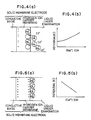
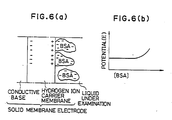
- Figs. 4 to 6 illustrate the status of charges induced on solid membrane electrode surface by ions and/or protein dissolved in solution under examination.
- Fig. 4 shows the behavior of sodium ions in the solution under examination containing NaCl with respect to the film surface of an hydrogen ion carrier membrane of a solid membrane electrode immersed in the solution under examination.
- sodium ions near the membrane surface are captured on the membrane surface to induce positive charges, while inducing negative charges on the carrier membrane of electrode on the side of conductive base.
- the membrane surface potential E and sodium ion concentration are related as shown in (b), and the calibration solution used here is prepared in comformity to the status of charges induced on the membrane surface.
- Fig. 5 shows behavior in case where magnesium and calcium ions are dissolved in the solution under examination. As shown in (a), these ions induce negative charges on the hydrogen carrier membrane surface, and the calcium ion concentration, for instance, and membrane surface potential E are related substantially linearly as shown in (b). The same applies in the case of magnesium ions.
- the calibration solution in this case is prepared such as to conform to the status of charges induced in the membrane surface from the consideration of the relation shown in the graph.
- Fig. 6 concerns a case, in which the solution under examination is a protein solution containing dissolved bovine serum albumin (BSA) as protein.
- BSA bovine serum albumin
- Examples of electrode subject to the influence of adsorbed protein are ISFET electrodes, platinum electrodes, SnO2 electrodes and galssy carbon electrodes.
- ISFET electrodes in which glass electrode and sensor membrane are covered with glass, variation of protein concentration caused no potential changes.
Landscapes
- Health & Medical Sciences (AREA)
- Life Sciences & Earth Sciences (AREA)
- Physics & Mathematics (AREA)
- Engineering & Computer Science (AREA)
- Molecular Biology (AREA)
- General Health & Medical Sciences (AREA)
- Chemical & Material Sciences (AREA)
- Pathology (AREA)
- Biomedical Technology (AREA)
- Immunology (AREA)
- Hematology (AREA)
- Heart & Thoracic Surgery (AREA)
- General Physics & Mathematics (AREA)
- Surgery (AREA)
- Public Health (AREA)
- Veterinary Medicine (AREA)
- Medical Informatics (AREA)
- Animal Behavior & Ethology (AREA)
- Biochemistry (AREA)
- Biophysics (AREA)
- Analytical Chemistry (AREA)
- Urology & Nephrology (AREA)
- Optics & Photonics (AREA)
- Food Science & Technology (AREA)
- Medicinal Chemistry (AREA)
- Microbiology (AREA)
- Cell Biology (AREA)
- Biotechnology (AREA)
- Chemical Kinetics & Catalysis (AREA)
- Electrochemistry (AREA)
- Investigating Or Analysing Biological Materials (AREA)
- Investigating Or Analyzing Materials By The Use Of Electric Means (AREA)
Applications Claiming Priority (2)
| Application Number | Priority Date | Filing Date | Title |
|---|---|---|---|
| JP63239489A JPH0287055A (ja) | 1988-09-24 | 1988-09-24 | センサの較正液及び較正法 |
| JP239489/88 | 1988-09-24 |
Publications (3)
| Publication Number | Publication Date |
|---|---|
| EP0362032A2 true EP0362032A2 (de) | 1990-04-04 |
| EP0362032A3 EP0362032A3 (en) | 1990-12-19 |
| EP0362032B1 EP0362032B1 (de) | 1995-04-12 |
Family
ID=17045539
Family Applications (1)
| Application Number | Title | Priority Date | Filing Date |
|---|---|---|---|
| EP89402596A Expired - Lifetime EP0362032B1 (de) | 1988-09-24 | 1989-09-21 | Eine Lösung und ein Verfahren zur Kalibrierung eines Sensors |
Country Status (5)
| Country | Link |
|---|---|
| US (1) | US5132000A (de) |
| EP (1) | EP0362032B1 (de) |
| JP (1) | JPH0287055A (de) |
| DE (1) | DE68922174T2 (de) |
| DK (1) | DK468689A (de) |
Cited By (6)
| Publication number | Priority date | Publication date | Assignee | Title |
|---|---|---|---|---|
| WO1994006019A1 (en) * | 1992-08-28 | 1994-03-17 | Via Medical Corporation | Calibration solutions useful for analyses of biological fluids and methods employing same |
| EP0837325A1 (de) * | 1996-10-15 | 1998-04-22 | Nova Biomedical Corporation | Sensoreneichung |
| WO1999062398A3 (de) * | 1998-06-04 | 2000-02-17 | Siemens Ag | Kalibrierungsfluid für einen sensors zur messung eines blutwertes |
| WO2000040956A1 (en) * | 1999-01-07 | 2000-07-13 | Bayer Corporation | Correcting protein induced error in ph-sensitive ise comprising a polymeric membrane |
| WO2004011931A1 (en) * | 2002-07-26 | 2004-02-05 | Instrumentation Laboratory Company | Compositions and method for reducing the rate of oxygen loss from aqueous |
| US7422903B2 (en) | 2002-12-11 | 2008-09-09 | Instrumentation Laboratory Company | Multi-analyte reference solutions |
Families Citing this family (9)
| Publication number | Priority date | Publication date | Assignee | Title |
|---|---|---|---|---|
| EP0958499B1 (de) * | 1997-01-17 | 2002-08-07 | Metracor Technologies Inc | Verfahren zum kalibrieren von sensoren in diagnostischen testverfahren |
| JP2000310636A (ja) * | 1999-02-23 | 2000-11-07 | Toto Ltd | 健康管理装置 |
| SG169949A1 (en) * | 2009-09-11 | 2011-04-29 | Agency Science Tech & Res | Method of determining a sensitivity of a biosensor arrangement, and biosensor sensitivity determining system |
| JP4621813B1 (ja) * | 2010-09-10 | 2011-01-26 | 株式会社常光 | イオン選択性電極法用2液系校正液および兼用参照電極液 |
| CN102809590B (zh) * | 2011-06-02 | 2014-10-08 | 深圳中科优瑞医疗科技有限公司 | 一种用于电解质分析仪锂离子测试的方法 |
| US10890558B2 (en) | 2014-10-06 | 2021-01-12 | Smartwash Solutions, Llc | Portable sensor validation system |
| MX372848B (es) * | 2014-10-06 | 2020-07-06 | Smartwash Solutions Llc | Sistema de validación de sensor en-línea. |
| JP7436368B2 (ja) * | 2018-08-28 | 2024-02-21 | 株式会社 堀場アドバンスドテクノ | カルシウムイオン濃度測定装置 |
| EP3983787A4 (de) * | 2019-06-12 | 2022-08-03 | Siemens Healthcare Diagnostics, Inc. | System und verfahren zur messung und kalibrierung von analyttests |
Family Cites Families (7)
| Publication number | Priority date | Publication date | Assignee | Title |
|---|---|---|---|---|
| NL292885A (de) * | 1963-05-16 | |||
| US3556950A (en) * | 1966-07-15 | 1971-01-19 | Ibm | Method and apparatus for automatic electrochemical analysis |
| US3681255A (en) * | 1970-09-03 | 1972-08-01 | Gen Electric | Process for the preparation of liquid calibration fluids |
| US3941565A (en) * | 1970-12-08 | 1976-03-02 | Schwartz Henry D | Clinical testing means and methods |
| IT1098867B (it) * | 1978-09-20 | 1985-09-18 | Instrumentation Lab Spa | Soluzioni preparate con tampone fosfato ed equilibrate con gas,confezionate in fiale a tre differenti livelli di ph,pc02,e p02,destinate al controllo di qualita' degli emogasanalizzatori;formulazione di tali soluzioni e processo per la loro preparazione industriale |
| DK149830C (da) * | 1982-05-17 | 1987-02-16 | Radiometer As | Fremgangsmaade ved bestemmelse af koncentrationen af en ion i en praeve af blod eller blodvaeske |
| JPH0797098B2 (ja) * | 1984-07-14 | 1995-10-18 | 株式会社堀場製作所 | 複数のイオン電極の同時校正用標準液 |
-
1988
- 1988-09-24 JP JP63239489A patent/JPH0287055A/ja active Pending
-
1989
- 1989-09-21 EP EP89402596A patent/EP0362032B1/de not_active Expired - Lifetime
- 1989-09-21 DE DE68922174T patent/DE68922174T2/de not_active Expired - Fee Related
- 1989-09-22 DK DK468689A patent/DK468689A/da not_active Application Discontinuation
- 1989-09-22 US US07/411,114 patent/US5132000A/en not_active Expired - Fee Related
Cited By (10)
| Publication number | Priority date | Publication date | Assignee | Title |
|---|---|---|---|---|
| WO1994006019A1 (en) * | 1992-08-28 | 1994-03-17 | Via Medical Corporation | Calibration solutions useful for analyses of biological fluids and methods employing same |
| EP0837325A1 (de) * | 1996-10-15 | 1998-04-22 | Nova Biomedical Corporation | Sensoreneichung |
| WO1999062398A3 (de) * | 1998-06-04 | 2000-02-17 | Siemens Ag | Kalibrierungsfluid für einen sensors zur messung eines blutwertes |
| US6599746B1 (en) | 1998-06-04 | 2003-07-29 | Walter Gumbrecht | Calibration fluid for calibrating a sensor for measuring a blood value and methods for producing and using the fluid |
| WO2000040956A1 (en) * | 1999-01-07 | 2000-07-13 | Bayer Corporation | Correcting protein induced error in ph-sensitive ise comprising a polymeric membrane |
| US6355158B1 (en) | 1999-01-07 | 2002-03-12 | Bayer Corporation | Method of measuring pH |
| WO2004011931A1 (en) * | 2002-07-26 | 2004-02-05 | Instrumentation Laboratory Company | Compositions and method for reducing the rate of oxygen loss from aqueous |
| US7378006B2 (en) | 2002-07-26 | 2008-05-27 | Instrumentation Laboratory Company | Aqueous solutions for reducing the rate of oxygen loss, and methods thereof |
| US7422903B2 (en) | 2002-12-11 | 2008-09-09 | Instrumentation Laboratory Company | Multi-analyte reference solutions |
| US7732210B2 (en) | 2002-12-11 | 2010-06-08 | Instrumentation Laboratory Company | Multi-analyte reference solutions |
Also Published As
| Publication number | Publication date |
|---|---|
| US5132000A (en) | 1992-07-21 |
| EP0362032A3 (en) | 1990-12-19 |
| EP0362032B1 (de) | 1995-04-12 |
| DK468689A (da) | 1990-03-26 |
| DE68922174D1 (de) | 1995-05-18 |
| DE68922174T2 (de) | 1995-09-14 |
| JPH0287055A (ja) | 1990-03-27 |
| DK468689D0 (da) | 1989-09-22 |
Similar Documents
| Publication | Publication Date | Title |
|---|---|---|
| EP0362032B1 (de) | Eine Lösung und ein Verfahren zur Kalibrierung eines Sensors | |
| Maas et al. | Ion-selective electrodes for sodium and potassium: a new problem of what is measured and what should be reported. | |
| Burnett et al. | Use of ion-selective electrodes for blood-electrolyte analysis. Recommendations for nomenclature, definitions and conventions | |
| EP1164372B1 (de) | Auf einem Mikrochip basierender Differenz-Kohlendioxidsensor | |
| Butler | The thermodynamic activity of calcium ion in sodium chloride-calcium chloride electrolytes | |
| US5554272A (en) | Planar bicarbonate sensor | |
| Mohan et al. | Calibration of ion-selective electrodes for use in biological fluids | |
| Schneider et al. | Determination of hydrogen single ion activity coefficients in aqueous HCl solutions at 25 C | |
| US5023186A (en) | Blood gas/electrolytes calibrator and methods of making and using the same | |
| Spitzer et al. | Improved traceability of pH measurements | |
| US4452672A (en) | Process and apparatus for polarographic determination of oxygen and carbon dioxide | |
| Friedman et al. | Glass electrode measurements of blood sodium and potassium in man | |
| US5102527A (en) | Calcium ion selective electrode | |
| Meier et al. | Applicability of available ion-selective liquid-membrane microelectrodes to intracellular ion-activity measurements | |
| EP0341793A2 (de) | Pufferlösungssysteme und Elektrolyten zur Eichung von Analysegeräten | |
| GB2080543A (en) | A reference liquid for use in calibrating a chemical analyzer | |
| US5518929A (en) | Method of making a blood gas/electrolyte control | |
| EP0350116A2 (de) | Elektrochemische Zelle zur Messung der ionischen Aktivität in einer Lösung und Verfahren zu deren Verwendung | |
| US5227305A (en) | Buffer solution systems for standardizing pH analyzers and electrolytes | |
| Emde | Electrochemical aspects of pH electrodes | |
| Osswald et al. | Calibration standards for multi ion analysis in whole blood samples | |
| Bijster et al. | Direct potentiometric determination of sodium ion in blood. I. Potentiometric response in simple sodium chloride solutions. | |
| Maas et al. | VII. Expert Panel* on pH and Blood Gases | |
| Markdahl-Bjarme et al. | Modified conventional type of p CO2-electrode with monocrystalline antimony as the pH-sensing element | |
| Deviney Jr et al. | Application of the glass electrode to the determination of the thermodynamic ionization constants of p-aminobenzoic acid |
Legal Events
| Date | Code | Title | Description |
|---|---|---|---|
| PUAI | Public reference made under article 153(3) epc to a published international application that has entered the european phase |
Free format text: ORIGINAL CODE: 0009012 |
|
| 17P | Request for examination filed |
Effective date: 19890925 |
|
| AK | Designated contracting states |
Kind code of ref document: A2 Designated state(s): BE DE ES FR GB IT NL SE |
|
| PUAL | Search report despatched |
Free format text: ORIGINAL CODE: 0009013 |
|
| AK | Designated contracting states |
Kind code of ref document: A3 Designated state(s): BE DE ES FR GB IT NL SE |
|
| 17Q | First examination report despatched |
Effective date: 19920309 |
|
| 18D | Application deemed to be withdrawn |
Effective date: 19930619 |
|
| 18RA | Request filed for re-establishment of rights before grant |
Effective date: 19940117 |
|
| 18RR | Decision to grant the request for re-establishment of rights before grant |
Free format text: 940428 ANGENOMMEN |
|
| D18D | Application deemed to be withdrawn (deleted) | ||
| REG | Reference to a national code |
Ref country code: DE Ref legal event code: 8570 |
|
| GRAA | (expected) grant |
Free format text: ORIGINAL CODE: 0009210 |
|
| AK | Designated contracting states |
Kind code of ref document: B1 Designated state(s): BE DE ES FR GB IT NL SE |
|
| PG25 | Lapsed in a contracting state [announced via postgrant information from national office to epo] |
Ref country code: IT Free format text: LAPSE BECAUSE OF FAILURE TO SUBMIT A TRANSLATION OF THE DESCRIPTION OR TO PAY THE FEE WITHIN THE PRE;WARNING: LAPSES OF ITALIAN PATENTS WITH EFFECTIVE DATE BEFORE 2007 MAY HAVE OCCURRED AT ANY TIME BEFORE 2007. THE CORRECT EFFECTIVE DATE MAY BE DIFFERENT FROM THE ONE RECORDED.SCRIBED TIME-LIMIT Effective date: 19950412 Ref country code: BE Effective date: 19950412 Ref country code: ES Free format text: THE PATENT HAS BEEN ANNULLED BY A DECISION OF A NATIONAL AUTHORITY Effective date: 19950412 Ref country code: FR Effective date: 19950412 Ref country code: NL Free format text: LAPSE BECAUSE OF NON-PAYMENT OF DUE FEES Effective date: 19950412 |
|
| REF | Corresponds to: |
Ref document number: 68922174 Country of ref document: DE Date of ref document: 19950518 |
|
| PG25 | Lapsed in a contracting state [announced via postgrant information from national office to epo] |
Ref country code: SE Effective date: 19950712 |
|
| EN | Fr: translation not filed | ||
| PG25 | Lapsed in a contracting state [announced via postgrant information from national office to epo] |
Ref country code: GB Effective date: 19950921 |
|
| NLV1 | Nl: lapsed or annulled due to failure to fulfill the requirements of art. 29p and 29m of the patents act | ||
| PLBE | No opposition filed within time limit |
Free format text: ORIGINAL CODE: 0009261 |
|
| STAA | Information on the status of an ep patent application or granted ep patent |
Free format text: STATUS: NO OPPOSITION FILED WITHIN TIME LIMIT |
|
| 26N | No opposition filed | ||
| GBPC | Gb: european patent ceased through non-payment of renewal fee |
Effective date: 19950921 |
|
| PGFP | Annual fee paid to national office [announced via postgrant information from national office to epo] |
Ref country code: DE Payment date: 20031002 Year of fee payment: 15 |
|
| PG25 | Lapsed in a contracting state [announced via postgrant information from national office to epo] |
Ref country code: DE Free format text: LAPSE BECAUSE OF NON-PAYMENT OF DUE FEES Effective date: 20050401 |