EP0362309B1 - (ethylenedioxo-3,3 zyclohexyl)-4 aketophenon und derivate davon, verfahren zu deren herstellung und verwendung dieser verbindungen - Google Patents
(ethylenedioxo-3,3 zyclohexyl)-4 aketophenon und derivate davon, verfahren zu deren herstellung und verwendung dieser verbindungen Download PDFInfo
- Publication number
- EP0362309B1 EP0362309B1 EP19890902223 EP89902223A EP0362309B1 EP 0362309 B1 EP0362309 B1 EP 0362309B1 EP 19890902223 EP19890902223 EP 19890902223 EP 89902223 A EP89902223 A EP 89902223A EP 0362309 B1 EP0362309 B1 EP 0362309B1
- Authority
- EP
- European Patent Office
- Prior art keywords
- formula
- compound
- group
- compounds
- cyclohexyl
- Prior art date
- Legal status (The legal status is an assumption and is not a legal conclusion. Google has not performed a legal analysis and makes no representation as to the accuracy of the status listed.)
- Expired - Lifetime
Links
- 150000001875 compounds Chemical class 0.000 title claims abstract description 225
- 238000000034 method Methods 0.000 title claims abstract description 34
- KWOLFJPFCHCOCG-UHFFFAOYSA-N Acetophenone Chemical compound CC(=O)C1=CC=CC=C1 KWOLFJPFCHCOCG-UHFFFAOYSA-N 0.000 title abstract description 38
- 238000002360 preparation method Methods 0.000 claims abstract description 24
- 229910052739 hydrogen Inorganic materials 0.000 claims abstract description 18
- 239000001257 hydrogen Substances 0.000 claims abstract description 15
- 230000001131 transforming effect Effects 0.000 claims abstract description 11
- UFHFLCQGNIYNRP-UHFFFAOYSA-N Hydrogen Chemical compound [H][H] UFHFLCQGNIYNRP-UHFFFAOYSA-N 0.000 claims abstract description 8
- 125000000217 alkyl group Chemical group 0.000 claims abstract description 8
- FASVODQCERZDFX-UHFFFAOYSA-N 2-[4-(3-oxocyclohexyl)phenyl]propanoic acid Chemical compound C1=CC(C(C(O)=O)C)=CC=C1C1CC(=O)CCC1 FASVODQCERZDFX-UHFFFAOYSA-N 0.000 claims abstract 2
- 239000000047 product Substances 0.000 claims description 28
- 150000002576 ketones Chemical group 0.000 claims description 21
- LYCAIKOWRPUZTN-UHFFFAOYSA-N Ethylene glycol Chemical compound OCCO LYCAIKOWRPUZTN-UHFFFAOYSA-N 0.000 claims description 18
- 238000006243 chemical reaction Methods 0.000 claims description 15
- 239000000460 chlorine Substances 0.000 claims description 15
- 125000002734 organomagnesium group Chemical group 0.000 claims description 15
- 125000000113 cyclohexyl group Chemical group [H]C1([H])C([H])([H])C([H])([H])C([H])(*)C([H])([H])C1([H])[H] 0.000 claims description 13
- 230000007062 hydrolysis Effects 0.000 claims description 13
- 238000006460 hydrolysis reaction Methods 0.000 claims description 13
- 238000006359 acetalization reaction Methods 0.000 claims description 12
- 230000003197 catalytic effect Effects 0.000 claims description 9
- 238000003747 Grignard reaction Methods 0.000 claims description 8
- 239000012467 final product Substances 0.000 claims description 8
- 125000002777 acetyl group Chemical group [H]C([H])([H])C(*)=O 0.000 claims description 7
- WFDIJRYMOXRFFG-UHFFFAOYSA-N Acetic anhydride Chemical compound CC(=O)OC(C)=O WFDIJRYMOXRFFG-UHFFFAOYSA-N 0.000 claims description 6
- VSCWAEJMTAWNJL-UHFFFAOYSA-K aluminium trichloride Chemical compound Cl[Al](Cl)Cl VSCWAEJMTAWNJL-UHFFFAOYSA-K 0.000 claims description 6
- 229910052801 chlorine Inorganic materials 0.000 claims description 6
- 150000002431 hydrogen Chemical group 0.000 claims description 6
- 238000007327 hydrogenolysis reaction Methods 0.000 claims description 6
- 238000006467 substitution reaction Methods 0.000 claims description 6
- CURLTUGMZLYLDI-UHFFFAOYSA-N Carbon dioxide Chemical compound O=C=O CURLTUGMZLYLDI-UHFFFAOYSA-N 0.000 claims description 4
- HEDRZPFGACZZDS-UHFFFAOYSA-N Chloroform Chemical compound ClC(Cl)Cl HEDRZPFGACZZDS-UHFFFAOYSA-N 0.000 claims description 4
- 238000005727 Friedel-Crafts reaction Methods 0.000 claims description 4
- 230000002378 acidificating effect Effects 0.000 claims description 4
- 125000001495 ethyl group Chemical group [H]C([H])([H])C([H])([H])* 0.000 claims description 4
- 125000002887 hydroxy group Chemical group [H]O* 0.000 claims description 4
- UAYWVJHJZHQCIE-UHFFFAOYSA-L zinc iodide Chemical compound I[Zn]I UAYWVJHJZHQCIE-UHFFFAOYSA-L 0.000 claims description 4
- ZAMOUSCENKQFHK-UHFFFAOYSA-N Chlorine atom Chemical compound [Cl] ZAMOUSCENKQFHK-UHFFFAOYSA-N 0.000 claims description 3
- 239000002841 Lewis acid Substances 0.000 claims description 3
- WETWJCDKMRHUPV-UHFFFAOYSA-N acetyl chloride Chemical compound CC(Cl)=O WETWJCDKMRHUPV-UHFFFAOYSA-N 0.000 claims description 3
- 239000012346 acetyl chloride Substances 0.000 claims description 3
- 239000012736 aqueous medium Substances 0.000 claims description 3
- 125000001309 chloro group Chemical group Cl* 0.000 claims description 3
- 150000007517 lewis acids Chemical class 0.000 claims description 3
- 239000002609 medium Substances 0.000 claims description 3
- WTAGBGKFGMJZNM-UHFFFAOYSA-N n,n-diethyl-3-phenylpropan-1-amine;hydrochloride Chemical compound Cl.CCN(CC)CCCC1=CC=CC=C1 WTAGBGKFGMJZNM-UHFFFAOYSA-N 0.000 claims description 3
- LEIMLDGFXIOXMT-UHFFFAOYSA-N trimethylsilyl cyanide Chemical compound C[Si](C)(C)C#N LEIMLDGFXIOXMT-UHFFFAOYSA-N 0.000 claims description 3
- 150000008044 alkali metal hydroxides Chemical class 0.000 claims description 2
- 239000001569 carbon dioxide Substances 0.000 claims description 2
- 229910002092 carbon dioxide Inorganic materials 0.000 claims description 2
- 230000009466 transformation Effects 0.000 claims 4
- 150000001804 chlorine Chemical class 0.000 claims 1
- 125000004435 hydrogen atom Chemical group [H]* 0.000 claims 1
- 239000013067 intermediate product Substances 0.000 claims 1
- XEKOWRVHYACXOJ-UHFFFAOYSA-N Ethyl acetate Chemical compound CCOC(C)=O XEKOWRVHYACXOJ-UHFFFAOYSA-N 0.000 description 33
- -1 oxo-3-cyclohexyl Chemical group 0.000 description 28
- LFQSCWFLJHTTHZ-UHFFFAOYSA-N Ethanol Chemical compound CCO LFQSCWFLJHTTHZ-UHFFFAOYSA-N 0.000 description 25
- VEXZGXHMUGYJMC-UHFFFAOYSA-N Hydrochloric acid Chemical compound Cl VEXZGXHMUGYJMC-UHFFFAOYSA-N 0.000 description 21
- WYURNTSHIVDZCO-UHFFFAOYSA-N Tetrahydrofuran Chemical compound C1CCOC1 WYURNTSHIVDZCO-UHFFFAOYSA-N 0.000 description 20
- 125000001997 phenyl group Chemical group [H]C1=C([H])C([H])=C(*)C([H])=C1[H] 0.000 description 15
- XBDQKXXYIPTUBI-UHFFFAOYSA-N dimethylselenoniopropionate Natural products CCC(O)=O XBDQKXXYIPTUBI-UHFFFAOYSA-N 0.000 description 14
- WNXJIVFYUVYPPR-UHFFFAOYSA-N 1,3-dioxolane Chemical compound C1COCO1 WNXJIVFYUVYPPR-UHFFFAOYSA-N 0.000 description 12
- CSCPPACGZOOCGX-UHFFFAOYSA-N Acetone Chemical compound CC(C)=O CSCPPACGZOOCGX-UHFFFAOYSA-N 0.000 description 12
- VLKZOEOYAKHREP-UHFFFAOYSA-N n-Hexane Chemical compound CCCCCC VLKZOEOYAKHREP-UHFFFAOYSA-N 0.000 description 12
- 238000006705 deacetalization reaction Methods 0.000 description 11
- FVSKHRXBFJPNKK-UHFFFAOYSA-N propionitrile Chemical compound CCC#N FVSKHRXBFJPNKK-UHFFFAOYSA-N 0.000 description 11
- 239000000243 solution Substances 0.000 description 11
- 239000002904 solvent Substances 0.000 description 11
- IPOQTZCBZFSJIV-UHFFFAOYSA-N 1-(4-bromophenyl)ethanone;1,3-dioxolane Chemical compound C1COCO1.CC(=O)C1=CC=C(Br)C=C1 IPOQTZCBZFSJIV-UHFFFAOYSA-N 0.000 description 10
- YMWUJEATGCHHMB-UHFFFAOYSA-N Dichloromethane Chemical compound ClCCl YMWUJEATGCHHMB-UHFFFAOYSA-N 0.000 description 10
- JHIVVAPYMSGYDF-UHFFFAOYSA-N cyclohexanone Chemical compound O=C1CCCCC1 JHIVVAPYMSGYDF-UHFFFAOYSA-N 0.000 description 10
- YLQBMQCUIZJEEH-UHFFFAOYSA-N tetrahydrofuran Natural products C=1C=COC=1 YLQBMQCUIZJEEH-UHFFFAOYSA-N 0.000 description 10
- 0 C*[C@]1(*)C(*)C(*)C(C)*C1* Chemical compound C*[C@]1(*)C(*)C(*)C(C)*C1* 0.000 description 9
- ZMXDDKWLCZADIW-UHFFFAOYSA-N N,N-Dimethylformamide Chemical compound CN(C)C=O ZMXDDKWLCZADIW-UHFFFAOYSA-N 0.000 description 9
- HEMHJVSKTPXQMS-UHFFFAOYSA-M Sodium hydroxide Chemical compound [OH-].[Na+] HEMHJVSKTPXQMS-UHFFFAOYSA-M 0.000 description 9
- KDLHZDBZIXYQEI-UHFFFAOYSA-N Palladium Chemical compound [Pd] KDLHZDBZIXYQEI-UHFFFAOYSA-N 0.000 description 7
- 235000019260 propionic acid Nutrition 0.000 description 7
- IUVKMZGDUIUOCP-BTNSXGMBSA-N quinbolone Chemical compound O([C@H]1CC[C@H]2[C@H]3[C@@H]([C@]4(C=CC(=O)C=C4CC3)C)CC[C@@]21C)C1=CCCC1 IUVKMZGDUIUOCP-BTNSXGMBSA-N 0.000 description 7
- 238000005160 1H NMR spectroscopy Methods 0.000 description 6
- XDTMQSROBMDMFD-UHFFFAOYSA-N Cyclohexane Chemical compound C1CCCCC1 XDTMQSROBMDMFD-UHFFFAOYSA-N 0.000 description 6
- RTZKZFJDLAIYFH-UHFFFAOYSA-N Diethyl ether Chemical compound CCOCC RTZKZFJDLAIYFH-UHFFFAOYSA-N 0.000 description 6
- 238000006722 reduction reaction Methods 0.000 description 6
- 238000011282 treatment Methods 0.000 description 6
- HEDRZPFGACZZDS-MICDWDOJSA-N Trichloro(2H)methane Chemical compound [2H]C(Cl)(Cl)Cl HEDRZPFGACZZDS-MICDWDOJSA-N 0.000 description 5
- 239000012074 organic phase Substances 0.000 description 5
- XTZHEZBHBNPIJG-UHFFFAOYSA-N C(C)OC1C(C=CCC1)=O Chemical compound C(C)OC1C(C=CCC1)=O XTZHEZBHBNPIJG-UHFFFAOYSA-N 0.000 description 4
- 230000015572 biosynthetic process Effects 0.000 description 4
- 238000010511 deprotection reaction Methods 0.000 description 4
- 238000004817 gas chromatography Methods 0.000 description 4
- 239000011777 magnesium Substances 0.000 description 4
- 125000002496 methyl group Chemical group [H]C([H])([H])* 0.000 description 4
- 239000000203 mixture Substances 0.000 description 4
- 238000010992 reflux Methods 0.000 description 4
- FYSNRJHAOHDILO-UHFFFAOYSA-N thionyl chloride Chemical compound ClS(Cl)=O FYSNRJHAOHDILO-UHFFFAOYSA-N 0.000 description 4
- OKKJLVBELUTLKV-UHFFFAOYSA-N Methanol Chemical compound OC OKKJLVBELUTLKV-UHFFFAOYSA-N 0.000 description 3
- YXFVVABEGXRONW-UHFFFAOYSA-N Toluene Chemical compound CC1=CC=CC=C1 YXFVVABEGXRONW-UHFFFAOYSA-N 0.000 description 3
- 125000001797 benzyl group Chemical group [H]C1=C([H])C([H])=C(C([H])=C1[H])C([H])([H])* 0.000 description 3
- 238000009903 catalytic hydrogenation reaction Methods 0.000 description 3
- 238000001704 evaporation Methods 0.000 description 3
- 230000008020 evaporation Effects 0.000 description 3
- 238000000605 extraction Methods 0.000 description 3
- 239000007858 starting material Substances 0.000 description 3
- 238000003786 synthesis reaction Methods 0.000 description 3
- 238000003420 transacetalization reaction Methods 0.000 description 3
- NLXLAEXVIDQMFP-UHFFFAOYSA-N Ammonia chloride Chemical compound [NH4+].[Cl-] NLXLAEXVIDQMFP-UHFFFAOYSA-N 0.000 description 2
- OTMSDBZUPAUEDD-UHFFFAOYSA-N Ethane Chemical compound CC OTMSDBZUPAUEDD-UHFFFAOYSA-N 0.000 description 2
- 239000007818 Grignard reagent Substances 0.000 description 2
- JUJWROOIHBZHMG-UHFFFAOYSA-N Pyridine Chemical compound C1=CC=NC=C1 JUJWROOIHBZHMG-UHFFFAOYSA-N 0.000 description 2
- DHKHKXVYLBGOIT-UHFFFAOYSA-N acetaldehyde Diethyl Acetal Natural products CCOC(C)OCC DHKHKXVYLBGOIT-UHFFFAOYSA-N 0.000 description 2
- 239000002253 acid Substances 0.000 description 2
- 238000005903 acid hydrolysis reaction Methods 0.000 description 2
- 239000008346 aqueous phase Substances 0.000 description 2
- 239000003054 catalyst Substances 0.000 description 2
- 238000010531 catalytic reduction reaction Methods 0.000 description 2
- 238000002425 crystallisation Methods 0.000 description 2
- 230000008025 crystallization Effects 0.000 description 2
- 125000004093 cyano group Chemical group *C#N 0.000 description 2
- FWFSEYBSWVRWGL-UHFFFAOYSA-N cyclohex-2-enone Chemical compound O=C1CCCC=C1 FWFSEYBSWVRWGL-UHFFFAOYSA-N 0.000 description 2
- 238000004821 distillation Methods 0.000 description 2
- 230000000694 effects Effects 0.000 description 2
- 150000004795 grignard reagents Chemical class 0.000 description 2
- JVTAAEKCZFNVCJ-UHFFFAOYSA-N lactic acid Chemical compound CC(O)C(O)=O JVTAAEKCZFNVCJ-UHFFFAOYSA-N 0.000 description 2
- 239000000041 non-steroidal anti-inflammatory agent Substances 0.000 description 2
- 229940021182 non-steroidal anti-inflammatory drug Drugs 0.000 description 2
- 239000003960 organic solvent Substances 0.000 description 2
- 239000011541 reaction mixture Substances 0.000 description 2
- 125000000547 substituted alkyl group Chemical group 0.000 description 2
- WYECURVXVYPVAT-UHFFFAOYSA-N 1-(4-bromophenyl)ethanone Chemical compound CC(=O)C1=CC=C(Br)C=C1 WYECURVXVYPVAT-UHFFFAOYSA-N 0.000 description 1
- CJAUDSQXFVZPTO-UHFFFAOYSA-N 3-phenylcyclohexan-1-one Chemical compound C1C(=O)CCCC1C1=CC=CC=C1 CJAUDSQXFVZPTO-UHFFFAOYSA-N 0.000 description 1
- BVKZGUZCCUSVTD-UHFFFAOYSA-M Bicarbonate Chemical compound OC([O-])=O BVKZGUZCCUSVTD-UHFFFAOYSA-M 0.000 description 1
- MVHMHZBDDCHMTF-UHFFFAOYSA-N C1COCO1.CC(=O)C1=CC=CC=C1 Chemical compound C1COCO1.CC(=O)C1=CC=CC=C1 MVHMHZBDDCHMTF-UHFFFAOYSA-N 0.000 description 1
- 229910021591 Copper(I) chloride Inorganic materials 0.000 description 1
- XFXPMWWXUTWYJX-UHFFFAOYSA-N Cyanide Chemical compound N#[C-] XFXPMWWXUTWYJX-UHFFFAOYSA-N 0.000 description 1
- FYYHWMGAXLPEAU-UHFFFAOYSA-N Magnesium Chemical compound [Mg] FYYHWMGAXLPEAU-UHFFFAOYSA-N 0.000 description 1
- 238000006957 Michael reaction Methods 0.000 description 1
- 238000013019 agitation Methods 0.000 description 1
- 125000003158 alcohol group Chemical group 0.000 description 1
- 150000001348 alkyl chlorides Chemical group 0.000 description 1
- 235000019270 ammonium chloride Nutrition 0.000 description 1
- 238000004458 analytical method Methods 0.000 description 1
- 239000007864 aqueous solution Substances 0.000 description 1
- 125000002915 carbonyl group Chemical group [*:2]C([*:1])=O 0.000 description 1
- 238000005660 chlorination reaction Methods 0.000 description 1
- 238000001816 cooling Methods 0.000 description 1
- OXBLHERUFWYNTN-UHFFFAOYSA-M copper(I) chloride Chemical compound [Cu]Cl OXBLHERUFWYNTN-UHFFFAOYSA-M 0.000 description 1
- 239000013078 crystal Substances 0.000 description 1
- 125000000596 cyclohexenyl group Chemical group C1(=CCCCC1)* 0.000 description 1
- 239000002024 ethyl acetate extract Substances 0.000 description 1
- 238000010438 heat treatment Methods 0.000 description 1
- 238000005984 hydrogenation reaction Methods 0.000 description 1
- 239000012535 impurity Substances 0.000 description 1
- 238000011065 in-situ storage Methods 0.000 description 1
- 238000002955 isolation Methods 0.000 description 1
- 229910052749 magnesium Inorganic materials 0.000 description 1
- 150000002825 nitriles Chemical class 0.000 description 1
- UMJSCPRVCHMLSP-UHFFFAOYSA-N pyridine Natural products COC1=CC=CN=C1 UMJSCPRVCHMLSP-UHFFFAOYSA-N 0.000 description 1
- 239000012429 reaction media Substances 0.000 description 1
- 239000012047 saturated solution Substances 0.000 description 1
- 238000000926 separation method Methods 0.000 description 1
- MNWBNISUBARLIT-UHFFFAOYSA-N sodium cyanide Chemical compound [Na+].N#[C-] MNWBNISUBARLIT-UHFFFAOYSA-N 0.000 description 1
- 238000003756 stirring Methods 0.000 description 1
- 239000000126 substance Substances 0.000 description 1
- 230000001988 toxicity Effects 0.000 description 1
- 231100000419 toxicity Toxicity 0.000 description 1
- XLYOFNOQVPJJNP-UHFFFAOYSA-N water Substances O XLYOFNOQVPJJNP-UHFFFAOYSA-N 0.000 description 1
- 229910052727 yttrium Inorganic materials 0.000 description 1
Images


Classifications
-
- C—CHEMISTRY; METALLURGY
- C07—ORGANIC CHEMISTRY
- C07D—HETEROCYCLIC COMPOUNDS
- C07D317/00—Heterocyclic compounds containing five-membered rings having two oxygen atoms as the only ring hetero atoms
- C07D317/08—Heterocyclic compounds containing five-membered rings having two oxygen atoms as the only ring hetero atoms having the hetero atoms in positions 1 and 3
- C07D317/72—Heterocyclic compounds containing five-membered rings having two oxygen atoms as the only ring hetero atoms having the hetero atoms in positions 1 and 3 spiro-condensed with carbocyclic rings
-
- C—CHEMISTRY; METALLURGY
- C07—ORGANIC CHEMISTRY
- C07C—ACYCLIC OR CARBOCYCLIC COMPOUNDS
- C07C255/00—Carboxylic acid nitriles
- C07C255/01—Carboxylic acid nitriles having cyano groups bound to acyclic carbon atoms
- C07C255/32—Carboxylic acid nitriles having cyano groups bound to acyclic carbon atoms having cyano groups bound to acyclic carbon atoms of a carbon skeleton containing at least one six-membered aromatic ring
- C07C255/40—Carboxylic acid nitriles having cyano groups bound to acyclic carbon atoms having cyano groups bound to acyclic carbon atoms of a carbon skeleton containing at least one six-membered aromatic ring the carbon skeleton being further substituted by doubly-bound oxygen atoms
-
- C—CHEMISTRY; METALLURGY
- C07—ORGANIC CHEMISTRY
- C07C—ACYCLIC OR CARBOCYCLIC COMPOUNDS
- C07C45/00—Preparation of compounds having >C = O groups bound only to carbon or hydrogen atoms; Preparation of chelates of such compounds
- C07C45/45—Preparation of compounds having >C = O groups bound only to carbon or hydrogen atoms; Preparation of chelates of such compounds by condensation
- C07C45/46—Friedel-Crafts reactions
-
- C—CHEMISTRY; METALLURGY
- C07—ORGANIC CHEMISTRY
- C07C—ACYCLIC OR CARBOCYCLIC COMPOUNDS
- C07C45/00—Preparation of compounds having >C = O groups bound only to carbon or hydrogen atoms; Preparation of chelates of such compounds
- C07C45/56—Preparation of compounds having >C = O groups bound only to carbon or hydrogen atoms; Preparation of chelates of such compounds from heterocyclic compounds
- C07C45/57—Preparation of compounds having >C = O groups bound only to carbon or hydrogen atoms; Preparation of chelates of such compounds from heterocyclic compounds with oxygen as the only heteroatom
- C07C45/59—Preparation of compounds having >C = O groups bound only to carbon or hydrogen atoms; Preparation of chelates of such compounds from heterocyclic compounds with oxygen as the only heteroatom in five-membered rings
-
- C—CHEMISTRY; METALLURGY
- C07—ORGANIC CHEMISTRY
- C07C—ACYCLIC OR CARBOCYCLIC COMPOUNDS
- C07C45/00—Preparation of compounds having >C = O groups bound only to carbon or hydrogen atoms; Preparation of chelates of such compounds
- C07C45/61—Preparation of compounds having >C = O groups bound only to carbon or hydrogen atoms; Preparation of chelates of such compounds by reactions not involving the formation of >C = O groups
- C07C45/62—Preparation of compounds having >C = O groups bound only to carbon or hydrogen atoms; Preparation of chelates of such compounds by reactions not involving the formation of >C = O groups by hydrogenation of carbon-to-carbon double or triple bonds
-
- C—CHEMISTRY; METALLURGY
- C07—ORGANIC CHEMISTRY
- C07C—ACYCLIC OR CARBOCYCLIC COMPOUNDS
- C07C45/00—Preparation of compounds having >C = O groups bound only to carbon or hydrogen atoms; Preparation of chelates of such compounds
- C07C45/61—Preparation of compounds having >C = O groups bound only to carbon or hydrogen atoms; Preparation of chelates of such compounds by reactions not involving the formation of >C = O groups
- C07C45/63—Preparation of compounds having >C = O groups bound only to carbon or hydrogen atoms; Preparation of chelates of such compounds by reactions not involving the formation of >C = O groups by introduction of halogen; by substitution of halogen atoms by other halogen atoms
-
- C—CHEMISTRY; METALLURGY
- C07—ORGANIC CHEMISTRY
- C07C—ACYCLIC OR CARBOCYCLIC COMPOUNDS
- C07C45/00—Preparation of compounds having >C = O groups bound only to carbon or hydrogen atoms; Preparation of chelates of such compounds
- C07C45/61—Preparation of compounds having >C = O groups bound only to carbon or hydrogen atoms; Preparation of chelates of such compounds by reactions not involving the formation of >C = O groups
- C07C45/64—Preparation of compounds having >C = O groups bound only to carbon or hydrogen atoms; Preparation of chelates of such compounds by reactions not involving the formation of >C = O groups by introduction of functional groups containing oxygen only in singly bound form
-
- C—CHEMISTRY; METALLURGY
- C07—ORGANIC CHEMISTRY
- C07C—ACYCLIC OR CARBOCYCLIC COMPOUNDS
- C07C49/00—Ketones; Ketenes; Dimeric ketenes; Ketonic chelates
- C07C49/587—Unsaturated compounds containing a keto groups being part of a ring
- C07C49/687—Unsaturated compounds containing a keto groups being part of a ring containing halogen
- C07C49/697—Unsaturated compounds containing a keto groups being part of a ring containing halogen containing six-membered aromatic rings
-
- C—CHEMISTRY; METALLURGY
- C07—ORGANIC CHEMISTRY
- C07C—ACYCLIC OR CARBOCYCLIC COMPOUNDS
- C07C49/00—Ketones; Ketenes; Dimeric ketenes; Ketonic chelates
- C07C49/587—Unsaturated compounds containing a keto groups being part of a ring
- C07C49/703—Unsaturated compounds containing a keto groups being part of a ring containing hydroxy groups
- C07C49/747—Unsaturated compounds containing a keto groups being part of a ring containing hydroxy groups containing six-membered aromatic rings
-
- C—CHEMISTRY; METALLURGY
- C07—ORGANIC CHEMISTRY
- C07C—ACYCLIC OR CARBOCYCLIC COMPOUNDS
- C07C49/00—Ketones; Ketenes; Dimeric ketenes; Ketonic chelates
- C07C49/76—Ketones containing a keto group bound to a six-membered aromatic ring
- C07C49/782—Ketones containing a keto group bound to a six-membered aromatic ring polycyclic
- C07C49/792—Ketones containing a keto group bound to a six-membered aromatic ring polycyclic containing rings other than six-membered aromatic rings
-
- C—CHEMISTRY; METALLURGY
- C07—ORGANIC CHEMISTRY
- C07C—ACYCLIC OR CARBOCYCLIC COMPOUNDS
- C07C49/00—Ketones; Ketenes; Dimeric ketenes; Ketonic chelates
- C07C49/76—Ketones containing a keto group bound to a six-membered aromatic ring
- C07C49/794—Ketones containing a keto group bound to a six-membered aromatic ring having unsaturation outside an aromatic ring
-
- C—CHEMISTRY; METALLURGY
- C07—ORGANIC CHEMISTRY
- C07C—ACYCLIC OR CARBOCYCLIC COMPOUNDS
- C07C59/00—Compounds having carboxyl groups bound to acyclic carbon atoms and containing any of the groups OH, O—metal, —CHO, keto, ether, groups, groups, or groups
- C07C59/40—Unsaturated compounds
- C07C59/76—Unsaturated compounds containing keto groups
- C07C59/86—Unsaturated compounds containing keto groups containing six-membered aromatic rings and other rings
Definitions
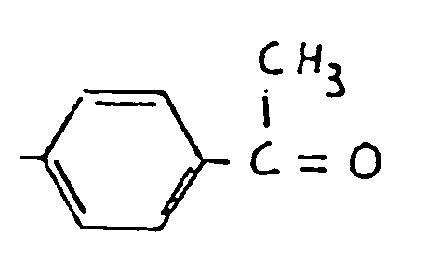
- the present invention relates to 1 '(ethylene-dioxo-3,3-cyclohexyl) -4 acetophenone and derivatives of this compound as well as processes for their preparation and the use of these compounds as starting material for the preparation of l '((oxo-3-cyclohexyl) -4 phenyl] -2 propionic acid and its derivatives.
- Propionic acid [(oxo-3-cyclohexyl) -4 phenyl] -2 and derivatives thereof are known as non-steroidal anti-inflammatory agents (NSAIDs) which, compared to their aryl-2 type counterparts -propionic, the advantage of having greater activity and less toxicity.
- NSAIDs non-steroidal anti-inflammatory agents
- the object of the invention is to eliminate these drawbacks and to enable the [(oxo-3-cyclohexyl) -4 phenyl] -2 propionic acid and derivatives thereof to be obtained efficiently and quickly with a high efficiency.
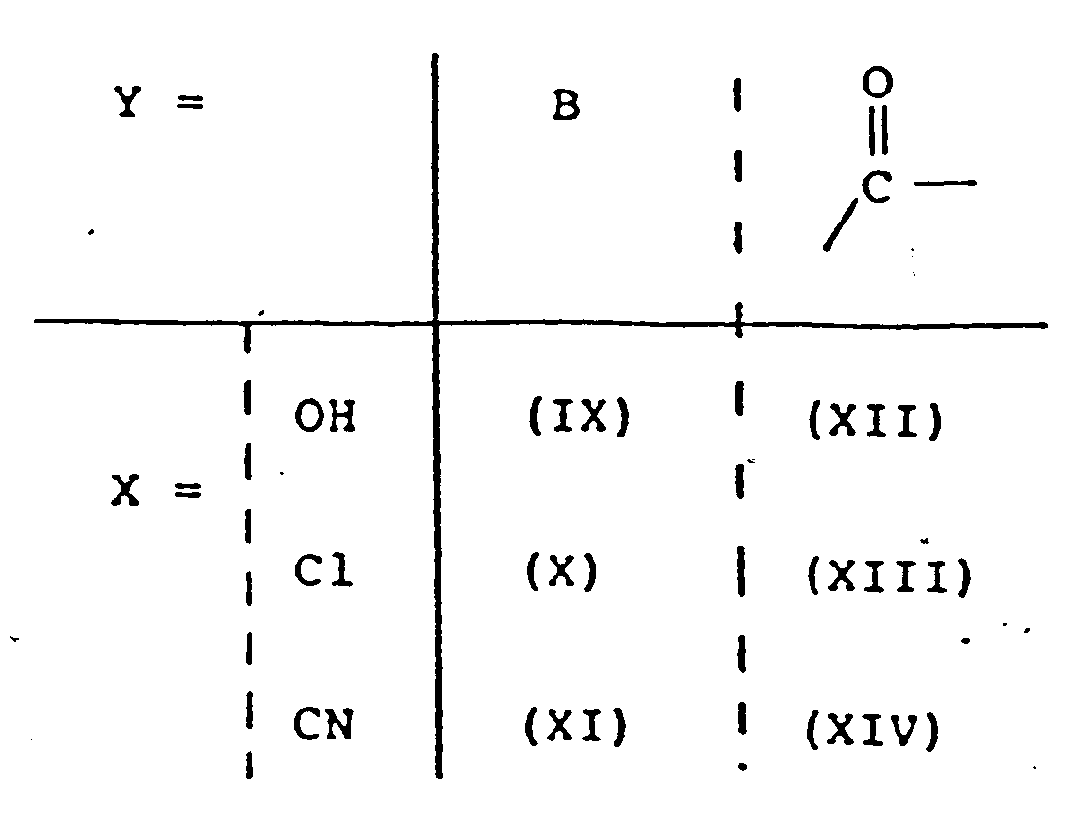
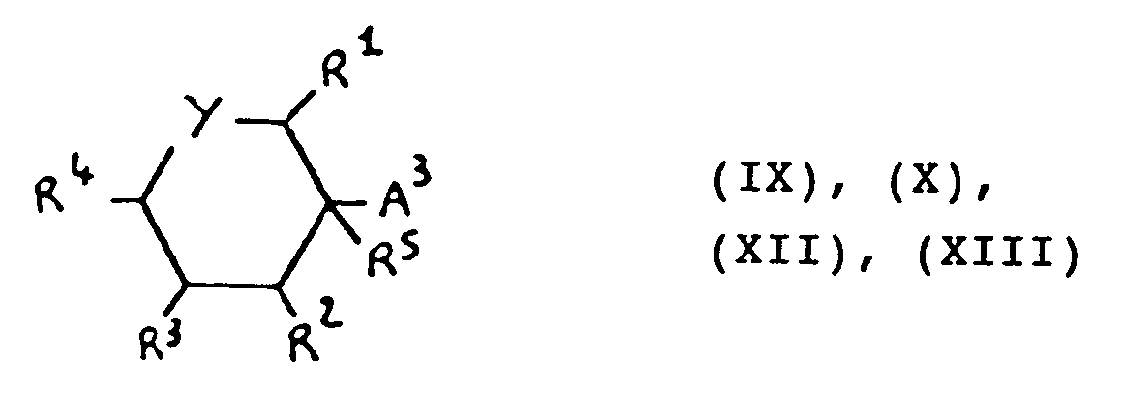
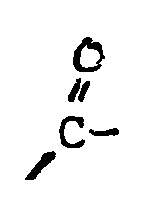
- the compounds of formula (IV) are transformed into compounds of formula (1), by forming successive intermediate compounds of formula: in which Y represents either the group B defined in claim 1, or a group and A 3 represents a group in which X represents OH, CI or CN, the meanings of Y and X for each formula being as indicated in the following table: namely, a first intermediate compound (IX) or (XII), in which X represents OH, obtained by reduction of the ketone function of group A 1 , and if necessary by deacetalization of the acetal function of group B, a second intermediate compound (X) or (XIII), in which X represents CI, obtained by substitution tion of the OH group of the first intermediate compound with chlorine, and a third intermediate compound (XI) or (XIV), in which X represents CN, obtained by substitution of the chlorine of the second intermediate compound with the group CN, then by transforming the third intermediate compound into a compound of formula (I), either directly in the case
- the compounds of formula (IV) are transformed into compounds of formula (l), by forming successive intermediate compounds of formula in which Y represents either the group B defined in claim 1, or a group and A 3 represents a group in which X represents OH or CI, the meanings of Y and X for each formula being as indicated in the following table: namely, a first intermediate compound (IX) or (XII), in which X represents OH, obtained by reduction of the ketone function of the group A 1 , and a second intermediate compound (X) or (XIII), in which X represents CI, obtained by substitution of the OH group of the first intermediate compound with chlorine by transforming, then, if necessary, the compound (XIII) into compound (X) by acetalization of the ketone function Y, then by transforming the compound (X) intermediate in a compound of formula (I) by a Grignard reaction according to which the organomagnesium derivative of compound (X) is reacted with carbon dioxide and
- the compounds of formula (IV) are transformed into compounds of formula (I) by forming an intermediate compound of formula in which A5 represents a group and R 1 , R 2 , R 3 , R 4 and R 5 are as defined in claim 1, this intermediate compound being obtained by reaction of compound (IV) with chloroform and an alkali metal hydroxide, in the presence of a catalytic amount of benzyltriethylamine chloride, then deacetalization of the group B of the compound (IV) by hydrolysis in an acidic aqueous medium, and by subjecting the intermediate compound (XV) thus obtained to hydrogenolysis so as to form the product (I).
- the compounds of formula (IV) are transformed into compounds of formula (1), by first reacting the compound (IV) with cyanotrimethylsilane, in the presence of '' a catalytic amount of zinc iodide, then subjecting the product of this reaction to hydrolysis in an acidic aqueous medium, so as to cause the deacetalization of group B, the whole so as to form an intermediate compound of the cyanohydrin type of formula in which A 6 represents a group and R 1 , R 2 , R 3 , R 4 and R 5 are as defined in claim 1, and by subjecting the intermediate compound (XVI) thus obtained to hydrolysis and hydrogenolysis so as to form the final product (l) .
- This process therefore involves the use of compounds having the general formula (IV) above, that is to say 1 '(3,3-ethylenedioxo cyclohexyl) -4 acetophenone and derivatives thereof, as starting material for the preparation of [(3-oxo-cyclohexyl) -4 phenyl] -2 propionic acid and its derivatives.
- the compounds of formula (IV) are new compounds useful as starting materials for the preparation of the compounds of formula (1), by the above-mentioned process and they can, of course, also be useful for other purposes.
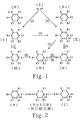
- the compound of formula (III) or (IIIa) can be transformed into the compound of formula (IV), in the two methods which have just been mentioned, either in a single transacetalization operation catalyzed by the presence of a Lewis acid and ethylene glycol, either by first transforming, by deacetalization of the group A 2, the compound of formula (III) or (IIIa) into a compound of formula then by transforming the latter compound into a compound of formula (IV) by acetalization of the ketone function of the cyclohexyl group.
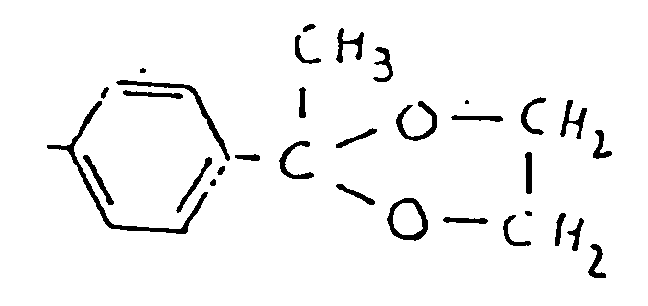
- the starting product of formula (V), namely p-bromoacetophenone dioxolane, is a known compound, easily prepared, for example from p-bromoacetophenone, as described in an article published by A.K. Zarkadis et al. (Chem.Berichte 188, 1183 (1985 ”.
- the compounds of formula (III) ((oxo-3-cyclohexyl) -4 acetophenone dioxolane and its derivatives substituted by one or more alkyl groups on the cyclohexyl group) can be formed in a single step, with a high yield, by reaction of Grignard between p-bromoacetophenone dioxolane and cyclohexen-2-one or its derivatives substituted by alkyl groups, i.e. the compounds of formula (Vla).
- This Grignard reaction comprises the addition of the organomagnesium to the unsaturated ketone, according to the Michael reaction, catalyzed for example by Cu CI or Cu (OAc) 2 (Step 1).
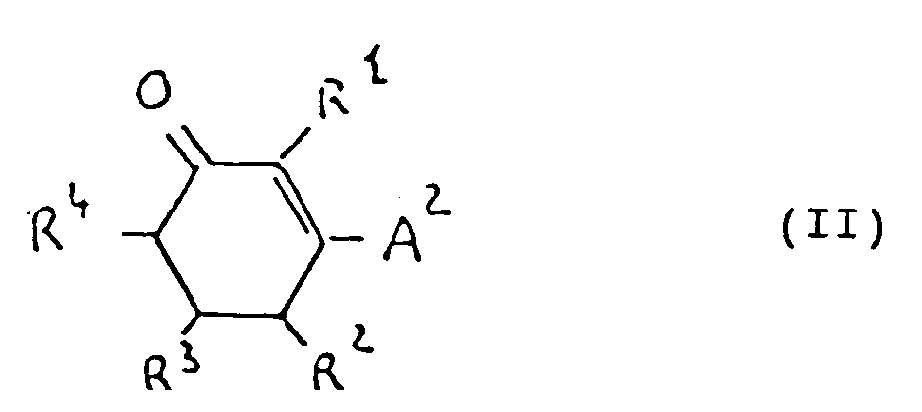
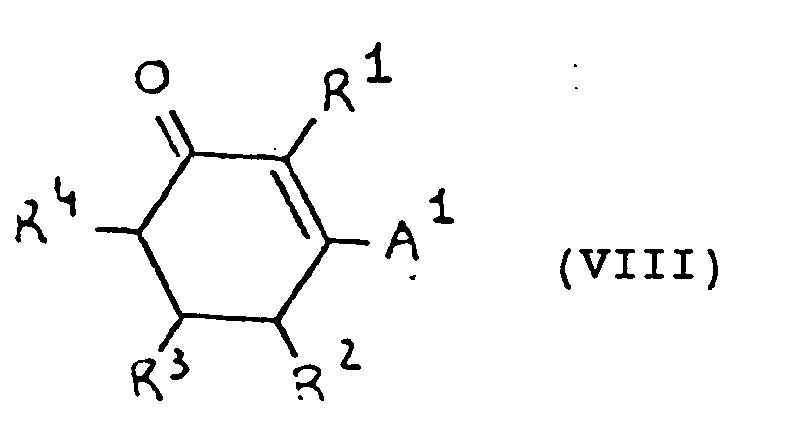
- the compounds of formula (III) can also be formed, with excellent yield, by catalytic hydrogenation of the compounds of formula (II) under conditions allowing the selective hydrogenation of the double bond of the cyclohexene group without reduction of the carbonyl function.
- catalytic hydrogenation in an EtOH / NaOH medium using palladium on carbon (Pd / C) as catalyst (Step 3).
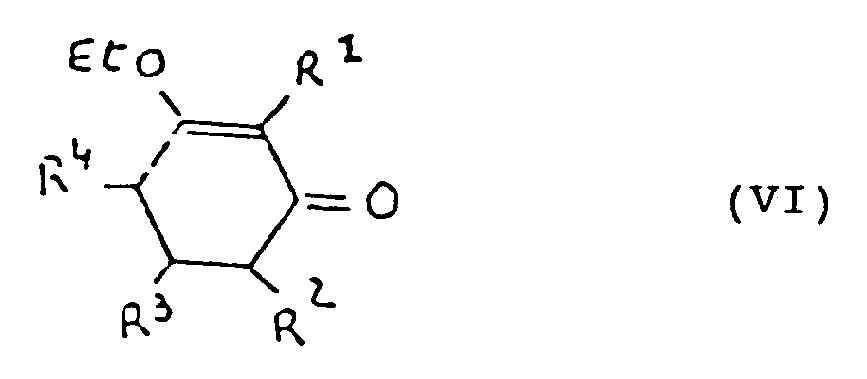
- the compounds of formula (II) can be formed, with a very good yield, by Grignard reaction, between p-bromoacetophenone dioxolane (V) and ethoxy-3-cyclohexen-2 one or its substituted alkyl derivatives, c. to.d. the compounds of formula (VI) (Step 2).
- the compounds (V) and (VI) can be condensed in any suitable solvent, such as ether or tetrahydrofuran (THF).
- THF tetrahydrofuran
- an oil is obtained which is sufficiently pure to be used as it is in the following stage of the synthesis, without isolation of the compound (II).
- the latter compound can also be obtained by crystallization from this oil, for example by using a mixture of THF and hexane to cause crystallization of the compound (II).
- the intermediate compounds (II), (III), (VII) and (VIII) formed during these new synthetic routes are new compounds which can of course be used not only as intermediate compounds in the processes of preparation, according to the invention, of the compounds of formula (IV), but also for other purposes.
- the derivatives (IX) or (XII) are first formed in which the function X of group A 3 is an alcohol function, by reduction of the ketone function of group A 1 , in a manner known per se.
- the derivatives (X) or (XIII) are then formed, in which the function X of group A 3 is an alkyl chloride function, by chlorination of the corresponding alcohol (IX) or (XII), for example by treatment of the latter by thionyl chloride.
- the chloro function of the compounds (X) or (XIII) is replaced by the cyano function so as to form the corresponding nitrile type derivatives (XI) or (XIV).
- an alkaline cyanide such as Na CN
- a suitable solvent such as dimethylformamide (DMF).
- the cyano group of the compounds (XI) or (XIV) is hydrolyzed, so as to form the acid function of the group A 4 of the final product (I).
- the hydrolysis is advantageously carried out in a basic medium.
- the Grignard reagent obtained from 17 g (70 mmol) of p-bromoacetophenone dioxolane and 1.9 g of Mg (78.19 mmol) in 80 ml of THF is cooled to -20 ° C. Then 0.6 g of CuCl and a solution of 6.2 g (64 mmol) of cyclohexen-2-one in 20 ml of THF are added thereto. It is left to react at -20 ° C. for 30 min., Then 1 h. at room temperature.
- the Grignard reagent obtained from 5 g (17.8 mmol) of compound (X) and 0.55 g (22.9 mmol) of Mg in THF (or Et 2 O) is cooled to 10 ° C. and a current of C0 2 is passed through the reaction medium, while maintaining the temperature between 5 and 10 ° C (2 hours). After the treatments specific to the Grignard reactions, 2.7 g of product (l) are obtained.
Landscapes
- Chemical & Material Sciences (AREA)
- Organic Chemistry (AREA)
- Chemical Kinetics & Catalysis (AREA)
- Organic Low-Molecular-Weight Compounds And Preparation Thereof (AREA)
- Acyclic And Carbocyclic Compounds In Medicinal Compositions (AREA)
- Heterocyclic Compounds That Contain Two Or More Ring Oxygen Atoms (AREA)
Claims (17)












Priority Applications (1)
| Application Number | Priority Date | Filing Date | Title |
|---|---|---|---|
| AT89902223T ATE80882T1 (de) | 1988-03-21 | 1989-02-24 | (ethylenedioxo-3,3 zyclohexyl)-4 aketophenon und derivate davon, verfahren zu deren herstellung und verwendung dieser verbindungen. |
Applications Claiming Priority (2)
| Application Number | Priority Date | Filing Date | Title |
|---|---|---|---|
| CH1045/88 | 1988-03-21 | ||
| CH1045/88A CH676001A5 (de) | 1988-03-21 | 1988-03-21 |
Publications (2)
| Publication Number | Publication Date |
|---|---|
| EP0362309A1 EP0362309A1 (de) | 1990-04-11 |
| EP0362309B1 true EP0362309B1 (de) | 1992-09-23 |
Family
ID=4201170
Family Applications (1)
| Application Number | Title | Priority Date | Filing Date |
|---|---|---|---|
| EP19890902223 Expired - Lifetime EP0362309B1 (de) | 1988-03-21 | 1989-02-24 | (ethylenedioxo-3,3 zyclohexyl)-4 aketophenon und derivate davon, verfahren zu deren herstellung und verwendung dieser verbindungen |
Country Status (9)
| Country | Link |
|---|---|
| US (1) | US5104995A (de) |
| EP (1) | EP0362309B1 (de) |
| JP (1) | JPH03502096A (de) |
| AT (1) | ATE80882T1 (de) |
| AU (1) | AU3046989A (de) |
| CH (1) | CH676001A5 (de) |
| DE (1) | DE68902971D1 (de) |
| FR (1) | FR2628742B1 (de) |
| WO (1) | WO1989009215A1 (de) |
Family Cites Families (1)
| Publication number | Priority date | Publication date | Assignee | Title |
|---|---|---|---|---|
| GB1364075A (en) * | 1971-09-04 | 1974-08-21 | Logeais Labor Jacques | Phenylacetic acid derivatives process for their preparation and therapeutic compositions |
-
1988
- 1988-03-21 CH CH1045/88A patent/CH676001A5/fr not_active IP Right Cessation
-
1989
- 1989-02-21 FR FR898902230A patent/FR2628742B1/fr not_active Expired - Lifetime
- 1989-02-24 JP JP1502083A patent/JPH03502096A/ja active Pending
- 1989-02-24 DE DE8989902223T patent/DE68902971D1/de not_active Expired - Lifetime
- 1989-02-24 AU AU30469/89A patent/AU3046989A/en not_active Abandoned
- 1989-02-24 EP EP19890902223 patent/EP0362309B1/de not_active Expired - Lifetime
- 1989-02-24 WO PCT/CH1989/000036 patent/WO1989009215A1/fr not_active Ceased
- 1989-02-24 AT AT89902223T patent/ATE80882T1/de active
- 1989-11-20 US US07/455,377 patent/US5104995A/en not_active Expired - Fee Related
Also Published As
| Publication number | Publication date |
|---|---|
| CH676001A5 (de) | 1990-11-30 |
| EP0362309A1 (de) | 1990-04-11 |
| DE68902971D1 (de) | 1992-10-29 |
| FR2628742A1 (fr) | 1989-09-22 |
| FR2628742B1 (fr) | 1990-11-16 |
| US5104995A (en) | 1992-04-14 |
| JPH03502096A (ja) | 1991-05-16 |
| WO1989009215A1 (fr) | 1989-10-05 |
| ATE80882T1 (de) | 1992-10-15 |
| AU3046989A (en) | 1989-10-16 |
Similar Documents
| Publication | Publication Date | Title |
|---|---|---|
| EP0442816A1 (de) | Alpha-Hydroxylsäuren, Verfahren zu ihrer Herstellung und Verwendung | |
| JPS6046104B2 (ja) | ブテン誘導体の製造方法 | |
| EP0362309B1 (de) | (ethylenedioxo-3,3 zyclohexyl)-4 aketophenon und derivate davon, verfahren zu deren herstellung und verwendung dieser verbindungen | |
| Zhang et al. | The Cleavage of p-nitrophenylhydrazones and semicarbazones with ammonium chlorochromate adsorbed on alumina under non-aqueous conditions | |
| EP0171320B1 (de) | Herstellungsverfahren von ungesättigten, in alpha-chlorierten Verbindungen von zwei in beta-Stellung elektronenanziehenden Gruppen | |
| EP0013995B1 (de) | Verfahren zur Herstellung acetylenischer macrocyclischer Ketone | |
| Shimizu et al. | One-step oxidation of olefins into. ALPHA.-phenylseleno carbonyl compounds. | |
| EP0012390B1 (de) | Verfahren zur Herstellung von Muscon und Pyran-Zwischenprodukte | |
| JPH05286902A (ja) | α−クロロ−β−ケトエステル誘導体の製造方法 | |
| EP0184572B1 (de) | Verfahren zur Herstellung von alpha-Hydroxyalkancarbonsäuren | |
| EP0647623B1 (de) | Zwischenprodukte zur Herstellung von Vitamin A und von Carotenoiden und Verfahren zu deren Herstellung | |
| JPH07103095B2 (ja) | ビタミンaアルデヒドの製造方法 | |
| FR2486526A1 (fr) | Procede de preparation de derives de l'oxyde de diphenyle | |
| FR2489311A1 (fr) | Procede de preparation d'oxo-acides a partir d'une cetone a, b-insaturee | |
| EP2661423B1 (de) | Neues verfahren zur synthese von agomelatin | |
| EP0000009B1 (de) | Verfahren zur Oxydation von Chinin zu Chininone und Chinidinone. | |
| JP3254746B2 (ja) | 末端アセチレン化合物およびその製造法 | |
| EP0258117A1 (de) | Verfahren zur Herstellung von 2,4-Diamino-5-benzyl-pyrimidinen | |
| JPH07330654A (ja) | エーテル置換アルデヒド類の製造方法 | |
| EP0097550B1 (de) | Verfahren zur Herstellung von Cystamin-Derivaten mit onkostatischer Wirkung | |
| EP0184573A1 (de) | Verfahren zur Herstellung von alpha-Hydroxyalkancarbonsäuren | |
| WO1984004090A1 (fr) | NOUVEAUX TETRA-ALKYL-2,2,5,5-CYCLOHEXANONE-4-ol-1 ET LEURS DERIVES SULFONYLES, LEUR PROCEDE ET LEURS INTERMEDIAIRES DE PREPARATION ET LEUR APPLICATION A LA SYNTHESE DE LACTONES CYCLOPROPANIQUES CIS | |
| FR2555180A1 (fr) | Acides dialcoxy-4,5 dioxolanne-1,3 carboxylique-2, leurs derives, leur procede de preparation et leur application | |
| FR2494696A1 (fr) | Nouveau procede de preparation de steroides 3-amines et leurs sels | |
| JPH04305548A (ja) | ハロゲノアリルアルコール誘導体 |
Legal Events
| Date | Code | Title | Description |
|---|---|---|---|
| PUAI | Public reference made under article 153(3) epc to a published international application that has entered the european phase |
Free format text: ORIGINAL CODE: 0009012 |
|
| AK | Designated contracting states |
Kind code of ref document: A1 Designated state(s): AT BE DE GB IT LU NL SE |
|
| 17P | Request for examination filed |
Effective date: 19900326 |
|
| 17Q | First examination report despatched |
Effective date: 19920109 |
|
| GRAA | (expected) grant |
Free format text: ORIGINAL CODE: 0009210 |
|
| AK | Designated contracting states |
Kind code of ref document: B1 Designated state(s): AT BE DE GB IT LU NL SE |
|
| PG25 | Lapsed in a contracting state [announced via postgrant information from national office to epo] |
Ref country code: SE Effective date: 19920923 Ref country code: DE Effective date: 19920923 Ref country code: AT Effective date: 19920923 Ref country code: NL Effective date: 19920923 Ref country code: GB Effective date: 19920923 Ref country code: IT Free format text: LAPSE BECAUSE OF FAILURE TO SUBMIT A TRANSLATION OF THE DESCRIPTION OR TO PAY THE FEE WITHIN THE PRE;WARNING: LAPSES OF ITALIAN PATENTS WITH EFFECTIVE DATE BEFORE 2007 MAY HAVE OCCURRED AT ANY TIME BEFORE 2007. THE CORRECT EFFECTIVE DATE MAY BE DIFFERENT FROM THE ONE RECORDED.SCRIBED TIME-LIMIT Effective date: 19920923 |
|
| REF | Corresponds to: |
Ref document number: 80882 Country of ref document: AT Date of ref document: 19921015 Kind code of ref document: T |
|
| REF | Corresponds to: |
Ref document number: 68902971 Country of ref document: DE Date of ref document: 19921029 |
|
| RAP4 | Party data changed (patent owner data changed or rights of a patent transferred) |
Owner name: SOCHINAZ, SOCIETE CHIMIQUE DE VIONNAZ S.A. |
|
| PG25 | Lapsed in a contracting state [announced via postgrant information from national office to epo] |
Ref country code: LU Free format text: LAPSE BECAUSE OF NON-PAYMENT OF DUE FEES Effective date: 19930228 Ref country code: BE Effective date: 19930228 |
|
| NLV1 | Nl: lapsed or annulled due to failure to fulfill the requirements of art. 29p and 29m of the patents act | ||
| GBV | Gb: ep patent (uk) treated as always having been void in accordance with gb section 77(7)/1977 [no translation filed] |
Effective date: 19920923 |
|
| PLBE | No opposition filed within time limit |
Free format text: ORIGINAL CODE: 0009261 |
|
| STAA | Information on the status of an ep patent application or granted ep patent |
Free format text: STATUS: NO OPPOSITION FILED WITHIN TIME LIMIT |
|
| BERE | Be: lapsed |
Owner name: SOC. CHIMIQUE DE VIONNAZ SOCHINAZ S.A. Effective date: 19930228 |
|
| 26N | No opposition filed |