EP0362514A2 - Ungesättigte, elastomere, asymmetrisch gekuppelte Blockcopolymere, ein Eintopfverfahren zu ihrer Herstellung und ihre Verwendung zur Herstellung von Reifenbauteilen - Google Patents
Ungesättigte, elastomere, asymmetrisch gekuppelte Blockcopolymere, ein Eintopfverfahren zu ihrer Herstellung und ihre Verwendung zur Herstellung von Reifenbauteilen Download PDFInfo
- Publication number
- EP0362514A2 EP0362514A2 EP89114421A EP89114421A EP0362514A2 EP 0362514 A2 EP0362514 A2 EP 0362514A2 EP 89114421 A EP89114421 A EP 89114421A EP 89114421 A EP89114421 A EP 89114421A EP 0362514 A2 EP0362514 A2 EP 0362514A2
- Authority
- EP
- European Patent Office
- Prior art keywords
- block copolymers
- production
- blocks
- butadiene
- units
- Prior art date
- Legal status (The legal status is an assumption and is not a legal conclusion. Google has not performed a legal analysis and makes no representation as to the accuracy of the status listed.)
- Granted
Links
Images
Classifications
-
- C—CHEMISTRY; METALLURGY
- C08—ORGANIC MACROMOLECULAR COMPOUNDS; THEIR PREPARATION OR CHEMICAL WORKING-UP; COMPOSITIONS BASED THEREON
- C08F—MACROMOLECULAR COMPOUNDS OBTAINED BY REACTIONS ONLY INVOLVING CARBON-TO-CARBON UNSATURATED BONDS
- C08F293/00—Macromolecular compounds obtained by polymerisation on to a macromolecule having groups capable of inducing the formation of new polymer chains bound exclusively at one or both ends of the starting macromolecule
-
- C—CHEMISTRY; METALLURGY
- C08—ORGANIC MACROMOLECULAR COMPOUNDS; THEIR PREPARATION OR CHEMICAL WORKING-UP; COMPOSITIONS BASED THEREON
- C08F—MACROMOLECULAR COMPOUNDS OBTAINED BY REACTIONS ONLY INVOLVING CARBON-TO-CARBON UNSATURATED BONDS
- C08F297/00—Macromolecular compounds obtained by successively polymerising different monomer systems using a catalyst of the ionic or coordination type without deactivating the intermediate polymer
- C08F297/02—Macromolecular compounds obtained by successively polymerising different monomer systems using a catalyst of the ionic or coordination type without deactivating the intermediate polymer using a catalyst of the anionic type
- C08F297/04—Macromolecular compounds obtained by successively polymerising different monomer systems using a catalyst of the ionic or coordination type without deactivating the intermediate polymer using a catalyst of the anionic type polymerising vinyl aromatic monomers and conjugated dienes
- C08F297/046—Macromolecular compounds obtained by successively polymerising different monomer systems using a catalyst of the ionic or coordination type without deactivating the intermediate polymer using a catalyst of the anionic type polymerising vinyl aromatic monomers and conjugated dienes polymerising vinyl aromatic monomers and isoprene, optionally with other conjugated dienes
-
- Y—GENERAL TAGGING OF NEW TECHNOLOGICAL DEVELOPMENTS; GENERAL TAGGING OF CROSS-SECTIONAL TECHNOLOGIES SPANNING OVER SEVERAL SECTIONS OF THE IPC; TECHNICAL SUBJECTS COVERED BY FORMER USPC CROSS-REFERENCE ART COLLECTIONS [XRACs] AND DIGESTS
- Y10—TECHNICAL SUBJECTS COVERED BY FORMER USPC
- Y10S—TECHNICAL SUBJECTS COVERED BY FORMER USPC CROSS-REFERENCE ART COLLECTIONS [XRACs] AND DIGESTS
- Y10S152/00—Resilient tires and wheels
- Y10S152/905—Tread composition
Definitions
- the invention relates to new asymmetrically coupled block copolymers, a one-pot process for their production and their use for the production of tire components.
- the properties of a rubber are essentially determined by the course of the tan delta curve. It is also known that a broad peak in the tan delta curve has a favorable effect on a number of antagonistic rubber properties, such as increasing the slip resistance, reducing the dynamic heat generation and reducing the rolling resistance without reducing the abrasion while at the same time being suitable all year round.
- Copolymers are known which differ in the type of their chemical composition and / or their structural structure. Examples include styrene-butadiene block copolymers whose blocks A and B differ in their styrene and / or vinyl content. Such copolymers are comparatively difficult to process.
- Another way of influencing the rubber properties and, in particular, of improving the cold flow is to couple the so-called “living polymers” present at the end of the polymerization with polyfunctional coupling agents such as polyhalides or polyalkenylaromatic compounds.
- polyfunctional coupling agents such as polyhalides or polyalkenylaromatic compounds.
- the coupling yield ie the percentage of coupled products in relation to the total amount of polymers, is often only very low. Coupling products are always obtained according to this principle, the arms of which - in terms of molecular weight, composition and structure - are identical.
- coupling products with different arms are also known, but these products consist of blocks consisting of styrene or butadiene units.
- thermoplastic coupling products with different arms are known. So far, there is no indication that these products could be used in the tire sector.
- thermoplastic, star-shaped block copolymers of the general formula (A - B / A ′) m - X - (A ′ / B) n known that contain 60 to 95% styrene and 40 to 5% of a conjugated diene.
- A represents a non-elastomeric polymer segment that contains 80 to 90% styrene.
- a ′ / B and B / A ′ mean elastomeric polymer segments based on styrene and a conjugated diene.
- US Pat. No. 4,391,949 describes coating compositions based on star-shaped block polymers of the general formula (A - B) x - Y - (C) z known.
- Y is a coupling agent
- A is the polymer of a monovinylaromatic compound, for example a polystyrene block
- B and C are polymers of conjugated dienes, for example polybutadiene blocks.
- the two polymers A - B and C are first produced in two separate reactors. The contents of both reactors are then combined and the coupling agent is added.
- the aim of the present invention was to provide novel star-shaped rubbers which are distinguished by a tan delta curve with the broadest possible vibration damping range.
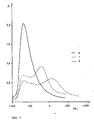
- a new principle of linking rubbers has now been discovered. This makes it possible to obtain significantly widened tan delta curves (see Figure 1). Since it is known that the rubber properties can be positively influenced in this way, the tire specialist is provided with a new parameter for optimizing the tire properties.
- the new rubbers are furthermore distinguished by the known advantages of coupled rubbers (cf. EP-OS 0 090 365) and high-vinyl rubbers (KH Nordsiek, KM Kiepert, Kautschuk und Kunststoffe 35 , 371 (1982).
- the styrene-containing rubbers have a statistical distribution of the styrene units. The proportion of block polystyrene proportions is less than 2%.
- the one-pot process for producing the new rubbers which is part of the present invention, guarantees a high coupling yield.
- the invention relates to unsaturated, elastomeric, asymmetrically coupled block copolymers of the general formula (AB) n - X - (B) m , based on butadiene and optionally isoprene and styrene, which preferably contain 40 to 90% butadiene, 0 to 40% isoprene and 0 to 30% styrene.
- X is the remainder of a polyfunctional coupling agent.
- the number m is at least as large as n.
- the sum of m and n should on the one hand be at least 3 and on the other hand at most 25.
- Blocks A preferably make up 40 to 80%, blocks B corresponding to 60 to 20% of all blocks in the block copolymer.
- Blocks A preferably consist exclusively of butadiene units, the vinyl group content of which is between 8 and 60%.
- Blocks B are composed of 0 to 60% butadiene units, at least 10% isoprene units and a maximum of 45% styrene units builds.
- the content of vinyl and 3,4-isopropenyl groups - based on block B - is between 75 and 90%.
- the invention also relates to a one-pot process for the preparation of the new block copolymers by polymerizing the monomers in an inert organic solvent in the presence of a monofunctional Li compound.
- This process consists in that block A is first produced with the addition of catalyst, block B is produced after the further addition of catalyst and monomer in the presence of a suitable cocatalyst and finally a coupling is carried out.
- the present process predominantly produces the asymmetrically coupled block copolymers according to the invention.
- symmetrically coupled block copolymers can also be produced in the present process.
- studies by the applicant show that the proportion of these products is very small. For this reason, the present application always only refers to the asymmetrically coupled products.
- An inert organic solvent is used as the reaction medium.
- Particularly suitable are hydrocarbons with 5 to 12 carbon atoms, such as pentane, hexane, heptane, octane and decane, and their cyclic ana lied.
- Aromatic solvents such as e.g. B. benzene, toluene, xylenes, etc. Of course, mixtures of the solvents described above can also be used.
- Alkyl lithium compounds are used as catalysts, which are easily accessible by reacting lithium with the corresponding alkyl halides.
- the alkyl radicals have 1 to 10 carbon atoms. Individual hydrogen atoms can be substituted by phenyl radicals.
- the following alkyl lithium compounds are particularly suitable: methyl lithium, ethyl lithium, pentyllithium; n-butyllithium is preferred.
- the catalyst is added at the start of the polymerization of block A and block B. In addition, it may be advantageous to add a small amount of catalyst during the polymerization of the first block.
- block B is produced in the presence of a cocatalyst.
- a cocatalyst In this case, one is interested in obtaining polymers with the highest possible proportion of 1,2 and / or 3,4 structural units.
- cocatalysts therefore depends on their ability to preserve the living polymer ends and the microstructure regulate, that is to direct the course of the polymerization with a view to the most complete possible formation of 1,2- and / or 3,4-structural units.
- Suitable cocatalysts include, in particular, dialkyl ethers of ethylene glycol, the alkyl groups of which each have up to 4 carbon atoms, such as. B. ethylene glycol diethyl ether (DEE).
- DEE ethylene glycol diethyl ether
- Ethers of the general formula are preferred wherein R1 and R2 alkyl radicals with a different number of carbon atoms from the group methyl, ethyl, n- and iso-propyl and n-, iso-, sec. and tert. Are butyl and R3 is hydrogen, methyl or ethyl. The sum of the C atoms of the two radicals R1 and R2 is preferably 5 to 7, in particular 6.
- the glycol ethers are accessible, for example, according to the Williamson synthesis principle from a sodium alcoholate and an alkyl halide. The ethers of the formula can be done easily by implementing the appropriate alcohol with isobutene in the presence of an acidic ion exchanger.
- the cocatalyst is used in a ratio of 2: 1 to 30: 1, in particular 2: 1 to 15: 1, based on the number of moles of the catalyst. At higher temperatures, larger amounts of cocatalyst are generally required to achieve the desired microstructure control. Reaction temperatures of 100 ° C should not exceed be paced. It is also possible to work with rising or falling temperature; however, care must be taken in this case that the microstructure is not fundamentally changed.
- styrene can be added as a comonomer. Appropriate measures must be taken to ensure that the content of polystyrene blocks does not exceed 2% by mass.
- a method for determining the content of polystyrene blocks is given in the standard work Houben-Weyl "Methods of Organic Chemistry", volume 14/1 (1061), page 698.
- Suitable coupling agents are polyepoxides such as epoxidized linseed oil, polyisocyanates, polyketones such as 1,3,6-hexanetrione, polyanhydrides such as the dianhydride of pyromellitic acid and dicarboxylic acid esters such as dimethyl adipate.
- polyepoxides such as epoxidized linseed oil, polyisocyanates, polyketones such as 1,3,6-hexanetrione, polyanhydrides such as the dianhydride of pyromellitic acid and dicarboxylic acid esters such as dimethyl adipate.
- - The tetrahalides of the elements Si, Ge, Sn and Pb, especially SiCl4.
- R is an n-valent organic radical, for example an alipha
- -Atoms examples include 1,2,4-tris (2-trichlorosilylethyl) cyclohexane, 1,8-bis (trichlorosilyl) octane and 1- (trichlorosilyl) octane.
- Di- and trivinylbenzenes such as. B. 1,4-divinylbenzene.
- Divinylbenzene is preferred as the coupling agent.
- the process can be operated batchwise or continuously.
- amorphous polymers obtained are to be processed into vulcanizates, they are mixed with active, reinforcing fillers, a vulcanizing agent and customary additives. In general, it is necessary to carry out this mixing under the action of shear forces.
- Masses which are intended for the production of tire treads are generally formed into raw tread strips.
- homogenization and shaping which can be carried out, for example, in an extruder, the conditions of temperature and time are chosen so that no vulcanization occurs.
- the rubber component in the vulcanizable compositions preferably consists of more than 70 and in particular 100% by mass of a block copolymer of the invention and 0 to 30% by mass of a known, amorphous general-purpose rubber such as. B. styrene-butadiene rubber, 1,4-cis-polybutadiene, 1,4-cis-polyisoprene and natural rubber. If this should be desired, the proportion of general-purpose rubbers can also be increased significantly.
- Active, reinforcing fillers are, for example, tire tread soils of different activity, and, if appropriate, treated with silane coupling agents, highly disperse silicas and their mixtures.
- Usual vulcanizing agents contain e.g. B. sulfur in combination with accelerators.
- the amount of the vulcanizing agent depends on the other components in the vulcanizable mass and can be determined by simple, orientation tests.
- plasticizer oils preferably aromatic, aliphatic and naphthenic hydrocarbons, as well as conventional auxiliaries, such as zinc oxide, stearic acids, resin acids, anti-aging agents and ozone protection waxes, can be used as additives in the usual amounts.
- the block copolymers according to the invention are suitable for the production of the treads of car and truck tires, both for the production of new tires and for the retreading of old tires.
- the tire treads are characterized in particular by the following advantageous properties: - high wet slip resistance - high abrasion resistance - low rolling resistance and therefore low fuel consumption - high wear resistance - All weather properties
- a hydrocarbon mixture consisting of about 50% hexane was used as the solvent.
- Other components of this hydrogenated C6 cut were in particular pentane, heptane and octane and their isomers.
- the solvent was dried over a molecular sieve with a pore size of 0.4 nm, so that the water content was reduced to below 10 ppm, and then stripped with N2.
- the organic lithium compound was n-butyllithium, which, unless stated otherwise, was used in the form of a 20% strength by weight solution in hexane.
- the monomers isoprene and styrene were refluxed over calcium hydride for 24 hours before use, distilled off and titrated with n-butyllithium in the presence of o-phenanthroline.
- glycol ethers were distilled over calcium hydride and then titrated with n-butyllithium in the presence of o-phenanthroline.
- the divinylbenzene (DVB) is a mixture of the m- and p-divinylbenzene and was used in the form of a 64 percent solution in hexane.
- the coupling conversion was determined by determining the solids content after evaporation of the solvent and the monomers.
- the tan delta curves were recorded using a Schmieder-Wolf torsion pendulum in accordance with DIN 53 520.
- Coupling yield is the percentage of rubber which has a star-shaped structure after reaction with a coupling agent and which is distinguished by a considerably higher molecular weight than the uncoupled rubber.
- the determination is carried out with the GPC analysis, using tetrahydrofuran as the solvent and polystyrene as the column material.
- the polymers are characterized by a light scattering detector. For this purpose, samples are taken from the reactor before the coupling agent is added and at the end of the reaction.
- the Defo hardness (DH) and the Defo elasticity (DE) were determined according to the usual measuring methods (DIN 53 514).
- Parts mean parts by mass, percent (%) mass%.
- Example 1 describes the preparation of an asymmetrical block copolymer of the general formula (AB) n -X- (B) m according to the invention. Both block copolymers were obtained from the same monomer mixtures. The figure shows that the tan delta curve of the asymmetrical block copolymers according to the invention is considerably wider than that of the corresponding symmetrical block copolymers.
Landscapes
- Chemical & Material Sciences (AREA)
- Health & Medical Sciences (AREA)
- Chemical Kinetics & Catalysis (AREA)
- Medicinal Chemistry (AREA)
- Polymers & Plastics (AREA)
- Organic Chemistry (AREA)
- Inorganic Chemistry (AREA)
- Graft Or Block Polymers (AREA)
- Compositions Of Macromolecular Compounds (AREA)
- Processing And Handling Of Plastics And Other Materials For Molding In General (AREA)
- Processes Of Treating Macromolecular Substances (AREA)
- Tyre Moulding (AREA)
- Addition Polymer Or Copolymer, Post-Treatments, Or Chemical Modifications (AREA)
- Ultra Sonic Daignosis Equipment (AREA)
- Medicines Containing Material From Animals Or Micro-Organisms (AREA)
- Materials For Medical Uses (AREA)
- Polymerization Catalysts (AREA)
- Polyoxymethylene Polymers And Polymers With Carbon-To-Carbon Bonds (AREA)
Abstract
Description
- Gegenstand der Erfindung sind neue asymmetrisch gekuppelte Blockcopolymere, ein Eintopfverfahren zu ihrer Herstellung und ihre Verwendung zur Herstellung von Reifenbauteilen.
- Es ist generell bekannt, daß die Eigenschaften eines Kautschukes ganz wesentlich durch den Verlauf der tan Delta-Kurve bestimmt werden. Es ist auch bekannt, daß sich ein breiter Peak in der tan Delta-Kurve auf eine Reihe von antagonistischen Kautschukeigenschaften wie Erhöhung des Rutschwiderstands, Verminderung der dynamischen Wärmebildung und Erniedrigung des Rollwiderstands ohne Verminderung des Abriebs bei gleichzeitiger Ganzjahrestauglichkeit günstig auswirkt.
- Es hat in der Vergangenheit zahllose Versuche gegeben, Kautschuke mit einem hohen Eigenschaftsniveau zu entwickeln. Um einen möglichst günstigen Kompromiß zwischen den sich teilweise gegensätzlich verhaltenden Eigenschaften zu finden, hat man Mischungen aus unterschiedlichen Kautschuken eingesetzt. Ein weiterer Lösungsweg bestand darin, Copolymere aus 2 unterschiedlichen Blöcken herzustellen. So sind Copolymere bekannt, die sich in der Art ihrer chemischen Zusammensetzung und/oder ihrem strukturellen Aufbau unterscheiden. Beispielhaft seien Styrol-Butadien-Blockcopolymere erwähnt, deren Blöcke A und B sich in ihrem Styrol- und/oder Vinylgehalt unterscheiden. Derartige Copolymere sind vergleichsweise schlecht verarbeitbar.
- Eine weitere Möglichkeit, die Kautschukeigenschaften zu beeinflussen und insbesondere den kalten Fluß zu verbessern, besteht darin, die zu Ende der Polymerisation vorhandenen, sogenannten "living polymers" mit polyfunktionellen Kupplungsmitteln wie Polyhalogeniden oder polyalkenylaromatischen Verbindungen zu kuppeln. Allerdings ist die Kupplungsausbeute, d. h. der Prozentsatz an gekuppelten Produkten im Verhältnis zur Gesamtmenge an Polymerisaten, vielfach nur sehr gering. Man erhält nach diesem Prinzip stets Kupplungsprodukte, deren Arme - im Hinblick auf Molekulargewicht, Zusammensetzung und Struktur - identisch sind.
- Es sind zwar grundsätzlich auch Kupplungsprodukte mit unterschiedlichen Armen bekannt, aber diese Produkte enthalten durchweg Blöcke, die aus Styrol- oder Butadieneinheiten bestehen. Darüberhinaus sind thermoplastische Kupplungsprodukte mit unterschiedlichen Armen bekannt. Es gibt bisher keinen Hinweis, daß diese Produkte im Reifensektor Anwendung finden könnten.
- Beispielsweise sind aus der US-PS 4 248 983 thermoplastische, sternförmige Blockcopolymere der allgemeinen Formel
(A - B/A′)m - X - (A′/B)n
bekannt, die 60 bis 95 % Styrol und 40 bis 5 % eines konjugierten Diens enthalten. In der allgemeinen Formel steht A für ein nichtelastomeres Polymersegment, das 80 bis 90 % Styrol enthält. A′/B und B/A′ bedeuten elastomere Polymersegmente auf Basis von Styrol und eines konjugierten Diens. Diese Produkte werden hergestellt, indem man das nichtelastomere Segment A polymerisiert, einen Initator zusetzt, die Reaktion durch Polymerisation eines Gemisches aus Styrol und einem Dien fortsetzt und schließlich eine Kupplung durchführt. Ähnliche Blockcopolymere sind aus den US-PSS 4 180 530, 4 221 884 und 4 248 980 bis 4 248 984 bekannt. - Aus der US-PS 4 391 949 sind Beschichtungszusammensetzungen auf Basis sternförmiger Blockpolymerer der allgemeinen Formel
(A - B)x - Y - (C)z
bekannt. Hierin ist Y ein Kupplungsmittel, A das Polymere einer monovinylaromatischen Verbindung, also beispielsweise ein Polystyrolblock, und B und C Polymere von konjugierten Dienen, beispielsweise Polybutadienblöcke. Die beiden Polymeren A - B und C werden zunächst in 2 getrennten Reaktoren hergestellt. Danach werden die Inhalte beider Reaktoren vereinigt und das Kupplungsmittel zugesetzt. - Allen bekannten Blockcopolymeren haftet mindestens einer der folgenden Mängel an:
- 1. Die Blockcopolymeren werden den gestiegenen Anforderungen im Hinblick auf ihre Verwendung als Reifenmaterial nicht befriedigend gerecht.
- 2. Es treten Probleme in der Verträglichkeit der beiden Blöcke auf.
- 3. Die tan Delta-Kurve weist nur ein schmales Dämpfungsmaximum auf.
- Ziel der vorliegenden Erfindung war es, neuartige sternförmige Kautschuke bereit zu stellen, die sich durch eine tan Delta-Kurve mit möglichst breitem Schwingungsdämpfungsbereich auszeichnen.
- Es wurde jetzt ein neues Prinzip der Verknüpfung von Kautschuken aufgefunden. Damit gelingt es, deutlich verbreiterte tan Delta-Kurven zu erhalten (siehe Abbildung 1). Da auf diese Weise bekanntlich die Kautschukeigenschaften positiv beeinflußt werden können, wird dem Reifenfachmann ein neuer Parameter zur Optimierung der Reifeneigenschaften zur Verfügung gestellt. Die neuen Kautschuke zeichnen sich darüber hinaus durch die bekannten Vorteile gekuppelter Kautschuke (vgl. EP-OS 0 090 365) sowie hochvinylhaltiger Kautschuke (K. H. Nordsiek, K. M. Kiepert, Kautschuk und Gummi, Kunststoffe 35, 371 (1982) aus. Die styrolhaltigen Kautschuke weisen eine statistische Verteilung der Styroleinheiten auf. Der Anteil an Blockpolystyrolanteilen liegt unter 2 %.
- Das Eintopfverfahren zur Herstellung der neuen Kautschuke, das Teil der vorliegenden Erfindung ist, garantiert eine hohe Kupplungsausbeute.
- Gegenstand der Erfindung sind ungesättigte, elastomere, asymmetrisch gekuppelte Blockcopolymere der allgemeinen Formel
(A-B)n - X - (B)m, auf Basis von Butadien und gegebenenfalls Isopren und Styrol, die vorzugsweise 40 bis 90 % Butadien, 0 bis 40 % Isopren und 0 bis zu 30 % Styrol enthalten. X ist der Rest eines polyfunktionellen Kupplungsmittels. Die Zahl m ist mindestens ebenso groß wie n. Die Summe von m und n soll einerseits mindestens 3 und andererseits höchstens 25 sein. Die Blöcke A machen vorzugsweise 40 bis 80 %, die Blöcke B entsprechend 60 bis 20 % aller Blöcke im Blockcopolymeren aus. Die Blöcke A bestehen vorzugsweise ausschließlich aus Butadieneinheiten, deren Vinylgruppengehalt zwischen 8 und 60 % liegt. Die Blöcke B sind zu 0 bis 60 % aus Butadieneinheiten, zu mindestens 10 % aus Isopreneinheiten und zu maximal 45 % aus Styroleinheiten aufge baut. Der Gehalt an Vinyl- und 3,4-Isopropenylgruppen - bezogen auf Block B - liegt zwischen 75 und 90 %. - Gegenstand der Erfindung ist auch ein Eintopfverfahren zur Herstellung der neuen Blockcopolymeren durch Polymerisation der Monomeren in einem inerten organischen Lösemittel in Gegenwart einer monofunktionellen Li-Verbindung. Dieses Verfahren besteht darin, daß man zunächst unter Katalysatorzugabe den Block A herstellt, nach erneuter Katalysator- und Monomerzugabe in Gegenwart eines geeigneten Cokatalysators den Block B herstellt und schließlich eine Kupplung durchführt.
- Bei dem vorliegenden Verfahren entstehen ganz überwiegend die erfindungsgemäßen asymmetrisch gekuppelten Blockcopolymeren. Grundsätzlich können bei dem vorliegenden Verfahren auch symmetrisch gekuppelte Blockcopolymere entstehen. Aus Untersuchungen der Anmelderin geht jedoch hervor, daß der Anteil dieser Produkte sehr gering ist. Aus diesem Grunde ist in der vorliegenden Anmeldung stets nur von den asymmetrisch gekuppelten Produkten die Rede.
- Der Gegenstand der vorliegenden Erfindung unterscheidet sich vom Gegenstand der am gleichen Tage hinterlegten Patentanmeldung der gleichen Inhaberin mit dem Titel "Ungesättigte, elastomere, asymmetrisch gekuppelte Blockcopolymere, ein Zweitopfverfahren zu ihrer Herstellung und ihre Verwendung zur Herstellung von Reifenbauteilen" vor allem in folgenden Punkten:
- 1. Das erfindungsgemäße Blockcopolymere weist die Formel (AB)n-X-(B)m, das Blockcopolymere der zitierten Anmeldung dagegen (A)n-X-(B)m.
- 2. Die erfindungsgemäßen Blockcopolymeren werden gemäß Anspruch 5 durch ein Eintopfverfahren hergestellt, die Blockcopolymeren der zitierten Anmeldung dagegen durch ein Zweitopfverfahren.
- Im folgenden soll das Verfahren detailliert beschrieben werden.
- Als Reaktionsmedium wird ein inertes organisches Lösemittel verwendet. Geeignet sind insbesondere Kohlenwasserstoffe mit 5 bis 12 C-Atomen wie Pentan, Hexan, Heptan, Oktan und Dekan sowie deren cyclische Ana logen. Geeignet sind auch aromatische Lösemittel wie z. B. Benzol, Toluol, Xylole u. a. Selbstverständlich können auch Gemische der vorstehend beschriebenen Lösemittel eingesetzt werden.
- Als Katalysator werden Alkyllithiumverbindungen eingesetzt, die durch Umsetzung von Lithium mit den entsprechenden Alkylhalogeniden leicht zugänglich sind. Die Alkylreste weisen 1 bis 10 C-Atome auf. Einzelne Wasserstoffatome können durch Phenylreste substituiert sein. Folgende Alkyllithiumverbindungen sind besonders geeignet: Methyllithium, Ethyllithium, Pentyllithium; bevorzugt wird n-Butyllithium.
- Der Katalysator wird zu Beginn der Polymerisation des Blockes A und des Blockes B zugesetzt. Darüber hinaus kann es vorteilhaft sein, während der Polymerisation des ersten Blockes eine geringe Katalysatormenge zuzusetzen.
- Art und Menge des Katalysators werden im allgemeinen so ausgewählt, daß das erhaltene Blockcopolymerisat folgende Eigenschaften aufweist:
Mooney-Viskosität (ML₁₋₄, 100 °C, DIN 53 523): 35 bis 120;
Uneinheitlichkeit U = (Mw/Mn) - 1, bestimmt durch gelpermeationschromatografische Analyse (GPC-Analyse): 0,6 bis 4,0;
Defo-Elastizität(80 °C, DIN 53 514): ≧ 20; - Bei dem vorliegenden Verfahren wird der Block B in Anwesenheit eines Cokatalysators hergestellt. In diesem Falle ist man daran interessiert, Polymerisate mit einem möglichst hohen Anteil von 1,2- und/oder 3,4-Struktureinheiten zu erhalten.

- Die Auswahl der Cokatalysatoren richtet sich daher nach ihrer Fähigkeit, die lebenden Polymerenden zu erhalten und die Mikrostruktur zu regeln, d. h. den Verlauf der Polymerisation im Hinblick auf eine möglichst vollständige Bildung von 1,2- und/oder 3,4-Struktureinheiten zu lenken.
- Geeignete Cokatalysatoren umfassen insbesondere Dialkylether des Ethylenglykols, deren Alkylgruppen jeweils bis zu 4 C-Atome aufweisen, wie z. B. Ethylenglykoldiethylether (DEE).
- Bevorzugt werden Ether der allgemeinen Formel


- Der Cokatalysator wird in einem Verhältnis von 2 : 1 bis 30 : 1, insbesondere 2 : 1 bis 15 : 1, bezogen auf die Molzahl des Katalysators eingesetzt. Bei höheren Temperaturen werden im allgemeinen größere Mengen an Cokatalysator benötigt, um die gewünschte Mikrostrukturregelung zu erzielen. Reaktionstemperaturen von 100 °C sollten nicht über schritten werden. Es ist auch möglich, bei steigender oder fallender Temperatur zu arbeiten; jedoch ist in diesem Falle dafür Sorge zu tragen, daß die Mikrostruktur nicht grundsätzlich verändert wird.
- Bei der Herstellung des Blockes A hängt es von dem gewünschten Vinylgruppengehalt ab, wieviel Cokatalysator zugegen sein sollte.
- Bei der Herstellung von Block B und gegebenenfalls A kann Styrol als Comonomer zugesetzt werden. Durch geeignete Maßnahmen ist dafür Sorge zu tragen, daß der Gehalt an Polystyrolblöcken 2 Massen-% nicht überschreitet. Ein Verfahren zur Bestimmung des Gehaltes an Polystyrolblöcken ist in dem Standardwerk Houben-Weyl "Methoden der Organischen Chemie", Band 14/1 (1061), Seite 698 angegeben.
- Es ist bekannt, daß einige als Cokatalysatoren vorgeschlagene Verbindungen die Eigenschaft haben, die Ausbildung von Polystyrolblöcken zu unterdrücken. Die gleiche Eigenschaft haben Verbindungen, die als Randomizer bezeichnet werden und meist Kaliumsalze von Alkoholaten sowie langkettigen organischen Carbon- und Sulfonsäuren sind. Sofern die Randomizerwirkung der Cokatalysatoren nicht ausreichend ist, können Randomizer zugesetzt werden.
- Geeignete Kupplungsmittel sind Polyepoxide wie epoxidiertes Leinsamenöl, Polyisocyanate, Polyketone wie 1,3,6-Hexantrion, Polyanhydride wie beispielsweise das Dianhydrid der Pyromellithsäure und Dicarbonsäureester wie Adipinsäuredimethylester. Besonders geeignet sind
- die Tetrahalogenide der Elemente Si, Ge, Sn und Pb, insbesondere SiCl₄.
- organische Verbindungen der allgemeinen Formel Rn/SiHal₃/n, mit n = 1 bis 6, insbesondere n = 1 und 2. Hierbei ist R ein n-wertiger organischer Rest, beispielsweise ein aliphatischer, cycloaliphatischer oder aromatischer Rest mit 6 bis 16 C-Atomen. Beispielhaft seien 1,2,4-Tris(2-trichlorsilylethyl)-cyclohexan, 1,8-Bis(trichlorsilyl)-octan und 1-(Trichlorsilyl)-octan genannt.
- organische Verbindungen, die mindestens einmal die Gruppierung > SiHal₂ enthalten, wie z. B. Dimethylsilylchlorid.
- Halogensilanwasserstoffe der allgemeinen Formel Si(H)m(Hal)4-m mit 3 ≧ m ≧ 1.
- Di- und Trivinylbenzole, wie z. B. 1,4-Divinylbenzol. - Als Kupplungsmittel wird Divinylbenzol bevorzugt.
- Das Verfahren kann sowohl diskontinuierlich wie kontinuierlich betrieben werden.
- Mit Hilfe der tan Delta-Kurve ist der Fachmann in der Lage, durch Variation der Reaktionsbedingungen Blockcopolymerisate herzustellen, die zu Reifenlaufflächen mit den gewünschten Eigenschaftskombinationen verarbeitet werden können.
- Die erhaltenen amorphen Polymerisate werden, wenn sie zu Vulkanisaten verarbeitet werden sollen, mit aktiven, verstärkenden Füllstoffen, einem Vulkanisationsmittel und üblichen Zusatzstoffen gemischt. Im allgemeinen ist es erforderlich, diese Vermischung unter Einwirkung von Scherkräften durchzuführen.
- Massen, welche zur Herstellung von Reifenlaufflächen bestimmt sind, werden im allgemeinen zu Rohlaufstreifen geformt. Bei der Homogenisierung und Formgebung, die beispielsweise in einem Extruder erfolgen kann, werden die Bedingungen von Temperatur und Zeit so gewählt, daß keine Vulkanisation eintritt.
- Die Kautschukkomponente in den vulkanisierbaren Massen besteht vorzugsweise zu mehr als 70 und insbesondere zu 100 Massen-% aus einem Blockcopolymerisat der Erfindung und zu 0 bis 30 Massen-% aus einem bekannten, amorphen Allzweckkautschuk wie z. B. Styrol-Butadien-Kautschuk, 1,4-cis-Polybutadien, 1,4-cis-Polyisopren und Naturkautschuk. Sofern dies erwünscht sein sollte, kann der Anteil der Allzweckkautschuke auch wesentlich erhöht werden.
- Aktive, verstärkende Füllstoffe sind beispielsweise Reifenlaufflächenruße unterschiedlicher Aktivität, gegebenenfalls mit Silan-Haftvermittlern behandelte, hochdisperse Kieselsäuren und ihre Gemische.
- Übliche Vulkanisationsmittel enthalten z. B. Schwefel in Kombination mit Beschleunigern. Die Menge des Vulkanisationsmittels richtet sich nach den übrigen Komponenten in der vulkanisierbaren Masse und kann durch einfache, orientierende Versuche ermittelt werden.
- Als Zusatzstoffe können die in der Kautschuktechnik üblichen Weichmacheröle, bevorzugt aromatische, aliphatische und naphthenische Kohlenwasserstoffe, sowie übliche Hilfsmittel, wie beispielsweise Zinkoxid, Stearinsäue, Harzsäuren, Alterungsschutzmittel und Ozonschutzwachse, in üblichen Mengen eingesetzt werden.
- Die erfindungsgemäßen Blockcopolymerisate eignen sich zur Herstellung der Laufflächen von PKW- und LKW-Reifen und zwar sowohl zur Herstellung von Neureifen als auch zur Runderneuerung von Altreifen.
- Die Reifenlaufflächen zeichnen sich insbesondere durch folgende vorteilhaften Eigenschaften aus:
- hoher Naßrutschwiderstand
- hoher Abriebwiderstand
- niedriger Rollwiderstand und daher geringer Treibstoffverbrauch
- hohe Verschleißfestigkeit
- Allwettereigenschaften - Als Lösemittel wurde ein Kohlenwasserstoffgemisch eingesetzt, das zu etwa 50 % aus Hexan bestand. Weitere Bestandteile dieses hydrierten C₆-Schnittes waren insbesondere Pentan, Heptan und Oktan sowie deren Isomere. Das Lösemitel wurde über einem Molekularsieb der Porenweite 0,4 nm getrocknet, so daß der Wasseranteil unter 10 ppm gesenkt wurde, und anschließend mit N₂ gestrippt.
- Die organische Lithiumverbindung war n-Butyllithium, die, wenn nicht anders angegeben, in Form einer 20 Gew.-prozentigen Lösung in Hexan zur Anwendung kam.
- Die Monomeren Isopren und Styrol wurden vor ihrem Einsatz 24 Stunden über Calciumhydrid unter Rückfluß gekocht, abdestilliert und mit n-Butyllithium in Gegenwart von o-Phenanthrolin austitriert.
- Die Glykolether wurden über Calciumhydrid destilliert und anschließend mit n-Butyllithium in Gegenwart von o-Phenanthrolin austitriert.
- Das Divinylbenzol (DVB) stellt ein Gemisch des m- und p-Divinylbenzols dar und wurde in Form einer 64prozentigen Lösung in Hexan eingesetzt. Die Bestimmung des Kupplungsumsatzes erfolgte, indem man den Feststoffgehalt nach Abdampfen des Lösemittels und der Monomeren bestimmte.
- Die tan Delta-Kurven wurden mit einem Torsionspendel nach Schmieder-Wolf gemäß DIN 53 520 aufgenommen.
- Als Kupplungsausbeute wird der Prozentanteil an Kautschuk angesehen, der nach der Umsetzung mit einem Kupplungsmittel eine sternförmige Struktur aufweist und sich gegenüber dem ungekuppelten Kautschuk durch ein erheblich höheres Molekulargewicht auszeichnet. Die Bestimmung erfolgt mit der GPC-Analyse, wobei Tetrahydrofuran als Lösemittel und Polystyrol als Säulenmaterial eingesetzt wird. Die Polymerisate werden mit einem Lichtstreuungsdetektor charakterisiert. Zu diesem Zweck werden dem Reaktor vor Zugabe des Kupplungsmittels und zu Ende der Reaktion Proben entnommen. Die Defo-Härte (DH) und die Defo-Elastizität (DE) wurden nach den üblichen Meßmethoden bestimmt (DIN 53 514).
- Teile bedeuten Massenteile, Prozent (%) Massen-%.
- In einem mit trockenem Stickstoff gespülten V2A-Rührautoklaven wurden 654 Teile Hexan und 67 Teile 1,3-Butadien vorgelegt. Dann wurde auf 50 °C erhitzt und mit einer 5-prozentigen Lösung von n-Butyllithium in Hexan unter thermoelektrischer Kontrolle titriert. Die Polymerisation wurde bei 50 °C durch Zugabe von 0,066 Teilen n-Butyllithium gestartet. Die Temperatur wurde durch Kühlung konstant gehalten. Nach 2 Stunden, als das Butadien umgesetzt war, wurden bei 50 °C 33 Teile Isopren und 0,83 Teile 1-Ethoxy-2-tert.-butoxy-ethan zugesetzt und in 60 Minuten auspolymerisiert. Danach wurden bei 50 °C 1,37 Teile DVB zugesetzt. Nach einer Stunde bei 50 °C wurde auf Raumtemperatur abgekühlt und 0,5 Teile 2,2′-Methylen-bis-(4-methyl-6-tert.-butylphenol) zugegeben. Der erhaltene Kautschuk wurde mit einem Gemisch aus Isopropanol und Methanol im Volumenverhältnis 80 : 20 gefällt und 24 Stunden bei 70 °C im Umlufttrockenschrank getrocknet.
- In einem mit trockenem Stickstoff gespülten V2A-Rührautoklaven wurden 654 Teile Hexan und 67 Teile 1,3-Butadien vorgelegt. Dann wurde auf 50 °C erhitzt und mit einer 5-prozentigen Lösung von n-Butyllithium in Hexan unter thermoelektrischer Kontrolle titriert. Die Polymerisation wurde bei 50 °C durch Zugabe von 0,048 Teilen n-Butyllithium gestartet. Die Temperatur wurde durch Kühlung konstant gehalten. Nach 2 Stunden, als das Butadien zu 90 % umgesetzt war, wurden bei 50 °C 33 Teile Isopren, 0,83 Teile 1-Ethoxy-2-tert.-butoxy-ethan und 0,030 Teile n-Butyllithium zugesetzt und in 90 Minuten auspolymerisiert. Danach wurden bei 50 °C 1,59 Teile DVB zugesetzt. Nach einer Stunde bei 50 °C wurde auf Raumtemperatur abgekühlt und 0,5 Teile 2,2′-Methylen-bis-(4-methyl-6-tert.-butylphenol) zugegeben. Der erhaltene Kautschuk wurde mit einem Gemisch aus Isopropanol und Methanol im Volumenverhältnis 80 : 20 gefällt und 24 Stunden bei 70 °C im Umlufttrockenschrank getrocknet.
- In einem mit trockenem Stickstoff gespülten V2A-Rührautoklaven wurden 594 Teile Hexan und 61 Teile 1,3-Butadien vorgelegt. Dann wurde auf 50 °C erhitzt und mit einer 5-prozentigen Lösung von n-Butyllithium in Hexan unter thermoelektrischer Kontrolle titriert. Die Polymerisation wurde bei 50 °C durch Zugabe von 0,044 Teilen n-Butyllithium gestartet. Die Temperatur wurde durch Kühlung konstant gehalten. Nach 2 Stunden, als das Butadien umgesetzt war, wurden bei 50 °C 15 Teile Isopren, 15 Teile Styrol, 9 Teile Butadien-1,3, 0,75 Teile 1-Ethoxy-2-tert.-butoxy-ethan und 0,027 Teile n-Butyllithium zugegeben und 90 Minuten auspolymerisiert. Danach wurden bei 50 °C 1,46 Teile DVB zugesetzt. Nach einer Stunde bei 50 °C wurde auf Raumtemperatur abgekühlt und 0,5 Teile 2,2′-Methylen-bis-(4-methyl-6-tert.-butylphenol) zugegeben. Der erhaltene Kautschuk wurde mit einem Gemisch aus Isopropanol und Methanol im Volumenverhältnis 80 : 20 gefällt und 24 Stunden bei 70 °C im Umlufttrockenschrank getrocknet.
Tabelle Zusammensetzung der Blockcopolymerisate Beispiel Butadien Isopren Styrol 1,4 trans 1,4 cis 1,2 3,4 1,4 A 36 27 8 26 3 - 1 35 26 9 26 4 - 2 32 25 11 11 4 17 Tabelle Makrostruktur der Blockcopolymerisate Beispiel U1) K2) A 1,8 80 1 2,7 60 2 3,0 60 1) U = Uneinheitlichkeit 2) K = Kupplungsausbeute - Im Vergleichsbeispiel A wird ein symmetrisches Blockcopolymeres der allgemeinen Formel (A-B)n-X hergestellt. Beispiel 1 beschreibt die Herstellung eines erfindungsgemäßen unsymmetrischen Blockcopolymeren der allgemeinen Formel (A-B)n-X-(B)m. Beide Blockcopolymeren wurden aus den gleichen Monomergemischen erhalten. Die Abbildung zeigt auf, daß die tan Delta-Kurve der erfindungsgemäßen unsymmetrischen Blockcopolymeren wesentlich breiter ist als die der entsprechenden symmetrischen Blockcopolymeren.
Claims (5)
- A und B unterschiedliche, elastomere Blöcke sind,
- X der Rest eines polyfunktionellen Kupplungsmittels ist und
- für m und n folgende Beziehungen gelten:
(m - n) ≧ 0
3 ≦ (m + n) ≦ 25
dadurch gekennzeichnet,
daß sie zu
40 - 90 % aus Butadien,
0 - 40 % aus Isopren und
0 - 30 % aus Styrol
bestehen.
dadurch gekennzeichnet,
daß die Blöcke A 40 bis 80 % aller Blöcke und die Blöcke B 60 bis 20 % aller Blöcke ausmachen.
dadurch gekennzeichnet,
daß
- die Blöcke A ausschließlich aus Butadieneinheiten mit einem Gehalt an gleichmäßig verteilten Vinylgruppen von 8 bis 60 % bestehen und
- die Blöcke B
zu 0 bis 60 % aus Butadieneinheiten,
zu mindestens 10 % aus Isopreneinheiten und
zu maximal 45 % aus Styroleinheiten
bestehen und die Dieneinheiten einen Vinylgehalt von 75 bis 90 % aufweisen.
dadurch gekennzeichnet,
daß man zunächst unter Katalysatorzugabe den Block A herstellt, anschließend nach erneuter Katalysator- und Monomerzugabe in Gegenwart eines geeigneten Cokatalysators den Block B herstellt und schließlich eine Kupplung mit einem polyfunktionellen Kupplungsmittel durchführt.
Priority Applications (1)
| Application Number | Priority Date | Filing Date | Title |
|---|---|---|---|
| AT8989114421T ATE104684T1 (de) | 1988-10-05 | 1989-08-04 | Ungesaettigte, elastomere, asymmetrisch gekuppelte blockcopolymere, ein eintopfverfahren zu ihrer herstellung und ihre verwendung zur herstellung von reifenbauteilen. |
Applications Claiming Priority (2)
| Application Number | Priority Date | Filing Date | Title |
|---|---|---|---|
| DE3833760 | 1988-10-05 | ||
| DE3833760A DE3833760A1 (de) | 1988-10-05 | 1988-10-05 | Ungesaettigte, elastomere, asymmetrisch gekuppelte blockcopolymere, ein eintopfverfahren zu ihrer herstellung und ihre verwendung zur herstellung von reifenbauteilen |
Publications (3)
| Publication Number | Publication Date |
|---|---|
| EP0362514A2 true EP0362514A2 (de) | 1990-04-11 |
| EP0362514A3 EP0362514A3 (de) | 1991-01-30 |
| EP0362514B1 EP0362514B1 (de) | 1994-04-20 |
Family
ID=6364371
Family Applications (1)
| Application Number | Title | Priority Date | Filing Date |
|---|---|---|---|
| EP89114421A Expired - Lifetime EP0362514B1 (de) | 1988-10-05 | 1989-08-04 | Ungesättigte, elastomere, asymmetrisch gekuppelte Blockcopolymere, ein Eintopfverfahren zu ihrer Herstellung und ihre Verwendung zur Herstellung von Reifenbauteilen |
Country Status (12)
| Country | Link |
|---|---|
| US (1) | US5147939A (de) |
| EP (1) | EP0362514B1 (de) |
| JP (1) | JPH02142811A (de) |
| KR (1) | KR900006383A (de) |
| AT (1) | ATE104684T1 (de) |
| AU (1) | AU612062B2 (de) |
| BR (1) | BR8905043A (de) |
| DE (2) | DE3833760A1 (de) |
| ES (1) | ES2051940T3 (de) |
| FI (1) | FI894661A7 (de) |
| PT (1) | PT91898B (de) |
| ZA (1) | ZA897528B (de) |
Cited By (1)
| Publication number | Priority date | Publication date | Assignee | Title |
|---|---|---|---|---|
| WO1995007307A1 (en) * | 1993-09-10 | 1995-03-16 | Shell Internationale Research Maatschappij B.V. | Method for producing coupled asymmetric polymers |
Families Citing this family (11)
| Publication number | Priority date | Publication date | Assignee | Title |
|---|---|---|---|---|
| US5352743A (en) * | 1990-01-16 | 1994-10-04 | Mobil Oil Corporation | Solid elastomeric block copolymers |
| US5412031A (en) * | 1993-05-25 | 1995-05-02 | Minnesota Mining & Manufacturing Company | Multi-arm block copolymers, and pressure sensitive adhesive and tape employing a multi-arm elastomeric block copolymer |
| USH1464H (en) * | 1993-11-09 | 1995-07-04 | Shell Oil Company | Method for preparing asymmetric radial copolymers having two first arms and two second arms |
| US5369175A (en) * | 1993-11-09 | 1994-11-29 | Shell Oil Company | Method for preparing asymmetric radial copolymers having four first arms and two second arms |
| US5446093A (en) * | 1993-11-10 | 1995-08-29 | Shell Oil Company | Method for producing statistically coupled asymmetric radial polymers |
| US5447995A (en) * | 1994-05-27 | 1995-09-05 | Shell Oil Company | Method for producing asymmetric radial polymers |
| US6274666B1 (en) * | 1994-08-11 | 2001-08-14 | Bridgestone/Firestone, Inc. | Adhesive and polymer for adhesives |
| US5460739A (en) * | 1994-09-09 | 1995-10-24 | Shell Oil Company | Star polymer viscosity index improver for oil compositions |
| GB2322133A (en) * | 1997-02-14 | 1998-08-19 | Goodyear Tire & Rubber | Asymmetrical tin-coupled rubbery polymers |
| CN102295733B (zh) * | 2010-06-25 | 2014-01-22 | 中国石油化工股份有限公司 | 一种具有星型嵌段结构的三元共聚橡胶、制备方法及其应用 |
| CN108395511A (zh) * | 2018-02-27 | 2018-08-14 | 宁波金海晨光化学股份有限公司 | 一种苯乙烯类热塑性弹性体的制备方法 |
Family Cites Families (3)
| Publication number | Priority date | Publication date | Assignee | Title |
|---|---|---|---|---|
| US4391949A (en) * | 1981-11-12 | 1983-07-05 | Shell Oil Company | Asymmetric block copolymers and corresponding adhesive formulations |
| GB8316052D0 (en) * | 1983-06-13 | 1983-07-20 | Shell Int Research | Elastomeric copolymers |
| DE3710002A1 (de) * | 1986-08-14 | 1988-02-18 | Huels Chemische Werke Ag | Abc-blockcopolymerisate auf basis von butadien und isopren, verfahren zu ihrer herstellung und ihre verwendung |
-
1988
- 1988-10-05 DE DE3833760A patent/DE3833760A1/de not_active Withdrawn
-
1989
- 1989-08-04 DE DE58907499T patent/DE58907499D1/de not_active Expired - Fee Related
- 1989-08-04 AT AT8989114421T patent/ATE104684T1/de active
- 1989-08-04 EP EP89114421A patent/EP0362514B1/de not_active Expired - Lifetime
- 1989-08-04 ES ES89114421T patent/ES2051940T3/es not_active Expired - Lifetime
- 1989-10-02 FI FI894661A patent/FI894661A7/fi not_active IP Right Cessation
- 1989-10-04 JP JP1258003A patent/JPH02142811A/ja active Pending
- 1989-10-04 AU AU42591/89A patent/AU612062B2/en not_active Ceased
- 1989-10-04 KR KR1019890014199A patent/KR900006383A/ko not_active Withdrawn
- 1989-10-04 US US07/416,978 patent/US5147939A/en not_active Expired - Fee Related
- 1989-10-04 PT PT91898A patent/PT91898B/pt not_active IP Right Cessation
- 1989-10-04 ZA ZA897528A patent/ZA897528B/xx unknown
- 1989-10-04 BR BR898905043A patent/BR8905043A/pt unknown
Cited By (1)
| Publication number | Priority date | Publication date | Assignee | Title |
|---|---|---|---|---|
| WO1995007307A1 (en) * | 1993-09-10 | 1995-03-16 | Shell Internationale Research Maatschappij B.V. | Method for producing coupled asymmetric polymers |
Also Published As
| Publication number | Publication date |
|---|---|
| BR8905043A (pt) | 1990-05-08 |
| JPH02142811A (ja) | 1990-05-31 |
| FI894661A7 (fi) | 1990-04-06 |
| US5147939A (en) | 1992-09-15 |
| EP0362514B1 (de) | 1994-04-20 |
| KR900006383A (ko) | 1990-05-08 |
| DE3833760A1 (de) | 1990-04-12 |
| AU612062B2 (en) | 1991-06-27 |
| AU4259189A (en) | 1990-04-12 |
| PT91898B (pt) | 1995-05-31 |
| FI894661A0 (fi) | 1989-10-02 |
| PT91898A (pt) | 1990-04-30 |
| DE58907499D1 (de) | 1994-05-26 |
| EP0362514A3 (de) | 1991-01-30 |
| ATE104684T1 (de) | 1994-05-15 |
| ES2051940T3 (es) | 1994-07-01 |
| ZA897528B (en) | 1990-07-25 |
Similar Documents
| Publication | Publication Date | Title |
|---|---|---|
| EP0302196B1 (de) | AB-Blockcopolymerisate auf Basis von Butadien, Isopren und Styrol, Verfahren zu ihrer Herstellung und ihre Verwendung | |
| EP0256261B1 (de) | ABC-Blockcopolymerisate auf Basis von Butadien und Isopren, Verfahren zu ihrer Herstellung und ihre Verwendung | |
| EP0328774B1 (de) | ABC-Blockcopolymerisate auf Basis von Butadien, Isopren und Styrol, Verfahren zu ihrer Herstellung und ihre Verwendung | |
| DE3546753C2 (de) | ||
| DE3315525C2 (de) | Kautschukzusammensetzung | |
| EP0046862B1 (de) | Verfahren zur Herstellung von verzweigten Blockcopolymerisaten und Verwendung derselben | |
| EP0362514B1 (de) | Ungesättigte, elastomere, asymmetrisch gekuppelte Blockcopolymere, ein Eintopfverfahren zu ihrer Herstellung und ihre Verwendung zur Herstellung von Reifenbauteilen | |
| EP0304589B1 (de) | Verfahren zur Herstellung von Polymerisaten auf Basis von konjugierten Dienen und ggf. monovinylaromatischen Verbindungen | |
| EP0362515B1 (de) | Ungesättigte, elastomere, asymmetrisch gekuppelte Blockcopolymere, ein Zweitopfverfahren zu ihrer Herstellung und ihre Verwendung zur Herstellung von Reifenbauteilen | |
| EP0384033B1 (de) | Statistische AB-Blockcopolymere mit verbesserten Eigenschaften, Verfahren zu ihrer Herstellung und ihre Verwendung | |
| EP0799726B1 (de) | Reifenlaufflächen mit geringem Rollwiderstand und verbessertem ABS-Bremsen | |
| DE1813765B1 (de) | Verfahren zum Copolymerisieren von konjugierten Dienen,die 4-12 C-Atome enthalten,mit vinylsubstituierten aromatischen Kohlenwasserstoffen | |
| EP0344441B1 (de) | AB-Blockcopolymerisate auf Basis von Butadien, Isopren und Styrol, Verfahren zu ihrer Herstellung und ihre Verwendung | |
| EP0248175B1 (de) | Polyisoprene mit einem hohen Anteil von 1, 2- und 3, 4- Struktureinheiten, Verfahren zu ihrer Herstellung und ihre Verwendung | |
| EP1525239B1 (de) | Verfahren zur herstellung von polymerisaten unter verwendung von konjugierten dienen und vinylaromatischen verbindungen, nach diesem verfahren hergestellte polymerisate und deren verwendung | |
| EP0799725B1 (de) | Reifenlaufflächen mit geringem Rollwiderstand und verbesserten ABS-Bremsen | |
| EP0799724B1 (de) | Reifenlaufflächen mit geringem Rollwiderstand und verbessertem ABS-Bremsen | |
| DE2630565C2 (de) | ||
| DE1816089B2 (de) | Verfahren zum herstellen von regellosen coplymeren aus conjugierten dienen mit 4 12 kohlenstoffatomen und vinylsubstitu ierten aromatischen kohlenwasserstoffen | |
| DE4001822C2 (de) | Kautschukmasse für Reifen-Laufflächen | |
| DE1960065A1 (de) | Laufstreifen fuer die Herstellung der Laufflaechen von PKW-Luftreifen auf Basis von Homopolymerisaten des Butadiens | |
| DE2513206A1 (de) | Butadien-piperylen-mischpolymerisate | |
| EP1453869A2 (de) | Mikrostrukturregler für die anionische polymerisation | |
| DE1720704A1 (de) | Verfahren zur Herstellung hochmolekularer Polymere | |
| EP1670836A1 (de) | Katalysatorsystem zur herstellung von homo- und copolymeren von dienen und vinylaromaten durch anionische polymerisation |
Legal Events
| Date | Code | Title | Description |
|---|---|---|---|
| PUAI | Public reference made under article 153(3) epc to a published international application that has entered the european phase |
Free format text: ORIGINAL CODE: 0009012 |
|
| AK | Designated contracting states |
Kind code of ref document: A2 Designated state(s): AT BE CH DE ES FR GB IT LI LU NL SE |
|
| PUAL | Search report despatched |
Free format text: ORIGINAL CODE: 0009013 |
|
| AK | Designated contracting states |
Kind code of ref document: A3 Designated state(s): AT BE CH DE ES FR GB IT LI LU NL SE |
|
| 17P | Request for examination filed |
Effective date: 19901217 |
|
| 17Q | First examination report despatched |
Effective date: 19920915 |
|
| GRAA | (expected) grant |
Free format text: ORIGINAL CODE: 0009210 |
|
| AK | Designated contracting states |
Kind code of ref document: B1 Designated state(s): AT BE CH DE ES FR GB IT LI LU NL SE |
|
| REF | Corresponds to: |
Ref document number: 104684 Country of ref document: AT Date of ref document: 19940515 Kind code of ref document: T |
|
| REF | Corresponds to: |
Ref document number: 58907499 Country of ref document: DE Date of ref document: 19940526 |
|
| GBT | Gb: translation of ep patent filed (gb section 77(6)(a)/1977) |
Effective date: 19940513 |
|
| ET | Fr: translation filed | ||
| REG | Reference to a national code |
Ref country code: ES Ref legal event code: FG2A Ref document number: 2051940 Country of ref document: ES Kind code of ref document: T3 |
|
| ITF | It: translation for a ep patent filed | ||
| PG25 | Lapsed in a contracting state [announced via postgrant information from national office to epo] |
Ref country code: AT Effective date: 19940804 |
|
| PG25 | Lapsed in a contracting state [announced via postgrant information from national office to epo] |
Ref country code: SE Effective date: 19940805 |
|
| ITTA | It: last paid annual fee | ||
| PG25 | Lapsed in a contracting state [announced via postgrant information from national office to epo] |
Ref country code: LI Effective date: 19940831 Ref country code: CH Effective date: 19940831 |
|
| EAL | Se: european patent in force in sweden |
Ref document number: 89114421.4 |
|
| PLBE | No opposition filed within time limit |
Free format text: ORIGINAL CODE: 0009261 |
|
| STAA | Information on the status of an ep patent application or granted ep patent |
Free format text: STATUS: NO OPPOSITION FILED WITHIN TIME LIMIT |
|
| 26N | No opposition filed | ||
| REG | Reference to a national code |
Ref country code: CH Ref legal event code: PL |
|
| EUG | Se: european patent has lapsed |
Ref document number: 89114421.4 |
|
| PGFP | Annual fee paid to national office [announced via postgrant information from national office to epo] |
Ref country code: LU Payment date: 19950801 Year of fee payment: 7 |
|
| PGFP | Annual fee paid to national office [announced via postgrant information from national office to epo] |
Ref country code: GB Payment date: 19950803 Year of fee payment: 7 |
|
| PGFP | Annual fee paid to national office [announced via postgrant information from national office to epo] |
Ref country code: ES Payment date: 19950818 Year of fee payment: 7 |
|
| PGFP | Annual fee paid to national office [announced via postgrant information from national office to epo] |
Ref country code: FR Payment date: 19950825 Year of fee payment: 7 |
|
| PGFP | Annual fee paid to national office [announced via postgrant information from national office to epo] |
Ref country code: BE Payment date: 19950829 Year of fee payment: 7 |
|
| PGFP | Annual fee paid to national office [announced via postgrant information from national office to epo] |
Ref country code: NL Payment date: 19950830 Year of fee payment: 7 |
|
| PGFP | Annual fee paid to national office [announced via postgrant information from national office to epo] |
Ref country code: DE Payment date: 19950901 Year of fee payment: 7 |
|
| PG25 | Lapsed in a contracting state [announced via postgrant information from national office to epo] |
Ref country code: LU Free format text: LAPSE BECAUSE OF NON-PAYMENT OF DUE FEES Effective date: 19960804 Ref country code: GB Effective date: 19960804 |
|
| PG25 | Lapsed in a contracting state [announced via postgrant information from national office to epo] |
Ref country code: ES Free format text: LAPSE BECAUSE OF THE APPLICANT RENOUNCES Effective date: 19960805 |
|
| PG25 | Lapsed in a contracting state [announced via postgrant information from national office to epo] |
Ref country code: BE Effective date: 19960831 |
|
| BERE | Be: lapsed |
Owner name: HULS A.G. Effective date: 19960831 |
|
| PG25 | Lapsed in a contracting state [announced via postgrant information from national office to epo] |
Ref country code: NL Effective date: 19970301 |
|
| GBPC | Gb: european patent ceased through non-payment of renewal fee |
Effective date: 19960804 |
|
| PG25 | Lapsed in a contracting state [announced via postgrant information from national office to epo] |
Ref country code: FR Effective date: 19970430 |
|
| NLV4 | Nl: lapsed or anulled due to non-payment of the annual fee |
Effective date: 19970301 |
|
| PG25 | Lapsed in a contracting state [announced via postgrant information from national office to epo] |
Ref country code: DE Effective date: 19970501 |
|
| REG | Reference to a national code |
Ref country code: FR Ref legal event code: ST |
|
| REG | Reference to a national code |
Ref country code: ES Ref legal event code: FD2A Effective date: 19991007 |
|
| PG25 | Lapsed in a contracting state [announced via postgrant information from national office to epo] |
Ref country code: IT Free format text: LAPSE BECAUSE OF NON-PAYMENT OF DUE FEES;WARNING: LAPSES OF ITALIAN PATENTS WITH EFFECTIVE DATE BEFORE 2007 MAY HAVE OCCURRED AT ANY TIME BEFORE 2007. THE CORRECT EFFECTIVE DATE MAY BE DIFFERENT FROM THE ONE RECORDED. Effective date: 20050804 |