EP0362637B1 - Thiophenazofarbstoffe mit einer Kupplungskomponente aus der Thiazolreihe - Google Patents
Thiophenazofarbstoffe mit einer Kupplungskomponente aus der Thiazolreihe Download PDFInfo
- Publication number
- EP0362637B1 EP0362637B1 EP89117505A EP89117505A EP0362637B1 EP 0362637 B1 EP0362637 B1 EP 0362637B1 EP 89117505 A EP89117505 A EP 89117505A EP 89117505 A EP89117505 A EP 89117505A EP 0362637 B1 EP0362637 B1 EP 0362637B1
- Authority
- EP
- European Patent Office
- Prior art keywords
- alkyl
- alkoxycarbonyl
- cyano
- interrupted
- phenyl
- Prior art date
- Legal status (The legal status is an assumption and is not a legal conclusion. Google has not performed a legal analysis and makes no representation as to the accuracy of the status listed.)
- Expired - Lifetime
Links
Classifications
-
- C—CHEMISTRY; METALLURGY
- C09—DYES; PAINTS; POLISHES; NATURAL RESINS; ADHESIVES; COMPOSITIONS NOT OTHERWISE PROVIDED FOR; APPLICATIONS OF MATERIALS NOT OTHERWISE PROVIDED FOR
- C09B—ORGANIC DYES OR CLOSELY-RELATED COMPOUNDS FOR PRODUCING DYES, e.g. PIGMENTS; MORDANTS; LAKES
- C09B31/00—Disazo and polyazo dyes of the type A->B->C, A->B->C->D, or the like, prepared by diazotising and coupling
- C09B31/02—Disazo dyes
- C09B31/12—Disazo dyes from other coupling components "C"
- C09B31/14—Heterocyclic components
-
- C—CHEMISTRY; METALLURGY
- C09—DYES; PAINTS; POLISHES; NATURAL RESINS; ADHESIVES; COMPOSITIONS NOT OTHERWISE PROVIDED FOR; APPLICATIONS OF MATERIALS NOT OTHERWISE PROVIDED FOR
- C09B—ORGANIC DYES OR CLOSELY-RELATED COMPOUNDS FOR PRODUCING DYES, e.g. PIGMENTS; MORDANTS; LAKES
- C09B29/00—Monoazo dyes prepared by diazotising and coupling
- C09B29/0025—Monoazo dyes prepared by diazotising and coupling from diazotized amino heterocyclic compounds
- C09B29/0059—Monoazo dyes prepared by diazotising and coupling from diazotized amino heterocyclic compounds the heterocyclic ring containing only sulfur as heteroatom
-
- C—CHEMISTRY; METALLURGY
- C09—DYES; PAINTS; POLISHES; NATURAL RESINS; ADHESIVES; COMPOSITIONS NOT OTHERWISE PROVIDED FOR; APPLICATIONS OF MATERIALS NOT OTHERWISE PROVIDED FOR
- C09B—ORGANIC DYES OR CLOSELY-RELATED COMPOUNDS FOR PRODUCING DYES, e.g. PIGMENTS; MORDANTS; LAKES
- C09B29/00—Monoazo dyes prepared by diazotising and coupling
- C09B29/34—Monoazo dyes prepared by diazotising and coupling from other coupling components
- C09B29/36—Monoazo dyes prepared by diazotising and coupling from other coupling components from heterocyclic compounds
- C09B29/3691—Monoazo dyes prepared by diazotising and coupling from other coupling components from heterocyclic compounds containing nitrogen and sulfur as heteroatom
Definitions
- Azo dyes are already known from EP-A 269 953, the diazo component of which is derived from an aminothiophene and the coupling component of which is derived from thiazole derivatives. However, it has been shown that the compounds mentioned there have weaknesses in their application properties.
- FR-A-2 401 960, EP-A-169 483, EP 201 896 and GB-A-2 163 768 also describe azo dyes with a diazo component from the aminothiophene and a coupling component from the thiazole series.
- EP-A-214 445 describes azo dyes with a diazo component from the aminothiophene and a coupling component from the diaminopyridine series.
- the object of the present invention was therefore to provide new azo dyes with a diazo component from the thiophene series and a coupling component from the thiazole series, which have an advantageous profile of properties.
- the substituents can be, for example, C1-C4-alkyl, C1-C4-alkoxy, halogen, in particular chlorine or bromine, C1-C4-alkanoylamino, sulfamoyl or C1-C4-mono- or Dialkylsulfamoyl, where the alkyl chain is optionally interrupted by an oxygen atom, are suitable.
- Suitable radicals R 1, R 2 and R 3 are, for example, methoxycarbonyl, ethoxycarbonyl, propoxycarbonyl, isopropoxycarbonyl, butoxycarbonyl or sec-butoxycarbonyl.
- Residues R2 are also, like the residues R4 and R5, e.g. Methyl, ethyl, propyl, isopropyl, butyl, isobutyl or sec-butyl.
- Residues R2 are also, like the rest R5, for example methoxy, ethoxy, propoxy, isopropoxy, butoxy, isobutoxy or sec-butoxy.
- Residues R2 are further e.g. Chlorine or bromine.
- R4 radicals are furthermore, for example, pentyl, isopentyl, neopentyl, tert-pentyl, hexyl, isohexyl, heptyl, octyl, 2-ethylhexyl, phenoxymethyl, 2-phenoxyethyl, 2-, 3- or 4-methylphenyl, 2-, 3- or 4 -Methoxyphenyl, 2-, 3- or 4-chlorophenyl, 2,4-dichlorophenyl, 2-, 3- or 4-bromophenyl, 2-, 3- or 4-formylaminophenyl, 2-, 3- or 4-acetylaminophenyl, 3 - or 4-sulfamoylphenyl, 3- or 4-mono- or dimethylsulfamoylphenyl or 3- or 4- [bis (2-methoxyethyl) sulfamoyl] phenyl.
- R5 residues are, like the R6 residues, e.g. 2-methoxyethyl, 2-ethoxyethyl, 2-propoxyethyl, 2-isopropoxyethyl, 2-butoxyethyl, 2- or 3-methoxypropyl, 2- or 3-ethoxypropyl, 2- or 3-propoxypropyl, 2- or 3-butoxypropyl, 2- or 4-methoxybutyl, 2- or 4-ethoxybutyl, 2- or 4-propoxybutyl, 3,6-dioxaheptyl, 3,6-dioxaoctyl, 4,8-dioxanonyl, 3,7-doxaoctyl, 3,7-dioxanonyl, 4 , 7-dioxaoctyl or 4,7-dioxanonyl.
- Residues R6 are still e.g. 2- or 4-butoxybutyl, 4,8-dioxadecyl, 3,6,9-trioxadecyl, 3,6,9-trioxaundecyl, 3,6,9,12-tetraoxatridecyl, 3,6,9,12-tetraoxatetradecyl, 3 -Benzyloxypropyl, 6-phenoxy-4-oxahexyl, 2-cyanoethyl or 2-phenylethyl.
- thiopheneazo dyes of the formula I in which only one of the radicals R1, R2 and R3 is C1-C4-alkoxycarbonyl.
- R6 is C2H4OCH3, C3H6OCH3, C3H6OC2H5, C3H6OC2H4OC2H5, C3H6OCH (CH3) CH2OCH3, CH2 (C2H4O) 2CH3, CH2 (C2HOO)
- the thiopheneazo dyes according to the invention are prepared in a manner known per se.
- 2-aminothiophenes of formula II are already known and e.g. described in EP-A 150 034 or can be obtained analogously to the production method mentioned therein.
- the thioazoles of the formula III are generally also known compounds. They are e.g. in U.S. Patent No. 3,770,719 or in J.V. Metzger "Heterocyclic Compounds - Thiazoles and its Derivatives", vol. 34, part 1, Interscience Publ., John Wiley, New York, 1979, or can be obtained analogously to the methods mentioned there.
- such thiopheneazo dyes of the formula I which together have 4 or more oxygen atoms in the radicals R5 and R6, are in a liquid state at room temperature.
- the new thiopheneazo dyestuffs of the formula I are advantageously suitable as disperse dyestuffs for dyeing textile fibers, in particular cellulose esters or polyesters, but also of polyamides or blended fabrics composed of polyesters and cellulose fibers.
- Colorings with good fastness properties are obtained, in particular with good light fastness and good thermal migration fastness.
- the new dyes show good migration.
- a mixture of 110 g of 80% by weight sulfuric acid, 15 g of glacial acetic acid and 32 g of 42% by weight nitrosylsulfuric acid was cooled to 0 ° C. Then, with thorough stirring and cooling, 21 g of ethyl 2-amino-3-cyano-4-methylthiophene-5-carboxylate were sprinkled in such that the reaction temperature was kept at 0 to 5 ° C. After stirring for 3 to 4 hours, a clear diazonium salt solution was obtained. They were placed in a solution consisting of 36.4 g of the coupling component of the formula in 15 ml conc. Hydrochloric acid, 350 ml of water and 0.5 g of an acidic dispersant was prepared.
- the mixture Before adding the diazonium salt solution, the mixture was cooled to ⁇ 0 ° C. with 300 g of ice and 1 g of amidosulfonic acid was added. Simultaneously with the addition of the diazonium salt solution, water and ice were added in such a way that the coupling mixture remained stirrable and the temperature did not exceed 5 ° C. The mixture was stirred for a further 15 minutes, the pH of the suspension was then raised to 0.5 to 0.8 by adding ice-cold, dilute sodium hydroxide solution and the product obtained was isolated as in Example 1.
Landscapes
- Chemical & Material Sciences (AREA)
- Organic Chemistry (AREA)
- Coloring (AREA)
- Plural Heterocyclic Compounds (AREA)
Description
- Die vorliegende Erfindung betrifft neue Thiophenazofarbstoffe der Formel I

in der - R¹
- Cyano, C₁-C₄-Alkoxycarbonyl, Phenylazo, Phenylsulfonyl, Formyl oder den Rest
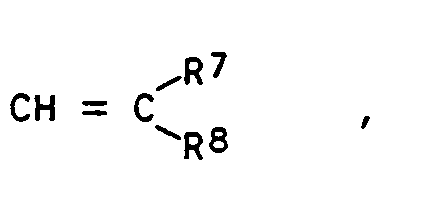
- R²
- C₁-C₄-Alkyl, Phenyl, Halogen, C₁-C₄-Alkoxy, oder C₁-C₄-Alkoxycarbonyl, oder R¹ und R² zusammen den Rest (CH₂)₃-CO, der gegebenenfalls durch 1 oder 2 Methylgruppen substituiert und dessen Carbonylgruppe orthoständig zum Schwefelatom an den Thiophenring geknüpft ist,
- R³
- Cyano oder C₁-C₄-Alkoxycarbonyl,
- R⁴
- C₁-C₈-Alkyl, Cyclohexyl, Phenoxy-C₁-C₄-alkyl, gegebenenfalls substituiertes Phenyl, Thienyl, C₁-C₄-Alkylthienyl oder Halogenthienyl,
- R⁵
- C₁-C₄-Alkyl, C₃-C₇-Alkyl, dessen Alkylkette durch 1 oder 2 Sauerstoffatome unterbrochen ist, oder C₁-C₄-Alkoxy und
- R⁶
- Phenylethyl oder C₃-C₁₂-Alkyl, dessen Alkylkette durch 1 bis 4 Sauerstoffatome unterbrochen und gegebenenfalls durch Phenyl oder Phenoxy substituiert ist,
- Aus der EP-A 269 953 sind bereits Azofarbstoffe bekannt, deren Diazokomponente sich von einem Aminothiophen und deren Kupplungskomponente sich von Thiazolderivaten ableitet. Es hat sich jedoch gezeigt, daß die dort genannten Verbindungen Schwächen in ihren anwendungstechnischen Eigenschaften aufweisen.
- Auch die FR-A- 2 401 960, EP-A- 169 483, EP 201 896 sowie die GB-A-2 163 768 beschreiben Azofarbstoffe mit einer Diazokomponente aus der Aminothiophen- und einer Kupplungskomponente aus der Thiazolreihe.
- Schließlich werden in der EP-A- 214 445 Azofarbstoffe mit einer Diazokomponente aus der Aminothiophen- und einer Kupplungskomponente aus der Diaminopyridinreihe beschrieben.
- Aufgabe der vorliegenden Erfindung war es deshalb, neue Azofarbstoffe mit einer Diazokomponente aus der Thiophenreihe und einer Kupplungskomponente aus Thiazolreihe bereitzustellen, die über ein vorteilhaftes anwendungstechnisches Eigenschaftsprofil verfügen.
- Demgemäß wurden die oben näher bezeichneten Thiophenazofarbstoffe der Formel I gefunden.
- Alle in der obengenannten Formel I auftretenden Alkylgruppen können sowohl geradkettig als auch verzweigt sein.
- Wenn in der obengenannten Formel I substituierte Phenylgruppen auftreten, so können als Substituenten beispielsweise C₁-C₄-Alkyl, C₁-C₄-Alkoxy, Halogen, dabei insbesondere Chlor oder Brom, C₁-C₄-Alkanoylamino, Sulfamoyl oder C₁-C₄-Mono- oder Dialkylsulfamoyl, wobei die Alkylkette gegebenenfalls durch ein Sauerstoffatom unterbrochen ist, in Betracht kommen.
- Geeignete Rest R¹, R² und R³ sind beispielsweise Methoxycarbonyl, Ethoxycarbonyl, Propoxycarbonyl, Isopropoxycarbonyl, Butoxycarbonyl oder sec-Butoxycarbonyl.
- Reste R¹ sind weiterhin z.B. CH=C(CN)₂, CH=C(CN)COOCH₃, CH=C(CN)COOC₂H₅, CH=C(COOCH₃)₂ oder CH=C(COOC₂H₅)₂.
- Reste R² sind weiterhin, ebenso wie die Reste R⁴ und R⁵, z.B. Methyl, Ethyl, Propyl, Isopropyl, Butyl, Isobutyl oder sec-Butyl.
- Reste R² sind weiterhin, ebenso wie der Rest R⁵, beispielsweise Methoxy, Ethoxy, Propoxy, Isopropoxy, Butoxy, Isobutoxy oder sec-Butoxy.
- Reste R² sind weiterhin z.B. Chlor oder Brom.
- Reste R⁴ sind weiterhin beispielsweise Pentyl, Isopentyl, Neopentyl, tert-Pentyl, Hexyl, Isohexyl, Heptyl, Octyl, 2-Ethylhexyl, Phenoxymethyl, 2-Phenoxyethyl, 2-, 3- oder 4-Methylphenyl, 2-, 3- oder 4-Methoxyphenyl, 2-, 3- oder 4-Chlorphenyl, 2,4-Dichlorphenyl, 2-, 3- oder 4-Bromphenyl, 2-, 3- oder 4-Formylaminophenyl, 2-, 3- oder 4-Acetylaminophenyl, 3- oder 4-Sulfamoylphenyl, 3- oder 4-Mono- oder Dimethylsulfamoylphenyl oder 3- oder 4-[Bis(2-methoxyethyl)sulfamoyl]phenyl.
- Reste R⁵ sind weiterhin, wie auch die Reste R⁶, z.B. 2-Methoxyethyl, 2-Ethoxyethyl, 2-Propoxyethyl, 2-Isopropoxyethyl, 2-Butoxyethyl, 2- oder 3-Methoxypropyl, 2- oder 3-Ethoxypropyl, 2- oder 3-Propoxypropyl, 2- oder 3-Butoxypropyl, 2- oder 4-Methoxybutyl, 2- oder 4-Ethoxybutyl, 2- oder 4-Propoxybutyl, 3,6-Dioxaheptyl, 3,6-Dioxaoctyl, 4,8-Dioxanonyl, 3,7-Doxaoctyl, 3,7-Dioxanonyl, 4,7-Dioxaoctyl oder 4,7-Dioxanonyl.
- Reste R⁶ sind weiterhin z.B. 2- oder 4-Butoxybutyl, 4,8-Dioxadecyl, 3,6,9-Trioxadecyl, 3,6,9-Trioxaundecyl, 3,6,9,12-Tetraoxatridecyl, 3,6,9,12-Tetraoxatetradecyl, 3-Benzyloxypropyl, 6-Phenoxy-4-oxahexyl, 2-Cyanoethyl oder 2-Phenylethyl.
- Bevorzugt sind Thiophenazofarbstoffe der Formel I, in der nur einer der Reste R¹, R² und R³ C₁-C₄-Alkoxycarbonyl bedeutet.
- Besonders bevorzugt sind Thiophenazofarbstoffe der Formel I, in der
- R¹
- Cyano, C₁-C₄-Alkoxycarbonyl oder Formyl,
- R²
- C₁-C₄-Alkyl oder Chlor,
- R³
- Cyano,
- R⁴
- Phenyl, Thien-2-yl oder Thien-3-yl,
- R⁵
- C₁-C₄-Alkyl und
- R⁶
- C₃-C₉-Alkyl, dessen Alkylkette durch 1 bis 3 Sauerstoffatome unterbrochen und gegebenenfalls durch Phenoxy substituiert ist,
- Insbesondere sind Thiophenazofarbstoffe der Formel I hervorzuheben, in der R⁶ C₂H₄OCH₃, C₃H₆OCH₃, C₃H₆OC₂H₅, C₃H₆OC₂H₄OC₂H₅, C₃H₆OCH(CH₃)CH₂OCH₃, CH₂(C₂H₄O)₂CH₃, CH₂(C₂H₄O)₃CH₃, C₃H₆O(C₂H₄O)₂C₂H₅ oder C₃H₆OC₂H₄OC₆H₅ bedeuten.
- Die Herstellung der erfindungsgemäßen Thiophenazofarbstoffe erfolgt nach an sich bekannter Weise. Beispielsweise kann man ein 2-Aminothiophen der Formel II

in der R¹, R² und R³ jeweils die obengenannte Bedeutung besitzen, diazotieren und mit einem Thiazol der Formel III
in der R⁴, R⁵ und R⁶ jeweils die obengenannte Bedeutung besitzen, kuppeln. - 2-Aminothiophene der Formel II sind bereits bekannt und z.B. in der EP-A 150 034 beschrieben oder können analog zu der dort genannten Herstellungsweise erhalten werden.
- Bei den Thioazolen der Formel III handelt es sich im allgemeinen ebenfalls um bekannte Verbindungen. Sie sind z.B. in der US-A-3 770 719 oder in J.V. Metzger "Heterocyclic Compounds - Thiazole and its Derivatives", Vol. 34, Part 1, Interscience Publ., John Wiley, New York, 1979, beschrieben oder können analog zu den dort genannten Methoden erhalten werden.
- Weitere Einzelheiten der Herstellung der erfindungsgemäßen Farbstoffe können den Beispielen entnommen werden.
- Im allgemeinen liegen solche Thiophenazofarbstoffe der Formel I, die in den Resten R⁵ und R⁶ zusammen 4 oder mehr Sauerstoffatome aufweisen, bei Raumtemperatur in flüssigem Aggregatzustand vor.
- Die neuen Thiophenazofarbstoffe der Formel I eignen sich in vorteilhafter Weise als Dispersionsfarbstoffe zum Färben von textilen Fasern, insbesondere von Celluloseestern oder Polyestern, aber auch von Polyamiden oder Mischgeweben aus Polyestern und Cellulosefasern.
- Man erhält Färbungen mit guten Echtheiten, insbesondere mit guter Lichtechtheit und guter Thermomigrierechtheit. Die neuen Farbstoffe weisen eine gute Migration auf.
- Um einen günstigen Farbaufbau zu erreichen, kann es in manchen Fällen von Vorteil sein, Mischungen der erfindungsgemäßen Farbstoffe der Formel I zum Färben zu verwenden.
- Die folgenden Beispiele sollen die Erfindung näher erläutern.
- 18,7 g 2-Amino-3-cyano-4-chlor-5-formylthiophen wurden in ein auf 0°C abgekühltes Gemisch aus 111 g 80 gew.%iger Schwefelsäure, 15 ml Eisessig und 32 g 42 Gew.%iger Nitrosylschwefelsäure eingetragen. Dann rührte man 4 Stunden bei 0 bis 5°C nach. Anschließend gab man die Diazoniumsalzlösung in ein Gemisch, das eine Temperatur von 0°C aufwies und aus 36,4 g der Kupplungskomponente der Formel

200 g Eisessig, 40 g Propionsäure und 30 ml einer 10 gew.%igen Amidosulfonsäurelösung hergestellt wurde. Nach der Vereinigung beider Lösungen gab man ca. 160 g Eis hinzu und pufferte das Gemisch dann mit Natriumacetatlösung (ca. 30 gew.%ig) auf pH 0,2 bis 0,7 ab. Danach fällte man den entstendenen Farbstoff durch Zugabe von Wasser vollständig aus, saugte ab, wusch neutral und trocknete. Man erhielt 52 g eines dunkelblauen Pulvers der Formel
Der Farbstoff löst sich in Aceton mit blauer Farbe und färbt Polyethylenterephthalategewebe in klaren, mittelblauen Tönen mit sehr gutem Aufbauvermögen egal an. Die Färbungen haben hohe Licht- und Thermofixierechtheiten. λmax: 604 nm (N,N-Dimethylformamid/Eisessig 9:1 v/v). - Ein Gemisch aus 110 g 80 gew.%iger Schwefelsäure, 15 g Eisessig und 32 g 42 gew.%iger Nitrosylschwefelsäure wurde auf 0°C abgekühlt. Dann streute man unter gutem Rühren unter Kühlen 21 g 2-Amino-3-cyano-4-methylthiophen-5-carbonsäureethylester so ein, daß die Reaktionstemperatur bei 0 bis 5°C gehalten wurde. Nach 3- bis 4-stündigem Rühren erhielt man eine klare Diazoniumsalzlösung. Man gab sie in eine Lösung, die aus 36,4 g der Kupplungskomponente der Formel

in 15 ml konz. Salzsäure, 350 ml Wasser und 0,5 g eines sauer wirksamen Dispergiermittels hergestellt wurde. Vor Zugabe der Diazoniumsalzlösung kühlte man mit 300 g Eis auf ≦ 0°C ab und setzte noch 1 g Amidosulfonsäure hinzu. Gleichzeitig mit dem Zulauf der Diazoniumsalzlösung wurden Wasser und Eis so zugesetzt, daß das Kupplungsgemisch rührbar blieb und die Temepratur 5°C nicht überschritt. Man rührte das Gemisch 15 Minuten nach, hob den pH-Wert der Suspension dann durch Zugabe von eiskalter, verdünnter Natronlauge auf 0,5 bis 0,8 an und isolierte das angefallen Produkt analog Beispiel 1. Man erhielt 57,5 g eines violetten Pulvers der Formel
das sich in Aceton mit rotstichig blauer Farbe löst und Polyestergewebe in lichtechten, kräftigen rotstichig blauen bis marineblauen Tönen färbt. λmax: 576 nm (N,N-Dimethylformamid/Eisessig 9:1 v/v). - Die in den folgenden Tabellen aufgeführten Farbstoffe werden in analoger Weise erhalten.


Claims (4)
- Thiophenazofarbstoffe der Formel I
 R¹ Cyano, C₁-C₄-Alkoxycarbonyl, Phenylazo, Phenylsulfonyl, Formyl oder den Rest
 R² C₁-C₄-Alkyl, Phenyl, Halogen, C₁-C₄-Alkoxy oder C₁-C₄-Alkoxycarbonyl, oder R¹ und R² zusammen den Rest (CH₂)₃-CO, der gegebenenfalls durch 1 oder 2 Methylgruppen substituiert und dessen Carbonylgruppe orthoständig zum Schwefelatom an den Thiophenring geknüpft ist,R³ Cyano oder C₁-C₄-Alkoxycarbonyl,R⁴ C₁-C₈-Alkyl, Cyclohexyl, Phenoxy-C₁-C₄-alkyl, gegebenenfalls substituiertes Phenyl, Thienyl, C₁-C₄-Alkylthienyl oder Halogenthienyl,R⁵ C₁-C₄-Alkyl, C₃-C₇-Alkyl, dessen Alkylkette durch 1 oder 2 Sauerstoffatome unterbrochen ist, oder C₁-C₄-Alkoxy undR⁶ Phenylethyl oder C₃-C₁₂-Alkyl, dessen Alkylkette durch 1 bis 4 Sauerstoffatome unterbrochen und gegebenenfalls durch Phenyl oder Phenoxy substituiert ist,bedeuten, mit der Maßgabe, daß wenn R⁵ und R⁶ gleichzeitig für durch Sauerstoffatome unterbrochenes Alkyl stehen, der Rest R⁶ mindestens 2 Kohlenstoffatome mehr aufweist als der Rest R⁵ und wobei mindestens einer der Reste R⁵ und R⁶ für eine durch Sauerstoff unterbrochene Alkylkette steht.
- Thiophenazofarbstoffe gemäß Anspruch 1, dadurch gekennzeichnet, daß nur einer der Reste R¹, R² und R³ C₁-C₄-Alkoxycarbonyl bedeutet.
- Thiophenazofarbstoffe gemäß Anspruch 1, dadurch gekennzeichnet, daßR¹ Cyano, C₁-C₄-Alkoxycarbonyl oder Formyl,R² C₁-C₄-Alkyl oder Chlor,R³ Cyano,R⁴ Phenyl, Thien-2-yl oder Thien-3-yl,R⁵ C₁-C₄-Alkyl undR⁶ C₃-C₉-Alkyl, dessen Alkylkette durch 1 bis 3 Sauerstoffatome unterbrochen und gegebenenfalls durch Phenoxy substituiert ist,bedeuten.
- Verwendung der Thiophenazofarbstoffe gemäß Anspruch 1 zum Färben von textilen Fasern.
Applications Claiming Priority (2)
| Application Number | Priority Date | Filing Date | Title |
|---|---|---|---|
| DE3833442 | 1988-10-01 | ||
| DE3833442A DE3833442A1 (de) | 1988-10-01 | 1988-10-01 | Thiophenazofarbstoffe mit einer kupplungskomponente aus der thiazolreihe |
Publications (2)
| Publication Number | Publication Date |
|---|---|
| EP0362637A1 EP0362637A1 (de) | 1990-04-11 |
| EP0362637B1 true EP0362637B1 (de) | 1994-02-02 |
Family
ID=6364190
Family Applications (1)
| Application Number | Title | Priority Date | Filing Date |
|---|---|---|---|
| EP89117505A Expired - Lifetime EP0362637B1 (de) | 1988-10-01 | 1989-09-22 | Thiophenazofarbstoffe mit einer Kupplungskomponente aus der Thiazolreihe |
Country Status (3)
| Country | Link |
|---|---|
| EP (1) | EP0362637B1 (de) |
| JP (1) | JP2693241B2 (de) |
| DE (2) | DE3833442A1 (de) |
Families Citing this family (6)
| Publication number | Priority date | Publication date | Assignee | Title |
|---|---|---|---|---|
| DE3911949A1 (de) * | 1989-04-12 | 1990-10-18 | Basf Ag | Neue marineblaue und schwarze farbstoffmischungen |
| DE4010512A1 (de) * | 1990-04-02 | 1991-10-10 | Basf Ag | Marineblaue farbstoffmischungen |
| DE4215495A1 (de) * | 1992-05-12 | 1993-11-18 | Basf Ag | Azofarbstoffe mit einer acetalisierten Diazokomponente aus der Thiophen- oder Thiazolreihe |
| DE4426023A1 (de) * | 1994-07-22 | 1996-01-25 | Basf Ag | Azofarbstoffe mit einer Kupplungskomponente aus der Aminothiazolreihe |
| KR20100056459A (ko) | 2007-07-12 | 2010-05-27 | 바스프 에스이 | 펄라이트 플레이크 기재 간섭 안료 |
| ES2491104T3 (es) * | 2010-04-29 | 2014-09-05 | Unilever N.V. | Colorantes azoicos bis heterocíclicos |
Citations (1)
| Publication number | Priority date | Publication date | Assignee | Title |
|---|---|---|---|---|
| EP0214445A2 (de) * | 1985-08-10 | 1987-03-18 | BASF Aktiengesellschaft | Heterocyclische Azofarbstoffe |
Family Cites Families (5)
| Publication number | Priority date | Publication date | Assignee | Title |
|---|---|---|---|---|
| DE2738885A1 (de) * | 1977-08-29 | 1979-03-22 | Basf Ag | Azofarbstoffe |
| DE3427201A1 (de) * | 1984-07-24 | 1986-01-30 | Basf Ag, 6700 Ludwigshafen | Heterocyclische azofarbstoffe |
| CH664762A5 (de) * | 1984-08-30 | 1988-03-31 | Sandoz Ag | Thiophen-azofarbstoffe. |
| IN167384B (de) * | 1985-05-14 | 1990-10-20 | Basf Ag | |
| DE3639942A1 (de) * | 1986-11-22 | 1988-06-01 | Basf Ag | Thiophenazofarbstoffe |
-
1988
- 1988-10-01 DE DE3833442A patent/DE3833442A1/de not_active Withdrawn
-
1989
- 1989-09-22 DE DE89117505T patent/DE58906884D1/de not_active Expired - Lifetime
- 1989-09-22 EP EP89117505A patent/EP0362637B1/de not_active Expired - Lifetime
- 1989-09-29 JP JP1252551A patent/JP2693241B2/ja not_active Expired - Lifetime
Patent Citations (1)
| Publication number | Priority date | Publication date | Assignee | Title |
|---|---|---|---|---|
| EP0214445A2 (de) * | 1985-08-10 | 1987-03-18 | BASF Aktiengesellschaft | Heterocyclische Azofarbstoffe |
Also Published As
| Publication number | Publication date |
|---|---|
| JPH02123165A (ja) | 1990-05-10 |
| DE58906884D1 (de) | 1994-03-17 |
| EP0362637A1 (de) | 1990-04-11 |
| DE3833442A1 (de) | 1990-04-12 |
| JP2693241B2 (ja) | 1997-12-24 |
Similar Documents
| Publication | Publication Date | Title |
|---|---|---|
| EP0534296B1 (de) | Azofarbstoffe mit einer Kupplungskomponente aus der Chinolinreihe | |
| EP0362637A1 (de) | Thiophenazofarbstoffe mit einer Kupplungskomponente aus der Thiazolreihe | |
| DE4335261C2 (de) | Dispersionsfarbstoffe | |
| EP0362708B1 (de) | Thiazolazofarbstoffe mit einer Diazokomponente aus der Isothiazol- oder Thiadiazolreihe | |
| EP0390027B1 (de) | Azofarbstoffe, deren Diazo- und Kupplungskomponente aus der Thiazolreihe stammt | |
| EP0716670B1 (de) | Azofarbstoffe mit einer diazokomponente aus der anilinreihe und einer kupplungskomponente aus der triazolopyridinreihe | |
| US5216139A (en) | Thiopheneazo dye based on a coupling component of the thiazole series | |
| EP0344487B1 (de) | Azofarbstoffe der 5-Aminoisothiazolreihe | |
| EP0400451A1 (de) | Benzisothiazolazofarbstoffe mit einer Kupplungskomponente aus der Thiazol- ioder Pyridinreihe | |
| EP0712429B1 (de) | Phenylazotriazolopyridinfarbstoffe | |
| EP0266692B1 (de) | Thiophengruppenhaltige Azofarbstoffe | |
| EP0428930B1 (de) | Thiazolazofarbstoffe | |
| EP0315898B1 (de) | Isothiazolazofarbstoffe | |
| DE19530176A1 (de) | Saure Diazofarbstoffe | |
| DE3917258A1 (de) | Isothiazolazofarbstoffe mit einer kupplungskomponente aus der thiazolreihe | |
| EP0269953A2 (de) | Thiophenazofarbstoffe | |
| DE3833443A1 (de) | Thiazolazofarbstoffe mit einer diazokomponente aus der isothiazol- oder thiadiazolreihe | |
| EP0569759B1 (de) | Benzisothiazolazofarbstoffe mit einer Kupplungskomponente aus der Anilinreihe | |
| DE4020768A1 (de) | Azofarbstoffe mit einer kupplungskomponente aus der (1,2,4,) triazolo- (1,5-a) pyridinreihe | |
| DE3723884A1 (de) | Isothiazolazofarbstoffe | |
| DE2100723A1 (en) | Monoazo dyes - contg sulphonic acid gps for dyeing polyamides and polyurethanes | |
| WO1998037150A1 (de) | Trifluormethylsubstituierte azofarbstoffe | |
| DE4105257A1 (de) | Azofarbstoffe mit einer diazokomponente, die sich von einer aminobenzophenonsulfonsaeure ableitet |
Legal Events
| Date | Code | Title | Description |
|---|---|---|---|
| PUAI | Public reference made under article 153(3) epc to a published international application that has entered the european phase |
Free format text: ORIGINAL CODE: 0009012 |
|
| 17P | Request for examination filed |
Effective date: 19891205 |
|
| AK | Designated contracting states |
Kind code of ref document: A1 Designated state(s): CH DE FR GB IT LI |
|
| 17Q | First examination report despatched |
Effective date: 19920129 |
|
| GRAA | (expected) grant |
Free format text: ORIGINAL CODE: 0009210 |
|
| AK | Designated contracting states |
Kind code of ref document: B1 Designated state(s): CH DE FR GB IT LI |
|
| REF | Corresponds to: |
Ref document number: 58906884 Country of ref document: DE Date of ref document: 19940317 |
|
| GBT | Gb: translation of ep patent filed (gb section 77(6)(a)/1977) |
Effective date: 19940217 |
|
| ITF | It: translation for a ep patent filed | ||
| ET | Fr: translation filed | ||
| PLBE | No opposition filed within time limit |
Free format text: ORIGINAL CODE: 0009261 |
|
| STAA | Information on the status of an ep patent application or granted ep patent |
Free format text: STATUS: NO OPPOSITION FILED WITHIN TIME LIMIT |
|
| 26N | No opposition filed | ||
| PGFP | Annual fee paid to national office [announced via postgrant information from national office to epo] |
Ref country code: FR Payment date: 19970814 Year of fee payment: 9 |
|
| PGFP | Annual fee paid to national office [announced via postgrant information from national office to epo] |
Ref country code: CH Payment date: 19970826 Year of fee payment: 9 |
|
| PGFP | Annual fee paid to national office [announced via postgrant information from national office to epo] |
Ref country code: GB Payment date: 19970915 Year of fee payment: 9 |
|
| PGFP | Annual fee paid to national office [announced via postgrant information from national office to epo] |
Ref country code: DE Payment date: 19970929 Year of fee payment: 9 |
|
| PG25 | Lapsed in a contracting state [announced via postgrant information from national office to epo] |
Ref country code: GB Free format text: LAPSE BECAUSE OF NON-PAYMENT OF DUE FEES Effective date: 19980922 Ref country code: DE Free format text: LAPSE BECAUSE OF THE APPLICANT RENOUNCES Effective date: 19980922 |
|
| PG25 | Lapsed in a contracting state [announced via postgrant information from national office to epo] |
Ref country code: LI Free format text: LAPSE BECAUSE OF NON-PAYMENT OF DUE FEES Effective date: 19980930 Ref country code: CH Free format text: LAPSE BECAUSE OF NON-PAYMENT OF DUE FEES Effective date: 19980930 |
|
| GBPC | Gb: european patent ceased through non-payment of renewal fee |
Effective date: 19980922 |
|
| REG | Reference to a national code |
Ref country code: CH Ref legal event code: PL |
|
| PG25 | Lapsed in a contracting state [announced via postgrant information from national office to epo] |
Ref country code: FR Free format text: LAPSE BECAUSE OF NON-PAYMENT OF DUE FEES Effective date: 19990531 |
|
| REG | Reference to a national code |
Ref country code: FR Ref legal event code: ST |
|
| PG25 | Lapsed in a contracting state [announced via postgrant information from national office to epo] |
Ref country code: IT Free format text: LAPSE BECAUSE OF NON-PAYMENT OF DUE FEES;WARNING: LAPSES OF ITALIAN PATENTS WITH EFFECTIVE DATE BEFORE 2007 MAY HAVE OCCURRED AT ANY TIME BEFORE 2007. THE CORRECT EFFECTIVE DATE MAY BE DIFFERENT FROM THE ONE RECORDED. Effective date: 20050922 |