EP0362667B1 - Procédé pour l'extraction d'amines aromatiques alkoyliques - Google Patents
Procédé pour l'extraction d'amines aromatiques alkoyliques Download PDFInfo
- Publication number
- EP0362667B1 EP0362667B1 EP89117713A EP89117713A EP0362667B1 EP 0362667 B1 EP0362667 B1 EP 0362667B1 EP 89117713 A EP89117713 A EP 89117713A EP 89117713 A EP89117713 A EP 89117713A EP 0362667 B1 EP0362667 B1 EP 0362667B1
- Authority
- EP
- European Patent Office
- Prior art keywords
- catalyst
- alkylation
- process according
- amount
- water
- Prior art date
- Legal status (The legal status is an assumption and is not a legal conclusion. Google has not performed a legal analysis and makes no representation as to the accuracy of the status listed.)
- Expired - Lifetime
Links
- 238000000034 method Methods 0.000 title claims description 23
- 150000004982 aromatic amines Chemical class 0.000 title claims description 17
- 239000003054 catalyst Substances 0.000 claims description 34
- XLYOFNOQVPJJNP-UHFFFAOYSA-N water Substances O XLYOFNOQVPJJNP-UHFFFAOYSA-N 0.000 claims description 34
- 238000005804 alkylation reaction Methods 0.000 claims description 30
- 230000029936 alkylation Effects 0.000 claims description 29
- VSCWAEJMTAWNJL-UHFFFAOYSA-K aluminium trichloride Chemical compound Cl[Al](Cl)Cl VSCWAEJMTAWNJL-UHFFFAOYSA-K 0.000 claims description 28
- 125000001997 phenyl group Chemical group [H]C1=C([H])C([H])=C(*)C([H])=C1[H] 0.000 claims description 20
- 229910052739 hydrogen Inorganic materials 0.000 claims description 18
- 239000001257 hydrogen Substances 0.000 claims description 18
- 150000007529 inorganic bases Chemical class 0.000 claims description 16
- 239000000203 mixture Substances 0.000 claims description 16
- 150000002431 hydrogen Chemical class 0.000 claims description 15
- 238000004821 distillation Methods 0.000 claims description 14
- 229910052751 metal Inorganic materials 0.000 claims description 13
- 239000002184 metal Substances 0.000 claims description 13
- UFHFLCQGNIYNRP-UHFFFAOYSA-N Hydrogen Chemical compound [H][H] UFHFLCQGNIYNRP-UHFFFAOYSA-N 0.000 claims description 12
- XAGFODPZIPBFFR-UHFFFAOYSA-N aluminium Chemical compound [Al] XAGFODPZIPBFFR-UHFFFAOYSA-N 0.000 claims description 12
- 125000002496 methyl group Chemical group [H]C([H])([H])* 0.000 claims description 12
- 229910052782 aluminium Inorganic materials 0.000 claims description 11
- 230000007062 hydrolysis Effects 0.000 claims description 10
- 238000006460 hydrolysis reaction Methods 0.000 claims description 10
- 125000001495 ethyl group Chemical group [H]C([H])([H])C([H])([H])* 0.000 claims description 9
- 125000002924 primary amino group Chemical group [H]N([H])* 0.000 claims description 9
- 150000001336 alkenes Chemical class 0.000 claims description 7
- 125000004178 (C1-C4) alkyl group Chemical group 0.000 claims description 6
- 125000000229 (C1-C4)alkoxy group Chemical group 0.000 claims description 6
- ZAMOUSCENKQFHK-UHFFFAOYSA-N Chlorine atom Chemical compound [Cl] ZAMOUSCENKQFHK-UHFFFAOYSA-N 0.000 claims description 6
- PXGOKWXKJXAPGV-UHFFFAOYSA-N Fluorine Chemical compound FF PXGOKWXKJXAPGV-UHFFFAOYSA-N 0.000 claims description 6
- 229910052736 halogen Inorganic materials 0.000 claims description 6
- 150000002367 halogens Chemical class 0.000 claims description 6
- 229910052784 alkaline earth metal Inorganic materials 0.000 claims description 5
- 150000004679 hydroxides Chemical class 0.000 claims description 5
- 229910052801 chlorine Inorganic materials 0.000 claims description 4
- 239000000460 chlorine Substances 0.000 claims description 4
- 229910052731 fluorine Inorganic materials 0.000 claims description 4
- 239000011737 fluorine Substances 0.000 claims description 4
- 125000000027 (C1-C10) alkoxy group Chemical group 0.000 claims description 3
- 125000000008 (C1-C10) alkyl group Chemical group 0.000 claims description 3
- WKBOTKDWSSQWDR-UHFFFAOYSA-N Bromine atom Chemical compound [Br] WKBOTKDWSSQWDR-UHFFFAOYSA-N 0.000 claims description 3
- 239000002253 acid Substances 0.000 claims description 3
- 150000007513 acids Chemical class 0.000 claims description 3
- 150000001342 alkaline earth metals Chemical class 0.000 claims description 3
- 150000004649 carbonic acid derivatives Chemical class 0.000 claims description 3
- 229910001507 metal halide Inorganic materials 0.000 claims description 3
- 150000005309 metal halides Chemical class 0.000 claims description 3
- -1 oxides Chemical class 0.000 claims description 3
- BVKZGUZCCUSVTD-UHFFFAOYSA-M Bicarbonate Chemical class OC([O-])=O BVKZGUZCCUSVTD-UHFFFAOYSA-M 0.000 claims description 2
- GDTBXPJZTBHREO-UHFFFAOYSA-N bromine Substances BrBr GDTBXPJZTBHREO-UHFFFAOYSA-N 0.000 claims description 2
- 229910052794 bromium Inorganic materials 0.000 claims description 2
- 239000003795 chemical substances by application Substances 0.000 claims description 2
- 159000000011 group IA salts Chemical class 0.000 claims description 2
- 150000004820 halides Chemical class 0.000 claims description 2
- 150000004678 hydrides Chemical class 0.000 claims description 2
- 239000011541 reaction mixture Substances 0.000 claims description 2
- 239000011949 solid catalyst Substances 0.000 claims description 2
- 229910052783 alkali metal Inorganic materials 0.000 claims 1
- 150000001340 alkali metals Chemical class 0.000 claims 1
- 239000004411 aluminium Substances 0.000 claims 1
- 238000002955 isolation Methods 0.000 claims 1
- HEMHJVSKTPXQMS-UHFFFAOYSA-M Sodium hydroxide Chemical compound [OH-].[Na+] HEMHJVSKTPXQMS-UHFFFAOYSA-M 0.000 description 27
- 150000003839 salts Chemical class 0.000 description 17
- 239000002699 waste material Substances 0.000 description 11
- 239000000243 solution Substances 0.000 description 10
- YXFVVABEGXRONW-UHFFFAOYSA-N Toluene Chemical compound CC1=CC=CC=C1 YXFVVABEGXRONW-UHFFFAOYSA-N 0.000 description 9
- 238000006243 chemical reaction Methods 0.000 description 8
- UHOVQNZJYSORNB-UHFFFAOYSA-N Benzene Chemical compound C1=CC=CC=C1 UHOVQNZJYSORNB-UHFFFAOYSA-N 0.000 description 6
- CDBYLPFSWZWCQE-UHFFFAOYSA-L Sodium Carbonate Chemical compound [Na+].[Na+].[O-]C([O-])=O CDBYLPFSWZWCQE-UHFFFAOYSA-L 0.000 description 6
- DMBHHRLKUKUOEG-UHFFFAOYSA-N diphenylamine Chemical compound C=1C=CC=CC=1NC1=CC=CC=C1 DMBHHRLKUKUOEG-UHFFFAOYSA-N 0.000 description 6
- HCHKCACWOHOZIP-UHFFFAOYSA-N Zinc Chemical compound [Zn] HCHKCACWOHOZIP-UHFFFAOYSA-N 0.000 description 5
- 150000001412 amines Chemical class 0.000 description 5
- 229910052725 zinc Inorganic materials 0.000 description 5
- PAYRUJLWNCNPSJ-UHFFFAOYSA-N Aniline Chemical compound NC1=CC=CC=C1 PAYRUJLWNCNPSJ-UHFFFAOYSA-N 0.000 description 4
- ODINCKMPIJJUCX-UHFFFAOYSA-N calcium oxide Inorganic materials [Ca]=O ODINCKMPIJJUCX-UHFFFAOYSA-N 0.000 description 4
- RZXMPPFPUUCRFN-UHFFFAOYSA-N p-toluidine Chemical compound CC1=CC=C(N)C=C1 RZXMPPFPUUCRFN-UHFFFAOYSA-N 0.000 description 4
- 239000011701 zinc Substances 0.000 description 4
- FXNDIJDIPNCZQJ-UHFFFAOYSA-N 2,4,4-trimethylpent-1-ene Chemical group CC(=C)CC(C)(C)C FXNDIJDIPNCZQJ-UHFFFAOYSA-N 0.000 description 3
- QTBSBXVTEAMEQO-UHFFFAOYSA-N Acetic acid Chemical compound CC(O)=O QTBSBXVTEAMEQO-UHFFFAOYSA-N 0.000 description 3
- VGGSQFUCUMXWEO-UHFFFAOYSA-N Ethene Chemical compound C=C VGGSQFUCUMXWEO-UHFFFAOYSA-N 0.000 description 3
- 239000005977 Ethylene Substances 0.000 description 3
- KWYUFKZDYYNOTN-UHFFFAOYSA-M Potassium hydroxide Chemical compound [OH-].[K+] KWYUFKZDYYNOTN-UHFFFAOYSA-M 0.000 description 3
- 239000003513 alkali Substances 0.000 description 3
- AXCZMVOFGPJBDE-UHFFFAOYSA-L calcium dihydroxide Chemical compound [OH-].[OH-].[Ca+2] AXCZMVOFGPJBDE-UHFFFAOYSA-L 0.000 description 3
- 239000000920 calcium hydroxide Substances 0.000 description 3
- 229910001861 calcium hydroxide Inorganic materials 0.000 description 3
- 235000011116 calcium hydroxide Nutrition 0.000 description 3
- 239000000292 calcium oxide Substances 0.000 description 3
- 235000012255 calcium oxide Nutrition 0.000 description 3
- 125000004432 carbon atom Chemical group C* 0.000 description 3
- 238000000354 decomposition reaction Methods 0.000 description 3
- 230000006203 ethylation Effects 0.000 description 3
- 238000006200 ethylation reaction Methods 0.000 description 3
- 238000001914 filtration Methods 0.000 description 3
- 238000000926 separation method Methods 0.000 description 3
- 229910000029 sodium carbonate Inorganic materials 0.000 description 3
- 238000003756 stirring Methods 0.000 description 3
- 238000005406 washing Methods 0.000 description 3
- VXNZUUAINFGPBY-UHFFFAOYSA-N 1-Butene Chemical compound CCC=C VXNZUUAINFGPBY-UHFFFAOYSA-N 0.000 description 2
- VOZKAJLKRJDJLL-UHFFFAOYSA-N 2,4-diaminotoluene Chemical compound CC1=CC=C(N)C=C1N VOZKAJLKRJDJLL-UHFFFAOYSA-N 0.000 description 2
- JJYPMNFTHPTTDI-UHFFFAOYSA-N 3-methylaniline Chemical compound CC1=CC=CC(N)=C1 JJYPMNFTHPTTDI-UHFFFAOYSA-N 0.000 description 2
- HRXZRAXKKNUKRF-UHFFFAOYSA-N 4-ethylaniline Chemical compound CCC1=CC=C(N)C=C1 HRXZRAXKKNUKRF-UHFFFAOYSA-N 0.000 description 2
- VTYYLEPIZMXCLO-UHFFFAOYSA-L Calcium carbonate Chemical compound [Ca+2].[O-]C([O-])=O VTYYLEPIZMXCLO-UHFFFAOYSA-L 0.000 description 2
- XDTMQSROBMDMFD-UHFFFAOYSA-N Cyclohexane Chemical compound C1CCCCC1 XDTMQSROBMDMFD-UHFFFAOYSA-N 0.000 description 2
- NHTMVDHEPJAVLT-UHFFFAOYSA-N Isooctane Chemical compound CC(C)CC(C)(C)C NHTMVDHEPJAVLT-UHFFFAOYSA-N 0.000 description 2
- AFBPFSWMIHJQDM-UHFFFAOYSA-N N-methyl-N-phenylamine Natural products CNC1=CC=CC=C1 AFBPFSWMIHJQDM-UHFFFAOYSA-N 0.000 description 2
- CTQNGGLPUBDAKN-UHFFFAOYSA-N O-Xylene Chemical compound CC1=CC=CC=C1C CTQNGGLPUBDAKN-UHFFFAOYSA-N 0.000 description 2
- 238000010533 azeotropic distillation Methods 0.000 description 2
- 239000002585 base Substances 0.000 description 2
- BRPQOXSCLDDYGP-UHFFFAOYSA-N calcium oxide Chemical compound [O-2].[Ca+2] BRPQOXSCLDDYGP-UHFFFAOYSA-N 0.000 description 2
- DIOQZVSQGTUSAI-UHFFFAOYSA-N decane Chemical compound CCCCCCCCCC DIOQZVSQGTUSAI-UHFFFAOYSA-N 0.000 description 2
- JVSWJIKNEAIKJW-UHFFFAOYSA-N dimethyl-hexane Natural products CCCCCC(C)C JVSWJIKNEAIKJW-UHFFFAOYSA-N 0.000 description 2
- 238000001035 drying Methods 0.000 description 2
- 150000002739 metals Chemical class 0.000 description 2
- UAEPNZWRGJTJPN-UHFFFAOYSA-N methylcyclohexane Chemical compound CC1CCCCC1 UAEPNZWRGJTJPN-UHFFFAOYSA-N 0.000 description 2
- RNVCVTLRINQCPJ-UHFFFAOYSA-N o-toluidine Chemical compound CC1=CC=CC=C1N RNVCVTLRINQCPJ-UHFFFAOYSA-N 0.000 description 2
- 239000003960 organic solvent Substances 0.000 description 2
- 239000002002 slurry Substances 0.000 description 2
- 238000010626 work up procedure Methods 0.000 description 2
- 239000008096 xylene Substances 0.000 description 2
- WZCQRUWWHSTZEM-UHFFFAOYSA-N 1,3-phenylenediamine Chemical compound NC1=CC=CC(N)=C1 WZCQRUWWHSTZEM-UHFFFAOYSA-N 0.000 description 1
- CDULGHZNHURECF-UHFFFAOYSA-N 2,3-dimethylaniline 2,4-dimethylaniline 2,5-dimethylaniline 2,6-dimethylaniline 3,4-dimethylaniline 3,5-dimethylaniline Chemical class CC1=CC=C(N)C(C)=C1.CC1=CC=C(C)C(N)=C1.CC1=CC(C)=CC(N)=C1.CC1=CC=C(N)C=C1C.CC1=CC=CC(N)=C1C.CC1=CC=CC(C)=C1N CDULGHZNHURECF-UHFFFAOYSA-N 0.000 description 1
- WKBALTUBRZPIPZ-UHFFFAOYSA-N 2,6-di(propan-2-yl)aniline Chemical compound CC(C)C1=CC=CC(C(C)C)=C1N WKBALTUBRZPIPZ-UHFFFAOYSA-N 0.000 description 1
- RLYCRLGLCUXUPO-UHFFFAOYSA-N 2,6-diaminotoluene Chemical compound CC1=C(N)C=CC=C1N RLYCRLGLCUXUPO-UHFFFAOYSA-N 0.000 description 1
- OIXUMNZGNCAOKY-UHFFFAOYSA-N 2,6-diethyl-4-methylaniline Chemical compound CCC1=CC(C)=CC(CC)=C1N OIXUMNZGNCAOKY-UHFFFAOYSA-N 0.000 description 1
- MLPVBIWIRCKMJV-UHFFFAOYSA-N 2-ethylaniline Chemical compound CCC1=CC=CC=C1N MLPVBIWIRCKMJV-UHFFFAOYSA-N 0.000 description 1
- GTJOHISYCKPIMT-UHFFFAOYSA-N 2-methylundecane Chemical compound CCCCCCCCCC(C)C GTJOHISYCKPIMT-UHFFFAOYSA-N 0.000 description 1
- AMKPQMFZCBTTAT-UHFFFAOYSA-N 3-ethylaniline Chemical compound CCC1=CC=CC(N)=C1 AMKPQMFZCBTTAT-UHFFFAOYSA-N 0.000 description 1
- 239000004215 Carbon black (E152) Substances 0.000 description 1
- 238000003547 Friedel-Crafts alkylation reaction Methods 0.000 description 1
- VQTUBCCKSQIDNK-UHFFFAOYSA-N Isobutene Chemical compound CC(C)=C VQTUBCCKSQIDNK-UHFFFAOYSA-N 0.000 description 1
- SGVYKUFIHHTIFL-UHFFFAOYSA-N Isobutylhexyl Natural products CCCCCCCC(C)C SGVYKUFIHHTIFL-UHFFFAOYSA-N 0.000 description 1
- 125000001931 aliphatic group Chemical group 0.000 description 1
- 150000001338 aliphatic hydrocarbons Chemical class 0.000 description 1
- 229910001854 alkali hydroxide Inorganic materials 0.000 description 1
- 229910001860 alkaline earth metal hydroxide Inorganic materials 0.000 description 1
- 150000007854 aminals Chemical class 0.000 description 1
- 239000007864 aqueous solution Substances 0.000 description 1
- 150000004945 aromatic hydrocarbons Chemical class 0.000 description 1
- 125000003118 aryl group Chemical group 0.000 description 1
- 230000015572 biosynthetic process Effects 0.000 description 1
- 238000000861 blow drying Methods 0.000 description 1
- 238000007664 blowing Methods 0.000 description 1
- 238000009835 boiling Methods 0.000 description 1
- KGBXLFKZBHKPEV-UHFFFAOYSA-N boric acid Chemical compound OB(O)O KGBXLFKZBHKPEV-UHFFFAOYSA-N 0.000 description 1
- 239000004327 boric acid Substances 0.000 description 1
- IAQRGUVFOMOMEM-UHFFFAOYSA-N butene Natural products CC=CC IAQRGUVFOMOMEM-UHFFFAOYSA-N 0.000 description 1
- 239000006227 byproduct Substances 0.000 description 1
- 229910000019 calcium carbonate Inorganic materials 0.000 description 1
- 230000003197 catalytic effect Effects 0.000 description 1
- 238000004140 cleaning Methods 0.000 description 1
- 230000003247 decreasing effect Effects 0.000 description 1
- 230000001419 dependent effect Effects 0.000 description 1
- 239000003599 detergent Substances 0.000 description 1
- 150000004985 diamines Chemical class 0.000 description 1
- 238000000605 extraction Methods 0.000 description 1
- 239000000706 filtrate Substances 0.000 description 1
- 125000004836 hexamethylene group Chemical class [H]C([H])([*:2])C([H])([H])C([H])([H])C([H])([H])C([H])([H])C([H])([H])[*:1] 0.000 description 1
- 229930195733 hydrocarbon Natural products 0.000 description 1
- 150000002430 hydrocarbons Chemical class 0.000 description 1
- 239000012535 impurity Substances 0.000 description 1
- VKPSKYDESGTTFR-UHFFFAOYSA-N isododecane Natural products CC(C)(C)CC(C)CC(C)(C)C VKPSKYDESGTTFR-UHFFFAOYSA-N 0.000 description 1
- 229940018564 m-phenylenediamine Drugs 0.000 description 1
- GYNNXHKOJHMOHS-UHFFFAOYSA-N methyl-cycloheptane Natural products CC1CCCCCC1 GYNNXHKOJHMOHS-UHFFFAOYSA-N 0.000 description 1
- 125000004433 nitrogen atom Chemical group N* 0.000 description 1
- 239000012074 organic phase Substances 0.000 description 1
- 230000001376 precipitating effect Effects 0.000 description 1
- 238000012545 processing Methods 0.000 description 1
- 230000006207 propylation Effects 0.000 description 1
- QQONPFPTGQHPMA-UHFFFAOYSA-N propylene Natural products CC=C QQONPFPTGQHPMA-UHFFFAOYSA-N 0.000 description 1
- 125000004805 propylene group Chemical group [H]C([H])([H])C([H])([*:1])C([H])([H])[*:2] 0.000 description 1
- 238000011084 recovery Methods 0.000 description 1
- 238000012958 reprocessing Methods 0.000 description 1
- 239000002904 solvent Substances 0.000 description 1
- 125000001424 substituent group Chemical group 0.000 description 1
- 239000000758 substrate Substances 0.000 description 1
- IAQRGUVFOMOMEM-ONEGZZNKSA-N trans-but-2-ene Chemical compound C\C=C\C IAQRGUVFOMOMEM-ONEGZZNKSA-N 0.000 description 1
- 239000002351 wastewater Substances 0.000 description 1
- 239000011592 zinc chloride Substances 0.000 description 1
Classifications
-
- C—CHEMISTRY; METALLURGY
- C07—ORGANIC CHEMISTRY
- C07C—ACYCLIC OR CARBOCYCLIC COMPOUNDS
- C07C209/00—Preparation of compounds containing amino groups bound to a carbon skeleton
- C07C209/82—Purification; Separation; Stabilisation; Use of additives
- C07C209/84—Purification
Definitions
- the invention relates to a process for obtaining alkylated aromatic amines by working up crude catalyst-containing alkylation mixtures of such amines from the alkylation with the aid of olefins.
- the crude alkylation mixtures after the alkylation reaction are worked up in a known manner by stirring with excess, dilute aqueous sodium hydroxide solution. As a result, the contact dissolved in the organic phase is decomposed and into the aqueous alkaline Layer transferred.
- the crude alkylated amine can be obtained by layer separation and fed to further workup, for example by distillation.
- This known reprocessing process is disadvantageous above all for ecological reasons: due to the technical importance of this aminal alkylation, it is carried out on a large scale, so that large amounts of waste sodium hydroxide solution are obtained as a by-product.
- the waste sodium hydroxide solution contains amine impurities which are emulsified as a result of poor layer separation. It is not possible to dispose of this contaminated waste sodium hydroxide solution without a complex cleaning process.
- a process has now been found for the recovery of alkylated aromatic amines by working up crude mixtures from the alkylation of aromatic amines with olefins containing metal and / or metal halide catalyst, which is characterized in that the alkylation mixture contains an inorganic base in an amount , which is at least equivalent to the amount of the catalyst halide, and water in an amount which is at least sufficient for the hydrolysis of the entire catalyst metal, after which the water present in the reaction mixture after the hydrolysis is removed by distillation, the solid catalyst residue is removed and the remaining catalyst-free alkylation mixture is one usual usual processing leads.
- aromatic amines which can be used in alkylation: Aniline, o-, m- and p-toluidine, the isomeric xylidines, o-, m- and p-ethylaniline, o-, m- and p-iosopropylaniline, diphenylamine, m-phenylenediamine, toluenediamine-2,4, toluenediamine- 2,6, 1-isopropyl-phenylenediamine-2,4, 1-isopropyl-phenylenediamine-2,6, 1-ethyl-phenylenediamine-2,4, 1-ethyl-phenylenediamine-2,6 and others Mixture of several of them used for alkylation and then fed to the extraction according to the invention.
- the alkenes which can be used in the alkylation have 2-10 C atoms, preferably 2-6 C atoms, particularly preferably 2-4 C atoms and can be straight-chain or branched. Your double bond can be terminal or internal, preferably terminal. Examples are: ethylene, propylene, butene-1, butene-2, i-butene, the isomeric amylenes, hexenes, octenes, nonenes or decenes.
- Metal-containing and / or metal-halide-containing catalysts known to those skilled in the art of Friedel-Crafts alkylations are used as catalysts for the alkylation.
- Aluminum-containing catalysts may be mentioned in particular.
- the aluminum-containing catalysts can contain other metals such as zinc. Examples are aluminum metal alone, aluminum metal / AlCl3, aluminum metal / zinc metal / AlCl3 and AlCl3 alone.
- the aromatic amines mentioned are alkylated in the nucleus one or more times. If the substituents on the N atom or on the nucleus of such aromatic amines are phenyl, this phenyl substituent can also be alkylated one or more times.
- the type and scope of such alkylation is irrelevant for the purposes of the present invention. What is important for the invention and its starting point is rather the fact that all of the crude alkylates originating from such an alkylation contain the catalyst used, which must be separated off and disposed of in order to obtain the pure alkylated aromatic amines.
- the hydrides, oxides, hydroxides, carbonates, bicarbonates or alkaline salts of other weak acids of the alkali and alkaline earth metals can be used as inorganic bases for the process according to the invention.
- Other weak acids include boric acid, acetic acid and others.
- the hydroxides, oxides or carbonates of the alkali or alkaline earth metals are preferably used, particularly preferably sodium hydroxide, potassium hydroxide, calcium hydroxide (hydrated lime), sodium carbonate, calcium carbonate or calcium oxide (quicklime), very particularly preferably sodium hydroxide, calcium hydroxide or sodium carbonate.
- the amount of the inorganic base to be used for processes according to the invention can vary within wide limits. Basically, it is stoichiometric Connection with the catalyst used. For example, it is possible to use enough base that the metal portion and the halogen portion of the catalyst react completely to the corresponding salts resulting from the inorganic base. In a special form, however, it is also possible to use significantly less base and in a minimum amount that the inorganic base to be used is stoichiometrically based on the halogen content of the catalyst. This has the advantage that a smaller amount of waste salt is produced.
- the amount of inorganic base to be used thus ranges from the stoichiometric amount of the halogen portion of the catalyst to an upper limit of 300% to be observed for economic reasons, preferably 150% of the stoichiometric amount of this inorganic base based on the metal portion and the halogen portion of the catalyst.
- the amount of water to be used for the process according to the invention must be at least sufficient for the hydrolysis of the entire catalyst metal.
- this water to be used at least can also be the water of reaction inherent in the hydroxides, which leads to the hydroxides of the catalyst metals.
- it is advantageous to use an excess This is generally 1.1 to 10 times the amount theoretically necessary, preferably 1.5 to 4 times.
- hydrolysis water can be used in the form of the solution or slurry water of the inorganic base.
- water and inorganic base separately in any order.
- the excess water recovered by distillation in the process according to the invention can advantageously be used as part of the hydrolysis water of a subsequent batch.
- the method according to the invention works in an ideal manner completely without waste water.
- the excess water is removed by azeotropic distillation.
- Azeotrope formers for water are known to the person skilled in the art; Examples include: aromatic hydrocarbons, such as benzene, toluene or xylene, (cyclo) aliphatic hydrocarbons, such as isooctane, decane, isododecane, cyclohexane, methylcyclohexane and others.
- Even excess alkene from the alkylation can be used as an azeotrope if it has a suitable boiling point; Examples include diisobutylene and tripropylene.
- All azeotroping agents are used in such an amount or recycled from a water separator that all excess water can be distilled off azeotropically; Any alkene from the alkylation, which is used as an azeotrope, also falls under this quantity determination.
- the process according to the invention is carried out at 30-150 ° C., preferably at 50-140 ° C. This temperature is largely uncritical.
- the decomposition of the catalyst which takes place at this temperature is followed by the distillation of the excess water, in the course of which the catalyst decomposition is completed.
- the temperature which arises during water distillation is dependent on the substrate and also on the decreasing concentration of the water; it can be carried out at normal pressure or under vacuum, that is in the range of 400-1000 mbar. Such distillations are familiar to the person skilled in the art.
- the inorganic base and water are added to the catalyst-containing alkylation mixture with thorough stirring.
- distillation of the solution and reaction water begins at a bottom temperature of 100 ° C. This water distillation is continued up to a bottom temperature of 140-160 ° C. After removal of the water, the decomposed catalyst is present in the alkylation mixture as a dry, granular salt.
- This waste salt can be separated off in a known manner by filtration, centrifuging or decanting. Such Separation, for example by filtration, can take place at room temperature; however, it is more advantageously carried out at an elevated temperature of, for example, 30 to 60.degree.
- the filtrate is free of salts and catalyst residues and free of water and can be fed directly to a customary further workup, for example fine distillation.
- the separated waste salt (catalyst residue) can be freed from small amounts of the alkylation mixture by washing with an organic solvent.
- the organic solvent used for this depends in a manner known to the person skilled in the art on the solubility of the alkylated amines and can be, for example, an aromatic, aliphatic or cycloaliphatic hydrocarbon, for example benzene, toluene, xylene, isooctane, gasoline fractions or cyclohexane.
- the washed waste salt can be sent to a landfill for disposal by drying or blowing dry. It goes without saying that the amine-containing washing solution and the solvents liberated on drying or blow-drying are recovered and added to suitable circuits.
- the salt-containing alkylate was suctioned off between 90 and 120 ° C.
- the yellowish salt remained on the nutsche.
- any adhering alkylate could be removed.
- the salt thus obtained weighed 23.7 g dry.
- the catalyst-containing crude alkylate of a reaction of 126.7 g diphenylamine with 266 g diisobutylene in the presence of 5 g aluminum chloride to 4,4'-di ( ⁇ , ⁇ , ⁇ , ⁇ -tetramethylbutyl) diphenylamine was 45% with 13.3 g Sodium hydroxide solution stirred in an autoclave at 135 ° C for 2 hours. The excess diisobutylene was then used to remove the water by azeotropic distillation. This resulted in 4.5 ml of water. After filtration, 10.4 g of waste salt were obtained.
Landscapes
- Chemical & Material Sciences (AREA)
- Organic Chemistry (AREA)
- Organic Low-Molecular-Weight Compounds And Preparation Thereof (AREA)
- Low-Molecular Organic Synthesis Reactions Using Catalysts (AREA)
- Catalysts (AREA)
Claims (10)
- Procédé pour l'obtention d'amines aromatiques alkylées par traitement de mélanges bruts issus de l'alkylation d'amines aromatiques à l'aide d'oléfines, contenant un catalyseur métallique et/ou d'halogénure métallique, qui est caractérisé en ce qu'on ajoute, au mélange d'alkylation, une base inorganique en une quantité qui est au moins équivalente à la quantité de l'halogénure du catalyseur, ainsi que de l'eau en une quantité qui est au moins suffisante pour l'hydrolyse de l'ensemble du métal du catalyseur; ensuite, on élimine par distillation l'eau présente dans le mélange réactionnel après l'hydrolyse, on sépare le résidu solide de catalyseur et on achemine le mélange d'alkylation subsistant exempt de catalyseur à un traitement ultérieur habituel.
- Procédé selon la revendication 1, caractérisé en ce qu'on met en oeuvre les amines aromatiques pour l'alkylation, répondant à la formule
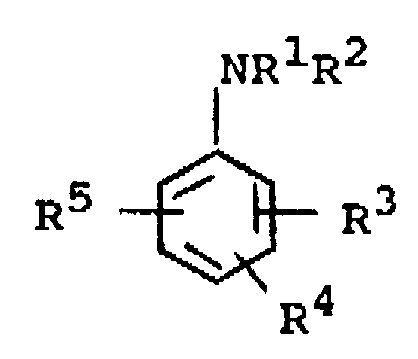 R¹ et R² représentent, indépendamment l'un de l'autre, un atome d'hydrogène, un groupe méthyle ou un groupe phényle substitué par R³, R⁴ et R⁵,R³ et R⁴ représentent, indépendamment l'un de l'autre, un atome d'hydrogène, un groupe alkyle en C₁-C₁₀ à chaîne droite ou ramifiée, un groupe alcoxy en C₁-C₁₀ à chaîne droite ou ramifiée, un groupe phényle, un atome de fluor, un atome de chlore ou un atome de brome, etR⁵ représente un atome d'hydrogène, un groupe méthyle, un groupe éthyle ou un groupe amino,de manière préférée, on met en oeuvre, pour l'alkylation, des amines aromatiques répondant à la formule
 R¹¹ représente un atome d'hydrogène ou un groupe phényle substitué par R⁵, R¹³ et R ¹⁴,R¹³ et R¹⁴ représentent, indépendamment l'un de l'autre, un atome d'hydrogène, un groupe alkyle en C₁-C₄ à chaîne droite ou ramifiée, un groupe alcoxy en C₁-C₄ à chaîne droite ou ramifiée, un groupe phényle, un atome de fluor ou un atome de chlore, etR⁵ représente un atome d'hydrogène, un groupe méthyle, un groupe éthyle ou un groupe amino,de manière particulièrement préférée, on met en oeuvre, pour l'alkylation, des amines aromatiques répondant à la formule
 R²¹ représente un atome d'hydrogène ou un groupe phényle substitué par R⁵ et R²³,R⁵ représente un atome d'hydrogène, un groupe méthyle, un groupe éthyle ou un groupe amino etR²³ représente un atome d'hydrogène, un groupe alkyle en C₁-C₄ à chaîne droite ou ramifiée, un groupe alcoxy en C₁-C₄ à chaîne droite ou ramifiée ou un groupe phényle.
 - Procédé selon la revendication 1, caractérisé en ce qu'on mot en oeuvre des oléfines en C₂-C₁₀ à chaîne droite ou ramifiée, de préférence des oléfines en C₂-C₆, de manière particulièrement préférée des oléfines en C₂-C₄.
- Procédé selon la revendication 1, caractérisé en ce que des catalyseurs contenant de l'aluminium, de préférence Al, Al/AlCl₃, Al/Zn/AlCl₃ ou AlCl₃, sont présents dans le mélange brut d'alkylation.
- Procédé selon la revendication 1, caractérisé en ce qu'on met en oeuvre, comme bases inorganiques, les hydrures, les oxydes, les hydroxydes, les carbonates, les hydrogénocarbonates ou les sels, à réaction alcaline d'autres acides faibles, des métaux alcalins ou alcalinoterreux.
- Procédé selon la revendication 1, caractérisé en ce qu'on met en oeuvre la base inorganique en une quantité qui va d'une quantité rapportée stoechiométriquement à la fraction en halogène du catalyseur jusqu'à 300% de la quantité rapportée stoechiométriquement à la fraction métallique et à la fraction en halogène du catalyseur, de préférence jusqu'à 150% de cette quantité.
- Procédé selon la revendication 1, caractérisé en ce qu'on ajoute l'eau en une quantité qui s'élève de 1,1 à 10 fois, de préférence de 1,5 à 4 fois la quantité suffisante pour l'hydrolyse du métal du catalyseur.
- Procédé selon la revendication 1, caractérisé en ce qu'on élimine, par distillation, l'eau en excès sous une pression de 400 à 1.000 mbar, de préférence sous pression normale, jusqu'à une température de résidu de 140 à 160°C.
- Procédé selon la revendication 1, caractérisé en ce que, pour l'élimination par distillation de l'eau en excès, on ajoute un agent formateur d'azéotrope.
- Procédé selon la revendication 1, caractérisé en ce qu'on met en oeuvre l'eau subsistant après l'hydrolyse et éliminée par distillation, comme fraction de l'eau d'hydrolyse d'une charge ultérieure.
Applications Claiming Priority (2)
| Application Number | Priority Date | Filing Date | Title |
|---|---|---|---|
| DE3834196 | 1988-10-07 | ||
| DE3834196A DE3834196A1 (de) | 1988-10-07 | 1988-10-07 | Verfahren zur gewinnung alkylierter aromatischer amine |
Publications (3)
| Publication Number | Publication Date |
|---|---|
| EP0362667A2 EP0362667A2 (fr) | 1990-04-11 |
| EP0362667A3 EP0362667A3 (fr) | 1991-02-06 |
| EP0362667B1 true EP0362667B1 (fr) | 1993-04-21 |
Family
ID=6364629
Family Applications (1)
| Application Number | Title | Priority Date | Filing Date |
|---|---|---|---|
| EP89117713A Expired - Lifetime EP0362667B1 (fr) | 1988-10-07 | 1989-09-26 | Procédé pour l'extraction d'amines aromatiques alkoyliques |
Country Status (4)
| Country | Link |
|---|---|
| US (1) | US4973759A (fr) |
| EP (1) | EP0362667B1 (fr) |
| JP (1) | JPH02164855A (fr) |
| DE (2) | DE3834196A1 (fr) |
Families Citing this family (6)
| Publication number | Priority date | Publication date | Assignee | Title |
|---|---|---|---|---|
| US5072047A (en) * | 1989-10-10 | 1991-12-10 | The Dow Chemical Company | Ortho-alkylation of aromatic amines |
| US5571453A (en) * | 1994-10-25 | 1996-11-05 | Uniroyal Chemical Company, Inc. | Stabilized polyether polyol and polyurethane foam obtained therefrom |
| AU2003278994A1 (en) * | 2002-09-26 | 2004-04-19 | Barrett Technology, Inc. | Intelligent, self-contained robotic hand |
| US7390928B2 (en) * | 2005-12-14 | 2008-06-24 | Chemtura Corporation | Alkylation of N′-phenyl-N-alkylphenylenediamines in ionic liquid, N′-phenyl-N-alkyl (alkylphenylene) diamines produced thereby, and lubricant compositions containing same |
| US7145038B1 (en) | 2005-12-14 | 2006-12-05 | Chemtura Corporation | Alkylation of a diphenylamine compound in ionic liquid |
| CN106946714B (zh) * | 2017-03-16 | 2022-03-22 | 安阳工学院 | 一种二乙基甲苯二胺的合成工艺 |
Family Cites Families (10)
| Publication number | Priority date | Publication date | Assignee | Title |
|---|---|---|---|---|
| US2187820A (en) * | 1938-08-11 | 1940-01-23 | American Cyanamid Co | Separation of aromatic amines from iron sludge |
| US2814646A (en) * | 1954-04-29 | 1957-11-26 | Ethyl Corp | Amine alkylation using aluminum anilide catalyst |
| US2943112A (en) * | 1957-11-06 | 1960-06-28 | Pennsalt Chemicals Corp | Alkylation of diphenylamine |
| US3496230A (en) * | 1966-02-17 | 1970-02-17 | American Cyanamid Co | Process for mixture of mono- and dialkyl-diphenylamines |
| US3862233A (en) * | 1969-04-24 | 1975-01-21 | Ethyl Corp | Aromatic amine alkylation |
| US3678113A (en) * | 1970-02-04 | 1972-07-18 | Ethyl Corp | Nuclearly alkylated aniline recovery process |
| US4128582A (en) * | 1973-06-04 | 1978-12-05 | Ethyl Corporation | Chemical process |
| US4219503A (en) * | 1979-08-06 | 1980-08-26 | Ethyl Corporation | Process for producing 2,6-dialkylanilines |
| US4436936A (en) * | 1981-06-19 | 1984-03-13 | Ciba-Geigy Corporation | Alkylation and aralkylation of aromatic amines |
| DE3402983A1 (de) * | 1984-01-28 | 1985-08-01 | Bayer Ag, 5090 Leverkusen | Verfahren zur orthoalkylierung von gegebenenfalls alkylsubstituierten m-phenylendiaminen |
-
1988
- 1988-10-07 DE DE3834196A patent/DE3834196A1/de not_active Withdrawn
-
1989
- 1989-09-20 US US07/410,183 patent/US4973759A/en not_active Expired - Fee Related
- 1989-09-26 EP EP89117713A patent/EP0362667B1/fr not_active Expired - Lifetime
- 1989-09-26 DE DE8989117713T patent/DE58904139D1/de not_active Expired - Fee Related
- 1989-10-02 JP JP1255350A patent/JPH02164855A/ja active Pending
Also Published As
| Publication number | Publication date |
|---|---|
| DE58904139D1 (de) | 1993-05-27 |
| DE3834196A1 (de) | 1990-04-26 |
| JPH02164855A (ja) | 1990-06-25 |
| EP0362667A3 (fr) | 1991-02-06 |
| US4973759A (en) | 1990-11-27 |
| EP0362667A2 (fr) | 1990-04-11 |
Similar Documents
| Publication | Publication Date | Title |
|---|---|---|
| EP0362667B1 (fr) | Procédé pour l'extraction d'amines aromatiques alkoyliques | |
| US2459597A (en) | Di-alkylated mono-hydroxy phenol | |
| EP0069065B1 (fr) | Procédé d'alkylation ou d'aralkylation d'amines aromatiques | |
| DE2426395C3 (de) | Verfahren zur Herstellung von Diäthylanilin | |
| SK280403B6 (sk) | Spôsob prípravy lineárnych alkylbenzénov | |
| DE3210597A1 (de) | Verfahren zur herstellung von aromatischen hydroxycarbonsaeuren | |
| US3748362A (en) | Production of 4-nitrosodiphenylamine | |
| US2671117A (en) | Hydroxy aromatic hydrocarbonolefin polymer alkylation with alcl2 hso4 catalyst | |
| JPH04227856A (ja) | 相転移触媒の回収 | |
| US2064797A (en) | Production of organic amino compounds | |
| US2205885A (en) | Preparation of acetylenic acids | |
| JPH05132439A (ja) | 2,6−ジ−第三ブチルフエノールの製造方法 | |
| US3310583A (en) | Manufacture of amino phenyl ethers | |
| US3222401A (en) | Process for the production of nuclearly alkylated aromatic amines | |
| US3076856A (en) | Process for preparing dialkyl-naphthalene | |
| US3413327A (en) | Preparation of crystalline group ii metal salts of lower alkyl phosphorodithioic acid | |
| EP0110239B1 (fr) | Procédé de préparation d'acide 2-hydroxy-carbazole-1-carboxylique | |
| US2886604A (en) | Preparation of compounds having a benzylbenzyl halide structure | |
| KR20010034846A (ko) | 설펜이미드의 제조방법 | |
| US3429908A (en) | Fluorene nucleus derivatives of polyphenyl compounds | |
| JPH0118065B2 (fr) | ||
| DE953524C (de) | Verfahren zur Herstellung von organischen Stickstoffbasen | |
| JP3564179B2 (ja) | 1,2−インダンジオールの製造方法 | |
| JPH1087562A (ja) | 3,5−ジアルキルサリチル酸の製造方法 | |
| JPS60228446A (ja) | 芳香族アミンの回収方法 |
Legal Events
| Date | Code | Title | Description |
|---|---|---|---|
| PUAI | Public reference made under article 153(3) epc to a published international application that has entered the european phase |
Free format text: ORIGINAL CODE: 0009012 |
|
| 17P | Request for examination filed |
Effective date: 19890926 |
|
| AK | Designated contracting states |
Kind code of ref document: A2 Designated state(s): BE CH DE FR GB IT LI NL |
|
| PUAL | Search report despatched |
Free format text: ORIGINAL CODE: 0009013 |
|
| AK | Designated contracting states |
Kind code of ref document: A3 Designated state(s): BE CH DE FR GB IT LI NL |
|
| 17Q | First examination report despatched |
Effective date: 19920929 |
|
| GRAA | (expected) grant |
Free format text: ORIGINAL CODE: 0009210 |
|
| AK | Designated contracting states |
Kind code of ref document: B1 Designated state(s): BE CH DE FR GB IT LI NL |
|
| REF | Corresponds to: |
Ref document number: 58904139 Country of ref document: DE Date of ref document: 19930527 |
|
| GBT | Gb: translation of ep patent filed (gb section 77(6)(a)/1977) |
Effective date: 19930504 |
|
| ITF | It: translation for a ep patent filed | ||
| ET | Fr: translation filed | ||
| PGFP | Annual fee paid to national office [announced via postgrant information from national office to epo] |
Ref country code: GB Payment date: 19930916 Year of fee payment: 5 |
|
| PGFP | Annual fee paid to national office [announced via postgrant information from national office to epo] |
Ref country code: FR Payment date: 19930917 Year of fee payment: 5 |
|
| PGFP | Annual fee paid to national office [announced via postgrant information from national office to epo] |
Ref country code: BE Payment date: 19930922 Year of fee payment: 5 |
|
| PGFP | Annual fee paid to national office [announced via postgrant information from national office to epo] |
Ref country code: NL Payment date: 19930930 Year of fee payment: 5 |
|
| PLBE | No opposition filed within time limit |
Free format text: ORIGINAL CODE: 0009261 |
|
| STAA | Information on the status of an ep patent application or granted ep patent |
Free format text: STATUS: NO OPPOSITION FILED WITHIN TIME LIMIT |
|
| 26N | No opposition filed | ||
| PG25 | Lapsed in a contracting state [announced via postgrant information from national office to epo] |
Ref country code: GB Effective date: 19940926 |
|
| ITTA | It: last paid annual fee | ||
| PG25 | Lapsed in a contracting state [announced via postgrant information from national office to epo] |
Ref country code: BE Effective date: 19940930 |
|
| BERE | Be: lapsed |
Owner name: BAYER A.G. Effective date: 19940930 |
|
| PG25 | Lapsed in a contracting state [announced via postgrant information from national office to epo] |
Ref country code: NL Effective date: 19950401 |
|
| NLV4 | Nl: lapsed or anulled due to non-payment of the annual fee | ||
| GBPC | Gb: european patent ceased through non-payment of renewal fee |
Effective date: 19940926 |
|
| PG25 | Lapsed in a contracting state [announced via postgrant information from national office to epo] |
Ref country code: FR Effective date: 19950531 |
|
| REG | Reference to a national code |
Ref country code: FR Ref legal event code: ST |
|
| PGFP | Annual fee paid to national office [announced via postgrant information from national office to epo] |
Ref country code: DE Payment date: 19960814 Year of fee payment: 8 |
|
| PGFP | Annual fee paid to national office [announced via postgrant information from national office to epo] |
Ref country code: CH Payment date: 19960902 Year of fee payment: 8 |
|
| PG25 | Lapsed in a contracting state [announced via postgrant information from national office to epo] |
Ref country code: LI Free format text: LAPSE BECAUSE OF NON-PAYMENT OF DUE FEES Effective date: 19970930 Ref country code: CH Free format text: LAPSE BECAUSE OF NON-PAYMENT OF DUE FEES Effective date: 19970930 |
|
| REG | Reference to a national code |
Ref country code: CH Ref legal event code: PL |
|
| PG25 | Lapsed in a contracting state [announced via postgrant information from national office to epo] |
Ref country code: DE Free format text: LAPSE BECAUSE OF NON-PAYMENT OF DUE FEES Effective date: 19980603 |
|
| PG25 | Lapsed in a contracting state [announced via postgrant information from national office to epo] |
Ref country code: IT Free format text: LAPSE BECAUSE OF NON-PAYMENT OF DUE FEES;WARNING: LAPSES OF ITALIAN PATENTS WITH EFFECTIVE DATE BEFORE 2007 MAY HAVE OCCURRED AT ANY TIME BEFORE 2007. THE CORRECT EFFECTIVE DATE MAY BE DIFFERENT FROM THE ONE RECORDED. Effective date: 20050926 |