EP0363014B1 - Unwuchtaufspürsystem für Kraftfahrzeugräder - Google Patents
Unwuchtaufspürsystem für Kraftfahrzeugräder Download PDFInfo
- Publication number
- EP0363014B1 EP0363014B1 EP89308953A EP89308953A EP0363014B1 EP 0363014 B1 EP0363014 B1 EP 0363014B1 EP 89308953 A EP89308953 A EP 89308953A EP 89308953 A EP89308953 A EP 89308953A EP 0363014 B1 EP0363014 B1 EP 0363014B1
- Authority
- EP
- European Patent Office
- Prior art keywords
- force
- signal
- roadwheel
- steering
- vehicle
- Prior art date
- Legal status (The legal status is an assumption and is not a legal conclusion. Google has not performed a legal analysis and makes no representation as to the accuracy of the status listed.)
- Expired - Lifetime
Links
Images

Classifications
-
- G—PHYSICS
- G01—MEASURING; TESTING
- G01M—TESTING STATIC OR DYNAMIC BALANCE OF MACHINES OR STRUCTURES; TESTING OF STRUCTURES OR APPARATUS, NOT OTHERWISE PROVIDED FOR
- G01M1/00—Testing static or dynamic balance of machines or structures
- G01M1/14—Determining imbalance
- G01M1/16—Determining imbalance by oscillating or rotating the body to be tested
- G01M1/28—Determining imbalance by oscillating or rotating the body to be tested with special adaptations for determining imbalance of the body in situ, e.g. of vehicle wheels
-
- G—PHYSICS
- G01—MEASURING; TESTING
- G01L—MEASURING FORCE, STRESS, TORQUE, WORK, MECHANICAL POWER, MECHANICAL EFFICIENCY, OR FLUID PRESSURE
- G01L5/00—Apparatus for, or methods of, measuring force, work, mechanical power, or torque, specially adapted for specific purposes
- G01L5/22—Apparatus for, or methods of, measuring force, work, mechanical power, or torque, specially adapted for specific purposes for measuring the force applied to control members, e.g. control members of vehicles, triggers
- G01L5/221—Apparatus for, or methods of, measuring force, work, mechanical power, or torque, specially adapted for specific purposes for measuring the force applied to control members, e.g. control members of vehicles, triggers to steering wheels, e.g. for power assisted steering
Definitions
- This invention relates to a vehicular system and method for detecting rotational imbalance of the roadwheels of a vehicle.
- the invention seeks to provide a system which dynamically detects rotational imbalance of vehicle roadwheels while the vehicle is in use, so that corrective measures may be taken before the dynamic imbalance becomes bothersome to the driver.
- the cyclic component of a steering force is measured while the vehicle is running along a roadway.
- US-A 4 463 936 discloses a system in which steering pressure is measured so as to indicate a vehicle operating condition wherein the leaves of a multileaf suspension spring will be clamped so as to change the damping characteristics of the suspension.
- US-A 4 470 260 discloses a system in which hydraulic pressure is sensed and used as a control variable in a system which controls the kickback of an open centre, load sensing hydraulic steering apparatus.
- US 4 408 673 discloses yet another system in which force is measured so as to provide a signal for increasing power steering assist offered to the vehicles's operator.
- DE-C2 28 19 687 a vehicle is supported with its wheels free of load, the wheels are driven, and a vibration sensor attached to the steering wheel or column is used to provide an indication of the extent of imbalance of the wheels.
- WO 88-08593 (EP-A 313 596), which was published on 3 November 1988 but was filed on 23 April 1988 and thus forms part of the state of the art according to Art. 54(3) EPC, discloses monitoring the unbalance of vehicle wheels by means of one or more vibration sensors attached to the wheel suspension and arranged to respond to vibration parallel to the vehicle axis or along the axis of the shock absorbers.
- a system for detecting rotational imbalance of a roadwheel of a vehicle comprises force measurement means for sensing the force required to steer said roadwheel and for generating a force signal corresponding to said sensed force and processor means responsive to cyclic variations in said force signal for determining the dynamic rotational balance condition of said roadwheel, said force measurement means comprising a hydraulic pressure transducer interposed between a steering gear for steering said roadwheel and a hydraulic pump for powering said steering gear or a force transducer interposed between said steering gear and a spindle upon which said roadwheel is journalled.
- steering gear includes any linkage exerting a force maintaining the rotational position, or controlling the rotation, of the wheel about its kingpin or steering axis. Accordingly, a system according to the invention could be used with the rear roadwheels of a front-steering vehicle, which are not thought of traditionally as being steerable.
- the system may be employed not only with hydraulically powered steering gears but also with either electrically or manually operated steering mechanisms.
- a further advantage is that the system may be employed for determining the absolute magnitude of a weight imbalance affecting a roadwheel.
- the processor means may conveniently comprise means for resolving the steering force signal into a base component corresponding to steering force normally required to steer the vehicle and a cyclic component attributable to dynamic rotational imbalance of the roadwheel.
- the means for resolving the force signal may suitably comprise a bandpass filter.
- the processor means may further comprise counter means for comparing the frequencies of a velocity signal and the cyclic component of said force signal, so that said force signal may be rejected by the processor as a spurious signal in the event that said frequencies are not within a common frequency tolerance band.
- a system according to the present invention may be used for measuring the absolute dynamic rotational imbalance of a steerable roadwheel if a signal corresponding to the forward velocity of the vehicle is fed back to the processor means so that the processor means is able to perform a calculation which is responsive to vehicle velocity as well as to the sensed steering force. It is possible to determine the absolute magnitude of roadwheel imbalance by using vehicle speed because the amplitude of the steering force signal which is attributable to dynamic rotational imbalance of the roadwheel is a function of the speed of the vehicle and the magnitude of the imbalance.
- a method for detecting dynamic imbalance of a roadwheel of a vehicle comprises the steps of sensing the force required to steer the roadwheel while the vehicle is running along a roadway, by means of a hydraulic pressure transducer interposed between a steering gear for steering said roadwheel and a hydraulic pump for powering said steering gear or a force transducer interposed between said steering gear and a spindle upon which said roadwheel is journalled; generating a force signal having a magnitude corresponding to said sensed force; resolving said force signal into a base component attributable to steering force normally required to steer said vehicle and a cyclic component attributable to dynamic rotational imbalance of the roadwheel; comparing the magnitude of said cyclic force component to a threshold value; and providing an imbalance signal in the event that said cyclic force component exceeds said threshold value.
- transducer and “sensor” are interchangeable. Both terms refer to a device for measuring physical or electronic phenomena.
- FIG. 1 shows a vehicle equipped with a system according to the present invention.
- Vehicle 10 has front steerable roadwheels 12 and rear roadwheels 14. The direction of the front roadwheels is controlled by the driver via steering shaft 26, which is coupled to steering gear 20, and which in turn controls the steering angle of front wheels 12.
- Steering gear 20 is of the power type, having steering pump 22, which is driven by the engine of the vehicle and coupled to the steering gear by means of hydraulic hoses or lines 24.
- Hydraulic pressure sensor 18 is employed for the purpose of measuring the hydraulic pressure maintained by steering pump 20 and hydraulic pressure hoses 25. This pressure is directly relatable to the amount of steering force, F S , required to keep the roadwheels at any steering angle selected by the driver.
- Hydraulic pressure sensor 18 is operatively connected with microprocessor controller 16 so that steering pressure information is provided by the pressure sensor to the microprocessor controller. The information from hydraulic pressure sensor 18 is translated by microprocessor controller 16 into steering force.
- hydraulic pressure sensor 18 could comprise any one of several known configurations operating according to a number of principles such as a piezo-resistive, or a piezo-electric, sensor in which a crystal generates an electrical signal representative of the pressure, or change in pressure, applied to the crystal, which is typically quartz.
- a piezo-resistive, or a piezo-electric, sensor in which a crystal generates an electrical signal representative of the pressure, or change in pressure, applied to the crystal, which is typically quartz.
- Other types of pressure sensors such as those utilising strain gages or electromagnetic principles, or variable capacitance diaphragm devices could be used. A discussion of such sensors is found in International Combustion Engines , International Textbook Co., 1968, pages 147-153.
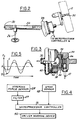
- FIGs 2 and 3 illustrate a second embodiment of the present invention in which steering force is detected by means of a piezo-electric force transducer.
- This embodiment is useful for practising the present invention with not only hydraulically assisted steering systems, but also with electrically powered or even manually operated steering systems because steering force is measured directly by an element interposed in the roadwheel's attaching linkage.
- steering gear 20, having rack 30 reciprocably mounted therein has a knuckle and force sensor assembly 34 mounted at each end. For the sake of brevity, only one side knuckle and force sensor assembly is shown, it being understood that this system is applied in the same manner to multiple steerable roadwheels.
- Knuckle and force sensor assembly 34 is connected by means of conventional linkage to spindle 32, having roadwheel 12 journalled thereon.
- Spindle 32 conventionally allows roadwheel 12 to be steered about the spindle's kingpin axis. Details of the knuckle and force sensor assembly 34 are shown in Figure 3.
- Steering rack 30 has a ball 36 formed on each end. Ball 36 is mounted within socket 38, which is positioned within knuckle body 35. Socket 38 is maintained in a neutral or centre position by means of Belleville springs 42 and 44. The closed end of socket 38 bears upon piezo-electric crystal assembly, 46, which is housed within knuckle body 35.
- socket 38 In response to steering forces, socket 38 will be urged to move against the force of the Belleville springs and to thereby press upon piezo-electric crystals 46 to a greater or lesser extent. It is well known that such crystals have the ability to translate a force or pressure directly into an electrical signal. Accordingly, as roadwheel 13 is steered, the pressure upon crystals 46 will rise and fall along with the steering and as well as due to any rotational imbalance in the roadwheel and tire assembly being steered by the particular end of the tie rod to which knuckle and sensor assembly 34 is mounted. As a result, crystals 46 will generate a signal proportional to the exerted steering force. This signal is transmitted to microprocessor controller 16 by means of electrical leads 47 ( Figure 3). The rubber boot or gaiter 40 protects the internal components of knuckle and sensor assembly 34 from road contamination.
- a piezo-electric force sensor could be employed at other points in the steering system in order to detect steering force.
- the sensor could be mounted to either end of steering linkage tie-rod.
- other types of force sensors could be employed such as those employing strain gauges, load cells, or other types of devices.
- FIG. 4 illustrates the major components of a system according to the present invention.
- Microprocessor controller 16 is shown as receiving inputs from steering force sensor 28, via filter 29, and from speed sensor 48.
- a signal generator driven by the power train of the vehicle.
- One such type of signal generator currently used in Ford Motor Company vehicles comprises a variable reluctance alternating current generator which produces a signal having a frequency which is directly proportional to the velocity of the vehicle.
- Microprocessor controller 16 is shown as sending a signal to driver warning device 50.
- microprocessor controller 16 and its associated peripheral equipment to be structured according to several known architectures.
- the microprocessor is configured so that control programs are sequentially read from a read-only memory (ROM). Unit commands are executed by a central processor unit (CPU).
- I/O Input/Output
- I/O devices which may be integrated with the microprocessor controller, serve to communicate with the balance of the system.
- One such I/O device could contain signal conditioning circuits such as filter 29.
- Other I/O devices could include signal frequency counters useful for rejecting spurious signals arising from road inputs.
- a random access memory (RAM) stores data for use by the CPU.
- RAM random access memory
- a number of different microprocessors could be used to practice the present invention, such as the model 8096 made by the Intel Corporation or other microprocessors known to those skilled in the art and suggested by this disclosure.
- Microprocessor controller 16 receives raw steering force data from steering force sensor 28, which may either comprise hydraulic pressure sensor 18 shown in Figure 1, or knuckle and force sensor assembly 34 shown in Figures 2 and 3, or any other suitable steering force sensor.
- the force signal is shown in Figure 5 as a sinusoidal signal which alternates about the line "A".
- the coordinates in Figure 5 are time on the abscissa and steering force, F S on the ordinate.
- the magnitude of steering force corresponding to "A" of Figure 5 represents a base component corresponding to the steering force normally required to steer the vehicle down a straight road.
- “A” represents an invariant level of steering force, which means that the vehicle for at least the time shown in Figure 5, is being steered straight down a roadway.
- Traces B and C of Figure 5 illustrate variations in steering force attributable to dynamic rotational imbalance of the steered roadwheel.
- a static imbalance condition will cause a dynamic imbalance which is characterised by sinusoidal oscillatory motion of the roadwheel about its kingpin axis.
- This oscillatory motion is damped by the steering mechanism; as a result, the measured steering force reflects the sinusoidal nature of the roadwheel's movement.
- a system according to the present invention operates as follows. While running along a roadway, force sensors 18 or 34 dynamically measure the steering force and output a signal according to Figure 5. This signal is conditioned by filter 29 which may comprise, for example, a bandpass filter.
- filter 29 which may comprise, for example, a bandpass filter.
- a bandpass filter is useful with a system according to the present invention because it is necessary to resolve the force signal into a base component corresponding to the steering force normally required to steer the vehicle and a variable component attributable to the dynamic rotational imbalance of the roadwheel under consideration.
- the high pass portion of a bandpass filter will eliminate the voltage offset arising from the force level shown as "A" in Figure 5, whereas the low pass portion of a bandpass filter will eliminate undesirable high frequency signals, such as electronic noise, from a sensor system according to the present invention.
- the filter could be implemented in software within microprocessor controller 16 according to known techniques.
- the magnitude of the filtered signal may be measured by any one of a variety of means known to those skilled in the art and suggested by this disclosure.
- microprocessor controller 16 may apply a derivation of the transfer function set forth above to calculate I S . If it is desired to calculate the actual magnitude of the imbalance, the following equation may be used: The equation for I S shows that the magnitude of the imbalance is a function of the measured steering force and the vehicle velocity, with constant K3 operating as a correction factor for the particular vehicle in question.
- microprocessor controller 16 it is desirable for microprocessor controller 16 to eliminate such spurious signals by comparing the frequency of the velocity signal with the frequency of the variable component of the steering force. This may be done by counting the frequencies of both signals. In the event that the counted frequencies are not sufficiently alike so as to fall within a common tolerance band, the microprocessor controller will reject the steering force signal as being the spurious offspring of road inputs, rather than roadwheel imbalance. Thereafter, the system will await data which is not tainted by road inputs.
- microprocessor controller 16 may output a driver warning signal by means of driver warning device 50 ( Figure 4), in the event that the magnitude of the imbalance exceeds a threshold value which may be a function of the velocity of the vehicle.
- a threshold value which may be a function of the velocity of the vehicle.
- the actual magnitude of the imbalance may be stored in the RAM for retrieval by a vehicle repair technician at a later date. This will allow the technician to apply the correct amount of weight in order to balance the affected roadwheels.
- the vehicle velocity need not be employed in the calculation for I S , it being necessary to compare the measured force with a predetermined threshold band having a minimum value which is sufficiently great so that a trivial imbalance will not cause the variable component of the steering force signal to exceed such minimum level at expected vehicle operating speeds, but having a maximum value which is less than the magnitude of the inputs expected from rough, deteriorated, road surfaces.
- microprocessor controller 16 will reject the signal as being spurious.
- This technique will preferably be combined with a frequency counting technique in which variations in the frequency of the variable component of the steering force are noted, with excessive variation being used as a basis for rejecting the steering force signal.
- the frequency of the variable force component will be counted by a counter within microprocessor controller 16 over successive periods of time. If the frequency change from one period to a later period is in excess of a predetermined value, the microprocessor controller will reject the force signal as being spurious. In sum, the force signal will be rejected if either the magnitude or the frequency variation of the force signal is not within predetermined tolerances.
Landscapes
- Physics & Mathematics (AREA)
- General Physics & Mathematics (AREA)
- Steering Control In Accordance With Driving Conditions (AREA)
- Testing Of Balance (AREA)
- Vehicle Body Suspensions (AREA)
Claims (9)
- System zur Erfassung des Rotationsungleichgewichts eines Rads eines Fahrzeuges umfassend ein Kraftmessungsmittel (18, 34) zum Abfühlen der erforderlichen Kraft zur Steuerung des genannten Rads (12) und zur Erzeugung eines Kraftsignals, das der genannten gefühlten Kraft entspricht, und ein Prozessorsmittel (16), das auf zyklischen Vertauschungen im genannten Kraftsignal reagiert, zur Bestimmung der dynamischen Rotationsgleichgewichtsbedingung des genannten Rads, wobei das genannte Kraftmessungsmittel einen zwischen einem Steuermechanismus (20) zur Steuerung des genannten Rads und einer hydraulischen Pumpe (22) zur Speisung des genannten Steuermechanismus eingesetzten hydraulischen Drucksensor (18) oder einen zwischen dem genannten Steuermechanismus und einer Spindel (32), auf welcher das genannte Rad drehbar gelagert ist, eingesetzten Kraftsensor (46) umfaßt.
- System nach Anspruch 1, wobei das genannte Prozessorsmittel (16) ein Mittel zur Verwandlung des genannten Kraftsignals in eine Grundkomponente, die der zur Steuerung des genannten Fahrzeug normalerweise erforderlichen Steuerkraft entspricht, und in eine zyklische Komponente, die aus dem dynamischen Rotationsungleichgewicht des genannten Rads resultiert, umfaßt.
- System nach Anspruch 2, wobei das genannte Mittel zur Verwandlung des genannten Kraftsignals ein Bandpaßfilter umfaßt.
- System nach Anspruch 2 oder 3, wobei das genannte Prozessorsmittel übrigens ein Mittel zum Vergleichen der Größe der genannten zyklischen Komponente zu einem vorgesetzten Schwellenband, und ein Zählermittel zur Bestimmung der Änderungen der Frequenz der genannten zyklischen Kraftkomponente umfaßt, so daß, für den Fall, daß entweder die Größe-oder die Frequenzänderung des genannten Kraftsignals sich in den vorgesetzen Toleranzen nicht befindet, das genannte Kraftsignal bei dem genannten Prozessor als Störsignal abgelehnt werden kann.
- System nach einem der Ansprüche 2 bis 4, wobei das genannte Prozessorsmittel ein Vergleichsmittel zum Vergleichen der Größe der genannten zyklischen Kraftkomponente zu einem Schwellenwert umfaßt, dadurch gekennzeichnet, daß für den Fall, daß die genannte zyklische Komponente den genannten Schwellenwert überschreitet, das genannte Prozessorsmittel übrigens ein Mittel zur Erzeugung eines Ungleichgewichtssignals umfaßt.
- System nach Anspruch 1, welches übrigens ein Mittel zum Messen der Vorwärtsgeschwindigkeit des genannten Fahrzeugs und zur Erzeugung eines Signals, das der genannten Geschwindigkeit entspricht, umfaßt, wobei das Prozessorsmittel auf das genannte Kraftsignal und auf das genannte Geschwindigkeitsignal zur Bestimmung der dynamischen Rotationsungleichgewichtsbedingung des genannten Rads reagiert, daß das Prozessorsmittel ein Mittel zur Verwandlung des genannten Kraftsignals in eine Grundkomponente (A), die aus der zur Steuerung des genannten Fahrzeugs normalerweise erforderlichen Steuerkraft resultiert, und in eine zyklische Komponente (B, C), die aus dem dynamischen Rotationsungleichgewicht des genannten Rads resultiert ; und ein Vergleichsmittel zum Vergleichen der Größe der genannten zyklischen Komponente zu einem Schwellenwert, wobei, für den Fall daß die genannte veränderliche Komponente den genannten Schwellenwert überschreitet, das Vergleichsmittel übrigens ein Mittel zur Erzeugung eines Ungleichgewichtssignals umfaßt.
- System nach Anspruch 6, wobei das genannte Prozessorsmittel übrigens ein Zählermittel zum Vergleichen der Frequenzen des genannten Geschwindigkeitsignals und der zyklischen Komponente des genannten Kraftsignals und, für den Fall, daß die genannten Frequenzen sich in einem gemeinsamen Frequenztoleranzband nicht befinden, ein Mittel zur Ablehnung des Kraftsignal, umfaßt.
- Methode zur Erfassung eines dynamischen Ungleichgewichts eines Rads (12) eines Fahrzeugs, umfassend die folgenden Stufen, die darin bestehen :
die zur Steuerung des genannten Rad (12) erfoderliche Kraft, mittels eines zwischen einem Steuermechanismus (20) zur Steuerung des genannten Rad und einer hydraulischen Pumpe (22) zur Speisung des genannten Steuermechanismus gesetzen hydraulischen Drucksensors (18) oder mittels eines zwischen des genannten Steuermechanismus und einer Spindel (32), auf welcher das genannte Rad drehbar gelagert ist, gesetzten Kraftsensor (46), während das genannte Fahrzeug eine Fahrbahn entlang fährt, abzufühlen ;
ein Kraftsignal aufweisend eine Größe, die der genannten gefühlten Kraft entspricht, zu erzeugen ;
das genannte Kraftsignal in eine Grundkomponente, die aus der zur Steuerung des genannten Fahrzeug normalerweise erfoderlichen Steuerkraft resultiert, und in eine zyklische Komponente, die aus dem dynamischen Rotationsumgleichgewicht des genannten Rad resultiert, zu verwandlen ;
die Größe der zyklischen Kraftkomponente zu einem Schwellenwert zu vergleichen, und ;
für den Fall, daß die genannte zyklische Kraftkomponente den genannten Schwellenwert uberschreitet, ein Ungleichgewichtssignal zu erzeugen. - Methode nach Anspruch 8, wobei der genannte Schwellenwert wie eine Funktion der Vorwärtsgeschwindigkeit des genannten Fahrzeug bestimmt wird.
Applications Claiming Priority (2)
| Application Number | Priority Date | Filing Date | Title |
|---|---|---|---|
| US07/253,531 US4907452A (en) | 1988-10-05 | 1988-10-05 | System for detecting rotational imbalance of vehicle roadwheels |
| US253531 | 1994-06-03 |
Publications (3)
| Publication Number | Publication Date |
|---|---|
| EP0363014A2 EP0363014A2 (de) | 1990-04-11 |
| EP0363014A3 EP0363014A3 (de) | 1991-07-24 |
| EP0363014B1 true EP0363014B1 (de) | 1994-11-30 |
Family
ID=22960662
Family Applications (1)
| Application Number | Title | Priority Date | Filing Date |
|---|---|---|---|
| EP89308953A Expired - Lifetime EP0363014B1 (de) | 1988-10-05 | 1989-09-05 | Unwuchtaufspürsystem für Kraftfahrzeugräder |
Country Status (4)
| Country | Link |
|---|---|
| US (1) | US4907452A (de) |
| EP (1) | EP0363014B1 (de) |
| CA (1) | CA1322674C (de) |
| DE (1) | DE68919634D1 (de) |
Families Citing this family (15)
| Publication number | Priority date | Publication date | Assignee | Title |
|---|---|---|---|---|
| US5269186A (en) * | 1990-12-24 | 1993-12-14 | Ford Motor Company | Apparatus and method for detecting rotational imbalance of vehicle roadwheels |
| DE4413078A1 (de) * | 1994-04-15 | 1995-10-19 | Bosch Gmbh Robert | Einrichtung zur Erfassung einer pulsierenden Größe |
| US5596141A (en) * | 1994-08-04 | 1997-01-21 | Nippondenso Co., Ltd. | Tire resonance frequency detecting system having inter-wheel noise elimination and method for the same |
| DE19735313B4 (de) * | 1997-08-14 | 2008-02-07 | Bayerische Motoren Werke Ag | Verfahren zur Ermittlung von geschwindigkeitsunabhängigen Frequenzen eines Nutzsignalanteils |
| US6208240B1 (en) * | 1999-12-07 | 2001-03-27 | Meritor Heavy Vehicle Systems, Llc | Misalignment sensor |
| US6494471B2 (en) | 2001-01-09 | 2002-12-17 | New Holland North America, Inc. | Apparatus for sensing an angular position of a wheel of a vehicle about a steering axis |
| US6606902B2 (en) * | 2001-07-09 | 2003-08-19 | The Goodyear Tire & Rubber Company | Method of improving steering performance robustness utilizing stiffness non-uniformity in tire/wheel |
| US6672148B2 (en) | 2001-07-09 | 2004-01-06 | The Goodyear Tire & Rubber Company | Method of improving steering performance robustness utilizing mass non-uniformity in tire/wheel |
| US6668635B2 (en) * | 2001-07-09 | 2003-12-30 | The Goodyear Tire & Rubber Company | Method of improving steering performance robustness utilizing dimensional non-uniformity in tire/wheel |
| US6834222B2 (en) * | 2003-02-27 | 2004-12-21 | Ford Global Technologies, Llc | Tire imbalance detection system and method using anti-lock brake wheel speed sensors |
| US7652562B2 (en) * | 2005-10-13 | 2010-01-26 | Hendrickson Usa, L.L.C. | Vehicle temperature warning system and method |
| DE102012017939A1 (de) * | 2012-09-12 | 2014-03-13 | GM Global Technology Operations LLC (n. d. Gesetzen des Staates Delaware) | Verfahren und Mittel zur Diagnose eines Fahrwerkzustandes |
| KR101373151B1 (ko) * | 2012-12-18 | 2014-03-20 | 현대오트론 주식회사 | 차량용 타이어의 상태 탐지 장치 및 방법 |
| US10801910B2 (en) | 2018-07-24 | 2020-10-13 | Ford Global Technologies, Llc | Vehicle force imbalance detection |
| US20230417616A1 (en) | 2022-06-22 | 2023-12-28 | Automated Tire, Inc. | Autonomous tire changing system and method therefor |
Citations (1)
| Publication number | Priority date | Publication date | Assignee | Title |
|---|---|---|---|---|
| DE2819687C2 (de) * | 1978-05-05 | 1986-04-30 | Kurt 7432 Urach Maurer | Verfahren und Vorrichtung zum Auswuchten von Kraftfahrzeugrädern |
Family Cites Families (9)
| Publication number | Priority date | Publication date | Assignee | Title |
|---|---|---|---|---|
| US2720638A (en) * | 1952-10-10 | 1955-10-11 | Jr Julian A Ritch | Combined tire pressure and wheel unbalance indicator system |
| US3526873A (en) * | 1965-02-18 | 1970-09-01 | Lb Safety Devices Inc | Device for indicating abnormal conditions in pneumatic tires |
| US3438646A (en) * | 1967-08-28 | 1969-04-15 | Martin Hannapel | Alignment change indicator for motor car wheels |
| US3744321A (en) * | 1971-12-16 | 1973-07-10 | J Hauge | Rotating body unbalance detector-locator |
| DE2838152A1 (de) * | 1978-09-01 | 1980-03-13 | Bosch Gmbh Robert | Servolenkung |
| JPS58128911A (ja) * | 1982-01-28 | 1983-08-01 | Nhk Spring Co Ltd | 車輛用懸架装置 |
| US4458535A (en) * | 1983-04-06 | 1984-07-10 | Juergens Jack W | Drive defect detector |
| US4470260A (en) * | 1983-08-11 | 1984-09-11 | Deere & Company | Open center load sensing hydraulic system |
| DE3541901C1 (de) * | 1985-11-27 | 1987-02-19 | Daimler Benz Ag | Verfahren und Vorrichtung zur waehrend des Fahrbetriebes eines Kraftfahrzeuges erfolgenden gleichzeitigen rberwachung von dessen Lenk- und Radaufhaengungsgeometrie sowie des Wuchtzustandes von mit dem kinematischen Lenkgestaenge des Kraftfahrzeuges verbundenen rotierenden Teilen |
-
1988
- 1988-10-05 US US07/253,531 patent/US4907452A/en not_active Expired - Fee Related
-
1989
- 1989-08-24 CA CA000609271A patent/CA1322674C/en not_active Expired - Fee Related
- 1989-09-05 EP EP89308953A patent/EP0363014B1/de not_active Expired - Lifetime
- 1989-09-05 DE DE68919634T patent/DE68919634D1/de not_active Expired - Lifetime
Patent Citations (1)
| Publication number | Priority date | Publication date | Assignee | Title |
|---|---|---|---|---|
| DE2819687C2 (de) * | 1978-05-05 | 1986-04-30 | Kurt 7432 Urach Maurer | Verfahren und Vorrichtung zum Auswuchten von Kraftfahrzeugrädern |
Non-Patent Citations (1)
| Title |
|---|
| DE-C2-2819687, WO-A1-88-8593, Book: H.Heider "Kraftfahrzeuglenkung" 1970 Berlin (DE) pages 226-231 * |
Also Published As
| Publication number | Publication date |
|---|---|
| CA1322674C (en) | 1993-10-05 |
| DE68919634D1 (de) | 1995-01-12 |
| EP0363014A3 (de) | 1991-07-24 |
| EP0363014A2 (de) | 1990-04-11 |
| US4907452A (en) | 1990-03-13 |
Similar Documents
| Publication | Publication Date | Title |
|---|---|---|
| CA1322674C (en) | System for detecting rotational imbalance of vehicle roadwheels | |
| US6574539B1 (en) | Steering wheel torque-based detection of misalignment of a vehicle's steering system | |
| EP0803386B1 (de) | System und Verfahren zur dynamischen Bestimmung des Fahrzustandes eines Kraftfahrzeuges | |
| US5123497A (en) | Automotive apparatus and method for dynamically determining centripetal force of a vehicle | |
| US6804584B2 (en) | Method for determining the roll angle of a vehicle using an estimation of road bank angle | |
| US5742919A (en) | Method and apparatus for dynamically determining a lateral velocity of a motor vehicle | |
| US5742918A (en) | Method and apparatus for dynamically compensating a lateral acceleration of a motor vehicle | |
| US5269186A (en) | Apparatus and method for detecting rotational imbalance of vehicle roadwheels | |
| EP0323066B1 (de) | System in einem Kraftfahrzeug, um auf dynamische Weise die Strassenadhäsion zu bestimmen | |
| US5018594A (en) | Rear-wheel steering system for four-wheel steering vehicle | |
| US5548536A (en) | Method for determining quantities which characterize the driving behavior | |
| EP0241493B1 (de) | Vorrichtung mit mindestens zwei starren verbindungsteilen | |
| US4905783A (en) | Vehicular controller with differential wheel speed input | |
| JPH0581472B2 (de) | ||
| EP0132930A1 (de) | Dehnungsmessstreifenanordnungen | |
| WO2009133534A2 (en) | Improvements relating to steering systems | |
| GB2270167A (en) | Method and apparatus for the evaluation of wheel speed data in a motor vehicle | |
| US5847290A (en) | Apparatus and method for measuring both suspension displacement and spring force in vehicle | |
| JP3032092B2 (ja) | タイヤの角速度の変化から空気圧異常を検出する装置における自動初期設定方法 | |
| EP0296756B1 (de) | Steuersystem für ein Fahrzeug mit der Drehzahldifferenz der Räder als Eingangssignal | |
| CN107792167A (zh) | 电机驱动动力转向系统中的柱转矩补偿装置和方法 | |
| JP2000507179A (ja) | 車両の走行状態を示す量を求める方法 | |
| EP2030868B1 (de) | Verfahren zum Betrieb einer elektrischen Servolenkung, elektrische Steuereinheit für eine elektrische Servolenkung und elektrisches Servolenkungssystem | |
| US5600062A (en) | Apparatus for measuring unbalance on a rotary member | |
| US6304807B1 (en) | Method for determining the yaw velocity of a vehicle |
Legal Events
| Date | Code | Title | Description |
|---|---|---|---|
| PUAI | Public reference made under article 153(3) epc to a published international application that has entered the european phase |
Free format text: ORIGINAL CODE: 0009012 |
|
| AK | Designated contracting states |
Kind code of ref document: A2 Designated state(s): DE FR GB |
|
| PUAL | Search report despatched |
Free format text: ORIGINAL CODE: 0009013 |
|
| AK | Designated contracting states |
Kind code of ref document: A3 Designated state(s): DE FR GB |
|
| 17P | Request for examination filed |
Effective date: 19911217 |
|
| 17Q | First examination report despatched |
Effective date: 19921229 |
|
| GRAA | (expected) grant |
Free format text: ORIGINAL CODE: 0009210 |
|
| AK | Designated contracting states |
Kind code of ref document: B1 Designated state(s): DE FR GB |
|
| REF | Corresponds to: |
Ref document number: 68919634 Country of ref document: DE Date of ref document: 19950112 |
|
| ET | Fr: translation filed | ||
| PG25 | Lapsed in a contracting state [announced via postgrant information from national office to epo] |
Ref country code: DE Effective date: 19950301 |
|
| REG | Reference to a national code |
Ref country code: GB Ref legal event code: 746 Effective date: 19950824 |
|
| PLBE | No opposition filed within time limit |
Free format text: ORIGINAL CODE: 0009261 |
|
| STAA | Information on the status of an ep patent application or granted ep patent |
Free format text: STATUS: NO OPPOSITION FILED WITHIN TIME LIMIT |
|
| 26N | No opposition filed | ||
| REG | Reference to a national code |
Ref country code: FR Ref legal event code: D6 |
|
| PGFP | Annual fee paid to national office [announced via postgrant information from national office to epo] |
Ref country code: GB Payment date: 19980814 Year of fee payment: 10 |
|
| PGFP | Annual fee paid to national office [announced via postgrant information from national office to epo] |
Ref country code: FR Payment date: 19980917 Year of fee payment: 10 |
|
| PG25 | Lapsed in a contracting state [announced via postgrant information from national office to epo] |
Ref country code: GB Free format text: LAPSE BECAUSE OF NON-PAYMENT OF DUE FEES Effective date: 19990905 |
|
| GBPC | Gb: european patent ceased through non-payment of renewal fee |
Effective date: 19990905 |
|
| PG25 | Lapsed in a contracting state [announced via postgrant information from national office to epo] |
Ref country code: FR Free format text: LAPSE BECAUSE OF NON-PAYMENT OF DUE FEES Effective date: 20000531 |
|
| REG | Reference to a national code |
Ref country code: FR Ref legal event code: ST |