EP0363097B1 - Procédé de façonnage d'une feuille de verre - Google Patents
Procédé de façonnage d'une feuille de verre Download PDFInfo
- Publication number
- EP0363097B1 EP0363097B1 EP89309975A EP89309975A EP0363097B1 EP 0363097 B1 EP0363097 B1 EP 0363097B1 EP 89309975 A EP89309975 A EP 89309975A EP 89309975 A EP89309975 A EP 89309975A EP 0363097 B1 EP0363097 B1 EP 0363097B1
- Authority
- EP
- European Patent Office
- Prior art keywords
- glass sheet
- shaping
- mold
- heating furnace
- ring mold
- Prior art date
- Legal status (The legal status is an assumption and is not a legal conclusion. Google has not performed a legal analysis and makes no representation as to the accuracy of the status listed.)
- Expired - Lifetime
Links
- 238000007493 shaping process Methods 0.000 title claims description 81
- 238000000034 method Methods 0.000 title claims description 26
- 239000005357 flat glass Substances 0.000 title description 3
- 239000011521 glass Substances 0.000 claims description 101
- 238000010438 heat treatment Methods 0.000 claims description 57
- 238000010791 quenching Methods 0.000 claims description 17
- 230000000171 quenching effect Effects 0.000 claims description 17
- 230000002093 peripheral effect Effects 0.000 claims description 8
- 230000000295 complement effect Effects 0.000 claims description 4
- 238000007599 discharging Methods 0.000 claims 1
- 230000005484 gravity Effects 0.000 description 7
- VYPSYNLAJGMNEJ-UHFFFAOYSA-N Silicium dioxide Chemical compound O=[Si]=O VYPSYNLAJGMNEJ-UHFFFAOYSA-N 0.000 description 4
- 238000003825 pressing Methods 0.000 description 4
- 239000000835 fiber Substances 0.000 description 3
- PNEYBMLMFCGWSK-UHFFFAOYSA-N aluminium oxide Inorganic materials [O-2].[O-2].[O-2].[Al+3].[Al+3] PNEYBMLMFCGWSK-UHFFFAOYSA-N 0.000 description 2
- 239000005350 fused silica glass Substances 0.000 description 2
- 235000004443 Ricinus communis Nutrition 0.000 description 1
- 240000000528 Ricinus communis Species 0.000 description 1
- 238000005452 bending Methods 0.000 description 1
- 229910010293 ceramic material Inorganic materials 0.000 description 1
- 238000004891 communication Methods 0.000 description 1
- 238000007796 conventional method Methods 0.000 description 1
- 229910052593 corundum Inorganic materials 0.000 description 1
- 239000012467 final product Substances 0.000 description 1
- 239000003365 glass fiber Substances 0.000 description 1
- 239000002184 metal Substances 0.000 description 1
- 238000002360 preparation method Methods 0.000 description 1
- 238000005096 rolling process Methods 0.000 description 1
- 239000000377 silicon dioxide Substances 0.000 description 1
- 239000002759 woven fabric Substances 0.000 description 1
- 229910001845 yogo sapphire Inorganic materials 0.000 description 1
Images

Classifications
-
- C—CHEMISTRY; METALLURGY
- C03—GLASS; MINERAL OR SLAG WOOL
- C03B—MANUFACTURE, SHAPING, OR SUPPLEMENTARY PROCESSES
- C03B23/00—Re-forming shaped glass
- C03B23/02—Re-forming glass sheets
- C03B23/023—Re-forming glass sheets by bending
- C03B23/035—Re-forming glass sheets by bending using a gas cushion or by changing gas pressure, e.g. by applying vacuum or blowing for supporting the glass while bending
- C03B23/0352—Re-forming glass sheets by bending using a gas cushion or by changing gas pressure, e.g. by applying vacuum or blowing for supporting the glass while bending by suction or blowing out for providing the deformation force to bend the glass sheet
- C03B23/0357—Re-forming glass sheets by bending using a gas cushion or by changing gas pressure, e.g. by applying vacuum or blowing for supporting the glass while bending by suction or blowing out for providing the deformation force to bend the glass sheet by suction without blowing, e.g. with vacuum or by venturi effect
-
- C—CHEMISTRY; METALLURGY
- C03—GLASS; MINERAL OR SLAG WOOL
- C03B—MANUFACTURE, SHAPING, OR SUPPLEMENTARY PROCESSES
- C03B23/00—Re-forming shaped glass
- C03B23/02—Re-forming glass sheets
- C03B23/023—Re-forming glass sheets by bending
- C03B23/025—Re-forming glass sheets by bending by gravity
-
- C—CHEMISTRY; METALLURGY
- C03—GLASS; MINERAL OR SLAG WOOL
- C03B—MANUFACTURE, SHAPING, OR SUPPLEMENTARY PROCESSES
- C03B23/00—Re-forming shaped glass
- C03B23/02—Re-forming glass sheets
- C03B23/023—Re-forming glass sheets by bending
- C03B23/025—Re-forming glass sheets by bending by gravity
- C03B23/0258—Gravity bending involving applying local or additional heating, cooling or insulating means
-
- C—CHEMISTRY; METALLURGY
- C03—GLASS; MINERAL OR SLAG WOOL
- C03B—MANUFACTURE, SHAPING, OR SUPPLEMENTARY PROCESSES
- C03B23/00—Re-forming shaped glass
- C03B23/02—Re-forming glass sheets
- C03B23/023—Re-forming glass sheets by bending
- C03B23/035—Re-forming glass sheets by bending using a gas cushion or by changing gas pressure, e.g. by applying vacuum or blowing for supporting the glass while bending
-
- C—CHEMISTRY; METALLURGY
- C03—GLASS; MINERAL OR SLAG WOOL
- C03B—MANUFACTURE, SHAPING, OR SUPPLEMENTARY PROCESSES
- C03B29/00—Reheating glass products for softening or fusing their surfaces; Fire-polishing; Fusing of margins
- C03B29/02—Reheating glass products for softening or fusing their surfaces; Fire-polishing; Fusing of margins in a discontinuous way
- C03B29/025—Glass sheets
Definitions
- the present invention relates to a method of shaping a curved sheet of glass for use as an automotive windshield.
- a sheet of glass is placed on a ring mold so that the peripheral edge of the glass sheet is softened with heat to the extent that it is deformed by gravity to a shape complementary to the shape of the ring mold.
- the pressing process employs a pair of upper and lower molds or a pair of lateral molds for bending a softened sheet of glass therebetween.
- the gravity process cannot bend a glass sheet to a considerably complex shape because only the peripheral edge of the glass sheet is held on the ring mold. Bent glass sheets formed by the gravity process tend to vary in configuration.
- the pressing process allows more uniformly shaped glass sheets.
- a sheet must be highly softened, and pressed by the molds under stronger forces. This is disadvantageous in that the glass tends to stick to the molds and cannot easily be separated from the molds, and the shaped glass sheet may have strains.
- DE-A1-3 640 892 One variation of such a pressing process, using a single mold and a hot blast, is shown in DE-A1-3 640 892.
- a preheated glass sheet is transported above a forming mold by a suction plate.
- the glass sheet is then released and drops onto the forming mold, the glass sheet being caused to take up the shape of the mold by means of a hot air blast.
- Such an arrangement can be satisfactory where a simple and relatively lightly curved result is required, but with more complex shapes, difficulties may arise due to the complexity of the finished glass object and the need, in many cases, for accuracy of finish.
- a method of shaping a glass sheet comprising the steps of supporting at least a peripheral edge of a glass sheet to be shaped on a ring mold, moving the ring mold into a heating furnace until the glass sheet is positioned directly above a shaping mold in the heating furnace, heating the glass sheet until the glass sheet on the ring mold is softened and deformed to a shape complimentary to the ring mold, lifting the shaping mold with respect to the ring mold to transfer the glass sheet from the ring mold onto the shaping mold and attracting the glass sheet against a shaping surface of the shaping mold to finally shape the glass sheet complementarily to the shaping surface, lowering the shaping mold with respect to the ring mold to transfer the shaped glass sheet from the shaping mold onto the ring mold and moving the ring mold out of the heating furnace.
- air may be ejected from the shaping surface of the shaping mold toward the glass sheet so that the glass sheet can easily be separated from the shaping surface.
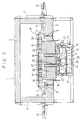
- a shaping apparatus for shaping a sheet of glass comprises a heating furnace 1 as a heating means for heating a sheet of glass G, a shaping mold 30 in the heating furnace 1, a lifting/lowering mechanism 20 (shown only in fig. 2) for vertically moving the shaping mold 30 in the heating furnace 1, a ring mold 10 for supporting at least the peripheral edge of the glass sheet G, a feed means including a chain 12 for feeding the ring mold 10 into and out of the heating furnace 1, and a quenching device 40 for quenching the shaped glass sheet G.
- the heating furnace 1 is constructed of three side walls 2, a furnace bed 7, a ceiling wall 3, and a vertically movable door 4. With the door 4 lifted, the ring mold 10 can be moved into and out of the heating furnace 1 by the chain 12.
- a number of heaters 5 are attached to the inner surfaces of the wall components of the heating furnace 1.
- a local area heating heater 6 is disposed in the heating furnace 1 above the shaping mold 30.
- FIG. 2 shows the heating furnace 1 with the ring mold 10 placed therein.
- a pair of spaced rails 8 is mounted on the furnace bed 7, and castors 11 rotatably supported on a lower portion of the ring mold 10 are positioned respectively on the rails 8 for rolling engagement therewith.
- the chain 12 (FIG. 1) is attached to the ring mold 30 and trained around sprockets, at least one of which is coupled to a motor (not shown). Therefore, the ring mold 10 can smoothly be taken into and out of the heating furnace 1 by energizing the motor.
- Two cylinder actuator units 13 (FIG. 2) are mounted on the outer surfaces of the two opposite side walls 2, and coupled to respective positioning pins 14. The positioning pins 14 are axially movable by the respective cylinder actuator units 13 into engagement with the ring mold 10 for thereby positioning the ring mold 10 in the heating furnace 1.
- the furnace bed 7 has a separate bed portion 7a which is vertically movable by the lifting/lowering mechanism 20.
- the shaping mold 30 is mounted on the separate bed portion 7a.
- the lifting/lowering mechanism 20 comprises a support frame 21, a pair of guides 22 and a guide 23 which are mounted on the support frame 21, and a motor 24 mounted on the support frame 21.
- Guide rods 25 extending downwardly from the lower surface of the separate bed 7a are slidably fitted in the guides 22, respectively.
- a rod 26 which is vertically movable by the motor 24 is slidably fitted in the guide 23.
- the rod 26 has an upper end fixed to an intermediate portion of an arm 27 pivotally coupled to the support frame 21.
- the arm 27 has an end joined to the lower surface of the separate bed 7a.
- the lifting/lowering mechanism 20 may comprise a cylinder actuator unit, rather than the illustrated assembly.
- the shaping mold 30 has upper and lower mold members 31, 32 with a space 33 defined therebetween.
- a pipe 34 extending through the separate bed 7a and connected to an evacuating unit (not shown), and another pipe 35 extending through the separate bed 7a and connected to a pressurized air source (not shown) open into the space 33.
- the upper mold member 31 is made of a ceramic material such as CaO-SiO2-Al2O3 or fused silica.
- the upper mold member 31 has an upper surface 36 which has been shaped by a numerically controlled machine in complementary relation to a final product shape.
- the upper shaping surface 36 is held in communication with the space 33 through small holes 37 defined in the upper mold member 31.
- the small holes 37 have a diameter of about 3 mm each, and are spaced about 60 mm on the upper shaping surface 36.
- a woven fabric or felt comprising alumina fibers, silica fibers, glass fibers, and metal fibers is attached to the upper shaping surface 36 except the open ends of the small holes 37, so that no glass sheet will adhere to the upper shaping surface 36.
- the lower mold member 32 is made of fused silica.
- the quenching device 40 is disposed near the heating furnace 1.
- the quenching device 40 is mounted on a mobile carriage 41 and has two upper and lower quenching air ejector nozzles 42 connected to a pressurized air source. As described later on, a shaped glass sheet G taken out of the heating furnace 1 is inserted and quenched between the nozzles 42.
- the peripheral edge of a flat glass sheet G is placed on the ring mold 10. Then, the door 4 of the heating furnace 1 is opened, and the chain 12 is driven to move the ring mold 10 into the heating furnace 1.
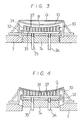
- the ring mold 10 is secured in position by the positioning pins 14. At this time, the glass sheet G is positioned directly above the shaping surface 36 of the shaping mold 30 as shown in FIG. 3.
- the heating furnace 1 is energized to start heating the glass sheet G, and the quenching device 40 is moved toward the heating furnace 1 in preparation for quenching a shaped glass sheet.
- the shaping mold 30 is lifted by the lifting/lowering mechanism 20 until the preliminarily shaped glass sheet G is received from the ring mold 10 onto the shaping surface 36 of the shaping mold 30 as shown in FIG. 4.
- the space 33 in the shaping mold 30 is evacuated to a vacuum ranging from - 20 mmAq. to - 300 mmAq. through the pipe 34.
- the glass sheet G is shaped primarily by the suction, it can accurately be curved or bent even where it should be bent deeply. While the glass sheet G is being heated and shaped, it is preferable to introduce hot air into the heating furnace 1 from an external source or circulate hot air in the heating furnace 1 with a fan disposed therein, so that various portions, especially the face and back, of the glass sheet G will be uniformly heated without any substantial temperature difference.
- the local area heating heater 6 disposed upwardly of the glass sheet G is also effective in heating and softening the glass sheet G efficiently and uniformly without substantial temperature differences on the glass sheet G.
- the shaping mold 30 is lowered by the lifting/lowering mechanism 20, and air is supplied into the space 33 in the shaping mold 30 through the pipe 35 to pressurize the space 33 up to + 100 mmAq. or less. Therefore, air is ejected out of the small holes 37 toward the glass sheet G, so that the glass sheet G will easily be separated from the shaping surface 36. Then, the shaping mold 30 is lowered to transfer the glass sheet G back onto the ring mold 10.
- the chain 12 is driven to move the ring mold 10 with the glass sheet G placed thereon out of the heating furnace 1 toward the quenching device 40 as shown in FIG. 5.
- the face and back of the shaped glass sheet G are then quenched by air ejected from the nozzles 42.
- the quenching device 40 is retracted to the right (FIG. 5), and the glass sheet G is fed to a next process either together with or independently of the ring mold 10.
- FIG. 6 shows a shaping apparatus for carrying out a shaping method according to another embodiment of the present invention.
- the shaping apparatus shown in FIG. 6 has a pair of opposite vertically movable doors 4, 4′ on the opposite sides of a heating furnace 1a.
- a glass sheet G to be shaped is fed into the heating furnace 1a through one of the doors 4′, and, after having been shaped, it is removed from the heating furnace 1a through the other door 4′.
- the shaped glass sheet G is then quenched by the quenching device 40 which has been brought in front of the door 4′ at least while the glass sheet G is being heated and shaped. Since the glass sheet G is delivered only in one direction through the heating furnace 1a toward the quenching device 40, a plurality of glass sheets G can successively be shaped and quenched.
- the heating furnace 1a shown in FIG. 6 can shape only one glass sheet G at a time.
- a long tunnel-shaped continuous heating furnace having inlet and outlet openings in its opposite ends e.g., a continuous heating furnace in which the heating temperature is gradually increased from the inlet opening toward a central region and gradually reduced from the central region toward the outlet opening, with the shaping mold 30 and the lifting/lowering mechanism 20 being located in the central region, may be employed in the present invention.
- the continuous heating furnace is more efficient since a plurality of glass sheets G can successively be introduced in a row into the heating furnace.
- Glass sheets G can be shaped more effectively by employing an auxiliary upper shaping mold in combination with the shaping mold 30 which is used as a lower shaping mold.
- the glass sheet since a glass sheet is bent under suction as well as by gravity, the glass sheet can efficiently be shaped even if it should be bent to a complex configuration, and glass sheets shaped by the method of the present invention do not suffer from substantial differences in shape. While a glass sheet is being shaped by the shaping mold, the peripheral edge of the glass sheet is separated from the ring mold. Consequently, inasmuch as the peripheral edge of the glass sheet is not pressed against the ring mold, no trace or mark of the ring mold is left on the glass sheet.
Landscapes
- Chemical & Material Sciences (AREA)
- Engineering & Computer Science (AREA)
- Materials Engineering (AREA)
- Organic Chemistry (AREA)
- Re-Forming, After-Treatment, Cutting And Transporting Of Glass Products (AREA)
Claims (7)
- Procédé de mise en forme de feuille de verre (G), comportant les étapes consistant à :(a) supporter au moins un bord périphérique d'une feuille de verre (G) à former sur un moule en anneau(10),(b) déplacer le moule en anneau (10) dans un four de chauffage (1) jusqu'à ce que la feuille de verre (G) soit positionnée directement au-dessus d'un moule de mise en forme (30) situé dans le four de chauffage (1),(c) chauffer la feuille de verre (G) jusqu'à ce que la feuille de verre située sur le moule en anneau (10) soit ramollie et déformée vers une forme complémentaire du moule en anneau (10) pour ainsi mettre en forme de manière préliminaire et graduelle la feuille de verre (G),(d) élever le moule de mise en forme (30) par rapport au moule en anneau (10) pour transférer la feuille de verre (G) depuis le moule en anneau (10) jusque sur le moule de mise en forme (30) et attirer la feuille de verre (G) contre une surface (36) de mise en forme du moule de mise en forme (30) pour en définitive mettre en forme la feuille de verre de manière complémentaire à la surface (36) de mise en forme,(e) abaisser le moule de mise en forme (30) par rapport au moule en anneau (10) pour transférer la feuille de verre formée (G) du moule de mise en forme (30) sur le moule en anneau (10), et(f) déplacer le moule en anneau (10) à l'extérieur du four de chauffage (1).
- Procédé selon la revendication 1, dans lequel ladite étape (d) comporte l'étape consistant à décharger de l'air à partir d'une position entre la surface inférieure de la feuille de verre (G) transférée sur la surface de mise en forme (36) dudit moule de mise en forme (30) et ladite surface de mise en forme (36), à travers ledit moule de mise en forme (30).
- Procédé selon la revendication 1 ou 2, dans lequel ladite étape (e) comporte l'étape consistant à éjecter l'air à partir de ladite surface de mise en forme (36) vers ladite feuille de verre (G) pour séparer la feuille de verre mise en forme (G) de ladite surface de mise en forme (36).
- Procédé selon la revendication 1, 2 ou 3, dans lequel ladite étape (b) comporte l'étape consistant à positionner un dispositif de trempage (40) à proximité d'une sortie dudit four de chauffage (1) à partir de laquelle la feuille de verre mise en forme (G) est déplacée à l'extérieur du four de chauffage (1), et dans lequel ladite étape (f) comporte l'étape consistant à tremper, à l'aide dudit dispositif de trempage (40), la feuille de verre mise en forme (G) déplacée à l'extérieur du four de chauffage (1).
- Procédé selon l'une quelconque des revendications 1 à 4, dans lequel au moins lesdites étapes (c) et (d) comportent l'étape consistant à mettre en circulation de l'air chaud dans le four de chauffage (1) pour uniformiser les températures des diverses parties de la feuille de verre (G).
- Procédé selon l'une quelconque des revendications 1 à 4, dans lequel au moins lesdites étapes (c) et (d) comportent l'étape consistant à chauffer et ramollir de manière uniforme la feuille de verre (G) à l'aide d'un réchauffeur (6) disposé au-dessus de la feuille de verre (G) dans ledit four de chauffage (1).
- Procédé selon l'une quelconque des revendications 1 à 6, dans lequel ladite étape (b) comporte l'étape consistant à déplacer ladite feuille de verre (G) dans ledit four de chauffage (1) à travers une première porte (4) de celui-ci, et ladite étape (f) comporte l'étape consistant à déplacer la feuille de verre mise en forme (G) à partir dudit four de chauffage (1) à travers une seconde porte (4) opposée à ladite première porte (4), ledit procédé comportant en outre l'étape consistant à positionner le dispositif de trempage (40) en face de ladite seconde porte (4) pour tremper la feuille de verre mise en forme (G) déplacée a l'extérieur dudit four de chauffage.
Applications Claiming Priority (2)
| Application Number | Priority Date | Filing Date | Title |
|---|---|---|---|
| JP63250454A JPH0297432A (ja) | 1988-10-04 | 1988-10-04 | 板ガラスの成形方法 |
| JP250454/88 | 1988-10-04 |
Publications (2)
| Publication Number | Publication Date |
|---|---|
| EP0363097A1 EP0363097A1 (fr) | 1990-04-11 |
| EP0363097B1 true EP0363097B1 (fr) | 1994-03-16 |
Family
ID=17208118
Family Applications (1)
| Application Number | Title | Priority Date | Filing Date |
|---|---|---|---|
| EP89309975A Expired - Lifetime EP0363097B1 (fr) | 1988-10-04 | 1989-09-29 | Procédé de façonnage d'une feuille de verre |
Country Status (5)
| Country | Link |
|---|---|
| EP (1) | EP0363097B1 (fr) |
| JP (1) | JPH0297432A (fr) |
| KR (1) | KR0119376B1 (fr) |
| CA (1) | CA1324723C (fr) |
| DE (1) | DE68913887T2 (fr) |
Families Citing this family (9)
| Publication number | Priority date | Publication date | Assignee | Title |
|---|---|---|---|---|
| DE69608747T2 (de) * | 1995-09-07 | 2000-10-12 | Ford Motor Co | Verfahren zum Erhitzen, Formen und Härten einer Glasscheibe |
| DE69608746T2 (de) * | 1995-09-07 | 2000-10-12 | Ford Motor Co | Verfahren zum Erhitzen einer Glasscheibe |
| DE10105200A1 (de) * | 2001-02-06 | 2002-08-14 | Saint Gobain | Verfahren und Vorrichtung zum paarweisen Biegen von Glasscheiben |
| DE102004008595B4 (de) | 2004-02-21 | 2006-03-23 | Schott Ag | Verfahren zum Herstellen von umgeformten Glaskeramikteilen und Vorrichtung zum Durchführen des Verfahrens |
| KR100631480B1 (ko) * | 2004-11-17 | 2006-10-09 | 김진동 | 유리의 곡면화 시스템 |
| FR2880343B1 (fr) * | 2004-12-31 | 2007-06-22 | Saint Gobain | Procede de bombage de feuilles de verre par aspiration |
| KR101581088B1 (ko) | 2013-11-26 | 2015-12-29 | 쌩-고벵 글래스 프랑스 | 판유리의 곡면 성형 장치 및 곡면 성형 방법 |
| CN113329978A (zh) * | 2019-02-08 | 2021-08-31 | Agc株式会社 | 玻璃板的成形方法 |
| JP7799528B2 (ja) * | 2022-03-23 | 2026-01-15 | 株式会社豊田中央研究所 | 溶融成形装置およびガラス振動子の製造方法 |
Family Cites Families (3)
| Publication number | Priority date | Publication date | Assignee | Title |
|---|---|---|---|---|
| US4280828A (en) * | 1978-11-13 | 1981-07-28 | Ppg Industries, Inc. | Shaping glass sheets by drop forming with pressure assist |
| JPS61222933A (ja) * | 1985-03-28 | 1986-10-03 | Nippon Sheet Glass Co Ltd | ガラス製品の成形方法及び装置 |
| DE3640892A1 (de) * | 1986-11-29 | 1988-06-09 | Ver Glaswerke Gmbh | Verfahren und vorrichtung zum biegen einer glasscheibe |
-
1988
- 1988-10-04 JP JP63250454A patent/JPH0297432A/ja active Pending
-
1989
- 1989-09-29 EP EP89309975A patent/EP0363097B1/fr not_active Expired - Lifetime
- 1989-09-29 DE DE68913887T patent/DE68913887T2/de not_active Expired - Fee Related
- 1989-09-29 CA CA000615172A patent/CA1324723C/fr not_active Expired - Fee Related
- 1989-10-04 KR KR1019890014271A patent/KR0119376B1/ko not_active Expired - Fee Related
Also Published As
| Publication number | Publication date |
|---|---|
| KR0119376B1 (ko) | 1997-09-30 |
| DE68913887D1 (de) | 1994-04-21 |
| CA1324723C (fr) | 1993-11-30 |
| JPH0297432A (ja) | 1990-04-10 |
| KR910007821A (ko) | 1991-05-30 |
| EP0363097A1 (fr) | 1990-04-11 |
| DE68913887T2 (de) | 1994-06-30 |
Similar Documents
| Publication | Publication Date | Title |
|---|---|---|
| US4282026A (en) | Apparatus for bending and tempering glass | |
| US4437871A (en) | Apparatus and method for bending glass sheets | |
| US5858047A (en) | Method and apparatus of bending glass sheets | |
| CA1241197A (fr) | Faconnage de panneaux de verre aux formes complexes | |
| CA1120725A (fr) | Appareillage de pliage et de recuit du verre | |
| CA1204936A (fr) | Prevention de la surchauffe d'un moule a vide servant a la mise en forme des panneaux de verre | |
| US4361432A (en) | Apparatus and method for removing a glass sheet from a carrier | |
| JPH03505082A (ja) | ガラス板を運搬するための方法及び装置 | |
| US5330550A (en) | Installation for the bending of glazing | |
| US4437872A (en) | Apparatus for bending and tempering glass sheets | |
| US4277276A (en) | Method and apparatus for shaping glass sheets using deformable vacuum mold | |
| JPH06115960A (ja) | ガラスシートを成形する装置と方法 | |
| EP0363097B1 (fr) | Procédé de façonnage d'une feuille de verre | |
| IT8223884A1 (it) | Stampo a vuoto deformabile per la sagomatura di lastre di vetro | |
| GB2058743A (en) | Method and apparatus for shaping glass sheets | |
| JP2831036B2 (ja) | 板ガラスの湾曲方法および装置 | |
| WO1993006052A1 (fr) | Procede de cintrage et de trempe de feuilles de verre | |
| US5022908A (en) | Apparatus for bending glass sheet | |
| US4364765A (en) | Apparatus and method for handling heated glass sheets | |
| CA1105707A (fr) | Systeme de suspension de ventouses pour le cintrage du verre | |
| JPS5919890B2 (ja) | ガラス板加工装置 | |
| KR960013570B1 (ko) | 유리판의 블록 구부림에 대한 담금질 방법 및 장치 | |
| EP1041045B1 (fr) | Appareil de positionnement de feuilles en verre en relation d'une station de formage dans des usines de fabrication de paneaux en verre et usine pour former lesdits paneaux | |
| CA1150053A (fr) | Faconnage de feuilles de verre a l'aide de moules de formes diverses |
Legal Events
| Date | Code | Title | Description |
|---|---|---|---|
| PUAI | Public reference made under article 153(3) epc to a published international application that has entered the european phase |
Free format text: ORIGINAL CODE: 0009012 |
|
| AK | Designated contracting states |
Kind code of ref document: A1 Designated state(s): BE DE ES FR GB IT |
|
| 17P | Request for examination filed |
Effective date: 19900615 |
|
| 17Q | First examination report despatched |
Effective date: 19911115 |
|
| GRAA | (expected) grant |
Free format text: ORIGINAL CODE: 0009210 |
|
| AK | Designated contracting states |
Kind code of ref document: B1 Designated state(s): BE DE ES FR GB IT |
|
| ITF | It: translation for a ep patent filed | ||
| PG25 | Lapsed in a contracting state [announced via postgrant information from national office to epo] |
Ref country code: BE Effective date: 19940316 Ref country code: ES Free format text: THE PATENT HAS BEEN ANNULLED BY A DECISION OF A NATIONAL AUTHORITY Effective date: 19940316 |
|
| ET | Fr: translation filed | ||
| REF | Corresponds to: |
Ref document number: 68913887 Country of ref document: DE Date of ref document: 19940421 |
|
| PLBE | No opposition filed within time limit |
Free format text: ORIGINAL CODE: 0009261 |
|
| STAA | Information on the status of an ep patent application or granted ep patent |
Free format text: STATUS: NO OPPOSITION FILED WITHIN TIME LIMIT |
|
| 26N | No opposition filed | ||
| REG | Reference to a national code |
Ref country code: GB Ref legal event code: IF02 |
|
| PGFP | Annual fee paid to national office [announced via postgrant information from national office to epo] |
Ref country code: FR Payment date: 20050823 Year of fee payment: 17 |
|
| PGFP | Annual fee paid to national office [announced via postgrant information from national office to epo] |
Ref country code: DE Payment date: 20050922 Year of fee payment: 17 |
|
| PGFP | Annual fee paid to national office [announced via postgrant information from national office to epo] |
Ref country code: GB Payment date: 20050928 Year of fee payment: 17 |
|
| PGFP | Annual fee paid to national office [announced via postgrant information from national office to epo] |
Ref country code: IT Payment date: 20060930 Year of fee payment: 18 |
|
| PG25 | Lapsed in a contracting state [announced via postgrant information from national office to epo] |
Ref country code: DE Free format text: LAPSE BECAUSE OF NON-PAYMENT OF DUE FEES Effective date: 20070403 |
|
| GBPC | Gb: european patent ceased through non-payment of renewal fee |
Effective date: 20060929 |
|
| REG | Reference to a national code |
Ref country code: FR Ref legal event code: ST Effective date: 20070531 |
|
| PG25 | Lapsed in a contracting state [announced via postgrant information from national office to epo] |
Ref country code: GB Free format text: LAPSE BECAUSE OF NON-PAYMENT OF DUE FEES Effective date: 20060929 |
|
| PG25 | Lapsed in a contracting state [announced via postgrant information from national office to epo] |
Ref country code: FR Free format text: LAPSE BECAUSE OF NON-PAYMENT OF DUE FEES Effective date: 20061002 |
|
| PG25 | Lapsed in a contracting state [announced via postgrant information from national office to epo] |
Ref country code: IT Free format text: LAPSE BECAUSE OF NON-PAYMENT OF DUE FEES Effective date: 20070929 |