EP0363139A2 - Encre d'enregistrement pour imprimante à jet d'encre - Google Patents
Encre d'enregistrement pour imprimante à jet d'encre Download PDFInfo
- Publication number
- EP0363139A2 EP0363139A2 EP89310081A EP89310081A EP0363139A2 EP 0363139 A2 EP0363139 A2 EP 0363139A2 EP 89310081 A EP89310081 A EP 89310081A EP 89310081 A EP89310081 A EP 89310081A EP 0363139 A2 EP0363139 A2 EP 0363139A2
- Authority
- EP
- European Patent Office
- Prior art keywords
- ink
- recording ink
- recording
- ppm
- printing
- Prior art date
- Legal status (The legal status is an assumption and is not a legal conclusion. Google has not performed a legal analysis and makes no representation as to the accuracy of the status listed.)
- Granted
Links
Images
Classifications
-
- C—CHEMISTRY; METALLURGY
- C09—DYES; PAINTS; POLISHES; NATURAL RESINS; ADHESIVES; COMPOSITIONS NOT OTHERWISE PROVIDED FOR; APPLICATIONS OF MATERIALS NOT OTHERWISE PROVIDED FOR
- C09D—COATING COMPOSITIONS, e.g. PAINTS, VARNISHES OR LACQUERS; FILLING PASTES; CHEMICAL PAINT OR INK REMOVERS; INKS; CORRECTING FLUIDS; WOODSTAINS; PASTES OR SOLIDS FOR COLOURING OR PRINTING; USE OF MATERIALS THEREFOR
- C09D11/00—Inks
- C09D11/30—Inkjet printing inks
-
- C—CHEMISTRY; METALLURGY
- C09—DYES; PAINTS; POLISHES; NATURAL RESINS; ADHESIVES; COMPOSITIONS NOT OTHERWISE PROVIDED FOR; APPLICATIONS OF MATERIALS NOT OTHERWISE PROVIDED FOR
- C09D—COATING COMPOSITIONS, e.g. PAINTS, VARNISHES OR LACQUERS; FILLING PASTES; CHEMICAL PAINT OR INK REMOVERS; INKS; CORRECTING FLUIDS; WOODSTAINS; PASTES OR SOLIDS FOR COLOURING OR PRINTING; USE OF MATERIALS THEREFOR
- C09D11/00—Inks
- C09D11/30—Inkjet printing inks
- C09D11/32—Inkjet printing inks characterised by colouring agents
- C09D11/328—Inkjet printing inks characterised by colouring agents characterised by dyes
Definitions
- This invention relates to recording inks for ink jet printers, for example, of the type where a recording ink is compressed by taking advantage of vibration generated either by an electro-mechanical transducing element or an electro-thermal transducing element, and an ink particle is then ejected from a nozzle onto a recording medium.
- Ink jet printers have many advantages such as freedom from noise and attainment of high speed printing, high quality printing and colour printing.
- liquid recording ink is compressed during a printing operation, and so the presence of bubbles or bubble nuclei at a pressure generating part of the ink jet printer makes it impossible to apply a sufficient pressure to the recording ink because of absorption of the generated pressure by the bubbles. In the worst case, this makes it impossible to eject an ink particle from a nozzle of the ink jet printer.
- recording inks for ink jet printers have to be de-aerated or subjected to fine filtration during manufacture to remove bubble nuclei before being put into a vessel, e.g. an ink bag, having low air permeability.
- the present invention seeks to provide a recording ink for an ink jet printer having high printing stability which does not evolve any gas which will form bubbles during transportation and storage even when placed in a relatively high temperature environment and, therefore, in use produce high quality print.
- the recording ink contains a dye having at least one azo linkage in its molecule.
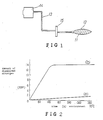
- an ink passage of an ink jet printer basically comprises an ink tank 12 for holding a recording ink 11, an ink feed pipe 13 for transferring the ink 11 to a printing head 14, and a filter 15 for removing foreign matter and bubble nuclei.
- the bubbles formed in the ink passage will flow with the recording ink and make it impossible to eject the recording ink from the nozzles of the printing head when the bubbles reach a pressure generating part thereof.
- curve (a) represents increase in nitrogen in the case where pure water is hermetically sealed in an aluminium laminate bag
- curve (b) represents increase in nitrogen in the case where 3% aqueous solution of a dye having three azo linkages, i.e. Direct Black 154, is hermetically sealed as a recording ink in the same bag.
- the amount of dissolved nitrogen was measured by gas chromatography (with a column packed with Molecular Sieve 5A manufactured by Gasukuro Kogyo Inc.).
- the present inventor has conducted analyses and experiments based on the recognition that impurities contained in a recording ink is the cause of the nitrogen generation and, as a result, has found that the presence of a nitrite in and a dye (particularly one having no azo linkage) in the recording ink is causative of nitrogen generation in the recording ink itself. Further, the present inventor has found that even when the recording ink contains a dye having an azo linkage, the adjustment of the nitrite ion concentration of the recording ink to 10 ppm or less enables the complete elimination of the formation of bubbles in the recording ink even when left to stand at a temperature of 70°C for fifteen days, so that the recording ink can satisfy the severest possible service conditions.
- the nitrite ion concentration of the recording ink should be 0.2 to 10 ppm.
- a recording ink according to the present invention uses a dye with an azo linkage in its molecule and a nitrite concentration of 0.2 to 10 ppm.
- the nitrite ion concentration of a recording ink according to the present invention can be adjusted to 0.2 to 10 ppm by making use of a know sulphamic acid neutralisation method for removing nitrite ions. With this method, however, it is difficult to control the nitrite ion concentration to be in the range of 0.2 to 10 ppm, and sulphate groups may remain in the recording ink.
- the recording ink is passed through an ion exchange resin to remove nitrous acid through adsorption.
- recording ink is passed through an ultra-filtration membrane to separate and remove the nitrite ions.
- the aim of the present invention can be attained by adjusting the nitrite ion concentration to 0.2 to 10 ppm, de-aerating the recording ink, and sealing the recording ink in a bag or a vessel having a low gas permeability.
- a recording ink according to the present invention may be mainly composed of a dye as a colourant, a wetting agent for preventing clogging of nozzles of the ink jet printer and water as a solvent.
- a salt of nitrous acid is contained in low concentration in the components of the recording ink.
- sodium nitrite is used when an aromatic amine is diazotised, but then it is necessary to lower the sodium nitrite concentration during the synthesis of the dye.
- the dyes used in a recording ink according to the present invention may be direct dyes, acidic dyes, and basic dyes listed in the Colour Index published by The Society of Dyers and Colourists.
- a dye having at least one azo linkage in its molecule and of high water solubility, and a wetting agent When the proportion of the dye in the recording ink is high, the nitrite ion concentration of the recording ink can also be easily increased. Therefore, in this case, the nitrite ions should first be removed by passing an aqueous dye solution through an ion exchange resin. Addition of a dye in an amount of 0.5 to 10 parts by weight is optimal for the purpose of attaining a sufficient print density.
- Dyes Nos. 1 to 23 listed in Table 1 are examples of dyes that can be used in a recording ink according to the present invention.
- a wetting agent is an important component for preventing a recording ink from drying at nozzles of an ink jet printer.
- a recording ink according to the present invention it is possible to use water soluble organic solvents.
- polyhydric alcohols, ether and ester derivatives of polyhydric alcohols, water soluble amines, and cyclic nitrogenous compounds are suitable. Since these compounds are substantially free from any salt of nitrous acid, no particular treatment is necessary for the removal of nitrate ions.
- Specific examples of polyhydric alcohols are ethylene glycol, diethylene glycol, triethylene glycol, propylene glycol, polyethylene glycol and glycerin.
- ether derivatives of polyhydric alcohols are ethylene glycol monomethyl ether, ethylene glycol monoethyl ether, diethylene glycol monoethyl ether, diethylene glycol monobutyl ether, diethylene glycol dimethyl ether, diethylene glycol methyl ethyl ether and triethylene glycol monomethyl ether.
- ester derivatives of polyhydric alcohols are ethylene glycol monomethyl ether acetate, diethylene glycol monoethyl ether acetate, glycerin monoacetate and glycerin diacetate.
- water soluble amines are mono-, di- and tri-ethanolamines and polyoxyethyleneamine.
- a specific example of a cyclic nitrogenous compound is N-methyl-2-pyrrolidone.
- the viscosity of a recording ink has a great effect on the ejection cycle of ink particles, and an increase in the viscosity makes it impossible to increase the ejection cycle and makes the ejection characteristics unstable.
- the recording ink visc.sity is preferably 50 mPa.s or less.
- a wetting agent in an amount of 5 to 80 parts by weight.
- the pH value of the ink may be adjusted to 12 to 14 as proposed in Japanese Laid Open Patent No. 57862/1981.
- additives such as preservatives, fungicides, chelating agent, and pH adjustors may be added to the recording ink. However, care should be taken when these additives are used because some of them comprise a salt of nitrous acid.
- EXAMPLE 1 Composition dye: C.I. Direct Black 154 (commercially available) (dye No. 16 of Table 1) 3 parts by weight glycerin 15 parts by weight ultra-pure water 82 parts by weight
- a recording ink having the above described composition was heated with stirring to prepare 500 g of the recording ink.
- This recording ink was cooled and passed through an anion exchange resin (Amberlite IRA-410; a product of Japan Organo Co. Ltd.) and then ion-chromatographed to confirm that the nitrite ion concentration was 5 ppm.
- the recording ink was filtered through a 1 micron membrane filter and de-aerated, and an aluminium-laminated polyethylene bag having low gas permeability was filled with the treated recording ink.
- the polyethylene bag was subjected to submerged sealing to obtain an ink bag containing the recording ink hermetically sealed therein.
- the volume of one ink bag was 122 cc.
- Four ink bags were placed in an environment of 70°C for fifteen days. Then, the nitrogen concentration was measured by gas chromatography and found to be, on average, 8 ppm.
- the recording ink was used for printing with an ink jet printer HG-2550 (a product of Seiko Epson Corporation). As a result, stable printing was possible and all required dots were formed with all four ink bags. A printing head of the ink jet printer was filled with this recording ink and allowed to stand at room temperature for one month without a cap (normally provided for prevention of clogging), and the recording ink was delivered again. It was found that printing was possible in good conditions without clogging.
- Example 2 Composition dye: C.I. Direct Black 168 (commercially available) 2 parts by weight polyethylene glycol No.200 10 parts by weight triethylene glycol 5 parts by weight ultra-pure water 83 parts by weight
- a recording ink having the above described composition was prepared in the same manner as that of Example 1 and passed through an ultra-filtration membrane (HF1-43-PM1; a product of Romicon), and ultra-pure water was added to compensate for the loss due to concentration by ultra-filtration. Thereafter it was confirmed that the nitrite ion concentration of the recording ink was 2 ppm.
- This recording ink was filtered and de-aerated and then hermetically sealed in an ink bag, and evaluation was conducted in the same manner as that of Example 1. As a result, it was found that the amount of nitrogen generated was 5 ppm. Further, printing stability was excellent, and no clogging occurred even after one month.
- Example 2 After a recording ink described in Example 2 was prepared, 0.1 g of sulphamic acid was added thereto. The recording ink was further heated with stirring, cooled and subjected to measurement of the nitrite ion concentration. As a result, it was found that the concentration was 0.1 ppm. This recording ink was filtered and de-aerated and then hermetically sealed in an ink bag, and evaluation was conducted in the same manner as that of Example 1. As a result, it was found that the amount of nitrogen generated was 1.5 ppm. Further, printing could be stably conducted without any omission of dots. However, in the evaluation of clogging after the recording ink had been allowed to stand at room temperature for one month, the print quality was poor because re-delivery of the recording ink was unstable and the ink particles described a curved flight although clogging was incomplete.
- Recording inks 3-1 to 3-5 as examples of the present invention were adjusted so as to have a nitrite ion concentration of 0.2 to 10 ppm by conducting the same treatment as that of Example 1 or Example 2.
- recording inks 3-6 to 3-8 were used as such without conducting any adjustment.
- Recording inks 3-9 and 3-10 were subjected to neutralisation of the nitrite ions with sulphamic acid.
- Example 2 In the same manner as that of Example 1, recording inks 3-1 to 3-10 were filtered and de-aerated, hermetically sealed in an ink bag, and placed in an environment of 70°C for fifteen days. Thereafter, in the same manner as that of Example 1, these recording inks were subjected to evaluation of delivery stability (A) in the printing operation with an ink jet printer and clogging (B) in the case where a printing head was filled with a recording ink and allowed to stand without providing a cap at room temperature for one month. The results are shown in Table 2.
- A delivery stability
- B clogging
- a recording ink having the above described compositions was heated with stirring to prepare 500 g of the recording ink.
- This recording ink was cooled and passed through anion exchange resin (Amberlite IRA-410; a product of Japan Organo Co. Ltd) and then ion-chromatographed to confirm that the nitrite ion concentration was 7 ppm. Thereafter, this recording ink was filtered through a 1 micron membrane filter and de-aerated, and an aluminium-laminated polyethylene bag having low gas permeability was filled with the treated recording ink.
- the polyethylene bag was subjected to submerged sealing to obtain an ink bag containing an ink hermetically sealed therein.
- the volume of one ink bag was 120 cc.
- a recording ink having the above composition was prepared in the same manner as that of Example 1 and passed through an ultrafiltration membrane (HF1-43-PM1; a product of Romicon), and ultrapure water was added to compensate for the loss due to concentration by ultrafiltration. Thereafter, it was confirmed that the nitrite ion concentration of the ink was 2 ppm.
- the recording ink was filtered and deaerated and then hermatically sealed in an ink bag, and evaluation was conducted in the same manner as that of Example 4. As a result, it was found that the amount of nitrogen generated was 5 ppm. Further, printing stability was excellent, and no clogging occurred even after one month.
- Example 5 After a recording ink described in Example 5 was prepared, 0.1 g of sulphamic acid was added thereto. The recording ink was further heated with stirring, cooled and subjected to measurement of the nitrite ion concentration. As a result, it was found that the concentration was 0.1 ppm. This recording ink was filtered and de-aerated and then hermetically sealed in an ink bag, and evaluation was conducted in the same manner as that of Example 4. As a result, it was found that the amount of nitrogen generated was 1.5 ppm. Further, printing could be stably conducted without omission of dots. However, in the evaluation of clogging after the recording ink was allowed to stand at room temperature for one month, no good printing could be attained because re-delivery of the recording ink was unstable and ink particles described as a curved flight although clogging was incomplete.
- a recording ink was prepared in the same manner as that of Example 5, except that dye No 24 of Table 1, not having any azo linkage was used instead of the dye used instead of Example 5.
- the recording ink was heated with stirring and cooled. Then, the nitrite ion concentration was measured and found to be 2.5 ppm.
- This recording ink was filtered and deaerated and then hermatically sealed in an ink bag, and evaluation was conducted in the same manner as that of Example 4. As a result, it was found that the amount of nitrogen generated was 3.5 ppm. Further, printing could be stably conducted without omission of dots. However, in the evaluation of clogging after the recording ink was allowed to stand at room temperature for one month, the print quality was poor because re-delivery of the recording ink was unstable and ink particles described a curved flight although clogging was incomplete.
- Recording inks 6-1 to 6-5 as the examples of the present invention were adjusted so as to have a nitrite ion concentration of 0.2 to 10 ppm by conducting the same treatment as that of Example 4 or 5. Comparative recording inks 6-6 to 6-8 were used as such without adjustment of the nitrite ion concentration. Recording inks 6-9 and 6-10 were subjected to neutralization of the nitrite ion with sulphamic acid. Comparative recording inks 6-11 and 6-12 were those wherein dyes Nos 25 and 26 of Table 1 respectively, each not having any azo linkage in its molecule were used as a component.
- Example 4 In the same manner as that of Example 4, recording inks 6-1 to 6-12 were filtered and de-aerated, and each were hermatically sealed in an ink bag, and placed in an environment of 70°C for 15 days. Thereafter, in the same manner as that of Example 1, these recording inks were subjected to evluation of delivery stability (A) in a printing operation with an ink-jet printer and clogging (B) in the case where a printing head was filled with a recording ink and allowed to stand without providing a cap at room temperature for one month. The results are shown in Table 4.
- A delivery stability
- B clogging
- the term "frequent dot omission” is intended to mean a state wherein the omission of dot occurs at least 5 times when 120 cc of an ink was subjected to continuous printing
- the term “curved flight” is intented to mean a state wherein missing of printing is observed or misalignment of printing occurs.
Landscapes
- Chemical & Material Sciences (AREA)
- Life Sciences & Earth Sciences (AREA)
- Engineering & Computer Science (AREA)
- Materials Engineering (AREA)
- Wood Science & Technology (AREA)
- Organic Chemistry (AREA)
- Inks, Pencil-Leads, Or Crayons (AREA)
- Ink Jet Recording Methods And Recording Media Thereof (AREA)
Applications Claiming Priority (4)
| Application Number | Priority Date | Filing Date | Title |
|---|---|---|---|
| JP249211/88 | 1988-10-03 | ||
| JP24921288A JP2699459B2 (ja) | 1988-10-03 | 1988-10-03 | インクジェット記録用インク |
| JP249212/88 | 1988-10-03 | ||
| JP24921188A JP2699458B2 (ja) | 1988-10-03 | 1988-10-03 | インクジェット記録用インク |
Publications (3)
| Publication Number | Publication Date |
|---|---|
| EP0363139A2 true EP0363139A2 (fr) | 1990-04-11 |
| EP0363139A3 EP0363139A3 (fr) | 1991-11-06 |
| EP0363139B1 EP0363139B1 (fr) | 1994-12-07 |
Family
ID=26539159
Family Applications (1)
| Application Number | Title | Priority Date | Filing Date |
|---|---|---|---|
| EP89310081A Expired - Lifetime EP0363139B1 (fr) | 1988-10-03 | 1989-10-03 | Encre d'enregistrement pour imprimante à jet d'encre |
Country Status (4)
| Country | Link |
|---|---|
| US (1) | US5092926A (fr) |
| EP (1) | EP0363139B1 (fr) |
| DE (1) | DE68919796T2 (fr) |
| HK (1) | HK118195A (fr) |
Cited By (2)
| Publication number | Priority date | Publication date | Assignee | Title |
|---|---|---|---|---|
| EP0585616A1 (fr) * | 1992-07-31 | 1994-03-09 | Canon Kabushiki Kaisha | Encre, méthode et dispositif d'enregistrement à jet d'encre utilisant cette encre |
| US6158856A (en) * | 1995-02-13 | 2000-12-12 | Canon Kabushiki Kaisha | Ink-jet recording process, ink-jet recording apparatus and image formed article |
Families Citing this family (17)
| Publication number | Priority date | Publication date | Assignee | Title |
|---|---|---|---|---|
| JP3102304B2 (ja) * | 1995-06-29 | 2000-10-23 | ブラザー工業株式会社 | 水性インク及びインクジェット記録方法 |
| JPH0931378A (ja) * | 1995-07-17 | 1997-02-04 | Brother Ind Ltd | 記録用インク |
| US6447679B1 (en) * | 1997-04-30 | 2002-09-10 | Mitsubishi Rayon Company, Limited | Hollow fiber membrane |
| JP4168465B2 (ja) * | 1998-02-02 | 2008-10-22 | セイコーエプソン株式会社 | 水溶性インク、水溶性インクの製造方法、およびインクジェット記録方法 |
| US6455132B1 (en) * | 1999-02-04 | 2002-09-24 | Kodak Polychrome Graphics Llc | Lithographic printing printable media and process for the production thereof |
| JP2004525195A (ja) * | 2000-10-02 | 2004-08-19 | キンバリー クラーク ワールドワイド インコーポレイテッド | ナノ粒子ベースのインク及びその製造方法 |
| US6598461B2 (en) * | 2001-10-29 | 2003-07-29 | Hewlett-Packard Development Company, L.P. | Apparatus for, and method of using, gas chromatography inlet system for direct analysis of substances fired from an inkjet pen |
| US7666410B2 (en) * | 2002-12-20 | 2010-02-23 | Kimberly-Clark Worldwide, Inc. | Delivery system for functional compounds |
| US6780896B2 (en) * | 2002-12-20 | 2004-08-24 | Kimberly-Clark Worldwide, Inc. | Stabilized photoinitiators and applications thereof |
| US8409618B2 (en) | 2002-12-20 | 2013-04-02 | Kimberly-Clark Worldwide, Inc. | Odor-reducing quinone compounds |
| JP3848352B2 (ja) * | 2004-07-02 | 2006-11-22 | キヤノン株式会社 | インクジェット用ブラックインク、インクセット、インクジェット記録方法、インクカートリッジ、記録ユニット及びインクジェット記録装置 |
| JP3885086B2 (ja) * | 2004-07-02 | 2007-02-21 | キヤノン株式会社 | インクジェット用ブラックインク、インクセット、インクジェット記録方法、インクカートリッジ、記録ユニット及びインクジェット記録装置 |
| JP2006063332A (ja) * | 2004-07-29 | 2006-03-09 | Canon Inc | インクジェット用ブラックインク、インクセット、インクジェット記録方法、インクカートリッジ、記録ユニット、及びインクジェット記録装置 |
| JP2006168794A (ja) * | 2004-12-16 | 2006-06-29 | Seiko Epson Corp | パック体、液滴吐出装置及び電気光学装置並びに電子機器 |
| US20070048247A1 (en) * | 2005-08-31 | 2007-03-01 | Kimberly-Clark Worldwide, Inc. | Deodorizing tablets |
| US20090163887A1 (en) * | 2007-12-20 | 2009-06-25 | Arehart Kelly D | Odor control cellulose granules with quinone compounds |
| JP7228123B2 (ja) | 2018-09-25 | 2023-02-24 | セイコーエプソン株式会社 | インクジェットインク組成物、インクパック、及びインクジェット記録方法 |
Family Cites Families (12)
| Publication number | Priority date | Publication date | Assignee | Title |
|---|---|---|---|---|
| GB1526017A (en) * | 1975-12-05 | 1978-09-27 | Dainippon Toryo Kk | Ink composition for ink jet recording |
| JPS5274406A (en) * | 1975-12-05 | 1977-06-22 | Dainippon Toryo Kk | Ink for ink jet recording |
| DE2930491C2 (de) * | 1979-07-27 | 1987-01-02 | Olympia AG, 2940 Wilhelmshaven | Verfahren zum Erzeugen fremdsalzfreier Tinten |
| JPS6034993B2 (ja) * | 1980-05-06 | 1985-08-12 | キヤノン株式会社 | 記録液及びその製造法 |
| JPS57207065A (en) * | 1981-06-17 | 1982-12-18 | Seiko Epson Corp | Ink jet recorder |
| JPS59199765A (ja) * | 1983-04-27 | 1984-11-12 | Canon Inc | 染料精製装置 |
| DE3417411A1 (de) * | 1983-06-30 | 1985-01-03 | Canon K.K., Tokio/Tokyo | Tintenherstellungssystem |
| EP0181226B1 (fr) * | 1984-11-08 | 1990-01-17 | Canon Kabushiki Kaisha | Méthode de purification de colorants |
| JPS61113669A (ja) * | 1984-11-08 | 1986-05-31 | Mitsubishi Chem Ind Ltd | 液組成物およびインクジェット記録方法 |
| US4732613A (en) * | 1984-11-08 | 1988-03-22 | Canon Kabushiki Kaisha | Recording liquid |
| JPS61113672A (ja) * | 1984-11-08 | 1986-05-31 | Canon Inc | 記録液及びこれを用いたインクジェット記録方法 |
| DE3687631T2 (de) * | 1985-12-05 | 1993-06-03 | Hewlett Packard Co | Tintenzusammensetzung fuer tintenstrahlschreiber. |
-
1989
- 1989-10-03 DE DE68919796T patent/DE68919796T2/de not_active Expired - Lifetime
- 1989-10-03 US US07/416,188 patent/US5092926A/en not_active Expired - Lifetime
- 1989-10-03 EP EP89310081A patent/EP0363139B1/fr not_active Expired - Lifetime
-
1995
- 1995-07-20 HK HK118195A patent/HK118195A/en not_active IP Right Cessation
Cited By (3)
| Publication number | Priority date | Publication date | Assignee | Title |
|---|---|---|---|---|
| EP0585616A1 (fr) * | 1992-07-31 | 1994-03-09 | Canon Kabushiki Kaisha | Encre, méthode et dispositif d'enregistrement à jet d'encre utilisant cette encre |
| US5380358A (en) * | 1992-07-31 | 1995-01-10 | Canon Kabushiki Kaisha | Ink, ink jet recording method using the same, and ink jet recording apparatus using the same |
| US6158856A (en) * | 1995-02-13 | 2000-12-12 | Canon Kabushiki Kaisha | Ink-jet recording process, ink-jet recording apparatus and image formed article |
Also Published As
| Publication number | Publication date |
|---|---|
| US5092926A (en) | 1992-03-03 |
| DE68919796T2 (de) | 1995-07-13 |
| EP0363139A3 (fr) | 1991-11-06 |
| HK118195A (en) | 1995-07-28 |
| EP0363139B1 (fr) | 1994-12-07 |
| DE68919796D1 (de) | 1995-01-19 |
Similar Documents
| Publication | Publication Date | Title |
|---|---|---|
| EP0363139B1 (fr) | Encre d'enregistrement pour imprimante à jet d'encre | |
| US5695820A (en) | Method for alleviating marangoni flow-induced print defects in ink-jet printing | |
| EP0745651B1 (fr) | Encre aqueuse pour impression a jet d'encre | |
| EP2022830B1 (fr) | Composition d'encre magenta, jeu d'encre, cartouche d'encre, procédé d'impression par jet d'encre et matière imprimée | |
| US5207824A (en) | Formulation for control of paper cockle in thermal ink-jet printing | |
| JPS6366268A (ja) | 記録用インク | |
| EP0839880A1 (fr) | Réduction des bavures d'encres d'impression par jet d'encre par l'utilisation d'acides contenant un groupe fonctionnel basique | |
| EP1867689B1 (fr) | Composition d'encre et cartouche d'encre comportant la composition d'encre | |
| GB2038862A (en) | Ink compositions for ink jet recording | |
| HK1048488B (en) | Use of mixtures of organic acids to adjust properties of ink-jet inks | |
| US4396429A (en) | Recording liquid | |
| JPH1077428A (ja) | インクジェット印刷用の水堅牢性赤外走査可能なインキ | |
| JP2008222770A (ja) | インク組成物、インクセット、該インク組成物を用いたインクカートリッジ、インクジェット記録方法および記録物 | |
| EP0659852A1 (fr) | Encre aqueuse pour l'enregistrement par jet d'encre | |
| JPH08283631A (ja) | インクジェット記録用インク | |
| JP2699458B2 (ja) | インクジェット記録用インク | |
| US5824142A (en) | Ink composition, process for its preparation, and ink-jet recording process | |
| JP2699459B2 (ja) | インクジェット記録用インク | |
| JP2022131699A (ja) | 染料水溶液の製造方法、水性インクの製造方法、インクカートリッジの製造方法及びインクジェット記録方法 | |
| EP0085869A2 (fr) | Encre pour l'impression par jet d'encre sélective | |
| JP2022161404A (ja) | 染料水溶液の製造方法、水性インクの製造方法、インクカートリッジの製造方法及びインクジェット記録方法 | |
| DE4438177A1 (de) | Farbstoffe für Drucktinten | |
| EP0779345B1 (fr) | Atténuation de la crystallisation des colorantes dans les images sur diapositives et supports brillants | |
| EP3778803B1 (fr) | Composition à jet d'encre à base d'eau et procédé de fabrication de matière imprimée | |
| JPS58185665A (ja) | 水性インクジエツト用インク |
Legal Events
| Date | Code | Title | Description |
|---|---|---|---|
| PUAI | Public reference made under article 153(3) epc to a published international application that has entered the european phase |
Free format text: ORIGINAL CODE: 0009012 |
|
| AK | Designated contracting states |
Kind code of ref document: A2 Designated state(s): DE FR GB |
|
| PUAL | Search report despatched |
Free format text: ORIGINAL CODE: 0009013 |
|
| AK | Designated contracting states |
Kind code of ref document: A3 Designated state(s): DE FR GB |
|
| 17P | Request for examination filed |
Effective date: 19920320 |
|
| 17Q | First examination report despatched |
Effective date: 19930618 |
|
| GRAA | (expected) grant |
Free format text: ORIGINAL CODE: 0009210 |
|
| AK | Designated contracting states |
Kind code of ref document: B1 Designated state(s): DE FR GB |
|
| REF | Corresponds to: |
Ref document number: 68919796 Country of ref document: DE Date of ref document: 19950119 |
|
| ET | Fr: translation filed | ||
| PLBE | No opposition filed within time limit |
Free format text: ORIGINAL CODE: 0009261 |
|
| STAA | Information on the status of an ep patent application or granted ep patent |
Free format text: STATUS: NO OPPOSITION FILED WITHIN TIME LIMIT |
|
| 26N | No opposition filed | ||
| REG | Reference to a national code |
Ref country code: GB Ref legal event code: IF02 |
|
| PGFP | Annual fee paid to national office [announced via postgrant information from national office to epo] |
Ref country code: DE Payment date: 20081014 Year of fee payment: 20 |
|
| PGFP | Annual fee paid to national office [announced via postgrant information from national office to epo] |
Ref country code: FR Payment date: 20081014 Year of fee payment: 20 |
|
| PGFP | Annual fee paid to national office [announced via postgrant information from national office to epo] |
Ref country code: GB Payment date: 20081001 Year of fee payment: 20 |
|
| REG | Reference to a national code |
Ref country code: GB Ref legal event code: PE20 Expiry date: 20091002 |
|
| PG25 | Lapsed in a contracting state [announced via postgrant information from national office to epo] |
Ref country code: GB Free format text: LAPSE BECAUSE OF EXPIRATION OF PROTECTION Effective date: 20091002 |