EP0363220B1 - Würfelschneidvorrichtung - Google Patents
Würfelschneidvorrichtung Download PDFInfo
- Publication number
- EP0363220B1 EP0363220B1 EP19890310260 EP89310260A EP0363220B1 EP 0363220 B1 EP0363220 B1 EP 0363220B1 EP 19890310260 EP19890310260 EP 19890310260 EP 89310260 A EP89310260 A EP 89310260A EP 0363220 B1 EP0363220 B1 EP 0363220B1
- Authority
- EP
- European Patent Office
- Prior art keywords
- feed
- product
- roll
- knife roll
- drum
- Prior art date
- Legal status (The legal status is an assumption and is not a legal conclusion. Google has not performed a legal analysis and makes no representation as to the accuracy of the status listed.)
- Expired - Lifetime
Links
Images


Classifications
-
- B—PERFORMING OPERATIONS; TRANSPORTING
- B26—HAND CUTTING TOOLS; CUTTING; SEVERING
- B26D—CUTTING; DETAILS COMMON TO MACHINES FOR PERFORATING, PUNCHING, CUTTING-OUT, STAMPING-OUT OR SEVERING
- B26D7/00—Details of apparatus for cutting, cutting-out, stamping-out, punching, perforating, or severing by means other than cutting
- B26D7/06—Arrangements for feeding or delivering work of other than sheet, web, or filamentary form
- B26D7/0625—Arrangements for feeding or delivering work of other than sheet, web, or filamentary form by endless conveyors, e.g. belts
-
- B—PERFORMING OPERATIONS; TRANSPORTING
- B26—HAND CUTTING TOOLS; CUTTING; SEVERING
- B26D—CUTTING; DETAILS COMMON TO MACHINES FOR PERFORATING, PUNCHING, CUTTING-OUT, STAMPING-OUT OR SEVERING
- B26D3/00—Cutting work characterised by the nature of the cut made; Apparatus therefor
- B26D3/18—Cutting work characterised by the nature of the cut made; Apparatus therefor to obtain cubes or the like
- B26D3/22—Cutting work characterised by the nature of the cut made; Apparatus therefor to obtain cubes or the like using rotating knives
-
- B—PERFORMING OPERATIONS; TRANSPORTING
- B26—HAND CUTTING TOOLS; CUTTING; SEVERING
- B26D—CUTTING; DETAILS COMMON TO MACHINES FOR PERFORATING, PUNCHING, CUTTING-OUT, STAMPING-OUT OR SEVERING
- B26D7/00—Details of apparatus for cutting, cutting-out, stamping-out, punching, perforating, or severing by means other than cutting
- B26D7/06—Arrangements for feeding or delivering work of other than sheet, web, or filamentary form
-
- B—PERFORMING OPERATIONS; TRANSPORTING
- B26—HAND CUTTING TOOLS; CUTTING; SEVERING
- B26D—CUTTING; DETAILS COMMON TO MACHINES FOR PERFORATING, PUNCHING, CUTTING-OUT, STAMPING-OUT OR SEVERING
- B26D7/00—Details of apparatus for cutting, cutting-out, stamping-out, punching, perforating, or severing by means other than cutting
- B26D7/06—Arrangements for feeding or delivering work of other than sheet, web, or filamentary form
- B26D7/0683—Arrangements for feeding or delivering work of other than sheet, web, or filamentary form specially adapted for elongated articles
Definitions
- the present invention generally involves the field of technology pertaining to methods and apparatus for sectionalizing cuttable material into discrete particles of predetermined shape and size. More specifically, the invention relates to an improved machine for cutting a food product, particularly slabs of fresh or frozen tempered meat, into diced sections.
- Machines for sectionalizing or dividing materials into smaller discrete portions through a series of cutting operations are well known in the art. Such machines are particularly suited for cutting food products, such as vegetables and fruits, into discrete pieces having a substantially rectangular or diced configuration. This is generally accomplished by conveying a large piece of the food product through a rotating bank of circular knives which initially cut the product into a plurality of elongate strips that are thereafter directed into a crosscut assembly wherein a rotating bank of elongate knives effect transverse cutting of the strips into diced sections.
- the bank of circular knives is associated with either a rotating feed drum or a stationary transfer plate, and defines a throat therebetween for receiving the conveyed product.
- the bank of elongate knives is provided with an associated stationary stripper plate having a cooperating shear edge against which the transverse cutting of the strips is accomplished.
- the conveyor assembly includes a driven, generally horizontal feed belt for supporting and conveying the product, whereby the feed roll is positioned near an end of the feed belt, a carriage supporting the feed roll for vertical movement and biasing means operatively associated with the feed roll to resiliently bias the feed roll against the product on the feed belt and the rotatable feed drum having said peripheral surface defines a plurality of circumferentially spaced grooves extending generally across the product feed path adapted to contact the product so as to retard the movement of the product through the feed throat.
- an improved machine for sectionalizing cuttable material into discrete pieces of a desired size and configuration which can efficiently and reliably produce diced sections of food products at high speeds, and is particularly suited for producing discrete diced sections from slabs of flesh or frozen tempered meat.
- the invention also extends to a method of cutting a product into a plurality of diced sections using the apparatus of claim 1 characterised in that the conveyor assembly includes a driven, generally horizontal feed belt for supporting and conveying the product, whereby the feed roll is positioned near an end of the feed belt, a carriage supporting the feed roll for vertical movement and biasing means operatively associated with the feed roll to resiliently bias the feed roll against the product on the feed belt and the rotatable feed drum having said peripheral surface defines a plurality of circumferentially spaced grooves extending generally across the product feed path adapted to contact the product so as to retard the movement of the product through the feed throat.
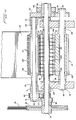
- a dicing machine 1 shall now be described with initial reference to Figs. 1 and 2.
- machine 1 is mounted on a rectangular-shaped support frame 3 by bolting a component support base 5 of machine 1 to a plurality of inwardly directed plates 7.
- Frame 3 includes a plurality of legs 9 sized to support machine 1 at a desired height.
- Frame 3 may be of any appropriate conventional design and is preferably formed from tubular or channel-shaped metal members welded or bolted together.
- Machine 1 includes an electric motor 11 for driving a pulley and gear assembly 13 which rotates the corresponding drive shafts of all of the components in a manner to be hereinafter detailed.
- Pulley and gear assembly 13 and its associated components are housed within a hood assembly 15 which permits easy access to assembly 13 and its components for maintenance purposes.
- a discharge chute 17 extends outwardly from hood 15 and frame 3 for discharging diced product DP produced by machine 1.
- the operation of machine 1 may be controlled by an appropriate known electrical or electronic system housed in a control box 19, through which electrical power may be transmitted to motor 11 for driving pulley and gear assembly 13.
- Machine 1 also includes a conveyor assembly 21 which comprises a horizontal feed belt 23 provided with a driven roll 25 and an idler roll 27. Roll 25 is driven by a gear 26 in a manner to be later described.
- assembly 13 includes a main drive pulley 29 mounted on a main drive shaft 31 which is rotated by the power output shaft of motor 11 through a main drive belt 33.
- Assembly 13 is supported on a pair of spaced side frames 35 and 37 which extend vertically from support base 5.
- a crossbar 43 is clamped in side frames 35 and 37.
- a driveshaft 45 of a crosscut assembly 47 is supported in side frames 35 and 37.
- a stripper plate 49, forming a portion of crosscut assembly 47, is also bolted to crossbar 43.
- Drive shaft 45 of crosscut assembly 47 is provided with a gear 51 which is engaged with and driven by a larger gear 53 mounted on main drive shaft 31 opposite drive pulley 29.
- a main drive gear 55 is also mounted on drive shaft 31 inwardly of drive pulley 29 and is in driving engagement with a secondary drive gear 57 for rotating a drive shaft 59.
- Rotation of main drive shaft 31 also drives a secondary pulley 61 through a secondary drive belt 63 for rotating a drive shaft 65.
- a feed roll 67 forming a part of conveyor assembly 21, is supported for rotation on drive shaft 65, with the latter being supported at its opposite ends on a carrier frame 69.
- Roll 67 may be provided with a plurality of longitudinal grooves 68 spaced around its periphery for engaging food product P.
- a pair of brackets 71 and 73 extend forwardly of frame 69 and are journalled for pivotal movement about main drive shaft 31.
- carrier 69 The opposite side of carrier 69 is provided with a pair of rearwardly extending brackets 75 and 77 which are supported on a pair of spring loading assemblies 79 and 81, respectively. Assemblies 79 and 81 are attached to corresponding pairs of spaced lugs 83 and 85 for pivotal movement about a pair of support shafts 87 and 89, respectively.
- feed roll 67 is supported in a floating manner by carrier 69 and biased downwardly towards the upper flight of feed belt 23 and directly above driven roll 25 by spring loading assembly 79.
- the bias imparted to roller 67 is realized by means of a coil spring 91 supported on a shaft 93 between a pair of opposed follower sleeves 95 and 97.
- the outer end of shaft 93 is threaded to receive an adjustment nut 99 for compressing or expanding spring 91 to vary the degree of bias, and a lock nut 101 for maintaining the bias adjustment.
- the other end of shaft 93 is secured to shaft 87 by a nut 103 for pivotal movement about lugs 83.
- a nut 105 is provided on shaft 93 for engagement by bracket 75 to establish the vertical position of roll 67 with respect to belt 23 and driven roll 25.
- Lugs 83 are rigidly secured to an upright 107 carried by support frame 3.
- Another upright (not shown) is provided for supporting lugs 85 in the same manner, and spring loading assembly 81 has the same structure and function as that described for assembly 79. It is thus apparent that assemblies 79 and 81 may be adjusted to secure the desired degree of spring loading imparted to carrier 69 so that feed roll 67 shall be permitted to realize a corresponding degree of resiliency when a food product P is engaged between feed roll 67 and driven roll 25 while it is being conveyed on belt 23 in the direction indicated by arrow A.
- Feed roll 67 is rotated by shaft 65 in the indicated clockwise direction.
- Driven roll 25 is rotated in the indicated counterclockwise direction.
- a feed throat 111 of a strip cutting assembly 113 that includes a first knife roll 114 defined by a plurality of longitudinally spaced circular knives 115 supported on main drive shaft 31, and a feed drum 117 supported on drive shaft 59.
- Each blade 115 is separated from an adjacent knife 115 by an annular spacer ring 119, with knives 115 and rings 119 being carried on an arbor 121 supported on shaft 31.
- Feed drum 117 is provided with an outer circumferential surface 123 which is configured to retard the movement of food product P through throat 111 of assembly 113 for a purpose and in a manner to be later described.
- Strips of food product P exiting strip cutting assembly 113 are conveyed directly to crosscut assembly 47.
- Assembly 47 includes a second knife roll 124 defined by a longitudinal block 125 supported on drive shaft 45 for rotation in the indicated counterclockwise direction.
- a plurality of elongate knives 127 are circumferentially spaced around block 125 for sequential cooperation with a shear edge 129 provided on stripper plate 49. Diced food product DP exiting from crosscut assembly 47 is discharged through chute 17.
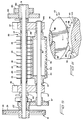
- feed roll 67 is supported for rotation on drive shaft 65 which is in turn journalled through a pair of opposed bearings 131 and 133 carried by brackets 71 and 73, respectively.
- the circumferential surface of roll 67 is provided with a plurality of longitudinally spaced peripheral grooves 135. The spacings between grooves 135 correspond to the spacings between circular knives 115 so that edge portions of knives 115 are intermeshed within grooves 135.
- Drive shaft 31 of first knife roll 114 is journalled through a pair of bearings 137 and 139 carried by side frames 35 and 37, respectively.
- Longitudinal block 125 of crosscut assembly 47 is supported for rotation on drive shaft 45, the latter also being journalled through a pair of opposed bearings 141 and 143 carried by side frames 35 and 37, respectively.
- Stripper plate 49 is provided with a plurality of longitudinally spaced slots 145 therein. The spacings between slots 145 also correspond to those of knives 115 so that edge portions of knives 115 are intermeshed within slots 145. As therefore apparent from Fig. 4, knives 115 are intermeshed with feed roll 67 and stripper plate 49 during rotation of drive shafts 31, 45 and 65.
- feed drum 117 of strip cutting assembly 113 is supported for rotation on drive shaft 59, the latter being journalled in a pair of opposed bearings 147 and 149 carried by side frames 35 and 37, respectively.
- the outer circumferential surface 123 of drum 117 is provided with a plurality of longitudinally spaced peripheral grooves 151, the spacings of which also correspond to those of knives 115 so that edge portions of knives 115 are intermeshed within grooves 151.
- knives 115 and feed drum 117 remain intermeshed during rotation about their respective driveshafts 31 and 59.
- main driveshaft 31 is provided with a flanged sleeve 153 for supporting gear 53 and a smaller outer gear 155, the latter being disposed in driving engagement with gear 26 of driven roll 25 for driving feed belt 23 of conveyor assembly 21, as shown in Fig. 1.
- Each circular knife 115 of first knife roll 114 may advantageously be provided with a serrated or scalloped peripheral cutting edge, as shown in Fig. 3.
- a plurality of circular knives 157 having plain cutting edges may also be advantageously utilized, as shown in Fig. 6.
- the choice of cutting edge configuration may be determined in accordance with the nature and consistency of food product P being cut by knife roll 114.
- circumferential surface 123 of feed drum 117 in addition to being provided with peripheral grooves 151, is also configured to define a plurality of longitudinally extending and circumferentially spaced grooves 159.
- Each groove 159 is defined by a radial face 161 and a corresponding tangential face 163.
- faces 161 are directed rearwardly of the direction of food product P travel through feed throat 111 of assembly 113. In this way, faces 161 serve to engage and retard the movement of product P through throat 111 during the cutting thereof, a procedure determined to be highly advantageous during the cutting of fresh meat due to its soft consistency.
- This retarding effect permits knives 115 or 157 to impart the appropriate slicing action on slabs of fresh meat, particularly when rotated at a peripheral speed that is at least twice the peripheral speed of feed drum 117. It is, of course, understood that the described configuration of surface 123 is only preferred and that other configurations are possible so long as such configurations serve the desired function of retarding the movement of food product P through throat 111 of assembly 113.
- Variations in the relative peripheral speeds of feed roll 67, first and second knife rolls 114 and 124, feed drum 117, feed roll 67 and driven roll 25 of conveyor assembly 21 are realized by varying the ratios of the gearing rotating the respective drive shafts through appropriate substitution and replacement of the gears forming pulley and gear assembly 13.
- the degree of spring bias imparted to feed roll 67 by spring loading assembly 79 and vertical position of roll 67 relative to driven roll 25 is established in accordance with the thickness and consistency of food product P and to compensate for occasional oversize pieces of product P moving between feed roll 67 and driven roll 25.
- motor 11 drives pulley and gear assembly 13, thereby imparting rotation in the indicated directions of driven roll 25, feed roll 67, first knife roll 114, feed drum 117 and second knife roll 124 of crosscut assembly 47.
- Product P exiting from between feed roll 67 and drive roll 25 in the direction indicated by arrow A is directly and horizontally transferred to feed throat 111 of strip cutting assembly 113 and is cut into plural strips by first knife roll 114 intermeshed with feed drum 117, the width of the strips corresponding to the spacings between circular knives 115.
- knife roll 114 is rotated by main drive shaft 31 in a clockwise direction, while associated feed drum 117 is rotated in a counterclockwise direction.
- Strips of product P exiting assembly 113 are conveyed to crosscut assembly 47 wherein blades 127 effect transverse cuts of the strips against shear edge 129 of stripper plate 49. This produces diced sections DP of product P, which sections DP are then discharged through chute 17.
- the spring-biased feed roll 67 in combination with the intermeshed disposition of first knife roll 114 within feed roll 67, feed drum 117 and stripper plate 49, collectively contribute to a high speed and reliable dicing of product P by machine 1 in a manner that cannot be duplicated by conventional dicing machines.
- machine 1 renders it particularly advantageous for the dicing of fresh, cooked or frozen tempered slabs of meat.
- pulley and gear assembly 13 is configured so that feed roll 67 will rotate at a peripheral speed that is approximately the same speed as feed belt 23.
- Feed drum 117 of assembly 113 is rotated at approximately the same peripheral speed as meat product P being conveyed by roll 67 and belt 23.
- first knife roll 114 is rotated at a peripheral speed that is at least twice the peripheral speed of feed drum 117. This minimum difference in peripheral speeds was found to produce a continuous slicing action on fresh meat. Since fresh meat has a soft consistency, the rapid rotation of circular knives 115 tends to move meat product P too quickly through assembly 113.
- feed drum 117 is therefore provided with the circumferential surface 123 configuration depicted in Fig. 6 to retard the movement of meat product P being conveyed through feed throat 111 of assembly 113, thus allowing knives 115 to perform the required slicing action on meat product P.
- the cut strips of meat product P are then directed to crosscut assembly 47 for transverse cutting to produce diced sections DP therefrom.
- pulley and gear assembly 13 is adjusted to rotate first knife roll 114 at a peripheral speed that is only slightly faster than the peripheral speed of feed drum 117.
- the smaller variation between the peripheral speeds of blades 115 and drum 117 is possible because cooked or frozen tempered slabs of meat have a harder consistency than fresh meat.
Landscapes
- Life Sciences & Earth Sciences (AREA)
- Forests & Forestry (AREA)
- Engineering & Computer Science (AREA)
- Mechanical Engineering (AREA)
- Crushing And Pulverization Processes (AREA)
- Nonmetal Cutting Devices (AREA)
- Formation And Processing Of Food Products (AREA)
Claims (11)
- Vorrichtung zum Schneiden eines Produktes in würfelförmige Teilstücke, aufweisend: eine Förder-Baugruppe (21) zum Tragen und Fördern des Produktes und eine rotierbare Vorschubrolle (67), welche nahe bei einem Ausgangs-Ende der Förder-Baugruppe angeordnet ist, wobei die rotierbare Vorschubrolle (67) durch einen Tragrahmen (69) getragen und dazu befähigt ist, mit dem Produkt in Eingriff zu gelangen und dieses in eine Zufuhr-Eintrittsöffnung (101) hineinzubefördern; eine drehbare erste Messerwalze (114) mit einer Vielzahl von voneinander beabstandeten, kreisförmigen Messern (115); die quer über einen Produkt-Zuführweg verlaufen, um das Produkt in eine Vielzahl von Streifen zu schneiden; eine rotierbare Zuführtrommel (117), welche sich im wesentlichen parallel zu der ersten Messerwalze (114) erstreckt und zusammen mit dieser eine Zuführ-Eintrittsöffnung (111) begrenzt, wobei die rotierbare Zuführtrommel (117) eine Vielzahl von in der Längsrichtung voneinander beabstandeten, über den Umfang verlaufenden Nuten (151) aufweist; eine Querschneide-Baugruppe (47), welche eine zweite Messerwalze (124) umfaßt, die mit einer Vielzahl von langgestreckten Messern (127) versehen ist, die sich im wesentlichen quer über den Produkt-Zuführweg erstrecken; eine Abstreifplatte (49), welche eine Abscherkante (129) definiert, wobei die Abstreifplatte (49) betriebsmäßig mit der ersten Messerwalze (114) in Verbindung steht, um das Produkt aus den Zwischenräumen zwischen den voneinander beabstandeten Messern (115) zu entnehmen, nachdem das Produkt in eine Vielzahl von Streifen geschnitten worden ist, wobei eine Abscher-Kante (129) betriebsmäßig mit der zweiten Messerwalze (124) verbunden ist, derart, daß die langgestreckten Messer (127) mit der Abscher-Kante (129) zusammenarbeiten, um das Produkt in würfelförmige Teilstücke zu schneiden, und wobei die Abstreifplatte (49) eine Vielzahl von in gegenseitigem Abstand befindlichen Schlitzen (145) aufweist; sowie Antriebsmittel (11, 13, 33), welche betriebsmäßig mit der ersten Messerwalze (114), der Zuführtrommel (117), der Vorschubrolle (67) und der zweiten Messerwalze (124) gekoppelt sind, so daß die erste Messerwalze (114), die Zuführtrommel (117), die Vorschubrolle (67) und die zweite Messerwalze (124) in Rotation versetzt werden, dadurch gekennzeichnet, daß die Förder-Baugruppe (21) umfaßt: ein angetriebenes, im allgemeinen horizontales Zubringerband (23) zum Tragen und Fördern des Produktes, wodurch die Vorschubrolle (67) nahe bei einem Ende des Zubringerbandes (23) angeordnet ist, einen Tragrahmen (69), der die Vorschubrolle (67) für eine vertikale Bewegung trägt, und Vorspannungs-Mittel (91), die betriebsmäßig mit der Vorschubrolle (67) verbunden sind, um die Vorschubrolle (67) gegen das Produkt auf dem Zubringerband (23) federnd vorzuspannen, und daß die rotierbare Zuführtrommel (117), welche die erwähnte Umfangs-Oberfläche aufweist, eine Vielzahl von in der Umfangsrichtung voneinander beabstandeten Nuten (159) definiert, welche sich im allgemeinen quer über den Produkt-Zuführweg (111) erstrecken und dazu befähigt sind, mit dem Produkt in Berührung zu gelangen, so daß die Bewegung des Produktes durch die Zuführ-Eintrittsöffnung (111) verzögert wird.
- Vorrichtung nach Anspruch 1, dadurch gekennzeichnet, daß eine jede von der Vielzahl der sich in Längsrichtung erstreckenden Nuten (159) auf der Zuführtrommel (117) durch eine im allgemeinen radiale Fläche (161) und eine im allgemeinen tangentiale Fläche (163) begrenzt ist.
- Vorrichtung nach Anspruch 2, dadurch gekennzeichnet, daß die im allgemeinen radiale Fläche (161) in eine Richtung weist, welche im allgemeinen entgegengesetzt der Richtung der Rotation der Zuführtrommel (117) ist.
- Vorrichtung nach einem der vorhergehenden Ansprüche, dadurch gekennzeichnet, daß die Antriebsmittel (11, 13, 33) die erste Messerwalze (114) und die Zuführtrommel (117) in einander entgegengesetzten Richtungen in Rotation versetzen.
- Vorrichtung nach einem der vorhergehenden Ansprüche, dadurch gekennzeichnet, daß die Antriebsmittel (11, 13, 33) die erste Messerwalze (114) mit einer Umfangsgeschwindigkeit von mindestens annähernd dem zweifachen der Umfangsgeschwindigkeit der Zuführtrommel (117) in Rotation versetzen.
- Vorrichtung nach einem der vorhergehenden Ansprüche, dadurch gekennzeichnet, daß jedes der im allgemeinen kreisförmigen Messer (115) eine ausgebogte oder ausgezackte Schneidkante aufweist.
- Vorrichtung nach einem der vorhergehenden Ansprüche, dadurch gekennzeichnet, daß die Vorspannungs-Mittel eine Federvorrichtung (91) aufweisen, welche betriebsmäßig mit der Vorschubrolle (67) verbunden ist.
- Vorrichtung nach Anspruch 7, gekennzeichnet durch Mittel (99) zum Einstellen der Vorspann-Kraft der Federvorrichtung (91).
- Vorrichtung nach einem der vorhergehenden Ansprüche, dadurch gekennzeichnet, daß die Förder-Baugruppe (21) eine angetriebene Rolle (25) sowie eine Leerlauf- oder Mitläufer-Rolle (27) zum Antreiben des Zubringerbandes (23) aufweist, wobei die angetriebene Rolle (25) an einem ausgangsseitigen Ende des Zubringerbandes (23) im wesentlichen unterhalb der Vorschubrolle (67) angeordnet ist.
- Verfahren zum Schneiden eines Produktes in eine Vielzahl von würfelförmigen Teilstücken unter Verwendung der Vorrichtung gemäß Anspruch 1, gekennzeichnet durch die folgenden Schritte:
Fördern des Produktes entlang einem Produkt-Zuführweg mittels einer Förder-Baugruppe (21), welche ein angetriebenes, im allgemeinen horizontales Zubringerband (23) mit einem Ausgangs-Ende sowie eine rotierbare Vorschubrolle (67) umfaßt, welche nahe bei dem Ausgangs-Ende des Zubringerbandes (23) angeordnet ist, um mit dem Produkt in Eingriff zu gelangen;
Vorspannen der Vorschubrolle (67) gegen das Produkt auf dem Zubringerband (23);
Schneiden des Produktes in eine Vielzahl von Streifen dadurch, daß es unmittelbar von der Förder-Baugruppe (23) und der Vorschubrolle (67) in eine Zuführ-Eintrittsöffnung (111) hineingeschickt wird, welche durch eine erste rotierbare Messerwalze (114) mit einer Vielzahl von voneinander beabstandeten, im allgemeinen kreisförmigen Messern (115), welche sich quer über den Produkt-Zuführweg erstrecken, sowie durch eine rotierbare Zuführtrommel (117) definiert ist, welche sich im allgemeinen parallel zu der ersten Messerwalze (114) erstreckt und eine Umfangs-Oberfläche aufweist, welche eine Vielzahl von sich in der Längsrichtung erstreckenden Nuten (159) definiert, welche sich im allgemeinen quer über den Produkt-Zuführweg zum Zwecke der Berührung des Produktes erstrecken, so daß die Geschwindigkeit des Produktes durch die Zuführ-Eintrittsöffnung (111) gesteuert wird;
Vorsehen einer Abstreiferplatte (49), welche eine Abscher-Kante (129) definiert, welche sich in betriebsmäßiger Verbindung mit der ersten Messerwalze (114) befindet, um die Produkt-Streifen aus den Zwischenräumen zwischen den voneinander beabstandeten Messern (115) zu entfernen;
Vorsehen einer Querschneide-Baugruppe (47) mit einer zweiten Messerwalze (124) mit einer Vielzahl von langgestreckten Messern (127), welche sich im allgemeinen quer über den Produkt-Zuführweg erstrecken und mit der Abscher-Kante (129) zusammenwirken, um die Produkt-Streifen in eine Vielzahl von würfelförmigen Teilstücken zu schneiden; und
Vorsehen von Antriebs-Mitteln (11, 13, 33), um die erste Messerwalze (114), die Vorschubrolle (67), die Zuführtrommel (117) und die zweite Messerwalze (124) in Rotation zu versetzen. - Verfahren nach Anspruch 10, gekennzeichnet durch den Schritt des Rotierenlassens der Messerwalze (114) mit einer Umfangsgeschwindigkeit, welche zumindest angenähert gleich dem zweifachen Betrag der Umfangsgeschwindigkeit der Vorschubrolle (117) ist.
Applications Claiming Priority (2)
| Application Number | Priority Date | Filing Date | Title |
|---|---|---|---|
| US25484388A | 1988-10-07 | 1988-10-07 | |
| US254843 | 1988-10-07 |
Publications (3)
| Publication Number | Publication Date |
|---|---|
| EP0363220A2 EP0363220A2 (de) | 1990-04-11 |
| EP0363220A3 EP0363220A3 (de) | 1991-01-23 |
| EP0363220B1 true EP0363220B1 (de) | 1993-08-11 |
Family
ID=22965799
Family Applications (1)
| Application Number | Title | Priority Date | Filing Date |
|---|---|---|---|
| EP19890310260 Expired - Lifetime EP0363220B1 (de) | 1988-10-07 | 1989-10-06 | Würfelschneidvorrichtung |
Country Status (4)
| Country | Link |
|---|---|
| EP (1) | EP0363220B1 (de) |
| JP (1) | JPH02152793A (de) |
| CA (1) | CA1318574C (de) |
| DE (1) | DE68908328T2 (de) |
Cited By (2)
| Publication number | Priority date | Publication date | Assignee | Title |
|---|---|---|---|---|
| DE19529613A1 (de) * | 1994-08-17 | 1996-02-22 | Pallmann Kg Maschf | Zerkleinerungsvorrichtung für schneidbare Stoffe zur Erzeugung prismatischer, insbesondere kubischer Partikel |
| EP3638468B1 (de) * | 2017-06-14 | 2024-12-18 | Urschel Laboratories, Inc. | Verkleinerungsmaschine und verkleinerungseinheit dafür |
Families Citing this family (13)
| Publication number | Priority date | Publication date | Assignee | Title |
|---|---|---|---|---|
| GB2292880B (en) * | 1994-08-17 | 1996-12-04 | Pallmann Kg Maschf | Size reduction apparatus for the production of prismatical and particularly cubical particles from cuttable materials. |
| DE102007063295A1 (de) * | 2007-12-27 | 2009-07-02 | Natec Gmbh | Schneiden einer weichen Lebensmittelmasse |
| RO129769B1 (ro) * | 2013-03-12 | 2018-07-30 | Petru Tompea | Maşină şi metodă de tăiat carne în cuburi |
| US9855669B2 (en) * | 2014-03-13 | 2018-01-02 | Urschel Laboratories, Inc. | Dicing machines and methods of use |
| CN109176663A (zh) * | 2018-10-11 | 2019-01-11 | 漯河恒丰机械制造科技有限公司 | 食品切花机分段切断机构 |
| CN114714417A (zh) * | 2021-01-05 | 2022-07-08 | 宁波长荣酿造设备有限公司 | 切曲装置 |
| CN112792893B (zh) * | 2021-02-03 | 2025-01-10 | 黄冈市农业科学院 | 一种食用菌纵向切片机 |
| CN113092217B (zh) * | 2021-05-10 | 2024-07-02 | 济源市畜产品质量监测检验中心 | 畜产品检测样品处理装置 |
| CN113561242B (zh) * | 2021-07-01 | 2022-06-24 | 湖南炬神电子有限公司 | 一种新型自动分板机 |
| CN115570627B (zh) * | 2022-10-11 | 2024-11-15 | 浙江中美日化有限公司 | 吸汗巾制备装置及一次性儿童吸汗巾 |
| CN117507030A (zh) * | 2023-02-22 | 2024-02-06 | 武汉轻工大学 | 一种切条机 |
| CN116985204B (zh) * | 2023-08-02 | 2026-01-30 | 江西德上制药股份有限公司 | 一种中药材加工用切片装置 |
| JP2025101346A (ja) * | 2023-12-25 | 2025-07-07 | 株式会社前川製作所 | 食肉切断装置 |
Family Cites Families (5)
| Publication number | Priority date | Publication date | Assignee | Title |
|---|---|---|---|---|
| US2011475A (en) * | 1929-10-07 | 1935-08-13 | Micro Corp | Bread slicing machine |
| US2060540A (en) * | 1933-04-03 | 1936-11-10 | Ind Patents Corp | Slicing machine attachment |
| US2506985A (en) * | 1947-11-18 | 1950-05-09 | Herald P Arnt | Slicing machine, including spaced disk cutters and rotary feeder |
| US2603262A (en) * | 1948-01-29 | 1952-07-15 | William E Urschel | Sectionalizing cutting machine |
| US3826185A (en) * | 1972-03-09 | 1974-07-30 | Castle & Cooke | Pineapple recoring, segmenting and chunking |
-
1989
- 1989-09-15 CA CA000611619A patent/CA1318574C/en not_active Expired - Lifetime
- 1989-10-06 EP EP19890310260 patent/EP0363220B1/de not_active Expired - Lifetime
- 1989-10-06 DE DE1989608328 patent/DE68908328T2/de not_active Expired - Lifetime
- 1989-10-06 JP JP26193489A patent/JPH02152793A/ja active Pending
Cited By (3)
| Publication number | Priority date | Publication date | Assignee | Title |
|---|---|---|---|---|
| DE19529613A1 (de) * | 1994-08-17 | 1996-02-22 | Pallmann Kg Maschf | Zerkleinerungsvorrichtung für schneidbare Stoffe zur Erzeugung prismatischer, insbesondere kubischer Partikel |
| DE19529613C2 (de) * | 1994-08-17 | 1998-01-22 | Pallmann Kg Maschf | Zerkleinerungsvorrichtung für schneidbare Stoffe zur Erzeugung prismatischer, insbesondere kubischer Partikel |
| EP3638468B1 (de) * | 2017-06-14 | 2024-12-18 | Urschel Laboratories, Inc. | Verkleinerungsmaschine und verkleinerungseinheit dafür |
Also Published As
| Publication number | Publication date |
|---|---|
| DE68908328D1 (en) | 1993-09-16 |
| CA1318574C (en) | 1993-06-01 |
| JPH02152793A (ja) | 1990-06-12 |
| EP0363220A3 (de) | 1991-01-23 |
| EP0363220A2 (de) | 1990-04-11 |
| DE68908328T2 (de) | 1994-02-10 |
Similar Documents
| Publication | Publication Date | Title |
|---|---|---|
| US5129299A (en) | Dicing machine | |
| EP0363220B1 (de) | Würfelschneidvorrichtung | |
| EP0759837B1 (de) | Schneidmesser für ein Rotationsgerät zum Schneiden eines Nahrungsmittels und Rotationschneidgerät | |
| EP3638468B1 (de) | Verkleinerungsmaschine und verkleinerungseinheit dafür | |
| US7100486B2 (en) | Apparatus for dicing a deformable product | |
| US3972256A (en) | Meat slicer | |
| CA3041296C (en) | Size-reduction machines, feed units therefor, and methods of use | |
| EP0791293B1 (de) | Verfahren und Vorrichtung zum Schneiden und zur Abgabe von Teig | |
| US5044240A (en) | Apparatus for conveying and cutting a product into discrete pieces | |
| US3195594A (en) | Material cutting machine | |
| EP1268142B1 (de) | Schneidemaschine für bahnförmige materialien mit getrenntem schärf- und schneidebereich für die messer | |
| US5673863A (en) | Size reduction apparatus for the production of prismatical and particularly cubical particles from cuttable materials | |
| US4960021A (en) | Meat slicer | |
| FI72895C (fi) | Foerfarande och anordning foer disintegrering av material. | |
| US3678976A (en) | Onion peeling apparatus | |
| GB2139080A (en) | Slicing apparatus for bakery products | |
| GB1370380A (en) | Apparatus and method for handling a process cheese spread and cutting it into slices | |
| US3550658A (en) | Nut-kernel dicing machine | |
| JPS6348676B2 (de) | ||
| EP0353446B1 (de) | Vorrichtung zum Schneiden von Nahrungsmitteln auf Länge | |
| EP0042462A1 (de) | Fleischschneidmaschine | |
| CN120245103A (zh) | 一种行星式食品切片设备 | |
| GB2037224A (en) | Apparatus for portioning meat | |
| GB2098463A (en) | Apparatus for cutting foodstuffs | |
| IE49830B1 (en) | Apparatus for portioning meat |
Legal Events
| Date | Code | Title | Description |
|---|---|---|---|
| PUAI | Public reference made under article 153(3) epc to a published international application that has entered the european phase |
Free format text: ORIGINAL CODE: 0009012 |
|
| AK | Designated contracting states |
Kind code of ref document: A2 Designated state(s): BE CH DE FR GB IT LI NL SE |
|
| PUAL | Search report despatched |
Free format text: ORIGINAL CODE: 0009013 |
|
| AK | Designated contracting states |
Kind code of ref document: A3 Designated state(s): BE CH DE FR GB IT LI NL SE |
|
| 17P | Request for examination filed |
Effective date: 19910703 |
|
| 17Q | First examination report despatched |
Effective date: 19920626 |
|
| ITF | It: translation for a ep patent filed | ||
| GRAA | (expected) grant |
Free format text: ORIGINAL CODE: 0009210 |
|
| AK | Designated contracting states |
Kind code of ref document: B1 Designated state(s): BE CH DE FR GB IT LI NL SE |
|
| REF | Corresponds to: |
Ref document number: 68908328 Country of ref document: DE Date of ref document: 19930916 |
|
| ET | Fr: translation filed | ||
| PLBE | No opposition filed within time limit |
Free format text: ORIGINAL CODE: 0009261 |
|
| STAA | Information on the status of an ep patent application or granted ep patent |
Free format text: STATUS: NO OPPOSITION FILED WITHIN TIME LIMIT |
|
| 26N | No opposition filed | ||
| EAL | Se: european patent in force in sweden |
Ref document number: 89310260.8 |
|
| PGFP | Annual fee paid to national office [announced via postgrant information from national office to epo] |
Ref country code: SE Payment date: 19960919 Year of fee payment: 8 |
|
| PGFP | Annual fee paid to national office [announced via postgrant information from national office to epo] |
Ref country code: NL Payment date: 19960924 Year of fee payment: 8 |
|
| PGFP | Annual fee paid to national office [announced via postgrant information from national office to epo] |
Ref country code: CH Payment date: 19970115 Year of fee payment: 8 |
|
| PG25 | Lapsed in a contracting state [announced via postgrant information from national office to epo] |
Ref country code: SE Free format text: LAPSE BECAUSE OF NON-PAYMENT OF DUE FEES Effective date: 19971007 |
|
| PG25 | Lapsed in a contracting state [announced via postgrant information from national office to epo] |
Ref country code: LI Free format text: LAPSE BECAUSE OF NON-PAYMENT OF DUE FEES Effective date: 19971031 Ref country code: CH Free format text: LAPSE BECAUSE OF NON-PAYMENT OF DUE FEES Effective date: 19971031 |
|
| PG25 | Lapsed in a contracting state [announced via postgrant information from national office to epo] |
Ref country code: NL Free format text: LAPSE BECAUSE OF NON-PAYMENT OF DUE FEES Effective date: 19980501 |
|
| REG | Reference to a national code |
Ref country code: CH Ref legal event code: PL |
|
| NLV4 | Nl: lapsed or anulled due to non-payment of the annual fee |
Effective date: 19980501 |
|
| EUG | Se: european patent has lapsed |
Ref document number: 89310260.8 |
|
| REG | Reference to a national code |
Ref country code: GB Ref legal event code: IF02 |
|
| PG25 | Lapsed in a contracting state [announced via postgrant information from national office to epo] |
Ref country code: IT Free format text: LAPSE BECAUSE OF NON-PAYMENT OF DUE FEES;WARNING: LAPSES OF ITALIAN PATENTS WITH EFFECTIVE DATE BEFORE 2007 MAY HAVE OCCURRED AT ANY TIME BEFORE 2007. THE CORRECT EFFECTIVE DATE MAY BE DIFFERENT FROM THE ONE RECORDED. Effective date: 20051006 |
|
| PGFP | Annual fee paid to national office [announced via postgrant information from national office to epo] |
Ref country code: GB Payment date: 20080915 Year of fee payment: 20 |
|
| PGFP | Annual fee paid to national office [announced via postgrant information from national office to epo] |
Ref country code: DE Payment date: 20081031 Year of fee payment: 20 |
|
| PGFP | Annual fee paid to national office [announced via postgrant information from national office to epo] |
Ref country code: BE Payment date: 20081031 Year of fee payment: 20 |
|
| PGFP | Annual fee paid to national office [announced via postgrant information from national office to epo] |
Ref country code: FR Payment date: 20081006 Year of fee payment: 20 |
|
| REG | Reference to a national code |
Ref country code: GB Ref legal event code: PE20 Expiry date: 20091005 |
|
| BE20 | Be: patent expired |
Owner name: *URSCHEL LABORATORIES INC. Effective date: 20091006 |
|
| PG25 | Lapsed in a contracting state [announced via postgrant information from national office to epo] |
Ref country code: GB Free format text: LAPSE BECAUSE OF EXPIRATION OF PROTECTION Effective date: 20091005 |