EP0363485B1 - Procede et appareil de prelevement d'echantillons sanguins - Google Patents
Procede et appareil de prelevement d'echantillons sanguins Download PDFInfo
- Publication number
- EP0363485B1 EP0363485B1 EP88905446A EP88905446A EP0363485B1 EP 0363485 B1 EP0363485 B1 EP 0363485B1 EP 88905446 A EP88905446 A EP 88905446A EP 88905446 A EP88905446 A EP 88905446A EP 0363485 B1 EP0363485 B1 EP 0363485B1
- Authority
- EP
- European Patent Office
- Prior art keywords
- blood
- needle
- serum
- layer
- distal end
- Prior art date
- Legal status (The legal status is an assumption and is not a legal conclusion. Google has not performed a legal analysis and makes no representation as to the accuracy of the status listed.)
- Expired - Lifetime
Links
- 210000004369 blood Anatomy 0.000 title claims abstract description 70
- 239000008280 blood Substances 0.000 title claims abstract description 70
- 238000000034 method Methods 0.000 title claims abstract description 23
- 238000005070 sampling Methods 0.000 claims description 60
- 210000002966 serum Anatomy 0.000 claims description 47
- 239000003795 chemical substances by application Substances 0.000 claims description 23
- 229920001971 elastomer Polymers 0.000 claims description 16
- 230000000149 penetrating effect Effects 0.000 claims description 5
- 238000001514 detection method Methods 0.000 claims description 3
- 239000012503 blood component Substances 0.000 abstract description 2
- 238000012545 processing Methods 0.000 description 5
- 238000010908 decantation Methods 0.000 description 4
- 238000005259 measurement Methods 0.000 description 4
- 239000000203 mixture Substances 0.000 description 4
- 238000000926 separation method Methods 0.000 description 4
- XAGFODPZIPBFFR-UHFFFAOYSA-N aluminium Chemical compound [Al] XAGFODPZIPBFFR-UHFFFAOYSA-N 0.000 description 3
- 229910052782 aluminium Inorganic materials 0.000 description 3
- 239000000463 material Substances 0.000 description 3
- 230000008569 process Effects 0.000 description 3
- 238000012360 testing method Methods 0.000 description 3
- 239000004636 vulcanized rubber Substances 0.000 description 3
- NLHHRLWOUZZQLW-UHFFFAOYSA-N Acrylonitrile Chemical compound C=CC#N NLHHRLWOUZZQLW-UHFFFAOYSA-N 0.000 description 2
- 238000010241 blood sampling Methods 0.000 description 2
- 239000000806 elastomer Substances 0.000 description 2
- 239000012535 impurity Substances 0.000 description 2
- 239000007788 liquid Substances 0.000 description 2
- 239000011347 resin Substances 0.000 description 2
- 229920005989 resin Polymers 0.000 description 2
- 210000003462 vein Anatomy 0.000 description 2
- KGWDUNBJIMUFAP-KVVVOXFISA-N Ethanolamine Oleate Chemical compound NCCO.CCCCCCCC\C=C/CCCCCCCC(O)=O KGWDUNBJIMUFAP-KVVVOXFISA-N 0.000 description 1
- 244000043261 Hevea brasiliensis Species 0.000 description 1
- 239000004677 Nylon Substances 0.000 description 1
- 239000004698 Polyethylene Substances 0.000 description 1
- GWEVSGVZZGPLCZ-UHFFFAOYSA-N Titan oxide Chemical compound O=[Ti]=O GWEVSGVZZGPLCZ-UHFFFAOYSA-N 0.000 description 1
- 230000002411 adverse Effects 0.000 description 1
- 230000004888 barrier function Effects 0.000 description 1
- 238000005452 bending Methods 0.000 description 1
- 238000009534 blood test Methods 0.000 description 1
- 238000007664 blowing Methods 0.000 description 1
- 229920005549 butyl rubber Polymers 0.000 description 1
- 239000004568 cement Substances 0.000 description 1
- 238000005345 coagulation Methods 0.000 description 1
- 230000015271 coagulation Effects 0.000 description 1
- 239000000306 component Substances 0.000 description 1
- 239000000470 constituent Substances 0.000 description 1
- 238000010276 construction Methods 0.000 description 1
- 229920001577 copolymer Polymers 0.000 description 1
- 238000000151 deposition Methods 0.000 description 1
- 230000000694 effects Effects 0.000 description 1
- 238000011156 evaluation Methods 0.000 description 1
- 239000004744 fabric Substances 0.000 description 1
- 239000011888 foil Substances 0.000 description 1
- 239000011521 glass Substances 0.000 description 1
- 239000002075 main ingredient Substances 0.000 description 1
- 230000007246 mechanism Effects 0.000 description 1
- 229920003052 natural elastomer Polymers 0.000 description 1
- 229920001194 natural rubber Polymers 0.000 description 1
- 229920001778 nylon Polymers 0.000 description 1
- 238000011017 operating method Methods 0.000 description 1
- 230000003287 optical effect Effects 0.000 description 1
- -1 polyethylene Polymers 0.000 description 1
- 229920000573 polyethylene Polymers 0.000 description 1
- 238000002360 preparation method Methods 0.000 description 1
- 230000004044 response Effects 0.000 description 1
- 235000010215 titanium dioxide Nutrition 0.000 description 1
Images


Classifications
-
- G—PHYSICS
- G01—MEASURING; TESTING
- G01N—INVESTIGATING OR ANALYSING MATERIALS BY DETERMINING THEIR CHEMICAL OR PHYSICAL PROPERTIES
- G01N35/00—Automatic analysis not limited to methods or materials provided for in any single one of groups G01N1/00 - G01N33/00; Handling materials therefor
- G01N35/10—Devices for transferring samples or any liquids to, in, or from, the analysis apparatus, e.g. suction devices, injection devices
- G01N35/1079—Devices for transferring samples or any liquids to, in, or from, the analysis apparatus, e.g. suction devices, injection devices with means for piercing stoppers or septums
-
- A—HUMAN NECESSITIES
- A61—MEDICAL OR VETERINARY SCIENCE; HYGIENE
- A61B—DIAGNOSIS; SURGERY; IDENTIFICATION
- A61B5/00—Measuring for diagnostic purposes; Identification of persons
- A61B5/15—Devices for taking samples of blood
- A61B5/150007—Details
- A61B5/150015—Source of blood
- A61B5/15003—Source of blood for venous or arterial blood
-
- A—HUMAN NECESSITIES
- A61—MEDICAL OR VETERINARY SCIENCE; HYGIENE
- A61B—DIAGNOSIS; SURGERY; IDENTIFICATION
- A61B5/00—Measuring for diagnostic purposes; Identification of persons
- A61B5/15—Devices for taking samples of blood
- A61B5/150007—Details
- A61B5/150351—Caps, stoppers or lids for sealing or closing a blood collection vessel or container, e.g. a test-tube or syringe barrel
-
- A—HUMAN NECESSITIES
- A61—MEDICAL OR VETERINARY SCIENCE; HYGIENE
- A61B—DIAGNOSIS; SURGERY; IDENTIFICATION
- A61B5/00—Measuring for diagnostic purposes; Identification of persons
- A61B5/15—Devices for taking samples of blood
- A61B5/150007—Details
- A61B5/150374—Details of piercing elements or protective means for preventing accidental injuries by such piercing elements
- A61B5/150381—Design of piercing elements
- A61B5/150389—Hollow piercing elements, e.g. canulas, needles, for piercing the skin
-
- A—HUMAN NECESSITIES
- A61—MEDICAL OR VETERINARY SCIENCE; HYGIENE
- A61B—DIAGNOSIS; SURGERY; IDENTIFICATION
- A61B5/00—Measuring for diagnostic purposes; Identification of persons
- A61B5/15—Devices for taking samples of blood
- A61B5/150007—Details
- A61B5/150374—Details of piercing elements or protective means for preventing accidental injuries by such piercing elements
- A61B5/150381—Design of piercing elements
- A61B5/150473—Double-ended needles, e.g. used with pre-evacuated sampling tubes
-
- A—HUMAN NECESSITIES
- A61—MEDICAL OR VETERINARY SCIENCE; HYGIENE
- A61B—DIAGNOSIS; SURGERY; IDENTIFICATION
- A61B5/00—Measuring for diagnostic purposes; Identification of persons
- A61B5/15—Devices for taking samples of blood
- A61B5/150007—Details
- A61B5/150732—Needle holders, for instance for holding the needle by the hub, used for example with double-ended needle and pre-evacuated tube
-
- A—HUMAN NECESSITIES
- A61—MEDICAL OR VETERINARY SCIENCE; HYGIENE
- A61B—DIAGNOSIS; SURGERY; IDENTIFICATION
- A61B5/00—Measuring for diagnostic purposes; Identification of persons
- A61B5/15—Devices for taking samples of blood
- A61B5/150007—Details
- A61B5/150755—Blood sample preparation for further analysis, e.g. by separating blood components or by mixing
-
- A—HUMAN NECESSITIES
- A61—MEDICAL OR VETERINARY SCIENCE; HYGIENE
- A61B—DIAGNOSIS; SURGERY; IDENTIFICATION
- A61B5/00—Measuring for diagnostic purposes; Identification of persons
- A61B5/15—Devices for taking samples of blood
- A61B5/153—Devices specially adapted for taking samples of venous or arterial blood, e.g. with syringes
- A61B5/154—Devices using pre-evacuated means
-
- G—PHYSICS
- G01—MEASURING; TESTING
- G01N—INVESTIGATING OR ANALYSING MATERIALS BY DETERMINING THEIR CHEMICAL OR PHYSICAL PROPERTIES
- G01N1/00—Sampling; Preparing specimens for investigation
- G01N1/02—Devices for withdrawing samples
- G01N1/10—Devices for withdrawing samples in the liquid or fluent state
Definitions
- This invention relates to a method and apparatus for sampling a blood specimen in blood testing.
- blood is collected from a vein using a blood-collecting tube 80 (sealed by a rubber stopper 81), of the kind shown in Fig. 7, the interior of which is depressurized with respect to the atmosphere. Thereafter, the blood is subjected to centrifugal separation when it coagulates sufficiently.
- Decantation refers to a method in which the rubber stopper is removed and only the serum from the upper layer is poured into a separate tube by hand. This state is illustrated in Fig. 8(a).
- a pipette is inserted into the blood-collecting tube 80 via the opening from which the rubber stopper has been removed, and only the serum is sampled by the pipette. This state is shown in Fig. 8(b). Apparatus for performing these operations automatically are also available.
- U.S. patent 3,748,911 describes a device for taking samples of liquid specimens for use with an automatic analysis apparatus.
- the device comprises a sampling head including a hollow needle connected to a pump at one end.
- Optical or electrical means may be provided for positioning the needle relative to a test tube containing the liquid to be analysed.
- the present invention has been devised in view of this prior art and attempts to provide a blood specimen sampling method and apparatus in which a process from blood collecting until sampling of an objective blood specimen is performed while a blood-collecting tube is kept closed, whereby the specimen inside the tube will not be spilled carelessly and impurities from the outside will not mix in with the specimen during this process.
- the blood specimen sampling method of the present invention comprises the steps set forth below.
- a blood specimen sampling method used in order to sample a blood specimen from a blood-collecting tube equipped with a film stopper at an opening thereof, said stopper comprising a gas-barrier film layer and a rubber layer for resealing on the gas-barrier film layer, said tube containing a blood specimen including a serum layer and a clot layer separated by a serum-separating agent layer, comprising the steps of: introducing a needle having a distal end into the interior of said blood collecting tube by moving downward a holding member which holds said needle and a sensor for detecting said serum-separating agent layer from the outside of the tube at a predetermined position downbelow said distal end of said needle; detecting said serum-separating agent layer by said sensor while introducing said needle into the interior of said blood collecting tube by penetrating said film stopper with said distal end of said needle; adjusting the position of said distal end of said needle to the predetermined position in said serum-layer by moving said holding member by a distance based on the relative
- the method includes a step of piercing the film stopper with an air-introducing needle at least before the blood specimen is drawn in. This introduces air into the blood-collecting tube from the outside to facilitate the sampling of the blood specimen.
- the blood specimen sampling apparatus of the present invention has the construction set forth below.
- a blood specimen sampling apparatus used in order to sample a blood specimen from a blood-collecting tube equipped with a film stopper at an opening thereof, said stopper comprising a gas-barrier film layer and a rubber layer for resealing on the gas barrier film layer, said tube containing a blood specimen including a serum layer and a clot layer separated by a serum-separating agent layer, comprising: introducing means for introducing a needle having a distal end into the interior of said blood collecting tube by moving downward a holding member which holds said needle and a sensor for detecting said serum-separating agent layer from the outside of the tube at a predetermined position downbelow said distal end of said needle; detecting means for detecting said serum-separating agent layer by said sensor while said introducing means is introducing said needle into the interior of said blood collecting tube by penetrating said film stopper with said distal end of said needle; adjusting means for adjusting the position of said distal end of said needle to the predetermined position in said serum-layer by moving
- the sampling means include an air-introducing needle capable of introducing air into the blood-collecting tube from the outside thereof. This will make it possible to introduce air into the blood-collecting tube from the outside to facilitate the sampling of the blood specimen.
- the piercing operation of the sampling means is halted based on the results of detection performed by the detecting means. This facilitates situating the sampling means at the position of the serum layer.
- detection of the interface between the blood serum layer and the clot layer is performed by blood serum separating means such as a blood separating agent or blood separating float, and the detecting means detects the blood serum separating means.
- blood serum separating means such as a blood separating agent or blood separating float
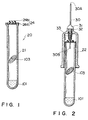
- Fig. 1 is a sectional view of a blood-collecting tube.
- the blood-collecting tube 20 is composed of a tube body 21 and a film stopper 24.
- the tube 20 is evacuated to negative pressure before blood is sampled from a living body.
- the structure of the stopper 24 will be described later.
- Fig. 2 is a view showing the blood-collecting tube of the embodiment when in use
- Fig. 3 is a view showing a state in which blood is sampled in accordance with the embodiment.
- Numeral 22 denotes a blood-collecting holder having an opening into which the blood-collecting tube 20 is inserted.
- the blood-collecting holder 22 has a piercing needle 30 (hollow) which is secured by screwing a hub 31 onto a threaded portion 32 formed on the holder 22.
- a tip 30A of the piercing needle 30 having a pointed end to facilitate piercing of a living body.
- the piercing needle 30 has another end 30B also equipped with a pointed tip capable of piercing the film stopper 24 of the blood-collecting tube 20.
- the pointed end 30B is covered by a sheath-shaped flexible rubber cap 33.
- the blood-collecting holder When blood is actually collected in the blood-collecting tube, first the blood-collecting holder is used to pierce the living body (a vein), after which the film stopper 24 of the blood-collecting tube 20 is inserted into the holder from the opening thereof so that the pointed end 30B of the piercing needle pierces into the blood-collecting tube 20, whereby blood is collected.
- the film stopper provided in the opening of the blood-collecting tube used particularly in this embodiment use is made of one which, unlike the conventional rubber stopper, is capable of being pierced by the needle body of the blood specimen sampling apparatus and is thin enough so that the needle will not bend when piercing the stopper.
- the film stopper comprises a laminated body of a gas-barrier film having a thickness of 20 - 200 ⁇ m and vulcanized rubber having a thickness of 0.3 - 2 mm.
- the tube body 21 of the blood-collecting tube in this embodiment is made of an acrylonitrile resin and is formed by an extrusion-blowing method (overall length: 100 mm, outer diameter: 14.4 mm, inner diameter: 13.4 mm).
- the film stopper 24 includes a gas-barrier film 24a [an acrylonitrile resin (brand name: Varex 210, manufactured by Mitsui Toatsu) 30 ⁇ m/vapor-deposited aluminum/nylon 15 ⁇ m) that is heated and caused to fuse with the opening of the tube body 21 under reduced pressure, and a natural rubber sheet 24b (diameter: 8 mm), having a thickness of approximately 1mm, bonded to the film by rubber cement.
- the material can be polyethylene, glass, etc.
- a liquid-tight state can be maintained between the interior and exterior of the blood-collecting tube even if the piercing needle is removed after it has pierced the film stopper 24.
- a serum-separating agent 101 whitened by titanium white the main ingredient of which is ⁇ -olefin-dialkylmaleate copolymer is placed inside the tube body of the blood-collecting tube in this embodiment. Further, an unwoven fabric 103 coated with a coagulating-promoting agent is inserted in the tube body.
- a serum layer 100 is produced by this processing.
- the sampling is performed with the blood-collecting tube 20 kept sealed, without using decantation or a pipette. Specifically, after, say, an 18G syringe needle 40 pierces the film stopper 24 from the upper portion of the blood-collecting tube 20 and the needle tip (a cutting edge) reaches the serum layer, a predetermined amount of the serum is sampled (Fig. 4).
- the piercing resistance between the film stopper 24 and the syringe needle 40 can be a problem.
- the piercing resistance between the film stopper 24 and the syringe needle 40 is about 550 g and no difficulties are encountered.
- the piercing resistance in a case where use is made of a stopper consisting of vulcanized butyl rubber or the like is as high as about 2100 g. With such a stopper, problems would arise such as bending of the syringe needle.
- piercing resistance The relationship between piercing resistance and the composition of the stopper used in serum sampling in this embodiment is shown in the table below, which illustrates average values each obtained from measuring piercing resistance five times. Further, A, B and C are shown in the evaluation column, in which A means that the syringe needle did not bend even after performing sampling using 100 blood-collecting tubes, B means that sampling is possible 50 times, and C means that sampling cannot be performed even 10 times.
- the film stopper comprises a gas-barrier film having a thickness of 10 - 200 ⁇ m, and vulcanized rubber or elastomer having a thickness of 0.3 - 2 mm.
- a gas-barrier film whose thickness is less than 10 ⁇ m is too weak in strength, while one whose thickness is greater than 200 ⁇ m offers too much piercing resistance and has adverse effects both at the time of collecting blood and at the time of sampling.
- the thickness of the vulcanized rubber or elastomer which is for providing resealability, is less than 0.3 mm, the result will be a poor resealing property; a thickness in excess of 2 mm results in too much piercing resistance.
- the sampling needle prefferably has a sharp, closed tip, with a hole being provided in the side thereof.
- any point having the resealing rubber will suffice, though it is permissible to pierce the film portion.
- a hole will be formed at the piercing since the film portion does not possess resealability.
- there will be no seal between the sampling needle and the hole and air from the outside will flow into the blood-collecting tube via the gap. Consequently, negative pressure will not develop inside blood-collecting tube at the time of sampling. In other words, the sampling operation can be performed smoothly.
- Fig. 5 illustrates the relationship between the serum sampling apparatus and a measurement section for analytically measuring the serum sample.
- numeral 1 denotes a controller for controlling the overall sampling apparatus and having internally a ROM la storing the operating procedure (see the flowchart of Fig. 7) and a RAM 1b used as a working area.
- Numeral 2 denotes a sampling base having a fixed portion 4 for fixing the blood-collecting tube 20.
- the sampling base 2 has a holding body 3 for fixedly holding a sampling needle 5 (hollow) having a pointed end for extracting serum from the blood-collecting tube 20, an air needle 6 (the interior of which is hollow) having similarly shaped tip for supplying air from the outside, and a sensor unit 8 equipped with a sensor at its distal end in order to detect a serum separating agent.
- the holding body 3 is moved up and down by a motor, not shown.
- Numeral 9 denotes a tube for introducing sampled serum, 10 an electromagnetic valve, 11 a rotary-type pump, and 12 a measurement section for measuring and analyzing sampled serum.
- the amount of blood collected inside the blood-collecting tube 20 is substantially constant. Therefore, when the sensor unit 8 senses the serum-separating agent 101, the positional relationship among the components is fixed in advance in such a manner that the tip of the sampling needle 5 will be situated within the serum layer 100 and the air needle 6 is situated in the air space of the blood-collecting tube 20.
- Numeral 102 denotes a clot layer.
- step S1 when the blood-collecting tube 20 in which the serum layer 100 has been produced by centrifugal separation is secured to the fixed portion 4, the holding body 3 is at rest (step S1) at the position of the broken line in the drawing until a start switch, not shown, is operated. Rather than relying upon a start switch, it is permissible to provide a sensor which senses that the blood-collecting tube 20 has been secured to (or placed on) the fixed portion 4, with sampling being started in response to a signal from this sensor.
- step S2 at which a motor (not shown) is driven to move the holding body 3 downward.
- the controller 1 is receiving a signal from the sensor of the sensor unit 8, with downward movement continuing until the serum-separating agent 101 (white in color) is detected (step S3).
- step S9 When a signal is received from the sensor unit 8 indicating that the serum-separating agent has been detected, the holding body is moved by an amount equal to the difference in distance between the sensor unit and the tip of the needle (step S9).
- the motor is stopped at step S4 to halt movement of the holding body 3.
- step S5 processing for driving the pump is executed (step S6) to supply a predetermined amount of serum to the measurement section 12.
- step S6 processing for driving the pump is executed
- step S7 processing for driving the pump is executed (step S6) to supply a predetermined amount of serum to the measurement section 12.
- step S7 processing for driving the pump is executed (step S6) to supply a predetermined amount of serum to the measurement section 12.
- step S7 processing for driving the pump is executed
- step S7 stopping the pump 11 and the electromagnetic valve 10 (step S7).
- the motor is driven to return the holding body 3 to its starting position, with the motor being stopped when the starting position is attained (step S8).
- Preparations are then made for the next specimen via a cleansing mechanism.
- the serum can be divided up without it reaching the measuring device.
- the blood-collecting tube is kept in a closed state from the time blood is collected until the objective blood specimen is sampled from the blood-collecting tube. During this time, therefore, the blood specimen inside the blood-collecting tube will not spill out and foreign matter will not mix in from the outside.
- sampling of serum is facilitated by introducing an air needle into the blood-collecting tube.
Landscapes
- Health & Medical Sciences (AREA)
- Life Sciences & Earth Sciences (AREA)
- Pathology (AREA)
- General Health & Medical Sciences (AREA)
- Physics & Mathematics (AREA)
- Animal Behavior & Ethology (AREA)
- Public Health (AREA)
- Biomedical Technology (AREA)
- Heart & Thoracic Surgery (AREA)
- Medical Informatics (AREA)
- Molecular Biology (AREA)
- Surgery (AREA)
- Biophysics (AREA)
- Hematology (AREA)
- Engineering & Computer Science (AREA)
- Veterinary Medicine (AREA)
- Chemical & Material Sciences (AREA)
- Analytical Chemistry (AREA)
- Biochemistry (AREA)
- General Physics & Mathematics (AREA)
- Immunology (AREA)
- Hydrology & Water Resources (AREA)
- Measurement Of The Respiration, Hearing Ability, Form, And Blood Characteristics Of Living Organisms (AREA)
- Investigating Or Analysing Biological Materials (AREA)
- Sampling And Sample Adjustment (AREA)
Abstract
Claims (8)
- Procédé de prélèvement d'échantillons sanguins pour prélever un échantillon sanguin dans un tube de collecte de sang (20) comportant un bouchon à film (24) prévu au niveau d'une ouverture du tube, ledit bouchon (24) comprenant une couche de film formant barrière aux gaz (24a) et une couche de caoutchouc (24b) destinée à se refermer hermétiquement sur la couche de film formant barrière aux gaz (24a), ledit tube (20) contenant un échantillon sanguin comportant une couche de sérum (100) et une couche de caillot (102) séparées par une couche d'agent de séparation de sérum (101), comprenant les étapes suivantes:
introduction d'une aiguille (5) ayant une extrémité distale à l'intérieur dudit tube de collecte de sang (20) par déplacement vers le bas d'un élément de maintien (3) qui maintient ladite aiguille (5) et un capteur (8) pour détecter ladite couche d'agent de séparation de sérum (101) depuis l'extérieur du tube (20) dans une position prédéterminée sous ladite extrémité distale de ladite aiguille (5);
détection de ladite couche d'agent de séparation de sérum (101) par ledit capteur (8) tandis que ladite aiguille (5) est introduite à l'intérieur dudit tube de collecte de sang (20) par pénétration au travers dudit bouchon à film (24) de ladite extrémité distale de ladite aiguille (5);
réglage de la position de ladite extrémité distale de ladite aiguille (5) dans la position prédéterminée dans ladite couche de sérum (100) par déplacement dudit élément de maintien (3) d'une distance basée sur la distance relative entre ladite extrémité distale de ladite aiguille (5) et une position de ladite partie détectrice dudit capteur (8) après la détection de ladite couche d'agent de séparation de sérum (101) par ledit capteur (8); et
aspiration depuis ladite couche de sérum (100) seulement d'un échantillon sanguin dans ladite aiguille (5) par ladite partie d'extrémité distale de ladite aiguille (5). - Procédé de prélèvement d'échantillons sanguins selon la revendication 1, caractérisé en ce qu'il comporte en outre une étape de perçage dudit bouchon à film (24) avec une aiguille d'introduction d'air (6) au moins avant l'aspiration de l'échantillon sanguin.
- Procédé de prélèvement d'échantillons sanguins selon la revendication 1 ou 2, caractérisé en ce que ladite couche de film formant barrière aux gaz (24a) a une épaisseur de 10 à 200 µm et ladite couche de caoutchouc (24b) a une épaisseur de 0,3 à 2 mm.
- Appareil de prélèvement d'échantillons sanguins pour prélever un échantillon sanguin dans un tube de collecte de sang (20) comportant un bouchon à film (24) prévu au niveau d'une ouverture du tube, ledit bouchon (24) comprenant une couche de film formant barrière aux gaz (24a) et une couche de caoutchouc (24b) destinée à se refermer sur la couche de film formant barrière aux gaz (24a), ledit tube (20) contenant un échantillon sanguin comportant une couche de sérum (100) et une couche de caillot (102) séparées par une couche d'agent de séparation de sérum (101), comprenant:
un dispositif d'introduction pour introduire une aiguille (5) ayant une extrémité distale à l'intérieur dudit tube de collecte de sang (20) par déplacement vers le bas d'un élément de maintien (3) qui maintient ladite aiguille (5) et un capteur (8) pour détecter ladite couche d'agent de séparation de sérum (101) depuis l'extérieur du tube (20) dans une position prédéterminée sous ladite extrémité distale de ladite aiguille (5);
un dispositif de détection pour détecter ladite couche d'agent de séparation de sérum (101) par ledit capteur (8) tandis que ledit dispositif d'introduction introduit ladite aiguille (5) à l'intérieur dudit tube de collecte de sang (20) par pénétration au travers dudit bouchon à film (24) de ladite extrémité distale de ladite aiguille (5);
un dispositif de réglage pour régler la position de ladite extrémité distale de ladite aiguille (5) dans la position prédéterminée dans ladite couche de sérum (100) par déplacement dudit élément de maintien (3) d'une distance basée sur la distance relative entre ladite extrémité distale de ladite aiguille (5) et une position de ladite partie détectrice dudit capteur (8) après la détection dudit agent de séparation de sérum (101) par ledit capteur (8);
un dispositif d'aspiration pour aspirer depuis ladite couche de sérum (100) seulement un échantillon sanguin dans ladite aiguille (5) par ladite partie d'extrémité distale de ladite aiguille (5). - Appareil de prélèvement d'échantillons sanguins selon la revendication 4, caractérisé en ce que le dispositif de prélèvement comprend une aiguille d'introduction d'air (6) capable d'introduire de l'air dans le tube de collecte de sang (20) depuis l'extérieur de celui-ci.
- Appareil de prélèvement d'échantillons sanguins selon la revendication 4 ou 5, caractérisé en ce que l'échantillon sanguin prélevé est du sérum et le dispositif de détection détecte une interface entre une couche de sérum sanguin (100) et une couche de caillot (102), l'opération de pénétration du dispositif de prélèvement étant arrêtée sur la base des résultats de la détection accomplie par le dispositif de détection.
- Appareil de prélèvement d'échantillons sanguins selon la revendication 6, caractérisé en ce que le dispositif de détection détecte un dispositif de séparation de sérum sanguin situé à l'interface entre la couche de sérum sanguin (100) et la couche de caillot (102) dans le tube de collecte de sang (20).
- Appareil de prélèvement d'échantillons sanguins selon l'une quelconque des revendications 4 à 7, caractérisé en ce que ladite couche de film formant barrière aux gaz (24a) a une épaisseur de 10 à 200 µm et ladite couche de caoutchouc (24b) a une épaisseur de 0,3 à 2 mm.
Applications Claiming Priority (3)
| Application Number | Priority Date | Filing Date | Title |
|---|---|---|---|
| JP62150241A JPS63315033A (ja) | 1987-06-18 | 1987-06-18 | 血液試料の採取方法及びその装置 |
| JP150241/87 | 1987-06-18 | ||
| PCT/JP1988/000605 WO1988010414A1 (fr) | 1987-06-18 | 1988-06-17 | Procede et appareil de prelevement d'echantillons sanguins |
Publications (3)
| Publication Number | Publication Date |
|---|---|
| EP0363485A1 EP0363485A1 (fr) | 1990-04-18 |
| EP0363485A4 EP0363485A4 (en) | 1991-03-20 |
| EP0363485B1 true EP0363485B1 (fr) | 1994-08-31 |
Family
ID=15492648
Family Applications (1)
| Application Number | Title | Priority Date | Filing Date |
|---|---|---|---|
| EP88905446A Expired - Lifetime EP0363485B1 (fr) | 1987-06-18 | 1988-06-17 | Procede et appareil de prelevement d'echantillons sanguins |
Country Status (6)
| Country | Link |
|---|---|
| US (1) | US5201794A (fr) |
| EP (1) | EP0363485B1 (fr) |
| JP (1) | JPS63315033A (fr) |
| AU (1) | AU609841B2 (fr) |
| DE (1) | DE3851329T2 (fr) |
| WO (1) | WO1988010414A1 (fr) |
Families Citing this family (29)
| Publication number | Priority date | Publication date | Assignee | Title |
|---|---|---|---|---|
| FR2624757B1 (fr) * | 1987-12-17 | 1990-05-25 | Roussel Uclaf | Dispositif assurant l'extraction d'une phase distincte |
| JP2679834B2 (ja) * | 1989-01-27 | 1997-11-19 | テルモ株式会社 | 採血管のフィルム状栓部材の開封装置 |
| US5055271A (en) * | 1989-07-24 | 1991-10-08 | Helena Laboratories Corporation | Pump inserter for test tubes |
| DE4212821C2 (de) * | 1991-04-19 | 1994-07-28 | Olympus Optical Co | Vorrichtung zum Entfernen eines Verschlusses von der Öffnung eines Behälters und zur Entnahme von flüssigen Inhalten |
| US5525298A (en) * | 1991-04-19 | 1996-06-11 | Olympus Optical Co., Ltd. | Apparatus for taking liquid content for use in analysis out of container |
| CA2088682A1 (fr) * | 1991-06-18 | 1992-12-19 | Nicolae Paraschiv | Aiguille a ponction avec cartouche de protection, remplacable et demontable |
| FR2719118B1 (fr) * | 1994-04-20 | 1996-05-24 | Commissariat Energie Atomique | Appareil et procédé de dilution d'une solution. |
| SE9402812D0 (sv) * | 1994-08-19 | 1994-08-19 | Karl Erik Sundstroem | Bloodcollection, plasmaseparation and high precision plasma dispensing device |
| US5554151A (en) * | 1994-09-27 | 1996-09-10 | United States Surgical Corporation | Specimen retrieval container |
| US6533760B2 (en) | 2000-05-02 | 2003-03-18 | Becton, Dickinson And Company | Flashback blood collection needle |
| GB0104177D0 (en) * | 2001-02-20 | 2001-04-11 | Isis Innovation | Aryl-aryl dendrimers |
| FR2821672B1 (fr) * | 2001-03-02 | 2003-05-02 | Scp Dosagene R & D | Moyens pour l'extraction de produits a analyser et leurs applications en diagnostic et analyse |
| US6712792B2 (en) | 2001-05-02 | 2004-03-30 | Becton, Dickinson And Company | Flashback blood collection needle |
| SG121744A1 (en) | 2002-11-06 | 2006-05-26 | Becton Dickinson Co | Flashback blood collection needle with needle shield |
| AU2003903254A0 (en) * | 2003-06-27 | 2003-07-10 | Invetech Pty Ltd | Method and apparatus for sampling a fluid |
| US7396343B2 (en) * | 2004-05-03 | 2008-07-08 | Clear View Patient Safty Products, Llc | Blood drawing device with flash detection |
| US7160267B2 (en) * | 2004-05-03 | 2007-01-09 | Clear View Patent Safety Products, Llc | Blood drawing device with flash detection |
| US7530967B2 (en) * | 2004-05-03 | 2009-05-12 | Clearview Patient Safety Technologies, Llc | Porous multiple sample sleeve and blood drawing device for flash detection |
| US20050273019A1 (en) * | 2004-06-02 | 2005-12-08 | Becton, Dickinson And Company | Blood collection set with venting mechanism |
| EP1602328A1 (fr) * | 2004-06-02 | 2005-12-07 | Becton, Dickinson and Company | Aiguille de prélèvement de sang avec reflux sanguin |
| ES2362188T3 (es) | 2004-08-16 | 2011-06-29 | Becton, Dickinson And Company | Aguja de extracción de sangre con área de visualización de reflujo o "flashback". |
| US20060129064A1 (en) * | 2004-11-29 | 2006-06-15 | Becton, Dickinson And Company | Blood collection set with an expanded internal volume |
| EP2132576B1 (fr) * | 2007-03-30 | 2016-08-17 | Instrumentation Laboratory Company | Adaptateur pour fiole a echantillon |
| US8387810B2 (en) | 2007-04-16 | 2013-03-05 | Becton, Dickinson And Company | Pierceable cap having piercing extensions for a sample container |
| US8387811B2 (en) * | 2007-04-16 | 2013-03-05 | Bd Diagnostics | Pierceable cap having piercing extensions |
| US9066690B2 (en) * | 2007-09-27 | 2015-06-30 | Covidien Lp | Blood collection needle assembly |
| CN108378858A (zh) * | 2018-02-13 | 2018-08-10 | 宫婷 | 一种兽医用动物血样采集装置 |
| CN111839549B (zh) * | 2020-07-06 | 2024-07-12 | 广东昊朗医疗科技有限责任公司 | 一种精确定量抽取血液样本的装置 |
| CN116369916B (zh) * | 2023-06-01 | 2023-08-08 | 南昌大学第一附属医院 | 一种可控式采血系统 |
Citations (2)
| Publication number | Priority date | Publication date | Assignee | Title |
|---|---|---|---|---|
| JPS59638A (ja) * | 1982-06-26 | 1984-01-05 | Toshiba Corp | サンプリングユニツト |
| JPS612037A (ja) * | 1984-06-15 | 1986-01-08 | Hitachi Ltd | 懸濁液層分取装置 |
Family Cites Families (33)
| Publication number | Priority date | Publication date | Assignee | Title |
|---|---|---|---|---|
| US2734649A (en) * | 1956-02-14 | Moistureproof vial closure | ||
| US2457120A (en) * | 1944-11-28 | 1948-12-28 | Baxter Laboratories Inc | Container and method of using same |
| US3092278A (en) * | 1957-09-20 | 1963-06-04 | Astra Apotekarnes Kem Fab | Cap for a container for an injection liquid |
| US3198368A (en) * | 1963-07-24 | 1965-08-03 | Abbott Lab | Container closure |
| US3463339A (en) * | 1966-04-25 | 1969-08-26 | Hamilton Co | Sealing element |
| US3424329A (en) * | 1967-06-21 | 1969-01-28 | Schering Corp | Sealed injection vial |
| FR2120300A5 (fr) * | 1970-12-29 | 1972-08-18 | Hoffmann La Roche | |
| US3872730A (en) * | 1972-03-10 | 1975-03-25 | Becton Dickinson Co | Sampling apparatus |
| US4111326A (en) * | 1976-03-04 | 1978-09-05 | Becton, Dickinson And Company | Closure for air evacuated container |
| JPS5339185A (en) * | 1976-09-21 | 1978-04-10 | Omron Tateisi Electronics Co | Separately sampling apparatus of blood serum |
| JPS53106077A (en) * | 1977-02-28 | 1978-09-14 | Nippon Steel Corp | Temperature measuring method of drawing materials in drawing line |
| JPS6013465B2 (ja) * | 1978-04-26 | 1985-04-08 | 麒麟麦酒株式会社 | プラスチツク製ボトルクレ−トの材質別選別装置 |
| JPS5552363U (fr) * | 1978-05-30 | 1980-04-07 | ||
| DE2834186C2 (de) * | 1978-08-04 | 1980-04-24 | Bodenseewerk Perkin-Elmer & Co Gmbh, 7770 Ueberlingen | Verschluß fur Probenflaschen |
| US4254884A (en) * | 1978-10-20 | 1981-03-10 | Toppan Printing Co., Ltd. | Plug body for a container |
| US4274453A (en) * | 1979-02-21 | 1981-06-23 | Southland Instruments, Inc. | Aseptic fluid transfer |
| JPS56119254A (en) * | 1980-02-25 | 1981-09-18 | Takeda Chemical Industries Ltd | Rubber stopper for vial |
| JPS5817430B2 (ja) * | 1980-05-13 | 1983-04-07 | テルモ株式会社 | 液体採取装置 |
| JPS57113364A (en) * | 1980-12-31 | 1982-07-14 | Joko:Kk | Reaction container |
| AT368389B (de) * | 1981-02-27 | 1982-10-11 | C A Greiner Und Soehne Ges M B | Mit einer dichtung verschlossenes, evakuierbares blutprobenroehrchen |
| US4478095A (en) * | 1981-03-09 | 1984-10-23 | Spectra-Physics, Inc. | Autosampler mechanism |
| JPS59637A (ja) * | 1982-06-25 | 1984-01-05 | Fujita Gakuen | 上層液の分取装置 |
| JPS5955240A (ja) * | 1982-09-24 | 1984-03-30 | テルモ株式会社 | 採血管 |
| JPS59187262A (ja) * | 1983-04-08 | 1984-10-24 | Terumo Corp | 血液分離管 |
| JPS6013465A (ja) * | 1983-07-04 | 1985-01-23 | Sankyo Seiki Mfg Co Ltd | リニアステツピングモ−タ |
| JPS6013465U (ja) * | 1983-07-07 | 1985-01-29 | 株式会社 柳本製作所 | 液体試料自動注入装置における密封型試料ビンの減圧防止機構 |
| JPS6027836A (ja) * | 1983-07-26 | 1985-02-12 | Denki Kagaku Keiki Co Ltd | 試料自動採取供給装置 |
| JPS60108754A (ja) * | 1983-11-18 | 1985-06-14 | Shimadzu Corp | リンパ球液分取装置 |
| AT379069B (de) * | 1984-01-11 | 1985-11-11 | Greiner & Soehne C A | Blutprobenroehrchen |
| US4577514A (en) * | 1984-04-09 | 1986-03-25 | Vanderbilt University | Method and apparatus for sampling liquid phase components from a liquid-semisolid fluid |
| JPS61247459A (ja) * | 1985-04-25 | 1986-11-04 | テルモ株式会社 | 医療容器用栓体 |
| US4811611A (en) * | 1985-09-03 | 1989-03-14 | Technicon Instruments Corporation | Apparatus and method for pressure equalization in closed tube sampler |
| US4873875A (en) * | 1986-06-27 | 1989-10-17 | Prism Technology, Inc. | System for optically interrogating liquid samples and for withdrawing selected sample portions |
-
1987
- 1987-06-18 JP JP62150241A patent/JPS63315033A/ja active Pending
-
1988
- 1988-06-17 WO PCT/JP1988/000605 patent/WO1988010414A1/fr not_active Ceased
- 1988-06-17 EP EP88905446A patent/EP0363485B1/fr not_active Expired - Lifetime
- 1988-06-17 DE DE3851329T patent/DE3851329T2/de not_active Expired - Lifetime
- 1988-06-17 AU AU19537/88A patent/AU609841B2/en not_active Ceased
-
1992
- 1992-02-05 US US07/830,992 patent/US5201794A/en not_active Expired - Lifetime
Patent Citations (2)
| Publication number | Priority date | Publication date | Assignee | Title |
|---|---|---|---|---|
| JPS59638A (ja) * | 1982-06-26 | 1984-01-05 | Toshiba Corp | サンプリングユニツト |
| JPS612037A (ja) * | 1984-06-15 | 1986-01-08 | Hitachi Ltd | 懸濁液層分取装置 |
Also Published As
| Publication number | Publication date |
|---|---|
| DE3851329D1 (de) | 1994-10-06 |
| AU609841B2 (en) | 1991-05-09 |
| AU1953788A (en) | 1989-01-19 |
| DE3851329T2 (de) | 1994-12-22 |
| WO1988010414A1 (fr) | 1988-12-29 |
| JPS63315033A (ja) | 1988-12-22 |
| EP0363485A4 (en) | 1991-03-20 |
| US5201794A (en) | 1993-04-13 |
| EP0363485A1 (fr) | 1990-04-18 |
Similar Documents
| Publication | Publication Date | Title |
|---|---|---|
| EP0363485B1 (fr) | Procede et appareil de prelevement d'echantillons sanguins | |
| US4962041A (en) | Method and apparatus for automatic processing and analyzing of blood serum | |
| US5312009A (en) | Liquid specimen collector with removable extraction device | |
| US3508653A (en) | Method and apparatus for fluid handling and separation | |
| US4393881A (en) | Midstream urine collection device | |
| US6755802B2 (en) | Whole blood sampling device | |
| US5284570A (en) | Fluid sample analyte collector and calibration assembly | |
| US5270219A (en) | Fluid transfer device | |
| JP2596963B2 (ja) | 液体試試料の分離方法及び分離装置 | |
| JP2511606B2 (ja) | 密封容器からピペットで液体を取り出す方法および装置 | |
| JPS5932732B2 (ja) | 血球沈降速度測定装置 | |
| US4893636A (en) | Medical container stopper | |
| US8926582B2 (en) | Sealing cap for a body fluid container and a blood collection device | |
| EP3411709B1 (fr) | Agencement de collecte et de séparation d'un fluide corporel à des fins d'analyse et procédé associé | |
| EP0587347A1 (fr) | Raccord pour des récipients d'inoculation | |
| CN1294675A (zh) | 改进的尿样容器及其使用方法 | |
| EP0058440B1 (fr) | Dispositif pour le prélèvement d'échantillons sanguins | |
| US20040022687A1 (en) | Device and process for collecting and releasing saliva | |
| JP2711121B2 (ja) | 血液サンプルを採集し貯蔵する単一使用装置 | |
| US3937213A (en) | Body fluid collection device | |
| US6050956A (en) | Hemolyzing tube and a method of preparing a hemolysis blood sample within tube | |
| JP4206200B2 (ja) | 閉じた容器から液体サンプルを抽出する方法および装置 | |
| EP0987534A2 (fr) | Procédé et appareil de prélèvement d'un échantillon d'un tube fermé | |
| US5869158A (en) | Safety sampler | |
| CN116519968B (zh) | 一种一体化多试剂样本混合加样装置 |
Legal Events
| Date | Code | Title | Description |
|---|---|---|---|
| PUAI | Public reference made under article 153(3) epc to a published international application that has entered the european phase |
Free format text: ORIGINAL CODE: 0009012 |
|
| 17P | Request for examination filed |
Effective date: 19891215 |
|
| AK | Designated contracting states |
Kind code of ref document: A1 Designated state(s): BE DE FR GB IT SE |
|
| A4 | Supplementary search report drawn up and despatched |
Effective date: 19910128 |
|
| AK | Designated contracting states |
Kind code of ref document: A4 Designated state(s): BE DE FR GB IT SE |
|
| 17Q | First examination report despatched |
Effective date: 19921207 |
|
| RBV | Designated contracting states (corrected) |
Designated state(s): DE FR GB |
|
| GRAA | (expected) grant |
Free format text: ORIGINAL CODE: 0009210 |
|
| AK | Designated contracting states |
Kind code of ref document: B1 Designated state(s): DE FR GB |
|
| REF | Corresponds to: |
Ref document number: 3851329 Country of ref document: DE Date of ref document: 19941006 |
|
| ET | Fr: translation filed | ||
| PLBE | No opposition filed within time limit |
Free format text: ORIGINAL CODE: 0009261 |
|
| STAA | Information on the status of an ep patent application or granted ep patent |
Free format text: STATUS: NO OPPOSITION FILED WITHIN TIME LIMIT |
|
| 26N | No opposition filed | ||
| REG | Reference to a national code |
Ref country code: GB Ref legal event code: IF02 |
|
| PGFP | Annual fee paid to national office [announced via postgrant information from national office to epo] |
Ref country code: DE Payment date: 20070614 Year of fee payment: 20 |
|
| PGFP | Annual fee paid to national office [announced via postgrant information from national office to epo] |
Ref country code: GB Payment date: 20070613 Year of fee payment: 20 |
|
| PGFP | Annual fee paid to national office [announced via postgrant information from national office to epo] |
Ref country code: FR Payment date: 20070608 Year of fee payment: 20 |
|
| REG | Reference to a national code |
Ref country code: GB Ref legal event code: PE20 Expiry date: 20080616 |
|
| PG25 | Lapsed in a contracting state [announced via postgrant information from national office to epo] |
Ref country code: GB Free format text: LAPSE BECAUSE OF EXPIRATION OF PROTECTION Effective date: 20080616 |