EP0363634B1 - Kraftfahrzeug-Bremsgerät unter Benutzung des Gaspedals - Google Patents
Kraftfahrzeug-Bremsgerät unter Benutzung des Gaspedals Download PDFInfo
- Publication number
- EP0363634B1 EP0363634B1 EP89116388A EP89116388A EP0363634B1 EP 0363634 B1 EP0363634 B1 EP 0363634B1 EP 89116388 A EP89116388 A EP 89116388A EP 89116388 A EP89116388 A EP 89116388A EP 0363634 B1 EP0363634 B1 EP 0363634B1
- Authority
- EP
- European Patent Office
- Prior art keywords
- accelerator pedal
- displacement
- treading force
- predetermined
- value
- Prior art date
- Legal status (The legal status is an assumption and is not a legal conclusion. Google has not performed a legal analysis and makes no representation as to the accuracy of the status listed.)
- Expired - Lifetime
Links
Images







Classifications
-
- G—PHYSICS
- G05—CONTROLLING; REGULATING
- G05G—CONTROL DEVICES OR SYSTEMS INSOFAR AS CHARACTERISED BY MECHANICAL FEATURES ONLY
- G05G1/00—Controlling members, e.g. knobs or handles; Assemblies or arrangements thereof; Indicating position of controlling members
- G05G1/30—Controlling members actuated by foot
- G05G1/46—Means, e.g. links, for connecting the pedal to the controlled unit
-
- B—PERFORMING OPERATIONS; TRANSPORTING
- B60—VEHICLES IN GENERAL
- B60K—ARRANGEMENT OR MOUNTING OF PROPULSION UNITS OR OF TRANSMISSIONS IN VEHICLES; ARRANGEMENT OR MOUNTING OF PLURAL DIVERSE PRIME-MOVERS IN VEHICLES; AUXILIARY DRIVES FOR VEHICLES; INSTRUMENTATION OR DASHBOARDS FOR VEHICLES; ARRANGEMENTS IN CONNECTION WITH COOLING, AIR INTAKE, GAS EXHAUST OR FUEL SUPPLY OF PROPULSION UNITS IN VEHICLES
- B60K26/00—Arrangement or mounting of propulsion-unit control devices in vehicles
-
- B—PERFORMING OPERATIONS; TRANSPORTING
- B60—VEHICLES IN GENERAL
- B60W—CONJOINT CONTROL OF VEHICLE SUB-UNITS OF DIFFERENT TYPE OR DIFFERENT FUNCTION; CONTROL SYSTEMS SPECIALLY ADAPTED FOR HYBRID VEHICLES; ROAD VEHICLE DRIVE CONTROL SYSTEMS FOR PURPOSES NOT RELATED TO THE CONTROL OF A PARTICULAR SUB-UNIT
- B60W10/00—Conjoint control of vehicle sub-units of different type or different function
- B60W10/04—Conjoint control of vehicle sub-units of different type or different function including control of propulsion units
-
- B—PERFORMING OPERATIONS; TRANSPORTING
- B60—VEHICLES IN GENERAL
- B60W—CONJOINT CONTROL OF VEHICLE SUB-UNITS OF DIFFERENT TYPE OR DIFFERENT FUNCTION; CONTROL SYSTEMS SPECIALLY ADAPTED FOR HYBRID VEHICLES; ROAD VEHICLE DRIVE CONTROL SYSTEMS FOR PURPOSES NOT RELATED TO THE CONTROL OF A PARTICULAR SUB-UNIT
- B60W10/00—Conjoint control of vehicle sub-units of different type or different function
- B60W10/04—Conjoint control of vehicle sub-units of different type or different function including control of propulsion units
- B60W10/06—Conjoint control of vehicle sub-units of different type or different function including control of propulsion units including control of combustion engines
-
- B—PERFORMING OPERATIONS; TRANSPORTING
- B60—VEHICLES IN GENERAL
- B60W—CONJOINT CONTROL OF VEHICLE SUB-UNITS OF DIFFERENT TYPE OR DIFFERENT FUNCTION; CONTROL SYSTEMS SPECIALLY ADAPTED FOR HYBRID VEHICLES; ROAD VEHICLE DRIVE CONTROL SYSTEMS FOR PURPOSES NOT RELATED TO THE CONTROL OF A PARTICULAR SUB-UNIT
- B60W10/00—Conjoint control of vehicle sub-units of different type or different function
- B60W10/18—Conjoint control of vehicle sub-units of different type or different function including control of braking systems
-
- B—PERFORMING OPERATIONS; TRANSPORTING
- B60—VEHICLES IN GENERAL
- B60W—CONJOINT CONTROL OF VEHICLE SUB-UNITS OF DIFFERENT TYPE OR DIFFERENT FUNCTION; CONTROL SYSTEMS SPECIALLY ADAPTED FOR HYBRID VEHICLES; ROAD VEHICLE DRIVE CONTROL SYSTEMS FOR PURPOSES NOT RELATED TO THE CONTROL OF A PARTICULAR SUB-UNIT
- B60W30/00—Purposes of road vehicle drive control systems not related to the control of a particular sub-unit, e.g. of systems using conjoint control of vehicle sub-units
- B60W30/18—Propelling the vehicle
- B60W30/1819—Propulsion control with control means using analogue circuits, relays or mechanical links
-
- B—PERFORMING OPERATIONS; TRANSPORTING
- B60—VEHICLES IN GENERAL
- B60W—CONJOINT CONTROL OF VEHICLE SUB-UNITS OF DIFFERENT TYPE OR DIFFERENT FUNCTION; CONTROL SYSTEMS SPECIALLY ADAPTED FOR HYBRID VEHICLES; ROAD VEHICLE DRIVE CONTROL SYSTEMS FOR PURPOSES NOT RELATED TO THE CONTROL OF A PARTICULAR SUB-UNIT
- B60W2710/00—Output or target parameters relating to a particular sub-units
- B60W2710/06—Combustion engines, Gas turbines
- B60W2710/0605—Throttle position
Definitions
- the present invention relates to a motor vehicle braking apparatus according to the preamble of claim 1 using accelerator pedal arranged such that the brakes are applied when the accelerator pedal of a motor vehicle is trodden with a treading force/displacement not smaller than a predetermined value.
- the brakes are conventionally applied with the use of the brake pedal and the parking brake both independent from the accelerator pedal.
- the Japanese Patent Laid-Open Publication JP-A-54-155529 discloses an apparatus in which the accelerator pedal treading force and treading speed are detected, and in which, if the pedal is once trodden with a treading force or a treading speed equal to or greater than a predetermined value, the engine throttle valve is thereafter closed in a continuous manner to apply the brakes, causing the motor vehicle to be emergently stopped.
- JP-U-61-47762 discloses an apparatus in which the engine accelerator is continuously stopped upon detection of an accelerator pedal speed or acceleration speed equal to or greater than a predetermined value, and in which, upon detection of a treading displacement equal to or greater than a predetermined value, the brakes are continuously applied to emergently stop the motor vehicle.
- the state where engine acceleration is stopped is maintained to apply the brakes even though the factor above-mentioned thereafter becomes below the predetermined value concerned.
- Such application of the brakes is continued until a specified release operation is carried out, for example, by turning OFF the ignition switch (Japanese Patent Laid-Open Publication JP-A-54-155529), or by once releasing the accelerator pedal and treading it again (Japanese Utility Model Publication JP-U-61-47762).
- the motor vehicle may be automatically stopped even though, after the driver has carried out an emergent operation when it is required to emergently stop the motor vehicle, he falls, due to an accident or the like, into the state where he cannot further operate the motor vehicle.
- This enables the motor vehicle to be securely stopped in case of emergency.
- these apparatus also involve the likelihood that, when the accelerator pedal is suddenly strongly or deeply trodden with the intention of, for example, rapid acceleration at the time it is not required to emergently stop the motor vehicle, the emergent brakes are applied to provoke an accident.
- the Japanese Utility Model JP-U-61-47762 discloses, as an embodiment of the invention, a mechanism incorporating a spring adapted to start compression at a position slightly higher than the accelerator pedal displacement position at which the emergent brakes are applied.
- the driver may become aware of the emergent braking start position.
- it is also difficult that such provision securely prevents the driver from erroneously treading the pedal.
- the present invention is proposed with the object of providing an emergent braking apparatus for a motor vehicle which overcomes the defects of the conventional inventions above-mentioned.
- the present invention provides a motor vehicle braking apparatus using accelerator pedal having a characteristic set forth in any of appended Claims 1 to 11.
- Apparatus of Claim 1 is operated as outlined below.
- the accelerator pedal is adapted to serve as a normal accelerator pedal when the driver treads it with a treading force/displacement equal to or smaller than a predetermined value. If the driver further treads the accelerator pedal with a treading force/displacement greater than the predetermined value, the engine throttle valve is closed. If the accelerator pedal is further trodden to an extent exceeding a predetermined limit, the brakes are applied. The braking force is adjusted according to the depth to which the accelerator pedal is trodden. When the accelerator pedal is trodden to an extent exceeding the predetermined limit, the accelerator pedal serves as a brake pedal. When the accelerator pedal treading is released to an extent exceeding a predetermined limit, the application of the brakes is released. However, the engine throttle valve still remains closed. After the accelerator pedal treading force has been released to an extent near the level where the pedal is fully released, the accelerator pedal serves as a normal accelerator pedal.
- the system of the present invention is simpler in operation since such function is selected according to the treading force or depth applied to the same position. Accordingly, this reduces the likelihood that the driver erroneously treads the pedal in case of emergency.
- the same accelerator pedal may be used for applying the brakes not only in case of emergency, but also at normal conditions.
- Apparatus of Claim 2 additionally includes reaction force generating means arranged such that the accelerator pedal reaction force is suddenly increased when the accelerator pedal is trodden, in the apparatus of Claim 1, from the treading force/depth level at which the accelerator pedal serves as a normal accelerator pedal, to the treading force/depth level slightly smaller/shallower than the treading force/depth level at which the engine throttle valve is closed.
- a sudden increase in accelerator pedal reaction force enables the driver to become aware, more securely than the conventional invention (Japanese Utility-Model Laid-Open Publication JP-U-61-47762), of the fact that the accelerator pedal is currently brought to a state immediately before the state where it loses the function of a normal accelerator pedal. This eliminates the danger that the driver erroneously treads the pedal when he has no intention of applying the brakes.
- Apparatus of Claim 3 is arranged such that, when the accelerator pedal is trodden, in the apparatus of Claim 1 or 2, strongly or deeply in the pedal operation which does not yet apply the brakes, the subsequent enlargement of the engine throttle valve opening degree is delayed by a predetermined period of time (for example, 0.5 second). Accordingly, when the accelerator pedal is trodden, at a speed equal to or higher than a predetermined speed, to an extent that the brakes are applied, the brakes may be applied without acceleration of the motor vehicle. Accordingly, it is further facilitated to apply the brakes with the use of one accelerator pedal, not only in case of emergency but also at normal conditions.
- a predetermined period of time for example, 0.5 second
- Apparatus of Claim 4, 5 or 6 is arranged such that, when, in the operation of the apparatus of Claim 1, the accelerator pedal is further trodden strongly or deeply to an extent exceeding a predetermined limit where the accelerator pedal serves as a brake pedal, the maximized brakes are applied and such application is continued until a predetermined release operation is carried out. More specifically, the motor vehicle may be emergently stopped by treading the accelerator pedal strongly or deeply. According to the apparatus, there is provided a treading range where the braking force varies with the accelerator pedal treading force or depth and where the accelerator pedal serves as a normal brake pedal, before the maximized brakes are applied. This reduces the danger that the driver erroneously treads the pedal to brake the motor vehicle to an unnecessary emergent stop.
- Apparatus of Claim 7 is arranged such that, when the accelerator pedal is trodden, in the apparatus of Claim 4, 5 or 6, continuously for a predetermined period of time to an extent of a predetermined limit that the accelerator pedal serves as a brake pedal, the maximized brakes are applied and such application is maintained until a predetermined release operation is carried out.
- the apparatus of Claim 7 achieves operational effects similar to those of the apparatus of Claim 4, 5 or 6. Further, according to the apparatus of Claim 7, when, after the driver has erroneously trodden, against his own will, the accelerator pedal so strongly or deeply that the maximized brakes are applied, the accelerator pedal treading force is weakened in a short period of time, the application of the maximized brakes is not continued. This further reduces the danger of unnecessary emergent stop due to erroneous pedal treading.
- Apparatus of Claim 8 further includes, in the apparatus of Claim 4, 5 or 6, a shock sensor for detecting a shock, if any, exerted to the motor vehicle.
- a shock sensor for detecting a shock, if any, exerted to the motor vehicle.
- the apparatus of Claim 8 may detect the shock exerted at the time of collision so that the application of the maximized brakes is maintained to automatically stop the motor vehicle.
- the accelerator pedal when the driver erroneously treads, against his own will, the accelerator pedal so strongly or deeply as to apply the maximized brakes and, at that time, no shock is exerted to the motor vehicle due to collision or the like, the accelerator pedal treading force may be weakened so that the application of the maximized brakes is not maintained. This reduces the likelihood that an erroneous pedal treading results in unnecessary emergent stop.
- Apparatus of Claim 9 further includes, in the apparatus of Claim 4, 5 or 6, an alarm device adapted to give a light or sound alarm when the accelerator pedal is trodden so strongly or deeply as to apply the maximized brakes. According to the apparatus of Claim 9, if the maximized brakes are applied, the fact that the motor vehicle is under emergent stop may be automatically informed both inside and outside of the vehicle.
- the brakes are applied, in the apparatus of Claim 1, 2, 4, 5 or 6, according to anti-lock control.
- This enables the brakes to be emergently applied with the steering ability assured at all times.
- the safety may be particularly improved when the maximized brakes are applied to emergently stop the vehicle, in the apparatus of Claim 4, 5 or 6.
- Apparatus of Claim 11 is arranged such that, when the accelerator pedal is trodden, in the apparatus of Claim 1, 2, 4, 5 or 6, to an extent exceeding a predetermined range, the clutch is disconnected at the same time when the engine throttle valve is closed. Accordingly, when the driver erroneously treads, against his own will, the accelerator pedal so strongly that the accelerator pedal loses its normal accelerator function, there is no possibility of sudden reduction in speed due to the fact that the engine throttle valve is closed. This enhances the safety.
- the clutch is adapted to be connected again when the accelerator pedal is so restored as to serve as a normal accelerator pedal.
- the driver is not required to change the pedal to be trodden, from the accelerator pedal to the brake pedal, when applying the brakes to the motor vehicle in case of emergency. This not only reduces the distance of vehicle travelling made while such pedal change is carried out, but also prevents an accident due to erroneous pedal treading.
- the driver may apply the brakes with the use of the same accelerator pedal. This is particularly convenient when frequent braking and acceleration are repeatedly required.
- the apparatus of the present invention may reduce the likelihood that the driver erroneously applies the brakes even though he intends to carry out acceleration.
- Fig. 1 shows a block diagram of an embodiment of apparatus in accordance with Claim 1.
- component elements designated by 1, 2, 4, 5, 6 and 7 may be readily arranged according to prior arts, or they are known per se.
- a control device 3 is composed of an electronic circuit including a micro-processor, a memory and an input/output interface, and is adapted to be operated according to a program previously written in the memory.
- a treading force/displacement detector 2 is operatively connected to an accelerator pedal 1 for detecting a treading force/displacement.
- the treading force/displacement detector 2 may be readily formed by a load sensor, a potentiometer and the like known per se.
- the control device 3 is adapted to read a detection signal (for example, a signal converted into a voltage) supplied from the treading force/displacement detector 2.
- the control device 3 supplies an electric signal (for example, a voltage signal) for instructing the operations of an engine throttle valve drive 4 and a brake fluid pressure generator 6.
- the engine throttle valve drive device 4 and the brake fluid pressure generator 6 respectively drive an engine throttle valve 5 and brakes 7.
- the throttle valve drive device 4 comprises an actuator for converting an electric signal (for example, a voltage signal) supplied from the control device 3 into a mechanical operation for driving the throttle valve.
- the throttle valve drive device 4 may be readily arranged according to prior arts.
- the brake fluid pressure generator 6 is adapted to convert an electric signal (for example, a voltage signal) supplied from the control device 3, into a brake fluid pressure for driving the brakes.
- the brake fluid pressure generator 6 is also a kind of an actuator known per se.
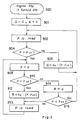
- Fig. 2 is a flowchart illustrating the operations of the control device 3.
- an engine throttle valve opening degree indicating value S and a brake fluid pressure indicating value B are initialized to zero at a step 901.
- an accelerator pedal treading force/displacement F detected by the device 2 is read (902).
- the detected value F is compared in size with a predetermined set value F c1 (greater than zero). If the detected value F is equal to or smaller than F c1 , the sequence proceeds to a step 906.
- the throttle valve drive device 4 is operated to open the throttle valve according to the opening degree proportional to this indicating value S within a range that the throttle valve is not fully opened.
- the indicating value S is increased such that the throttle valve is fully opened, the throttle valve remains fully opened even though the indicating value S is further increased.
- k s is a positive proportional coefficient
- F c3 is smaller than F c1 and is a positive constant near zero.
- the detected value F is compared in size with a preset value F c2 which is a constant greater than F c1 .
- F c2 a preset value
- the brake fluid pressure generator 6 generates a brake fluid pressure in proportion to this indicating value B.
- the detected value F is read. The sequence is then returned to the step 908.
- step 910 when F is equal to or smaller than F c2 , the sequence proceeds to a step 914, where B is set to zero. This indicates that the brake fluid pressure is to be released.
- step 916 F is compared in size with F c3 . When F is equal to or greater than F c3 , the sequence proceeds to a step 913. When F is smaller than F c3 , the sequence is returned to the step 902.
- the constant k s is set such that the throttle valve is fully opened when, with respect to the constant F c1 , the throttle valve opening degree indicating value S is greater than k s (F c4 - F c3 ) or greater than a value slightly smaller than k s (F c4 - F c3 ). This is also applied to embodiments of the present invention discussed in the following.
- Fig. 3 shows a block diagram of an embodiment of apparatus in accordance with Claim 2.
- reaction force generating means 8 is added to the embodiment shown in Fig. 1.
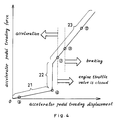
- reaction force generating means 8 there is established the relationship between the accelerator pedal treading force and the accelerator pedal treading displacement, as shown in Fig. 4.
- the treading force is suddenly increased (decreased) as compared with respect to increase (decrease) in treading displacement, at the level of treading force or treading displacement slightly smaller than the treading force or treading displacement which causes the engine throttle valve to be closed.
- the driver may feel such sudden increase, causing him to become aware of the fact that the throttle valve is now about to be closed.
- Fig. 5 shows an example of an accelerator pedal incorporating this reaction force generating means.
- an accelerator pedal 30 has a fulcrum 31 at which the arm of the accelerator pedal 30 is rotatably secured to the vehicle body.
- a return spring 32 for the arm of the accelerator pedal 30.
- Supports 33 are fixedly connected to the vehicle body.
- a spring 34 has repelling power stronger than that of the return spring 32.
- the spring 34 is disposed as compressed.
- a flange 35 is disposed for compressing the spring 34.
- a rod 36 is disposed for transmitting the displacement of the accelerator pedal 30 to the treading displacement detector.
- a flange 37 is fixedly connected to the rod 36 for pushing the flange 35.
- a support member 38 is disposed for determining the position in which the accelerator pedal 30 is located when released. When the accelerator pedal 30 is trodden, the rod 36 is displaced.
- Fig. 4 Shown in Fig. 4 are positions 1 to 4 on the curve corresponding to first to fourth predetermined treading force/displacement values set forth in Claims. Further shown in Fig. 4 is a position 5 corresponding to a fifth predetermined treading force/displacement value, to be discussed later.
- control device 3 in this embodiment is shown in the form of a flowchart in Fig. 2.
- the throttle valve opening degree indicating value S is greater than k s (F c4 - F c3 ) or greater than a value slightly smaller than k s (F c4 - F c3 ).
- FIG. 1 An embodiment of apparatus in accordance with Claim 3 is shown in the form of a block diagram in Fig. 1 or 3.
- Figs. 6 and 7 show, in the form of a flowchart, the operations of a control device 3 of the apparatus of Claim 3.
- added to the apparatus of Claim 1 is a function of delaying, by a predetermined period of time, the opening of the engine throttle valve in response to the accelerator pedal treading.
- the variables are initialized at a step 202. That is, an engine throttle valve opening degree indicating value S, a brake fluid pressure indicating value B, a variable t corresponding to the number of iteration times, and a variable F(0) are set to zero.
- the variable t is renewed to (t+1).
- a treading force/displacement detected value F is read.
- the detected value F is compared with the preset value F c1 . When the detected value F is greater than F c1 , the sequence proceeds to a step 216.
- the engine throttle valve opening degree indicating value S is renewed to zero, thereby to instruct that the throttle valve is to be closed.
- the subsequent steps on and after the step 216 are the same as those on and after the step 908 in Fig. 2.
- the sequence proceeds to a time delay sub-routine 212.
- Fig. 7 shows, in the form of a flowchart, this time delay sub-routine.
- a variable F(t) is set to the detected value F at a step 302.
- a predetermined positive constant ⁇ is compared with (t- ⁇ ) and zero.
- ⁇ corresponds to a delay time added to the response time during which the control device 3 instructs the opening of the engine throttle valve in response to the accelerator pedal treading.
- step 304 when (t- ⁇ ) is equal to and smaller than zero, the sequence proceeds to a step 306.
- the value of k s (F(0) - F c3 ) is given to a variable S1, which is then stored.
- the sequence proceeds to a step 308.
- the value k s (F(t- ⁇ ) - F c3 ) is given to the variable S1, which is then stored.
- the sequence proceeds to a step 310, where the value k s (F(t) - F c3 ) is given to a variable S2, which is then stored.
- the value S1 is compared with the value S2.
- the engine throttle valve opening degree indicating value S is set to the value of the variable S2.
- the sequence proceeds to a step 315, where the variable F(t) is compared in size with F(t-1). If F(t) is greater than F(t-1), the sequence proceeds to a step 316, where the variable F(0) is renewed to the value F(t-1). Then, the variable t is renewed to zero, and the sequence proceeds to a step 322, where this sub-routine is finished.
- step 315 if F(t) is equal to or smaller than F(t-1), the sequence proceeds to the step 322, where this sub-routine is finished.
- step 312 when S1 is smaller than S2, the engine throttle valve opening degree indicating value S is set to the value of the variable S1 at a step 320. Then, the sequence proceeds to the step 322, where this sub-routine is finished. When the sub-routine is finished at the step 322, the sequence is returned to the step 204, as shown in Fig. 6.
- T is the response delay time above-mentioned.
- FIG. 1 An embodiment of apparatus in accordance with Claim 4, 5, or 6 is shown in the form of a block diagram in Fig. 1, 3, 10 or 14.
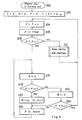
- the operations of a control device 3 in this embodiment are shown in the form of a flowchart in Fig. 8, in which the characteristic function of the apparatus of Claim 4, 5 or 6 is added to the apparatus of Claim 1.
- a detected value F is compared with a predetermined set value F c5 which is a constant set to a predetermine value greater than the preset value F c2 .
- F c5 a predetermined set value
- the sequence proceeds to a step 417, where the detected value F is read. Then, the sequence is returned to a step 408.
- the sequence proceeds to a step 420, where a brake fluid pressure indicating value B is set to a maximum value B max . Accordingly, the brake fluid pressure generator 6 provides a maximized brake fluid pressure. Then, the sequence proceeds to a maximized-brake release routine 422.
- the detected value F is compared in size with the preset value F c3 . When F is smaller than F c3 , the sequence is returned to a step 402, and when F is equal to or greater than F c3 , the sequence proceeds to a step 417.
- FIG. 9, 11 or 12 An example of the maximized-brake release routine 422 is shown in Fig. 9, 11 or 12.
- the apparatus of Claim 4 is characterized in that a brake pedal treading force/displacement detector 14 is added to the arrangement of the apparatus of Claim 1 shown in Fig. 1.
- the control device 3 is adapted to read not only an accelerator pedal treading force/displacement detected value, but also a brake pedal treading force/displacement detected value, thereby to control the engine throttle valve, as well as the brakes.
- the apparatus of Claim 5 having a maximized-brake release routine described in the flowchart in Fig. 11, is shown in the form of a block diagram in, for example, Fig. 1 or 3.
- the apparatus of Claim 6 having a maximized-brake release routine described in the flowchart in Fig. 12, is shown in the form of a block diagram in, for example, Fig. 14.
- a switch operable by the driver is added to the arrangement shown by the block diagram in Fig. 1.
- the control device 3 is adapted to detect the operational state of the switch by an electric signal.
- the detected value F is read at a step 501.
- the detected value F is compared with the preset value F c3 .
- the sequence is returned to the step 501.
- F is smaller than F c3 , the sequence proceeds to a step 503, where a brake pedal treading force/displacement detected value D is read.
- the detected value D is compared with a predetermined set value D c which is greater than zero but near zero.
- the sequence is returned to the step 501.
- step 506 When D is greater than D c , the sequence proceeds to a step 506, where a brake fluid pressure indicating value B is set to zero. The sequence proceeds to a step 508, where this routine is finished. Then, the sequence is returned to the step 402 in Fig. 8. That is, the accelerator pedal is released and the brake pedal is trodden to a certain extent, thereby to release the state where the maximized brakes are applied.
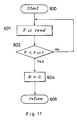
- the maximized-brake release routine starts at a step 600, and a detected value F is read at a step 601.
- the detected value F is compared with the preset value F c3 .
- the sequence is returned to the step 601.
- F is smaller than F c3
- the sequence proceeds to a step 604, where the indicating value B is set to zero.
- this routine is finished, and the sequence is returned to the step 402 in Fig. 8. That is, when the accelerator pedal is released, there is released the state where the maximized brakes are applied.
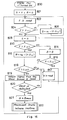
- the maximized-brake release routine starts at a step 700, and a detected value F is read at a step 701.
- the detected value F is compared with the preset value F c3 .
- the sequence is returned to the step 701.
- F is smaller than F c3
- the sequence proceeds to a step 704, where the release switch is checked for operational state.
- the release switch has not been turned ON, the sequence is returned to the step 701.
- the release switch has been turned ON, the sequence proceeds to a step 706, where the brake fluid pressure indicating value B is set to zero.
- the sequence proceeds to a step 708, where this routine is finished.
- the sequence is returned to the step 402 in Fig. 8. That is, when the accelerator pedal is released and the specified release switch is operated, there is released the state where the maximized brakes are applied.
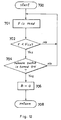
- FIG. 13 is the same as that in Fig. 8, except that the step 418 in Fig. 8 is replaced with steps 113, 115, 118 and 119 in Fig. 13.
- the sequence proceeds to the step 113, where a variable k is initialized to zero.
- a treading force/displacement detected value F is compared in size with the preset value F c5 .
- the sequence proceeds to a step 117.
- the sequence proceeds to the step 118, where the variable k is incremented by +1.
- the sequence then proceeds to the step 119, where the variable k is compared in size with a predetermined preset positive value K.
- the varialbe k is equal to or smaller than the constant K, the sequence is returned to the step 115.
- k is greater than K, the sequence proceeds to a step 120.
- ⁇ 1 is the time during which the sequence makes a round of a loop starting from and returning to the step 115 through the steps 118, 119.
- FIG. 9, 11 or 12 An example of the maximized-brake release routine 122 is shown in Fig. 9, 11 or 12.
- the apparatus having a maximized-brake release routine described in the flowchart in Fig. 9, is shown in the form of a block diagram in, for example, Fig. 10.
- the apparatus having a maximized-brake release routine described in the flowchart in Fig. 11, is shown in the form of a block diagram in, for example, Fig. 1 or 3.
- the apparatus having a maximized-brake release routine described in the flowchart in Fig. 12 is shown in the form of a block diagram in, for example, Fig. 14.
- FIG. 8 An embodiment of apparatus of Claim 8 is shown in the form of a block diagram including a shock sensor added to the arrangement shown in Fig. 1, 3, 10 or 14.
- FIG. 15 An example of such block diagram is shown in Fig. 15, in which a shock sensor 16 is added to the block diagram in Fig. 1 illustrating the embodiment of apparatus of Claim 1.
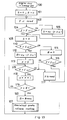
- Fig. 16 shows a flowchart of the operations of the control device 3 in this embodiment.
- an accelerator pedal treading force/displacement detected value F is compared in size with the predetermined preset value F c5 of accelerator pedal treading force/displacement set forth in the embodiment of apparatus of Claim 4, 5 or 6.
- the sequence proceeds to a step 817.
- the sequence proceeds to a step 819.
- an output signal from the shock sensor 16 is read.
- the contents of the output signal thus read are checked. When this output signal represents that the shock sensor has detected no shock, the sequence proceeds to a step 817.
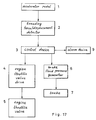
- FIG. 17 An embodiment of apparatus of Claim 9 is shown in the form of a block diagram in Fig. 17. This embodiment is arranged such that an alarm device 9 is driven when a control device 3 indicates a maximized-brake state.
- the alarm device 9 includes (a) a buzzer, (b) flash lamps, (c) lightings or (d) tail lamps and indicators.
- the buzzer is so arranged as to sound inside or outside of the motor vehicle.
- the flash lamps and lightings are so arranged as to flicker, and the tail lamps and indicators are so arranged as to simultaneously flicker.
- An example of the operations of the control device 3 is arranged such that the controls device 3 indicates an actuation of the alarm device at the same time when the indicating value B is set to the maximized value B max , for example, at the step 420 in Fig. 8, and that the control device 3 indicates a release of the actuation of the alarm device at the same time when the maximized-brake release routine is finished at the step 422.
- the actuation of the alarm device the fact that the motor vehicle is under emergent stop may be informed inside and outside of the motor vehicle. This enhances the safety.
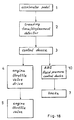
- FIG. 18 An embodiment of apparatus of Claim 10 is shown in the form of a block diagram in Fig. 18.
- an anti-lock brake (ABS) fluid pressure control device 10 is incorporated, instead of the brake fluid pressure generator 6, in the block diagram of the embodiment of apparatus of Claim 1 in Fig. 1.
- ABS anti-lock brake
- the brakes are applied through an ABS fluid pressure control device 10 according to an indicating value of a control device 3.
- the brakes are so controlled as to prevent the wheels from being fixed (locked).
- the ABS fluid pressure control device is known per se.
- the brakes may be applied with a maximum friction with respect to the road surface, while assuring the steering ability. This is a particularly important function in view of improvement in safety.
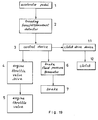
- FIG. 19 An embodiment of apparatus of Claim 11 is shown in the form of a block diagram in Fig. 19, in which a clutch drive device 11 is added to the block diagram of the apparatus of Claim 1 in Fig. 1.
- a control device 3 not only controls the engine throttle valve and the brakes, but also a clutch 12.
- control device 3 instructs the clutch drive device to separate the clutch at the same time when the engine throttle valve opening degree indicating value S is set to zero, for example, at the step 908 in the flowchart in Fig. 2. Further, when a judgement YES is obtained at the step 916, the control device 3 instructs the clutch drive device to connect the clutch at the step just before the sequence is returned to the step 902.
- the apparatus of each of Claims 1 to 11 is so arranged as not to prevent a normal braking operation by the brake pedal.
- the brake fluid pressure unit is composed of two systems, i.e., a first system for generating a fluid pressure by the brake pedal and the master cylinder, and a second system for generating a fluid pressure by the apparatus of each of Claims 1 to 11. Both systems may apply the brakes.
- the brake pedal may serve as a normal brake pedal even though the brake fluid pressure indicating value B is set to, for example, zero by the control device 3.
- the apparatus of Claim 11 is so arranged as not to prevent a clutch disconnection operation by the clutch pedal.
- the clutch drive unit includes two systems, i.e., a first drive system by the apparatus of Claim 11 and a second drive system by the clutch pedal. Any of both systems may disconnect the clutch.
- Such arrangement of the clutch drive unit may be readily made according to prior arts. Accordingly, when the control device 3 of the apparatus of, for example, Claim 11 instructs to connect the clutch, the clutch pedal may serve as a normal clutch pedal.
Landscapes
- Engineering & Computer Science (AREA)
- Chemical & Material Sciences (AREA)
- Combustion & Propulsion (AREA)
- Transportation (AREA)
- Mechanical Engineering (AREA)
- Automation & Control Theory (AREA)
- Physics & Mathematics (AREA)
- General Physics & Mathematics (AREA)
- Control Of Throttle Valves Provided In The Intake System Or In The Exhaust System (AREA)
- Regulating Braking Force (AREA)
- Control Of Driving Devices And Active Controlling Of Vehicle (AREA)
Claims (11)
- Kraftfahrzeug-Bremseinrichtung für ein Fahrzeug mit über einen Bremsfluiddruck betätigten Bremsen, einer Motordrosselklappe, einem Gaspedal (1), einem Detektor (2) zur Erfassung einer Verstellung des Gaspedals (1) und einer Steuereinrichtung (3) zur Steuerung des Öffnungsgrades der Motordrosselklappe sowie zur Steuerung der Bremsen, wobei die Steuereinrichtung (3) so ausgelegt ist,
daß das Gaspedal (1) als normales Gaspedal wirkt, das mit zunehmender Verstellung den Öffnungsgrad der Motordrosselklappe erhöht,
daß die Motordrosselklappe geschlossen wird, wenn die Verstellung einen vorgegebenen Verstellwert (Fc1) überschreitet,
daß der Bremsfluiddruck erhöht wird, wenn die Verstellung einen zweiten vorgegebenen Verstellwert (Fc2), der über dem ersten vorgegebenen Verstellwert (Fc1) liegt, überschreitet, und
daß der Bremsfluiddruck nachgelassen wird, wenn die Verstellung unter dem zweiten vorgegebenen Verstellwert (Fc2) liegt,
dadurch gekennzeichnet,
daß die Steuereinrichtung (3) so ausgelegt ist, daß sie mindestens eine der beiden über eine vorgegebene Funktion verknüpfte Größen Tretkraft und Verstellung des Gaspedals (1) erfaßt,
daß dann, wenn die erfaßte Tretkraft/Verstellung über dem zweiten vorgegebenen Tretkraft/Verstell-Wert (Fc2) liegt, der Bremsfluiddruck in Abhängigkeit von der erfaßten Tretkraft/Verstellung erhöht oder erniedrigt wird,
daß das Gaspedal (1) derart zurückgestellt wird, daß es als normales Gaspedal wirkt, wenn die Tretkraft/Verstellung kleiner ist als ein dritter vorgegebener Tretkraft/Verstell-Wert (Fc3), der unter dem ersten Wert (Fc1) liegt und eine Freigabe des Gaspedals (1) bewirkt, und
daß die Motordrosselklappe geschlossen gehalten wird, bis das Gaspedal (1) so zurückgestellt ist, daß es als normales Gaspedal wirkt. - Kraftfahrzeug-Bremsvorrichtung nach Anspruch 1, mit einer Einrichtung zur Erzeugung einer Gaspedal-Reaktionskraft, die so angeordnet ist, daß sie eine Tretkraft/Verstell-Kennlinie ergibt, in der bei einem vierten vorgegebenen Tretkraft/Verstell-Wert, der niedriger ist als der erste und höher als der dritte vorgegebene Tretkraft/Verstell-Wert, die Tretkraft bei zunehmender Verstellung plötzlich ansteigt.
- Kraftfahrzeug-Bremsvorrichtung nach Anspruch 1 oder 2, wobei die Steuereinrichtung so ausgelegt ist, daß dann, wenn der Öffnungsgrad der Motordrosselklappe bei steigender Gaspedal-Tretkraft/Verstellung zunimmt, bevor die Tretkraft/Verstellung den ersten vorgegebenen Tretkraft/Verstell-Wert überschreitet, zwischen der Zunahme der Tretkraft/Verstellung und dem darauf folgenden Ansprechen der Motordrosselklappe eine vorgegebene Zeitverzögerung stattfindet.
- Kraftfahrzeug-Bremsvorrichtung nach Anspruch 1, mit einem Bremspedal-Tretkraft/Verstell-Detektor (14), wobei die Steuereinrichtung (3) so ausgelegt ist,(i) daß ein fünfter vorgegebener Gaspedal-Tretkraft/Verstell-Wert (Fc5) vorhanden ist, der höher ist als der zweite vorgegebene Tretkraft/Verstell-Wert (Fc2),(ii) daß der Bremsfluiddruck maximal wird, wenn die Gaspedal-Tretkraft/Verstellung den fünften vorgegebenen Wert überschreitet und(iii) daß dann, wenn die Gaspedal-Tretkraft/Verstellung unter dem dritten vorgegebenen Tretkraft/Verstell-Wert (Fc3) liegt und der Bremspedal-Tretkraft/Verstell-Detektor (14) einen vorgegebenen Bremspedal-Tretkraft/Verstell-Wert erfaßt, der maximale Bremsfluiddruck nachgelassen und dadurch das Bremspedal (13) und das Gaspedal (1) derart zurückgestellt werden, daß sie als normales Bremspedal bzw. normales Gaspedal wirken.
- Kraftfahrzeug-Bremsvorrichtung nach Anspruch 1, wobei die Steuereinrichtung so ausgelegt ist,(i) daß ein fünfter vorgegebener Gaspedal-Tretkraft/Verstell-Wert (Fc5) vorgesehen ist, der größer ist als der zweite vorgegebene Tretkraft/Verstell-Wert (Fc2),(ii) daß der Bremsfluiddruck maximal wird, wenn die Gaspedal-Tretkraft/Verstellung den fünften Vorgabewert überschreitet, und(iii) daß dann, wenn die Gaspedal-Tretkraft/Verstellung kleiner ist als der dritte vorgegebene Tretkraft/Verstell-Wert (Fc3), der Bremsfluiddruck nachgelassen und dadurch das Gaspedal (1) so zurückgestellt wird, daß es als normales Gaspedal wirkt.
- Kraftfahrzeug-Bremsvorrichtung nach Anspruch 1, mit einem vom Fahrer betätigbaren Schalter (15), wobei die Steuereinrichtung so ausgelegt ist,(i) daß ein fünfter vorgegebener Gaspedal-Tretkraft/Verstell-Wert (Fc5) vorgesehen ist, der größer ist als der zweite vorgegebene Tretkraft/Verstell-Wert (Fc2),(ii) daß der Bremsfluiddruck maximal wird, wenn die Gaspedal-Tretkraft/Verstellung den fünften Vorgabewert überschreitet, und(iii) daß dann, wenn die Gaspedal-Tretkraft/Verstellung kleiner als der dritte vorgegebene Tretkraft/Verstell-Wert (Fc3) und der Schalter (15) betätigt ist, der maximale Bremsfluiddruck nachgelassen und dadurch das Gaspedal (1) so zurückgestellt wird, daß es als normales Gaspedal wirkt.
- Kraftfahrzeug-Bremsvorrichtung nach Anspruch 4, 5 oder 6, wobei die Steuereinrichtung so ausgelegt ist, daß der Bremsfluiddruck maximal wird, wenn die Gaspedal-Tretkraft/Verstellung über eine vorgegebene Zeitspanne kontinuierlich über dem fünften Vorgabewert (Fc5) liegt.
- Kraftfahrzeug-Bremsvorrichtung nach Anspruch 4, 5 oder 6, mit einem Stoßsensor (16) zur Erfassung eines auf das Kraftfahrzeug gegebenenfalls einwirkenden Stoßes, wobei die Steuereinrichtung so ausgelegt ist, daß dann, wenn der Stoßsensor (16) ein Detektorsignal abgibt und gleichzeitig die Gaspedal-Tretkraft/Verstellung größer ist als der fünfte Vorgabewert (Fc5), der Bremsfluiddruck vom Zeitpunkt der Abgabe des Detektorsignals an maximal wird.
- Kraftfahrzeug-Bremsvorrichtung nach Anspruch 4, 5 oder 6, mit einer Alarmeinrichtung (9), die so ausgelegt ist, daß sie bei Betätigung mindestens entweder innerhalb oder außerhalb des Kraftfahrzeugs Schall- oder Lichtalarm gibt, wenn der Zustand maximalen Bremsfluiddrucks, der dadurch hervorgerufen worden ist, daß die Gaspedal-Tretkraft/Verstellung den fünften vorgegebenen Wert überschreitet, andauert.
- Kraftfahrzeug-Bremsvorrichtung nach Anspruch 1, 2, 4, 5 oder 6, mit einer Antiblockier-Bremseinrichtung (10), die so ausgelegt ist, daß der Bremsfluiddruck bei Anlegen der Bremsen einer Antiblockiersteuerung unterworfen wird.
- Kraftfahrzeug-Bremsvorrichtung nach Anspruch 1, 2, 4, 5 oder 6, mit einer Kupplungs-Antriebseinrichtung (11), die so ausgelegt ist,(i) daß sie die Kupplung zum gleichen Zeitpunkt ausrückt, zu dem die Steuereinrichtung (3) die Motordrosselklappe schließt, wenn der Gaspedal-Tretkraft/Verstell-Detektor feststellt, daß die Gaspedal-Tretkraft/Verstellung den ersten vorgegebenen Tretkraft/Verstell-Wert (Fc1) überschreitet, und(ii) daß sie die Kupplung zum gleichen Zeitpunkt einrückt, zu dem das Gaspedal (1) so zurückgestellt wird, daß es als normales Gaspedal wirkt.
Applications Claiming Priority (4)
| Application Number | Priority Date | Filing Date | Title |
|---|---|---|---|
| JP13322788 | 1988-10-11 | ||
| JP133227/88 | 1988-10-11 | ||
| JP96027/89 | 1989-04-15 | ||
| JP9602789 | 1989-04-15 |
Publications (2)
| Publication Number | Publication Date |
|---|---|
| EP0363634A1 EP0363634A1 (de) | 1990-04-18 |
| EP0363634B1 true EP0363634B1 (de) | 1995-11-29 |
Family
ID=26437248
Family Applications (1)
| Application Number | Title | Priority Date | Filing Date |
|---|---|---|---|
| EP89116388A Expired - Lifetime EP0363634B1 (de) | 1988-10-11 | 1989-09-05 | Kraftfahrzeug-Bremsgerät unter Benutzung des Gaspedals |
Country Status (3)
| Country | Link |
|---|---|
| US (1) | US5007516A (de) |
| EP (1) | EP0363634B1 (de) |
| DE (1) | DE68924957T2 (de) |
Families Citing this family (19)
| Publication number | Priority date | Publication date | Assignee | Title |
|---|---|---|---|---|
| US5048655A (en) * | 1990-05-22 | 1991-09-17 | Deere & Company | Electric declutch mechanism for direct drive crawler |
| DE19753764A1 (de) * | 1997-12-04 | 1999-06-10 | Itt Mfg Enterprises Inc | Verfahren und Vorrichtung zum Manövrieren von Kraftfahrzeugen |
| DE19943894B4 (de) * | 1998-10-14 | 2011-03-31 | Continental Teves Ag & Co. Ohg | Verfahren zum Stabilisieren des Fahrverhaltens |
| DE19922338A1 (de) | 1999-05-14 | 2000-11-23 | Bayerische Motoren Werke Ag | Verfahren zum Herstellen einer vorgegebenen Wirkbeziehung zwischen der Betätigung des Fahrpedals und dem daraus resultierenden Bremsmoment eines Fahrzeugs |
| EP1065092A3 (de) * | 1999-07-01 | 2005-03-30 | Hitachi, Ltd. | Vorrichtung zur Steuerung der Bremsung und der Antriebskraft eines Fahrzeugs |
| DE10205770B4 (de) * | 2002-02-12 | 2006-08-24 | Bayerische Motoren Werke Ag | Verfahren zum Bestimmen des vom Fahrer eines Kraftfahrzeugs vorgegebenen Wunsches zur Fahrzeug-Längsdynamik |
| JP3651793B2 (ja) * | 2002-04-03 | 2005-05-25 | 本田技研工業株式会社 | 車両用アクセルペダル装置 |
| JP2005090347A (ja) * | 2003-09-17 | 2005-04-07 | Honda Motor Co Ltd | 車両用アクセルペダル装置 |
| US7627412B2 (en) * | 2004-04-23 | 2009-12-01 | Nissan Motor Co., Ltd. | Automatic braking force control apparatus |
| KR100800032B1 (ko) * | 2006-10-24 | 2008-01-31 | 마지현 | 브레이크와 엑셀레이터 통합장치 |
| US20090025506A1 (en) * | 2007-07-27 | 2009-01-29 | Boris Karpachev | Vehicle Pedal Controls proof against Misapplication of Accelerator |
| AU2007231765B1 (en) * | 2007-08-21 | 2008-07-10 | Erland George Olofsson | Accelerator Braking Module |
| DE102008038540A1 (de) * | 2008-08-20 | 2010-02-25 | Wabco Gmbh | Verfahren zur Steuerung einer Brems- und/oder Motormomentansteuerung und Vorrichtung zur Durchführung des Verfahrens |
| AT508697B1 (de) | 2010-12-02 | 2014-06-15 | Avl List Gmbh | Verfahren und eine vorrichtung zum regeln der fahrgeschwindigkeit eines kraftfahrzeuges |
| JP2012166631A (ja) * | 2011-02-11 | 2012-09-06 | Denso Corp | 踏み間違い対応装置および踏み間違い対応装置用のプログラム |
| BR112013031984B1 (pt) * | 2011-06-16 | 2020-10-20 | Toyota Jidosha Kabushiki Kaisha | dispositivo de controle de veículo |
| JP5871572B2 (ja) * | 2011-11-14 | 2016-03-01 | 富士重工業株式会社 | 車両用出力制御装置 |
| GB201411228D0 (en) * | 2014-06-24 | 2014-08-06 | Torotrak Dev Ltd | Driver interface for a kinetic energy recovery system |
| DE102014012359B3 (de) * | 2014-08-25 | 2015-11-19 | Lazarov Veselin | Bifunktionales Pedal |
Family Cites Families (13)
| Publication number | Priority date | Publication date | Assignee | Title |
|---|---|---|---|---|
| US1569502A (en) * | 1925-02-12 | 1926-01-12 | Kurtis Angelos | Automatic braking device for vehicles |
| US2218721A (en) * | 1936-05-14 | 1940-10-22 | Oscar A Ross | Control apparatus for motor driven vehicles |
| JPS4916127A (de) * | 1972-06-10 | 1974-02-13 | ||
| JPS4961826A (de) * | 1972-10-16 | 1974-06-15 | ||
| DE2454061A1 (de) * | 1973-11-16 | 1975-06-26 | Allard | Verfahren und vorrichtung zum regeln der beschleunigung von motoren |
| DE2638144A1 (de) * | 1976-08-25 | 1978-03-02 | Heinz Eichholz | Gestaenge fuer einen kraftantrieb |
| JPS54155529A (en) * | 1978-05-26 | 1979-12-07 | Aisin Seiki Co Ltd | Emergency brake system for motor car |
| JPS5664826A (en) * | 1979-10-31 | 1981-06-02 | Matsushita Electric Works Ltd | Lamination of synthetic resin film to metal strip |
| JPS5748131A (en) * | 1980-09-08 | 1982-03-19 | Toshiba Corp | Data input device |
| JPS5972130A (ja) * | 1982-10-16 | 1984-04-24 | Nippon Telegr & Teleph Corp <Ntt> | 半導体への金属電極付着法 |
| DE3332664A1 (de) * | 1982-12-20 | 1984-01-19 | Erler Karl Heinz | Not-, halt-, warn- und sicherheitsvorrichtung fuer kraftfahrzeuge mit verbrennungsmotor |
| JPS6147762A (ja) * | 1984-08-16 | 1986-03-08 | Matsushita Electric Ind Co Ltd | 絶縁塗料 |
| DE3820319A1 (de) * | 1987-06-25 | 1989-01-05 | Volkswagen Ag | Kraftfahrzeug mit einem beschleunigungspedal fuer einen antriebsmotor und einem bremspedal |
-
1989
- 1989-08-30 US US07/400,614 patent/US5007516A/en not_active Expired - Lifetime
- 1989-09-05 DE DE68924957T patent/DE68924957T2/de not_active Expired - Fee Related
- 1989-09-05 EP EP89116388A patent/EP0363634B1/de not_active Expired - Lifetime
Also Published As
| Publication number | Publication date |
|---|---|
| US5007516A (en) | 1991-04-16 |
| DE68924957D1 (de) | 1996-01-11 |
| EP0363634A1 (de) | 1990-04-18 |
| DE68924957T2 (de) | 1996-08-29 |
Similar Documents
| Publication | Publication Date | Title |
|---|---|---|
| EP0363634B1 (de) | Kraftfahrzeug-Bremsgerät unter Benutzung des Gaspedals | |
| JP4558933B2 (ja) | 制動距離の短縮方法及びその装置 | |
| US6962396B2 (en) | Method and device for controlling a brake system for a vehicle | |
| US7561954B2 (en) | Creep drive control device for driving vehicle at creep speed | |
| CN100393562C (zh) | 控制施加到汽车的备用制动转矩的方法和系统 | |
| EP1127728B1 (de) | Verfahren zur Verwaltung von unverträglichen Drehmomentanforderungen in einem Geschwindigkeitsregelungssystem | |
| US6275763B1 (en) | Temperature dependent regenerative brake system for electric vehicle | |
| EP0945322B1 (de) | Elektrisch betätigtes Feststellbremsgerät mit einer Bremskraftänderungsvorrichtung, die bei abgeschaltetem Antriebsleistungsschalter betriebsfähig ist | |
| US4969103A (en) | Speed control apparatus for an automotive vehicle with creep control | |
| US4629043A (en) | Electric parking brake system for a vehicle | |
| US5924508A (en) | Process for carrying out an automatic braking operation | |
| US5415467A (en) | Automatic standstill brake for a motor vehicle equipped with an automatic transmission | |
| US6470986B2 (en) | Method for determining an initiation threshold value for an automatic braking process | |
| EP1310400A1 (de) | Autonome Notbremseinrichtung | |
| EP1424255A1 (de) | Elektromechanische Bremsvorrichtung und deren Steuerungsvorrichtung und -verfahren | |
| US6280004B1 (en) | Brake control system for balanced braking of a towed vehicle | |
| JPH0789432A (ja) | 自動車用ブレーキ圧増大装置 | |
| JPH0948263A (ja) | 車両用駆動力制御装置 | |
| JP2000219111A (ja) | 自動車のための安全システム | |
| US7882920B2 (en) | Vehicle braking force controller | |
| GB2284028A (en) | Parking aid with brake intervention | |
| EP1134137B1 (de) | Vorschauendes Fahrzeug- Bremsregelgerät und Bremsregelmethode | |
| EP1310414A1 (de) | Vom Fahrer verstärkte autonome Bremsvorrichtung | |
| EP1127761B1 (de) | Fahrzeuggeschwindigkeitsregelung | |
| US6816768B2 (en) | Controlling scheme for stand-by braking torque applied to automotive vehicle |
Legal Events
| Date | Code | Title | Description |
|---|---|---|---|
| PUAI | Public reference made under article 153(3) epc to a published international application that has entered the european phase |
Free format text: ORIGINAL CODE: 0009012 |
|
| AK | Designated contracting states |
Kind code of ref document: A1 Designated state(s): DE FR GB IT SE |
|
| 17P | Request for examination filed |
Effective date: 19900622 |
|
| 17Q | First examination report despatched |
Effective date: 19920813 |
|
| GRAA | (expected) grant |
Free format text: ORIGINAL CODE: 0009210 |
|
| AK | Designated contracting states |
Kind code of ref document: B1 Designated state(s): DE FR GB IT SE |
|
| REF | Corresponds to: |
Ref document number: 68924957 Country of ref document: DE Date of ref document: 19960111 |
|
| ITF | It: translation for a ep patent filed | ||
| ET | Fr: translation filed | ||
| PLBE | No opposition filed within time limit |
Free format text: ORIGINAL CODE: 0009261 |
|
| STAA | Information on the status of an ep patent application or granted ep patent |
Free format text: STATUS: NO OPPOSITION FILED WITHIN TIME LIMIT |
|
| 26N | No opposition filed | ||
| REG | Reference to a national code |
Ref country code: GB Ref legal event code: IF02 |
|
| PGFP | Annual fee paid to national office [announced via postgrant information from national office to epo] |
Ref country code: IT Payment date: 20060930 Year of fee payment: 18 |
|
| PGFP | Annual fee paid to national office [announced via postgrant information from national office to epo] |
Ref country code: GB Payment date: 20070221 Year of fee payment: 18 |
|
| PGFP | Annual fee paid to national office [announced via postgrant information from national office to epo] |
Ref country code: DE Payment date: 20070222 Year of fee payment: 18 |
|
| PGFP | Annual fee paid to national office [announced via postgrant information from national office to epo] |
Ref country code: SE Payment date: 20070227 Year of fee payment: 18 |
|
| PG25 | Lapsed in a contracting state [announced via postgrant information from national office to epo] |
Ref country code: SE Free format text: LAPSE BECAUSE OF NON-PAYMENT OF DUE FEES Effective date: 20070906 |
|
| PGFP | Annual fee paid to national office [announced via postgrant information from national office to epo] |
Ref country code: FR Payment date: 20070226 Year of fee payment: 18 |
|
| EUG | Se: european patent has lapsed | ||
| GBPC | Gb: european patent ceased through non-payment of renewal fee |
Effective date: 20070905 |
|
| PG25 | Lapsed in a contracting state [announced via postgrant information from national office to epo] |
Ref country code: DE Free format text: LAPSE BECAUSE OF NON-PAYMENT OF DUE FEES Effective date: 20080401 |
|
| REG | Reference to a national code |
Ref country code: FR Ref legal event code: ST Effective date: 20080531 |
|
| PG25 | Lapsed in a contracting state [announced via postgrant information from national office to epo] |
Ref country code: FR Free format text: LAPSE BECAUSE OF NON-PAYMENT OF DUE FEES Effective date: 20071001 |
|
| PG25 | Lapsed in a contracting state [announced via postgrant information from national office to epo] |
Ref country code: GB Free format text: LAPSE BECAUSE OF NON-PAYMENT OF DUE FEES Effective date: 20070905 |
|
| PG25 | Lapsed in a contracting state [announced via postgrant information from national office to epo] |
Ref country code: IT Free format text: LAPSE BECAUSE OF NON-PAYMENT OF DUE FEES Effective date: 20070905 |