EP0363758A2 - Aromatische Polyhydroxypolyamine, ein Verfahren zu ihrer Herstellung und ihre Verwendung zur Herstellung von Polyurethan-Kunststoffen - Google Patents
Aromatische Polyhydroxypolyamine, ein Verfahren zu ihrer Herstellung und ihre Verwendung zur Herstellung von Polyurethan-Kunststoffen Download PDFInfo
- Publication number
- EP0363758A2 EP0363758A2 EP89118111A EP89118111A EP0363758A2 EP 0363758 A2 EP0363758 A2 EP 0363758A2 EP 89118111 A EP89118111 A EP 89118111A EP 89118111 A EP89118111 A EP 89118111A EP 0363758 A2 EP0363758 A2 EP 0363758A2
- Authority
- EP
- European Patent Office
- Prior art keywords
- compounds
- aromatic
- polyhydroxypolyamines
- mol
- general formula
- Prior art date
- Legal status (The legal status is an assumption and is not a legal conclusion. Google has not performed a legal analysis and makes no representation as to the accuracy of the status listed.)
- Granted
Links
Classifications
-
- C—CHEMISTRY; METALLURGY
- C08—ORGANIC MACROMOLECULAR COMPOUNDS; THEIR PREPARATION OR CHEMICAL WORKING-UP; COMPOSITIONS BASED THEREON
- C08G—MACROMOLECULAR COMPOUNDS OBTAINED OTHERWISE THAN BY REACTIONS ONLY INVOLVING UNSATURATED CARBON-TO-CARBON BONDS
- C08G73/00—Macromolecular compounds obtained by reactions forming a linkage containing nitrogen with or without oxygen or carbon in the main chain of the macromolecule, not provided for in groups C08G12/00 - C08G71/00
- C08G73/02—Polyamines
-
- C—CHEMISTRY; METALLURGY
- C08—ORGANIC MACROMOLECULAR COMPOUNDS; THEIR PREPARATION OR CHEMICAL WORKING-UP; COMPOSITIONS BASED THEREON
- C08G—MACROMOLECULAR COMPOUNDS OBTAINED OTHERWISE THAN BY REACTIONS ONLY INVOLVING UNSATURATED CARBON-TO-CARBON BONDS
- C08G18/00—Polymeric products of isocyanates or isothiocyanates
- C08G18/06—Polymeric products of isocyanates or isothiocyanates with compounds having active hydrogen
- C08G18/28—Polymeric products of isocyanates or isothiocyanates with compounds having active hydrogen characterised by the compounds used containing active hydrogen
- C08G18/40—High-molecular-weight compounds
- C08G18/48—Polyethers
- C08G18/50—Polyethers having heteroatoms other than oxygen
- C08G18/5021—Polyethers having heteroatoms other than oxygen having nitrogen
- C08G18/5024—Polyethers having heteroatoms other than oxygen having nitrogen containing primary and/or secondary amino groups
- C08G18/5027—Polyethers having heteroatoms other than oxygen having nitrogen containing primary and/or secondary amino groups directly linked to carbocyclic groups
-
- C—CHEMISTRY; METALLURGY
- C07—ORGANIC CHEMISTRY
- C07C—ACYCLIC OR CARBOCYCLIC COMPOUNDS
- C07C217/00—Compounds containing amino and etherified hydroxy groups bound to the same carbon skeleton
- C07C217/78—Compounds containing amino and etherified hydroxy groups bound to the same carbon skeleton having amino groups and etherified hydroxy groups bound to carbon atoms of six-membered aromatic rings of the same carbon skeleton
- C07C217/80—Compounds containing amino and etherified hydroxy groups bound to the same carbon skeleton having amino groups and etherified hydroxy groups bound to carbon atoms of six-membered aromatic rings of the same carbon skeleton having amino groups and etherified hydroxy groups bound to carbon atoms of non-condensed six-membered aromatic rings
- C07C217/82—Compounds containing amino and etherified hydroxy groups bound to the same carbon skeleton having amino groups and etherified hydroxy groups bound to carbon atoms of six-membered aromatic rings of the same carbon skeleton having amino groups and etherified hydroxy groups bound to carbon atoms of non-condensed six-membered aromatic rings of the same non-condensed six-membered aromatic ring
- C07C217/84—Compounds containing amino and etherified hydroxy groups bound to the same carbon skeleton having amino groups and etherified hydroxy groups bound to carbon atoms of six-membered aromatic rings of the same carbon skeleton having amino groups and etherified hydroxy groups bound to carbon atoms of non-condensed six-membered aromatic rings of the same non-condensed six-membered aromatic ring the oxygen atom of at least one of the etherified hydroxy groups being further bound to an acyclic carbon atom
-
- C—CHEMISTRY; METALLURGY
- C08—ORGANIC MACROMOLECULAR COMPOUNDS; THEIR PREPARATION OR CHEMICAL WORKING-UP; COMPOSITIONS BASED THEREON
- C08G—MACROMOLECULAR COMPOUNDS OBTAINED OTHERWISE THAN BY REACTIONS ONLY INVOLVING UNSATURATED CARBON-TO-CARBON BONDS
- C08G18/00—Polymeric products of isocyanates or isothiocyanates
- C08G18/06—Polymeric products of isocyanates or isothiocyanates with compounds having active hydrogen
- C08G18/28—Polymeric products of isocyanates or isothiocyanates with compounds having active hydrogen characterised by the compounds used containing active hydrogen
- C08G18/30—Low-molecular-weight compounds
- C08G18/32—Polyhydroxy compounds; Polyamines; Hydroxyamines
- C08G18/3271—Hydroxyamines
- C08G18/329—Hydroxyamines containing aromatic groups
-
- C—CHEMISTRY; METALLURGY
- C08—ORGANIC MACROMOLECULAR COMPOUNDS; THEIR PREPARATION OR CHEMICAL WORKING-UP; COMPOSITIONS BASED THEREON
- C08G—MACROMOLECULAR COMPOUNDS OBTAINED OTHERWISE THAN BY REACTIONS ONLY INVOLVING UNSATURATED CARBON-TO-CARBON BONDS
- C08G18/00—Polymeric products of isocyanates or isothiocyanates
- C08G18/06—Polymeric products of isocyanates or isothiocyanates with compounds having active hydrogen
- C08G18/28—Polymeric products of isocyanates or isothiocyanates with compounds having active hydrogen characterised by the compounds used containing active hydrogen
- C08G18/40—High-molecular-weight compounds
-
- C—CHEMISTRY; METALLURGY
- C08—ORGANIC MACROMOLECULAR COMPOUNDS; THEIR PREPARATION OR CHEMICAL WORKING-UP; COMPOSITIONS BASED THEREON
- C08G—MACROMOLECULAR COMPOUNDS OBTAINED OTHERWISE THAN BY REACTIONS ONLY INVOLVING UNSATURATED CARBON-TO-CARBON BONDS
- C08G65/00—Macromolecular compounds obtained by reactions forming an ether link in the main chain of the macromolecule
- C08G65/02—Macromolecular compounds obtained by reactions forming an ether link in the main chain of the macromolecule from cyclic ethers by opening of the heterocyclic ring
- C08G65/32—Polymers modified by chemical after-treatment
- C08G65/321—Polymers modified by chemical after-treatment with inorganic compounds
- C08G65/322—Polymers modified by chemical after-treatment with inorganic compounds containing hydrogen
-
- C—CHEMISTRY; METALLURGY
- C08—ORGANIC MACROMOLECULAR COMPOUNDS; THEIR PREPARATION OR CHEMICAL WORKING-UP; COMPOSITIONS BASED THEREON
- C08G—MACROMOLECULAR COMPOUNDS OBTAINED OTHERWISE THAN BY REACTIONS ONLY INVOLVING UNSATURATED CARBON-TO-CARBON BONDS
- C08G65/00—Macromolecular compounds obtained by reactions forming an ether link in the main chain of the macromolecule
- C08G65/02—Macromolecular compounds obtained by reactions forming an ether link in the main chain of the macromolecule from cyclic ethers by opening of the heterocyclic ring
- C08G65/32—Polymers modified by chemical after-treatment
- C08G65/329—Polymers modified by chemical after-treatment with organic compounds
- C08G65/333—Polymers modified by chemical after-treatment with organic compounds containing nitrogen
- C08G65/33379—Polymers modified by chemical after-treatment with organic compounds containing nitrogen containing nitro group
- C08G65/33386—Polymers modified by chemical after-treatment with organic compounds containing nitrogen containing nitro group cyclic
- C08G65/33389—Polymers modified by chemical after-treatment with organic compounds containing nitrogen containing nitro group cyclic aromatic
-
- C—CHEMISTRY; METALLURGY
- C08—ORGANIC MACROMOLECULAR COMPOUNDS; THEIR PREPARATION OR CHEMICAL WORKING-UP; COMPOSITIONS BASED THEREON
- C08G—MACROMOLECULAR COMPOUNDS OBTAINED OTHERWISE THAN BY REACTIONS ONLY INVOLVING UNSATURATED CARBON-TO-CARBON BONDS
- C08G2101/00—Manufacture of cellular products
Definitions
- the invention relates to new compounds having terminal aminophenoxy and hydroxyl groups, a process for their preparation and their use as structural components in the production of optionally cellular polyurethane plastics and foams.
- Terminal polyadducts containing aromatic amino groups are known in principle.
- NCO prepolymers with sulfamic acid according to DE-AS 1 155 907, with formic acid according to FR-PS 1 415 317 or with hydroxyl-containing enamines, aldimines or ketimines according to DE-OS 2 116 882 and DE-OS 2 546 536 also leads after hydrolysis or saponification to give aromatic aminopolyethers, such as the thermal cleavage of urethanes from NCO prepolymers and secondary or tertiary carbinols according to DE-AS 1 270 046.
- DE-OS 2 948 419, 3 223 397, 3 223 398 describe and 3,223,400 different one- or two-stage processes for the production of aromatic polyamines by hydrolysis of NCO prepolymers in the presence of various solvent and catalyst systems.
- Aromatic amino polyethers are also obtained by reacting polyoxyalkylene polyols with p-aminobenzoic acid derivatives according to Japanese patent applications 59 053 533, 59 089 322 and 59 199 715.
- the low reactivity of the aromatic ester amines obtained in this way is disadvantageous for many purposes.
- EP-A-268 849 presented polyphenoxyamines which show more favorable viscosities and, in some cases, good reactivities with isocyanates. However, in the preparation of the polyphenoxynitro compounds from which the amines are obtained by hydrogenation, there remains unreacted nitrophenylating agent, which has an extremely disruptive effect when the amines are processed and which has to be removed beforehand at great expense.
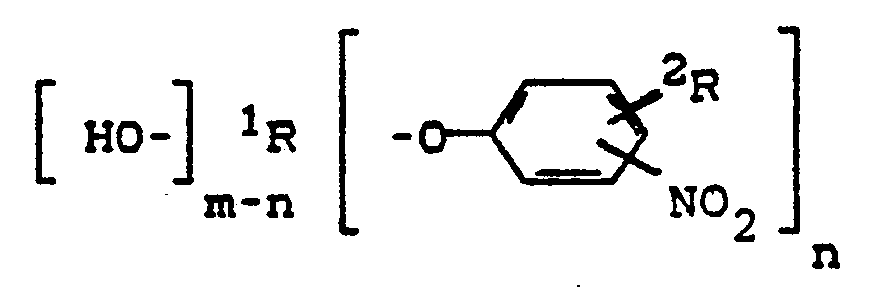
- the present invention thus relates to novel compounds of the general formula having terminal aminophenoxy and hydroxyl groups in which 1R stands for an m-valent radical, such as is formed by partial removal of the hydroxyl groups from an m-valent polyhydroxyl compound with a molecular weight of 400-8000, 2R represents hydrogen or a methyl group, m is an integer from 2 to 4, n represents an average value and a positive number of 0.05 ⁇ m to 0.73 ⁇ m, preferably 0.15 ⁇ m to 0.70 ⁇ m.
- 1R stands for an m-valent radical, such as is formed by partial removal of the hydroxyl groups from an m-valent polyhydroxyl compound with a molecular weight of 400-8000
- 2R represents hydrogen or a methyl group
- m is an integer from 2 to 4
- n represents an average value and a positive number of 0.05 ⁇ m to 0.73 ⁇ m, preferably 0.15 ⁇ m to 0.70 ⁇ m.
- the invention also relates to the use of the compounds according to the invention having the latter hydroxyl and aminophenoxy groups as structural components in the production of polyurethane plastics by the isocyanate polyaddition process.
- Starting materials for the process according to the invention are (i) higher molecular weight polyhydroxyl compounds and (ii) optionally methyl-substituted nitrohalobenzenes.
- Suitable polyhydroyl compounds (i) are preferably higher molecular weight compounds with an average molecular weight of 400 to 8000, which have at least 2 to 4 reactive hydroxyl groups per mol.
- hydroxyl-containing polyacetals, polythioethers, polycarbonates, polyamides, polysiloxanes and / or polybutadienes, polyesters, polylactones and polyethers are suitable for use in polyurethane chemistry. in particular, however, polyethers bearing hydroxyl groups.
- the polyethers according to the invention which have hydroxyl groups are those of the type known per se and are known, for. B. by polymerization of epoxides such as ethylene oxide, propylene oxide, butylene oxide, tetrahydrofuran, styrene oxide or epichlorohydrin with itself, for. B. in the presence of BF3, or by the addition of these epoxides, optionally in a mixture or in succession, to starting components with reactive hydrogen atoms such as water, alcohols or amines, e.g. B.
- epoxides such as ethylene oxide, propylene oxide, butylene oxide, tetrahydrofuran, styrene oxide or epichlorohydrin
- BF3 BF3
- reactive hydrogen atoms such as water, alcohols or amines
- sucrose polyethers such as those e.g. B. are described in German interpretations 1 176 358 and 1 064 938, come into question according to the invention. In many cases, those polyethers are preferred which predominantly (up to 90% by weight, based on all the OH groups present in the polyether) have primary OH groups. Also modified by vinyl polymers, polyethers such as z. B.
- polyacetals such. B. from glycols, such as di- or tri-ethylene glycol, 4,4'-dihydroxyethoxydiphenylmethane, hexanediol and formaldehyde or by polymerization of cyclic acetals, such as. B. trioxane, producible compounds in question.
- glycols such as di- or tri-ethylene glycol, 4,4'-dihydroxyethoxydiphenylmethane, hexanediol and formaldehyde
- polymerization of cyclic acetals such as. B. trioxane, producible compounds in question.
- Suitable polycarbonates containing hydroxyl groups are those of the type known per se, which, for. B. by reacting diols such as 1,3-propanediol, 1,4-butanediol and / or 1,6-hexanediol, di-, tri- or tetraethylene glycol or thiodiglycol with diaryl carbonates, e.g. B. diphenyl carbonate, or phosgene can be produced (DE-B 1 694 080, 1 915 908 and 2 221 751; DE-A 2 605 024).
- Suitable polyesters from dicarboxylic acids and diols are those from adipic acid and isophthalic acid and straight-chain and / or branched diols, as are lactone polyesters, preferably based on caprolactone and starter diols.
- Polyhydroxyl compounds already containing urethane or urea groups and also modified natural polyols can also be used. Addition products of alkylene oxides on phenol-formaldehyde resins or also on urea-formaldehyde resins can also be used according to the invention. It is also possible e.g. B. according to DE-A 2 559 372, in the polyhydroxy compounds to introduce amide groups.
- polyhydroxyl compounds in which high molecular weight polyadducts or polycondensates or polymers are also used can optionally be used are contained in finely dispersed or dissolved form.
- Such polyhydroxyl compounds are e.g. B. obtained when polyaddition reactions (z. B. reactions between polyisocyanates and amino-functional compounds) or polycondensation reactions (z. B. between formaldehyde and phenols and / or amines) in situ in the above-mentioned, hydroxyl-containing compounds .
- polyhydroxyl compounds such as z. B. by polymerization of styrene and acrylonitrile in the presence of polyethers (US Pat. No. 3,383,351, 3,304,273, 3,523,093, 3,110,695, DE-B 1,152,536) or polycarbonate polyols (DE-PS 1,769,795, US -PS 3 637 909) are obtained are suitable for the process according to the invention.
- plastics When using polyether polyols which have been modified according to DE-A 2 442 101, 2 644 922 and 2 646 141 by graft polymerization with vinylphosphonic acid esters and optionally (meth) acrylonitrile, (meth) acrylamide or OH-functional (meth) acrylic acid esters, plastics are obtained of special flame retardancy.
- modified polyhydroxyl compounds of the type mentioned above gives rise to starting components which, in many cases, give polyurethane plastics with significantly improved mechanical properties in the polyisocyanate polyaddition process.
- Suitable, albeit less preferred, polyhydroxyl components (i) are also organofunctional polysiloxanes which have two terminal groups and structural units of the formula -O-Si (R) 2- which are reactive toward isocyanate groups, in this formula R for a C1-C4-alkyl - or a phenyl radical, but preferably a methyl radical.
- suitable starting materials are both the pure polysiloxanes which are known per se and have terminal organofunctional groups and the terminal organofunctional siloxanepolyoxyalkylene copolymers which are known per se.
- organopolysiloxanes which are particularly preferred according to the invention correspond to the general formula They are prepared in a manner known per se by equilibration of 1,1,3,3-tetramethyl-1,3-hydroxymethyldisiloxane of the formula with octamethylcyclotetrasiloxane in the presence of sulfuric acid or by the process of DE-B 1 236 505.
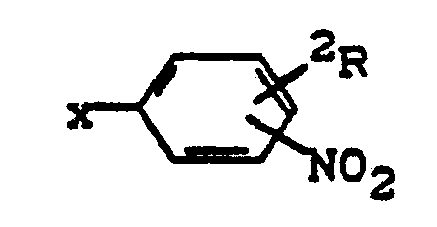
- the starting materials (ii) which are suitable according to the invention include, where appropriate, methyl-substituted halonitrobenzenes of the general formula for which 2R represents hydrogen or a methyl group, preferably hydrogen, X represents fluorine or preferably chlorine, and in which the halogen and nitro substituents are preferably arranged ortho or para to one another.
- Particularly preferred starting materials (ii) are 2-nitrochlorobenzene or 4-nitrochlorobenzene.
- alkaline compounds which are required for the reaction of the polyhydroxyl compounds (i) with the halonitrobenzenes (ii) are metal hydrides, metal alkoxides and preferably metal hydroxides. Sodium hydroxide and potassium hydroxide are particularly preferred.
- stage a) of the process according to the invention When stage a) of the process according to the invention is carried out, the starting materials (ii), based on component (i), are used in a deficit.
- the hydrogen halide released in the reaction can be bound by adding metal hydrides, metal alkoxides and metal hydroxides.
- Sodium or potassium hydroxide is preferably used in finely divided form. The amount is at least such that it is sufficient to neutralize the hydrogen chloride that is split off. They are particularly preferably used in an amount such that 1 to 3 mol base equivalents are available per mol component (ii).
- Step a) of the process according to the invention is carried out in bulk or advantageously in an organic solvent, optionally in the presence of a phase transfer catalyst.
- the reactants can be present in a homogeneous phase or in two phases, dissolved, emulsified or suspended.
- Suitable organic solvents are for example: benzene, toluene, xylene, chlorobenzene, dichlorobenzene, trichlorobenzene, diethyl ether, diisopropyl ether, tert-butyl methyl ether, tetrahydrofuran, dioxane, ethylene glycol dimethyl ether, Essigester, acetone, methyl ethyl ketone, acetonitrile, furfural, methylene chloride, chloroform, trichlorethylene, tetrachlorethylene , Nitromethane, nitropropane, dimethylformamide, dimethylacetamide, N-methylpyrrolidone, tetramethylurea, N-methylcaprolactam, dimethyl sulfoxide, tetramethylene sulfone, hexamethylene phosphoric acid triamide, etc.
- the amount of solvent is generally such that it is sufficient to clearly dissolve the starting materials (i) and (ii). In practice, this means that the solvents are generally used in an amount of 50 to 1,000, preferably 100 to 500 parts by weight of solvent per 100 parts by weight of the mixture of components (i) and (ii).
- a phase transfer catalyst Such catalysts are e.g. B. in EV and SS Dehmlow, Phase Transfer Catalysis, 2nd edition, Verlag Chemie 1983.
- Suitable catalysts are quaternary ammonium or phosphonium salts of the formula in which Z represents nitrogen or phosphorus, R ′, R ⁇ , R ′′′ and R ⁇ ⁇ represent the same or different radicals and are alkyl groups having 1 to 18 carbon atoms, where one of the radicals can also represent an araliphatic radical having 7 to 16 carbon atoms, and the sum of the carbon atoms the four radicals are preferably from 12 to 31.
- Typical examples of suitable catalysts are N-benzyl-N, N, N-triethylammonium chloride or bromide, N-benzyl-N-dodecyl-N, N-dimethylammonium chloride or bromide, N, N, N, N-tetra -n-hexylammonium chloride or bromide, N-benzyl-N, N, N -tri-n-octylammonium chloride or bromide or the phosphonium salts corresponding to these ammonium salts, preferably N, N, N-trimethyl-N-benzylammonium chloride or N-hexadecyl-N, N, N-trimethylammonium bromide.
- the quaternary ammonium or phosphonium salts mentioned by way of example are preferably carried out in bulk or in the form of their aqueous solutions (for example with a solids content of 30 to 60% by weight) and preferably in an amount of 1 to 10 mol%, based on the number of moles of the hydroxyl groups present.
- Step a) of the process according to the invention is generally carried out at 10 to 100 ° C., preferably at 20 to 80 ° C., with positive pressure, negative pressure or expediently without pressure, continuously or batchwise.
- the residence time is generally 0.5 to 24 hours; 0.5 to 12 hours are preferred.
- stage a) of the process according to the invention one can proceed, for example, by initially introducing the starting materials and, if appropriate, the phase transfer catalyst in the solvent selected, and the base in dissolved or suspended form, preferably in solid, as finely ground as possible, with stirring, if appropriate with Cooling is added in portions or continuously. The mixture is then stirred at room temperature or, if appropriate, at an elevated temperature, until complete conversion of the nitrophenylating agent (ii) is indicated by thin layer chromatography.
- the nitrophenoxy adducts are worked up in a manner known per se.
- the reaction mixture is expediently diluted with an inert solvent which is not miscible with water and washed with water or brine neutral, distilled off the solvents, if necessary, in vacuo and dried in vacuo.
- the reaction mixture can also be neutralized by treatment with CO2.
- inert solvents are toluene, methylene chloride, chlorobenzene, dichlorobenzene, 1,2-dichloroethane, trichlorethylene.
- Another way of working up is that after adding 1-20% water to the reaction mixture with mineral acid, preferably hydrochloric acid or sulfuric acid, optionally under vacuum, the mixture is removed and the mixture at temperatures of 10-120 ° C., preferably 25-90 ° C, filtered.
- the crude product thus obtained can generally be processed without further purification.
- stage a In principle conceivable, but less preferred, would also be a procedure which consists in feeding the reaction mixture obtained in stage a) directly to stage b), if appropriate after neutralizing the excess alkali metal hydroxide without intermediate isolation.
- the compounds containing terminal nitrophenoxy groups obtained in step a) of the process according to the invention are converted into the corresponding polyamines in step b) in a manner known per se by reduction with nascent or catalytic hydrogen, for example by means of Raney nickel or palladium on carbon.
- the hydrogenation can be carried out in the presence or absence of inert solvents at 20-120 ° C. and a pressure of 20 to 80 bar.
- Suitable solvents are, for example, methanol, ethanol, i-propanol, toluene, DMF and others. Methanol or toluene is preferred.
- the diamines are called a destilla tion residue obtained in the removal of the solvent by distillation and can be used without further purification steps for the production of polyurethane plastics.
- the polyhydroxypolyamines according to the invention obtained after working up are generally light yellow to brownish colored products and are distinguished from the previously known aromatic aminopolyethers by their lower viscosity.
- the functional groups already present in the underlying polyhydroxyl compounds such as e.g. B. ether and / or thioether and / or dialkylsiloxane and / or carbonate groups and / or residues of polybutadienes only a number of ether groups and hydroxyl groups corresponding to their functionality.
- the aromatic polyhydroxypolyamines according to the invention are suitable as reactants for optionally blocked polyisocyanates in the production of polyurethanes (polyurethane ureas), optionally cellular polyurethane plastics or polyurethane foams, where appropriate also with other low molecular weight (molecular weight 32 to 399) and / or higher molecular weight (molecular weight 400 to approx. 12,000 compounds with groups reactive toward isocyanates can be combined.
- suitable starting components for the production of polyurethane plastics are described, for example, in DE-A 2 302 564, DE-A 2 432 764 (US Pat. No.
- the polyhydroxypolyamines according to the invention are particularly suitable for use in combination with solid polyisocyanates. According to DE-A 3 230 757, these components can be used to produce reaction systems which can be stored for as long as required at RT or, if appropriate, at elevated temperature and which cure only when exposed to high temperatures. Systems of this type are generally referred to as one-component systems.
- Suitable solid polyisocyanates are, for example, dimeric 2,4-diisocyanatotoluene (TT) or 3,3'-dimethyl-4,4'-diisocyanatodiphenylurea (TDIH).
- polyurethane (urea) by means of the polyamines produced according to the invention is also the subject of the present invention.
- Your application can e.g. B. for elastomers, coatings, threads in the application from melts, solutions, dispersions or as a reactive component mixture.
- Further uses of the polyamines produced according to the invention are e.g. B. coupling components for diazo dyes, hardeners for epoxy and phenolic resins, and all other known reactions of amines such as amide or imide formation and others.
- Examples 11 to 18 are shown in Table 1.
- Table 1 Polyhydroxypolynitroverb. ⁇ Polyhydroxypolyamine example M G f (-OH)) f (-NO2) OH number example OH number NH number Viscosity [mPas / 25 ° C] 1 6121 2nd 1 18th 11 30th 9 1700 2nd 6191 1.4 1.6 14 12 30th 14 2000 3rd 6266 0.8 2.2 9 13 30th 21st 2300 5 6193 1.4 1.6 14 14 30th 18th 1800 6 6266 0.8 2.2 9 15 29 22 2000 8th 6266 0.8 2.2 10th 16 29 22 2000 9 6193 1.4 1.6 16 17th 30th 14 1600 10th 5054 0.9 2.1 12 18th 35 24th 1700 MG: average molecular weight OH number and NH number in mg KOH / g compound
Landscapes
- Chemical & Material Sciences (AREA)
- Organic Chemistry (AREA)
- Chemical Kinetics & Catalysis (AREA)
- Health & Medical Sciences (AREA)
- Medicinal Chemistry (AREA)
- Polymers & Plastics (AREA)
- General Chemical & Material Sciences (AREA)
- Inorganic Chemistry (AREA)
- Polyurethanes Or Polyureas (AREA)
- Organic Low-Molecular-Weight Compounds And Preparation Thereof (AREA)
- Polyamides (AREA)
- Polymers With Sulfur, Phosphorus Or Metals In The Main Chain (AREA)
- Macromolecular Compounds Obtained By Forming Nitrogen-Containing Linkages In General (AREA)
Abstract
Description
- Die Erfindung betrifft neue, endständige Aminophenoxy- und Hydroxygruppen aufweisende Verbindungen, ein Verfahren zu ihrer Herstellung und ihre Verwendung als Aufbaukomponente bei der Herstellung von gegebenenfalls zellförmigen Polyurethan-Kunststoffen und Schaumstoffen.
- Endständige, aromatische Aminogruppen aufweisende Polyaddukte sind im Prinzip bekannt.
- US-PS 2 888 439 und DE-OS 1 720 646 beschreiben die Herstellung von Aminopolyethern durch Reaktion von Nitroarylisocyanaten mit Polyolen und nachfolgender Hydrierung. Die analoge Umsetzung von Azoarylisocyanaten mit Polyolen liefert nach Reduktion ebenfalls aromatische Aminopolyether (DE-OS 1 257 427). In den DE-OS 1 122 254 und DE-OS 1 694 152 wird ein Verfahren beschrieben, bei dem NCO-Prepolymere mit Diaminen umgesetzt werden, welche unterschiedlich reaktive Aminogruppen aufweisen. Auch die Reaktion von NCO-Prepolymeren mit Sulfaminsäure gemäß DE-AS 1 155 907, mit Ameisensäure gemäß FR-PS 1 415 317 oder mit Hydroxylgruppen aufweisenden Enaminen, Aldiminen oder Ketiminen gemäß DE-OS 2 116 882 sowie DE-OS 2 546 536 führt nach Hydrolyse bzw. Verseifung ebenso zu aromatischen Aminopolyethern, wie die thermische Spaltung von Urethanen aus NCO-Prepolymeren und sekundären oder tertiären Carbinolen gemäß DE-AS 1 270 046. Ferner beschreiben die DE-OS 2 948 419, 3 223 397, 3 223 398 sowie 3 223 400 verschiedene ein- bzw. zweistufige Verfahren zur Herstellung aromatischer Polyamine durch Hydrolyse von NCO-Prepolymeren in Gegenwart verschiedener Lösungsmittel- und Katalysatorsysteme.
- Alle bisher beschriebenen Verfahren verlaufen über Isocyanatzwischenstufen und liefern daher in allen Fällen Produkte, die neben Ether- und aromatischen Aminogruppen zusätzliche Urethan- bzw. Harnstoffgruppen aufweisen. Dadurch bedingt zeigen diese Produkte eine für viele Zwecke unerwünscht hohe Viskosität. Ein weiterer Nachteil dieser zusätzlichen Urethan- bzw. Harnstoffbindungen ist ihre relativ geringe thermische Stabilität, wodurch der Wärmestand entsprechender mit diesen Aminopolyethern hergestellten Polyurethankunststoffe insbesondere von Elastomeren ungünstig beeinflußt wird.
- Als weitere Synthesemöglichkeit für aromatische Polyamine kommt die unter Ringöffnung verlaufende Reaktion von Isatosäureanhydrid mit Polyolen in Betracht. Solche Amine sind beispielsweise in den DE-OS 2 019 432, 2 619 840, 2 648 774, 2 648 825 sowie in US-PS 4 180 644, beschrieben. Aromatische Aminopolyether erhält man ferner durch Umsetzung von Polyoxyalkylenpolyolen mit p-Aminobenzoesäurederivaten gemäß den japanischen Patentanmeldungen 59 053 533, 59 089 322 und 59 199 715. Nachteilig für viele Zwecke ist jedoch die geringe Reaktivität der auf diesem Wege erhaltenen aromatischen Esteramine.
- In der EP-A-268 849 wurden Polyphenoxyamine vorgestellt, welche günstigere Viskositäten und teilweise gute Reaktivitäten mit Isocyanaten aufzeigen. Bei der Darstellung der Polyphenoxynitroverbindungen, aus denen die Amine durch Hydrierung erhalten werden, verbleibt jedoch nicht umgesetztes Nitrophenylierungsmittel, das sich bei einer Verarbeitung der Amine äußerst störend auswirkt und zuvor aufwendig entfernt werden muß.
- Es war daher Aufgabe der vorliegenden Erfindung, neue Polyhydroxypolyphenoxyamine zur Verfügung zu stellen, unter vollständigem Umsatz des Nitrophenylierungsmittels und insbesondere mit noch niedrigeren Viskositäten als oben genannte Polyphenoxyamine und gegebenenfalls günstigeren Reaktivitäten. Der durch die schnell reagierenden Aminogruppen und die langesamer reagierenden OH-Gruppen erreichte zweistufige Reaktionsverlauf wirkt sich besonders günstig z. B. beim Reaktionsspritzgießen aus. Durch die anfänglich niedrige Viskosität wird eine gute Vermischung im Mischkopf erreicht. Nach Reaktion der schnellen Aminogruppen steigt die Viskosität soweit an, daß Dichtungsprobleme an der Form nicht auftreten, wobei jedoch das Produkt lang genug dünnflüssig bleibt um die Form vollständig auszufüllen.
- Diese Aufgabe konnte durch Bereitstellung der erfindungsgemäßen Verbindungen gelöst werden.
- Gegenstand der vorliegenden Erfindung sind somit neue endständige Aminophenoxy- und Hydroxylgruppen aufweisende Verbindungen der allgemeinen Formel

¹R für einen m-wertigen Rest steht, wie er durch teilweise Entfernung der Hydroxylgruppen von einer m-wertigen Polyhydroxylverbindung des Molgewichts 400 - 8000 entsteht,
²R für Wasserstoff oder eine Methylgruppe steht,
m eine ganze Zahl von 2 bis 4 bedeutet,
n ein Durchschnittswert und eine positive Zahl von 0,05·m bis 0,73·m bedeutet, vorzugsweise 0,15·m bis 0,70·m. - Gegenstand der vorliegenden Erfindung ist auch ein Verfahren zur Herstellung von endständige Hydroxy- und Aminophenoxygruppen aufweisenden Verbindungen der allgemeinen Formel

- a)
- (i) m-wertige höhermolekulare Polyhydroxylverbindungen der allgemeinen Formel
¹R(OH)m - (ii) n-Molen der Verbindungen der allgemeinen Formel

- (i) m-wertige höhermolekulare Polyhydroxylverbindungen der allgemeinen Formel
- b) die so erhaltenen (m-n)-Hydroxy, n-Nitrophenoxyaddukte der allgemeinen Formel
- Gegenstand der Erfindung ist schließlich auch die Verwendung der letztgenannten erfindungsgemäßen Hydroxy- und Aminophenoxygruppen aufweisenden Verbindungen als Aufbaukomponente bei der Herstellung von Polyurethankunststoffen nach dem Isocyanat-Polyadditionsverfahren.
- Ausgangsmaterialien für das erfindungsgemäße Verfahren sind (i) höhermolekulare Polyhydroxylverbindungen und (ii) gegebenenfalls methylsubstituierte Nitrohalogenbenzole.
- Geeignete Polyhydroylverbindungen (i) sind vorzugsweise höhermolekulare Verbindungen mit einem mittleren Molgewicht von 400 bis 8000, welche mindestens 2 bis 4 reaktive Hydroxylgruppen pro mol aufweisen.
- In Frage kommen beispielsweise die in der Polyurethanchemie üblichen, hydroxylgruppentragenden Polyacetale, Polythioether, Polycarbonate, Polyamide, Polysiloxane und/oder Polybutadiene, Polyester, Polylactone sowie Polyether; insbesondere aber Hydroxylgruppen tragende Polyether.
- Die erfindungsgemäß in Frage kommenden Hydroxylgruppen aufweisenden Polyether sind solche der an sich bekannten Art und werden z. B. durch Polymerisation von Epoxiden wie Ethylenoxid, Propylenoxid, Butylenoxid, Tetrahydrofuran, Styroloxid oder Epichlorhydrin mit sich selbst, z. B . in Gegenwart von BF₃, oder durch Anlagerung dieser Expoxide, gegebenenfalls im Gemisch oder nacheinander, an Startkomponenten mit reaktionsfähigen Wasserstoffatomen wie Wasser, Alkohole oder Amine, z. B. Ethylenglykol, Propylenglykol-(1,3) oder -(1,2), Trimethylolpropan, 4,4′-Dihydroxy-diphenylpropan, Anilin, Ammoniak, Ethanolamin oder Ethylendiamin hergestellt. Auch Sucrosepolyether, wie sie z. B. in den deutschen Auslegeschriften 1 176 358 und 1 064 938 beschrieben werden, kommen erfindungsgemäß in Frage. Vielfach sind solche Polyether bevorzugt, die überwiegend (bis zu 90 Gew.-%, bezogen auf alle vorhandenen OH-Gruppen im Polyether) primäre OH-Gruppen aufweisen. Auch durch Vinylpolymerisate modifizierte Polyether, wie sie z. B. durch Polymerisation von Styrol und Acrylnitril in Gegenwart von Polyethern entstehen (amerikanische Patentschriften 3 383 351, 3 304 273, 3 523 093, 3 110 659, deutsche Patentschrift 1 152 536), sind geeignet, ebenso OH-Gruppen aufweisende Polybutadiene.
- Als Polyacetale kommen z. B. die aus Glykolen, wie Di- oder Tri-ethylenglykol, 4,4′-Dihydroxyethoxydiphenylmethan, Hexandiol und Formaldehyd oder durch Polymerisation cyclischer Acetale, wie z. B. Trioxan, herstellbare Verbindungen in Frage.
- Als Hydroxylgruppen aufweisende Polycarbonate kommen solche der an sich bekannten Art in Betracht, die z. B. durch Umsetzung von Diolen wie Propandiol-1,3, Butandiol-1,4 und/oder Hexandiol-1,6, Di-, Tri- oder Tetraethylenglykol oder Thiodiglykol mit Diarylcarbonaten, z. B. Diphenylcarbonat, oder Phosgen hergestellt werden können (DE-B 1 694 080, 1 915 908 und 2 221 751; DE-A 2 605 024).
- Als Polyester aus Dicarbonsäuren und Diolen kommen solche aus Adipinsäure- und Isophthalsäure und geradkettigen und/oder verzweigten Diolen in Betracht, ebenso Lactonpolyester, vorzugsweise auf Basis von Caprolacton und Starterdiolen.
- Unter den Polythioethern seien insbesondere die Kondensationsprodukte von Thiodiglykol mit sich selbst und/oder mit anderen Glykolen angeführt.
- Auch bereits Urethan- oder Harnstoffgruppen enthaltende Polyhydroxylverbindungen sowie gegebenenfalls modifizierte natürliche Polyole sind verwendbar. Auch Anlagerungsprodukte von Alkylenoxiden an Phenol-Formaldehyd-Harze oder auch an Harnstoff-Formaldehyd-Harze sind erfindungsgemäß einsetzbar. Es ist auch möglich, z. B. gemäß DE-A 2 559 372, in die Polyhydroxylverbindungen Amidgruppen einzuführen.
- Erfindungsgemäß können gegebenenfalls auch Polyhydroxylverbindungen eingesetzt werden, in welchen hochmolekulare Polyaddukte bzw. Polykondensate oder Polymerisate in feindisperser oder gelöster Form enthalten sind. Derartige Polyhydroxylverbindungen werden z. B. erhalten, wenn man Polyadditionsreaktionen (z. B. Umsetzungen zwischen Polyisocyanaten und aminofunktionellen Verbindungen) bzw. Polykondensationsreaktionen (z. B. zwischen Formaldehyd und Phenolen und/oder Aminen) in situ in den o. G., Hydroxylgruppen aufweisenden Verbindungen ablaufen läßt. Derartige Verfahren sind beispielsweise in den DE-B 1 168 075 und 1 260 142, sowie den DE-A 2 324 134, 2 423 984, 2 512 385, 2 513 815, 2 550 796, 2 550 797, 2 550 833, 2 550 862, 2 633 293 und 2 639 254 beschrieben. Es ist aber auch möglich, gemäß US-PS 3 869 413 bzw. 2 550 860 eine fertige wäßrige Polymerdispersion mit einer Polyhydroxylverbindung zu vermischen und anschließend aus dem Gemisch das Wasser zu entfernen.
- Auch durch Vinylpolymerisate modifizierte Polyhydroxylverbindungen, wie sie z. B. durch Polymerisation von Styrol und Acrylnitril in Gegenwart von Polyethern (US-PS 3 383 351, 3 304 273, 3 523 093, 3 110 695, DE-B 1 152 536) oder Polycarbonatpolyolen (DE-PS 1 769 795, US-PS 3 637 909) erhalten werden, sind für das erfindungsgemäße Verfahren geeignet. Bei Verwendung von Polyetherpolyolen, welche gemäß DE-A 2 442 101, 2 644 922 und 2 646 141 durch Pfropfpolymerisation mit Vinylphosphonsäureestern sowie gegebenenfalls (Meth)acrylnitril, (Meth)acrylamid oder OH-funktionellen (Meth)acrylsäureestern modifiziert wurden, erhält man Kunststoffe von besonderer Flammwidrigkeit.
- Beim Einsatz von modifizierten Polyhydroxylverbindungen der oben genannten Art als Ausgangsmaterialien für die Polyamine entstehen Ausgangskomponenten, die im Polyisocyanat-Polyadditionsverfahren in vielen Fällen Polyurethankunststoffe mit wesentlich verbesserten mechanischen Eigenschaften ergeben.
- Geeignete, wenn auch weniger bevorzugte Polyhydroxylkomponenten (i) sind auch organofunktionelle Polysiloxane, die zwei endständige, gegenüber Isocyanatgruppen reaktionsfähige Gruppen und Struktureinheiten der Formel -O-Si(R)₂- aufweisen, wobei in dieser Formel R für einen C₁-C₄-Alkyl- oder einen Phenylrest, vorzugsweise jedoch für einen Methylrest, steht. Erfindungsgemäß eignen sich als Ausgangsmaterialien sowohl die an sich bekannten, endständige organofunktionelle Gruppen aufweisenden reinen Polysiloxane als auch die an sich bekannten endständig organofunktionellen Siloxanpolyoxyalkylencopolymeren.
- Die erfindungsgemäß besonders bevorzugten Organopolysiloxane entsprechen der allgemeinen Formel


- Zu den erfindungsgemäß in Betracht kommenden Ausgangsmaterialien (ii) gehören gegebenenfalls methylsubstituierte Halogennitrobenzole der allgemeinen Formel

²R für Wasserstoff oder eine Methylgruppe, vorzugsweise für Wasserstoff steht,
X für Fluor oder vorzugsweise Chlor steht,
und in welcher die Halogen- und Nitrosubstituenten vorzugsweise ortho- oder paraständig zueinander angeordnet sind. In Betracht kommen beispielsweise 2-Nitrochlorbenzol, 2-Nitrofluorbenzol, 4-Nitrochlorbenzol, 4-Nitrofluorbenzol, 1-Methyl-2-nitro-3-chlorbenzol, 1-Methyl-2-nitro-3-fluorbenzol, 1-Methyl-4-nitro-5-chlorbenzol, 1-Methyl-4-nitro-5-fluorbenzol, 1-Methyl-2-nitro-6-chlorbenzol oder 1-Methyl-2-nitro-6-fluorbenzol. Besonders bevorzugte Ausgangsmaterialien (ii) sind 2-Nitrochlorbenzol oder 4-Nitrochlorbenzol. - Als alkalisch reagierende Verbindung, die zur Umsetzung der Polyhydroxylverbindungen (i) mit den Halogennitrobenzolen (ii) erforderlich sind, kommen beispielsweise Metallhydride, Metallalkoxide und bevorzugt Metallhydroxide in Frage. Besonders bevorzugt werden Natriumhydroxid und Kaliumhydroxid.
- Bei der Durchführung der Stufe a) des erfindungsgemäßen Verfahrens werden die Ausgangsmaterialien (ii) bezogen auf die Komponente (i) im Unterschuß eingesetzt.
- Der bei der Reaktion frei werdende Halogenwasserstoff kann, wie schon erwähnt, durch Zusatz von Metallhydriden, Metallalkoxiden und Metallhydroxiden gebunden werden. Bevorzugt werden Natrium- oder Kalium-hydroxid in fein verteilter Form eingesetzt. Dabei wird ihre Menge zumindest so bemessen, daß sie zur Neutralisation des abgespaltenen Chlorwasserstoffs ausreicht. Besonders bevorzugt werden sie in einer Menge verwendet, daß 1 bis 3 mol Basenäquivalente pro mol Komponenten (ii) zur Verfügung stehen.
- Die Stufe a) des erfindungsgemäßen Verfahrens wird in Substanz oder zweckmäßig in einem organischen Lösungsmittel, gegegebenenfalls in Gegenwart eines Phasentransferkatalysators durchgeführt. Dabei können die Reaktionspartner in homogener Phase oder zweiphasig, gelöst, emulgiert oder suspendiert vorliegen.
- Geeignete organische Lösungsmittel sind beispielsweise: Benzol, Toluol, Xylol, Chlorbenzol, Dichlorbenzol, Trichlorbenzol, Diethylether, Diisopropylether, tert.-Butylmethylether, Tetrahydrofuran, Dioxan, Ethylenglykoldimethylether, Essigester, Aceton, Methylethylketon, Acetonitril, Furfurol, Methylenchlorid, Chloroform, Trichlorethylen, Tetrachlorethylen, Nitromethan, Nitropropan, Dimethylformamid, Dimethylacetamid, N-Methylpyrrolidon, Tetramethylharnstoff, N-Methylcaprolactam, Dimethylsulfoxid, Tetramethylensulfon, Hexamethylenphosphorsäuretriamid usw.
- Selbstverständlich können auch beliebige Gemische derartiger Lösungsmittel eingesetzt werden.
- Die Menge des Lösungsmittels wird hierbei im allgemeinen so bemessen, daß sie ausreicht, um die Ausgangsmaterialien (i) und (ii) klar zu lösen. In der Praxis bedeutet dies, daß die Lösungsmittel im allgemeinen in einer Menge von 50 bis 1.000, bevorzugt 100 bis 500 Gew.-Teilen Lösungsmittel pro 100 Gew.-Teilen des Gemisches aus den Komponenten (i) und (ii) zum Einsatz gelangen.
- Es kann in manchen Fällen vorteilhaft sein, die Umsetzung in Gegenwart eines Phasentransferkatalysators durchzuführen. Solche Katalysatoren werden z. B. in E. V. und S. S. Dehmlow, Phase Transfer Catalysis, 2. Auflage, Verlag Chemie 1983, beschrieben. Geeignete Katalysatoren sind quaternäre Ammonium- oder Phosphoniumsalze der Formel

Z für Stickstoff oder Phosphor steht,
R′, R˝, R‴ und R˝˝ für gleiche oder verschiedene Reste stehen und Alkylgruppen mit 1 bis 18 Kohlenstoffatomen bedeuten, wobei einer der Reste auch für einen araliphatischen Rest mit 7 bis 16 Kohlenstoffatomen stehen kann, und wobei die Summe der Kohlenstoffatome der vier Reste vorzugsweise bei 12 bis 31 liegt. - Typische Beispiele geeigneter Katalysatoren sind N-Benzyl-N,N,N-triethyl-ammoniumchlorid oder -bromid, N-Benzyl-N-dodecyl-N,N-dimethyl-ammoniumchlorid oder -bromid, N,N,N,N-Tetra-n-hexyl-ammoniumchlorid oder -bromid, N-Benzyl-N,N,N-tri-n-octyl-ammoniumchlorid oder -bromid oder die diesen Ammoniumsalzen entsprechenden Phosphoniumsalze, vorzugsweise N,N,N-Trimethyl-N-benzylammoniumchlorid oder N-Hexadecyl-N,N,N-trimethylammoniumbromid.
- Die beispielhaft genannten quarternären Ammonium- oder Phosphoniumsalze werden bei der Durchführung des erfindungsgemäßen Verfahrens vorzugsweise in Substanz oder in Form ihrer wäßrigen Lösungen (beispielsweise mit einem Feststoffgehalt von 30 bis 60 Gew.-%) und vorzugsweise in einer Menge von 1 bis 10 Mol-%, bezogen auf die Molzahl der vorhandenen Hydroxylgruppen eingesetzt.
- Die Stufe a) des erfindungsgemäßen Verfahrens wird im allgemeinen bei 10 bis 100°C, bevorzugt bei 20 bis 80°C mit Überdruck, Unterdruck oder zweckmäßig drucklos, kontinuierlich oder diskontinuierlich durchgeführt.
- Die Verweilzeit beträgt im allgemeinen 0,5 bis 24 Stunden; bevorzugt werden 0,5 bis 12 Stunden.
- Zur Durchführung der Stufe a) des erfindungsgemäßen Verfahrens kann man beispielsweise so vorgehen, daß man die Ausgangsmaterialien und gegebenenfalls den Phasentransferkatalysator im gewählten Lösungsmittel vorlegt und die Base in gelöster oder suspendierter Form, bevorzugt in fester, möglichst fein gemahlener Form, unter Rühren, gegebenenfalls unter Kühlung portionsweise oder kontinuierlich zugibt. Anschließend rührt man bei Raumtemperatur oder gegebenenfalls erhöhter Temperatur so lange nach, bis dünnschichtchromatographisch ein vollständiger Umsatz des Nitrophenylierungsmittel (ii) angezeigt wird.
- Die Aufarbeitung der Nitrophenoxyaddukte erfolgt in an sich bekannter Weise. Zweckmäßig verdünnt man das Reaktionsgemisch mit einem mit Wasser nicht mischbaren inerten Lösungsmittel, wäscht mit Wasser oder Salzlösung neutral, destilliert die Lösungsmittel gegebenenfalls im Vakuum ab und trocknet im Vakuum. Die Neutralisation des Reaktionsgemisches kann auch durch Behandeln mit CO₂ erfolgen. Als inerte Lösungsmittel kommen beispielsweise Tuluol, Methylenchlorid, Chlorbenzol, Dichlorbenzol, 1,2-Dichlorethan, Trichlorethylen u.a. in Betracht. Eine weitere Möglichkeit der Aufarbeitung besteht darin, daß nach Zusatz von 1-20 % Wasser, zum Reaktionsgemisch mit Mineralsäure, bevorzugt Salzsäure oder Schwefelsäure, gegegebenenfalls unter Vakuum, entfernt und die Mischung bei Temperaturen von 10-120°C, bevorzugt 25-90°C, filtriert. Das so erhaltene Rohprodukt kann im allgemeinen ohne weitere Reinigung weiterverarbeitet werden.
- Grundsätzlich denkbar, jedoch weniger bevorzugt, wäre auch eine Arbeitsweise, die darin besteht, das in der Stufe a) anfallende Reaktionsgemisch, gegebenenfalls nach Neutralisation des überschüssigen Alkalihydroxids ohne Zwischenisolierung direkt der Stufe b) zuzuführen.
- Die in der Stufe a) des erfindungsgemäßen Verfahrens erhaltenen endständige Nitrophenoxygruppen aufweisenden Verbindungen werden in der Stufe b) in an sich bekannter Weise durch Reduktion mit nascierendem oder katalytischem, beispielsweise mittels Raney-Nickel oder Palladium auf Kohle angeregtem Wasserstoff in die entsprechenden Polyamine überführt. Die Hydrierung kann in Gegenwart oder Abwesenheit von inerten Lösungsmitteln bei 20 - 120°C und einem Druck von 20 bis 80 bar erfolgen. Geeignete Lösungsmittel sind beispielsweise Methanol, Ethanol, i-Propanol, Toluol, DMF u. a. Bevorzugt wird Methanol oder Toluol. Die Diamine werden als Destilla tionsrückstand bei der destillativen Entfernung des Lösungsmittels gewonnen und können ohne weitere Reinigungsschritte zur Herstellung von Polyurethankunststoffen verwendet werden.
- Die nach Aufarbeitung erhaltenen erfindungsgemäßen Polyhydroxypolyamine stellen im allgemeinen hellgelbe bis bräunlich gefärbte Produkte dar und zeichnen sich gegenüber den bisher bekannten aromatischen Aminopolyethern durch ihre niedrigere Viskosität aus. Sie erhalten neben den bereits in den zugrunde liegenden Polyhydroxylverbindungen vorhandenen funktionellen Gruppen wie z. B. Ether- und/oder Thioether- und/oder Dialkylsiloxan und/oder Carbonatgruppen und/oder Reste von Polybutadienen nur noch eine ihrer Funktionalität entsprechende Anzahl von Ethergruppen und Hydroxygruppen. Die erfindungsgemäßen aromatischen Polyhydroxypolyamine eignen sich als Reaktionspartner für gegebenenfalls blockierte Polyisocyanate bei der Herstellung von Polyurethanen (Polyurethanharnstoffen), gegebenenfalls zelligen Polyurethankunststoffen oder Polyurethanschaumstoffen, wobei sie gegebenenfalls auch mit anderen niedermolekularen (Molekulargewicht 32 bis 399) und/oder höhermolekularen (Molekulargewicht 400 bis ca. 12.000 Verbindungen mit gegenüber Isocyanaten reaktiven Gruppen kombiniert werden können. Geeignete Ausgangskomponenten für die Herstellung von Polyurethankunststoffen werden beispielsweise in DE-A 2 302 564, DE-A 2 432 764 (US-PS 3 903 679) sowie in den DE-A 2 639 083, 2 512 385, 2 513 815, 2 550 796, 2 550 797, 2 550 833, 2 550 860 und 2 550 862 genannt. Dort finden sich auch Hinweise auf bei der Polyurethanherstellung gegebenenfalls mitzuverwendenden Hilfs- und Zusatzstoffe.
- Besonders geeignet sind die erfindungsgemäßen Polyhydroxypolyamine für eine Anwendung in Kombination mit festen Polyisocyanaten. Gemäß DE-A 3 230 757 können mit diesen Komponenten bei RT oder gegebenenfalls erhöhter Temperatur beliebig lang lagerfähige Reaktionssysteme hergestellt werden, die erst bei stärkerer Hitzeeinwirkung aushärten. Derartige Systeme werden allgemein als Einkomponentensysteme bezeichnet. Geeignete feste Polyisocyanate sind beispielsweise dimeres 2,4-Diisocyanatotoluol (TT) oder 3,3′-Dimethyl-4,4′-diisocyanatodiphenylharnstoff (TDIH).
- Die Herstellung von Polyurethan(harnstoff)en mittels der erfindungsgemäß hergestellten Polyamine ist ebenfalls Gegenstand der vorliegenden Erfindung. Ihre Anwendung kann z. B. für Elastomere, Beschichtungen, Fäden in der Applikation aus Schmelzen, Lösungen, Dispersionen oder als Reaktivkomponentenmischung erfolgen. Weitere Verwendungszwecke der erfindungsgemäß hergestellten Polyamine sind z. B. Kupplungskomponenten für Diazofarbstoffe, Härter für Epoxid und Phenolharze, sowie alle anderen an sich bekannten Reaktionen von Aminen wie Amid- oder Imidbildung und andere.
- Die Erfindung soll anhand der folgenden Beispiele näher erläutert werden (%-Angaben sind - soweit nicht anders vermerkt ist - Gew.-%).
- 1000 g (0,17 mol) eines entwässerten Trimethylolpropan (TMP) gestarteten Polypropylenoxid-(82,5 %)ethylenoxid-(17,5 %)-ethertriols der OH-Zahl 29, versetzt mit 26 g (0,16 mol) 4-Chlornitrobenzol, 14 g (0,25 mol) gepulverten Kaliumhydroxid und 9,25 g (0,05 mol) Trimethylbenzylammoniumchlorid werden 12 h bei 70°C gerührt. Bei Raumtemperatur werden 200 ml Wasser zugesetzt, die Mischung mit 50 %iger H₂SO₄ neutral gestellt, das Wasser abdestilliert und die anfallenden Salze abfiltriert.
Ausbeute: 800 g (79 % d.Th.)
Viskosität: 1500 mPas/26°C
OH-Zahl: 18
Gaschromatogramm: 0,0 % 4-Chlornitrobenzol - 1000 g (0,17 mol) entwässertes Trimethylolpropan gestarteten Polypropylenoxid-(82,5 %)-ethylenoxid-(17,5 %)-ethertriol der OH-Zahl 29, 42 g (0,26 mol) 4-Chlornitrobenzol, 22,4 g (0,40 mol) Kaliumhydroxid und 9,25 g (0,05 mol) Trimethylbenzylammoniumchlorid werden analog Beispiel 1 umgesetzt.
Ausbeute: 840 g (81 5 d.Th.)
Viskosität: 1600 mPas/26°C
OH-Zahl: 14
Gascromatogramm: 0,0 % 4-Chlornitrobenzol - 1000 g (0,17 mol) entwässertes TMP gestarteten Polypropylenoxid-(82,5 %)-ethylenoxid-(17,5 %)-ethertriol der OH-Zahl 29, 57,5 g (0,36 mol) 4-Chlornitrobenzo, 30,8 g (0,55 mol) Kaliumhydroxid und 9,25 g (0,05 mol) Trimethylbenzylammoniumchlorid werden analog Beispiel 1 umgesetzt.
Ausbeute: 820 g (78 % d.Th.)
Viskosität: 1900 mPas/26°C
OH-Zahl: 9
Gascrhomatogramm: 0,0 % 4-Chlornitrobenzol - 1000 g (0,17 mol) eines entwässerten TMP gestarteten Polypropylenoxid-(82,5 %)-ethylenoxid-(17,5 %)-ethertriols der OH-Zahl 29, gelöst in 1000 ml Toluol, werden mit 26 g (0,16 mol) 4-Chlornitrobenzol, 14 g (0,25 mol) Kaliumhydroxid und 9,25 g (0,05 ml) Trimethylbenzylammoniumchlorid versetzt und 12 h bei 70°C gerührt.
- Bei Raumtemperatur werden 200 ml Wasser zugesetzt und die Mischung mit 50 %iger H₂SO₄ neutral gestellt. Anschließend wird das Lösungsmittel und das Wasser abdestilliert und die ausfallenden Salze abfiltriert.
Ausbeute: 898 g (88 % d.Th.)
Viskosität: 1500 mPas/20°C
OH-Zahl: 18
Gaschromatogramm: 0,0 % 4-Chlornitrobenzol - 1000 g (0,17 mol) entwässertes TMP gestarteten Polypropylenoxid-(82,5 %)-ethylenoxid-(17,5 %)-ethertriol der OH-Zahl 29 gelöst in 1000 ml Toluol, 42 g (0,26 mol) 4-Chlornitrobenzol, 22,4 g (0,40 mol) Kaliumhydroxid und 9,25 g (0,05 % mol) Trimethylbenzylammoniumchlorid werden analog Beispiel 4 umgesetzt.
Ausbeute: 955 g (92 % d.Th.)
Viskosität: 1400 mPas/27°C
OH-Zahl: 14
Gaschromatogramm: 0,0 % 4-Chlornitrobenzol - 1000 g (0,17 mol) entwässertes TMP gestarteten Polypropylenoxid-(82,5 %)-ethylenoxid-(17,5 %)-ethertriol der OH-Zahl 29 gelöst in 1000 ml Toluol, 57,5 g (0,36 mol) 4-Chlornitrobenzol, 30,8 g (0,55 mol) Kaliumhydroxid und 9,25 g (0,05 mol) Trimethylbenzylammoniumchlorid werden analog Beispiel 4 umgesetzt.
Ausbeute: 1028 g (100 % d.Th.)
Viskosität: 1700 mPas/20°C
OH-Zahl: 9
Gaschromatogramm: 0,1 % 4-Chlornitrobenzol - 1400 g (1 mol) entwässertes Polyethylenoxidetherdiol der OH-Zahl 80 gelöst in 1500 ml Toluol, werden mit 167 g (1,06 mol) 4-Chlornitrobenzol, 90 g (1,6 mol) Kaliumhydroxid und 11,1 g (0,06 mol) Trimethylbenzylammoniumchlorid versetzt und 12 h bei 70°C gerührt.
- Bei Raumtemperatur werden 300 ml Wasser zugesetzt und mit 50%iger H₂SO₄ neutral gestellt. Anschließend wird das Lösungsmittel und das Wasser abdestilliert und die ausfallenden Salze abfiltriert.
Ausbeute: 1440 g (94 % d.Th.)
Viskosität: 140 mPas/70°C
OH-Zahl: 35
Gaschromatogramm: 0,0% 4-Chlornitrobenzol - 1000 g (0,17 mol) eines entwässerten TMP gestarteten Polypropylenoxid-(82,5 %)-ethylenoxid-(17,5 %)-ethertriols der OH-Zahl 29 werden mit 57,5 g (0,36 mol) 4-Chlornitrobenzol und 30,8 g (0,55 mol) Kaliumhydroxid versetzt und 12 h unter Durchleiten von Luft bei 70°C gerührt. Bei Raumtemperatur werden 200 ml Wasser zugesetzt und mit 50 %iger H₂SO₄ neutral gestellt. Anschließend wird das Wasser abdestilliert und die ausfallenden Salze abfiltriert.
Ausbeute: 756 g (74 % d.Th.)
Viskosität: 2000 mPas/26°C
OH-Zahl: 10
Gaschromatogramm: 0,0 % 4-Chlornitrobenzol - 1000 g (0,17 mol) eines entwässerten TMP gest. Polypropylenoxid-(82,5 %)ethylenoxid-(17,2 %)-ethertriols der OH-Zahl 29 wurden it 42 g (0,26 mol) 2-Chlornitrobenzol, 22,4 g (0,40 mol) Trimethylbenzylammoniumchlorid versetzt und 12 h unter Durchleiten von Luft bei 70°C gerührt.
- Bei Raumtemperatur werden 200 ml Wasser zugesetzt und mit 50%iger H₂SO₄ neutral gestellt. Anschließend wird das Wasser abdestilliert und die ausfallende Salze abfiltriert.
Ausbeute: 770 g (75 % d.Th.)
Viskosität: 2500 mPas/26°C
OH-Zahl: 16
Gaschromatogramm: 0,0 % 2-Chlornitrobenzol - 1000 g (0,21 mol) eines TMP gestarteten Polypropylenoxid-(82,5 %)-ethylenoxid-(17,2 %)-ethertriols der OH-Zahl 35 wurden mit 105 g (0,94 mol) 50 %iger wäßriger Kaliumhydroxidlösung und 100 ml Toluol versetzt. Die Wasser/Toluol-Mischung wirde durch Vakuumdestillation (70°C/20 mbar) entfernt.
- Der entwässerte Polyether wurde mit 69 g (0,44 mol) p-Chlornitrobenzol, gelöst in 170 ml Toluol, versetzt und unter Vakuum (20 mbar) 17 h bei 40°C gerührt. Nach Zugabe von 115 ml Wasser zu Reaktionsmischungstellte man mit 50 %iger Schwefelsäure neutral. Anschließend wurde das Wasser abdestilliert und die ausgefallenen Salze bei 80°C abfiltriert.
Ausbeute: 940 g (88 % d.Th.)
Viskosität: 1600 mPas/24°C
OH-Zahl: 12
Gaschromatogramm: 0,0 % 4-Chlornitrobenzol - 100 Teile Polyhydroxypolynitroverbindung werden in 100 Teilen Lösungsmittel gelöst und mit 10 Teilen Raney-Nickel versetzt. Die Hydrierung erfolgt in einem Druckkessel bei einem Wasserstoffdruck von 60 bar zu Beginn der Reaktion und einer Temperatur von 70°C.
- Die Daten der Beispiele 11 bis 18 sind Tabelle 1 zu entnehmen.
Tabelle 1 Polyhydroxypolynitroverb. → Polyhydroxypolyamin Beispiel M Gf(-OH)) f(-NO₂) OH-Zahl Beispiel OH-Zahl NH-Zahl Viskosität [mPas/25°C] 1 6121 2 1 18 11 30 9 1700 2 6191 1,4 1,6 14 12 30 14 2000 3 6266 0,8 2,2 9 13 30 21 2300 5 6193 1,4 1,6 14 14 30 18 1800 6 6266 0,8 2,2 9 15 29 22 2000 8 6266 0,8 2,2 10 16 29 22 2000 9 6193 1,4 1,6 16 17 30 14 1600 10 5054 0,9 2,1 12 18 35 24 1700 MG: durchschnittliches Molekulargewicht OH-Zahl und NH-Zahl in mg KOH/g Verbindung - 200 g des in Beispiel 15 beschriebenen Aminopolyethers der Aminzahl 22 werden 15 Minuten bei Raumtemperatur im Wasserstrahlvakuum entgast und mit 19,0 g feingemahlenem dimeren 2,4-Diisocyanat (TT) der mittleren Korngröße 10 bis 30 µ versetzt. Anschließend wird durch kurzzeitiges intensives Rühren (ca. 1 Minute) eine möglichst feinteilige Suspension hergestellt und innerhalb von 2 bis 3 Minuten in eine mit Trennmittel behandelte, auf 100°C vorgeheizte Form gegossen. Nach ca. 30 bis 60 Minuten bei 120-130°C wird der inzwischen verfestigte Prüfkörper entformt und weitere 3 bis 4 Stunden bei dieser Temperatur getempert.
Reißfestigkeit: 6,0 kp/abs
Reißdehnung: 250 %
Modul 100 %: 3,16 mPa
Weiterreißwiderstand: 81 N/cm
Shore Härte A: 74
Elastizität: 46 % - 400 g (0,07 mol) eines entwässerten Polypropylenoxidethertriols der OH-Zahl 29, versetzt mit 30 g (0,19 mol) 4-Chlornitrobenzol, 16,8 (0,3 mol) Kaliumhydroxid und 3,7 g (0,02 mol) Trimethylbenzylammoniumchlorid werden 22 h bei 70°C gerührt. Bei Raumtemperatur werden 100 ml Wasser zugesetzt, die Mischung mit 50 %iger H₂SO₄ neutral gestellt, das Wasser abdestilliert und die anfallenden Salze abfiltriert.
Ausbeute: 383 g (91 % d.Th.)
Viskosität: 2000 mPas/26°C
OH-Zahl: 5
Gaschromatogramm: 1,0 % 4-Chlornitrobenzol - Aus dem Vergleichsbeispiel 20 ist ersichtlich, daß bei geringem Unterschuß an Nitrophenylierungsmittel (4-Chlornitrobenzol) ein Rest verbleibt (1,0 % 4-Chlornitrobenzol), der vor der weiteren Umsetzung aufwendig entfernt werden muß.
- Analog Beispiel 19 werden 200 g Aminopolyether, erhalten durch Hydrierung von Nitroverbindung analog Beispiel 20 nach vorheriger Entfernung des Restgehalts an 4-Chlornitrobenzol, der Aminzahl 26 mit 19,0 g feingemahlenem dimeren 2,4-Diisocyanat (TT) der mittleren Korngröße 10 bis 30 µ umgesetzt.
Reißfestigkeit: 6,9 kp/abs
Reißdehnung: 250 %
Modul 100 %: 5,2 mPa
Weiterreißwiderstand: 78 N/cm
Shore Härte A: 79
Elastizität: 47 % - Das Anwendungsgegenbeispiel 21 zeigt, daß bei fast vollständiger Aminierung des Polyols kein wesentlich besseres Werteniveau der daraus hergestellten Kunststoffe erreicht wird.
Claims (12)

¹R für einen m-wertigen Rest steht, wie er durch teilweise Entfernung der Hydroxylgruppen von einer m-wertigen Polyhydroxylverbindung des Molgewichts 400 - 8000 entsteht,
²R für Wasserstoff oder eine Methylgruppe steht,
m eine ganze Zahl von 2 bis 4 bedeutet,
n ein Durchschnittswert und eine positive Zahl von 0,05·m bis 0,73·m bedeutet, vorzugsweise 0,15·m bis 0,70·m.
¹R(OH)m mit
(ii) n-Molen der Verbindungen der allgemeinen Formel

Priority Applications (1)
| Application Number | Priority Date | Filing Date | Title |
|---|---|---|---|
| AT89118111T ATE83231T1 (de) | 1988-10-12 | 1989-09-29 | Aromatische polyhydroxypolyamine, ein verfahren zu ihrer herstellung und ihre verwendung zur herstellung von polyurethan-kunststoffen. |
Applications Claiming Priority (2)
| Application Number | Priority Date | Filing Date | Title |
|---|---|---|---|
| DE3834749 | 1988-10-12 | ||
| DE3834749A DE3834749A1 (de) | 1988-10-12 | 1988-10-12 | Aromatische polyhydroxypolyamine, ein verfahren zu ihrer herstellung und ihre verwendung zur herstellung von polyurethan-kunststoffen |
Publications (3)
| Publication Number | Publication Date |
|---|---|
| EP0363758A2 true EP0363758A2 (de) | 1990-04-18 |
| EP0363758A3 EP0363758A3 (de) | 1991-05-02 |
| EP0363758B1 EP0363758B1 (de) | 1992-12-09 |
Family
ID=6364958
Family Applications (1)
| Application Number | Title | Priority Date | Filing Date |
|---|---|---|---|
| EP89118111A Expired - Lifetime EP0363758B1 (de) | 1988-10-12 | 1989-09-29 | Aromatische Polyhydroxypolyamine, ein Verfahren zu ihrer Herstellung und ihre Verwendung zur Herstellung von Polyurethan-Kunststoffen |
Country Status (11)
| Country | Link |
|---|---|
| EP (1) | EP0363758B1 (de) |
| JP (1) | JPH02169614A (de) |
| KR (1) | KR900006400A (de) |
| AT (1) | ATE83231T1 (de) |
| AU (1) | AU619903B2 (de) |
| BR (1) | BR8905157A (de) |
| CA (1) | CA1334104C (de) |
| DD (1) | DD288385A5 (de) |
| DE (2) | DE3834749A1 (de) |
| ES (1) | ES2053901T3 (de) |
| ZA (1) | ZA897690B (de) |
Cited By (4)
| Publication number | Priority date | Publication date | Assignee | Title |
|---|---|---|---|---|
| EP0471966A3 (en) * | 1990-07-19 | 1992-04-29 | Bayer Ag | Process for the preparation of polyethers containing amino phenoxy groups, compounds from the process and their use as reactants for organic polyisocyanates |
| EP0517167A3 (en) * | 1991-06-04 | 1993-01-13 | National Starch And Chemical Investment Holding Corporation | Flexible polyetheramines useful in epoxy compositions |
| EP0781786A1 (de) * | 1995-12-29 | 1997-07-02 | Chevron Chemical Company | Substituierte aromatische Polyalkylether, und die selben enthaltende Kraftstoffzusammensetzungen |
| EP0905165A1 (de) * | 1997-09-30 | 1999-03-31 | Chevron Chemical Company LLC | Substituierte Biphenylpolyoxyalkyleneether und diese enthaltende Kraftstoffzusammensetzungen |
Family Cites Families (5)
| Publication number | Priority date | Publication date | Assignee | Title |
|---|---|---|---|---|
| JPS6038412B2 (ja) * | 1982-09-21 | 1985-08-31 | 東洋ゴム工業株式会社 | ポリエ−テルポリオ−ル誘導体及びその製造法 |
| DE3622784A1 (de) * | 1986-07-07 | 1988-01-21 | Wella Ag | Neue 5-alkoxy-2,4-diamino-alkylbenzole sowie haarfaerbemittel mit 5-alkoxy-2,4-diamino-alkyl-benzolen |
| US4847416A (en) * | 1986-10-27 | 1989-07-11 | The Dow Chemical Company | Capping of polyols with aromatic amines |
| DE3713858A1 (de) * | 1987-04-25 | 1988-11-17 | Bayer Ag | Aromatische polyamine, ein verfahren zu ihrer herstellung und ihre verwendung zur herstellung von polyurethankunststoffen |
| EP0371248A1 (de) * | 1988-11-03 | 1990-06-06 | Miles Inc. | Mittels des Reaktionsspritzguss-Verfahrens hergestellte Polyharnstoffsysteme |
-
1988
- 1988-10-12 DE DE3834749A patent/DE3834749A1/de not_active Withdrawn
-
1989
- 1989-09-28 CA CA000613904A patent/CA1334104C/en not_active Expired - Fee Related
- 1989-09-29 EP EP89118111A patent/EP0363758B1/de not_active Expired - Lifetime
- 1989-09-29 AT AT89118111T patent/ATE83231T1/de not_active IP Right Cessation
- 1989-09-29 DE DE8989118111T patent/DE58902962D1/de not_active Expired - Fee Related
- 1989-09-29 ES ES89118111T patent/ES2053901T3/es not_active Expired - Lifetime
- 1989-10-09 JP JP1262315A patent/JPH02169614A/ja active Pending
- 1989-10-10 DD DD89333472A patent/DD288385A5/de not_active IP Right Cessation
- 1989-10-10 KR KR1019890014461A patent/KR900006400A/ko not_active Withdrawn
- 1989-10-10 AU AU42744/89A patent/AU619903B2/en not_active Ceased
- 1989-10-11 ZA ZA897690A patent/ZA897690B/xx unknown
- 1989-10-11 BR BR898905157A patent/BR8905157A/pt unknown
Cited By (4)
| Publication number | Priority date | Publication date | Assignee | Title |
|---|---|---|---|---|
| EP0471966A3 (en) * | 1990-07-19 | 1992-04-29 | Bayer Ag | Process for the preparation of polyethers containing amino phenoxy groups, compounds from the process and their use as reactants for organic polyisocyanates |
| EP0517167A3 (en) * | 1991-06-04 | 1993-01-13 | National Starch And Chemical Investment Holding Corporation | Flexible polyetheramines useful in epoxy compositions |
| EP0781786A1 (de) * | 1995-12-29 | 1997-07-02 | Chevron Chemical Company | Substituierte aromatische Polyalkylether, und die selben enthaltende Kraftstoffzusammensetzungen |
| EP0905165A1 (de) * | 1997-09-30 | 1999-03-31 | Chevron Chemical Company LLC | Substituierte Biphenylpolyoxyalkyleneether und diese enthaltende Kraftstoffzusammensetzungen |
Also Published As
| Publication number | Publication date |
|---|---|
| DE3834749A1 (de) | 1990-04-19 |
| ZA897690B (en) | 1990-07-25 |
| DD288385A5 (de) | 1991-03-28 |
| JPH02169614A (ja) | 1990-06-29 |
| AU4274489A (en) | 1990-04-26 |
| KR900006400A (ko) | 1990-05-08 |
| CA1334104C (en) | 1995-01-24 |
| EP0363758B1 (de) | 1992-12-09 |
| AU619903B2 (en) | 1992-02-06 |
| BR8905157A (pt) | 1990-05-15 |
| DE58902962D1 (de) | 1993-01-21 |
| ES2053901T3 (es) | 1994-08-01 |
| ATE83231T1 (de) | 1992-12-15 |
| EP0363758A3 (de) | 1991-05-02 |
Similar Documents
| Publication | Publication Date | Title |
|---|---|---|
| EP0097290B1 (de) | Einstufenverfahren zur Herstellung von Polyaminen aus NCO-Prepolymeren, Polyamine und deren Verwendung zur Herstellung von Polyurethanen | |
| DE2948419A1 (de) | Verfahren zur herstellung von polyaminen und deren verwendung in einem verfahren zur herstellung von polyurethankunststoffen | |
| DE2019432A1 (de) | Neue,endstaendige Minogruppen aufweisende Polyaether und ihre Verwendung zur Herstellung von Kunststoffen | |
| EP0097298B1 (de) | Polyamine, Verfahren zur Herstellung von Polyaminen und deren Verwendung zur Herstellung von Polyurethanen | |
| DE1125647B (de) | Verfahren zur Herstellung von gegebenenfalls verschaeumten Polyurethanen | |
| EP0288825A2 (de) | Aromatische Polyamine, ein Verfahren zu ihrer Herstellung und ihre Verwendung zur Herstellung von Polyurethankunststoffen | |
| EP0097299B1 (de) | Polyamine, Verfahren zur Herstellung von Polyaminen und deren Verwendung zur Herstellung von Polyurethanen | |
| DE10156014A1 (de) | Verfahren zur Herstellung von Polyetheralkoholen | |
| EP0099537B1 (de) | Einstufenverfahren zur Herstellung von Polyaminen aus NCO-Prepolymeren | |
| EP0363758B1 (de) | Aromatische Polyhydroxypolyamine, ein Verfahren zu ihrer Herstellung und ihre Verwendung zur Herstellung von Polyurethan-Kunststoffen | |
| EP0079536B1 (de) | Verfahren zur Herstellung modifizierter Polyamine | |
| DE3144874A1 (de) | Verfahren zur herstellung von polyaminen aus n-monoaryl-n', n'-dialkylharnstoff-verbindungen und ihre verwendung zum aufbau von polyurethanen | |
| EP0747411B1 (de) | Verfahren zur Herstellung von Aromaten enthaltenden Polyetherpolyolen | |
| EP0298336A1 (de) | Aromatische Polyisocyanate, Verfahren zu ihrer Herstellung sowie ihre Verwendung als Klebstoffkomponente | |
| EP0045892B1 (de) | Verfahren zur Herstellung von Oxazolin-2-on-Ringe aufweisenden Kunststoffvorläufern und ihre Verwendung zur Herstellung von hochmolekularen Kunststoffen | |
| EP0148462B1 (de) | Verfahren zur in situ-Herstellung von Harnstoffgruppen-enthaltenden Diisocyanaten in Polyolen, dem Verfahren entsprechende Dispersionen oder Lösungen sowie ihre Verwendung | |
| EP0013923A1 (de) | Suspensionen von Isocyanatoharnstoffen in Isocyanat-Präpolymeren, ein Verfahren zu ihrer Herstellung sowie ihre Verwendung bei der Herstellung von hochmolekularen Polyurethankunststoffen | |
| DE3437632A1 (de) | Verfahren zur herstellung hoehermolekularer aminoverbindungen mit vermindertem monomeramingehalt, sowie deren verwendung | |
| EP0050780B1 (de) | Isocyanato-oxazolinone, ein Verfahren zur Herstellung von Oxazolin-2-on-Ringe aufweisenden Kunststoffvorläufern und deren Verwendung zur Herstellung von hochmolekularen Kunststoffen | |
| DE4022931A1 (de) | Verfahren zur herstellung von aminophenoxygruppen aufweisenden polyethern, die nach diesem verfahren erhaltenen verbindungen und ihre verwendung als reaktionspartner fuer organische polyisocyanate | |
| DE3824287A1 (de) | N,n-disubstituierte oligo- und polyurethane, verfahren zu ihrer herstellung sowie ihre verwendung bei der herstellung von kunststoffen | |
| EP0071138A2 (de) | Neue aromatische und aliphatische, schwefelhaltige primäre Amine, ein Verfahren zu ihrer Herstellung und ihre Verwendung zur Herstellung von Polyurethanen | |
| DE102007015891A1 (de) | Verfahren zur Herstellung von Polyurethanen |
Legal Events
| Date | Code | Title | Description |
|---|---|---|---|
| PUAI | Public reference made under article 153(3) epc to a published international application that has entered the european phase |
Free format text: ORIGINAL CODE: 0009012 |
|
| 17P | Request for examination filed |
Effective date: 19890929 |
|
| AK | Designated contracting states |
Kind code of ref document: A2 Designated state(s): AT BE CH DE ES FR GB IT LI NL SE |
|
| PUAL | Search report despatched |
Free format text: ORIGINAL CODE: 0009013 |
|
| AK | Designated contracting states |
Kind code of ref document: A3 Designated state(s): AT BE CH DE ES FR GB IT LI NL SE |
|
| 17Q | First examination report despatched |
Effective date: 19920520 |
|
| GRAA | (expected) grant |
Free format text: ORIGINAL CODE: 0009210 |
|
| AK | Designated contracting states |
Kind code of ref document: B1 Designated state(s): AT BE CH DE ES FR GB IT LI NL SE |
|
| REF | Corresponds to: |
Ref document number: 83231 Country of ref document: AT Date of ref document: 19921215 Kind code of ref document: T |
|
| REF | Corresponds to: |
Ref document number: 58902962 Country of ref document: DE Date of ref document: 19930121 |
|
| GBT | Gb: translation of ep patent filed (gb section 77(6)(a)/1977) |
Effective date: 19930111 |
|
| ITF | It: translation for a ep patent filed | ||
| ET | Fr: translation filed | ||
| PLBE | No opposition filed within time limit |
Free format text: ORIGINAL CODE: 0009261 |
|
| STAA | Information on the status of an ep patent application or granted ep patent |
Free format text: STATUS: NO OPPOSITION FILED WITHIN TIME LIMIT |
|
| 26N | No opposition filed | ||
| REG | Reference to a national code |
Ref country code: ES Ref legal event code: FG2A Ref document number: 2053901 Country of ref document: ES Kind code of ref document: T3 |
|
| EAL | Se: european patent in force in sweden |
Ref document number: 89118111.7 |
|
| PGFP | Annual fee paid to national office [announced via postgrant information from national office to epo] |
Ref country code: DE Payment date: 19950811 Year of fee payment: 7 |
|
| PGFP | Annual fee paid to national office [announced via postgrant information from national office to epo] |
Ref country code: SE Payment date: 19950816 Year of fee payment: 7 |
|
| PGFP | Annual fee paid to national office [announced via postgrant information from national office to epo] |
Ref country code: CH Payment date: 19950907 Year of fee payment: 7 |
|
| PGFP | Annual fee paid to national office [announced via postgrant information from national office to epo] |
Ref country code: ES Payment date: 19950913 Year of fee payment: 7 |
|
| PGFP | Annual fee paid to national office [announced via postgrant information from national office to epo] |
Ref country code: GB Payment date: 19950920 Year of fee payment: 7 Ref country code: BE Payment date: 19950920 Year of fee payment: 7 |
|
| PGFP | Annual fee paid to national office [announced via postgrant information from national office to epo] |
Ref country code: AT Payment date: 19950921 Year of fee payment: 7 |
|
| PGFP | Annual fee paid to national office [announced via postgrant information from national office to epo] |
Ref country code: FR Payment date: 19950922 Year of fee payment: 7 |
|
| PGFP | Annual fee paid to national office [announced via postgrant information from national office to epo] |
Ref country code: NL Payment date: 19950929 Year of fee payment: 7 |
|
| PG25 | Lapsed in a contracting state [announced via postgrant information from national office to epo] |
Ref country code: GB Effective date: 19960929 Ref country code: AT Effective date: 19960929 |
|
| PG25 | Lapsed in a contracting state [announced via postgrant information from national office to epo] |
Ref country code: SE Effective date: 19960930 Ref country code: LI Effective date: 19960930 Ref country code: FR Effective date: 19960930 Ref country code: ES Free format text: LAPSE BECAUSE OF THE APPLICANT RENOUNCES Effective date: 19960930 Ref country code: CH Effective date: 19960930 Ref country code: BE Effective date: 19960930 |
|
| BERE | Be: lapsed |
Owner name: BAYER A.G. Effective date: 19960930 |
|
| PG25 | Lapsed in a contracting state [announced via postgrant information from national office to epo] |
Ref country code: NL Effective date: 19970401 |
|
| REG | Reference to a national code |
Ref country code: CH Ref legal event code: PL |
|
| GBPC | Gb: european patent ceased through non-payment of renewal fee |
Effective date: 19960929 |
|
| NLV4 | Nl: lapsed or anulled due to non-payment of the annual fee |
Effective date: 19970401 |
|
| PG25 | Lapsed in a contracting state [announced via postgrant information from national office to epo] |
Ref country code: DE Effective date: 19970603 |
|
| EUG | Se: european patent has lapsed |
Ref document number: 89118111.7 |
|
| REG | Reference to a national code |
Ref country code: FR Ref legal event code: ST |
|
| REG | Reference to a national code |
Ref country code: FR Ref legal event code: ST |
|
| REG | Reference to a national code |
Ref country code: ES Ref legal event code: FD2A Effective date: 19991007 |
|
| PG25 | Lapsed in a contracting state [announced via postgrant information from national office to epo] |
Ref country code: IT Free format text: LAPSE BECAUSE OF NON-PAYMENT OF DUE FEES;WARNING: LAPSES OF ITALIAN PATENTS WITH EFFECTIVE DATE BEFORE 2007 MAY HAVE OCCURRED AT ANY TIME BEFORE 2007. THE CORRECT EFFECTIVE DATE MAY BE DIFFERENT FROM THE ONE RECORDED. Effective date: 20050929 |