EP0363828A2 - Procédé et dispositif de mesure et reconnaissance d'images universelles avec apprentissage adaptatif - Google Patents
Procédé et dispositif de mesure et reconnaissance d'images universelles avec apprentissage adaptatif Download PDFInfo
- Publication number
- EP0363828A2 EP0363828A2 EP89118529A EP89118529A EP0363828A2 EP 0363828 A2 EP0363828 A2 EP 0363828A2 EP 89118529 A EP89118529 A EP 89118529A EP 89118529 A EP89118529 A EP 89118529A EP 0363828 A2 EP0363828 A2 EP 0363828A2
- Authority
- EP
- European Patent Office
- Prior art keywords
- measurement
- general purpose
- type general
- adaptive learning
- learning type
- Prior art date
- Legal status (The legal status is an assumption and is not a legal conclusion. Google has not performed a legal analysis and makes no representation as to the accuracy of the status listed.)
- Granted
Links
Images





Classifications
-
- G—PHYSICS
- G06—COMPUTING OR CALCULATING; COUNTING
- G06V—IMAGE OR VIDEO RECOGNITION OR UNDERSTANDING
- G06V10/00—Arrangements for image or video recognition or understanding
- G06V10/40—Extraction of image or video features
- G06V10/42—Global feature extraction by analysis of the whole pattern, e.g. using frequency domain transformations or autocorrelation
-
- G—PHYSICS
- G06—COMPUTING OR CALCULATING; COUNTING
- G06F—ELECTRIC DIGITAL DATA PROCESSING
- G06F18/00—Pattern recognition
- G06F18/20—Analysing
- G06F18/21—Design or setup of recognition systems or techniques; Extraction of features in feature space; Blind source separation
-
- G—PHYSICS
- G06—COMPUTING OR CALCULATING; COUNTING
- G06V—IMAGE OR VIDEO RECOGNITION OR UNDERSTANDING
- G06V10/00—Arrangements for image or video recognition or understanding
- G06V10/70—Arrangements for image or video recognition or understanding using pattern recognition or machine learning
Definitions
- This invention relates to a method and apparatus for various image measurements (including counting and discrimination) of the shapes and numbers of objects expressed in binary images in the fields of image measurement such as inspection or identification of parts on production lines, material or medical fields, and more particularly to a general or universal purpose image measurement and recognition device which either counts or measures geometric characteristics (such as a number or length of a circumference) of objects as the two-dimensional patterns at a high speed or discriminates two-dimensional patterns at a high speed by learning and to a method therefor.
- the method is largely used as the general purpose image measurement and recognition device in which adaptive learning function and high speed of real time are requested.
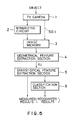
- an image measurement device is realized by sequentially and serially combining image processing techniques which are judged necessary in order to achieve particular tasks as shown in FIG.1 (Sequential and Procedural Method). For example, in order to count the number of two types of particles in binary image including a large number of particles of two different radii, all the particles (black circles) on a screen (white background) are first detected, and discriminated by attaching labels (numbers) to the respective particles. Next, their diameters, areas and so on are respectively measured, the type of the groups is decided to which each particle belongs, and the decision numbers are counted to finally obtain the respective numbers of particles of two different groups.
- FIG.2 shows the structure of such the neural networks which is modelled after the information processing by the brain.
- layers input layer, intermediate layer and output layer
- connection coefficients are set as variable weights (parameters).
- desirable results measured results
- a large number of data for the learning are sequentially inputted, and the above connection coefficients are sequentially modified every time an error is made in output.
- the above-mentioned measuring method is slow in convergence speed of the learning although it is fast in measuring processing because of the parallel processing. Further, local optimal solutions sometimes make obtaining the global optimal result difficult.
- the measuring method is adaptive and universal, the practical application inevitably takes a trial-and-error manner because it is not known what number of elements should be combined in what way to a particular problem or what should be inputted.
- the elements used in such the neural networks are restricted to use the input and output signals in the two values of "0" and "1" or the values therebetween on the model of neuron cells. Therefore, the weighted sum 10 of a large number of inputs is non-linearly transformed 11 before becoming one output as shown in FIG.3.
- the expression of information in this type of measuring method is significant as a model of a neurological information processing, it is not quite important in practice and is rather limitative and inefficient. Therefore, the measuring method has some problem and limitation as a practical image measuring device.
- U.S. Patent 4,288,779 corresponding to Japanese Patent Publication (KOKOKU) No. 47064/1983 discloses a system which can discriminate two-dimensional patterns at a high speed and measure geometrical characteristics of the patterns at a high speed.
- the measuring method since the measuring method must have other machines do arithmetic operations necessary for the character recognition to have the results in advance, its usage is limited. It is limited in usages for reading out the characters because it solely aims at providing the characteristics which do not need segmentation of a character, and it is not quite adaptive to the changes in the size and forms of the objective patterns. Therefore, the measuring method is not quite adaptive nor universal when a user wishes to apply it to a particular need at his shop. Since it is generally not easy to predict environment conditions (disturbance, for example mistiness and image quality) and so on of the device in advance, it is impossible to prepare a method which is most adaptive and optimal to particular conditions.
- This invention was conceived to eliminate such problems encountered in the prior art and aims at providing an adaptive learning type general purpose image measurement and recognition method and apparatus which extracts features in two stages of a relatively simple structure based on the observation of basic and principle conditions of the image measurement, and adaptively measures the images for arbitrary objects or usages suitable for environments by high speed learning.
- an adaptive learning type general purpose image measurement and recognition method which comprises the steps of extracting a large number of basic initial feature which are based on N th order autocorrelation and invariant to parallel displacement of an object to be caught in an image frame and which have additivity with respect to the image frame, and performing statistical features extraction having learning function used multivariate analysis methods based on the extracted initial features to thereby enable use for various types of measurement adaptively.
- an adaptive learning type general purpose image measurement and recognition apparatus which comprises a pick-up means to pick-up objects of measurement in two-dimension, an image cutting-out means which partially cuts out video signals of said picked-up images, a window signal generating means which generates a window signal for designating a measurement scope, a correlating means which computers N th order autocorrelation of said cut-out data within the scopes of said window signal, a memory means which stores coefficients of said autocorrelation, and an arithmetic controlling means which controls said respective as well as calculates multivariate analysis based on said computed values to thereby enable use for various types of measurement adaptively.
- stage F1 For the geometrical feature extraction of the stage F1, for instance, we can use the feature extraction by local autocorrelation masks based on the principle of autocorrelation of N th order (refer to U.S. Patent 4,288,779 corresponding to Japanese Patent Publication No.47064/1983).
- the statistical feature extraction of the stage F2 can be realized by the technique of linear regression analysis or the like in multivariate analysis. The linear combination in the statistical feature extraction F2 is necessary to maintain the above condition to show the learning mode and the measuring recognition mode of the system.
- the measuring concept of this invention is a parallel and adaptive measuring method which can satisfy the fundamental conditions 1 through 3, and is simple in structure and easy to implement.
- the measuring method enables the image measurement adaptive to various and many uses by the high speed learning.
- the measuring device measures the images of the two-dimensional patterns universally and rapidly in real time based on the aforementioned operation.
- An object of measurement as shown in FIG.5 is expressed as gray scale (multi-values) within a frame through a TV camera (for instance, CCD) 1.
- this measuring method is applicable to the gray scale (signal SG1) as it is, it is applied here to binary images which are binarized by a binarizing circuit 2 for facilitating the explanation since the objects for the measurement are mostly the binary images in practice.
- the gray scale is binarized by a predetermined threshold value and divided into object areas (value 1: black) and background areas (value 0: white), and are inputted into an image memory (M ⁇ M pixels) 3.
- the features to be extracted are specifically the autocorrelation functions of N th order shown below (refer to U.S. Patent 4,288,779. Labers underlined hereinbelow represent vectors.
- the extraction of the initial features is based on the principle of the above formula (1).
- the extraction of the initial features represents positional unchangeability or invariance with regard to any parallel displacement therein f( r ) ⁇ f ( r + b ) within the image frame of the object.
- the displacement direction ( a 1, ??, a N ) may be arbitrarilly determined, it would suffice for practical purposes if N is limited to the order of two and the displacement direction is limited to the directions of the locality 3 ⁇ 3 around a reference point r in order to satisfy the above condition 2.
- FIG.6 shows an example of the local displacement direction.
- the N th order autocorrelation function of the above formula (1) can be calculated by scanning once the whole screen with a local frame (with the center r ) of 3 ⁇ 3.
- Patent 4,288,779 corresponding to Japanese Patent Publication No.47064/1983 discloses the details of the calculating circuit method.
- Mask patterns are not limited the same shown in FIG.6, and they may be hexagonal patterns.
- the mask pattern may be hexagonal as shown in FIG.8A or 8D instead of the square of the size 3B ⁇ 3 as shown in FIG.7.
- the correlation using such a hexagonal pattern is effective in that fluctuation of intervals between the pixels from the center pixel is smaller than those with square pattern, that the number of the independent patterns can be reduced to "13" due to the invariance of parallel displacement, and that efficienct is higher compared to the case shown in FIG.7.
- the phases of the clock signal may be deviated by 180 degrees for each scanning line.
- FIG.9 shows a case of the autocorrelation mask (No.1 through No.17) which is independent in terms of the invariance of parallel displacement in the hexagonal patterns.
- the "1" and "*" within the patterns are similar to those shown in
- the initial features x j from the geometrical feature extraction section 4 are inputted to the statistical feature extraction section 5 as shown in FIG.5. Description will now be given to the statistical feature extraction (F2).
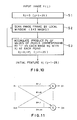
- the initial features x j obtained as above are the features which are general and fundamental and which are not dependent on measurement problems. However, they cover the information of an objective image necessary for a measurement problem. Therefore, from these linear combina tions, in the structure as shown in FIG.11, and in accordance with the following formula (2), new features (measurement values themselves or forecast approximate values) effective to the measurement problem can be obtained as y i .
- K is equal to 25 in this case
- the letter M represents the number of the feature values which are simultaneously measured.
- A R xx ⁇ 1 R xz (4)
- the following formula (5) represents an autocorrelation matrix with respect to the initial features x i and a crosscorrelation matrix with respect to the input data x i and z i , respectively.
- To the power of "-1" herein represents an inverse matrix.
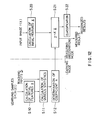
- the system in FIG.5 can hereafter estimate quite accurately the measurement vector for an input image f( r ) in the running mode (Right half of FIG.12) by using the coefficient A obtained at the Steps S11 and S12 in the learning mode (Left half of FIG.12). If the accurate measurement vector z i can be expressed by the above formula (2), a correct coefficient A is automatically obtained by the learning.
- Recognition of objects may be possible in a similar manner.
- Discriminant analysis may be used as the learning of the coefficient A for recognition.
- the coefficient A can be obtained as a solution (eigenvectors) of an eigenvalue problem below in a manner to optimally separate (discriminate) K classes in the space of the vector y .
- the letters X W and X B denote respectively the within-class covariance matrix and the between-class covariant matrix of the initial feature vector x , and are defined by the following formula.
- the image measuring device is based on the aforementioned principle, and an embodiment will now be described referred to FIG.13.
- An industrial TV camera 101 picks up an objective image 100, and sequentially outputs two-dimensional video images IS in time series to a sampling circuit 102 and an output image synthesizing/switching circuit 154.
- the sampling circuit 102 converts the video images IS sequentially into digital values (herein binary values) BP in accordane with a clock signal CLK fed from a timing signal generating circuit 103.
- the clock signal CLK is of about 6 MHz if the whole screen is assumed to have 320-pixels horizontally and 240-pixels vertically.
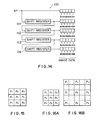
- the binary images BP from the sampling circuit 102 are inputted to the output image synthesizing/switching circuit 154 and a partial image cutting-out circuit 110 to be shown in more detail in FIG.14.
- Nine pixels are selected from the parallel image data a11 through a55. If it is assumed that pixels for outputs are P1 through P9 in FIG.15 as listed in Table 1, nine pixels in a square shape of 3 ⁇ 3 size as shown in FIG.16A or nine pixels in a square shape of 5 ⁇ 5 size as shown in FIG.16B will be outputted.
- the relationship between the mask patterns and the objective image may be modified size-wise in similar figures. The size may easily be increased to 7 ⁇ 7 or 9 ⁇ 9 simply by adding other circuits.
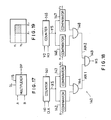
- the pixels may be selected with a selection signal SL from a controlling section comprising a CPU 150 and so on by, for instance, a multiplexer 115 as shown in FIG.17. For example, either one of the pixels a11 and a22 is selected and then outputted.
- the video images DP thus cut-out are inputted to a matching circuit 120 within a correlating circuit 160, and correlated to an autocorrelation mask as it is unchanged by the parallel displacement.
- the matching circuit 120 matches them within the scope of a window signal WS generated by a window signal generating circuit 140. Description will be first given to the window signal generating circuit 140.
- the window signal generating circuit 140 is structured as shown in FIG.18. For simplicity's sake, the explanation is made in respect of a case where a circuit is structured to process the hatched portion (or window) out of the video signals as shown in FIG.19.
- the circuit inputs horizontal synchronizing signals HD, vertical synchronizing signals VD and the clock signal CLK from the timing signal generating circuit 103, and counters 141 and 145 generate X-coordinates XS and Y-coordinates YS.
- the counter 141 counts the clock signal CLK using the horizontal synchronizing signals HD as a clear signal while the counter 145 counts the horizontal synchronizing signals HD using the vertical synchronizing signals VD as a clear signal.
- the output XS from the counter 141 and the output YS from the counter 145 are compared by digital comparators 142, 143 and 146, 147 respectively with the coordinates X1, X2 and Y1, Y2 shown in FIG.19 set in the controlling section.
- the AND circuit 149 outputs the window signal WS.
- the window signal WS is outputted in a manner so that when the output XS from the counter 141 exists between the set values X1 and X21 the output AN1 from the AND circuit 144 becomes "1", when the output YS from the counter 145 exists between the set values Y1 and Y2, the output AN2 from the AND circuit 148 becomes “1", and when the both of the outputs AN1 and AN2 are "1", the output from the AND circuit 149 becomes "1".
- the window signal WS becomes "1".
- the window signal WS is inputted to the matching circuit 120 to designate the scope of matching and the output image synthesizing/switching circuit 154. Correlation histogram is counted only when the window signal WS is "1" (or possibly "0") . The end of this window signal WS becomes a sign to finish the counting operation.
- the window signal WS is effective since it can process only the objects, cut out in accordance with the size of the object, and sequentially scan a screen at an arbitrary interval.
- the matching circuit 120 conducts matching operation with the autocorrelation mask as shown in FIG.7 by obtaining logical products of the portion of "1" in the figure. If the image is of multivalues, the sum of the portions of "1" will suffice.
- the correlation data CL matched by the matching circuit 120 are inputted to the counting means 130 comprising plural counters in the number equivalent to the autocorrelation masks, and outputs thereof are then sequentially counted by the plural counters.
- the counted data are stored in an RAM 152 and may be read out at any time. Then, the data of the counting means 130 are initialized by the horizontal and vertical synchronizing signals from the timing signal generating circuit 103.
- the output image synthesizing/switching circuit 154 switches the video images IS from the TV camera 101 and the binary images BP with the switching signal PS from the CPU 150 to display, and displays the window signal WS when the need arises.
- the CPU 150 makes necessary setting at the sampling circuit 102, the partial image cutting-out circuit 110 and the counting means 130 in accordance with the program stored in the ROM 151, conducts the learning and the arithmetic operations, and does the measurement and output.
- the CPU 150 is connected with such input devices as a keyboard via an input/output interface 153 so that it can input the teaching data, direct the learning sampling, output the results and input for directly various settings.
- the size (5 ⁇ 5 or 3 ⁇ 3) to be cut out of images is controlled in a way since the mask pattern No.1 represents the area (size) of an object pattern, if this value is greater than a predetermined value, the size 5 ⁇ 5 will be chosen while if it is less than the value, the size 3 ⁇ 3 will be chosen.
- the object 100 which has been picked up by the TV camera 101 is extracted of the features in the form of 25-demensional vector or initial features x j as a matching histogram (counted values) with the mask patterns. Only the space within the window becomes the object of measurement, and the initial features x j are extracted every time the window signal WS ends.
- the initial features x j are stored in the RAM 152 together with the information teached in accordance with plural commands.
- the plural data within the memory are processed with the technique of the multivariate analysis so as to determine the parameters for the subsequent measurements.
- the initial features x j extractedfrom unknown object are judged to output the result of the measurement.
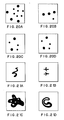
- FIGs. 20A to 20D show a real binarized image which is inputted to a system through a TV camera for the image in FIG.20C and the image in FIG.20D is seen to be greatly influenced with noises.
- the learning is performed by using the above images.
- FIGs.21A to 21D measurement examples of topological characteristic of the objective image are shown in FIGs.21A to 21D.
- the examples are numbers of the objects separated in the image frame (FIGs.21A and 21B) and are numbers of holes of the objects (FIGs.21C and 21D). It is an important matter as the topological characteristics that the number is irrespective of the shapes of the objects or the holes.
- the learning is performed as the teaching inputs z1 of the right number.
- FIGs.21A and 21B are examples of the images which are used in the above examples.
- the value y1 was respectively "1, 2" for FIGs.21A and 21B.
- the measurement of the hole number also could obtain very good results.
- the value y1 was respectively "5, 1" for FIGs.21C and 21D.
- the application to the recognition is explained.
- the objects are generated "84" numbers in triangle of optional shape and are respetively allotted to the learning images.
- the 84-images are recognized by using the most suitable coefficient matrix A, only one was missed the acute angle as the obtuse angle. The missed triangle was almost a rectangular triangle.
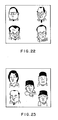
- the device may be applied to a system which discriminates faces wearing glasses as shown in FIG.22 from faces without glasses as shown in FIG.23.
- the system first shows the faces with glasses in FIG.22, then sets windows to include one face in each, indicates classes (in other words whether or not the face wears a pair of glasses) and samples them.
- Sampling data comprises 25-dimensional vectors and classes (i .e. "1" or "2"). These faces are inputted in a manner to allow slight disturbance (e.g. giving a minute angular displacement for 10 times).
- the similar operation is conducted for the faces without glasses shown in FIG.23.
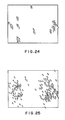
- the CPU 150 does the discriminant analysis in its arithmetic operation to xtract the statistical features optimal to decide the faces with glasses from the faces without glasses. While in FIG.24 the data of the faces form lumps randomly with class 1 and class 2 mixed, in FIG.25 (after the discriminant analysis) the two classes 1 and 2 are distinctively separate. The statistical features which can discriminate the faces with glasses from those without glasses are extracted, and may be applied to unknown faces.
- the first principal component is plotted on the horizontal axis and the second principal component on the vertical axis to show the result of the principal component analysis.
- the first eigen-projection is plotted on the horizontal axis, and the second eigen-projection on the vertical axis to show the result of the discriminant analysis.
- the device has high generality, and the learning due to the multivariate analysis is simple and high speed. Especially, it does not need to give an algorithm how to measure and it is sufficient to show an images to simply become examples and answers (measuring values to be obtained) for those.
- the invention it is possible to apply the invention to the problem which is impossible by the prior art sequential method and measurement algorithm is unknown. Further, since the position is invariable, it is possible to measure moving images (objects sequentially moving in time, for example, parts on the belt-conveyor). Therefore, the present method has good effects as a cheap general purpose image measuring device.
- the feature extraction according to this invention has good effciency and universal character, and therefore it is possible to link to neuro-computers, especially multilayered feed-forward neural networks with an error back propagation learning.
- neuro-computers especially multilayered feed-forward neural networks with an error back propagation learning.
- the structure of the neuro-computer may be small. The efficiency becomes great if the object image is large. Fyrther, since the system does not need position-invariant learning and can efficiently learn, the learning time becomes short.
- the neuro-computer is described in "Parallel Distributed Processing", Vol. I , II, MIT Press, 1986, by D.E.Rumelhart, J.L.Mcclellard and the PDP Research Group.
- this invention device can learn the device about the objects they wish to measure, to thereby allow the device automatically to select the optimum measurement method under the particular situation and to measure them at a higher speed.
- this invention device can be applied to any uses no matter how difficult it is to determine an optimal means for discrimination.
- the device performs the measurement at high resistance against the disturbance at the site as it can learn about surrounding environment.
- the device is not only adaptive but also easy to use as it can provide the extraction of the feature effectively and adaptively by such functions as windows and mask size switching.
- the device can perform a high speed processing in real time due to parallel calculation irrespective of the position of a particular object with a window. Since it is of the type of the adaptive learning, the same device can be applied to various purposes and thus is of universal type.
- the device does not have to be fed with any algorithm, but can measure if users simply provide example images and corresponding answers (or measurement values to obtain).
Landscapes
- Engineering & Computer Science (AREA)
- Theoretical Computer Science (AREA)
- Computer Vision & Pattern Recognition (AREA)
- General Physics & Mathematics (AREA)
- Physics & Mathematics (AREA)
- Artificial Intelligence (AREA)
- Data Mining & Analysis (AREA)
- Multimedia (AREA)
- Evolutionary Computation (AREA)
- Databases & Information Systems (AREA)
- Software Systems (AREA)
- Medical Informatics (AREA)
- General Health & Medical Sciences (AREA)
- Health & Medical Sciences (AREA)
- Computing Systems (AREA)
- Life Sciences & Earth Sciences (AREA)
- Bioinformatics & Cheminformatics (AREA)
- Bioinformatics & Computational Biology (AREA)
- Evolutionary Biology (AREA)
- General Engineering & Computer Science (AREA)
- Image Analysis (AREA)
- Length Measuring Devices By Optical Means (AREA)
Applications Claiming Priority (4)
| Application Number | Priority Date | Filing Date | Title |
|---|---|---|---|
| JP255678/88 | 1988-10-11 | ||
| JP63255678A JP2982814B2 (ja) | 1988-10-11 | 1988-10-11 | 適応学習型汎用画像計測方法 |
| JP255679/88 | 1988-10-11 | ||
| JP63255679A JP2834153B2 (ja) | 1988-10-11 | 1988-10-11 | 適応学習型汎用画像計測装置 |
Publications (3)
| Publication Number | Publication Date |
|---|---|
| EP0363828A2 true EP0363828A2 (fr) | 1990-04-18 |
| EP0363828A3 EP0363828A3 (fr) | 1992-08-12 |
| EP0363828B1 EP0363828B1 (fr) | 1999-01-07 |
Family
ID=26542362
Family Applications (1)
| Application Number | Title | Priority Date | Filing Date |
|---|---|---|---|
| EP89118529A Expired - Lifetime EP0363828B1 (fr) | 1988-10-11 | 1989-10-05 | Procédé et dispositif de mesure et reconnaissance d'images universelles avec apprentissage adaptatif |
Country Status (3)
| Country | Link |
|---|---|
| US (2) | US5442716A (fr) |
| EP (1) | EP0363828B1 (fr) |
| DE (1) | DE68928895T2 (fr) |
Cited By (5)
| Publication number | Priority date | Publication date | Assignee | Title |
|---|---|---|---|---|
| RU2216044C2 (ru) * | 1998-08-05 | 2003-11-10 | ШУЛЬЦЕ Клаус, др.-инж. | Способ идентификации подлинных серий изображений и устройство для его осуществления |
| CN101030244B (zh) * | 2006-03-03 | 2010-08-18 | 中国科学院自动化研究所 | 基于人体生理图像中排序测度特征的自动身份识别方法 |
| RU2413301C2 (ru) * | 2008-12-01 | 2011-02-27 | Закрытое акционерное общество "МНИТИ" (ЗАО "МНИТИ") | Способ распознавания сигнала изображений |
| US7957557B2 (en) | 2004-12-02 | 2011-06-07 | National Institute Of Advanced Industrial Science And Technology | Tracking apparatus and tracking method |
| US7957560B2 (en) | 2006-06-16 | 2011-06-07 | National Institute Of Advanced Industrial Science And Technology | Unusual action detector and abnormal action detecting method |
Families Citing this family (33)
| Publication number | Priority date | Publication date | Assignee | Title |
|---|---|---|---|---|
| US5740270A (en) * | 1988-04-08 | 1998-04-14 | Neuromedical Systems, Inc. | Automated cytological specimen classification system and method |
| EP0590759B1 (fr) * | 1992-08-12 | 1998-12-09 | International Business Machines Corporation | Système et méthode pour localiser les limites de segment vidéo |
| JPH06169395A (ja) * | 1992-11-27 | 1994-06-14 | Sharp Corp | 画像形成装置 |
| EP0693200B1 (fr) * | 1993-04-10 | 1997-07-09 | Fraunhofer-Gesellschaft Zur Förderung Der Angewandten Forschung E.V. | Procede de classement d'objets |
| JP3549569B2 (ja) * | 1993-04-27 | 2004-08-04 | ソニー エレクトロニクス インコーポレイテッド | 映像内の目標パターン探知方法 |
| US5911035A (en) * | 1995-04-12 | 1999-06-08 | Tsao; Thomas | Method and apparatus for determining binocular affine disparity and affine invariant distance between two image patterns |
| JP4114959B2 (ja) * | 1995-06-20 | 2008-07-09 | キヤノン株式会社 | 画像処理方法及び装置 |
| US6625317B1 (en) | 1995-09-12 | 2003-09-23 | Art Gaffin | Visual imaging system and method |
| US5768421A (en) * | 1995-09-12 | 1998-06-16 | Gaffin; Arthur Zay | Visual imaging system and method |
| US6996549B2 (en) * | 1998-05-01 | 2006-02-07 | Health Discovery Corporation | Computer-aided image analysis |
| US6452177B1 (en) | 1998-09-04 | 2002-09-17 | California Institute Of Technology | Atmospheric electron x-ray spectrometer |
| EP1435138A4 (fr) * | 2001-05-01 | 2005-08-03 | Philips Electronics Na | Mesure de qualite video objective composite |
| US6629010B2 (en) | 2001-05-18 | 2003-09-30 | Advanced Vision Particle Measurement, Inc. | Control feedback system and method for bulk material industrial processes using automated object or particle analysis |
| US6885904B2 (en) * | 2001-05-18 | 2005-04-26 | Advanced Vision Particle Measurement, Inc. | Control feedback system and method for bulk material industrial processes using automated object or particle analysis |
| GB2382289B (en) * | 2001-09-28 | 2005-07-06 | Canon Kk | Method and apparatus for generating models of individuals |
| AU2003278047A1 (en) * | 2002-10-31 | 2004-05-25 | Stephen F. Corbin | System and method for closed-loop control of laser cladding by powder injection |
| US7375731B2 (en) * | 2002-11-01 | 2008-05-20 | Mitsubishi Electric Research Laboratories, Inc. | Video mining using unsupervised clustering of video content |
| JP3987013B2 (ja) * | 2003-09-01 | 2007-10-03 | 本田技研工業株式会社 | 車両周辺監視装置 |
| WO2005114338A1 (fr) * | 2004-05-20 | 2005-12-01 | Mcmaster University | Procede pour commander l'aspect de produits et la performance de traitement par analyse d'images |
| JP4368767B2 (ja) * | 2004-09-08 | 2009-11-18 | 独立行政法人産業技術総合研究所 | 異常動作検出装置および異常動作検出方法 |
| US7583819B2 (en) * | 2004-11-05 | 2009-09-01 | Kyprianos Papademetriou | Digital signal processing methods, systems and computer program products that identify threshold positions and values |
| JP4603512B2 (ja) * | 2006-06-16 | 2010-12-22 | 独立行政法人産業技術総合研究所 | 異常領域検出装置および異常領域検出方法 |
| JP4429298B2 (ja) * | 2006-08-17 | 2010-03-10 | 独立行政法人産業技術総合研究所 | 対象個数検出装置および対象個数検出方法 |
| US7849037B2 (en) * | 2006-10-09 | 2010-12-07 | Brooks Roger K | Method for using the fundamental homotopy group in assessing the similarity of sets of data |
| US7849039B2 (en) * | 2006-12-29 | 2010-12-07 | Brooks Roger K | Method for using one-dimensional dynamics in assessing the similarity of sets of data using kinetic energy |
| US7849038B2 (en) * | 2006-12-31 | 2010-12-07 | Brooks Roger K | Method for using the second homotopy group in assessing the similarity of sets of data |
| US8644600B2 (en) * | 2007-06-05 | 2014-02-04 | Microsoft Corporation | Learning object cutout from a single example |
| US7876421B2 (en) * | 2008-01-29 | 2011-01-25 | Ian Lewin | Light meter apparatus and system |
| US8786847B2 (en) | 2011-01-12 | 2014-07-22 | Underwriters Laboratories, Inc. | Light measuring meter apparatus |
| CN102523482B (zh) * | 2011-12-07 | 2014-07-23 | 中山大学 | 一种基于视频内容以及回归方法的广告监测技术 |
| WO2015192239A1 (fr) | 2014-06-20 | 2015-12-23 | Miovision Technologies Incorporated | Plateforme d'apprentissage machine pour réaliser une analyse de données à grande échelle |
| US10083530B1 (en) * | 2016-10-21 | 2018-09-25 | The United States Of America As Represented By The Secretary Of The Army | Multivariate digital display device and method for increasing the separation between classes' data points in hyperspace |
| US10747989B2 (en) * | 2018-08-21 | 2020-08-18 | Software Ag | Systems and/or methods for accelerating facial feature vector matching with supervised machine learning |
Family Cites Families (10)
| Publication number | Priority date | Publication date | Assignee | Title |
|---|---|---|---|---|
| US3267431A (en) * | 1963-04-29 | 1966-08-16 | Ibm | Adaptive computing system capable of being trained to recognize patterns |
| US3588823A (en) * | 1968-03-28 | 1971-06-28 | Ibm | Mutual information derived tree structure in an adaptive pattern recognition system |
| US3968475A (en) * | 1974-11-11 | 1976-07-06 | Sperry Rand Corporation | Digital processor for extracting data from a binary image |
| US4177448A (en) * | 1978-06-26 | 1979-12-04 | International Business Machines Corporation | Character recognition system and method multi-bit curve vector processing |
| JPS5847064B2 (ja) * | 1978-07-08 | 1983-10-20 | 工業技術院長 | 文字読取方式 |
| US4760604A (en) * | 1985-02-15 | 1988-07-26 | Nestor, Inc. | Parallel, multi-unit, adaptive, nonlinear pattern class separator and identifier |
| US4805225A (en) * | 1986-11-06 | 1989-02-14 | The Research Foundation Of The State University Of New York | Pattern recognition method and apparatus |
| US4965725B1 (en) * | 1988-04-08 | 1996-05-07 | Neuromedical Systems Inc | Neural network based automated cytological specimen classification system and method |
| US5048100A (en) * | 1988-12-15 | 1991-09-10 | Michael Kuperstein | Self organizing neural network method and system for general classification of patterns |
| US4954963A (en) * | 1989-03-02 | 1990-09-04 | Texas Instruments Incorporated | Neural network and system |
-
1989
- 1989-10-05 EP EP89118529A patent/EP0363828B1/fr not_active Expired - Lifetime
- 1989-10-05 DE DE68928895T patent/DE68928895T2/de not_active Expired - Fee Related
-
1993
- 1993-06-24 US US08/080,976 patent/US5442716A/en not_active Expired - Lifetime
-
1994
- 1994-12-05 US US08/353,323 patent/US5619589A/en not_active Expired - Lifetime
Cited By (5)
| Publication number | Priority date | Publication date | Assignee | Title |
|---|---|---|---|---|
| RU2216044C2 (ru) * | 1998-08-05 | 2003-11-10 | ШУЛЬЦЕ Клаус, др.-инж. | Способ идентификации подлинных серий изображений и устройство для его осуществления |
| US7957557B2 (en) | 2004-12-02 | 2011-06-07 | National Institute Of Advanced Industrial Science And Technology | Tracking apparatus and tracking method |
| CN101030244B (zh) * | 2006-03-03 | 2010-08-18 | 中国科学院自动化研究所 | 基于人体生理图像中排序测度特征的自动身份识别方法 |
| US7957560B2 (en) | 2006-06-16 | 2011-06-07 | National Institute Of Advanced Industrial Science And Technology | Unusual action detector and abnormal action detecting method |
| RU2413301C2 (ru) * | 2008-12-01 | 2011-02-27 | Закрытое акционерное общество "МНИТИ" (ЗАО "МНИТИ") | Способ распознавания сигнала изображений |
Also Published As
| Publication number | Publication date |
|---|---|
| EP0363828B1 (fr) | 1999-01-07 |
| EP0363828A3 (fr) | 1992-08-12 |
| US5442716A (en) | 1995-08-15 |
| US5619589A (en) | 1997-04-08 |
| DE68928895T2 (de) | 1999-05-27 |
| DE68928895D1 (de) | 1999-02-18 |
Similar Documents
| Publication | Publication Date | Title |
|---|---|---|
| US5442716A (en) | Method and apparatus for adaptive learning type general purpose image measurement and recognition | |
| CN116664559B (zh) | 基于机器视觉的内存条损伤快速检测方法 | |
| CN118865042A (zh) | 一种基于深度学习和多模态融合的高效机器人视觉系统 | |
| CN108830188A (zh) | 基于深度学习的车辆检测方法 | |
| CN102831427B (zh) | 一种融合视觉显著性和灰度共生矩的纹理特征提取方法 | |
| Espinal et al. | Wavelet-based fractal signature analysis for automatic target recognition | |
| JP2010134957A (ja) | パターン認識方法 | |
| CN106373146A (zh) | 一种基于模糊学习的目标跟踪方法 | |
| Fernandez et al. | A new plant cell image segmentation algorithm | |
| CN116703895B (zh) | 基于生成对抗网络的小样本3d视觉检测方法及其系统 | |
| CN114283326A (zh) | 一种结合局部感知和高阶特征重构的水下目标重识别方法 | |
| Lin et al. | Determination of the varieties of rice kernels based on machine vision and deep learning technology | |
| CN117152083A (zh) | 一种基于类别激活映射的探地雷达道路病害图像预测可视化方法 | |
| CN113221812A (zh) | 人脸关键点检测模型的训练方法和人脸关键点检测方法 | |
| CN116912670A (zh) | 基于改进yolo模型的深海鱼类识别方法 | |
| CN106529441B (zh) | 基于模糊边界分片的深度动作图人体行为识别方法 | |
| Minami et al. | Robust scene recognition using a GA and real-world raw-image | |
| JP2982814B2 (ja) | 適応学習型汎用画像計測方法 | |
| Miciak | Character recognition using Radon transformation and principal component analysis in postal applications | |
| CN114065798A (zh) | 基于机器识别的视觉识别方法及装置 | |
| CN114140698A (zh) | 一种基于FasterR-CNN的水系信息提取算法 | |
| CN110751189B (zh) | 一种基于感知对比度和特征选择的椭圆检测方法 | |
| JP2834153B2 (ja) | 適応学習型汎用画像計測装置 | |
| CN114283296B (zh) | 一种基于结构相似度的目标识别自评估方法 | |
| CN118196396A (zh) | 一种基于深度学习的水下目标检测方法 |
Legal Events
| Date | Code | Title | Description |
|---|---|---|---|
| PUAI | Public reference made under article 153(3) epc to a published international application that has entered the european phase |
Free format text: ORIGINAL CODE: 0009012 |
|
| AK | Designated contracting states |
Kind code of ref document: A2 Designated state(s): DE FR GB IT SE |
|
| 17P | Request for examination filed |
Effective date: 19911018 |
|
| PUAL | Search report despatched |
Free format text: ORIGINAL CODE: 0009013 |
|
| AK | Designated contracting states |
Kind code of ref document: A3 Designated state(s): DE FR GB IT SE |
|
| 17Q | First examination report despatched |
Effective date: 19940621 |
|
| GRAG | Despatch of communication of intention to grant |
Free format text: ORIGINAL CODE: EPIDOS AGRA |
|
| GRAG | Despatch of communication of intention to grant |
Free format text: ORIGINAL CODE: EPIDOS AGRA |
|
| GRAH | Despatch of communication of intention to grant a patent |
Free format text: ORIGINAL CODE: EPIDOS IGRA |
|
| RAP1 | Party data changed (applicant data changed or rights of an application transferred) |
Owner name: KABUSHIKI KAISHA OUYO KEISOKU KENKYUSHO Owner name: AGENCY OF INDUSTRIAL SCIENCE AND TECHNOLOGY |
|
| GRAH | Despatch of communication of intention to grant a patent |
Free format text: ORIGINAL CODE: EPIDOS IGRA |
|
| GRAA | (expected) grant |
Free format text: ORIGINAL CODE: 0009210 |
|
| AK | Designated contracting states |
Kind code of ref document: B1 Designated state(s): DE FR GB IT SE |
|
| PG25 | Lapsed in a contracting state [announced via postgrant information from national office to epo] |
Ref country code: SE Free format text: THE PATENT HAS BEEN ANNULLED BY A DECISION OF A NATIONAL AUTHORITY Effective date: 19990107 |
|
| REF | Corresponds to: |
Ref document number: 68928895 Country of ref document: DE Date of ref document: 19990218 |
|
| ITF | It: translation for a ep patent filed | ||
| ET | Fr: translation filed | ||
| PLBE | No opposition filed within time limit |
Free format text: ORIGINAL CODE: 0009261 |
|
| STAA | Information on the status of an ep patent application or granted ep patent |
Free format text: STATUS: NO OPPOSITION FILED WITHIN TIME LIMIT |
|
| 26N | No opposition filed | ||
| EUG | Se: european patent has lapsed |
Ref document number: 89118529.0 |
|
| PG25 | Lapsed in a contracting state [announced via postgrant information from national office to epo] |
Ref country code: FR Free format text: LAPSE BECAUSE OF NON-PAYMENT OF DUE FEES Effective date: 20000630 |
|
| REG | Reference to a national code |
Ref country code: FR Ref legal event code: ST |
|
| REG | Reference to a national code |
Ref country code: GB Ref legal event code: IF02 |
|
| REG | Reference to a national code |
Ref country code: GB Ref legal event code: 732E |
|
| PGFP | Annual fee paid to national office [announced via postgrant information from national office to epo] |
Ref country code: GB Payment date: 20050923 Year of fee payment: 17 |
|
| PG25 | Lapsed in a contracting state [announced via postgrant information from national office to epo] |
Ref country code: IT Free format text: LAPSE BECAUSE OF NON-PAYMENT OF DUE FEES;WARNING: LAPSES OF ITALIAN PATENTS WITH EFFECTIVE DATE BEFORE 2007 MAY HAVE OCCURRED AT ANY TIME BEFORE 2007. THE CORRECT EFFECTIVE DATE MAY BE DIFFERENT FROM THE ONE RECORDED. Effective date: 20051005 |
|
| PGFP | Annual fee paid to national office [announced via postgrant information from national office to epo] |
Ref country code: DE Payment date: 20051213 Year of fee payment: 17 |
|
| PG25 | Lapsed in a contracting state [announced via postgrant information from national office to epo] |
Ref country code: DE Free format text: LAPSE BECAUSE OF NON-PAYMENT OF DUE FEES Effective date: 20070501 |
|
| GBPC | Gb: european patent ceased through non-payment of renewal fee |
Effective date: 20061005 |
|
| PG25 | Lapsed in a contracting state [announced via postgrant information from national office to epo] |
Ref country code: GB Free format text: LAPSE BECAUSE OF NON-PAYMENT OF DUE FEES Effective date: 20061005 |