EP0364671B1 - Vorrichtung und Verfahren zum Entwässern von Flüssigkeiten - Google Patents
Vorrichtung und Verfahren zum Entwässern von Flüssigkeiten Download PDFInfo
- Publication number
- EP0364671B1 EP0364671B1 EP89112408A EP89112408A EP0364671B1 EP 0364671 B1 EP0364671 B1 EP 0364671B1 EP 89112408 A EP89112408 A EP 89112408A EP 89112408 A EP89112408 A EP 89112408A EP 0364671 B1 EP0364671 B1 EP 0364671B1
- Authority
- EP
- European Patent Office
- Prior art keywords
- liquid
- dehydrating agent
- separator
- mixer
- dehydrated
- Prior art date
- Legal status (The legal status is an assumption and is not a legal conclusion. Google has not performed a legal analysis and makes no representation as to the accuracy of the status listed.)
- Revoked
Links
- 239000007788 liquid Substances 0.000 title claims description 239
- 238000000034 method Methods 0.000 title claims description 8
- 238000001035 drying Methods 0.000 title description 3
- 239000012024 dehydrating agents Substances 0.000 claims description 94
- XLYOFNOQVPJJNP-UHFFFAOYSA-N water Substances O XLYOFNOQVPJJNP-UHFFFAOYSA-N 0.000 claims description 57
- 238000011084 recovery Methods 0.000 claims description 37
- 239000000203 mixture Substances 0.000 claims description 17
- LYCAIKOWRPUZTN-UHFFFAOYSA-N Ethylene glycol Chemical compound OCCO LYCAIKOWRPUZTN-UHFFFAOYSA-N 0.000 claims description 12
- PEDCQBHIVMGVHV-UHFFFAOYSA-N Glycerine Chemical compound OCC(O)CO PEDCQBHIVMGVHV-UHFFFAOYSA-N 0.000 claims description 6
- MTHSVFCYNBDYFN-UHFFFAOYSA-N diethylene glycol Chemical compound OCCOCCO MTHSVFCYNBDYFN-UHFFFAOYSA-N 0.000 claims description 6
- ZIBGPFATKBEMQZ-UHFFFAOYSA-N triethylene glycol Chemical group OCCOCCOCCO ZIBGPFATKBEMQZ-UHFFFAOYSA-N 0.000 claims description 6
- 230000005484 gravity Effects 0.000 claims description 5
- 238000011144 upstream manufacturing Methods 0.000 claims description 4
- 229920001223 polyethylene glycol Polymers 0.000 claims description 2
- 230000003068 static effect Effects 0.000 claims description 2
- UWHCKJMYHZGTIT-UHFFFAOYSA-N tetraethylene glycol Chemical compound OCCOCCOCCOCCO UWHCKJMYHZGTIT-UHFFFAOYSA-N 0.000 claims description 2
- 239000007789 gas Substances 0.000 description 22
- 239000002808 molecular sieve Substances 0.000 description 17
- URGAHOPLAPQHLN-UHFFFAOYSA-N sodium aluminosilicate Chemical compound [Na+].[Al+3].[O-][Si]([O-])=O.[O-][Si]([O-])=O URGAHOPLAPQHLN-UHFFFAOYSA-N 0.000 description 17
- 229930195733 hydrocarbon Natural products 0.000 description 9
- 150000002430 hydrocarbons Chemical class 0.000 description 9
- ATUOYWHBWRKTHZ-UHFFFAOYSA-N Propane Chemical compound CCC ATUOYWHBWRKTHZ-UHFFFAOYSA-N 0.000 description 8
- 239000004215 Carbon black (E152) Substances 0.000 description 7
- 238000005406 washing Methods 0.000 description 6
- 239000002737 fuel gas Substances 0.000 description 5
- WGCNASOHLSPBMP-UHFFFAOYSA-N hydroxyacetaldehyde Natural products OCC=O WGCNASOHLSPBMP-UHFFFAOYSA-N 0.000 description 5
- NNPPMTNAJDCUHE-UHFFFAOYSA-N isobutane Chemical compound CC(C)C NNPPMTNAJDCUHE-UHFFFAOYSA-N 0.000 description 4
- VNWKTOKETHGBQD-UHFFFAOYSA-N methane Chemical compound C VNWKTOKETHGBQD-UHFFFAOYSA-N 0.000 description 4
- IJDNQMDRQITEOD-UHFFFAOYSA-N n-butane Chemical compound CCCC IJDNQMDRQITEOD-UHFFFAOYSA-N 0.000 description 4
- 239000001294 propane Substances 0.000 description 4
- 238000010586 diagram Methods 0.000 description 3
- 239000008246 gaseous mixture Substances 0.000 description 3
- 238000010438 heat treatment Methods 0.000 description 3
- 238000001179 sorption measurement Methods 0.000 description 3
- 238000010521 absorption reaction Methods 0.000 description 2
- 239000001273 butane Substances 0.000 description 2
- 239000003795 chemical substances by application Substances 0.000 description 2
- 238000001816 cooling Methods 0.000 description 2
- 239000002274 desiccant Substances 0.000 description 2
- 239000001282 iso-butane Substances 0.000 description 2
- OFBQJSOFQDEBGM-UHFFFAOYSA-N n-pentane Natural products CCCCC OFBQJSOFQDEBGM-UHFFFAOYSA-N 0.000 description 2
- 239000003345 natural gas Substances 0.000 description 2
- OKTJSMMVPCPJKN-UHFFFAOYSA-N Carbon Chemical compound [C] OKTJSMMVPCPJKN-UHFFFAOYSA-N 0.000 description 1
- 229910052799 carbon Inorganic materials 0.000 description 1
- 125000004432 carbon atom Chemical group C* 0.000 description 1
- 150000001875 compounds Chemical class 0.000 description 1
- 239000000498 cooling water Substances 0.000 description 1
- 239000012530 fluid Substances 0.000 description 1
- 239000003208 petroleum Substances 0.000 description 1
- 238000005504 petroleum refining Methods 0.000 description 1
- 239000000126 substance Substances 0.000 description 1
Images
Classifications
-
- B—PERFORMING OPERATIONS; TRANSPORTING
- B01—PHYSICAL OR CHEMICAL PROCESSES OR APPARATUS IN GENERAL
- B01D—SEPARATION
- B01D17/00—Separation of liquids, not provided for elsewhere, e.g. by thermal diffusion
- B01D17/02—Separation of non-miscible liquids
- B01D17/0208—Separation of non-miscible liquids by sedimentation
-
- B—PERFORMING OPERATIONS; TRANSPORTING
- B01—PHYSICAL OR CHEMICAL PROCESSES OR APPARATUS IN GENERAL
- B01D—SEPARATION
- B01D17/00—Separation of liquids, not provided for elsewhere, e.g. by thermal diffusion
- B01D17/02—Separation of non-miscible liquids
- B01D17/04—Breaking emulsions
- B01D17/047—Breaking emulsions with separation aids
Definitions
- the present invention relates to an apparatus for dehydrating a liquid such as a liquid hydrocarbon or the like which is produced in a natural gas treatment plant, a natural gas pressure feed plant, a petroleum refining plant, a petroleum chemical plant or the like.
- the dehydrating of the liquid hydrocarbon has usually been carried out by adsorbing water present in the liquid hydrocarbon with molecular sieves.
- Fig. 3 shows a conventional two-adsorbing column type apparatus for dehydrating a liquid hydrocarbon with molecular sieves.
- a liquid to be dried 01 is introduced into one of adsorbing columns 02, 03 packed with the molecular sieve which is now performing an adsorbing operation, and water in the liquid to be dehydrated is adsorbed by the molecular sieve and the dehydrated liquid 04 is taken out of the system.
- the recovery operation of the molecular sieve is carried out.
- the molecular sieve on which water is adsorbed are recovered by a high-temperature gas.
- a gas 05 for recovering the molecular sieve is heated up to a level of about 250 to about 300°C in a recovery gas heating furnace 06, and a heated gas for recovery 07 is then forwarded to the adsorbing column in which the recovery operation of the molecular sieve is performed.
- a gas 08 by which the molecular sieve have been recovered is afterwards cooled to ordinary temperatures or so by means of a cooling device 09. This cooled gas 08 is then forwarded to a gas/liquid separator 012, in which water is removed therefrom, and the gas 014 is then discharged from the system.
- switching valves 015 to 022 are disposed, as shown in Fig. 3. These valves are controllable to perform the above-mentioned operation.
- a different process has been disclosed in the DE-A-28 39 432 for the dehydrating of gaseous mixtures containing condensable hydrocarbon.
- the gaseous mixture comprising predominantly hydrocarbons having 1 to 3 carbon atoms, is fed to a washing column at the bottom thereof and a washing liquid, preferably glycol, is introduced at the head of the washing column.
- a washing liquid preferably glycol
- the DE-A-28 29 432 discloses that the glycol adsorbs the water contained in the gaseous mixture, that the hydrocarbons condensed during the washing process are separated from the glycol charged with water and that the charged glycol may be regenerated. According to the DE-A-28 29 432 efforts are emphasized to minimize losses of washing glycol.
- the water content of the hydrocarbon mixture is reduced from 3400 ppm to some few ppm.
- 9000 kg/h triethylene glycol have to be introduced into the washing column in order to dehydrate 160 000 kg/h of gas mixture.
- An object of the present invention is to provide an apparatus and process for dehydrating a liquid by which the above-mentioned problems of conventional ones can be solved.
- the apparatus for dehydrating a liquid of the present invention is constituted as follows:
- the liquid to be dehydrated containing water is mixed with the liquid dehydrating agent in the mixer, whereby water present in the liquid to be dehydrated is absorbed by the liquid dehydrating agent.
- a mixture of the liquid from which water has been removed by the absorption of the liquid dehydrating agent and the liquid dehydrating agent containing the absorbed water is forwarded to the separator, and these liquids are separated from each other therein. Afterward, the dehydrated liquid is taken out of the system.
- the liquid dehydrating agent containing the absorbed water is forwarded to the recovery device, and water is then removed therefrom in this device. Afterward, the water-free dehydrating agent is returned to the mixer and is then used again.
- the liquid to be dehydrated can be dehydrated by the successive fluid operations of the simple apparatus, and furthermore, the apparatus of the present case is simplified and the operation of the apparatus can be facilitated.
- the gas for recovery used in the recovery device regarding the present invention can fulfil its role in a small amount, and a large amount of a heat source is unnecessary.
- the plural sections each comprising the mixer and the separator are arranged in series in the apparatus for dehydrating a liquid described in the above paragraph (1), and therefore the liquid to be dehydrated can be dehydrated sufficiently.
- the liquid dehydrating agent by which water in the liquid to be dehydrated having a lower water content has been absorbed on the downstream side, is fed to the mixer on the upstream side, so that water in the liquid to be dehydrated having a higher water content is absorbed by the fed liquid dehydrating agent.
- the liquid dehydrating agent can be effectively used, and the dehydrating of the liquid to be dehydrated can be achieved efficiently.
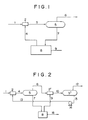
- Reference numeral 1 is a liquid to be dehydrated such as a liquid hydrocarbon containing water
- numeral 2 is a mixer to which the liquid to be dehydrated is fed.
- a recovered liquid dehydrating agent 4 is delivered from a recovery device 8 for the liquid dehydrating agent.
- a mixture 3 is forwarded to a liquid/liquid separator 5, where the dehydrated liquid 6 and the liquid dehydrating agent 7 containing the absorbed water are then separated from each other.
- the dehydrated liquid 6 is taken out from the system, and the liquid dehydrating agent 7 containing the absorbed water is fed to the recovery device 8.
- liquid/liquid separator 5 there is used any of a separator in which a difference between gravities is utilized, a parallel plate separator packed with plate-shaped contents, a corrugated plate separator, a cohesion separator called a coalescer , a cohesion separator in which electrodes are used, and a combination thereof.
- the recovery device 8 there is used a device called a dehydrator which is used to remove moisture from a gas.
- the liquid to be dehydrated 1 containing water is mixed with the liquid dehydrating agent 4 in the mixer, so that water present in the liquid to be dehydrated 1 is absorbed by the liquid dehydrating agent.
- the mixture 3 of the liquid to be dehydrated from which water has been removed by the absorption of the liquid dehydrating agent and the liquid dehydrating agent containing the absorbed water is then forwarded to the liquid/liquid separator 5, and these liquids are separated to each other therein.
- the dehydrated liquid 6 is taken out from the system, and on the other hand, the liquid dehydrating agent 7 containing the absorbed water is forwarded to a liquid dehydrating agent recovery device 8.
- water 9 is removed from the liquid dehydrating agent 7 containing the absorbed water so as to recover the liquid dehydrating agent, and the thus recovered liquid dehydrating agent is delivered to the mixer 2 again.
- the liquid to be dehydrated 1 containing water is mixed with the liquid dehydrating agent in the mixer 2, so that water is removed from the liquid to be dehydrated.
- the water-free liquid is then taken out from the system, and simultaneously the liquid dehydrating agent containing the absorbed water is recovered in the liquid dehydrating agent recovery device 8 and is then recycled.
- liquid dehydrating agent examples include triethylene glycol, diethylene glycol, monoethylene glycol, tetraethylene glycol and glycerol.
- triethylene glycol is used as the liquid dehydrating agent, and a mixture of propane and butane is used as the liquid to be dried.
- the conditions and results of the embodiment are set forth in Table 1.
- the liquid to be dehydrated (a mixture of 50 mole percent of liquid propane, 20 mole percent of liquid normal butane and 30 mole percent of liquid isobutane) containing 360 ppm by weight of water (dissolved water and free water) at a flow rate of 100,000 kg/hour is mixed suffiently with the liquid dehydrating agent (triethylene glycol) having a purity of 99.90% by weight at a flow rate of 2,000 kg/hour, whereby water present in the liquid to be dehydrated is absorbed by the liquid dehydrating agent.
- the liquid dehydrating agent triethylene glycol
- the liquid to be dehydrated and the liquid dehydrating agent in the resulting mixture are separated from each other by means of the liquid/liquid separator 5 composed of a gravity difference type separator and a cohesion separator called a coalescer, and the dehydrated liquid 6 is then taken out from the system.
- a water content in the dehydrated liquid 6 is 20 ppm by weight.
- the liquid dehydrating agent 7 containing the dehydrated water is forwarded to the liquid dehydrating agent recovery device 8, where the water 9 is then removed therefrom.
- the recovery of the liquid dehydrating agent is carried out until its purity has reached 99.90% by weight.
- the liquid dehydrating agent recovery device 8 is composed of the following members: A flush separator, a reboiler, a still column, a stripping column, a surge tank, a filter, an active carbon filter, a heat exchanger, a cooler and a pump.
- the liquid dehydrating agent 4 from which water has been removed is delivered to the mixer 2 and is then mixed with the liquid to be dehydrated 1 again.
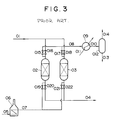
- a first section comprising the mixer 2 and the liquid/liquid separator 5 and a second section comprising a mixer 2' and a liquid/liquid separator 5', which are the same as in first embodiment, are arranged in series in the form of 2 steps.
- a liquid to be dehydrated containing water is fed to the mixer 2 in the first step section, and the liquid dehydrating agent 13 separated in the liquid/liquid separator 5' in the second section is also fed to the mixer 2 by means of a circulating pump 14.
- the liquid to be dehydrated 6 which has been separated in the liquid/liquid separator 5 is then fed to the mixer 2' in the second section, and the liquid dehydrating agent 7 containing the absorbed water is fed to the liquid dehydrating agent recovery device 8.
- the recovered liquid dehydrating agent 9 is delivered from the liquid dehydrating agent recovery device 8 to the mixer 2' in the second section. Furthermore, the liquid to be dehydrated 12 separated in the liquid/liquid separator 5' in the second section is then taken out from the system, and the liquid dehydrating agent 13 is returned to the mixer 2 in the first section by means of the circulating pump 14.
- the liquid to be dehydrated 1 is mixed, in the mixer 2 of the first section, with the liquid dehydrating agent 13 separated from the liquid/liquid separator 5' in the second section, whereby water present in the liquid to be dehydrated is absorbed by the liquid dehydrating agent.
- a mixture 4 of the liquid to be dehydrated and the liquid dehydrating agent is introduced into the liquid/liquid separator 5, where the dehydrated liquid 6 is then separated from the liquid dehydrating agent 7 containing the absorbed water, and the latter 7 is forwarded to the liquid dehydrating agent recovery device 8.
- the liquid to be dehydrated 6 separated in the liquid/liquid separator 5 and the liquid dehydrating agent 9 recovered in the liquid dehydrating agent recovery device 8 are fed to the mixer 2' in the second section.
- this mixer 2' they are mixed, so that water in the liquid to be dehydrated is absorbed by the liquid dehydrating agent in order to further dehydrate the liquid, and the mixture is then forwarded to the liquid/liquid separator 5' in the second section, where the liquid to be dehydrated is then separated from the liquid dehydrating agent.
- the dehydrated liquid 12 is taken out from the system, and the liquid dehydrating agent 13 separated in the liquid/liquid separator 5' is delivered to the mixer 2 in the first section by means of the liquid dehydrating agent circulating pump 14.
- the water 16 removed from the liquid dehydrating agent in the liquid dehydrating agent recovery device 15 is discharged from the system.
- this embodiment permits dehydrating the liquid to be dehydrated sufficiently in the two steps, and also permits using the liquid dehydrating agent 13 effectively, because the liquid dehydrating agent 13 absorbs, in the mixer 2' in the second section, water in the liquid to be dehydrated 6 having a lower water content from which water has already roughly removed in the mixer 2 in the first section, and the agent 13 is then separated in the liquid/liquid separator 5' in the second section and is afterward forwarded to the mixer 2 in the first section.
- liquid dehydrating agent the same compounds as enumerated in the first embodiment can be used.
- the liquid to be dehydrated (a mixture of 50 mole percent of liquid propane, 20 mole percent of liquid normal butane and 30 mole percent of liquid isobutane) containing 360 ppm by weight of water (dissolved water and free water) at a flow rate of 100,000 kg/hour is mixed with the liquid dehydrating agent 13 separated in the liquid/liquid separator 5' in the second section and then forwarded by the liquid dehydrating agent circulating pump 14, whereby water present in the liquid to be dehydrated 1 is absorbed by the liquid drying agent 13.
- the liquid to be dehydrated a mixture of 50 mole percent of liquid propane, 20 mole percent of liquid normal butane and 30 mole percent of liquid isobutane
- the liquid to be dehydrated and the liquid dehydrating agent in the resulting mixture are separated from each other by means of the liquid/liquid separator 5 composed of a gravity difference type separator and a cohesion separator called a coalescer, and the liquid to be dehydrated 6 is further mixed with the recovered liquid dehydrating agent 9 having a purity of 99.90% by weight in the mixer 2' in the second section.
- the liquid dehydrating agent 7 containing the absorbed water which has been separated in the liquid/liquid separator 5 in the first section is forwarded to the liquid dehydrating agent recovery device 8, where the agent 7 is then recovered up to a purity of 99.90% by weight.
- the liquid to be dehydrated is further dehydrated by the recovered liquid dehydrating agent in the mixer 2' in the second section and is then separated from the liquid dehydrating agent in the liquid/liquid separator 5' in the second section which is the same as the liquid/liquid separator in the first section.
- the thus separated water-free liquid is taken out from the system.
- a water content in the dried liquid 12 is 10 ppm by weight.
- the liquid dehydrating agent separated in the liquid/liquid separator 5' in the second section is then delivered to the mixer 2 in the first section by means of the liquid dehydrating agent circulating pump 14.
- the two sections each comprising the mixer and the liquid/liquid separator are arranged, but three or more of the similar sections may be disposed so that the liquid dehydrating agent separated from the separator in the downstream section may be fed to the mixer in the upstream section.
Landscapes
- Physics & Mathematics (AREA)
- Thermal Sciences (AREA)
- Chemical & Material Sciences (AREA)
- Chemical Kinetics & Catalysis (AREA)
- Treatment Of Liquids With Adsorbents In General (AREA)
- Extraction Or Liquid Replacement (AREA)
Claims (7)
- Verfahren zur Entwässerung einer flüssigen Substanz, dadurch gekennzeichnet, daß ein flüssiges Entwässerungsmittel (4) und eine zu entwässernde Flüssigkeit (1) in einem Mixer (2) miteinander vermischt werden, so daß dadurch der Wasseranteil der Flüssigkeit (1) von dem flüssigen Entwässerungsmittel (4) absorbiert werden kann, dann die vom Wasseranteil befreite Flüssigkeit (3) und das flüssige Entwässerungsmittel (7), welches den Wasseranteil absorbiert hat, in einem Abscheider (5) voneinander getrennt werden und sodann das abgetrennte flüssige Entwässerungsmittel (7) durch eine Wiedergewinnungsvorrichtung (8) rückgewonnen wird, so daß das rückgewonnene flüssige Entwässerungsmittel (4) über Rückführung als flüssiges Entwässerungsmittel (4) zur Einführung in den Mixer (2) verwendet werden kann.
- Verfahren nach Anspruch 1, dadurch gekennzeichnet, daß 2 Stufen mit jeweils einem Mixer (2, 2') und einem Abscheider (5, 5') hintereinander angeordnet sind, so daß das im zweiten Abschnitt vom Abscheider (5') abgetrennte flüssige Entwässerungsmittel (13) in den Mixer (2) im ersten Abschnitt eingeleitet und das vom Abscheider (5) im ersten Abschnitt abgetrennte flüssige Entwässerungsmittel (7) von der Wiedergewinnungsvorrichtung (8) rückgewonnen wird und das so rückgewonnene flüssige Entwässerungsmittel (9) in den Mixer (2') im zweiten Abschnitt eingeleitet wird, wodurch die Flüssigkeit (1) schrittweise entwässert wird.
- Verfahren nach Anspruch 1 oder 2, dadurch gekennzeichnet, daß das verwendete flüssige Entwässerungsmittel (4, 7, 9, 13) Trieethylenglycol, Diethylenglycol, Monoethylenglycol, Tetraetylenglycol und /oder Glyzerin ist.
- Vorrichtung zur Durchführung des Verfahrens nach den Ansprüchen 1-3, mit- einem Mixer (2) zum vermischen eines flüssigen Entwässerungsmittels (4) mit einer zu entwässernden Flüssigkeit (1),- einem Abscheider (5) zur gegenseitigen Abtrennung des flüssigen Entwässerungsmittels (4) und der entwässerten Flüssigkeit (1) in der erhaltenen Mischung (3),- einer Rückgewinnungsvorrichtung (8) zur Rückgewinnung des abgetrennten, vom Abscheider (5) stammenden flüssigen Entwässerungsmittels (7), und einer Vorrichtung zur Einleitung des rückgewonnenen flüssigen Entwässerungsmittels (4) in den Mixer (2),dadurch gekennzeichnet, daß
der Abscheider (5) so eingerichtet ist, daß die Mischung (3) vom Mixer (2) zum Abscheider (5) gelangt, und dadurch, daß der Abscheider (5) irgendeine Abscheider ist, in welchem Schwerkraftunterschiede ausgenutzt werden, ein mit plattenförmiger Füllung bestückter Parallelplatten - Abscheider, ein Abscheider mit gewellten Platten, ein als sogenannter Koaleszer bezeichneter Kohäsionsabscheider, ein Kohäsionsabscheider mit Verwendung von Elektoden und eine Kombination davon. - Vorrichtung nach Anspruch 4, dadurch gekennzeichnet, daß der Mixer (2) irgendein Vertreter aus der Gruppe Flüssigkeit/Flüssigkeits-Mischventil, statischer Mixer, Flüssigkeit/Flüssigkeits-Mischdüse und eine Kombination davon ist.
- Vorrichtung nach jedem der Ansprüche 4 oder 5, dadurch gekennzeichnet, daß die Rückgewinnungsvorrichtung (8) ein zur Entfernung von Feuchtigkeit aus Gas verwendetes Entwässerungsverrichtung ist.
- Vorrichtung nach jedem der Ansprüche 4-7, dadurch gekennzeichnet, daß mehrere jeweils einen Mixer (2, 2') und einen Abscheider (5, 5') umfassende Abschnitte hintereinander so angeordnet sind, daß das im Abscheider (5') abstromseitig abgetrennte Entwässerungsmittel für die Flüssigkeit aufstromseitig in den Mixer (2) eingeleitet werden kann.
Applications Claiming Priority (2)
| Application Number | Priority Date | Filing Date | Title |
|---|---|---|---|
| JP63263880A JPH07100121B2 (ja) | 1988-10-21 | 1988-10-21 | 液体乾燥装置 |
| JP263880/88 | 1988-10-21 |
Publications (3)
| Publication Number | Publication Date |
|---|---|
| EP0364671A2 EP0364671A2 (de) | 1990-04-25 |
| EP0364671A3 EP0364671A3 (en) | 1990-11-28 |
| EP0364671B1 true EP0364671B1 (de) | 1994-01-12 |
Family
ID=17395525
Family Applications (1)
| Application Number | Title | Priority Date | Filing Date |
|---|---|---|---|
| EP89112408A Revoked EP0364671B1 (de) | 1988-10-21 | 1989-07-07 | Vorrichtung und Verfahren zum Entwässern von Flüssigkeiten |
Country Status (3)
| Country | Link |
|---|---|
| EP (1) | EP0364671B1 (de) |
| JP (1) | JPH07100121B2 (de) |
| DE (1) | DE68912264T2 (de) |
Family Cites Families (6)
| Publication number | Priority date | Publication date | Assignee | Title |
|---|---|---|---|---|
| AT214412B (de) * | 1957-12-12 | 1961-04-10 | Separator Ab | Verfahren zur kontinuierlichen Spaltung von Emulsionen |
| DE2839432C2 (de) * | 1978-09-11 | 1984-06-28 | Linde Ag, 6200 Wiesbaden | Verfahren zum Trocknen von kondensierbare Kohlenwasserstoffe enthaltenden Gasen |
| FR2467235A1 (fr) * | 1979-10-12 | 1981-04-17 | Petroles Cie Francaise | Equipement pour la recuperation et le traitement des emulsions petrolieres visqueuses |
| GB2101900B (en) * | 1981-06-24 | 1985-02-27 | British Petroleum Co Plc | Demulsifying water-in-oil emulsions |
| DE3446688A1 (de) * | 1984-12-21 | 1986-06-26 | Texaco Canada Resources Ltd., Calgary, Alberta | Verfahren und vorrichtung zur aufloesung einer bitumen-in-wasser-emulsion |
| DK373686A (da) * | 1985-08-12 | 1987-02-13 | Dow Chemical Co | Gastaerringsfremgangsmaade |
-
1988
- 1988-10-21 JP JP63263880A patent/JPH07100121B2/ja not_active Expired - Fee Related
-
1989
- 1989-07-07 DE DE89112408T patent/DE68912264T2/de not_active Revoked
- 1989-07-07 EP EP89112408A patent/EP0364671B1/de not_active Revoked
Also Published As
| Publication number | Publication date |
|---|---|
| JPH02111406A (ja) | 1990-04-24 |
| JPH07100121B2 (ja) | 1995-11-01 |
| EP0364671A3 (en) | 1990-11-28 |
| DE68912264T2 (de) | 1994-05-05 |
| EP0364671A2 (de) | 1990-04-25 |
| DE68912264D1 (de) | 1994-02-24 |
Similar Documents
| Publication | Publication Date | Title |
|---|---|---|
| US5345771A (en) | Process for recovering condensable compounds from inert gas-condensable compound vapor mixtures | |
| US5061465A (en) | Bulk CO2 recovery process | |
| KR100490937B1 (ko) | 복합 아민 혼합물에 의해 이산화탄소를 회수하는 방법 | |
| US4606741A (en) | Process for purifying natural gas | |
| US4270938A (en) | Processes for decontaminating nuclear process off-gas streams | |
| EP0046472B1 (de) | Verfahren und Vorrichtung zur Gewinnung von Kohlenwasserstoffen aus Luft-Kohlenwasserstoff-Dampf-Gemischen | |
| US6183540B1 (en) | Method and apparatus for removing aromatic hydrocarbons from a gas stream prior to an amine-based gas sweetening process | |
| US5520724A (en) | Process for the recovery of low molecular weight C2+ hydrocarbons from a cracking gas | |
| CA2162575A1 (en) | Controlling emissions from glycol dehydrators | |
| EP2559466B1 (de) | Verbessertes Verfahren zur extraktiven Destillation unter Verwendung von wasserlöslichen extraktiven Lösungsmitteln | |
| CN1218711A (zh) | 从工业气体中除去二氧化碳和硫化合物的方法 | |
| US4962238A (en) | Removal of glycols from a polyalkylene glycol dialkyl ether solution | |
| CN202516336U (zh) | 储罐区排放气处理系统 | |
| US4101297A (en) | Process for recovering a solvent vapor | |
| JPS5827961B2 (ja) | 蒸留性混合物の精留方法 | |
| EP0567388B1 (de) | Verfahren zur Abtrennung von einer flüchtigen organischen Verbindung aus einem Gas | |
| US8540803B2 (en) | Method and device for removing water from natural gas or from industrial gases with physical solvents | |
| US5766423A (en) | Dehydration of gases with liquid desiccants | |
| US5315832A (en) | Process for the recovery of a light hydrocarbon fraction from marine loading operations | |
| US3831348A (en) | Removal of sulfur compounds from glycolic and alcoholic compounds by solvent extraction | |
| US4227891A (en) | Recovery of hydrocarbon vapors from air | |
| EP0364671B1 (de) | Vorrichtung und Verfahren zum Entwässern von Flüssigkeiten | |
| CA1134121A (en) | Vapor recovery | |
| EP0448880A1 (de) | Verfahren und Vorrichtung zur Wiedergewinnung von Kohlenwasserstoffen aus Luft-Kohlenwasserstoffdampfmischungen | |
| US3739548A (en) | Method and apparatus for removing distillate from physical solvents |
Legal Events
| Date | Code | Title | Description |
|---|---|---|---|
| PUAI | Public reference made under article 153(3) epc to a published international application that has entered the european phase |
Free format text: ORIGINAL CODE: 0009012 |
|
| AK | Designated contracting states |
Kind code of ref document: A2 Designated state(s): DE FR GB IT |
|
| PUAL | Search report despatched |
Free format text: ORIGINAL CODE: 0009013 |
|
| AK | Designated contracting states |
Kind code of ref document: A3 Designated state(s): DE FR GB IT |
|
| 17P | Request for examination filed |
Effective date: 19901212 |
|
| 17Q | First examination report despatched |
Effective date: 19911204 |
|
| GRAA | (expected) grant |
Free format text: ORIGINAL CODE: 0009210 |
|
| AK | Designated contracting states |
Kind code of ref document: B1 Designated state(s): DE FR GB IT |
|
| REF | Corresponds to: |
Ref document number: 68912264 Country of ref document: DE Date of ref document: 19940224 |
|
| ITF | It: translation for a ep patent filed | ||
| ET | Fr: translation filed | ||
| PLBI | Opposition filed |
Free format text: ORIGINAL CODE: 0009260 |
|
| 26 | Opposition filed |
Opponent name: BASF AKTIENGESELLSCHAFT Effective date: 19941012 |
|
| PGFP | Annual fee paid to national office [announced via postgrant information from national office to epo] |
Ref country code: GB Payment date: 19960628 Year of fee payment: 8 |
|
| PGFP | Annual fee paid to national office [announced via postgrant information from national office to epo] |
Ref country code: FR Payment date: 19960709 Year of fee payment: 8 |
|
| RDAH | Patent revoked |
Free format text: ORIGINAL CODE: EPIDOS REVO |
|
| PGFP | Annual fee paid to national office [announced via postgrant information from national office to epo] |
Ref country code: DE Payment date: 19960712 Year of fee payment: 8 |
|
| RDAG | Patent revoked |
Free format text: ORIGINAL CODE: 0009271 |
|
| STAA | Information on the status of an ep patent application or granted ep patent |
Free format text: STATUS: PATENT REVOKED |
|
| GBPR | Gb: patent revoked under art. 102 of the ep convention designating the uk as contracting state |
Free format text: 960725 |
|
| 27W | Patent revoked |
Effective date: 19960725 |
|
| PLAB | Opposition data, opponent's data or that of the opponent's representative modified |
Free format text: ORIGINAL CODE: 0009299OPPO |