EP0364924A2 - Manchon thermorétractable avec une faible tendance au déchirement - Google Patents
Manchon thermorétractable avec une faible tendance au déchirement Download PDFInfo
- Publication number
- EP0364924A2 EP0364924A2 EP89119173A EP89119173A EP0364924A2 EP 0364924 A2 EP0364924 A2 EP 0364924A2 EP 89119173 A EP89119173 A EP 89119173A EP 89119173 A EP89119173 A EP 89119173A EP 0364924 A2 EP0364924 A2 EP 0364924A2
- Authority
- EP
- European Patent Office
- Prior art keywords
- heat
- covering according
- shrinkable
- crosslinking
- areas
- Prior art date
- Legal status (The legal status is an assumption and is not a legal conclusion. Google has not performed a legal analysis and makes no representation as to the accuracy of the status listed.)
- Granted
Links
- 238000004132 cross linking Methods 0.000 claims abstract description 43
- 239000000463 material Substances 0.000 claims abstract description 20
- 229920003023 plastic Polymers 0.000 claims abstract description 20
- 239000004033 plastic Substances 0.000 claims abstract description 20
- 229920000642 polymer Polymers 0.000 claims abstract description 10
- 239000000835 fiber Substances 0.000 claims description 10
- 229920001684 low density polyethylene Polymers 0.000 claims description 7
- 239000004702 low-density polyethylene Substances 0.000 claims description 7
- 239000000203 mixture Substances 0.000 claims description 7
- -1 polyethylene Polymers 0.000 claims description 7
- 229920000573 polyethylene Polymers 0.000 claims description 7
- 229920000098 polyolefin Polymers 0.000 claims description 6
- 230000005855 radiation Effects 0.000 claims description 6
- 239000004698 Polyethylene Substances 0.000 claims description 5
- 238000010276 construction Methods 0.000 claims description 5
- 230000000694 effects Effects 0.000 claims description 5
- 239000011148 porous material Substances 0.000 claims description 5
- 229920001038 ethylene copolymer Polymers 0.000 claims description 4
- 229920001903 high density polyethylene Polymers 0.000 claims description 4
- 239000004700 high-density polyethylene Substances 0.000 claims description 4
- KOMNUTZXSVSERR-UHFFFAOYSA-N 1,3,5-tris(prop-2-enyl)-1,3,5-triazinane-2,4,6-trione Chemical compound C=CCN1C(=O)N(CC=C)C(=O)N(CC=C)C1=O KOMNUTZXSVSERR-UHFFFAOYSA-N 0.000 claims description 3
- BJELTSYBAHKXRW-UHFFFAOYSA-N 2,4,6-triallyloxy-1,3,5-triazine Chemical compound C=CCOC1=NC(OCC=C)=NC(OCC=C)=N1 BJELTSYBAHKXRW-UHFFFAOYSA-N 0.000 claims description 3
- XTXRWKRVRITETP-UHFFFAOYSA-N Vinyl acetate Chemical compound CC(=O)OC=C XTXRWKRVRITETP-UHFFFAOYSA-N 0.000 claims description 3
- 150000001412 amines Chemical class 0.000 claims description 3
- CQEYYJKEWSMYFG-UHFFFAOYSA-N butyl acrylate Chemical compound CCCCOC(=O)C=C CQEYYJKEWSMYFG-UHFFFAOYSA-N 0.000 claims description 3
- 239000003623 enhancer Substances 0.000 claims description 3
- 239000006260 foam Substances 0.000 claims description 3
- 229920000092 linear low density polyethylene Polymers 0.000 claims description 3
- 239000004707 linear low-density polyethylene Substances 0.000 claims description 3
- 239000006057 Non-nutritive feed additive Substances 0.000 claims description 2
- 230000003712 anti-aging effect Effects 0.000 claims description 2
- 239000003963 antioxidant agent Substances 0.000 claims description 2
- 239000006229 carbon black Substances 0.000 claims description 2
- 239000003795 chemical substances by application Substances 0.000 claims description 2
- 239000000945 filler Substances 0.000 claims description 2
- 150000002989 phenols Chemical class 0.000 claims description 2
- DBCAQXHNJOFNGC-UHFFFAOYSA-N 4-bromo-1,1,1-trifluorobutane Chemical compound FC(F)(F)CCCBr DBCAQXHNJOFNGC-UHFFFAOYSA-N 0.000 claims 1
- 239000004952 Polyamide Substances 0.000 claims 1
- STVZJERGLQHEKB-UHFFFAOYSA-N ethylene glycol dimethacrylate Substances CC(=C)C(=O)OCCOC(=O)C(C)=C STVZJERGLQHEKB-UHFFFAOYSA-N 0.000 claims 1
- 239000003365 glass fiber Substances 0.000 claims 1
- 239000002184 metal Substances 0.000 claims 1
- 229920002647 polyamide Polymers 0.000 claims 1
- 229920000728 polyester Polymers 0.000 claims 1
- 239000000126 substance Substances 0.000 claims 1
- 229920002725 thermoplastic elastomer Polymers 0.000 claims 1
- 239000002759 woven fabric Substances 0.000 claims 1
- 239000002861 polymer material Substances 0.000 description 15
- 238000000034 method Methods 0.000 description 10
- 229920006037 cross link polymer Polymers 0.000 description 9
- 238000001125 extrusion Methods 0.000 description 8
- 230000006378 damage Effects 0.000 description 7
- 230000008569 process Effects 0.000 description 7
- 238000004519 manufacturing process Methods 0.000 description 6
- 238000002844 melting Methods 0.000 description 5
- 230000008018 melting Effects 0.000 description 5
- 239000004744 fabric Substances 0.000 description 4
- 238000010894 electron beam technology Methods 0.000 description 3
- 239000004831 Hot glue Substances 0.000 description 2
- ATUOYWHBWRKTHZ-UHFFFAOYSA-N Propane Chemical compound CCC ATUOYWHBWRKTHZ-UHFFFAOYSA-N 0.000 description 2
- 208000027418 Wounds and injury Diseases 0.000 description 2
- 239000011324 bead Substances 0.000 description 2
- 208000014674 injury Diseases 0.000 description 2
- 229920006254 polymer film Polymers 0.000 description 2
- 230000002787 reinforcement Effects 0.000 description 2
- 238000007493 shaping process Methods 0.000 description 2
- ICBJBNAUJWZPBY-UHFFFAOYSA-N 2-hydroxyethyl 3-methylbut-2-enoate Chemical compound CC(=CC(=O)OCCO)C ICBJBNAUJWZPBY-UHFFFAOYSA-N 0.000 description 1
- ISWSIDIOOBJBQZ-UHFFFAOYSA-N Phenol Chemical compound OC1=CC=CC=C1 ISWSIDIOOBJBQZ-UHFFFAOYSA-N 0.000 description 1
- 150000001336 alkenes Chemical class 0.000 description 1
- 230000004888 barrier function Effects 0.000 description 1
- 230000006399 behavior Effects 0.000 description 1
- 230000015572 biosynthetic process Effects 0.000 description 1
- 230000008859 change Effects 0.000 description 1
- 230000000295 complement effect Effects 0.000 description 1
- 239000002131 composite material Substances 0.000 description 1
- 238000005336 cracking Methods 0.000 description 1
- 239000011243 crosslinked material Substances 0.000 description 1
- 230000002349 favourable effect Effects 0.000 description 1
- 238000003780 insertion Methods 0.000 description 1
- 230000037431 insertion Effects 0.000 description 1
- 230000006855 networking Effects 0.000 description 1
- 230000002265 prevention Effects 0.000 description 1
- 239000001294 propane Substances 0.000 description 1
- 230000009467 reduction Effects 0.000 description 1
- 230000003014 reinforcing effect Effects 0.000 description 1
- 238000007789 sealing Methods 0.000 description 1
- 238000005728 strengthening Methods 0.000 description 1
- 230000008719 thickening Effects 0.000 description 1
Images


Classifications
-
- B—PERFORMING OPERATIONS; TRANSPORTING
- B29—WORKING OF PLASTICS; WORKING OF SUBSTANCES IN A PLASTIC STATE IN GENERAL
- B29C—SHAPING OR JOINING OF PLASTICS; SHAPING OF MATERIAL IN A PLASTIC STATE, NOT OTHERWISE PROVIDED FOR; AFTER-TREATMENT OF THE SHAPED PRODUCTS, e.g. REPAIRING
- B29C61/00—Shaping by liberation of internal stresses; Making preforms having internal stresses; Apparatus therefor
- B29C61/06—Making preforms having internal stresses, e.g. plastic memory
- B29C61/0608—Making preforms having internal stresses, e.g. plastic memory characterised by the configuration or structure of the preforms
-
- B—PERFORMING OPERATIONS; TRANSPORTING
- B29—WORKING OF PLASTICS; WORKING OF SUBSTANCES IN A PLASTIC STATE IN GENERAL
- B29C—SHAPING OR JOINING OF PLASTICS; SHAPING OF MATERIAL IN A PLASTIC STATE, NOT OTHERWISE PROVIDED FOR; AFTER-TREATMENT OF THE SHAPED PRODUCTS, e.g. REPAIRING
- B29C61/00—Shaping by liberation of internal stresses; Making preforms having internal stresses; Apparatus therefor
- B29C61/06—Making preforms having internal stresses, e.g. plastic memory
- B29C61/0608—Making preforms having internal stresses, e.g. plastic memory characterised by the configuration or structure of the preforms
- B29C61/0616—Making preforms having internal stresses, e.g. plastic memory characterised by the configuration or structure of the preforms layered or partially layered preforms, e.g. preforms with layers of adhesive or sealing compositions
-
- H—ELECTRICITY
- H02—GENERATION; CONVERSION OR DISTRIBUTION OF ELECTRIC POWER
- H02G—INSTALLATION OF ELECTRIC CABLES OR LINES, OR OF COMBINED OPTICAL AND ELECTRIC CABLES OR LINES
- H02G15/00—Cable fittings
- H02G15/08—Cable junctions
- H02G15/18—Cable junctions protected by sleeves, e.g. for communication cable
- H02G15/1806—Heat shrinkable sleeves
- H02G15/1813—Wraparound or slotted sleeves
-
- B—PERFORMING OPERATIONS; TRANSPORTING
- B29—WORKING OF PLASTICS; WORKING OF SUBSTANCES IN A PLASTIC STATE IN GENERAL
- B29C—SHAPING OR JOINING OF PLASTICS; SHAPING OF MATERIAL IN A PLASTIC STATE, NOT OTHERWISE PROVIDED FOR; AFTER-TREATMENT OF THE SHAPED PRODUCTS, e.g. REPAIRING
- B29C61/00—Shaping by liberation of internal stresses; Making preforms having internal stresses; Apparatus therefor
- B29C61/06—Making preforms having internal stresses, e.g. plastic memory
- B29C61/10—Making preforms having internal stresses, e.g. plastic memory by bending plates or sheets
-
- Y—GENERAL TAGGING OF NEW TECHNOLOGICAL DEVELOPMENTS; GENERAL TAGGING OF CROSS-SECTIONAL TECHNOLOGIES SPANNING OVER SEVERAL SECTIONS OF THE IPC; TECHNICAL SUBJECTS COVERED BY FORMER USPC CROSS-REFERENCE ART COLLECTIONS [XRACs] AND DIGESTS
- Y10—TECHNICAL SUBJECTS COVERED BY FORMER USPC
- Y10S—TECHNICAL SUBJECTS COVERED BY FORMER USPC CROSS-REFERENCE ART COLLECTIONS [XRACs] AND DIGESTS
- Y10S174/00—Electricity: conductors and insulators
- Y10S174/08—Shrinkable tubes
-
- Y—GENERAL TAGGING OF NEW TECHNOLOGICAL DEVELOPMENTS; GENERAL TAGGING OF CROSS-SECTIONAL TECHNOLOGIES SPANNING OVER SEVERAL SECTIONS OF THE IPC; TECHNICAL SUBJECTS COVERED BY FORMER USPC CROSS-REFERENCE ART COLLECTIONS [XRACs] AND DIGESTS
- Y10—TECHNICAL SUBJECTS COVERED BY FORMER USPC
- Y10T—TECHNICAL SUBJECTS COVERED BY FORMER US CLASSIFICATION
- Y10T428/00—Stock material or miscellaneous articles
- Y10T428/13—Hollow or container type article [e.g., tube, vase, etc.]
- Y10T428/131—Glass, ceramic, or sintered, fused, fired, or calcined metal oxide or metal carbide containing [e.g., porcelain, brick, cement, etc.]
- Y10T428/1314—Contains fabric, fiber particle, or filament made of glass, ceramic, or sintered, fused, fired, or calcined metal oxide, or metal carbide or other inorganic compound [e.g., fiber glass, mineral fiber, sand, etc.]
-
- Y—GENERAL TAGGING OF NEW TECHNOLOGICAL DEVELOPMENTS; GENERAL TAGGING OF CROSS-SECTIONAL TECHNOLOGIES SPANNING OVER SEVERAL SECTIONS OF THE IPC; TECHNICAL SUBJECTS COVERED BY FORMER USPC CROSS-REFERENCE ART COLLECTIONS [XRACs] AND DIGESTS
- Y10—TECHNICAL SUBJECTS COVERED BY FORMER USPC
- Y10T—TECHNICAL SUBJECTS COVERED BY FORMER US CLASSIFICATION
- Y10T428/00—Stock material or miscellaneous articles
- Y10T428/13—Hollow or container type article [e.g., tube, vase, etc.]
- Y10T428/1328—Shrinkable or shrunk [e.g., due to heat, solvent, volatile agent, restraint removal, etc.]
-
- Y—GENERAL TAGGING OF NEW TECHNOLOGICAL DEVELOPMENTS; GENERAL TAGGING OF CROSS-SECTIONAL TECHNOLOGIES SPANNING OVER SEVERAL SECTIONS OF THE IPC; TECHNICAL SUBJECTS COVERED BY FORMER USPC CROSS-REFERENCE ART COLLECTIONS [XRACs] AND DIGESTS
- Y10—TECHNICAL SUBJECTS COVERED BY FORMER USPC
- Y10T—TECHNICAL SUBJECTS COVERED BY FORMER US CLASSIFICATION
- Y10T428/00—Stock material or miscellaneous articles
- Y10T428/13—Hollow or container type article [e.g., tube, vase, etc.]
- Y10T428/1328—Shrinkable or shrunk [e.g., due to heat, solvent, volatile agent, restraint removal, etc.]
- Y10T428/1331—Single layer [continuous layer]
-
- Y—GENERAL TAGGING OF NEW TECHNOLOGICAL DEVELOPMENTS; GENERAL TAGGING OF CROSS-SECTIONAL TECHNOLOGIES SPANNING OVER SEVERAL SECTIONS OF THE IPC; TECHNICAL SUBJECTS COVERED BY FORMER USPC CROSS-REFERENCE ART COLLECTIONS [XRACs] AND DIGESTS
- Y10—TECHNICAL SUBJECTS COVERED BY FORMER USPC
- Y10T—TECHNICAL SUBJECTS COVERED BY FORMER US CLASSIFICATION
- Y10T428/00—Stock material or miscellaneous articles
- Y10T428/24—Structurally defined web or sheet [e.g., overall dimension, etc.]
- Y10T428/24479—Structurally defined web or sheet [e.g., overall dimension, etc.] including variation in thickness
-
- Y—GENERAL TAGGING OF NEW TECHNOLOGICAL DEVELOPMENTS; GENERAL TAGGING OF CROSS-SECTIONAL TECHNOLOGIES SPANNING OVER SEVERAL SECTIONS OF THE IPC; TECHNICAL SUBJECTS COVERED BY FORMER USPC CROSS-REFERENCE ART COLLECTIONS [XRACs] AND DIGESTS
- Y10—TECHNICAL SUBJECTS COVERED BY FORMER USPC
- Y10T—TECHNICAL SUBJECTS COVERED BY FORMER US CLASSIFICATION
- Y10T428/00—Stock material or miscellaneous articles
- Y10T428/24—Structurally defined web or sheet [e.g., overall dimension, etc.]
- Y10T428/24479—Structurally defined web or sheet [e.g., overall dimension, etc.] including variation in thickness
- Y10T428/24521—Structurally defined web or sheet [e.g., overall dimension, etc.] including variation in thickness with component conforming to contour of nonplanar surface
- Y10T428/24537—Parallel ribs and/or grooves
-
- Y—GENERAL TAGGING OF NEW TECHNOLOGICAL DEVELOPMENTS; GENERAL TAGGING OF CROSS-SECTIONAL TECHNOLOGIES SPANNING OVER SEVERAL SECTIONS OF THE IPC; TECHNICAL SUBJECTS COVERED BY FORMER USPC CROSS-REFERENCE ART COLLECTIONS [XRACs] AND DIGESTS
- Y10—TECHNICAL SUBJECTS COVERED BY FORMER USPC
- Y10T—TECHNICAL SUBJECTS COVERED BY FORMER US CLASSIFICATION
- Y10T428/00—Stock material or miscellaneous articles
- Y10T428/24—Structurally defined web or sheet [e.g., overall dimension, etc.]
- Y10T428/24479—Structurally defined web or sheet [e.g., overall dimension, etc.] including variation in thickness
- Y10T428/2457—Parallel ribs and/or grooves
Definitions
- the invention relates to a heat-shrinkable cover made of cross-linked, polymeric plastic material with different degrees of cross-linking for a tight closure of objects.
- molded parts consist of a first part made of a crosslinked, infusible polymer material and a second part made of a meltable, essentially uncrosslinked polymer material. In between there is an impermeable barrier layer.
- Such molded parts are shaped, for example, as tubes and form a heat-shrinkable structure with an outer heat-shrinkable part and a second, fusible, seal-serving inner part.
- the shrinking process can result in tearing due to the acting shrinking forces, which can lead to the fact that it cannot be used.
- the melting layer underneath cannot remedy this, since melting the material no longer provides the necessary strength. This tearing preferably occurs transverse to the direction of shrinkage.
- the present invention is based on the object of creating heat-shrinkable coverings which have sufficient resistance to mechanical damage, in particular against tearing or tearing.
- the object is now achieved according to the invention with a heat-shrinkable covering of the type described in the introduction in that at least two plastic components with different degrees of crosslinking are arranged regularly distributed over the entire surface of the covering, one plastic component having a degree of crosslinking that has optimum shrinkability guaranteed and wherein another plastic component has a degree of crosslinking that is matched to optimal mechanical strength against tearing and that special geometric shapes and arrangements support the desired effect.
- the structural structure and methods for their manufacture guarantee a significantly reduced susceptibility to further tear and tear compared to the current state of the art. If the surface is damaged by notches, incisions, touching the heated surface, for example with a propane gas burner necessary for heat shrinking, and the like, conventional heat-shrinking articles lead to destruction by tearing.
- the present invention is based on the fact that the tearing is locally limited by the insertion of tearing-in and tearing-neutralizing areas or even leads to its absence. Such further or tear-neutralizing areas can be reached in various ways.
- a preferred measure for achieving these crack-neutralizing areas consists in a significantly different cross-linking of these areas compared to the remaining mass of the cross-linked, shrinkable material. Areas that are more cross-linked, when expanded, have the high shrinkage forces required for shrinkage; they are naturally prone to cracking if they are prevented from shrinking back during the shrinking process. Areas of lower crosslinking have lower shrinkage forces - which hardly contribute to the shrinking process - and are significantly more resistant to tearing across the direction of shrinkage. In this area, an incipient crack (due to injury, incision) is stopped perpendicular to the direction of shrinkage.
- a simple method of production results from coextrusion of crosslinkable, polymeric materials with different crosslinking characteristics with subsequent electron beam crosslinking. This is achieved particularly easily by doping crosslinking enhancers of different heights, such as triallyl cyanurate (TAC), triallyl isocyanurate (TAIC), ethylene glycol dimethylacrylate (EDMA) and the like.
- TAC triallyl cyanurate
- TAIC triallyl isocyanurate
- EDMA ethylene glycol dimethylacrylate
- the arrangement which can be achieved by coextrusion is carried out, for example, in layers in what is known as the sandwich structure, the degree of crosslinking of the individual plastic layers being different in each case.
- the object on which the invention is based can also be carried out or improved by a suitable geometric shape and a suitable construction of the heat-shrinking surfaces, suitable combinations with additional mechanical reinforcements expanding the area of use.
- a further measure for achieving or strengthening the crack-neutralizing areas consists in a subsequent reduction in the shrinking force of these areas after the expansion by selective post-crosslinking of these areas, the after crosslinking in the expanded state reduces the shrinkage force.
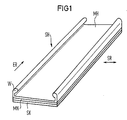
- a shrinkable sheath SH is shown, in which the susceptibility to tearing is considerably reduced according to the invention.
- This sheathing SH is manufactured in a sandwich construction and consists, for example, on its outside of a highly cross-linked polymer material MH and an underlying layer of low-cross-linked polymer material MN.
- both polymer materials are identical or at least mutually compatible so that good adhesion is achieved between them.
- both layers of the polymer materials are not meltable at the shrinking temperature, the The shrinkage effect is primarily due to the highly cross-linked material component MH, although both layers are stretched together to impress the shape memory.
- the inventive effect is based on the different behavior of the polymer films during the shrinking process.
- the low degree of crosslinking in the material component MN is just so great that it does not melt at the shrinking temperature.
- a melting layer for example made of a hot melt adhesive SK known per se, can additionally be applied on the inward-facing side.
- Such a covering or later shrinkable surface is preferably produced by extrusion, the direction of extrusion ER in this case being expediently such that corresponding beads W can be formed along the two longitudinal edges, for example as closure elements together with one of these beads W comprehensive rail bracket can be used.
- the direction of expansion and thus also the direction of shrinkage SR is selected perpendicular to the direction of extrusion ER, so that the sheath SH can be shrunk onto the enclosed object. If the surface of this sheathing SH is damaged, tearing or tearing is prevented by the second, almost shrink-free layer.
- the low level of crosslinking prevents this layer from melting at the shrinking temperature.
- the sandwich design is not limited to two differently crosslinkable layers. Any number of alternately arranged layers of different networking are conceivable. A restriction can only be seen from an economic point of view.
- the first, outer layer can also be a weakly cross-linked layer MN, and the first underlying layer can be a highly cross-linked layer SH.
- FIG. 2 illustrates a shrinkable surface which, for example, can also be designed and used as a shrinkable sheath SH with side closure elements. They in this case, according to the invention, consists of mutually parallel, alternately arranged areas of polymer materials of different degrees of crosslinking, namely areas with low crosslinked polymer material MN and areas made of highly crosslinked polymer material MH. The alternation of these areas in turn ensures that damage to the surface cannot spread over a greater distance, since areas with low-crosslinked polymer material, that is, areas with less shrinkage force, are always in between.
- the width dimensions of each area are preferably approximately the same, although this is not mandatory and, depending on the desired strength or application, other dimensional relationships can also be used.
- this shrinkable envelope SH can also be chosen as required, but it is generally smaller than the width dimension a.
- This area can also be produced in a simple manner by the extrusion process, the shrinking direction SR taking place here due to the impressed shape memory by stretching after the electron irradiation in the extrusion direction ER.
- FIG. 3 now shows a further exemplary embodiment according to the invention for a shrinkable surface, in particular for a shrinkable sheath SH, in which the susceptibility to tearing is reduced in the event of damage with a special shaping of the surface.
- a geometrical shape is selected in which the areas for preventing tearing are formed at the tapered points on the fabric.
- a longitudinally extruded surface SH is selected from longitudinal tubes R with cavities H and webs S in between. It is particularly advantageous if the outer diameter of the tubes R is about three times as large as the diameter of their cavities H.
- the webs S between two tubes R are each as wide as the diameter of a cavity H; however, these dimensions can also be determined in a different way depending on the application.
- the direction of shrinkage SR increases the shrinkage forces at the thickening points due to the geometrical shape than in the webs S, so that areas are formed in this way, by which tearing or tearing is stopped.
- the direction of extrusion ER is also the same as the later direction of shrinkage SR.
- a further layer structure is possible with this structure in combination, for example, with a melting layer of a hot melt adhesive or other modified layers corresponding to the respective application.
- FIG. 4 shows an exemplary embodiment according to the invention, in which the areas for preventing tearing in the event of surface damage are formed from a combination of the exemplary embodiments according to FIG. 2 and according to FIG. 3.
- This shape is determined, for example, by the fact that the individual regions have different thicknesses, so that the shrinkage forces change abruptly at the jump points. In this way, both effects complement each other and thus promote resilience.
- the proportions can also be adapted to the requirements here, but there are particularly favorable conditions if the areas of different degrees of crosslinking are of equal width and if a third of the height b of the low crosslinked areas MN is selected for the thickness of the highly crosslinked areas MH.
- the exemplary embodiment according to the invention according to FIG. 5 corresponds to that of FIG. 4, but here again the tube structure according to FIG. 3 is used as a basis.
- different areas with different degrees of crosslinking are also used. So exist for example, the previous webs S are now made of low-crosslinked polymer material SMN and the previous tubes R are made of highly cross-linked polymer material RMH. This area can also be produced in a simple manner by coextrusion from polymer material with different proportions of crosslinking accelerators, which is then subjected to a crosslinking process with electron radiation.
- the surface After stretching perpendicular to the direction of extrusion ER under the conditions known per se, the surface has a shrinkage capacity which becomes effective when heated. Due to the alternating alternation of low-crosslinked and highly crosslinked polymer material, tearing or tearing can also be prevented here in the manner already described above.
- the web regions that are low cross-linking in FIG. 7 can be further developed and, if necessary, fully embed the highly cross-linked tubes.
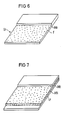
- FIG. 6 shows an example of a shrinkable sheath SH made of different polymer layers, in which fibers F made of polymers or polymer-compatible materials are embedded.
- the fibers F here either individually or together with the other layers act as areas preventing tearing and additionally additionally mechanically reinforce the heat-shrinking article.
- woven or knitted fabrics made of such fibers F can also be incorporated here, the woven or knitted fabrics being able to have firm or loose knots.
- the fibers F on their own as well as in the composite of the woven or knitted fabric can have shrinking properties even when heat is added, so that overall a shrinkage reinforcement also occurs. In such a case, the fibers themselves are also cross-linked and then stretched under the appropriate conditions and thus provided with a shape memory.
- FIG. 7 illustrates an exemplary embodiment according to the invention in which a networked and thus heat-shrinkable Polymer film, in particular a polyethylene film in sandwich construction is used together with the other layers of differently cross-linked polymer materials.
- Prevention of tearing is optimally achieved if the low-crosslinked layer MN additionally contains pores P which are evenly distributed and if the pore volume is not more than 30% of the polymer.
- the pores P form areas of additional hindrance to tearing.
- the mode of operation on which the invention is based can also be achieved if the surface or envelope SH receives alternately irradiated or more or less unirradiated areas by means of electron beams. In this way, the production of areas with different degrees of crosslinking is completely relocated to the radiation process. Such different irradiation areas result from appropriate covers, for example by placing a lead grille or by similar measures.
- the idea according to the invention lies in the fact that all polymeric materials, on the one hand, consist of areas with a defined shrinkage force and, on the other hand, of areas with less or less shrinkage force.
- the former areas cause the necessary heat deformation of the article and the latter areas, on the other hand, prevent the tearing from occurring if the surface is damaged.
Landscapes
- Shaping By String And By Release Of Stress In Plastics And The Like (AREA)
- Laminated Bodies (AREA)
- Wrappers (AREA)
Applications Claiming Priority (2)
| Application Number | Priority Date | Filing Date | Title |
|---|---|---|---|
| DE3835471 | 1988-10-18 | ||
| DE3835471 | 1988-10-18 |
Publications (3)
| Publication Number | Publication Date |
|---|---|
| EP0364924A2 true EP0364924A2 (fr) | 1990-04-25 |
| EP0364924A3 EP0364924A3 (fr) | 1991-10-09 |
| EP0364924B1 EP0364924B1 (fr) | 1995-02-22 |
Family
ID=6365385
Family Applications (1)
| Application Number | Title | Priority Date | Filing Date |
|---|---|---|---|
| EP89119173A Expired - Lifetime EP0364924B1 (fr) | 1988-10-18 | 1989-10-16 | Manchon thermorétractable avec une faible tendance au déchirement |
Country Status (8)
| Country | Link |
|---|---|
| US (1) | US5250332A (fr) |
| EP (1) | EP0364924B1 (fr) |
| AT (1) | ATE118729T1 (fr) |
| AU (1) | AU617540B2 (fr) |
| CA (1) | CA2000759A1 (fr) |
| DE (1) | DE58909026D1 (fr) |
| ES (1) | ES2068226T3 (fr) |
| GR (1) | GR3015100T3 (fr) |
Cited By (4)
| Publication number | Priority date | Publication date | Assignee | Title |
|---|---|---|---|---|
| EP0423549A3 (en) * | 1989-10-20 | 1991-10-09 | Rxs Schrumpftechnik-Garnituren Gmbh | Heat-shrinkable covering with improved edge bear resistance |
| EP0528125A1 (fr) * | 1991-08-09 | 1993-02-24 | Stewing Nachrichtentechnik GmbH & Co. KG Berlin | Bande thermorétractable |
| WO2008077434A1 (fr) * | 2006-12-27 | 2008-07-03 | Raychem Electronics (Shanghai) Ltd. | Manchon adapté pour être raccourcie à un état dilaté |
| EP1278212A3 (fr) * | 2001-07-17 | 2009-06-03 | Sumitomo Electric Fine Polymer, Inc. | Manchon thermorétractable de polyéthylène |
Families Citing this family (2)
| Publication number | Priority date | Publication date | Assignee | Title |
|---|---|---|---|---|
| DE102006011159A1 (de) * | 2006-03-10 | 2007-09-13 | Benecke-Kaliko Ag | Verfahren zur Herstellung einer thermoplastischen Folie |
| CN114479248B (zh) * | 2022-03-02 | 2024-05-10 | 深圳市沃尔核材股份有限公司 | 一种热收缩材料、热收缩套管及制备方法 |
Family Cites Families (18)
| Publication number | Priority date | Publication date | Assignee | Title |
|---|---|---|---|---|
| US3455337A (en) * | 1966-10-31 | 1969-07-15 | Raychem Corp | Irradiated article |
| US3542077A (en) * | 1968-05-22 | 1970-11-24 | Raychem Corp | Differentially cross-linked article and process for making the same |
| US3984005A (en) * | 1974-10-15 | 1976-10-05 | Owens-Illinois, Inc. | Decorative neckband label for a bottle |
| FR2369912A1 (fr) * | 1976-11-08 | 1978-06-02 | Raychem Sa Nv | Objet a reprise thermique |
| DE3202547C2 (de) * | 1981-01-29 | 1985-02-21 | Minnesota Mining And Manufacturing Co., Saint Paul, Minn. | Verfahren zum Herstellen eines durch Wärmeeinwirkung auf ein Substrat aufschrumpfbaren Hohlkörpers |
| JPS57199626A (en) * | 1981-05-30 | 1982-12-07 | Dainippon Printing Co Ltd | Manufacture of heat-shrinkable plastic film |
| CA1191006A (fr) * | 1982-01-14 | 1985-07-30 | Sekisui Kaseihin Kogyo Kabushiki Kaisha | Feuille a faconner en manchon, et sa production |
| ES528709A0 (es) * | 1983-01-06 | 1985-05-16 | Raychem Ltd | Un metodo de encerrar un substrato contorneado y un articulo contractil correspondiente. |
| GB8300220D0 (en) * | 1983-01-06 | 1983-02-09 | Raychem Ltd | Arrangement for enclosing substrates |
| SE8304779L (sv) * | 1983-02-18 | 1984-08-19 | Grace W R & Co | Forbettrade linjera polyetenkrympfilmer samt forfarande for framstellning av dessa |
| WO1987007880A1 (fr) * | 1986-06-19 | 1987-12-30 | Asahi Kasei Kogyo Kabushiki Kaisha | Film stratifie cylindrique thermoretractable |
| FR2605930B1 (fr) * | 1986-10-31 | 1989-04-28 | Conservatome | Procede de traitement de films complexes thermoretractables en polymeres destines notamment a l'emballage d'objets |
| US4816316A (en) * | 1987-02-11 | 1989-03-28 | Robbins Edward S Iii | Ribbed sheet |
| US4833024A (en) * | 1987-04-03 | 1989-05-23 | W. R. Grace & Co. | Low shrink energy films |
| DE3717618A1 (de) * | 1987-05-25 | 1988-12-08 | Kabelmetal Electro Gmbh | Waermerueckstellbarer gegenstand und verfahren zu seiner herstellung |
| US4952437A (en) * | 1987-07-15 | 1990-08-28 | Firma Rxs Schrumpftechnik-Garnituren Gmbh | Heat-shrinkable sleeve |
| US4952438A (en) * | 1987-07-15 | 1990-08-28 | Firma RXS Schrumpftechnik-Carnituren GmbH | Heat-shrinkable envelope |
| US4957790A (en) * | 1987-12-21 | 1990-09-18 | W. R. Grace & Co.-Conn. | Oriented polymeric films |
-
1989
- 1989-10-13 US US07/421,123 patent/US5250332A/en not_active Expired - Fee Related
- 1989-10-16 EP EP89119173A patent/EP0364924B1/fr not_active Expired - Lifetime
- 1989-10-16 DE DE58909026T patent/DE58909026D1/de not_active Expired - Fee Related
- 1989-10-16 AT AT89119173T patent/ATE118729T1/de not_active IP Right Cessation
- 1989-10-16 CA CA002000759A patent/CA2000759A1/fr not_active Abandoned
- 1989-10-16 ES ES89119173T patent/ES2068226T3/es not_active Expired - Lifetime
- 1989-10-17 AU AU42949/89A patent/AU617540B2/en not_active Ceased
-
1995
- 1995-02-17 GR GR950400317T patent/GR3015100T3/el unknown
Cited By (6)
| Publication number | Priority date | Publication date | Assignee | Title |
|---|---|---|---|---|
| EP0423549A3 (en) * | 1989-10-20 | 1991-10-09 | Rxs Schrumpftechnik-Garnituren Gmbh | Heat-shrinkable covering with improved edge bear resistance |
| EP0528125A1 (fr) * | 1991-08-09 | 1993-02-24 | Stewing Nachrichtentechnik GmbH & Co. KG Berlin | Bande thermorétractable |
| EP1278212A3 (fr) * | 2001-07-17 | 2009-06-03 | Sumitomo Electric Fine Polymer, Inc. | Manchon thermorétractable de polyéthylène |
| WO2008077434A1 (fr) * | 2006-12-27 | 2008-07-03 | Raychem Electronics (Shanghai) Ltd. | Manchon adapté pour être raccourcie à un état dilaté |
| GB2458092A (en) * | 2006-12-27 | 2009-09-09 | Tyco Electronics Raychem Gmbh | Sleeve adapted to be shortened in an expanded state |
| GB2458092B (en) * | 2006-12-27 | 2011-08-17 | Raychem Electronics | Shrink sleeve |
Also Published As
| Publication number | Publication date |
|---|---|
| GR3015100T3 (en) | 1995-05-31 |
| EP0364924B1 (fr) | 1995-02-22 |
| CA2000759A1 (fr) | 1990-04-18 |
| AU617540B2 (en) | 1991-11-28 |
| DE58909026D1 (de) | 1995-03-30 |
| ES2068226T3 (es) | 1995-04-16 |
| ATE118729T1 (de) | 1995-03-15 |
| US5250332A (en) | 1993-10-05 |
| EP0364924A3 (fr) | 1991-10-09 |
| AU4294989A (en) | 1990-04-26 |
Similar Documents
| Publication | Publication Date | Title |
|---|---|---|
| DE2848231C2 (de) | Wärmerückstellfähiger Gegenstand | |
| EP0299438B1 (fr) | Enveloppe thermorétractable et son procédé de fabrication | |
| DE3751709T3 (de) | Wärmerückstellbarer Gegenstand | |
| DE3588037T2 (de) | Gegenstand zur Verbindung von wärmeschrumpfbaren Teilen. | |
| DE1925739A1 (de) | Unterschiedlich vernetzte Formteile und Verfahren zu ihrer Herstellung | |
| DE2749697C2 (fr) | ||
| EP0299439B1 (fr) | Enveloppe thermorétractable | |
| EP2976450A1 (fr) | Tissu à mailles tridimensionnelles et procédé de fabrication d'un coupon de tissu à mailles tridimensionnelles | |
| DE3780905T2 (de) | Artikel aus waermeschrumpfbarem gewebe. | |
| EP0350732A2 (fr) | Câble formé, élité | |
| DE2216160A1 (de) | Wärmeerholbare Gegenstände | |
| DE69016791T2 (de) | Rückstellbare gewebemuffe. | |
| EP0364924B1 (fr) | Manchon thermorétractable avec une faible tendance au déchirement | |
| EP0299411B1 (fr) | Gaine rétrécissable à chaud | |
| EP0373476B1 (fr) | Manchon de câble divisé longitudinalement comprenant une enveloppe flexible et produit semi-fini pour la fabrication d'un tel manchon de câble | |
| EP0423549B1 (fr) | Couverture thermorétractable à résistance à la déchirure du bord améliorée | |
| EP0776753B1 (fr) | Enveloppe thermorétractable | |
| EP0570997B1 (fr) | Procédé de fabrication de bande thermorétractable en matière synthétique | |
| DE10212920A1 (de) | Gewebeschlauch | |
| EP0445381B1 (fr) | Couverture thermo-rétractable | |
| DE4020931C2 (de) | Verfahren zum Herstellen einer wärmerückstellbaren Werkstoffbahn | |
| DE1704971A1 (de) | Extrudiertes Bahnmaterial und Verfahren zur Herstellung desselben | |
| EP0423550B1 (fr) | Couverture thermorétractable avec un composant de renfort | |
| DE69222865T2 (de) | Rückstellbare Gewebemuffe. | |
| DE60203091T2 (de) | Dachbahn, Dachbahnrolle und Verfahren zur Herstellung einer Dachbahn |
Legal Events
| Date | Code | Title | Description |
|---|---|---|---|
| PUAI | Public reference made under article 153(3) epc to a published international application that has entered the european phase |
Free format text: ORIGINAL CODE: 0009012 |
|
| AK | Designated contracting states |
Kind code of ref document: A2 Designated state(s): AT BE CH DE ES FR GB GR IT LI LU NL SE |
|
| 17P | Request for examination filed |
Effective date: 19901205 |
|
| PUAL | Search report despatched |
Free format text: ORIGINAL CODE: 0009013 |
|
| AK | Designated contracting states |
Kind code of ref document: A3 Designated state(s): AT BE CH DE ES FR GB GR IT LI LU NL SE |
|
| 17Q | First examination report despatched |
Effective date: 19930928 |
|
| GRAA | (expected) grant |
Free format text: ORIGINAL CODE: 0009210 |
|
| AK | Designated contracting states |
Kind code of ref document: B1 Designated state(s): AT BE CH DE ES FR GB GR IT LI LU NL SE |
|
| REF | Corresponds to: |
Ref document number: 118729 Country of ref document: AT Date of ref document: 19950315 Kind code of ref document: T |
|
| REF | Corresponds to: |
Ref document number: 58909026 Country of ref document: DE Date of ref document: 19950330 |
|
| REG | Reference to a national code |
Ref country code: ES Ref legal event code: FG2A Ref document number: 2068226 Country of ref document: ES Kind code of ref document: T3 |
|
| REG | Reference to a national code |
Ref country code: GR Ref legal event code: FG4A Free format text: 3015100 |
|
| ITF | It: translation for a ep patent filed | ||
| ET | Fr: translation filed | ||
| GBT | Gb: translation of ep patent filed (gb section 77(6)(a)/1977) |
Effective date: 19950602 |
|
| PLBE | No opposition filed within time limit |
Free format text: ORIGINAL CODE: 0009261 |
|
| STAA | Information on the status of an ep patent application or granted ep patent |
Free format text: STATUS: NO OPPOSITION FILED WITHIN TIME LIMIT |
|
| 26N | No opposition filed | ||
| PGFP | Annual fee paid to national office [announced via postgrant information from national office to epo] |
Ref country code: GB Payment date: 19970909 Year of fee payment: 9 |
|
| PGFP | Annual fee paid to national office [announced via postgrant information from national office to epo] |
Ref country code: AT Payment date: 19970926 Year of fee payment: 9 |
|
| PGFP | Annual fee paid to national office [announced via postgrant information from national office to epo] |
Ref country code: ES Payment date: 19971009 Year of fee payment: 9 |
|
| PGFP | Annual fee paid to national office [announced via postgrant information from national office to epo] |
Ref country code: LU Payment date: 19971013 Year of fee payment: 9 Ref country code: BE Payment date: 19971013 Year of fee payment: 9 |
|
| PGFP | Annual fee paid to national office [announced via postgrant information from national office to epo] |
Ref country code: SE Payment date: 19971029 Year of fee payment: 9 Ref country code: NL Payment date: 19971029 Year of fee payment: 9 Ref country code: FR Payment date: 19971029 Year of fee payment: 9 |
|
| PGFP | Annual fee paid to national office [announced via postgrant information from national office to epo] |
Ref country code: GR Payment date: 19971031 Year of fee payment: 9 |
|
| PGFP | Annual fee paid to national office [announced via postgrant information from national office to epo] |
Ref country code: DE Payment date: 19971218 Year of fee payment: 9 |
|
| PGFP | Annual fee paid to national office [announced via postgrant information from national office to epo] |
Ref country code: CH Payment date: 19980120 Year of fee payment: 9 |
|
| PG25 | Lapsed in a contracting state [announced via postgrant information from national office to epo] |
Ref country code: LU Free format text: LAPSE BECAUSE OF NON-PAYMENT OF DUE FEES Effective date: 19981016 Ref country code: GB Free format text: LAPSE BECAUSE OF NON-PAYMENT OF DUE FEES Effective date: 19981016 Ref country code: AT Free format text: LAPSE BECAUSE OF NON-PAYMENT OF DUE FEES Effective date: 19981016 |
|
| PG25 | Lapsed in a contracting state [announced via postgrant information from national office to epo] |
Ref country code: SE Free format text: LAPSE BECAUSE OF NON-PAYMENT OF DUE FEES Effective date: 19981017 Ref country code: ES Free format text: LAPSE BECAUSE OF THE APPLICANT RENOUNCES Effective date: 19981017 |
|
| PG25 | Lapsed in a contracting state [announced via postgrant information from national office to epo] |
Ref country code: LI Free format text: LAPSE BECAUSE OF NON-PAYMENT OF DUE FEES Effective date: 19981031 Ref country code: GR Free format text: LAPSE BECAUSE OF NON-PAYMENT OF DUE FEES Effective date: 19981031 Ref country code: CH Free format text: LAPSE BECAUSE OF NON-PAYMENT OF DUE FEES Effective date: 19981031 Ref country code: BE Free format text: LAPSE BECAUSE OF NON-PAYMENT OF DUE FEES Effective date: 19981031 |
|
| BERE | Be: lapsed |
Owner name: RXS SCHRUMPFTECHNIK-GARNITUREN G.M.B.H. Effective date: 19981031 |
|
| PG25 | Lapsed in a contracting state [announced via postgrant information from national office to epo] |
Ref country code: NL Free format text: LAPSE BECAUSE OF NON-PAYMENT OF DUE FEES Effective date: 19990501 |
|
| GBPC | Gb: european patent ceased through non-payment of renewal fee |
Effective date: 19981016 |
|
| REG | Reference to a national code |
Ref country code: CH Ref legal event code: PL |
|
| EUG | Se: european patent has lapsed |
Ref document number: 89119173.6 |
|
| PG25 | Lapsed in a contracting state [announced via postgrant information from national office to epo] |
Ref country code: FR Free format text: LAPSE BECAUSE OF NON-PAYMENT OF DUE FEES Effective date: 19990630 |
|
| NLV4 | Nl: lapsed or anulled due to non-payment of the annual fee |
Effective date: 19990501 |
|
| REG | Reference to a national code |
Ref country code: FR Ref legal event code: ST |
|
| PG25 | Lapsed in a contracting state [announced via postgrant information from national office to epo] |
Ref country code: DE Free format text: LAPSE BECAUSE OF NON-PAYMENT OF DUE FEES Effective date: 19990803 |
|
| REG | Reference to a national code |
Ref country code: ES Ref legal event code: FD2A Effective date: 20001009 |
|
| PG25 | Lapsed in a contracting state [announced via postgrant information from national office to epo] |
Ref country code: IT Free format text: LAPSE BECAUSE OF NON-PAYMENT OF DUE FEES Effective date: 20051016 |