EP0365352A2 - Verfahren und Vorrichtung zur spektroskopischen Metaboliten-Quantifikation und -Bildgebung mittels magnetischer Kernresonanz - Google Patents
Verfahren und Vorrichtung zur spektroskopischen Metaboliten-Quantifikation und -Bildgebung mittels magnetischer Kernresonanz Download PDFInfo
- Publication number
- EP0365352A2 EP0365352A2 EP89310840A EP89310840A EP0365352A2 EP 0365352 A2 EP0365352 A2 EP 0365352A2 EP 89310840 A EP89310840 A EP 89310840A EP 89310840 A EP89310840 A EP 89310840A EP 0365352 A2 EP0365352 A2 EP 0365352A2
- Authority
- EP
- European Patent Office
- Prior art keywords
- sample
- ijk
- nmr
- volume
- coil
- Prior art date
- Legal status (The legal status is an assumption and is not a legal conclusion. Google has not performed a legal analysis and makes no representation as to the accuracy of the status listed.)
- Withdrawn
Links
- 238000000034 method Methods 0.000 title claims abstract description 41
- 239000002207 metabolite Substances 0.000 title claims abstract description 34
- 238000003384 imaging method Methods 0.000 title claims abstract description 23
- 238000011002 quantification Methods 0.000 title description 5
- 238000005481 NMR spectroscopy Methods 0.000 claims abstract description 53
- 230000004044 response Effects 0.000 claims abstract description 35
- 230000005284 excitation Effects 0.000 claims abstract description 12
- 238000001228 spectrum Methods 0.000 claims description 24
- 238000000701 chemical imaging Methods 0.000 claims description 8
- 238000012545 processing Methods 0.000 claims description 8
- 230000003595 spectral effect Effects 0.000 claims description 7
- 230000003068 static effect Effects 0.000 claims description 7
- 238000005160 1H NMR spectroscopy Methods 0.000 claims description 6
- 210000003484 anatomy Anatomy 0.000 claims description 5
- 230000035945 sensitivity Effects 0.000 claims description 5
- 230000000747 cardiac effect Effects 0.000 claims description 3
- 206010016352 Feeling of relaxation Diseases 0.000 claims description 2
- 230000000763 evoking effect Effects 0.000 claims 2
- 230000009466 transformation Effects 0.000 abstract description 4
- 230000005540 biological transmission Effects 0.000 abstract description 3
- 230000000694 effects Effects 0.000 abstract description 2
- DRBBFCLWYRJSJZ-UHFFFAOYSA-N N-phosphocreatine Chemical compound OC(=O)CN(C)C(=N)NP(O)(O)=O DRBBFCLWYRJSJZ-UHFFFAOYSA-N 0.000 description 10
- 238000001514 detection method Methods 0.000 description 7
- 239000000126 substance Substances 0.000 description 6
- 229950007002 phosphocreatine Drugs 0.000 description 5
- ZKHQWZAMYRWXGA-KQYNXXCUSA-J ATP(4-) Chemical compound C1=NC=2C(N)=NC=NC=2N1[C@@H]1O[C@H](COP([O-])(=O)OP([O-])(=O)OP([O-])([O-])=O)[C@@H](O)[C@H]1O ZKHQWZAMYRWXGA-KQYNXXCUSA-J 0.000 description 4
- ZKHQWZAMYRWXGA-UHFFFAOYSA-N Adenosine triphosphate Natural products C1=NC=2C(N)=NC=NC=2N1C1OC(COP(O)(=O)OP(O)(=O)OP(O)(O)=O)C(O)C1O ZKHQWZAMYRWXGA-UHFFFAOYSA-N 0.000 description 4
- 238000004611 spectroscopical analysis Methods 0.000 description 4
- 238000004679 31P NMR spectroscopy Methods 0.000 description 3
- 238000001727 in vivo Methods 0.000 description 3
- NBIIXXVUZAFLBC-UHFFFAOYSA-N Phosphoric acid Chemical compound OP(O)(O)=O NBIIXXVUZAFLBC-UHFFFAOYSA-N 0.000 description 2
- 230000000903 blocking effect Effects 0.000 description 2
- 238000010586 diagram Methods 0.000 description 2
- 230000006870 function Effects 0.000 description 2
- 230000004807 localization Effects 0.000 description 2
- 210000003205 muscle Anatomy 0.000 description 2
- 238000001208 nuclear magnetic resonance pulse sequence Methods 0.000 description 2
- 210000000056 organ Anatomy 0.000 description 2
- 150000004713 phosphodiesters Chemical class 0.000 description 2
- 150000003013 phosphoric acid derivatives Chemical class 0.000 description 2
- 210000001519 tissue Anatomy 0.000 description 2
- 206010001497 Agitation Diseases 0.000 description 1
- YUBJPYNSGLJZPQ-UHFFFAOYSA-N Dithiopyr Chemical compound CSC(=O)C1=C(C(F)F)N=C(C(F)(F)F)C(C(=O)SC)=C1CC(C)C YUBJPYNSGLJZPQ-UHFFFAOYSA-N 0.000 description 1
- 241001465754 Metazoa Species 0.000 description 1
- 108010076504 Protein Sorting Signals Proteins 0.000 description 1
- 238000010521 absorption reaction Methods 0.000 description 1
- 230000002730 additional effect Effects 0.000 description 1
- 229910000147 aluminium phosphate Inorganic materials 0.000 description 1
- 230000002238 attenuated effect Effects 0.000 description 1
- 230000000740 bleeding effect Effects 0.000 description 1
- 210000004556 brain Anatomy 0.000 description 1
- 238000012937 correction Methods 0.000 description 1
- 230000001934 delay Effects 0.000 description 1
- 230000001419 dependent effect Effects 0.000 description 1
- 201000010099 disease Diseases 0.000 description 1
- 208000037265 diseases, disorders, signs and symptoms Diseases 0.000 description 1
- 229940079593 drug Drugs 0.000 description 1
- 239000003814 drug Substances 0.000 description 1
- 238000002592 echocardiography Methods 0.000 description 1
- UBIJTWDKTYCPMQ-UHFFFAOYSA-N hexachlorophosphazene Chemical compound ClP1(Cl)=NP(Cl)(Cl)=NP(Cl)(Cl)=N1 UBIJTWDKTYCPMQ-UHFFFAOYSA-N 0.000 description 1
- 238000000669 high-field nuclear magnetic resonance spectroscopy Methods 0.000 description 1
- 238000007654 immersion Methods 0.000 description 1
- 229910052816 inorganic phosphate Inorganic materials 0.000 description 1
- 230000002045 lasting effect Effects 0.000 description 1
- 210000004185 liver Anatomy 0.000 description 1
- 230000005415 magnetization Effects 0.000 description 1
- 239000000463 material Substances 0.000 description 1
- 239000011159 matrix material Substances 0.000 description 1
- MBKDYNNUVRNNRF-UHFFFAOYSA-N medronic acid Chemical compound OP(O)(=O)CP(O)(O)=O MBKDYNNUVRNNRF-UHFFFAOYSA-N 0.000 description 1
- 230000002503 metabolic effect Effects 0.000 description 1
- 238000012986 modification Methods 0.000 description 1
- 230000004048 modification Effects 0.000 description 1
- 238000012544 monitoring process Methods 0.000 description 1
- 238000013421 nuclear magnetic resonance imaging Methods 0.000 description 1
- 150000003018 phosphorus compounds Chemical class 0.000 description 1
- 230000000704 physical effect Effects 0.000 description 1
- 230000002311 subsequent effect Effects 0.000 description 1
- 230000001360 synchronised effect Effects 0.000 description 1
- 230000002123 temporal effect Effects 0.000 description 1
- 239000002699 waste material Substances 0.000 description 1
Images




Classifications
-
- G—PHYSICS
- G01—MEASURING; TESTING
- G01R—MEASURING ELECTRIC VARIABLES; MEASURING MAGNETIC VARIABLES
- G01R33/00—Arrangements or instruments for measuring magnetic variables
- G01R33/20—Arrangements or instruments for measuring magnetic variables involving magnetic resonance
- G01R33/44—Arrangements or instruments for measuring magnetic variables involving magnetic resonance using nuclear magnetic resonance [NMR]
- G01R33/48—NMR imaging systems
- G01R33/483—NMR imaging systems with selection of signals or spectra from particular regions of the volume, e.g. in vivo spectroscopy
- G01R33/485—NMR imaging systems with selection of signals or spectra from particular regions of the volume, e.g. in vivo spectroscopy based on chemical shift information [CSI] or spectroscopic imaging, e.g. to acquire the spatial distributions of metabolites
-
- G—PHYSICS
- G01—MEASURING; TESTING
- G01R—MEASURING ELECTRIC VARIABLES; MEASURING MAGNETIC VARIABLES
- G01R33/00—Arrangements or instruments for measuring magnetic variables
- G01R33/20—Arrangements or instruments for measuring magnetic variables involving magnetic resonance
- G01R33/28—Details of apparatus provided for in groups G01R33/44 - G01R33/64
- G01R33/32—Excitation or detection systems, e.g. using radio frequency signals
- G01R33/36—Electrical details, e.g. matching or coupling of the coil to the receiver
- G01R33/3628—Tuning/matching of the transmit/receive coil
Definitions
- the present invention relates to nuclear magnetic resonance (NMR) spectroscopy and, for example, to novel methods for 1-, 2-, and 3-dimensional metabolite imaging and quantification using NMR spectroscopy.
- NMR nuclear magnetic resonance
- NMR nuclear magnetic resonance
- a method for spectroscopy metabolite imaging utilizes the steps of: applying to a desired portion of a sample a pulsed phase-encoding linear magnetic gradient signal in at least one of the three orthogonal dimensions of a Cartesian coordinate set, prior to acquisition of free-induction-decay NMR response signals from the sample portion; substantially eliminating from at least the sample portion eddy current fields induced responsive to the phase-encoding gradient pulses; maximizing the signal-to-noise ratio of the NMR response signals; and displaying the data resulting from Fourier transformation of the received response data.
- a high-field NMR imaging system is provided with self-shielded gradient coils, to substantially remove eddy-current effects, and a maximized SNR quadrature-driven volume RF coil is utilized for both transmission of the excitation RF pulses and reception of the RF response signals.
- the acquired FID data is filtered and a Fourier transform reconstruction, of dimension d ′ equal to one greater than the number d of spatial dimensions to be displayed, is performed, prior to phase and baseline correction of the data for the image to be displayed.
- a nuclear magnetic resonance (NMR) imaging system 10 utilizes a large magnet 11 having an open bore 11a therethrough, in which bore is provided a static magnetic field B O , of magnitude on the order of about 1.5 Tesla.
- This static field is oriented along the longitudinal, or Z, axis of the cylindrical bore. While any volumetric coordinate system can be used, we have found it advantageous to use a Cartesian coordinate system, as illustrated.
- a "whole-body" radio-frequency (RF) coil 14 is positioned within the bore of the gradient coil set 12, and is used at least for transmitting to an enclosed sample 15 an excitation RF magnetic field B1, responsive to a RF signal in coil cable 14a. Responsive to immersion in the magnetic field and to excitation with a radio-frequency signal of proper characteristics, sample 15 re-radiates a RF response signal, which may be received by the RF coil 14, and the like, for subsequent processing.
- RF radio-frequency
- the complete NMR imaging system 10 includes a computer means 16, having a suitable amount of random-access memory (RAM) means 16-1, disc memory means 16-2 and an array processor means 16-3; computer means 16 interfaces with an input/output console means 17.
- Computer 16 has a port 16a for interfacing to a data bus means 18 for sending and receiving data to, inter alia , gradient power supply means 20x, 20y and 20z, each providing the proper driving current to an associated one of the X, Y or Z gradient coils 12x, 12y or l2z.
- the gradient coils are of the self-shielded variety, as described and claimed in co-pending U.S.
- the volume RF coil may be a quadrature coil 14-1, operating with RF interface means 22 (including a pair of balun means 22a-1 and 22a-2, with suitable half-wavelength cables and a quadrature hybrid means 22b, diode T/R means 22c-1 and 22c-2, characteristic-impedance load means 22d, quarter-wavelength cable 22e and a low-noise amplifier (LNA) means 22f) as known to the art for properly connecting a NMR transmitter means 23 and receiver means 24 to a common antenna means 14-1.
- LNA low-noise amplifier
- Each of the transmitter means 23 and receiver means 24 also receives commands from bus means 18 and at least receiver means 24 also provides data back to computer means 16 via the data bus 18.
- the NMR response signal (emitted by the sample 15 to be studied) may, alternatively, be received with a surface coil means 14-2, having at least one surface coil each connected directly to its own means 22f′, and the like, for connection directly to receiver means 24.
- the signal-to-noise ratio (SNR) of the received signal is maximized by utilizing either a properly dimensioned surface coil or a maximized-SNR volume coil means 14-1 (such as one with a length less than 2 sample diameters long, as described and claimed in co-pending U.S. Application Serial No.
- An array of a plurality of surface coils, with at least one LNA, can be used if the array has been designed to maximize SNR [such as the array described and claimed in US-A-4825162 (Application 130,046, filed December 7, 1987) incorporated herein in its entirety by reference]. Additional details concerning the system 10 can be found in our U.S. Patent 4, 689,563, entitled "High-Field Nuclear Magnetic Resonance Imaging/Spectroscopy System", issued August 25, 1987, and incorporated herein in its entirety by reference.
- yet another alternative RF coil arrangement employs coaxial coplanar surface coils.
- This arrangement is ideally suited for, but not restricted to, spectroscopy studies involving the human torso, such as of the heart, liver, and the like.
- the quadrature volume coil arrangement is disconnected at points P1 and P2 (Fig. 1b), LNA 22f′ is connected to point P2, and coil 14-2 is disconnected from point P3.
- Surface coil 14-3 is now connected to point P1 and used at least for transmitting RF excitation field B1 (for example in the Y direction) to sample 15.
- the dimensions of coil 14-3 e.g.
- S t ⁇ 40 cm. are chosen such as to provide a substantially uniform RF field B1 over the sensitive volume of a first receive coil 14-4, located adjacent to the region of the interest in the sample 15.
- the diameter D r of the receive coil is chosen to be comparable to the depth from the surface of the organ or tissue of most interest.
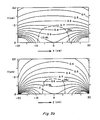
- coils 14-4 and 14-4′ can each be one of a coaxial pair of circular coils, each with a diameter D r of about 10 cm., as would be suitable for heart studies; the field profiles of respective coil 14-4 or coil 14-4′ are depicted for the X-Y plane and the Y-Z plane, respectively in Figure 3a or Figure 3b.
- the sensitive volume of the coil over which B1 ⁇ 0.1 of its maximum falls in a region 26a and 26a′ over which B1 changes by not more than 25%.
- Transmit coil 14-3 may include diode blocking means 22c-3 which effectively turns the coil off during the response RF signal detection portion (e.g. time interval T s , as will be shown in Figure 4).
- receive coils 14-4 can include tuned diode blocking means 22c-4, comprised of a tuned series resonant circuit (with inductance 27a and capacitance 27b) at the NMR frequency of the surface coil, in order to effectively turn the detection coil off during a transmission portion (e.g. time interval T t in Figure 4) of an NMR spectroscopy study.
- the impedance of coils 14-3 and 14-4 in the presence of sample 15 can be adjusted to approximately the optimum output impedance of transmitter 23 and the input impedance (Zi) of LNA 22f using a capacitive divider means 22c-5.
- Additional coaxial coplanar coils 14-4′ and the like may be added to detect NMR signals from other nuclei.
- cardiac-gating transducer means 28 scan provide a gate signal to data port 29, of the bus, to permit NMR spectroscopy (and imaging) pulse sequences to be applied synchronous to selected periods in the cardiac cycle.
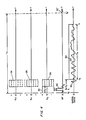
- spectroscopic metabolite images are obtained by operating system 10 in accordance with the gradient and RF signals shown in Figure 4.
- Suitable signal sequences include those described and claimed in our U.S. Patent 4,506,223, issued March 19, 1985, and incorporated herein in its entirety by reference.
- a spatially-selected NMR pulse uses a RF pulse signal 30, shown as being of a truncated sinc form, in conjunction with a non-zero G Z gradient lobe 32; both signals 30 and 32 occur in a time interval T t , commencing at a time t0, with the RF signal peaking at a mid-pulse time t1, and both RF signal pulse and gradient lobe terminating substantially at a time t2 thereafter.
- RF pulse 30 may be a 90° NMR pulse, or alternatively may be adjusted to maximize the detected NMR signal, in which case the pulse angle may be less than 90°, depending on the pulse sequence repetition period T R .
- This initial pulse selects a slab with a small Z-axis width in the sample, so that spectroscopic information in the two dimensions of the selected plane (here, the X and Y dimensions) can be spatially encoded via the subsequent phase-encoding G X and G Y gradient lobes 34 and 36, respectively.
- G X and G Y gradient lobe 34 and 36 magnitudes as shown by the broken line portions, different columns and rows of pixels in the X and Y directions are encoded.
- a Z-gradient G Z refocussing lobe 38 of substantially constant amplitude (the amplitude associated with the center of the Z slab) is provided while this two-dimensional spatial encoding sequence occurs.
- the amplitude of the G Z rephasing lobe 38 can be varied, as shown by the broken-line portions thereof, to also vary the responses in the Z direction.
- a single direction of spatial encoding say, the X direction only, then a zero value of Y-direction gradient lobe 36 and Z direction gradient lobe 38 would be utilized with the various sequential phase-encoding values of X-direction gradient lobe 34.
- the 1, 2 or 3-dimension spatial encoding gradient lobes occur from time t2 to a spatial-encoding temporal endpoint time t3 occurring at a fixed delay time interval T d after the spatially-selective pulse midpoint time t1.
- the free-induction decay (FID) signal 40 begins substantially at the gradient lobe endpoint time t3, at which time the received data is gated on, by a gating function 42 lasting for a time interval T s , to be digitized starting at time t3 and ceasing at a sequence ending time t4. It is only the gated data 40′, from time t3 to time t4, that is returned to the system computational means 16 for processing.
- This Fourier transform is performed both with respect to the spatial gradient amplitudes and also with respect to time, to yield the spectroscopic image consisting of d spatial dimensions and one chemical-shift dimension, respectively. It will be seen that omission of a phase-encoding gradient in one or more of the spatial dimensions will result in a corresponding loss of spatial discrimination in those dimensions.
- a particularly useful spectroscopic imaging sequence uses only one such phase-encoding gradient applied in the direction of the surface coil axis. Then, a 2DFT, with respect to gradient amplitude and time, yields spectra as a function of axial depth below the surface coil plane; localization in the other two spatial dimensions is provided by the inherent sensitivity profile of the surface coil, and the removal of gradient encoding in these other 2 dimensions reduces imaging time.
- FIG. 5a a set of intensity/chemical-shift-frequency spectra are shown, as the results of the (d+1)-DFT processing of the data from each of a plurality n of voxels, V i , where 1 ⁇ i ⁇ n.
- Figure 5a can show, for example, a set of spectra for voxels with one combination of eight different X values and four different Y values in a XY plane, for a single Z thickness.
- a relatively long time interval TR must usually be used between sequence repetitions of the total of N x ⁇ N y repetitions (where N x is the number of voxels in the X direction and N y is the number of voxels in the Y direction, for each of N Z different planes).
- the sequence is repeated but with a different one of the N Z slices, or planes, being excited by a frequency offset selective-excitation pulse applied in the presence of gradient G z lobe 32 followed by rephasing lobe 38, at a repetition period of T R /N z .
- the RF pulse amplitude 30 may be adjusted to compensate for the nonuniformity on a slice-by-slice basis.
- the latter compensation is achieved by weighting the pulse amplitudes for each slice according to either the average B1 field in the slice or the particular B1 field in the slice at the level of an organ of interest (with field B1 being deduced from the information in Fig. 3 herein, in Fig. 3 of US application 202,624, (European Patent Application 89305663.0) or the like).
- Figure 5b shows a 3DFT set of spectra for a single-Z-thickness volume through the head with "cells" C i,j having one (i) of eight different X-axis voxel values and one (j) of eight different Y-axis voxel values.
- a total of 64 cells are defined (by eight different lobe 34 amplitudes and eight different lobe 36 amplitudes); a spectrum is provided for each cell.
- a display may be superimposed of the periphery of the body portion being imaged. This outline 55 may be from an image taken prior, during, or after to the spectroscopic imaging procedure.
- a sample vial 57 having a known concentration of a known metabolite, can be placed in a known position (e.g. in front of the patient's head, as on a headband) so that a particular spectrum 57 is of a voxel (e.g. cell C5,2) containing only the known concentration sample (and air), and not any portion of the sample-to-be-imaged.
- a standard of known concentration having a T2* relaxation time much greater than the phase-encoding gradient application delay time interval T d , is located within the imaging field-of-view, but outside of the sample.
- Metabolite concentrations can now be quantified by comparison of the intensity of spectral components.
- 31P standards of several cm3 vials of 1M solutions of phosphoric acid, of methylene diphosphonic acid or of phosphonitrilic chloride trimer available from Aldrich Chemical Company: see J.K.
- Figure 6 illustrates one possible form for the display and presentation of the spectroscopic imaging information acquired by use of the present invention.
- a slice-selective, 8x8 voxel, 256 point 3DFT imaging sequence has been used, with T d of about 2.7 mSec. (with about 2.2 msec. used for the slice-selective gradient refocussing lobe and the phase-encoding gradient lobes, including rise and fall times), and a 10 cm. diameter surface detection coil.
- the NMR pulse power was adjusted to maximize the SNR in 31P spectra derived from the entire selected image slice in the absence of phase-encoding gradients immediately prior to commencement of the spectroscopic imaging procedure.
- absorption mode spectra were inverse-transformed, exponentially-multiplied (12 Hz line-broadening), zero-filled, retransformed, phase-corrected (zero and first order), and baseline-flattened.
- GASS steady state
- the 1H NMR signal from the selected spectroscopic image slice was also used to shim the magnet homogeneity prior to the 31P procedure, which used the depth-resolved surface coil spectroscopy (DRESS) response signal acquisition procedure, as described and claimed in U.S. Patent 4,629,988, issued December 16, 1986 and incorporated herein in its entirety by reference.
- the 1H image 60 is divided into a matrix of pixels P r,c where r is the row number (1 ⁇ r ⁇ 8) and is the column number (1 ⁇ c ⁇ 8). While spectra are available (as seen in Figure 5) for all 64 voxels in the spectroscopic image, we chose to display only 8 here, so that they could be enlarged to show detail.
- the spectra S 7,3 and S 7,4 of predominantly muscle-containing pixels P 7,3 and P 7,4 clearly show large amounts of both PCr and ATP, which are not present in the spectra S 8,2 and S 8,3 of predominantly fat-containing pixels P 8,2 and P 8,3 .
- the line 62 dividing pixel rows 7 and 8 has been so positioned as to cause these two pairs of pixels to have completely different forms of material therein.
- Pixels, such as P 6,5 or P 7,8 having a combination of muscle and fat have spectra (e.g. S 6,5 or S 7,8 ) in which the concentrations of PCr and ATP are "smeared".
Landscapes
- Physics & Mathematics (AREA)
- Spectroscopy & Molecular Physics (AREA)
- Optics & Photonics (AREA)
- High Energy & Nuclear Physics (AREA)
- Condensed Matter Physics & Semiconductors (AREA)
- General Physics & Mathematics (AREA)
- Magnetic Resonance Imaging Apparatus (AREA)
Applications Claiming Priority (2)
| Application Number | Priority Date | Filing Date | Title |
|---|---|---|---|
| US07/260,633 US4881032A (en) | 1988-10-21 | 1988-10-21 | Method of, and apparatus for, NMR spectroscopic metabolite imaging and quantification |
| US260633 | 1988-10-21 |
Publications (2)
| Publication Number | Publication Date |
|---|---|
| EP0365352A2 true EP0365352A2 (de) | 1990-04-25 |
| EP0365352A3 EP0365352A3 (de) | 1991-02-06 |
Family
ID=22989962
Family Applications (1)
| Application Number | Title | Priority Date | Filing Date |
|---|---|---|---|
| EP19890310840 Withdrawn EP0365352A3 (de) | 1988-10-21 | 1989-10-20 | Verfahren und Vorrichtung zur spektroskopischen Metaboliten-Quantifikation und -Bildgebung mittels magnetischer Kernresonanz |
Country Status (4)
| Country | Link |
|---|---|
| US (1) | US4881032A (de) |
| EP (1) | EP0365352A3 (de) |
| JP (1) | JPH02159249A (de) |
| IL (1) | IL91955A0 (de) |
Cited By (1)
| Publication number | Priority date | Publication date | Assignee | Title |
|---|---|---|---|---|
| WO2001079874A1 (en) * | 2000-04-18 | 2001-10-25 | F. Hoffmann-La Roche Ag | Method for increasing the throughput of nmr spectrometers |
Families Citing this family (18)
| Publication number | Priority date | Publication date | Assignee | Title |
|---|---|---|---|---|
| FR2621125B1 (fr) * | 1987-09-28 | 1989-12-08 | Thomson Cgr | Systeme de bobines de gradient pour machine de rmn |
| US5201311A (en) * | 1989-08-11 | 1993-04-13 | General Electric Company | Spatially-localized chemical-reaction-rate NMR spectroscopic imaging |
| JPH03173531A (ja) * | 1989-12-01 | 1991-07-26 | Hitachi Ltd | 磁気共鳴イメージング装置の渦電流補償方法及び渦電流補償装置 |
| US5707875A (en) * | 1994-08-11 | 1998-01-13 | Hitachi, Ltd. | 170-Labeled phosphoric acid compound and method and apparatus for selective observation of nuclear magnetic resonance signals using the compound |
| US5500592A (en) * | 1994-10-31 | 1996-03-19 | General Electric Company | Absolute metabolite concentrations from poorly spatially-resolved MR response signals |
| US5578921A (en) * | 1995-01-10 | 1996-11-26 | Board Of Trustees Of The Leland Stanford Junior University | Magnetic resonance imaging using three-dimensional spectral-spatial excitation |
| US5898306A (en) * | 1997-04-09 | 1999-04-27 | Regents Of The University Of Minnesota | Single circuit ladder resonator quadrature surface RF coil |
| AU2002235546A1 (en) * | 2000-08-22 | 2002-03-04 | Randell L. Mills | 4 dimensional magnetic resonance imaging |
| IL147221A (en) | 2001-12-20 | 2010-11-30 | Given Imaging Ltd | Device, system and method for image based size analysis |
| US6983181B2 (en) * | 2002-05-01 | 2006-01-03 | General Electric Company | Spatial encoding MR data of a moving subject using a higher-order gradient field |
| US7403004B2 (en) * | 2003-10-31 | 2008-07-22 | Koninklijke Philips Electronics N.V. | B1 field control in magnetic resonance imaging |
| WO2006110768A2 (en) * | 2005-04-12 | 2006-10-19 | The General Hospital Corporation | System, method and software arrangement for analyzing and correlating molecular profiles associated with anatomical structures |
| WO2007120911A2 (en) * | 2006-04-14 | 2007-10-25 | Carnegie Mellon University | Cellular labeling and quantification for nuclear magnetic resonance techniques |
| WO2010057093A2 (en) * | 2008-11-14 | 2010-05-20 | University Of Southern California | Tailored radiofrequency pulses for uniform saturation in magnetic resonance imaging |
| WO2012173976A2 (en) | 2011-06-17 | 2012-12-20 | Carroll Robert G | Methods and apparatus for assessing activity of an organ and uses thereof |
| KR101351584B1 (ko) * | 2012-09-26 | 2014-01-22 | 연세대학교 산학협력단 | 자기 공명 영상에서 지질에 의한 왜곡을 제거하기 위한 방법 및 장치 |
| US11181594B2 (en) | 2014-11-13 | 2021-11-23 | Brigham And Women's Hospital, Inc. | System and method for locally correlated spectroscopy for assessing medical discorders |
| US10254361B2 (en) * | 2016-09-16 | 2019-04-09 | General Electric Company | Systems and methods for disconnecting an MRI RF coil |
Family Cites Families (16)
| Publication number | Priority date | Publication date | Assignee | Title |
|---|---|---|---|---|
| DE2846832B1 (de) * | 1978-10-27 | 1980-02-07 | Hoechst Ag | Spurenelementduengemittelpasten und Verfahren zu deren Herstellung |
| EP0100183B1 (de) * | 1982-07-28 | 1988-12-07 | Picker International Limited | Kernmagnetische Resonanzmethode und Vorrichtung |
| US4506223A (en) * | 1982-11-22 | 1985-03-19 | General Electric Company | Method for performing two-dimensional and three-dimensional chemical shift imaging |
| US4567440A (en) * | 1983-06-09 | 1986-01-28 | Haselgrove John C | Vivo P-31 NMR imaging of phosphorus metabolites |
| US4629988A (en) * | 1984-07-02 | 1986-12-16 | General Electric Company | Method of imaging by depth-resolved surface coil spectroscopy |
| US4678995A (en) * | 1984-12-12 | 1987-07-07 | Yale University | Apparatus and method for determining the presence of substances in a sample by NMR and producing an NMR image thereof |
| US4728893A (en) * | 1985-07-31 | 1988-03-01 | The Regents Of The University Of California | Increased signal-to-noise ratio in magnetic resonance images using synthesized conjugate symmetric data |
| US4683431A (en) * | 1985-08-16 | 1987-07-28 | Picker International, Inc. | Magnetic resonance imaging of high velocity flows |
| US4689560A (en) * | 1985-08-16 | 1987-08-25 | Picker International, Inc. | Low R.F. dosage magnetic resonance imaging of high velocity flows |
| GB8528357D0 (en) * | 1985-11-18 | 1985-12-24 | Picker Int Ltd | Nuclear magnetic resonance imaging |
| US4709212A (en) * | 1986-01-03 | 1987-11-24 | General Electric Company | Method of enhancing image signal-to-noise ratio by combining NMR images of differing pulse sequence timing |
| US4698591A (en) * | 1986-01-03 | 1987-10-06 | General Electric Company | Method for magnetic field gradient eddy current compensation |
| US4740753A (en) * | 1986-01-03 | 1988-04-26 | General Electric Company | Magnet shimming using information derived from chemical shift imaging |
| US4737716A (en) * | 1986-02-06 | 1988-04-12 | General Electric Company | Self-shielded gradient coils for nuclear magnetic resonance imaging |
| EP0237105A2 (de) * | 1986-03-06 | 1987-09-16 | Philips Patentverwaltung GmbH | Verfahren zum Bestimmen der spektralen Verteilung der Kernmagnetisierung in einem begrenzten Volumenbereich |
| DE3632738A1 (de) * | 1986-09-26 | 1988-03-31 | Philips Patentverwaltung | Verfahren zum bestimmen der spektralen verteilung der kernmagnetisierung in einem begrenzten volumenbereich |
-
1988
- 1988-10-21 US US07/260,633 patent/US4881032A/en not_active Expired - Fee Related
-
1989
- 1989-10-12 IL IL91955A patent/IL91955A0/xx not_active IP Right Cessation
- 1989-10-20 JP JP1271949A patent/JPH02159249A/ja active Pending
- 1989-10-20 EP EP19890310840 patent/EP0365352A3/de not_active Withdrawn
Cited By (3)
| Publication number | Priority date | Publication date | Assignee | Title |
|---|---|---|---|---|
| WO2001079874A1 (en) * | 2000-04-18 | 2001-10-25 | F. Hoffmann-La Roche Ag | Method for increasing the throughput of nmr spectrometers |
| EP1158307A1 (de) * | 2000-04-18 | 2001-11-28 | F.Hoffmann-La Roche Ag | Verfahren zur Vergrösserung des Durchsatzes von NMR-Spektrometern |
| US6504368B2 (en) | 2000-04-18 | 2003-01-07 | Hoffmann-La Roche Inc. | Spectroscopic measurement method using NMR |
Also Published As
| Publication number | Publication date |
|---|---|
| JPH02159249A (ja) | 1990-06-19 |
| US4881032A (en) | 1989-11-14 |
| EP0365352A3 (de) | 1991-02-06 |
| IL91955A0 (en) | 1990-07-12 |
Similar Documents
| Publication | Publication Date | Title |
|---|---|---|
| US4881032A (en) | Method of, and apparatus for, NMR spectroscopic metabolite imaging and quantification | |
| US4585992A (en) | NMR imaging methods | |
| Bottomley | Spatial localization in NMR spectroscopy in vivo | |
| Barfuss et al. | In vivo magnetic resonance imaging and spectroscopy of humans with a 4 T whole‐body magnet | |
| Moonen et al. | Comparison of single‐shot localization methods (STEAM and PRESS) for in vivo proton NMR spectroscopy | |
| US5711300A (en) | Real time in vivo measurement of temperature changes with NMR imaging | |
| Bendel et al. | 31P spectroscopic zeugmatography of phosphorus metabolites | |
| US5770943A (en) | Method for measuring and compensating for spatially and temporally varying magnetic fields induced by eddy currents | |
| US5709208A (en) | Method and system for multidimensional localization and for rapid magnetic resonance spectroscopic imaging | |
| US6559642B2 (en) | Calibration method for use with sensitivity encoding MRI acquisition | |
| Barfuss et al. | Whole-body MR imaging and spectroscopy with a 4-T system. | |
| US4698592A (en) | MRI of chemical shift spectra within limited inner volume | |
| Beaulieu et al. | Diffusion‐weighted MR microscopy with fast spin‐echo | |
| WO1995005610A1 (en) | Method for magnetic resonance spectroscopic imaging with multiple spin-echoes | |
| US20040239324A1 (en) | Method and system for accelerated imaging using parallel MRI | |
| US5064638A (en) | Simultaneous multinuclear magnetic resonance imaging and spectroscopy | |
| CN104685368A (zh) | 耐金属mr成像参考扫描 | |
| US7197353B2 (en) | Sensitivity encoding MRI acquisition method | |
| Maudsley et al. | Spin echo 31P spectroscopic imaging in the human brain | |
| EP0900388B1 (de) | Verfahren zur bilderzeugung mittels spektroskopischer magnetresonanz | |
| US4567440A (en) | Vivo P-31 NMR imaging of phosphorus metabolites | |
| US5201311A (en) | Spatially-localized chemical-reaction-rate NMR spectroscopic imaging | |
| US20010056231A1 (en) | High resolution MRI imaging of brain functions | |
| Gonen et al. | Hybrid three dimensional (1D‐Hadamard, 2D‐chemical shift imaging) phosphorus localized spectroscopy of phantom and human brain | |
| Andrew | Nuclear magnetic resonance and the brain |
Legal Events
| Date | Code | Title | Description |
|---|---|---|---|
| PUAI | Public reference made under article 153(3) epc to a published international application that has entered the european phase |
Free format text: ORIGINAL CODE: 0009012 |
|
| AK | Designated contracting states |
Kind code of ref document: A2 Designated state(s): DE FR GB NL |
|
| PUAL | Search report despatched |
Free format text: ORIGINAL CODE: 0009013 |
|
| AK | Designated contracting states |
Kind code of ref document: A3 Designated state(s): DE FR GB NL |
|
| 17P | Request for examination filed |
Effective date: 19910715 |
|
| 17Q | First examination report despatched |
Effective date: 19940203 |
|
| STAA | Information on the status of an ep patent application or granted ep patent |
Free format text: STATUS: THE APPLICATION IS DEEMED TO BE WITHDRAWN |
|
| 18D | Application deemed to be withdrawn |
Effective date: 19940817 |