EP0365728B1 - Accès aux ressources pour système à multiprocesseurs - Google Patents
Accès aux ressources pour système à multiprocesseurs Download PDFInfo
- Publication number
- EP0365728B1 EP0365728B1 EP88310187A EP88310187A EP0365728B1 EP 0365728 B1 EP0365728 B1 EP 0365728B1 EP 88310187 A EP88310187 A EP 88310187A EP 88310187 A EP88310187 A EP 88310187A EP 0365728 B1 EP0365728 B1 EP 0365728B1
- Authority
- EP
- European Patent Office
- Prior art keywords
- local
- global
- count
- storage means
- content
- Prior art date
- Legal status (The legal status is an assumption and is not a legal conclusion. Google has not performed a legal analysis and makes no representation as to the accuracy of the status listed.)
- Expired - Lifetime
Links
Images





Classifications
-
- G—PHYSICS
- G06—COMPUTING OR CALCULATING; COUNTING
- G06F—ELECTRIC DIGITAL DATA PROCESSING
- G06F9/00—Arrangements for program control, e.g. control units
- G06F9/06—Arrangements for program control, e.g. control units using stored programs, i.e. using an internal store of processing equipment to receive or retain programs
- G06F9/46—Multiprogramming arrangements
- G06F9/52—Program synchronisation; Mutual exclusion, e.g. by means of semaphores
-
- G—PHYSICS
- G06—COMPUTING OR CALCULATING; COUNTING
- G06F—ELECTRIC DIGITAL DATA PROCESSING
- G06F11/00—Error detection; Error correction; Monitoring
- G06F11/07—Responding to the occurrence of a fault, e.g. fault tolerance
- G06F11/14—Error detection or correction of the data by redundancy in operations
- G06F11/1402—Saving, restoring, recovering or retrying
Definitions
- the invention relates to a multiprocessing computer system in which a plurality of processes each have access to at least one system resource.
- system resource which may be a unit of storage, or a register or a specific piece of system hardware
- problems of access contention and resource integrity to be resolved. For example, in the case where the resource is a unit of storage, if one process is changing the content of the storage, then no other process should be allowed to access the resource until the first one has finished.
- a complication with the above system is that a process may be terminated early by the multi-tasking operating system in response to an abort instruction.
- the early aborting of a process can mean that some read accesses for that process are pending when it is aborted and consequently that the counts mentioned above may need to be reset in order to maintain system integrity.
- the termination of a process has typically been controlled by means of exit processing logic which is called by the operating system each time a process terminates.
- a multiprocessing computer system is, therefore known, in which each of a plurality of processes can access at least one system resource, the multiprocessing computer system comprising:
- An object of the invention is, therefore, to provide a multiprocessing system of the above type which can effectively deal with such abnormal process termination.
- a multiprocessing computer system of the above type is characterised in that:
- semaphore means are provided for ensuring that access may be had to the global count means by only one process at a time.
- the local and global count means maintain a count of permits to read a resource.
- the expected value of the local count stored in the first storage means is the current local count plus an intended local count increment and the expected value of the global count stored in the second temporary storage means is the current global count plus an intended global count increment. It should be understood the “increment" may be any positive or negative number.
- the update logic updates the local count means before the global count means and on process termination the exit logic tests whether the content of the first storage means is the same as that of the local count means and whether the content of the second storage means is different from that of the global count means, and, if both conditions are true, decrements the content of the local count means by the numerical difference between the content of the second storage means and that of the global count means. If, for example, the content of the second storage means is one less than the count of the global count means, the content of the local count means will be decremented by minus one (ie. it will be increased by one). Note that the decrement may be by plus or minus any number depending on the result of the calculation: second storage means minus global count means.
- the update logic stores the expected value of the local count before that of the global count
- the update logic could update the global count means before the local count means.
- the exit logic would test whether the content of the second storage means is the same as that of the global count means and whether the content of the first storage means is different from that of the local count means, and, if both conditions are true, would decrement the content of the global count means by the numerical difference between the content of the first storage means and that of the local count means.
- Control is simplified if the update logic stores the expected value of the local count and the global count in the first and second storage means, respectively, in the same chronological order as it updates the local and global count means. In this way the comparison of the expected and actual counts is sufficient to determine whether termination occurred between the updating of the local and global counts. However, if this test alone is going to be used to determine the point of termination, then it is preferable that the update logic should set the content of the first and second storage means to an invalid value, as a means of ensuring that the values have not been contaminated.
- the update logic additionally comprises logic for bracketing a section of logic including that for updating the local and global count means and the exit logic additionally comprises logic for testing whether a process was terminated during execution of the bracketed section of logic. If the chronological order of setting the expected values is not the same as the order of updating the count values, then the bracketing function should bracket only the three operations of setting with an expected value of the second of the first and second storage means to be set and the updating of the local and global count means.
- bracketing logic can be to set the content of at least one of the first and the second storage means to an invalid value before said expected values are stored therein and to reset the content of said at least one of the first and second storage means to an invalid value after the local and global count means have been updated.
- the logic for testing the bracketed section of logic can then test whether the content of said at least one of said first and second storage means has a valid value.
- bracketing logic which, after the storing the expected values, sets the content of a third storage means to the value of a unique identifier for the resource and which, after the updating of the local and global variables, resets the third storage means to an invalid value.
- the logic for testing the bracketed section of logic tests whether the content of the third storage means corresponds to that of a valid identifier, and if so identifies that resource.
- this technique has the additional advantage of identifying the identity of the resource currently being accessed by the process being terminated. If the third storage means is used in this way, it is not essential to provide for the initial and subsequent setting of first and second storage means to an invalid value, although the logic described above for doing this could also be provided.
- a method of maintaining resource integrity in a multiprocessing computer system wherein a local variable which is accessible by a single process and a global variable which is accessible by a plurality of processes and is dependent on the local variable are updated sequentially and wherein the process may be terminated between the updating of the local and the global variable, said method comprising the steps of:
- FIG. 1 illustrates a typical hardware set-up of a personal computer system on which the present invention may be implemented.
- the computer system comprises a microprocessor 1 which is connected to a system bus 2.
- the system bus comprises a data, address and control lines.
- a plurality of I/O devices including user input means (eg. a keyboard and mouse) 3, a display 4, media (eg. disc drives) 5, random access memory 6, read only memory 7 and other I/O devices (eg. a printer or modem) 8 are connected to the bus via respective adapters 9 to 14.
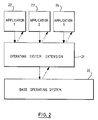
- FIG. 2 is a schematic block diagram illustrating the logical relationship between an existing multi-tasking operating system (hereinafter referred to as the base operating system 20), a multi-tasking operating system extension (hereinafter referred to as the operating system extension 21) and a plurality of processes in the form of application programs 22, 23, 24, each of which has access to a plurality of resources (not shown).
- the base operating system 20 an existing multi-tasking operating system
- the operating system extension 21 hereinafter referred to as the operating system extension 21
- the base operating system 20 runs on the personal computer hardware indicated in Figure 1 and supports the operating system extension 21, which in turn supports the applications 22, 23, 24.
- the base operating system 20, the operating system extension 21 and the applications 22, 23, 24 are all be provided in the form of software from the media 5 and stored, in use, in the random access memory 6. It should be noted, however, that this is not essential to the invention, as at least some of the logic to be described later may be down-loaded over a communications link, or stored in ROM, or provided in the form of hard-wired special purpose logic.
- the solid arrows represent calls down the hierarchy and the dotted arrows represent the passing of control information up the hierarchy.
- the operating system extension 21 could be combined with a base operating system to form a new enhanced operating system. In other words, the logical separation indicated between the base operating system and the extension need not be there. Alternatively, however, the operating system extension 21 can be provided as a multi-tasking application which runs on a prior art basic operating system 20 and itself supports a plurality of user applications 22, 23, 24.
- the base operating system 20 provides a multi-tasking environment with semaphore support and functions to notify a process 22, 23, 24, via the operating system extension 21, that it is being terminated.
- This environment may also define processes and threads as the subject of ownership and execution respectively.
- a process can own many threads, which can be thought of as sub-processes, whereas a thread belongs to one and only one process. Processes and threads are terms which are known to the person skilled in the art.
- FIGS 3A to 3E illustrate part of the logic which is provided in the operating system extension 21 in order to provide the functions of the present invention. Only those aspects of the logic of the system which are important for an understanding of the present invention are shown in the Figures.
- the operating system extension may provide other features as are required, such as an object-based environment, windowing functions, and so on. However, these do not form part of the present invention and are accordingly not described herein.
- a multiprocessing computer system in accordance with the present invention employs a resource access restriction which is well known in the art, namely that at any one time there may be either multiple read access or a single, exclusive write access to a resource.
- This has the effect that, when a thread is changing a resource, all other accesses are prevented until the change is complete.
- a thread accessing the resource can assume that nothing in the resource will have changed for the duration of its access apart from any changes it has itself made.
- This restriction has a second advantage.
- the resource may comprise many items which cannot be changed in one atomic instruction. However, the interpretation of these items may be such that the value of one restricts the meaningful values of others. Thus there is a period between changing the first item and changing the others when the resource has no meaningful interpretation, no thread should be allowed to read the resource during this period other than the one which is changing it.
- this restriction has been implemented by tracking the current number of read accesses per resource both globally (ie. for all processes) and locally (ie. the count for each process) and employing a semaphore for each resource to serialise access to the read counts associated with that resource.
- Write operations to a resource are only permitted when all the read access counts are zero for that resource.
- StartRead is a function which enables a process to request a multi-tasking operating system for read access to a resource
- EndRead is a function which enables a process to relinquish the resource when the read operation has been completed.
- StartWrite and EndWrite are functions which similarly enable a process to request the operating system for write access to the resource and to relinquish that resource when the writing operation is complete.
- the resource semaphore is not held between the end of the StartRead function and the beginning of an EndRead operation in order to allow other readers access to access the resource, but it is held between a StartWrite operation and an EndWrite operation to ensure exclusive access when writing.
- Both the semaphore and the global read count for each resource must be available to any thread which can access the resource. Consequently, they are held as part of the resource itself.
- the local read count does not need to be accessed by processes other than the one with which it belongs. Accordingly the local read count can be held as part of the process.
- the tracking of the read counts is complicated by the fact that a process may be terminated early by the multi-tasking operating system in response to an abort instruction.
- the early aborting of a process can mean that a read request and/or existing read permits for that process are pending when it is aborted and consequently that the counts mentioned above may need to be reset in order to maintain system integrity.
- exit processing logic which can be called by the operating system each time a process terminates.
- Notification of process termination is traditionally achieved by the process calling the operating system to request an addition to an Exit List. At the time the process does this, it provides the address of a routine to be executed when the process is about to terminate.
- the Exit List is a list of entry points to routines which are to be executed when a process terminates, one list per process being maintained by the operating system.
- the routine can be executed by any one of the process's threads and should take a fairly short time to execute. A thread executing this routine is called an Exit List Processor.
- the exit list processor is provided by each process running on the operating system.
- the Exit List Processor must be able to identify what access permits are held against which resources and, in the case of read accesses, it must identify how many are held.
- Identifying the resources concerned is achieved by recording, per process, the identity of every resource for which a write permit is held. For read permits not just the identity must be recorded but also the number of permits held per resource. This is done by maintaining two further lists, one of identifiers of resources to which the process has write access (ie. a Write List), the other of identifiers of resources to which read access is granted (ie a Read List). Associated with every identifier on the read list is a count of the number of read permits currently held against that resource by this particular process. These further lists are then held in memory accessible only by the process.
- the thread could be terminated between modifying the local read count in the process's read list and incrementing the resource's global read count. In this case, there could be loss of system integrity because the Exit List Processor would decrement the resource's global read count by one more than this process had incremented it.
- the Exit List Processor would decrement the resource's global read count by one less than this process had incremented it.
- the difficulty for the Exit List Processor is to identify those situations when the read count held in the read list is not the correct amount by which to decrement the resource's global read count, and when this is the case to determine the correct value. This problem has either not been recognised before, or if it has been recognised, then it has been ignored. An illustration of how errors could occur in the prior art is described later with respect to Figure 4D.
- the solution to the problem comprises the recording of expected values of the local read count in the process's read list and the resource's global read count immediately before they are changed during performance of the StartRead and EndRead functions and causing the Exit List Processor to test whether the actual values match the intended values.
- These expected values of the local and global counts can be stored in respective registers.
- the registers may be separate hardware registers. However, as M registers may be needed for the global counts and M x N registers for the local counts (assuming that there are M resources and N processes), the registers will normally be configured in storage accessible to the process and the operating system extension. This technique assumes that the variables cannot be altered in the intervening period, which is correct as the resource is locked by a semaphore.
- a comparison of the actual and intended values will, in the case where there is a difference, identify whether the interrupted operation was an increment or a decrement and whether the local read count is one too many or one too little.
- the Exit List Processor is thus able to determine exactly how many times the global read count was incremented by the terminated process and therefore how many to decrement it by.
- the read count of read permits for all processes of a given resource is identified by the term “Global Read Count” (abbreviated to "G” in Figure 3)
- the count held in the process' read list and indicating the number of read permits held by this process for a given resource is identified by the term “Local Read Count” (abbreviated to “L” in Figure 3), with “TempLocal” ("TL”, Fig. 3) and “TempGlobal” ("TG", Fig. 3) having meanings only during the calculation of the new read count value.
- a variable “Critical ID” (“CID", Fig.
- steps 41 and 42 the expected values of the Local Read Count and the Global Read Count are stored in the temporary storage locations TempLocal and TempGlobal respectively. Note that an increment of "X" is indicated above at steps 41, 42 (also steps 44 and 45). The value “X” may be “1", as indicated in the drawings, but could be any other number depending on the number of read operation to be performed.
- step 43 the identifier of the resource is stored in the variable Critical ID.
- steps 44 and 45 the Local Read Count is first updated followed by the Global Read Count.
- steps 46, 47 and 48 CriticalID, TempLocal and TempGlobal are reset to invalid values. (Note: Although not indicated here, TempLocal and TempGlobal could be reset to zero immediately before step 41 as discussed earlier).
- step 49 the resource's semaphore is released.
- step 50 the Critical Section is exited, releasing the other threads of the process.
- control is returned to where it came from with an indication that the attempt to request read access was successful (ie. that a read permit for the resource in question has been placed on the process's read list).
- StartRead function successfully terminates, other processes have access to the read counter as the semaphore has been released. The process that initiated the StartRead function is thus able to read until it initiates an EndRead function, or until it is terminated.
- step 57 and 58 the expected values of the Local Read Count and the Global Read Count are stored in the temporary storage locations TempLocal and TempGlobal respectively. Once again, the value "X" may be "1" as indicated in the drawings, but could be some other value.
- step 59 the identifier of the resource is stored in the variable Critical ID.
- steps 60 and 61 the Local Read Count is first updated followed by the Global Read Count.
- steps 62, 63 and 64 CriticalID, TempLocal and TempGlobal are reset to invalid values as before in the StartRead function. (Note: Although not indicated here, TempLocal and TempGlobal could be reset to zero immediately before step 57 as discussed earlier).
- step 65 the resource's semaphore is released.
- StartWrite function terminates successfully at step 82, the semaphore is not released. As a result of this other processes do not have access to the read counter. The process that initiated the StartWrite function thus has exclusive access to the resource until it initiates an EndWrite function, or until it is terminated. The steps involved in performing an EndWrite function described immediately below with reference to Figure 3D.
- the Exit List Processor can identify a potential wrong value for a read count by checking the value of CriticalID, if this is not invalid then the variable will hold the identifier of the resource which was having its Global Read Count altered when the process was signalled for termination. In such a case the thread could have reached one of six stages, three each in StartRead and EndRead.
- the local counter can be adjusted accordingly before decrementing it from the global read count. It should be noted that the use of the CriticalID variable is not essential, if other means are provided for identifying the process that has been interrupted.
- the test indicated at step 91 is sufficient to determine that the counts will be inconsistent as long as the setting of the temporary local and global values is performed in the same order as the updating of the counts themselves. If CriticalID is used, then it does not matter whether the temporary local and global values are updated in the same order as the counts themselves. It is assumed in step 89 that an operation to release a semaphore for a process, where the process does not actually hold a semaphore at that time, will lead to no operation being performed.
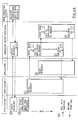
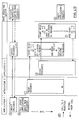
- FIGS 4A to 4C are schematic illustrations of the flow of operations in a multiprocessing computer system in accordance with the invention between the base operating system 20, the operating system extension 21 and three applications 22, 23, 24.
- only one resource is referred to. It should however be understood that this is for ease of explanation only. In practice there will typically be many resources. Also, reference is made to a single Global Read Count and to a single Local Read Count for each application process. In practice there will be a Global Read Count for each resource, and, a Local Read Count for each resource a process is associated with.
- the Global Read Count for the resource is zero, this means that the resource is available for other processes to access, both for read and for write operations.
- Figure 4B illustrates a sequence of events, which generally mirrors that in Figure 4A except that, in Figure 4B, Application 2 is terminated by the base operating system during reading, ie between steps (d) and (e).
- Figure 4C illustrates a third sequence of events, which generally this sequence mirrors those in Figure 4A and 4B. However, there is an important difference between this sequence and the two earlier ones.
- Application 2 is terminated between the updating of the local and global read counts during execution of the EndRead logic (ie during step (e) of Figure 4A).
- the Global Read Count for the resource is zero at the end of step (f), which means that the resource is available for other processes to access, both for read and for write operations. Without the additional logic present in a computer system in accordance with the invention, however, it would not be possible for the system to recover from such an abnormal termination.
- the invention may be used to maintain resource integrity in any situation in a multiprocessing computer system wherein a local variable which is accessible by a single process and a global variable which is accessible by a plurality of processes and is dependent on the local variable are updated sequentially and wherein the process may be terminated between the updating of the local and global variables, the expected value of the local variable and global variables being stored in first and second storage locations respectively before the local and global variables themselves are updated.
- a determination of whether the process was terminated between the updating of said local and global variables can be made by comparing the content of the first storage means to that of the local variable and by comparing the content of the second storage means to that of the global variable and, if necessary, remedial action can be undertaken to correct the values of the variables.
Landscapes
- Engineering & Computer Science (AREA)
- Theoretical Computer Science (AREA)
- Software Systems (AREA)
- Physics & Mathematics (AREA)
- General Engineering & Computer Science (AREA)
- General Physics & Mathematics (AREA)
- Quality & Reliability (AREA)
- Multi Processors (AREA)
Claims (20)
- Système informatique multitraitement dans lequel chacun d'une pluralité de processus a accès à au moins l'une des ressources du système, ce système informatique multitraitement comprenant :- un dispositif de comptage local (L) pour chaque processus, pour tenir un compte des autorisations d'accès à ladite ressource pour ce processus;- un dispositif de comptage global (G) pour tenir un compte des autorisations d'accès à ladite ressource pour tous les processus;- une logique de mise à jour pour mettre à jour séquentiellement le dispositif de comptage local et le dispositif de comptage global à chaque fois qu'un processus demande à utiliser la ressource ou rend l'usage de la ressource; et- une logique de sortie pour interrompre un processus, comprenant un dispositif pour remettre à l'état initial le dispositif de comptage global, caractérisée en ce que :- la logique de sortie comprend, de plus, une logique (41, 42, 57, 58) pour mémoriser les valeurs escomptées des comptes local et global respectivement dans un premier et un second support de mémoire (TL, TG), avant que le dispositif de comptage local (L) ou le dispositif de comptage global (G) soient mis à jour; et- le logique de sortie comprend, de plus, une logique (92) pour comparer le contenu du premier support de mémoire (TL) à celui du dispositif de comptage local approprié (L) et pour comparer le contenu du second support de mémoire (TG) au dispositif de comptage global, et, en fonction des résultats des comparaisons, pour déterminer si le processus a été interrompu entre la mise à jour des dispositifs de comptage local et global (L et G).
- Système selon la revendication 1 comprenant un support de sémaphore pour s'assurer que l'accès au dispositif de comptage global (G) ne peut être obtenu que par un seul processus à la fois.
- Système selon la revendication 1 ou 2, dans lequel les dispositifs de comptage local et global (L et G) tiennent un compte des autorisations de lecture d'une ressource.
- Système selon la revendication 3, dans lequel la valeur escomptée du compte local mémorisée dans la premier support de mémoire (TL) est le compte local en lecture courant plus un incrément projeté du compte local, et la valeur escomptée du compte global mémorisée dans le second support de mémoire (TG) est la compte global courant plus un incrément projeté du compte global.
- Système selon l'une quelconque des revendications précédentes, dans lequel la logique de mise à jour met à jour la dispositif de comptage local (L) avant le dispositif de comptage global (G), et dans lequel la logique de sortie (92) vérifie si le contenu du premier support de mémoire (TL) est identique à celui du dispositif de comptage local (L), et si le contenu du second support de mémoire (TG) est différent de celui du dispositif de comptage global (G), et, si les deux conditions sont vraies, décrémente (92, 93, 94) le contenu du dispositif de comptage local (L) de la différence numérique entre le contenu du second support de mémoire (TG) et celui du dispositif de comptage global (G).
- Système selon l'une quelconque des revendications 1 à 4, dans lequel la logique de mise à jour met à jour la dispositif de comptage global (G) avant le dispositif de comptage local (L), et dans lequel la logique de sortie (92) vérifie si le contenu du second support de mémoire (TG) est identique à celui du dispositif de comptage global (G), et si le contenu du premier support de mémoire (TL) est différent de celui du dispositif de comptage local (L), et, si les deux conditions sont vraies, décrémente (92, 93, 94) le contenu du dispositif de comptage global (G) de la différence numérique entre le contenu du premier support de mémoire (TL) et celui du dispositif de comptage local (L).
- Système selon le revendication 5 ou la revendication 6, dans lequel la logique de mise à jour mémorise la valeur escomptée du compte local et du compte global respectivement dans le premier et le second support de mémoire (TL et TG), dans le même ordre chronologique que celui suivi pour la mise à jour des dispositifs de comptage local et global (L, G).
- Système selon l'une quelconque des revendications précédentes, dans lequel la logique de mise à jour comprend, de plus, une logique pour encadrer une section de logique comprenant celle pour la mise à jour des dispositifs de comptage local et global (L, G), et dans lequel la logique de sortie comprend, de plus, une logique pour vérifier si le processus a été interrompu au cours de l'exécution de la section de logique encadrée.
- Système selon la revendication 8, dans lequel :- la logique d'encadrement positionne le contenu d'au moins l'un des premier et second supports de mémoire (TL, TG) sur une valeur invalide avant que les dites valeurs escomptées y soient entrées en mémoire, et réinitialise la contenu du dit "au moins l'un des premier et second supports de mémoire" à une valeur invalide après la mise à jour des dispositifs de comptage local et global; et- la logique pour vérifier la section encadrée de logique vérifie si le contenu du dit "au moins l'un des premier et second supports de mémoire" a une valeur valide.
- Système selon la revendication 8, dans lequel :- la logique d'encadrement, après avoir entré en mémoire les valeurs escomptées, positionne le contenu d'un troisième support de mémoire sur la valeur d'un identificateur unique pour la ressource et, après la mise à jour des variables locale et globale réinitialise le troisième support de mémoire à une valeur invalide; et- la logique pour vérifier la section encadrée de logique vérifie si le contenu du troisième support de mémoire correspond à celui d'un identificateur valide et, si c'est le cas, identifie cette ressource.
- Méthode pour conserver l'intégrité des ressources dans un système informatique multitraitement dans lequel une variable locale (L) qui est accessible par un seul processus et une variable globale (G) qui est accessible par une pluralité de processus, et qui est dépendante de la variable locale (L), sont mises à jour séquentiellement, et dans lequel le processus peut être interrompu entre la mise à jour de variables local et global (L, G), ladite méthode comprenant les étapes suivantes consistant à :a) entrer en mémoire la valeur escompté de la variable locale dans un premier support de mémoire (TL) et la valeur escomptée de la variable globale dans un second support de mémoire (TG); puis àb) mettre à jour la variable locale (L) et la variable globale (G) séquentiellement, et àc) si ledit processus est interrompu, déterminer si le processus a été interrompu entre la mise à jour des variables locale et globale en comparant (91) le contenu du premier support de mémoire (TL) à celui de la variable locale (L), et en comparant (91) le contenu du second support de mémoire (TG) à celui de la variable globale (G) et, si nécessaire, intervenir pour corriger les valeurs des variables.
- Méthode selon la revendication 11, dans laquelle un sémaphore est associé à la variable globale (G) pour sérialiser l'accès à celle-ci.
- Méthode selon la revendication 11 ou 12, dans laquelle les variables locale et globale (L, G) sont des comptes en lecture pour tenir un compte des autorisations d'accès en lecture à une ressource.
- Méthode selon la revendication 13, dans laquelle, dans l'étape (b), la valeur escomptée de la variable locale mémorisée dans le premier support de mémoire (TL) est le compte local en lecture courant plus un incrément projeté du compte local en lecture, et la valeur escomptée de la variable globale mémorisée dans le second support de mémoire (TG) est le compte global en lecture courant plus un incrément projeté du compte global en lecture.
- Méthode selon l'une quelconque des revendications 11 à 14, dans laquelle :- dans l'étape (b), la variable locale (L) est mise à jour avant la variable globale (G); et- l'étape (c) comprend les sous-étapes suivantes consistant à :(i) vérifier si le contenu du premier support de mémoire (TL) est identique à celui de la variable locale (L) et si le contenu du second support de mémoire (TG) est différent de celui de la variable globale (G), et, si les deux conditions sont vraies;(ii) décrémenter le contenu de la variable locale (L) de la différence numérique entre le contenu du second support de mémoire (TG) et celui de la variable globale (G).
- Méthode selon l'une quelconque des revendications 11 à 14, dans laquelle :- dans l'étape (b), la variable globale (G) est mise à jour avant la variable locale (G); et- l'étape (c) comprend les sous-étapes suivantes consistant à :(i) vérifier si le contenu du second support de mémoire (TG) est identique à celui de la variable globale (G) et si le contenu du premier support de mémoire (TL) est différent de celui de la variable locale (L), et, si les deux conditions sont vraies;(ii) décrémenter le contenu de la variable globale (G) de la différence numérique entre le contenu du premier support de mémoire (TL) et celui de la variable locale (L).
- Méthode selon la revendication 13, dans laquelle, dans l'étape (a), les valeurs escomptées du compte local et du compte global sont respectivement mémorisées dans le premier et le second support de mémoire (TL et TG), dans le même ordre chronologique que celui suivi pour la mise à jour des variable locale et globale (L, G).
- Méthode selon l'une quelconque des revendications 11 à 17, comprenant, de plus, des étapes pour encadrer une section de la méthode et dans laquelle l'étape (c) comprend, de plus, une sous-étape pour vérifier si le processus a été interrompu au cours de l'exécution de la section de cette section.
- Méthode selon la revendication 18, dans laquelle :- les étapes d'encadrement comprennent, dans l'étape (a), une sous-étape pour positionner initialement le contenu d'au moins l'un des premier et second supports de mémoire (TL, TG) sur une valeur invalide avant que les dites valeurs escomptées y soient entrées en mémoire, et, dans l'étape (b), une sous-étape pour réinitialiser le contenu du dit "au moins l'un des premier et second supports de mémoire" à une valeur invalide après la mise à jour des variables locale et globale; et- la sous-étape de test vérifie si le contenu du dit "au moins l'un des premier et second supports de mémoire" a une valeur valide.
- Méthode selon la revendication 18, dans laquelle :- les étapes d'encadrement comprennent, dans l'étape (a), une sous-étape pour positionner le contenu d'un troisième support de mémoire sur la valeur d'un identificateur unique associée à la variable globale après la mise en mémoire des valeurs escomptées dans les premier et second supports de mémoire et, dans l'étape (b), une sous-étape pour réinitialiser le troisième support de mémoire à une valeur invalide après la mise à jour des variables locale et globale; et- la sous-étape de test vérifie si le contenu du troisième support de mémoire correspond à celui d'un identificateur valide et, si c'est le cas, à quel identificateur.
Priority Applications (4)
| Application Number | Priority Date | Filing Date | Title |
|---|---|---|---|
| DE3886756T DE3886756T2 (de) | 1988-10-28 | 1988-10-28 | Betriebsmittelzugriff für Multiprozessorrechnersystem. |
| EP88310187A EP0365728B1 (fr) | 1988-10-28 | 1988-10-28 | Accès aux ressources pour système à multiprocesseurs |
| JP1211539A JPH0675252B2 (ja) | 1988-10-28 | 1989-08-18 | 多重処理コンピュータ・システム及び方法 |
| US07/422,938 US5138713A (en) | 1988-10-28 | 1989-10-17 | Multiprocessing computer system with exit logic and method for maintaining resource integrity |
Applications Claiming Priority (1)
| Application Number | Priority Date | Filing Date | Title |
|---|---|---|---|
| EP88310187A EP0365728B1 (fr) | 1988-10-28 | 1988-10-28 | Accès aux ressources pour système à multiprocesseurs |
Publications (2)
| Publication Number | Publication Date |
|---|---|
| EP0365728A1 EP0365728A1 (fr) | 1990-05-02 |
| EP0365728B1 true EP0365728B1 (fr) | 1993-12-29 |
Family
ID=8200266
Family Applications (1)
| Application Number | Title | Priority Date | Filing Date |
|---|---|---|---|
| EP88310187A Expired - Lifetime EP0365728B1 (fr) | 1988-10-28 | 1988-10-28 | Accès aux ressources pour système à multiprocesseurs |
Country Status (4)
| Country | Link |
|---|---|
| US (1) | US5138713A (fr) |
| EP (1) | EP0365728B1 (fr) |
| JP (1) | JPH0675252B2 (fr) |
| DE (1) | DE3886756T2 (fr) |
Families Citing this family (20)
| Publication number | Priority date | Publication date | Assignee | Title |
|---|---|---|---|---|
| JPH0318935A (ja) * | 1989-06-15 | 1991-01-28 | Hitachi Ltd | データリストに対するアクセスの直列化方式 |
| GB9123264D0 (en) * | 1991-11-01 | 1991-12-18 | Int Computers Ltd | Semaphone arrangement for a data processing system |
| EP0559222A2 (fr) * | 1992-03-06 | 1993-09-08 | Microsoft Corporation | Procédé amélioré de chargement de programme |
| US5375229A (en) * | 1992-04-13 | 1994-12-20 | Motorola, Inc. | System and method for adding a control function to a semiconductor equipment system |
| US5394545A (en) * | 1992-08-07 | 1995-02-28 | International Business Machines Corporation | System for determination and display of memory used, dedicated, and shared by a process at a particular time |
| JP2963298B2 (ja) * | 1993-03-26 | 1999-10-18 | 富士通株式会社 | 二重化共有メモリにおける排他制御命令のリカバリ方法および計算機システム |
| US5586318A (en) * | 1993-12-23 | 1996-12-17 | Microsoft Corporation | Method and system for managing ownership of a released synchronization mechanism |
| US6519623B1 (en) * | 1996-10-31 | 2003-02-11 | International Business Machines Corporation | Generic semaphore for concurrent access by multiple operating systems |
| FI106988B (fi) * | 1997-05-16 | 2001-05-15 | Nokia Networks Oy | Palveluriippumattomien rakenneosien toteutus |
| DE19728971C2 (de) * | 1997-07-07 | 2003-10-09 | Bosch Gmbh Robert | Datenverarbeitungsvorrichtung und -verfahren |
| US6785888B1 (en) * | 1997-08-29 | 2004-08-31 | International Business Machines Corporation | Memory allocator for a multiprocessor computer system |
| CN1313967A (zh) * | 1998-07-03 | 2001-09-19 | 西门子公司 | 用于设计全过程控制的方法和装置 |
| US6366946B1 (en) * | 1998-12-16 | 2002-04-02 | Microsoft Corporation | Critical code processing management |
| GB0002174D0 (en) | 2000-01-31 | 2000-03-22 | Sgs Thomson Microelectronics | Design flow checker |
| US6430659B1 (en) * | 2000-09-22 | 2002-08-06 | International Business Machines Corporation | Method and means for increasing performance of multiprocessor computer systems by reducing accesses to global memory locations through the use of quanta |
| DE10056046A1 (de) * | 2000-11-11 | 2002-05-23 | Bosch Gmbh Robert | Verfahren zur Realisierung einer Intertask-Kommunikation in einem Multitasking-Betriebssystem |
| US6966062B2 (en) * | 2001-04-20 | 2005-11-15 | International Business Machines Corporation | Method and apparatus for allocating use of an access device between host and guest operating systems |
| US10834109B2 (en) * | 2014-12-23 | 2020-11-10 | Mcafee, Llc | Determining a reputation for a process |
| CN109783230A (zh) * | 2018-12-17 | 2019-05-21 | 平安普惠企业管理有限公司 | 基于信号量的流量控制方法、装置、计算机设备和存储介质 |
| US11048549B2 (en) | 2019-04-04 | 2021-06-29 | Google Llc | Transferral of process state and/or components in computing environments |
Family Cites Families (5)
| Publication number | Priority date | Publication date | Assignee | Title |
|---|---|---|---|---|
| JPS605024B2 (ja) * | 1979-09-04 | 1985-02-07 | ファナック株式会社 | 情報処理方式 |
| US4819154A (en) * | 1982-12-09 | 1989-04-04 | Sequoia Systems, Inc. | Memory back up system with one cache memory and two physically separated main memories |
| US4658351A (en) * | 1984-10-09 | 1987-04-14 | Wang Laboratories, Inc. | Task control means for a multi-tasking data processing system |
| US4860228A (en) * | 1987-02-24 | 1989-08-22 | Motorola, Inc. | Non-volatile memory incremental counting system |
| US4922456A (en) * | 1988-04-29 | 1990-05-01 | Scientific-Atlanta, Inc. | Method of reducing wearout in a non-volatile memory with double buffer |
-
1988
- 1988-10-28 EP EP88310187A patent/EP0365728B1/fr not_active Expired - Lifetime
- 1988-10-28 DE DE3886756T patent/DE3886756T2/de not_active Expired - Fee Related
-
1989
- 1989-08-18 JP JP1211539A patent/JPH0675252B2/ja not_active Expired - Lifetime
- 1989-10-17 US US07/422,938 patent/US5138713A/en not_active Expired - Fee Related
Also Published As
| Publication number | Publication date |
|---|---|
| DE3886756D1 (de) | 1994-02-10 |
| US5138713A (en) | 1992-08-11 |
| DE3886756T2 (de) | 1994-06-23 |
| JPH0383154A (ja) | 1991-04-09 |
| JPH0675252B2 (ja) | 1994-09-21 |
| EP0365728A1 (fr) | 1990-05-02 |
Similar Documents
| Publication | Publication Date | Title |
|---|---|---|
| EP0365728B1 (fr) | Accès aux ressources pour système à multiprocesseurs | |
| US4949251A (en) | Exactly-once semantics in a TP queuing system | |
| US6681226B2 (en) | Selective pessimistic locking for a concurrently updateable database | |
| EP0145889B1 (fr) | Verroillage de tâche non répétitif utilisant "comparer" et "échanger" | |
| US6101524A (en) | Deterministic replay of multithreaded applications | |
| US7720891B2 (en) | Synchronized objects for software transactional memory | |
| US5742785A (en) | Posting multiple reservations with a conditional store atomic operations in a multiprocessing environment | |
| US5623670A (en) | Method and apparatus for crash safe enforcement of mutually exclusive access to shared resources in a multitasking computer system | |
| US5895494A (en) | Method of executing perform locked operation instructions for supporting recovery of data consistency if lost due to processor failure, and a method of recovering the data consistency after processor failure | |
| US4584644A (en) | Method of controlling use of resources in a data processing system by at least two processes | |
| EP0810526A1 (fr) | Mécanisme de quorum dans un système informatique réparti à deux noeuds | |
| US6463532B1 (en) | System and method for effectuating distributed consensus among members of a processor set in a multiprocessor computing system through the use of shared storage resources | |
| JPH07120299B2 (ja) | マルチプロセッサシステムの試験方法 | |
| US6223335B1 (en) | Platform independent double compare and swap operation | |
| US6742135B1 (en) | Fault-tolerant match-and-set locking mechanism for multiprocessor systems | |
| JP4620871B2 (ja) | マルチスレッドコンピュータシステムにおけるモニタ変換 | |
| US7747996B1 (en) | Method of mixed lock-free and locking synchronization | |
| US6662364B1 (en) | System and method for reducing synchronization overhead in multithreaded code | |
| EP0955584A2 (fr) | Synchronisation rapide pour des programmes écrits dans le langage de programmation Java | |
| US7266825B2 (en) | Method for synchronizing program sections of a computer program | |
| EP2144163A1 (fr) | Procédé et système de synchronisation de l'exécution d'une section de code critique | |
| JP4196414B2 (ja) | コンピュータリソースのロック処理 | |
| US20090064141A1 (en) | Efficient utilization of transactions in computing tasks | |
| JPH04127261A (ja) | マルチプロセッサシステム | |
| CN120276878B (zh) | 基于硬件实现的互斥锁装置及其控制方法 |
Legal Events
| Date | Code | Title | Description |
|---|---|---|---|
| PUAI | Public reference made under article 153(3) epc to a published international application that has entered the european phase |
Free format text: ORIGINAL CODE: 0009012 |
|
| AK | Designated contracting states |
Kind code of ref document: A1 Designated state(s): DE FR GB |
|
| 17P | Request for examination filed |
Effective date: 19900820 |
|
| 17Q | First examination report despatched |
Effective date: 19930112 |
|
| GRAA | (expected) grant |
Free format text: ORIGINAL CODE: 0009210 |
|
| AK | Designated contracting states |
Kind code of ref document: B1 Designated state(s): DE FR GB |
|
| REF | Corresponds to: |
Ref document number: 3886756 Country of ref document: DE Date of ref document: 19940210 |
|
| ET | Fr: translation filed | ||
| PLBE | No opposition filed within time limit |
Free format text: ORIGINAL CODE: 0009261 |
|
| STAA | Information on the status of an ep patent application or granted ep patent |
Free format text: STATUS: NO OPPOSITION FILED WITHIN TIME LIMIT |
|
| 26N | No opposition filed | ||
| PGFP | Annual fee paid to national office [announced via postgrant information from national office to epo] |
Ref country code: FR Payment date: 19951009 Year of fee payment: 8 |
|
| PGFP | Annual fee paid to national office [announced via postgrant information from national office to epo] |
Ref country code: GB Payment date: 19960925 Year of fee payment: 9 |
|
| PGFP | Annual fee paid to national office [announced via postgrant information from national office to epo] |
Ref country code: DE Payment date: 19961030 Year of fee payment: 9 |
|
| PG25 | Lapsed in a contracting state [announced via postgrant information from national office to epo] |
Ref country code: FR Effective date: 19970630 |
|
| REG | Reference to a national code |
Ref country code: FR Ref legal event code: ST |
|
| PG25 | Lapsed in a contracting state [announced via postgrant information from national office to epo] |
Ref country code: GB Free format text: LAPSE BECAUSE OF NON-PAYMENT OF DUE FEES Effective date: 19971028 |
|
| GBPC | Gb: european patent ceased through non-payment of renewal fee |
Effective date: 19971028 |
|
| PG25 | Lapsed in a contracting state [announced via postgrant information from national office to epo] |
Ref country code: DE Free format text: LAPSE BECAUSE OF NON-PAYMENT OF DUE FEES Effective date: 19980701 |