EP0366003B1 - Système de commande de pression d'alimentation pour une transmission automatique - Google Patents
Système de commande de pression d'alimentation pour une transmission automatique Download PDFInfo
- Publication number
- EP0366003B1 EP0366003B1 EP89119407A EP89119407A EP0366003B1 EP 0366003 B1 EP0366003 B1 EP 0366003B1 EP 89119407 A EP89119407 A EP 89119407A EP 89119407 A EP89119407 A EP 89119407A EP 0366003 B1 EP0366003 B1 EP 0366003B1
- Authority
- EP
- European Patent Office
- Prior art keywords
- line pressure
- shift operation
- control system
- speed
- shift
- Prior art date
- Legal status (The legal status is an assumption and is not a legal conclusion. Google has not performed a legal analysis and makes no representation as to the accuracy of the status listed.)
- Expired - Lifetime
Links
- 230000005540 biological transmission Effects 0.000 title claims description 56
- 230000008859 change Effects 0.000 claims description 25
- 230000007246 mechanism Effects 0.000 claims description 23
- 239000012530 fluid Substances 0.000 claims description 18
- 230000011664 signaling Effects 0.000 claims 1
- 230000001276 controlling effect Effects 0.000 description 15
- 230000035939 shock Effects 0.000 description 9
- 238000000034 method Methods 0.000 description 8
- 230000001105 regulatory effect Effects 0.000 description 8
- 238000013459 approach Methods 0.000 description 4
- 230000006870 function Effects 0.000 description 4
- 230000009471 action Effects 0.000 description 3
- 230000003247 decreasing effect Effects 0.000 description 3
- 230000004044 response Effects 0.000 description 2
- 230000007423 decrease Effects 0.000 description 1
- 230000007935 neutral effect Effects 0.000 description 1
Images




Classifications
-
- F—MECHANICAL ENGINEERING; LIGHTING; HEATING; WEAPONS; BLASTING
- F16—ENGINEERING ELEMENTS AND UNITS; GENERAL MEASURES FOR PRODUCING AND MAINTAINING EFFECTIVE FUNCTIONING OF MACHINES OR INSTALLATIONS; THERMAL INSULATION IN GENERAL
- F16H—GEARING
- F16H61/00—Control functions within control units of change-speed- or reversing-gearings for conveying rotary motion ; Control of exclusively fluid gearing, friction gearing, gearings with endless flexible members or other particular types of gearing
- F16H61/0021—Generation or control of line pressure
-
- F—MECHANICAL ENGINEERING; LIGHTING; HEATING; WEAPONS; BLASTING
- F16—ENGINEERING ELEMENTS AND UNITS; GENERAL MEASURES FOR PRODUCING AND MAINTAINING EFFECTIVE FUNCTIONING OF MACHINES OR INSTALLATIONS; THERMAL INSULATION IN GENERAL
- F16H—GEARING
- F16H61/00—Control functions within control units of change-speed- or reversing-gearings for conveying rotary motion ; Control of exclusively fluid gearing, friction gearing, gearings with endless flexible members or other particular types of gearing
- F16H61/04—Smoothing ratio shift
- F16H61/06—Smoothing ratio shift by controlling rate of change of fluid pressure
- F16H61/061—Smoothing ratio shift by controlling rate of change of fluid pressure using electric control means
-
- F—MECHANICAL ENGINEERING; LIGHTING; HEATING; WEAPONS; BLASTING
- F16—ENGINEERING ELEMENTS AND UNITS; GENERAL MEASURES FOR PRODUCING AND MAINTAINING EFFECTIVE FUNCTIONING OF MACHINES OR INSTALLATIONS; THERMAL INSULATION IN GENERAL
- F16H—GEARING
- F16H61/00—Control functions within control units of change-speed- or reversing-gearings for conveying rotary motion ; Control of exclusively fluid gearing, friction gearing, gearings with endless flexible members or other particular types of gearing
- F16H2061/0075—Control functions within control units of change-speed- or reversing-gearings for conveying rotary motion ; Control of exclusively fluid gearing, friction gearing, gearings with endless flexible members or other particular types of gearing characterised by a particular control method
- F16H2061/0087—Adaptive control, e.g. the control parameters adapted by learning
-
- F—MECHANICAL ENGINEERING; LIGHTING; HEATING; WEAPONS; BLASTING
- F16—ENGINEERING ELEMENTS AND UNITS; GENERAL MEASURES FOR PRODUCING AND MAINTAINING EFFECTIVE FUNCTIONING OF MACHINES OR INSTALLATIONS; THERMAL INSULATION IN GENERAL
- F16H—GEARING
- F16H61/00—Control functions within control units of change-speed- or reversing-gearings for conveying rotary motion ; Control of exclusively fluid gearing, friction gearing, gearings with endless flexible members or other particular types of gearing
- F16H61/02—Control functions within control units of change-speed- or reversing-gearings for conveying rotary motion ; Control of exclusively fluid gearing, friction gearing, gearings with endless flexible members or other particular types of gearing characterised by the signals used
- F16H61/0202—Control functions within control units of change-speed- or reversing-gearings for conveying rotary motion ; Control of exclusively fluid gearing, friction gearing, gearings with endless flexible members or other particular types of gearing characterised by the signals used the signals being electric
- F16H61/0251—Elements specially adapted for electric control units, e.g. valves for converting electrical signals to fluid signals
- F16H2061/0255—Solenoid valve using PWM or duty-cycle control
-
- F—MECHANICAL ENGINEERING; LIGHTING; HEATING; WEAPONS; BLASTING
- F16—ENGINEERING ELEMENTS AND UNITS; GENERAL MEASURES FOR PRODUCING AND MAINTAINING EFFECTIVE FUNCTIONING OF MACHINES OR INSTALLATIONS; THERMAL INSULATION IN GENERAL
- F16H—GEARING
- F16H59/00—Control inputs to control units of change-speed- or reversing-gearings for conveying rotary motion
- F16H59/68—Inputs being a function of gearing status
- F16H59/72—Inputs being a function of gearing status dependent on oil characteristics, e.g. temperature, viscosity
-
- F—MECHANICAL ENGINEERING; LIGHTING; HEATING; WEAPONS; BLASTING
- F16—ENGINEERING ELEMENTS AND UNITS; GENERAL MEASURES FOR PRODUCING AND MAINTAINING EFFECTIVE FUNCTIONING OF MACHINES OR INSTALLATIONS; THERMAL INSULATION IN GENERAL
- F16H—GEARING
- F16H61/00—Control functions within control units of change-speed- or reversing-gearings for conveying rotary motion ; Control of exclusively fluid gearing, friction gearing, gearings with endless flexible members or other particular types of gearing
- F16H61/04—Smoothing ratio shift
- F16H61/08—Timing control
Definitions
- the present invention relates to a control system for an automatic transmission of motor vehicle, more specifically to a line pressure control for a hydraulic control mechanism of the transmission.
- an automatic transmission of a motor vehicle is provided with a torque converter, a transmitting mechanism employing a planetary gear mechanism.
- the transmission is also provided with a plurality of frictional elements such as clutches, brakes for establishing a desirable shift gear stage among the plurality of shift gear stages provided in the transmission.
- a hydraulic control circuit is provided with a plurality of solenoid valves for switching hydraulic passages in the circuit so that the frictional elements are engaged and disengaged to perform a desirable shift operation.
- Japanese Patent publication No. 54-2349 issued to Ford Motor corporation and published for opposition on February 6, 1979 discloses a basic electrical hydraulic control system for an automatic transmission in which regulator valves are provided for controlling a line pressure of hydraulic passages of circuit of the transmission, and pilot pressures of the regulator valves are controlled by solenoid valves.
- the frequency of control signal for the solenoid valves is determined taking account of reliability of operation, durability thereof and the like. It should be noted that as the frequency of the control signal is decreased, the response in the line pressure control is deteriorated but that if the frequency is too high, the durability and the reliability of the solenoid is badly affected.
- a known control system for controlling the transmission fluid pressure controls the pressure of a transmission fluid in order to hydraulically actuate appropriate elements to change the ratio between a driving input shaft and a driven output shaft.
- Pressurized transmission fluid is supplied to a solenoid valve which is operated by a pulse width modulated signal.
- the duty cycle of the pulse width modulated signal is adjusted to produce an appropriate transmission fluid pressure to perfom several functions as actuating a clutch, shifting gears.
- the known control system is further provided with temperature sensing means for sensing the temperature of the transmission fluid. Further, means are provided, responsive to the temperature sensing means for adjusting the characteristic of the electrical signal as a function of the temperature of the transmission fluid, that is by changing the frequency of the pulse width modulated signal.
- this known control system is particularly useful in maintaining a proper pressure control under cold weather conditions when the transmission fluid thickens and its viscosity increases. If the temperature of the transmission fluid is high, the pulse width modulated signal will be set to a high frequency, thereby achieving a fast response time. If the temperature is low, the frequency will be decreased preventing an insufficient fluid flow but still providing a satisfactory operation.
- the frequency control device may be provided in a control section in the solenoid valve.
- the control signal may be a duty signal of a certain duty ratio determined by a control unit as constituted by a microcomputer.
- the frequency of the control signal for the solenoid valve is maintained at a proper value in view of the durability and the reliability in operation when the transmission is not under a shift operation.
- the frequency is increased to accomplish a responsive switching operation during the shift operation to reduce a torque shock.
- an automatic transmission AT is provided with a torque converter 2, a multiple stage transmission gear mechanism 10 and a hydraulic control circuit 30 therefor.
- the transmission gear mechanism 10 is provided with a plurality of frictional elements, such as clutches and brakes for switching power transmitting path therein. The engagement and disengagement of the frictional elements are controlled by the hydraulic control circuit 30.
- the hydraulic control circuit 30 is provided with a pressure regulating valve 32 for adjusting a line pressure introduced into the frictional elements and a duty solenoid valve 33 for controlling the regulating valve 32, which constitute a line pressure control mechanism.
- an electronic control unit (ECU) 100 constituted by a microcomputer and the like for controlling the hydraulic control circuit 30.
- the control unit 100 receives a signal from a throttle sensor 101 for detecting an opening of throttle valve (not shown), turbine speed sensor 102 for detecting turbine speed or rotation speed of input element of the transmission gear mechanism 10 and the like.
- the control unit 100 controls solenoid valve 37, 40 and 42 to perform a shift control in accordance with an engine operating condition obtained through the throttle opening and the turbine speed or vehicle speed based on a predetermined shift pattern and also controls a lock-up solenoid valve 51 to thereby control a lock-up clutch 29 for establishing a lock-up condition.
- the control signal applied to the duty solenoid valve 33 is of a duty signal constituted by a continuous on-off signal wherein a ratio of on-period to a single cycle of the signal is defined as a duty ratio.
- the duty ratio is controlled in accordance with engine operating condition.
- the frequency of the control signal for the duty solenoid valve 33 is also changed during the shift operation of the transmission AT. According to the illustrated embodiment of the present invention, the frequency is increased from 30 Hz to 70 Hz during the shift operation as shown in Figure 2.
- FIG. 3 there is shown a structure of the automatic transmission AT in which the torque converter 2 is joined with an engine output shaft 1 and the multiple transmission gear mechanism 10 is connected with an output member of the torque converter 2.
- the torque converter 2 is provided with a pump 3 connected with the engine output shaft 1, a turbine 4 and a stator 5 mounted on a shaft 7 through one-way clutch 6.
- the gear mechanism 10 comprises an oil pump drive shaft 12 connected with the engine output shaft 1 at base end and with an oil pump 31 at a tip end thereof, a hollow turbine shaft 13 connected with the turbine 4 at base end outside of the oil pump drive shaft 12 and Ravigneaux-type planetary gear mechanism 14 around the turbine shaft 13.
- the planetary gear mechanism 14 is provided with a small sun gear 15 and a large sun gear 16 which are disposed side by side in a longitudinal direction of the transmission gear mechanism 10.
- the planetary gear mechanism 14 is also provided with a short pinion gear 18, a long pinon gear 17 meshed with the large sun gear 16 and the short pinion gear 18, and a ring gear 19 meshed with the long pinion gear 17.
- a 2-4 brake 23 provided with a brake drum 23a connected with the large sun gear 16 and a brake band 23b adapted to be engaged with the brake drum 23a so that when the 2-4 brake is engaged, the large sun gear is fixed.
- a reverse clutch 24 is arranged rearward of the brake 23 for controlling a power transmission between the large sun gear 16 and the turbine shaft 13 through the brake drum 23a to thereby establish a reverse shift stage.
- a low & reverse brake 25 between a carrier 14a of the planetary gear mechanism 14 and a casing 10a of the transmission gear mechanism 10 for controlling the engagement and disengagement between the carrier 14a and the casing 10a.
- the long pinion 17 is connected with the low & reverse brake 25 for fixing the long pinion 17 and with a second one-way clutch 26 arranged in a row with the brake 25 for allowing a rotation of the long pinion 17 in the same direction as the engine output shaft 1.
- a 3-4 clutch 27 is arranged in front of the planetary gear mechanism 14 for controlling the engagement and disengagement of between the carrier 14a and the turbine shaft 13.
- An output gear 28 disposed in front of the 3-4 clutch 27 is connected with the ring gear 19 through an output shaft 28a.
- Numerals 29 denote a lock-up clutch for directly connecting the engine output shaft 1 with the turbine shaft 13.
- the table 1 shows operations of the respective clutches and brakes in the respective shift gear stages of the transmission.
- reference O means that the corresponding element is under operation for transmitting a torque but the corresponding element to reference (O) is effected to transmit the power only when it functions as a driving element.
- the oil pump 31 discharges a hydraulic fluid to the hydraulic passage L1.
- the hydraulic pressure of the fluid is introduced into the pressure regulating valve 32.
- the pressure regulating valve 32 is controlled by the duty solenoid valve 33 to adjust the line pressure of the hydraulic control circuit 30.
- the hydraulic pressure from the pump 31 is reduced in a reducing valve 34 to a predetermined value.
- the hydraulic pressure is adjusted by virtue of a duty control of the solenoid valve 33 by controlling an amount of drain and introduced into the pressure regulating valve 32 as a pilot pressure therefor.
- the line pressure control of the hydraulic control circuit 30 is established.
- the regulated line pressure is introduced into a port g of a manual shift valve 35.
- the manual shift valve 35 is provided with a spool 35a connected with a select lever and associated with the lever so that the spool 35a can be moved in accordance with a manual operation for the select lever by a driver to the range D in which the gear shift operation is automatically made among the four forward gear stages, range 2 in which the gear shift operation is automatically made among the first through a third gear stages of the transmission, the range 1 in which the gear shift operation is automatically made between the first and second gear stages and a reverse range R, a parking range P, a neutral range N.
- the port g is communicated with ports a and e when set at the range 1, with ports a and c when set in the range 2 and D, and with a port f when set at the reverse range R.
- the port a of the manual shift valve 35 is connected with a 1-2 shift valve 36 through the hydraulic line L2.
- the 1-2 shift valve 36 is subjected to a pilot pressure which is adapted to be controlled by a 1-2 solenoid valve 37.
- the 1-2 solenoid valve 37 is turned off so that a spool 36a thereof is moved toward the left end to connect a hydraulic passage L3 communicated with an apply chamber 23c of the 2-4 brake 23 to a draining port.
- the 1-2 solenoid valve 37 is turned on so that the spool 36a is moved toward the right end in the drawing.
- the hydraulic pressure is introduced from the port a into the apply chamber 23c of the 2-4 brake 23.
- the 1-2 shift valve introduces the hydraulic pressure supplied from the port e of the manual shift valve 35 through a low reducing valve 38 into the low & reverse brake 25.
- the hydraulic pressure from the port a of the manual shift valve 35 is applied to a 2-3 shift valve 39 as a pilot pressure as well.
- the 2-3 shift valve 39 is connected with the port c of the manual valve 35 through a hydraulic passage L4.
- the pilot pressure therefor is controlled by a 2-3 solenoid valve 40.
- the 2-3 solenoid valve 40 When in the first and second stages, the 2-3 solenoid valve 40 is turned on causing a spool 39a of the valve 40 to be moved rightward so that a hydraulic passage L5 communicated with the 3-4 clutch 27 is connected with a draining passage to release the 3-4 clutch 27.
- the 2-3 solenoid valve 40 When in the third and fourth stages, the 2-3 solenoid valve 40 is turned off causing the spool 39a to be moved leftward so that the hydraulic pressure from the port c introduced into the hydraulic passage L5 establishes an engagement of the 3-4 clutch 27.
- the hydraulic passage L5 is also connected with a 3-4 shift valve 41 subjected to a pilot pressure controlled by a 3-4 solenoid valve 42.
- the 3-4 solenoid valve 42 is turned on causing a spool 41a of the valve 42 to be moved rightward so that a hydraulic passage L6 communicated with a release chamber 23d of the 2-4 brake 23 is connected with a draining passage.
- the 3-4 solenoid valve 42 is turned off causing the spool 42a to be moved leftward so that the hydraulic passage L6 is connected with the passage L5 connected with the 2-3 shift valve 39.
- the introduction of the hydraulic pressure is controlled in accordance with the operation of the 2-3 shift valve 39.
- the 3-4 shift valve 41 controls a communication between a hydraulic passage L7 connected with the port a of the manual shift valve 35 and a hydraulic passage L8 connected with the coast clutch 21 to thereby control the engagement and disengagement of the coast clutch 21.
- the operation of the 2-4 brake and 3-4 clutch 27 as frictional element can be accomplished through the control of solenoid valves 37, 40 and 42 as shown in Table 1.
- the control circuit 30 is provided with a 1-2 accumulator 43, a 2-3 accumulator 44, a 2-3 timing valve 45, a 3-2 timing valve 46 and a bypass valve 47 between the shift valves 36, 39 and 41 and the 2-4 brake 23 and the 3-4 clutch 27 for reducing a torque shock caused by switching operations thereof.
- control circuit 30 is provided with a N-D accumulator 48 connected with a hydraulic passage L9 which supplies the hydraulic pressure from the port a of the manual shift valve 35 so as to engage the forward clutch 20 in the first and second stages of the range D, a N-R accumulator connected with a hydraulic passage L10 which supplies the hydraulic pressure from the port f of the manual shift valve 35 so as to engage the reverse clutch 24 in the reverse range R, a lock-up control valve 50 for controlling the lock-up valve 29, a lock-up solenoid valve 51 for controlling the lock-up control valve 50 and a converter relief valve 52.
- the control unit 100 controls the line pressure of the control circuit 30 in accordance with flow charts shown in Figures 4 through 6, Figure 10, Figure 11 and Figure 14.
- the line pressure control is carried out by compensating the line pressure through a learning control and differently provided for the shift-up operation and the shift-down operation.
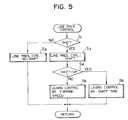
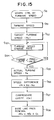
- the control unit 100 judges as to whether or not the transmission AT is in a shift operation in light of the shift pattern in step S1. If the judgment is No or the transmission AT is not in the shift operation, the control unit 100 carries out in step S2 a line pressure control in accordance with a routine provided for no-shift operation as shown in Figure 6. If the judgment is Yes in step S1, the control unit 100 carries out a routine for the shift operation as shown in Figure 7. Next, the control unit 100 judges whether or not a shift-up operation is made in step S4. If the judgment is Yes or the transmission AT is in the shift-up operation, the control unit 100 carries out a routine as shown in Figure 12 in which the line pressure is controlled based on a learning of shift operation time period.
- control unit 100 carries out a routine as shown in Figure 15 in which the line pressure is changed based on a learning control of a turbine speed increase. Then, the control unit 100 returns to the step S1.
- the control unit 100 reads the throttle opening and turbine speed from the sensors 101 and 102 respectively in step S11 and S12.
- the control unit 100 obtains the line pressure of the control circuit 30 in light of a map stored in a memory of the unit 100 in accordance with the throttle opening and the turbine speed.
- the control unit 100 determines a duty ratio DU for the duty solenoid valve 33 in accordance with the line pressure obtained in step S13.
- the control unit 100 sets a frequency for actuating the solenoid valve 33, for instance 35 Hz in the illustrated embodiment in step S15.
- step S16 the control unit 100 determines on-period in a single cycle by multiplying the duty ratio DU into a operating cycle.
- step S17 the control unit 100 actuates the solenoid valve 33 in accordance with the result of step S16 so as to accomplish the line pressure obtained in step S13 by applying a duty signal of normal frequency 35 Hz.
- the control unit 100 judges whether or not the shift operation is a shift-up operation in step S21.
- the control unit 100 reads the throttle opening in step S22 and determines the line pressure Pl in accordance with the throttle opening and gear stages involved in the shift-up operation. It will be understood that according to the illustrated embodiment, in determining the line pressure Pl, the gear stages are taken into account.
- the control unit 100 is provided in memory thereof with a map for obtaining the line pressure Pl in accordance with the throttle opening and the gear stages involved in the shift-up operation as shown in Figure 8(a).
- the line pressure obtained through step 23 will be further modified through the compensating procedure in Figure 12 in order to optimize the value.
- step S21 If the judgment of the step S21 is No or the transmission AT is in a shift-down operation, the control unit 100 further judges whether or not the shift-down operation is third to second stages in step S24. If Yes, the control unit 100 carries out steps S25 through S28. If No, the control in accordance with Figure 6 is carried out. It is necessary to make a timing control for engagement of the 2-4 brake 23 when the shift-down is made from the third to second stages by controlling the line pressure. In other shift-down operations, there is no need to control the line pressure because only disengagement action occurs on the 3-4 clutch 27 and the 2-4 brake 23 in this embodiment.
- control unit 100 reads the turbine speed in step S25 and determines a base line pressure Pl0 in accordance with the turbine speed in step 26.
- the control unit 100 determines the base line pressure Pl0 based on a map stored in a memory thereof in which the base line pressure Pl0 is provided in accordance with the turbine speed as shown in Figure 9.
- the base line pressure will be modified through a procedure of Figure 15 in order to optimize the value.
- the control unit 100 compensates the base line pressure Pl0 in accordance with a change speed in the throttle opening by employing and multiplying a compensation coefficient Ca into the base line pressure P10 in steps S27, S28.
- the coefficient is provided in accordance with the change speed in the throttle opening as shown in Figure 10.
- the control unit 100 determines the duty ratio DU of the solenoid valve 33 in step S29, sets the actuating frequency for actuating the valve 33 in step S30, calculates on-period of the solenoid in step S31 and actuates the valve 33 in step S32 so as to accomplish the line pressure value obtained through the step S23 or S28.
- the solenoid actuating frequency is set at 70 Hz higher than the value of step S15 in Figure 6 so as to get a responsive operation of the solenoid valve 33 .
- the control unit 100 reads the line pressure in step S35 and reads a temperature of the hydraulic fluid in the transmission AT in step S36. In step S37, the control unit 100 determines a base duty ratio DU0 in accordance with the hydraulic fluid temperature.
- the control unit 100 is provided with maps providing the base duty ratio DU0 based on the line pressure. Several maps are prepared with regard to respective temperatures of the hydraulic fluid since the relationship between the line pressure and the base duty ratio DU0 is changed in accordance with the temperature of the hydraulic fluid for better control. An accurate value of the base duty ratio DU0 can be obtained by means of a linear interpolation utilizing two maps even when the temperature of the hydraulic fluid takes an intermediate value.
- step S38 a time period is detected after starting engine.
- a compensation coefficient Cdu is obtained through a map in accordance with the time period after starting engine.
- the control unit 100 calculates the duty ratio DU by multiplying the coefficient Cdu into the base duty ratio DU0.
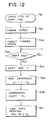
- This procedure is carried out for modifying the value of the line pressure obtained through step S23 of Figure 7 and stored in the memory of the control unit 100 in accordance with the shift operation time period.
- the turbine speed gradually decreases as the engaging force of the frictional elements increases.
- the engaging speed or the change speed of the engaging force of the frictional elements relates to the shift operation time period.
- the line pressure is compensated in accordance with the shift operation time period.
- the control unit 100 reads the turbine speed in step S41 and calculates a target turbine speed after the shift operation based on the actual turbine speed before the shift operation in step S42.
- step S43 the control unit 100 finds the termination of the shift operation when the difference between the target turbine speed and the actual turbine speed is smaller than a predetermined value and a change rate of the turbine speed is smaller than a predetermined value.
- the control unit 100 calculates the shift operation time period T in step S44.
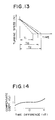
- step S45 the control unit 100 calculates a difference dT between the time period T and a target time period T0 which provides an appropriate speed change property of the turbine speed as shown by real line in Figure 13.
- step S46 the control unit 100 determines a coefficient Ct in accordance with the difference dT as shown in Figure 14. As the difference dT approaches 0, the coefficient Ct approaches 1. As the difference dT increases in a negative direction or the shift operation time period T takes a value T1 smaller than the value T0 as shown by a broken line in Figure 13, the coefficient Ct is reduced. When the difference dT increases in a positive direction or the shift operation time period T takes a value T2 larger than the target value T0 as shown in Figure 14, the coefficient Ct is increased.
- step S47 the line pressure Pl stored in the memory of the control unit 100 is replaced by a value obtained by multiplying the line pressure Pl into the coefficient Ct and renewed.
- the renewed value Pl is employed in the subsequent line pressure control.
- the learning control can be based on the turbine speed change during the shift operation.
- the learning control of the line pressure can be applied to the shift-down operation as well.
- the control unit 100 reads the turbine speed in step S51 and sets a target turbine speed N0 based on the turbine speed just before the shift operation in step S52.
- the control unit 100 calculates turbine speed change rate in step S53 and judges whether or not the turbine speed change rate is smaller than a predetermined value in step S54. If the turbine speed change rate is not smaller than the predetermined value, the control unit 100 returns to the step S53. When the turbine speed change rate is smaller than the predetermined value, the control unit 100 reads the turbine speed Ns just after the turbine speed change rate reduces below the predetermined value in step S55 and calculates a speed difference dN between the actual turbine speed Ns and the target turbine speed N0. In the illustrated embodiment, the turbine speed Ns exists in the vicinity of points x1, x0, x2 which are extreme points in respective turbine speed curves in Figure 16.
- the control unit 100 determines a compensating coefficient Cn in light of a map as shown Figure 17 in accordance with the speed difference dN in step S57.
- the coefficient approaches 1. If the speed difference dN increases in a positive direction as shown by a chain line in Figure 16, the coefficient Cn is increased. If the speed difference dN increases in a negative direction as shown by a broken line in Figure 16, the coefficient Cn is reduced as shown in Figure 17.
- step S58 the control unit 100 replaces the value of the base line pressure Pl0 by a new value which is obtained by multiplying the coefficient Cn into the value Pl0.
- the renewed line pressure Pl0 is stored in the memory and utilized for the subsequent control.
- the line pressure is modified to be increased when the turbine speed is increased as shown by the chain line in Figure 16.
- the line pressure is modified to be reduced when the turbine speed is decreased as shown by the broken line.
- the modified value of the line pressure is used for the subsequent line pressure control as a base value.
- the learning control according to the illustrated embodiment functions to lead the turbine speed change during the shift operation to a smaller value.
- the torque shock due to the shift operation can be effectively reduced by utilizing the above mentioned line pressure learning control.
- the duty solenoid valve 33 When the transmission is not under a shift operation, the duty solenoid valve 33 is actuated by a control signal of a normal frequency or 35 Hz in the illustrated embodiment so that an improved durability and reliable operation of the valve can be obtained.
- the solenoid valve 33 is actuated by a control signal of an increased frequency or 70 Hz in the illustrated embodiment during the shift-up and shift-down operation of the transmission so that a responsive operation of the solenoid valve 33 can be obtained.
- This facilitates the line pressure regulating valve 32 to control the line pressure of the hydraulic circuit 30 to enable a highly responsive switching action of the friction elements of the transmission. Such properly timed switching action of the friction elements is effected to reduce the torque shock during the shift operation.
Landscapes
- Engineering & Computer Science (AREA)
- General Engineering & Computer Science (AREA)
- Mechanical Engineering (AREA)
- Physics & Mathematics (AREA)
- Fluid Mechanics (AREA)
- Control Of Transmission Device (AREA)
- Structure Of Transmissions (AREA)
Claims (14)
- Ensemble de réglage d'une pression hydraulique destiné à une transmission automatique (AT), comprenant :
un mécanisme (10) de transmission à plusieurs vitesses ayant plusieurs étages d'engrenages et des éléments de friction destinés à commuter des trajets de transmission d'énergie dans le mécanisme de transmission (10),
un mécanisme (30) de commande hydraulique destiné à commander la mise en prise et la séparation des éléments de friction afin qu'il établisse l'un des étages d'engrenages,
un distributeur (32) de commande de pression de canalisation destiné à régler la pression de canalisation (Pl) du mécanisme de commande hydraulique (30),
une électrovanne (33) destinée à recevoir un signal de commande et à régler une pression pilote en fonction du signal de commande de manière que le distributeur (32) de réglage de pression de canalisation puisse régler la pression (Pl) dans la canalisation,
un dispositif (100) de détection d'une opération de changement de vitesse destiné à détecter une opération réelle de changement de vitesse, et
un dispositif (104) de réglage de fréquence commandé par le dispositif (100) de détection d'opération de changement de vitesse et destiné à augmenter la fréquence du signal de commande destiné à l'électrovanne (33) pendant une opération de changement de vitesse de la transmission (AT). - Ensemble de réglage d'une pression hydraulique selon la revendication 1, comprenant en outre un dispositif (102) de détection de la vitesse de rotation d'un organe d'entrée (13) du mécanisme de transmission à engrenages, un dispositif (Cn) assurant la compensation de la pression de la canalisation d'après la vitesse de rotation de l'organe d'entrée.
- Ensemble de réglage d'une pression hydraulique selon la revendication 2, dans lequel le dispositif de compensation comprend un dispositif (S₄₄) de détection d'une période réelle d'une opération de changement de vitesse d'après une vitesse de variation de la vitesse de l'organe d'entrée, et un dispositif de réglage d'une période cible destiné au réglage d'une période cible d'opération de changement de vitesse, le dispositif de compensation (Ct) assurant la compensation de la pression de la canalisation en fonction d'une différence de temps (dT) entre la période réelle (T) de l'opération de changement de vitesse et la période cible (To) de la période de changement de vitesse.
- Ensemble de réglage d'une pression hydraulique selon la revendication 3, dans lequel le dispositif de compensation assure la compensation de la pression de la canalisation afin qu'elle soit réduite lorsque la période réelle de l'opération de changement de vitesse est inférieure à la période cible de cette opération.
- Ensemble de réglage d'une pression hydraulique selon la revendication 3, dans lequel le dispositif de compensation compense la pression de la canalisation afin qu'elle augmente lorsque la période réelle de l'opération de changement de vitesse est supérieure à la période cible correspondante.
- Ensemble de réglage d'une pression hydraulique selon la revendication 3, dans lequel le dispositif de compensation assure la compensation de la pression de la canalisation par une commande par apprentissage reposant sur la période (S₅) de l'opération de changement de vitesse.
- Ensemble de réglage d'une pression hydraulique selon la revendication 3, dans lequel le dispositif de compensation comprend un dispositif destiné à détecter une vitesse de variation de la vitesse de l'organe d'entrée (13) en fonction du signal provenant du dispositif de détection de vitesse, et le dispositif de compensation détermine la fin d'une opération de changement de vitesse lorsque la vitesse de variation de vitesse diminue au-dessous d'une valeur prédéterminée.
- Ensemble de réglage d'une pression hydraulique selon la revendication 3, dans lequel l'opération de changement de vitesse est un passage à une vitesse supérieure.
- Ensemble de réglage d'une pression hydraulique selon la revendication 2, dans lequel le dispositif de compensation comprend un dispositif de réglage d'une vitesse cible de l'organe d'entrée dans l'opération de changement de vitesse, le dispositif de compensation assurant la compensation de la pression de la canalisation d'après une différence de vitesse (dN) entre la vitesse réelle obtenue à l'aide du dispositif (Ns) de détection de vitesse et la vitesse cible (No).
- Ensemble de réglage d'une pression hydraulique selon la revendication 9, dans lequel le dispositif de compensation assure la compensation de la pression dans la canalisation par commande par apprentissage en fonction de la vitesse de l'organe d'entrée (S₆).
- Ensemble de réglage d'une pression hydraulique selon la revendication 9, dans lequel le dispositif de compensation assure la compensation de la pression dans la canalisation afin qu'elle soit réduite lorsque la vitesse réelle de l'organe d'entrée (13) est inférieure à la vitesse cible (No).
- Ensemble de réglage d'une pression hydraulique selon la revendication 9, dans lequel le dispositif de compensation assure la compensation de la pression dans la canalisation afin qu'elle augmente lorsque la vitesse réelle de l'organe d'entrée (13) est supérieure à la vitesse cible (No).
- Ensemble de réglage d'une pression hydraulique selon la revendication 9, dans lequel l'opération de changement de vitesse est un passage à une vitesse inférieure.
- Ensemble de réglage d'une pression hydraulique selon la revendication 2, dans lequel le dispositif de compensation assure la compensation de la pression dans la canalisation d'après la température du fluide hydraulique dans la transmission (S₃₆).
Applications Claiming Priority (2)
| Application Number | Priority Date | Filing Date | Title |
|---|---|---|---|
| JP63266997A JPH0633813B2 (ja) | 1988-10-22 | 1988-10-22 | 自動変速機のライン圧制御装置 |
| JP266997/88 | 1988-10-22 |
Publications (3)
| Publication Number | Publication Date |
|---|---|
| EP0366003A2 EP0366003A2 (fr) | 1990-05-02 |
| EP0366003A3 EP0366003A3 (fr) | 1991-06-26 |
| EP0366003B1 true EP0366003B1 (fr) | 1994-01-26 |
Family
ID=17438628
Family Applications (1)
| Application Number | Title | Priority Date | Filing Date |
|---|---|---|---|
| EP89119407A Expired - Lifetime EP0366003B1 (fr) | 1988-10-22 | 1989-10-19 | Système de commande de pression d'alimentation pour une transmission automatique |
Country Status (4)
| Country | Link |
|---|---|
| US (1) | US5079971A (fr) |
| EP (1) | EP0366003B1 (fr) |
| JP (1) | JPH0633813B2 (fr) |
| DE (1) | DE68912706T2 (fr) |
Families Citing this family (20)
| Publication number | Priority date | Publication date | Assignee | Title |
|---|---|---|---|---|
| KR920010906B1 (ko) * | 1989-08-23 | 1992-12-21 | 마쯔다 가부시기가이샤 | 자동변속기의 라인압 제어장치 |
| US5214984A (en) * | 1990-12-06 | 1993-06-01 | Jatco Corporation | Pressure control system for automotive automatic power transmission with feature of fluid pressure dependent actuator control |
| JP2657007B2 (ja) * | 1991-04-15 | 1997-09-24 | 三菱電機株式会社 | 電子制御自動変速機の変速油圧制御装置 |
| JP2959284B2 (ja) * | 1991-07-31 | 1999-10-06 | 三菱自動車工業株式会社 | 自動変速機の変速制御装置 |
| US5349885A (en) * | 1991-09-03 | 1994-09-27 | Mazda Motor Corporation | Hydraulic control system for controlling line pressure based on backtorque and throttle rate in an automatic transmission |
| JPH05203038A (ja) * | 1992-01-28 | 1993-08-10 | Jatco Corp | 自動変速機の制御装置 |
| US5404301A (en) * | 1993-06-07 | 1995-04-04 | Eaton Corporation | Method and apparatus of vehicle transmission control by assured minimum pulse width |
| EP0654623B1 (fr) * | 1993-11-22 | 1999-08-18 | Mazda Motor Corporation | Commande hydraulique pour transmission automatique |
| GB2286641B (en) * | 1994-02-17 | 1998-01-07 | Acg France | Method and apparatus for controlling a gear change in an automatic transmission |
| JP3536533B2 (ja) * | 1996-06-11 | 2004-06-14 | トヨタ自動車株式会社 | 車両用自動変速機の変速制御装置 |
| JP3536537B2 (ja) * | 1996-06-28 | 2004-06-14 | トヨタ自動車株式会社 | 車両用自動変速機の変速制御装置 |
| GB2314901B (en) * | 1996-07-02 | 2001-02-14 | Luk Getriebe Systeme Gmbh | Fluid-operated regulating apparatus and method of using the same |
| KR100411032B1 (ko) * | 1997-06-18 | 2004-05-10 | 현대자동차주식회사 | 자동변속기용 파워 트레인 |
| DE19757603B4 (de) * | 1997-12-23 | 2004-03-18 | Hyundai Motor Company | Druckeinstellventil und mit demselben ausgestattetes Hydrauliksteuersystem eines Automatikgetriebes |
| KR100302809B1 (ko) * | 1999-06-30 | 2001-09-22 | 이계안 | 차량용 자동 변속기의 변속 제어 방법 |
| US6671577B2 (en) * | 2000-12-01 | 2003-12-30 | United States Postal Service | System and method for directly connecting an advanced facer canceler system to a delivery bar code sorter |
| JP2002276799A (ja) * | 2001-01-11 | 2002-09-25 | Jatco Ltd | 自動変速機の変速制御装置 |
| JP5126144B2 (ja) * | 2009-03-27 | 2013-01-23 | アイシン・エィ・ダブリュ株式会社 | 電磁弁装置およびそれを備えた動力伝達装置 |
| CN104455374B (zh) * | 2014-11-21 | 2016-09-07 | 湖北航天技术研究院特种车辆技术中心 | 具备应急档位自动切换功能的换挡电液系统 |
| DE102015120796B4 (de) * | 2014-12-15 | 2019-07-18 | Hyundai Autron Co., Ltd. | Schaltsteuerverfahren und Schaltsteuervorrichtung für ein Fahrzeug |
Citations (1)
| Publication number | Priority date | Publication date | Assignee | Title |
|---|---|---|---|---|
| EP0251479A1 (fr) * | 1986-06-27 | 1988-01-07 | Borg-Warner Automotive, Inc. | Système pour contrôler la pression du liquide de transmission |
Family Cites Families (19)
| Publication number | Priority date | Publication date | Assignee | Title |
|---|---|---|---|---|
| JPS4930051A (fr) * | 1972-07-17 | 1974-03-18 | ||
| JPS542349A (en) * | 1977-06-07 | 1979-01-09 | Idemitsu Kosan Co Ltd | Sublimable multi-layered composite |
| US4283970A (en) * | 1979-07-02 | 1981-08-18 | General Motors Corporation | Automatic transmission line pressure control |
| JPS5747056A (en) * | 1980-09-04 | 1982-03-17 | Nissan Motor Co Ltd | Oil pressure control device for automatic transmission |
| JPS6049793B2 (ja) * | 1981-03-30 | 1985-11-05 | 日産自動車株式会社 | ロツクアツプ式自動変速機のロツクアツプ制御装置 |
| JPS58137652A (ja) * | 1982-02-12 | 1983-08-16 | Komatsu Ltd | 変速装置のシフトシヨツク低減方法 |
| JPS5962756A (ja) * | 1982-10-01 | 1984-04-10 | Mazda Motor Corp | 電子制御自動変速装置 |
| JPS6148021A (ja) * | 1984-08-15 | 1986-03-08 | Toshiba Corp | 計算機のリセツト回路 |
| JPS6184446A (ja) * | 1984-09-29 | 1986-04-30 | Mitsubishi Motors Corp | 車両用自動変速機の制御装置 |
| JPS6217328A (ja) * | 1985-07-15 | 1987-01-26 | Diesel Kiki Co Ltd | 内燃機関車輛用制御装置 |
| DE3630768C2 (de) * | 1985-09-14 | 1997-04-03 | Volkswagen Ag | Steuereinrichtung für ein automatisches Kraftfahrzeug-Wechselgetriebe |
| JPS633183A (ja) * | 1986-06-20 | 1988-01-08 | Matsushita Refrig Co | フイン付熱交換器 |
| JPS6314053U (fr) * | 1986-07-07 | 1988-01-29 | ||
| JP2505755B2 (ja) * | 1986-07-10 | 1996-06-12 | 日産自動車株式会社 | 自動変速機の液圧制御装置 |
| JPS6353349A (ja) * | 1986-08-20 | 1988-03-07 | Aisin Warner Ltd | 電子制御式自動変速機 |
| JPS6367448A (ja) * | 1986-09-10 | 1988-03-26 | Fuji Heavy Ind Ltd | 自動変速機の油圧制御システム |
| US4922424A (en) * | 1987-04-20 | 1990-05-01 | Mitsubishi Jidosha Kogyo Kabushiki Kaisha | Control method for a driving system provided in a vehicle |
| JPH0781631B2 (ja) * | 1987-12-25 | 1995-09-06 | 日産自動車株式会社 | 自動変速機のライン圧制御装置 |
| US4919012A (en) * | 1989-03-01 | 1990-04-24 | Ford Motor Company | Pilot operated solenoid valve in an automatic transmission control circuit |
-
1988
- 1988-10-22 JP JP63266997A patent/JPH0633813B2/ja not_active Expired - Lifetime
-
1989
- 1989-10-19 EP EP89119407A patent/EP0366003B1/fr not_active Expired - Lifetime
- 1989-10-19 DE DE68912706T patent/DE68912706T2/de not_active Expired - Fee Related
- 1989-10-20 US US07/424,763 patent/US5079971A/en not_active Expired - Fee Related
Patent Citations (1)
| Publication number | Priority date | Publication date | Assignee | Title |
|---|---|---|---|---|
| EP0251479A1 (fr) * | 1986-06-27 | 1988-01-07 | Borg-Warner Automotive, Inc. | Système pour contrôler la pression du liquide de transmission |
Also Published As
| Publication number | Publication date |
|---|---|
| JPH0633813B2 (ja) | 1994-05-02 |
| JPH02113161A (ja) | 1990-04-25 |
| US5079971A (en) | 1992-01-14 |
| EP0366003A2 (fr) | 1990-05-02 |
| DE68912706T2 (de) | 1994-06-09 |
| EP0366003A3 (fr) | 1991-06-26 |
| DE68912706D1 (de) | 1994-03-10 |
Similar Documents
| Publication | Publication Date | Title |
|---|---|---|
| EP0366003B1 (fr) | Système de commande de pression d'alimentation pour une transmission automatique | |
| EP0414547B1 (fr) | Système à commande de pression de ligne pour une transmission automatique | |
| US4751858A (en) | Device for controlling quantity of lubricating oil in automatic transmission for vehicle | |
| EP0310117B1 (fr) | Système de commande de pontage pour une transmission automatique | |
| US5014575A (en) | Control systems for automatic transmissions | |
| US5086668A (en) | Line pressure control system for automatic transmission | |
| AU630834B2 (en) | Double transition downshift control method for an automatic transmission | |
| US4982622A (en) | Hydraulic pressure control device for automatic transmission | |
| US5005444A (en) | Hydraulic control apparatus for automatic transmission for motor vehicle | |
| US4843922A (en) | Hydraulic control system for automatic transmission | |
| US5800309A (en) | Hydraulic control device for automatic transmission | |
| EP0525853B1 (fr) | Procédé de commande d'une transmission automatique | |
| JP2672063B2 (ja) | 自動変速機の制御装置 | |
| US5024125A (en) | Shift control system for an automatic transmission | |
| US4998449A (en) | Duty solenoid valve control system for an automatic transmission | |
| US5012699A (en) | Apparatus for controlling gearshifts in automatic transmission | |
| US5213013A (en) | Line pressure control system for automatic transmission | |
| EP0851153A2 (fr) | Méthode de commande de la pression hydraulique d'une transmission automatique | |
| EP0279606B1 (fr) | Commande hydraulique pour transmission automatique | |
| AU630833B2 (en) | Double transition upshift control method for an automatic transmission | |
| EP0503691B1 (fr) | Commande d'engagement contrôlé d'un dispositif de transmission de couple actionné par fluide | |
| US6370463B1 (en) | Strategy for controlling ratio changes in a swap-shift automatic transmission | |
| US5421791A (en) | Shift control arrangement for automatic transmission | |
| US4709596A (en) | Control of a vehicle automatic transmission | |
| EP0370425B1 (fr) | Système de commande pour un embrayage de blocage du convertisseur de couple |
Legal Events
| Date | Code | Title | Description |
|---|---|---|---|
| PUAI | Public reference made under article 153(3) epc to a published international application that has entered the european phase |
Free format text: ORIGINAL CODE: 0009012 |
|
| AK | Designated contracting states |
Kind code of ref document: A2 Designated state(s): DE FR GB |
|
| PUAL | Search report despatched |
Free format text: ORIGINAL CODE: 0009013 |
|
| AK | Designated contracting states |
Kind code of ref document: A3 Designated state(s): DE FR GB |
|
| 17P | Request for examination filed |
Effective date: 19910812 |
|
| 17Q | First examination report despatched |
Effective date: 19920803 |
|
| GRAA | (expected) grant |
Free format text: ORIGINAL CODE: 0009210 |
|
| AK | Designated contracting states |
Kind code of ref document: B1 Designated state(s): DE FR GB |
|
| REF | Corresponds to: |
Ref document number: 68912706 Country of ref document: DE Date of ref document: 19940310 |
|
| ET | Fr: translation filed | ||
| PLBE | No opposition filed within time limit |
Free format text: ORIGINAL CODE: 0009261 |
|
| STAA | Information on the status of an ep patent application or granted ep patent |
Free format text: STATUS: NO OPPOSITION FILED WITHIN TIME LIMIT |
|
| 26N | No opposition filed | ||
| PGFP | Annual fee paid to national office [announced via postgrant information from national office to epo] |
Ref country code: FR Payment date: 19961009 Year of fee payment: 8 |
|
| PGFP | Annual fee paid to national office [announced via postgrant information from national office to epo] |
Ref country code: GB Payment date: 19961010 Year of fee payment: 8 |
|
| PG25 | Lapsed in a contracting state [announced via postgrant information from national office to epo] |
Ref country code: GB Free format text: LAPSE BECAUSE OF NON-PAYMENT OF DUE FEES Effective date: 19971019 |
|
| PG25 | Lapsed in a contracting state [announced via postgrant information from national office to epo] |
Ref country code: FR Free format text: THE PATENT HAS BEEN ANNULLED BY A DECISION OF A NATIONAL AUTHORITY Effective date: 19971031 |
|
| GBPC | Gb: european patent ceased through non-payment of renewal fee |
Effective date: 19971019 |
|
| REG | Reference to a national code |
Ref country code: FR Ref legal event code: ST |
|
| PGFP | Annual fee paid to national office [announced via postgrant information from national office to epo] |
Ref country code: DE Payment date: 19981023 Year of fee payment: 10 |
|
| PG25 | Lapsed in a contracting state [announced via postgrant information from national office to epo] |
Ref country code: DE Free format text: LAPSE BECAUSE OF NON-PAYMENT OF DUE FEES Effective date: 20000801 |