EP0366413A2 - Dispositif pour déterminer la mise au point - Google Patents
Dispositif pour déterminer la mise au point Download PDFInfo
- Publication number
- EP0366413A2 EP0366413A2 EP89310948A EP89310948A EP0366413A2 EP 0366413 A2 EP0366413 A2 EP 0366413A2 EP 89310948 A EP89310948 A EP 89310948A EP 89310948 A EP89310948 A EP 89310948A EP 0366413 A2 EP0366413 A2 EP 0366413A2
- Authority
- EP
- European Patent Office
- Prior art keywords
- light receiving
- light
- receiving device
- accumulation
- focus
- Prior art date
- Legal status (The legal status is an assumption and is not a legal conclusion. Google has not performed a legal analysis and makes no representation as to the accuracy of the status listed.)
- Granted
Links
- 238000009825 accumulation Methods 0.000 claims abstract description 73
- 238000001514 detection method Methods 0.000 claims abstract description 26
- 230000000694 effects Effects 0.000 claims abstract description 7
- 238000012544 monitoring process Methods 0.000 claims description 10
- 238000006243 chemical reaction Methods 0.000 claims description 3
- 230000001419 dependent effect Effects 0.000 claims 2
- 239000004065 semiconductor Substances 0.000 claims 1
- 239000000758 substrate Substances 0.000 claims 1
- 230000035508 accumulation Effects 0.000 description 55
- 238000010276 construction Methods 0.000 description 6
- 238000000034 method Methods 0.000 description 6
- 239000003990 capacitor Substances 0.000 description 5
- 230000004044 response Effects 0.000 description 2
- 238000005286 illumination Methods 0.000 description 1
- 238000003384 imaging method Methods 0.000 description 1
- 230000003287 optical effect Effects 0.000 description 1
Images


Classifications
-
- G—PHYSICS
- G02—OPTICS
- G02B—OPTICAL ELEMENTS, SYSTEMS OR APPARATUS
- G02B7/00—Mountings, adjusting means, or light-tight connections, for optical elements
- G02B7/28—Systems for automatic generation of focusing signals
- G02B7/34—Systems for automatic generation of focusing signals using different areas in a pupil plane
Definitions
- This invention relates to a focus detecting apparatus in an auto focus camera.
- a charge accumulation type light receiving element for example, a CCD image sensor
- a focus detecting apparatus in a camera.
- the illumination of the element surface varies from a high luminance to a low luminance depending on an object to be photographed and therefore, the accumulation time is varied and controlled so that the signal level to be processed becomes substantially constant.
- One of them is a method as disclosed, for example, in U.S. Patent No. 4,660,955 wherein the luminance of an object is monitored by a light receiving device differing from an image sensor and accumulation is terminated when the monitoring output reaches a predetermined level.
- charges are accumulated in advance in an image sensor for a certain time and after the termination of the accumulation, a signal from the image sensor itself is introduced and the next accumulation time is determined in conformity with the signal level.
- the image sensor is a CCD or the like and therefore, it is difficult to individually detect a monitoring output corresponding to each light receiving element of the image sensor. As a result, it is unavoidable to monitor the average value of received light in a certain degree of range. If so, when as shown, for example, in Figure 8 of the accompanying drawings, there is an object of high luminance in the fashion of a spot, if monitoring is effected at the average value, there has been the problem that the peak value exceeds the dynamic range of signal processing and accurate focus detection calculation is impossible.
- the focus detecting apparatus is provided with means for detecting the quantity of light and a time counter for measuring the accumulation time.
- the first accumulation time after the closing of the power source switch (including a case where focus detection is discontinued and then resumed) may be controlled by said means for detecting the quantity of light, and the second and subsequent accumulation times may be controlled on the basis of a result obtained by calculating the last output level of a focus detecting sensor and the accumulation time thereof.
- the output level of the sensor becomes a substantially proper level
- the second accumulation it becomes a more proper level and thus, the response after the closing of the power source switch is quick and accurate focus detection becoems possible.
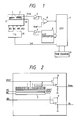
- the outputs of the light receiving elements of the light receiving unit 1 converted into digital values by the A/D converter 6 are successively introduced into a CPU 7.
- the output of the buffer 4 is input to one input of a comparator 8.
- the other input of this comparator 8 is connected to a predetermined potential Vref, and the output of the comparator 8 is introduced into the CPU 7.
- the CPU 7 is connected also to a time counter 9, and is capable of clearing, starting and reading of the counted value of the time counter 9.
- the CPU 7 is connected to a timing generator (TG) 10 so as to be able to deliver the accumulation starting and terminating signal (INT) of the light receiving unit 1 to the timing generator (TG) 10.
- the timing generator (TG) 10 outputs a signal ⁇ INT regarding the accumulation, a signal ⁇ R regarding the reading-out, a transportation clock ⁇ C and a shift pulse ⁇ S so that the light receiving unit 1 can start and terminate the accumulation under the control of the CPU 7 and after the termination of the accumulation, the reading-out can be sequentially effected in the order of the shift of the accumulated charges to the shift register 3 and the transportation of the signal charge in the shift register 3.
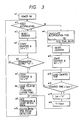
- the detailed constructions of the output portions of the light receiving unit 1, the photodiode 2 and the shift register 3 are as shown in Figure 2.
- FIG. 3 shows the operation flow of the CPU, and description will be made in accordance therewith.
- the CPU 7 After the closing of the power source switch (step #1), the CPU 7 first judges whether the accumulate in the light receiving unit 1 for focus detection is the first accumulation after the closing of the power source switch (step #2), and if it is the first accumulation advance is made to step #3, and if it is not the first accumulation, skip is made to step #4.
- the time counter 9 is reset, and next, at step #5, the time counter 9 is started and the accumulation signal INT is set to "L", and the timing generator 10 is instructed to start the accumulation.
- step #6 it is detected that the output of the comparator 8 becomes "H".
- the timing generator 10 reports it to the light receiving unit 1, whereby the accumulating operation of the light receiving unit 1 is started.
- the resetting of the monitoring photodiode is released, and as shown in Figure 4, an output corresponding to the quantity of light impinging on the monitoring photodiode (in this example, the exposure amount from the start of the accumulaiton) is produced from the terminal Vmon.
- the output of the comparator 8 is designed to put out “L” until the exposure amount of the monitoring photodiode reaches a predetermined value, and to put out "H” when said exposure amount reaches said predetermined value.
- step #6 it is detected that the output of the comparator 8 becomes "H” and therfore, when the exposure amount of the monitoring photodiode reaches said predetermined value and the output of the comparator 8 beocmes "H", advance is immediately made to step #7, where the counting by the time counter 9 is stopped and the accumulation signal INT is set to "H".
- step #8 the time counter value is read and this is stored as the accumulation time in T.
- the timing generator as shown in Figure 4, shifts the accumulated charges to the analog shift register 3 and therefore, the shift pulse ⁇ S is given to the shift gate, thereby terminating the accumulation.
- the charges of the light receiving elements introduced into the analog shift register are successively output as light receiving element signals from the terminal Vs by the transportation clock ⁇ C.
- the light receiving element signals successively output from the terminal Vs by this transportation clock ⁇ C are A/D-converted at one light receiving element unit, and the CPU introduces thereinto these A/D-converted values in succession (step #9), and effects focus detection calculation by the use of this light receiving element data (step #10), and skip is again made to step #1.
- the maximum value Pmax of the outputs of the plurality of elements of the light receiving unit 1 is detected, and the details of this operation will be described later. In the second and subsequent accumulations, skip is made to step #4, where the next accumulation time is determined.
- the time counter is reset, whereafter the time counter 9 is started and the signal INT is set to "L", and the timing generator 10 is instructed to start the accumulation (step #12).
- step #13 the time counter value is read out and whether the counted value is equal to Tnext is judged, and if it is equal to Tnext, advance is made to step #15. If the counted value is not equal to Tnext, skip is made to step #13, where the reading-in of the time counter value is repeated.
- step #15 the timing generator 10 is instructed to terminate the accumulation with the accumulation signal INT as an "H" output, and at step #16, Tnext is stored in the accumulation time T for the calculation of the next accumulation time, and skip is made to step #9, where the A/D-converted values of the CCD data are successively introduced and focus detection calculation is effected (step #10), and skip is again made to step #2, where this sequence is repeated.
- FIG. 5 shows the construction of a focus detecting apparatus according to another embodiment, and in Figure 5, portions similar to those in Figure 1 are given similar reference numerals.
- a photometering circuit for controlling the exposure amount of film connected to a film exposure amount control circuit for determining the aperture value of a photo-taking lens and the speed of a shutter during the exposure of the film is diverted to a quantity-of-light detecting circuit.
- the output of a photometering amplifier 41 is input to a film exposure amount control circuit 42 and is also input to the base of a transistor 43.
- the collector of the transistor 43 is connected to the negative input terminal of the comparator 8 and is also connected to the other end of a capacitor 44 having one end thereof connected to a potential Vcc.
- the output of the photometering amplifier 41 is input to an A/D converter 61 to cause this A/D converter to process the output of the photometering amplifier.
- the first accumulation time after the closing of the power source switch is predetermined by the CPU 7 before the first accumulation on the basis of the A/D conversion value of the photometering amplifier 41.
- the second and subsequent accumulations, as in the previous embodiments, are found by calculation from the maximum value of the A/D-converted data and the accumulation time of the CCD at the last time. In the case of this embodiment, the comparator is unnecessary.
Landscapes
- Physics & Mathematics (AREA)
- General Physics & Mathematics (AREA)
- Optics & Photonics (AREA)
- Focusing (AREA)
- Automatic Focus Adjustment (AREA)
Applications Claiming Priority (2)
| Application Number | Priority Date | Filing Date | Title |
|---|---|---|---|
| JP267621/88 | 1988-10-24 | ||
| JP63267621A JP2893687B2 (ja) | 1988-10-24 | 1988-10-24 | 焦点検出装置 |
Publications (3)
| Publication Number | Publication Date |
|---|---|
| EP0366413A2 true EP0366413A2 (fr) | 1990-05-02 |
| EP0366413A3 EP0366413A3 (fr) | 1991-07-31 |
| EP0366413B1 EP0366413B1 (fr) | 1995-04-12 |
Family
ID=17447235
Family Applications (1)
| Application Number | Title | Priority Date | Filing Date |
|---|---|---|---|
| EP89310948A Expired - Lifetime EP0366413B1 (fr) | 1988-10-24 | 1989-10-24 | Dispositif pour déterminer la mise au point |
Country Status (4)
| Country | Link |
|---|---|
| US (1) | US4931822A (fr) |
| EP (1) | EP0366413B1 (fr) |
| JP (1) | JP2893687B2 (fr) |
| DE (1) | DE68922179T2 (fr) |
Cited By (1)
| Publication number | Priority date | Publication date | Assignee | Title |
|---|---|---|---|---|
| EP0515689A4 (fr) * | 1990-11-09 | 1994-04-13 | Olympus Optical Co., Ltd. |
Families Citing this family (9)
| Publication number | Priority date | Publication date | Assignee | Title |
|---|---|---|---|---|
| JP2911521B2 (ja) * | 1990-02-15 | 1999-06-23 | キヤノン株式会社 | センサ装置 |
| JPH04181128A (ja) * | 1990-11-14 | 1992-06-29 | Olympus Optical Co Ltd | 測光装置 |
| US5526088A (en) * | 1992-03-05 | 1996-06-11 | Nikon Corporation | Focus detection device |
| JP3590806B2 (ja) * | 1994-09-07 | 2004-11-17 | 株式会社ニコン | イメージセンサーシステムおよび自動焦点検出装置 |
| DE19606694C2 (de) * | 1995-02-22 | 2002-12-12 | Asahi Optical Co Ltd | Entfernungsmeßvorrichtung |
| JP3700219B2 (ja) * | 1995-11-08 | 2005-09-28 | 株式会社ニコン | 焦点検出装置、および焦点検出装置の調整方法 |
| JP3747497B2 (ja) * | 1995-12-13 | 2006-02-22 | 株式会社ニコン | 測光装置 |
| JP4788054B2 (ja) * | 2001-03-28 | 2011-10-05 | 株式会社ニコン | 焦点検出装置 |
| JP5917051B2 (ja) * | 2011-09-08 | 2016-05-11 | キヤノン株式会社 | 半導体装置 |
Family Cites Families (2)
| Publication number | Priority date | Publication date | Assignee | Title |
|---|---|---|---|---|
| US4660955A (en) * | 1983-11-08 | 1987-04-28 | Minolta Camera Kabushiki Kaisha | Focus condition detecting device for use in a camera |
| JPH0727102B2 (ja) * | 1984-07-16 | 1995-03-29 | ミノルタ株式会社 | カメラの自動焦点検出装置 |
-
1988
- 1988-10-24 JP JP63267621A patent/JP2893687B2/ja not_active Expired - Lifetime
-
1989
- 1989-10-19 US US07/424,177 patent/US4931822A/en not_active Expired - Lifetime
- 1989-10-24 DE DE68922179T patent/DE68922179T2/de not_active Expired - Lifetime
- 1989-10-24 EP EP89310948A patent/EP0366413B1/fr not_active Expired - Lifetime
Cited By (2)
| Publication number | Priority date | Publication date | Assignee | Title |
|---|---|---|---|---|
| EP0515689A4 (fr) * | 1990-11-09 | 1994-04-13 | Olympus Optical Co., Ltd. | |
| US5398063A (en) * | 1990-11-09 | 1995-03-14 | Olympus Optical Co., Ltd. | Focusing position detecting device incorporated in a microscope |
Also Published As
| Publication number | Publication date |
|---|---|
| DE68922179T2 (de) | 1995-11-16 |
| DE68922179D1 (de) | 1995-05-18 |
| JP2893687B2 (ja) | 1999-05-24 |
| EP0366413B1 (fr) | 1995-04-12 |
| JPH02113215A (ja) | 1990-04-25 |
| EP0366413A3 (fr) | 1991-07-31 |
| US4931822A (en) | 1990-06-05 |
Similar Documents
| Publication | Publication Date | Title |
|---|---|---|
| US4635126A (en) | Image pick-up system | |
| US4701626A (en) | Accumulation time adjusting device for photo-electric converter | |
| US4733264A (en) | Charge-coupled device for automatic focusing and camera shake detector using such charge-coupled device | |
| US4931822A (en) | Focus detecting apparatus | |
| US4523101A (en) | Image scanning system with signal integration time control | |
| EP0773469A1 (fr) | Circuit à commande digitale pour l'extinction d'un flash | |
| US4612454A (en) | Method for controlling signal integration time of a signal integration type image sensing device | |
| US4411505A (en) | Camera | |
| US4320946A (en) | Camera focus detecting device | |
| JP2002213946A (ja) | イメージ信号出力方法、イメージ信号出力装置、測距装置及び撮像装置 | |
| US4786933A (en) | Focus detection apparatus for camera | |
| US5267015A (en) | Photometric apparatus | |
| US4870441A (en) | Photoelectric conversion apparatus for focus detection | |
| JPH11205694A (ja) | 光電変換装置及び焦点検出装置 | |
| JP3384818B2 (ja) | カメラおよびその予備測光方法ならびに予備測光装置および方法 | |
| JP3397221B2 (ja) | 測光装置 | |
| JP2001305422A (ja) | 測距装置 | |
| US5028948A (en) | Photoelectric transducer apparatus for focus detection | |
| GB2047036A (en) | Focus detection device | |
| US4762987A (en) | Automatic focusing system with correlation-determined disabling | |
| US4293207A (en) | Camera focus detecting device | |
| JP3109095B2 (ja) | 電荷蓄積型光電変換手段を用いた測光装置 | |
| JP3808912B2 (ja) | 焦点検出センサ装置 | |
| JP3132440B2 (ja) | 電荷蓄積型光電変換装置 | |
| JP2845859B2 (ja) | Ccd光量飽和制御回路 |
Legal Events
| Date | Code | Title | Description |
|---|---|---|---|
| PUAI | Public reference made under article 153(3) epc to a published international application that has entered the european phase |
Free format text: ORIGINAL CODE: 0009012 |
|
| AK | Designated contracting states |
Kind code of ref document: A2 Designated state(s): DE FR GB |
|
| PUAL | Search report despatched |
Free format text: ORIGINAL CODE: 0009013 |
|
| AK | Designated contracting states |
Kind code of ref document: A3 Designated state(s): DE FR GB |
|
| 17P | Request for examination filed |
Effective date: 19920123 |
|
| 17Q | First examination report despatched |
Effective date: 19931105 |
|
| GRAA | (expected) grant |
Free format text: ORIGINAL CODE: 0009210 |
|
| AK | Designated contracting states |
Kind code of ref document: B1 Designated state(s): DE FR GB |
|
| REF | Corresponds to: |
Ref document number: 68922179 Country of ref document: DE Date of ref document: 19950518 |
|
| ET | Fr: translation filed | ||
| PLBE | No opposition filed within time limit |
Free format text: ORIGINAL CODE: 0009261 |
|
| STAA | Information on the status of an ep patent application or granted ep patent |
Free format text: STATUS: NO OPPOSITION FILED WITHIN TIME LIMIT |
|
| 26N | No opposition filed | ||
| PGFP | Annual fee paid to national office [announced via postgrant information from national office to epo] |
Ref country code: FR Payment date: 19991011 Year of fee payment: 11 |
|
| PGFP | Annual fee paid to national office [announced via postgrant information from national office to epo] |
Ref country code: GB Payment date: 19991020 Year of fee payment: 11 |
|
| PG25 | Lapsed in a contracting state [announced via postgrant information from national office to epo] |
Ref country code: GB Free format text: LAPSE BECAUSE OF NON-PAYMENT OF DUE FEES Effective date: 20001024 |
|
| GBPC | Gb: european patent ceased through non-payment of renewal fee |
Effective date: 20001024 |
|
| PG25 | Lapsed in a contracting state [announced via postgrant information from national office to epo] |
Ref country code: FR Free format text: LAPSE BECAUSE OF NON-PAYMENT OF DUE FEES Effective date: 20010629 |
|
| REG | Reference to a national code |
Ref country code: FR Ref legal event code: ST |
|
| PGFP | Annual fee paid to national office [announced via postgrant information from national office to epo] |
Ref country code: DE Payment date: 20081016 Year of fee payment: 20 |