EP0366795A1 - Methode zur herstellung eines multi-sensors - Google Patents
Methode zur herstellung eines multi-sensors Download PDFInfo
- Publication number
- EP0366795A1 EP0366795A1 EP88906062A EP88906062A EP0366795A1 EP 0366795 A1 EP0366795 A1 EP 0366795A1 EP 88906062 A EP88906062 A EP 88906062A EP 88906062 A EP88906062 A EP 88906062A EP 0366795 A1 EP0366795 A1 EP 0366795A1
- Authority
- EP
- European Patent Office
- Prior art keywords
- layers
- multisensor
- sensitive
- redox function
- sensor
- Prior art date
- Legal status (The legal status is an assumption and is not a legal conclusion. Google has not performed a legal analysis and makes no representation as to the accuracy of the status listed.)
- Ceased
Links
Images




Classifications
-
- G—PHYSICS
- G01—MEASURING; TESTING
- G01N—INVESTIGATING OR ANALYSING MATERIALS BY DETERMINING THEIR CHEMICAL OR PHYSICAL PROPERTIES
- G01N33/00—Investigating or analysing materials by specific methods not covered by groups G01N1/00 - G01N31/00
- G01N33/48—Biological material, e.g. blood, urine; Haemocytometers
- G01N33/483—Physical analysis of biological material
- G01N33/487—Physical analysis of biological material of liquid biological material
- G01N33/49—Blood
- G01N33/492—Determining multiple analytes
Definitions
- the present invention relates to a so-called multisensor which is a composite form of a plurality of ion sensors and/or biosensors and a method of manufacturing the same and, more particularly, to a compact multisensor applied to clinical analyses and a method of manufacturing the same.
- ion sensors such as a pH sensor, an Na + sensor and a K + sensor and biosensors such as a glucose sensor and a urea sensor, and miniaturization of these sensors has been studied.
- Examples of a known method of depositing a sensitive layer of a small multisensor are:
- miniaturization can be easily performed, but manufacture is difficult because complicated lithography steps are required.
- manufacture is difficult because complicated lithography steps are required.
- it is difficult to achieve miniaturization.
- a multisensor of the present.invention comprises: a plurality of electrically conductive layers micropatterned on a surface of an isolating substrate; a plurality of redox function layers having a redox function covering surfaces of the plurality of electrically conductive layers; and a plurality of sensitive layers sensitive to concentrations of the same or different types of substances covering the plurality of redox function layers.
- a method of manufacturing a multisensor of the present invention comprises the steps of: forming a plurality of micropatterned electrically conductive layers on a surface of an isolating substrate; forming a plurality of redox function layers having a redox function covering surfaces of the plurality of electrically conductive layers; and forming a plurality of sensitive layers sensitive to the same or different types of substances covering the plurality of.redox function layers.
- patterning uniformity and formation repetitiveness of the plurality of electrically conductive layers to the isolating substrate surface.
- the plurality of sensitive layers of the multisensor sense concentrations of different substances, information about the sensed concentration is transmitted to the electrically conductive layer via the redox function layer, and the electrically conductive layer generates a voltage response corresponding to the sensed concentration.
- a plurality of micropatterned electrically conductive layers are formed on the isolating substrate surface, and redox function layers and sensitive layers sensitive to different substances are coated on the plurality of electrically conductive layers in a one-to-one correspondence.
- a so-called multisensor which is a composite form of a plurality of sensors and a method of manufacturing the same.
- a compact multisensor which can be used in clinical analyses or medical applications and a method of manufacturing the same.
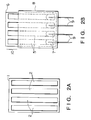
- a metal mask 1 (Mo plate) having a pattern shown in Fig. 2A (in which reference numerals 2 denote holes) was urged against a 6 x 10-mm, 0.5-mm thick sapphire substrate 6, and thin iridium oxide film patterns 5 were formed through the metal mask 1 using a sputtering apparatus (SPE-210H: manufactured by NEC Anelva K.K.).
- SPE-210H manufactured by NEC Anelva K.K.
- a lead wire 9 (polyurethane-coated wire having a diameter of 100 mm) was adhered to an end portion of each of the iridium oxide layers 5 formed as described above using an electrically conductive adhesive 7 (C-850-6: manufactured by Amicon Co.).
- the iridium oxide layers 5 were electrically isolated using an isolating adhesive 8 (SILICONE (tradename)) except for distal end portions 10 (1 to 2 mm long), thereby forming iridium oxide electrodes as shown'in Fig. 2B.
- a redox function layer 4 was coated on the exposed surface of the distal end portion 10 of each iridium oxide layer 5 by an electrolytic polymerization.
- a 3-electrode cell using the four iridium oxide electrodes the lead wires 9 of which were bound as an active electrode, a saturated sodium chloride calomel electrode (SSCE) as a reference electrode and a platinum steel as a counter electrode, and a potentiostat were used to simultaneously electrolyse the four iridium oxide electrodes.
- Electrolyte composition :
- a potentiostat was used in the following electrolyte to sweep the electrolytic potential three times (sweep rate: 50 mV/sec) from 0 to 1.5 V and then constant potential electrolysis was performed at 1.5 V for ten minutes. In this manner, a urease layer (layer thickness: about 50 ⁇ m) was coated to form a urea sensor 20.
- Electrolyte composition :
- one iridium oxide electrode was electrolysed in the following GOD (glucose oxidase) electrolyte to coat a 50 ⁇ m thick GOD layer, thereby forming a glucose sensor 21.
- GOD glucose oxidase
- Electrolyte composition :
- one iridium oxide electrode was electrolysed in the following electrolyte for a penicillinase layer to coat a 50 ⁇ m thick penicillinase layer, thereby forming a penicillin sensor 22.
- Electrolyte composition :
- one iridium oxide electrode was used to cause an electrolytic polymerization reaction in an electrolyte not containing an enzyme to form a poly(l,2-diaminobenzene) layer, thereby forming a pH sensor 23.
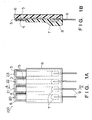
- Fig. lA shows an arrangement of the multisensor according to this example
- Fig. 1B is a sectional view taken along a line A - A' in Fig. lA.
- the sensors 20 to 23 are summarized in Table 1 below.
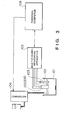
- a multisensor 100 prepared in this example was dipped together with a reference electrode (SSCE) 102 and a common electrode (silver wire) 103 in a sample solution 101 of a measuring apparatus shown in Fig. 3.
- SSCE reference electrode
- a common electrode silver wire
- a solution containing substrates glucose, urea and penicillin
- Responses were measured by a multichannel measuring apparatus 105 having a differential electrometer.
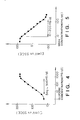
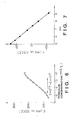
- the measurement values were supplied to and recorded by a personal computer 106 and then analyzed to check the responses to the substrate concentration changes. The check results are shown in Figs. 4 to 7.
- the multisensor of this example has good linearity when the glucose, urea and penicillin concentrations and the pH fall within the ranges of 5 to 500 mg/dl, 10 to 200 mg/dl, 2 x 10⁻⁵ to 2 x 10 -3 mol/l and 5.0 to 9.0, respectively.
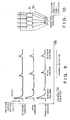
- the multisensor 100 of this example was placed in a flow through cell 80 shown in Fig. 8, and a buffer solution (tris-hydrochloric acid-based buffer solution having a pH of 7.4 or 8.0) was flowed at a flow rate of 0.5 ml/min using metering pumps 81a and 81b. Outputs from the multisensor were measured by a multichannel measuring apparatus 84 and recorded by a multipen recorder 85.
- a buffer solution tris-hydrochloric acid-based buffer solution having a pH of 7.4 or 8.0
- a calibration solution containing three substrates (glucose, urea and penicillin) of known concentrations was injected from an injector 83 via an injector valve 82 to calibrate the multisensor 100, and then a sample solution of an unknown concentration was injected.
- Outputs from the multisensor 100 together with calibration curves are shown in Fig. 9.
- the multisensor of this example since the sensitive layers are formed on the patterned base plate using the electrolytic polymerization.method, a multisensor comprising a plurality of sensors can be easily prepared by simple manufacturing steps. In addition, if the multisensor of this example is used as a detector for a flow injection analyzer, a large number of pieces of information can be simultaneously obtained without a column.
- a MOSFET or J-FET may be formed or an FET chip may be bonded on a single isolating substrate to form a multi FET sensor.
- a further miniaturized multisensor can be provided.
- a carbon paste (JEF-010: manufactured by Japan Atison K.K.) was coated using a screen printer and dried at 150°C for 30 minutes to prepare a substrate 120 having thin,carbon layers 121 (layer thickness: 2/tm) having a pattern shown in Fig. 12A.
- an isolating coating agent 122 (silicone-based coating agent) was coated (coating thickness: 500 ⁇ m) by the screen printer and dried at 180°C for 30 minutes, and lead wires 124 (polyurethane-coated wires each having a diameter of 100 ⁇ m) were adhered using electrically conductive adhesives 123 (C-850-6: manufactured by Amicon Co.).
- the four lead wires 124 of the thin carbon layer electrodes prepared as described above were bound and only exposed portions 125 at the distal ends shown in Fig. 12B were dipped in an electrolyte to form an active electrode.
- a saturated sodium chloride calomel electrode (SSCE) as a reference electrode and a platinum steel as a counter electrode, and a potentiostat, redox function layers 126 (poly(2,6-ditylphenol) layers) were formed on the surfaces of the four carbon exposed portions 125.
- the composition of the used electrolyte was as follows.
- Fig. 11A shows an arrangement of the multisensor of this example
- Fig. 11B is a sectional view taken along a line B - B' in Fig. 11A.
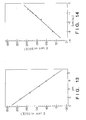
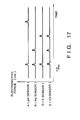
- Measurement results of individual sensor characteristics of the multisensor 200 prepared in this example are shown in Figs. 13 to 16.
- a solution having known concentrations was added from the autoburet 104 in order to change ion concentrations in the sample solution 101, and electromotive forces of the ion sensors with reference to the reference electrode (SSCE) 102 were measured at 37°C by a multichannel high-input resistance voltmeter.
- the measurement results were input to the personal computer 106 and then calculated and analyzed. The analyzed results are summarized in Table 4.
- the respective ion concentrations in the solution containing a plurality of types of ions can be measured without adversely affecting each other.
- the multisensor of this example comprises a plurality of micropatterned sensors, it can simultaneously measure a large number of pieces of information regardless of its miniaturized size.
- the multisensor can be prepared utilizing a lithography technique, miniaturization and a composite form of the multisensor can be easily achieved.
- a multisensor with a high response speed can be provided. Furthermore, a multisensor without a problem of mutual interference between individual sensors can be provided.
- a MOSFET or J-FET may be formed or an FET chip may be bonded on a single isolating substrate to form a multi FET sensor.
- a further miniaturized multisensor can be provided.
Landscapes
- Health & Medical Sciences (AREA)
- Life Sciences & Earth Sciences (AREA)
- Engineering & Computer Science (AREA)
- Biomedical Technology (AREA)
- Chemical & Material Sciences (AREA)
- Hematology (AREA)
- Physics & Mathematics (AREA)
- Analytical Chemistry (AREA)
- Biochemistry (AREA)
- Urology & Nephrology (AREA)
- Ecology (AREA)
- Food Science & Technology (AREA)
- Medicinal Chemistry (AREA)
- Biophysics (AREA)
- Molecular Biology (AREA)
- General Health & Medical Sciences (AREA)
- General Physics & Mathematics (AREA)
- Immunology (AREA)
- Pathology (AREA)
- Measurement Of The Respiration, Hearing Ability, Form, And Blood Characteristics Of Living Organisms (AREA)
- Investigating Or Analysing Biological Materials (AREA)
- Measuring Or Testing Involving Enzymes Or Micro-Organisms (AREA)
Applications Claiming Priority (2)
| Application Number | Priority Date | Filing Date | Title |
|---|---|---|---|
| JP62165434A JPH0743338B2 (ja) | 1987-07-03 | 1987-07-03 | マルチセンサ |
| JP165434/87 | 1987-07-03 |
Publications (2)
| Publication Number | Publication Date |
|---|---|
| EP0366795A1 true EP0366795A1 (de) | 1990-05-09 |
| EP0366795A4 EP0366795A4 (en) | 1991-09-25 |
Family
ID=15812354
Family Applications (1)
| Application Number | Title | Priority Date | Filing Date |
|---|---|---|---|
| EP19880906062 Ceased EP0366795A4 (en) | 1987-07-03 | 1988-07-01 | Multi-sensor and production thereof |
Country Status (3)
| Country | Link |
|---|---|
| EP (1) | EP0366795A4 (de) |
| JP (1) | JPH0743338B2 (de) |
| WO (1) | WO1989000287A1 (de) |
Cited By (5)
| Publication number | Priority date | Publication date | Assignee | Title |
|---|---|---|---|---|
| WO1992001929A1 (de) * | 1990-07-20 | 1992-02-06 | Battelle-Institut E.V. | Verfahren zur herstellung einer ionensensitiven arbeitselektrode eines schwermetallionen-sensors |
| GB2293883A (en) * | 1994-06-30 | 1996-04-10 | Nok Corp | Electrochemical protein biosensor |
| RU2168174C2 (ru) * | 1997-04-21 | 2001-05-27 | Рэндокс Лэборэтэриз Лтд. | Твердое устройство для проведения мультианалитных анализов, способ его формирования и система, включающая такое устройство |
| GB2402221A (en) * | 2003-05-26 | 2004-12-01 | Bosch Gmbh Robert | A Process and apparatus for developing an electrochemical measuring arrangement, in a particular sensor. |
| US7824529B2 (en) * | 2001-06-04 | 2010-11-02 | Epocal Inc. | Electrode module |
Families Citing this family (4)
| Publication number | Priority date | Publication date | Assignee | Title |
|---|---|---|---|---|
| DE3925091A1 (de) * | 1989-07-28 | 1991-01-31 | Eberhard Dipl Biol Kuhn | Verfahren zur biologischen behandlung von abwasser und anlage sowie reaktor zur durchfuehrung des verfahrens |
| CA2034266A1 (en) * | 1990-02-27 | 1991-08-28 | Paul A. D'orazio | Thick film reagent spreading and reagent immobilization layer |
| WO2020091033A1 (ja) * | 2018-11-01 | 2020-05-07 | 学校法人慶應義塾 | 参照電極として導電性ダイヤモンド電極を有する三極電極、装置及び、電気化学的測定方法 |
| CN116033870A (zh) * | 2020-08-26 | 2023-04-28 | 丁格医疗有限责任公司 | 连续葡萄糖传感器和安装组件 |
Family Cites Families (9)
| Publication number | Priority date | Publication date | Assignee | Title |
|---|---|---|---|---|
| JPS57118153A (en) * | 1981-01-14 | 1982-07-22 | Terumo Corp | Ph sensor |
| JPS5810645A (ja) * | 1981-07-13 | 1983-01-21 | Fuji Photo Film Co Ltd | フイルム状イオン選択電極及びこれを用いるイオン濃度測定法 |
| JPS59210356A (ja) * | 1983-05-13 | 1984-11-29 | Kuraray Co Ltd | トリグリセライドセンサ |
| JPS60243555A (ja) * | 1984-05-18 | 1985-12-03 | Fuji Photo Film Co Ltd | イオン選択電極及びその製造方法 |
| US4717673A (en) * | 1984-11-23 | 1988-01-05 | Massachusetts Institute Of Technology | Microelectrochemical devices |
| JPS61251764A (ja) * | 1985-04-30 | 1986-11-08 | Terumo Corp | ↓pHセンサ− |
| JPS61266952A (ja) * | 1985-05-21 | 1986-11-26 | Terumo Corp | カリウムイオンセンサ− |
| CA1315927C (en) * | 1986-12-10 | 1993-04-13 | Terumo Kabushiki Kaisha | Ion carrier membrane, and ion sensor having same |
| JP2993308B2 (ja) * | 1993-01-19 | 1999-12-20 | 日産自動車株式会社 | 車体シール構造及びその製造方法 |
-
1987
- 1987-07-03 JP JP62165434A patent/JPH0743338B2/ja not_active Expired - Fee Related
-
1988
- 1988-07-01 EP EP19880906062 patent/EP0366795A4/en not_active Ceased
- 1988-07-01 WO PCT/JP1988/000665 patent/WO1989000287A1/ja not_active Ceased
Cited By (9)
| Publication number | Priority date | Publication date | Assignee | Title |
|---|---|---|---|---|
| WO1992001929A1 (de) * | 1990-07-20 | 1992-02-06 | Battelle-Institut E.V. | Verfahren zur herstellung einer ionensensitiven arbeitselektrode eines schwermetallionen-sensors |
| US5262205A (en) * | 1990-07-20 | 1993-11-16 | Battelle-Institut E.V. | Process for producing the ion-sensitive probe electrode of a heavy-metal-ion sensor |
| GB2293883A (en) * | 1994-06-30 | 1996-04-10 | Nok Corp | Electrochemical protein biosensor |
| GB2293883B (en) * | 1994-06-30 | 1998-07-29 | Nok Corp | Method for measuring protein concentration using a protein biosensor |
| RU2168174C2 (ru) * | 1997-04-21 | 2001-05-27 | Рэндокс Лэборэтэриз Лтд. | Твердое устройство для проведения мультианалитных анализов, способ его формирования и система, включающая такое устройство |
| US7824529B2 (en) * | 2001-06-04 | 2010-11-02 | Epocal Inc. | Electrode module |
| GB2402221A (en) * | 2003-05-26 | 2004-12-01 | Bosch Gmbh Robert | A Process and apparatus for developing an electrochemical measuring arrangement, in a particular sensor. |
| GB2402221B (en) * | 2003-05-26 | 2005-11-02 | Bosch Gmbh Robert | Process and apparatus for developing an electrochemical measuring arrangement |
| US7553402B2 (en) | 2003-05-26 | 2009-06-30 | Robert Bosch Gmbh | Method and device for developing an electrochemical measuring system |
Also Published As
| Publication number | Publication date |
|---|---|
| JPS6410165A (en) | 1989-01-13 |
| EP0366795A4 (en) | 1991-09-25 |
| WO1989000287A1 (fr) | 1989-01-12 |
| JPH0743338B2 (ja) | 1995-05-15 |
Similar Documents
| Publication | Publication Date | Title |
|---|---|---|
| EP0333860B1 (de) | Enzymatischer sensor | |
| Urban et al. | Miniaturized multi-enzyme biosensors integrated with pH sensors on flexible polymer carriers for in vivo applications | |
| US5670031A (en) | Electrochemical sensor | |
| EP0470649B1 (de) | Verfahren für elektrochemische Messungen | |
| EP1423688B1 (de) | Produktionsmethoden von hoch empfindlichen potentiometrischen sensoren | |
| EP0251915A2 (de) | Enzymsensor | |
| Suzuki et al. | An integrated three-electrode system with a micromachined liquid-junction Ag/AgCl reference electrode | |
| US8900440B2 (en) | Method for detecting chemical or biological species and electrode arrangement therefor | |
| WO1992019961A1 (en) | Two-terminal voltammetric microsensors | |
| EP3249050B1 (de) | Enzymelektrode und biosensor mit verwendung davon | |
| EP0366795A1 (de) | Methode zur herstellung eines multi-sensors | |
| Chen et al. | Electrochemical determination of reduced glutathione (GSH) by applying the powder microelectrode technique | |
| JPH07109413B2 (ja) | 化学感応性変換器 | |
| Saban et al. | Multi-element heavy metal ion sensors for aqueous solutions | |
| Lemke et al. | Multisensor array for pH, K+, Na+ and Ca2+ measurements based on coated-film electrodes | |
| KR20220097909A (ko) | 화학 반응 동안 산화환원전위를 동적으로 측정하기 위한 방법 및 시스템 | |
| Meyer et al. | Chemical and biochemical sensor array for two-dimensional imaging of anlyte distributions | |
| Wang et al. | Electrochemical behavior and determination of nicardipine | |
| El Nashar et al. | Applications of calixarenes as potential ionophores for electrochemical sensors | |
| EP1225449B1 (de) | Nicht-enzymatischer, Detergenzien enthaltender Einweg-Elektrodestreifen für den Nachweis von Harnsäure oder Hämoglobin,sowie Verfahren für die Produktion und Anwendung desgleichen | |
| Hampp et al. | Design and application of thick-film multisensors | |
| Majeed et al. | Electrochemical biosensors for determination of anticancer medicine etoposide in human blood by glassy carbon modified electrode based on film of poly (L-lysine) with MWCNTS | |
| JPH04118554A (ja) | 電気化学的酵素測定方法およびバイオセンサ | |
| KR20200104091A (ko) | 웨어러블 디바이스용 플렉서블 바이오센서 및 이의 제조방법 | |
| Jiang et al. | Performance of an amperometric biosensor for the determination of hemoglobin |
Legal Events
| Date | Code | Title | Description |
|---|---|---|---|
| PUAI | Public reference made under article 153(3) epc to a published international application that has entered the european phase |
Free format text: ORIGINAL CODE: 0009012 |
|
| 17P | Request for examination filed |
Effective date: 19900102 |
|
| AK | Designated contracting states |
Kind code of ref document: A1 Designated state(s): BE DE FR IT |
|
| A4 | Supplementary search report drawn up and despatched |
Effective date: 19910807 |
|
| AK | Designated contracting states |
Kind code of ref document: A4 Designated state(s): BE DE FR IT |
|
| 17Q | First examination report despatched |
Effective date: 19940331 |
|
| STAA | Information on the status of an ep patent application or granted ep patent |
Free format text: STATUS: THE APPLICATION HAS BEEN REFUSED |
|
| 18R | Application refused |
Effective date: 19950724 |