EP0366880B1 - Ausrichtungsvorrichtung - Google Patents
Ausrichtungsvorrichtung Download PDFInfo
- Publication number
- EP0366880B1 EP0366880B1 EP89114147A EP89114147A EP0366880B1 EP 0366880 B1 EP0366880 B1 EP 0366880B1 EP 89114147 A EP89114147 A EP 89114147A EP 89114147 A EP89114147 A EP 89114147A EP 0366880 B1 EP0366880 B1 EP 0366880B1
- Authority
- EP
- European Patent Office
- Prior art keywords
- carriage
- axis
- bearing
- contact locations
- base
- Prior art date
- Legal status (The legal status is an assumption and is not a legal conclusion. Google has not performed a legal analysis and makes no representation as to the accuracy of the status listed.)
- Expired - Lifetime
Links
Images




Classifications
-
- F—MECHANICAL ENGINEERING; LIGHTING; HEATING; WEAPONS; BLASTING
- F16—ENGINEERING ELEMENTS AND UNITS; GENERAL MEASURES FOR PRODUCING AND MAINTAINING EFFECTIVE FUNCTIONING OF MACHINES OR INSTALLATIONS; THERMAL INSULATION IN GENERAL
- F16C—SHAFTS; FLEXIBLE SHAFTS; ELEMENTS OR CRANKSHAFT MECHANISMS; ROTARY BODIES OTHER THAN GEARING ELEMENTS; BEARINGS
- F16C19/00—Bearings with rolling contact, for exclusively rotary movement
- F16C19/50—Other types of ball or roller bearings
-
- B—PERFORMING OPERATIONS; TRANSPORTING
- B23—MACHINE TOOLS; METAL-WORKING NOT OTHERWISE PROVIDED FOR
- B23K—SOLDERING OR UNSOLDERING; WELDING; CLADDING OR PLATING BY SOLDERING OR WELDING; CUTTING BY APPLYING HEAT LOCALLY, e.g. FLAME CUTTING; WORKING BY LASER BEAM
- B23K20/00—Non-electric welding by applying impact or other pressure, with or without the application of heat, e.g. cladding or plating
- B23K20/02—Non-electric welding by applying impact or other pressure, with or without the application of heat, e.g. cladding or plating by means of a press ; Diffusion bonding
-
- H—ELECTRICITY
- H10—SEMICONDUCTOR DEVICES; ELECTRIC SOLID-STATE DEVICES NOT OTHERWISE PROVIDED FOR
- H10P—GENERIC PROCESSES OR APPARATUS FOR THE MANUFACTURE OR TREATMENT OF DEVICES COVERED BY CLASS H10
- H10P72/00—Handling or holding of wafers, substrates or devices during manufacture or treatment thereof
- H10P72/04—Apparatus for manufacture or treatment
- H10P72/0446—Apparatus for mounting on conductive members, e.g. leadframes or conductors on insulating substrates
-
- H—ELECTRICITY
- H10—SEMICONDUCTOR DEVICES; ELECTRIC SOLID-STATE DEVICES NOT OTHERWISE PROVIDED FOR
- H10W—GENERIC PACKAGES, INTERCONNECTIONS, CONNECTORS OR OTHER CONSTRUCTIONAL DETAILS OF DEVICES COVERED BY CLASS H10
- H10W72/00—Interconnections or connectors in packages
- H10W72/071—Connecting or disconnecting
- H10W72/0711—Apparatus therefor
-
- H—ELECTRICITY
- H10—SEMICONDUCTOR DEVICES; ELECTRIC SOLID-STATE DEVICES NOT OTHERWISE PROVIDED FOR
- H10W—GENERIC PACKAGES, INTERCONNECTIONS, CONNECTORS OR OTHER CONSTRUCTIONAL DETAILS OF DEVICES COVERED BY CLASS H10
- H10W72/00—Interconnections or connectors in packages
- H10W72/071—Connecting or disconnecting
- H10W72/0711—Apparatus therefor
- H10W72/07173—Means for moving chips, wafers or other parts, e.g. conveyor belts
-
- H—ELECTRICITY
- H10—SEMICONDUCTOR DEVICES; ELECTRIC SOLID-STATE DEVICES NOT OTHERWISE PROVIDED FOR
- H10W—GENERIC PACKAGES, INTERCONNECTIONS, CONNECTORS OR OTHER CONSTRUCTIONAL DETAILS OF DEVICES COVERED BY CLASS H10
- H10W72/00—Interconnections or connectors in packages
- H10W72/071—Connecting or disconnecting
- H10W72/0711—Apparatus therefor
- H10W72/07178—Means for aligning
-
- Y—GENERAL TAGGING OF NEW TECHNOLOGICAL DEVELOPMENTS; GENERAL TAGGING OF CROSS-SECTIONAL TECHNOLOGIES SPANNING OVER SEVERAL SECTIONS OF THE IPC; TECHNICAL SUBJECTS COVERED BY FORMER USPC CROSS-REFERENCE ART COLLECTIONS [XRACs] AND DIGESTS
- Y10—TECHNICAL SUBJECTS COVERED BY FORMER USPC
- Y10S—TECHNICAL SUBJECTS COVERED BY FORMER USPC CROSS-REFERENCE ART COLLECTIONS [XRACs] AND DIGESTS
- Y10S269/00—Work holders
- Y10S269/903—Work holder for electrical circuit assemblages or wiring systems
Definitions
- This invention relates to an apparatus for aligning a first surface against a second surface by pressing the first surface against the second surface. More particularly, this invention relates to an apparatus for aligning a bond head in substantially parallel relationship with beam leads aligned with and contacting contact locations on a substrate surface by pressing the bond head against the beam leads, and aligning a first and second electronic device in substantially parallel relationship with beam leads disposed therebetween by pressing the first electronic device against the second electronic device.
- a set of beam leads each having an inner lead bond end (ILB) and each having an outer lead bond end (OLB) are used to electrically interconnect an electronic device, for example, a semiconductor chip, to an electronic packaging substrate, for example a printed circuit board.
- the ILB ends are bonded to contact locations on the electronic device.
- the OLB ends are bonded to contact locations on the packaging substrate.
- the beam lead set is carried by the TAB tape.
- the inner lead bond ends of one set are disposed over and aligned with the electronic device contact locations.
- a bond head is generally brought over the inner lead bond ends. The bond head is heated and pressed against the inner lead bond ends to thermocompression bond the inner lead bond ends to the electronic device contact locations.
- the outer lead bond ends of the beam leads can be bonded in similar fashion to contact locations on the electronic device packaging substrate. Both the inner and outer lead bond ends can be bonded to the contact locations by other means such as solder bonding.
- the bond head In the process of bonding the inner lead bond ends to the electronic device or the outer lead bond ends to the packaging substrate, it is essential that the bond head be substantially parallel to the substrate to which the bonds are made. The degree to which they are parallel determines to a large degree the uniformity of heat and force applied to the leads. Non-uniform temperature or force results in poor quality bonds between the beam leads and contact locations and also results in a lack of control of the process.
- the bond head is adjusted to be substantially parallel to the substrate to which the beam lead ends are being bonded by a manual adjustment.
- solder bonding tool which has a ball joint enabling a block with bond head elements attached thereto to swivel in multiple directions from its normally level orientation relative to a housing to which it is held by symmetrically located springs.
- the ball permits self adjustment of the bond head elements to conform to slight irregularities at the soldering surface of the board.
- Leads on a chip are aligned with contact pads on a board.
- the bond head tip is aligned with the lead ends and pressed against the leads.
- the apparatus permits the plane containing the tips of the bond heads to swing through an arc in space so that when the bond head tip is pressed against the leads aligned with contacts on the board,the bond head tip will have a lateral movement which can damage the lead and contacts and can push the leads out of alignment with the pads.
- the apparatus has an additional problem. Since the block with the bond head swivels on a ball and socket joint, the plane of the bond head can twist about an axis perpendicular to this plane. When the head is pressed against the leads, this twist will cause an additional misalignment between the bond head tip and the leads.
- US-A-3 574 923 describes a bonding tool which has a ball joint enabling a platform with a work piece attached thereto to swivel in multiple directions from its normal orientation relative to the support to which the ball joint is attached.
- a bond head holding a chip with leads attached thereto is pressed against the work piece. Before pressing, the leads are aligned to contact pads on the work piece.
- the ball joint allows the work piece to move to be parallel dispersed against the leads.
- the work piece can twist about an axis perpendicular to the plane of the work piece misaligning the leads and contact pads.
- the invention as claimed solves the problem of how to provide an apparatus for adjusting the orientation of a first surface of a first body to be substantially flush against a second surface of a second body when the first surface is pressed against the second surface without lateral displacement and twisting of the first surface.
- the invention is an apparatus for adjusting the orientation of a first surface of a first body to be substantially flush against a second surface of a second body when said first surface is pressed against said second surface.
- the first surface rotates on space about a point thereon, thereby avoiding lateral displacement of the first surface.
- the first body is movably mounted to a support permitting rotation of the first surface about a first and second axis so that when the first surface is pressed against the second surface, the first surface rotates about the first and the second axis resulting in the first surface being substantially flush against the second surface.
- the first body is movably mounted to the support by a plurality of bearing means.
- the two axes of rotation are mutually perpendicular and intersect at a point on the first surface.
- the first surface rotates about the intersection point.
- FIG. 1 diagrammatically shows the concept of the present invention.
- Body 3 is movably mounted to support 5.
- Diamond shaped structure 7 represents the connection between body 3 and support 5 permitting surface 9 of body 3 to rotate in space so that when surface 9 is pressed against surface 11 of body 13, surface 9 rotates in space and is flush or intimately pressed against surface 11.
- surfaces 9 and 11 are substantially planar. However, as shown in FIG. 1, this is not necessary and the invention is not limited to substantially planar surfaces. If the means permitting the surface 9 to rotate, permits solid angular rotation of surface 9 with respect to surface 11, surface 9 will contact surface 11 in at least three points which define a plane of intersection of surface 9 and 11. If means 7 permits only a plane angular rotation of surface 9 with respect to surface 11, surface 9 will contact surface 11 in at least two points.
- FIG. 2 shows the inner ends of beam leads 2 aligned with contact locations 4 on electronic device 6 which is held by fixture 8. Bond head 10 is heated and aligned over the inner ends of the beam leads 2 for pressing the inner ends of the beam leads against the electronic device contact locations.
- Bonding surface 12 of bond head 10 is shown in FIG. 2 not parallel to surface 14 of electronic device 6. Bonding surface 12 will contact beam lead inner end 16 prior to contacting beam lead inner end 18 when bond head holder 20 is moved towards electronic device 6.
- FIG. 3 shows an electronic device 24 held in fixture 26 and an electronic device 28 held in fixture 30, typically by vacuum pickup 31 and 33.
- Electronic device 24 has contact locations 29 thereon and electronic device 28 has contact locations 32 thereon.
- the inner ends 34 and 35 of beam leads 36 are aligned between contact pads 29 and contact pads 32.
- Fixture 26 is moved towards fixture 30 to press beam lead inner ends 34 and 35 between contact pad 30 on electronic device 24 and contact pad 32 on electronic device 28.
- One or both of fixtures 26 and 30 are heated. This forms a thermal compression bond between contact pads 29, 32 and the inner ends 34 and 35 of the beam leads.
- the apparatus according to the present invention avoids the trial and error in manual adjustment methods as described above.
- a spaced series of beam lead sets are fabricated on an elongated flexible tape.
- the flexible tape can be wound onto reels and unwound from the reels for use in automated process to electrically connect electronic devices to the beam lead sets and to electrically connect the assembly of electronic device and beam lead sets onto a packaging substrate.
- FIG. 4 shows one set of beam leads represented by 50 formed on a flexible film 52, each beam lead has an inner lead bond (ILB) end 54 and an outer lead bond (OLB) end 56.
- the ILB ends project inwardly towards a central location and are bonded to contact pads on an electronic device represented by 58.
- the ILB ends project inwardly in cantilevered fashion over the edge 60 of aperture 62 in film 52.
- the beam leads project over apertures 64.
- Apertures 64 provide an opening in the film 52 to form bonds at the OLB ends.
- Flexible film 52 has a series of sprocket holes 66 at the outer edges of the film. These sprocket holes permit alignment of the beam leads to contact pads to which both the ILB and the OLB will be electrically connected.
- the sprocket holes permit only a coarse alignment of the ILB and OLB ends of the contact pads on a chip and a substrate, respectively.
- Commonly used optical systems are used to provide fine alignment of the ILB and OLB ends to contact pads on a chip and a substrate, respectively.
- FIG. 4 is an example of only one type of metallized carrier for a spaced series of groups of beam leads.
- Another commonly used beam lead carrier has only one layer of metal in which a series of beam lead patterns are formed.
- the beam leads and the metal film are a unitary structure.
- the beam leads are formed by etching the beam lead patterns on the tape or alternatively, the leads may be patterned plated using photolithographic processes.
- the leads are severed, by methods commonly used in the art, from the metallized film in the region of the OLB ends in the region of aperture 64 in FIG. 5.
- FIG. 5 shows the basic concept of the preferred embodiment of the present invention.
- Body 108 comprises Y carriage 80 which is movably mounted to base 82.
- X carriage 84 is movably mounted to Y carriage 80.
- Base 82 has a concave cylindrical surface 86 having radius of curvature 88 centered on axis 90.
- Y carriage 80 has a convex cylindrical surface 92 having radius of curvature 88 centered on axis 90. Cylindrical surface 92 is disposed in contact with cylindrical surface 86. Surface 92 slides along surface 86.
- Surface 94 of Y carriage 80 is opposite to surface 92 of Y carriage 80.
- Surface 94 is concave and cylindrical having radius of curvature 96 centered on axis 98.
- axis 98 intersects axis 90 at point 100. It is not necessary that axis 98 intersect axis 90.
- axes 98 and 90 are perpendicular. It is not necessary that axes 90 and 98 be perpendicular.
- Surface 102 of X carriage 84 has a convex cylindrical surface having radius of curvature 96 centered on axis 98. Cylindrical surface 102 is disposed against cylindrical surface 94. Cylindrical surface 102 is capable of sliding with respect to cylindrical surface 94.
- Substantially planar surface 104 of X carriage 84 is opposite to cylindrical surface 102 of X carriage 84. Surface 104 is not visible in the perspective of FIG. 5.
- the apparatus of FIG. 5 avoids the twisting described above with reference to the apparatus described in US-A-3 574 923 and the IBM TDB article.
- FIG. 5 The invention will be further described in terms of a specific application of the concept of FIG. 5 to a bonding apparatus to bond lead frames of the type shown in FIG. 4 to electronic devices by the bonding operations shown in FIGS. 2 and 3.
- the concept shown in FIG. 5 is not limited to these applications.
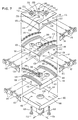
- FIG. 7 base 110 is movably mounted to Y carriage 112 by means of ball bearings held in ball bearing cages 114 and 116.
- FIG. 8 shows a side view of a commonly available ball bearing assembly. A plurality of balls 118 are maintained in a spaced apart relationship in apertures 119 in retainer or cage 120. The balls roll on grooves in an outer race 117 and an inner race 121.
- FIG. 9 is a perspective sectional view of the structure of FIG. 8. The bearing races and retainers used in the structure of FIG. 7 are cut out from an assembly as shown in FIG. 8. For the purpose of this application a bearing race and a bearing track mean the same thing.
- the balls of bearing assembly 114 roll in outer race 122 of base 110 and roll in inner race 124 of Y carriage 112.
- the balls of bearing assembly 116 roll in outer race 126 of base 110 and in inner race 128 of Y carriage 112.
- Bearing races 126 and 122 form a cylindrical surface as described with regard to FIG. 5.
- Bearing race 128 and 124 form a cylindrical surface on Y carriage 112 as described with reference to FIG. 5.
- the arrangement of bearing assemblies 116 and 114 and the bearing races on base 110 and 112 permit Y carriage 112 to slide with respect to base 110 along a circular arc having an axis of rotation 130. Cylindrical surface 132 of Y carriage 112 supports bearing races 128 and 124.
- Cylindrical surface 134 of Y carriage 112 carries bearing race 136 and 138.
- Cylindrical surface 140 of X carriage 142 supports bearing race 144 and 146.
- Bearing assembly 148 is disposed between bearing race 138 on Y carriage 112 and bearing race 144 on X carriage 142.
- Bearing assembly 150 is disposed between bearing race 136 on Y carriage 112 and bearing race 146 on X carriage 142.
- the arrangement of bearing assemblies 148, 150 and bearing races 138, 144, 136 and 146 permit the X carriage 142 to slide with respect to the Y carriage 112.
- Bearing races 138 and 136 form a cylindrical surface having axis 152.
- Bearing races 144 and 146 form a cylindrical surface having axis 152.
- Bond head assembly 160 is attached to surface 162 of X carriage 142.
- Surface 162 is opposite to surface 140 of X carriage 142.
- Surface 164 of bond assembly 160 has holes 166 through which screws 168 are inserted for attaching assembly 160 surface 162 of X carriage 142.
- Bearing race 122 is held in place by bearing retainer 174 which is held in place by a plurality of screws 176 which are screwed into tapped holes 178 of base 110.
- Bearing race 126 is held in place by bearing retainer 175 and screws 177.
- Bearing race 124 is held in place by bearing retainer 180 which is held in place by a plurality of screws 182 which are screwed into tapped hole 184 of Y carriage 112.
- Bearing race 128 is held in place by a bearing retainer plate 181 and screws 183.
- Bearing race 138 is held in place by bearing retainer plate 186 which is held in place by a plurality of screws 188 which are screwed into tapped holes 190 on Y carriage 112.
- Bearing race 136 is held in place by a bearing retaining plate 187 and screws 189.
- Bearing race 144 is held in place by retainer plate 192 which is held in place by screws 194 which are screwed into tapped holes 196 in X carriage 142.
- Bearing race 146 is held in place by bearing retainer plate 193 and screws 195.
- the use of retainer plates to hold the bearing tracks in place are commonly in use in the art.
- Spring 200 passes through aperture 202 in X carriage 142 and through aperture 204 in Y carriage 112 and through aperture 206 in base 110.
- One end 201 of spring 200 is fixed to pin 208 which spans across aperture 206 in base 110.
- the other end 203 of spring 200 is fixed to pin 210 which spans across aperture 202 in X carriage 142.
- the second spring passes through aperture 212 in X carriage 142, through aperture 214 in Y carriage 112 and through aperture 216 in base 110.
- the second spring is only partially shown in the figures.
- One end 217 of the second spring is fixed to pin 218 which spans across aperture 216.
- the other end of the second spring is fixed to a pin which spans across aperture 212.
- the relative degree of movement between base 110, Y carriage 112 and X carriage 142 is constrained by two shoulder screws, one of which is shown in FIG. 10 as 230.
- One end 232 of shoulder screws 230 is screwed into tapped hole 234 in base 110.
- Pin 230 extends through an aperture 236 in Y carriage 112 and through an aperture 238 in X carriage 142.
- Apertures 236 and 238 have a larger cross sectional area than does shoulder screws 230 which is inserted through those apertures. Therefore, there is an empty space surrounding shoulder screw 230 in aperture 236 and surrounding shoulder screw 230 in aperture 238. This space permits both the X and Y carriage to move relative to base 110 only up until the edge of apertures 236 and 238, respectively, butt up against shoulder screw 230.
- the end of shoulder screw 230 opposite to end 232 has a head 240.
- Head 240 sits in an end 242 of aperture 238, which has a larger cross sectional area than head 240. Head 240 prevents pulling apart the assembly of base 110, Y carriage 112 and X carriage 142.
- the second constraining pin is screwed into tapped hole 246 which is shown in FIG. 12. The second constraining pin is not otherwise shown in the figures.
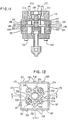
- BoltS 252 are inserted through apertures 250 in base 110 for attachment of the assembly shown in FIG. 6 to a bonding machine 254 shown in FIG. 10.
- Bond head 160 has two major parts: thermode bracket 260 and thermode 262.
- the thermode 260 is the same as a thermode commonly used in the electronic art for thermal compression bonding.
- At the end of thermode 262 is either a bond head knife as shown as 10 in FIG. 2 or a chip holding fixture such as shown in FIG. 3 as 26.
- a beam lead set on tape 265 is held between bond head tip end 263 and chip 267 is held in chip nest 269 of fixture 270.
- the surface 12 of the thermode knife of FIG. 2 is in the plane formed by the intersection of the rotation axes 130 and 152.
- the contact locations 30 of the electronic device 24 as shown in FIG. 3 is in the plane formed by the intersection of the rotation axes 130 and 152.
- the apparatus of the present invention can also be used for solder bonding the lead ends to contact locations on a substrate.
- the apparatus of the present invention can be used to bond the outer lead ends 3 in FIG. 2 and 37 of FIG. 3 to contact locations on a substrate.
- a vacuum pickup shown in FIG. 3 as 25 is used to hold the chip in place at thermode tip end 263.
- the apparatus of FIG. 6 has a central cavity 280 which extends through base 110, Y carriage 112 and X carriage 142 and through the bond head 160.
- a bellows 281 which is preferably made from stainless steel which is sufficiently flexible to flex along with the relative movements of base 110, Y carriage 112 and X carriage 142.
- a tube adequate for this application is Servometer Corp. FC1.
- Base 110, X carriage 142 and Y carriage 112 can be made of any rigid material such as for example brass, copper and aluminum, they are preferably made of stainless steel.
- Bearing races can be made from similar rigid materials, they are preferably made of hardened steel.
- the ball bearings can be made of similar rigid materials; they are preferably made of hardened steel.
- the bearing retainers can be made of similar rigid materials; they are preferably made of stainless steel.
- the springs can be made of carbon or stainless steel, they are preferably made of stainless steel.
- the bond head 160 can be made of similar rigid materials, it is preferably made of stainless steel. These materials are exemplary only and not limiting.
- radius 88 is about 7 cm and radius 98 is about 6 cm.
- the maximum rotation about axis 130 and 152 has been found to be about 0.5 degrees.
- bond head 160 is shown attached to x-carriage 142.
- the invention is an apparatus for automatically adjusting thc orientation of a first substantially planar surface of a first body to be substantially parallel to a second substantially planar surface of a second body when said first surface is pressed against said second surface.
Landscapes
- Engineering & Computer Science (AREA)
- General Engineering & Computer Science (AREA)
- Mechanical Engineering (AREA)
- Wire Bonding (AREA)
- Automatic Assembly (AREA)
- Eye Examination Apparatus (AREA)
Claims (11)
- Ausrichtungsvorrichtung, die beim Thermokompressions-bonden verwendet wird, um die Ausrichtung einer ersten Oberfläche (9, 104) eines ersten Körpers (3, 108) auf eine zweite Oberfläche (11, 106) eines zweiten Körpers (13) zu regulieren, wenn die erste Oberfläche gegen die zweite Oberfläche gedrückt wird, die über ein Trageelement (5) für den ersten Körper verfügt, ein Mittel zum Drücken der ersten Oberfläche gegen die zweite Oberfläche und ein Mittel (86, 92, 94, 102) zum beweglichen Montieren des ersten Körpers auf dem Trageelement an den gekrümmten Oberflächen, wobei eine Rotation der ersten Oberfläche um eine erste Achse (90) und eine zweite Achse (98) ermöglicht wird, die im wesentlichen vertikal zueinander liegen, so daß sich die erste Oberfläche um die erste und zweite Achse dreht, wenn das Trageelement so bewegt wird, daß die erste Oberfläche gegen die zweite Oberfläche gedrückt wird, woraus sich eine im wesentlichen parallele Ausrichtung der ersten Oberfläche auf die zweite Oberfläche ergibt,
die gekennzeichnet ist durch
eine am Trageelement befestigte Basis (82), wobei die Basis eine zylindrische, konkave Oberfläche (86) mit einem ersten Radius (88) und der ersten Achse aufweist,
einen ersten Träger (80) mit einer zylindrischen, konvexen Oberfläche (92) mit einem Radius und einer Achse, die im wesentlichen mit dem ersten Radius und der ersten Achse identisch sind, wobei die zylindrische, konkave Oberfläche der Basis beweglich auf der zylindrischen, konvexen Oberfläche des ersten Trägers montiert ist und der erste Träger eine zylindrische, konkave Oberfläche (94) mit einem zweiten Radius (96) und der zweiten Achse aufweist, und
einen zweiten Träger (84) mit der ersten Oberfläche (104) und einer zylindrischen, konvexen Oberfläche (102) mit einem Radius und einer Achse, die im wesentlichen mit dem zweiten Radius und der zweiten Achse identisch sind, wobei die zylindrische, konkave Oberfläche des ersten Trägers beweglich auf der zylindrischen, konvexen Oberfläche des zweiten Trägers montiert ist. - Vorrichtung eines der vorausgehenden Ansprüche, wobei sich die erste Achse und die zweite Achse schneiden.
- Vorrichtung eines der vorausgehenden Ansprüche, wobei die erste Oberfläche die erste und zweite Achse enthält.
- Vorrichtung gemäß einem der vorausgehenden Ansprüche, wobei die konkave Oberfläche der Basis auf der konvexen Oberfläche des ersten Trägers durch ein Lager (114, 116, 118, 122, 124, 126, 128) beweglich montiert ist und die konkave Oberfläche des ersten Trägers auf der konvexen Oberfläche des zweiten Trägers durch ein Lager (118, 136, 138, 144, 146, 148, 150) beweglich montiert ist.
- Vorrichtung gemäß Anspruch 4, wobei das Lager mindestens zwei Lagerstrukturen umfaßt, die eine Vielzahl von Kugeln (118) enthalten, die zwischen den Lagerbahnen liegen.
- Vorrichtung gemäß einem der vorausgehenden Ansprüche 1 bis 5, wobei die konkave Oberfläche der Basis auf der konvexen Oberfläche des ersten Trägers beweglich montiert ist und sich zwischen der konvexen Oberfläche und der konkaven Oberfläche ein Schmiermittel befindet.
- Vorrichtung gemäß einem der vorausgehenden Ansprüche, wobei die Basis, der erste Träger und der zweite Träger durch eine Feder zusammengehalten werden.
- Vorrichtung gemäß einem der vorausgehenden Ansprüche, wobei die erste Oberfläche an den Körper gehalten wird, indem ein Vakuum durch ein flexibles Glied erzeugt wird, das sich durch eine Öffnung in dem erwähnten Mittel zum beweglichen Montieren des ersten Körpers auf dem Trageelement erstreckt.
- Vorrichtung gemäß einem der vorausgehenden Ansprüche, wobei das flexible Glied eine Ausgleichverbindung ist.
- Vorrichtung gemäß einem der vorausgehenden Ansprüche, wobei mindestens die erste Oberfläche im wesentlichen eben ist.
- Vorrichtung gemäß einem der vorausgehenden Ansprüche, wobei die Vorrichtung ein Bondierwerkzeug zum Bonden der Enden einer Vielzahl von Beam-Leads mit einer Vielzahl von Kontaktstellen auf einem Substrat oder zum Bonden einer Vielzahl von Kontaktstellen auf einem ersten Substrat mit einer Vielzahl von Kontaktstellen auf einem zweiten Substrat ist und die erste Oberfläche ein Bondierkopf ist, mit dem die Enden gegen die Kontaktstellen gedrückt werden, und die zweite Oberfläche die Vielzahl der Kontaktstellen darstellt oder die erste Oberfläche die Vielzahl der Kontaktstellen auf dem ersten Substrat und die zweite Oberfläche die Vielzahl der Kontaktstellen auf dem zweiten Substrat darstellt.
Applications Claiming Priority (2)
| Application Number | Priority Date | Filing Date | Title |
|---|---|---|---|
| US264713 | 1988-10-31 | ||
| US07/264,713 US4875614A (en) | 1988-10-31 | 1988-10-31 | Alignment device |
Publications (3)
| Publication Number | Publication Date |
|---|---|
| EP0366880A2 EP0366880A2 (de) | 1990-05-09 |
| EP0366880A3 EP0366880A3 (de) | 1991-05-29 |
| EP0366880B1 true EP0366880B1 (de) | 1995-01-04 |
Family
ID=23007290
Family Applications (1)
| Application Number | Title | Priority Date | Filing Date |
|---|---|---|---|
| EP89114147A Expired - Lifetime EP0366880B1 (de) | 1988-10-31 | 1989-08-01 | Ausrichtungsvorrichtung |
Country Status (4)
| Country | Link |
|---|---|
| US (1) | US4875614A (de) |
| EP (1) | EP0366880B1 (de) |
| JP (1) | JPH0650752B2 (de) |
| DE (1) | DE68920405T2 (de) |
Families Citing this family (42)
| Publication number | Priority date | Publication date | Assignee | Title |
|---|---|---|---|---|
| US4982890A (en) * | 1989-01-10 | 1991-01-08 | Siemens Aktiengesellschaft | Soldering means having at least one stirrup electrode and two soldering webs lying opposite one another or four soldering webs lying opposite one another in pairs |
| US5016804A (en) * | 1989-01-10 | 1991-05-21 | Siemens Aktiengesellschaft | Soldering apparatus having at least one stirrup electrode |
| JPH02303100A (ja) * | 1989-05-17 | 1990-12-17 | Matsushita Electric Ind Co Ltd | 部品装着方法 |
| US5051555A (en) * | 1990-02-26 | 1991-09-24 | Universal Instruments Corporation | Hot-bar suspension system |
| US5052606A (en) * | 1990-06-29 | 1991-10-01 | International Business Machines Corp. | Tape automated bonding feeder |
| US5207467A (en) * | 1990-08-31 | 1993-05-04 | International Business Machines Corporation | Monitor for detecting the absence of an electronic component on a vacuum pickup |
| JP2835983B2 (ja) * | 1990-10-31 | 1998-12-14 | 株式会社新川 | ボンデイングヘツド |
| US5092510A (en) * | 1990-11-20 | 1992-03-03 | International Business Machines Corporation | Method and apparatus for circuit board support during component mounting |
| US5185509A (en) * | 1991-02-19 | 1993-02-09 | Toddco General, Inc. | Robotic arm tool mounting apparatus |
| US5150827A (en) * | 1991-11-22 | 1992-09-29 | Hughes Aircraft Company | Self-leveling reflow solder head with double pivot |
| ATA70592A (de) * | 1992-04-03 | 1996-02-15 | Alcatel Austria Ag | Positioniereinrichtung bei der bestückung von leiterplatten |
| US20050062492A1 (en) * | 2001-08-03 | 2005-03-24 | Beaman Brian Samuel | High density integrated circuit apparatus, test probe and methods of use thereof |
| US5371654A (en) * | 1992-10-19 | 1994-12-06 | International Business Machines Corporation | Three dimensional high performance interconnection package |
| US5377897A (en) * | 1993-07-29 | 1995-01-03 | Zimmer; Gero | Compensation of non-parallelism (balancing) of a first body to a second body |
| US5368217A (en) * | 1993-08-25 | 1994-11-29 | Microelectronics And Computer Technology Corporation | High force compression flip chip bonding method and system |
| US7073254B2 (en) | 1993-11-16 | 2006-07-11 | Formfactor, Inc. | Method for mounting a plurality of spring contact elements |
| US20020053734A1 (en) | 1993-11-16 | 2002-05-09 | Formfactor, Inc. | Probe card assembly and kit, and methods of making same |
| US5683026A (en) * | 1995-05-31 | 1997-11-04 | Sony Corporation | Pressure-bonding unit and pressure-bonding head unit |
| US6047875A (en) * | 1995-09-20 | 2000-04-11 | Unitek Miyachi Coporation | Reflow soldering self-aligning fixture |
| US8033838B2 (en) | 1996-02-21 | 2011-10-11 | Formfactor, Inc. | Microelectronic contact structure |
| US6019154A (en) * | 1996-09-20 | 2000-02-01 | Motorola, Inc. | Self leveling operation stage for ultrasonic welding |
| US6041996A (en) * | 1996-11-22 | 2000-03-28 | Matsushita Electric Industrial Co., Ltd. | Method of pressure bonding a bumped electronic part and an apparatus for pressure bonding a bumped electronic part |
| JP3298810B2 (ja) * | 1997-07-09 | 2002-07-08 | 株式会社新川 | ダイボンディング装置 |
| US5996434A (en) * | 1997-07-29 | 1999-12-07 | Swanson; David W. | Pressure head with dual horns |
| US6012711A (en) * | 1997-12-10 | 2000-01-11 | International Business Machines Corporation | Alignment device for establishing a coplanar relationship between first and second surfaces |
| JP4544755B2 (ja) * | 2001-01-17 | 2010-09-15 | パナソニック株式会社 | ボンディングヘッド及び部品装着装置 |
| US7296727B2 (en) * | 2001-06-27 | 2007-11-20 | Matsushita Electric Industrial Co., Ltd. | Apparatus and method for mounting electronic components |
| DE20207138U1 (de) | 2002-05-06 | 2002-10-17 | SiMoTec GmbH, 82024 Taufkirchen | Stempelkopf zum Thermokompressionsaushärten von Klebstoffverbindungen |
| DE10304777B4 (de) * | 2003-02-05 | 2006-11-23 | Infineon Technologies Ag | Verfahren zur Herstellung eines Chipnutzens mittels eines Hitze- und Druckprozesses unter Verwendung eines thermoplastischen Materials und Vorrichtung zur Durchführung des Verfahrens |
| TWI234804B (en) * | 2004-08-03 | 2005-06-21 | Chunghwa Picture Tubes Ltd | Chip compressing mechanism and chip compressing process |
| CH697496B1 (de) * | 2005-12-23 | 2008-11-14 | Alphasem Gmbh | Werkzeug zum Aufnehmen, Absetzen oder Anpressen eines flächigen Objektes und Verwendung des Werkzeugs. |
| DE102006003735A1 (de) * | 2006-01-26 | 2007-08-09 | Infineon Technologies Ag | Anordnung zum Befestigen von elektronischen Bauelementen auf einem Träger |
| ATE499703T1 (de) * | 2006-10-31 | 2011-03-15 | Kulicke & Soffa Die Bonding Gmbh | Vorrichtung zum positionieren und/oder anpressen eines flächigen bauteils relativ zu einem substrat und verfahren zum positionieren eines aufnahmewerkzeugs relativ zu einem substrat |
| US7845543B1 (en) * | 2009-11-17 | 2010-12-07 | Asm Assembly Automation Ltd | Apparatus and method for bonding multiple dice |
| US8113411B2 (en) * | 2010-03-30 | 2012-02-14 | Flextronics Ap, Llc | Universal radio frequency shield removal |
| US8683882B2 (en) | 2011-09-23 | 2014-04-01 | Ascent Ventures, Llc | Apparatus for ultrasonic transducer or other contact sensor placement against a test material |
| US8387851B1 (en) * | 2012-05-04 | 2013-03-05 | Asm Technology Singapore Pte. Ltd. | Apparatus for aligning a bonding tool of a die bonder |
| US9334066B2 (en) * | 2013-04-12 | 2016-05-10 | The Boeing Company | Apparatus for automated rastering of an end effector over an airfoil-shaped body |
| TWI531013B (zh) * | 2013-06-26 | 2016-04-21 | 新川股份有限公司 | 覆晶黏晶用晶片保持工具以及覆晶黏晶方法 |
| US20180109661A1 (en) * | 2016-10-14 | 2018-04-19 | Steven Palen | Mobile device stand |
| JP6984179B2 (ja) * | 2017-05-30 | 2021-12-17 | Tdk株式会社 | 熱圧着装置および電子部品の製造方法 |
| CN118786520A (zh) * | 2022-04-12 | 2024-10-15 | 库利克和索夫工业公司 | 调整焊接系统的焊接工具组件和支撑结构组件之间的倾斜度的方法及相关焊接系统 |
Family Cites Families (21)
| Publication number | Priority date | Publication date | Assignee | Title |
|---|---|---|---|---|
| US1059545A (en) * | 1912-03-21 | 1913-04-22 | Paulin Karl Kunze | Device for obtaining intimate contact with, engaging, or clamping bodies of any shape. |
| US2325387A (en) * | 1940-12-09 | 1943-07-27 | Fredrickson Ernst Waldemar | Work clamping device |
| US3259367A (en) * | 1964-01-13 | 1966-07-05 | Superior Scaffold Co | Shoring jack |
| GB1150661A (en) * | 1965-04-08 | 1969-04-30 | Ampep Ind Products Ltd | Improvements relating to Bearing Units |
| US3574923A (en) * | 1967-06-15 | 1971-04-13 | Western Electric Co | Compensating base for simultaneously bonding multiple leads |
| US3442432A (en) * | 1967-06-15 | 1969-05-06 | Western Electric Co | Bonding a beam-leaded device to a substrate |
| US3529759A (en) * | 1967-06-15 | 1970-09-22 | Bell Telephone Labor Inc | Apparatus for bonding a beam-lead device to a substrate |
| US3608809A (en) * | 1968-08-16 | 1971-09-28 | Western Electric Co | Apparatus for uniform multiple-lead bonding |
| US3669333A (en) * | 1970-02-02 | 1972-06-13 | Western Electric Co | Bonding with a compliant medium |
| US3823863A (en) * | 1973-02-16 | 1974-07-16 | Western Electric Co | Compensating base for lead-frame bonding |
| US3905537A (en) * | 1974-07-08 | 1975-09-16 | Western Electric Co | Method and apparatus for compensating for substance variations during lead frame bonding |
| US3957185A (en) * | 1975-08-25 | 1976-05-18 | Western Electric Company, Inc. | Methods of and apparatus for thermocompression bonding with a compensating system |
| JPS5252369A (en) * | 1975-10-25 | 1977-04-27 | Fujitsu Ltd | Junction head |
| DE2640613C2 (de) * | 1976-09-09 | 1985-03-07 | Siemens AG, 1000 Berlin und 8000 München | Verfahren und Vorrichtung zum Kontaktieren von Schaltungsbausteinen in eine Schichtschaltung |
| JPS5737842A (en) * | 1980-08-19 | 1982-03-02 | Seiko Epson Corp | Device for gang bonding |
| JPS58215286A (ja) * | 1982-06-09 | 1983-12-14 | Nissan Motor Co Ltd | 電極チツプ用ホルダ− |
| JPH0673364B2 (ja) * | 1983-10-28 | 1994-09-14 | 株式会社日立製作所 | 集積回路チップ冷却装置 |
| US4600228A (en) * | 1984-05-31 | 1986-07-15 | Sperry Corporation | Lockable compliant end effector apparatus |
| JPS62256441A (ja) * | 1986-04-30 | 1987-11-09 | Hitachi Ltd | ダイボンデイング装置 |
| JPS63200541A (ja) * | 1987-02-17 | 1988-08-18 | Toshiba Corp | ボンデイングツ−ルの傾き調整機構 |
| USH539H (en) * | 1987-04-01 | 1988-11-01 | The United States Of America As Represented By The Secretary Of The Navy | Arcuate rolling bearing |
-
1988
- 1988-10-31 US US07/264,713 patent/US4875614A/en not_active Expired - Fee Related
-
1989
- 1989-08-01 DE DE68920405T patent/DE68920405T2/de not_active Expired - Fee Related
- 1989-08-01 EP EP89114147A patent/EP0366880B1/de not_active Expired - Lifetime
- 1989-08-18 JP JP1211544A patent/JPH0650752B2/ja not_active Expired - Lifetime
Non-Patent Citations (1)
| Title |
|---|
| "Self-leveling soldering tool" (N.F.Jensen), IBM Technical Disclosure Bulletin, Vol.11, No.8, January 1969, page 1026 * |
Also Published As
| Publication number | Publication date |
|---|---|
| JPH02137241A (ja) | 1990-05-25 |
| JPH0650752B2 (ja) | 1994-06-29 |
| EP0366880A3 (de) | 1991-05-29 |
| DE68920405D1 (de) | 1995-02-16 |
| US4875614A (en) | 1989-10-24 |
| DE68920405T2 (de) | 1995-07-13 |
| EP0366880A2 (de) | 1990-05-09 |
Similar Documents
| Publication | Publication Date | Title |
|---|---|---|
| US4875614A (en) | Alignment device | |
| JP3090477B2 (ja) | 垂直型の針を有するプローブカードおよびプローブカードの製造法 | |
| US5174021A (en) | Device manipulation apparatus and method | |
| US6305230B1 (en) | Connector and probing system | |
| US5159535A (en) | Method and apparatus for mounting a flexible film semiconductor chip carrier on a circuitized substrate | |
| CN101496156B (zh) | 探针板的平行度调整机构 | |
| US6300783B1 (en) | Probe, manufacture of same, and vertically operative type probe card assembly employing same | |
| KR101353188B1 (ko) | 프로브 카드 조립체 | |
| US5201451A (en) | Method and apparatus for mounting a flexible film semiconductor chip carrier on a circuitized substrate | |
| US5170931A (en) | Method and apparatus for mounting a flexible film semiconductor chip carrier on a circuitized substrate | |
| US3448911A (en) | Compensating base for simultaneously bonding multiple leads | |
| US5222293A (en) | System for placing an object on a carrier and method | |
| JPH07209386A (ja) | プリント回路基板のテスタと方法 | |
| EP0487315B1 (de) | Verfahren und Vorrichtung für die Montage von elektronischen Bauelementen | |
| US3574923A (en) | Compensating base for simultaneously bonding multiple leads | |
| US8601677B2 (en) | Optical alignment module utilizing transparent reticle to facilitate tool calibration during high temperature process | |
| JPH02169178A (ja) | ヒータ棒装置 | |
| US5197888A (en) | Method of positioning flexible circuit members on a common circuit member | |
| US5051555A (en) | Hot-bar suspension system | |
| JP3393527B2 (ja) | はんだバンプの接続方法及び加圧治具 | |
| US5185509A (en) | Robotic arm tool mounting apparatus | |
| US6927588B1 (en) | Ball alignment plate testing apparatus and method for testing semiconductor chips | |
| JP2510688B2 (ja) | 過剰はんだ除去装置 | |
| JPH1056027A (ja) | 素子接合装置 | |
| JPH09127156A (ja) | 液晶表示体用プローブカード |
Legal Events
| Date | Code | Title | Description |
|---|---|---|---|
| PUAI | Public reference made under article 153(3) epc to a published international application that has entered the european phase |
Free format text: ORIGINAL CODE: 0009012 |
|
| AK | Designated contracting states |
Kind code of ref document: A2 Designated state(s): DE FR GB |
|
| 17P | Request for examination filed |
Effective date: 19900820 |
|
| PUAL | Search report despatched |
Free format text: ORIGINAL CODE: 0009013 |
|
| AK | Designated contracting states |
Kind code of ref document: A3 Designated state(s): DE FR GB |
|
| RHK1 | Main classification (correction) |
Ipc: H01L 21/00 |
|
| 17Q | First examination report despatched |
Effective date: 19920312 |
|
| GRAA | (expected) grant |
Free format text: ORIGINAL CODE: 0009210 |
|
| AK | Designated contracting states |
Kind code of ref document: B1 Designated state(s): DE FR GB |
|
| REF | Corresponds to: |
Ref document number: 68920405 Country of ref document: DE Date of ref document: 19950216 |
|
| ET | Fr: translation filed | ||
| PLBE | No opposition filed within time limit |
Free format text: ORIGINAL CODE: 0009261 |
|
| STAA | Information on the status of an ep patent application or granted ep patent |
Free format text: STATUS: NO OPPOSITION FILED WITHIN TIME LIMIT |
|
| 26N | No opposition filed | ||
| PGFP | Annual fee paid to national office [announced via postgrant information from national office to epo] |
Ref country code: FR Payment date: 19960806 Year of fee payment: 8 |
|
| PGFP | Annual fee paid to national office [announced via postgrant information from national office to epo] |
Ref country code: GB Payment date: 19970721 Year of fee payment: 9 |
|
| PGFP | Annual fee paid to national office [announced via postgrant information from national office to epo] |
Ref country code: DE Payment date: 19970826 Year of fee payment: 9 |
|
| PG25 | Lapsed in a contracting state [announced via postgrant information from national office to epo] |
Ref country code: FR Free format text: LAPSE BECAUSE OF NON-PAYMENT OF DUE FEES Effective date: 19980430 |
|
| REG | Reference to a national code |
Ref country code: FR Ref legal event code: ST |
|
| PG25 | Lapsed in a contracting state [announced via postgrant information from national office to epo] |
Ref country code: GB Free format text: LAPSE BECAUSE OF NON-PAYMENT OF DUE FEES Effective date: 19980801 |
|
| GBPC | Gb: european patent ceased through non-payment of renewal fee |
Effective date: 19980801 |
|
| PG25 | Lapsed in a contracting state [announced via postgrant information from national office to epo] |
Ref country code: DE Free format text: LAPSE BECAUSE OF NON-PAYMENT OF DUE FEES Effective date: 19990601 |