EP0367158B1 - Herstellung von Poly(arylether/thioether)-polyester-Blockcopolymeren - Google Patents
Herstellung von Poly(arylether/thioether)-polyester-Blockcopolymeren Download PDFInfo
- Publication number
- EP0367158B1 EP0367158B1 EP89120049A EP89120049A EP0367158B1 EP 0367158 B1 EP0367158 B1 EP 0367158B1 EP 89120049 A EP89120049 A EP 89120049A EP 89120049 A EP89120049 A EP 89120049A EP 0367158 B1 EP0367158 B1 EP 0367158B1
- Authority
- EP
- European Patent Office
- Prior art keywords
- thioether
- poly
- aryl ether
- ether
- blocks
- Prior art date
- Legal status (The legal status is an assumption and is not a legal conclusion. Google has not performed a legal analysis and makes no representation as to the accuracy of the status listed.)
- Expired - Lifetime
Links
- 150000003568 thioethers Chemical class 0.000 title claims description 54
- 150000008378 aryl ethers Chemical class 0.000 title claims description 53
- 229920000728 polyester Polymers 0.000 title claims description 41
- 229920001400 block copolymer Polymers 0.000 title claims description 38
- 238000002360 preparation method Methods 0.000 title description 9
- 229920000642 polymer Polymers 0.000 claims description 59
- -1 m-phenylene, p-phenylene Chemical group 0.000 claims description 30
- 229920001577 copolymer Polymers 0.000 claims description 24
- 125000003118 aryl group Chemical group 0.000 claims description 21
- 238000000034 method Methods 0.000 claims description 19
- RTZKZFJDLAIYFH-UHFFFAOYSA-N Diethyl ether Chemical compound CCOCC RTZKZFJDLAIYFH-UHFFFAOYSA-N 0.000 claims description 16
- 239000003054 catalyst Substances 0.000 claims description 16
- 150000002148 esters Chemical class 0.000 claims description 10
- 125000001931 aliphatic group Chemical group 0.000 claims description 7
- 230000009477 glass transition Effects 0.000 claims description 6
- 229920001519 homopolymer Polymers 0.000 claims description 6
- 229910052760 oxygen Inorganic materials 0.000 claims description 5
- 239000000126 substance Substances 0.000 claims description 5
- 229910052717 sulfur Inorganic materials 0.000 claims description 5
- 229920000090 poly(aryl ether) Polymers 0.000 claims description 4
- BVKZGUZCCUSVTD-UHFFFAOYSA-M Bicarbonate Chemical compound OC([O-])=O BVKZGUZCCUSVTD-UHFFFAOYSA-M 0.000 claims description 3
- BVKZGUZCCUSVTD-UHFFFAOYSA-L Carbonate Chemical compound [O-]C([O-])=O BVKZGUZCCUSVTD-UHFFFAOYSA-L 0.000 claims description 3
- XFXPMWWXUTWYJX-UHFFFAOYSA-N Cyanide Chemical compound N#[C-] XFXPMWWXUTWYJX-UHFFFAOYSA-N 0.000 claims description 3
- 229910002651 NO3 Inorganic materials 0.000 claims description 3
- NHNBFGGVMKEFGY-UHFFFAOYSA-N Nitrate Chemical compound [O-][N+]([O-])=O NHNBFGGVMKEFGY-UHFFFAOYSA-N 0.000 claims description 3
- IOVCWXUNBOPUCH-UHFFFAOYSA-M Nitrite anion Chemical compound [O-]N=O IOVCWXUNBOPUCH-UHFFFAOYSA-M 0.000 claims description 3
- 229910019142 PO4 Inorganic materials 0.000 claims description 3
- 150000004703 alkoxides Chemical class 0.000 claims description 3
- QVGXLLKOCUKJST-UHFFFAOYSA-N atomic oxygen Chemical compound [O] QVGXLLKOCUKJST-UHFFFAOYSA-N 0.000 claims description 3
- 230000015572 biosynthetic process Effects 0.000 claims description 3
- 150000004820 halides Chemical class 0.000 claims description 3
- XLYOFNOQVPJJNP-UHFFFAOYSA-M hydroxide Chemical compound [OH-] XLYOFNOQVPJJNP-UHFFFAOYSA-M 0.000 claims description 3
- 238000004519 manufacturing process Methods 0.000 claims description 3
- 229910021645 metal ion Inorganic materials 0.000 claims description 3
- 239000001301 oxygen Substances 0.000 claims description 3
- ISWSIDIOOBJBQZ-UHFFFAOYSA-M phenolate Chemical compound [O-]C1=CC=CC=C1 ISWSIDIOOBJBQZ-UHFFFAOYSA-M 0.000 claims description 3
- NBIIXXVUZAFLBC-UHFFFAOYSA-K phosphate Chemical compound [O-]P([O-])([O-])=O NBIIXXVUZAFLBC-UHFFFAOYSA-K 0.000 claims description 3
- 239000010452 phosphate Substances 0.000 claims description 3
- NINIDFKCEFEMDL-UHFFFAOYSA-N Sulfur Chemical compound [S] NINIDFKCEFEMDL-UHFFFAOYSA-N 0.000 claims description 2
- 230000003247 decreasing effect Effects 0.000 claims description 2
- 239000011593 sulfur Substances 0.000 claims description 2
- 239000003960 organic solvent Substances 0.000 claims 1
- 239000000203 mixture Substances 0.000 description 24
- YMWUJEATGCHHMB-UHFFFAOYSA-N Dichloromethane Chemical compound ClCCl YMWUJEATGCHHMB-UHFFFAOYSA-N 0.000 description 20
- OKKJLVBELUTLKV-UHFFFAOYSA-N Methanol Chemical compound OC OKKJLVBELUTLKV-UHFFFAOYSA-N 0.000 description 18
- 238000006243 chemical reaction Methods 0.000 description 18
- MVPPADPHJFYWMZ-UHFFFAOYSA-N chlorobenzene Chemical compound ClC1=CC=CC=C1 MVPPADPHJFYWMZ-UHFFFAOYSA-N 0.000 description 16
- KZTYYGOKRVBIMI-UHFFFAOYSA-N diphenyl sulfone Chemical compound C=1C=CC=CC=1S(=O)(=O)C1=CC=CC=C1 KZTYYGOKRVBIMI-UHFFFAOYSA-N 0.000 description 14
- XJHCXCQVJFPJIK-UHFFFAOYSA-M caesium fluoride Chemical compound [F-].[Cs+] XJHCXCQVJFPJIK-UHFFFAOYSA-M 0.000 description 12
- 229920006393 polyether sulfone Polymers 0.000 description 12
- 238000002156 mixing Methods 0.000 description 10
- LYCAIKOWRPUZTN-UHFFFAOYSA-N Ethylene glycol Chemical compound OCCO LYCAIKOWRPUZTN-UHFFFAOYSA-N 0.000 description 9
- KKEYFWRCBNTPAC-UHFFFAOYSA-N Terephthalic acid Chemical compound OC(=O)C1=CC=C(C(O)=O)C=C1 KKEYFWRCBNTPAC-UHFFFAOYSA-N 0.000 description 8
- ISWSIDIOOBJBQZ-UHFFFAOYSA-N phenol group Chemical group C1(=CC=CC=C1)O ISWSIDIOOBJBQZ-UHFFFAOYSA-N 0.000 description 8
- 239000011541 reaction mixture Substances 0.000 description 8
- 239000002253 acid Substances 0.000 description 7
- 125000000129 anionic group Chemical group 0.000 description 7
- IISBACLAFKSPIT-UHFFFAOYSA-N bisphenol A Chemical compound C=1C=C(O)C=CC=1C(C)(C)C1=CC=C(O)C=C1 IISBACLAFKSPIT-UHFFFAOYSA-N 0.000 description 7
- 239000002904 solvent Substances 0.000 description 7
- 238000012360 testing method Methods 0.000 description 7
- FJKROLUGYXJWQN-UHFFFAOYSA-N 4-hydroxybenzoic acid Chemical compound OC(=O)C1=CC=C(O)C=C1 FJKROLUGYXJWQN-UHFFFAOYSA-N 0.000 description 6
- WFDIJRYMOXRFFG-UHFFFAOYSA-N Acetic anhydride Chemical compound CC(=O)OC(C)=O WFDIJRYMOXRFFG-UHFFFAOYSA-N 0.000 description 6
- LFQSCWFLJHTTHZ-UHFFFAOYSA-N Ethanol Chemical compound CCO LFQSCWFLJHTTHZ-UHFFFAOYSA-N 0.000 description 6
- 229920004695 VICTREX™ PEEK Polymers 0.000 description 6
- 150000001732 carboxylic acid derivatives Chemical class 0.000 description 6
- 230000006835 compression Effects 0.000 description 5
- 238000007906 compression Methods 0.000 description 5
- 238000005160 1H NMR spectroscopy Methods 0.000 description 4
- IJGRMHOSHXDMSA-UHFFFAOYSA-N Atomic nitrogen Chemical compound N#N IJGRMHOSHXDMSA-UHFFFAOYSA-N 0.000 description 4
- CSNNHWWHGAXBCP-UHFFFAOYSA-L Magnesium sulfate Chemical compound [Mg+2].[O-][S+2]([O-])([O-])[O-] CSNNHWWHGAXBCP-UHFFFAOYSA-L 0.000 description 4
- JUJWROOIHBZHMG-UHFFFAOYSA-N Pyridine Chemical compound C1=CC=NC=C1 JUJWROOIHBZHMG-UHFFFAOYSA-N 0.000 description 4
- 238000004458 analytical method Methods 0.000 description 4
- WERYXYBDKMZEQL-UHFFFAOYSA-N butane-1,4-diol Chemical compound OCCCCO WERYXYBDKMZEQL-UHFFFAOYSA-N 0.000 description 4
- QQVIHTHCMHWDBS-UHFFFAOYSA-N isophthalic acid Chemical compound OC(=O)C1=CC=CC(C(O)=O)=C1 QQVIHTHCMHWDBS-UHFFFAOYSA-N 0.000 description 4
- 229920001230 polyarylate Polymers 0.000 description 4
- 239000011347 resin Substances 0.000 description 4
- 229920005989 resin Polymers 0.000 description 4
- 238000003756 stirring Methods 0.000 description 4
- 229940090248 4-hydroxybenzoic acid Drugs 0.000 description 3
- KAUQJMHLAFIZDU-UHFFFAOYSA-N 6-Hydroxy-2-naphthoic acid Chemical compound C1=C(O)C=CC2=CC(C(=O)O)=CC=C21 KAUQJMHLAFIZDU-UHFFFAOYSA-N 0.000 description 3
- QTBSBXVTEAMEQO-UHFFFAOYSA-M Acetate Chemical compound CC([O-])=O QTBSBXVTEAMEQO-UHFFFAOYSA-M 0.000 description 3
- MUBZPKHOEPUJKR-UHFFFAOYSA-N Oxalic acid Chemical compound OC(=O)C(O)=O MUBZPKHOEPUJKR-UHFFFAOYSA-N 0.000 description 3
- YXFVVABEGXRONW-UHFFFAOYSA-N Toluene Chemical compound CC1=CC=CC=C1 YXFVVABEGXRONW-UHFFFAOYSA-N 0.000 description 3
- 239000002585 base Substances 0.000 description 3
- 238000007796 conventional method Methods 0.000 description 3
- 230000007423 decrease Effects 0.000 description 3
- 238000000113 differential scanning calorimetry Methods 0.000 description 3
- 150000002009 diols Chemical class 0.000 description 3
- 125000006575 electron-withdrawing group Chemical group 0.000 description 3
- 239000012634 fragment Substances 0.000 description 3
- 239000005457 ice water Substances 0.000 description 3
- 238000002844 melting Methods 0.000 description 3
- 230000008018 melting Effects 0.000 description 3
- VLKZOEOYAKHREP-UHFFFAOYSA-N n-Hexane Chemical compound CCCCCC VLKZOEOYAKHREP-UHFFFAOYSA-N 0.000 description 3
- 230000007935 neutral effect Effects 0.000 description 3
- 229920002530 polyetherether ketone Polymers 0.000 description 3
- 229920002959 polymer blend Polymers 0.000 description 3
- 239000002243 precursor Substances 0.000 description 3
- XLYOFNOQVPJJNP-UHFFFAOYSA-N water Substances O XLYOFNOQVPJJNP-UHFFFAOYSA-N 0.000 description 3
- XBNGYFFABRKICK-UHFFFAOYSA-N 2,3,4,5,6-pentafluorophenol Chemical compound OC1=C(F)C(F)=C(F)C(F)=C1F XBNGYFFABRKICK-UHFFFAOYSA-N 0.000 description 2
- CSCPPACGZOOCGX-UHFFFAOYSA-N Acetone Chemical compound CC(C)=O CSCPPACGZOOCGX-UHFFFAOYSA-N 0.000 description 2
- VEXZGXHMUGYJMC-UHFFFAOYSA-M Chloride anion Chemical compound [Cl-] VEXZGXHMUGYJMC-UHFFFAOYSA-M 0.000 description 2
- 229920001634 Copolyester Polymers 0.000 description 2
- VEXZGXHMUGYJMC-UHFFFAOYSA-N Hydrochloric acid Chemical compound Cl VEXZGXHMUGYJMC-UHFFFAOYSA-N 0.000 description 2
- QIGBRXMKCJKVMJ-UHFFFAOYSA-N Hydroquinone Chemical compound OC1=CC=C(O)C=C1 QIGBRXMKCJKVMJ-UHFFFAOYSA-N 0.000 description 2
- UIIMBOGNXHQVGW-UHFFFAOYSA-M Sodium bicarbonate Chemical compound [Na+].OC([O-])=O UIIMBOGNXHQVGW-UHFFFAOYSA-M 0.000 description 2
- QAOWNCQODCNURD-UHFFFAOYSA-N Sulfuric acid Chemical compound OS(O)(=O)=O QAOWNCQODCNURD-UHFFFAOYSA-N 0.000 description 2
- HEDRZPFGACZZDS-MICDWDOJSA-N Trichloro(2H)methane Chemical compound [2H]C(Cl)(Cl)Cl HEDRZPFGACZZDS-MICDWDOJSA-N 0.000 description 2
- 229920004747 ULTEM® 1000 Polymers 0.000 description 2
- 229920004728 VICTREX® PEEK 380P Polymers 0.000 description 2
- WNLRTRBMVRJNCN-UHFFFAOYSA-N adipic acid Chemical compound OC(=O)CCCCC(O)=O WNLRTRBMVRJNCN-UHFFFAOYSA-N 0.000 description 2
- 150000001450 anions Chemical class 0.000 description 2
- 229910052786 argon Inorganic materials 0.000 description 2
- 150000007860 aryl ester derivatives Chemical class 0.000 description 2
- VCCBEIPGXKNHFW-UHFFFAOYSA-N biphenyl-4,4'-diol Chemical group C1=CC(O)=CC=C1C1=CC=C(O)C=C1 VCCBEIPGXKNHFW-UHFFFAOYSA-N 0.000 description 2
- PXKLMJQFEQBVLD-UHFFFAOYSA-N bisphenol F Chemical compound C1=CC(O)=CC=C1CC1=CC=C(O)C=C1 PXKLMJQFEQBVLD-UHFFFAOYSA-N 0.000 description 2
- 239000003795 chemical substances by application Substances 0.000 description 2
- 238000007334 copolymerization reaction Methods 0.000 description 2
- 238000002425 crystallisation Methods 0.000 description 2
- 230000008025 crystallization Effects 0.000 description 2
- 238000004821 distillation Methods 0.000 description 2
- 230000001747 exhibiting effect Effects 0.000 description 2
- 230000007062 hydrolysis Effects 0.000 description 2
- 238000006460 hydrolysis reaction Methods 0.000 description 2
- 229910052943 magnesium sulfate Inorganic materials 0.000 description 2
- 235000019341 magnesium sulphate Nutrition 0.000 description 2
- 239000000463 material Substances 0.000 description 2
- QPJVMBTYPHYUOC-UHFFFAOYSA-N methyl benzoate Chemical compound COC(=O)C1=CC=CC=C1 QPJVMBTYPHYUOC-UHFFFAOYSA-N 0.000 description 2
- PGJQPLVEUVHSFQ-UHFFFAOYSA-N methyl-4-acetoxybenzoate Chemical compound COC(=O)C1=CC=C(OC(C)=O)C=C1 PGJQPLVEUVHSFQ-UHFFFAOYSA-N 0.000 description 2
- 238000000465 moulding Methods 0.000 description 2
- 229910052757 nitrogen Inorganic materials 0.000 description 2
- BDJRBEYXGGNYIS-UHFFFAOYSA-N nonanedioic acid Chemical compound OC(=O)CCCCCCCC(O)=O BDJRBEYXGGNYIS-UHFFFAOYSA-N 0.000 description 2
- 239000012044 organic layer Substances 0.000 description 2
- WLJVNTCWHIRURA-UHFFFAOYSA-N pimelic acid Chemical compound OC(=O)CCCCCC(O)=O WLJVNTCWHIRURA-UHFFFAOYSA-N 0.000 description 2
- 238000006068 polycondensation reaction Methods 0.000 description 2
- YPFDHNVEDLHUCE-UHFFFAOYSA-N propane-1,3-diol Chemical compound OCCCO YPFDHNVEDLHUCE-UHFFFAOYSA-N 0.000 description 2
- UMJSCPRVCHMLSP-UHFFFAOYSA-N pyridine Natural products COC1=CC=CN=C1 UMJSCPRVCHMLSP-UHFFFAOYSA-N 0.000 description 2
- 238000010992 reflux Methods 0.000 description 2
- GHMLBKRAJCXXBS-UHFFFAOYSA-N resorcinol Chemical compound OC1=CC=CC(O)=C1 GHMLBKRAJCXXBS-UHFFFAOYSA-N 0.000 description 2
- CXMXRPHRNRROMY-UHFFFAOYSA-N sebacic acid Chemical compound OC(=O)CCCCCCCCC(O)=O CXMXRPHRNRROMY-UHFFFAOYSA-N 0.000 description 2
- 239000007858 starting material Substances 0.000 description 2
- TYFQFVWCELRYAO-UHFFFAOYSA-N suberic acid Chemical compound OC(=O)CCCCCCC(O)=O TYFQFVWCELRYAO-UHFFFAOYSA-N 0.000 description 2
- 235000011149 sulphuric acid Nutrition 0.000 description 2
- LWBHHRRTOZQPDM-UHFFFAOYSA-N undecanedioic acid Chemical compound OC(=O)CCCCCCCCCC(O)=O LWBHHRRTOZQPDM-UHFFFAOYSA-N 0.000 description 2
- MGAXYKDBRBNWKT-UHFFFAOYSA-N (5-oxooxolan-2-yl)methyl 4-methylbenzenesulfonate Chemical compound C1=CC(C)=CC=C1S(=O)(=O)OCC1OC(=O)CC1 MGAXYKDBRBNWKT-UHFFFAOYSA-N 0.000 description 1
- RTBFRGCFXZNCOE-UHFFFAOYSA-N 1-methylsulfonylpiperidin-4-one Chemical compound CS(=O)(=O)N1CCC(=O)CC1 RTBFRGCFXZNCOE-UHFFFAOYSA-N 0.000 description 1
- 238000001644 13C nuclear magnetic resonance spectroscopy Methods 0.000 description 1
- NGNBDVOYPDDBFK-UHFFFAOYSA-N 2-[2,4-di(pentan-2-yl)phenoxy]acetyl chloride Chemical compound CCCC(C)C1=CC=C(OCC(Cl)=O)C(C(C)CCC)=C1 NGNBDVOYPDDBFK-UHFFFAOYSA-N 0.000 description 1
- VPWNQTHUCYMVMZ-UHFFFAOYSA-N 4,4'-sulfonyldiphenol Chemical compound C1=CC(O)=CC=C1S(=O)(=O)C1=CC=C(O)C=C1 VPWNQTHUCYMVMZ-UHFFFAOYSA-N 0.000 description 1
- VWGKEVWFBOUAND-UHFFFAOYSA-N 4,4'-thiodiphenol Chemical compound C1=CC(O)=CC=C1SC1=CC=C(O)C=C1 VWGKEVWFBOUAND-UHFFFAOYSA-N 0.000 description 1
- 125000005274 4-hydroxybenzoic acid group Chemical group 0.000 description 1
- 229920013683 Celanese Polymers 0.000 description 1
- XDTMQSROBMDMFD-UHFFFAOYSA-N Cyclohexane Chemical compound C1CCCCC1 XDTMQSROBMDMFD-UHFFFAOYSA-N 0.000 description 1
- 238000005481 NMR spectroscopy Methods 0.000 description 1
- ALQSHHUCVQOPAS-UHFFFAOYSA-N Pentane-1,5-diol Chemical compound OCCCCCO ALQSHHUCVQOPAS-UHFFFAOYSA-N 0.000 description 1
- 235000021355 Stearic acid Nutrition 0.000 description 1
- KDYFGRWQOYBRFD-UHFFFAOYSA-N Succinic acid Natural products OC(=O)CCC(O)=O KDYFGRWQOYBRFD-UHFFFAOYSA-N 0.000 description 1
- YIMQCDZDWXUDCA-UHFFFAOYSA-N [4-(hydroxymethyl)cyclohexyl]methanol Chemical compound OCC1CCC(CO)CC1 YIMQCDZDWXUDCA-UHFFFAOYSA-N 0.000 description 1
- 230000002730 additional effect Effects 0.000 description 1
- 239000001361 adipic acid Substances 0.000 description 1
- 235000011037 adipic acid Nutrition 0.000 description 1
- 229910052783 alkali metal Inorganic materials 0.000 description 1
- JFCQEDHGNNZCLN-UHFFFAOYSA-N anhydrous glutaric acid Natural products OC(=O)CCCC(O)=O JFCQEDHGNNZCLN-UHFFFAOYSA-N 0.000 description 1
- 239000012300 argon atmosphere Substances 0.000 description 1
- 150000001501 aryl fluorides Chemical class 0.000 description 1
- 230000009286 beneficial effect Effects 0.000 description 1
- WPYMKLBDIGXBTP-UHFFFAOYSA-N benzoic acid Chemical compound OC(=O)C1=CC=CC=C1 WPYMKLBDIGXBTP-UHFFFAOYSA-N 0.000 description 1
- RWCCWEUUXYIKHB-UHFFFAOYSA-N benzophenone Chemical compound C=1C=CC=CC=1C(=O)C1=CC=CC=C1 RWCCWEUUXYIKHB-UHFFFAOYSA-N 0.000 description 1
- 239000012965 benzophenone Substances 0.000 description 1
- 238000012661 block copolymerization Methods 0.000 description 1
- 238000009835 boiling Methods 0.000 description 1
- 210000000988 bone and bone Anatomy 0.000 description 1
- HJJVPARKXDDIQD-UHFFFAOYSA-N bromuconazole Chemical compound ClC1=CC(Cl)=CC=C1C1(CN2N=CN=C2)OCC(Br)C1 HJJVPARKXDDIQD-UHFFFAOYSA-N 0.000 description 1
- KDYFGRWQOYBRFD-NUQCWPJISA-N butanedioic acid Chemical compound O[14C](=O)CC[14C](O)=O KDYFGRWQOYBRFD-NUQCWPJISA-N 0.000 description 1
- FJDQFPXHSGXQBY-UHFFFAOYSA-L caesium carbonate Chemical compound [Cs+].[Cs+].[O-]C([O-])=O FJDQFPXHSGXQBY-UHFFFAOYSA-L 0.000 description 1
- 229910000024 caesium carbonate Inorganic materials 0.000 description 1
- 229910052799 carbon Inorganic materials 0.000 description 1
- 150000007942 carboxylates Chemical class 0.000 description 1
- 238000005266 casting Methods 0.000 description 1
- NHGGJRABQHWCGJ-UHFFFAOYSA-M cesium;phenoxide Chemical compound [Cs+].[O-]C1=CC=CC=C1 NHGGJRABQHWCGJ-UHFFFAOYSA-M 0.000 description 1
- 238000003776 cleavage reaction Methods 0.000 description 1
- 238000000748 compression moulding Methods 0.000 description 1
- 239000000470 constituent Substances 0.000 description 1
- 230000018044 dehydration Effects 0.000 description 1
- 238000006297 dehydration reaction Methods 0.000 description 1
- 230000001419 dependent effect Effects 0.000 description 1
- 238000013461 design Methods 0.000 description 1
- 150000001991 dicarboxylic acids Chemical class 0.000 description 1
- 238000005516 engineering process Methods 0.000 description 1
- 229920003247 engineering thermoplastic Polymers 0.000 description 1
- 238000006266 etherification reaction Methods 0.000 description 1
- 150000002170 ethers Chemical class 0.000 description 1
- 238000002474 experimental method Methods 0.000 description 1
- XXMIOPMDWAUFGU-UHFFFAOYSA-N hexane-1,6-diol Chemical compound OCCCCCCO XXMIOPMDWAUFGU-UHFFFAOYSA-N 0.000 description 1
- 125000002887 hydroxy group Chemical group [H]O* 0.000 description 1
- 230000010354 integration Effects 0.000 description 1
- 150000002531 isophthalic acids Chemical class 0.000 description 1
- 239000010410 layer Substances 0.000 description 1
- 239000007788 liquid Substances 0.000 description 1
- 239000000155 melt Substances 0.000 description 1
- FEMLQRZUSKWKCM-UHFFFAOYSA-N methyl 6-acetyloxynaphthalene-2-carboxylate Chemical compound C1=C(OC(C)=O)C=CC2=CC(C(=O)OC)=CC=C21 FEMLQRZUSKWKCM-UHFFFAOYSA-N 0.000 description 1
- 229940095102 methyl benzoate Drugs 0.000 description 1
- 125000002496 methyl group Chemical group [H]C([H])([H])* 0.000 description 1
- HMRROBKAACRWBP-UHFFFAOYSA-N methyl naphthalene-1-carboxylate Chemical class C1=CC=C2C(C(=O)OC)=CC=CC2=C1 HMRROBKAACRWBP-UHFFFAOYSA-N 0.000 description 1
- 239000002991 molded plastic Substances 0.000 description 1
- KYTZHLUVELPASH-UHFFFAOYSA-N naphthalene-1,2-dicarboxylic acid Chemical compound C1=CC=CC2=C(C(O)=O)C(C(=O)O)=CC=C21 KYTZHLUVELPASH-UHFFFAOYSA-N 0.000 description 1
- NXPPAOGUKPJVDI-UHFFFAOYSA-N naphthalene-1,2-diol Chemical class C1=CC=CC2=C(O)C(O)=CC=C21 NXPPAOGUKPJVDI-UHFFFAOYSA-N 0.000 description 1
- 239000012299 nitrogen atmosphere Substances 0.000 description 1
- 230000000269 nucleophilic effect Effects 0.000 description 1
- QIQXTHQIDYTFRH-UHFFFAOYSA-N octadecanoic acid Chemical compound CCCCCCCCCCCCCCCCCC(O)=O QIQXTHQIDYTFRH-UHFFFAOYSA-N 0.000 description 1
- OQCDKBAXFALNLD-UHFFFAOYSA-N octadecanoic acid Natural products CCCCCCCC(C)CCCCCCCCC(O)=O OQCDKBAXFALNLD-UHFFFAOYSA-N 0.000 description 1
- 235000006408 oxalic acid Nutrition 0.000 description 1
- IZUPBVBPLAPZRR-UHFFFAOYSA-N pentachloro-phenol Natural products OC1=C(Cl)C(Cl)=C(Cl)C(Cl)=C1Cl IZUPBVBPLAPZRR-UHFFFAOYSA-N 0.000 description 1
- 125000001997 phenyl group Chemical group [H]C1=C([H])C([H])=C(*)C([H])=C1[H] 0.000 description 1
- 229920001693 poly(ether-ester) Polymers 0.000 description 1
- 229920001601 polyetherimide Polymers 0.000 description 1
- 238000001556 precipitation Methods 0.000 description 1
- 238000010791 quenching Methods 0.000 description 1
- 230000000171 quenching effect Effects 0.000 description 1
- 239000000376 reactant Substances 0.000 description 1
- 238000011160 research Methods 0.000 description 1
- 150000003839 salts Chemical class 0.000 description 1
- 230000007017 scission Effects 0.000 description 1
- 238000005204 segregation Methods 0.000 description 1
- 229910000030 sodium bicarbonate Inorganic materials 0.000 description 1
- 235000017557 sodium bicarbonate Nutrition 0.000 description 1
- 150000003457 sulfones Chemical group 0.000 description 1
- 125000004434 sulfur atom Chemical group 0.000 description 1
- KKEYFWRCBNTPAC-UHFFFAOYSA-L terephthalate(2-) Chemical compound [O-]C(=O)C1=CC=C(C([O-])=O)C=C1 KKEYFWRCBNTPAC-UHFFFAOYSA-L 0.000 description 1
- 150000003504 terephthalic acids Chemical class 0.000 description 1
- 229920001169 thermoplastic Polymers 0.000 description 1
- 239000004416 thermosoftening plastic Substances 0.000 description 1
- 230000007704 transition Effects 0.000 description 1
- 229920000428 triblock copolymer Polymers 0.000 description 1
- LEMQFBIYMVUIIG-UHFFFAOYSA-N trifluoroborane;hydrofluoride Chemical compound F.FB(F)F LEMQFBIYMVUIIG-UHFFFAOYSA-N 0.000 description 1
Classifications
-
- C—CHEMISTRY; METALLURGY
- C08—ORGANIC MACROMOLECULAR COMPOUNDS; THEIR PREPARATION OR CHEMICAL WORKING-UP; COMPOSITIONS BASED THEREON
- C08G—MACROMOLECULAR COMPOUNDS OBTAINED OTHERWISE THAN BY REACTIONS ONLY INVOLVING UNSATURATED CARBON-TO-CARBON BONDS
- C08G81/00—Macromolecular compounds obtained by interreacting polymers in the absence of monomers, e.g. block polymers
Definitions
- This invention relates to poly(ether ester) copolymers. More particularly, the invention relates to novel poly(aryl ether/thioether)-polyester block copolymers, and to their preparation.
- One method for circumventing the aforementioned difficulties is to prepare a copolymer comprising blocks of the two or more polymers of interest. Because the block segments are covalently bonded together, the problems associated with interfacial adhesion are significantly reduced or eliminated.
- the morphology, and therefore the properties of the block copolymer may be controlled by varying the relative amounts of each block segment and their lengths. Block copolymers can exhibit morphologies which range from two-phase segregated materials to single-phase homogeneous materials.
- 4,668,744 disclose the preparation of block copolymers containing poly(ether sulfone) and a polyarylate as follows: wherein Ar and Ar′ are both independently an aromatic structure, such as for example:
- This previous art method for preparing poly(aryl ether ester) block copolymers requires that an aryl ether oligomer of the length desired for the ultimate block copolymer be prepared separately. Subsequently, the oligomer, which must have phenolic end groups, is then contacted with a diacid chloride and base in solution, thereby preparing a block poly(aryl ether ester) copolymer.
- aryl ether block segments are joined to the aryl ester blocks as represented by the following general formula: wherein Ar represents the aromatic portion of the aryl ether, Ar' represents the aromatic portion of the aryl ester, and ⁇ represents the aromatic portion of the diacid chloride starting material. It is apparent that the aromatic portion of the aryl ether block is joined to the remainder of the copolymer molecule, at both ends of the aryl ether block segment, through ester linkages, thus:
- the present invention is directed toward a novel class of homogeneous poly(aryl ether/thioether)-polyester block copolymers, comprising: one or more activated poly(aryl ether/thioether) blocks comprising from 2 to 50 repeat units corresponding to the general formulae: wherein each Ar' is independently m-phenylene, p-phenylene, p-C6H4C(CH3)2p-C6H4, p-C6H4Op-C6H4, p-C6H4Sp-C6H4, p-C6H4CH2p-C6H4, p-C6H4C6H4, or p-C6H4SO2p-C6H4; X is N-R, S or O; O' is oxygen in the case of an ether and sulfur in the case of a thioether; and one or more ester blocks comprising from 2 to 50 aliphatic or aromatic repeat units corresponding to the formulae: wherein Ar' is as previously defined.
- block copolymers are distinct from the block copolymers of the prior art in that the aromatic portion of the aryl ether/thioether blocks are joined to the remainder of the copolymer molecule by one ether/thioether linkage and one ester linkage, thus: wherein -A-O'- is one of the aryl ether/thioether repeat units I to XII, w is the number of repeat units forming the poly(aryl ether/thioether) block, -B-CO-O- is the carboxylate terminus of a polyester polymer block, and -B-O-CO- is the (formerly) hydroxylated terminus of a polyester polymer block, the hydroxyl group having been used up for etherification with the poly(aryl ether/thioether) block.
- block copolymers are surprisingly prepared by: contacting at least one activated poly(aryl ether) or poly(aryl thioether) comprising from 2 to 50 repeat units corresponding to the aforesaid formulae I to XII with at least one aliphatic or aromatic polyester polymer comprising from 2 to 50 repeat units corresponding to the aforesaid formulae XIII to XXV in the presence of an exchange catalyst corresponding to the formula M p Z q , wherein M represents a monovalent or multivalent metal ion, Z is a halide, carbonate, bicarbonate, phenoxide, alkoxide, cyanide, nitrate, nitrite, hydroxide, phosphate, or aryl or alkyl carboxylate ion, and p and q are each independently whole numbers in the range from 1 to 6 which satisfy chemical valency requirements, at a temperature from 100°C to 400°C and above the highest glass transition temperature of the polymers for a time sufficient
- poly(aryl ether/thioether)-polyester block copolymers of the present invention exhibit high temperature stability and excellent thermoplastic engineering properties, as well as superior solvent resistance, making them particularly suited for producing molded plastic components for the automotive and electrical housings markets.
- poly(aryl ether/thioether)-polyester block copolymers may be prepared by reacting together activated poly(aryl ether/thioether) polymers with polyester polymers, in the presence of an exchange catalyst, to form a poly(aryl ether/thioether)-polyester block copolymer.
- poly(aryl ether/thioether)-polyester block copolymers of the present invention may contain either poly(aryl ether) block segments or poly(aryl thioether) block segments, or mixtures thereof.
- a thioether is understood to mean an ether compound wherein a sulfur atom is substituted for the normally present ether oxygen atom.
- activated ether/thioether means that the particular aromatic radical contains at least one electron-withdrawing group at a position ortho or para to its ether/thioether linking group.
- any activated poly(aryl ether/thioether) polymer may be employed in preparing the copolymers of the present invention, provided that it contains at least one electron-withdrawing group at a position ortho or para (preferably para) to its ether/thioether linking group.
- the poly(aryl ether/thioether) polymers of the present invention may be prepared by known conventional chemical reactions, such as for example by the polycondensation of an aromatic acid in the presence of a boron trifluoride-hydrogen fluoride catalyst. See U.S. Patent No. 3,442,857.
- poly(aryl ether/thioether) polymers may be prepared by the polycondensation of the anhydrous alkali metal salt of an aryl fluoride in the presence of diphenyl sulphone solvent, as disclosed in Attwood et al., Polymer, vol. 22, p. 1096 (1981).
- Preferred activated poly(aryl ethers/thioethers) are poly(ether sulfone) and poly(ether ether ketone).
- the polyesters suitable for use according to the present invention may be generally prepared by condensing aromatic or aliphatic dicarboxylic acids with diols, or by condensing precursors which contain both an alcohol or phenol and a carboxylic acid.
- Suitable aromatic dicarboxylic acids include for example terephthalic acid, isophthalic acid, naphthalenedicarboxylic acid, diphenyletherdicarboxylic acid, diphenyldicarboxylic acid, diphenylsulfonedicarboxylic acid, and diphenoxyethanedicarboxylic acid.
- Suitable aliphatic dicarboxylic acids include sebacic acid, octadecanoic acid, suberic acid, adipic acid, azelaic acid, succinic acid, undecanedioic acid, glutaric acid, pimelic acid and oxalic acid.
- suitable aromatic diols are hydroquinone, resorcinol, 2,2-bis-(4-hydroxyphenyl)propane, bis-(4-hydroxyphenyl)methane, 4,4′-thiodiphenol, bis-(4-hydroxyphenyl)sulfone, 4,4′-oxydiphenyl, 4,4′-dihydroxybiphenyl, and dihydroxynaphthalenes.
- the aliphatic diols suitable for preparation of the aromatic poly(aryl esters) include for example ethylene glycol, 1,3-propylene glycol, 1,4-butanediol, 1,5-pentanediol, 1,6-hexanediol, and cyclohexane dimethylol.
- Examples of precursors which contain both an alcohol and a carboxylic acid are 4-hydroxybenzoic acid and 2-hydroxy-6-naphthoic acid.
- Polyesters may be prepared from these precursors using any of the several well known methods, such as for example the reaction of the acid chloride of a carboxylic acid with an alcohol or phenol in the presence of a base; dehydration of an acid and alcohol or phenol through physical or chemical means; reaction of the ester derivative of a carboxylic acid (such as a methyl or phenyl ester) with an alcohol or phenol; or reaction of a carboxylic acid with a derivative (such as an acetate) of an alcohol or phenol.
- polyester as used in the present invention, is also contemplated copolyesters, which may be prepared by cocondensing one or more dicarboxylic acids with one or more diols.
- liquid crystalline polyesters derived from mixtures of 4-hydroxybenzoic acid and 2-hydroxy-6-naphthoic acid; or mixtures of terephthalic acid, 4-hydroxybenzoic and ethylene glycol; or mixtures of terephthalic acid, 4-hydrobenzoic acid, and 4,4'-dihydroxybiphenyl.
- Polyesters may also be derived from a mixture of terephthalic and isophthalic acids and various diols including Bisphenol A, ethylene glycol, 1,4-butanediol and 1,4-cyclohexanedimethanol.
- An exchange catalyst suitable for use in the present invention is represented by the formula: M p Z q wherein M represents a monovalent or multivalent metal ion, Z is a halide, carbonate, bicarbonate, phenoxide, bisphenoxide, alkoxide, cyanide, nitrate, nitrite, hydroxide, phosphate, or aryl or alkyl carboxylate radical, and p and q are whole numbers in the range from 1 to 6 which satisfy chemical valency requirements.
- An effective amount of catalyst, according to the present invention is that amount which will catalyze the reaction between a poly(aryl ether/thioether) and a polyester to prepare a poly(aryl ether/thioether)polyester block copolymer.
- Preferred catalysts, according to the present invention are cesium fluoride, cesium carbonate and cesium phenoxide. A most preferred catalyst is cesium fluoride.
- the block copolymerization of the present invention is carried out by blending a poly(aryl ether/thioether) polymer and a polyester polymer, at a temperature at least as high as the highest of the glass transition temperatures of the polymers, in the presence of an exchange catalyst, and optionally in the presence of a solvent.
- High boiling point solvents such as for example diphenyl sulfone or benzophenone, are preferred.
- the solvent may comprise up to 80 percent by weight of the reaction mixture, and preferably up to 33 percent by weight.
- the reaction is conducted in the absence of a solvent, where mixing equipment is capable of stirring together the starting polymers.
- Copolymerization is allowed to proceed until the desired block segment lengths are achieved, as determined by experimentation, at which time the reaction is terminated.
- the reaction is typically effected at temperatures in the range from 100°C to 400°C, depending upon the glass transition temperatures of the polymers; preferably the range is from 250°C to 350°C; most preferably, the effective temperature range is from 280°C to 340°C.
- the catalyst is preferably employed in an amount in the range from 0.01 to 10.0 weight percent relative to the total weight of polymers; more preferably the range is from 0.1 to 5.0 weight percent; most preferably, the effective range is from 0.1 to 2.0 weight percent.
- the numbers of repeat units of the poly (aryl ether/thioether) blocks and of the aliphatic or aromatic polyester blocks in the copolymers as well as of the poly (aryl ether/thioether) polymers and of the aliphatic or aromatic polyester polymers, serving as starting compounds, are each independently conveniently in the range of 2 to 50; preferably 2 to 40; more preferably the range is 2 to 30; most preferably the range is from 4 to 20.
- the exchange reaction by which the poly(aryl ether/thioether)-polyester block copolymers may be prepared, may produce block copolymers in which the numbers of repeat units are each independently any value greater than 2, having a maximum value depending upon the lengths of the starting polymers.
- the block copolymers of the present invention may be prepared by contacting, under poly(aryl ether/thioether)-polyester block copolymer forming conditions, varying quantities of activated poly(aryl ether/thioether) polymers with polyester polymers, wherein the ratio of poly(aryl ether/thioether) to polyester polymers is in the range from 99:1 to 1:99.
- the initial step involves chain cleavage by the nucleophilic anion of an exchange catalyst salt at one of the oxygen/sulfur-carbon bonds in the poly(aryl ether/thioether) polymer molecule: This produces two polymer fragments; a shortened poly(aryl ether/thioether) neutral polymer molecule with a terminus covalently bonded to the anion of the catalyst, and an anionic phenate terminated poly(aryl ether/thioether) polymer molecule.
- the anionic fragment produced in the first step attacks a polyester polymer molecule at an ester linkage:
- a neutral molecule is formed as well as an anionic molecule.
- the neutral polymer molecule is a block copolymer which contains a poly(aryl ether/thioether) block and a polyester block.
- the resultant anionic polyester polymer molecule is free to attack other polymer molecules to form new polymers and new anionic molecules.
- the anionic polyester molecule may attack a poly(aryl ether/thioether) polymer molecule, thereby producing an anionic poly(aryl ether/thioether) molecule, thus:
- -A-O'- is a repeat unit having one of the formulae I to XII
- -CO-B-O- is a repeat unit having one of the formulae XII to XXV
- M, Z, p and q are as previously defined
- n, m, n', n'', m', m'' and m''' represent the number of repeat units.
- the anionic polyester and poly(aryl ether/thioether) molecules thus produced continue to attack the homopolymers and copolymers contained in the reaction mixture, thereby forming the block copolymers of the present invention.
- the amount of poly(aryl ether/thioether)-polyester copolymer increases, and the lengths of the block segments decrease.
- the properties of the resultant block copolymer product may be changed by modifying the reaction conditions, such as the length of time that the polymers are reacted together, the nature of the poly(aryl ether/thioether) and polyester polymers, or the reaction temperature. It must be noted, however, that the reaction conditions are not sharply critical to the successful preparation of the copolymers of the present invention.
- the reaction conditions are not sharply critical to the successful preparation of the copolymers of the present invention.
- the copolymer block segments become sufficiently short such that no phase segregation occurs, and a homogeneous product results. The appearance of the mixture changes from opaque to translucent, and ultimately to clear.
- Poly(aryl ether/thioether) and polyester polymers alternatively may be contacted under reactive conditions which result in a product wherein only one percent of the polymers have combined to form a poly(aryl ether/thioether)polyester block copolymer.
- the present invention may advantageously be employed to transform immiscible poly(aryl ether/thioether) and polyester polymer blends into a homogeneous block copolymer, or, during the early stages of the reactive blending process, a composition comprising a compatibilizing amount of the block copolymer and a residual amount of the polymers. It is known that block copolymers are often excellent compatibilizing agents for their constituent homopolymers. See Kirk-Othmer "Encyclopedia of Chemical Technology," 3rd Edition, vol. 18, p. 433 (1982).
- ⁇ inh refers to inherent viscosities measured at 0.50 g/dL in CH2Cl2 at 25°C. Intrinsic viscosities ( ⁇ inh) were determined in H2SO4 at 25°C by measuring the inherent viscosities at three different concentrations, typically 0.5, 0.2, and 0.08 g/dL, and extrapolating to zero concentration. Glass transition temperatures (Tg) were determined by differential scanning calorimetry (DSC) under nitrogen at 10°C/minute. The inflection points of the transitions are quoted. The mechanical properties were determined on dog bone shaped bars milled from 0.0079 cm (0.020 inch) compression molded films according to ASTM D1708. The abbreviation 'Ph' represents a paraphenylene diradical, while ' m Ph' represents metaphenylene diradical.
- Cesium fluoride (1.31 g) was introduced into the mixture, and the mixture was stirred for an additional 180 minutes.
- the resultant product was removed from the reactor and dissolved into 600 mL of CH2Cl2 and 200 mL of Cl2CHCHCl2.
- the resultant amber solution was filtered, then blended twice with 1 L of methanol.
- the off-white copolymer was recovered by conventional means and compression molded into a film from which test specimens were prepared.
- the lengths of the poly(ether sulfone) blocks were determined as follows. A 1.4056 g sample of the copolymer was dissolved into a solution of 5 mL of methanol, 15 mL of CH2Cl2 and 1.0 g of KOH under a nitrogen atmosphere. After stirring overnight, the reaction was acidified with 6 M HCl, and an additional 10 mL of water and 15 mL of Cl2CHCHCl2 were added. The aqueous layer was separated and washed with 15 mL of Cl2CHCHCl2. The combined organic layers were dried with MgSO4, filtered, and evaporated by conventional means to produce a viscous, amber oil.
- the number average molecular weights of these blocks were determined by integrating the NMR results corresponding to the aromatic region from 7.8-8.0 ppm, which represents 4 protons of the repeating unit, and comparing it to the integration of the acetate attached to the phenyl which was substituted with sulfone. This data indicated that n in the above formula was 18, corresponding to a number average molecular weight of 3,900 for the aryl ether block.
- a 200 mL resin kettle was charged with 15.00 g of ARDEL® D-100, 15.00 g of VICTREX® PES 3600G, 15.00 g of diphenyl sulfone, and 50 mL of chlorobenzene.
- the chlorobenzene was distilled off over a period of 1 hour.
- Cesium fluoride 132.9 mg was added to the reaction mixture, which was then heated to 280°C, and gradually further heated to 300°C over a period of 75 minutes while being stirred. While maintaining the stirred reaction mixture at 300°C for an additional 100 minutes, the melt appearance changed from opaque white to translucent amber.
- the resultant product was dissolved into 100 mL of CH2Cl2 and 50 mL of Cl2CHCHCl2, and slowly poured into 500 mL of methanol in a blender.
- the resultant off-white polymer was thereafter recovered by conventional means, and compression molded into test specimens whose properties are listed in Table I.
- Example 2 The procedure described in Example 1 was repeated, excepting that VICTREX® PES 5200G (a poly(ether sulfone) manufactured by I.C.I.) was used instead of VICTREX® PES 3600G, toluene was used in place of chlorobenzene, and the reaction proceeded for 195 minutes after the addition of 1.40 g of CsF catalyst.
- the copolymer was recovered by conventional means, and compression molded into test specimens whose properties are listed in Table I.
- a blend of VICTREX® PES 3600G and ARDEL® D-100 was prepared by mixing and extruding equal weights of the predried polymers. Test specimens were prepared whose properties are listed in Table I.
- Table I compares three block copolymers of the present invention with a simple blend of the polymers and the polymers themselves. The merging of glass transition temperatures is apparent from the data. As the copolymer blocks are shortened by the exchange process, a block length size is approached, generally between 3,500 and 2,200, wherein the two different block segments no longer phase separate, resulting in a clear film exhibiting a singular Tg.
- the beneficial effect of the reactive blending process of the present invention was immediately apparent following the fabrication of the film test specimens.
- the blend (Comparison 1) produced a film which was too brittle to remove intact from the casting die, while the reactive blending process resulted in a tough, creasable film.
- An unexpected result was that the modulus, tensile at yield and tensile at break values were much better than the weighted averages for the two polymers.
- VICTREX® PEEK 380P a poly(ether ether ketone) manufactured by I.C.I.
- 10.00 g of ARDEL® D-100 10.00 g of diphenyl sulfone
- 25 mL of chlorobenzene 25 mL.
- the chlorobenzene was distilled off, and the reaction mixture temperature raised to 350°C briefly, then allowed to cool to 325°C before adding 350.2 mg of CsF.
- the reaction mixture temperature was then raised to 345°C over a period of 25 minutes, and maintained for an additional 145 minutes.
- the resultant product was recovered (28.02 g) by conventional means, and placed in a Soxlet extractor with refluxing CH2Cl2 overnight.
- An insoluble polymer (16.27 g) was recovered and dried in a vacuum oven at 130°C.
- the hazy CH2Cl2 solution was evaporated, and heated to 200°C at 0.1 mm Hg for 30 minutes to remove diphenyl sulfone, resulting in 2.87 g of soluble polymer.
- the soluble fraction contained only polyarylate (confirmed by 1H NMR analysis), while the insoluble portion contained a copolymer having a ratio of poly(ether ether ketone) to polyarylate of 59:41.
- Actual 1H NMR analysis in a pentafluorophenol solution indicated a ratio of 58:42.
- a film test specimen was prepared from the CH2Cl2 insoluble fraction polymer by compression molding at 360°C.
- the first DSC scan of the ice water quenched film indicated a Tg at 164°C, a crystallization exotherm at 251°C, and a melting endotherm at 333°C. Additional properties are listed in Table II.
- a 200 mL resin kettle was charged with 10.00 g of VICTREX® PEEK 380P, 10.00 g of ARDEL® D-100, and 25 ml of chlorobenzene. The mixture was heated to and maintained at a temperature of 360°C for 45 minutes. The resultant polymer was recovered by conventional methods, and test specimens were compression molded at 370°C. The specimens were too brittle to prepare tensile bars, but a reasonably tough film was prepared by quickly removing the specimen from the molding machine and quenching it in ice water. Tensile bars were prepared from the amorphous film, a portion of which were annealed at 250°C for 60 minutes.
- the inherent viscosity of the blend was 0.75 dL/g (0.50 g/dL in C6F5OH at 45°C).
- the first DSC scan of the ice water quenched sample indicated a Tg at 148°C, crystallization exotherm at 211°C, and a melting endotherm at 336°C.
- the second scan of the same sample indicated a Tg at 155°C and a melting endotherm at 334°C.
- Other properties are listed in Table II.
- the properties of the block copolymer were superior to those of either the blend (Comparison 2) or the weighted average properties of the polymers.
- a 200 mL resin kettle was charged with 10.00 g of ULTEM® 1000 (a poly(ether imide) manufactured by General Electric), 10.00 g of ARDEL® D-100, 10.00 g of diphenyl sulfone, and 131.4 mg of CsF.
- the temperature of the stirred reaction mixture was increased to and maintained at 345°C for 60 minutes.
- the resultant copolymer was recovered by conventional methods, then dissolved into 235 mL of CH2Cl2.
- the copolymer was isolated by precipitation into 700 mL of methanol.
- the resultant fibrous polymer was twice reblended with a 75:25 mixture of hexane and acetone, filtered, then placed in a vacuum oven overnight at 150°C.
- a translucent film (0.020 inch) was molded at 300°C, having the properties listed in Table III.
- a Haake mixer was heated to 300°C and charged with 140 g of VICTREX® 3600G, 5 g of CsF and 60 g of VECTRA® A900 (a copolyester prepared from p-hydroxybenzoic acid and 2-hydroxy-6-naphthoic acid, manufactured by Hoechst-Celanese). After 1 hour of stirring at 30 RPM, the product was removed from the mixer.
- VICTREX® 3600G 5 g of CsF
- VECTRA® A900 a copolyester prepared from p-hydroxybenzoic acid and 2-hydroxy-6-naphthoic acid, manufactured by Hoechst-Celanese.
- the following hydrolysis experiment was performed to analyze the poly(ether sulfone) block length in the copolymer product.
- a portion of the polymer (2.0 g) was ref luxed under nitrogen with 20 g phenol and 2.0 g sodium phenoxide for 48 hours.
- Concentrated HCl was then added to neutralize the base, and the phenol was removed by bulb-to-bulb distillation at 85°C for 30 minutes at 0.1 mm Hg vacuum.
- the pot residue was then refluxed with 3 mL methanol, 25 mL Cl2CHCHCl2, and 3 drops H2SO4 overnight to esterify the carboxylic acid ends of the oligomers.
- the acid was neutralized with 1 M NaHCO3, and the reaction mixture was washed with 50 mL water.
- Example 6 The procedure of Example 6 was repeated, excepting that no catalyst was added to the mixture. The resultant product was subjected to the same hydrolysis analysis. The non-volatile residue was determined to be a high molecular weight poly(aryl ether), thereby demonstrating that the catalyst is required for copolymer formation.
Landscapes
- Chemical & Material Sciences (AREA)
- Health & Medical Sciences (AREA)
- Chemical Kinetics & Catalysis (AREA)
- Medicinal Chemistry (AREA)
- Polymers & Plastics (AREA)
- Organic Chemistry (AREA)
- Polyesters Or Polycarbonates (AREA)
- Other Resins Obtained By Reactions Not Involving Carbon-To-Carbon Unsaturated Bonds (AREA)
- Measurement Of Velocity Or Position Using Acoustic Or Ultrasonic Waves (AREA)
Claims (4)
- Verfahren zur Herstellung von homogenen Blockcopolymeren, enthaltend einen oder mehrere aktivierte Poly(arylether/arylthioether)-Blöcke mit von 2 bis 50 sich wiederholenden Einheiten der Formeln


und einen oder mehrere Ester-Blöcke mit von 2 bis 50 sich wiederholenden aliphatischen oder aromatischen Einheiten der Formeln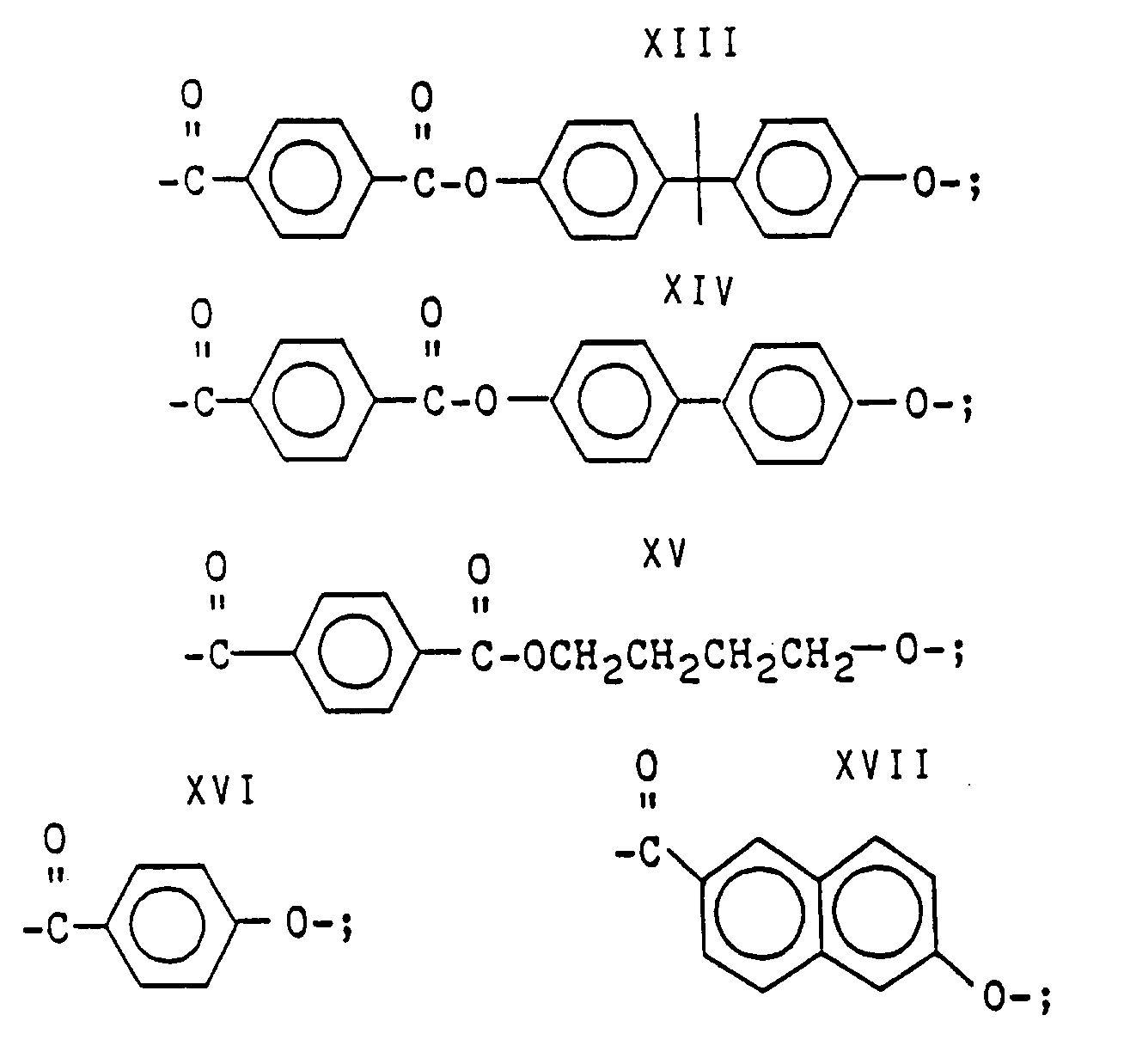

wobei der aromatische Teil der Poly(arylether/arylthioether)-Blöcke mit dem restlichen Teil des Copolymeren über eine Ether/Thioether-Bindung und über eine Ester-Bindung verbunden ist;
dadurch gekennzeichnet, daß man mindestens einen aktivierten Poly(arylether) oder Poly(arylthioether) mit von 2 bis 50 sich wiederholenden Einheiten der Formeln I bis XII mit mindestens einem aliphatischen oder aromatischen Polyester-Polymeren mit von 2 bis 50 sich wiederholenden Einheiten der Formeln XIII bis XXV in Gegenwart eines Austauschkatalysators der Formel MpZq in Berührung bringt,
in der M ein ein- oder mehrwertiges Metallion bezeichnet, Z für ein Halogenid-, Carbonat-, Bicarbonat-, Phenolat-, Alkoholat-, Cyanid-, Nitrat-, Nitrit-, Hydroxid-, Phosphat- oder Aryl- oder Alkylcarboxylat-Ion steht und p sowie q jeweils unabhängig ganze Zahlen im Bereich von 1 bis 6 bedeuten, die chemische Valenzanforderungen erfüllen,
bei einer Temperatur von 100 bis 400°C und oberhalb der höchsten Glasübergangstemperatur der Polymeren und für einen Zeitraum, der ausreicht, um das Blockcopolymere entstehen zu lassen, in dem die Längen der Copolymer-Blöcke im Vergleich zu den entsprechenden Längen der als Ausgangsstoffe dienenden Moleküle der Homopolymeren vermindert sind. - Verfahren nach Anspruch 1, wobei die als Ausgangsstoffe dienenden Homopolymeren in Gegenwart eines organischen Lösungsmittels miteinander in Berührung gebracht werden.
- Verfahren nach Anspruch 1, wobei der Katalysator in einer Menge von 0,1 bis 10 Gewichtsprozent, bezogen auf das Gesamtgewicht der Polymeren, eingesetzt wird.
- Homogenes Poly(arylether/arylthioether)-Polyester-Blockcopolymeres, enthaltend:
einen oder mehrere aktivierte Poly(arylether/arylthioether)-Blöcke mit von 2 bis 50 sich wiederholenden Einheiten der Formeln I bis XII, wie in Anspruch 1 definiert; und
einen oder mehrere Ester-Blöcke, enthaltend von 2 bis 50 sich wiederholende aliphatische oder aromatische Einheiten der Formeln XIII bis XXV, wie in Anspruch 1 definiert;
wobei der aromatische Teil der Poly(arylether/arylthioether)-Blöcke mit dem verbleibenden Teil des Moleküls des Copolymeren über eine Ether/Thioether-Bindung und über eine Ester-Bindung verbunden ist.
Priority Applications (1)
| Application Number | Priority Date | Filing Date | Title |
|---|---|---|---|
| AT89120049T ATE97935T1 (de) | 1988-11-03 | 1989-10-28 | Herstellung von poly(arylether/thioether)polyester-blockcopolymeren. |
Applications Claiming Priority (3)
| Application Number | Priority Date | Filing Date | Title |
|---|---|---|---|
| US26659588A | 1988-11-03 | 1988-11-03 | |
| US266595 | 1988-11-03 | ||
| CA002022086A CA2022086A1 (en) | 1988-11-03 | 1990-07-27 | An active sonar system for target detection in the presence of strong main lobe interference |
Publications (3)
| Publication Number | Publication Date |
|---|---|
| EP0367158A2 EP0367158A2 (de) | 1990-05-09 |
| EP0367158A3 EP0367158A3 (de) | 1991-07-10 |
| EP0367158B1 true EP0367158B1 (de) | 1993-12-01 |
Family
ID=25674225
Family Applications (1)
| Application Number | Title | Priority Date | Filing Date |
|---|---|---|---|
| EP89120049A Expired - Lifetime EP0367158B1 (de) | 1988-11-03 | 1989-10-28 | Herstellung von Poly(arylether/thioether)-polyester-Blockcopolymeren |
Country Status (6)
| Country | Link |
|---|---|
| EP (1) | EP0367158B1 (de) |
| JP (1) | JPH02196831A (de) |
| AU (1) | AU620461B2 (de) |
| CA (2) | CA2002086A1 (de) |
| DE (1) | DE68911108T2 (de) |
| ES (1) | ES2059675T3 (de) |
Families Citing this family (2)
| Publication number | Priority date | Publication date | Assignee | Title |
|---|---|---|---|---|
| JPH02163119A (ja) * | 1988-09-23 | 1990-06-22 | Dow Chem Co:The | ポリ(アリールエーテル/チオエーテル)セグメントブロックコポリマーの製造 |
| GB201113196D0 (en) * | 2011-08-01 | 2011-09-14 | Cytec Tech Corp | Thermoset resin compositions with increased toughness |
Family Cites Families (3)
| Publication number | Priority date | Publication date | Assignee | Title |
|---|---|---|---|---|
| US4668744A (en) * | 1985-10-15 | 1987-05-26 | Amoco Corporation | Novel poly(aryl ether ketone) polyester block copolymers |
| US4777221A (en) * | 1987-02-17 | 1988-10-11 | General Electric Company | Polyphenylene ether-polycarbonate copolymers and method of preparation |
| ES2054936T3 (es) * | 1988-07-08 | 1994-08-16 | Dow Chemical Co | Preparacion de copolimeros de bloques de poli(eter/tioeter arilico)-poli(carbonato de arilo). |
-
1989
- 1989-10-28 EP EP89120049A patent/EP0367158B1/de not_active Expired - Lifetime
- 1989-10-28 ES ES89120049T patent/ES2059675T3/es not_active Expired - Lifetime
- 1989-10-28 DE DE89120049T patent/DE68911108T2/de not_active Expired - Fee Related
- 1989-11-02 AU AU44350/89A patent/AU620461B2/en not_active Ceased
- 1989-11-02 JP JP1285122A patent/JPH02196831A/ja active Pending
- 1989-11-02 CA CA002002086A patent/CA2002086A1/en not_active Abandoned
-
1990
- 1990-07-27 CA CA002022086A patent/CA2022086A1/en not_active Abandoned
Also Published As
| Publication number | Publication date |
|---|---|
| EP0367158A3 (de) | 1991-07-10 |
| EP0367158A2 (de) | 1990-05-09 |
| JPH02196831A (ja) | 1990-08-03 |
| DE68911108D1 (de) | 1994-01-13 |
| CA2022086A1 (en) | 2001-02-01 |
| DE68911108T2 (de) | 1994-04-28 |
| ES2059675T3 (es) | 1994-11-16 |
| CA2002086A1 (en) | 1990-05-03 |
| AU620461B2 (en) | 1992-02-20 |
| AU4435089A (en) | 1990-05-10 |
Similar Documents
| Publication | Publication Date | Title |
|---|---|---|
| US4259478A (en) | Process for preparing high molecular weight copolyesters | |
| EP0272676A2 (de) | Voll-aromatisches Polyester und Verfahren zu seiner Herstellung | |
| US4668744A (en) | Novel poly(aryl ether ketone) polyester block copolymers | |
| US4123454A (en) | Thermoplastic copolyesters | |
| JP3649494B2 (ja) | ポリアリレートからなるバインダー | |
| JPH09136946A (ja) | ポリアリレート | |
| EP0367158B1 (de) | Herstellung von Poly(arylether/thioether)-polyester-Blockcopolymeren | |
| EP0093891B1 (de) | Hitzebeständiger aromatischer Polyester und Verfahren zu seiner Herstellung | |
| JP2830118B2 (ja) | 芳香族ポリエステル及びその製造方法 | |
| US5036150A (en) | Polyarylates having improved hydrolytic stability | |
| EP0021653A1 (de) | Geradkettige aromatische Polyester mit verbesserter Hydrolysebeständigkeit, ihre Herstellung und daraus geformte Artikel | |
| EP0353478B1 (de) | Herstellung von Blockcopolymeren von Polyaryläther oder Polyarylthioäther mit Polycarbonaten | |
| JPH0536452B2 (de) | ||
| US5618889A (en) | Poly(arylether)/liquid crystalline polyester block copolymers and a process for their production | |
| JP2569097B2 (ja) | 全芳香族ポリエステル及びその製造法 | |
| JPH0247132A (ja) | 低い加工温度を有する熱互変性の完全芳香族系ポリエステル | |
| EP0361262B1 (de) | Herstellung von segmentierten Poly(aryl-äther/thioäther)-Blockmischpolymeren | |
| JPS6142532A (ja) | 芳香族ポリエステル | |
| US5284921A (en) | Preparation of poly(arylether/thioether) segmented block copolymers | |
| JPH0251523A (ja) | 芳香族ポリエステル | |
| JP3162482B2 (ja) | 芳香族ポリエステルの製造方法 | |
| JPH0542964B2 (de) | ||
| CA1054746A (en) | High molecular weight copolyester resins having a high degree of alternating structure | |
| WO1991006591A1 (en) | Novel polyarylate compositions having improved properties | |
| JPS6155115A (ja) | ポリアリレ−トの製造方法 |
Legal Events
| Date | Code | Title | Description |
|---|---|---|---|
| PUAI | Public reference made under article 153(3) epc to a published international application that has entered the european phase |
Free format text: ORIGINAL CODE: 0009012 |
|
| AK | Designated contracting states |
Kind code of ref document: A2 Designated state(s): AT BE CH DE ES FR GB IT LI NL |
|
| PUAL | Search report despatched |
Free format text: ORIGINAL CODE: 0009013 |
|
| AK | Designated contracting states |
Kind code of ref document: A3 Designated state(s): AT BE CH DE ES FR GB IT LI NL |
|
| 17P | Request for examination filed |
Effective date: 19911105 |
|
| 17Q | First examination report despatched |
Effective date: 19920313 |
|
| GRAA | (expected) grant |
Free format text: ORIGINAL CODE: 0009210 |
|
| AK | Designated contracting states |
Kind code of ref document: B1 Designated state(s): AT BE CH DE ES FR GB IT LI NL |
|
| REF | Corresponds to: |
Ref document number: 97935 Country of ref document: AT Date of ref document: 19931215 Kind code of ref document: T |
|
| ET | Fr: translation filed | ||
| REF | Corresponds to: |
Ref document number: 68911108 Country of ref document: DE Date of ref document: 19940113 |
|
| ITF | It: translation for a ep patent filed | ||
| PLBE | No opposition filed within time limit |
Free format text: ORIGINAL CODE: 0009261 |
|
| STAA | Information on the status of an ep patent application or granted ep patent |
Free format text: STATUS: NO OPPOSITION FILED WITHIN TIME LIMIT |
|
| PG25 | Lapsed in a contracting state [announced via postgrant information from national office to epo] |
Ref country code: GB Effective date: 19941028 Ref country code: AT Effective date: 19941028 |
|
| PG25 | Lapsed in a contracting state [announced via postgrant information from national office to epo] |
Ref country code: ES Free format text: LAPSE BECAUSE OF EXPIRATION OF PROTECTION Effective date: 19941029 |
|
| PG25 | Lapsed in a contracting state [announced via postgrant information from national office to epo] |
Ref country code: LI Effective date: 19941031 Ref country code: CH Effective date: 19941031 Ref country code: BE Effective date: 19941031 |
|
| REG | Reference to a national code |
Ref country code: ES Ref legal event code: FG2A Ref document number: 2059675 Country of ref document: ES Kind code of ref document: T3 |
|
| 26N | No opposition filed | ||
| BERE | Be: lapsed |
Owner name: THE DOW CHEMICAL CY Effective date: 19941031 |
|
| PG25 | Lapsed in a contracting state [announced via postgrant information from national office to epo] |
Ref country code: NL Effective date: 19950501 |
|
| NLV4 | Nl: lapsed or anulled due to non-payment of the annual fee | ||
| GBPC | Gb: european patent ceased through non-payment of renewal fee |
Effective date: 19941028 |
|
| PG25 | Lapsed in a contracting state [announced via postgrant information from national office to epo] |
Ref country code: FR Effective date: 19950630 |
|
| REG | Reference to a national code |
Ref country code: CH Ref legal event code: PL |
|
| PG25 | Lapsed in a contracting state [announced via postgrant information from national office to epo] |
Ref country code: DE Effective date: 19950701 |
|
| REG | Reference to a national code |
Ref country code: FR Ref legal event code: ST |
|
| REG | Reference to a national code |
Ref country code: ES Ref legal event code: FD2A Effective date: 19990601 |
|
| PG25 | Lapsed in a contracting state [announced via postgrant information from national office to epo] |
Ref country code: IT Free format text: LAPSE BECAUSE OF NON-PAYMENT OF DUE FEES;WARNING: LAPSES OF ITALIAN PATENTS WITH EFFECTIVE DATE BEFORE 2007 MAY HAVE OCCURRED AT ANY TIME BEFORE 2007. THE CORRECT EFFECTIVE DATE MAY BE DIFFERENT FROM THE ONE RECORDED. Effective date: 20051028 |