EP0367187B1 - Câble composite et procédé de fabrication d'un tel câble - Google Patents
Câble composite et procédé de fabrication d'un tel câble Download PDFInfo
- Publication number
- EP0367187B1 EP0367187B1 EP89120113A EP89120113A EP0367187B1 EP 0367187 B1 EP0367187 B1 EP 0367187B1 EP 89120113 A EP89120113 A EP 89120113A EP 89120113 A EP89120113 A EP 89120113A EP 0367187 B1 EP0367187 B1 EP 0367187B1
- Authority
- EP
- European Patent Office
- Prior art keywords
- twisted
- composite rope
- primarily
- rope according
- product
- Prior art date
- Legal status (The legal status is an assumption and is not a legal conclusion. Google has not performed a legal analysis and makes no representation as to the accuracy of the status listed.)
- Expired - Lifetime
Links
Images




Classifications
-
- D—TEXTILES; PAPER
- D07—ROPES; CABLES OTHER THAN ELECTRIC
- D07B—ROPES OR CABLES IN GENERAL
- D07B1/00—Constructional features of ropes or cables
- D07B1/16—Ropes or cables with an enveloping sheathing or inlays of rubber or plastics
- D07B1/165—Ropes or cables with an enveloping sheathing or inlays of rubber or plastics characterised by a plastic or rubber inlay
-
- D—TEXTILES; PAPER
- D07—ROPES; CABLES OTHER THAN ELECTRIC
- D07B—ROPES OR CABLES IN GENERAL
- D07B1/00—Constructional features of ropes or cables
- D07B1/02—Ropes built-up from fibrous or filamentary material, e.g. of vegetable origin, of animal origin, regenerated cellulose, plastics
-
- D—TEXTILES; PAPER
- D07—ROPES; CABLES OTHER THAN ELECTRIC
- D07B—ROPES OR CABLES IN GENERAL
- D07B1/00—Constructional features of ropes or cables
- D07B1/02—Ropes built-up from fibrous or filamentary material, e.g. of vegetable origin, of animal origin, regenerated cellulose, plastics
- D07B1/025—Ropes built-up from fibrous or filamentary material, e.g. of vegetable origin, of animal origin, regenerated cellulose, plastics comprising high modulus, or high tenacity, polymer filaments or fibres, e.g. liquid-crystal polymers
-
- D—TEXTILES; PAPER
- D07—ROPES; CABLES OTHER THAN ELECTRIC
- D07B—ROPES OR CABLES IN GENERAL
- D07B5/00—Making ropes or cables from special materials or of particular form
- D07B5/02—Making ropes or cables from special materials or of particular form from straw or like vegetable material
-
- D—TEXTILES; PAPER
- D07—ROPES; CABLES OTHER THAN ELECTRIC
- D07B—ROPES OR CABLES IN GENERAL
- D07B2201/00—Ropes or cables
- D07B2201/20—Rope or cable components
- D07B2201/2001—Wires or filaments
- D07B2201/2002—Wires or filaments characterised by their cross-sectional shape
- D07B2201/2003—Wires or filaments characterised by their cross-sectional shape flat
-
- D—TEXTILES; PAPER
- D07—ROPES; CABLES OTHER THAN ELECTRIC
- D07B—ROPES OR CABLES IN GENERAL
- D07B2201/00—Ropes or cables
- D07B2201/20—Rope or cable components
- D07B2201/2001—Wires or filaments
- D07B2201/201—Wires or filaments characterised by a coating
- D07B2201/2012—Wires or filaments characterised by a coating comprising polymers
-
- D—TEXTILES; PAPER
- D07—ROPES; CABLES OTHER THAN ELECTRIC
- D07B—ROPES OR CABLES IN GENERAL
- D07B2201/00—Ropes or cables
- D07B2201/20—Rope or cable components
- D07B2201/2083—Jackets or coverings
- D07B2201/2089—Jackets or coverings comprising wrapped structures
-
- D—TEXTILES; PAPER
- D07—ROPES; CABLES OTHER THAN ELECTRIC
- D07B—ROPES OR CABLES IN GENERAL
- D07B2205/00—Rope or cable materials
- D07B2205/20—Organic high polymers
- D07B2205/2028—Polyvinyl alcohols
-
- D—TEXTILES; PAPER
- D07—ROPES; CABLES OTHER THAN ELECTRIC
- D07B—ROPES OR CABLES IN GENERAL
- D07B2205/00—Rope or cable materials
- D07B2205/20—Organic high polymers
- D07B2205/2046—Polyamides, e.g. nylons
- D07B2205/205—Aramides
-
- D—TEXTILES; PAPER
- D07—ROPES; CABLES OTHER THAN ELECTRIC
- D07B—ROPES OR CABLES IN GENERAL
- D07B2205/00—Rope or cable materials
- D07B2205/30—Inorganic materials
- D07B2205/3003—Glass
-
- D—TEXTILES; PAPER
- D07—ROPES; CABLES OTHER THAN ELECTRIC
- D07B—ROPES OR CABLES IN GENERAL
- D07B2205/00—Rope or cable materials
- D07B2205/30—Inorganic materials
- D07B2205/3007—Carbon
-
- D—TEXTILES; PAPER
- D07—ROPES; CABLES OTHER THAN ELECTRIC
- D07B—ROPES OR CABLES IN GENERAL
- D07B2205/00—Rope or cable materials
- D07B2205/30—Inorganic materials
- D07B2205/3017—Silicon carbides
-
- D—TEXTILES; PAPER
- D07—ROPES; CABLES OTHER THAN ELECTRIC
- D07B—ROPES OR CABLES IN GENERAL
- D07B2207/00—Rope or cable making machines
- D07B2207/40—Machine components
- D07B2207/404—Heat treating devices; Corresponding methods
Definitions
- the present invention relates to a composite rope suitable for use as the material for reinforcing concrete structures, the rope for holding various equipments on boats and ships and anchoring boats and ships themselves, the material for reinforcing cables not to become loose, the cable for operating cars and air planes, and the material for reinforcing non-magnetic structures.
- the present invention also relates to a method of manufacturing the composite rope.
- Japanese Patent Publication Sho 57-25679 discloses a technique of impregnating multifilaments, high tensile strength and low elongation, with a thermo setting resin to prepare a corrosion-resistant composite rope, substantially same in strength and elongation but lighter, as compared with the conventional wire rope.
- the multifilaments high in strength but low in extension, are twisted together, in such a way that their strength-utilizing efficiency becomes higher than 50%, to prepare a primarily-twisted product (eg. yarn of continuous fiber).
- a primarily-twisted product eg. yarn of continuous fiber.
- the term "strength-utilizing efficiency ⁇ " means a ratio between the tensile strength of a bundle of the multifilaments not twisted and that of the bundle of them twisted.
- the primarily-twisted product is impregnated with a thermosetting resin, which has been so set as to hold the primarily-twisted product as it is, and then coated at the outer circumference thereof with a thermoplastic resin.
- Plural products thus formed are twisted or laid together to prepare a secondarily-twisted product (eg. cable). This secondarily-twisted or -laid product is heated to set the impregnated resin and to provide a composite rope.
- thermoplastic resin The reason why the primarily-twisted product is coated with thermoplastic resin resides in enhancing the forming ability of the composite rope and protecting the rope.
- the primarily-twisted product is impregnated with thermosetting resin and then coated at the outer circumference with thermoplastic resin. Therefore, the coating resin makes the inside of the primarily-twisted product air-tight, causing air to be caught in it in the course of impregnating and coating it with resins. Further, volatile gas caused when the thermosetting resin is heated and a part of solvent in the resin are caught and left in it. These air, gas and solvent are present as voids in it, causing the composite rope, which is the final product, to become low in mechanical property.
- US Patent No. 4,677,818 discloses another technique of eliminating the above-mentioned drawbacks to prepare a composite rope, higher in strength and lower in extension.
- the primarily-twisted product which has been impregnated with resin is attached by smoothing powder (or talc) and further wrapped at the outer circumference thereof by a woven fabric (cloth). And the primarily-twisted product thus wrapped by the cloth is heated to set the impregnating resin. Air, gas and solvent caught in the primarily-twisted product can be thus escaped through meshes of the cloth, thereby enabling no void to be left in the primarily-twisted product.
- the cloth is formed by fibers woven together. Therefore, the thickness of the cloth wrapped round the primarily-twisted product becomes theoretically two times the diameter of the fiber woven and it sometimes reaches 0.5 mm in the thickest. When the primarily-twisted product is wrapped by the cloth, therefore, its diameter becomes large and this makes it impossible to prepare a compact composite rope.
- the object of the present invention is therefore to provide a compact composite rope, high tensile strength and low elongation.
- a composite rope is prepared by a process comprising impregnating multifilaments with a thermo setting resin, half-setting the thermosetting resin to form prepregs, twisting plural prepregs to form a primarily-twisted product, closely winding a filament or a yarn round the primarily-twisted product in a direction substantially perpendicular to the longitudinal axis of the product, twisting plural primarily-twisted products, each of which has been wound by the filament or yarn, to form a secondarily-twisted product, and heating the a secondarily-twisted product to set the resin impregnated.
- organic or inorganic filaments can be used as the winding (or coating) one, but it is preferable to use a yarn of those filaments made of particularly polyester, polyamide (eg. Aramide) or carbon.
- the winding yarn has a filament diameter of 5 - 50 ⁇ m and that the size of the yarn wound is in a range of 2000 - 15000 denier.
- 1 denier is a unit representing the size of that multifilament which has a length of 9000 m and a weigth of 1 gram.
- a porous tape may be wound or coated round the primarily-twisted product instead. It is preferable in this case that the thickness of the porous tape is in a range of 0.01 - 0.30 mm. When it becomes smaller than 0.01 mm, the porous tape is likely to be broken while being wound round the product and when it becomes larger than 0.30 mm, the tape makes the diameter of the product unnecessarily large.
- filaments made of particularly polyester, polyamide (eg. Aramide), glass, silicon carbide or carbon.
- the diameter of the filament is preferably in a range of 5 - 40 ⁇ m, more preferably about 7 ⁇ m.
- the sectional area of the whole multifilaments which are not treated to form the prepreg yet is smaller than 2.0 mm2. This is because the resin cannot easily enter into the multifilaments when the sectional area of the whole multifilaments are too large.
- the ratio of the thermosetting resin impregnated is in a range of 25 - 60 volume%.
- the ratio of the thermosetting resin impregnated is made as small as possible.
- the ratio of the impregnated resin is smaller than 25 volume%, however, it becomes difficult for the resin to fully enter into those filaments which form the multifilament.
- prepregs become too soft to be rightly twisted together.
- thermosetting resin epoxy resin, unsaturated polyester resin, polyimide resin or bismaleimide resin is used as the thermosetting resin.
- a method of manufacturing the composite rope comprising impregnating multifilaments with a thermosetting resin and half-setting the impregnated resin to form prepregs, twisting the plural prepregs to form a primarily-twisted product, winding a yarn or porous tape round the primarily-twisted product to coat the product, twisting the plural primarily-twisted products to form a secondarily-twisted product, and heating the secondarily-twisted product to set the resin impregnated.
- the twisting degree of the primarily-twisted product (or composite strand) cannot be defined, using the twisting angle of it. This is because the twisting angle is different inside and on the surface of it. Therefore, the twisting degree is defined here, using ratio "n" of the twisting length relative to the diameter of it.
- Curve E in Fig. 9 represents data obtained when fifteen strands of prepregs 12 k made of carbon filaments are twisted together to form a primarily-twisted product whose diameter is 4.0 mm.
- angle (or average twisting angle) formed and by the axis of a composite rope by the center axis of one of those primarily-twisted products which have been twisted to form a secondarily-twisted product is assumed to be ⁇
- this angle ⁇ is preferably larger than 72°, more preferably about 80°.
- the primarily-twisted products (or composite strands) are twisted to form a secondarily-twisted product and to make the value of tan ⁇ larger than 3. This is because strength-utilizing efficiency ⁇ quickly reduces and becomes smaller than 80% when the value of tan ⁇ becomes smaller than 3, as apparent from a curve F in Fig. 10.
- the curve F represents data obtained when a composite rope having a diameter of 12.5 mm is prepared using those primarily-twisted products each of which is twisted at ratio n equal to 21.
- the prepreg When the prepreg is fully dried, it has sufficient smoothness and this makes it unnecessary to attach any smoothing powder to it. When some solid smoothing powder such as talc is attached to it, however, its smoothness can be further enhanced. It is therefore desirable that some smoothing powder or agent is attached to the prepreg.
- Control 1 is a twisted PC steel rope prepared according to the standards of JIS-G-3536
- control 2 a conventional composite rope prepared according to the technique disclosed by US Patent No. 4,677,818
- control 3 a conventional composite rope prepared according to the technique disclosed by Japanese Patent Publication Sho 57-25679.
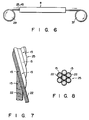
- the ropes were examined under such a condition that they were practically used. Namely, the rope (formed by twisting seven strings of composite strands) is embedded in concrete whose compression strength is about 500 Kgf/cm2. Force needed to pull the rope out of concrete is measured and divided by surface area A of the rope to obtain the concrete-adhesive strength of the rope. Considering that surface area of the rope which is contacted with concrete, it is assumed that an area which corresponds to two thirds of the surface area of six strings of composite strands twisted round a core strand is surface area A of the rope.
- gas and solvent caught in each of the composite strands can be escaped through the yarn wrapped round each of the strands and the number of voids in the strands can be reduced to a great extent. This enables mechanical properties of the rope to be improved.
- This prevention of voids occurrence can contribute a great deal to improving the strength-utilizing efficiency (at item 3 in Table 1) and tension fatigue characteristic (at item 6 in Table 1) of the rope.
- the composite rope of the present invention can be same in strength but much smaller in diameter, as compared with the conventional ones.
- This reduction of the wrapping thickness can contribute a great deal to improving relaxation loss (at item 7 in Table 1) as well as enhancing breaking load (at item 2 in Table 1).
- Yarn 22 is wound round each of composite strands 15 at an angle which is perpendicular to the strand. This increases the frictional resistance of the rope surface.
- the composite rope is used as concrete-reinforcing material, therefore, its concrete-adhesive strength becomes 2.5 - 4.6 times those of the conventional ropes (controls 1 through 3).
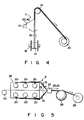
- each of composite strands 15 is wrapped and coated by porous tape 42.
- a sheet of unwoven fabric made of polyester staples is used as porous tape 42.
- Unwoven fabric of polyamide eg. aramide
- Porous tape 42 is 20 mm wide and 0.1 mm thickness.
- tape 42 is wound round composite strand 15 at an angle of 37° and a pitch of 17 mm in such a way that half of tape 42 in the width direction thereof is overlapped upon the other half thereof (Step 55).
- secondarily-twisted product 45 is heated at 130°C for 90 minutes (Step 57).
- the half-set resin impregnated in secondarily-twisted product 45 is thus completely set to form a composite rope, high tensile strength and low elongation.
- gas in each of composite strands 15 can be escaped through numerous holes of porous tape 42. This enables composite strand 15 not to have any void therein, so that properties of the composite rope can be improved.
- the composite rope can be made slimmer as compared with the conventional ones, because tape 42 wrapped round each of composite strands 15 is thin.
- a composite rope having a larger diameter can be prepared using the first and the second embodiment of the composite rope as its core. More particularly, plural composite strands each containing a half-set resin are twisted round a composite rope which has been formed by seven composite strands to form a tertiarily-twisted product. This tertiarily-twisted product is heated to completely set the half-set resin impregnated in each of the outer composite strands.
- rope strength per unit volume can be enhanced and the composite rope can be thus made slimmer as compared with the conventional ones.
Landscapes
- Chemical & Material Sciences (AREA)
- Crystallography & Structural Chemistry (AREA)
- Ropes Or Cables (AREA)
- Reinforced Plastic Materials (AREA)
- Reinforcement Elements For Buildings (AREA)
- Laminated Bodies (AREA)
- Moulding By Coating Moulds (AREA)
- Knitting Of Fabric (AREA)
Claims (26)
- Câble composite obtenu par un procédé comprenant :(a) l'imprégnation d'un multifilament (2) avec une résine thermodurcissable et le semi-durcissement de la résine imprégnée dans le multifilament (2) pour former des préimprégnés (5) ;(b) le tordage de la pluralité de préimprégnés (5) les uns avec les autres pour former un produit (15) tordu en premier ;(c) l'enveloppement, de façon serrée, du produit (15) tordu en premier avec un filé (22) de manière telle que le filé (22) soit orienté dans une direction sensiblement perpendiculaire à l'axe du produit (15) tordu en premier ;(d) le tordage de la pluralité de produits (15) tordus en premier et ainsi enveloppé pour former un produit (25) tordu en second ; et(e) le chauffage du produit (25) tordu en second pour durcir la résine imprégnée.
- Câble composite selon la revendication 1, caractérisé en ce que ledit filé (2)est formé d'un multifilament organique ou minéral.
- Câble composite selon la revendication 1, caractérisé en ce que ledit filé (22) est formé d'un multifilament de polyester, de polyamide ou de carbone.
- Câble composite selon la revendication 1, caractérisé en ce que ledit filé (22) a un diamètre de 5-50 µm ou un titre de 2000-15000 deniers.
- Câble composite selon la revendication 1, caractérisé en ce que ledit filé (22) est enroulé autour du produit (15) tordu en premier suivant un angle de 50°-85° par rapport à l'axe du produit (15).
- Câble composite selon la revendication 1, caractérisé en ce que la superficie totale de section du multifilament (2) qui n'est pas encore imprégnée avec la résine thermodurcissable est inférieure à 2,0 mm².
- Câble composite selon la revendication 1, caractérisé en ce que ledit multifilament (2) est formé d'un ou plusieurs filaments choisis parmi les filaments de carbone, de carbure de silicium, de verre et de poly(alcool vinylique).
- Câble composite selon la revendication 1, caractérisé en ce que la proportion de résine thermodurcissable imprégnée est comprise entre 20 et 60% en volume.
- Câble composite selon la revendication 1, caractérisé en ce que ladite résine thermodurcissable est une ou plusieurs résines choisies parmi les résines du type époxy, polyester insaturé, polyimide et bismaléimide.
- Câble composite selon la revendication 1, caractérisé en ce que lesdits préimprégnés (5) sont tordus ensemble dans une condition telle que le rapport (n) est supérieur à 8.
- Câble composite selon la revendication 1, caractérisé en ce que lesdits produits (15) tordus en premier sont tordus ensemble dans une condition telle que tg ϑ est supérieure à 3.
- Câble composite selon la revendication 1, caractérisé en ce que ladite pluralité de produits (15) tordus en premier sont tordus autour du produit (25) tordu en second, dans lequel la résine imprégnée a été complètement durcie et qui sert d'âme, et sont ensuite chauffés de manière à durcir complètement la résine semi durcie imprégnée dans les produits (15) tordus en premier.
- Câble composite obtenu par un procédé comprenant :(a) l'imprégnation d'un multifilament (2) avec une résine thermodurcissable et une résine semi-durcissable imprégnée pour former un préimprégné (5) ;(b) le tordage de la pluralité de préimprégnés (5) ensemble pour former un produit (15) tordu en premier ;(c) l'enveloppement dudit produit (15) tordu en premier avec un ruban poreux (42) ;(d) le tordage ensemble de la pluralité de produits (15) tordus en premier et enveloppés par un ruban pour former un produit (45) tordu en second ; et(e) le chauffage du produit (45) tordu en second pour durcir la résine imprégnée.
- Câble composite selon la revendication 13, caractérisé en ce que ledit ruban poreux (42) est une feuille de tissu non tissé formée de brins de polyester ou de polyamide.
- Câble composite selon la revendication 13, caractérisé en ce que l'épaisseur dudit ruban poreux (42) est comprise entre 0,01 et 0,30 mm.
- Câble composite selon la revendication 13, caractérisé en ce que ledit ruban poreux (42) est enroulé autour du produit (15) tordu en premier de manière telle que sa moitié dans le sens de sa largeur recouvre son autre moitié.
- Câble composite selon la revendication 13, caractérisé en ce que la superficie de section totale du multifilament (2) qui n'a pas encore été imprégné avec la résine thermodurcissable est inférieure à 2,0 mm².
- Câble composite selon la revendication 13, caractérisé en ce que ledit multifilament (2) est formé d'un ou plusieurs filaments choisis parmi les filaments de carbone, de carbure de silicium, de polyamide, de verre et de poly(alcool vinylique).
- Câble composite selon la revendication 13, caractérisé en ce que la proportion de résine thermodurcissable imprégnée est comprise entre 25 et 60% en volume.
- Câble composite selon la revendication 13, caractérisé en ce que ladite résine thermodurcissable est une résine du type époxy, polyester insaturé, polyimide et bismaléimide.
- Câble composite selon la revendication 13, caractérisé en ce que lesdits préimprégnés (5) sont tordus ensemble dans une condition telle que le rapport (n) est supérieur à 8.
- Câble composite selon la revendication 13, caractérisé en ce que lesdits produits (15) tordus en premier sont tordus ensemble dans une condition telle que tg ϑ est supérieure à 3.
- Câble composite selon la revendication 13, caractérisé en ce que lesdits produits (15) tordus en premier sont tordus autour du produit (45) tordu en second dans lequel la résine imprégnée a été complètement durcie et qui est utilisée comme âme, et sont chauffés ensuite pour durcir complètement la résine semi-durcie imprégnée dans les produits (15) tordus en premier.
- Procédé pour fabriquer un câble composite comprenant :(a) l'imprégnation d'un multifilament (2) avec une résine thermodurcissable et le semi-durcissement de la résine (2)pour former un préimprégné (5) ;(b) le tordage de la pluralité de préimprégnés (5) ensemble pour former un produit (15) tordu en premier ;(c) l'enveloppement et le revêtement du produit (15) tordu en premier avec un filé (22) ou un ruban poreux (42) ;(d) le tordage ensemble de la pluralité de produits (15) tordus en premier et enveloppés d'un filé ou d'un ruban pour former un produit (25, 45) tordu en second ; et(e) le chauffage dudit produit (25, 45) tordu en second pour durcir la résine imprégnée.
- Procédé pour fabriquer un câble composite selon la revendication 24, grâce auquel plusieurs filés (22) sont enroulés simultanément autour du produit (15) tordu en premier.
- Procédé pour fabriquer un câble composite selon la revendication 24, grâce auquel un agent d'assouplissement est fixé à chacun des préimprégnés (5) et ces préimprégnés sont tordus ensemble pour former un produit (15) tordu en premier.
Applications Claiming Priority (2)
| Application Number | Priority Date | Filing Date | Title |
|---|---|---|---|
| JP275623/88 | 1988-10-31 | ||
| JP63275623A JPH0686718B2 (ja) | 1988-10-31 | 1988-10-31 | 複合撚合型線条体の製造方法 |
Publications (3)
| Publication Number | Publication Date |
|---|---|
| EP0367187A2 EP0367187A2 (fr) | 1990-05-09 |
| EP0367187A3 EP0367187A3 (en) | 1990-11-22 |
| EP0367187B1 true EP0367187B1 (fr) | 1993-12-15 |
Family
ID=17558032
Family Applications (1)
| Application Number | Title | Priority Date | Filing Date |
|---|---|---|---|
| EP89120113A Expired - Lifetime EP0367187B1 (fr) | 1988-10-31 | 1989-10-30 | Câble composite et procédé de fabrication d'un tel câble |
Country Status (6)
| Country | Link |
|---|---|
| US (1) | US5060466A (fr) |
| EP (1) | EP0367187B1 (fr) |
| JP (1) | JPH0686718B2 (fr) |
| KR (1) | KR920003384B1 (fr) |
| CA (1) | CA2001788C (fr) |
| DE (1) | DE68911481T2 (fr) |
Families Citing this family (44)
| Publication number | Priority date | Publication date | Assignee | Title |
|---|---|---|---|---|
| JPH0726347B2 (ja) * | 1991-12-13 | 1995-03-22 | 株式会社タイムスエンジニアリング | 防錆被覆pcストランドの製造方法 |
| JP2585165B2 (ja) * | 1992-06-30 | 1997-02-26 | 東京製綱株式会社 | 可撓性のある複合撚合型抗張力条体の製造方法 |
| JPH07102491A (ja) * | 1993-10-01 | 1995-04-18 | Sumitomo Electric Ind Ltd | 繊維複合線状体及びその製造方法 |
| CA2126980A1 (fr) * | 1992-12-28 | 1994-07-07 | Toshiroh Kido | Cordage en fibres composites et methode de fabrication |
| AU695685B2 (en) * | 1994-02-18 | 1998-08-20 | Keith Jol | Rope handle |
| JP3482252B2 (ja) * | 1994-07-29 | 2003-12-22 | 住友電工スチールワイヤー株式会社 | 繊維複合線状体及びその製造方法 |
| DE69614343T2 (de) * | 1995-10-30 | 2002-05-16 | Bando Chemical Industries Ltd., Kobe | Lastaufnahmeelement eines Riemens, Herstellungsverfahren dafür und dieses aufweisendes Riemen |
| JP3724322B2 (ja) * | 2000-03-15 | 2005-12-07 | 株式会社日立製作所 | ワイヤロープとそれを用いたエレベータ |
| JP4503940B2 (ja) * | 2003-05-29 | 2010-07-14 | 東京製綱株式会社 | グラウンドアンカー |
| NO320472B1 (no) | 2003-06-23 | 2005-12-12 | Spilka Ind As | Fremgangsmate for fremstilling av en boyd armeringsstang, samt anordning for utovelse av fremgangsmaten |
| US7134267B1 (en) | 2003-12-16 | 2006-11-14 | Samson Rope Technologies | Wrapped yarns for use in ropes having predetermined surface characteristics |
| US7296394B2 (en) * | 2005-02-11 | 2007-11-20 | Gore Enterprise Holdings, Inc. | Fluoropolymer fiber composite bundle |
| US9334587B2 (en) | 2005-02-11 | 2016-05-10 | W. L. Gore & Associates, Inc. | Fluoropolymer fiber composite bundle |
| US20060182962A1 (en) * | 2005-02-11 | 2006-08-17 | Bucher Richard A | Fluoropolymer fiber composite bundle |
| US8341930B1 (en) | 2005-09-15 | 2013-01-01 | Samson Rope Technologies | Rope structure with improved bending fatigue and abrasion resistance characteristics |
| JP2010532430A (ja) * | 2007-05-18 | 2010-10-07 | サムソン ロープ テクノロジーズ | 複合ロープ構造体と、複合ロープ構造体を作製するシステムおよび方法 |
| US20080282666A1 (en) * | 2007-05-19 | 2008-11-20 | Chia-Te Chou | Composite rope structures and systems and methods for fabricating cured composite rope structures |
| US8109072B2 (en) | 2008-06-04 | 2012-02-07 | Samson Rope Technologies | Synthetic rope formed of blend fibers |
| KR101150469B1 (ko) * | 2009-09-08 | 2012-06-01 | (주)삼박 | 섬유강화 열가소성 복합재료의 성형장치 및 성형방법과 이에 의해 제조되는 성형품 |
| JP3158927U (ja) | 2010-02-09 | 2010-04-22 | 東京製綱株式会社 | 繊維複合型撚合ケーブル |
| CN102345238A (zh) * | 2010-07-27 | 2012-02-08 | 江苏恒神碳纤维复合材料工程研究中心有限公司 | 一种纤维加强芯材湿法生产装置 |
| CN102345236A (zh) * | 2010-07-27 | 2012-02-08 | 江苏恒神碳纤维复合材料工程研究中心有限公司 | 一种多芯绞合型纤维加强芯材湿法生产工艺 |
| KR101235676B1 (ko) * | 2010-09-03 | 2013-02-21 | 주식회사 삼부포리마 | 철근 대체용 고강력원사 성형체 및 그의 제조방법 |
| PL2630100T3 (pl) * | 2010-10-21 | 2024-10-28 | Reforcetech Ltd. | Pręt zbrojeniowy i sposób jego wytwarzania |
| RU2482248C2 (ru) * | 2011-03-25 | 2013-05-20 | Антон Сергеевич Кукин | Арматура композитная |
| KR20140027252A (ko) | 2011-04-12 | 2014-03-06 | 티코나 엘엘씨 | 송전 케이블용 복합체 코어 |
| BR112013026310B1 (pt) | 2011-04-12 | 2020-10-27 | Southwire Company, Llc. | cabo elétrico e método de produção de cabo elétrico |
| US9003757B2 (en) | 2012-09-12 | 2015-04-14 | Samson Rope Technologies | Rope systems and methods for use as a round sling |
| JP5995706B2 (ja) * | 2012-12-27 | 2016-09-21 | 東京製綱株式会社 | 炭素繊維強化プラスチック製補強材の製造方法および炭素繊維強化プラスチック製補強材 |
| US8689534B1 (en) | 2013-03-06 | 2014-04-08 | Samson Rope Technologies | Segmented synthetic rope structures, systems, and methods |
| DE102015103115A1 (de) * | 2015-03-04 | 2016-09-08 | Casar Drahtseilwerk Saar Gmbh | Seil und Verfahren zur Herstellung des Seils |
| US9573661B1 (en) | 2015-07-16 | 2017-02-21 | Samson Rope Technologies | Systems and methods for controlling recoil of rope under failure conditions |
| RU2612374C1 (ru) * | 2015-12-24 | 2017-03-09 | Дмитрий Анатольевич Ильин | Гибридная композитная арматура |
| US11274184B2 (en) * | 2016-04-12 | 2022-03-15 | Trillium Marketing Inc. | Bi-polymer thermoplastic |
| US10377607B2 (en) | 2016-04-30 | 2019-08-13 | Samson Rope Technologies | Rope systems and methods for use as a round sling |
| EP3297000A1 (fr) | 2016-09-15 | 2018-03-21 | Fogang Xinyuan Hengye Cable Technology Co. Ltd. | Câble en plafond avec âme composite-résine et fibres et procédé de production associés |
| US10576658B2 (en) | 2017-05-15 | 2020-03-03 | Morton Buildings, Inc. | System and method for embedding substrate in concrete structure |
| CN108773113B (zh) * | 2018-05-30 | 2020-06-02 | 嘉兴星创科技有限公司 | 一种具有除异味且便于散热的面料 |
| US10858780B2 (en) * | 2018-07-25 | 2020-12-08 | Otis Elevator Company | Composite elevator system tension member |
| US11686043B2 (en) * | 2018-11-05 | 2023-06-27 | Acclarent, Inc. | Pull wire with coated fibers |
| US11655120B2 (en) * | 2019-06-28 | 2023-05-23 | Otis Elevator Company | Elevator load bearing member including a unidirectional weave |
| CN111056790B (zh) * | 2019-12-13 | 2022-03-29 | 东北林业大学 | 一种复掺微-纳米级纤维高性能混凝土及制备方法 |
| WO2022251125A1 (fr) * | 2021-05-23 | 2022-12-01 | Trillium Marketing, Inc. | Procédés et systèmes de fabrication de corde élastique |
| WO2025058978A1 (fr) * | 2023-09-14 | 2025-03-20 | Slingmax, Llc | Couvercle tressé pour élingue ronde avec une torsion dans des fils centraux et procédé associé |
Family Cites Families (12)
| Publication number | Priority date | Publication date | Assignee | Title |
|---|---|---|---|---|
| US3405516A (en) * | 1966-08-22 | 1968-10-15 | Wall Ind Inc | Yarn, cordage, ropes, and the like |
| US3776293A (en) * | 1967-08-29 | 1973-12-04 | Owens Corning Fiberglass Corp | Reinforcement for tires |
| CA1041385A (fr) * | 1975-02-24 | 1978-10-31 | Tadao Senoo | Cable de fibres et methode d'assemblage |
| JPS5199149A (ja) * | 1975-02-24 | 1976-09-01 | Ube Nitto Kasei Co | Senikyokanetsukokaseijushifukugozairyonyoruroopu oyobi sonoseizohoho |
| DE2818386C2 (de) * | 1978-04-27 | 1982-03-11 | Fröhlich & Wolff GmbH, 3436 Hessisch-Lichtenau | Garn aus einem multifilen, synthetischen, polymeren Material und Verfahren zur Veredelung eines derartigen Garns |
| US4228641A (en) * | 1978-09-28 | 1980-10-21 | Exxon Research & Engineering Co. | Thermoplastic twines |
| FR2446336A1 (fr) * | 1979-01-10 | 1980-08-08 | Payen & Cie L | Nouveau type de fil textile guipe et procede pour son obtention |
| JPS5725679A (en) * | 1980-07-24 | 1982-02-10 | Furukawa Battery Co Ltd:The | Sealed storage battery |
| EP0082067A3 (fr) * | 1981-12-10 | 1986-01-02 | Schlumberger Limited | Elément en fibres de graphite résistant à la tension, câbles assemblés à partir de ces éléments et procédé de sa fabrication |
| US4430851A (en) * | 1982-01-29 | 1984-02-14 | Minnesota Mining And Manufacturing Company | Twisted ceramic fiber sewing thread |
| JPS6128092A (ja) * | 1984-07-11 | 1986-02-07 | 東京製綱繊維ロ−プ株式会社 | 複合線条体およびその製造方法 |
| FR2571072B1 (fr) * | 1984-09-28 | 1986-12-05 | Cables De Lyon Geoffroy Delore | Machine pour enrouler sur un cable, a pas tres court, au moins un fil metallique d'armure. |
-
1988
- 1988-10-31 JP JP63275623A patent/JPH0686718B2/ja not_active Expired - Lifetime
-
1989
- 1989-10-25 US US07/427,171 patent/US5060466A/en not_active Expired - Lifetime
- 1989-10-28 KR KR1019890015602A patent/KR920003384B1/ko not_active Expired
- 1989-10-30 DE DE68911481T patent/DE68911481T2/de not_active Expired - Fee Related
- 1989-10-30 CA CA002001788A patent/CA2001788C/fr not_active Expired - Lifetime
- 1989-10-30 EP EP89120113A patent/EP0367187B1/fr not_active Expired - Lifetime
Also Published As
| Publication number | Publication date |
|---|---|
| EP0367187A3 (en) | 1990-11-22 |
| US5060466A (en) | 1991-10-29 |
| JPH0686718B2 (ja) | 1994-11-02 |
| JPH02127583A (ja) | 1990-05-16 |
| DE68911481T2 (de) | 1994-06-16 |
| CA2001788A1 (fr) | 1990-04-30 |
| KR900006608A (ko) | 1990-05-08 |
| DE68911481D1 (de) | 1994-01-27 |
| CA2001788C (fr) | 1997-02-11 |
| EP0367187A2 (fr) | 1990-05-09 |
| KR920003384B1 (ko) | 1992-04-30 |
Similar Documents
| Publication | Publication Date | Title |
|---|---|---|
| EP0367187B1 (fr) | Câble composite et procédé de fabrication d'un tel câble | |
| US4887422A (en) | Rope with fiber core and method of forming same | |
| US4050230A (en) | Rope | |
| US4034547A (en) | Composite cable and method of making the same | |
| US4677818A (en) | Composite rope and manufacture thereof | |
| US4534163A (en) | Rope or cable and method of making same | |
| US5934168A (en) | Rope for the taking along and transferring of paper webs in the manufacture of paper and cardboard on paper machines | |
| US4947636A (en) | Metal wire cord for elastomer reinforcement | |
| JP2640240B2 (ja) | ロープの製造法 | |
| US5047104A (en) | Profiles of composite fibrous materials | |
| JPH0718206B2 (ja) | 構造用ロッドの製造方法 | |
| US4976550A (en) | Expanded fiber-reinforced bearings | |
| US4257309A (en) | Continuous filament rope and method of making same | |
| US4466949A (en) | Process for continuously producing carbon fibers | |
| US5609014A (en) | Rubber reinforcing steel cord | |
| CN115161870A (zh) | 一种高强度超高分子量聚乙烯复编绳索及其制作方法 | |
| KR20230095116A (ko) | 로프, 스트랜드, 그리고 로프 및 스트랜드를 제조하기 위한 방법 및 장치 | |
| JP2001523188A (ja) | 空気入りタイヤ用織物コード及びこの種のコードの製造方法 | |
| DE2729172A1 (de) | Kabel und verfahren zu seiner herstellung | |
| JPH07243148A (ja) | 繊維強化熱可塑性樹脂成形用材料およびその製造方法 | |
| KR100194254B1 (ko) | 자전제지성 와이어로프 | |
| JP2516714B2 (ja) | 複合撚合型抗張力体の製造方法 | |
| JPS5837410B2 (ja) | 炭素繊維の製造法 | |
| GB2372262A (en) | Multifilamentary ripcord for cutting the jacket of a cable | |
| US6161370A (en) | Transport belts for transporting yarn |
Legal Events
| Date | Code | Title | Description |
|---|---|---|---|
| PUAI | Public reference made under article 153(3) epc to a published international application that has entered the european phase |
Free format text: ORIGINAL CODE: 0009012 |
|
| 17P | Request for examination filed |
Effective date: 19891030 |
|
| AK | Designated contracting states |
Kind code of ref document: A2 Designated state(s): BE CH DE FR GB IT LI NL |
|
| PUAL | Search report despatched |
Free format text: ORIGINAL CODE: 0009013 |
|
| AK | Designated contracting states |
Kind code of ref document: A3 Designated state(s): BE CH DE FR GB IT LI NL |
|
| 17Q | First examination report despatched |
Effective date: 19930119 |
|
| GRAA | (expected) grant |
Free format text: ORIGINAL CODE: 0009210 |
|
| AK | Designated contracting states |
Kind code of ref document: B1 Designated state(s): BE CH DE FR GB IT LI NL |
|
| ET | Fr: translation filed | ||
| REF | Corresponds to: |
Ref document number: 68911481 Country of ref document: DE Date of ref document: 19940127 |
|
| ITF | It: translation for a ep patent filed | ||
| PLBE | No opposition filed within time limit |
Free format text: ORIGINAL CODE: 0009261 |
|
| STAA | Information on the status of an ep patent application or granted ep patent |
Free format text: STATUS: NO OPPOSITION FILED WITHIN TIME LIMIT |
|
| 26N | No opposition filed | ||
| REG | Reference to a national code |
Ref country code: GB Ref legal event code: IF02 |
|
| PGFP | Annual fee paid to national office [announced via postgrant information from national office to epo] |
Ref country code: FR Payment date: 20060913 Year of fee payment: 18 |
|
| PGFP | Annual fee paid to national office [announced via postgrant information from national office to epo] |
Ref country code: BE Payment date: 20060927 Year of fee payment: 18 |
|
| PGFP | Annual fee paid to national office [announced via postgrant information from national office to epo] |
Ref country code: CH Payment date: 20060928 Year of fee payment: 18 |
|
| PGFP | Annual fee paid to national office [announced via postgrant information from national office to epo] |
Ref country code: GB Payment date: 20061025 Year of fee payment: 18 |
|
| PGFP | Annual fee paid to national office [announced via postgrant information from national office to epo] |
Ref country code: IT Payment date: 20061031 Year of fee payment: 18 Ref country code: NL Payment date: 20061031 Year of fee payment: 18 |
|
| PGFP | Annual fee paid to national office [announced via postgrant information from national office to epo] |
Ref country code: DE Payment date: 20061211 Year of fee payment: 18 |
|
| REG | Reference to a national code |
Ref country code: CH Ref legal event code: PFA Owner name: TOKYO ROPE MANUFACTURING CO., LTD Free format text: TOKYO ROPE MANUFACTURING CO., LTD#2-3-14, NIHONBASHI MUROMACHI#CHUO-KU/TOKYO (JP) -TRANSFER TO- TOKYO ROPE MANUFACTURING CO., LTD#2-3-14, NIHONBASHI MUROMACHI#CHUO-KU/TOKYO (JP) |
|
| BERE | Be: lapsed |
Owner name: *TOKYO ROPE MFG CO. LTD Effective date: 20071031 |
|
| GBPC | Gb: european patent ceased through non-payment of renewal fee |
Effective date: 20071030 |
|
| REG | Reference to a national code |
Ref country code: CH Ref legal event code: PL |
|
| NLV4 | Nl: lapsed or anulled due to non-payment of the annual fee |
Effective date: 20080501 |
|
| PG25 | Lapsed in a contracting state [announced via postgrant information from national office to epo] |
Ref country code: LI Free format text: LAPSE BECAUSE OF NON-PAYMENT OF DUE FEES Effective date: 20071031 Ref country code: CH Free format text: LAPSE BECAUSE OF NON-PAYMENT OF DUE FEES Effective date: 20071031 Ref country code: DE Free format text: LAPSE BECAUSE OF NON-PAYMENT OF DUE FEES Effective date: 20080501 |
|
| PG25 | Lapsed in a contracting state [announced via postgrant information from national office to epo] |
Ref country code: BE Free format text: LAPSE BECAUSE OF NON-PAYMENT OF DUE FEES Effective date: 20071031 |
|
| REG | Reference to a national code |
Ref country code: FR Ref legal event code: ST Effective date: 20080630 |
|
| PG25 | Lapsed in a contracting state [announced via postgrant information from national office to epo] |
Ref country code: NL Free format text: LAPSE BECAUSE OF NON-PAYMENT OF DUE FEES Effective date: 20080501 |
|
| PG25 | Lapsed in a contracting state [announced via postgrant information from national office to epo] |
Ref country code: GB Free format text: LAPSE BECAUSE OF NON-PAYMENT OF DUE FEES Effective date: 20071030 |
|
| PG25 | Lapsed in a contracting state [announced via postgrant information from national office to epo] |
Ref country code: FR Free format text: LAPSE BECAUSE OF NON-PAYMENT OF DUE FEES Effective date: 20071031 |
|
| PG25 | Lapsed in a contracting state [announced via postgrant information from national office to epo] |
Ref country code: IT Free format text: LAPSE BECAUSE OF NON-PAYMENT OF DUE FEES Effective date: 20071030 |