EP0367341A1 - Procédé pour l'assemblage de deux corps avec une colle contenant des monomères de cristaux liquides - Google Patents
Procédé pour l'assemblage de deux corps avec une colle contenant des monomères de cristaux liquides Download PDFInfo
- Publication number
- EP0367341A1 EP0367341A1 EP89202718A EP89202718A EP0367341A1 EP 0367341 A1 EP0367341 A1 EP 0367341A1 EP 89202718 A EP89202718 A EP 89202718A EP 89202718 A EP89202718 A EP 89202718A EP 0367341 A1 EP0367341 A1 EP 0367341A1
- Authority
- EP
- European Patent Office
- Prior art keywords
- adhesive
- liquid crystalline
- shrinkage
- monomers
- bodies
- Prior art date
- Legal status (The legal status is an assumption and is not a legal conclusion. Google has not performed a legal analysis and makes no representation as to the accuracy of the status listed.)
- Granted
Links
- 239000000178 monomer Substances 0.000 title claims abstract description 37
- 239000007788 liquid Substances 0.000 title claims abstract description 25
- 239000000853 adhesive Substances 0.000 title claims description 33
- 230000001070 adhesive effect Effects 0.000 title claims description 33
- 238000000034 method Methods 0.000 title claims description 16
- 229920000642 polymer Polymers 0.000 claims description 7
- 239000002131 composite material Substances 0.000 claims description 4
- NIXOWILDQLNWCW-UHFFFAOYSA-M Acrylate Chemical compound [O-]C(=O)C=C NIXOWILDQLNWCW-UHFFFAOYSA-M 0.000 claims description 2
- 230000003287 optical effect Effects 0.000 abstract description 24
- 239000012790 adhesive layer Substances 0.000 abstract description 13
- 238000006116 polymerization reaction Methods 0.000 abstract description 12
- 239000011521 glass Substances 0.000 description 9
- 230000000712 assembly Effects 0.000 description 4
- 238000000429 assembly Methods 0.000 description 4
- 239000003999 initiator Substances 0.000 description 4
- OXBLVCZKDOZZOJ-UHFFFAOYSA-N 2,3-Dihydrothiophene Chemical compound C1CC=CS1 OXBLVCZKDOZZOJ-UHFFFAOYSA-N 0.000 description 3
- 150000001252 acrylic acid derivatives Chemical class 0.000 description 3
- 238000010438 heat treatment Methods 0.000 description 3
- 239000000463 material Substances 0.000 description 3
- RIWRBSMFKVOJMN-UHFFFAOYSA-N 2-methyl-1-phenylpropan-2-ol Chemical compound CC(C)(O)CC1=CC=CC=C1 RIWRBSMFKVOJMN-UHFFFAOYSA-N 0.000 description 2
- 239000004342 Benzoyl peroxide Substances 0.000 description 2
- OMPJBNCRMGITSC-UHFFFAOYSA-N Benzoylperoxide Chemical compound C=1C=CC=CC=1C(=O)OOC(=O)C1=CC=CC=C1 OMPJBNCRMGITSC-UHFFFAOYSA-N 0.000 description 2
- QYKIQEUNHZKYBP-UHFFFAOYSA-N Vinyl ether Chemical class C=COC=C QYKIQEUNHZKYBP-UHFFFAOYSA-N 0.000 description 2
- 235000019400 benzoyl peroxide Nutrition 0.000 description 2
- 150000002118 epoxides Chemical class 0.000 description 2
- 125000004435 hydrogen atom Chemical group [H]* 0.000 description 2
- 239000010410 layer Substances 0.000 description 2
- 238000005259 measurement Methods 0.000 description 2
- 125000006850 spacer group Chemical group 0.000 description 2
- KWVGIHKZDCUPEU-UHFFFAOYSA-N 2,2-dimethoxy-2-phenylacetophenone Chemical compound C=1C=CC=CC=1C(OC)(OC)C(=O)C1=CC=CC=C1 KWVGIHKZDCUPEU-UHFFFAOYSA-N 0.000 description 1
- 239000004642 Polyimide Substances 0.000 description 1
- BLRPTPMANUNPDV-UHFFFAOYSA-N Silane Chemical compound [SiH4] BLRPTPMANUNPDV-UHFFFAOYSA-N 0.000 description 1
- 239000002318 adhesion promoter Substances 0.000 description 1
- 125000000217 alkyl group Chemical group 0.000 description 1
- 125000004432 carbon atom Chemical group C* 0.000 description 1
- 125000002091 cationic group Chemical group 0.000 description 1
- 239000012952 cationic photoinitiator Substances 0.000 description 1
- 150000001768 cations Chemical class 0.000 description 1
- 239000004568 cement Substances 0.000 description 1
- 238000006243 chemical reaction Methods 0.000 description 1
- 230000000052 comparative effect Effects 0.000 description 1
- 150000001875 compounds Chemical class 0.000 description 1
- 238000011038 discontinuous diafiltration by volume reduction Methods 0.000 description 1
- 238000006073 displacement reaction Methods 0.000 description 1
- 239000004744 fabric Substances 0.000 description 1
- 125000005843 halogen group Chemical group 0.000 description 1
- 238000004519 manufacturing process Methods 0.000 description 1
- QSHDDOUJBYECFT-UHFFFAOYSA-N mercury Chemical compound [Hg] QSHDDOUJBYECFT-UHFFFAOYSA-N 0.000 description 1
- 229910052753 mercury Inorganic materials 0.000 description 1
- 125000002496 methyl group Chemical group [H]C([H])([H])* 0.000 description 1
- 239000000203 mixture Substances 0.000 description 1
- 125000004430 oxygen atom Chemical group O* 0.000 description 1
- 229920001721 polyimide Polymers 0.000 description 1
- 229920001451 polypropylene glycol Polymers 0.000 description 1
- 238000002360 preparation method Methods 0.000 description 1
- 238000007573 shrinkage measurement Methods 0.000 description 1
- 229910000077 silane Inorganic materials 0.000 description 1
- 150000004756 silanes Chemical class 0.000 description 1
- 150000003384 small molecules Chemical class 0.000 description 1
- 239000002904 solvent Substances 0.000 description 1
- 229920003002 synthetic resin Polymers 0.000 description 1
- 239000000057 synthetic resin Substances 0.000 description 1
Images


Classifications
-
- C—CHEMISTRY; METALLURGY
- C09—DYES; PAINTS; POLISHES; NATURAL RESINS; ADHESIVES; COMPOSITIONS NOT OTHERWISE PROVIDED FOR; APPLICATIONS OF MATERIALS NOT OTHERWISE PROVIDED FOR
- C09J—ADHESIVES; NON-MECHANICAL ASPECTS OF ADHESIVE PROCESSES IN GENERAL; ADHESIVE PROCESSES NOT PROVIDED FOR ELSEWHERE; USE OF MATERIALS AS ADHESIVES
- C09J5/00—Adhesive processes in general; Adhesive processes not provided for elsewhere, e.g. relating to primers
-
- G—PHYSICS
- G02—OPTICS
- G02B—OPTICAL ELEMENTS, SYSTEMS OR APPARATUS
- G02B7/00—Mountings, adjusting means, or light-tight connections, for optical elements
-
- B—PERFORMING OPERATIONS; TRANSPORTING
- B32—LAYERED PRODUCTS
- B32B—LAYERED PRODUCTS, i.e. PRODUCTS BUILT-UP OF STRATA OF FLAT OR NON-FLAT, e.g. CELLULAR OR HONEYCOMB, FORM
- B32B37/00—Methods or apparatus for laminating, e.g. by curing or by ultrasonic bonding
-
- G—PHYSICS
- G02—OPTICS
- G02B—OPTICAL ELEMENTS, SYSTEMS OR APPARATUS
- G02B7/00—Mountings, adjusting means, or light-tight connections, for optical elements
- G02B7/02—Mountings, adjusting means, or light-tight connections, for optical elements for lenses
- G02B7/025—Mountings, adjusting means, or light-tight connections, for optical elements for lenses using glue
Definitions
- the invention relates to a method of bonding two bodies using an adhesive, in which adhesive is applied between the two bodies which are then positioned relative to one another, after which the adhesive is made to cure.
- the invention also relates to a composite body comprising at least two parts, at least two parts of which are bonded by means of an adhesive bond.
- a method of bonding two bodies, one body being an optical component such as a mirror or lens, and the other body being a mount, is described in European Patent Specification EP 0090218.
- the mount is provided with a bore in which the optical component is fitted, a slot being formed between the inner wall of the mount and the outer wall of the optical component. This slot is completely or partly filled with adhesive.
- Such optical assemblies are used, for example, in optical disc players. In these devices it is important that the optical parts are properly positioned relative to each other. Important in this connection is the positioning accuracy in the direction of the optical axis (Z-direction) of the optical assembly, in the directions of two axes (X- and Y-direction) extending perpendicularly to the optical axis and to one another, and in the directions of rotation about the latter axes.
- the well-known method has the disadvantage that the curing of the adhesive between the optical component and the mount may bring about relatively large displacements of the optical component in the Z-direction due to the inevitable shrinkage of the adhesive layer during curing. Moreover, due to the occurrence of shrinkage stresses in the layer of adhesive there is a considerable chance that the optical component will tilt about the axes extending in the X- and Y-direction.
- chemically-hardening adhesives comprising no or little solvent are used to cement such optical components to each other, which adhesives are based on a polymerization reaction of reactive monomers or oligomers.
- this object is achieved by a method as described in the opening paragraph, which is characterized in that the adhesive comprises liquid crystalline monomers.
- the adhesive comprises liquid crystalline monomers.
- the adhesive which comprises liquid crystalline monomers is applied in a customary manner by applying one or more drops to a surface of one or both of the bodies to be joined.
- a narrow slit between the two bodies to be joined use can be made of the capillary action of the slit.
- a suitable embodiment of the method is characterized in that a di-(meth)acrylate is used as the liquid crystalline monomer.
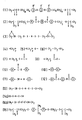
- Suitable liquid crystalline di-acrylates are shown in general formula 1 of the formula sheet.
- R is a hydrogen atom or a methyl group
- R′ is a hydrogen atom, an alkyl group having 1-4 carbon atoms or a halogen atom
- A is an oxygen atom or the group -O- -
- B is the group -O- - or - -O
- m has the value 1-15
- n is 0 or 1.
- An exponent of these di-(meth)acrylates is shown in formula 2 of the formula sheet.
- suitable liquid crystalline di-(meth)acrylates are stated, in, for example, European Patent Application EP 261712 (PHN 11.855), wherein the method of preparation is also described.
- Other suitable liquid crystalline monomers are epoxides which are represented by formula 3 of the formula sheet.
- X is a group which is represented by one of the formulae 4 up to and including 8 of the formula sheet, wherein p has a value of from 0-20
- M is a mesogenic group, a few examples of which are represented by formulae 9 up to and including 12 of the formula sheet.
- suitable liquid crystalline monomers are vinyl ethers and thiolene systems which are represented by the formulae 13 and 14a, 14b, respectively, of the formula sheet.
- X and X′ have the above-stated meaning of X and M and M′ have the above-stated meaning of M.
- the value of p is 0-20.
- the liquid crystalline monomers are mixed with 1 to 2% by weight of a radical initiator such as, for example, Darocur 1173 (Merck; formula 16 of the formula sheet) and Irgacure 651 (Ciba-Geigy; formula 17 of the formula sheet) which are both photoinitiators or benzoyl peroxide which is a thermal initiator.
- a radical initiator such as, for example, Darocur 1173 (Merck; formula 16 of the formula sheet) and Irgacure 651 (Ciba-Geigy; formula 17 of the formula sheet) which are both photoinitiators or benzoyl peroxide which is a thermal initiator.
- Cationic initiators for example Degacure KI 85 (Degusa; formula 18 of the formula sheet) are used to cure epoxides and vinyl ethers.
- a preferred embodiment of the method is characterized in that the liquid crystalline monomers are oriented by an external field of force before the adhesive is left to cure.
- the external field of force may be an electric or magnetic field whose direction can be readily adjusted, so that any specific orientation of the liquid crystalline monomers can be obtained. It is also possible to previously rub the surface to be cemented in one direction, so that the liquid crystalline monomers will be oriented in the direction of rubbing.
- the surface to be cemented may be first provided with a suitable polymer orientation layer such as polyimide.
- the liquid crystalline monomers can alternatively be oriented by previously providing microgrooves or a silane on the surface to be cemented. During polymerization, the field is maintained so that the molecules cannot become disoriented. Due to the additional ordering, the linear shrinkage perpendicular to the direction of orientation is less than the linear shrinkage in the direction of orientation. This can be attributed to the fact that in the direction perpendicular to the direction of orientation the monomer molecules are already densely packed, which hardly changes by polymerization. In many applications the inaccuracies or stressses are introduced by the linear shrinkage in one or two directions, so that the orientation of the monomers can be dramatically improved by applying the proper external field of force.
- a practical embodiment of the method according to the invention is characterized in that the curing is carried out by means of exposure to UV light.
- the adhesive comprising liquid crystalline monomers contains an above-mentioned radical or cationic photoinitiator.
- the photoinitiator decomposes into radicals or in a cation which initiate(s) polymerization of the monomers.
- the use of UV light of course requires that at least one of the bodies to be cemented is transparent to UV light or that the adhesive layer is otherwise accessible to UV light. In the case of applications in optical assemblies this requirement is mostly fulfilled.
- the invention further relates to a composite body comprising at least two parts, at least two parts of which are bonded by means of an adhesive bond, and is characterized in that the adhesive bond comprises an oriented polymer.
- the orientation of the polymer is selected such that shrinkage and shrinkage stresses are least desirable in directions perpendicular to the orientation of the polymer.
- the two parts of the composite body exhibit a high degree of positioning accuracy relative to one another because of the very small shrinkage during curing in the directions which are important to the positioning.
- the shrinkage stress in the adhesive layer is also very small.
- Such accuracies are important in the above-mentioned optical disc players such as Laser Vision and Compact-Disc players in which positional accuracies of a few tenths of one micron and angular accuracies of 10 ⁇ 4 to 10 ⁇ 6 rad. are required.
- optical components such as lenses, mirrors, prisms and lasers in a suitable mount are concerned.
- the liquid crystalline monomers can be cured by using a thermal initiator such as benzoyl peroxide.
- adhesion promoters may be added, for example silanes.
- reference numeral 1 denotes a section of an optical assembly 1 comprising a synthetic resin mount 3 (polypropylene oxide) and a glass lens 5 having an optical axis 6.
- An adhesive is prepared which consists of a compound of formula 2 of the formula sheet and 2% by weight of Darocur 1173 (Merck). The adhesive has liquid crystalline nematic properties in the temperature range of from 78 to 161 o C.
- An inner wall 7 of the mount is rubbed with a non-fluff velvet cloth in a direction Z which extends parallel to the optical axis.
- a cartesian coordinates system is shown at one side of the drawing, wherein 2 extends parallel to the direction of the optical axis 6.
- the lens is positioned in the mount in a customary manner.
- An adhesive layer 9 is present between the periphery of the lens and the inner wall of the mount.
- the assembly 1 is then heated to a temperature of 80 o C.
- the monomers in the adhesive layer become oriented in the direction of rubbing 2.
- the adhesive layer is exposed to UV light of 360 nm for several minutes.
- the U.V.-light power of the low-pressure mercury-vapour lamp to which the adhjesive is exposed is 5 mW/cm2.
- the monomer molecules in the adhesive layer 9 which are oriented in the direction of rubbing, thereby fixing the orientation.
- the molecular axes of the polymer molecules are directed in the direction of rubbing Z. Due to the fact that the shrinkage perpendicular to the molecular axis is small, the polymerization shrinkage in two of the three main directions is small, namely in the X and Y direction. By choosing the direction of orientation of the molecules, it becomes possible to select a surface having little shrinkage in both directions.
- the polymerization shrinkage of curing monomers is measured by means of an arrangement as shown in Fig. 2.
- a glass plate 3 is located on a heating stage 1.
- a spacer 5 having a thickness of 450 ⁇ m is arranged on the glass plate along the periphery.
- a thin reflecting metallized glass plate 7 is provided on the spacer.
- the adhesive has the same composition as in example 1.
- the volume of the drop of adhesive is 0.002 cm3.
- the drop contacts both the glass plate 3 and the metallized glass plate 7.
- the entire arrangement may be located between magnet poles (not shown) having a field strength of 10 kGauss.
- the Table lists the results of the polymerization-shrinkage measurements. Column 2 lists the linear shrinkage when no external magnetic field is applied; columns 3 and 4 list the linear shrinkage parallel and perpendicular, respectively, to the molecular axis when an external magnetic field is applied, and column 5 lists the volume shrinkage.
- the volume shrinkage can be calculated from the individual values of the three main directions.
- the Table lists the measured values of an allied non-liquid crystalline monomer, namely Diacryl 101 (Akzo). This monomer is shown in formula 15 of the formula sheet.
Landscapes
- Physics & Mathematics (AREA)
- General Physics & Mathematics (AREA)
- Optics & Photonics (AREA)
- Chemical & Material Sciences (AREA)
- Organic Chemistry (AREA)
- Adhesives Or Adhesive Processes (AREA)
- Addition Polymer Or Copolymer, Post-Treatments, Or Chemical Modifications (AREA)
- Lining Or Joining Of Plastics Or The Like (AREA)
Applications Claiming Priority (2)
| Application Number | Priority Date | Filing Date | Title |
|---|---|---|---|
| NL8802683A NL8802683A (nl) | 1988-11-02 | 1988-11-02 | Werkwijze voor het onderling verbinden van twee lichamen met een lijm alsmede een samengesteld lichaam. |
| NL8802683 | 1988-11-02 |
Publications (2)
| Publication Number | Publication Date |
|---|---|
| EP0367341A1 true EP0367341A1 (fr) | 1990-05-09 |
| EP0367341B1 EP0367341B1 (fr) | 1993-05-19 |
Family
ID=19853147
Family Applications (1)
| Application Number | Title | Priority Date | Filing Date |
|---|---|---|---|
| EP89202718A Expired - Lifetime EP0367341B1 (fr) | 1988-11-02 | 1989-10-27 | Procédé pour l'assemblage de deux corps avec une colle contenant des monomères de cristaux liquides |
Country Status (5)
| Country | Link |
|---|---|
| EP (1) | EP0367341B1 (fr) |
| JP (1) | JPH02170881A (fr) |
| KR (1) | KR0133284B1 (fr) |
| DE (1) | DE68906642T2 (fr) |
| NL (1) | NL8802683A (fr) |
Cited By (3)
| Publication number | Priority date | Publication date | Assignee | Title |
|---|---|---|---|---|
| US5375138A (en) * | 1992-09-25 | 1994-12-20 | International Business Machines Corporation | Optical cavities for lasers |
| US6031015A (en) * | 1995-07-18 | 2000-02-29 | Ivoclar Ag | Dental materials based on liquid crystalline monomers |
| WO2000077561A3 (fr) * | 1999-06-15 | 2002-05-23 | Inst Stefan Jozef | Procede de fabrication d'une couche compensatrice polymere pour obturateur a cristaux liquides et realisation |
Families Citing this family (4)
| Publication number | Priority date | Publication date | Assignee | Title |
|---|---|---|---|---|
| JPH0541408A (ja) * | 1991-08-05 | 1993-02-19 | Rohm Co Ltd | 接着方法 |
| US5998499A (en) | 1994-03-25 | 1999-12-07 | Dentsply G.M.B.H. | Liquid crystalline (meth)acrylate compounds, composition and method |
| DE102015118100A1 (de) * | 2015-10-23 | 2017-04-27 | Hella Kgaa Hueck & Co. | Verbindungsanordnung zur klebenden Verbindung eines lageempfindlichen Elementes mit einem Aufnahmekörper |
| KR20200031228A (ko) | 2018-09-14 | 2020-03-24 | 최종갑 | 반죽물 자동 토출장치 |
Citations (10)
| Publication number | Priority date | Publication date | Assignee | Title |
|---|---|---|---|---|
| GB1419634A (en) * | 1972-05-15 | 1975-12-31 | Ciba Geigy Ag | Method of bonding surfaces together using adhesive compositons |
| GB1488354A (en) * | 1975-02-07 | 1977-10-12 | Ogden & Wheldon Ltd | Anaerobic curable compositions |
| US4181752A (en) * | 1974-09-03 | 1980-01-01 | Minnesota Mining And Manufacturing Company | Acrylic-type pressure sensitive adhesives by means of ultraviolet radiation curing |
| US4281152A (en) * | 1980-06-20 | 1981-07-28 | Gulf Oil Corporation | Acrylate monomers and photopolymerizable compositions containing same |
| EP0090218A1 (fr) * | 1982-03-31 | 1983-10-05 | Firma Carl Zeiss | Méthode et appareil pour l'adjustage et le montage des éléments optiques à des instruments optiques |
| EP0138326A1 (fr) * | 1983-08-19 | 1985-04-24 | RAYCHEM CORPORATION (a California corporation) | Méthode et composition pour la liaison de fibres optiques |
| EP0206397A1 (fr) * | 1985-06-10 | 1986-12-30 | Koninklijke Philips Electronics N.V. | Lentille réplique |
| EP0268886A2 (fr) * | 1986-11-07 | 1988-06-01 | Tremco Incorporated | Adhésif flexible et préfabriqué, construction de fenêtre et aggloméré laminé |
| EP0282280A1 (fr) * | 1987-03-09 | 1988-09-14 | Mitsui Petrochemical Industries, Ltd. | Compositions adhésives durcissables |
| EP0140006B1 (fr) * | 1983-09-06 | 1989-11-15 | Gerhard Dr. Piestert | Matériau d'étanchéité dont le durcissement nécessite l'exclusion d'oxygène, pour l'étanchéification de surfaces et de filetages |
-
1988
- 1988-11-02 NL NL8802683A patent/NL8802683A/nl not_active Application Discontinuation
-
1989
- 1989-10-27 EP EP89202718A patent/EP0367341B1/fr not_active Expired - Lifetime
- 1989-10-27 DE DE89202718T patent/DE68906642T2/de not_active Expired - Fee Related
- 1989-10-30 KR KR1019890015623A patent/KR0133284B1/ko not_active Expired - Fee Related
- 1989-10-31 JP JP1282060A patent/JPH02170881A/ja active Pending
Patent Citations (10)
| Publication number | Priority date | Publication date | Assignee | Title |
|---|---|---|---|---|
| GB1419634A (en) * | 1972-05-15 | 1975-12-31 | Ciba Geigy Ag | Method of bonding surfaces together using adhesive compositons |
| US4181752A (en) * | 1974-09-03 | 1980-01-01 | Minnesota Mining And Manufacturing Company | Acrylic-type pressure sensitive adhesives by means of ultraviolet radiation curing |
| GB1488354A (en) * | 1975-02-07 | 1977-10-12 | Ogden & Wheldon Ltd | Anaerobic curable compositions |
| US4281152A (en) * | 1980-06-20 | 1981-07-28 | Gulf Oil Corporation | Acrylate monomers and photopolymerizable compositions containing same |
| EP0090218A1 (fr) * | 1982-03-31 | 1983-10-05 | Firma Carl Zeiss | Méthode et appareil pour l'adjustage et le montage des éléments optiques à des instruments optiques |
| EP0138326A1 (fr) * | 1983-08-19 | 1985-04-24 | RAYCHEM CORPORATION (a California corporation) | Méthode et composition pour la liaison de fibres optiques |
| EP0140006B1 (fr) * | 1983-09-06 | 1989-11-15 | Gerhard Dr. Piestert | Matériau d'étanchéité dont le durcissement nécessite l'exclusion d'oxygène, pour l'étanchéification de surfaces et de filetages |
| EP0206397A1 (fr) * | 1985-06-10 | 1986-12-30 | Koninklijke Philips Electronics N.V. | Lentille réplique |
| EP0268886A2 (fr) * | 1986-11-07 | 1988-06-01 | Tremco Incorporated | Adhésif flexible et préfabriqué, construction de fenêtre et aggloméré laminé |
| EP0282280A1 (fr) * | 1987-03-09 | 1988-09-14 | Mitsui Petrochemical Industries, Ltd. | Compositions adhésives durcissables |
Cited By (3)
| Publication number | Priority date | Publication date | Assignee | Title |
|---|---|---|---|---|
| US5375138A (en) * | 1992-09-25 | 1994-12-20 | International Business Machines Corporation | Optical cavities for lasers |
| US6031015A (en) * | 1995-07-18 | 2000-02-29 | Ivoclar Ag | Dental materials based on liquid crystalline monomers |
| WO2000077561A3 (fr) * | 1999-06-15 | 2002-05-23 | Inst Stefan Jozef | Procede de fabrication d'une couche compensatrice polymere pour obturateur a cristaux liquides et realisation |
Also Published As
| Publication number | Publication date |
|---|---|
| DE68906642T2 (de) | 1993-12-09 |
| KR0133284B1 (ko) | 1998-04-14 |
| NL8802683A (nl) | 1990-06-01 |
| DE68906642D1 (de) | 1993-06-24 |
| EP0367341B1 (fr) | 1993-05-19 |
| KR900007992A (ko) | 1990-06-02 |
| JPH02170881A (ja) | 1990-07-02 |
Similar Documents
| Publication | Publication Date | Title |
|---|---|---|
| US5178710A (en) | Bonding using a difunctional liquid crystalline monomer adhesive under an applied force field | |
| CN103477255B (zh) | 光学膜 | |
| KR100890662B1 (ko) | 광 소자의 제조방법 | |
| JP5312482B2 (ja) | 液晶配向膜組成物、これを用いた液晶配向膜の製造方法、および液晶配向膜を含む光学フィルム | |
| RU2444538C1 (ru) | Эпоксидная композиция для полимеризации и герметизирующая композиция, содержащая ее | |
| TWI712636B (zh) | 液晶硬化膜、含有液晶硬化膜的光學膜及顯示裝置 | |
| EP0587280B1 (fr) | Matériau composite de liquide cristallin anti-ferro-électrique, procédé pour sa préparation et élément de liquide cristallin l'utilisant | |
| KR100839261B1 (ko) | 광학소자 | |
| JP4087205B2 (ja) | 液晶表示素子用光学フィルムおよび当該フィルムを搭載した液晶表示素子 | |
| KR101676894B1 (ko) | 액정 필름 | |
| EP0367341B1 (fr) | Procédé pour l'assemblage de deux corps avec une colle contenant des monomères de cristaux liquides | |
| JP2009098187A (ja) | 光学部品用接着剤 | |
| KR19990023378A (ko) | 액정성 조성물, 경화물 및 그의 제조 방법 | |
| JP3879109B2 (ja) | 光学接着剤及びこれを用いた光学部品 | |
| JP2007293314A (ja) | フィルムおよびフィルムの製造方法、並びにその利用 | |
| US12577469B2 (en) | Compound, composition, cured product, optically anisotropic body, optical element, and light guide element | |
| JP2010072439A (ja) | 液晶層用光硬化型接着剤組成物および液晶フィルム | |
| JPH03192311A (ja) | 分子配向合成樹脂組成物、その製造方法およびクラッド | |
| EP0540806A2 (fr) | Film à cristal liquide | |
| JPH07120761A (ja) | 光学素子の製造方法 | |
| EP1291404A1 (fr) | Composition adhesive optique et appareil optique | |
| KR102719472B1 (ko) | 편광판용 접착제 조성물, 이를 이용한 편광판 및 이를 포함하는 광학표시장치 | |
| JP4979242B2 (ja) | トリオキセタン化合物、カチオン重合性組成物および光学フィルム並びに表示装置 | |
| KR101742335B1 (ko) | 편광판 | |
| JP2000119655A (ja) | 液晶光学素子及びその製造方法 |
Legal Events
| Date | Code | Title | Description |
|---|---|---|---|
| PUAI | Public reference made under article 153(3) epc to a published international application that has entered the european phase |
Free format text: ORIGINAL CODE: 0009012 |
|
| AK | Designated contracting states |
Kind code of ref document: A1 Designated state(s): CH DE FR GB IT LI NL SE |
|
| 17P | Request for examination filed |
Effective date: 19901107 |
|
| 17Q | First examination report despatched |
Effective date: 19920302 |
|
| GRAA | (expected) grant |
Free format text: ORIGINAL CODE: 0009210 |
|
| AK | Designated contracting states |
Kind code of ref document: B1 Designated state(s): CH DE FR GB IT LI NL SE |
|
| PG25 | Lapsed in a contracting state [announced via postgrant information from national office to epo] |
Ref country code: IT Free format text: LAPSE BECAUSE OF FAILURE TO SUBMIT A TRANSLATION OF THE DESCRIPTION OR TO PAY THE FEE WITHIN THE PRE;WARNING: LAPSES OF ITALIAN PATENTS WITH EFFECTIVE DATE BEFORE 2007 MAY HAVE OCCURRED AT ANY TIME BEFORE 2007. THE CORRECT EFFECTIVE DATE MAY BE DIFFERENT FROM THE ONE RECORDED.SCRIBED TIME-LIMIT Effective date: 19930519 Ref country code: SE Effective date: 19930519 |
|
| REF | Corresponds to: |
Ref document number: 68906642 Country of ref document: DE Date of ref document: 19930624 |
|
| ET | Fr: translation filed | ||
| PLBE | No opposition filed within time limit |
Free format text: ORIGINAL CODE: 0009261 |
|
| STAA | Information on the status of an ep patent application or granted ep patent |
Free format text: STATUS: NO OPPOSITION FILED WITHIN TIME LIMIT |
|
| 26N | No opposition filed | ||
| REG | Reference to a national code |
Ref country code: CH Ref legal event code: PFA Free format text: PHILIPS ELECTRONICS N.V. |
|
| REG | Reference to a national code |
Ref country code: FR Ref legal event code: CD |
|
| NLT1 | Nl: modifications of names registered in virtue of documents presented to the patent office pursuant to art. 16 a, paragraph 1 |
Owner name: PHILIPS ELECTRONICS N.V. |
|
| PGFP | Annual fee paid to national office [announced via postgrant information from national office to epo] |
Ref country code: GB Payment date: 19970930 Year of fee payment: 9 |
|
| PGFP | Annual fee paid to national office [announced via postgrant information from national office to epo] |
Ref country code: FR Payment date: 19971021 Year of fee payment: 9 |
|
| PGFP | Annual fee paid to national office [announced via postgrant information from national office to epo] |
Ref country code: NL Payment date: 19971030 Year of fee payment: 9 |
|
| PGFP | Annual fee paid to national office [announced via postgrant information from national office to epo] |
Ref country code: DE Payment date: 19971219 Year of fee payment: 9 |
|
| PGFP | Annual fee paid to national office [announced via postgrant information from national office to epo] |
Ref country code: CH Payment date: 19980115 Year of fee payment: 9 |
|
| REG | Reference to a national code |
Ref country code: FR Ref legal event code: CD |
|
| PG25 | Lapsed in a contracting state [announced via postgrant information from national office to epo] |
Ref country code: GB Free format text: LAPSE BECAUSE OF NON-PAYMENT OF DUE FEES Effective date: 19981027 |
|
| PG25 | Lapsed in a contracting state [announced via postgrant information from national office to epo] |
Ref country code: CH Free format text: LAPSE BECAUSE OF THE APPLICANT RENOUNCES Effective date: 19981031 Ref country code: LI Free format text: LAPSE BECAUSE OF THE APPLICANT RENOUNCES Effective date: 19981031 |
|
| REG | Reference to a national code |
Ref country code: CH Ref legal event code: PL |
|
| PG25 | Lapsed in a contracting state [announced via postgrant information from national office to epo] |
Ref country code: NL Free format text: LAPSE BECAUSE OF NON-PAYMENT OF DUE FEES Effective date: 19990501 |
|
| GBPC | Gb: european patent ceased through non-payment of renewal fee |
Effective date: 19981027 |
|
| PG25 | Lapsed in a contracting state [announced via postgrant information from national office to epo] |
Ref country code: FR Free format text: LAPSE BECAUSE OF NON-PAYMENT OF DUE FEES Effective date: 19990630 |
|
| NLV4 | Nl: lapsed or anulled due to non-payment of the annual fee |
Effective date: 19990501 |
|
| REG | Reference to a national code |
Ref country code: FR Ref legal event code: ST |
|
| PG25 | Lapsed in a contracting state [announced via postgrant information from national office to epo] |
Ref country code: DE Free format text: LAPSE BECAUSE OF NON-PAYMENT OF DUE FEES Effective date: 19990803 |