EP0367380B1 - Doppelkommutierungsleistungssperrwandler - Google Patents
Doppelkommutierungsleistungssperrwandler Download PDFInfo
- Publication number
- EP0367380B1 EP0367380B1 EP89307946A EP89307946A EP0367380B1 EP 0367380 B1 EP0367380 B1 EP 0367380B1 EP 89307946 A EP89307946 A EP 89307946A EP 89307946 A EP89307946 A EP 89307946A EP 0367380 B1 EP0367380 B1 EP 0367380B1
- Authority
- EP
- European Patent Office
- Prior art keywords
- switch
- primary winding
- voltage
- power
- current
- Prior art date
- Legal status (The legal status is an assumption and is not a legal conclusion. Google has not performed a legal analysis and makes no representation as to the accuracy of the status listed.)
- Expired - Lifetime
Links
- 238000004804 winding Methods 0.000 claims description 104
- 239000003990 capacitor Substances 0.000 claims description 26
- 238000012546 transfer Methods 0.000 claims description 15
- 230000001105 regulatory effect Effects 0.000 claims description 8
- 238000005086 pumping Methods 0.000 claims description 7
- 230000008878 coupling Effects 0.000 claims description 2
- 238000010168 coupling process Methods 0.000 claims description 2
- 238000005859 coupling reaction Methods 0.000 claims description 2
- 230000004044 response Effects 0.000 claims description 2
- 230000001276 controlling effect Effects 0.000 claims 1
- 230000000779 depleting effect Effects 0.000 claims 1
- 230000005669 field effect Effects 0.000 claims 1
- 238000000034 method Methods 0.000 claims 1
- 230000004907 flux Effects 0.000 description 8
- 230000009471 action Effects 0.000 description 7
- 238000010586 diagram Methods 0.000 description 6
- 239000004020 conductor Substances 0.000 description 5
- 230000033228 biological regulation Effects 0.000 description 2
- 230000008859 change Effects 0.000 description 2
- 238000006243 chemical reaction Methods 0.000 description 2
- 238000009499 grossing Methods 0.000 description 2
- 230000001939 inductive effect Effects 0.000 description 2
- 239000004065 semiconductor Substances 0.000 description 2
- 238000012360 testing method Methods 0.000 description 2
- 238000007599 discharging Methods 0.000 description 1
- 230000000694 effects Effects 0.000 description 1
- 238000003780 insertion Methods 0.000 description 1
- 230000037431 insertion Effects 0.000 description 1
- 230000004048 modification Effects 0.000 description 1
- 238000012986 modification Methods 0.000 description 1
- 238000012544 monitoring process Methods 0.000 description 1
- 230000010287 polarization Effects 0.000 description 1
- 230000001360 synchronised effect Effects 0.000 description 1
Images


Classifications
-
- H—ELECTRICITY
- H02—GENERATION; CONVERSION OR DISTRIBUTION OF ELECTRIC POWER
- H02M—APPARATUS FOR CONVERSION BETWEEN AC AND AC, BETWEEN AC AND DC, OR BETWEEN DC AND DC, AND FOR USE WITH MAINS OR SIMILAR POWER SUPPLY SYSTEMS; CONVERSION OF DC OR AC INPUT POWER INTO SURGE OUTPUT POWER; CONTROL OR REGULATION THEREOF
- H02M3/00—Conversion of DC power input into DC power output
- H02M3/22—Conversion of DC power input into DC power output with intermediate conversion into AC
- H02M3/24—Conversion of DC power input into DC power output with intermediate conversion into AC by static converters
- H02M3/28—Conversion of DC power input into DC power output with intermediate conversion into AC by static converters using discharge tubes with control electrode or semiconductor devices with control electrode to produce the intermediate AC
- H02M3/325—Conversion of DC power input into DC power output with intermediate conversion into AC by static converters using discharge tubes with control electrode or semiconductor devices with control electrode to produce the intermediate AC using devices of a triode or a transistor type requiring continuous application of a control signal
- H02M3/335—Conversion of DC power input into DC power output with intermediate conversion into AC by static converters using discharge tubes with control electrode or semiconductor devices with control electrode to produce the intermediate AC using devices of a triode or a transistor type requiring continuous application of a control signal using semiconductor devices only
- H02M3/3353—Conversion of DC power input into DC power output with intermediate conversion into AC by static converters using discharge tubes with control electrode or semiconductor devices with control electrode to produce the intermediate AC using devices of a triode or a transistor type requiring continuous application of a control signal using semiconductor devices only having at least two simultaneously operating switches on the input side, e.g. "double forward" or "double (switched) flyback" converter
-
- H—ELECTRICITY
- H02—GENERATION; CONVERSION OR DISTRIBUTION OF ELECTRIC POWER
- H02M—APPARATUS FOR CONVERSION BETWEEN AC AND AC, BETWEEN AC AND DC, OR BETWEEN DC AND DC, AND FOR USE WITH MAINS OR SIMILAR POWER SUPPLY SYSTEMS; CONVERSION OF DC OR AC INPUT POWER INTO SURGE OUTPUT POWER; CONTROL OR REGULATION THEREOF
- H02M3/00—Conversion of DC power input into DC power output
- H02M3/22—Conversion of DC power input into DC power output with intermediate conversion into AC
- H02M3/24—Conversion of DC power input into DC power output with intermediate conversion into AC by static converters
- H02M3/28—Conversion of DC power input into DC power output with intermediate conversion into AC by static converters using discharge tubes with control electrode or semiconductor devices with control electrode to produce the intermediate AC
- H02M3/325—Conversion of DC power input into DC power output with intermediate conversion into AC by static converters using discharge tubes with control electrode or semiconductor devices with control electrode to produce the intermediate AC using devices of a triode or a transistor type requiring continuous application of a control signal
- H02M3/335—Conversion of DC power input into DC power output with intermediate conversion into AC by static converters using discharge tubes with control electrode or semiconductor devices with control electrode to produce the intermediate AC using devices of a triode or a transistor type requiring continuous application of a control signal using semiconductor devices only
- H02M3/33569—Conversion of DC power input into DC power output with intermediate conversion into AC by static converters using discharge tubes with control electrode or semiconductor devices with control electrode to produce the intermediate AC using devices of a triode or a transistor type requiring continuous application of a control signal using semiconductor devices only having several active switching elements
Definitions
- This invention relates generally to power converters and, more particularly, to double-switched flyback converters.
- Power converters provide a regulated DC voltage from a primary DC source.
- Conventional DC/DC converters are generally of the push-pull or switching regulator type.
- a flyback converter uses a switching regulator to cyclically store and transfer energy from a primary DC source through a power transformer to an output circuit.
- the primary winding of the power transformer is connected to the primary DC source; the secondary winding is connected to the output circuit.
- the switching regulator alternately opens and closes a switch connecting the primary DC source to the primary winding of the transformer. This switching action defines a power cycle which inductively couples the primary DC source to the output circuit.
- the power cycle of the converter comprises two parts: a primary conduction cycle and a flyback cycle.
- the switch is closed, transferring energy from the primary DC source to the primary winding of the power transformer.
- the switch is opened, starting the flyback cycle.
- energy is coupled through the secondary winding into a rectified output circuit.
- PWM pulse width modulating
- a double-switched flyback converter uses two switches in series and on opposite ends of the primary winding of the transformer.
- the switches typically, are high voltage transistors driven by a gate drive transformer connected directly to the PWM circuit.
- the PWM circuit acting through the gate drive transformer, biases the gates of the transistor switches to the "on” state, storing energy in the primary winding during the primary conduction cycle.
- the gates of the transistor switches are subsequently biased to the "off" state during the flyback cycle.
- US-A-4594649 discloses a flyback power converter for developing a regulated output of DC power from a DC source, the converter having a power transformer including a primary winding and secondary windings; a first switch, responsive to a first electrical signal, coupled in series with a first end of the primary winding for periodically coupling the primary winding to the source; a second switch, responsive to a second electrical signal, coupled in series with a second end of the primary winding, both switches being closed when the source is energizing the transformer; a charge pumping circuit, including a first of the secondary windings, for closing the first switch when the energy transfer is completed; an output circuit, operable in response to the energy transfer and including a third of the secondary windings, for producing an output DC voltage; a pulse width modulation control circuit, which has to be synchronised with the remainder of the circuit, to open and close the second switch; and a controller for opening the second switch to initiate an energy transfer from the primary winding.
- transients in the primary DC source or output load may impose undesirable stresses in the converter circuit. For instance, a surge in the input voltage may transfer excess energy to the primary winding during the primary conduction cycle; during the subsequent flyback cycle, the PWM circuit may command the transistor switches "on" before the energy transfer to the secondary winding is complete. This condition imposes high stress currents on both the transistor switches and the power transformer, leading to possible component failure. This condition occurs because the PWM circuit is blind to the exact status of the energy transfer at the power transformer. Therefore, it is desirable to monitor the status of the energy transfer at the transformer windings to provide for more efficient switching action.
- the invention overcomes the above-noted and other drawbacks of the prior art by providing a flyback power-converter characterised by: a current monitor for monitoring the current in the primary winding a controller comprising control logic which is responsive to a preselected current level in the primary winding, for opening the second switch to initiate an energy transfer from the primary winding; and a second charge pumping circuit, including a second of the secondary windings, for closing the second switch when the energy transfer is completed.
- a current sensing means monitors the primary winding current and signals a control logic circuit at a predetermined current level. The control logic circuit then turns off the second switch, forcing the power transformer into the flyback mode of operation.
- the charge pumping circuit pumps the charge stored from the flyback cycle into the switches.
- the switches turn on, returning the double-switched flyback power converter to the primary conduction cycle.
- the total power cycle is now complete and ready to repeat.
- Fig.5 depicts a known flyback power-regulator 10.
- a PWM circuit 200 provides duty cycle switching to a gate-drive transformer T21.
- An error amp input feedback line 202 indicates to the PWM circuit variation of the voltage out of the power-regulator 10 from a reference (not shown).
- Current through a primary winding 204 of the gate-drive transformer T21 creates a flux that is coupled to a pair of secondary windings 206 and 208. Flux reversal at the secondary windings 206 and 208 drives the gates of a pair of switches represented by transistors Q11 and Q21. When transistors Q11 and Q21 conduct, flux builds up in a primary winding 210 of a transformer T11.
- a subsequent pulse to the gate-drive transformer T21 opens the switches Q11 and Q21 to initiate the flyback cycle at the transformer T11.
- a diode CR31 rectifies the voltage developed at the secondary 212 of the transformer T11, which voltage is filtered by capacitor C11.
- a resistor RL represents the load.
- a current sense resistor R11 provides a signal to the PWM circuit indicative of the primary current at transformer T11. Line 202 and R11 indicate to the PWM 200 when to end a primary conduction cycle and allow stored energy to be transferred to the secondary winding 212.
- Fig. 1 depicts a double-switched flyback power-converter 20 in block diagram form.
- a 110 VAC line 22 provides input power to a rectifier and filter circuit 24.
- the rectifier and filter circuit 24 provides a high voltage DC supply to the double-switched flyback power-converter 20.
- a conductor 26 connects the positive side of the high voltage DC supply to one side of a first high-voltage switch 28.
- a second high-voltage switch 32 connects to the negative side of the high voltage DC supply through a conductor 33.
- the primary winding of a power transformer 30 connects in series between the first high voltage switch 28 and the second high voltage switch 32.
- the power transformer 30 receives current through the high-voltage switches 28 and 32.
- a current monitor 34 measures the current passing through the high voltage switches 32 and 28 and the primary winding of the transformer 30.
- the current monitor converts the current to a voltage level and sends the voltage level to the control logic circuit 36.
- the control logic circuit 36 ends the primary conduction cycle by turning off the second high voltage switch 32, beginning a flyback or a power conversion cycle.
- Energy stored in the power transformer 30 during the primary conduction cycle is depleted during the flyback cycle by current generated in the secondary windings of the power transformer 30.
- a power output rectifier and filter circuit 38 connected to one of the secondary windings rectifies and filters a major portion of the secondary current.
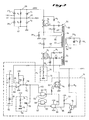
- Fig.2 provides a more detailed depiction of the double-switched flyback power-converter 20.
- a pair of diodes, CR6 and CR7 rectify the 110 VAC line voltage. Current flows through rectifier diode CR6 during the positive half of the input cycle, charging a smoothing capacitor C1 to approximately 150 V. Current flows through rectifier diode CR7 during the negative half of the input cycle, charging a smoothing capacitor C2 to approximately 150 V.
- the negative side of capacitor C2 is grounded; the positive side of the capacitor C2 connects to a conductor 40 and remains at approximately 150 V.
- the negative side of the capacitor C1 connects to the conductor 40; the positive side of capacitor C1 connects to conductor 26 and is approximately 300 V above ground.
- Resistors R1 and R2 bleed current from capacitors C1 and C2 respectively.
- the power transformer 30 includes a primary winding 46, a first secondary winding 48, a second secondary winding 50, and a third secondary winding 52.
- a dot 54 at one end of each winding shows the polarization of the windings. For consistency, the end of a winding having a dot will be referred to as the first end of the winding, and the opposite end of the winding will be referred to as the second end of the winding.
- a first end 55 of the primary winding 46 is connected to the 300 V supply via an enhancement mode MOSFET transistor Q1.
- a second end 57 of the primary winding 46 is connected to ground via a second enhancement mode MOSFET transistor Q2 and a resistor R5.
- Transistors Q1 and Q2 are the high voltage switches 28 and 32, respectively, of Fig. 1.
- a first end of the first secondary winding 48 connects to a capacitor C3.
- a second end of the first secondary winding connects to the source S of transistor Q1.
- Current from the 300 VDC supply flows through a resistor R3 to initially charge the gate of transistor Q1. Thereafter, the gate of Q1 is controlled by a circuit comprising the first secondary winding 48, the capacitor C3 and a zener diode CR1.
- a first end of the second secondary winding 50 connects to a capacitor C4.
- a second end of the second secondary winding connects to the source S of transistor Q2.
- Current from the 150 VDC supply flows through a resistor R4 to initially charge the gate of transistor Q2. Thereafter, the gate of Q2 is controlled by the circuit comprising the second secondary winding 50, the capacitor C4 and a zener diode CR2.
- the third secondary transformer winding 52 drives current through the output circuit 38 during the flyback cycle of the double-switched flyback power-converter 20.
- a diode CR5 rectifies the output current which is then filtered by a capacitor C5.
- a resistor R L represents a load connected to the power output circuit.
- a resistor R5 is connected between the source of transistor Q2 and ground.
- the resistor R5 serves as the current monitor 34 of Fig. 1, generating a voltage proportional to the current flowing through the primary winding 46 of the power transformer 30.
- transistors Q1 and Q2 are turned on. Initially, the gates of transistors Q1 and Q2 are charged in a positive direction through resistors R3 and R4 respectively. As Q1 and Q2 begin to turn on, current flowing through the transformer primary winding 46 induces voltage onto the secondary windings 48, 50, and 52. Capacitors C3 and C4 transfer this induced voltage to the gates of transistors Q1 and Q2 respectively. This increases the positive charge on the gates and rapidly turns the transistors Q1 and Q2 into full conduction.
- the zener diodes CR1 and CR2 limit the gate to source voltage of the transistors Q1 and Q2 to approximately 15 V, providing over-voltage protection between the gate and source of each transistor.
- Control logic circuit 36 monitors this voltage. At a predetermined voltage level, control logic circuit 36 turns on a MOSFET transistor Q3 which discharges the gate of transistor Q2 to ground. Transistor Q2 turns off, breaking the current path through the transformer primary winding 46. A flux reversal occurs, inducing a voltage of opposite polarity across the windings of the power transformer 30. Capacitors C3 and C4 couple this voltage reversal to the gates of the transistors Q1 and Q2 respectively. The gates of transistors Q1 and Q2 rapidly discharge to one diode threshold voltage drop below their respective sources, turning off transistor Q1 and ensuring transistor Q2 remains off.
- Zener diode CR1 being forward biased, maintains a diode threshold drop across the gate of transistor Q1.
- Clamping diodes CR3 and CR4 protect the transistors Q1 and Q2 respectively from voltage overshoot which may occur when the primary current in the power transformer 30 is interrupted.
- the energy stored in the power transformer 30 is a function of the level of the primary current at the end of the primary conduction cycle; this current is then absorbed during the flyback cycle by current induced in the secondary windings 48, 50, and 52. The major portion of this current is induced into the third secondary winding 52, charging the capacitor C5 through the forward biased diode CR5. The remainder of this secondary current is induced into the first and second secondary windings 48 and 50.
- the first secondary winding 48 charges the capacitor C3 through the forward biased diode CR1; the second secondary winding 50 charges the capacitor C4 through the forward biased diode CR2.
- the secondary currents fall as a function of time and of the mutual inductance of the transformer windings. As the secondary current reaches zero, the flux reverses direction. With this flux change, a voltage reversal occurs across all of the transformer windings.
- Capacitors C3 and C4 having charged up during the flyback cycle, pump charge into the gates of transistors Q1 and Q2 respectively. The transistors Q1 and Q2 turn on, forcing current to build up in the primary winding 46. The primary cycle then proceeds under the control of the control logic circuit 36. The total power cycle is now ready to repeat.
- the control logic circuit 36 comprises NAND gates 62, 63, and 68, a voltage reference circuit 92, a voltage comparator 56, the enhancement mode MOSFET transistor Q3, a voltage sensing bipolar transistor Q4, and a start-up circuit 94.
- the control logic circuit receives a regulated DC supply of, for example, +12 V from the 110 VAC line.
- the start-up circuit 94 has the first end of a resistor 74 connecting to the +12 V supply.
- the second end of the resistor 74 connects to the first end of a capacitor 76 and the cathode of a diode 78.
- the second end of the capacitor 76 connects to ground.
- the capacitor 76 holds the cathode of the diode 78 to near ground potential.
- the anode of the diode 78 holds an input 60 of the NAND gate 62 one diode threshold voltage drop above ground, which is at a logical zero.
- An output 64 of the NAND gate 62 is thus forced to a logical one, charging the gate of the transistor Q3 and turning the transistor Q3 on. By discharging the gate of Q2, transistor Q3 holds off transistor Q2, preventing current from passing through the primary winding 46 of the power transformer 30.
- the start-up circuit 94 allows the control logic circuit 36 to stabilize before the double-switched flyback power converter 20 begins to function. After a time period determined by the time constant of resistor 74 and capacitor 76, capacitor 76 charges towards the +12 V supply, enabling the input 60 of the NAND gate 62 to be controlled by the voltage comparator 56.
- the first end of a resistor 82 connects to the +12 V supply.
- the second end of the resistor 82 connects to the cathode of a zener diode 84 and to the positive input of the comparator 56.
- the anode of the zener diode 84 connects to ground.
- Resistor 82 is selected to allow sufficient current to pass through the zener diode 84, providing a stable reference voltage at the positive input 88 of comparator 56.
- the zener voltage characteristic of the zener diode 84 determines the value of the reference voltage. Diodes with different zener values may be used to change the reference voltage.
- the voltage generated across the current monitor resistor R5 appears at the negative input 86 of the comparator 56.
- the positive input 88 of the comparator 56 has a reference voltage of, for example, 2.5 volts.
- the output 58 of the comparator 56 changes to a logical zero.
- the logical zero is transmitted to the input 60 of the NAND gate 62.
- the output 64 of the NAND gate 62 goes to a logical one.
- the logical one at the output 64 of the NAND gate 62 positively charges the gate 66 of the enhancement mode MOSFET transistor Q3.
- Transistor Q3 turns on and discharges the gate of transistor Q2 towards ground, turning off the transistor Q2. This ends the primary conduction cycle.
- transistor Q3 turning on, combined with the subsequent voltage reversal across the second secondary transformer winding 50, imposes a reverse bias across the base-emitter junction of transistor Q4.
- Transistor Q4 turns off, allowing a pull-up resistor 72 to raise the collector of Q4 to approximately +12 volts, establishing a logical one at the input 95 of NAND gate 68.
- the input 96 of NAND gate 68 being connected to the output of NAND gate 64, is a logical one.
- the output of NAND gate 68 is, therefore, a logical zero.
- the output of NAND gate 68 connects to the input 97 of NAND gate 63.
- NAND gate 63 being a logical zero establishes a logical one at the output of NAND gate 63.
- the output of NAND gate 63 connects to the input 70 of NAND gate 62 and holds the input 70 at a logical one.
- the logic circuit made up of the NAND gates 63, 64, and 68, remains in a stable state until the voltage comparator 56 detects the peak current during the next primary conduction cycle.
- the voltage induced across the second secondary winding 50 drives current through the base of transistor Q4.
- Transistor Q4 turns on, establishing a logical zero at the input 95 of NAND gate 68, forcing the output of NAND gate 68 to a logical one.
- a resistor R6 limits the base current in transistor Q4.
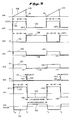
- Fig.3 depicts a waveform diagram demonstrating the operation of the double-switched flyback power converter 20.
- Waveform V R5 refers to the voltage across resistor R5.
- Waveform Q 1S depicts the voltage at the source of Q1 with respect to ground, etc.
- the zener diode CR1 limits the gate-to-source voltage of the transistor Q1 to approximately 15 V as depicted by interval 100.
- the source of transistor Q1 is a small voltage drop below the 300 VDC level determined by the ON resistance of transistor Q1 and is depicted by interval 104.
- the zener diode CR2 limits the gate to source voltage of the transistor Q2 to approximately 15 V and is depicted by interval 102.
- the drain of transistor Q2, depicted by interval 106, is a little above the ground level depending on the voltage drop across resistor R5 and the ON resistance of transistor Q2.
- the potential difference of approximately 300 V maintained across the primary winding 46 causes the current to ramp nearly linearly through the primary winding of the power transformer 30.
- the primary current increases through the resistor R5, generating the voltage V R5 depicted by interval 108.
- a test point TP1 connects to the first end of the second secondary winding 50.
- the amplitude of the voltage at TP1 is about 30 V and is a function of the turns ratio between the second secondary winding 50 and the primary winding 46. Referring again to Fig.2, this 30 V is connected to the base of transistor Q4, requiring the resistor R6 to limit the current through the base of transistor Q4.
- a negative voltage as depicted by interval 112, appears across the diode CR5.
- the diode CR5 is reverse biased, preventing current conducting into the output circuit.
- the control logic circuit 36 charges the gate of transistor Q3 to approximately +12 V as depicted by interval 114.
- Transistor Q3 turns off transistor Q2, forcing the double-switched flyback power converter 20 into the flyback cycle.
- the resulting transformer action discharges the gate of transistor Q2 to approximately 1 V below ground, clamped by the forward biased diode CR2. This action is depicted by line 116.
- the gate of transistor Q1 is discharged to a negative value and clamped to approximately 1 V below ground by the forward biased diode CR1. This action is depicted by interval 118.
- the voltage at test point TP1 goes negative by approximately 18 V, depicted by interval 120.
- the transistor Q4 turns off, enabling the control logic to discharge the gate of transistor Q3, depicted by interval 122, soon after the decay of voltage V R5 . Meanwhile, the primary current attained during the primary conduction cycle is coupled into the secondary windings.
- the diode CR5 is forward biased to a value of less than 1 V, depicted by interval 124.
- the voltage across the third secondary winding 52 is transformed onto the primary winding 46 of the transformer.
- the interval 126 depicts the voltage of the source of transistor Q1.
- the interval 128 depicts the voltage of the drain of transistor Q2.
- transformer 30 has three secondary windings, more secondary windings may be added to generate different power outputs of different voltage and current ratings.
- the double-switched flyback power supply 20 may be regulated by ways commonly known by those in the art. Typically, the output voltage or output current is compared to a reference value in the output circuit. A discrepancy between the output value and the reference value generates an error signal. The error signal is amplified and summed into the control logic circuit 36. One convenient point of insertion would be the negative input 86 to the voltage comparator 56. If, for example, the output voltage is being regulated, an increase in the output voltage increases the voltage at the input 86 of the comparator 56. The comparator will respond to a lower primary current. Less energy is stored in the transformer; during the flyback cycle less current passes into the power output circuit lowering the output voltage. The output current may be controlled in a similar way.
- the high voltage switches of the preferred embodiment are enhancement mode MOSFET transistors, other types of semiconductor switching devices may be used, with appropriate circuit modification, without withdrawing from the scope of the invention.
- Fig.4 depicts an alternative rectifier and filter circuit 24 having a removable jumper. With the jumper in place, the circuit provides 300 V and 150 V and will operate from a 110 VAC supply. With the jumper removed, the circuit requires approximately 220 VAC and provides a single 300 V supply. Referring to Fig.2, the resistor R4 is the only part of the circuit connected to the 150 V supply. The resistor R4 may be connected to the 300 V supply by increasing the value of the resistor R4 to provide a similar charge current to the gate of transistor Q2. Other supply voltages may be accommodated by changing the turns ratio of the transformer as known by those skilled in the art.
Landscapes
- Engineering & Computer Science (AREA)
- Power Engineering (AREA)
- Dc-Dc Converters (AREA)
Claims (7)
- Leistungssperrwandler zum Hervorbringen einer geregelten Ausgabe von Gleichstromleistung aus einer Gleichstromquelle (24). Der Leistungswandler umfaßt:
einen Leistungstransformator (30) einschließlich einer Primärwicklung (46) und Sekundärwicklungen (48,50,52);
einen ersten Schalter (Q₁), der auf ein erstes elektrisches Signal anspricht, in Reihe verbunden mit einem ersten Ende der Primärwicklung zum periodischen Verbinden der Primärwicklung mit der Quelle;
einen zweiten Schalter (Q₂), der auf ein zweites elektrisches Signal anspricht, in Reihe verbunden mit einem zweiten Ende der Primärwicklung, wobei beide Schalter geschlossen sind, wenn die Quelle den Transformator erregt;
einen ersten Ladungspumpenkreis (C₃), einschließlich einer ersten (48) der Sekundärwicklungen, zum Schließen des ersten Schalters, wenn die Energieübertragung beendet ist;
einen Ausgabekreis, betriebsfähig als Reaktion auf die Energieübertragung und enthaltend eine dritte (52) der Sekundärwicklungen, zum Erzeugen einer Ausgangsgleichspannung; und
eine Steuereinheit (36) zum Öffnen des zweiten Schalters, um eine Energieübertragung von der Primärwicklung einzuleiten;
dadurch gekennzeichnet, daß
ein Stromüberwacher (34) bereitgestellt ist, um den Strom in der Primärwicklung zu überwachen;
die Steuereinheit (36) eine Steuerlogik umfaßt, die auf einen vorgewählten Strompegel in der Primärwicklung anspricht, um den zweiten Schalter (Q₂) zu öffnen; und durch
einen zweiten Ladungspumpenkreis (C₄), einschließlich einer zweiten (50) der Sekundärwicklungen, zum Schließen des zweiten Schalters, wenn die Energieübertragung beendet ist. - Leistungswandler nach Anspruch 1, worin der Stromüberwacher (34) umfaßt
Einrichtung (R₅) zum Abtasten des vorgewählten Strompegels in der Primärwicklung (46);
und worin die Steuereinheit (36) weiter umfaßt:
Einrichtung (R₆) zum Abtasten einer Spannungsumkehr in der ersten oder der zweiten der Sekundärwicklungen;
eine Logikschaltung, die auf die Stromabtasteinrichtung und die Spannungsabtasteinrichtung anspricht, zum Erzeugen eines Steuersignals; und
einen Steuerschalter (Q₃), der auf das Steuersignal anspricht, zum Schließen des zweiten Schalters (Q₂) über das zweite elektrische Signal. - Leistungswandler nach Anspruch 1 oder 2, worin der erste Schalter (Q₁) und der zweite Schalter (Q₂) Feldeffektransistoren sind.
- Leistungswandler nach Anspruch 3, worin der erste Ladungspumpenkreis weiter einen Kondensator (C₃) umfaßt, der mit dem Gate (G) des ersten Schalters (Q₁) verbunden ist, und worin der zweite Ladungspumpenkreis weiter einen Kondensator (C₄) umfaßt, der mit dem Gate (G) des zweiten Schalters (Q₂) verbunden ist.
- Leistungswandler nach einem der Ansprüche 2 bis 4, worin die Einrichtung zum Abtasten des vorgewählten Strompegels in der Primärwicklung ein Widerstandselement (R₅) umfaßt.
- Verfahren zum Umwandeln eines ersten Gleichspannungspegels in einen zweiten Gleichspannungspegel, umfassend die Schritte:
Bereitstellen eines ersten Gleichspannungspegels an der Primärwicklung (46) eines Rücklauftransformators (30);
Beginnen eines primären Leitungszyklusses durch Schließen eines Schalters (Q₁,Q₂) in Reihe mit der Primärwicklung;
Speichern von Energie in der Primärwicklung des Transformators während des primären Leitungszyklusses;
Abtasten des Stroms in der Primärwicklung des Transformators und, bei einem vorbestimmten Strompegel, Beginnen eines Rücklaufzyklusses, während dessen Energie an Sekundärwicklungen (48,50,52) des Transformators übertragen wird;
Abreichern der meisten Energie in den Sekundärwicklungen in einer Lastsekundärwicklung (52) und Anlegen des verbleibenden Teils der Energie in der Sekundärwicklung an einen Ladungspumpenkreis (C₃,C₄), wobei der Ladungspumpenkreis das Schließen des Schalters (Q₁,Q₂) in Reihe mit der Primärwicklung steuert; und
wenn die in der Primärwicklung gespeicherte Energie im wesentlichen abgereichert ist, Schließen des Schalters, um einen anderen primären Leitungszyklus zu beginnen. - Geregeltes Gleichspannungsnetzteil mit einem Leistungssperrwandler nach einem der Ansprüche 1 bis 5.
Applications Claiming Priority (2)
| Application Number | Priority Date | Filing Date | Title |
|---|---|---|---|
| US267456 | 1988-11-04 | ||
| US07/267,456 US4870553A (en) | 1988-11-04 | 1988-11-04 | Double-switched flyback power-converter |
Publications (3)
| Publication Number | Publication Date |
|---|---|
| EP0367380A2 EP0367380A2 (de) | 1990-05-09 |
| EP0367380A3 EP0367380A3 (en) | 1990-10-31 |
| EP0367380B1 true EP0367380B1 (de) | 1993-06-02 |
Family
ID=23018852
Family Applications (1)
| Application Number | Title | Priority Date | Filing Date |
|---|---|---|---|
| EP89307946A Expired - Lifetime EP0367380B1 (de) | 1988-11-04 | 1989-08-04 | Doppelkommutierungsleistungssperrwandler |
Country Status (4)
| Country | Link |
|---|---|
| US (1) | US4870553A (de) |
| EP (1) | EP0367380B1 (de) |
| CA (1) | CA1294671C (de) |
| DE (1) | DE68906857T2 (de) |
Families Citing this family (18)
| Publication number | Priority date | Publication date | Assignee | Title |
|---|---|---|---|---|
| US4974142A (en) * | 1990-02-20 | 1990-11-27 | Leslie Alexander D | Bootstrap drive for a switch-mode power converter |
| US5513088A (en) * | 1991-06-14 | 1996-04-30 | Williamson; Floyd | Uninterruptable off-line, isolated flyback topology switch-mode power supply |
| US5146396A (en) * | 1991-06-17 | 1992-09-08 | At&T Bell Laboratories | Single stage power factor corrected converter having isolated output |
| FR2682543B1 (fr) * | 1991-10-09 | 1997-06-20 | Sgs Thomson Microelectronics | Circuit de commande de regulateur en demi-pont asymetrique. |
| CA2165709A1 (en) * | 1994-12-27 | 1996-06-28 | Tadatoshi Ogawa | Oxygen absorber |
| US5530636A (en) * | 1995-01-13 | 1996-06-25 | Dell Usa, L.P. | Automatic feedback system for a dual output power supply |
| US5726901A (en) * | 1996-01-25 | 1998-03-10 | Dell Usa, L.P. | System for reporting computer energy consumption |
| US6344959B1 (en) | 1998-05-01 | 2002-02-05 | Unitrode Corporation | Method for sensing the output voltage of a charge pump circuit without applying a load to the output stage |
| US6348784B1 (en) | 2001-02-13 | 2002-02-19 | Coltene/Whaledent Inc. | Switching power supply |
| US20070081371A1 (en) * | 2005-04-25 | 2007-04-12 | Wittenbreder Ernest H Jr | Synchronous Rectifier Control Circuits |
| US9461552B2 (en) | 2006-03-23 | 2016-10-04 | Enphase Energy, Inc. | Method and apparatus for power conversion |
| US9436198B2 (en) | 2006-03-23 | 2016-09-06 | Enphase Energy, Inc. | Method and apparatus for power conversion |
| KR101205279B1 (ko) * | 2006-03-23 | 2012-11-27 | 엔페이즈 에너지, 인코포레이티드 | 직류를 교류로 변환하는 방법 및 장치 |
| AT504961B1 (de) * | 2006-12-19 | 2010-01-15 | Siemens Ag Oesterreich | Schaltungsanordnung zur reduzierten schalterbelastung |
| KR101103387B1 (ko) | 2008-12-12 | 2012-01-06 | 주식회사 제너릭스 | 스위칭 전원 장치 및 이의 동작 방법 |
| US7876584B2 (en) * | 2009-06-24 | 2011-01-25 | Alpha And Omega Semiconductor Incorporated | Circuit and method for controlling the secondary FET of transformer coupled synchronous rectified flyback converter |
| US8451630B2 (en) | 2010-07-13 | 2013-05-28 | Power Integrations, Inc. | Reset voltage circuit for a forward power converter |
| KR101372825B1 (ko) * | 2013-03-08 | 2014-03-11 | 숭실대학교산학협력단 | 고승압 컨버터 |
Family Cites Families (9)
| Publication number | Priority date | Publication date | Assignee | Title |
|---|---|---|---|---|
| US4092709A (en) * | 1976-09-24 | 1978-05-30 | Texas Instruments Incorporated | Multiple output self oscillating converter regulator power supply |
| US4302802A (en) * | 1979-08-08 | 1981-11-24 | Hewlett-Packard Company | Flyback power supply regulator |
| US4408267A (en) * | 1981-01-08 | 1983-10-04 | Rca Corporation | DC-to-DC Switching converters |
| US4608625A (en) * | 1983-04-27 | 1986-08-26 | Astec Components, Ltd. | Current driven flyback power supply |
| GB2152770B (en) * | 1983-11-15 | 1987-04-29 | Yokogawa Hokushin Electric | Dc/dc converter |
| US4594649A (en) * | 1985-03-01 | 1986-06-10 | Ncr Corporation | Bootstrap drive for a two-transistor forward converter |
| FR2596927B1 (fr) * | 1986-04-04 | 1988-05-20 | Thomson Csf | Circuit de protection d'alimentation a decoupage |
| US4686616A (en) * | 1986-10-03 | 1987-08-11 | Intecolor Corporation | Power supply operable on varying inputs |
| US4754385A (en) * | 1987-01-30 | 1988-06-28 | Varo, Inc. | Two transistor flyback switching converter with current sensing for discontinuous operation |
-
1988
- 1988-11-04 US US07/267,456 patent/US4870553A/en not_active Expired - Lifetime
-
1989
- 1989-07-28 CA CA000606985A patent/CA1294671C/en not_active Expired - Fee Related
- 1989-08-04 EP EP89307946A patent/EP0367380B1/de not_active Expired - Lifetime
- 1989-08-04 DE DE8989307946T patent/DE68906857T2/de not_active Expired - Fee Related
Also Published As
| Publication number | Publication date |
|---|---|
| DE68906857D1 (de) | 1993-07-08 |
| EP0367380A3 (en) | 1990-10-31 |
| EP0367380A2 (de) | 1990-05-09 |
| US4870553A (en) | 1989-09-26 |
| DE68906857T2 (de) | 1993-09-09 |
| CA1294671C (en) | 1992-01-21 |
Similar Documents
| Publication | Publication Date | Title |
|---|---|---|
| US4870553A (en) | Double-switched flyback power-converter | |
| US7148671B2 (en) | Method and apparatus for maintaining an approximate constant current output characteristic in a switched mode power supply | |
| US4323961A (en) | Free-running flyback DC power supply | |
| US6456511B1 (en) | Start-up circuit for flyback converter having secondary pulse width modulation | |
| US6125046A (en) | Switching power supply having a high efficiency starting circuit | |
| US4754385A (en) | Two transistor flyback switching converter with current sensing for discontinuous operation | |
| US4293902A (en) | Transformerless fast current limiter with symetry correction for a switched-mode power supply | |
| EP0123030B1 (de) | Schaltnetzteil mit isolierter Rückkopplung | |
| US4809150A (en) | DC to DC converter with feed forward and feed back regulation | |
| EP0925637B1 (de) | Schaltnetzteil-steuerschaltung | |
| EP0567257A2 (de) | Steuerschaltung für die Leistungsschalter eines nullstromschaltenden Leistungswandlers | |
| US4629971A (en) | Switch mode converter and improved primary switch drive therefor | |
| US6233165B1 (en) | Power converter having a low voltage regulator powered from a high voltage source | |
| EP0124210B1 (de) | Energieversorgung mit stromgesteuertem Sperrwandler | |
| US4713740A (en) | Switch-mode power supply | |
| US6154377A (en) | Method and apparatus reducing overshoot in a power supply controller | |
| US4605997A (en) | Switch mode converter and improved deadband control therefor | |
| CA2025448C (en) | Bootstrap drive for a switch power converter | |
| US4744020A (en) | Switching mode power supply | |
| US5488551A (en) | Pulse width modulated power supply which avoids excessive on-time of switch during start-up | |
| JPH1127875A (ja) | 充電装置 | |
| JP2919182B2 (ja) | スイッチングレギュレータ制御回路 | |
| JPH04325867A (ja) | スイッチング電源 |
Legal Events
| Date | Code | Title | Description |
|---|---|---|---|
| PUAI | Public reference made under article 153(3) epc to a published international application that has entered the european phase |
Free format text: ORIGINAL CODE: 0009012 |
|
| AK | Designated contracting states |
Kind code of ref document: A2 Designated state(s): DE FR GB IT NL |
|
| PUAL | Search report despatched |
Free format text: ORIGINAL CODE: 0009013 |
|
| AK | Designated contracting states |
Kind code of ref document: A3 Designated state(s): DE FR GB IT NL |
|
| 17P | Request for examination filed |
Effective date: 19910404 |
|
| 17Q | First examination report despatched |
Effective date: 19911125 |
|
| GRAA | (expected) grant |
Free format text: ORIGINAL CODE: 0009210 |
|
| AK | Designated contracting states |
Kind code of ref document: B1 Designated state(s): DE FR GB IT NL |
|
| PG25 | Lapsed in a contracting state [announced via postgrant information from national office to epo] |
Ref country code: IT Free format text: LAPSE BECAUSE OF FAILURE TO SUBMIT A TRANSLATION OF THE DESCRIPTION OR TO PAY THE FEE WITHIN THE PRE;WARNING: LAPSES OF ITALIAN PATENTS WITH EFFECTIVE DATE BEFORE 2007 MAY HAVE OCCURRED AT ANY TIME BEFORE 2007. THE CORRECT EFFECTIVE DATE MAY BE DIFFERENT FROM THE ONE RECORDED.SCRIBED TIME-LIMIT Effective date: 19930602 Ref country code: NL Effective date: 19930602 Ref country code: FR Effective date: 19930602 |
|
| REF | Corresponds to: |
Ref document number: 68906857 Country of ref document: DE Date of ref document: 19930708 |
|
| EN | Fr: translation not filed | ||
| NLV1 | Nl: lapsed or annulled due to failure to fulfill the requirements of art. 29p and 29m of the patents act | ||
| PLBE | No opposition filed within time limit |
Free format text: ORIGINAL CODE: 0009261 |
|
| STAA | Information on the status of an ep patent application or granted ep patent |
Free format text: STATUS: NO OPPOSITION FILED WITHIN TIME LIMIT |
|
| 26N | No opposition filed | ||
| PGFP | Annual fee paid to national office [announced via postgrant information from national office to epo] |
Ref country code: GB Payment date: 19980727 Year of fee payment: 10 |
|
| PGFP | Annual fee paid to national office [announced via postgrant information from national office to epo] |
Ref country code: DE Payment date: 19980810 Year of fee payment: 10 |
|
| PG25 | Lapsed in a contracting state [announced via postgrant information from national office to epo] |
Ref country code: GB Free format text: LAPSE BECAUSE OF NON-PAYMENT OF DUE FEES Effective date: 19990804 |
|
| GBPC | Gb: european patent ceased through non-payment of renewal fee |
Effective date: 19990804 |
|
| PG25 | Lapsed in a contracting state [announced via postgrant information from national office to epo] |
Ref country code: DE Free format text: LAPSE BECAUSE OF NON-PAYMENT OF DUE FEES Effective date: 20000601 |