EP0368537B1 - Zuverlässige Datenrückgewinnung in einem Kodierer/Dekodierer - Google Patents
Zuverlässige Datenrückgewinnung in einem Kodierer/Dekodierer Download PDFInfo
- Publication number
- EP0368537B1 EP0368537B1 EP89311245A EP89311245A EP0368537B1 EP 0368537 B1 EP0368537 B1 EP 0368537B1 EP 89311245 A EP89311245 A EP 89311245A EP 89311245 A EP89311245 A EP 89311245A EP 0368537 B1 EP0368537 B1 EP 0368537B1
- Authority
- EP
- European Patent Office
- Prior art keywords
- signal
- bit
- inter
- detection
- synchronizing signal
- Prior art date
- Legal status (The legal status is an assumption and is not a legal conclusion. Google has not performed a legal analysis and makes no representation as to the accuracy of the status listed.)
- Expired - Lifetime
Links
- 238000011084 recovery Methods 0.000 title description 5
- 238000001514 detection method Methods 0.000 claims description 18
- 230000003111 delayed effect Effects 0.000 claims description 14
- 238000000034 method Methods 0.000 claims description 8
- 239000000835 fiber Substances 0.000 abstract description 3
- 238000010586 diagram Methods 0.000 description 8
- 238000006243 chemical reaction Methods 0.000 description 6
- 230000001360 synchronised effect Effects 0.000 description 4
- 238000009432 framing Methods 0.000 description 2
- 238000013459 approach Methods 0.000 description 1
- 230000005540 biological transmission Effects 0.000 description 1
- 238000012217 deletion Methods 0.000 description 1
- 230000037430 deletion Effects 0.000 description 1
- 238000013461 design Methods 0.000 description 1
- 238000012986 modification Methods 0.000 description 1
- 230000004048 modification Effects 0.000 description 1
- 229910052710 silicon Inorganic materials 0.000 description 1
- 239000010703 silicon Substances 0.000 description 1
- 230000006641 stabilisation Effects 0.000 description 1
- 238000011105 stabilization Methods 0.000 description 1
- 230000000087 stabilizing effect Effects 0.000 description 1
- 238000011144 upstream manufacturing Methods 0.000 description 1
Images



Classifications
-
- H—ELECTRICITY
- H04—ELECTRIC COMMUNICATION TECHNIQUE
- H04J—MULTIPLEX COMMUNICATION
- H04J3/00—Time-division multiplex systems
- H04J3/02—Details
- H04J3/06—Synchronising arrangements
- H04J3/062—Synchronisation of signals having the same nominal but fluctuating bit rates, e.g. using buffers
- H04J3/0632—Synchronisation of packets and cells, e.g. transmission of voice via a packet network, circuit emulation service [CES]
Definitions
- This invention relates to the serial transmission of digital data, and more particularly, to synchronization of bytes of serial data received over a local area network.
- connection management symbols In local area networks, when a node joins the network, the first stream of signals it receives are connection management symbols.
- the symbols are especially chosen so that they can be decoded by an encoder/decoder (ENDEC) of the node without regard to their alignment within a byte of the signal stream.
- ENDEC encoder/decoder
- the start of the connection management symbols can be at any one of the 10 bits within the "byte.” Decoding of these connection management symbols proceeds without regard to this alignment because of their chosen nature. However, once these symbols are processed, decoding of the data packet following these symbols requires that their "bytes" be aligned.
- the required alignment was provided by the detection of a packet delimiter called a "JK" symbol-pair. Under this procedure, a preamble "byte” immediately preceding the "JK" symbol-pair could be misinterpreted; being a decoded byte.
- the elastic buffer is centered upon detection of the "JK" delimiter. During that time, a few bits in the byte-stream are dropped or added to compensate for clock differences between the upstream of local station, resulting in a non-integral number of bytes in the preamble.
- the physical layer has to reliably decode the incoming data stream, without any deletion or modification of frame bits. Also, the receiver is allowed to delete only few bits of IDLE for compensation of clock differences, so as to ensure a minimum number of preambles before a packet.
- FDDI Fiber Distributed Data Interface
- the physical layer of the FDDI is implemented by a combination of Encoder/Decoder (ENDEC) and fiber optic transceiver.
- the encoder performs repeat filter, 4B/5B encoding, parallel to serial conversion, and Non-Return to Zero (NRZ) to Non-Return to Zero Invert (NRZI) Code conversion.
- the decoder performs NRZI to NRZ conversion, clock recovery, serial to parallel conversion, byte alignment 5B/4B code conversion, elasticity buffer function and line state decode.
- ENDEC is implemented in Silicon by means of a two chip set called an ENDEC chip and ENDEC Data Separator.
- the ENDEC chip performs the encoder, control and status functions, and all the decoder functions, and line state detect function.
- the ENDEC Data Separator performs recovery of clock and retimes the data from the received data.
- a FDDI system there will be a plurality of ENDECs located as a token ring. In such a system each of the ENDECs have their own clock frequencies.
- the FDDI standard requires that the clock frequency of the ENDEC is in the range of 125 Mhz +/- 6.25 KHz. This 12.5 KHz range may significantly affect the information being transmitted or received unless the information received by the receive ENDEC is synchronized with the frequency of the transmitted information.
- this synchronization is accomplished by deleting or adding IDLE bits of information by the receiver ENDEC.
- the problem with this approach is that when bits are deleted from the incoming signal there is a possibility that actual data will be deleted if there are not enough IDLE bits in the incoming signal. Therefore, by deleting bits, there is a significant chance that the information may not be accurate.
- GB-A-1 188 816 describes a method and an apparatus for detecting a packet-synchronizing framing code added to a start portion of each packet of a coded information signal, and for stabilizing a reference signal used to fetch a data signal following the framing code.
- the present invention provides a method of adjusting a synchronizing signal aligned with a start-of-packet delimiter for serially-received digital signals from a network, said serially-received signals having a predetermined inter-bit period, comprising the step of:
- the apparatus comprises means for generating a recovered clock signal from the digital signals and converting the digital signals according to a predetermined code.
- the apparatus also includes means for generating a synchronizing signal aligned with the start of a packet delimiter.
- Coupled to synchronizing signal generating means is means for adjusting the synchronizing signal responsive to the detection of the delimiter during a predetermined period.
- Decoding and generating means respond to the synchronizing signal and the converted serial digital signals to provide the decoded bit signals.
- Fig. 1 provides a block diagram of the preferred embodiment of the ENDEC Data Separator and the receiver portion of an encoder/decoder (ENDEC) consistent with the present invention.
- Fig. 2 is a circuit representation of the "lookahead logic" of the present invention.
- Fig. 3 is a block diagram of the synchronization modify logic of the ENDEC receiver of Figure 1.
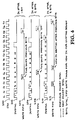
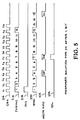
- Fig. 4-6 are timing diagrams for the various conditions of the ENDEC receiver of Figure 1.
- the present invention comprises a novel receiver portion of an encoder/decoder.
- the following description is presented to enable any person skilled in the art to make use of the invention and is provided in the context of a particular application and its requirements.
- a control element not shown in Fig. 1, provides control signals to the various elements shown in Fig. 1. Design and implementation of such control elements are well-known to those skilled in the art and, accordingly, will not be described herein.
- Serial data (Rx) is received on signal line 30 by a clock recovery block called the ENDEC Data Separator 50 which performs clock recovery and non-return-to-zero invert-on-ones (NRZI) to non-return-to-zero (NRZ) conversion.
- Block 50 generates a receiver clock signal (CRx) and the converted NRZ version of the serial data received on line 30.
- the CRx and NRZ signals are conducted to a serial-to-parallel shift register 52 of the receive portion of ENDEC.
- Shift register 52 produces therefrom ten-bit parallel "bytes" corresponding to ten bits received in series on line 30.
- the ten-bit "bytes" of data is transferred in parallel to a set of first input terminals to a multiplexer (MUX) 54.
- MUX 54 also receives in parallel at a set of second input terminals the code of the "JK" delimiter symbol.
- MUX 54 also receives a control signal (SEL) from sync modify logic 60 which causes either the ten signals representing the 10-bit data "byte” or the "JK” symbol to be generated at a set of ten output terminals of the MUX 54.
- SEL control signal
- Lookahead Logic Block 56 generates therefrom two logic signals; a JK1 signal which is set HIGH when a pattern of coded bits representing the JK symbol, shifted by ore bit position is present in the shift register 52.
- a JK2 signal is generated HIGH when the JK pattern, shifted by two bit positions, is present in the shift register 52.
- a byte synchronization (BYTE SYNC) block 58 receives the JK1 signal generated by Lookahead Logic Block 56.
- BYTE SYNC block 58 generates a byte alignment signal JK_SYNC once for every ten bits of serial data received on line 30.
- BYTE SYNC block 58 synchronizes its generation of the JK_SYNC signal with the reception of the one-bit lookahead signal JK1.
- a synchronization modify logic (SYNC MODIFY LOGIC) block 60 receives the JK_SYNC signal generated by BYTE SYNC 58 and the JK1 and JK2 signals generated by LOOKAHEAD LOGIC 56. SYNC MODIFY LOGIC block 60 also receives the CRx timing signal generated by block 50. SYNC MODIFY LOGIC 60 block generates a synchronization (SYNC) signal which is conducted to a DECODE block 62. A ten-bit "byte" selected to be generated at the output of MUX 54 is conducted in parallel to DECODE block 62, synchronized by the SYNC signal.
- SYNC MODIFY LOGIC receives the JK_SYNC signal generated by BYTE SYNC 58 and the JK1 and JK2 signals generated by LOOKAHEAD LOGIC 56. SYNC MODIFY LOGIC block 60 also receives the CRx timing signal generated by block 50. SYNC MODIFY LOGIC 60 block
- SYNC MODIFY LOGIC 60 generates a first level of the SEL signal received by MUX 54 during those times that this new SYNC is generated. This first level of SEL causes the MUX 54 to select the signals representing a JK symbol, as is applied to the second set of input terminals of MUX 54, to be conducted to the DECODE 62. At all other times, SYNC MODIFY LOGIC 60 generates a second level of the SEL signal which causes MUX 54 to select the signals representing parallel data, as applied to the first set of input terminals of MUX 54, to be conducted to the DECODE 62.
- SYNC MODIFY LOGIC block 60 also generates a WRITE signal which is conducted to a first-in, first-out (FIFO) buffer 64. Received symbols, are decoded in parallel by DECODE 62 and transferred in parallel to FIFO 64, synchronized by the WRITE signal.
- SYNC MODIFY LOGIC block 60 generates the WRITE signal delayed by three CRx time periods from the generation of the SYNC signal to permit signal stabilization and decoding to proceed.
- the SYNC register 68 receives the information from FIFO 64. This information is delivered to SYNC and Hold Logic 76 which is used to read in the data from the FIFO buffer 64 responsive to a byte clock signal 72 to the SYNC register 68.
- the register 70 clocks in the information from Sync register 68 by a second byte clock signal 74 which is one bit delayed from the first clock signal 72.
- the parallel information from register 70 is then provided to a media access control layer (not shown) which interprets the received information.
- a logic diagram of the LOOKAHEAD LOGIC block 56 is provided.
- the ten signals generated in parallel by shift register 52 are denoted thereon as A ⁇ 9..0>; arrayed from most-significant bit A ⁇ 9> to least-significant bit A ⁇ 0>.
- the complemented values of A ⁇ 9>, A ⁇ 8>, A ⁇ 7>, A ⁇ 4>, A ⁇ 3> and A ⁇ 0> are also shown in Fig. 2 denoted AL ⁇ 9>, AL ⁇ 8>, AL ⁇ 7>, AL ⁇ 4>, AL ⁇ 3> and AL ⁇ 0>, respectively.
- NRZL is also shown in Fig. 3, being the complemented value of the serial signal NRZ currently applied to the serial input of register 52.
- An OR gate 100 receives AL ⁇ 8>, A ⁇ 6> and A ⁇ 5>.
- An OR gate 102 receives the signal generated by OR gate 100 as well as A ⁇ 2> and A ⁇ 1>.
- the signal generated by OR gate 102 is conducted to a first input of a NOR gate 104 and a first input of a NOR gate 106.
- NOR gate 104 also receives at a second input a signal generated by an OR gate 108 which in turn receives AL ⁇ 9>, A ⁇ 7> and AL ⁇ 4>.
- NOR gate 104 receives a third input a signal generated by an OR gate 110 which in turn receives A ⁇ 3> and AL ⁇ 0>.
- NOR gate 106 receives at a second input a signal generated by an OR gate 112 which in turn receives AL ⁇ 7>, A ⁇ 4> and AL ⁇ 3>.
- NOR gate 106 receives at a third input a signal generated by an OR gate 114 which receives A ⁇ 0> and NRZL.
- NOR gates 104 and 106 generate the JK1 and JK2 signals, respectively.
- a logic diagram of the SYNC MODIFY LOGIC block 60 (Fig.1) is provided.
- the JK1 and JK2 signals generated by LOOKAHEAD LOGIC 56 (Fig. 1) are applied to an OR gate 120; the signal generated thereby is applied to a first input of an AND gate 122.
- the JK_SYNC signal is applied to a second input of AND gate 122 and to a first input of an OR gate 124.
- the signal generated by AND gate, 122 is applied to the first stage of a three-stage delay comprising serially coupled delay-type (D) flip-flops 126, 128 and 130.
- D delay-type
- Flip-flop 120 receives the CRx clock at a clock input, and the Q output of each stage is connected to the D input of the next stage, the signal generated at the Q output of the third-stage flip-flop 130 is the SEL signal. This signal is also conducted to the second input of OR gate 124. Reset signal is applied to serial coupled flip-flop 126-120 to reset the flip-flops during initial powerup. The signal generated by OR gate 124 is the SYNC signal. This signal is also conducted to the first stage of a three-stage delay write comprising serially coupled delay-type (D) flip-flops 132, 134 and 136. Flip-flops 132, 134 and 136 are connected to one another as are flip-flops 126, 128 and 130. The signal generated at the Q output of the third stage flip-flop 136 is the WRITE signal.
- D serially coupled delay-type
- the operation of the byte synchronizer of the instant invention is best understood by reference to Fig. 4; a waveform timing diagram of signals described above in connection with Fig. 1.
- the recovered clock (CRx) signal 200 is shown in Fig. 4, providing a reference for the various other signals shown thereon.
- the JK_SYNC signal 202 generated by BYTE SYNC 58 is shown as generated at the first CRx signal (t1); this generation being aligned with the previous packet's synchronization.
- a new JK symbol is detected one bit period after this generation of JK_SYNC; i.e., occurring during the second CRx signal (t2).
- the next packet's synchronization should be aligned to coincide with this new JK symbol.
- a JK_SYNC signal should be generated during t2, t12, etc., as shown in Fig. 4 in dashed lines.
- the WRITE signal to the FIFO 64 is not generated until the third CRx clock following JK_SYNC, the contents of the previous packet has not been transferred to FIFO 64; it is still in DECODE block 62 when the next packet arrives. If no precaution is taken, the last byte of the previous frame is thus overwritten, with attendant loss of data, when the WRITE signal 204 is generated at t5. If a new JK symbol is detected two bit periods after generation of JK_SYNC, as shown by waveform 206 occurring at t3; then again a WRITE signal 208 is generated at t6 also causing the contents of the previous packet to be overwritten.
- a WRITE signal 212 occurs at t4 permitting the contents of the last byte of the previous packet to be transferred to the FIFO and then another WRITE signal occurs at t7 permitting the contents of the newly-detected packet to be written to the FIFO.
- the SYNC MODIFY LOGIC block 60 generates the SYNC, SEL and WRITE FIFO signals in response to JK_SYNC and the JK1 and JK2 signals generated by BYTE SYNC 58 and LOOKAHEAD LOGIC 56, respectively, as shown in Figs. 5 and 6.
- the timing according to the instant invention when a new JK is detected one bit period after the previous JK_SYNC signal is described with reference to Fig. 5.
- the CRx signal 214 is used to provide a reference for the other signals.
- the JK_SYNC signal 216 is shown in Fig. 6 as occurring during the first CRx time period t1 and again during the second CRx time period t2, as was described in connection with waveforms 202 and 204 of Fig. 4. Because of the one-bit interval between the previous JK_SYNC and the new JK symbol, LOOKAHEAD LOGIC block 56 generates a JK1 signal 218 during time period t1.
- JK_SYNC causes a SYNC signal 220 to be generated during t1 by SYNC MODIFY LOGIC 60, and a WRITE signal 222 to be generated during t4; i.e., delayed by three CRx clock periods. Accordingly, the contents of the last byte of the previous packet is decoded and written to FIFO 64.
- the generation of JK1 during time period t1, along with the presence of JK_SYNC during t1 causes a SYNC signal to be generated during t4 causing the contents of the newly-arrived packet to be written to FIFO 64. In this manner, overwriting of the last byte of the previous packet is avoided.
- the situation when a new JK is detected during the second bit period following the previous JK_SYNC signal is shown in waveform timing diagram of Fig. 6. Again the CRx waveform 226 is used in Fig. 6 for reference.
- the JK_SYNC signal 228 is shown in Fig. 6 as occurring during the first CRx time period t3, as was described in connection with waveforms 206 and 208 of Fig. 4. Because of the two-bit interval between the previous JK SYNC and the new JK symbol, LOOKAHEAD LOGIC block 56 generates a JK2 signal 230 during time period t1.
- JK_SYNC causes a SYNC signal 232 to be generated during t1 by SYNC MODIFY LOGIC 60, and a WRITE signal 234 to be generated during t4. Accordingly, the contents of the last byte of the previous packet is decoded and written to FIFO 64.
- the generation of JK2 during time period t1, along with the presence of JK_SYNC during t1 causes a SYNC signal to be generated during t4 causing the contents of the newly-detected packet to be transferred to DECODE 62.
- a WRITE signal is then generated during t7, causing the contents of the newly-arrived packet to be written to FIFO 64.
- SYNC MODIFY LOGIC block 60 also generates at appropriate timings the SEL signal which causes MUX 54 to apply the JK delimiter symbol to the DECODE 62 input terminals. In this manner, overwriting of the last byte of the previous packet is avoided by the instant invention.
Landscapes
- Engineering & Computer Science (AREA)
- Multimedia (AREA)
- Computer Hardware Design (AREA)
- Computer Networks & Wireless Communication (AREA)
- Signal Processing (AREA)
- Synchronisation In Digital Transmission Systems (AREA)
- Communication Control (AREA)
- Error Detection And Correction (AREA)
- Data Exchanges In Wide-Area Networks (AREA)
- Small-Scale Networks (AREA)
Claims (5)
- Verfahren zum Justieren eines mit einem Paket-Beginn-Begrenzungszeichen ausgerichteten Synchronisiersignals, das für seriell empfangene Digitalsignale von einem Netzwerk, wobei die seriell empfangenen Signale eine vorbestimmte Zwischenbitperiode aufweisen, mit dem folgenden Schritt:(a) Umsetzen der seriell empfangenen Signale in Mehr-Bit-Parallelwörter;
und gekennzeichnet durch die weiteren Schritte:(b) Detektieren des Auftretens des Begrenzungszeichens während einer auf das am kürzesten zurückliegende Auftreten des Synchronisiersignals folgenden n-ten Zwischenbitperiode; und(c) Erzeugen des justierten Synchronisiersignals
zum Zeitpunkt der in Schritt (b) erfolgenden Detektion, falls n>2;
zu einem vom Zeitpunkt der in Schritt (b) erfolgenden Detektion um eine Zwischenbitperiode verzögerten Zeitpunkt, falls n=2; oder
zu einem vom Zeitpunkt der in Schritt (b) erfolgenden Detektion um zwei Zwischenbitperioden verzögerten Zeitpunkt, falls n=1. - Verfahren nach Anspruch 1, dadurch gekennzeichnet, daß die Mehr-Bit-Wörter dekodiert und dann parallel in einem elastischen Puffer gespeichert werden, und ferner gekennzeichnet durch die folgenden Schritte:(d) Eingeben des justierten Synchronisiersignals in den Dekodierer; und(e) Speichern der Wörter in dem Puffer drei Zwischenbitperioden nach der gemäß Schritt (d) erfolgenden Eingabe des Signals.
- Vorrichtung zum Dekodieren seriell empfangener Digitalsignale von einem Netzwerk, wobei die seriell empfangenen Signale eine vorbestimmte Zwischenbitperiode und ein mit einem Paket-Beginn-Begrenzungszeichen ausgerichtetes Synchronisiersignal aufweisen, mit:
einer auf die seriell empfangenen Signale reagierenden Einrichtung (50) zur Erzeugung eines regenerierten Taktsignals (CRX) aus diesen Signalen und zum Umsetzen der seriell empfangenen Signale (NRZ) entsprechend einem bestimmten Code;
einer auf das regenerierte Taktsignal und auf die umgesetzten seriellen Signale (NRZ) reagierenden Einrichtung (52), um daraus den seriell empfangenen Signalen (NRZ) entsprechend Mehr-Bit-Parallelwörter zu erzeugen;
einer Einrichtung (56,58,60), um in zeitlicher Relation zu dem Paket-Beginn-Begrenzungszeichen ein Synchronisiersignal zu erzeugen, die ausgebildet ist zum Detektieren des Auftretens des Begrenzungszeichens während einer auf das am kürzesten zurückliegende Auftreten des Synchronisiersignals folgenden n-ten Zwischenbitperiode, und zum Erzeugen des Synchronisiersignals
zum Zeitpunkt der Detektion, falls n>2;
zu einem vom Zeitpunkt der Detektion um eine Zwischenbitperiode verzögerten Zeitpunkt, falls n=2; oder
zu einem vom Zeitpunkt der Detektion um zwei Zwischenbitperioden verzögerten Zeitpunkt, falls n=1;
einer auf die Mehr-Bit-Parallelwörter und das Synchronisiersignal reagierenden Einrichtung (62), um bei Empfang des Synchronisiersignals die Mehr-Bit-Parallelwörter zu dekodieren und daraus Signale zu erzeugen, die die dekodierten Mehr-Bit-Parallelwörter repräsentieren. - Vorrichtung nach Anspruch 3, dadurch gekennzeichnet, daß die Erzeugungseinrichtung ferner ein WRITE-Signal erzeugt, und gekennzeichnet durch eine auf das WRITE-Signal und die dekodierten Mehr-Bit-Wörter reagierende First-in-first-out(FIFO)-Einrichtung (64) zum Speichern der dekodierten Mehr-Bit-Wörter.
- Vorrichtung nach Anspruch 3 oder 4, dadurch gekennzeichnet, daß die Erzeugungseinrichtung aufweist:
eine auf die Mehr-Bit-Parallelwörter und die seriell empfangenen Signale reagierende LOOKAHEAD-Einrichtung (56) zum Detektieren des Begrenzungszeichens während der auf das am kürzesten zurückliegende Auftreten des Synchronisiersignals nächstfolgenden Zwischenbitperiode und zum Erzeugen eines ersten Detektionssignals daraufhin, und zum Detektieren des Begrenzungszeichens während der um eine Zwischenbitperiode auf das am kürzesten zurückliegende Auftreten des Synchronisiersignals folgenden Zwischenbitperiode und zum Erzeugen eines zweiten Detektionssignals daraufhin, und
eine auf die ersten und die zweiten Detektionssignale und auf das regenerierte Taktsignal reagierende Einrichtung (58) zum Erzeugen des mit dem Paket-Beginn-Begrenzungszeichen ausgerichteten Synchronisiersignals, und zwar, bei Abwesenheit des ersten oder des zweiten Detektionssignals, mit einer Verzögerung um zwei Zwischenbitperioden bei Empfang des ersten Detektionssignals und mit einer Verzögerung um eine Zwischenbitperiode bei Empfang des zweiten Detektionssignals.
Applications Claiming Priority (2)
| Application Number | Priority Date | Filing Date | Title |
|---|---|---|---|
| US07/268,396 US4890304A (en) | 1988-11-07 | 1988-11-07 | Reliable recovery of data in encoder/decoder |
| US268396 | 1999-03-15 |
Publications (3)
| Publication Number | Publication Date |
|---|---|
| EP0368537A2 EP0368537A2 (de) | 1990-05-16 |
| EP0368537A3 EP0368537A3 (de) | 1991-06-05 |
| EP0368537B1 true EP0368537B1 (de) | 1995-01-18 |
Family
ID=23022819
Family Applications (1)
| Application Number | Title | Priority Date | Filing Date |
|---|---|---|---|
| EP89311245A Expired - Lifetime EP0368537B1 (de) | 1988-11-07 | 1989-10-31 | Zuverlässige Datenrückgewinnung in einem Kodierer/Dekodierer |
Country Status (5)
| Country | Link |
|---|---|
| US (1) | US4890304A (de) |
| EP (1) | EP0368537B1 (de) |
| JP (1) | JP2578668B2 (de) |
| AT (1) | ATE117484T1 (de) |
| DE (1) | DE68920703T2 (de) |
Families Citing this family (8)
| Publication number | Priority date | Publication date | Assignee | Title |
|---|---|---|---|---|
| US5063575A (en) * | 1989-04-17 | 1991-11-05 | Advanced Micro Devices, Inc. | Apparatus and method for proper byte alignment in an encoder/decoder |
| JP2811802B2 (ja) * | 1989-09-20 | 1998-10-15 | ソニー株式会社 | 情報伝送装置 |
| US5539727A (en) * | 1992-04-14 | 1996-07-23 | Kramarczyk; Marian | Method and apparatus for configuring and maintaining token ring networks |
| US5351242A (en) * | 1992-04-14 | 1994-09-27 | Marian Kramarczyk | Method and apparatus for configuring and maintaining token ring networks |
| US5491802A (en) * | 1992-05-29 | 1996-02-13 | Hewlett-Packard Company | Network adapter for inserting pad bytes into packet link headers based on destination service access point fields for efficient memory transfer |
| US5457690A (en) * | 1994-01-03 | 1995-10-10 | Integrated Network Corporation | DTMF Signaling on four-wire switched 56 Kbps Lines |
| DE4431023C2 (de) * | 1994-08-31 | 1996-10-02 | Siemens Ag | Verfahren zur Neusynchronisation eines Datenempfangsgerätes |
| US5719904A (en) * | 1994-10-13 | 1998-02-17 | Samsung Electronics Co., Ltd. | Data restoring circuit |
Family Cites Families (9)
| Publication number | Priority date | Publication date | Assignee | Title |
|---|---|---|---|---|
| US4135156A (en) * | 1974-06-20 | 1979-01-16 | Sanders Associates, Inc. | Satellite communications system incorporating ground relay station through which messages between terminal stations are routed |
| JPS55107360A (en) * | 1979-02-08 | 1980-08-18 | Matsushita Electric Ind Co Ltd | Detector for synchronizing signal |
| GB2089178B (en) * | 1980-11-18 | 1984-07-04 | Sony Corp | Digital signal processing |
| JPS59221047A (ja) * | 1983-05-30 | 1984-12-12 | Victor Co Of Japan Ltd | デイジタル信号伝送における同期信号検出回路 |
| FR2563398B1 (fr) * | 1984-04-20 | 1986-06-13 | Bojarski Alain | Procede et dispositif de recuperation du verrouillage de trame pour un mot de verrouillage de trame a bits repartis dans la trame |
| FR2586150B1 (fr) * | 1985-08-07 | 1987-10-23 | Thomson Csf Mat Tel | Dispositif de transmission de paquets dans un reseau temporel asynchrone, et procede de codage des silences |
| ATE51988T1 (de) * | 1985-09-11 | 1990-04-15 | Siemens Ag | Verfahren und schaltungsanordnung zum ubertragen von datensignalen zwischen ueber ein ringleitungssystem miteinander verbundenen steuereinrichtungen. |
| JPS62230177A (ja) * | 1986-03-31 | 1987-10-08 | Toshiba Corp | 文字放送受信装置 |
| US4964142A (en) * | 1987-07-15 | 1990-10-16 | Kadiresan Annamalai | Receiver synchronization in encoder/decoder |
-
1988
- 1988-11-07 US US07/268,396 patent/US4890304A/en not_active Expired - Lifetime
-
1989
- 1989-10-31 AT AT89311245T patent/ATE117484T1/de active
- 1989-10-31 DE DE68920703T patent/DE68920703T2/de not_active Expired - Fee Related
- 1989-10-31 EP EP89311245A patent/EP0368537B1/de not_active Expired - Lifetime
- 1989-11-07 JP JP1289825A patent/JP2578668B2/ja not_active Expired - Lifetime
Also Published As
| Publication number | Publication date |
|---|---|
| EP0368537A3 (de) | 1991-06-05 |
| ATE117484T1 (de) | 1995-02-15 |
| DE68920703D1 (de) | 1995-03-02 |
| EP0368537A2 (de) | 1990-05-16 |
| JP2578668B2 (ja) | 1997-02-05 |
| US4890304A (en) | 1989-12-26 |
| JPH02181536A (ja) | 1990-07-16 |
| DE68920703T2 (de) | 1995-08-03 |
Similar Documents
| Publication | Publication Date | Title |
|---|---|---|
| CA1289249C (en) | Parallel transmission system | |
| EP0545915B1 (de) | Anordnung zum Senden von ein digitalisiertes analoges Signal darstellenden Datenwörtern | |
| US4813040A (en) | Method and apparatus for transmitting digital data and real-time digitalized voice information over a communications channel | |
| US4945548A (en) | Method and apparatus for detecting impending overflow and/or underrun of elasticity buffer | |
| US4584690A (en) | Alternate Mark Invert (AMI) transceiver with switchable detection and digital precompensation | |
| JPH055710Y2 (de) | ||
| KR0150214B1 (ko) | 바이트 폭 탄성 버퍼 | |
| US4849969A (en) | Implementation of smoothing apparatus for an independently clocked network | |
| US4095053A (en) | Quasi-pulse stuffing synchronization | |
| JPS59214357A (ja) | リング通信システム | |
| US4849970A (en) | Smoothing apparatus for an independently clocked network | |
| US6404780B1 (en) | Synchronizing data transfer protocol across high voltage interface | |
| US4890304A (en) | Reliable recovery of data in encoder/decoder | |
| EP0393952B1 (de) | Einrichtung und Verfahren zur richtigen Dekodierung in einem Kodierer/Dekodierer | |
| US5179664A (en) | Symbol-wide elasticity buffer with a read-only section and a read-write section | |
| JPS59139747A (ja) | デジタル伝送回線上の設備を遠隔監視する方法及び装置 | |
| EP0396669B1 (de) | Verfahren und anordnung zur wahrnehmung bevorstehender überläufe und/oder unterschreitungen eines elastischen puffers | |
| EP0299265A2 (de) | Empfängersynchronisation in einer Anordnung zur Kodierung/Dekodierung | |
| US5636248A (en) | Method and system for regenerating amplitude and timing characteristics of an analog signal | |
| Johannes et al. | Multiplexing of asynchronous digital signals using pulse stuffing with added-bit signaling | |
| US5579320A (en) | Channel unit transmission for removing false data bits in adjacent unterminated channel slots for D4 and SLC-96 channel banks | |
| KR930007133B1 (ko) | 동기식 다중장치의 대기시간지터 감소회로 | |
| EP0364170B1 (de) | Serielle Übertragungsstrecke für hohe Datenraten | |
| EP1232566A1 (de) | Verfahren und vorrichtung zur korrektur von unvollständig ausgeglichenen bipolaren signalen | |
| WO1994011952A1 (en) | Pseudo clock extractor |
Legal Events
| Date | Code | Title | Description |
|---|---|---|---|
| PUAI | Public reference made under article 153(3) epc to a published international application that has entered the european phase |
Free format text: ORIGINAL CODE: 0009012 |
|
| AK | Designated contracting states |
Kind code of ref document: A2 Designated state(s): AT BE CH DE ES FR GB GR IT LI LU NL SE |
|
| PUAL | Search report despatched |
Free format text: ORIGINAL CODE: 0009013 |
|
| AK | Designated contracting states |
Kind code of ref document: A3 Designated state(s): AT BE CH DE ES FR GB GR IT LI LU NL SE |
|
| 17P | Request for examination filed |
Effective date: 19910909 |
|
| 17Q | First examination report despatched |
Effective date: 19930615 |
|
| GRAA | (expected) grant |
Free format text: ORIGINAL CODE: 0009210 |
|
| AK | Designated contracting states |
Kind code of ref document: B1 Designated state(s): AT BE CH DE ES FR GB GR IT LI LU NL SE |
|
| PG25 | Lapsed in a contracting state [announced via postgrant information from national office to epo] |
Ref country code: GR Free format text: LAPSE BECAUSE OF FAILURE TO SUBMIT A TRANSLATION OF THE DESCRIPTION OR TO PAY THE FEE WITHIN THE PRESCRIBED TIME-LIMIT Effective date: 19950118 Ref country code: ES Free format text: THE PATENT HAS BEEN ANNULLED BY A DECISION OF A NATIONAL AUTHORITY Effective date: 19950118 |
|
| REF | Corresponds to: |
Ref document number: 117484 Country of ref document: AT Date of ref document: 19950215 Kind code of ref document: T |
|
| EAL | Se: european patent in force in sweden |
Ref document number: 89311245.8 |
|
| REF | Corresponds to: |
Ref document number: 68920703 Country of ref document: DE Date of ref document: 19950302 |
|
| ITF | It: translation for a ep patent filed | ||
| ET | Fr: translation filed | ||
| PLBE | No opposition filed within time limit |
Free format text: ORIGINAL CODE: 0009261 |
|
| STAA | Information on the status of an ep patent application or granted ep patent |
Free format text: STATUS: NO OPPOSITION FILED WITHIN TIME LIMIT |
|
| 26N | No opposition filed | ||
| PGFP | Annual fee paid to national office [announced via postgrant information from national office to epo] |
Ref country code: AT Payment date: 19970918 Year of fee payment: 9 |
|
| PGFP | Annual fee paid to national office [announced via postgrant information from national office to epo] |
Ref country code: SE Payment date: 19971006 Year of fee payment: 9 |
|
| PGFP | Annual fee paid to national office [announced via postgrant information from national office to epo] |
Ref country code: BE Payment date: 19971105 Year of fee payment: 9 |
|
| PGFP | Annual fee paid to national office [announced via postgrant information from national office to epo] |
Ref country code: CH Payment date: 19980109 Year of fee payment: 9 |
|
| PGFP | Annual fee paid to national office [announced via postgrant information from national office to epo] |
Ref country code: LU Payment date: 19980306 Year of fee payment: 9 |
|
| PG25 | Lapsed in a contracting state [announced via postgrant information from national office to epo] |
Ref country code: LU Free format text: LAPSE BECAUSE OF NON-PAYMENT OF DUE FEES Effective date: 19981031 Ref country code: LI Free format text: LAPSE BECAUSE OF NON-PAYMENT OF DUE FEES Effective date: 19981031 Ref country code: CH Free format text: LAPSE BECAUSE OF NON-PAYMENT OF DUE FEES Effective date: 19981031 Ref country code: BE Free format text: LAPSE BECAUSE OF NON-PAYMENT OF DUE FEES Effective date: 19981031 Ref country code: AT Free format text: LAPSE BECAUSE OF NON-PAYMENT OF DUE FEES Effective date: 19981031 |
|
| PG25 | Lapsed in a contracting state [announced via postgrant information from national office to epo] |
Ref country code: SE Free format text: LAPSE BECAUSE OF NON-PAYMENT OF DUE FEES Effective date: 19981101 |
|
| BERE | Be: lapsed |
Owner name: ADVANCED MICRO DEVICES INC. Effective date: 19981031 |
|
| REG | Reference to a national code |
Ref country code: CH Ref legal event code: PL |
|
| EUG | Se: european patent has lapsed |
Ref document number: 89311245.8 |
|
| PGFP | Annual fee paid to national office [announced via postgrant information from national office to epo] |
Ref country code: GB Payment date: 20000918 Year of fee payment: 12 |
|
| PGFP | Annual fee paid to national office [announced via postgrant information from national office to epo] |
Ref country code: NL Payment date: 20000929 Year of fee payment: 12 |
|
| PGFP | Annual fee paid to national office [announced via postgrant information from national office to epo] |
Ref country code: FR Payment date: 20001009 Year of fee payment: 12 |
|
| PGFP | Annual fee paid to national office [announced via postgrant information from national office to epo] |
Ref country code: DE Payment date: 20011030 Year of fee payment: 13 |
|
| PG25 | Lapsed in a contracting state [announced via postgrant information from national office to epo] |
Ref country code: GB Free format text: LAPSE BECAUSE OF NON-PAYMENT OF DUE FEES Effective date: 20011031 |
|
| REG | Reference to a national code |
Ref country code: GB Ref legal event code: IF02 |
|
| PG25 | Lapsed in a contracting state [announced via postgrant information from national office to epo] |
Ref country code: NL Free format text: LAPSE BECAUSE OF NON-PAYMENT OF DUE FEES Effective date: 20020501 |
|
| GBPC | Gb: european patent ceased through non-payment of renewal fee |
Effective date: 20011031 |
|
| PG25 | Lapsed in a contracting state [announced via postgrant information from national office to epo] |
Ref country code: FR Free format text: LAPSE BECAUSE OF NON-PAYMENT OF DUE FEES Effective date: 20020628 |
|
| NLV4 | Nl: lapsed or anulled due to non-payment of the annual fee |
Effective date: 20020501 |
|
| REG | Reference to a national code |
Ref country code: FR Ref legal event code: ST |
|
| PG25 | Lapsed in a contracting state [announced via postgrant information from national office to epo] |
Ref country code: DE Free format text: LAPSE BECAUSE OF NON-PAYMENT OF DUE FEES Effective date: 20030501 |
|
| PG25 | Lapsed in a contracting state [announced via postgrant information from national office to epo] |
Ref country code: IT Free format text: LAPSE BECAUSE OF NON-PAYMENT OF DUE FEES;WARNING: LAPSES OF ITALIAN PATENTS WITH EFFECTIVE DATE BEFORE 2007 MAY HAVE OCCURRED AT ANY TIME BEFORE 2007. THE CORRECT EFFECTIVE DATE MAY BE DIFFERENT FROM THE ONE RECORDED. Effective date: 20051031 |