EP0368912B1 - Polyanhydrides ayant des proprietes de degradation hydrolytiques ameliorees - Google Patents
Polyanhydrides ayant des proprietes de degradation hydrolytiques ameliorees Download PDFInfo
- Publication number
- EP0368912B1 EP0368912B1 EP88906761A EP88906761A EP0368912B1 EP 0368912 B1 EP0368912 B1 EP 0368912B1 EP 88906761 A EP88906761 A EP 88906761A EP 88906761 A EP88906761 A EP 88906761A EP 0368912 B1 EP0368912 B1 EP 0368912B1
- Authority
- EP
- European Patent Office
- Prior art keywords
- polymer
- bioactive compound
- aliphatic
- polyanhydrides
- degradation
- Prior art date
- Legal status (The legal status is an assumption and is not a legal conclusion. Google has not performed a legal analysis and makes no representation as to the accuracy of the status listed.)
- Expired - Lifetime
Links
- 230000015556 catabolic process Effects 0.000 title claims abstract description 41
- 238000006731 degradation reaction Methods 0.000 title claims abstract description 41
- 229920002732 Polyanhydride Polymers 0.000 title claims abstract description 35
- 230000003301 hydrolyzing effect Effects 0.000 title description 8
- 229920000642 polymer Polymers 0.000 claims abstract description 60
- 239000011159 matrix material Substances 0.000 claims abstract description 46
- 150000001875 compounds Chemical class 0.000 claims abstract description 32
- 125000001931 aliphatic group Chemical group 0.000 claims abstract description 30
- 238000000034 method Methods 0.000 claims abstract description 24
- 230000000975 bioactive effect Effects 0.000 claims abstract description 23
- 239000003814 drug Substances 0.000 claims abstract description 23
- 229940079593 drug Drugs 0.000 claims abstract description 23
- 125000003118 aryl group Chemical group 0.000 claims abstract description 22
- 238000002844 melting Methods 0.000 claims abstract description 20
- 230000008018 melting Effects 0.000 claims abstract description 20
- 239000002253 acid Substances 0.000 claims abstract description 10
- 239000003960 organic solvent Substances 0.000 claims abstract description 9
- 238000009827 uniform distribution Methods 0.000 claims abstract description 7
- 239000000599 controlled substance Substances 0.000 claims abstract description 6
- 238000012377 drug delivery Methods 0.000 claims abstract description 6
- 239000000178 monomer Substances 0.000 claims description 20
- QACUUGBVDGMIQH-UHFFFAOYSA-N 4-(1-carboxybutoxy)benzoic acid Chemical compound CCCC(C(O)=O)OC1=CC=C(C(O)=O)C=C1 QACUUGBVDGMIQH-UHFFFAOYSA-N 0.000 claims description 17
- 238000006116 polymerization reaction Methods 0.000 claims description 5
- SANQYXVPRGSGCN-UHFFFAOYSA-N 4-(1-carboxyheptoxy)benzoic acid Chemical compound CCCCCCC(C(O)=O)OC1=CC=C(C(O)=O)C=C1 SANQYXVPRGSGCN-UHFFFAOYSA-N 0.000 claims description 2
- 150000001720 carbohydrates Chemical class 0.000 claims description 2
- 150000007523 nucleic acids Chemical group 0.000 claims description 2
- 102000004169 proteins and genes Human genes 0.000 claims description 2
- 108090000623 proteins and genes Proteins 0.000 claims description 2
- 230000000379 polymerizing effect Effects 0.000 claims 3
- 108091028043 Nucleic acid sequence Proteins 0.000 claims 1
- 230000005465 channeling Effects 0.000 abstract description 7
- 150000007513 acids Chemical class 0.000 abstract description 6
- 238000010528 free radical solution polymerization reaction Methods 0.000 abstract description 6
- 125000000217 alkyl group Chemical group 0.000 abstract description 3
- 238000012643 polycondensation polymerization Methods 0.000 abstract description 2
- WFDIJRYMOXRFFG-UHFFFAOYSA-N Acetic anhydride Chemical compound CC(=O)OC(C)=O WFDIJRYMOXRFFG-UHFFFAOYSA-N 0.000 description 18
- -1 bis(p-carboxyphenoxy) methane anhydride Chemical class 0.000 description 17
- 230000003628 erosive effect Effects 0.000 description 15
- 239000000243 solution Substances 0.000 description 15
- HEDRZPFGACZZDS-UHFFFAOYSA-N Chloroform Chemical compound ClC(Cl)Cl HEDRZPFGACZZDS-UHFFFAOYSA-N 0.000 description 14
- TYMLOMAKGOJONV-UHFFFAOYSA-N 4-nitroaniline Chemical compound NC1=CC=C([N+]([O-])=O)C=C1 TYMLOMAKGOJONV-UHFFFAOYSA-N 0.000 description 10
- RTZKZFJDLAIYFH-UHFFFAOYSA-N Diethyl ether Chemical compound CCOCC RTZKZFJDLAIYFH-UHFFFAOYSA-N 0.000 description 10
- 239000000203 mixture Substances 0.000 description 10
- 230000007062 hydrolysis Effects 0.000 description 9
- 238000006460 hydrolysis reaction Methods 0.000 description 9
- 150000008064 anhydrides Chemical class 0.000 description 8
- 238000013270 controlled release Methods 0.000 description 8
- OKKJLVBELUTLKV-UHFFFAOYSA-N Methanol Chemical compound OC OKKJLVBELUTLKV-UHFFFAOYSA-N 0.000 description 6
- ZMANZCXQSJIPKH-UHFFFAOYSA-N Triethylamine Chemical compound CCN(CC)CC ZMANZCXQSJIPKH-UHFFFAOYSA-N 0.000 description 6
- 238000006243 chemical reaction Methods 0.000 description 6
- 238000006068 polycondensation reaction Methods 0.000 description 5
- 239000000126 substance Substances 0.000 description 5
- FAPWRFPIFSIZLT-UHFFFAOYSA-M Sodium chloride Chemical compound [Na+].[Cl-] FAPWRFPIFSIZLT-UHFFFAOYSA-M 0.000 description 4
- 229920001577 copolymer Polymers 0.000 description 4
- 238000007405 data analysis Methods 0.000 description 4
- 238000001914 filtration Methods 0.000 description 4
- 238000001727 in vivo Methods 0.000 description 4
- 125000001570 methylene group Chemical group [H]C([H])([*:1])[*:2] 0.000 description 4
- 239000004005 microsphere Substances 0.000 description 4
- 229920000075 poly(4-vinylpyridine) Polymers 0.000 description 4
- 238000010992 reflux Methods 0.000 description 4
- CXMXRPHRNRROMY-UHFFFAOYSA-N sebacic acid Chemical compound OC(=O)CCCCCCCCC(O)=O CXMXRPHRNRROMY-UHFFFAOYSA-N 0.000 description 4
- XLYOFNOQVPJJNP-UHFFFAOYSA-N water Substances O XLYOFNOQVPJJNP-UHFFFAOYSA-N 0.000 description 4
- YMWUJEATGCHHMB-UHFFFAOYSA-N Dichloromethane Chemical compound ClCCl YMWUJEATGCHHMB-UHFFFAOYSA-N 0.000 description 3
- 229920001710 Polyorthoester Polymers 0.000 description 3
- HEMHJVSKTPXQMS-UHFFFAOYSA-M Sodium hydroxide Chemical compound [OH-].[Na+] HEMHJVSKTPXQMS-UHFFFAOYSA-M 0.000 description 3
- 230000015572 biosynthetic process Effects 0.000 description 3
- 239000007857 degradation product Substances 0.000 description 3
- 238000001746 injection moulding Methods 0.000 description 3
- 239000003208 petroleum Substances 0.000 description 3
- 239000011148 porous material Substances 0.000 description 3
- 239000002244 precipitate Substances 0.000 description 3
- 238000003786 synthesis reaction Methods 0.000 description 3
- CPYWEYCFUNAHOK-UHFFFAOYSA-N 4-[1-[2-(4-carboxyphenoxy)pentanoyloxy]-1-oxopentan-2-yl]oxybenzoic acid Chemical compound C=1C=C(C(O)=O)C=CC=1OC(CCC)C(=O)OC(=O)C(CCC)OC1=CC=C(C(O)=O)C=C1 CPYWEYCFUNAHOK-UHFFFAOYSA-N 0.000 description 2
- CSCPPACGZOOCGX-UHFFFAOYSA-N Acetone Chemical compound CC(C)=O CSCPPACGZOOCGX-UHFFFAOYSA-N 0.000 description 2
- IJGRMHOSHXDMSA-UHFFFAOYSA-N Atomic nitrogen Chemical compound N#N IJGRMHOSHXDMSA-UHFFFAOYSA-N 0.000 description 2
- 238000005481 NMR spectroscopy Methods 0.000 description 2
- HEDRZPFGACZZDS-MICDWDOJSA-N Trichloro(2H)methane Chemical compound [2H]C(Cl)(Cl)Cl HEDRZPFGACZZDS-MICDWDOJSA-N 0.000 description 2
- 239000000654 additive Substances 0.000 description 2
- 238000004458 analytical method Methods 0.000 description 2
- 239000003054 catalyst Substances 0.000 description 2
- 238000003776 cleavage reaction Methods 0.000 description 2
- 238000000748 compression moulding Methods 0.000 description 2
- HCUYBXPSSCRKRF-UHFFFAOYSA-N diphosgene Chemical compound ClC(=O)OC(Cl)(Cl)Cl HCUYBXPSSCRKRF-UHFFFAOYSA-N 0.000 description 2
- 238000009826 distribution Methods 0.000 description 2
- 238000002329 infrared spectrum Methods 0.000 description 2
- 230000010354 integration Effects 0.000 description 2
- JVTAAEKCZFNVCJ-UHFFFAOYSA-N lactic acid Chemical compound CC(O)C(O)=O JVTAAEKCZFNVCJ-UHFFFAOYSA-N 0.000 description 2
- 239000008363 phosphate buffer Substances 0.000 description 2
- 229920000728 polyester Polymers 0.000 description 2
- 238000002360 preparation method Methods 0.000 description 2
- 238000000425 proton nuclear magnetic resonance spectrum Methods 0.000 description 2
- 230000007017 scission Effects 0.000 description 2
- 239000011780 sodium chloride Substances 0.000 description 2
- 238000003756 stirring Methods 0.000 description 2
- NNJYZJFCQHAVHK-UHFFFAOYSA-N 4-(1-methoxy-1-oxooctan-2-yl)oxybenzoic acid Chemical compound CCCCCCC(C(=O)OC)OC1=CC=C(C(O)=O)C=C1 NNJYZJFCQHAVHK-UHFFFAOYSA-N 0.000 description 1
- XWLGNUTZOARNMQ-UHFFFAOYSA-N 4-(1-methoxy-1-oxopentan-2-yl)oxybenzoic acid Chemical compound CCCC(C(=O)OC)OC1=CC=C(C(O)=O)C=C1 XWLGNUTZOARNMQ-UHFFFAOYSA-N 0.000 description 1
- SPBVJVFCFLINPJ-UHFFFAOYSA-N 4-(2-methoxy-2-oxoethoxy)benzoic acid Chemical compound COC(=O)COC1=CC=C(C(O)=O)C=C1 SPBVJVFCFLINPJ-UHFFFAOYSA-N 0.000 description 1
- LABJFIBQJFPXHZ-UHFFFAOYSA-N 4-(carboxymethoxy)benzoic acid Chemical compound OC(=O)COC1=CC=C(C(O)=O)C=C1 LABJFIBQJFPXHZ-UHFFFAOYSA-N 0.000 description 1
- LPERYSLKUWXSIR-UHFFFAOYSA-N 4-[1-[2-(4-carboxyphenoxy)octanoyloxy]-1-oxooctan-2-yl]oxybenzoic acid Chemical compound C=1C=C(C(O)=O)C=CC=1OC(CCCCCC)C(=O)OC(=O)C(CCCCCC)OC1=CC=C(C(O)=O)C=C1 LPERYSLKUWXSIR-UHFFFAOYSA-N 0.000 description 1
- YZOLSBWAOQHPFJ-UHFFFAOYSA-N 4-[2-[2-(4-carboxyphenoxy)acetyl]oxy-2-oxoethoxy]benzoic acid Chemical compound C1=CC(C(=O)O)=CC=C1OCC(=O)OC(=O)COC1=CC=C(C(O)=O)C=C1 YZOLSBWAOQHPFJ-UHFFFAOYSA-N 0.000 description 1
- VBISQLWPGDULSX-UHFFFAOYSA-N 4-[3-(4-carboxyphenoxy)propoxy]benzoic acid Chemical compound C1=CC(C(=O)O)=CC=C1OCCCOC1=CC=C(C(O)=O)C=C1 VBISQLWPGDULSX-UHFFFAOYSA-N 0.000 description 1
- ATEFPOUAMCWAQS-UHFFFAOYSA-N 7,8-dihydroxycoumarin Chemical compound C1=CC(=O)OC2=C(O)C(O)=CC=C21 ATEFPOUAMCWAQS-UHFFFAOYSA-N 0.000 description 1
- CURLTUGMZLYLDI-UHFFFAOYSA-N Carbon dioxide Chemical compound O=C=O CURLTUGMZLYLDI-UHFFFAOYSA-N 0.000 description 1
- VYZAMTAEIAYCRO-UHFFFAOYSA-N Chromium Chemical compound [Cr] VYZAMTAEIAYCRO-UHFFFAOYSA-N 0.000 description 1
- AEMRFAOFKBGASW-UHFFFAOYSA-N Glycolic acid Natural products OCC(O)=O AEMRFAOFKBGASW-UHFFFAOYSA-N 0.000 description 1
- DGAQECJNVWCQMB-PUAWFVPOSA-M Ilexoside XXIX Chemical compound C[C@@H]1CC[C@@]2(CC[C@@]3(C(=CC[C@H]4[C@]3(CC[C@@H]5[C@@]4(CC[C@@H](C5(C)C)OS(=O)(=O)[O-])C)C)[C@@H]2[C@]1(C)O)C)C(=O)O[C@H]6[C@@H]([C@H]([C@@H]([C@H](O6)CO)O)O)O.[Na+] DGAQECJNVWCQMB-PUAWFVPOSA-M 0.000 description 1
- 239000004952 Polyamide Substances 0.000 description 1
- 108010020346 Polyglutamic Acid Proteins 0.000 description 1
- 239000004793 Polystyrene Substances 0.000 description 1
- KEAYESYHFKHZAL-UHFFFAOYSA-N Sodium Chemical compound [Na] KEAYESYHFKHZAL-UHFFFAOYSA-N 0.000 description 1
- 238000002835 absorbance Methods 0.000 description 1
- 238000010521 absorption reaction Methods 0.000 description 1
- 230000002378 acidificating effect Effects 0.000 description 1
- 239000012736 aqueous medium Substances 0.000 description 1
- 230000004071 biological effect Effects 0.000 description 1
- 239000012620 biological material Substances 0.000 description 1
- 229940088623 biologically active substance Drugs 0.000 description 1
- 239000007853 buffer solution Substances 0.000 description 1
- 235000011089 carbon dioxide Nutrition 0.000 description 1
- 230000000052 comparative effect Effects 0.000 description 1
- 238000004590 computer program Methods 0.000 description 1
- 238000009833 condensation Methods 0.000 description 1
- 239000007859 condensation product Substances 0.000 description 1
- 238000007334 copolymerization reaction Methods 0.000 description 1
- 239000007822 coupling agent Substances 0.000 description 1
- 230000006378 damage Effects 0.000 description 1
- 230000001419 dependent effect Effects 0.000 description 1
- 150000005690 diesters Chemical class 0.000 description 1
- 239000003937 drug carrier Substances 0.000 description 1
- 238000001035 drying Methods 0.000 description 1
- 238000000921 elemental analysis Methods 0.000 description 1
- 150000002148 esters Chemical class 0.000 description 1
- 238000013213 extrapolation Methods 0.000 description 1
- 239000000706 filtrate Substances 0.000 description 1
- 239000011521 glass Substances 0.000 description 1
- 238000010438 heat treatment Methods 0.000 description 1
- 239000005556 hormone Substances 0.000 description 1
- 229940088597 hormone Drugs 0.000 description 1
- 230000002209 hydrophobic effect Effects 0.000 description 1
- 229920001600 hydrophobic polymer Polymers 0.000 description 1
- 239000005457 ice water Substances 0.000 description 1
- 238000010348 incorporation Methods 0.000 description 1
- 239000005367 kimax Substances 0.000 description 1
- 230000007774 longterm Effects 0.000 description 1
- 229920002521 macromolecule Polymers 0.000 description 1
- 238000004519 manufacturing process Methods 0.000 description 1
- 239000000463 material Substances 0.000 description 1
- 238000005259 measurement Methods 0.000 description 1
- YDCHPLOFQATIDS-UHFFFAOYSA-N methyl 2-bromoacetate Chemical compound COC(=O)CBr YDCHPLOFQATIDS-UHFFFAOYSA-N 0.000 description 1
- RAVVJKCSZXAIQP-UHFFFAOYSA-N methyl 5-bromopentanoate Chemical compound COC(=O)CCCCBr RAVVJKCSZXAIQP-UHFFFAOYSA-N 0.000 description 1
- IZIJRYNUYQXBPG-UHFFFAOYSA-N methyl 8-bromooctanoate Chemical compound COC(=O)CCCCCCCBr IZIJRYNUYQXBPG-UHFFFAOYSA-N 0.000 description 1
- 150000004702 methyl esters Chemical class 0.000 description 1
- 125000002496 methyl group Chemical group [H]C([H])([H])* 0.000 description 1
- 235000010270 methyl p-hydroxybenzoate Nutrition 0.000 description 1
- 239000004292 methyl p-hydroxybenzoate Substances 0.000 description 1
- LXCFILQKKLGQFO-UHFFFAOYSA-N methylparaben Chemical compound COC(=O)C1=CC=C(O)C=C1 LXCFILQKKLGQFO-UHFFFAOYSA-N 0.000 description 1
- 229910052757 nitrogen Inorganic materials 0.000 description 1
- 231100000065 noncytotoxic Toxicity 0.000 description 1
- 230000002020 noncytotoxic effect Effects 0.000 description 1
- 230000002352 nonmutagenic effect Effects 0.000 description 1
- 102000039446 nucleic acids Human genes 0.000 description 1
- 108020004707 nucleic acids Proteins 0.000 description 1
- 230000003287 optical effect Effects 0.000 description 1
- 150000002905 orthoesters Chemical class 0.000 description 1
- 239000008188 pellet Substances 0.000 description 1
- 230000035515 penetration Effects 0.000 description 1
- 229920000747 poly(lactic acid) Polymers 0.000 description 1
- 229920002627 poly(phosphazenes) Polymers 0.000 description 1
- 229920002239 polyacrylonitrile Polymers 0.000 description 1
- 229920002647 polyamide Polymers 0.000 description 1
- 229920001610 polycaprolactone Polymers 0.000 description 1
- 239000004632 polycaprolactone Substances 0.000 description 1
- 229920002643 polyglutamic acid Polymers 0.000 description 1
- 239000004626 polylactic acid Substances 0.000 description 1
- 238000012667 polymer degradation Methods 0.000 description 1
- 229920002223 polystyrene Polymers 0.000 description 1
- 229920002635 polyurethane Polymers 0.000 description 1
- 239000004814 polyurethane Substances 0.000 description 1
- 238000001556 precipitation Methods 0.000 description 1
- 230000002028 premature Effects 0.000 description 1
- 239000000047 product Substances 0.000 description 1
- 230000001737 promoting effect Effects 0.000 description 1
- 239000011541 reaction mixture Substances 0.000 description 1
- 238000009877 rendering Methods 0.000 description 1
- 230000035945 sensitivity Effects 0.000 description 1
- 229910052708 sodium Inorganic materials 0.000 description 1
- 239000011734 sodium Substances 0.000 description 1
- 239000002904 solvent Substances 0.000 description 1
- 238000000807 solvent casting Methods 0.000 description 1
- 239000011877 solvent mixture Substances 0.000 description 1
- 230000003595 spectral effect Effects 0.000 description 1
- 238000004611 spectroscopical analysis Methods 0.000 description 1
- 239000012258 stirred mixture Substances 0.000 description 1
- 238000003860 storage Methods 0.000 description 1
- QAOWNCQODCNURD-UHFFFAOYSA-N sulfuric acid Substances OS(O)(=O)=O QAOWNCQODCNURD-UHFFFAOYSA-N 0.000 description 1
- 230000002194 synthesizing effect Effects 0.000 description 1
- 231100000378 teratogenic Toxicity 0.000 description 1
- 230000003390 teratogenic effect Effects 0.000 description 1
- CZDYPVPMEAXLPK-UHFFFAOYSA-N tetramethylsilane Chemical compound C[Si](C)(C)C CZDYPVPMEAXLPK-UHFFFAOYSA-N 0.000 description 1
- 239000004753 textile Substances 0.000 description 1
Images


Classifications
-
- A—HUMAN NECESSITIES
- A61—MEDICAL OR VETERINARY SCIENCE; HYGIENE
- A61K—PREPARATIONS FOR MEDICAL, DENTAL OR TOILETRY PURPOSES
- A61K9/00—Medicinal preparations characterised by special physical form
- A61K9/0012—Galenical forms characterised by the site of application
- A61K9/0019—Injectable compositions; Intramuscular, intravenous, arterial, subcutaneous administration; Compositions to be administered through the skin in an invasive manner
- A61K9/0024—Solid, semi-solid or solidifying implants, which are implanted or injected in body tissue
-
- A—HUMAN NECESSITIES
- A61—MEDICAL OR VETERINARY SCIENCE; HYGIENE
- A61K—PREPARATIONS FOR MEDICAL, DENTAL OR TOILETRY PURPOSES
- A61K9/00—Medicinal preparations characterised by special physical form
- A61K9/20—Pills, tablets, discs, rods
- A61K9/2004—Excipients; Inactive ingredients
- A61K9/2022—Organic macromolecular compounds
- A61K9/2031—Organic macromolecular compounds obtained otherwise than by reactions only involving carbon-to-carbon unsaturated bonds, e.g. polyethylene glycol, polyethylene oxide, poloxamers
-
- A—HUMAN NECESSITIES
- A61—MEDICAL OR VETERINARY SCIENCE; HYGIENE
- A61P—SPECIFIC THERAPEUTIC ACTIVITY OF CHEMICAL COMPOUNDS OR MEDICINAL PREPARATIONS
- A61P43/00—Drugs for specific purposes, not provided for in groups A61P1/00-A61P41/00
-
- C—CHEMISTRY; METALLURGY
- C08—ORGANIC MACROMOLECULAR COMPOUNDS; THEIR PREPARATION OR CHEMICAL WORKING-UP; COMPOSITIONS BASED THEREON
- C08G—MACROMOLECULAR COMPOUNDS OBTAINED OTHERWISE THAN BY REACTIONS ONLY INVOLVING UNSATURATED CARBON-TO-CARBON BONDS
- C08G67/00—Macromolecular compounds obtained by reactions forming in the main chain of the macromolecule a linkage containing oxygen or oxygen and carbon, not provided for in groups C08G2/00 - C08G65/00
- C08G67/04—Polyanhydrides
Definitions
- This invention is in the area of organic synthetic chemistry and is in particular a method of preparing a polyanhydride polymer which contains a uniform distribution of aliphatic and aromatic residues for use as a bioerodible matrix material for controlled bioactive compound delivery systems.
- Biodegradable controlled release systems for bioactive compounds have an advantage over the other controlled release systems in obviating the need to surgically remove the drug depleted device.
- the device is implanted under the skin, and degrades during bioactive compound release.
- Drug loaded devices are generally fabricated by solvent casting, injection molding or compression molding. Injection molding is conducted at temperatures above the melting point of the polymer, and so it is important to construct a polymer which has a melting point lower than the temperature at which drugs begin to degrade or react with the matrix.
- the polymer matrix material other than melting point are very important to obtaining the proper release of the drug.
- the polymer composition must undergo surface erosion in the in vivo environment, rather than bulk erosion.
- Surface erosion occurs when the rate of hydrolytic degradation on the surface is much faster than the rate of water penetration into the bulk of the matrix. This deters whole scale permeation of the drug molecules into the environment.
- Bulk erosion occurs when the polymers incorporate water in the center of the matrix, rendering the entire polymer composition sponge like. This results in the break up of the matrix, and creates a channeling effect in which the bioactive compound is released from the matrix. Bulk erosion is directly related to the sensitivity of the polymer composition to hydrolysis.
- the matrix degrades heterogeneously when it erodes from the surface, and homogeneously when it erodes evenly from the surface and the interior.
- Polymers which undergo bulk erosion include polylactic acid, polyglutamic acid, polycaprolactone and lactic/glycolic acid copolymers.
- the ideal polymer must have a hydrophobic backbone, but with a water labile linkage.
- Many classes of polymers including polyesters, polyamides, polyurethanes, polyorthoesters, polyacrylonitriles, and polyphosphazenes, have been studied for controlled delivery applications, but few, except for polyorthoesters, have been designed with these considerations in mind. Leong, K.W., Brott, B.C. and Langer, R., J. Biomed. Mater. Res. 19, 941, 942 (1985). Polyorthoesters, furthermore, erode from the surface only if additives are included in the matrix.
- preferential hydrolysis at the surface is obtained by either addition of basic substances to suppress degradation in the bulk, or incorporation of acidic catalysts to promote degradation on the surface.
- Polyanhydrides are well suited as a biodegradable system because they erode in a heterogeneous manner without requiring any such additives.
- the degradation products of polyanhydrides are nonmutagenic, noncytotoxic and have a low teratogenic potential, Leong, K.W., D'Amore, P.D., Marletta, M., and Langer, R., J. Biomed. Mater. Res. 20, 51 (1986), which further confirms the utility of these compound for in vivo use.
- hydrophobic polymers of p(CPP) and p(CPP-SA) displayed constant erosion kinetics over several months, and by extrapolation it was estimated that p(CPP) would completely degrade in over three years. Degradation rates in the range of 10 ⁇ 1 to 10 ⁇ 4 mg/h/cm2 were obtained.
- Channeling occurs when sufficient anhydride bonds are cleaved in the same region of the matrix that wholescale permeation of the bioactive compound into the environment occurs.
- the aliphatic anhydride bonds are cleaved and all drug is released in 10 days (60% degradation), yet the aromatic anhydride regions of the matrix remain for another 5 1/2 months. See Figure 1.
- the polyanhydride is aromatic, although a zero order hydrolytic degradation profile is displayed, the rate of degradation is so slow that the compounds are limited to long-term applications (years). Furthermore, they cannot be fabricated into microspheres or films from solutions because they have low solubility in common organic solvents and have high melting points, which results in the destruction of the drug on preparation of the controlled release device.
- the present invention is a method of preparing polyanhydrides with a uniform distribution of aliphatic and aromatic residues in the chain, which property imparts valuable characteristics to the polymer for use as a bioerodible matrix material in controlled bioactive compound delivery devices.
- the matrix degrades uniformly.
- Aliphatic anhydrides hydrolyze more rapidly than aromatic anhydrides.
- the aliphatic hydrolysis results in many fine breaks (or pores) in the matrix, limiting bioactive compound release during the later period in which the aromatic anhydride bonds are being cleaved.
- Hydrolytic degradation of these polyanhydrides display zero-order kinetics, indicative of surface erosion of the matrix. Integrity of the matrix is maintained during hydrolysis, as indicated by the fact that drug release rates closely follow polymer degradation rates.
- the matrix does not degradate homogeneously before 60% heterogeneous degradation, and more usually, not until greater than 90% heterogeneous degradation has taken place.
- degradation rates are accomplished which typify the time frames needed for drug release (days-months).
- the rate of degradation is dependent on the length of the aliphatic residue in the monomer unit.
- poly (p-carboxyphenoxyvaleric anhydride), with four alkyl carbons per monomer completely degrades in less than 20 days
- poly (p-carboxyphenoxyoctanoic anhydride), with seven alkyl carbons degrades in less than 120 days.
- the present invention is a method for synthesizing polyanhydride polymers which have a uniform distribution of aliphatic and aromatic residues, are soluble in organic solvents, have low melting points (in the range of 40-100°C) and which hydrolytically degrade in periods of days to months without undergoing bulk erosion. These properties are essential to a useful bioerodible matrix material for controlled drug delivery devices.
- monomers are polymerized according to the methods described below, namely by melt polycondensation of prepolymers or solution polymerisation, polymers result which contain a uniform distribution of aliphatic and aromatic groups.
- the aliphatic-aromatic diacids are connected by an anhydride bond in the polymer. Since the monomer has a "head,” the aromatic region, and a "tail,” the aliphatic region, these monomers connect to form the polymer in three ways: tail to tail, head to head, and head to tail (or tail to head).
- the polymeric matrix degrades hydrolytically in a two phase process. Since aliphatic anhydrides hydrolyze faster than aromatic anhydrides, the first phase consists of the cleavage of the aliphatic bonds. Because there are no more than two aliphatic moieties linked together, the aliphatic hydrolysis result in many fine breaks (or pores) in the matrix. The integrity of the matrix is maintained, and the device continues to limit bioactive compound release. In the second phase, the aromatic anhydrides are hydrolyzed, resulting in the degradation of the matrix.
- the method of the present invention also consists of choosing monomers which will polymerize into polyanhydrides with low melting points (within the range of 40-100°C) and which are soluble in organic solvents. This solves the problem to date of the inability to fabricate long acting polymers into microspheres or films because of low solubility and high melting point of the product.
- a bioactive compound is any compound which has a direct or indirect biological effect. Examples are drugs, proteins, hormones, antibodies, nucleic acids and saccharides.
- the bioactive compound is embedded into the polymer and then implanted for controlled delivery in vivo .
- the melting points of prepolymers were determined on a Fisher Johns melting point apparatus.
- the molecular weights of the polymers and prepolymers were estimated on a Perkin-Elmer GPC system consisting of the series 10 pump and the 3600 Data Station with The LKB 214-rapid spectral detector at 254 nm wavelength. Samples were eluted in chloroform through two PL Gel columns (Polymer Laboratories; 100A and 1000A pore sizes) in series at a flow rate of 1.5 ml/min. Molecular weights of polymers were determined relative to polystyrene standards (Polysciences; polyanhydrides with molecular weights from 500 to 1,500,000) using CHROM 2 and GPC 4 computer programs (Perkin-Elmer, MA).
- UV measurements were performed on a Perkin-Elmer 553 UV/VIS spectrophotometer.
- methyl p-carboxyphenoxyalkanoate monomers were prepared according to the method of Izard. Izard, C.F.; K wornk, X.I. J. Am. Chem. Soc. 1951, 73, 1861, (1951) as follows:
- Freshly cut sodium metal (5.98 g, 0.26 mole) was gradually introduced into 150 ml of dry methanol in a 1000 ml flask equipped with a stirrer, and a reflux condenser with a drying tube.
- Upon complete solution of the sodium first, 39.56 g (0.26 mole) of methyl p-hydroxybenzoate in 100 ml of methanol and later 50.0 g (0.26 mole) of methyl 5-bromovalerate were added rapidly. The reaction was allowed to reflux for 78 hours. After 78 hours of refluxing precipitated material was removed by filtration. The diester was precipitated upon pouring the solution into an ice water mixture. A clear powdery white precipitate was obtained, and filtered from the remaining solution.
- These monomers may be polymerized by the method of melt polycondensation of prepolymers or by solution polymerization.
- the prepolymers underwent melt-condensation as follows: in a typical reaction, CPV prepolymer (2.0 g) was placed in a glass tube 2x20 cm (Kimax) with a side arm equipped with a capillary nitrogen inlet. The tube was immersed in an oil bath at 180°C. After the prepolymers were melted (1 min), high vacuum (0.1 mm Hg) was applied through the side arm. The condensation product (acetic anhydride) was collected in an acetone/dry ice trap. Polymerization was continued for 90 minutes. The crude polymer was purified by precipitation in dry petroleum ether from a chloroform solution. For melting point, IR spectra analysis and molecular weight see Table 3.
- Table 4 describes the molecular weight, polymer yield and melting point of several illustrative polyanhydrides with uniform aliphatic and aromatic residues, polymerized in solution.
- Poly [p-carboxyphenoxyacetic anhydride] has been described in Ency. of Poly Sci and Tech (10) 630, 644 (1969).
- Polymers synthesized according to the method above were characterized by NMR. As stated above, because a monomer is used which has both an aliphatic and an aromatic region, the aliphatic-aromatic diacids can be connected by anhydride bond in the polymer by either: 1. aliphatic moiety and aliphatic moiety ("tail to tail”) 2. aliphatic moiety and aromatic moiety ("tail to head” or “head to tail”) 3. aromatic moiety and aromatic moiety ("head to head”).
- the polymers synthesized according to this method are stable when stored at 25°C under vacuum. Specifically, after six months of storage, p(CPV) and p(CPO) did not show any decrease in molecular weight and are pliable.
- the polymers synthesized according to the method stated herein display low melting points, as indicated in Table 3, and are soluble in organic solvents, such as chloroform, and methylene chloride up to 40% w/v. These properties of the aliphatic-aromatic polymeric anhydrides allow for fabrication into microspheres or films from solution.
- Hydrolytic degradation of these aliphatic-aromatic polymers display zero-order kinetic degradation profiles.
- a zero-order kinetic degradation profile results in a linear relationship between percentage degradation and time.
- poly(CPA), poly(CPV) and poly (CPO) maintain a linear relationship up to 100% degradation. See Figure 2. This demonstrates that surface erosion, as opposed to bulk erosion, is taking place.
- Drug incorporated matrices were formulated by compression molding.
- P-Nitroaniline is used as a model drug because it absorbs strongly in the near visible range and provides minimum interference with the UV analysis of the matrix degradation products.
- the polymer erosion and drug release kinetics were followed by measuring the UV absorbance of the periodically changed buffer solutions in the Perkin-Elmer UV spectrophotometer.
- the optical densities at 381 nm (absorption maximum for p-nitroaniline) and 250 nm for degradation products were measured to determine the respective results.
- Figures 3 and 4 demonstrate clearly that the release of p-nitroaniline follows the degradation of the polymer, indicative of an intact matrix with surface erosion.
- the obvious importance of this invention is that the polymer matrix does not remain to degrade slowly over time in vivo long after the drug has been delivered. This is the result of the fine uniform distribution of aliphatic and aromatic residues in the polymer.
- Another useful property of this invention is that a polymer with a required degradation profile may be obtained by choosing the appropriate length of the aliphatic moiety. For example, p(CPV) with an aliphatic chain of four methylene groups degraded completely after two weeks while p(CPO) with seven methylene groups degraded about 120 days.
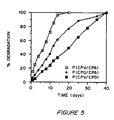
- Copolymers of these aromatic-aliphatic monomeric diacids also display zero-order degradation, with a time frame indicative of the monomers selected. See Fig 5.
Landscapes
- Health & Medical Sciences (AREA)
- Chemical & Material Sciences (AREA)
- Medicinal Chemistry (AREA)
- General Health & Medical Sciences (AREA)
- Veterinary Medicine (AREA)
- Public Health (AREA)
- Animal Behavior & Ethology (AREA)
- Life Sciences & Earth Sciences (AREA)
- Pharmacology & Pharmacy (AREA)
- Epidemiology (AREA)
- Engineering & Computer Science (AREA)
- Organic Chemistry (AREA)
- Chemical Kinetics & Catalysis (AREA)
- Neurosurgery (AREA)
- Dermatology (AREA)
- Polymers & Plastics (AREA)
- Biomedical Technology (AREA)
- General Chemical & Material Sciences (AREA)
- Bioinformatics & Cheminformatics (AREA)
- Nuclear Medicine, Radiotherapy & Molecular Imaging (AREA)
- Medicinal Preparation (AREA)
- Pharmaceuticals Containing Other Organic And Inorganic Compounds (AREA)
- Compositions Of Macromolecular Compounds (AREA)
- Polyethers (AREA)
- Polyesters Or Polycarbonates (AREA)
Abstract
Claims (9)
- Polyanhydride de formule générale

- Polymère selon la revendication 1, qui présente des profils de dégradation cinétique d'ordre zéro au-delà d'une dégradation de 60 %.
- Polymère selon les revendications 1 ou 2, formé par la polymérisation de l' acide p-carboxyphénoxyalcanoïque.
- Polymère selon la revendication 3, formé par la polymérisation de monomères d'acide p-carboxyphénoxyvalérique et/ou d'acide p-carboxyphénoxyoctanoïque.
- Polymère selon l'une quelconque des revendications précédentes, comprenant en outre un composé bioactif destiné à être utilisé dans un dispositif d'apport contrôlé de médicament.
- Procédé de préparation d'un dispositif d'apport contrôlé de médicament, comprenant un composé bioactif et un polyanhydride selon l'une quelconque des revendications 1 à 4, par polymérisation de monomères ayant à la fois des fragments aromatiques et des fragments aliphatiques qui sont polymérisés en ledit polyanhydride, avec une distribution uniforme de résidus aliphatiques et aromatiques dans la chaîne du polymère.
- Procédé selon la revendication 6, dans lequel le composé bioactif est une protéine, un médicament, un saccharide, une séquence d'acide nucléique ou une combinaison de ceux-ci.
- Procédé selon la revendication 7, comprenant la polymérisation des monomères pour former une matrice polymère, la fourniture d'un composé bioactif, et l'insertion du composé bioactif dans la matrice polymère.
- Procédé selon la revendication 7, comprenant la polymérisation des monomères avec un composé bioactif.
Priority Applications (1)
| Application Number | Priority Date | Filing Date | Title |
|---|---|---|---|
| AT88906761T ATE102833T1 (de) | 1987-07-31 | 1988-07-28 | Polyanhydride mit verbesserten hydrolytischen degradierungseigenschaften. |
Applications Claiming Priority (2)
| Application Number | Priority Date | Filing Date | Title |
|---|---|---|---|
| US80631 | 1987-07-31 | ||
| US07/080,631 US4857311A (en) | 1987-07-31 | 1987-07-31 | Polyanhydrides with improved hydrolytic degradation properties |
Publications (3)
| Publication Number | Publication Date |
|---|---|
| EP0368912A1 EP0368912A1 (fr) | 1990-05-23 |
| EP0368912A4 EP0368912A4 (en) | 1990-12-19 |
| EP0368912B1 true EP0368912B1 (fr) | 1994-03-16 |
Family
ID=22158602
Family Applications (1)
| Application Number | Title | Priority Date | Filing Date |
|---|---|---|---|
| EP88906761A Expired - Lifetime EP0368912B1 (fr) | 1987-07-31 | 1988-07-28 | Polyanhydrides ayant des proprietes de degradation hydrolytiques ameliorees |
Country Status (8)
| Country | Link |
|---|---|
| US (1) | US4857311A (fr) |
| EP (1) | EP0368912B1 (fr) |
| JP (1) | JPH0757797B2 (fr) |
| AU (1) | AU2258088A (fr) |
| CA (1) | CA1335858C (fr) |
| DE (1) | DE3888536T2 (fr) |
| NZ (1) | NZ225323A (fr) |
| WO (1) | WO1989000855A1 (fr) |
Families Citing this family (123)
| Publication number | Priority date | Publication date | Assignee | Title |
|---|---|---|---|---|
| US5356630A (en) * | 1989-02-22 | 1994-10-18 | Massachusetts Institute Of Technology | Delivery system for controlled release of bioactive factors |
| WO1990009783A1 (fr) * | 1989-02-22 | 1990-09-07 | Massachusetts Institute Of Technology | Systeme d'acheminement a liberation regulee de facteurs bioactifs |
| US4997904A (en) * | 1989-08-25 | 1991-03-05 | Nova Pharmaceutical Corporation | Aromatic polyanhydride compositions |
| AU655762B2 (en) * | 1989-12-26 | 1995-01-12 | Nova Pharmaceutical Corporation | Prodrug anhydrides of asprin, indomethacin and ibuprofen, their preparation, compositions, and anti-inflammatory method of use |
| US5660851A (en) * | 1989-12-26 | 1997-08-26 | Yissum Research Development Company Of The Hebrew Univ. Of Jerusalem | Ocular inserts |
| US5317079A (en) * | 1990-01-19 | 1994-05-31 | Nova Pharmaceutical Corporation | Fatty acid terminated polyanhydride |
| US5171812A (en) * | 1990-01-19 | 1992-12-15 | Nova Pharmaceutical Corporation | Polyanhydrides of oligomerized unsaturated aliphatic acids |
| US5270419A (en) * | 1990-01-19 | 1993-12-14 | Nova Pharmaceutical Corporation | Polyanhydrides of oligomerized unsaturated aliphatic acids |
| US5175235A (en) * | 1990-06-04 | 1992-12-29 | Nova Pharmaceutical Corporation | Branched polyanhydrides |
| US5240963A (en) * | 1990-01-19 | 1993-08-31 | Nova Pharmaceutical Corporation | Branched polyanhydrides |
| US5179189A (en) * | 1990-01-19 | 1993-01-12 | Nova Pharmaceutical Corporation | Fatty acid terminated polyanhydrides |
| CA2046830C (fr) * | 1990-07-19 | 1999-12-14 | Patrick P. Deluca | Systeme d'administration des medicaments comprenant une interaction entre une proteine ou une polypeptide et un polymere hydrophobe biodegradable |
| DK0568651T3 (da) * | 1991-02-01 | 2002-08-05 | Massachusetts Inst Technology | Bionedbrydelige polymerblandinger til afgivelse af lægemidler |
| US5330768A (en) * | 1991-07-05 | 1994-07-19 | Massachusetts Institute Of Technology | Controlled drug delivery using polymer/pluronic blends |
| ES2038072B1 (es) * | 1991-07-12 | 1994-02-16 | Univ Valladolid | Procedimiento para la obtencion de polianhidridos a base de acidos dicarboxilicos y anhidrido acetico. |
| US5863530A (en) * | 1991-10-11 | 1999-01-26 | Spruson & Ferguson | Treating ophthalmic fibrosis using interferon-α |
| US5518730A (en) | 1992-06-03 | 1996-05-21 | Fuisz Technologies Ltd. | Biodegradable controlled release flash flow melt-spun delivery system |
| US6582728B1 (en) * | 1992-07-08 | 2003-06-24 | Inhale Therapeutic Systems, Inc. | Spray drying of macromolecules to produce inhaleable dry powders |
| US5264540A (en) * | 1992-07-20 | 1993-11-23 | Ethicon, Inc. | Aromatic polyanhydrides |
| DK0659073T3 (da) * | 1992-09-10 | 2002-03-11 | Childrens Medical Center | Bionedbrydelige polymermatrixer med vedvarerende afgivelse af lokalanæstetika |
| US5700485A (en) | 1992-09-10 | 1997-12-23 | Children's Medical Center Corporation | Prolonged nerve blockade by the combination of local anesthetic and glucocorticoid |
| US5321113A (en) * | 1993-05-14 | 1994-06-14 | Ethicon, Inc. | Copolymers of an aromatic anhydride and aliphatic ester |
| US5543158A (en) * | 1993-07-23 | 1996-08-06 | Massachusetts Institute Of Technology | Biodegradable injectable nanoparticles |
| US6007845A (en) * | 1994-07-22 | 1999-12-28 | Massachusetts Institute Of Technology | Nanoparticles and microparticles of non-linear hydrophilic-hydrophobic multiblock copolymers |
| US5626862A (en) | 1994-08-02 | 1997-05-06 | Massachusetts Institute Of Technology | Controlled local delivery of chemotherapeutic agents for treating solid tumors |
| WO1997005185A2 (fr) | 1995-07-28 | 1997-02-13 | Focal, Inc. | Hydrogels multiblocs biodegradables destines a etre utilises comme agents de liberation regulee pour l'administration de medicaments et le traitement de tissus |
| US5968543A (en) * | 1996-01-05 | 1999-10-19 | Advanced Polymer Systems, Inc. | Polymers with controlled physical state and bioerodibility |
| US5902599A (en) * | 1996-02-20 | 1999-05-11 | Massachusetts Institute Of Technology | Biodegradable polymer networks for use in orthopedic and dental applications |
| EP0882085B1 (fr) * | 1996-02-20 | 2002-07-24 | Massachusetts Institute Of Technology | Reseaux de polymeres biodegradables destines a des applications orthopediques et dentaires |
| BR9707936B1 (pt) * | 1996-03-05 | 2010-12-14 | composiÇço formadora de imagem atravÉs de ultra-som. | |
| US5611344A (en) * | 1996-03-05 | 1997-03-18 | Acusphere, Inc. | Microencapsulated fluorinated gases for use as imaging agents |
| US6652837B1 (en) | 1996-05-24 | 2003-11-25 | Massachusetts Institute Of Technology | Preparation of novel particles for inhalation |
| US20020052310A1 (en) * | 1997-09-15 | 2002-05-02 | Massachusetts Institute Of Technology The Penn State Research Foundation | Particles for inhalation having sustained release properties |
| US6254854B1 (en) | 1996-05-24 | 2001-07-03 | The Penn Research Foundation | Porous particles for deep lung delivery |
| US5874064A (en) | 1996-05-24 | 1999-02-23 | Massachusetts Institute Of Technology | Aerodynamically light particles for pulmonary drug delivery |
| US5985309A (en) * | 1996-05-24 | 1999-11-16 | Massachusetts Institute Of Technology | Preparation of particles for inhalation |
| USRE37053E1 (en) | 1996-05-24 | 2001-02-13 | Massachusetts Institute Of Technology | Particles incorporating surfactants for pulmonary drug delivery |
| US5855913A (en) * | 1997-01-16 | 1999-01-05 | Massachusetts Instite Of Technology | Particles incorporating surfactants for pulmonary drug delivery |
| US5837221A (en) * | 1996-07-29 | 1998-11-17 | Acusphere, Inc. | Polymer-lipid microencapsulated gases for use as imaging agents |
| WO1999011272A1 (fr) * | 1997-09-02 | 1999-03-11 | Johns Hopkins University School Of Medicine | Formulations polymeres chargees en analogues de vitamine d3 destinees au traitement du cancer et des troubles neurodegeneratifs |
| US6468519B1 (en) | 1997-09-10 | 2002-10-22 | Rutgers, The State University Of New Jersey | Polyanhydrides with biologically active degradation products |
| US6486214B1 (en) * | 1997-09-10 | 2002-11-26 | Rutgers, The State University Of New Jersey | Polyanhydride linkers for production of drug polymers and drug polymer compositions produced thereby |
| US7122615B1 (en) * | 1998-09-10 | 2006-10-17 | Rutgers, The State University Of New Jersey | Polyanhydrides with therapeutically useful degradation products |
| US7052678B2 (en) | 1997-09-15 | 2006-05-30 | Massachusetts Institute Of Technology | Particles for inhalation having sustained release properties |
| US6956021B1 (en) * | 1998-08-25 | 2005-10-18 | Advanced Inhalation Research, Inc. | Stable spray-dried protein formulations |
| US20010036481A1 (en) * | 1999-08-25 | 2001-11-01 | Advanced Inhalation Research, Inc. | Modulation of release from dry powder formulations |
| US6749835B1 (en) | 1999-08-25 | 2004-06-15 | Advanced Inhalation Research, Inc. | Formulation for spray-drying large porous particles |
| US7678364B2 (en) | 1999-08-25 | 2010-03-16 | Alkermes, Inc. | Particles for inhalation having sustained release properties |
| EP1210067A2 (fr) * | 1999-08-25 | 2002-06-05 | Advanced Inhalation Research, Inc. | Modulation de liberation a partir de formulations seches en poudre |
| US6503528B1 (en) | 1999-11-19 | 2003-01-07 | Abbott Laboratories | Polymeric compositions and a method of making the same |
| EP2095817A1 (fr) | 1999-12-07 | 2009-09-02 | Rutgers, The State University Of New Jersey | Compositions et procédés thérapeutiques |
| US20040038948A1 (en) * | 1999-12-07 | 2004-02-26 | Uhrich Kathryn E. | Therapeutic compositions and methods |
| US6685928B2 (en) | 1999-12-07 | 2004-02-03 | Rutgers, The State University Of New Jersey | Therapeutic compositions and methods |
| EP1309354A2 (fr) * | 2000-07-27 | 2003-05-14 | Rutgers, The State University | Polyesters et polyamides therapeutiques |
| AU2001279064A1 (en) * | 2000-07-27 | 2002-02-13 | Rutgers, The State University | Therapeutic azo-compounds for drug delivery |
| US20020141946A1 (en) * | 2000-12-29 | 2002-10-03 | Advanced Inhalation Research, Inc. | Particles for inhalation having rapid release properties |
| US20030125236A1 (en) * | 2000-12-29 | 2003-07-03 | Advenced Inhalation Research, Inc. | Particles for inhalation having rapid release properties |
| JP2005504715A (ja) * | 2000-12-29 | 2005-02-17 | アドバンスト インハレーション リサーチ,インコーポレイテッド | 持続放出特性を有する吸入用粒子 |
| AU2002352836B2 (en) * | 2001-11-20 | 2005-09-29 | Alkermes, Inc. | Improved particulate compositions for pulmonary delivery |
| US20030129250A1 (en) * | 2001-11-20 | 2003-07-10 | Advanced Inhalation Research Inc. | Particulate compositions for improving solubility of poorly soluble agents |
| DE60231555D1 (de) * | 2001-11-23 | 2009-04-23 | Theodore James Anastasiou | Verbesserte synthese von polyanhydriden |
| US7635463B2 (en) | 2002-02-27 | 2009-12-22 | Pharmain Corporation | Compositions for delivery of therapeutics and other materials |
| DE60335608D1 (de) * | 2002-02-27 | 2011-02-17 | Pharmain Corp | Zusammensetzungen zur abgabe von therapeutika und anderen materialien und verfahren zu ihrer herstellung und verwendung |
| WO2004006863A2 (fr) * | 2002-07-17 | 2004-01-22 | Rutgers, The State University | Dispositifs therapeutiques pour croissance cellulaire structuree |
| US20080260834A1 (en) * | 2002-08-20 | 2008-10-23 | Martin Burke | Vitamin d3 analog loaded polymer formulations for cancer and neurodegenerative disorders |
| US7718189B2 (en) | 2002-10-29 | 2010-05-18 | Transave, Inc. | Sustained release of antiinfectives |
| EP1585500B8 (fr) * | 2002-12-20 | 2017-07-26 | Auritec Pharmaceuticals | Particules enrobees destinees a l'administration prolongee d'ingredients pharmaceutiques |
| US7662864B2 (en) * | 2003-06-04 | 2010-02-16 | Rutgers, The State University Of New Jersey | Solution polymerization processes to prepare a polymer that degrades to release a physiologically active agent |
| WO2005112977A2 (fr) * | 2004-04-23 | 2005-12-01 | Pharmain, Ltd. | Compositions de traitement avec un peptide de type glucagon, et procede de fabrication et d'utilisation de ces compositions |
| US8012457B2 (en) | 2004-06-04 | 2011-09-06 | Acusphere, Inc. | Ultrasound contrast agent dosage formulation |
| JP2008507585A (ja) * | 2004-07-26 | 2008-03-13 | コセリックス インク | 微粒子製剤を用いて吸入したイロプロストによる肺高血圧症の治療 |
| EP2594272B1 (fr) | 2005-05-18 | 2018-07-11 | Horizon Orphan LLC | Fluoroquinolones en aérosol et leurs utilisations |
| US8546423B2 (en) | 2005-05-18 | 2013-10-01 | Mpex Pharmaceuticals, Inc. | Aerosolized fluoroquinolones and uses thereof |
| EP3067047B1 (fr) | 2005-12-08 | 2022-04-20 | Insmed Incorporated | Compositions a base de lipide d'anti-infectieux pour traiter des infections pulmonaires |
| KR101529318B1 (ko) | 2005-12-19 | 2015-06-16 | 파마인 코포레이션 | 치료제를 전달하기 위한 소수성 코어 담체 조성물, 이조성물의 제조 방법 및 그 조성물의 이용 방법 |
| US20070225472A1 (en) * | 2006-03-23 | 2007-09-27 | Varshney Sunil K | Polyanhydride polymers and their uses in biomedical devices |
| EP2032614A2 (fr) * | 2006-06-06 | 2009-03-11 | Rutgers, The State University Of New Jersey | Polymères iodés |
| WO2008034019A2 (fr) | 2006-09-13 | 2008-03-20 | Polymerix Corporation | Agents actifs et oligomères et polymères de ceux-ci |
| AU2007306936B2 (en) | 2006-10-12 | 2014-02-06 | The University Of Queensland | Compositions and methods for modulating immune responses |
| WO2008051565A2 (fr) * | 2006-10-23 | 2008-05-02 | Bioabsorbable Therapeutics, Inc. | Composition pour libération de médicament présentant un support thérapeutique |
| WO2008137717A1 (fr) | 2007-05-04 | 2008-11-13 | Transave, Inc. | Compositions de médicaments multicationiques pour réduire des interactions avec des biomolécules polyanioniques et leurs procédés et utilisations |
| US9114081B2 (en) | 2007-05-07 | 2015-08-25 | Insmed Incorporated | Methods of treating pulmonary disorders with liposomal amikacin formulations |
| US9333214B2 (en) | 2007-05-07 | 2016-05-10 | Insmed Incorporated | Method for treating pulmonary disorders with liposomal amikacin formulations |
| US9119783B2 (en) | 2007-05-07 | 2015-09-01 | Insmed Incorporated | Method of treating pulmonary disorders with liposomal amikacin formulations |
| US7960336B2 (en) * | 2007-08-03 | 2011-06-14 | Pharmain Corporation | Composition for long-acting peptide analogs |
| US8563527B2 (en) * | 2007-08-20 | 2013-10-22 | Pharmain Corporation | Oligonucleotide core carrier compositions for delivery of nucleic acid-containing therapeutic agents, methods of making and using the same |
| US20090176892A1 (en) | 2008-01-09 | 2009-07-09 | Pharmain Corporation | Soluble Hydrophobic Core Carrier Compositions for Delivery of Therapeutic Agents, Methods of Making and Using the Same |
| CA2739893C (fr) | 2008-10-07 | 2016-10-04 | Mpex Pharmaceuticals, Inc. | Inhalation de levofloxacine pour reduire une inflammation des poumons |
| KR101959873B1 (ko) | 2008-10-07 | 2019-03-19 | 랩터 파마슈티컬스 인코포레이티드 | 약동학 개선을 위한 에어로졸 플루오로퀴놀론 제형 |
| WO2011005756A1 (fr) | 2009-07-06 | 2011-01-13 | Puretech Ventures, Llc | Administration d'agents ciblés contre des niches de microbiote |
| WO2011025893A1 (fr) | 2009-08-28 | 2011-03-03 | The Trustees Of Columbia University In The City Of New York | Systèmes, procédés, et dispositifs de production de microbulles remplies de gaz |
| WO2011026111A1 (fr) | 2009-08-31 | 2011-03-03 | The United States Of America, As Represented By The Secretary, Department Of Health And Human Services | Distribution par voie orale d'un vaccin au gros intestin pour induire une immunité mucosale |
| WO2011029059A1 (fr) | 2009-09-04 | 2011-03-10 | Mpex Pharmaceuticals, Inc. | Utilisation de lévofloxacine en aérosol pour traiter la fibrose kystique |
| US8449916B1 (en) * | 2009-11-06 | 2013-05-28 | Iowa State University Research Foundation, Inc. | Antimicrobial compositions and methods |
| WO2011075557A1 (fr) | 2009-12-16 | 2011-06-23 | The Trustees Of Columbia University In The City Of New York | Procédés, dispositifs, et systèmes de délivrance de médicament à la demande déclenchée par ultrasons |
| US8741317B2 (en) | 2010-08-19 | 2014-06-03 | Rutgers, The State University Of New Jersey | Slow-degrading polymers comprising salicylic acid for undelayed and sustained drug delivery |
| US11311610B2 (en) | 2010-11-01 | 2022-04-26 | University Of Technology Sydney | Immune-modulating agents and uses therefor |
| WO2012106382A1 (fr) | 2011-01-31 | 2012-08-09 | Genoa Pharmaceuticals, Inc. | Composés analogues de pyridone et de pirfénidone en aérosol, et leurs utilisations |
| JP6138904B2 (ja) | 2012-03-16 | 2017-05-31 | ザ・ジョンズ・ホプキンス・ユニバーシティー | 活性剤の送達のための非線状マルチブロックコポリマー薬物コンジュゲート |
| US8962577B2 (en) | 2012-03-16 | 2015-02-24 | The Johns Hopkins University | Controlled release formulations for the delivery of HIF-1 inhibitors |
| CA3008794C (fr) | 2012-03-29 | 2021-03-16 | Therabiome, Llc | Formulations de vaccination orale specifiques a un site gastro-intestinal actives sur l'ileon et l'appendice |
| PL2852391T3 (pl) | 2012-05-21 | 2022-04-11 | Insmed Incorporated | Układy do leczenia infekcji płuc |
| US9144579B2 (en) | 2012-08-17 | 2015-09-29 | Rutgers, The State University Of New Jersey | Polyesters and methods of use thereof |
| US20140120057A1 (en) | 2012-10-25 | 2014-05-01 | Rutgers, The State University Of New Jersey | Polymers and methods thereof for wound healing |
| US10124066B2 (en) | 2012-11-29 | 2018-11-13 | Insmed Incorporated | Stabilized vancomycin formulations |
| AU2014239883B2 (en) | 2013-03-14 | 2019-01-17 | Therabiome, Llc | Targeted gastrointestinal tract delivery of probiotic organisms and/or therapeutic agents |
| US9387250B2 (en) | 2013-03-15 | 2016-07-12 | Rutgers, The State University Of New Jersey | Therapeutic compositions for bone repair |
| BR112015024234B1 (pt) | 2013-03-21 | 2022-11-16 | Eupraxia Pharmaceuticals USA LLC | Composição farmacêutica de liberação sustentada injetável, uso da mesma para diminuir inflamação ou controlar dor e método para formar micropartículas revestidas |
| WO2014194055A1 (fr) | 2013-05-29 | 2014-12-04 | Rutgers, The State University Of New Jersey | Poly(anhydride-esters) à base d'antioxydants |
| EP3782604A1 (fr) | 2013-07-31 | 2021-02-24 | Windward Pharma, Inc. | Composés inhibiteurs de tyrosine kinase en aérosol et leurs utilisations |
| AU2015204558B2 (en) | 2014-01-10 | 2020-04-30 | Avalyn Pharma Inc. | Aerosol pirfenidone and pyridone analog compounds and uses thereof |
| LT3466432T (lt) | 2014-05-15 | 2020-12-28 | Insmed Incorporated | Būdai, skirti plaučių netuberkuliozinėms mikobakterinėms infekcijoms gydyti |
| US10695406B2 (en) | 2014-05-27 | 2020-06-30 | The University Of Queensland | Modulation of cellular stress using a B-cell oxidative and/or endoplasmic reticulum stress inhibitor and a targeting agent |
| US10023521B2 (en) | 2014-06-13 | 2018-07-17 | Rutgers, The State University Of New Jersey | Process and intermediates for preparing poly(anhydride-esters) |
| CA2957764C (fr) | 2014-08-13 | 2019-07-02 | The Johns Hopkins University | Nanoparticules chargees de glucocorticoides utilisables en vue de la prevention du rejet d'une allogreffe de cornee et de la neovascularisation corneenne |
| US20180008718A1 (en) | 2015-01-20 | 2018-01-11 | The Johns Hopkins University | Compositions for the sustained release of anti-glaucoma agents to control intraocular pressure |
| WO2016164898A1 (fr) | 2015-04-10 | 2016-10-13 | Rutgers, The State University Of New Jersey | Polymères d'acide kojique |
| DK3206672T3 (en) | 2015-10-27 | 2018-06-18 | Eupraxia Pharmaceuticals Inc | Formulations for sustained release of local anesthetics |
| EP3246050A1 (fr) | 2016-05-17 | 2017-11-22 | BSN medical GmbH | Timbre transdermique ou pansement |
| US10449269B2 (en) | 2016-08-29 | 2019-10-22 | Yale University | Particle conjugated prosthetic patches and methods of making and using thereof |
| EP3773505B1 (fr) | 2018-03-30 | 2026-04-29 | Insmed Incorporated | Procédés pour la fabrication continue de produits médicamenteux liposomaux |
| JP7449275B2 (ja) | 2018-05-02 | 2024-03-13 | インスメッド インコーポレイテッド | リポソーム薬物製剤の製造方法 |
| US12496279B2 (en) | 2019-04-11 | 2025-12-16 | The Johns Hopkins University | Nanoparticles for drug delivery to brain |
Family Cites Families (5)
| Publication number | Priority date | Publication date | Assignee | Title |
|---|---|---|---|---|
| US2071250A (en) * | 1931-07-03 | 1937-02-16 | Du Pont | Linear condensation polymers |
| US3960150A (en) * | 1971-09-09 | 1976-06-01 | Alza Corporation | Bioerodible ocular device |
| US3986510A (en) | 1971-09-09 | 1976-10-19 | Alza Corporation | Bioerodible ocular device |
| US4757128A (en) * | 1986-08-01 | 1988-07-12 | Massachusetts Institute Of Technology | High molecular weight polyanhydride and preparation thereof |
| US4657543A (en) | 1984-07-23 | 1987-04-14 | Massachusetts Institute Of Technology | Ultrasonically modulated polymeric devices for delivering compositions |
-
1987
- 1987-07-31 US US07/080,631 patent/US4857311A/en not_active Expired - Lifetime
-
1988
- 1988-07-05 CA CA000571101A patent/CA1335858C/fr not_active Expired - Fee Related
- 1988-07-07 NZ NZ225323A patent/NZ225323A/xx unknown
- 1988-07-28 EP EP88906761A patent/EP0368912B1/fr not_active Expired - Lifetime
- 1988-07-28 AU AU22580/88A patent/AU2258088A/en not_active Abandoned
- 1988-07-28 JP JP63506862A patent/JPH0757797B2/ja not_active Expired - Lifetime
- 1988-07-28 DE DE3888536T patent/DE3888536T2/de not_active Expired - Lifetime
- 1988-07-28 WO PCT/US1988/002569 patent/WO1989000855A1/fr not_active Ceased
Also Published As
| Publication number | Publication date |
|---|---|
| EP0368912A4 (en) | 1990-12-19 |
| JPH0757797B2 (ja) | 1995-06-21 |
| DE3888536T2 (de) | 1994-07-21 |
| CA1335858C (fr) | 1995-06-06 |
| WO1989000855A1 (fr) | 1989-02-09 |
| US4857311A (en) | 1989-08-15 |
| AU2258088A (en) | 1989-03-01 |
| DE3888536D1 (de) | 1994-04-21 |
| NZ225323A (en) | 1990-05-28 |
| JPH02504158A (ja) | 1990-11-29 |
| EP0368912A1 (fr) | 1990-05-23 |
Similar Documents
| Publication | Publication Date | Title |
|---|---|---|
| EP0368912B1 (fr) | Polyanhydrides ayant des proprietes de degradation hydrolytiques ameliorees | |
| Domb et al. | Poly (anhydrides). 3. Poly (anhydrides) based on aliphatic-aromatic diacids | |
| EP0260415B1 (fr) | Synthèse et utilisation de polyanhydrides à haut poids moléculaire | |
| Leong et al. | Bioerodible polyanhydrides as drug‐carrier matrices. I: Characterization, degradation, and release characteristics | |
| US4882168A (en) | Polyesters containing alkylene oxide blocks as drug delivery systems | |
| AU605172B2 (en) | Polyesters containing alkylene oxide blocks as drug delivery systems | |
| JP3121604B2 (ja) | 芳香族ポリ酸無水物組成物 | |
| US5019379A (en) | Unsaturated polyanhydrides | |
| US5962520A (en) | Hydrolytically unstable, biocompatible polymer | |
| EP0511292B1 (fr) | Polyanhydrides d'acides aliphatiques oligomerises insatures | |
| Domb et al. | Polyanhydrides. IV. Unsaturated and crosslinked polyanhydrides | |
| CA2118584C (fr) | Polyanhydrides termines par des acides gras | |
| US8133968B2 (en) | Poly(orthoester) polymers, and methods of making and using same | |
| JPS6076531A (ja) | マトリックス材料とその製造法およびこの材料を使用した医薬組成物 | |
| US5463012A (en) | Polycarbonates and the use thereof for the preparation of bioerosible matrices | |
| US5317079A (en) | Fatty acid terminated polyanhydride | |
| US5473103A (en) | Biopolymers derived from hydrolyzable diacid fats | |
| US5955068A (en) | Biodegradable polanhydrides derived from dimers of bile acids, and use thereof as controlled drug release systems | |
| Sintzel et al. | In vitro drug release from self-catalyzed poly (ortho ester): case study of 5-fluorouracil | |
| Quaglia et al. | New segmented copolymers containing poly (ϵ-caprolactone) and etheramide segments for the controlled release of bioactive compounds | |
| Domb et al. | Polyanhydrides: Stability and novel composition | |
| CN1232563C (zh) | 用于药物缓释载体的聚酸酐及其合成方法 | |
| CN116419764A (zh) | 聚酸酐及其制备方法 | |
| CA2210800A1 (fr) | Biopolymeres derives de matieres grasses diacides hydrolysables |
Legal Events
| Date | Code | Title | Description |
|---|---|---|---|
| PUAI | Public reference made under article 153(3) epc to a published international application that has entered the european phase |
Free format text: ORIGINAL CODE: 0009012 |
|
| 17P | Request for examination filed |
Effective date: 19900126 |
|
| AK | Designated contracting states |
Kind code of ref document: A1 Designated state(s): AT BE CH DE FR GB IT LI LU NL SE |
|
| RIN1 | Information on inventor provided before grant (corrected) |
Inventor name: LANGER, ROBERT, S. Inventor name: DOMB, ABRAHAM, J. |
|
| ITCL | It: translation for ep claims filed |
Representative=s name: JACOBACCI CASETTA & PERANI S.P.A. |
|
| EL | Fr: translation of claims filed | ||
| TCNL | Nl: translation of patent claims filed | ||
| TCAT | At: translation of patent claims filed | ||
| A4 | Supplementary search report drawn up and despatched |
Effective date: 19901102 |
|
| AK | Designated contracting states |
Kind code of ref document: A4 Designated state(s): AT BE CH DE FR GB IT LI LU NL SE |
|
| DET | De: translation of patent claims | ||
| 17Q | First examination report despatched |
Effective date: 19920703 |
|
| GRAA | (expected) grant |
Free format text: ORIGINAL CODE: 0009210 |
|
| AK | Designated contracting states |
Kind code of ref document: B1 Designated state(s): AT BE CH DE FR GB IT LI LU NL SE |
|
| PG25 | Lapsed in a contracting state [announced via postgrant information from national office to epo] |
Ref country code: SE Free format text: LAPSE BECAUSE OF FAILURE TO SUBMIT A TRANSLATION OF THE DESCRIPTION OR TO PAY THE FEE WITHIN THE PRESCRIBED TIME-LIMIT Effective date: 19940316 Ref country code: NL Effective date: 19940316 |
|
| REF | Corresponds to: |
Ref document number: 102833 Country of ref document: AT Date of ref document: 19940415 Kind code of ref document: T |
|
| REF | Corresponds to: |
Ref document number: 3888536 Country of ref document: DE Date of ref document: 19940421 |
|
| ITF | It: translation for a ep patent filed | ||
| ET | Fr: translation filed | ||
| PGFP | Annual fee paid to national office [announced via postgrant information from national office to epo] |
Ref country code: SE Payment date: 19940715 Year of fee payment: 7 |
|
| NLV1 | Nl: lapsed or annulled due to failure to fulfill the requirements of art. 29p and 29m of the patents act | ||
| EPTA | Lu: last paid annual fee | ||
| PLBE | No opposition filed within time limit |
Free format text: ORIGINAL CODE: 0009261 |
|
| STAA | Information on the status of an ep patent application or granted ep patent |
Free format text: STATUS: NO OPPOSITION FILED WITHIN TIME LIMIT |
|
| 26N | No opposition filed | ||
| REG | Reference to a national code |
Ref country code: GB Ref legal event code: IF02 |
|
| REG | Reference to a national code |
Ref country code: CH Ref legal event code: PFA Owner name: MASSACHUSETTS INSTITUTE OF TECHNOLOGY Free format text: MASSACHUSETTS INSTITUTE OF TECHNOLOGY#77 MASSACHUSETTS AVENUE#CAMBRIDGE/MA (US) -TRANSFER TO- MASSACHUSETTS INSTITUTE OF TECHNOLOGY#77 MASSACHUSETTS AVENUE#CAMBRIDGE/MA (US) |
|
| PGFP | Annual fee paid to national office [announced via postgrant information from national office to epo] |
Ref country code: LU Payment date: 20070731 Year of fee payment: 20 |
|
| PGFP | Annual fee paid to national office [announced via postgrant information from national office to epo] |
Ref country code: DE Payment date: 20070831 Year of fee payment: 20 |
|
| PGFP | Annual fee paid to national office [announced via postgrant information from national office to epo] |
Ref country code: CH Payment date: 20070730 Year of fee payment: 20 Ref country code: AT Payment date: 20070705 Year of fee payment: 20 |
|
| PGFP | Annual fee paid to national office [announced via postgrant information from national office to epo] |
Ref country code: GB Payment date: 20070727 Year of fee payment: 20 |
|
| PGFP | Annual fee paid to national office [announced via postgrant information from national office to epo] |
Ref country code: IT Payment date: 20070730 Year of fee payment: 20 Ref country code: BE Payment date: 20070816 Year of fee payment: 20 |
|
| PGFP | Annual fee paid to national office [announced via postgrant information from national office to epo] |
Ref country code: FR Payment date: 20070717 Year of fee payment: 20 |
|
| BE20 | Be: patent expired |
Owner name: MASSACHUSETTS *INSTITUTE OF TECHNOLOGY Effective date: 20080728 |
|
| REG | Reference to a national code |
Ref country code: CH Ref legal event code: PL |
|
| REG | Reference to a national code |
Ref country code: GB Ref legal event code: PE20 Expiry date: 20080727 |
|
| PG25 | Lapsed in a contracting state [announced via postgrant information from national office to epo] |
Ref country code: GB Free format text: LAPSE BECAUSE OF EXPIRATION OF PROTECTION Effective date: 20080727 |