EP0369249A2 - Verfahren zur Herstellung von cyclischen Kohlensäureestern - Google Patents
Verfahren zur Herstellung von cyclischen Kohlensäureestern Download PDFInfo
- Publication number
- EP0369249A2 EP0369249A2 EP89120324A EP89120324A EP0369249A2 EP 0369249 A2 EP0369249 A2 EP 0369249A2 EP 89120324 A EP89120324 A EP 89120324A EP 89120324 A EP89120324 A EP 89120324A EP 0369249 A2 EP0369249 A2 EP 0369249A2
- Authority
- EP
- European Patent Office
- Prior art keywords
- compound
- reaction
- aromatic
- residue
- formula
- Prior art date
- Legal status (The legal status is an assumption and is not a legal conclusion. Google has not performed a legal analysis and makes no representation as to the accuracy of the status listed.)
- Granted
Links
- 238000000034 method Methods 0.000 title claims description 20
- 238000002360 preparation method Methods 0.000 title claims description 4
- 150000005676 cyclic carbonates Chemical class 0.000 title description 3
- -1 Cyclic carbonic acid esters Chemical class 0.000 claims abstract description 21
- YGYAWVDWMABLBF-UHFFFAOYSA-N Phosgene Chemical compound ClC(Cl)=O YGYAWVDWMABLBF-UHFFFAOYSA-N 0.000 claims abstract description 19
- 125000003118 aryl group Chemical group 0.000 claims abstract description 15
- 229910052757 nitrogen Inorganic materials 0.000 claims abstract description 6
- 125000004433 nitrogen atom Chemical group N* 0.000 claims abstract description 6
- 150000001875 compounds Chemical class 0.000 claims description 26
- 238000006243 chemical reaction Methods 0.000 claims description 18
- 239000002904 solvent Substances 0.000 claims description 18
- RAXXELZNTBOGNW-UHFFFAOYSA-N imidazole Natural products C1=CNC=N1 RAXXELZNTBOGNW-UHFFFAOYSA-N 0.000 claims description 15
- 238000009835 boiling Methods 0.000 claims description 10
- YPFDHNVEDLHUCE-UHFFFAOYSA-N propane-1,3-diol Chemical compound OCCCO YPFDHNVEDLHUCE-UHFFFAOYSA-N 0.000 claims description 8
- JUJWROOIHBZHMG-UHFFFAOYSA-N Pyridine Chemical compound C1=CC=NC=C1 JUJWROOIHBZHMG-UHFFFAOYSA-N 0.000 claims description 6
- 125000001033 ether group Chemical group 0.000 claims description 6
- FVIZARNDLVOMSU-UHFFFAOYSA-N ginsenoside K Natural products C1CC(C2(CCC3C(C)(C)C(O)CCC3(C)C2CC2O)C)(C)C2C1C(C)(CCC=C(C)C)OC1OC(CO)C(O)C(O)C1O FVIZARNDLVOMSU-UHFFFAOYSA-N 0.000 claims description 6
- 125000004432 carbon atom Chemical group C* 0.000 claims description 5
- PUPZLCDOIYMWBV-UHFFFAOYSA-N (+/-)-1,3-Butanediol Chemical compound CC(O)CCO PUPZLCDOIYMWBV-UHFFFAOYSA-N 0.000 claims description 4
- BSKHPKMHTQYZBB-UHFFFAOYSA-N 2-methylpyridine Chemical compound CC1=CC=CC=N1 BSKHPKMHTQYZBB-UHFFFAOYSA-N 0.000 claims description 4
- 229930185605 Bisphenol Natural products 0.000 claims description 4
- SMWDFEZZVXVKRB-UHFFFAOYSA-N Quinoline Chemical compound N1=CC=CC2=CC=CC=C21 SMWDFEZZVXVKRB-UHFFFAOYSA-N 0.000 claims description 4
- 150000004651 carbonic acid esters Chemical class 0.000 claims description 4
- 230000003197 catalytic effect Effects 0.000 claims description 4
- 150000002009 diols Chemical class 0.000 claims description 3
- 125000000623 heterocyclic group Chemical group 0.000 claims description 3
- 125000002887 hydroxy group Chemical group [H]O* 0.000 claims description 3
- 239000000155 melt Substances 0.000 claims description 3
- 229920001223 polyethylene glycol Polymers 0.000 claims description 3
- UMJSCPRVCHMLSP-UHFFFAOYSA-N pyridine Natural products COC1=CC=CN=C1 UMJSCPRVCHMLSP-UHFFFAOYSA-N 0.000 claims description 3
- 150000003852 triazoles Chemical class 0.000 claims description 3
- HYZJCKYKOHLVJF-UHFFFAOYSA-N 1H-benzimidazole Chemical compound C1=CC=C2NC=NC2=C1 HYZJCKYKOHLVJF-UHFFFAOYSA-N 0.000 claims description 2
- 239000002202 Polyethylene glycol Substances 0.000 claims description 2
- WTKZEGDFNFYCGP-UHFFFAOYSA-N Pyrazole Chemical compound C=1C=NNC=1 WTKZEGDFNFYCGP-UHFFFAOYSA-N 0.000 claims description 2
- QRUDEWIWKLJBPS-UHFFFAOYSA-N benzotriazole Chemical compound C1=CC=C2N[N][N]C2=C1 QRUDEWIWKLJBPS-UHFFFAOYSA-N 0.000 claims description 2
- 239000012964 benzotriazole Substances 0.000 claims description 2
- IISBACLAFKSPIT-UHFFFAOYSA-N bisphenol A Chemical compound C=1C=C(O)C=CC=1C(C)(C)C1=CC=C(O)C=C1 IISBACLAFKSPIT-UHFFFAOYSA-N 0.000 claims description 2
- 239000007795 chemical reaction product Substances 0.000 claims description 2
- 238000004821 distillation Methods 0.000 claims description 2
- 239000012442 inert solvent Substances 0.000 claims description 2
- HTSGKJQDMSTCGS-UHFFFAOYSA-N 1,4-bis(4-chlorophenyl)-2-(4-methylphenyl)sulfonylbutane-1,4-dione Chemical compound C1=CC(C)=CC=C1S(=O)(=O)C(C(=O)C=1C=CC(Cl)=CC=1)CC(=O)C1=CC=C(Cl)C=C1 HTSGKJQDMSTCGS-UHFFFAOYSA-N 0.000 claims 5
- 150000001491 aromatic compounds Chemical class 0.000 claims 1
- 150000002391 heterocyclic compounds Chemical class 0.000 abstract description 2
- 150000002440 hydroxy compounds Chemical class 0.000 abstract 1
- YXFVVABEGXRONW-UHFFFAOYSA-N Toluene Chemical compound CC1=CC=CC=C1 YXFVVABEGXRONW-UHFFFAOYSA-N 0.000 description 9
- IJGRMHOSHXDMSA-UHFFFAOYSA-N Atomic nitrogen Chemical compound N#N IJGRMHOSHXDMSA-UHFFFAOYSA-N 0.000 description 6
- YMWUJEATGCHHMB-UHFFFAOYSA-N Dichloromethane Chemical compound ClCCl YMWUJEATGCHHMB-UHFFFAOYSA-N 0.000 description 6
- VEXZGXHMUGYJMC-UHFFFAOYSA-N Hydrochloric acid Chemical compound Cl VEXZGXHMUGYJMC-UHFFFAOYSA-N 0.000 description 6
- MTHSVFCYNBDYFN-UHFFFAOYSA-N diethylene glycol Chemical compound OCCOCCO MTHSVFCYNBDYFN-UHFFFAOYSA-N 0.000 description 6
- 229910052736 halogen Inorganic materials 0.000 description 6
- 150000002367 halogens Chemical class 0.000 description 6
- IXCSERBJSXMMFS-UHFFFAOYSA-N hydrogen chloride Substances Cl.Cl IXCSERBJSXMMFS-UHFFFAOYSA-N 0.000 description 6
- 229910000041 hydrogen chloride Inorganic materials 0.000 description 6
- 150000004649 carbonic acid derivatives Chemical class 0.000 description 5
- ZAMOUSCENKQFHK-UHFFFAOYSA-N Chlorine atom Chemical compound [Cl] ZAMOUSCENKQFHK-UHFFFAOYSA-N 0.000 description 4
- IMHDGJOMLMDPJN-UHFFFAOYSA-N biphenyl-2,2'-diol Chemical group OC1=CC=CC=C1C1=CC=CC=C1O IMHDGJOMLMDPJN-UHFFFAOYSA-N 0.000 description 4
- 229910052801 chlorine Inorganic materials 0.000 description 4
- 239000000460 chlorine Substances 0.000 description 4
- 239000001257 hydrogen Substances 0.000 description 4
- 229910052739 hydrogen Inorganic materials 0.000 description 4
- 125000004435 hydrogen atom Chemical class [H]* 0.000 description 4
- 125000001997 phenyl group Chemical group [H]C1=C([H])C([H])=C(*)C([H])=C1[H] 0.000 description 4
- 150000003254 radicals Chemical class 0.000 description 4
- 239000011541 reaction mixture Substances 0.000 description 4
- 125000004169 (C1-C6) alkyl group Chemical group 0.000 description 3
- UHOVQNZJYSORNB-UHFFFAOYSA-N Benzene Chemical compound C1=CC=CC=C1 UHOVQNZJYSORNB-UHFFFAOYSA-N 0.000 description 3
- WKBOTKDWSSQWDR-UHFFFAOYSA-N Bromine atom Chemical compound [Br] WKBOTKDWSSQWDR-UHFFFAOYSA-N 0.000 description 3
- XEKOWRVHYACXOJ-UHFFFAOYSA-N Ethyl acetate Chemical compound CCOC(C)=O XEKOWRVHYACXOJ-UHFFFAOYSA-N 0.000 description 3
- PXGOKWXKJXAPGV-UHFFFAOYSA-N Fluorine Chemical compound FF PXGOKWXKJXAPGV-UHFFFAOYSA-N 0.000 description 3
- NINIDFKCEFEMDL-UHFFFAOYSA-N Sulfur Chemical compound [S] NINIDFKCEFEMDL-UHFFFAOYSA-N 0.000 description 3
- 125000001931 aliphatic group Chemical group 0.000 description 3
- JFDZBHWFFUWGJE-UHFFFAOYSA-N benzonitrile Chemical compound N#CC1=CC=CC=C1 JFDZBHWFFUWGJE-UHFFFAOYSA-N 0.000 description 3
- GDTBXPJZTBHREO-UHFFFAOYSA-N bromine Substances BrBr GDTBXPJZTBHREO-UHFFFAOYSA-N 0.000 description 3
- 229910052794 bromium Inorganic materials 0.000 description 3
- 125000004122 cyclic group Chemical group 0.000 description 3
- 229910052731 fluorine Inorganic materials 0.000 description 3
- 239000011737 fluorine Substances 0.000 description 3
- 125000000325 methylidene group Chemical group [H]C([H])=* 0.000 description 3
- SLCVBVWXLSEKPL-UHFFFAOYSA-N neopentyl glycol Chemical compound OCC(C)(C)CO SLCVBVWXLSEKPL-UHFFFAOYSA-N 0.000 description 3
- 229920000166 polytrimethylene carbonate Polymers 0.000 description 3
- 229910052717 sulfur Inorganic materials 0.000 description 3
- 239000011593 sulfur Substances 0.000 description 3
- DNIAPMSPPWPWGF-VKHMYHEASA-N (+)-propylene glycol Chemical compound C[C@H](O)CO DNIAPMSPPWPWGF-VKHMYHEASA-N 0.000 description 2
- 125000000229 (C1-C4)alkoxy group Chemical group 0.000 description 2
- FYGHSUNMUKGBRK-UHFFFAOYSA-N 1,2,3-trimethylbenzene Chemical compound CC1=CC=CC(C)=C1C FYGHSUNMUKGBRK-UHFFFAOYSA-N 0.000 description 2
- OCJBOOLMMGQPQU-UHFFFAOYSA-N 1,4-dichlorobenzene Chemical compound ClC1=CC=C(Cl)C=C1 OCJBOOLMMGQPQU-UHFFFAOYSA-N 0.000 description 2
- VNFOYJLZGPKGPB-UHFFFAOYSA-N 2,2-bis(ethoxymethyl)propane-1,3-diol Chemical compound CCOCC(CO)(CO)COCC VNFOYJLZGPKGPB-UHFFFAOYSA-N 0.000 description 2
- NDYJEAUUNHDJMC-UHFFFAOYSA-N 2,2-diphenylpropane-1,3-diol Chemical compound C=1C=CC=CC=1C(CO)(CO)C1=CC=CC=C1 NDYJEAUUNHDJMC-UHFFFAOYSA-N 0.000 description 2
- VXHYVVAUHMGCEX-UHFFFAOYSA-N 2-(2-hydroxyphenoxy)phenol Chemical class OC1=CC=CC=C1OC1=CC=CC=C1O VXHYVVAUHMGCEX-UHFFFAOYSA-N 0.000 description 2
- FCIMDZFOYJBMLV-UHFFFAOYSA-N 2-[(2-hydroxy-3,5-dimethylphenyl)methyl]-4,6-dimethylphenol Chemical compound CC1=CC(C)=C(O)C(CC=2C(=C(C)C=C(C)C=2)O)=C1 FCIMDZFOYJBMLV-UHFFFAOYSA-N 0.000 description 2
- XZXYQEHISUMZAT-UHFFFAOYSA-N 2-[(2-hydroxy-5-methylphenyl)methyl]-4-methylphenol Chemical compound CC1=CC=C(O)C(CC=2C(=CC=C(C)C=2)O)=C1 XZXYQEHISUMZAT-UHFFFAOYSA-N 0.000 description 2
- QOOXGUCQYVVEFD-UHFFFAOYSA-N 2-butyl-2-methylpropane-1,3-diol Chemical compound CCCCC(C)(CO)CO QOOXGUCQYVVEFD-UHFFFAOYSA-N 0.000 description 2
- VNAWKNVDKFZFSU-UHFFFAOYSA-N 2-ethyl-2-methylpropane-1,3-diol Chemical compound CCC(C)(CO)CO VNAWKNVDKFZFSU-UHFFFAOYSA-N 0.000 description 2
- BHEIMYVOVVBWRL-UHFFFAOYSA-N 2-methyl-2-phenylpropane-1,3-diol Chemical compound OCC(C)(CO)C1=CC=CC=C1 BHEIMYVOVVBWRL-UHFFFAOYSA-N 0.000 description 2
- JVZZUPJFERSVRN-UHFFFAOYSA-N 2-methyl-2-propylpropane-1,3-diol Chemical compound CCCC(C)(CO)CO JVZZUPJFERSVRN-UHFFFAOYSA-N 0.000 description 2
- 125000003903 2-propenyl group Chemical group [H]C([*])([H])C([H])=C([H])[H] 0.000 description 2
- VPWNQTHUCYMVMZ-UHFFFAOYSA-N 4,4'-sulfonyldiphenol Chemical class C1=CC(O)=CC=C1S(=O)(=O)C1=CC=C(O)C=C1 VPWNQTHUCYMVMZ-UHFFFAOYSA-N 0.000 description 2
- HEDRZPFGACZZDS-UHFFFAOYSA-N Chloroform Chemical compound ClC(Cl)Cl HEDRZPFGACZZDS-UHFFFAOYSA-N 0.000 description 2
- RGSFGYAAUTVSQA-UHFFFAOYSA-N Cyclopentane Chemical compound C1CCCC1 RGSFGYAAUTVSQA-UHFFFAOYSA-N 0.000 description 2
- MDNWOSOZYLHTCG-UHFFFAOYSA-N Dichlorophen Chemical compound OC1=CC=C(Cl)C=C1CC1=CC(Cl)=CC=C1O MDNWOSOZYLHTCG-UHFFFAOYSA-N 0.000 description 2
- PEDCQBHIVMGVHV-UHFFFAOYSA-N Glycerine Chemical compound OCC(O)CO PEDCQBHIVMGVHV-UHFFFAOYSA-N 0.000 description 2
- KYQCOXFCLRTKLS-UHFFFAOYSA-N Pyrazine Chemical compound C1=CN=CC=N1 KYQCOXFCLRTKLS-UHFFFAOYSA-N 0.000 description 2
- ZJCCRDAZUWHFQH-UHFFFAOYSA-N Trimethylolpropane Chemical compound CCC(CO)(CO)CO ZJCCRDAZUWHFQH-UHFFFAOYSA-N 0.000 description 2
- ORLQHILJRHBSAY-UHFFFAOYSA-N [1-(hydroxymethyl)cyclohexyl]methanol Chemical compound OCC1(CO)CCCCC1 ORLQHILJRHBSAY-UHFFFAOYSA-N 0.000 description 2
- OKSKZFYXWJAIIT-UHFFFAOYSA-N [1-(hydroxymethyl)cyclopentyl]methanol Chemical compound OCC1(CO)CCCC1 OKSKZFYXWJAIIT-UHFFFAOYSA-N 0.000 description 2
- QSGREIXRTDCBHO-UHFFFAOYSA-N [3-(hydroxymethyl)oxetan-3-yl]methanol Chemical compound OCC1(CO)COC1 QSGREIXRTDCBHO-UHFFFAOYSA-N 0.000 description 2
- 150000007824 aliphatic compounds Chemical class 0.000 description 2
- QVGXLLKOCUKJST-UHFFFAOYSA-N atomic oxygen Chemical compound [O] QVGXLLKOCUKJST-UHFFFAOYSA-N 0.000 description 2
- IOJUPLGTWVMSFF-UHFFFAOYSA-N benzothiazole Chemical compound C1=CC=C2SC=NC2=C1 IOJUPLGTWVMSFF-UHFFFAOYSA-N 0.000 description 2
- 125000001797 benzyl group Chemical group [H]C1=C([H])C([H])=C(C([H])=C1[H])C([H])([H])* 0.000 description 2
- MVPPADPHJFYWMZ-UHFFFAOYSA-N chlorobenzene Chemical compound ClC1=CC=CC=C1 MVPPADPHJFYWMZ-UHFFFAOYSA-N 0.000 description 2
- 229940117389 dichlorobenzene Drugs 0.000 description 2
- USIUVYZYUHIAEV-UHFFFAOYSA-N diphenyl ether Chemical compound C=1C=CC=CC=1OC1=CC=CC=C1 USIUVYZYUHIAEV-UHFFFAOYSA-N 0.000 description 2
- 150000002430 hydrocarbons Chemical group 0.000 description 2
- 150000003840 hydrochlorides Chemical class 0.000 description 2
- AWJUIBRHMBBTKR-UHFFFAOYSA-N isoquinoline Chemical compound C1=NC=CC2=CC=CC=C21 AWJUIBRHMBBTKR-UHFFFAOYSA-N 0.000 description 2
- 125000000449 nitro group Chemical group [O-][N+](*)=O 0.000 description 2
- 239000001301 oxygen Substances 0.000 description 2
- 229910052760 oxygen Inorganic materials 0.000 description 2
- XRVCFZPJAHWYTB-UHFFFAOYSA-N prenderol Chemical compound CCC(CC)(CO)CO XRVCFZPJAHWYTB-UHFFFAOYSA-N 0.000 description 2
- 229950006800 prenderol Drugs 0.000 description 2
- 239000000047 product Substances 0.000 description 2
- 238000010992 reflux Methods 0.000 description 2
- 150000003839 salts Chemical class 0.000 description 2
- 239000007858 starting material Substances 0.000 description 2
- 239000000725 suspension Substances 0.000 description 2
- 238000005809 transesterification reaction Methods 0.000 description 2
- ZIBGPFATKBEMQZ-UHFFFAOYSA-N triethylene glycol Chemical compound OCCOCCOCCO ZIBGPFATKBEMQZ-UHFFFAOYSA-N 0.000 description 2
- 238000010626 work up procedure Methods 0.000 description 2
- 125000004178 (C1-C4) alkyl group Chemical group 0.000 description 1
- 125000004191 (C1-C6) alkoxy group Chemical group 0.000 description 1
- 150000000180 1,2-diols Chemical class 0.000 description 1
- 150000000185 1,3-diols Chemical class 0.000 description 1
- JTPNRXUCIXHOKM-UHFFFAOYSA-N 1-chloronaphthalene Chemical compound C1=CC=C2C(Cl)=CC=CC2=C1 JTPNRXUCIXHOKM-UHFFFAOYSA-N 0.000 description 1
- MQCPOLNSJCWPGT-UHFFFAOYSA-N 2,2'-Bisphenol F Chemical class OC1=CC=CC=C1CC1=CC=CC=C1O MQCPOLNSJCWPGT-UHFFFAOYSA-N 0.000 description 1
- KGRVJHAUYBGFFP-UHFFFAOYSA-N 2,2'-Methylenebis(4-methyl-6-tert-butylphenol) Chemical compound CC(C)(C)C1=CC(C)=CC(CC=2C(=C(C=C(C)C=2)C(C)(C)C)O)=C1O KGRVJHAUYBGFFP-UHFFFAOYSA-N 0.000 description 1
- MQXNNWDXHFBFEB-UHFFFAOYSA-N 2,2-bis(2-hydroxyphenyl)propane Chemical class C=1C=CC=C(O)C=1C(C)(C)C1=CC=CC=C1O MQXNNWDXHFBFEB-UHFFFAOYSA-N 0.000 description 1
- AZLRECYOMFCGTK-UHFFFAOYSA-N 2,2-dibenzylpropane-1,3-diol Chemical compound C=1C=CC=CC=1CC(CO)(CO)CC1=CC=CC=C1 AZLRECYOMFCGTK-UHFFFAOYSA-N 0.000 description 1
- JBGNINOUZCHFPB-UHFFFAOYSA-N 2,4,6-trimethyl-1h-triazine Chemical compound CN1NC(C)=CC(C)=N1 JBGNINOUZCHFPB-UHFFFAOYSA-N 0.000 description 1
- PKKDWPSOOQBWFB-UHFFFAOYSA-N 2,4-dichloro-6-[(3,5-dichloro-2-hydroxyphenyl)methyl]phenol Chemical compound OC1=C(Cl)C=C(Cl)C=C1CC1=CC(Cl)=CC(Cl)=C1O PKKDWPSOOQBWFB-UHFFFAOYSA-N 0.000 description 1
- GQIMEVASXZUFSS-UHFFFAOYSA-N 2-[2-(2-hydroxy-3,5-dimethylphenyl)propan-2-yl]-4,6-dimethylphenol Chemical compound CC1=CC(C)=C(O)C(C(C)(C)C=2C(=C(C)C=C(C)C=2)O)=C1 GQIMEVASXZUFSS-UHFFFAOYSA-N 0.000 description 1
- JVAGPLAZIMCLFQ-UHFFFAOYSA-N 2-chloro-2-nitropropane-1,3-diol Chemical compound OCC(Cl)(CO)[N+]([O-])=O JVAGPLAZIMCLFQ-UHFFFAOYSA-N 0.000 description 1
- LZDXRPVSAKWYDH-UHFFFAOYSA-N 2-ethyl-2-(prop-2-enoxymethyl)propane-1,3-diol Chemical compound CCC(CO)(CO)COCC=C LZDXRPVSAKWYDH-UHFFFAOYSA-N 0.000 description 1
- LXBGSDVWAMZHDD-UHFFFAOYSA-N 2-methyl-1h-imidazole Chemical compound CC1=NC=CN1 LXBGSDVWAMZHDD-UHFFFAOYSA-N 0.000 description 1
- JJXSMZLINUIUFX-UHFFFAOYSA-N 2-methyl-2-prop-2-enylpropane-1,3-diol Chemical compound OCC(C)(CO)CC=C JJXSMZLINUIUFX-UHFFFAOYSA-N 0.000 description 1
- JFFYKITVXPZLQS-UHFFFAOYSA-N 2-methylidenepropane-1,3-diol Chemical compound OCC(=C)CO JFFYKITVXPZLQS-UHFFFAOYSA-N 0.000 description 1
- QWGRWMMWNDWRQN-UHFFFAOYSA-N 2-methylpropane-1,3-diol Chemical compound OCC(C)CO QWGRWMMWNDWRQN-UHFFFAOYSA-N 0.000 description 1
- MSVMSXHTHSWNAU-UHFFFAOYSA-N 2-phenylcyclohexa-2,4-diene-1,1-diol Chemical group OC1(O)CC=CC=C1C1=CC=CC=C1 MSVMSXHTHSWNAU-UHFFFAOYSA-N 0.000 description 1
- UMBQWJHNUSDWMU-UHFFFAOYSA-N 2-tert-butyl-2-methylpropane-1,3-diol Chemical compound CC(C)(C)C(C)(CO)CO UMBQWJHNUSDWMU-UHFFFAOYSA-N 0.000 description 1
- ATVJXMYDOSMEPO-UHFFFAOYSA-N 3-prop-2-enoxyprop-1-ene Chemical compound C=CCOCC=C ATVJXMYDOSMEPO-UHFFFAOYSA-N 0.000 description 1
- JRFXQKZEGILCCO-UHFFFAOYSA-N 5,5-dimethyl-1,3-dioxan-2-one Chemical compound CC1(C)COC(=O)OC1 JRFXQKZEGILCCO-UHFFFAOYSA-N 0.000 description 1
- DKPFZGUDAPQIHT-UHFFFAOYSA-N Butyl acetate Natural products CCCCOC(C)=O DKPFZGUDAPQIHT-UHFFFAOYSA-N 0.000 description 1
- DRSHXJFUUPIBHX-UHFFFAOYSA-N COc1ccc(cc1)N1N=CC2C=NC(Nc3cc(OC)c(OC)c(OCCCN4CCN(C)CC4)c3)=NC12 Chemical compound COc1ccc(cc1)N1N=CC2C=NC(Nc3cc(OC)c(OC)c(OCCCN4CCN(C)CC4)c3)=NC12 DRSHXJFUUPIBHX-UHFFFAOYSA-N 0.000 description 1
- CURLTUGMZLYLDI-UHFFFAOYSA-N Carbon dioxide Chemical compound O=C=O CURLTUGMZLYLDI-UHFFFAOYSA-N 0.000 description 1
- PMPVIKIVABFJJI-UHFFFAOYSA-N Cyclobutane Chemical compound C1CCC1 PMPVIKIVABFJJI-UHFFFAOYSA-N 0.000 description 1
- LVZWSLJZHVFIQJ-UHFFFAOYSA-N Cyclopropane Chemical compound C1CC1 LVZWSLJZHVFIQJ-UHFFFAOYSA-N 0.000 description 1
- ZAFNJMIOTHYJRJ-UHFFFAOYSA-N Diisopropyl ether Chemical compound CC(C)OC(C)C ZAFNJMIOTHYJRJ-UHFFFAOYSA-N 0.000 description 1
- VGGSQFUCUMXWEO-UHFFFAOYSA-N Ethene Chemical compound C=C VGGSQFUCUMXWEO-UHFFFAOYSA-N 0.000 description 1
- 239000005977 Ethylene Substances 0.000 description 1
- WSFSSNUMVMOOMR-UHFFFAOYSA-N Formaldehyde Chemical compound O=C WSFSSNUMVMOOMR-UHFFFAOYSA-N 0.000 description 1
- CPELXLSAUQHCOX-UHFFFAOYSA-N Hydrogen bromide Chemical class Br CPELXLSAUQHCOX-UHFFFAOYSA-N 0.000 description 1
- FXHOOIRPVKKKFG-UHFFFAOYSA-N N,N-Dimethylacetamide Chemical compound CN(C)C(C)=O FXHOOIRPVKKKFG-UHFFFAOYSA-N 0.000 description 1
- SECXISVLQFMRJM-UHFFFAOYSA-N N-Methylpyrrolidone Chemical compound CN1CCCC1=O SECXISVLQFMRJM-UHFFFAOYSA-N 0.000 description 1
- CTQNGGLPUBDAKN-UHFFFAOYSA-N O-Xylene Chemical compound CC1=CC=CC=C1C CTQNGGLPUBDAKN-UHFFFAOYSA-N 0.000 description 1
- 229910019142 PO4 Inorganic materials 0.000 description 1
- ALQSHHUCVQOPAS-UHFFFAOYSA-N Pentane-1,5-diol Chemical compound OCCCCCO ALQSHHUCVQOPAS-UHFFFAOYSA-N 0.000 description 1
- PCNDJXKNXGMECE-UHFFFAOYSA-N Phenazine Natural products C1=CC=CC2=NC3=CC=CC=C3N=C21 PCNDJXKNXGMECE-UHFFFAOYSA-N 0.000 description 1
- FZWLAAWBMGSTSO-UHFFFAOYSA-N Thiazole Chemical compound C1=CSC=N1 FZWLAAWBMGSTSO-UHFFFAOYSA-N 0.000 description 1
- AEBIBBWVNCPTNL-UHFFFAOYSA-N [1-(hydroxymethyl)cyclobutyl]methanol Chemical compound OCC1(CO)CCC1 AEBIBBWVNCPTNL-UHFFFAOYSA-N 0.000 description 1
- YXEBFFWTZWGHEY-UHFFFAOYSA-N [1-(hydroxymethyl)cyclohex-3-en-1-yl]methanol Chemical compound OCC1(CO)CCC=CC1 YXEBFFWTZWGHEY-UHFFFAOYSA-N 0.000 description 1
- YAINYZJQSQEGND-UHFFFAOYSA-N [1-(hydroxymethyl)cyclopropyl]methanol Chemical compound OCC1(CO)CC1 YAINYZJQSQEGND-UHFFFAOYSA-N 0.000 description 1
- GAADRFVRUBFCML-UHFFFAOYSA-N [2-(hydroxymethyl)cyclobutyl]methanol Chemical compound OCC1CCC1CO GAADRFVRUBFCML-UHFFFAOYSA-N 0.000 description 1
- XMUZQOKACOLCSS-UHFFFAOYSA-N [2-(hydroxymethyl)phenyl]methanol Chemical compound OCC1=CC=CC=C1CO XMUZQOKACOLCSS-UHFFFAOYSA-N 0.000 description 1
- AUUTXOYRXQOPFB-UHFFFAOYSA-N [3-(hydroxymethyl)thietan-3-yl]methanol Chemical compound OCC1(CO)CSC1 AUUTXOYRXQOPFB-UHFFFAOYSA-N 0.000 description 1
- 150000001242 acetic acid derivatives Chemical class 0.000 description 1
- 125000003342 alkenyl group Chemical group 0.000 description 1
- 125000000217 alkyl group Chemical group 0.000 description 1
- 150000001408 amides Chemical class 0.000 description 1
- 150000001412 amines Chemical class 0.000 description 1
- 229940111121 antirheumatic drug quinolines Drugs 0.000 description 1
- 125000003710 aryl alkyl group Chemical group 0.000 description 1
- 150000001556 benzimidazoles Chemical class 0.000 description 1
- 150000001565 benzotriazoles Chemical class 0.000 description 1
- 150000001717 carbocyclic compounds Chemical class 0.000 description 1
- 125000002837 carbocyclic group Chemical group 0.000 description 1
- 235000011089 carbon dioxide Nutrition 0.000 description 1
- 239000003054 catalyst Substances 0.000 description 1
- AOGYCOYQMAVAFD-UHFFFAOYSA-N chlorocarbonic acid Chemical class OC(Cl)=O AOGYCOYQMAVAFD-UHFFFAOYSA-N 0.000 description 1
- 229920001577 copolymer Polymers 0.000 description 1
- 238000002425 crystallisation Methods 0.000 description 1
- 230000008025 crystallization Effects 0.000 description 1
- 125000001995 cyclobutyl group Chemical group [H]C1([H])C([H])([H])C([H])(*)C1([H])[H] 0.000 description 1
- 125000000113 cyclohexyl group Chemical group [H]C1([H])C([H])([H])C([H])([H])C([H])(*)C([H])([H])C1([H])[H] 0.000 description 1
- POLCUAVZOMRGSN-UHFFFAOYSA-N dipropyl ether Chemical compound CCCOCCC POLCUAVZOMRGSN-UHFFFAOYSA-N 0.000 description 1
- 230000008030 elimination Effects 0.000 description 1
- 238000003379 elimination reaction Methods 0.000 description 1
- 150000002148 esters Chemical class 0.000 description 1
- 150000002170 ethers Chemical class 0.000 description 1
- 125000001301 ethoxy group Chemical group [H]C([H])([H])C([H])([H])O* 0.000 description 1
- 125000001495 ethyl group Chemical group [H]C([H])([H])C([H])([H])* 0.000 description 1
- 238000000605 extraction Methods 0.000 description 1
- 150000004675 formic acid derivatives Chemical class 0.000 description 1
- 238000005194 fractionation Methods 0.000 description 1
- 125000000524 functional group Chemical group 0.000 description 1
- 235000011187 glycerol Nutrition 0.000 description 1
- 150000008282 halocarbons Chemical class 0.000 description 1
- 125000004970 halomethyl group Chemical group 0.000 description 1
- DMEGYFMYUHOHGS-UHFFFAOYSA-N heptamethylene Natural products C1CCCCCC1 DMEGYFMYUHOHGS-UHFFFAOYSA-N 0.000 description 1
- 125000005842 heteroatom Chemical group 0.000 description 1
- XXMIOPMDWAUFGU-UHFFFAOYSA-N hexane-1,6-diol Chemical compound OCCCCCCO XXMIOPMDWAUFGU-UHFFFAOYSA-N 0.000 description 1
- FUZZWVXGSFPDMH-UHFFFAOYSA-M hexanoate Chemical compound CCCCCC([O-])=O FUZZWVXGSFPDMH-UHFFFAOYSA-M 0.000 description 1
- 229930195733 hydrocarbon Natural products 0.000 description 1
- 125000004029 hydroxymethyl group Chemical group [H]OC([H])([H])* 0.000 description 1
- 150000002460 imidazoles Chemical class 0.000 description 1
- 239000011261 inert gas Substances 0.000 description 1
- 150000003951 lactams Chemical class 0.000 description 1
- 239000007788 liquid Substances 0.000 description 1
- YFESJHPTNWYOCO-UHFFFAOYSA-N loprodiol Chemical compound OCC(CO)(CCl)CCl YFESJHPTNWYOCO-UHFFFAOYSA-N 0.000 description 1
- 125000000956 methoxy group Chemical group [H]C([H])([H])O* 0.000 description 1
- 239000000203 mixture Substances 0.000 description 1
- 150000002825 nitriles Chemical class 0.000 description 1
- QJGQUHMNIGDVPM-UHFFFAOYSA-N nitrogen group Chemical group [N] QJGQUHMNIGDVPM-UHFFFAOYSA-N 0.000 description 1
- OEIJHBUUFURJLI-UHFFFAOYSA-N octane-1,8-diol Chemical compound OCCCCCCCCO OEIJHBUUFURJLI-UHFFFAOYSA-N 0.000 description 1
- 125000003566 oxetanyl group Chemical group 0.000 description 1
- WXZMFSXDPGVJKK-UHFFFAOYSA-N pentaerythritol Chemical compound OCC(CO)(CO)CO WXZMFSXDPGVJKK-UHFFFAOYSA-N 0.000 description 1
- ISWSIDIOOBJBQZ-UHFFFAOYSA-N phenol group Chemical group C1(=CC=CC=C1)O ISWSIDIOOBJBQZ-UHFFFAOYSA-N 0.000 description 1
- 235000021317 phosphate Nutrition 0.000 description 1
- 150000003013 phosphoric acid derivatives Chemical class 0.000 description 1
- OXNIZHLAWKMVMX-UHFFFAOYSA-N picric acid Chemical class OC1=C([N+]([O-])=O)C=C([N+]([O-])=O)C=C1[N+]([O-])=O OXNIZHLAWKMVMX-UHFFFAOYSA-N 0.000 description 1
- 150000003217 pyrazoles Chemical class 0.000 description 1
- PBMFSQRYOILNGV-UHFFFAOYSA-N pyridazine Chemical compound C1=CC=NN=C1 PBMFSQRYOILNGV-UHFFFAOYSA-N 0.000 description 1
- 150000003222 pyridines Chemical class 0.000 description 1
- 150000003248 quinolines Chemical class 0.000 description 1
- 238000001953 recrystallisation Methods 0.000 description 1
- CQRYARSYNCAZFO-UHFFFAOYSA-N salicyl alcohol Chemical compound OCC1=CC=CC=C1O CQRYARSYNCAZFO-UHFFFAOYSA-N 0.000 description 1
- 229920006395 saturated elastomer Polymers 0.000 description 1
- 239000007787 solid Substances 0.000 description 1
- 239000012265 solid product Substances 0.000 description 1
- 150000003467 sulfuric acid derivatives Chemical class 0.000 description 1
- XSROQCDVUIHRSI-UHFFFAOYSA-N thietane Chemical compound C1CSC1 XSROQCDVUIHRSI-UHFFFAOYSA-N 0.000 description 1
- FCFMKFHUNDYKEG-UHFFFAOYSA-N thietane 1,1-dioxide Chemical group O=S1(=O)CCC1 FCFMKFHUNDYKEG-UHFFFAOYSA-N 0.000 description 1
- GINSRDSEEGBTJO-UHFFFAOYSA-N thietane 1-oxide Chemical compound O=S1CCC1 GINSRDSEEGBTJO-UHFFFAOYSA-N 0.000 description 1
- 150000003568 thioethers Chemical class 0.000 description 1
- 125000003396 thiol group Chemical group [H]S* 0.000 description 1
- 150000003918 triazines Chemical class 0.000 description 1
- QXJQHYBHAIHNGG-UHFFFAOYSA-N trimethylolethane Chemical compound OCC(C)(CO)CO QXJQHYBHAIHNGG-UHFFFAOYSA-N 0.000 description 1
- 238000005292 vacuum distillation Methods 0.000 description 1
- 239000008096 xylene Substances 0.000 description 1
Classifications
-
- C—CHEMISTRY; METALLURGY
- C07—ORGANIC CHEMISTRY
- C07D—HETEROCYCLIC COMPOUNDS
- C07D321/00—Heterocyclic compounds containing rings having two oxygen atoms as the only ring hetero atoms, not provided for by groups C07D317/00 - C07D319/00
- C07D321/02—Seven-membered rings
- C07D321/10—Seven-membered rings condensed with carbocyclic rings or ring systems
-
- C—CHEMISTRY; METALLURGY
- C07—ORGANIC CHEMISTRY
- C07D—HETEROCYCLIC COMPOUNDS
- C07D319/00—Heterocyclic compounds containing six-membered rings having two oxygen atoms as the only ring hetero atoms
- C07D319/04—1,3-Dioxanes; Hydrogenated 1,3-dioxanes
- C07D319/06—1,3-Dioxanes; Hydrogenated 1,3-dioxanes not condensed with other rings
Definitions
- the present invention relates to a process for the preparation of cyclic carbonic acid esters using catalytic amounts of an N-heterocyclic aromatic compound.
- carbonic acid esters can also be used to produce cyclic carbonic acid esters by transesterification (Houben-Weyl, Volume E 4 (1983), p. 88 ff.). However, this procedure includes an additional step, since the carbonic acid esters used for the transesterification have to be prepared beforehand, for example from phosgene.
- the object of the invention was therefore to provide a process which provides cyclic carbonic acid esters from phosgene and diols in high yields, without the use of large (approximately equivalent) amounts of bases and without the need for expensive work-up.
- the invention relates to a process for the preparation of cyclic carbonic acid esters of the formula by reacting compounds of the formula HO-A-OH (II), in which A is a common link in carbonic acid ester chemistry, and is preferably capable of forming monomeric cyclic carbonates, in particular the remainder of an aliphatic diol with 3-18 C atoms, the remainder of a carbocyclic or heterocyclic non-aromatic diol with 3-8 ring members, the The rest of an ether group-containing aliphatic diol with up to 5 ether groups and up to 18 carbon atoms or the rest of an aromatic or araliphatic dihydroxy compound with one or two aromatic nuclei, both OH groups in the formula (II) being primary or phenolic OH Groups are and where z in formula (I) represents an integer from 1 to 4 with phosgene, characterized in that the reaction is carried out in the presence of catalytic amounts of a nitrogen-containing compound K in which at least one nitrogen
- the catalyst K is preferably used in an amount of 0.01-5% by weight, based on the compound II.
- Preferred compounds of the formula (II) are in particular the following compounds HO-CH2 - (- CR1R2-) m -CH2-OH (III), saturated carbocyclic or heterocyclic compounds of the formula HO-CH2-Q-CH2-OH (IV), Aliphatic compounds of the formula containing ether groups HO - [(CH2-) 2-O-] o - (CH2) 2-OH (V), and aromatic or araliphatic compounds of the formulas
- the index m has the meaning of an integer from 1 to 16.
- R1 and R2 independently of one another are hydrogen, alkyl, in particular C1-C6-alkyl, alkenyl, in particular allyl, aryl, in particular phenyl, aralkyl, in particular benzyl, where the radicals mentioned can be substituted, or halogen, in particular fluorine, chlorine, bromine or Iodine, nitro or OH.
- radicals R1 and R2 are C1-C6-alkyl, allyl, phenyl, benzyl, halogen, such as fluorine, chlorine, bromine or iodine, nitro, di (C1-C4-alkyl) amino, hydroxy, hydroxymethyl, C1-C4- Alkoxymethyl, allyloxymethyl, halomethyl, the rest of the formula or together methylene.
- the aromatic nuclei mentioned can in turn be substituted by the halogen, nitro, methyl, ethyl, methoxy or ethoxy mentioned.
- Q denotes such a cyclic system with 3-8, preferably 3-6 ring members and can, for example, be a 1,1-linked cyclopropane, cyclobutane, cyclopentane or cyclohexane ring, a 3,3-linked oxetane ring. , Thietane, thietane-1-oxide, thietane-1,1-dioxide ring or a 1,2-linked cyclobutane ring.
- the index o denotes an integer from 1 to 5, preferably from 1 to 3.
- the indices p and q independently of one another are the numbers 0, 1 or 2, the sum p + q ⁇ 1.
- the radicals R3 and R4 independently of one another are hydrogen, C1-C6-alkyl, C1-C6 Alkoxy, halogen, such as fluorine, chlorine or bromine or nitro.
- R3 and R4 together can also mean a condensed further aromatic nucleus.
- R3 or R4 can also mean phenyl.
- X can be a single bond, a link, in particular an optionally substituted alkyl radical, in particular methylene and ethylene, a hydrocarbon chain with 1-4 C atoms, oxygen, sulfur, -SO- or -SO2-.
- alkyl radical in particular methylene and ethylene
- hydrocarbon chain with 1-4 C atoms, oxygen, sulfur, -SO- or -SO2-.
- R3 and R4 have the meaning given.
- Compounds of formula (III) can for example be 1,3-propanediol, 1,5-pentanediol, 1,6-hexanediol, 1,8-octanediol, 1.10-decanediol, 1.12-dodecanediol, 1.18-octadecanediol, 2,2-subst .
- 1,3-propanediols such as 2-methyl-1,3-propanediol, 2,2-dimethyl-1,3-propanediol, 2-methyl-2-ethyl-1,3-propanediol, 2-methyl-2-propyl- 1,3-propanediol, 2,2-diethyl-1,3-propanediol, 2-t-butyl-2-methyl-1,3-propanediol, 2-butyl-2-methyl-1,3-propanediol, 2-Allyl-2-methyl-1,3-propanediol, 2,2-diphenyl-1,3-propanediol, 2-methyl-2-phenyl-1,3-propanediol, 2,2-dibenzyl-1,3-propanediol, 2-chloro-2-nitro-1,3-propanediol, glycerin, 2,2-bis-hydroxymethyl-1,3-propane
- Examples of compounds of the formula (IV) are cyclopropane-1,1-dimethanol, cyclobutane-1,1-dimethanol, cyclopentane-1,1-dimethanol, 1-cyclohexene-4,4-dimethanol, cyclohexane-1,1-dimethanol , Cyclobutane-1,2-dimethanol, 3,3-bishydroxymethyloxetane and 3,3-bishydroxymethylthietane.
- Examples of compounds of the formulas (V) and (VI) are diethylene glycol, triethylene glycol, o-hydroxymethylphenol and 1,2-bishydroxymethylbenzene.
- Suitable bisphenols of formula (VII) are e.g. optionally substituted 2,2'-dihydroxybiphenyls, optionally substituted bis (2-hydroxyphenyl) methanes such as bis (2-hydroxy-5-methylphenyl) methane, bis (3-tert-butyl-2-hydroxy-5 -methylphenyl) methane, bis (5-chloro-2-hydroxyphenyl) methane, bis (3,5-dichloro-2-hydroxyphenyl) methane, bis (3,5-dimethyl-2-hydroxyphenyl) - methane, optionally substituted 2,2-bis (2-hydroxyphenyl) propane such as 2,2-bis (3,5-dimethyl-2-hydroxyphenyl) propane and optionally substituted bis (2-hydroxyphenyl) oxides and sulfides
- Particularly suitable compounds II for the process according to the invention are those of the formula HO-B-OH (VIII), in the B is the rest of a propane-1,3-diol, the rest of a polyethylene glycol or the rest of a bisphenol.
- Propane-1,3-diols are those of the formula in the R11 and R12 independently of one another can be hydrogen, C1-C4-alkyl, phenyl, hydroxymethyl, C1-C4-alkoxymethyl or allyloxymethyl or together can be -CH2-O-CH2- or together can be C4- or C5-alkylidene.
- Polyethylene glycols also falling under the formula (VIII) are those of the formula HO- (CH2-CH2-O) r-CH2-CH2-OH (X), in the the index r means the number 1 or 2.
- the bisphenols also falling under the formula (VIII) are those of the formula (XI) in the Y represents a single bond, methylene, oxygen or sulfur and R14 and R15 are independently hydrogen, C1-C4 alkyl or chlorine.
- a compound K in the presence of 0.01-5 wt .-%, preferably 0.1-2 wt .-%, based on the dihydroxy compound, a compound K.
- These are primarily nitrogen bases that carry the N atom in an aromatic 5- or 6-membered ring and also do not carry any functional groups that form strong bonds with phosgene, chlorocarbonic acid esters or carbonates under the reaction conditions, e.g. Amino, hydroxy or mercapto groups.
- the heterocycle can also be condensed with other aromatic heterocycles or with aromatic carbocycles.
- Examples of such compounds K are: pyridine, quinoline, isoquinoline; Picolines, pyrazine, pyridazine and their benzo-fused derivatives; Triazines such as 2,4,6-trimethyltriazine, pyrazole, imidazole, triazole and thiazole and the compounds substituted by C1-C4-alkyl, C1-C4-alkoxy, C1-C4-carbalkoxy or halogen, such as 2-methyl-imidazole; Furthermore, their benzo-fused derivatives, such as benzimidazole, benzotriazole and benzothiazole.
- the condensed benzene nuclei in such systems can in turn be substituted by C1-C4-alkyl, C1-C4-alkoxy, C1-C4-carbalkoxy, halogen or nitro.
- Preferred compounds K for the process according to the invention are quinolines, picolines, benzimidazoles, Pyrazoles, triazoles and benzotriazoles, pyridines and imidazoles, especially picolines, pyridine and imidazole.
- these compounds can be used as a mixture.
- their salts for example their hydrochlorides, hydrobromides, sulfates, etc.
- salts from which the hydrochlorides can easily form in the reaction mixture for example the formates, acetates, phosphates, carbaminates, picrates and others.
- the reaction of the dihydroxy compound with phosgene can take place in the melt of the dihydroxy compound or in solution, it being possible to use inert solvents such as hydrocarbons, halogenated hydrocarbons, esters, nitriles, ethers, amides, etc.
- solvents such as hydrocarbons, halogenated hydrocarbons, esters, nitriles, ethers, amides, etc.
- solvents are: dichloromethane, chloroform, toluene, xylene, chlorobenzene, dichlorobenzene, trimethylbenzene, diphenyl ether, chloronaphthalene, butyl acetate, benzonitrile, dimethylacetamide, N-methylpyrrolidone,
- the amount of any solvent used is not critical to the process according to the invention and can therefore vary within wide limits. For example, 20 to 2000% by weight, based on the weight of the dihydroxy compound used, preferably 100-1000% by weight, of solvent can also be used.
- 0.8-2 moles, preferably 0.9-1.5 moles of phosgene are generally used per mole of compound of the formula II, very particularly preferably 0.9-1.1 moles per mole of compound of the formula II Phosgene used, the components can also be replenished.
- the phosgene can be placed in a solvent that is also used, or it can be added in the form of a solution to the (dissolved or suspended) dihydroxy compound in the form of a solution.
- the phosgene can be condensed in liquid or gaseous form into the solution, suspension or melt of the dihydroxy compound without further solvent.
- the N-heterocyclic aromatic compound to be used according to the invention can either be introduced together with the starting material or added after the phosgene has been added.
- the reaction according to the invention is carried out at a temperature of from -20 ° C. to + 300 ° C., preferably between 120 and 250 ° C. for aromatics and between -20 and 140 ° C. for aliphatics. This can be done in such a way that the temperature can be increased within the specified range in the course of the reaction. If a solvent is also used, this can be distilled off when the temperature rises. During the reaction according to the invention one can change from a lower boiling solvent to a higher boiling solvent. This is accomplished very simply by distilling off the low-boiling solvent when the temperature rises, while at the same time continuously or batchwise the higher-boiling solvent is metered into the reaction mixture.
- a temperature of from -20 ° C. to + 140 ° C., preferably from -5 ° C. to + 12 ° C. has proven to be advantageous; it is particularly advantageous here if the reaction is started at a temperature of -5 ° C to + 50 ° C, preferably at -5 ° C to + 15 ° C. In the manner described, the temperature can also be increased during the reaction in this variant.
- the reaction according to the invention has ended when, even when the temperature rises, the evolution of hydrogen chloride is no longer observed.
- it may be expedient either to apply a vacuum or to pass an inert gas stream (for example nitrogen) through the reaction mixture.
- the cyclic carbonic acid esters are isolated from the reaction mixture in a customary manner, for example by crystallization or distillation, vacuum or high vacuum distillation also being suitable for high-boiling reaction products.
- the yields of cyclic carbonic acid esters are usually very high. In the case of six-membered, aliphatic compounds, they are usually greater than 90% of the theoretical yield. The raw products are usually pure enough for many applications.
- cyclic carbonic acid esters obtainable according to the invention are valuable starting materials for homo- and copolycarbonates, duromer systems (EP-A 188 204) and copolymers of cyclic carbonic acid esters and lactams (DE-A 30 40 612).
- Residual hydrogen chloride was removed by applying a weak vacuum. After removal of the toluene and fractionation of the residue in vacuo, 121 g (93% solid product (boiling point 142 to 146 ° C./10 mbar) were obtained. After recrystallization from ethyl acetate, 117 g (90%) product (mp. 108 to 109) ° C) No further work up is necessary.
Landscapes
- Chemical & Material Sciences (AREA)
- Organic Chemistry (AREA)
- Organic Low-Molecular-Weight Compounds And Preparation Thereof (AREA)
- Low-Molecular Organic Synthesis Reactions Using Catalysts (AREA)
- Heterocyclic Carbon Compounds Containing A Hetero Ring Having Oxygen Or Sulfur (AREA)
- Heterocyclic Compounds That Contain Two Or More Ring Oxygen Atoms (AREA)
Abstract
Description
- Die vorliegende Erfindung betrifft ein Verfahren zur Herstellung cyclischer Kohlensäureester unter Verwendung katalytischer Mengen einer N-heterocyclischen aromatischen Verbindung.
- Es ist bekannt, aliphatische Ringcarbonate aus den zugrundeliegenden Diolen und Phosgen unter Zusatz von äquivalenten Mengen einer Base, bevorzugt von Aminbasen, herzustellen (Houben-Weyl, Methoden der organischen Chemie, 4. Auflage, Band E 4 (1983), S. 83 ff.). Während 1,2-Diole auf diese Weise in guten Ausbeuten in die entsprechenden Fünfringcarbonate überführbar sind, erhält man mit 1,3-Diolen und längerkettigen α,ω-Diolen wesentlich geringere Ausbeuten der entsprechenden Ringcarbonate (J. Org. Chem. 24 (1959), 1873). Die Aufarbeitung ist bei diesem Verfahren umständlich, da die gebildeten Aminsalze meist durch wäßrige Extraktion entfernt werden müssen (vgl. J. Am. Chem. Soc. 73 (1951), 5779; US-A-3.532.715), was besonders bei wasserlöslichen und leicht verseifbaren Carbonaten zu Ausbeuteverlusten führt. Ähnlich wie aliphatische Diole lassen sich auch o,o′-Bisphenole mit Phosgen und äquivalenten Mengen einer Stickstoffbase zu cyclischen Kohlensäureestern umsetzen (US 3.221.025).
- Anstelle von Phosgen können auch Kohlensäureester zur Herstellung von cyclischen Kohlensäureestern durch Umesterung eingesetzt werden (Houben-Weyl, Band E 4 (1983), S. 88 ff.). Jedoch beinhaltet diese Verfahrensweise einen zusätzlichen Verfahrensschritt, da die für die Umesterung verwendeten Kohlensäureester vorher, beispielsweise aus Phosgen, hergestellt werden müssen.
- Aufgabe der Erfindung war es daher ein Verfahren zur Verfügung zu stellen, das cyclische Kohlensäureester aus Phosgen und Diolen in hohen Ausbeuten liefert, ohne daß eine Verwendung großer (annähernd äquivalenter) Mengen an Basen erforderlich ist und ohne daß eine aufwendige Aufarbeitung durchgeführt werden muß.
- Gegenstand der Erfindung ist ein Verfahren zur Herstellung von cyclischen Kohlensäureestern der Formel

HO-A-OH (II),
wobei
A ein in der Kohlensäureesterchemie übliches Bindeglied ist, und vorzugsweise zur Ausbildung monomerer cyclischer Carbonate befähigt ist, insbesondere der Rest eines aliphatischen Diols mit 3-18 C-Atomen, der Rest eines carbocyclischen oder heterocyclischen nicht-aromatischen Diols mit 3-8 Ringgliedern, der Rest eines Ethergruppen-haltigen aliphatischen Diols mit bis zu 5 Ethergruppen und bis zu 18 C-Atomen oder der Rest einer aromatischen oder araliphatischen Dihydroxyverbindung mit einem oder zwei aromatischen Kernen ist, wobei beide OH-Gruppen in der Formel (II) primäre oder phenolische OH-Gruppen sind und wobei
z in Formel (I) für eine ganze Zahl von 1 bis 4 steht
mit Phosgen,
dadurch gekennzeichnet, daß man die Umsetzung in Gegenwart katalytischer Mengen einer stickstoffhaltigen Verbindung K durchführt, bei der wenigstens ein Stickstoffatom Ringglied eines aromatischen Ringes ist. - Der Katalysator K wird vorzugsweise in einer Menge von 0,01-5 Gew.-%, bezogen auf die Verbindung II eingesetzt.
- Bevorzugte Verbindungen der Formel (II) sind insbesondere folgende Verbindungen
HO-CH₂-(-CR¹R²-)m-CH₂-OH (III),
gesättigte carbo- bzw. heterocyclische Verbindungen der Formel
HO-CH₂-Q-CH₂-OH (IV),
Ethergruppen-haltige aliphatische Verbindungen der Formel
HO-[(CH₂-)₂-O-]o-(CH₂)₂-OH (V),
und aromatische oder araliphatische Verbindungen der Formeln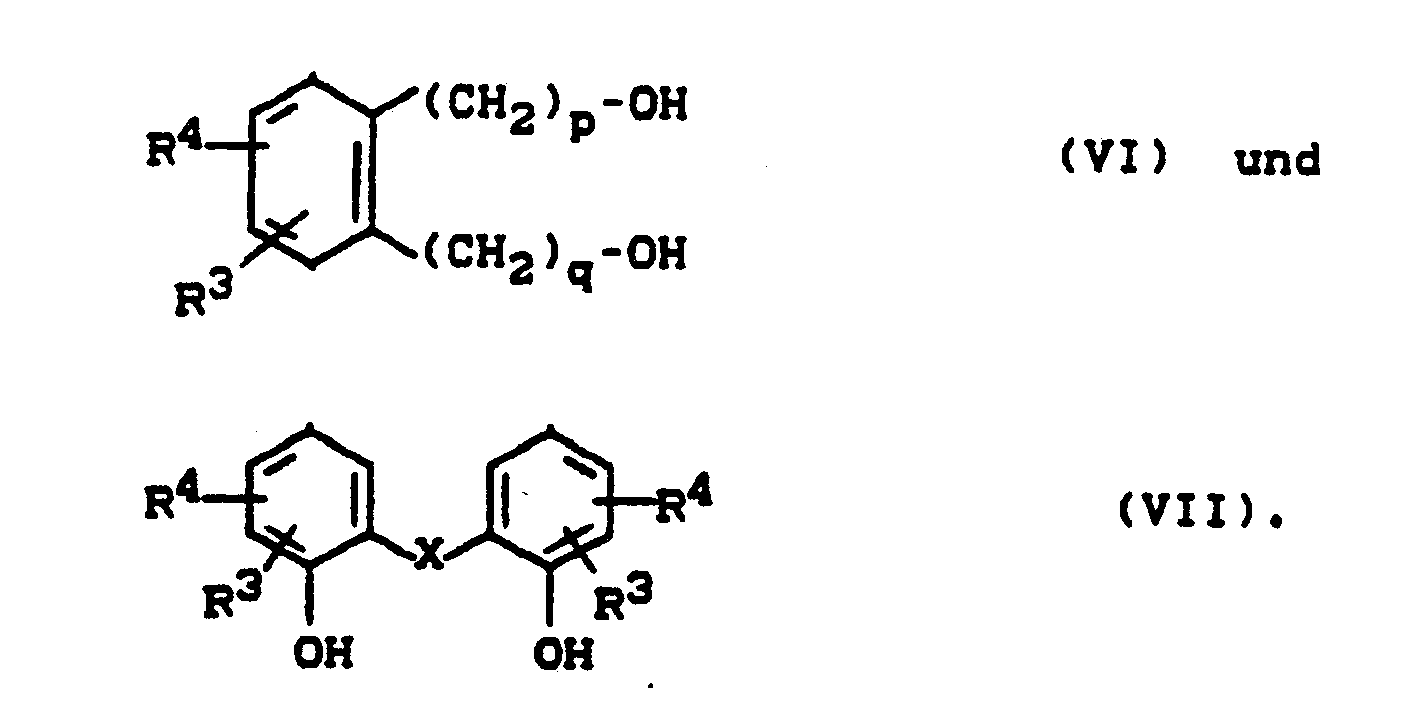
- In der Formel (III) hat der Index m die Bedeutung einer ganzen Zahl von 1 bis 16.
- R₁ und R₂ bedeuten unabhängig voneinander Wasserstoff, Alkyl, insbesondere C₁-C₆-Alkyl, Alkenyl, insbesondere Allyl, Aryl, insbesondere Phenyl, Aralkyl, insbesondere Benzyl, wobei die genannten Reste substituiert sein können, oder Halogen, insbesondere Fluor, Chlor, Brom oder Iod, Nitro oder OH. Besonders bevorzugte Reste R¹ und R² sind C₁-C₆-Alkyl, Allyl, Phenyl, Benzyl, Halogen, wie Fluor, Chlor, Brom oder Iod, Nitro, Di(C₁-C₄-alkyl)amino, Hydroxy, Hydroxymethyl, C₁-C₄-Alkoxymethyl, Allyloxymethyl, Halogenomethyl, der Rest der Formel

- In der Formel (IV) bedeutet Q ein solches cyclisches System mit 3-8, bevorzugt 3-6 Ringgliedern und kann beispielsweise ein 1,1-verknüpfter Cyclopropan-, Cyclobutan-, Cyclopentan- oder Cyclohexanring, ein 3,3-verknüpfter Oxetan-, Thietan-, Thietan-1-oxid-, Thietan-1,1-dioxidring oder ein 1,2-verknüpfter Cyclobutanring sein.
- In der Formel (V) bedeutet der Index o eine ganze Zahl von 1 bis 5, bevorzugt von 1 bis 3.
- In der Formel (VI) bedeuten die Indices p und q unabhängig voneinander die Zahlen 0, 1 oder 2, wobei die Summe p + q ≧ 1. Die Reste R³ und R⁴ bedeuten unabhängig voneinander Wasserstoff, C₁-C₆-Alkyl, C₁-C₆-Alkoxy, Halogen, wie Fluor, Chlor oder Brom oder Nitro. R³ und R⁴ können gemeinsam auch einen kondensierten weiteren aromatischen Kern bedeuten. Darüber hinaus kann R³ oder R⁴ auch Phenyl bedeuten.
- In der Formel (VII) bedeutet X kann eine Einfachbindung, ein Bindeglied, insbesondere einen gegebenenfalls substituierten Alkylrest, insbesondere Methylen und Ethylen, eine Kohlenwasserstoffkette mit 1-4 C-Atomen, Sauerstoff, Schwefel, -SO- oder -SO₂-. Die Reste R³ und R⁴ haben die genannte Bedeutung.
- Verbindungen der Formel (III) können beispielsweise sein 1,3-Propandiol, 1,5-Pentandiol, 1,6-Hexandiol, 1,8-Octandiol, 1.10-Decandiol, 1.12-Dodecandiol, 1.18-Octadecandiol, 2,2-subst. 1,3-Propandiole wie 2-Methyl-1,3-propandiol, 2,2-Dimethyl-1,3-propandiol, 2-Methyl-2-ethyl-1,3-propandiol, 2-Methyl-2-propyl-1,3-propandiol, 2,2-Diethyl-1,3-propandiol, 2-t-Butyl-2-methyl-1,3-propandiol, 2-Butyl-2-methyl-1,3-propandiol, 2-Allyl-2-methyl-1,3-propandiol, 2,2-Diphenyl-1,3-propandiol, 2-Methyl-2-phenyl-1,3-propandiol, 2,2-Dibenzyl-1,3-propandiol, 2-Chlor-2-nitro-1,3-propandiol, Glycerin, 2,2-Bis-hydroxymethyl-1,3-propandiol, 2-Allyloxymethyl-2-ethyl-1,3-propandiol (TMP-monoallylether), 2,2-Bis ethoxymethyl-1,3-propandiol (Pentaerythrit-diethylether), 2,2-Bischlormethyl-1,3-propandiol und 2-Methylen-1,3-propandiol.
- Beispiele für Verbindungen der Formel (IV) sind Cyclopropan-1,1-dimethanol, Cyclobutan-1,1-dimethanol, Cyclopentan-1,1-dimethanol, 1-Cyclohexen-4,4-dimethanol, Cyclohexan-1,1-dimethanol, Cyclobutan-1,2-dimethanol, 3,3-Bishydroxymethyloxetan und 3,3-Bishydroxymethylthietan.
- Beispiele für Verbindungen der Formel (V) und (VI) sind Diethylenglykol, Triethylenglykol, o-Hydroxymethylphenol und 1,2-Bishydroxymethylbenzol.
- Geeignete Bisphenole der Formel (VII) sind z.B. gegebenenfalls substituierte 2,2′-Dihydroxybiphenyle, gegebenenfalls substituierte Bis-(2-hydroxyphenyl)-methane wie Bis-(2-hydroxy-5-methylphenyl)-methan, Bis-(3-tert.-butyl-2-hydroxy-5-methylphenyl)-methan, Bis-(5-chlor-2-hydroxyphenyl)-methan, Bis-(3,5-dichlor-2-hydroxyphenyl)-methan, Bis-(3,5-dimethyl-2-hydroxyphenyl)-methan, gegebenenfalls substituierte 2,2-Bis-(2-hydroxyphenyl)-propane wie z.B. 2,2-Bis-(3,5-dimethyl-2-hydroxyphenyl)-propan und gegebenenfalls substituierte Bis-(2-hydroxyphenyl)-oxide und -sulfide
- Besonders geeignete Verbindungen II für das erfindungsgemäße Verfahren sind solche der Formel
HO-B-OH (VIII),
in der
B der Rest eines Propan-1,3-diols, der Rest eines Polyethylenglykols oder der Rest eines Bisphenols ist. - Propan-1,3-diole sind hierbei solche der Formel

R¹¹ und R¹² unabhängig voneinander Wasserstoff, C₁-C₄-Alkyl, Phenyl, Hydroxymethyl,C₁-C₄-Alkoxymethyl oder Allyloxymethyl sein können oder gemeinsam für -CH₂-O-CH₂- oder gemeinsam für C₄- oder C₅-Alkyliden stehen können. - Ebenfalls unter die Formel (VIII) fallende Polyethylenglykole sind solche der Formel
HO-(CH₂-CH₂-O)r-CH₂-CH₂-OH (X),
in der
der Index r die Zahl 1 oder 2 bedeutet. - Die ebenfalls unter die Formel (VIII) fallenden Bisphenole sind solche der Formel (XI)

Y eine Einfachbindung, Methylen, Sauerstoff oder Schwefel bedeutet und
R¹⁴ und R¹⁵ unabhängig voneinander Wasserstoff, C₁-C₄-Alkyl oder Chlor bedeuten. - Als typische Vertreter der Dihydroxyverbindungen der Formeln (IX), (X) und (XI) sind ebenfalls wieder beispielhaft und keineswegs erschöpfend zu nennen: 1,3-Propandiol, 2,2-Dimethyl-1,3-propandiol, 2-Ethyl-2-methyl-1,3-propandiol, 2,2-Diethyl-1,3-propandiol, 2-Methyl-2-propyl-1,3-propandiol, 2-Methyl-2-butyl-1,3-propandiol, 2-Methyl-2-phenyl-1,3-propandiol, 2,2-Diphenyl-1,3-propandiol, Trimethylolalkane, wie Trimethylolpropan und Trimethylolethan, Trimethylolpropan-monopropylether, Trimethylolpropan-monoallylether, Cyclopentan-1,1-dimethanol, Cyclohexan-1,1-dimethanol und 3,3-Bis-(hydroxymethyl)-oxetan; Diethylenglykol und Triethylenglykol; 2,2-Dihydroxybiphenyl, Bis-(5-methyl-2-hydroxyphenyl)-methan, Bis-(3,5-dimethyl-2-hydroxyphenyl)-methan, Bis-(5-chlor-2-hydroxyphenyl)-methan und Bis-(2-hydroxyphenyl)-oxid.
- Erfindungsgemäß wird in Gegenwart von 0,01-5 Gew.-%, bevorzugt 0,1-2 Gew.-%, bezogen auf die Dihydroxyverbindung, einer Verbindung K gearbeitet. Dies sind vor allem Stickstoffbasen, die das N-Atom in einem aromatischen 5- oder 6-Ring tragen und außerdem keine funktionellen Gruppen tragen, die mit Phosgen, Chlorkohlensäureestern oder Carbonaten unter den Reaktionsbedingungen feste Bindungen eingehen wie z.B. Amino-, Hydroxy- oder Mercaptogruppen. Neben dem N-Atom können im Ringsystem weitere Heteroatome stehen, beispielsweise Sauerstoff, Schwefel oder weitere N-Atome. Der Heterocyclus kann ferner mit anderen aromatischen Heterocyclen oder auch mit aromatischen Carbocyclen kondensiert sein.
- Beispiele für solche Verbindungen K sind: Pyridin, Chinolin, Isochinolin; Picoline, Pyrazin, Pyridazin und deren benzokondensierte Abkömmlinge; Triazine wie 2,4,6-Trimethyltriazin, Pyrazol, Imidazol, Triazol und Thiazol sowie die mit C₁-C₄-Alkyl, C₁-C₄-Alkoxy, C₁-C₄-Carbalkoxy oder Halogen substituierte Verbindungen, wie 2-Methyl-imidazol; weiterhin deren benzokondensierte Abkömmlinge, wie Benzimidazol, Benztriazol und Benzthiazol. Die kondensierten Benzolkerne in solchen Systemen können ihrerseits durch C₁-C₄-Alkyl, C₁-C₄-Alkoxy, C₁-C₄-Carbalkoxy, Halogen oder Nitro substituiert sein.
- Bevorzugte Verbindungen K für das erfindungsgemäße Verfahren sind Chinoline, Picoline, Benzimidazole, Pyrazole, Triazole und Benzotriazole, Pyridine und Imidazole, speziell Picoline, Pyridin und Imidazol. Selbstverständlich können mehrere dieser Verbindungen als Gemisch eingesetzt werden. Weiterhin können anstelle der freien Basen dieser Verbindungen deren Salze, beispielsweise deren Hydrochloride, Hydrobromide, Sulfate usw. eingesetzt werden. Es können auch solche Salze eingesetzt werden, aus denen sich im Reaktionsgemisch leicht die Hydrochloride bilden können, beispielsweise die Formiate, Acetate, Phosphate, Carbaminate, Picrate und andere.
- Die Umsetzung der Dihydroxyverbindung mit Phosgen kann in der Schmelze der Dihydroxyverbindung oder in Lösung erfolgen, wobei inerte Lösungsmittel, wie Kohlenwasserstoffe, Halogenkohlenwasserstoffe, Ester, Nitrile, Ether, Amide usw. eingesetzt werden können. Beispiele für solche Lösungsmittel sind: Dichlormethan, Chloroform, Toluol, Xylol, Chlorbenzol, Dichlorbenzol, Trimethylbenzol, Diphenylether, Chlornaphthalin, Butylacetat, Benzonitril, Dimethylacetamid, N-Methylpyrrolidon,
- Die Menge des etwa mitverwendeten Lösungsmittels ist für das erfindungsgemäße Verfahren unkritisch und kann daher in weiten Grenzen schwanken. Beispielsweise können 20 bis 2000 Gew.-%, bezogen auf das Gewicht der eingesetzten Dihydroxyverbindung, bevorzugt 100-1000 Gew.-%, an Lösungsmittel mitverwendet werden.
- Zur erfindungsgemäßen Umsetzung werden im allgemeinen 0,8-2 Mol, bevorzugt 0,9-1,5 Mol Phosgen pro Mol Verbindung der Formel II eingesetzt, ganz besonders bevorzugt werden auf 1 Mol Verbindung der Formel II 0,9-1,1 Mol Phosgen eingesetzt, wobei die Komponenten auch nachdosiert werden können. Das Phosgen kann sowohl in einem etwa mitverwendeten Lösungsmittel vorgelegt werden, als auch in Form einer Lösung dem vorgelegten (gelösten oder suspendierten) Dihydroxyverbindung in Form einer Lösung zugegeben werden. Schließlich kann das Phosgen flüssig oder gasförmig ohne weiteres Lösungsmittel in die Lösung, Suspension oder Schmelze der Dihydroxyverbindung einkondensiert werden. Die erfindungsgemäß einzusetzende N-heterocyclische aromatische Verbindung kann sowohl zusammen mit dem Ausgangsmaterial vorgelegt werden als auch nach dem Zusatz des Phosgens zugesetzt werden.
- Die erfindungsgemäße Umsetzung wird bei einer Temperatur von -20° C bis +300° C, bevorzugt zwischen 120 und 250° C bei Aromaten und zwischen -20 und 140° C bei Aliphaten durchgeführt. Hierbei kann man so arbeiten, daß die Temperatur im Verlaufe der Umsetzung innerhalb des angegebenen Bereichs gesteigert werden kann. Für den Fall der Mitverwendung eines Lösungsmittels kann dies bei einer solchen Temperatursteigerung abdestilliert werden. Während der erfindungsgemäßen Umsetzung kann man von einem niedriger siedenden Lösungsmittel zu einem höhersiedenden Lösungsmittel übergehen. Dies wird sehr einfach dadurch bewerkstelligt, daß bei einer Temperatursteigerung das niedrigsiedende Lösungsmittel abdestilliert wird, während gleichzeitig kontinuierlich oder absatzweise das höhersiedende Lösungsmittel in den Reaktionsansatz eindosiert wird. Die Umsetzung wird sodann in einem solchen höhersiedenden Lösungsmittel oder bei völligem Abdestillieren aller verwendeten Lösungsmittel auch in der Schmelze des hergestellten cyclischen Kohlensäureesters beendet. Bei der Umsetzung von aliphatischen und Ethergruppen oder cyclischen nicht-aromatische Gruppen enthaltenden Dihydroxyverbindungen hat sich eine Temperatur von -20° C bis +140° C, bevorzugt von -5° C bis +12° C als vorteilhaft erwiesen; hierbei ist es ganz besonders vorteilhaft, wenn die Umsetzung bei einer Temperatur von -5° C bis +50° C, bevorzugt bei -5° C bis +15° C begonnen wird. In der beschriebenen Art läßt sich auch bei dieser Variante die Temperatur während der Umsetzung steigern.
- Die erfindungsgemäße Umsetzung ist beendet, wenn auch bei einer Temperatursteigerung eine Chlorwasserstoffentwicklung nicht mehr beobachtet wird. Zur Entfernung von Chlorwasserstoffresten kann es zweckmäßig sein, entweder ein Vakuum anzulegen, oder einen Inertgasstrom (beispielsweise Stickstoff) durch das Reaktionsgemisch zu leiten.
- Die Isolierung der cyclischen Kohlensäureester aus dem Umsetzungsgemisch erfolgt in üblicher Weise beispielsweise durch Kristallisation oder Destillation, wobei bei hochsiedenden Reaktionsprodukten auch eine Vakuum- oder Hochvakuum-Destillation in Frage kommt.
- Die Ausbeuten an cyclischen Kohlensäureestern sind in der Regel sehr hoch. Im Falle von sechsgliedrigen, aliphatischen Verbindungen sind sie meist größer als 90 % der theoretischen Ausbeute. Die rohen Produkte sind in der Regel für viele Anwendungszwecke bereits rein genug.
- Die erfindungsgemäß erhältlichen cyclischen Kohlensäureester sind wertvolle Ausgangsmaterialien für Homo- und Copolycarbonate, Duromersysteme (EP-A 188 204) und Copolymerisate aus cyclischen Kohlensäureestern und Lactamen (DE-A 30 40 612).
- In eine Suspension aus 208 g (2,00 Mol) 2,2-Dimethylpropan-1,3-diol und 600 ml trockenem Dichlormethan leitete man innerhalb von 1,5 h bei 0 bis 5° C 198 g (2,00 Mol) Phosgen ein und rührte bei dieser Temperatur, bis die anfangs heftige Chlorwasserstoffentwicklung abgeklungen war. Durch einen wirksamen Rückflußkühler (Trockeneis) wurde dabei das Austragen von Phosgen verhindert. Dann wurde das Lösungsmittel im Vakuum entfernt und 500 mg (0,2 Gew.-%) Imidazol und 500 ml Toluol zugesetzt und die Reaktion unter langsamer Steigerung der Temperatur bis auf 110° C innerhalb von 3 h bis zum Abklingen der Chlorwasserstoffentwicklung zu Ende geführt. Chlorwasserstoffreste wurden durch Anlegen eines schwachen Vakuums entfernt. Nach Entfernung des Toluols und Fraktionierung des Rückstands im Vakuum erhielt man 121 g (93 % festes Produkt (Siedepunkt 142 bis 146° C/10 mbar). Nach Umkristallisation aus Ethylacetat erhielt man 117 g (90 %) Produkt (Fp. 108 bis 109° C). Eine weitere Aufarbeitung ist nicht erforderlich.
- In eine Lösung aus 186 g (1,00 Mol) 2,2′-Dihydroxybiphenyl und 1,00 g Imidazol in 500 ml trockenem Dichlorbenzol wurden innerhalb von 2,5 h bei 115 bis 120° C 150 g (1,50 Mol) Phosgen eingeleitet. Zur Vervollständigung der Chlorwasserstoffabspaltung erhitzte man die Lösung innerhalb von 2 h bis zum beginnenden Rückfluß und destillierte dann das Lösungsmittel im Vakuum ab. Der feste Rückstand (212 g) wurde im Hochvakuum destilliert. Man erhielt 189 g (89 %) eines farblosen kristallisierenden Destillats (Siedepunkt 126 bis 130°C/0,35 bis 0,5 mbar).
Fp. 99 bis 100° C (aus Diisopropylether); IR: 1805 cm⁻¹ (C=O)
Eine weitere Aufarbeitung ist nicht erforderlich.
Claims (10)

HO-A-OH ,
wobei bedeuten
z eine ganze Zahl von 1 bis 5
A ein in der Kohlensäureesterchemie übliches Bindeglied
mit Phosgen,
dadurch gekennzeichnet, daß die Umsetzung in Gegenwart katalytischer Mengen einer Verbindung K durchgeführt wird, die wenigstens ein Stickstoffatom als Ringglied in einem aromatischen Ringsystem aufweist.
HO-B-OH
in der
B der Rest eines Propan-1,3-diols, der Rest eines Polyethylenglykols oder der Rest eines Bisphenols ist, der nach Entfernung von 2 OH-Gruppen verbleibt.
Applications Claiming Priority (2)
| Application Number | Priority Date | Filing Date | Title |
|---|---|---|---|
| DE3838752 | 1988-11-16 | ||
| DE3838752A DE3838752A1 (de) | 1988-11-16 | 1988-11-16 | Verfahren zur herstellung von cyclischen kohlensaeureestern |
Publications (3)
| Publication Number | Publication Date |
|---|---|
| EP0369249A2 true EP0369249A2 (de) | 1990-05-23 |
| EP0369249A3 EP0369249A3 (en) | 1990-12-19 |
| EP0369249B1 EP0369249B1 (de) | 1993-12-29 |
Family
ID=6367252
Family Applications (1)
| Application Number | Title | Priority Date | Filing Date |
|---|---|---|---|
| EP89120324A Expired - Lifetime EP0369249B1 (de) | 1988-11-16 | 1989-11-03 | Verfahren zur Herstellung von cyclischen Kohlensäureestern |
Country Status (5)
| Country | Link |
|---|---|
| US (1) | US5023346A (de) |
| EP (1) | EP0369249B1 (de) |
| JP (1) | JPH02196783A (de) |
| DE (2) | DE3838752A1 (de) |
| ES (1) | ES2061884T3 (de) |
Cited By (1)
| Publication number | Priority date | Publication date | Assignee | Title |
|---|---|---|---|---|
| WO2003053952A1 (en) * | 2001-12-20 | 2003-07-03 | Ppg Industries Ohio, Inc. | Method of making trimethylene carbonate |
Families Citing this family (23)
| Publication number | Priority date | Publication date | Assignee | Title |
|---|---|---|---|---|
| US5391768A (en) | 1993-03-25 | 1995-02-21 | United States Surgical Corporation | Purification of 1,4-dioxan-2-one by crystallization |
| US6369157B1 (en) | 2000-01-21 | 2002-04-09 | Cyclics Corporation | Blend material including macrocyclic polyester oligomers and processes for polymerizing the same |
| US6906147B2 (en) * | 2002-03-20 | 2005-06-14 | Cyclics Corporation | Catalytic systems |
| US7151143B2 (en) * | 2000-01-21 | 2006-12-19 | Cyclics Corporation | Blends containing macrocyclic polyester oligomer and high molecular weight polymer |
| US7256241B2 (en) | 2000-01-21 | 2007-08-14 | Cyclics Corporation | Methods for polymerizing macrocyclic polyester oligomers using catalyst promoters |
| US6960626B2 (en) * | 2000-01-21 | 2005-11-01 | Cyclics Corporation | Intimate physical mixtures containing macrocyclic polyester oligomer and filler |
| US20050282952A1 (en) * | 2000-01-21 | 2005-12-22 | Cyclics Corporation | Graphite-polyester composites made from macrocyclic polyester oligomers |
| US6420047B2 (en) * | 2000-01-21 | 2002-07-16 | Cyclics Corporation | Macrocyclic polyester oligomers and processes for polymerizing the same |
| AU2001288663A1 (en) * | 2000-09-01 | 2002-03-13 | Cyclics Corporation | Methods for converting linear polyesters to macrocyclic oligoester compositions and macrocyclic oligoesters |
| US7767781B2 (en) * | 2000-09-01 | 2010-08-03 | Cyclics Corporation | Preparation of low-acid polyalkylene terephthalate and preparation of macrocyclic polyester oligomer therefrom |
| US7750109B2 (en) | 2000-09-01 | 2010-07-06 | Cyclics Corporation | Use of a residual oligomer recyclate in the production of macrocyclic polyester oligomer |
| US6436548B1 (en) | 2000-09-12 | 2002-08-20 | Cyclics Corporation | Species modification in macrocyclic polyester oligomers, and compositions prepared thereby |
| US6420048B1 (en) | 2001-06-05 | 2002-07-16 | Cyclics Corporation | High molecular weight copolyesters from macrocyclic oligoesters and cyclic esters |
| US7304123B2 (en) * | 2001-06-27 | 2007-12-04 | Cyclics Corporation | Processes for shaping macrocyclic oligoesters |
| US7071291B2 (en) * | 2001-06-27 | 2006-07-04 | Cyclics Corporation | Isolation, formulation and shaping of macrocyclic oligoesters |
| US6436549B1 (en) | 2001-07-16 | 2002-08-20 | Cyclics Corporation | Block copolymers from macrocyclic oligoesters and dihydroxyl-functionalized polymers |
| US6787632B2 (en) * | 2001-10-09 | 2004-09-07 | Cyclics Corporation | Organo-titanate catalysts for preparing pure macrocyclic oligoesters |
| US6506909B1 (en) * | 2001-12-20 | 2003-01-14 | Ppg Industries Ohio, Inc. | Method of making trimethylene carbonate |
| US6831138B2 (en) | 2002-01-07 | 2004-12-14 | Cyclics Corporation | Polymer-containing organo-metal catalysts |
| US6962968B2 (en) * | 2002-12-20 | 2005-11-08 | Cyclics Corporation | Purification of macrocyclic oligoesters |
| ATE460462T1 (de) * | 2003-12-19 | 2010-03-15 | Cyclics Corp | Verfahren zum dispergieren eines schlagzähigkeitsmodifikators in einem makrocyclischen polyesteroligomer |
| RU2309935C1 (ru) * | 2006-05-10 | 2007-11-10 | Открытое Акционерное Общество "Каустик" | Способ совместного получения хлороформа и алкиленкарбонатов |
| CN106459421B (zh) * | 2014-05-07 | 2019-11-19 | 旭化成株式会社 | 水系组合物用聚碳酸酯/聚氧乙烯嵌段共聚物、以及包含其的水系组合物 |
Family Cites Families (10)
| Publication number | Priority date | Publication date | Assignee | Title |
|---|---|---|---|---|
| US3221025A (en) * | 1961-12-21 | 1965-11-30 | Gen Electric | Aromatic carbonates |
| US3532715A (en) * | 1969-02-24 | 1970-10-06 | Union Carbide Corp | Six-membered cyclic carbonates having two olefinically unsaturated substitutents |
| DE3103136A1 (de) * | 1981-01-30 | 1982-08-26 | Bayer Ag, 5090 Leverkusen | Neue bicyclische ethercarbonate, verfahren zu ihrer herstellung und ihre verwendung |
| EP0057360B1 (de) * | 1981-01-30 | 1984-09-26 | Bayer Ag | Neue cyclische Kohlensäurederivate, ein Verfahren zu ihrer Herstellung und ihre Verwendung als Copolymerisationskomponenten bei der Herstellung von Polycarbonaten |
| US4585566A (en) * | 1984-11-21 | 1986-04-29 | Chevron Research Company | Carbonate treated dispersants |
| DE3502106A1 (de) * | 1985-01-23 | 1986-07-24 | Bayer Ag, 5090 Leverkusen | Verfahren zur herstellung von cyclischen, aliphatischen orthokohlensaeureestern sowie neue cyclische orthokohlensaeureester |
| US4727134A (en) * | 1985-02-22 | 1988-02-23 | General Electric Company | Method for preparing cyclic polycarbonate oligomer mixtures |
| JPS62238279A (ja) * | 1986-04-08 | 1987-10-19 | Neos Co Ltd | 1,3−ジオキサン−2−オン誘導体およびその製造方法 |
| US4870127A (en) * | 1986-09-22 | 1989-09-26 | The Dow Chemical Company | Poly (alkylene carbonate) polyahls having on the average up to one acid-terminal moiety and salts thereof |
| US4767840A (en) * | 1987-03-24 | 1988-08-30 | General Electric Company | Cyclic monocarbonate bishaloformates, method for their preparation, and uses thereof |
-
1988
- 1988-11-16 DE DE3838752A patent/DE3838752A1/de not_active Withdrawn
-
1989
- 1989-11-03 DE DE89120324T patent/DE58906574D1/de not_active Expired - Fee Related
- 1989-11-03 EP EP89120324A patent/EP0369249B1/de not_active Expired - Lifetime
- 1989-11-03 ES ES89120324T patent/ES2061884T3/es not_active Expired - Lifetime
- 1989-11-10 JP JP1291438A patent/JPH02196783A/ja active Pending
- 1989-11-13 US US07/434,443 patent/US5023346A/en not_active Expired - Fee Related
Cited By (1)
| Publication number | Priority date | Publication date | Assignee | Title |
|---|---|---|---|---|
| WO2003053952A1 (en) * | 2001-12-20 | 2003-07-03 | Ppg Industries Ohio, Inc. | Method of making trimethylene carbonate |
Also Published As
| Publication number | Publication date |
|---|---|
| US5023346A (en) | 1991-06-11 |
| DE3838752A1 (de) | 1990-05-17 |
| ES2061884T3 (es) | 1994-12-16 |
| JPH02196783A (ja) | 1990-08-03 |
| EP0369249B1 (de) | 1993-12-29 |
| DE58906574D1 (de) | 1994-02-10 |
| EP0369249A3 (en) | 1990-12-19 |
Similar Documents
| Publication | Publication Date | Title |
|---|---|---|
| EP0369249B1 (de) | Verfahren zur Herstellung von cyclischen Kohlensäureestern | |
| US4154738A (en) | Imidazole derivatives and intermediates in their preparation | |
| EP0124009B1 (de) | Verfahren zur Herstellung von Oxiranen | |
| HU205829B (en) | Fungicide composition containing 2-/amino-methyl/-1,4-dioxa/or1-oxa-4-thia/-spiro/4,5/decane derivative as active component and process for producing the active components | |
| DE1952091A1 (de) | Polyfunktionelle Polypol-Esteroxazolidine | |
| EP1599459B1 (de) | Verfahren zur herstellung von 4-fluor-1,3-dioxolan-2-on | |
| DE2940133A1 (de) | 1-(2-aryl-1,3-dioxolan-2-ylmethyl)-1h- 1,2,4-triazole | |
| DE3601927A1 (de) | Alpha, beta-substituierte acroleine, verfahren zu deren herstellung und deren verwendung | |
| EP2513082B1 (de) | Neue dioxolan- und dioxanderivate und ein verfahren zur deren herstellung | |
| US4141908A (en) | 2-Aryl-1,3-dioxolanes | |
| EP0067361B1 (de) | Verfahren zur Herstellung von 2-Alkoxy-(1,3)-dioxolanen | |
| DE4129752A1 (de) | Verfahren zur herstellung von 2-oxo-1,3-dioxolanen | |
| DE3236730A1 (de) | Verfahren zur herstellung von benzoxazolyl- und benzthiazolyloxyphenoxypropionsaeurederivaten | |
| DE69714875T2 (de) | Verfahren zur Herstellung von hetero-bizyklischem Alkohol-Enantiomer | |
| DE3021516C2 (de) | ||
| US4518785A (en) | Malondialdehyde tetraalkylacetals and their preparation | |
| EP0325927A1 (de) | Verfahren zur Herstellung von cyclischen, aliphatischen Orthokolensäureestern sowie neue cyclische Orthokohlensäureester | |
| DE3244956A1 (de) | Verfahren zur herstellung von glycolsaeureamiden | |
| EP0176076B1 (de) | Verfahren zur Herstellung von Kronenethern | |
| DE2528368C3 (de) | Verfahren zur Herstellung von heterocyclischen Verbindungen | |
| EP0277572A2 (de) | Verfahren zur Herstellung optisch aktiver 2-Hydroxyethyl-azol-Derivate | |
| DE3603100C2 (de) | Verfahren zur Herstellung von Nitromethylen-Derivaten | |
| EP2809664B1 (de) | Verfahren zur herstellung von methylen-1,3-dioxolanen | |
| DE60109299T2 (de) | 2,2-disubstituierte 1,3-dioxolane als hustenmittel | |
| DE1233882B (de) | Verfahren zur Herstellung von substituierten 1, 3-Oxathiol-2-onen |
Legal Events
| Date | Code | Title | Description |
|---|---|---|---|
| PUAI | Public reference made under article 153(3) epc to a published international application that has entered the european phase |
Free format text: ORIGINAL CODE: 0009012 |
|
| 17P | Request for examination filed |
Effective date: 19891103 |
|
| AK | Designated contracting states |
Kind code of ref document: A2 Designated state(s): DE ES FR GB IT NL |
|
| PUAL | Search report despatched |
Free format text: ORIGINAL CODE: 0009013 |
|
| AK | Designated contracting states |
Kind code of ref document: A3 Designated state(s): DE ES FR GB IT NL |
|
| 17Q | First examination report despatched |
Effective date: 19921215 |
|
| GRAA | (expected) grant |
Free format text: ORIGINAL CODE: 0009210 |
|
| AK | Designated contracting states |
Kind code of ref document: B1 Designated state(s): DE ES FR GB IT NL |
|
| ITF | It: translation for a ep patent filed | ||
| REF | Corresponds to: |
Ref document number: 58906574 Country of ref document: DE Date of ref document: 19940210 |
|
| GBT | Gb: translation of ep patent filed (gb section 77(6)(a)/1977) |
Effective date: 19940124 |
|
| ET | Fr: translation filed | ||
| PGFP | Annual fee paid to national office [announced via postgrant information from national office to epo] |
Ref country code: GB Payment date: 19941025 Year of fee payment: 6 |
|
| PGFP | Annual fee paid to national office [announced via postgrant information from national office to epo] |
Ref country code: FR Payment date: 19941027 Year of fee payment: 6 |
|
| PLBE | No opposition filed within time limit |
Free format text: ORIGINAL CODE: 0009261 |
|
| STAA | Information on the status of an ep patent application or granted ep patent |
Free format text: STATUS: NO OPPOSITION FILED WITHIN TIME LIMIT |
|
| PGFP | Annual fee paid to national office [announced via postgrant information from national office to epo] |
Ref country code: ES Payment date: 19941117 Year of fee payment: 6 |
|
| PGFP | Annual fee paid to national office [announced via postgrant information from national office to epo] |
Ref country code: NL Payment date: 19941130 Year of fee payment: 6 |
|
| REG | Reference to a national code |
Ref country code: ES Ref legal event code: FG2A Ref document number: 2061884 Country of ref document: ES Kind code of ref document: T3 |
|
| 26N | No opposition filed | ||
| PG25 | Lapsed in a contracting state [announced via postgrant information from national office to epo] |
Ref country code: GB Effective date: 19951103 |
|
| PG25 | Lapsed in a contracting state [announced via postgrant information from national office to epo] |
Ref country code: ES Free format text: LAPSE BECAUSE OF NON-PAYMENT OF DUE FEES Effective date: 19951104 |
|
| PG25 | Lapsed in a contracting state [announced via postgrant information from national office to epo] |
Ref country code: NL Effective date: 19960601 |
|
| GBPC | Gb: european patent ceased through non-payment of renewal fee |
Effective date: 19951103 |
|
| PG25 | Lapsed in a contracting state [announced via postgrant information from national office to epo] |
Ref country code: FR Effective date: 19960731 |
|
| NLV4 | Nl: lapsed or anulled due to non-payment of the annual fee |
Effective date: 19960601 |
|
| REG | Reference to a national code |
Ref country code: FR Ref legal event code: ST |
|
| PGFP | Annual fee paid to national office [announced via postgrant information from national office to epo] |
Ref country code: DE Payment date: 19961014 Year of fee payment: 8 |
|
| PG25 | Lapsed in a contracting state [announced via postgrant information from national office to epo] |
Ref country code: DE Free format text: LAPSE BECAUSE OF NON-PAYMENT OF DUE FEES Effective date: 19980801 |
|
| REG | Reference to a national code |
Ref country code: ES Ref legal event code: FD2A Effective date: 19961213 |
|
| PG25 | Lapsed in a contracting state [announced via postgrant information from national office to epo] |
Ref country code: IT Free format text: LAPSE BECAUSE OF NON-PAYMENT OF DUE FEES;WARNING: LAPSES OF ITALIAN PATENTS WITH EFFECTIVE DATE BEFORE 2007 MAY HAVE OCCURRED AT ANY TIME BEFORE 2007. THE CORRECT EFFECTIVE DATE MAY BE DIFFERENT FROM THE ONE RECORDED. Effective date: 20051103 |