EP0369434A2 - Lautsprecher-Dämpfungsanordnung - Google Patents
Lautsprecher-Dämpfungsanordnung Download PDFInfo
- Publication number
- EP0369434A2 EP0369434A2 EP89121155A EP89121155A EP0369434A2 EP 0369434 A2 EP0369434 A2 EP 0369434A2 EP 89121155 A EP89121155 A EP 89121155A EP 89121155 A EP89121155 A EP 89121155A EP 0369434 A2 EP0369434 A2 EP 0369434A2
- Authority
- EP
- European Patent Office
- Prior art keywords
- damper
- conductive members
- peripheral portion
- corrugations
- main body
- Prior art date
- Legal status (The legal status is an assumption and is not a legal conclusion. Google has not performed a legal analysis and makes no representation as to the accuracy of the status listed.)
- Granted
Links
Images


Classifications
-
- H—ELECTRICITY
- H04—ELECTRIC COMMUNICATION TECHNIQUE
- H04R—LOUDSPEAKERS, MICROPHONES, GRAMOPHONE PICK-UPS OR LIKE ACOUSTIC ELECTROMECHANICAL TRANSDUCERS; ELECTRIC HEARING AIDS; PUBLIC ADDRESS SYSTEMS
- H04R31/00—Apparatus or processes specially adapted for the manufacture of transducers or diaphragms therefor
- H04R31/003—Apparatus or processes specially adapted for the manufacture of transducers or diaphragms therefor for diaphragms or their outer suspension
-
- H—ELECTRICITY
- H04—ELECTRIC COMMUNICATION TECHNIQUE
- H04R—LOUDSPEAKERS, MICROPHONES, GRAMOPHONE PICK-UPS OR LIKE ACOUSTIC ELECTROMECHANICAL TRANSDUCERS; ELECTRIC HEARING AIDS; PUBLIC ADDRESS SYSTEMS
- H04R1/00—Details of transducers, loudspeakers or microphones
- H04R1/06—Arranging circuit leads; Relieving strain on circuit leads
-
- H—ELECTRICITY
- H04—ELECTRIC COMMUNICATION TECHNIQUE
- H04R—LOUDSPEAKERS, MICROPHONES, GRAMOPHONE PICK-UPS OR LIKE ACOUSTIC ELECTROMECHANICAL TRANSDUCERS; ELECTRIC HEARING AIDS; PUBLIC ADDRESS SYSTEMS
- H04R7/00—Diaphragms for electromechanical transducers; Cones
- H04R7/16—Mounting or tensioning of diaphragms or cones
-
- H—ELECTRICITY
- H04—ELECTRIC COMMUNICATION TECHNIQUE
- H04R—LOUDSPEAKERS, MICROPHONES, GRAMOPHONE PICK-UPS OR LIKE ACOUSTIC ELECTROMECHANICAL TRANSDUCERS; ELECTRIC HEARING AIDS; PUBLIC ADDRESS SYSTEMS
- H04R7/00—Diaphragms for electromechanical transducers; Cones
- H04R7/26—Damping by means acting directly on free portion of diaphragm or cone
Definitions
- the present invention relates to a speaker damper having a conductive member to input an audio signal to a voice coil and also relates to method and apparatus for manufacturing such a damper.
- a speaker damper comprising a damper main body 1 and two conductive members 2.
- the damper main body is constructed in a manner such that a thermosetting resin such as a phenol resin or the like is impregnated into a damper raw material comprising a cloth material such as woven cloth, unwoven cloth, or the like and a wave-shaped corrugation is integrally formed by a thermal molding work.
- the conductive materials are attached from the inner peripheral portion to the outer peripheral portion along the shape of the corrugation.
- the conductive members are used as current supplying means to a coil which is provided at the center of the damper.
- Fig. 3 is a cross sectional view of dies to mold the damper as mentioned above.
- the above-mentioned damper raw material or the damper raw material onto which the conductive members were adhered is thermally pressed and molded by upper and lower dies on which a number of convex and concave portions corresponding to the corrugations in Fig. 3 are annularly formed.
- the material i.e., the damper raw material is molded while being pulled from the outer peripheral portion to the inner peripheral portion side. Therefore, the shape and number of corrugations, particularly, a width W and a depth D are set to values within ranges such that a damage of the material upon molding and a bending, a deformation, or the like after the molding do not occur.
- the conductive members are adhered to the damper main body and the resultant damper is attached. Therefore, there is a drawback such that when the damper is continuously vibrated at a large amplitude for a long time, the conductive members are peeled off from the corrugations and the peeled-off portions are come into contact with the back surfaces of the damper and the cone diaphragm and an abnormal sound is generated. There is also a drawback such that if the abnormal resonance is continued without keeping the proper shape in a state in which the conductive members were peeled off, the conductive members are cut out.
- the conventional method of manufacturing the speaker damper described in the above items (1) to (3) has the following drawbacks in terms of the mass productivity.
- thermosetting resin adhered to the conductive members is hardened and becomes a good insulative material.
- the hardened thermosetting resin must be eliminated, and the like. In this manner, the number of manufacturing steps increases.
- the number of steps is increased in a manner similar to the above, resulting in an increase in costs.
- the conventional speaker damper has the following drawbacks because the width W and depth D of the corrugations are set so as to have the same shape from the inner peripheral portion to the outer peripheral portion.
- the copper foils, woven wires, or the like which are generally used as conductive members have drawbacks such that cracks are generated in the conductive members upon molding since the deforming ratio is lower than that of the cloth material such as woven cloth, unwoven cloth, or the like.
- cracks are easily generated near the first concave portion and the first convex portion on the inner peripheral portion side where a force to pull in the material such as conductive members largely acts.
- the outer peripheral portion sides of the conductive members are cut out and become the free ends and the materials can easily move, but at the inner peripheral portion sides, the inner end is fixed, so that it is extremely diffucult to move the material. Accordingly, as the position approaches the inner peripheral portion side, the force to pull in the material is large, so that a more number of cracks are generated in the inner peripheral portion.
- a woven wire has been used as conductive wire members.
- the woven wire is formed in a manner such that a copper foil is wound around the twisted fiber and one thin wire-shaped line raw material is formed and a proper number of such line raw materials are selected as necessary and are woven. Therefore, since the copper foil of the woven wire is formed as a continuous spiral shape, the woven wire has a function such that even when the woven thread wire is largely bent, the copper foil can move in conformity with the bent state. Due to this, the wire material is flexible and bending stresses are hardly applied to the copper foil, so that the wire-cut resistance by the metal fatigue is extremely high. Consequently, the woven wire is most frequently used as a conductive material of the speaker which needs the flexibility and vibration resistance.
- the conventional ordinary woven wire also inevitably has an inconvenience such that cracks are generated due to the vibration of the damper.
- the movable portions of the copper foils can move only on the opposite side of the adhesive portion, that is, only on the upper side in the diagram. Only about half of the inherent capability of the woven wire can be effected.
- the fixed portions of the copper foils, that is, the adhesive portions with the damper cannot help deforming in conformity with the amplitude of the damper, so that there is a fear such that cracks are finally generated due to the metal fatigue and the wire is cut out.
- the second object of the invention is that when conductive members are attached along the surface of the damper main body having coaxial corrugations, it can be prevented that a damage such as cracks or the like occurs in the conductive members.
- the third object of the invention is to provide a method of manufacturing a damper comprising a damper main body having an excellent mass productivity and conductive members which are attached to the damper main body.
- reference numeral 1 denotes the damper main body.
- a thermosetting resin such as a phenol resin or the like which was diluted by a solvent is impregnated into a damper raw material comprising a cloth material such as woven cloth, unwoven cloth, or the like. The solvent is evaporated to eliminate the resin tackiness.
- the damper material is molded by thermal molding dies and concentric wave-shaped corrugations are integrally formed. In this manner, the damper main body 1 is formed.
- Reference numeral 2 indicates the conductive members which are attached along the shapes of the corrugations in the direction from the inner peripheral portion to the outer peripheral portion.
- Fig. 5B shows an enlarged cross sectional view of the portion shown by C in Fig. 5A.
- the damper raw material comprising the above cloth material is allowed to pass in the treating bath in which the thermosetting resin such as a phenol resin or the like which was diluted by a solvent is stored, thereby impregnating the thermosetting resin into the damper raw material.
- the solvent is evaporated and the resin tackiness is eliminated.
- the conductive members 2 are sewed to the damper raw material 1 by using a fiber (thread) 3.
- Such a sewing step can be easily realized by an industrial sewing machine 4.
- the corrugations are integrally molded to the damper main body and the conductive members 2 are attached along the shapes of the corrugations.
- the plain weave woven wire which is frequently used in the conductive members of the speaker which requires the flexibility and the vibration resistance has been used as conductive members.
- an ordinary woven wire can be also obviously used.
- the conductive members since the conductive members have been sewed along the shapes of the corrugations of the damper main body by using a fiber, different from the conventional adhesion method or the like, no adhesive agent layer is formed. Therefore, the conductive members can move by a certain degree and keeps a flexibility. Moreover, as compared with the conventional damper configuration, the conductive members can be extremely strictly mounted. Even if the damper is continuously vibrated at a large amplitude for a long time, the conductive members are not peeled off from the corrugation portions.
- the above flexibility can be further effected and the limit performance of the amplitude can be set to be fairly improved. Therefore, as compared with the conventional example, the performance can be remarkably improved and a range of the speaker in which the damper with the conductive portions can be used is widened.
- the damper material is thermally molded and the damper is manufactured. Therefore, the insulative resin is not adhered to the conductive members.
- the step of eliminating the insulative resin adhered to the conductive members or the like as in the conventional one is unnecessary.
- the conductive members can be easily sewed and attached by the sewing machine. Therefore, the examination of the material of the adhesive agent, the complicated method of coating the adhesive agent, and the like as in the items (2) and (3) in the conventional examples are unnecessary. The number of steps can be reduced.
- the costs can be reduced because the process can easily advance to the next step, the number of intermediate parts to be repaired can be decreased, and the like. Moreover, since no adhesive agent is used, there are advantages such that the damper main body is not adhered to the dies upon thermal molding, the damper main body can be easily removed from the dies, and the like.
- a structure of the conductive members such that even if the conductive members are adhered to the damper surface, the conductive members can be shifted for the damper surface.
- the woven wire of the conductive member structure is formed in the following manner as shown in Fig. 7A. That is, two sheets of conductive foils (copper foils) 12a and 12b are overlaid and wound around twisted fibers 11 and one thin wire-shaped line raw material 10 is formed. A proper number of such wire raw materials 10 are selected and woven. In this manner, the woven wire is formed. Therefore, the inner and outer conductive foil layers 12a and 12b of the wire raw materials constructing the woven wire can be slightly shifted from each other.
- a flat net-shaped woven wire 20 which is formed by weaving the wire raw materials 10 like a flat net shape is used.
- Fig. 7C shows an embodiment in which the flat net-shaped woven wire 20 is molded so as to be adhered to the damper 1 by either one of the damper manufacturing methods of the conventional techniques.
- Fig. 5 shows an embodiment in which after the flat net-shaped woven wire 20 was sewed to the damper raw material 1 by using a thread 3, corrugations are formed by thermally pressing and molding them.
- the inside conductive foil 12a is held to the outside copper foil 12b so as to be freely movable.
- the flat net-shaped woven thread wire since almost of the outside conductive foil is held by the sewing thread 3, the flat net-shaped woven thread wire is not peeled off from the corrugations but can accurately operate for a long time.
- the number of conductive foils is not limited to two but can be set to three or more.
- the woven wire is not limited to the flat net-shaped woven type but may be a string-shaped woven wire which has conventionally generally been used.
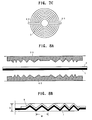
- a die apparatus in which a plurality of annular concave and convex portions are provided for upper and lower dies 30 and 40 as shown in Fig. 8 in order to mold corrugations of the damper and widths among the concave and convex portions on the inner peripheral portion side and the outer peripheral portion side and made different, that is, the width between the concave and convex portions on the inner peripheral portion side is set to be sequentially larger than that on the outer peripheral portion side.
- the damper raw material from which the resin tackiness was eliminated and the conductive members and overlaid by an adhesive material or the conductive members are sewed and mounted to the damper raw material and they are thermally pressed and molded by the die apparatus.
- corrugations are molded in the damper main body 1 and the conductive members 2 are mounted to the damper main body along the corrugations.
- the pull-in amount of the material on the inner peripheral portion side is small. Thus, no crack is generated on the inner peripheral portion side of the conductive members.
- Fig. 8A shows the speaker damper molded as mentioned above.
- the width W of the corrugation on the inner peripheral portion side is sequentially widened as the position approaches the corrugation of the outer peripheral portion.
- the conductive members 2 are attached along the corrugations.
- the conductive members 2 are set to the upper or back surface of the damper main body 1 and they are pressed by the die apparatus, and the conductive members 2 can be also mounted in conformity with the shapes of the corrugations of the damper main body 1.
- width W among the corrugations has been varied.
- a depth D of corrugations is sequentially shallowed as the position approaches from the corrugation on the outer peripheral portion side to the corrugation on the inner peripheral portion side.
- the width W and depth D can be also sequentially widened and shallowed as the position approaches from the corrugation on the outer peripheral portion side to the corrugation on the inner peripheral portion side.
Landscapes
- Engineering & Computer Science (AREA)
- Physics & Mathematics (AREA)
- Acoustics & Sound (AREA)
- Signal Processing (AREA)
- Multimedia (AREA)
- Manufacturing & Machinery (AREA)
- Audible-Bandwidth Dynamoelectric Transducers Other Than Pickups (AREA)
Applications Claiming Priority (4)
| Application Number | Priority Date | Filing Date | Title |
|---|---|---|---|
| JP286679/88 | 1988-11-15 | ||
| JP63286679A JP2671140B2 (ja) | 1988-11-15 | 1988-11-15 | スピーカ用ダンパーとその製造法 |
| JP26114/89U | 1989-03-09 | ||
| JP1989026114U JP2553450Y2 (ja) | 1989-03-09 | 1989-03-09 | スピーカ用ダンパーの配線構造 |
Publications (3)
| Publication Number | Publication Date |
|---|---|
| EP0369434A2 true EP0369434A2 (de) | 1990-05-23 |
| EP0369434A3 EP0369434A3 (de) | 1991-11-21 |
| EP0369434B1 EP0369434B1 (de) | 1995-02-01 |
Family
ID=26363850
Family Applications (1)
| Application Number | Title | Priority Date | Filing Date |
|---|---|---|---|
| EP89121155A Expired - Lifetime EP0369434B1 (de) | 1988-11-15 | 1989-11-15 | Lautsprecher-Dämpfungsanordnung |
Country Status (3)
| Country | Link |
|---|---|
| US (1) | US5125473A (de) |
| EP (1) | EP0369434B1 (de) |
| DE (1) | DE68920956T2 (de) |
Cited By (9)
| Publication number | Priority date | Publication date | Assignee | Title |
|---|---|---|---|---|
| FR2668018A1 (fr) * | 1990-10-12 | 1992-04-17 | Cabasse Kergonan Sa | Procede de fabrication de l'equipage mobile d'un haut-parleur electrodynamique, et equipage mobile correspondant. |
| EP0479317A3 (en) * | 1990-10-05 | 1993-03-03 | Kabushiki Kaisha Kenwood | Loudspeaker damper and method of manufacturing the same |
| EP0702501A3 (de) * | 1994-09-13 | 1996-06-05 | Blaupunkt Werke Gmbh | Dynamischer Lautsprecher mit einer Zentriermembran |
| EP0753238A4 (de) * | 1994-03-29 | 1998-01-21 | Harman Int Ind | Verfahren zur herstellung eines lautsprecherdämpfers |
| GB2322505A (en) * | 1997-02-20 | 1998-08-26 | Ellis Dev Ltd | Components for loudspeakers |
| WO1998053640A1 (en) * | 1997-05-22 | 1998-11-26 | Kabushiki Kaisha Kenwood | Loudspeaker suspension device and fabricating method thereof |
| CN1085484C (zh) * | 1995-03-28 | 2002-05-22 | 先锋电子股份有限公司 | 扬声器用阻尼器 |
| EP1233644A3 (de) * | 2001-02-16 | 2006-11-02 | Pioneer Corporation | Elektrisches leitfähiges Dämpfungsgerät für Lautsprecher |
| WO2023072781A1 (en) | 2021-10-25 | 2023-05-04 | Pss Belgium Nv | Loudspeaker |
Families Citing this family (8)
| Publication number | Priority date | Publication date | Assignee | Title |
|---|---|---|---|---|
| AU4639400A (en) | 1999-01-20 | 2000-08-18 | Ensign-Bickford Company, The | Accumulated detonating cord explosive charge and method of making and of use of the same |
| EP1169657A4 (de) * | 1999-03-17 | 2003-03-05 | Input Output Inc | Eichung von sensoren. |
| JP3893004B2 (ja) * | 1999-12-28 | 2007-03-14 | パイオニア株式会社 | スピーカ用導電ダンパーの製造装置 |
| US6732832B2 (en) * | 2001-11-14 | 2004-05-11 | Yen-Chen Chan | Speaker damper |
| US20040112630A1 (en) * | 2002-12-13 | 2004-06-17 | Taiwan Maeden Co., Ltd. | Sound signal wire and process for enhancing rigidity thereof |
| US7141740B2 (en) * | 2002-12-13 | 2006-11-28 | Taiwan Maeden Co., Ltd. | Sound signal wire and process for enhancing rigidity thereof |
| TWI260935B (en) * | 2004-09-06 | 2006-08-21 | Rosa Chang | Audio transmission wire |
| TWI901960B (zh) * | 2023-05-19 | 2025-10-21 | 大原祐子 | 具有形狀寬薄且平坦的導電結構的彈波及其製造方法 |
Family Cites Families (4)
| Publication number | Priority date | Publication date | Assignee | Title |
|---|---|---|---|---|
| US2624417A (en) * | 1947-02-20 | 1953-01-06 | Joseph B Brennan | Acoustic diaphragm with flexible rim portion and rigid body portion |
| US3837425A (en) * | 1973-06-11 | 1974-09-24 | Bozak Inc | Edge-damped diaphragm for electrodynamic loudspeakers |
| JPS5444451A (en) * | 1977-09-14 | 1979-04-07 | Fujitsu Ltd | Address extension system |
| JPH07112309B2 (ja) * | 1987-10-23 | 1995-11-29 | 松下電器産業株式会社 | スピーカ用振動板 |
-
1989
- 1989-11-15 DE DE68920956T patent/DE68920956T2/de not_active Expired - Lifetime
- 1989-11-15 EP EP89121155A patent/EP0369434B1/de not_active Expired - Lifetime
-
1991
- 1991-03-25 US US07/675,033 patent/US5125473A/en not_active Expired - Lifetime
Cited By (13)
| Publication number | Priority date | Publication date | Assignee | Title |
|---|---|---|---|---|
| EP0479317A3 (en) * | 1990-10-05 | 1993-03-03 | Kabushiki Kaisha Kenwood | Loudspeaker damper and method of manufacturing the same |
| FR2668018A1 (fr) * | 1990-10-12 | 1992-04-17 | Cabasse Kergonan Sa | Procede de fabrication de l'equipage mobile d'un haut-parleur electrodynamique, et equipage mobile correspondant. |
| US6269167B1 (en) | 1994-03-29 | 2001-07-31 | Harman International Industries, Incorporated | Loudspeaker spider, method of making it and loudspeaker incorporating it |
| EP0753238A4 (de) * | 1994-03-29 | 1998-01-21 | Harman Int Ind | Verfahren zur herstellung eines lautsprecherdämpfers |
| US7082667B2 (en) | 1994-03-29 | 2006-08-01 | Harman International Industries, Incorporated | Method of making a loudspeaker |
| EP0702501A3 (de) * | 1994-09-13 | 1996-06-05 | Blaupunkt Werke Gmbh | Dynamischer Lautsprecher mit einer Zentriermembran |
| CN1085484C (zh) * | 1995-03-28 | 2002-05-22 | 先锋电子股份有限公司 | 扬声器用阻尼器 |
| GB2322505B (en) * | 1997-02-20 | 2001-06-20 | Ellis Dev Ltd | Components for loudspeakers |
| GB2322505A (en) * | 1997-02-20 | 1998-08-26 | Ellis Dev Ltd | Components for loudspeakers |
| US6332262B1 (en) | 1997-05-22 | 2001-12-25 | Kabushiki Kaisha Kenwood | Method of fabricating a loudspeaker suspension device |
| WO1998053640A1 (en) * | 1997-05-22 | 1998-11-26 | Kabushiki Kaisha Kenwood | Loudspeaker suspension device and fabricating method thereof |
| EP1233644A3 (de) * | 2001-02-16 | 2006-11-02 | Pioneer Corporation | Elektrisches leitfähiges Dämpfungsgerät für Lautsprecher |
| WO2023072781A1 (en) | 2021-10-25 | 2023-05-04 | Pss Belgium Nv | Loudspeaker |
Also Published As
| Publication number | Publication date |
|---|---|
| EP0369434A3 (de) | 1991-11-21 |
| DE68920956T2 (de) | 1995-09-21 |
| US5125473A (en) | 1992-06-30 |
| EP0369434B1 (de) | 1995-02-01 |
| DE68920956D1 (de) | 1995-03-16 |
Similar Documents
| Publication | Publication Date | Title |
|---|---|---|
| EP0369434B1 (de) | Lautsprecher-Dämpfungsanordnung | |
| CN106899918B (zh) | 扬声器振板及其制造方法、和包括该扬声器振板的扬声器 | |
| EP1715720B1 (de) | Teil des Vibrationssystems eines Lautsprechers und Herstellungsmethode | |
| EP0753238A1 (de) | Verfahren zur herstellung eines lautsprecherdämpfers | |
| EP1091616B1 (de) | Lautsprechersmembran | |
| JP3331908B2 (ja) | スピーカ用サスペンション装置の製造方法及びスピーカ用サスペンション製造用金型 | |
| EP0479317B1 (de) | Verfahren zur Herstellung eines Lautsprecherdämpfers und Lautsprecherdämpfer resultierend aus diesem Verfahren | |
| EP1638365A2 (de) | Lautsprechermembran und Lautsprecher mit Anwendung einer solchen Menbran | |
| JP3942069B2 (ja) | スピーカ用ダンパーおよびその製造方法 | |
| JP2009021832A (ja) | スピーカ用振動板とそれを用いたスピーカ | |
| US6814181B2 (en) | Electrically conductive damper device for speaker | |
| JP3751445B2 (ja) | スピーカ用ダンパーおよびその製造方法 | |
| JP3585465B2 (ja) | 伸縮性コード | |
| JP3942053B2 (ja) | スピーカ用ダンパおよびその製造方法 | |
| JPH01897A (ja) | スピ−カ | |
| JP3456819B2 (ja) | スピーカ及びその製造方法 | |
| JPH0710120B2 (ja) | スピーカ用ダンパーの製造方法 | |
| JPH07312126A (ja) | ケーブル圧接ハーネスの製造方法 | |
| US8077903B2 (en) | Method and apparatus for controlling material vibration modes in polymer and paper high performance speaker diaphragms | |
| JP4756393B2 (ja) | スピーカー振動板およびこれを用いた動電型スピーカー | |
| JP2671140B2 (ja) | スピーカ用ダンパーとその製造法 | |
| EP0835040A1 (de) | Lautsprecher | |
| JP2555781Y2 (ja) | スピーカのダンパー構造 | |
| JP2000299897A (ja) | 平面型スピーカ | |
| JP3131033B2 (ja) | スピーカ |
Legal Events
| Date | Code | Title | Description |
|---|---|---|---|
| PUAI | Public reference made under article 153(3) epc to a published international application that has entered the european phase |
Free format text: ORIGINAL CODE: 0009012 |
|
| AK | Designated contracting states |
Kind code of ref document: A2 Designated state(s): DE FR GB |
|
| PUAL | Search report despatched |
Free format text: ORIGINAL CODE: 0009013 |
|
| AK | Designated contracting states |
Kind code of ref document: A3 Designated state(s): DE FR GB |
|
| 17P | Request for examination filed |
Effective date: 19920403 |
|
| RAP1 | Party data changed (applicant data changed or rights of an application transferred) |
Owner name: MOGAMI DENKI KABUSHIKI KAISHA Owner name: KABUSHIKI KAISHA KENWOOD |
|
| RAP1 | Party data changed (applicant data changed or rights of an application transferred) |
Owner name: MOGAMI DENKI KABUSHIKI KAISHA Owner name: KABUSHIKI KAISHA KENWOOD |
|
| 17Q | First examination report despatched |
Effective date: 19930924 |
|
| RAP3 | Party data changed (applicant data changed or rights of an application transferred) |
Owner name: MOGAMI DENKI KABUSHIKI KAISHA Owner name: KABUSHIKI KAISHA KENWOOD |
|
| GRAA | (expected) grant |
Free format text: ORIGINAL CODE: 0009210 |
|
| AK | Designated contracting states |
Kind code of ref document: B1 Designated state(s): DE FR GB |
|
| REF | Corresponds to: |
Ref document number: 68920956 Country of ref document: DE Date of ref document: 19950316 |
|
| ET | Fr: translation filed | ||
| PLBE | No opposition filed within time limit |
Free format text: ORIGINAL CODE: 0009261 |
|
| STAA | Information on the status of an ep patent application or granted ep patent |
Free format text: STATUS: NO OPPOSITION FILED WITHIN TIME LIMIT |
|
| 26N | No opposition filed | ||
| REG | Reference to a national code |
Ref country code: GB Ref legal event code: IF02 |
|
| PGFP | Annual fee paid to national office [announced via postgrant information from national office to epo] |
Ref country code: DE Payment date: 20081114 Year of fee payment: 20 |
|
| PGFP | Annual fee paid to national office [announced via postgrant information from national office to epo] |
Ref country code: FR Payment date: 20081112 Year of fee payment: 20 |
|
| PGFP | Annual fee paid to national office [announced via postgrant information from national office to epo] |
Ref country code: GB Payment date: 20081112 Year of fee payment: 20 |
|
| REG | Reference to a national code |
Ref country code: GB Ref legal event code: PE20 Expiry date: 20091114 |
|
| PG25 | Lapsed in a contracting state [announced via postgrant information from national office to epo] |
Ref country code: GB Free format text: LAPSE BECAUSE OF EXPIRATION OF PROTECTION Effective date: 20091114 |