EP0369740A1 - Verfahren zum Entfetten von keramischen Formkörpern - Google Patents
Verfahren zum Entfetten von keramischen Formkörpern Download PDFInfo
- Publication number
- EP0369740A1 EP0369740A1 EP89311771A EP89311771A EP0369740A1 EP 0369740 A1 EP0369740 A1 EP 0369740A1 EP 89311771 A EP89311771 A EP 89311771A EP 89311771 A EP89311771 A EP 89311771A EP 0369740 A1 EP0369740 A1 EP 0369740A1
- Authority
- EP
- European Patent Office
- Prior art keywords
- temperature
- degreasing
- molded bodies
- contraction
- paraffin wax
- Prior art date
- Legal status (The legal status is an assumption and is not a legal conclusion. Google has not performed a legal analysis and makes no representation as to the accuracy of the status listed.)
- Granted
Links
- 239000000919 ceramic Substances 0.000 title claims abstract description 33
- 238000005238 degreasing Methods 0.000 title claims abstract description 33
- 238000000034 method Methods 0.000 title claims description 14
- 230000008602 contraction Effects 0.000 claims abstract description 26
- 239000012188 paraffin wax Substances 0.000 claims abstract description 17
- 238000010438 heat treatment Methods 0.000 claims abstract description 16
- 238000005979 thermal decomposition reaction Methods 0.000 claims abstract description 8
- 239000011230 binding agent Substances 0.000 claims description 27
- 230000001590 oxidative effect Effects 0.000 claims description 8
- 238000012423 maintenance Methods 0.000 description 15
- 230000015572 biosynthetic process Effects 0.000 description 14
- 238000002347 injection Methods 0.000 description 7
- 239000007924 injection Substances 0.000 description 7
- 239000001993 wax Substances 0.000 description 7
- 239000000843 powder Substances 0.000 description 6
- 229910052581 Si3N4 Inorganic materials 0.000 description 3
- PNEYBMLMFCGWSK-UHFFFAOYSA-N aluminium oxide Inorganic materials [O-2].[O-2].[O-2].[Al+3].[Al+3] PNEYBMLMFCGWSK-UHFFFAOYSA-N 0.000 description 3
- 238000004455 differential thermal analysis Methods 0.000 description 3
- 239000007789 gas Substances 0.000 description 3
- 239000004413 injection moulding compound Substances 0.000 description 3
- HQVNEWCFYHHQES-UHFFFAOYSA-N silicon nitride Chemical compound N12[Si]34N5[Si]62N3[Si]51N64 HQVNEWCFYHHQES-UHFFFAOYSA-N 0.000 description 3
- 238000002411 thermogravimetry Methods 0.000 description 3
- 238000006243 chemical reaction Methods 0.000 description 2
- 238000000354 decomposition reaction Methods 0.000 description 2
- 230000003247 decreasing effect Effects 0.000 description 2
- 238000002474 experimental method Methods 0.000 description 2
- 238000001746 injection moulding Methods 0.000 description 2
- 238000000465 moulding Methods 0.000 description 2
- 238000007254 oxidation reaction Methods 0.000 description 2
- 238000005245 sintering Methods 0.000 description 2
- 238000002076 thermal analysis method Methods 0.000 description 2
- 229910052799 carbon Inorganic materials 0.000 description 1
- 125000004432 carbon atom Chemical group C* 0.000 description 1
- 150000001875 compounds Chemical class 0.000 description 1
- 238000004090 dissolution Methods 0.000 description 1
- 238000002309 gasification Methods 0.000 description 1
- 239000007788 liquid Substances 0.000 description 1
- 238000005259 measurement Methods 0.000 description 1
- 239000000203 mixture Substances 0.000 description 1
- 239000003960 organic solvent Substances 0.000 description 1
- 239000002245 particle Substances 0.000 description 1
- 238000004904 shortening Methods 0.000 description 1
- 239000007787 solid Substances 0.000 description 1
- 238000001757 thermogravimetry curve Methods 0.000 description 1
- 229920005992 thermoplastic resin Polymers 0.000 description 1
- 238000012546 transfer Methods 0.000 description 1
- 238000011179 visual inspection Methods 0.000 description 1
Images


Classifications
-
- C—CHEMISTRY; METALLURGY
- C04—CEMENTS; CONCRETE; ARTIFICIAL STONE; CERAMICS; REFRACTORIES
- C04B—LIME, MAGNESIA; SLAG; CEMENTS; COMPOSITIONS THEREOF, e.g. MORTARS, CONCRETE OR LIKE BUILDING MATERIALS; ARTIFICIAL STONE; CERAMICS; REFRACTORIES; TREATMENT OF NATURAL STONE
- C04B35/00—Shaped ceramic products characterised by their composition; Ceramics compositions; Processing powders of inorganic compounds preparatory to the manufacturing of ceramic products
- C04B35/622—Forming processes; Processing powders of inorganic compounds preparatory to the manufacturing of ceramic products
- C04B35/64—Burning or sintering processes
-
- C—CHEMISTRY; METALLURGY
- C04—CEMENTS; CONCRETE; ARTIFICIAL STONE; CERAMICS; REFRACTORIES
- C04B—LIME, MAGNESIA; SLAG; CEMENTS; COMPOSITIONS THEREOF, e.g. MORTARS, CONCRETE OR LIKE BUILDING MATERIALS; ARTIFICIAL STONE; CERAMICS; REFRACTORIES; TREATMENT OF NATURAL STONE
- C04B35/00—Shaped ceramic products characterised by their composition; Ceramics compositions; Processing powders of inorganic compounds preparatory to the manufacturing of ceramic products
- C04B35/622—Forming processes; Processing powders of inorganic compounds preparatory to the manufacturing of ceramic products
- C04B35/626—Preparing or treating the powders individually or as batches ; preparing or treating macroscopic reinforcing agents for ceramic products, e.g. fibres; mechanical aspects section B
- C04B35/63—Preparing or treating the powders individually or as batches ; preparing or treating macroscopic reinforcing agents for ceramic products, e.g. fibres; mechanical aspects section B using additives specially adapted for forming the products, e.g.. binder binders
- C04B35/632—Organic additives
-
- C—CHEMISTRY; METALLURGY
- C04—CEMENTS; CONCRETE; ARTIFICIAL STONE; CERAMICS; REFRACTORIES
- C04B—LIME, MAGNESIA; SLAG; CEMENTS; COMPOSITIONS THEREOF, e.g. MORTARS, CONCRETE OR LIKE BUILDING MATERIALS; ARTIFICIAL STONE; CERAMICS; REFRACTORIES; TREATMENT OF NATURAL STONE
- C04B35/00—Shaped ceramic products characterised by their composition; Ceramics compositions; Processing powders of inorganic compounds preparatory to the manufacturing of ceramic products
- C04B35/622—Forming processes; Processing powders of inorganic compounds preparatory to the manufacturing of ceramic products
- C04B35/626—Preparing or treating the powders individually or as batches ; preparing or treating macroscopic reinforcing agents for ceramic products, e.g. fibres; mechanical aspects section B
- C04B35/63—Preparing or treating the powders individually or as batches ; preparing or treating macroscopic reinforcing agents for ceramic products, e.g. fibres; mechanical aspects section B using additives specially adapted for forming the products, e.g.. binder binders
- C04B35/638—Removal thereof
Definitions
- the present invention relates to a process for heat-degreasing ceramic molded bodies containing an organic binder mainly comprising paraffin wax, wherein the organic binder is removed in a short period of time without forming cracks or deformation.
- a ceramic starting powder is incorporated with a large quantity of an organic binder, such as a thermoplastic resin, wax or the like, in order to improve moldability and then molded into ceramic shaped bodies.
- an organic binder such as a thermoplastic resin, wax or the like
- the shaped bodies containing a large quantity of the organic binder require a degreasing step to remove the organic binder therefrom by means of thermal decomposition, dissolution with an organic solvent, or the like, prior to sintering.
- the heat-degreasing is a method for removing organic binders by thermal decomposition and gasification thereof.
- build-up of stress due to gases or heat of reaction evolving during the thermal decomposition of the binders causes cracks or deformation.
- this tendency is remarkable in thick molded bodies or intricately shaped articles, such as turbocharger rotors or the like. Therefore, it has a disadvantage such that the temperature must be elevated very slowly, so that the degreasing usually requires 20-30 days.
- Japanese Patent Application Laid-open No. 62-78,165 discloses a degreasing process wherein a first degreasing step is conducted at a temperature lower than the decomposition temperature of the binder in an oxidizing atmosphere and then a second degreasing step is conducted at the decomposition temperature or higher of the binder in a non-oxidizing atmosphere.
- this process has difficulties such that the degreasing time is not so shortened as a whole because the molded bodies have been once cooled down are taken out and then heated again, that semi-degreased molded bodies are readily damaged in handling, further, that a non-oxidizing atmosphere is required, and the like.
- the object of the present invention is, obviating the above-described difficulties, to provide a novel process for degreasing ceramic molded bodies wherein an organic binder mainly comprising paraffin wax, e.g. of about 20-35 carbon atoms, can be removed within a short period of time, without forming cracks.
- an organic binder mainly comprising paraffin wax e.g. of about 20-35 carbon atoms
- the process for degreasing ceramic molded bodies according to the present invention wherein an organic binder mainly comprising paraffin wax, contained in the ceramic molded bodies is removed by heating in an oxidizing atmosphere, is characterized in that a constant-temperature heating is conducted for a predetermined period of time at a temperature immediately below (e.g. within 5°C) the temperature for said ceramic molded bodies to commence contraction, at least in the low temperature region of two regions: a low temperature region wherein the contraction occurs due to liquefaction of said paraffin wax; and a high temperature region wherein the contraction occurs due to thermal decomposition of said paraffin wax.
- a constant-temperature heating is conducted for a predetermined period of time at a temperature immediately below (e.g. within 5°C) the temperature for said ceramic molded bodies to commence contraction, at least in the low temperature region of two regions: a low temperature region wherein the contraction occurs due to liquefaction of said paraffin wax; and a high temperature region wherein the contraction occurs due to thermal decomposition of said
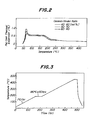
- the mechanism of the crack formation of injection molded bodies is accounted for that the cracks are formed due to a loss in weight and an exothermic peak in the temperature range of 180-400°C, as seen from the TGA (thermogravimetric analysis) curve and the DTA (differential thermal analysis) curve, respectively, of the test-piece cut out from a molded body, shown in Fig. 1. This is because the wax undergoes an oxidation reaction to evolve heat or gases whereby stress is built up and causes crack formation.
- the built-up stress has heretofore been released by conducting a gradual oxidation reaction of the wax, according to a very slow heating schedule as described above, at such a low temperature increasing rate as 0.5°C/hr particularly in the temperature range of 180-400°C, or by means of heating at 180°C for a predetermined period of time, or stepwise constant-temperature heatings.
- the present invention has been achieved by the finding, through determination of thermal expansion of molded bodies to find the magnitude of the stress built up therein, that a rapid expansion occurs from room temperature to 60°C, whereas a sudden contraction occurs in the low temperature region of 60-70°C as well as in the high temperature region of 180-220°C. Namely, it has been found that the stress causing the crack formation is built up during contraction and that a contraction not accompanied by change in weight takes place also between 60°C and 70°C which has not been found from the TGA curve.
- This temperature region is inherent in wax binders, wherein the wax binders are converted from solid into liquid. Namely, since the expansion and contraction in this low temperature region occur within a very narrow temperature range, in the case of thick molded bodies the expansion and the contraction occur simultaneously within the whole body in relation to heat transfer and induce build-up of a high stress resulting in crack formation.
- Silicon nitride (Si3N4) powder incorporated with a small amount of sintering aids was admixed with an organic binder comprising, as a main component, paraffin wax (SP-3035, manufactured by Nippon Seiro K.K.) in volume ratios of the silicon nitride powder to the organic binder of 45/55, 50/50 and 55/45.
- the mixtures were kneaded while heating under pressure and then pelletized to prepare three kinds of injection molding compounds.
- Each of the three kinds of injection molding compounds was molded with an injection molding machine at an injection pressure of 400 kg/cm2, an injection temperature of 70°C and a mold temperature of 45°C, into three kinds of ceramic columnar bodies, 2 cm in diameter and 2 cm long, 4 cm in diameter and 4 cm long and 6 cm in diameter and 6 cm long, respectively.
- a test-piece of 3 mm ⁇ 3 mm ⁇ 3 mm was cut out from the molded body of the above ratio 50/50 and subjected to a thermal analysis. The result is shown in Fig. 1.
- the weight begins to decrease when the temperature has got over 180°C and is substantially stabilized at around 450°C.
- it shows that the heat of reaction beings to increase gradually from around 180°C until it develops violently at around 290°C.
- the samples used in the experiment were 20 test-pieces each of 3 kinds, differing in size, of columnar injection molded bodies which were the same as those used in the foregoing examination.
- the test-pieces were buried in alumina powder of 80 ⁇ 100 ⁇ m particle diameters and degreased in an oxidizing atmosphere using a degreasing oven of a hot flue type manufactured by Kyowa Konetsu Kogyo K.K.
- the experiment was conducted according to two degreasing schedules: a conventional one as shown in Fig.
- Example 1 Along with the temperature maintenance in Example 1, constant-temperature heating was conducted at 180°C varying the maintenance time, at which temperature the second contraction of ceramic molded bodies took place, and then possible crack formation was examined.
- the temperature increasing schedule was as shown in Fig. 5 wherein the temperature was maintained at 60°C for 10 hours, 30 hours and 70 hours, respectively for the columnar body 2 cm, 4 cm and 6 cm, in diameter, and then the temperature was maintained at 180°C varying the maintenance periods of time over 0 ⁇ 30 hours.
- Example 1 was followed. The result is shown in Table 3 below. Table 3 Crack formation ratio (%) Ceramic/Binder 55:45 50:50 45:55 Dia.
- Three kinds of injection molding compounds the same as those in Example 1, where prepared and injection molded into 30 pieces each of 3 kinds of ceramic turbocharger rotors having vane spreads of 5 cm, 10 cm and 15 cm, respectively.
- Each molded body was buried in alumina powder and degreased.
- the degreasing schedule was set according to Fig. 5, wherein the maintenance periods of time at 60°C were 10 hours, 30 hours and 70 hours, respectively for 5 cm, 10 cm and 15 cm vane spreads, and the maintenance periods of time at 180°C were 5 hours, 10 hours and 30 hours, respectively for 5 cm, 10 cm and 15 cm vane spreads.
- the temperatures gradient between the surface and the inside of the molded bodies can be leveled to decrease build-up of stress, by virtue of heating at a constant temperature for the molded bodies to begin contraction for the first time, namely, for the wax binder to begin liquefaction, for example, at 60°C, for an appropriate period of time predetermined according to the size and shape of the molded bodies, and thus the crack formation can be prevented effectively.
- heating can be performed, at a temperature increase rate as high as at least 2 times the conventional rate, up to about 180°C that is the temperature for the molded bodies to commence the second contraction due to thermal decomposition of the wax binders, and further the temperature maintenance time at around 180°C can be decreased, so that the degreasing time is extremely shortened.
- the degreasing process can be conducted with one degreasing oven in an oxidizing atmosphere throughout the process, so that the degreasing is readily performed with neither requiring for semi-degreased molded bodies to be taken out in mid course, nor for a non-oxidizing atmosphere to be produced.
- the process of the present invention is suitable for degreasing of injection molded bodies, such as not only members of ceramic turbocharger rotors, gas turbine rotors, or the like, but also automotive members or parts, for example, ceramic subcombustion chambers, ceramic valves or the like, and members for industrial application, for example, ceramic guide rolls, ceramic burner nozzles or the like.
Landscapes
- Chemical & Material Sciences (AREA)
- Engineering & Computer Science (AREA)
- Manufacturing & Machinery (AREA)
- Ceramic Engineering (AREA)
- Inorganic Chemistry (AREA)
- Materials Engineering (AREA)
- Structural Engineering (AREA)
- Organic Chemistry (AREA)
- Compositions Of Oxide Ceramics (AREA)
- Powder Metallurgy (AREA)
Applications Claiming Priority (2)
| Application Number | Priority Date | Filing Date | Title |
|---|---|---|---|
| JP63286886A JPH02137773A (ja) | 1988-11-15 | 1988-11-15 | セラミックス成形体の脱脂方法 |
| JP286886/88 | 1988-11-15 |
Publications (2)
| Publication Number | Publication Date |
|---|---|
| EP0369740A1 true EP0369740A1 (de) | 1990-05-23 |
| EP0369740B1 EP0369740B1 (de) | 1993-08-04 |
Family
ID=17710275
Family Applications (1)
| Application Number | Title | Priority Date | Filing Date |
|---|---|---|---|
| EP89311771A Expired - Lifetime EP0369740B1 (de) | 1988-11-15 | 1989-11-14 | Verfahren zum Entfetten von keramischen Formkörpern |
Country Status (4)
| Country | Link |
|---|---|
| US (1) | US5486331A (de) |
| EP (1) | EP0369740B1 (de) |
| JP (1) | JPH02137773A (de) |
| DE (1) | DE68908095T2 (de) |
Cited By (2)
| Publication number | Priority date | Publication date | Assignee | Title |
|---|---|---|---|---|
| BE1007035A3 (nl) * | 1993-04-28 | 1995-02-21 | Vito | Werkwijze voor het verwijderen van het bindmiddel bij poederspuitgieten. |
| EP0639543A1 (de) * | 1993-08-17 | 1995-02-22 | Praxair Technology, Inc. | Thermisches Entfernen von Bindemitteln aus Körpern aus Keramikpulvern |
Families Citing this family (6)
| Publication number | Priority date | Publication date | Assignee | Title |
|---|---|---|---|---|
| US5469130A (en) * | 1992-11-27 | 1995-11-21 | Murata Mfg. Co., Ltd. | High frequency parallel strip line cable comprising connector part and connector provided on substrate for connecting with connector part thereof |
| US20050121833A1 (en) * | 2003-12-09 | 2005-06-09 | Jenn-Shing Wang | Processing method for ceramic |
| US7790078B2 (en) * | 2005-02-14 | 2010-09-07 | Shin-Etsu Quartz Products Co., Ltd. | Process for producing silica glass product |
| JP4532323B2 (ja) * | 2005-03-31 | 2010-08-25 | 日本碍子株式会社 | 焼結体の製造方法 |
| JP6906343B2 (ja) * | 2017-03-30 | 2021-07-21 | 日本碍子株式会社 | 炭化珪素質焼結体の製造方法 |
| WO2021206029A1 (ja) * | 2020-04-08 | 2021-10-14 | 岐阜県 | 三次元造形物から焼結製品を製造する方法、及び3d造形用インクジェットインク |
Citations (1)
| Publication number | Priority date | Publication date | Assignee | Title |
|---|---|---|---|---|
| DE3507804C2 (de) * | 1984-03-16 | 1989-03-09 | Ngk Insulators, Ltd., Nagoya, Aichi, Jp |
Family Cites Families (4)
| Publication number | Priority date | Publication date | Assignee | Title |
|---|---|---|---|---|
| JPS6177671A (ja) * | 1984-09-20 | 1986-04-21 | 株式会社豊田中央研究所 | 有機結合剤を含むセラミツクス成形体の脱脂方法 |
| US4704242A (en) * | 1985-03-26 | 1987-11-03 | Gte Laboratories Incorporated | Method for injection molding and removing binder from large cross section ceramic shapes |
| US4923652A (en) * | 1986-07-01 | 1990-05-08 | Mitsui Toatsu Chemicals, Inc. | Method of removing binder from powder molded products |
| US5021208A (en) * | 1990-05-14 | 1991-06-04 | Gte Products Corporation | Method for removal of paraffin wax based binders from green articles |
-
1988
- 1988-11-15 JP JP63286886A patent/JPH02137773A/ja active Granted
-
1989
- 1989-11-14 EP EP89311771A patent/EP0369740B1/de not_active Expired - Lifetime
- 1989-11-14 DE DE89311771T patent/DE68908095T2/de not_active Expired - Fee Related
-
1994
- 1994-04-08 US US08/225,073 patent/US5486331A/en not_active Expired - Fee Related
Patent Citations (1)
| Publication number | Priority date | Publication date | Assignee | Title |
|---|---|---|---|---|
| DE3507804C2 (de) * | 1984-03-16 | 1989-03-09 | Ngk Insulators, Ltd., Nagoya, Aichi, Jp |
Non-Patent Citations (3)
| Title |
|---|
| DERWENT ACCESSION NO. 84-278 269, Questel Tele- systems (WIPL) DERWENT PUBLICATIONS LTD., London * |
| DERWENT ACCESSION NO. 87-139 575, Questel Tele- systems (WPIL) DERWENT PUBLICATIONS LTD., London * |
| SOVIET INVENTIONS ILLUSTRATED,section Ch, week C42, November 26, 1980 DERWENT PUBLICATIONS LTD., London L02 * |
Cited By (2)
| Publication number | Priority date | Publication date | Assignee | Title |
|---|---|---|---|---|
| BE1007035A3 (nl) * | 1993-04-28 | 1995-02-21 | Vito | Werkwijze voor het verwijderen van het bindmiddel bij poederspuitgieten. |
| EP0639543A1 (de) * | 1993-08-17 | 1995-02-22 | Praxair Technology, Inc. | Thermisches Entfernen von Bindemitteln aus Körpern aus Keramikpulvern |
Also Published As
| Publication number | Publication date |
|---|---|
| JPH0512305B2 (de) | 1993-02-17 |
| DE68908095D1 (de) | 1993-09-09 |
| JPH02137773A (ja) | 1990-05-28 |
| US5486331A (en) | 1996-01-23 |
| EP0369740B1 (de) | 1993-08-04 |
| DE68908095T2 (de) | 1994-02-03 |
Similar Documents
| Publication | Publication Date | Title |
|---|---|---|
| JP4762392B2 (ja) | ガスタービン用途の鋳造に用いる性能の優れたコア組成物および物品 | |
| EP0162547B2 (de) | Gesinterte, keramische Körper und ihr Herstellungsverfahren | |
| EP0771769A2 (de) | Sinterung von Alpha-Siliciumcarbidpulver mit mehreren Sinterhilfsmitteln | |
| ATE16275T1 (de) | Dichte formkoerper aus polykristallinem, hexagonalem bornitrid und verfahren zu ihrer herstellung durch isostatisches heisspressen. | |
| US4026746A (en) | Method of manufacturing an open-celled ceramic article | |
| EP0369740B1 (de) | Verfahren zum Entfetten von keramischen Formkörpern | |
| EP0045134B1 (de) | Verbundmaterial aus Siliciumcarbid und Silicium und Verfahren zu seiner Herstellung | |
| EP0357491A2 (de) | Verfahren zur Herstellung eines zusammengesetzten Körpers aus gesintertem Siliciumcarbid | |
| US6783866B1 (en) | Polymerceramic materials with thermal expansion characteristics similar to those of metals | |
| EP0377408B1 (de) | Verfahren zur Herstellung von Siliziumnitrid-Formkörpern | |
| EP0712819A2 (de) | Verfahren zur Herstellung von Kompositsinterkörpern aus Siliciumkarbid und Siliciumnitrid | |
| US4801414A (en) | Production of silicon nitride sintered body | |
| Jones et al. | Strength, density, nitrogen weight gain relationships for reaction sintered silicon nitride | |
| EP0515574B1 (de) | Verfahren zur herstellung von durch spritz- oder schlickerguss erhaltenen formen mit grossem durchmesser | |
| JPS60145966A (ja) | セラミツク射出成形体の脱脂方法 | |
| EP0887326A1 (de) | Verfahren zur Herstellung durch Phosphat gebundener Keramik | |
| EP0309282B1 (de) | Heisse Form und Verfahren zur Herstellung derselben | |
| KR960004386B1 (ko) | 고인성, 고절연성 지르코니아 드라이버 소결체의 제조방법 | |
| JPH025711B2 (de) | ||
| EP0294597B1 (de) | Verfahren zur Herstellung eines gesinterten Formkörpers aus Siliziumnitrid | |
| JPH0454632B2 (de) | ||
| US4966629A (en) | Hot forming mold and method of manufacturing the same | |
| US6051181A (en) | Process for production of ceramic product | |
| US4871697A (en) | Method of producing homogeneous silicon nitride sintered bodies | |
| JPH0687664A (ja) | 窒化珪素焼結体の製造方法 |
Legal Events
| Date | Code | Title | Description |
|---|---|---|---|
| PUAI | Public reference made under article 153(3) epc to a published international application that has entered the european phase |
Free format text: ORIGINAL CODE: 0009012 |
|
| AK | Designated contracting states |
Kind code of ref document: A1 Designated state(s): DE FR GB |
|
| 17P | Request for examination filed |
Effective date: 19901121 |
|
| 17Q | First examination report despatched |
Effective date: 19920224 |
|
| GRAA | (expected) grant |
Free format text: ORIGINAL CODE: 0009210 |
|
| AK | Designated contracting states |
Kind code of ref document: B1 Designated state(s): DE FR GB |
|
| REF | Corresponds to: |
Ref document number: 68908095 Country of ref document: DE Date of ref document: 19930909 |
|
| ET | Fr: translation filed | ||
| PLBE | No opposition filed within time limit |
Free format text: ORIGINAL CODE: 0009261 |
|
| STAA | Information on the status of an ep patent application or granted ep patent |
Free format text: STATUS: NO OPPOSITION FILED WITHIN TIME LIMIT |
|
| 26N | No opposition filed | ||
| REG | Reference to a national code |
Ref country code: GB Ref legal event code: IF02 |
|
| PGFP | Annual fee paid to national office [announced via postgrant information from national office to epo] |
Ref country code: GB Payment date: 20021104 Year of fee payment: 14 |
|
| PGFP | Annual fee paid to national office [announced via postgrant information from national office to epo] |
Ref country code: FR Payment date: 20021120 Year of fee payment: 14 |
|
| PGFP | Annual fee paid to national office [announced via postgrant information from national office to epo] |
Ref country code: DE Payment date: 20021128 Year of fee payment: 14 |
|
| PG25 | Lapsed in a contracting state [announced via postgrant information from national office to epo] |
Ref country code: GB Free format text: LAPSE BECAUSE OF NON-PAYMENT OF DUE FEES Effective date: 20031114 |
|
| PG25 | Lapsed in a contracting state [announced via postgrant information from national office to epo] |
Ref country code: DE Free format text: LAPSE BECAUSE OF NON-PAYMENT OF DUE FEES Effective date: 20040602 |
|
| GBPC | Gb: european patent ceased through non-payment of renewal fee |
Effective date: 20031114 |
|
| PG25 | Lapsed in a contracting state [announced via postgrant information from national office to epo] |
Ref country code: FR Free format text: LAPSE BECAUSE OF NON-PAYMENT OF DUE FEES Effective date: 20040730 |
|
| REG | Reference to a national code |
Ref country code: FR Ref legal event code: ST |